DISCOVER . LEARN. EMPOWER
UNIVERSITY INSTITUTE OF ENGINEERING
DEPARTMENT- ACADEMIC UNITS
FIRST YEAR ENGINEERING PROGRAMMES
Subject Name : Basic Data Structures using C++
Subject Code: 24CSH-103
STACK
2.
2
Basic Data Structure
UsingC++
Course Objectives
• To enable the students to understand various stages
and constructs of C++ programming language.
• To improve their ability to analyze and address variety
of problems in C++.
• To understand the concept of data structures and
various operations on them.
• To understand the properties of various data
structures and able to identify the strengths and
weaknesses of different data structures.
• To analyze and compare the efficiency of algorithms
and learn to design efficient algorithms for solving
computing problems
3.
3
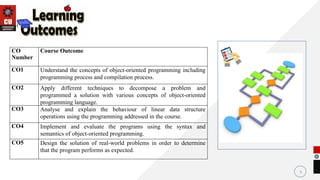
CO
Number
Course Outcome
CO1 Understandthe concepts of object-oriented programming including
programming process and compilation process.
CO2 Apply different techniques to decompose a problem and
programmed a solution with various concepts of object-oriented
programming language.
CO3 Analyse and explain the behaviour of linear data structure
operations using the programming addressed in the course.
CO4 Implement and evaluate the programs using the syntax and
semantics of object-oriented programming.
CO5 Design the solution of real-world problems in order to determine
that the program performs as expected.
Course Outcomes
4.
4
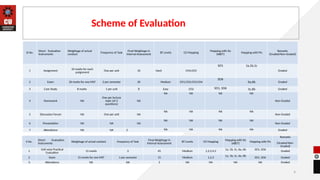
Scheme of Evaluation
SNo.
Direct Evaluation
Instruments
Weightage of actual conduct Frequency of Task
Final Weightage in
Internal Assessment
BT Levels CO Mapping
Mapping with SIs
(ABET)
Mapping with PIs
Remarks
(Graded/Non-
Graded)
1
Unit wise Practical
Evaluation
15 marks 3 45 Medium 1,2,3,4,5
1a, 1b, 1c, 6a, 6b SO1, SO6
Graded
2 Exam 15 marks for one MST 1 per semester 15 Medium 1,2,3
1a, 1b, 1c, 6a, 6b
SO1, SO6 Graded
3 Attendance NA NA 2 NA NA NA NA Graded
Sl No.
Direct Evaluation
Instruments
Weightage of actual
conduct
Frequency of Task
Final Weightage in
Internal Assessment
BT Levels CO Mapping
Mapping with SIs
(ABET)
Mapping with PIs
Remarks
(Graded/Non-Graded)
1 Assignment
10 marks for each
assignment
One per unit 10 Hard CO4,CO5
SO1 1a,1b,1c
Graded
2 Exam 20 marks for one MST 2 per semester 20 Medium CO1,CO2,CO3,CO4
SO6
6a,6b Graded
3 Case Study 8 marks 1 per unit 8 Easy CO2 SO1, SO6 1c,6b Graded
4 Homework NA
One per lecture
topic (of 2
questions)
NA
NA NA NA NA
Non-Graded
5 Discussion Forum NA One per unit NA
NA NA NA NA
Non-Graded
6 Presentation NA NA NA
NA NA NA NA
Non-Graded
7 Attendance NA NA 2 NA NA NA NA Graded
5.
5
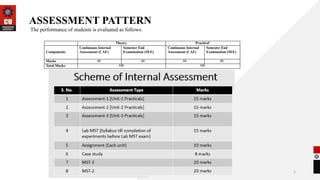
ASSESSMENT PATTERN
The performanceof students is evaluated as follows:
Theory Practical
Components
Continuous Internal
Assessment (CAE)
Semester End
Examination (SEE)
Continuous Internal
Assessment (CAE)
Semester End
Examination (SEE)
Marks 40 60 60 40
Total Marks 100 100
6.
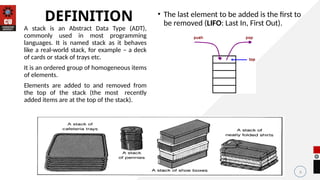
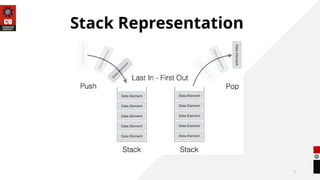
• The lastelement to be added is the first to
be removed (LIFO: Last In, First Out).
6
DEFINITION
A stack is an Abstract Data Type (ADT),
commonly used in most programming
languages. It is named stack as it behaves
like a real-world stack, for example – a deck
of cards or stack of trays etc.
It is an ordered group of homogeneous items
of elements.
Elements are added to and removed from
the top of the stack (the most recently
added items are at the top of the stack).
8
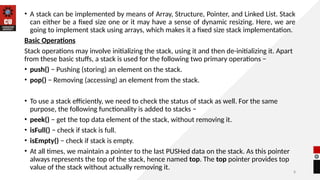
• A stackcan be implemented by means of Array, Structure, Pointer, and Linked List. Stack
can either be a fixed size one or it may have a sense of dynamic resizing. Here, we are
going to implement stack using arrays, which makes it a fixed size stack implementation.
Basic Operations
Stack operations may involve initializing the stack, using it and then de-initializing it. Apart
from these basic stuffs, a stack is used for the following two primary operations −
• push() − Pushing (storing) an element on the stack.
• pop() − Removing (accessing) an element from the stack.
• To use a stack efficiently, we need to check the status of stack as well. For the same
purpose, the following functionality is added to stacks −
• peek() − get the top data element of the stack, without removing it.
• isFull() − check if stack is full.
• isEmpty() − check if stack is empty.
• At all times, we maintain a pointer to the last PUSHed data on the stack. As this pointer
always represents the top of the stack, hence named top. The top pointer provides top
value of the stack without actually removing it.
9.
Sequential/ Array representationof
Stack
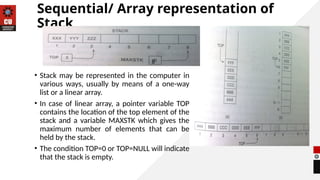
• Stack may be represented in the computer in
various ways, usually by means of a one-way
list or a linear array.
• In case of linear array, a pointer variable TOP
contains the location of the top element of the
stack and a variable MAXSTK which gives the
maximum number of elements that can be
held by the stack.
• The condition TOP=0 or TOP=NULL will indicate
that the stack is empty.
8
10.
Insertion in aStack
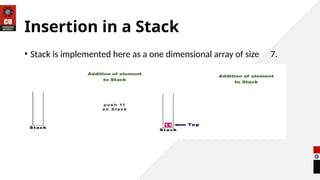
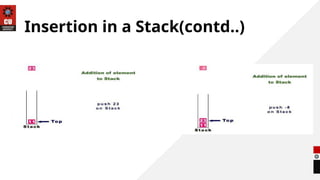
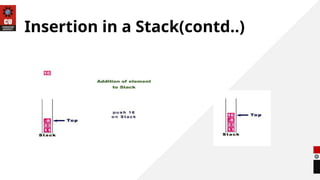
• Stack is implemented here as a one dimensional array of size 7.
15
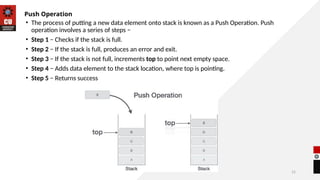
Push Operation
• Theprocess of putting a new data element onto stack is known as a Push Operation. Push
operation involves a series of steps −
• Step 1 − Checks if the stack is full.
• Step 2 − If the stack is full, produces an error and exit.
• Step 3 − If the stack is not full, increments top to point next empty space.
• Step 4 − Adds data element to the stack location, where top is pointing.
• Step 5 − Returns success
16.
Algorithm: PUSH(STACK,TOP,MAXSTK,ITEM)
This procedurepushes an ITEM onto a stack.
1. [Stack already filled?]
If TOP=MAXSTK,
then: Print: OVERFLOW & Exit
2. Set TOP=TOP+1 [Increases TOP by 1]
3. Set STACK[TOP]=ITEM [Inserts ITEM in new
TOP position.]
4. Exit
Algorithm to insert in Stack
17.
17
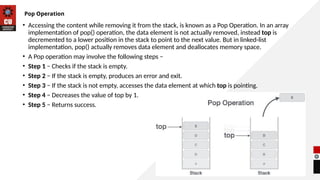
Pop Operation
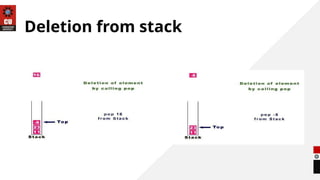
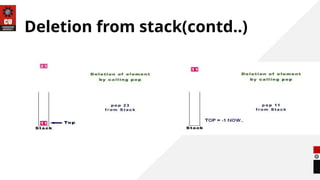
• Accessingthe content while removing it from the stack, is known as a Pop Operation. In an array
implementation of pop() operation, the data element is not actually removed, instead top is
decremented to a lower position in the stack to point to the next value. But in linked-list
implementation, pop() actually removes data element and deallocates memory space.
• A Pop operation may involve the following steps −
• Step 1 − Checks if the stack is empty.
• Step 2 − If the stack is empty, produces an error and exit.
• Step 3 − If the stack is not empty, accesses the data element at which top is pointing.
• Step 4 − Decreases the value of top by 1.
• Step 5 − Returns success.
18.
Algorithm to deletein Stack
Algorithm: POP(STACK,TOP,ITEM)
This procedure deletes the top element of STACK & assigns it
to the variable ITEM.
1. [Stack has an item to be removed?]
If TOP=0,
then: Print: UNDERFLOW & Exit
2. Set ITEM=STACK[TOP] [Assigns TOP element to ITEM]
3. Set TOP=TOP-1 [Decreases TOP by 1]
4. Exit
19.
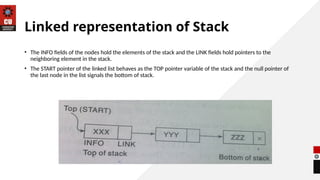
Linked representation ofStack
• The INFO fields of the nodes hold the elements of the stack and the LINK fields hold pointers to the
neighboring element in the stack.
• The START pointer of the linked list behaves as the TOP pointer variable of the stack and the null pointer of
the last node in the list signals the bottom of stack.
20.
20
Notations
An arithmetic expressioncan be written in three different but equivalent notations, i.e., without
changing the essence or output of an expression. These notations are −
• Infix Notation
• Prefix (Polish) Notation
• Postfix (Reverse-Polish) Notation
These notations are named as how they use operator in expression. We shall learn the same here in
this chapter.
Infix Notation
We write expression in infix notation, e.g. a - b + c, where operators are used in-between operands.
It is easy for us humans to read, write, and speak in infix notation but the same does not go well with
computing devices. An algorithm to process infix notation could be difficult and costly in terms of
time and space consumption.
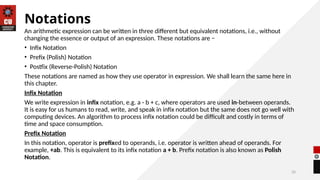
Prefix Notation
In this notation, operator is prefixed to operands, i.e. operator is written ahead of operands. For
example, +ab. This is equivalent to its infix notation a + b. Prefix notation is also known as Polish
Notation.
21.
21
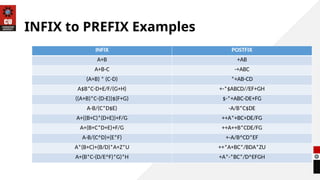
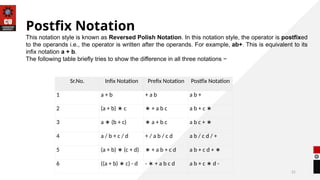
Sr.No. Infix NotationPrefix Notation Postfix Notation
1 a + b + a b a b +
2 (a + b) c
∗ ∗ + a b c a b + c ∗
3 a (b + c)
∗ ∗ a + b c a b c + ∗
4 a / b + c / d + / a b / c d a b / c d / +
5 (a + b) (c + d)
∗ ∗ + a b + c d a b + c d + ∗
6 ((a + b) c) - d
∗ - + a b c d
∗ a b + c d -
∗
Postfix Notation
This notation style is known as Reversed Polish Notation. In this notation style, the operator is postfixed
to the operands i.e., the operator is written after the operands. For example, ab+. This is equivalent to its
infix notation a + b.
The following table briefly tries to show the difference in all three notations −
22.
22
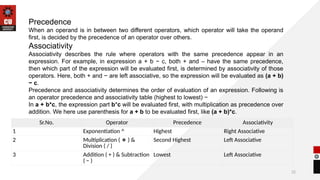
Sr.No. Operator PrecedenceAssociativity
1 Exponentiation ^ Highest Right Associative
2 Multiplication ( ) &
∗
Division ( / )
Second Highest Left Associative
3 Addition ( + ) & Subtraction
( − )
Lowest Left Associative
Precedence
When an operand is in between two different operators, which operator will take the operand
first, is decided by the precedence of an operator over others.
Associativity
Associativity describes the rule where operators with the same precedence appear in an
expression. For example, in expression a + b − c, both + and – have the same precedence,
then which part of the expression will be evaluated first, is determined by associativity of those
operators. Here, both + and − are left associative, so the expression will be evaluated as (a + b)
− c.
Precedence and associativity determines the order of evaluation of an expression. Following is
an operator precedence and associativity table (highest to lowest) −
In a + b*c, the expression part b*c will be evaluated first, with multiplication as precedence over
addition. We here use parenthesis for a + b to be evaluated first, like (a + b)*c.
23.
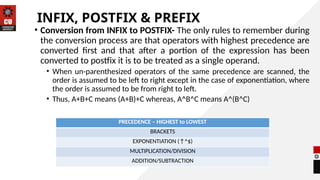
INFIX, POSTFIX &PREFIX
• Conversion from INFIX to POSTFIX- The only rules to remember during
the conversion process are that operators with highest precedence are
converted first and that after a portion of the expression has been
converted to postfix it is to be treated as a single operand.
• When un-parenthesized operators of the same precedence are scanned, the
order is assumed to be left to right except in the case of exponentiation, where
the order is assumed to be from right to left.
• Thus, A+B+C means (A+B)+C whereas, A^B^C means A^(B^C)
PRECEDENCE – HIGHEST to LOWEST
BRACKETS
EXPONENTIATION (↑^$)
MULTIPLICATION/DIVISION
ADDITION/SUBTRACTION
Algorithm for Infixto Postfix
Suppose Q is an arithmetic expression written in infix notation. This algorithm also finds the
equivalent postfix expression P.
1) Push “(“ onto stack and add “)” to the end of Q.
2) Scan Q from left to right and repeat steps 3 to 6 for each element of Q until the stack is empty:
3) If an operand is encountered, add it to P.
4) If a left parenthesis is encountered, push it onto stack.
5) If an operator is encountered, then:
⊗
(a) Repeatedly pop from stack and add to P each operator(on top of stack)
which has the same precedence as or higher precedence than .
⊗
(b) Add to stack.
⊗
[End of if structure]
6) If a right parenthesis is encountered, then:
(a) Repeatedly pop from stack and add to P each operator until a left
parenthesis is encountered.
(b) Remove a left parenthesis.
[end of if structure]
26.
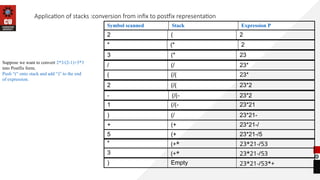
Application of stacks:conversion from infix to postfix representation
Suppose we want to convert 2*3/(2-1)+5*3
into Postfix form,
Push “(“ onto stack and add “)” to the end
of expression.
2 ( 2
* (* 2
3 (* 23
/ (/ 23*
( (/( 23*
2 (/( 23*2
- (/(- 23*2
1 (/(- 23*21
) (/ 23*21-
+ (+ 23*21-/
5 (+ 23*21-/5
3 (+* 23*21-/53
Symbol scanned Stack Expression P
* (+* 23*21-/53
) Empty 23*21-/53*+
27.
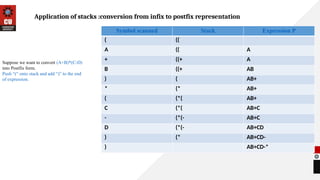
Application of stacks:conversion from infix to postfix representation
Suppose we want to convert (A+B)*(C-D)
into Postfix form,
Push “(“ onto stack and add “)” to the end
of expression.
Symbol scanned Stack Expression P
( ((
A (( A
+ ((+ A
B ((+ AB
) ( AB+
* (* AB+
( (*( AB+
C (*( AB+C
- (*(- AB+C
D (*(- AB+CD
) (* AB+CD-
) AB+CD-*
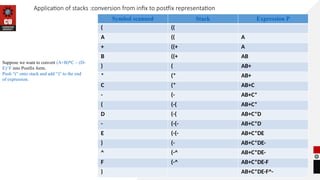
28.
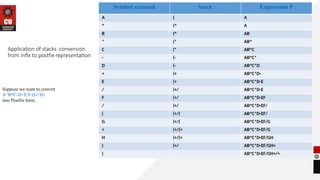
Application of stacks:conversion from infix to postfix representation
Suppose we want to convert (A+B)*C – (D-
E)^F into Postfix form,
Push “(“ onto stack and add “)” to the end
of expression.
Symbol scanned Stack Expression P
( ((
A (( A
+ ((+ A
B ((+ AB
) ( AB+
* (* AB+
C (* AB+C
- (- AB+C*
( (-( AB+C*
D (-( AB+C*D
- (-(- AB+C*D
E (-(- AB+C*DE
) (- AB+C*DE-
^ (-^ AB+C*DE-
F (-^ AB+C*DE-F
) AB+C*DE-F^-
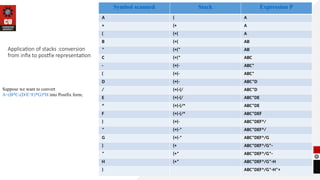
29.
Application of stacks:conversion
from infix to postfix representation
Suppose we want to convert
A+(B*C-(D/E^F)*G)*H into Postfix form,
Symbol scanned Stack Expression P
A ( A
+ (+ A
( (+( A
B (+( AB
* (+(* AB
C (+(* ABC
- (+(- ABC*
( (+(- ABC*
D (+(- ABC*D
/ (+(-(/ ABC*D
E (+(-(/ ABC*DE
^ (+(-(/^ ABC*DE
F (+(-(/^ ABC*DEF
) (+(- ABC*DEF^/
* (+(-* ABC*DEF^/
G (+(-* ABC*DEF^/G
) (+ ABC*DEF^/G*-
* (+* ABC*DEF^/G*-
H (+* ABC*DEF^/G*-H
) ABC*DEF^/G*-H*+
30.
Application of stacks:conversion
from infix to postfix representation
Suppose we want to convert
A^B*C-D+E/F/(G+H)
into Postfix form,
Symbol scanned Stack Expression P
A ( A
^ (^ A
B (^ AB
* (* AB^
C (* AB^C
- (- AB^C*
D (- AB^C*D
+ (+ AB^C*D-
E (+ AB^C*D-E
/ (+/ AB^C*D-E
F (+/ AB^C*D-EF
/ (+/ AB^C*D-EF/
( (+/( AB^C*D-EF/
G (+/( AB^C*D-EF/G
+ (+/(+ AB^C*D-EF/G
H (+/(+ AB^C*D-EF/GH
) (+/ AB^C*D-EF/GH+
) AB^C*D-EF/GH+/+
31.
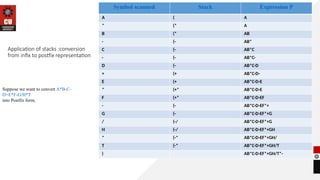
Application of stacks:conversion
from infix to postfix representation
Suppose we want to convert A*B-C-
D+E*F-G/H*T
into Postfix form,
Symbol scanned Stack Expression P
A ( A
* (* A
B (* AB
- (- AB*
C (- AB*C
- (- AB*C-
D (- AB*C-D
+ (+ AB*C-D-
E (+ AB*C-D-E
* (+* AB*C-D-E
F (+* AB*C-D-EF
- (- AB*C-D-EF*+
G (- AB*C-D-EF*+G
/ (-/ AB*C-D-EF*+G
H (-/ AB*C-D-EF*+GH
* (-* AB*C-D-EF*+GH/
T (-* AB*C-D-EF*+GH/T
) AB*C-D-EF*+GH/T*-
32.
32
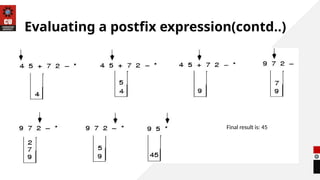
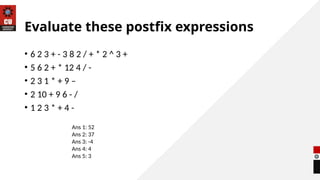
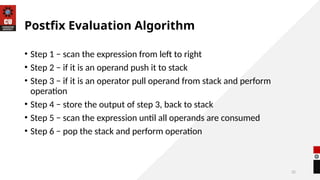
Postfix Evaluation Algorithm
•Step 1 − scan the expression from left to right
• Step 2 − if it is an operand push it to stack
• Step 3 − if it is an operator pull operand from stack and perform
operation
• Step 4 − store the output of step 3, back to stack
• Step 5 − scan the expression until all operands are consumed
• Step 6 − pop the stack and perform operation
33.
Application of stacks:Evaluating a postfix expression
• This algorithm finds the value of an arithmetic expression P written in postfix
notation.
1) Add a right parenthesis “)” at the end of P(expression).
2) Scan P from left to right and repeat steps 3 & 4 for each element of P until the
sentinel “)” is encountered.
3) If an operand is encountered, put it on STACK.
4) If an operator is encountered , then:
⊗
a) Remove the two top elements of stack, where A is the top element and
B is the next-to-top element.
b) Evaluate B A.
⊗
c) Place the result of (b) back on stack.
[End of if structure]
[End of step2 loop]
5) Set value equal to the top element on stack.
6) Exit
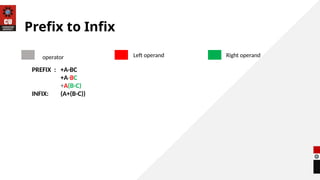
Prefix to Infix
PREFIX: +A-BC
+A-BC
+A(B-C)
INFIX: (A+(B-C))
operator Left operand Right operand
38.
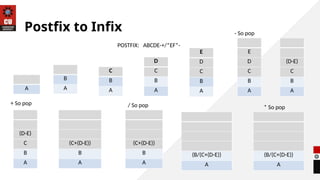
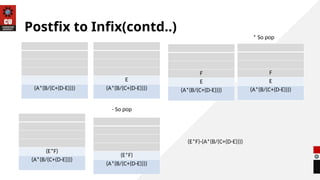
Postfix to Infix
POSTFIX:ABCDE-+/*EF*-
A
B
A
C
B
A
D
C
B
A
E
D
C
B
A
E
D
C
B
A
(D-E)
C
B
A
(D-E)
C
B
A
(C+(D-E))
B
A
(C+(D-E))
B
A
(B/(C+(D-E))
A
(B/(C+(D-E))
A
- So pop
+ So pop / So pop * So pop
40
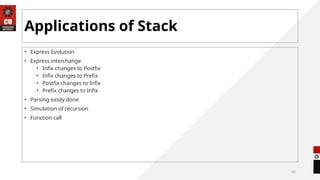
Applications of Stack
•Express Evolution
• Express interchange
• Infix changes to Postfix
• Infix changes to Prefix
• Postfix changes to Infix
• Prefix changes to Infix
• Parsing easily done
• Simulation of recursion
• Function call
41.
41
REFERENCES
• https://www.cs.cmu.edu/~adamchik/15-121/lectures/Stacks%20and%20Queues/Stacks%20and%20Queue
s.html
• DataStructures with C/ schaum outline series/ volume 2
• https://www.geeksforgeeks.org/stack-data-structure-introduction-program/
• https://www.geeksforgeeks.org/queue-set-1introduction-and-array-implementation/
• http://www.yashcode.com/2017/11/prefix-to-postfix-conversion-using-stack.html
• Lipschutz, Seymour, “Data Structures”, Schaum's Outline Series, Tata McGraw Hill.
• Gilberg/Forouzan,” Data Structure with C ,Cengage Learning.
• Augenstein,Moshe J , Tanenbaum, Aaron M, “Data Structures using C and C++”, Prentice Hall of India.
• Goodrich, Michael T., Tamassia, Roberto, and Mount, David M., “Data Structures and Algorithms in C++”,
Wiley Student Edition.
• Aho, Alfred V., Ullman, Jeffrey D., Hopcroft ,John E. “Data Structures and Algorithms”, Addison Wesley


![Algorithm: PUSH(STACK,TOP,MAXSTK,ITEM)
This procedure pushes an ITEM onto a stack.
1. [Stack already filled?]
If TOP=MAXSTK,
then: Print: OVERFLOW & Exit
2. Set TOP=TOP+1 [Increases TOP by 1]
3. Set STACK[TOP]=ITEM [Inserts ITEM in new
TOP position.]
4. Exit
Algorithm to insert in Stack](https://image.slidesharecdn.com/pptlecture3-250410153300-32b80ca0/85/PPT-Lecture-3-2-1-stack-newxxxxxxxxxx-pptx-16-320.jpg)
![Algorithm to delete in Stack
Algorithm: POP(STACK,TOP,ITEM)
This procedure deletes the top element of STACK & assigns it
to the variable ITEM.
1. [Stack has an item to be removed?]
If TOP=0,
then: Print: UNDERFLOW & Exit
2. Set ITEM=STACK[TOP] [Assigns TOP element to ITEM]
3. Set TOP=TOP-1 [Decreases TOP by 1]
4. Exit](https://image.slidesharecdn.com/pptlecture3-250410153300-32b80ca0/85/PPT-Lecture-3-2-1-stack-newxxxxxxxxxx-pptx-18-320.jpg)
![Algorithm for Infix to Postfix
Suppose Q is an arithmetic expression written in infix notation. This algorithm also finds the
equivalent postfix expression P.
1) Push “(“ onto stack and add “)” to the end of Q.
2) Scan Q from left to right and repeat steps 3 to 6 for each element of Q until the stack is empty:
3) If an operand is encountered, add it to P.
4) If a left parenthesis is encountered, push it onto stack.
5) If an operator is encountered, then:
⊗
(a) Repeatedly pop from stack and add to P each operator(on top of stack)
which has the same precedence as or higher precedence than .
⊗
(b) Add to stack.
⊗
[End of if structure]
6) If a right parenthesis is encountered, then:
(a) Repeatedly pop from stack and add to P each operator until a left
parenthesis is encountered.
(b) Remove a left parenthesis.
[end of if structure]](https://image.slidesharecdn.com/pptlecture3-250410153300-32b80ca0/85/PPT-Lecture-3-2-1-stack-newxxxxxxxxxx-pptx-25-320.jpg)
![Application of stacks: Evaluating a postfix expression
• This algorithm finds the value of an arithmetic expression P written in postfix
notation.
1) Add a right parenthesis “)” at the end of P(expression).
2) Scan P from left to right and repeat steps 3 & 4 for each element of P until the
sentinel “)” is encountered.
3) If an operand is encountered, put it on STACK.
4) If an operator is encountered , then:
⊗
a) Remove the two top elements of stack, where A is the top element and
B is the next-to-top element.
b) Evaluate B A.
⊗
c) Place the result of (b) back on stack.
[End of if structure]
[End of step2 loop]
5) Set value equal to the top element on stack.
6) Exit](https://image.slidesharecdn.com/pptlecture3-250410153300-32b80ca0/85/PPT-Lecture-3-2-1-stack-newxxxxxxxxxx-pptx-33-320.jpg)