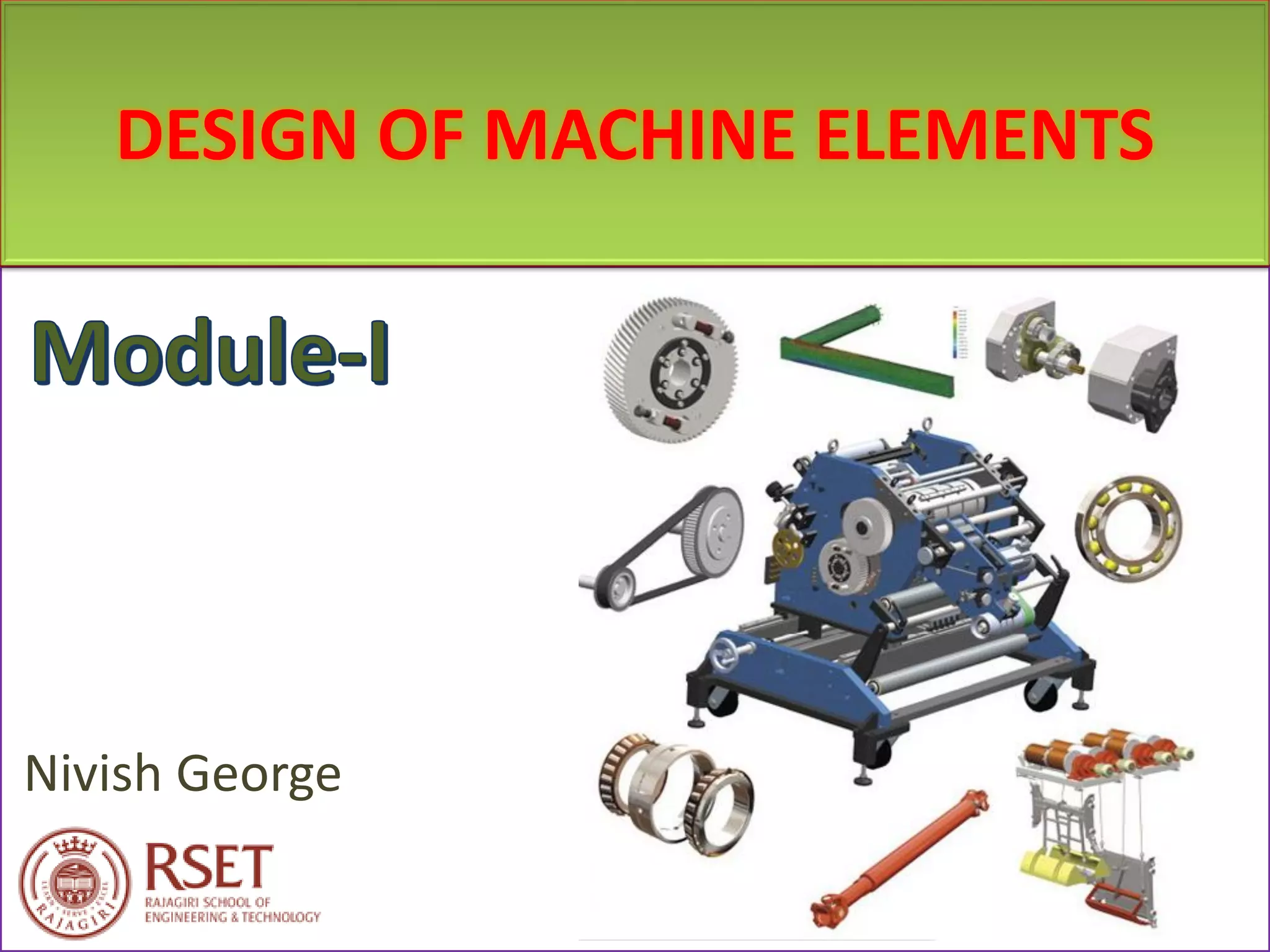
Nivish George
DESIGN OF MACHINE ELEMENTS
Poor Design??
Ref:http://www.boredpanda.com/poor-design-decisions-fails/
Department of Mechanical Engineering 2
• Definition
– Machine Design is defined as the use of scientific
principles, technical information and imagination
in the description of a machine or a mechanical
system to perform specific functions with
maximum economy and efficiency
– Design is an innovative and highly iterative
process
Machine Design
Department of Mechanical Engineering 3
The Design Process
Department of Mechanical Engineering 4
• Market
survey
Contd…
Department of Mechanical Engineering 5
Ref: https://www.carwale.com/rollsroyce-cars/
Ref:http://www.lamborghinila.com/
Ref:https://www.cardekho.com/Tata/Tata_Nano Product Specification
Contd…
Department of Mechanical Engineering 6
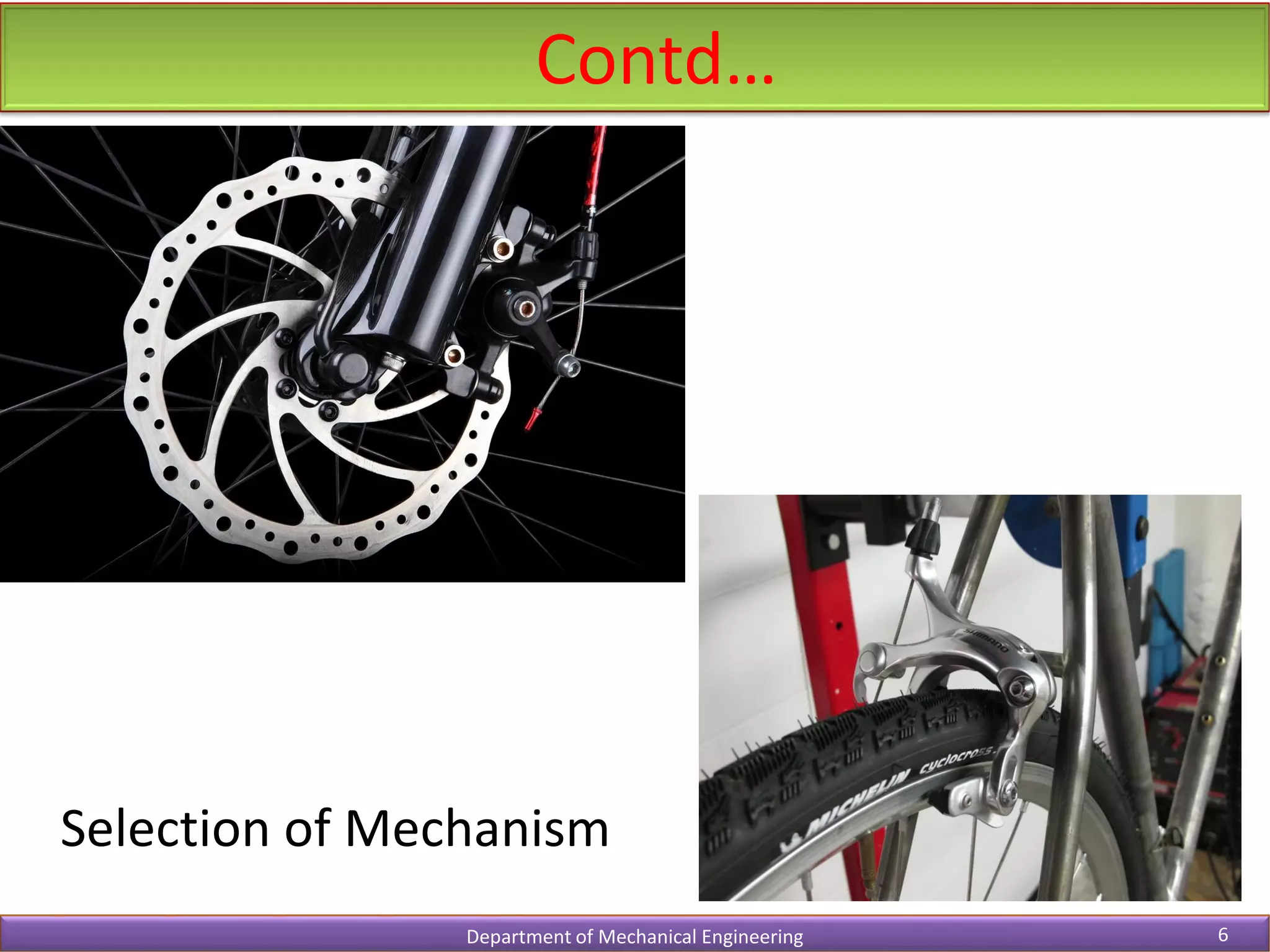
Selection of Mechanism
Contd…
Department of Mechanical Engineering 7
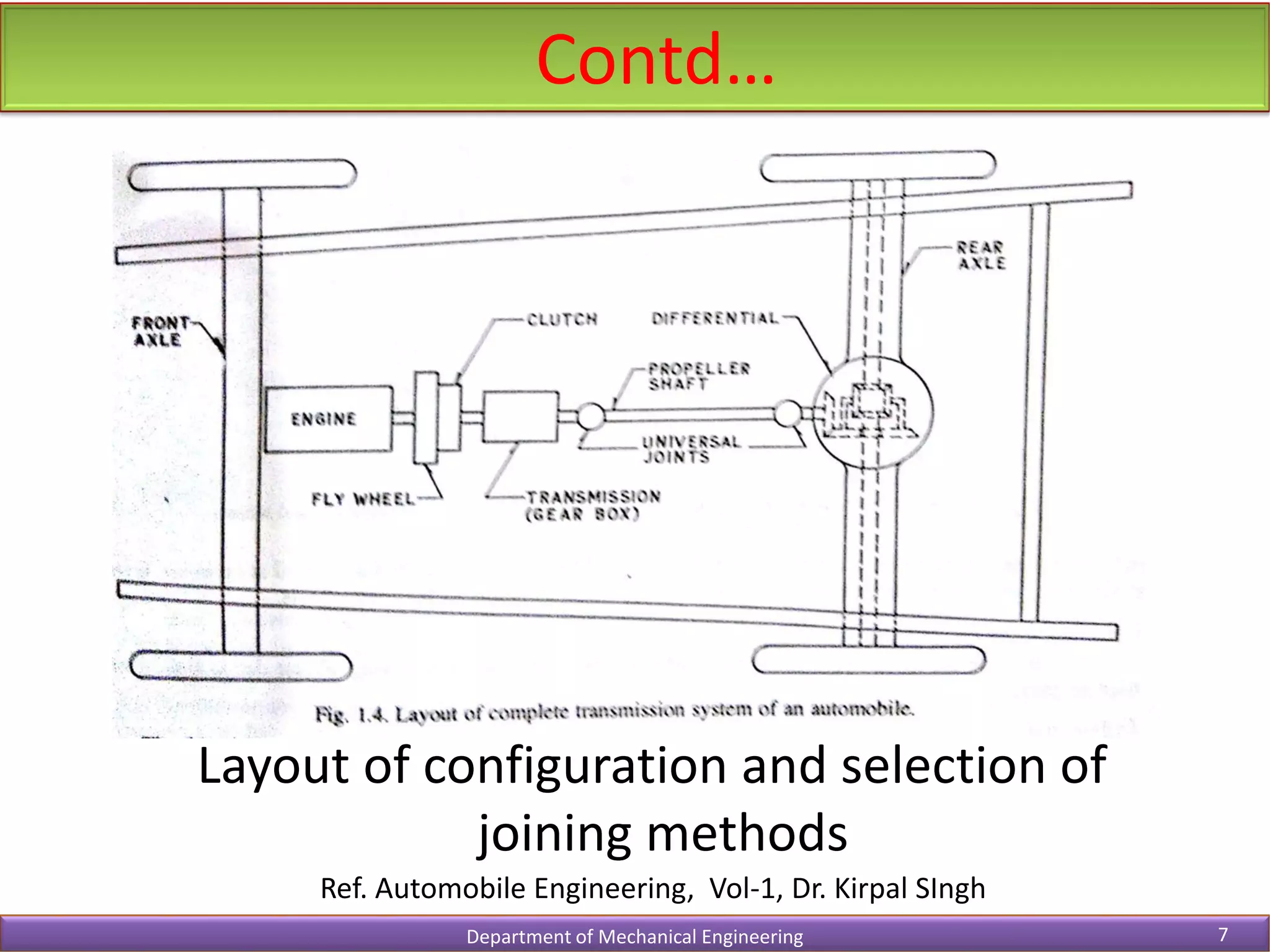
Ref. Automobile Engineering, Vol-1, Dr. Kirpal SIngh
Layout of configuration and selection of
joining methods
Contd…
Department of Mechanical Engineering 8
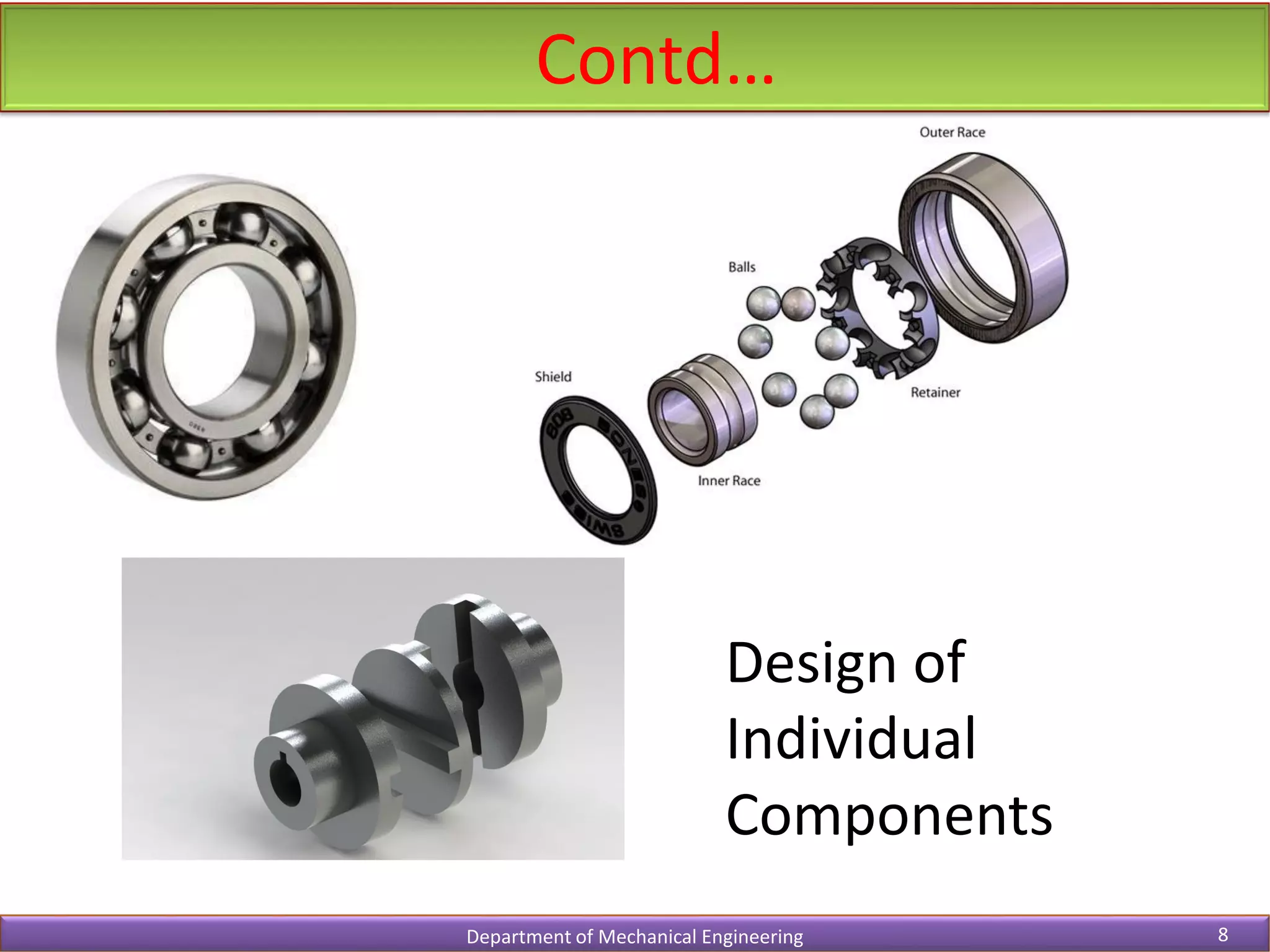
Design of
Individual
Components
Contd…
Department of Mechanical Engineering 9
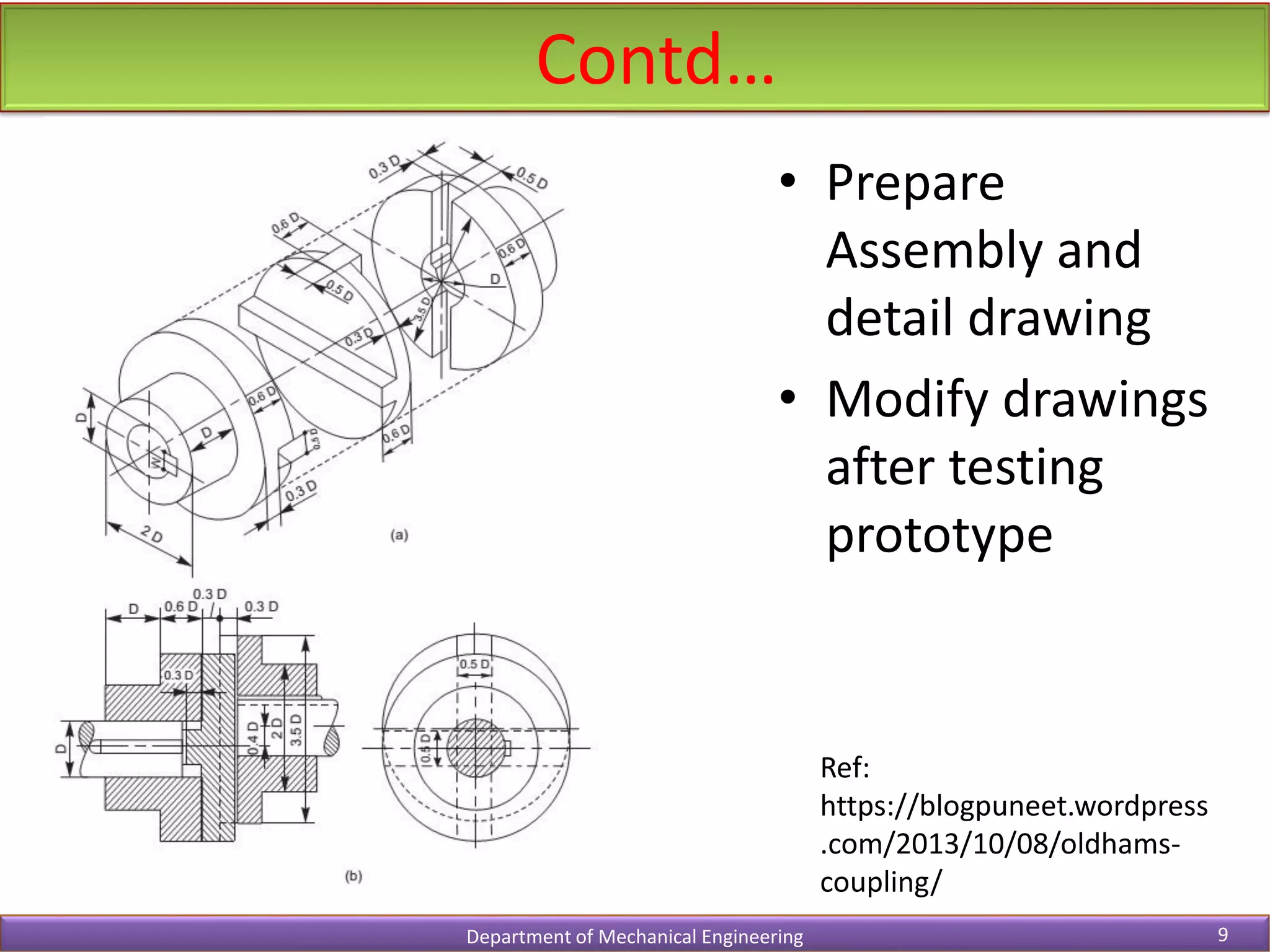
• Prepare
Assembly and
detail drawing
• Modify drawings
after testing
prototype
Ref:
https://blogpuneet.wordpress
.com/2013/10/08/oldhams-
coupling/
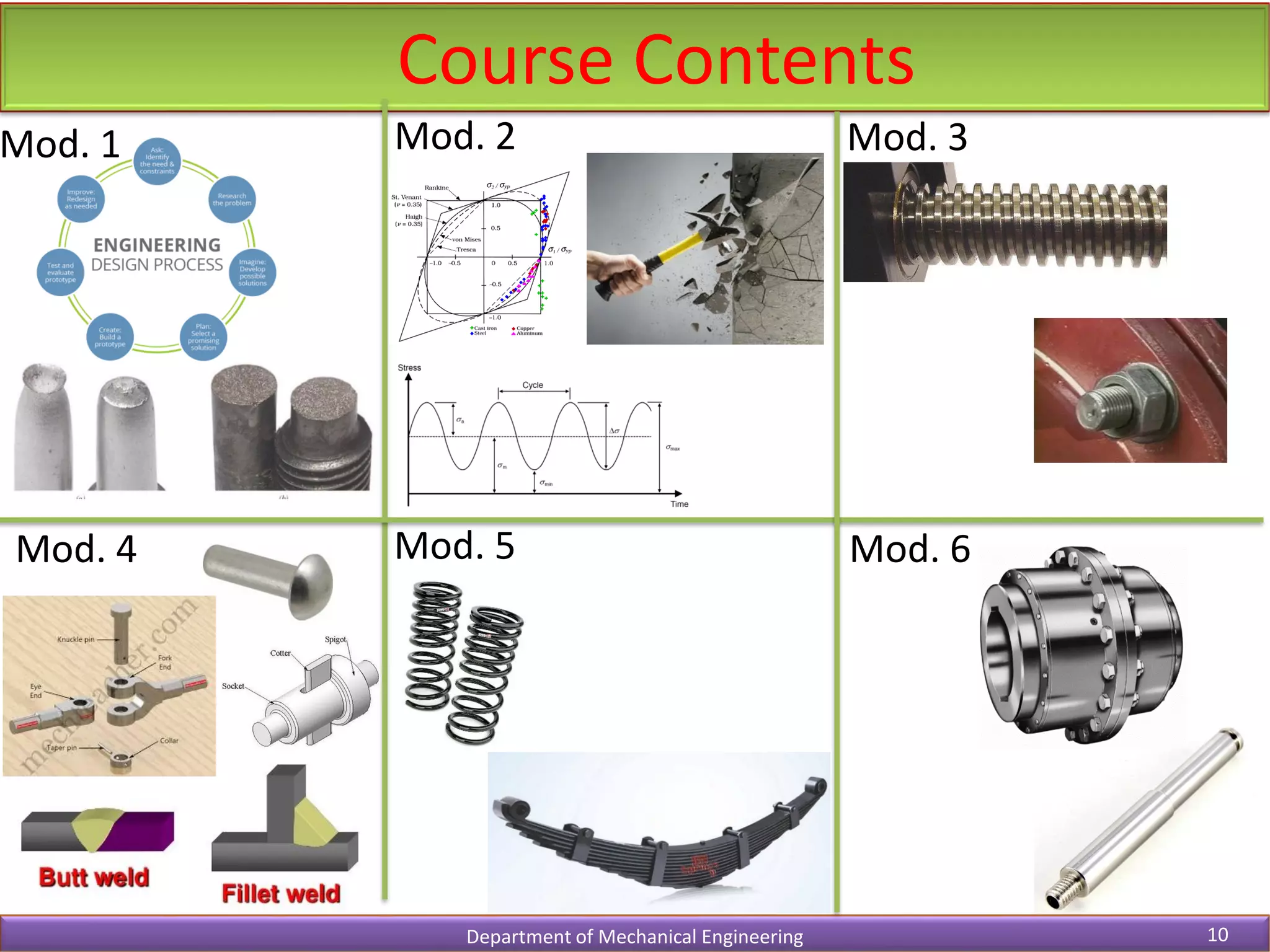
Course Contents
Department of Mechanical Engineering 10
Mod. 1 Mod. 2
Mod. 4 Mod. 5
Mod. 3
Mod. 6
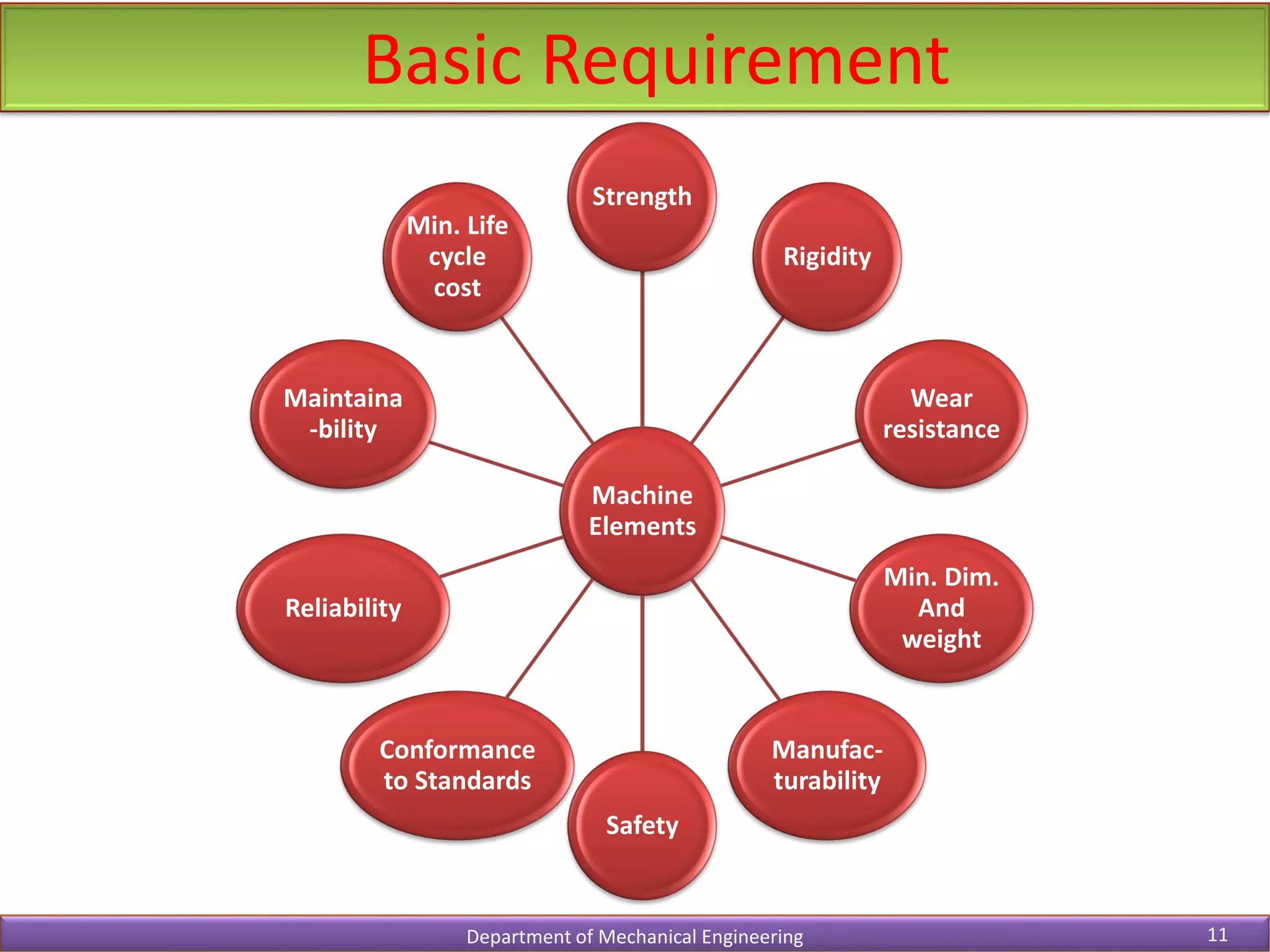
Basic Requirement
Department of Mechanical Engineering 11
Machine
Elements
Strength
Rigidity
Wear
resistance
Min. Dim.
And
weight
Manufac-
turability
Safety
Conformance
to Standards
Reliability
Maintaina
-bility
Min. Life
cycle
cost
TRADITIONAL DESIGN METHODS
Department of Mechanical Engineering 12
• Design by craft evolution
• Design by drawing
Ref:https://www.123rf.com/stock-
photo/bullock_cart.html
Ref:http://directboats.com/rowboats.html
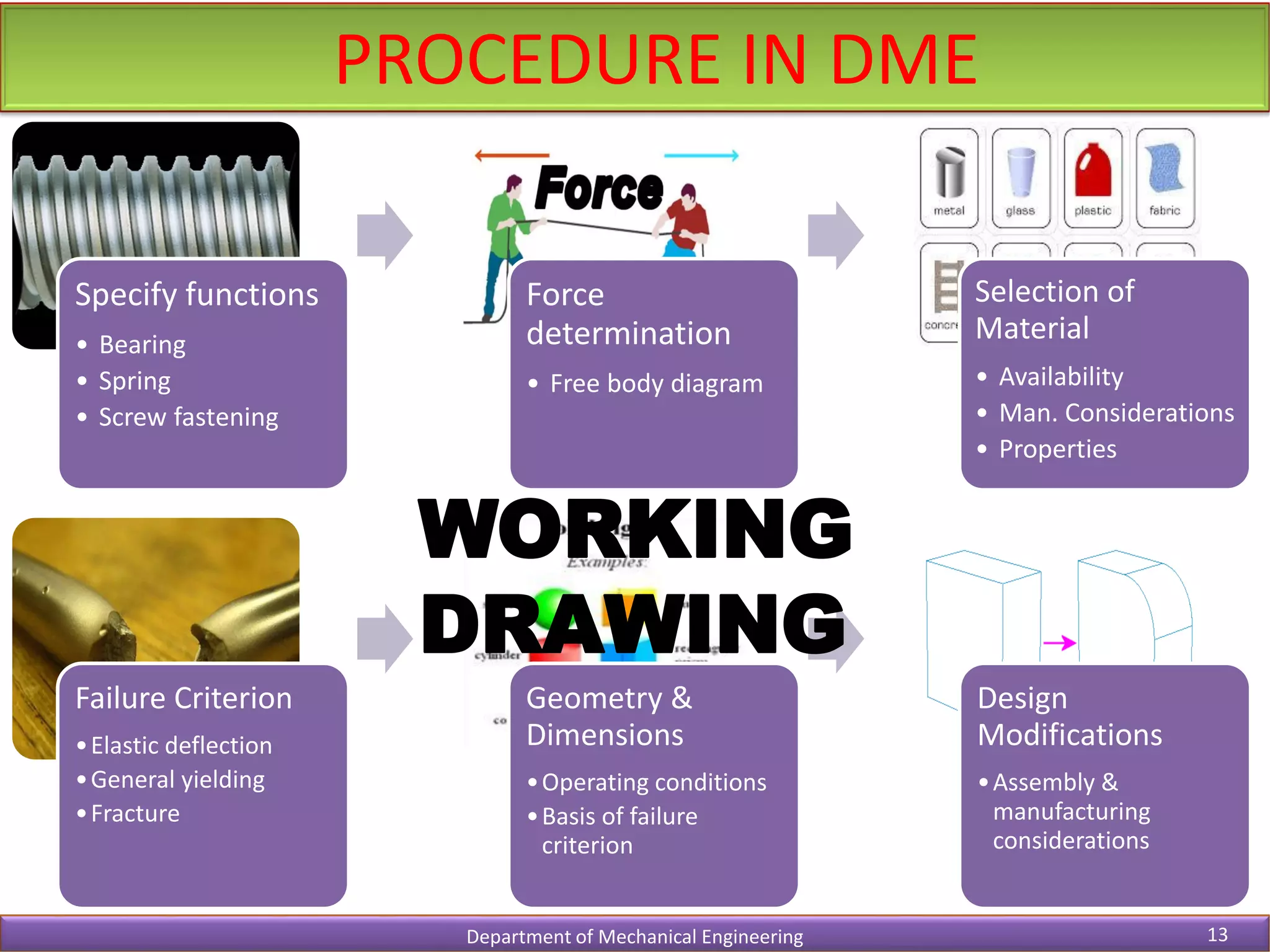
PROCEDURE IN DME
Department of Mechanical Engineering 13
Failure Criterion
•Elastic deflection
•General yielding
•Fracture
Geometry &
Dimensions
•Operating conditions
•Basis of failure
criterion
Design
Modifications
•Assembly &
manufacturing
considerations
Specify functions
• Bearing
• Spring
• Screw fastening
Force
determination
• Free body diagram
Selection of
Material
• Availability
• Man. Considerations
• Properties
WORKING
DRAWING
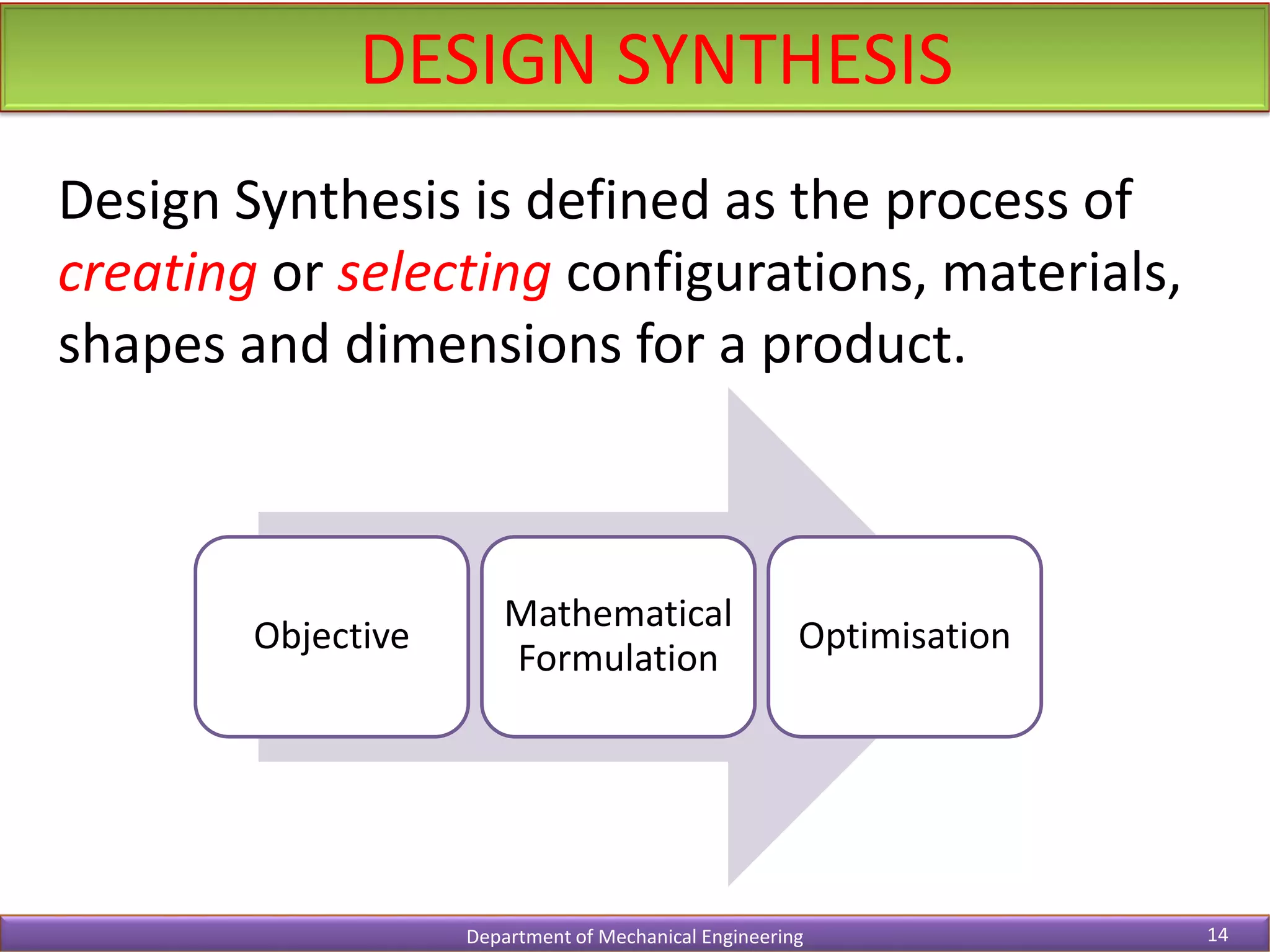
DESIGN SYNTHESIS
Department of Mechanical Engineering 14
Design Synthesis is defined as the process of
creating or selecting configurations, materials,
shapes and dimensions for a product.
Objective
Mathematical
Formulation
Optimisation
AESTHETIC CONSIDERATIONS
Department of Mechanical Engineering 15
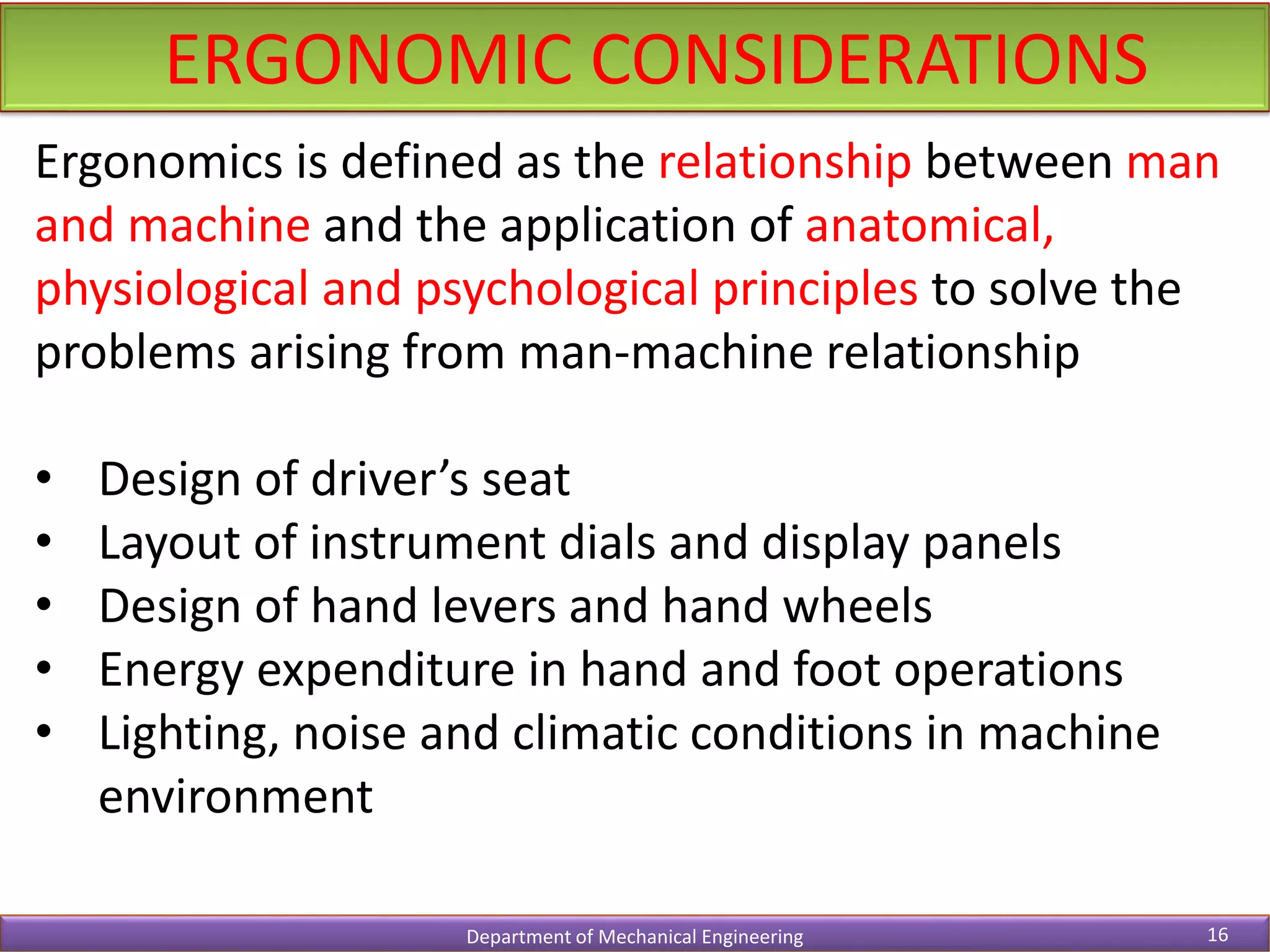
ERGONOMIC CONSIDERATIONS
Department of Mechanical Engineering 16
Ergonomics is defined as the relationship between man
and machine and the application of anatomical,
physiological and psychological principles to solve the
problems arising from man-machine relationship
• Design of driver’s seat
• Layout of instrument dials and display panels
• Design of hand levers and hand wheels
• Energy expenditure in hand and foot operations
• Lighting, noise and climatic conditions in machine
environment
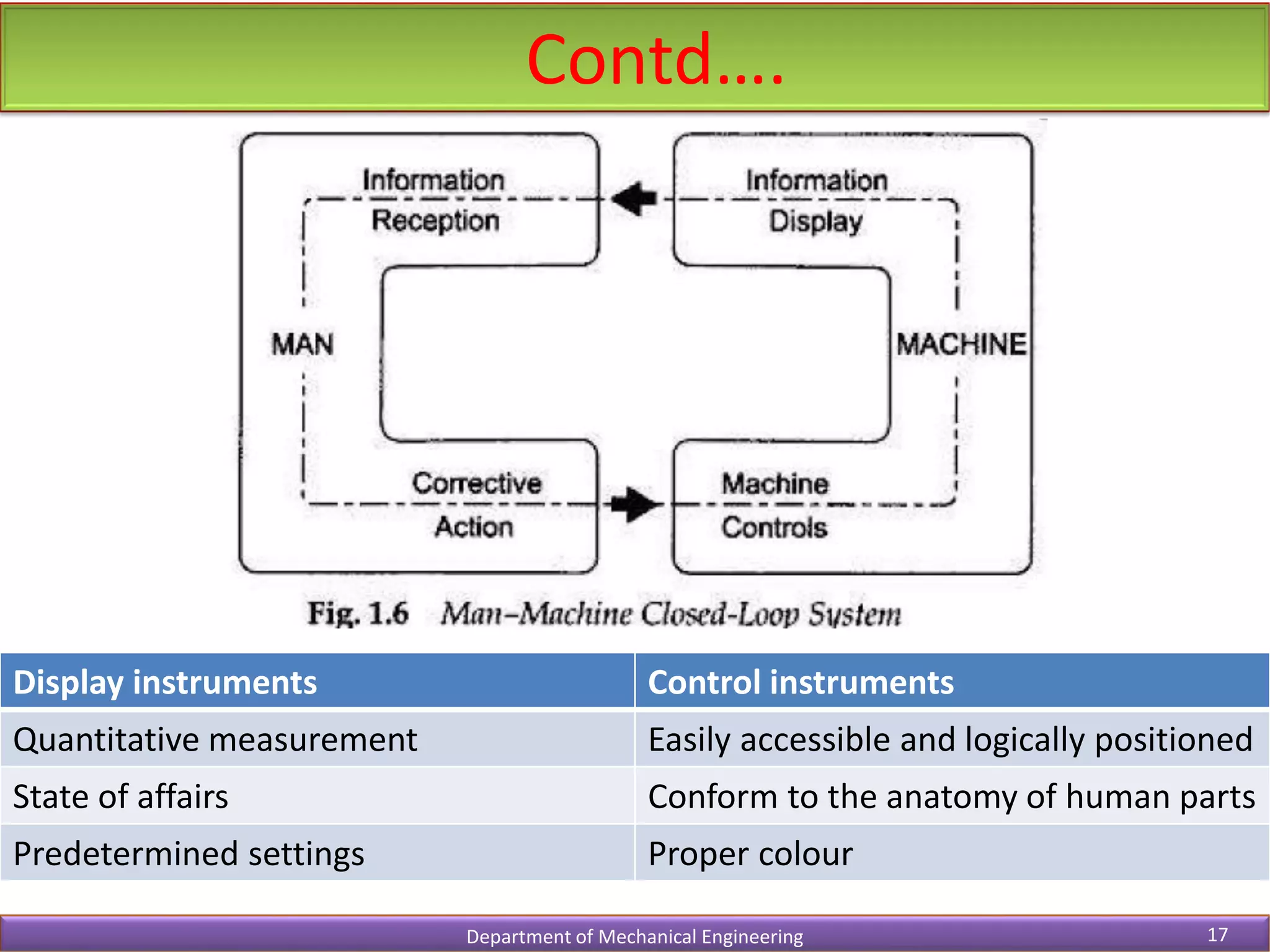
Contd….
Department of Mechanical Engineering 17
Display instruments Control instruments
Quantitative measurement Easily accessible and logically positioned
State of affairs Conform to the anatomy of human parts
Predetermined settings Proper colour
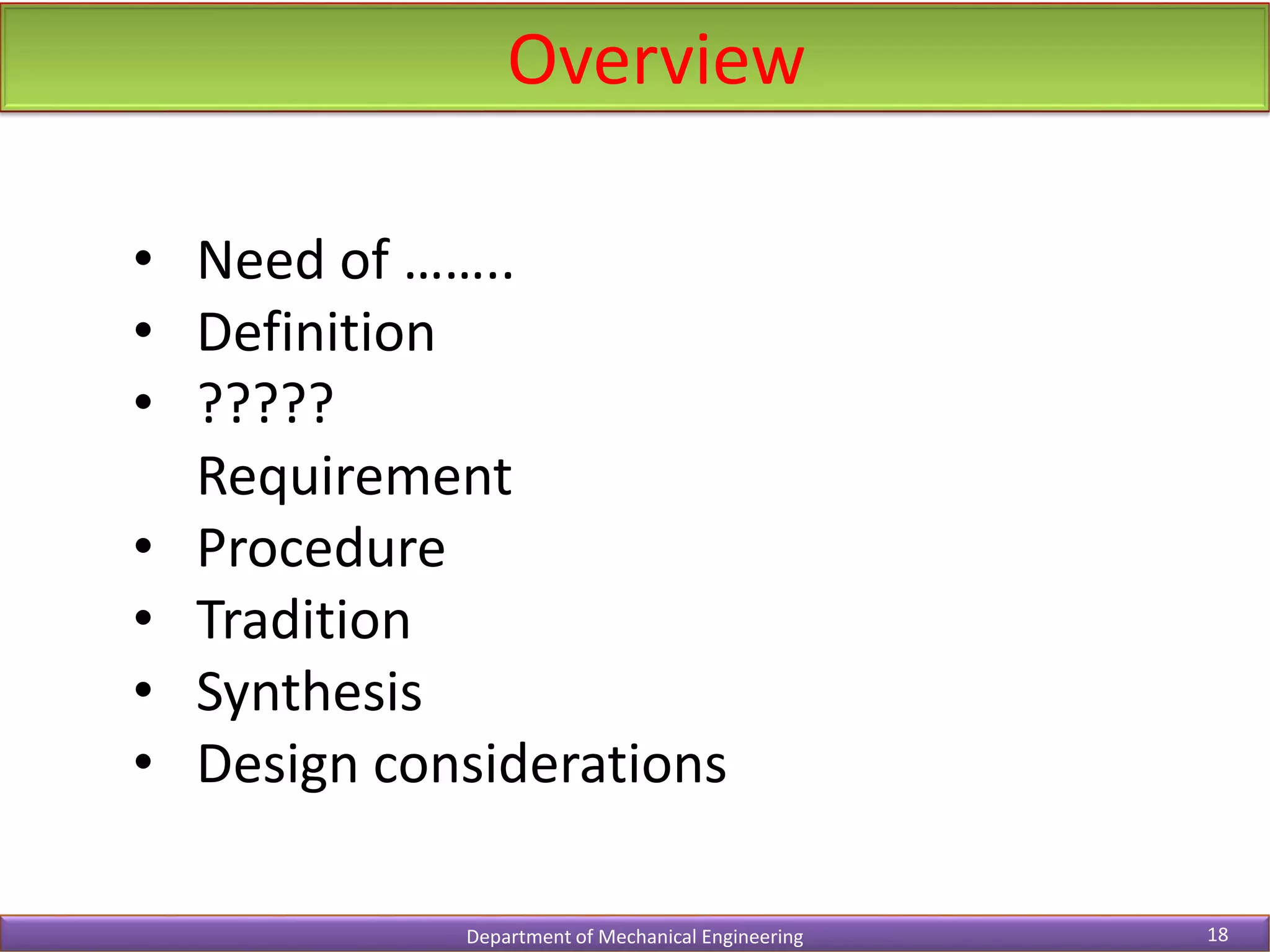
Overview
Department of Mechanical Engineering 18
• Need of ……..
• Definition
• ?????
Requirement
• Procedure
• Tradition
• Synthesis
• Design considerations
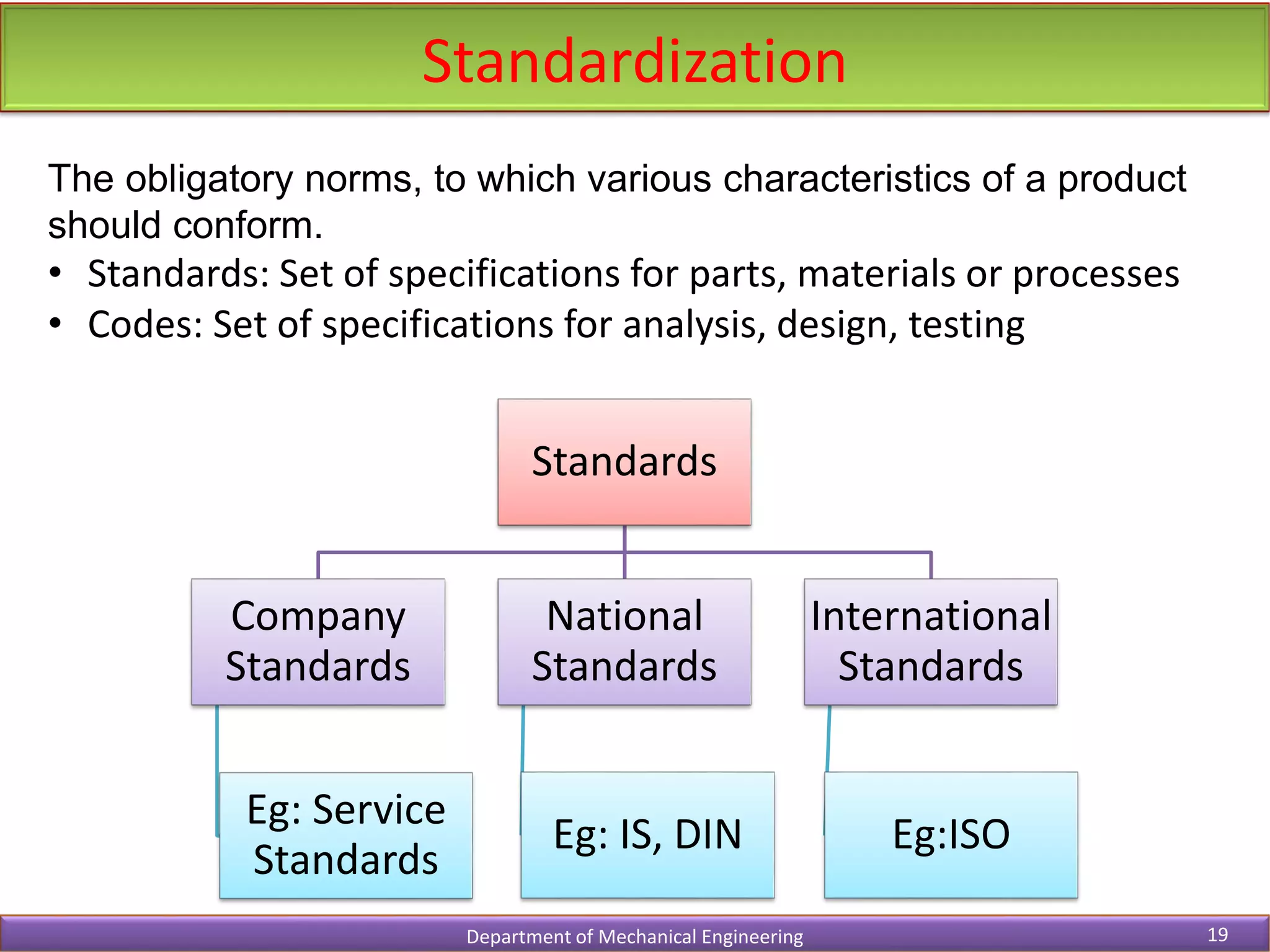
Standardization
Department of Mechanical Engineering 19
The obligatory norms, to which various characteristics of a product
should conform.
• Standards: Set of specifications for parts, materials or processes
• Codes: Set of specifications for analysis, design, testing
Standards
Company
Standards
Eg: Service
Standards
National
Standards
Eg: IS, DIN
International
Standards
Eg:ISO
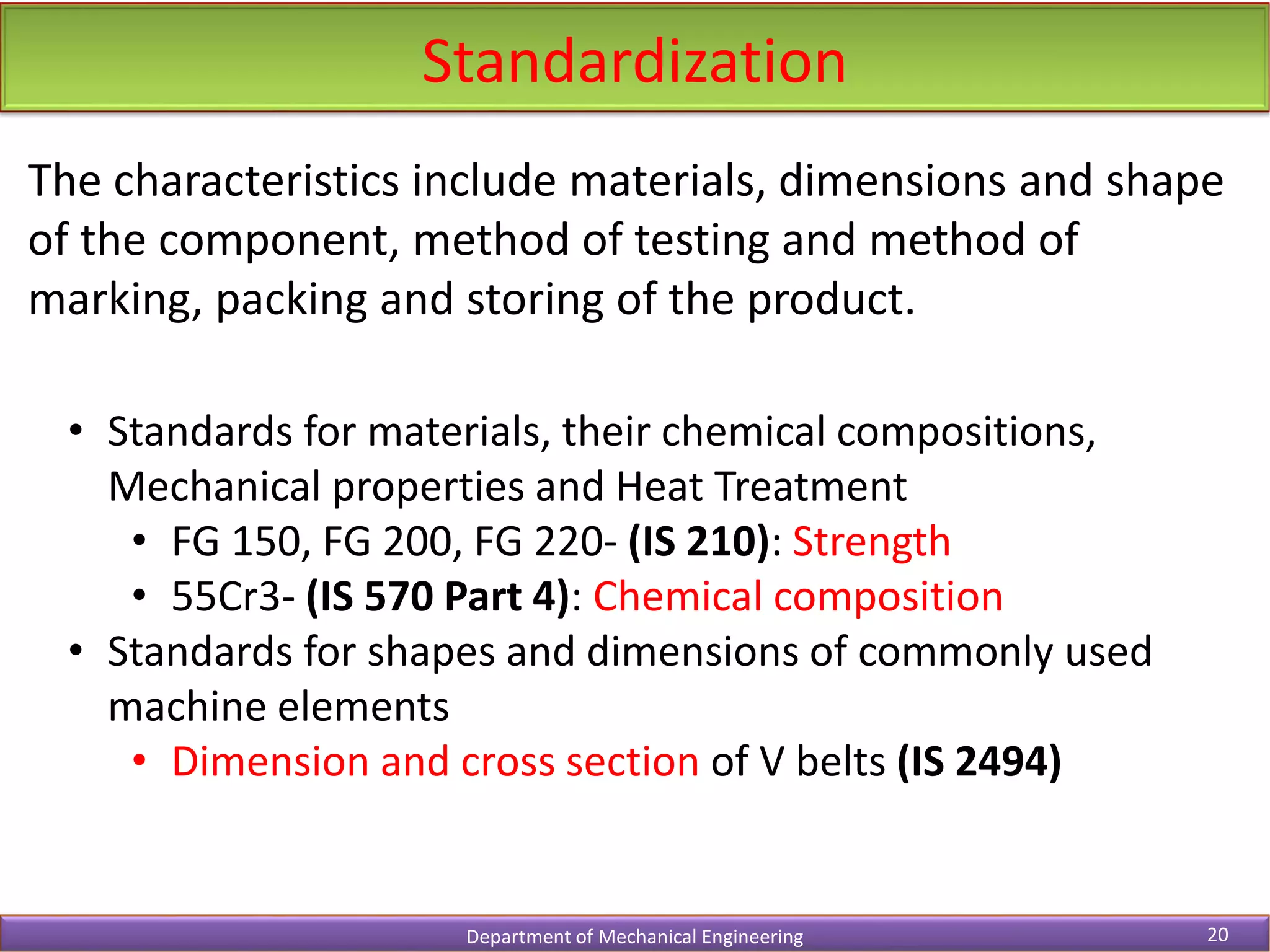
Standardization
Department of Mechanical Engineering 20
The characteristics include materials, dimensions and shape
of the component, method of testing and method of
marking, packing and storing of the product.
• Standards for materials, their chemical compositions,
Mechanical properties and Heat Treatment
• FG 150, FG 200, FG 220- (IS 210): Strength
• 55Cr3- (IS 570 Part 4): Chemical composition
• Standards for shapes and dimensions of commonly used
machine elements
• Dimension and cross section of V belts (IS 2494)
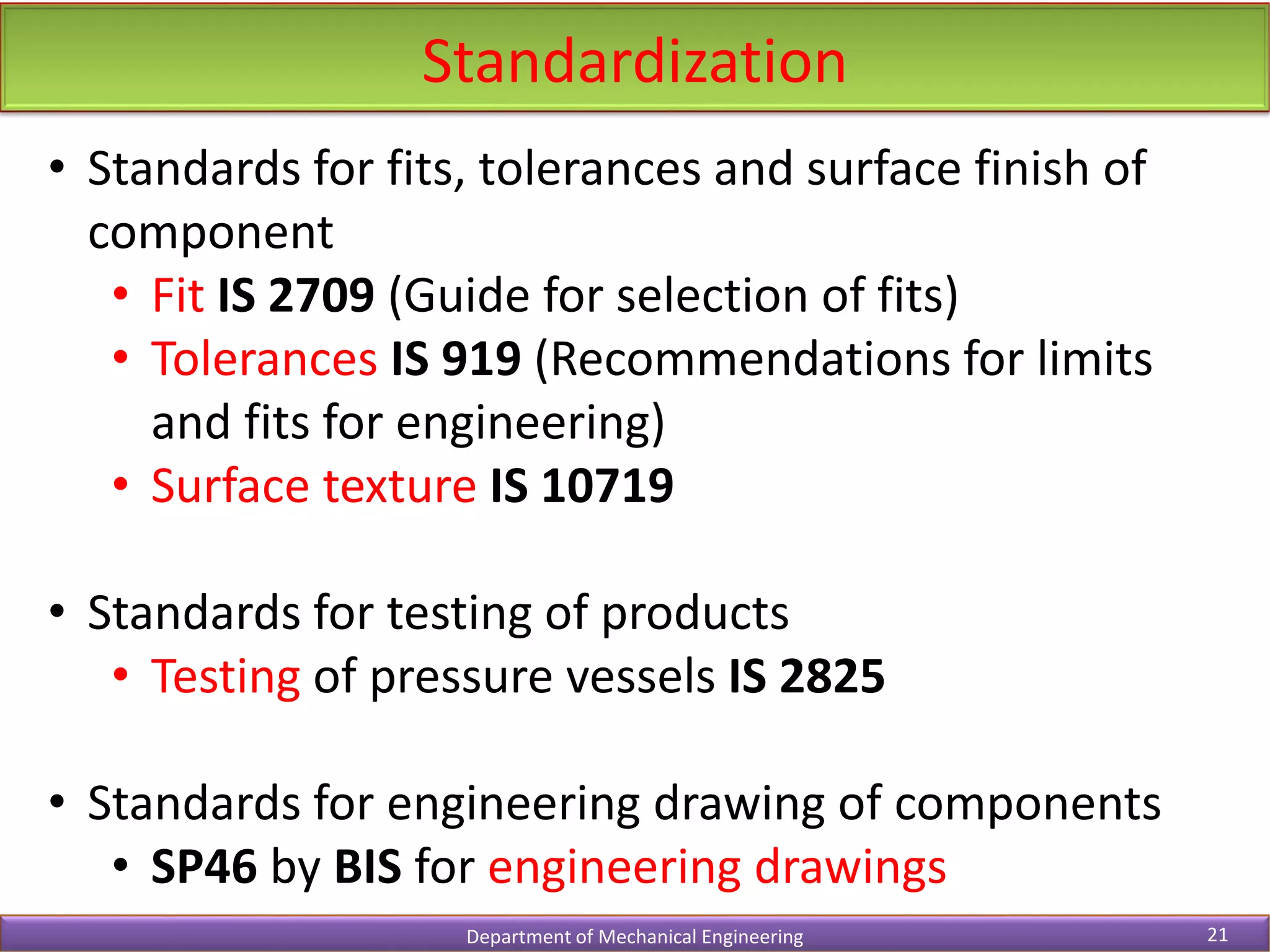
Standardization
Department of Mechanical Engineering 21
• Standards for fits, tolerances and surface finish of
component
• Fit IS 2709 (Guide for selection of fits)
• Tolerances IS 919 (Recommendations for limits
and fits for engineering)
• Surface texture IS 10719
• Standards for testing of products
• Testing of pressure vessels IS 2825
• Standards for engineering drawing of components
• SP46 by BIS for engineering drawings
Standardization: Advantages
Department of Mechanical Engineering 22
• Reduction in types and dimensions of identical
components
• Reduced manufacturing facilities required for
individual organisation
• Easy replacement and availability
• Reduced designer tasks
• Improved quality and reliability
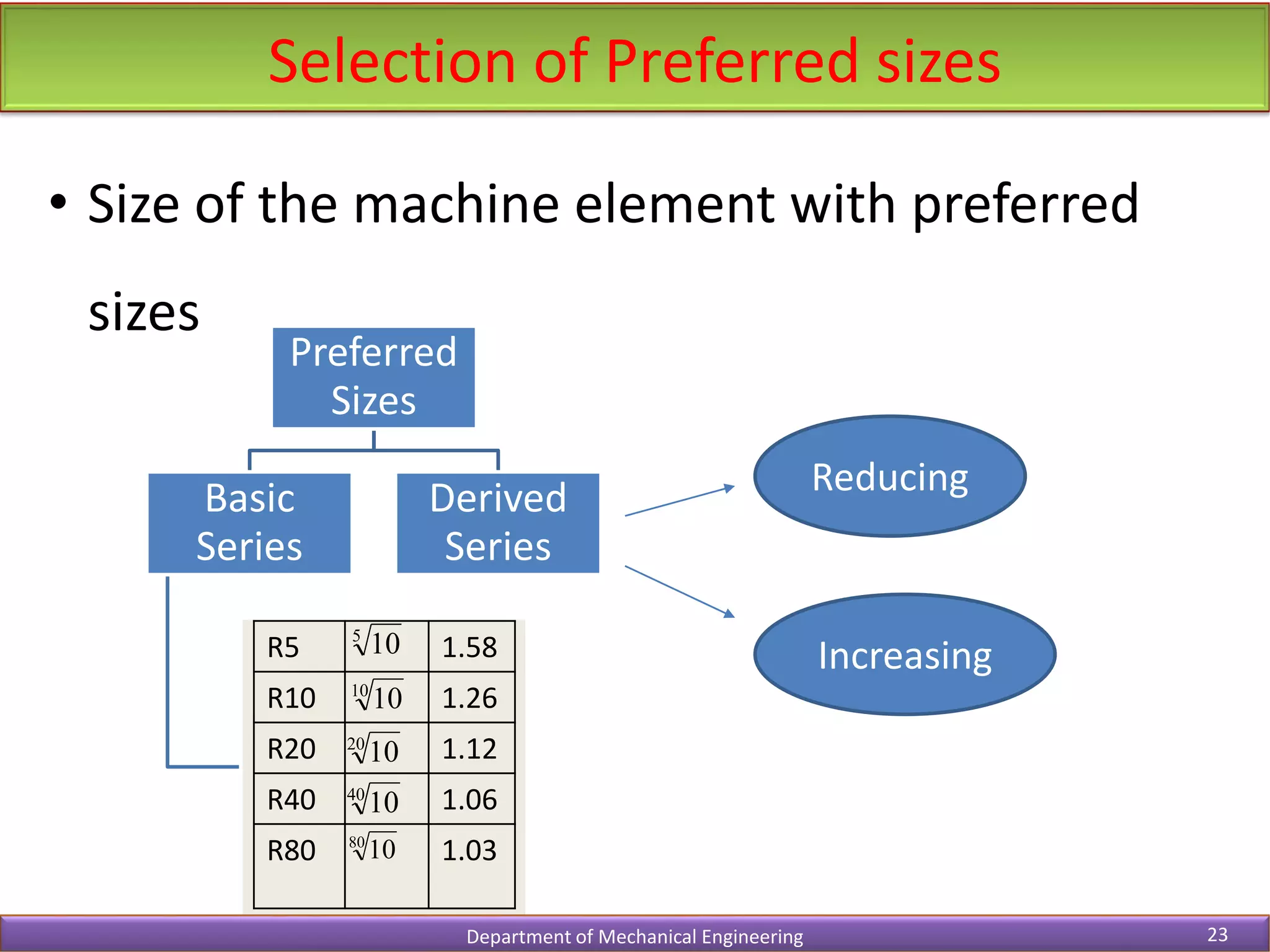
Preferred
Sizes
Basic
Series
Derived
Series
R5 1.58
R10 1.26
R20 1.12
R40 1.06
R80 1.03
Selection of Preferred sizes
Department of Mechanical Engineering 23
• Size of the machine element with preferred
sizes
5
10
10
10
20
10
40
10
80
10
Reducing
Increasing
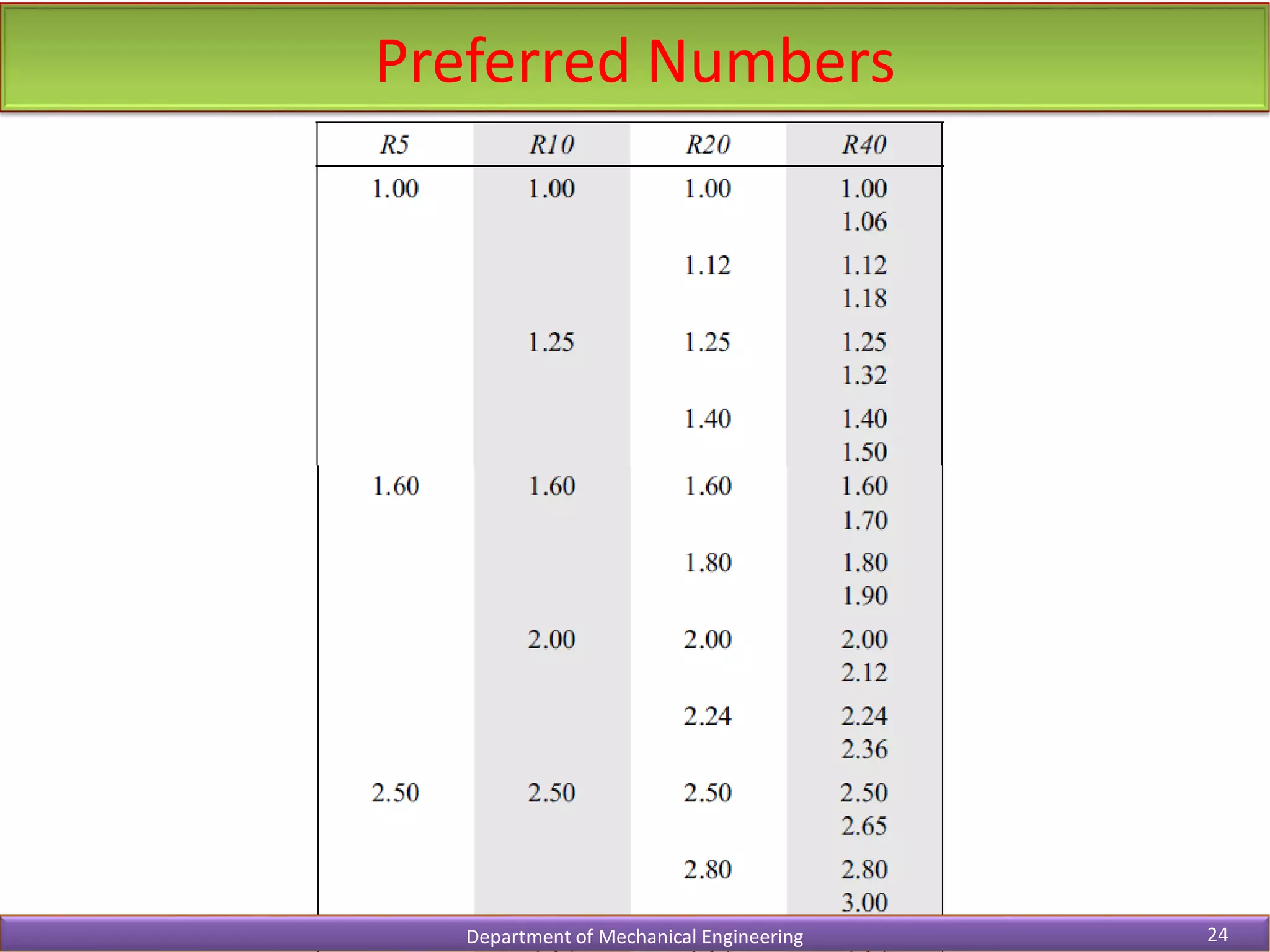
Preferred Numbers
Department of Mechanical Engineering 24
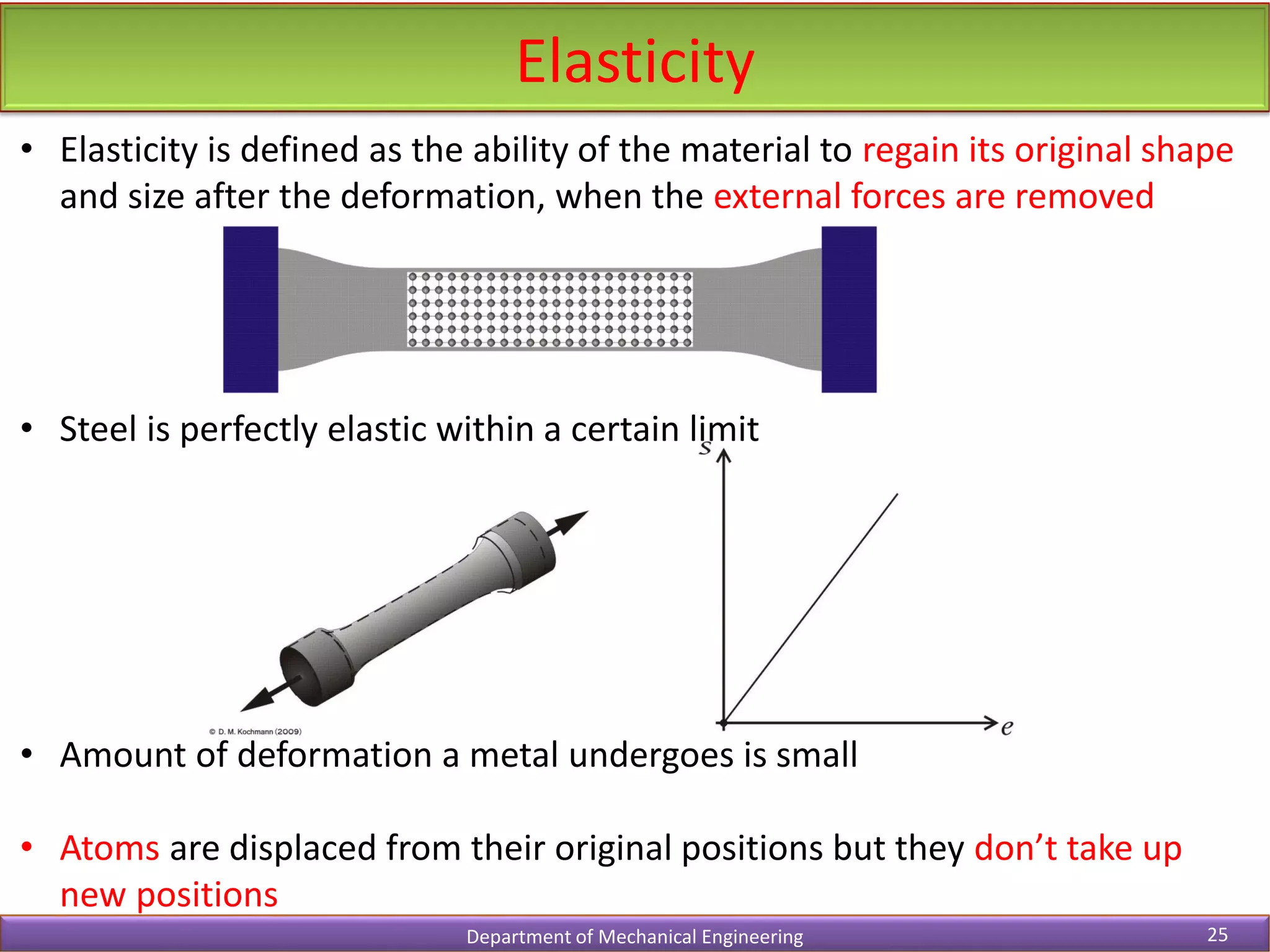
• Elasticity is defined as the ability of the material to regain its original shape
and size after the deformation, when the external forces are removed
• Steel is perfectly elastic within a certain limit
• Amount of deformation a metal undergoes is small
• Atoms are displaced from their original positions but they don’t take up
new positions
Elasticity
Department of Mechanical Engineering 25
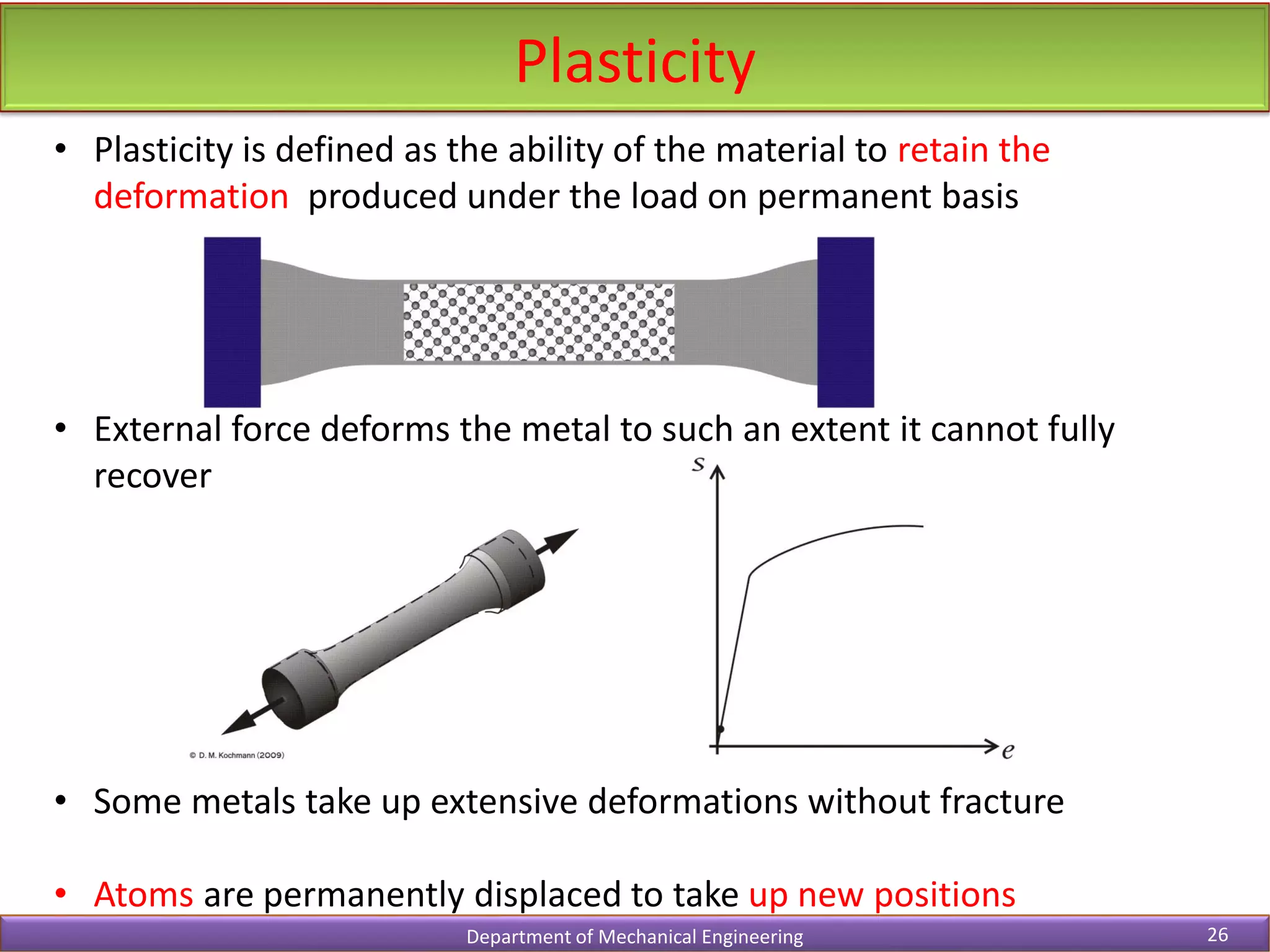
• Plasticity is defined as the ability of the material to retain the
deformation produced under the load on permanent basis
• External force deforms the metal to such an extent it cannot fully
recover
• Some metals take up extensive deformations without fracture
• Atoms are permanently displaced to take up new positions
Plasticity
Department of Mechanical Engineering 26
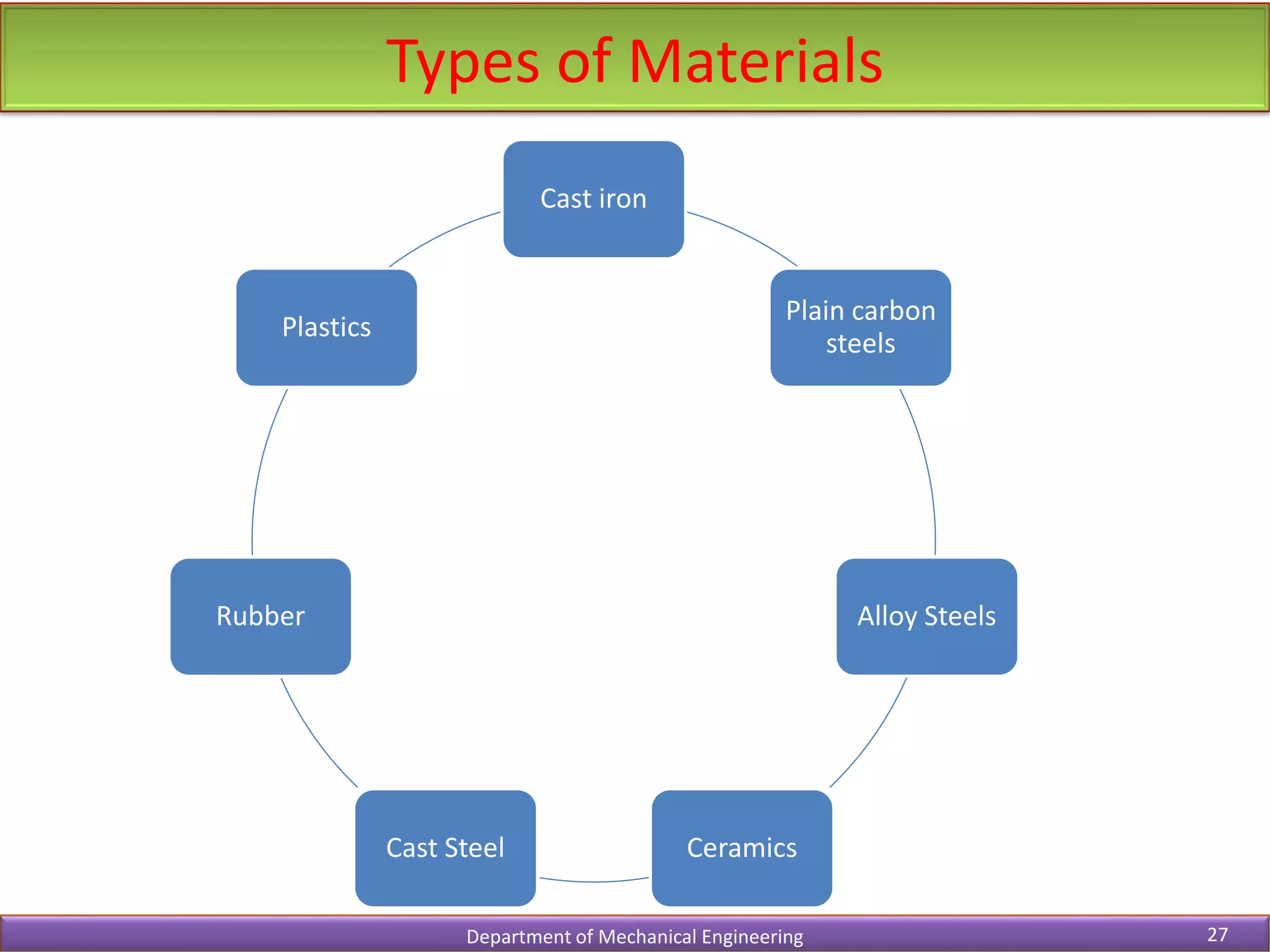
Types of Materials
Department of Mechanical Engineering 27
Cast iron
Plain carbon
steels
Alloy Steels
Ceramics
Cast Steel
Rubber
Plastics
Factors for selection
Department of Mechanical Engineering 28
Availability
Cost
Mechanical
Properties
Manufacturing
Considerations
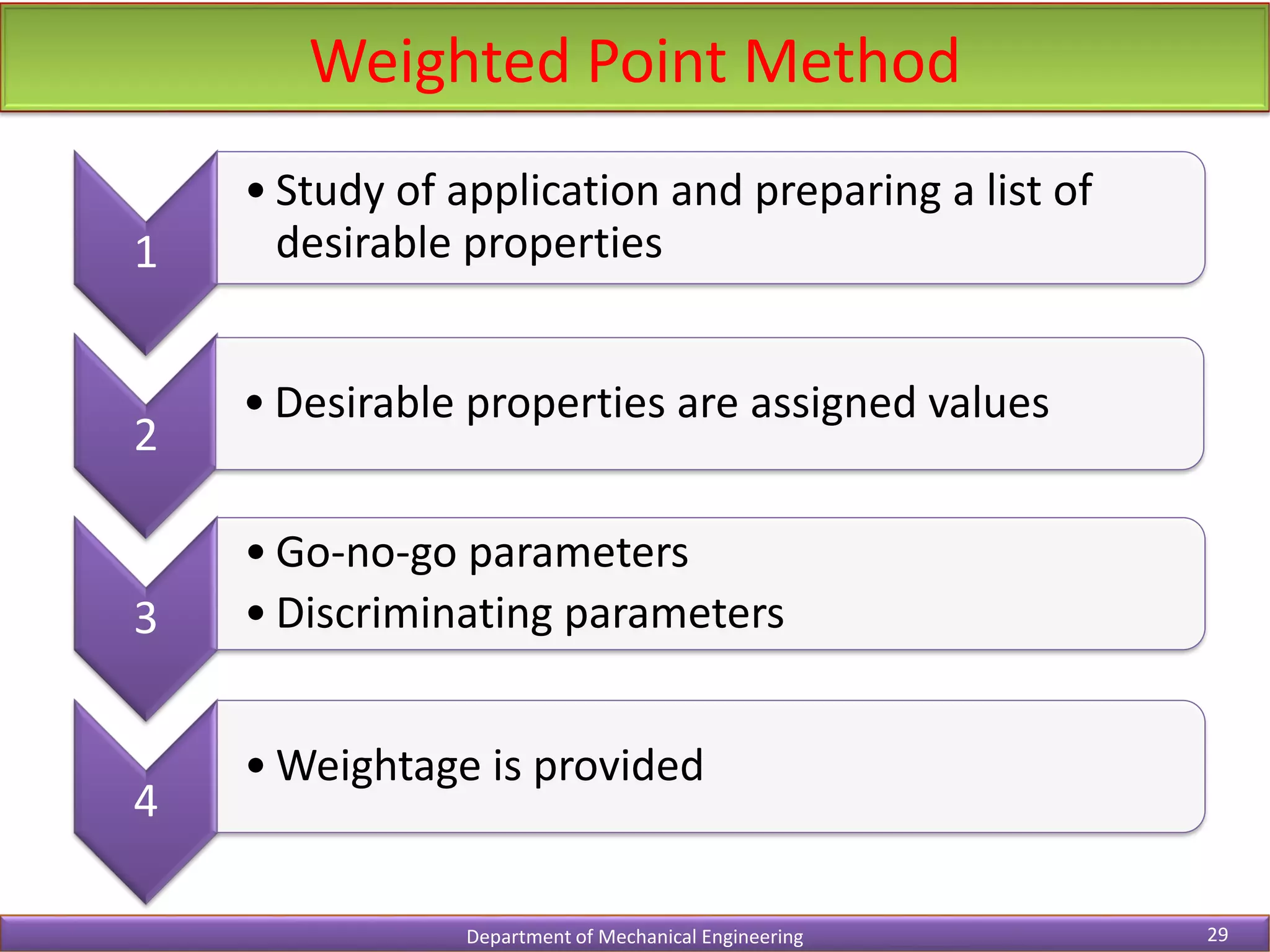
Weighted Point Method
Department of Mechanical Engineering 29
1
• Study of application and preparing a list of
desirable properties
2
• Desirable properties are assigned values
3
• Go-no-go parameters
• Discriminating parameters
4
• Weightage is provided
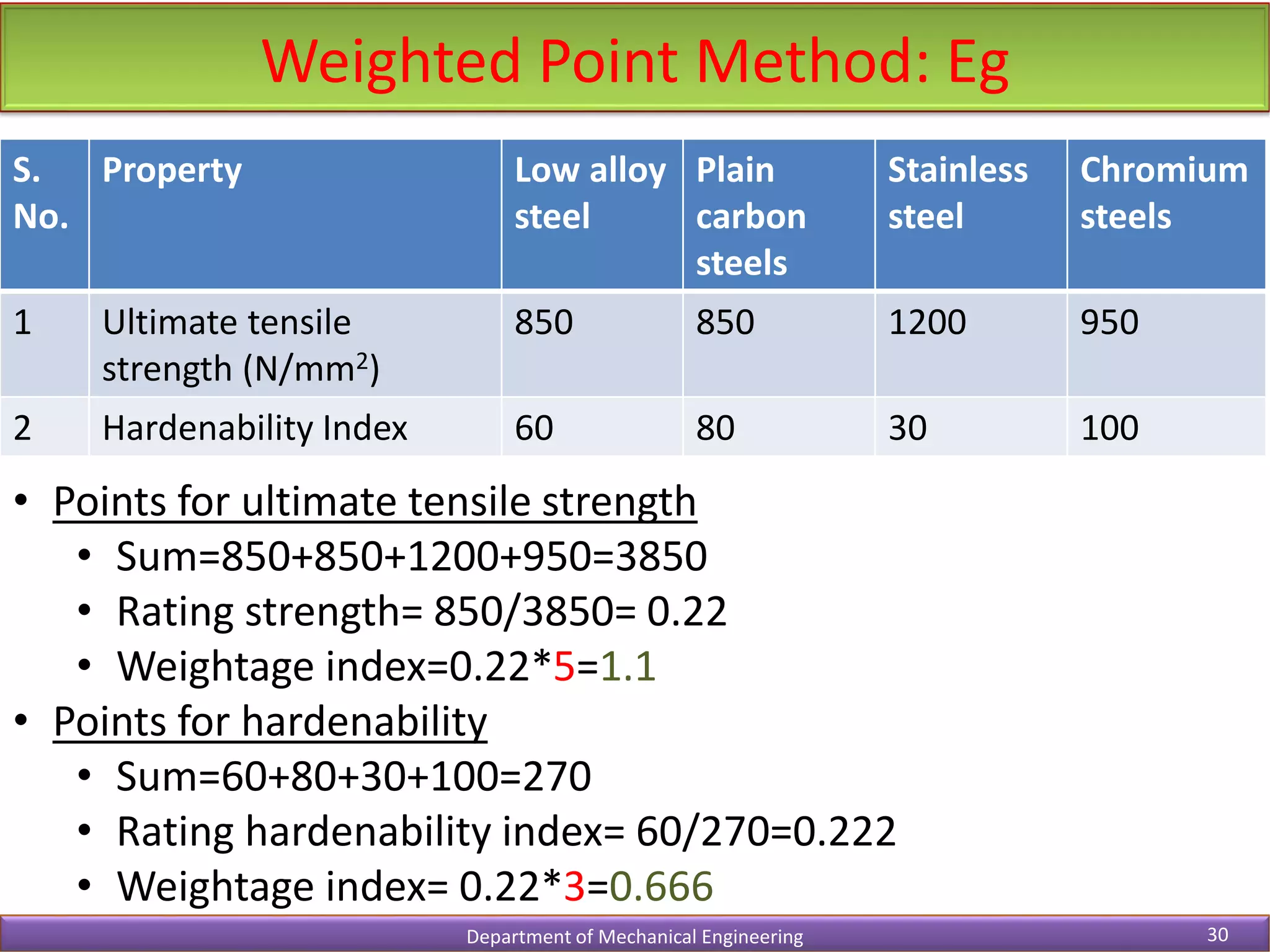
Weighted Point Method: Eg
Department of Mechanical Engineering 30
S.
No.
Property Low alloy
steel
Plain
carbon
steels
Stainless
steel
Chromium
steels
1 Ultimate tensile
strength (N/mm2)
850 850 1200 950
2 Hardenability Index 60 80 30 100
• Points for ultimate tensile strength
• Sum=850+850+1200+950=3850
• Rating strength= 850/3850= 0.22
• Weightage index=0.22*5=1.1
• Points for hardenability
• Sum=60+80+30+100=270
• Rating hardenability index= 60/270=0.222
• Weightage index= 0.22*3=0.666
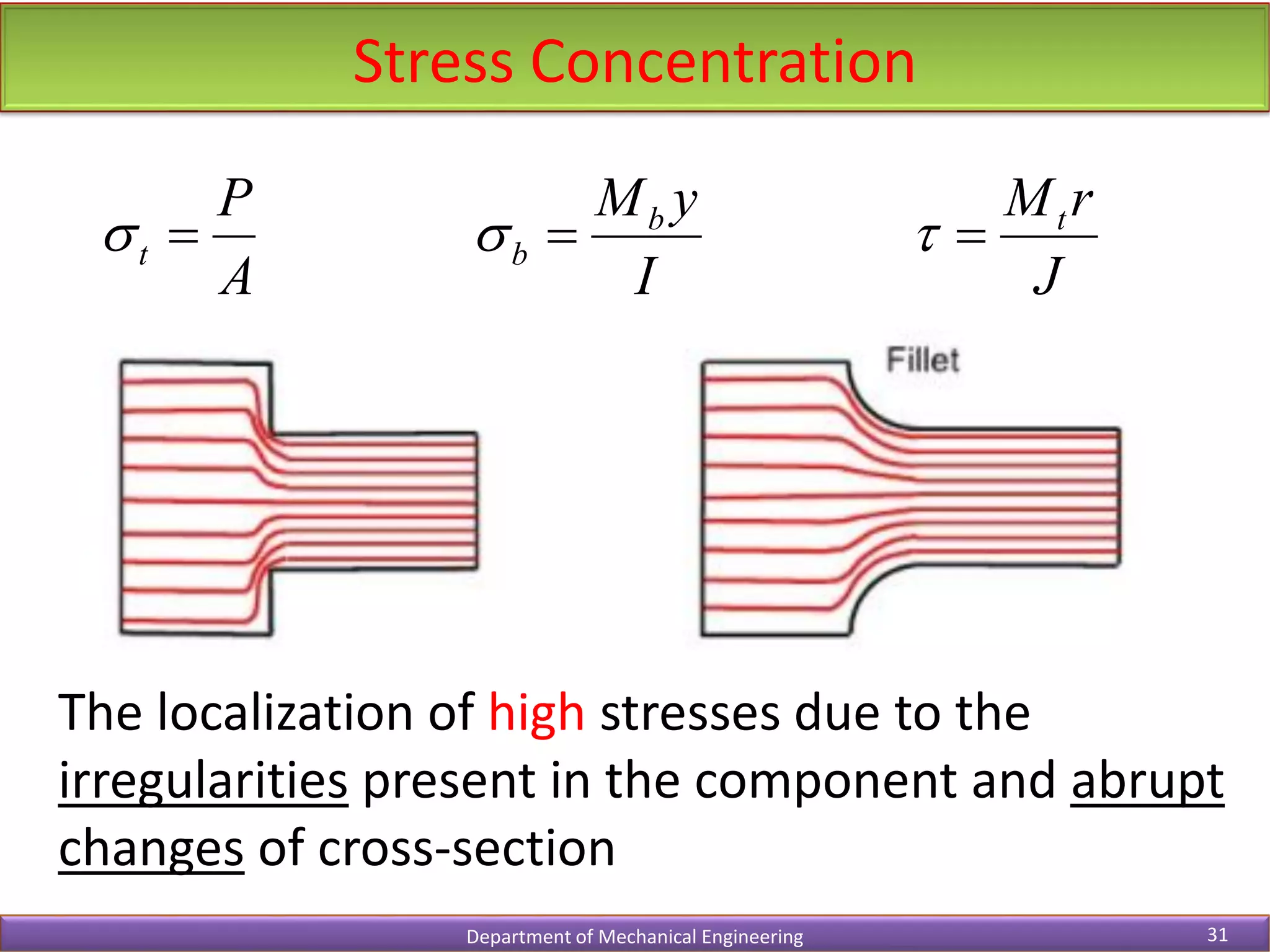
Stress Concentration
Department of Mechanical Engineering 31
A
P
t 

I
y
Mb
b 

J
r
Mt


The localization of high stresses due to the
irregularities present in the component and abrupt
changes of cross-section
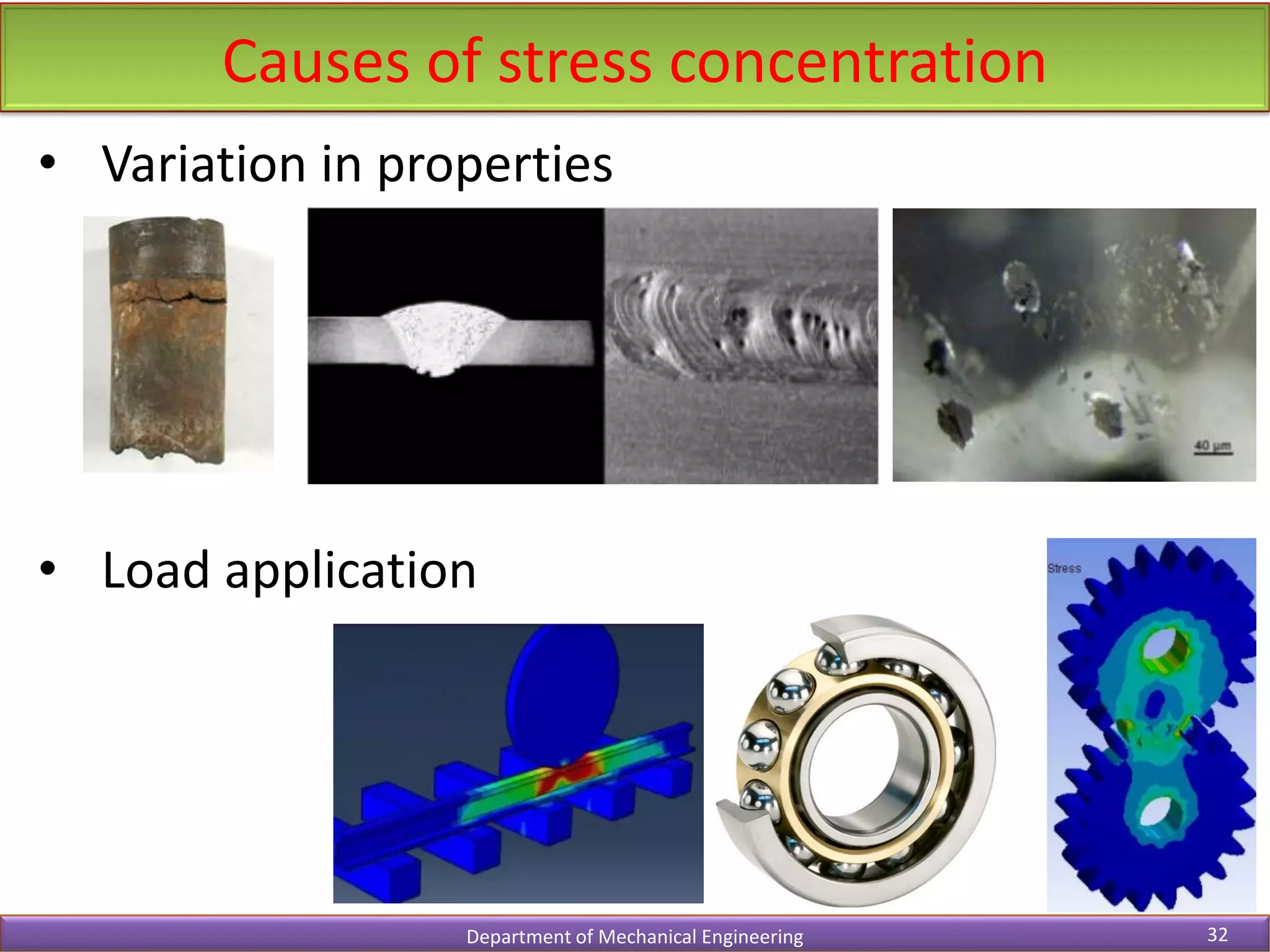
Causes of stress concentration
Department of Mechanical Engineering 32
• Variation in properties
• Load application
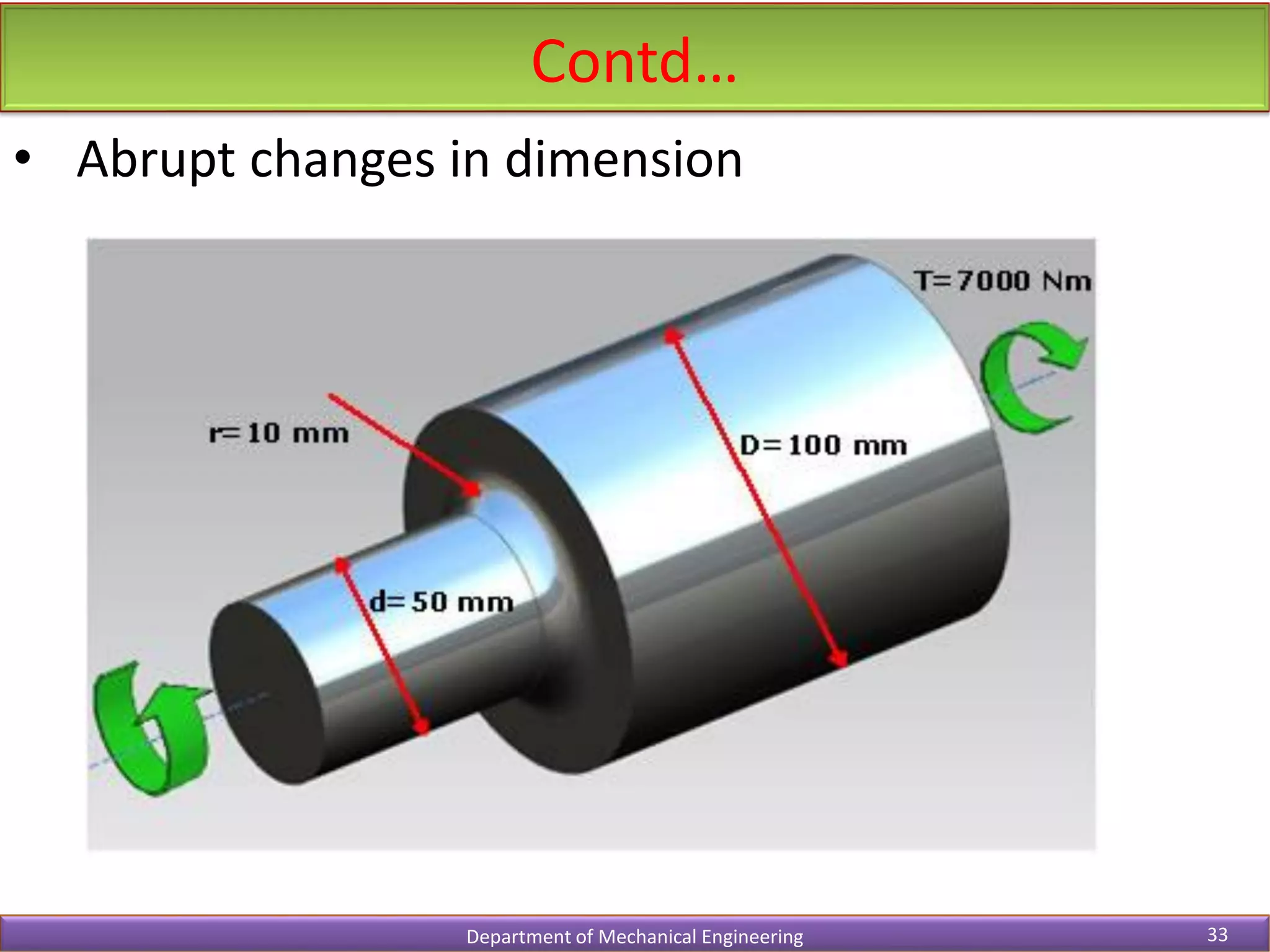
Contd…
Department of Mechanical Engineering 33
• Abrupt changes in dimension
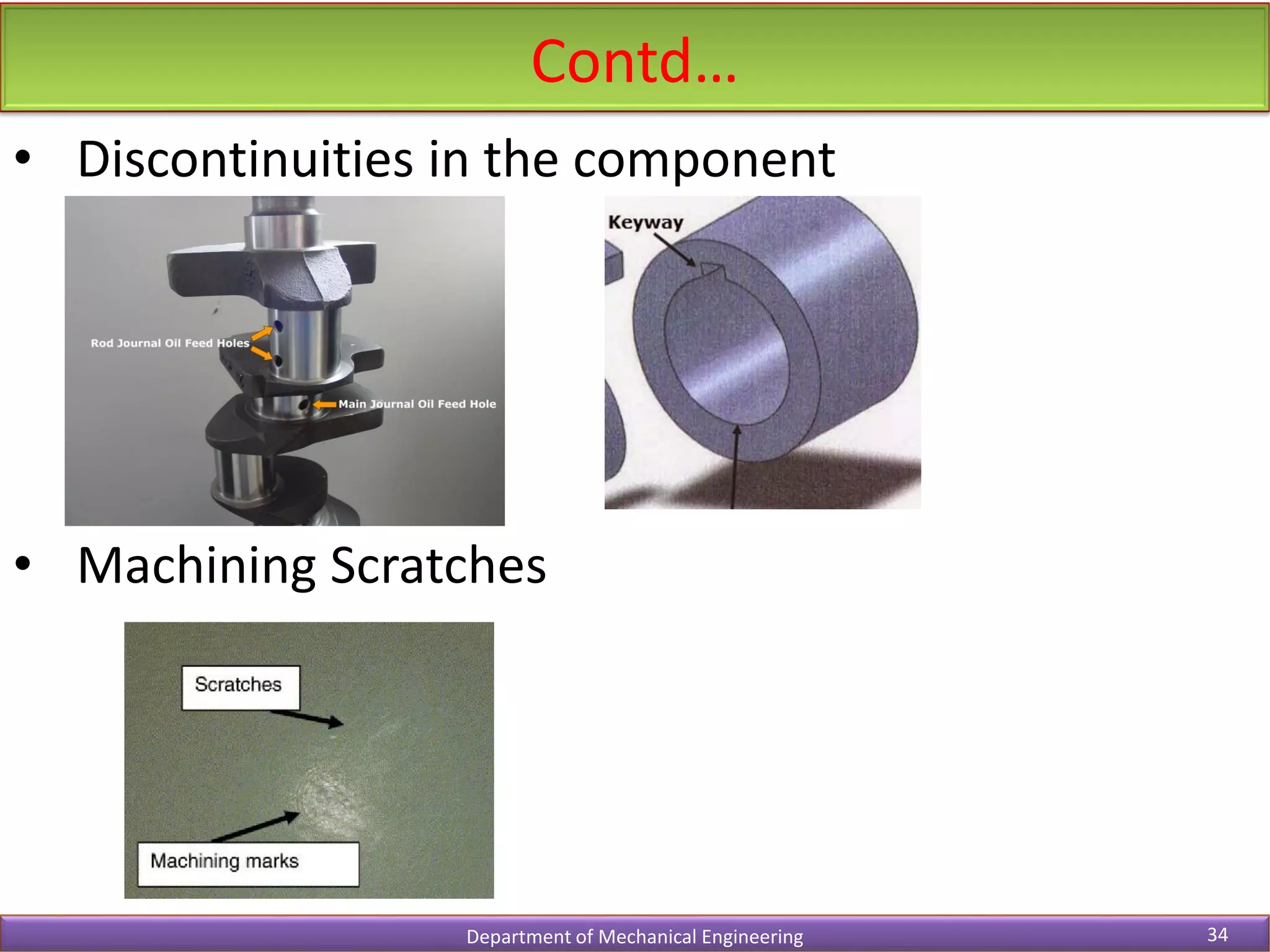
Contd…
Department of Mechanical Engineering 34
• Discontinuities in the component
• Machining Scratches
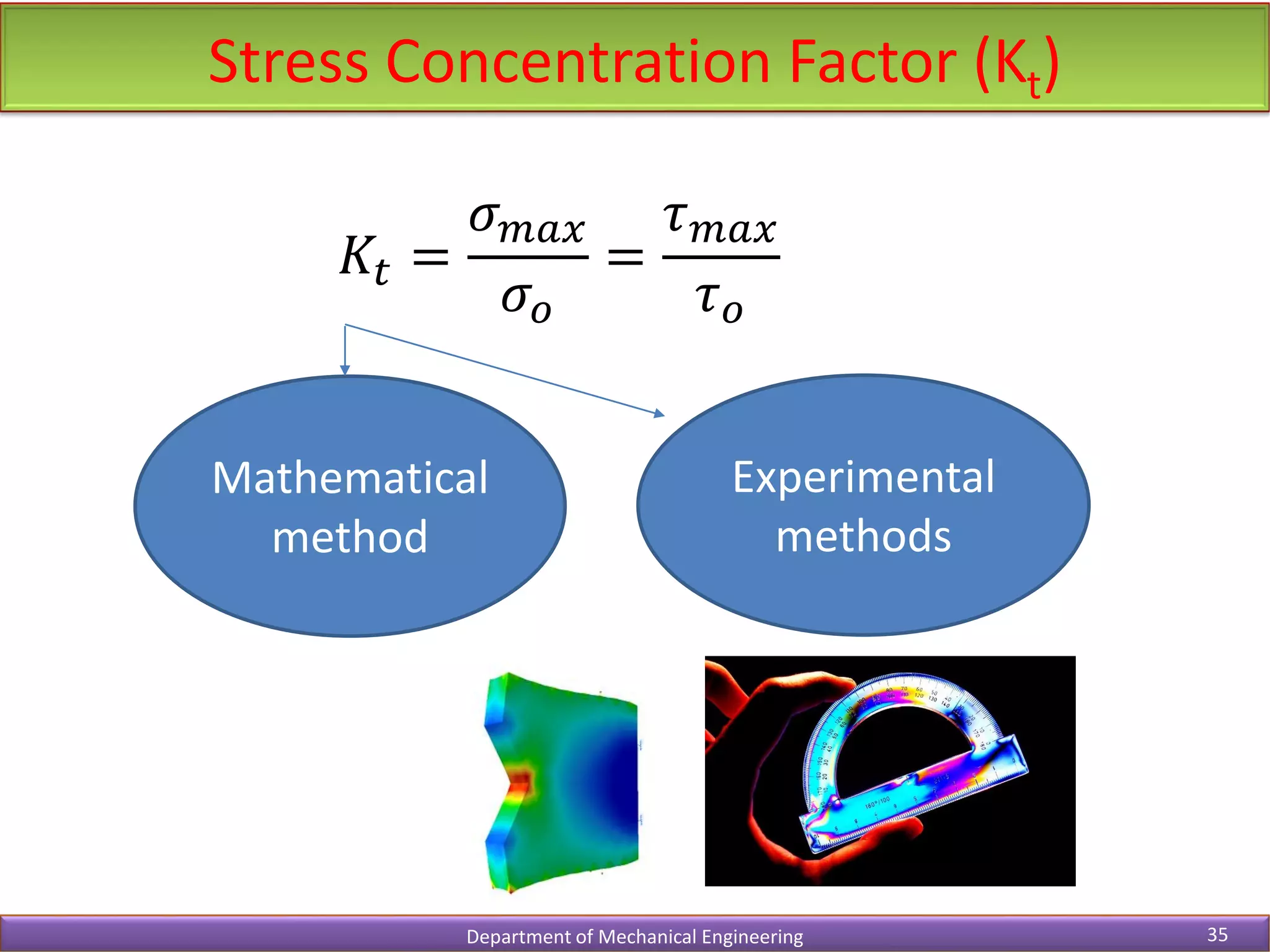
Stress Concentration Factor (Kt)
Department of Mechanical Engineering 35
𝐾𝑡 =
𝜎𝑚𝑎𝑥
𝜎𝑜
=
𝜏𝑚𝑎𝑥
𝜏𝑜
Mathematical
method
Experimental
methods
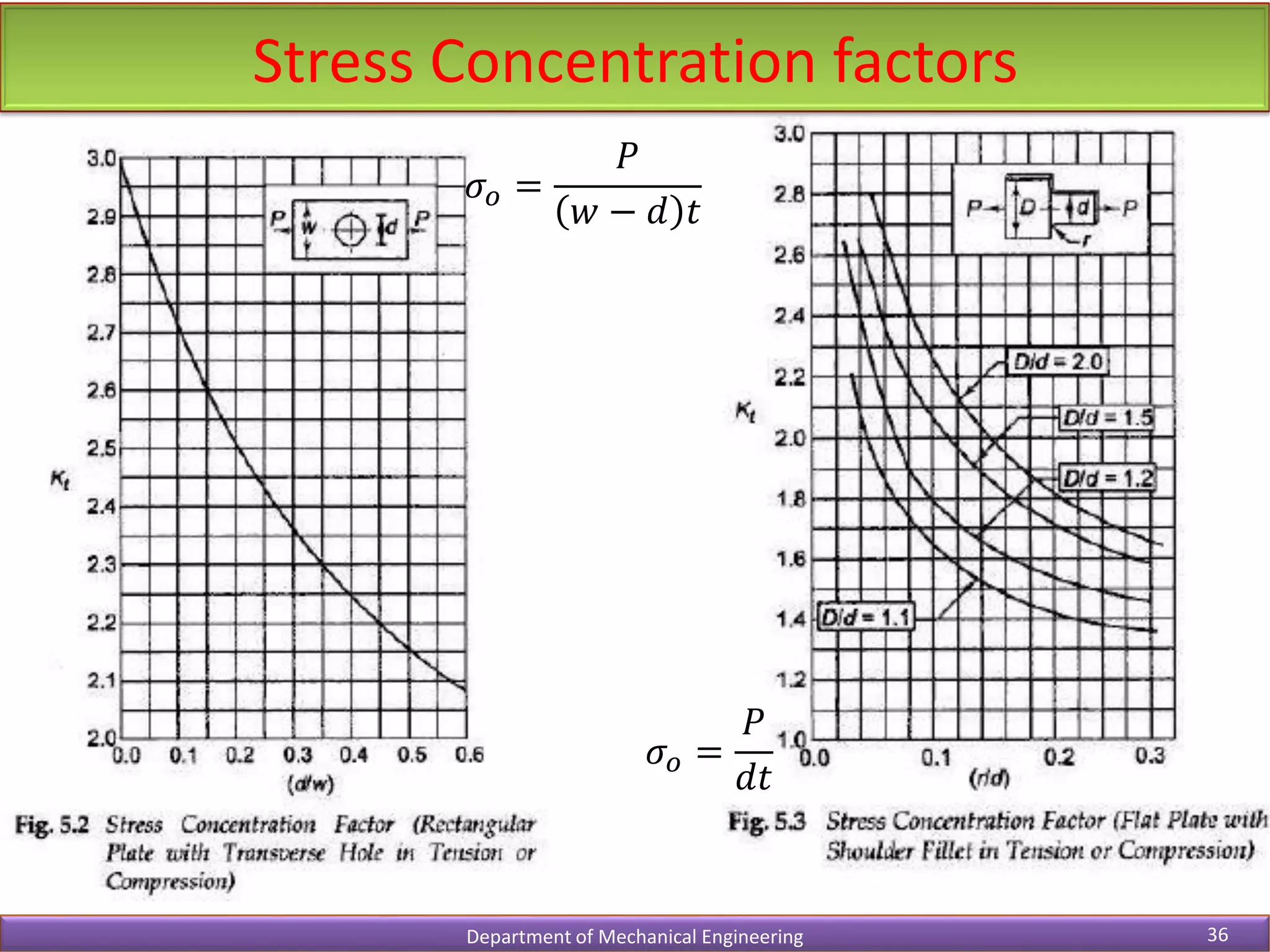
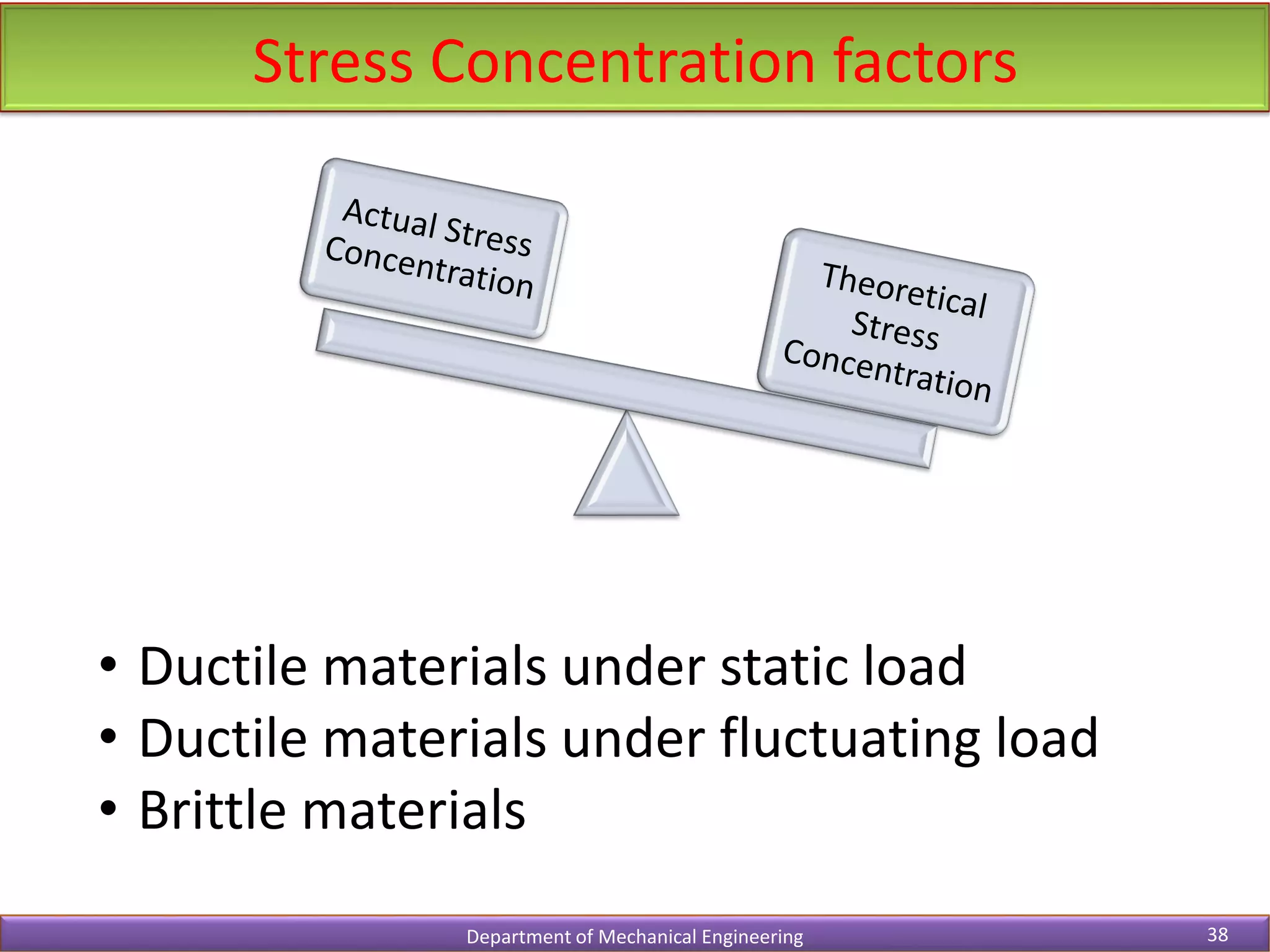
Stress Concentration factors
Department of Mechanical Engineering 36
𝜎𝑜 =
𝑃
𝑤 − 𝑑 𝑡
𝜎𝑜 =
𝑃
𝑑𝑡
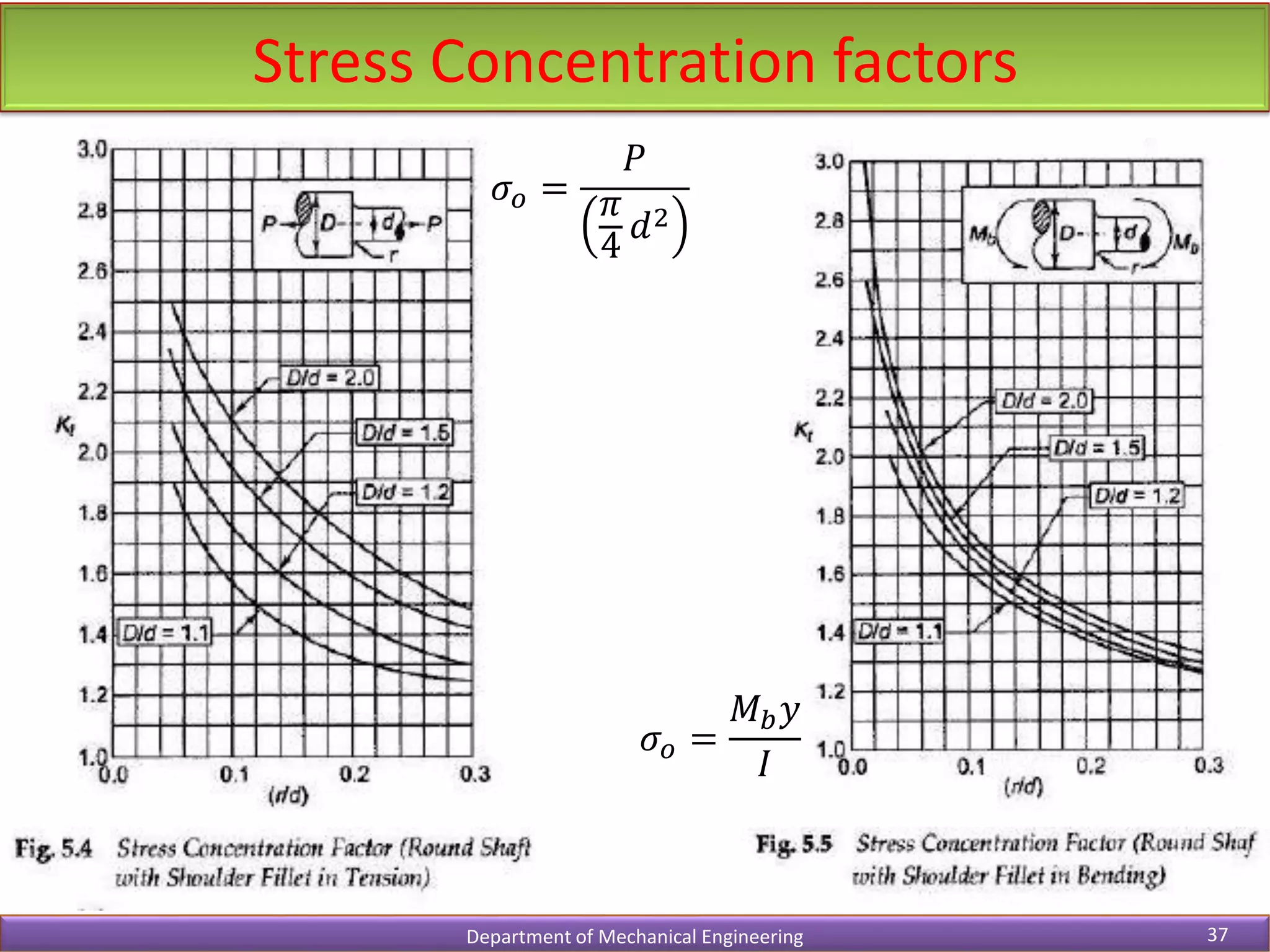
Stress Concentration factors
Department of Mechanical Engineering 37
𝜎𝑜 =
𝑃
𝜋
4
𝑑2
𝜎𝑜 =
𝑀𝑏𝑦
𝐼
Stress Concentration factors
Department of Mechanical Engineering 38
• Ductile materials under static load
• Ductile materials under fluctuating load
• Brittle materials
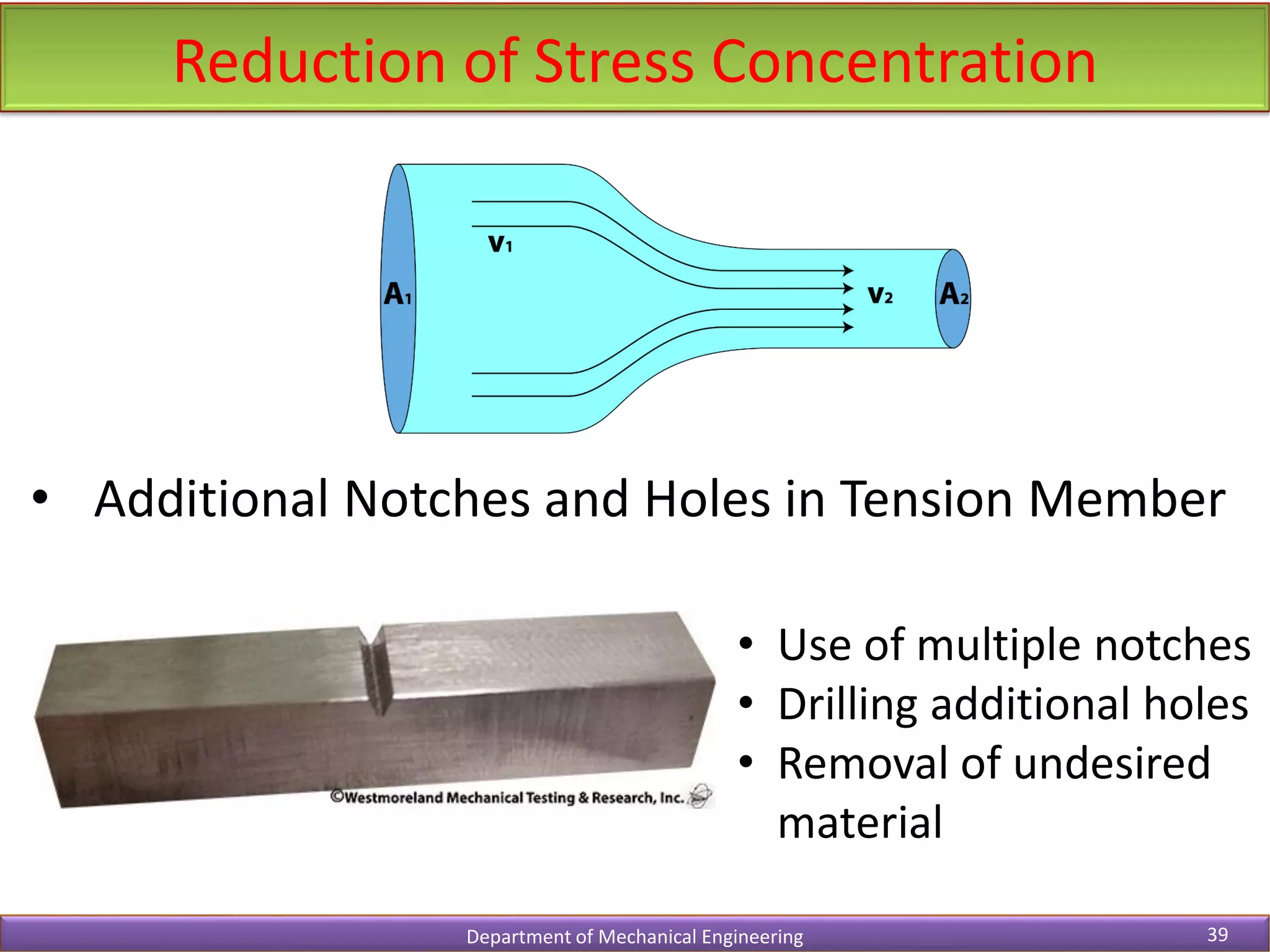
Reduction of Stress Concentration
Department of Mechanical Engineering 39
• Additional Notches and Holes in Tension Member
• Use of multiple notches
• Drilling additional holes
• Removal of undesired
material
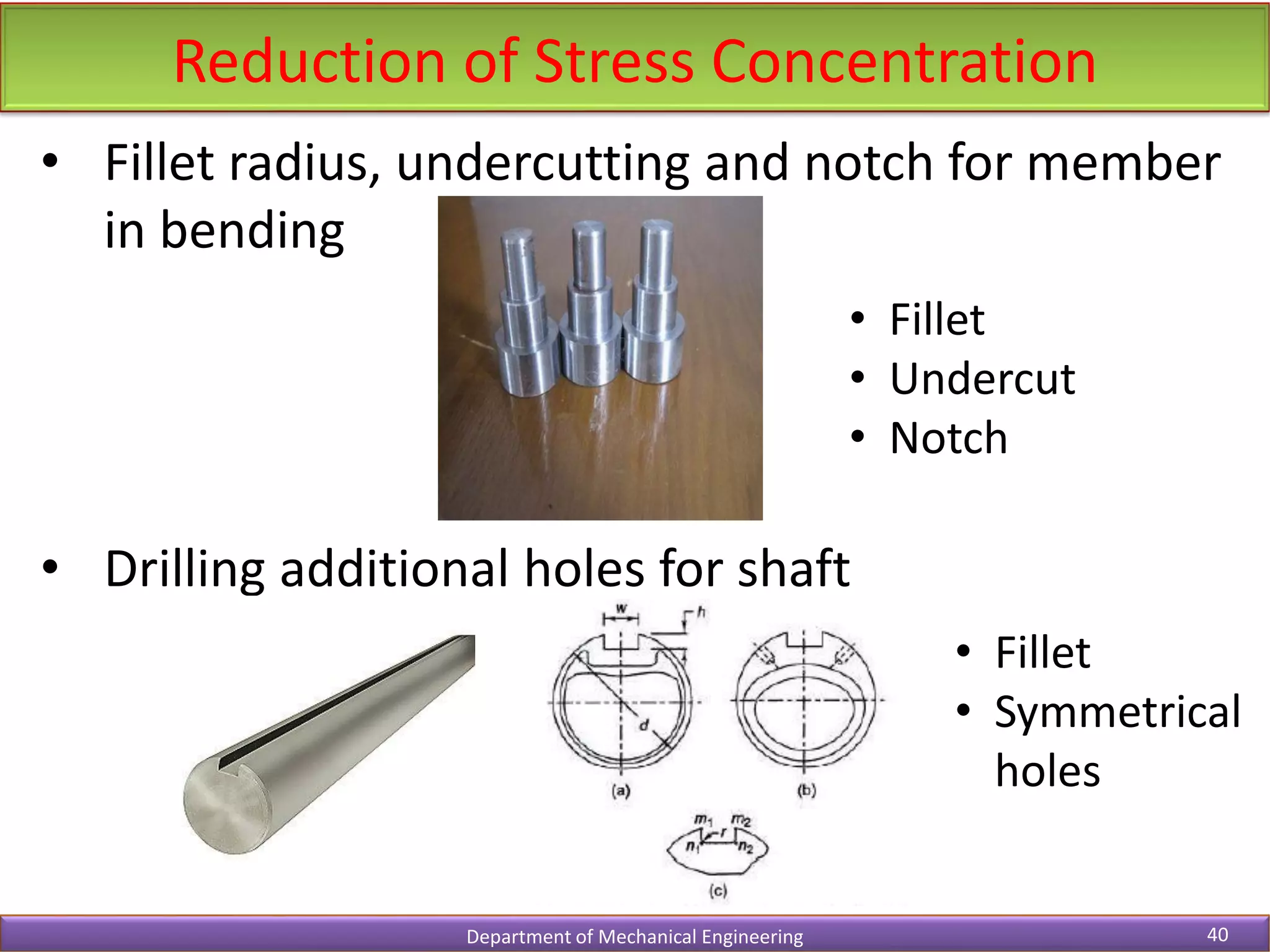
Reduction of Stress Concentration
Department of Mechanical Engineering 40
• Fillet radius, undercutting and notch for member
in bending
• Drilling additional holes for shaft
• Fillet
• Undercut
• Notch
• Fillet
• Symmetrical
holes
Reduction of Stress Concentration
Department of Mechanical Engineering 41
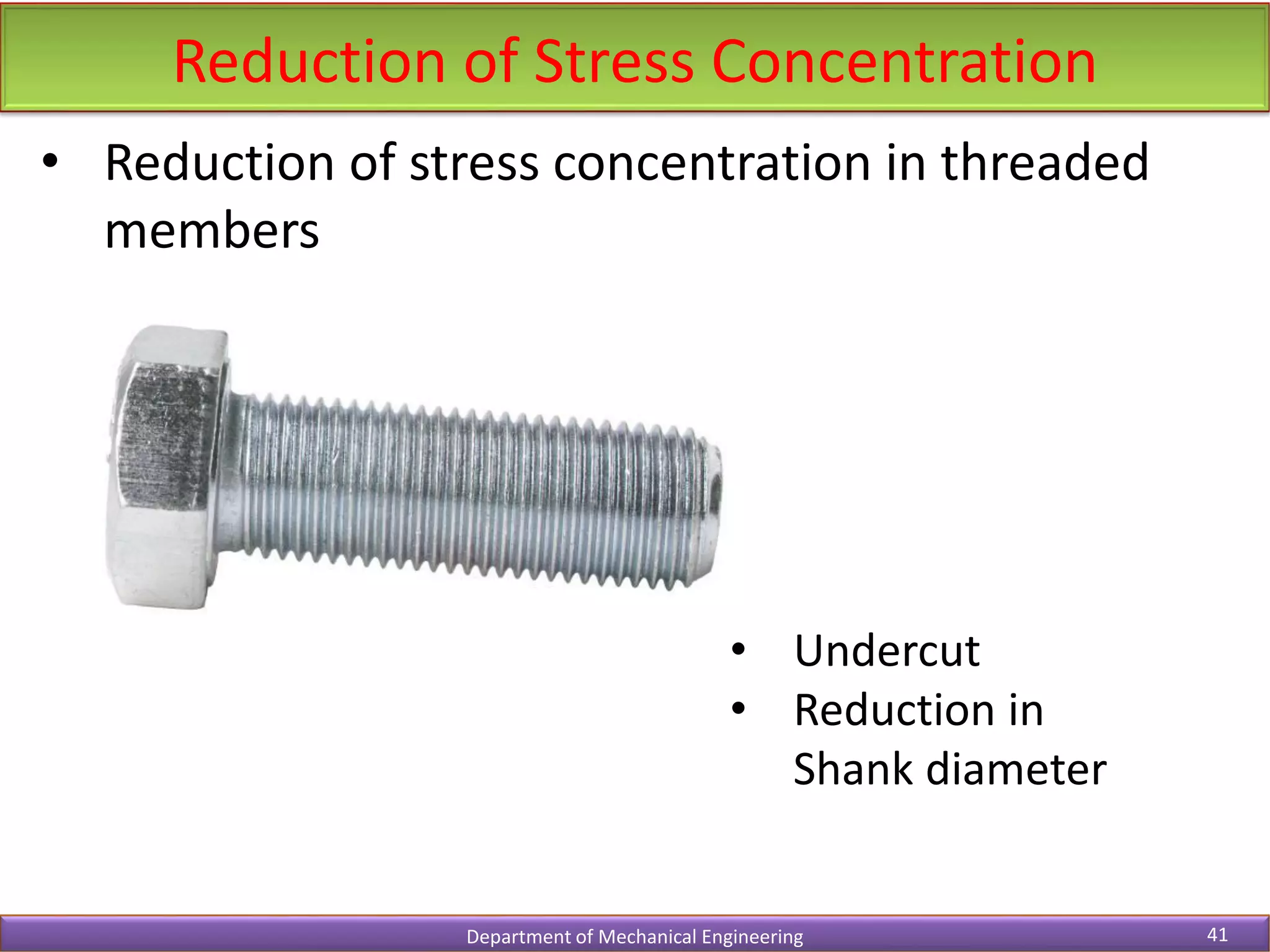
• Reduction of stress concentration in threaded
members
• Undercut
• Reduction in
Shank diameter
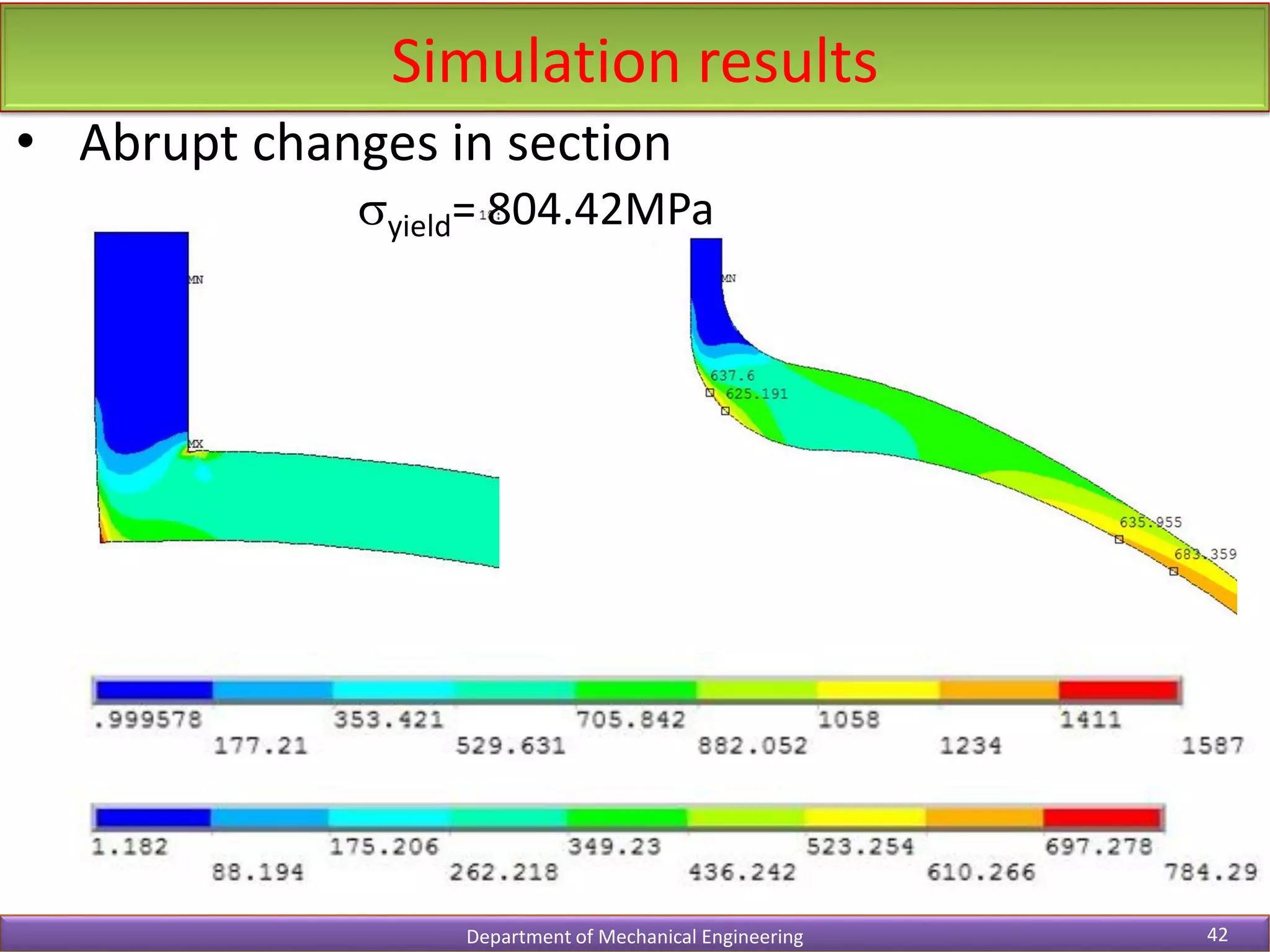
Simulation results
Department of Mechanical Engineering 42
yield= 804.42MPa
• Abrupt changes in section
Problem??
Department of Mechanical Engineering 43
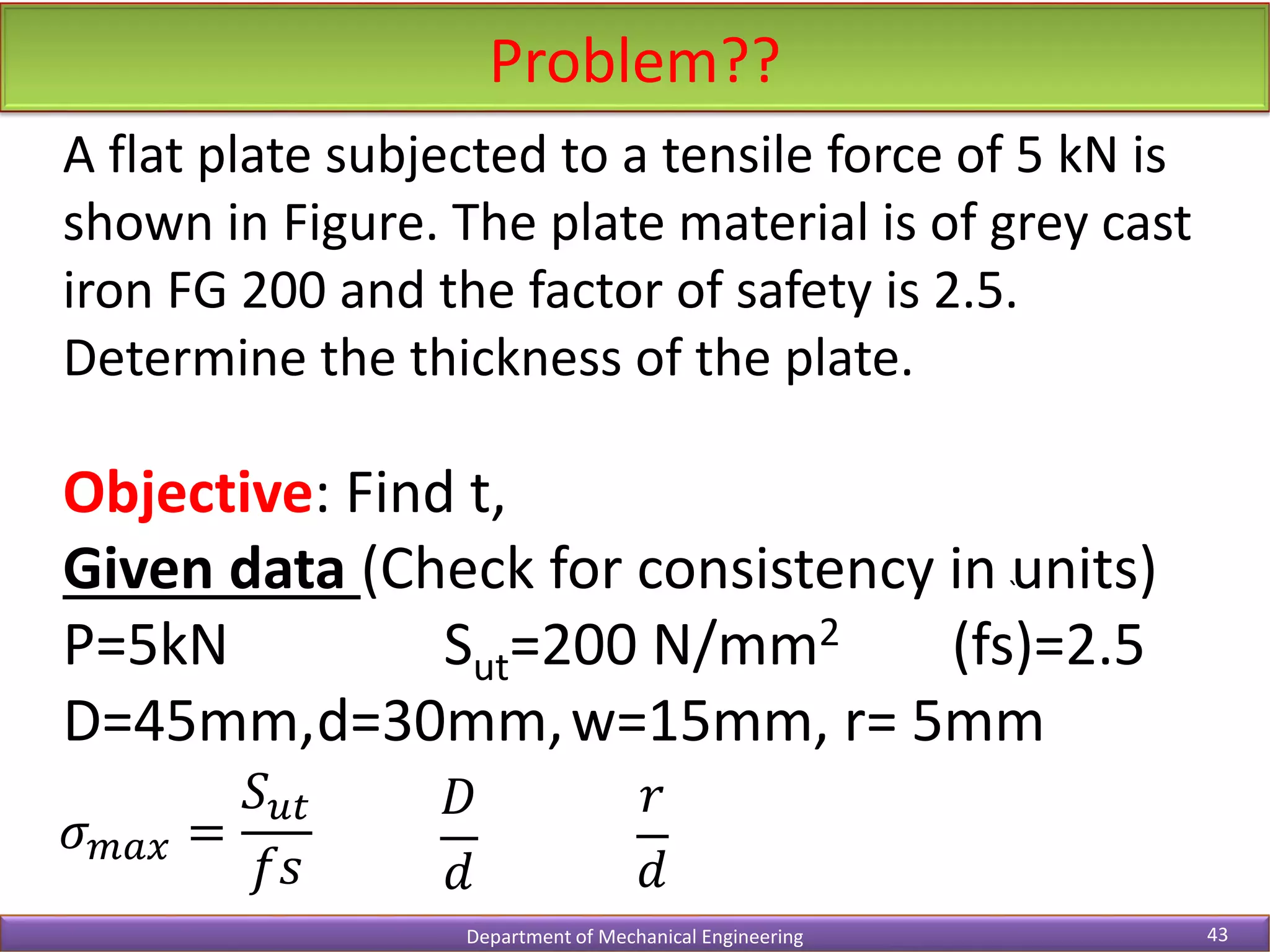
A flat plate subjected to a tensile force of 5 kN is
shown in Figure. The plate material is of grey cast
iron FG 200 and the factor of safety is 2.5.
Determine the thickness of the plate.
Objective: Find t,
Given data (Check for consistency in units)
P=5kN Sut=200 N/mm2 (fs)=2.5
D=45mm,d=30mm,w=15mm, r= 5mm
𝜎𝑚𝑎𝑥 =
𝑆𝑢𝑡
𝑓𝑠
𝐷
𝑑
𝑟
𝑑
`
Tolerances
Department of Mechanical Engineering 44
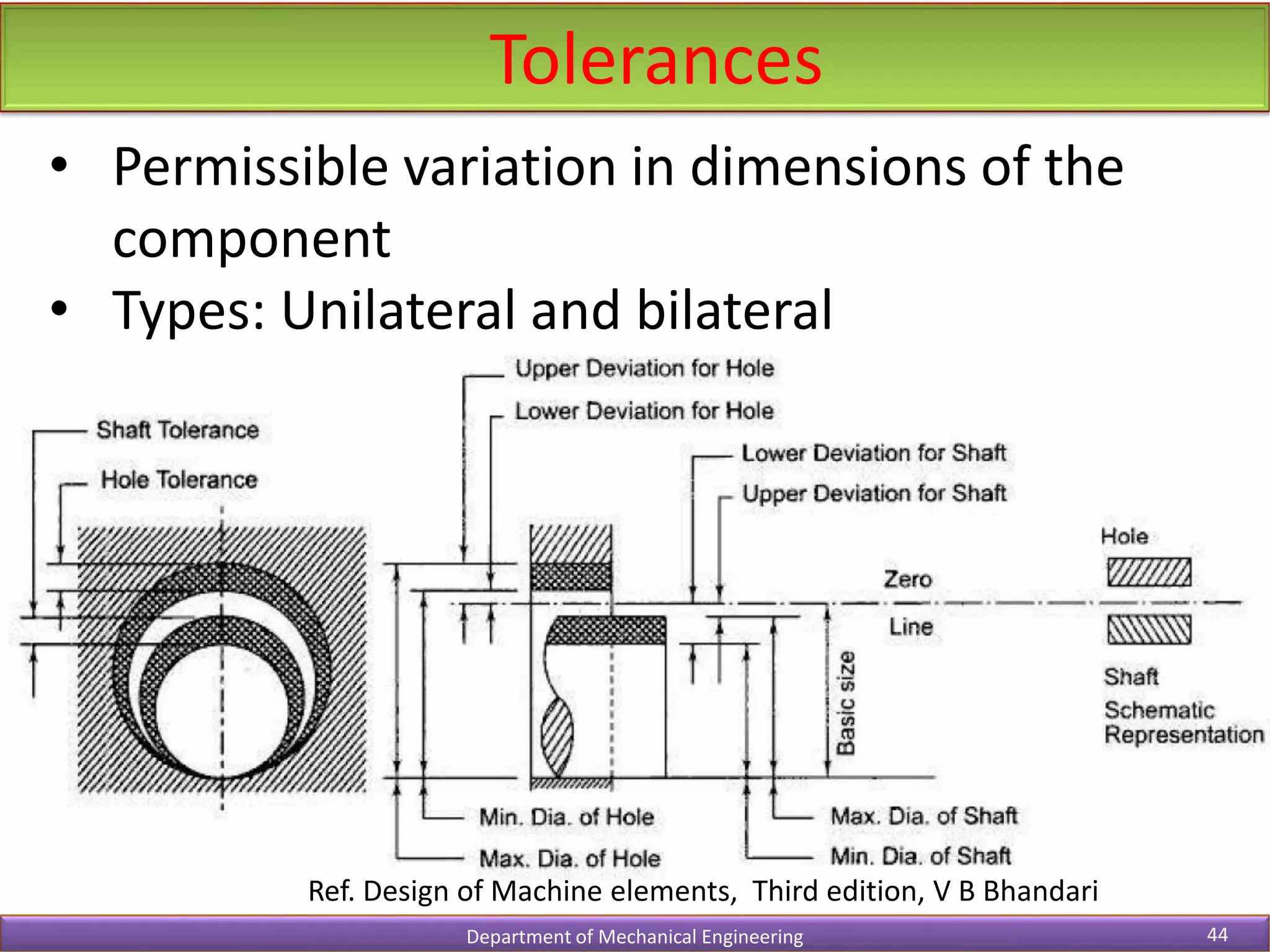
• Permissible variation in dimensions of the
component
• Types: Unilateral and bilateral
Ref. Design of Machine elements, Third edition, V B Bhandari
Fits
Department of Mechanical Engineering 45
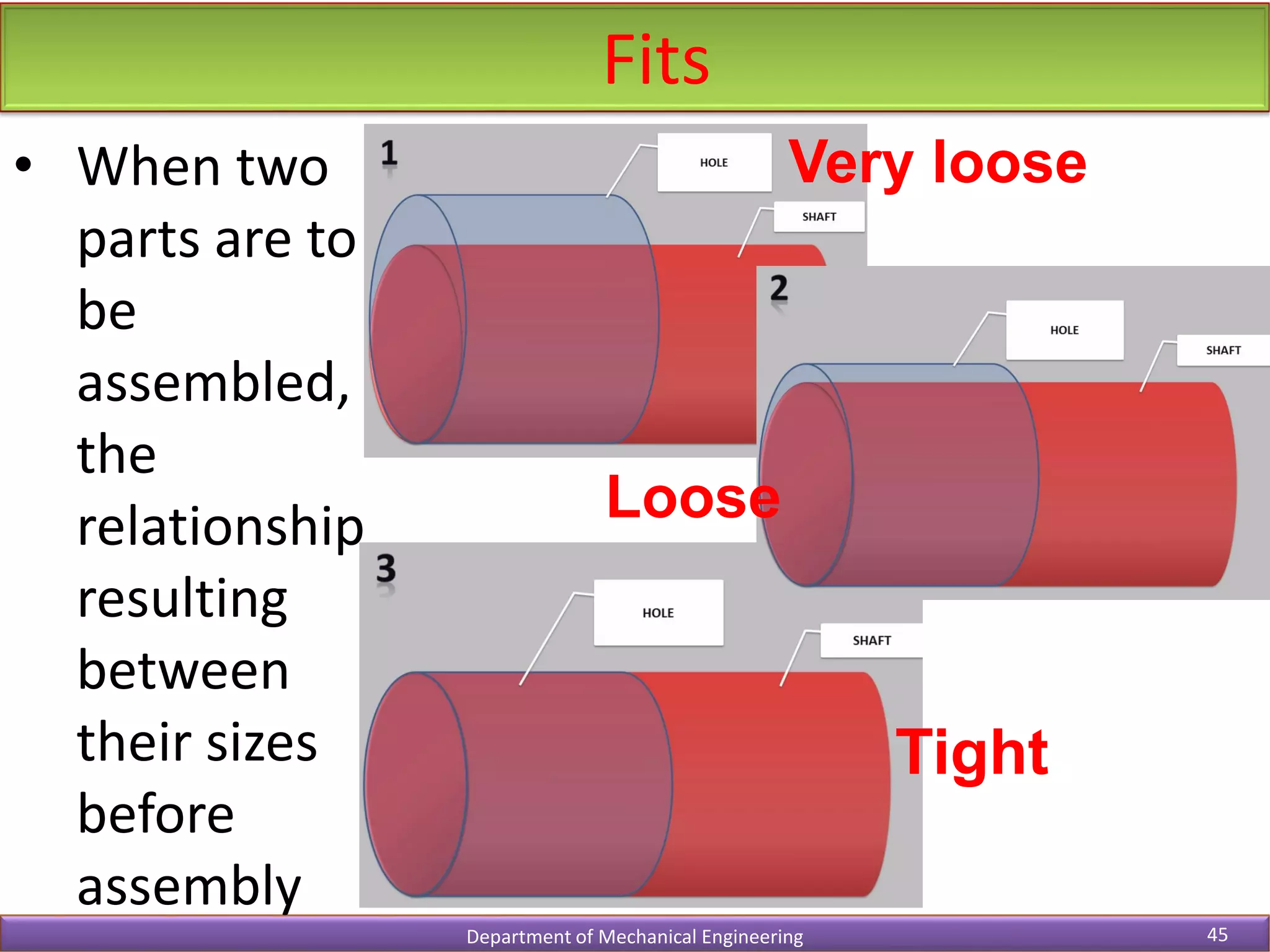
• When two
parts are to
be
assembled,
the
relationship
resulting
between
their sizes
before
assembly
Very loose
Tight
Loose
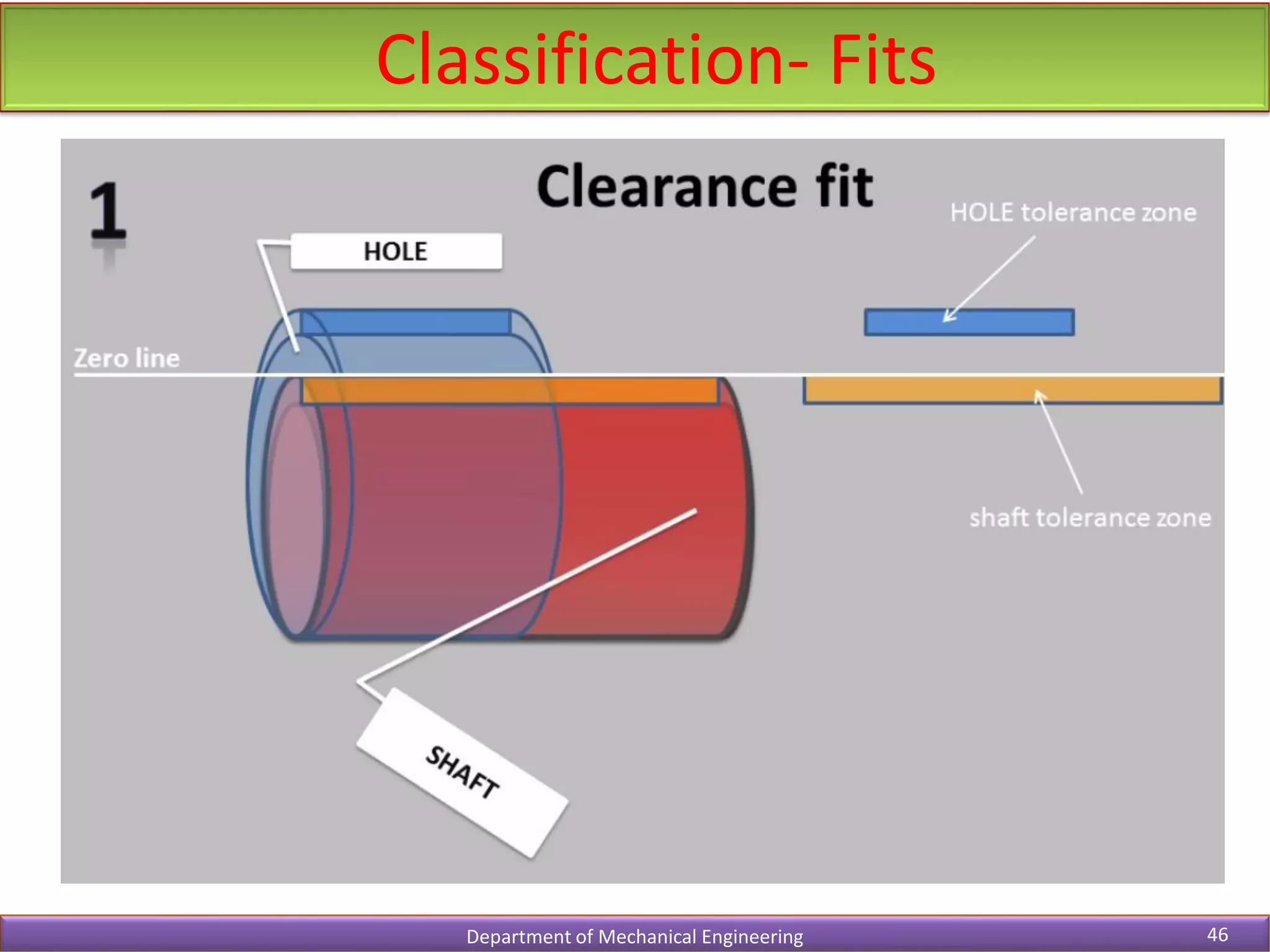
Classification- Fits
Department of Mechanical Engineering 46
Classification- Fits
Department of Mechanical Engineering 47
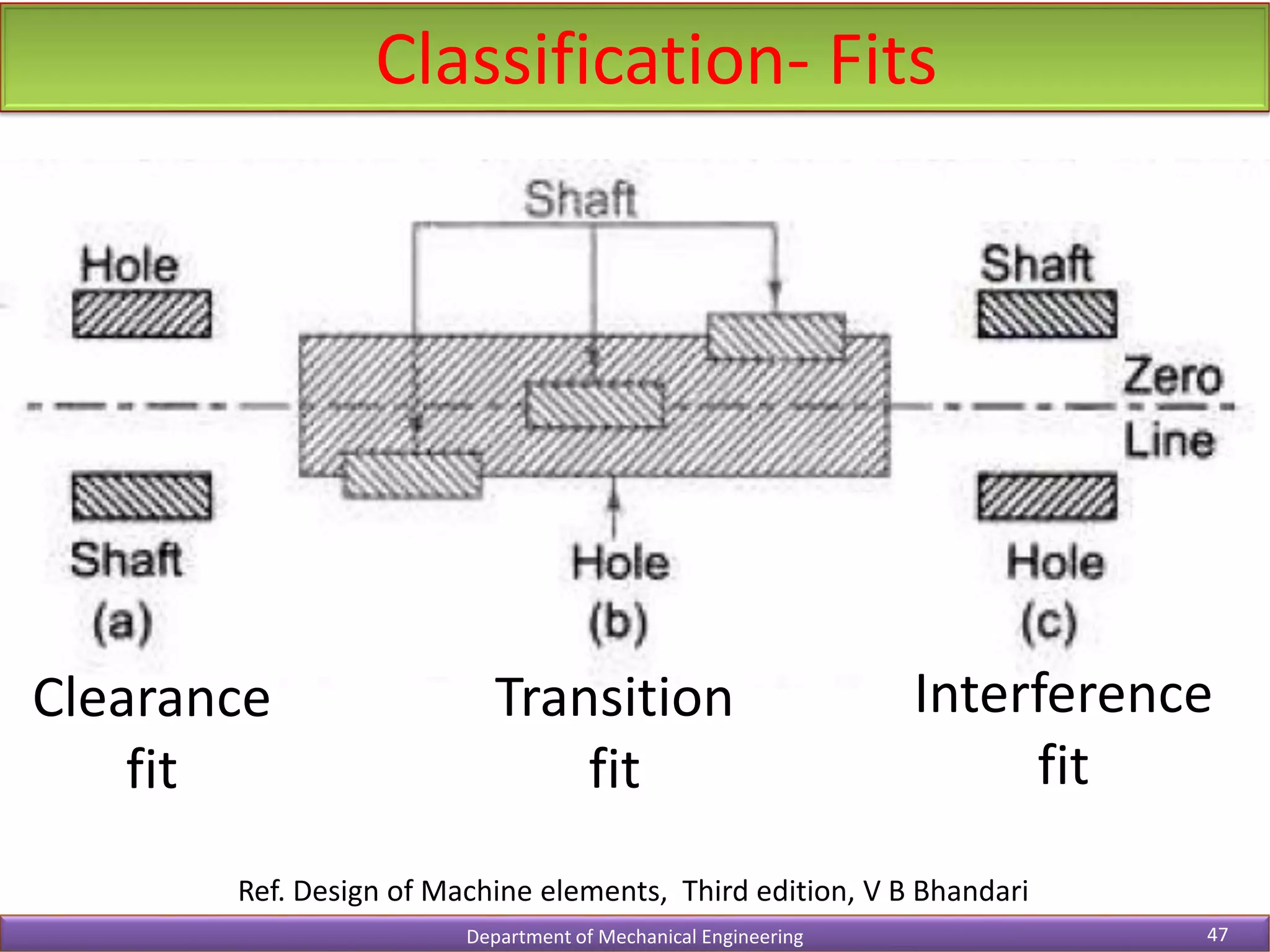
Ref. Design of Machine elements, Third edition, V B Bhandari
Clearance
fit
Transition
fit
Interference
fit
Classification- Fits
Department of Mechanical Engineering 48
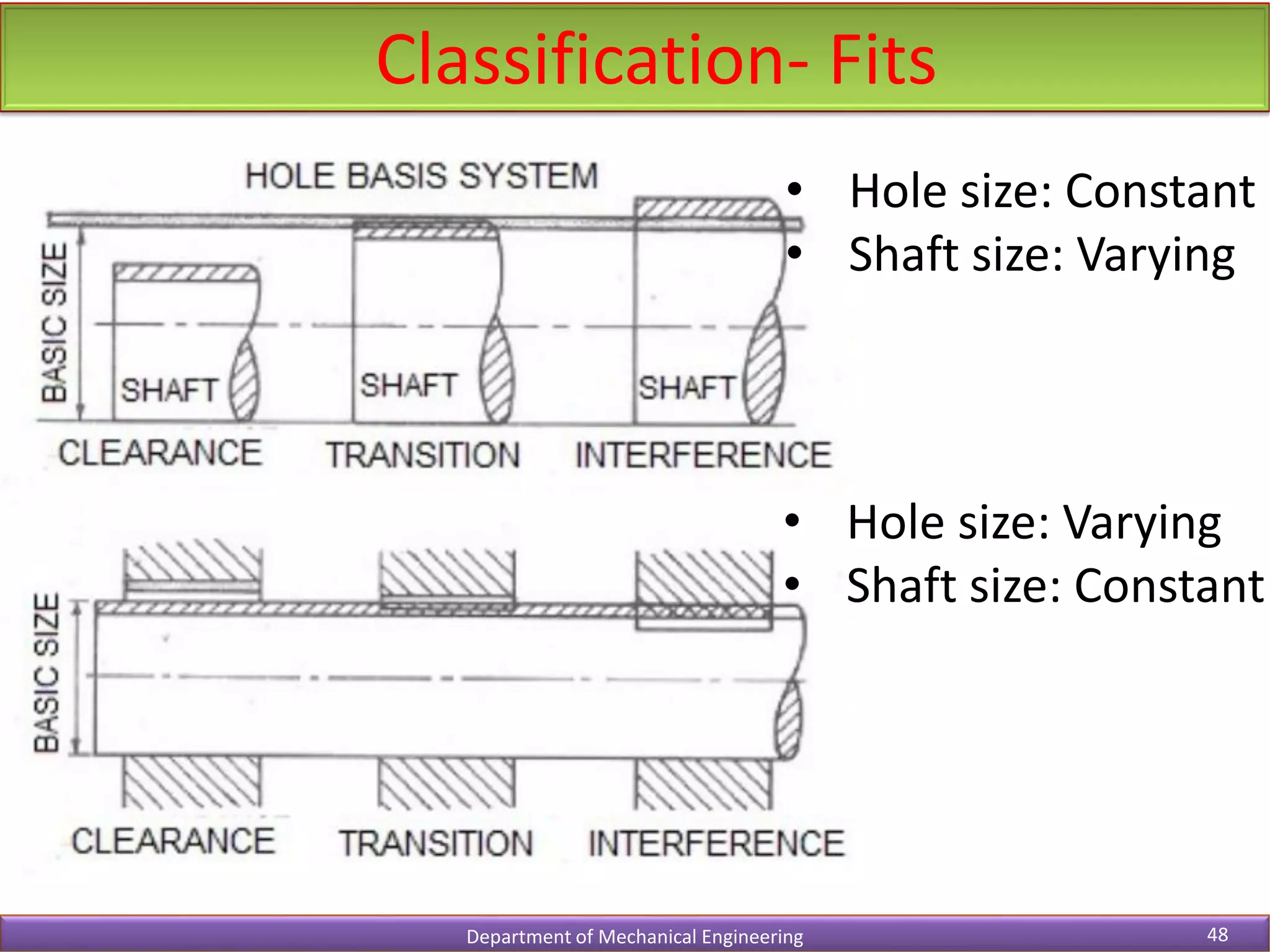
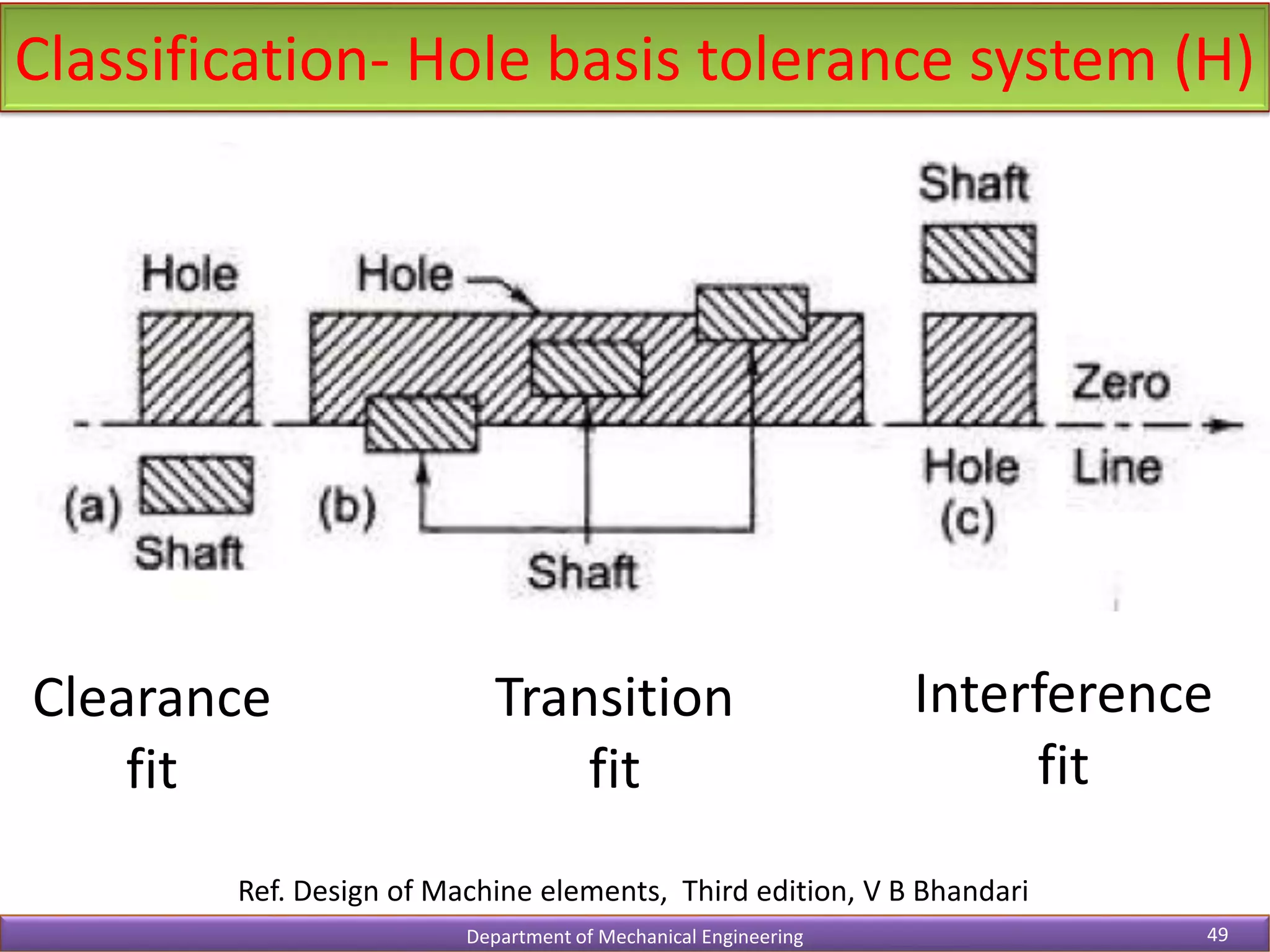
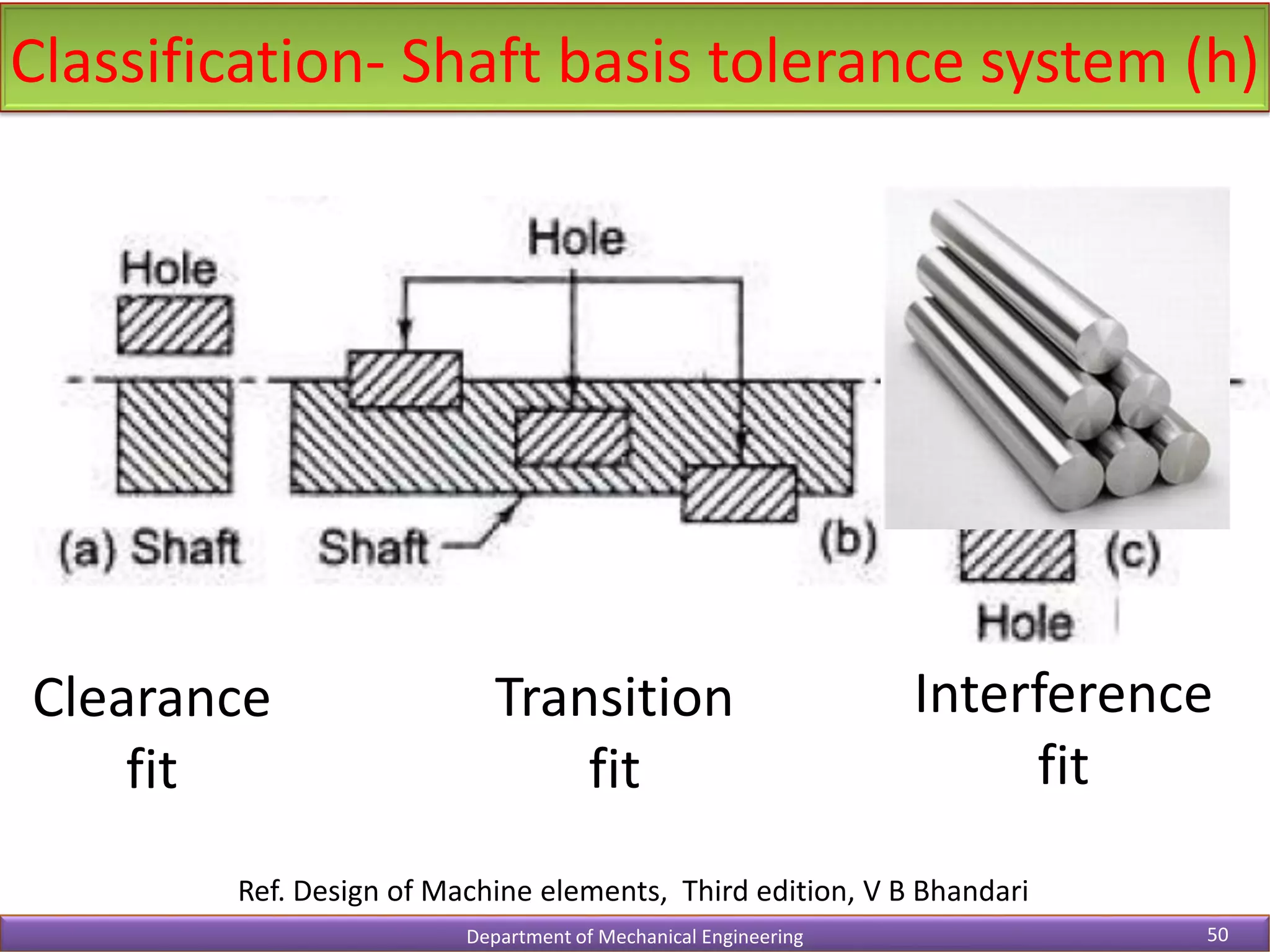
• Hole size: Constant
• Shaft size: Varying
• Hole size: Varying
• Shaft size: Constant
Classification- Hole basis tolerance system (H)
Department of Mechanical Engineering 49
Ref. Design of Machine elements, Third edition, V B Bhandari
Clearance
fit
Transition
fit
Interference
fit
Classification- Shaft basis tolerance system (h)
Department of Mechanical Engineering 50
Ref. Design of Machine elements, Third edition, V B Bhandari
Clearance
fit
Transition
fit
Interference
fit
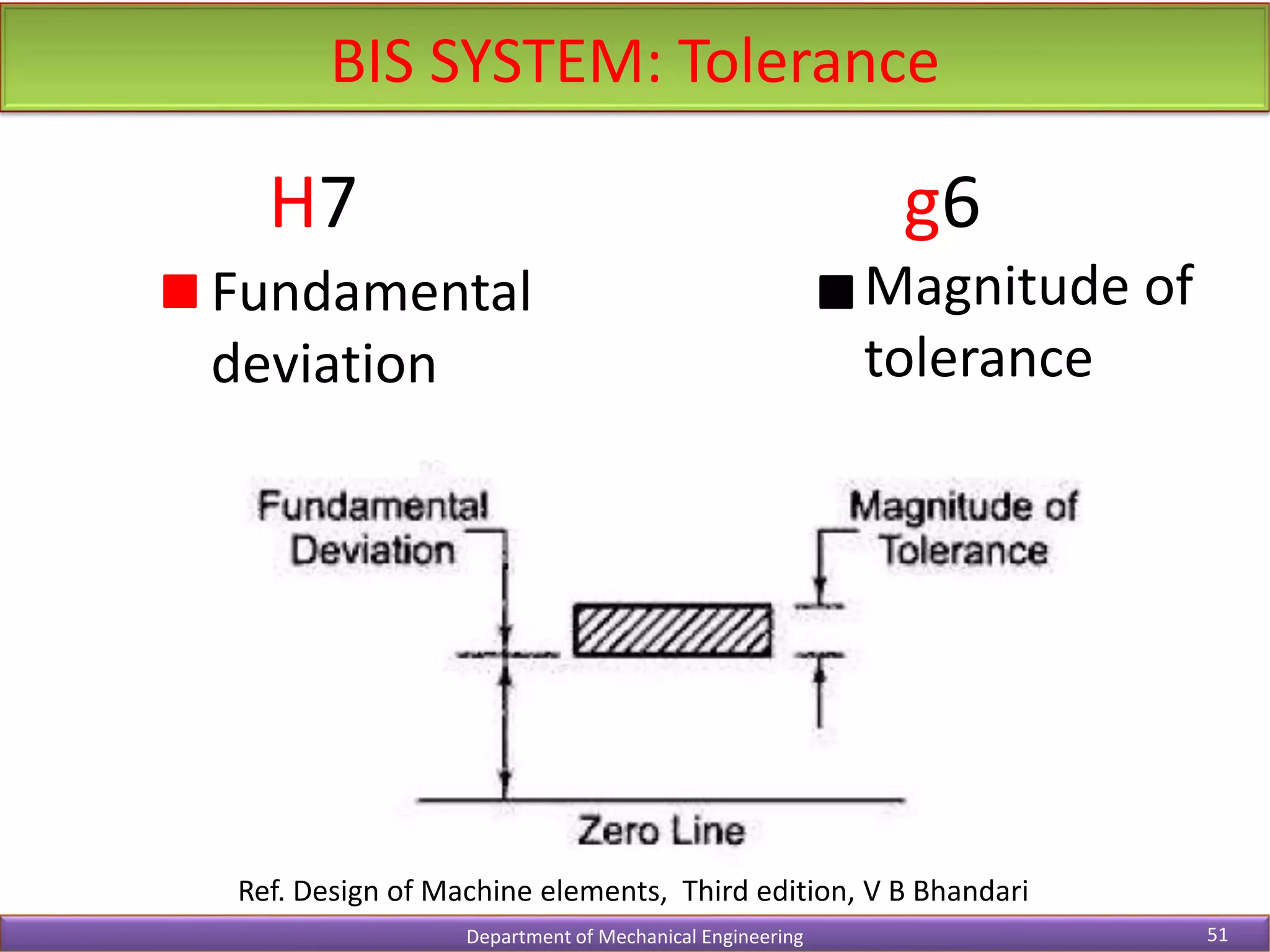
BIS SYSTEM: Tolerance
Department of Mechanical Engineering 51
Ref. Design of Machine elements, Third edition, V B Bhandari
H7 g6
Fundamental
deviation
Magnitude of
tolerance
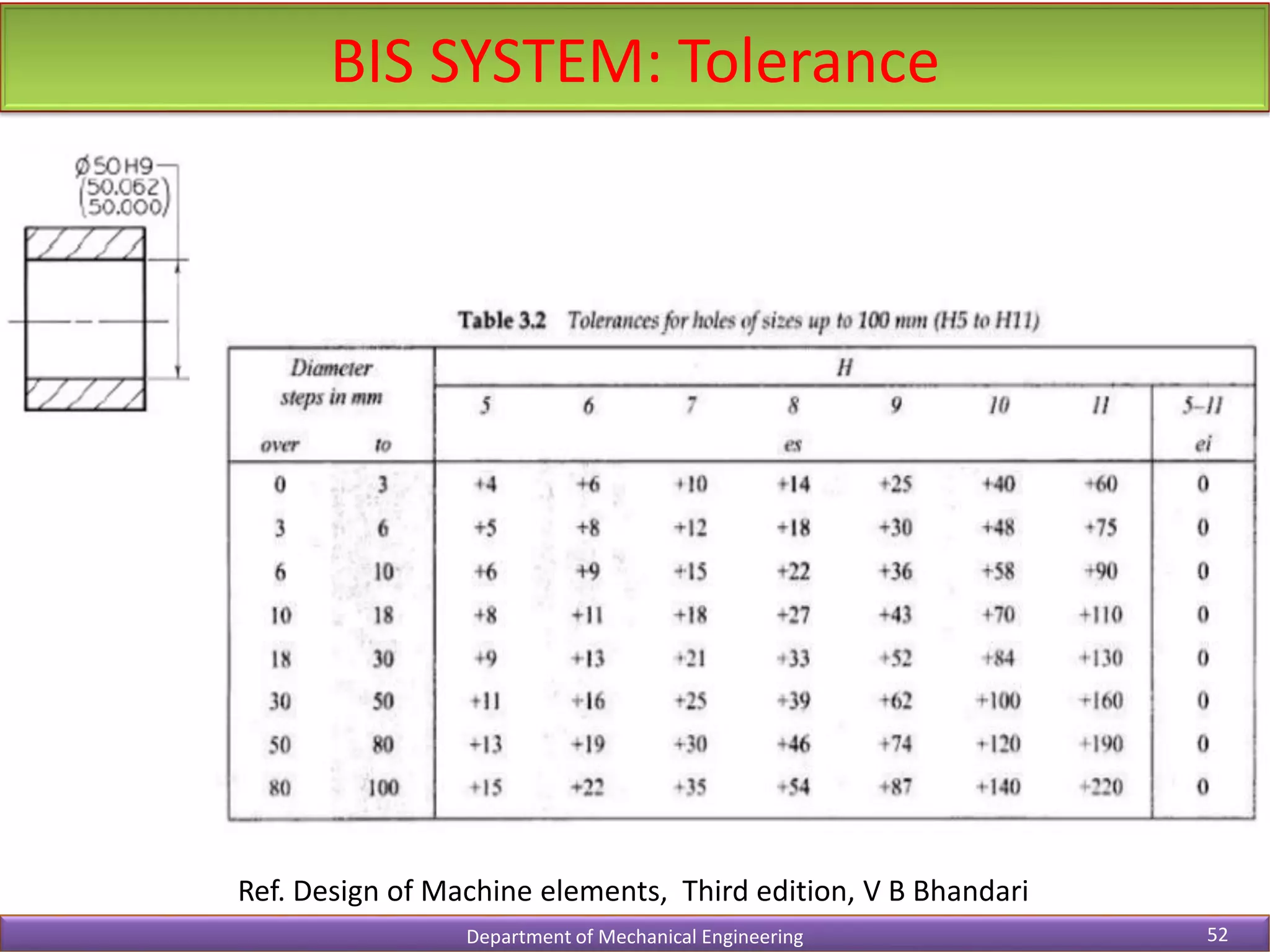
BIS SYSTEM: Tolerance
Department of Mechanical Engineering 52
Ref. Design of Machine elements, Third edition, V B Bhandari
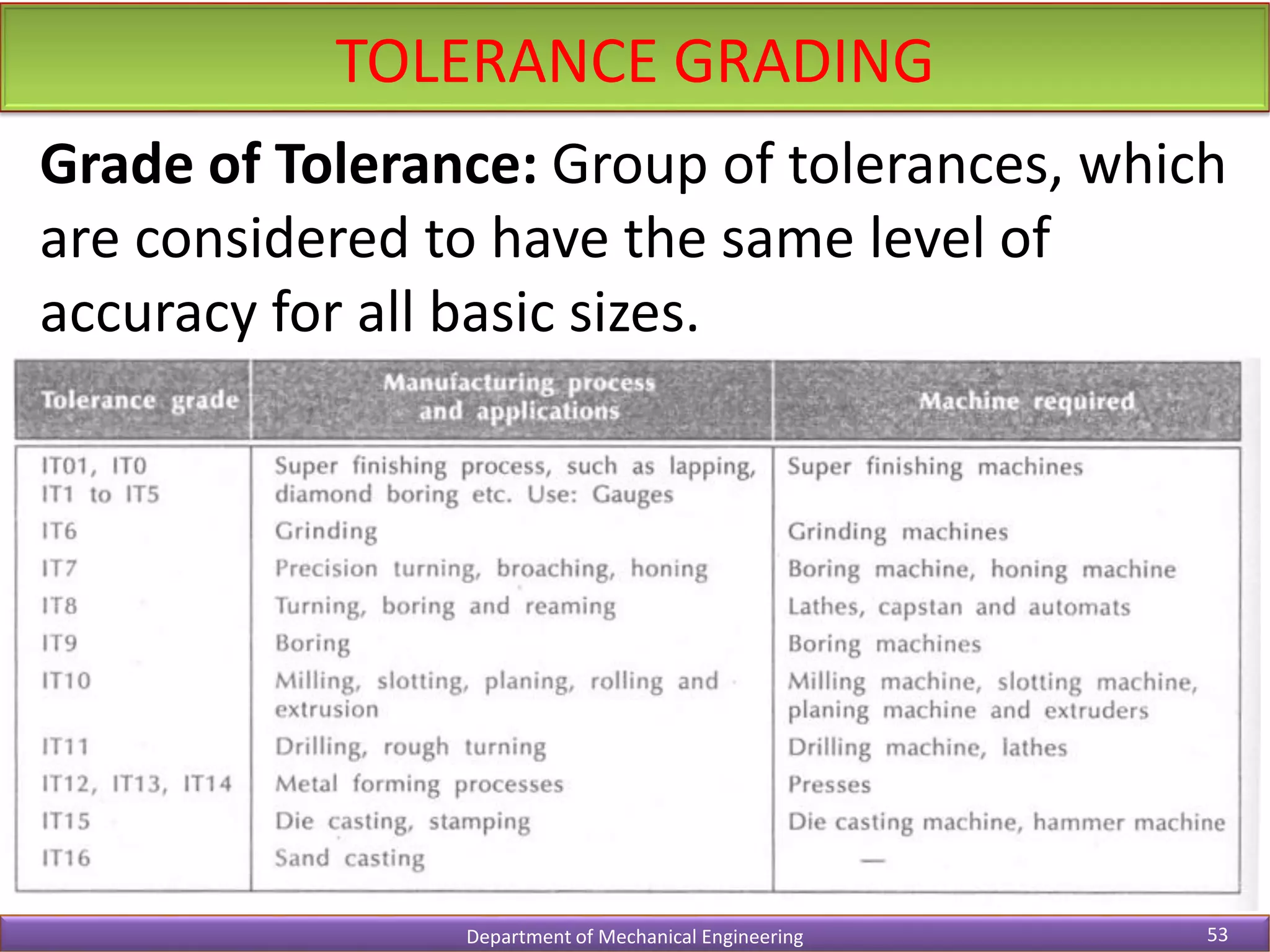
TOLERANCE GRADING
Department of Mechanical Engineering 53
Grade of Tolerance: Group of tolerances, which
are considered to have the same level of
accuracy for all basic sizes.
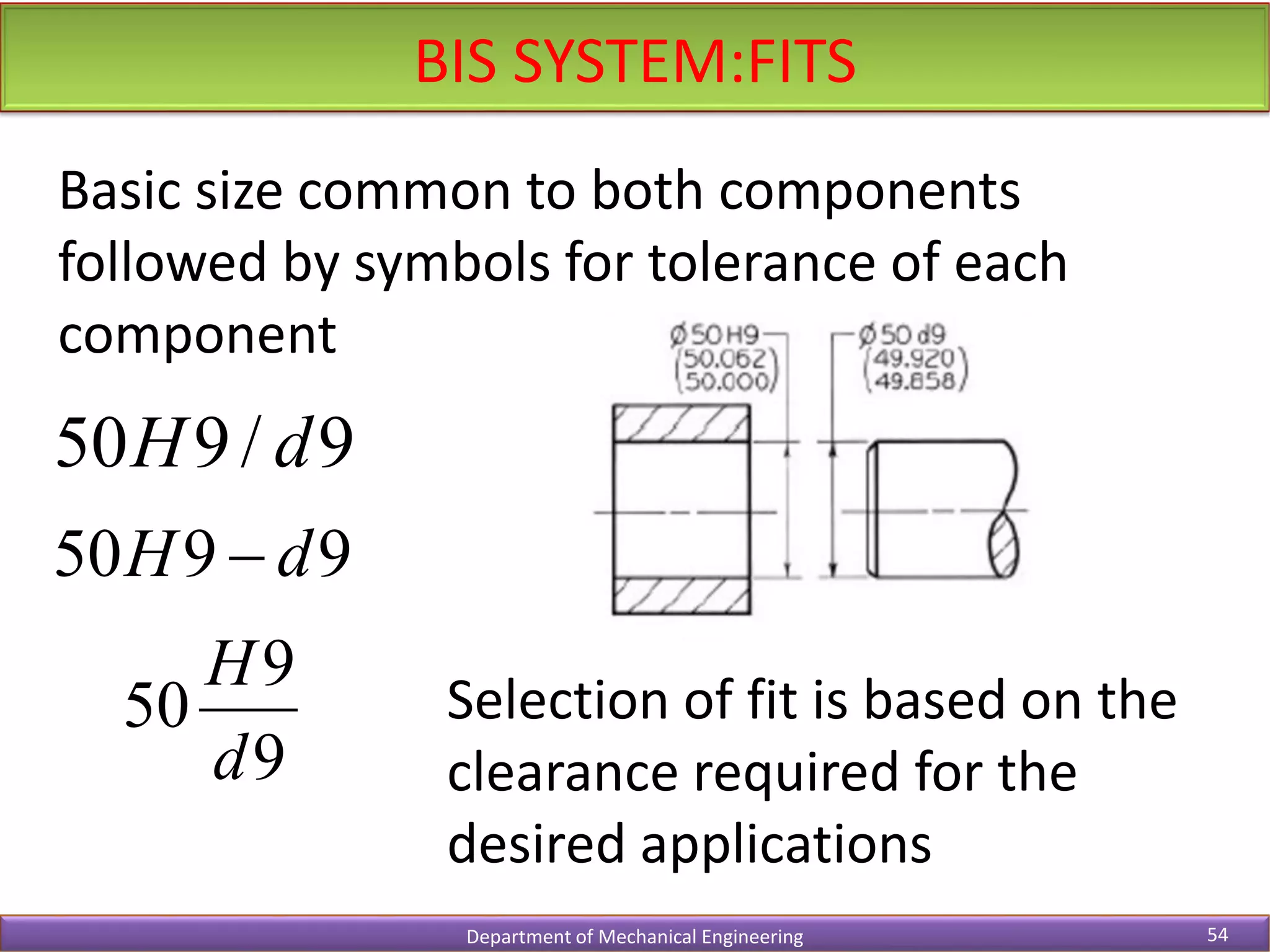
BIS SYSTEM:FITS
Department of Mechanical Engineering 54
Basic size common to both components
followed by symbols for tolerance of each
component
9
/
9
50 d
H
9
9
50 d
H 
9
9
50
d
H
Selection of fit is based on the
clearance required for the
desired applications

Module 1.pdf

  • 1.
    Nivish George DESIGN OFMACHINE ELEMENTS
  • 2.
  • 3.
    • Definition – MachineDesign is defined as the use of scientific principles, technical information and imagination in the description of a machine or a mechanical system to perform specific functions with maximum economy and efficiency – Design is an innovative and highly iterative process Machine Design Department of Mechanical Engineering 3
  • 4.
    The Design Process Departmentof Mechanical Engineering 4 • Market survey
  • 5.
    Contd… Department of MechanicalEngineering 5 Ref: https://www.carwale.com/rollsroyce-cars/ Ref:http://www.lamborghinila.com/ Ref:https://www.cardekho.com/Tata/Tata_Nano Product Specification
  • 6.
    Contd… Department of MechanicalEngineering 6 Selection of Mechanism
  • 7.
    Contd… Department of MechanicalEngineering 7 Ref. Automobile Engineering, Vol-1, Dr. Kirpal SIngh Layout of configuration and selection of joining methods
  • 8.
    Contd… Department of MechanicalEngineering 8 Design of Individual Components
  • 9.
    Contd… Department of MechanicalEngineering 9 • Prepare Assembly and detail drawing • Modify drawings after testing prototype Ref: https://blogpuneet.wordpress .com/2013/10/08/oldhams- coupling/
  • 10.
    Course Contents Department ofMechanical Engineering 10 Mod. 1 Mod. 2 Mod. 4 Mod. 5 Mod. 3 Mod. 6
  • 11.
    Basic Requirement Department ofMechanical Engineering 11 Machine Elements Strength Rigidity Wear resistance Min. Dim. And weight Manufac- turability Safety Conformance to Standards Reliability Maintaina -bility Min. Life cycle cost
  • 12.
    TRADITIONAL DESIGN METHODS Departmentof Mechanical Engineering 12 • Design by craft evolution • Design by drawing Ref:https://www.123rf.com/stock- photo/bullock_cart.html Ref:http://directboats.com/rowboats.html
  • 13.
    PROCEDURE IN DME Departmentof Mechanical Engineering 13 Failure Criterion •Elastic deflection •General yielding •Fracture Geometry & Dimensions •Operating conditions •Basis of failure criterion Design Modifications •Assembly & manufacturing considerations Specify functions • Bearing • Spring • Screw fastening Force determination • Free body diagram Selection of Material • Availability • Man. Considerations • Properties WORKING DRAWING
  • 14.
    DESIGN SYNTHESIS Department ofMechanical Engineering 14 Design Synthesis is defined as the process of creating or selecting configurations, materials, shapes and dimensions for a product. Objective Mathematical Formulation Optimisation
  • 15.
    AESTHETIC CONSIDERATIONS Department ofMechanical Engineering 15
  • 16.
    ERGONOMIC CONSIDERATIONS Department ofMechanical Engineering 16 Ergonomics is defined as the relationship between man and machine and the application of anatomical, physiological and psychological principles to solve the problems arising from man-machine relationship • Design of driver’s seat • Layout of instrument dials and display panels • Design of hand levers and hand wheels • Energy expenditure in hand and foot operations • Lighting, noise and climatic conditions in machine environment
  • 17.
    Contd…. Department of MechanicalEngineering 17 Display instruments Control instruments Quantitative measurement Easily accessible and logically positioned State of affairs Conform to the anatomy of human parts Predetermined settings Proper colour
  • 18.
    Overview Department of MechanicalEngineering 18 • Need of …….. • Definition • ????? Requirement • Procedure • Tradition • Synthesis • Design considerations
  • 19.
    Standardization Department of MechanicalEngineering 19 The obligatory norms, to which various characteristics of a product should conform. • Standards: Set of specifications for parts, materials or processes • Codes: Set of specifications for analysis, design, testing Standards Company Standards Eg: Service Standards National Standards Eg: IS, DIN International Standards Eg:ISO
  • 20.
    Standardization Department of MechanicalEngineering 20 The characteristics include materials, dimensions and shape of the component, method of testing and method of marking, packing and storing of the product. • Standards for materials, their chemical compositions, Mechanical properties and Heat Treatment • FG 150, FG 200, FG 220- (IS 210): Strength • 55Cr3- (IS 570 Part 4): Chemical composition • Standards for shapes and dimensions of commonly used machine elements • Dimension and cross section of V belts (IS 2494)
  • 21.
    Standardization Department of MechanicalEngineering 21 • Standards for fits, tolerances and surface finish of component • Fit IS 2709 (Guide for selection of fits) • Tolerances IS 919 (Recommendations for limits and fits for engineering) • Surface texture IS 10719 • Standards for testing of products • Testing of pressure vessels IS 2825 • Standards for engineering drawing of components • SP46 by BIS for engineering drawings
  • 22.
    Standardization: Advantages Department ofMechanical Engineering 22 • Reduction in types and dimensions of identical components • Reduced manufacturing facilities required for individual organisation • Easy replacement and availability • Reduced designer tasks • Improved quality and reliability
  • 23.
    Preferred Sizes Basic Series Derived Series R5 1.58 R10 1.26 R201.12 R40 1.06 R80 1.03 Selection of Preferred sizes Department of Mechanical Engineering 23 • Size of the machine element with preferred sizes 5 10 10 10 20 10 40 10 80 10 Reducing Increasing
  • 24.
    Preferred Numbers Department ofMechanical Engineering 24
  • 25.
    • Elasticity isdefined as the ability of the material to regain its original shape and size after the deformation, when the external forces are removed • Steel is perfectly elastic within a certain limit • Amount of deformation a metal undergoes is small • Atoms are displaced from their original positions but they don’t take up new positions Elasticity Department of Mechanical Engineering 25
  • 26.
    • Plasticity isdefined as the ability of the material to retain the deformation produced under the load on permanent basis • External force deforms the metal to such an extent it cannot fully recover • Some metals take up extensive deformations without fracture • Atoms are permanently displaced to take up new positions Plasticity Department of Mechanical Engineering 26
  • 27.
    Types of Materials Departmentof Mechanical Engineering 27 Cast iron Plain carbon steels Alloy Steels Ceramics Cast Steel Rubber Plastics
  • 28.
    Factors for selection Departmentof Mechanical Engineering 28 Availability Cost Mechanical Properties Manufacturing Considerations
  • 29.
    Weighted Point Method Departmentof Mechanical Engineering 29 1 • Study of application and preparing a list of desirable properties 2 • Desirable properties are assigned values 3 • Go-no-go parameters • Discriminating parameters 4 • Weightage is provided
  • 30.
    Weighted Point Method:Eg Department of Mechanical Engineering 30 S. No. Property Low alloy steel Plain carbon steels Stainless steel Chromium steels 1 Ultimate tensile strength (N/mm2) 850 850 1200 950 2 Hardenability Index 60 80 30 100 • Points for ultimate tensile strength • Sum=850+850+1200+950=3850 • Rating strength= 850/3850= 0.22 • Weightage index=0.22*5=1.1 • Points for hardenability • Sum=60+80+30+100=270 • Rating hardenability index= 60/270=0.222 • Weightage index= 0.22*3=0.666
  • 31.
    Stress Concentration Department ofMechanical Engineering 31 A P t   I y Mb b   J r Mt   The localization of high stresses due to the irregularities present in the component and abrupt changes of cross-section
  • 32.
    Causes of stressconcentration Department of Mechanical Engineering 32 • Variation in properties • Load application
  • 33.
    Contd… Department of MechanicalEngineering 33 • Abrupt changes in dimension
  • 34.
    Contd… Department of MechanicalEngineering 34 • Discontinuities in the component • Machining Scratches
  • 35.
    Stress Concentration Factor(Kt) Department of Mechanical Engineering 35 𝐾𝑡 = 𝜎𝑚𝑎𝑥 𝜎𝑜 = 𝜏𝑚𝑎𝑥 𝜏𝑜 Mathematical method Experimental methods
  • 36.
    Stress Concentration factors Departmentof Mechanical Engineering 36 𝜎𝑜 = 𝑃 𝑤 − 𝑑 𝑡 𝜎𝑜 = 𝑃 𝑑𝑡
  • 37.
    Stress Concentration factors Departmentof Mechanical Engineering 37 𝜎𝑜 = 𝑃 𝜋 4 𝑑2 𝜎𝑜 = 𝑀𝑏𝑦 𝐼
  • 38.
    Stress Concentration factors Departmentof Mechanical Engineering 38 • Ductile materials under static load • Ductile materials under fluctuating load • Brittle materials
  • 39.
    Reduction of StressConcentration Department of Mechanical Engineering 39 • Additional Notches and Holes in Tension Member • Use of multiple notches • Drilling additional holes • Removal of undesired material
  • 40.
    Reduction of StressConcentration Department of Mechanical Engineering 40 • Fillet radius, undercutting and notch for member in bending • Drilling additional holes for shaft • Fillet • Undercut • Notch • Fillet • Symmetrical holes
  • 41.
    Reduction of StressConcentration Department of Mechanical Engineering 41 • Reduction of stress concentration in threaded members • Undercut • Reduction in Shank diameter
  • 42.
    Simulation results Department ofMechanical Engineering 42 yield= 804.42MPa • Abrupt changes in section
  • 43.
    Problem?? Department of MechanicalEngineering 43 A flat plate subjected to a tensile force of 5 kN is shown in Figure. The plate material is of grey cast iron FG 200 and the factor of safety is 2.5. Determine the thickness of the plate. Objective: Find t, Given data (Check for consistency in units) P=5kN Sut=200 N/mm2 (fs)=2.5 D=45mm,d=30mm,w=15mm, r= 5mm 𝜎𝑚𝑎𝑥 = 𝑆𝑢𝑡 𝑓𝑠 𝐷 𝑑 𝑟 𝑑 `
  • 44.
    Tolerances Department of MechanicalEngineering 44 • Permissible variation in dimensions of the component • Types: Unilateral and bilateral Ref. Design of Machine elements, Third edition, V B Bhandari
  • 45.
    Fits Department of MechanicalEngineering 45 • When two parts are to be assembled, the relationship resulting between their sizes before assembly Very loose Tight Loose
  • 46.
    Classification- Fits Department ofMechanical Engineering 46
  • 47.
    Classification- Fits Department ofMechanical Engineering 47 Ref. Design of Machine elements, Third edition, V B Bhandari Clearance fit Transition fit Interference fit
  • 48.
    Classification- Fits Department ofMechanical Engineering 48 • Hole size: Constant • Shaft size: Varying • Hole size: Varying • Shaft size: Constant
  • 49.
    Classification- Hole basistolerance system (H) Department of Mechanical Engineering 49 Ref. Design of Machine elements, Third edition, V B Bhandari Clearance fit Transition fit Interference fit
  • 50.
    Classification- Shaft basistolerance system (h) Department of Mechanical Engineering 50 Ref. Design of Machine elements, Third edition, V B Bhandari Clearance fit Transition fit Interference fit
  • 51.
    BIS SYSTEM: Tolerance Departmentof Mechanical Engineering 51 Ref. Design of Machine elements, Third edition, V B Bhandari H7 g6 Fundamental deviation Magnitude of tolerance
  • 52.
    BIS SYSTEM: Tolerance Departmentof Mechanical Engineering 52 Ref. Design of Machine elements, Third edition, V B Bhandari
  • 53.
    TOLERANCE GRADING Department ofMechanical Engineering 53 Grade of Tolerance: Group of tolerances, which are considered to have the same level of accuracy for all basic sizes.
  • 54.
    BIS SYSTEM:FITS Department ofMechanical Engineering 54 Basic size common to both components followed by symbols for tolerance of each component 9 / 9 50 d H 9 9 50 d H  9 9 50 d H Selection of fit is based on the clearance required for the desired applications