NSTP BINGO
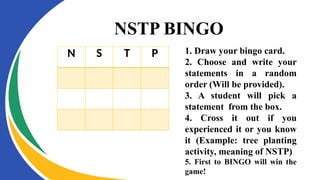
N ST P 1. Draw your bingo card.
2. Choose and write your
statements in a random
order (Will be provided).
3. A student will pick a
statement from the box.
4. Cross it out if you
experienced it or you know
it (Example: tree planting
activity, meaning of NSTP)
5. First to BINGO will win the
game!
4.
NSTP BINGO
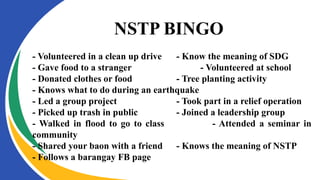
- Volunteeredin a clean up drive - Know the meaning of SDG
- Gave food to a stranger - Volunteered at school
- Donated clothes or food - Tree planting activity
- Knows what to do during an earthquake
- Led a group project - Took part in a relief operation
- Picked up trash in public - Joined a leadership group
- Walked in flood to go to class - Attended a seminar in
community
- Shared your baon with a friend - Knows the meaning of NSTP
- Follows a barangay FB page
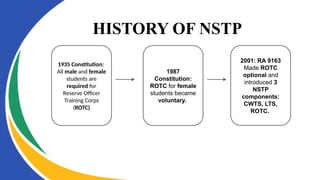
1935 Constitution:
All maleand female
students are
required for
Reserve Officer
Training Corps
(ROTC)
1987
Constitution:
ROTC for female
students became
voluntary.
2001: RA 9163
Made ROTC
optional and
introduced 3
NSTP
components:
CWTS, LTS,
ROTC.
HISTORY OF NSTP
7.
THUMBS UP, THUMBSDOWN
In the 1935 Constitution, all male and
female students are required to take
ROTC.
8.
THUMBS UP, THUMBSDOWN
In the 1935 Constitution, all male and
female students are required to take
ROTC.
THUMBS UP!
9.
THUMBS UP, THUMBSDOWN
ROTC became voluntary for female
students in the 1987 constitution.
10.
THUMBS UP, THUMBSDOWN
ROTC became voluntary for female
students in the 1987 constitution.
THUMBS UP!
11.
THUMBS UP, THUMBSDOWN
In 2001, RA 9163 or the NSTP Act of 2001
Made ROTC optional and introduced 1
component.
12.
THUMBS UP, THUMBSDOWN
In 2001, RA 9163 or the NSTP Act of 2001
Made ROTC optional and introduced 1
component.
THUMBS DOWN! IT HAS 3
COMPONENTS: CWTS, LTS, ROTC.
Republic Act 9163
Knownas National Service Training Program (NSTP) Act
of 2001
Is an act establishing the National Service Training
Program (NSTP) for tertiary level students, amending for
the purpose Republic Act 7077 (Citizen Armed Forces of
the Philippines Reservist Act) and Presidential Decree
1708 (National Service Law) and for other purposes.
15.
What is theguiding principle in establishing the
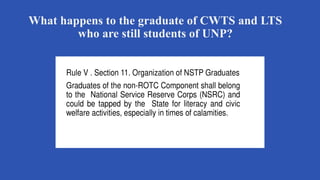
NSTP Law?
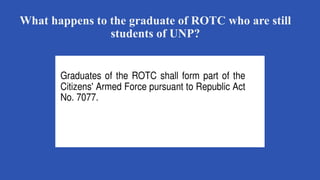
• Section 2 of R.A 9163 affirmed that it is the prime duty
of the government to serve and protect its citizens.
• It shall the responsibility of the citizens to defend the
security of the state and in fulfilment thereof, the
government may require each citizen to render
personal, military or civil service.
16.
What is theNational Service Training Program (NSTP)?
• It is a program aimed at enhancing civic
consciousness and defense preparedness in
the youth by developing the ethic of service
and patriotism while undergoing training in
any of its three (3) program components.
17.
Mission
To conduct capabilityenhancement for the three (3) components
CWTS, LTS and ROTC towards strengthening the values and traits
of the youth while working closely with a network of organizing
within and outside the college.
18.
Goal
To promote andintegrate values education, transformational
leadership and sustainable social mobilization for youth and family
development, community building, national security and global
solidarity.
19.
Objectives
Inculcate among thestudents the ideas of patriotism,
nationalism and enhance their involvement in public and
civic-oriented activities.
20.
Objectives
• Train thestudents in various field of endeavor imbued
with moral values that enhance their physical,
intellectual, moral, spiritual and social well-being.
• Produce service- oriented and responsive students that
will be of help to the locality and community.
21.
What should thestate do to pursue the goals?
The youth shall be motivated, trained,
organized and mobilized in military training,
literacy, civic welfare and other similar
endeavors in the service of the nation.
Who are totake the NSTP?
Section 4. Coverage:
a. All incoming students, male and female,
starting SY 2002- 2003 enrolled in any
baccalaureate and in at least two (2)-year
technical vocational or associate courses, are
required to complete one (1) of the NSTP
component of their choice, as graduation
requirement.
25.
Why is therea need to conduct NSTP Orientation Program?
Section 4
c. There shall be an orientation for all NSTP
enrollees to be jointly conducted by the ROTC,
CWTS, and LTS coordinators/implementers.
Students enrolled in the first semester of the
freshmen year shall be made to undergo a
common module phase for 25hours training
period.
26.
Continuation of Section4
• Subjects covered are: citizenship
training, Drug addiction; disaster
awareness, preparedness, and
management; environmental
protection and other national security
concerns.
27.
What are thedifferent program components of the NSTP?
Section 5. Program Components
a. The NSTP shall have the following components
which students can choose from as defined in
Rule II, Section 3 thereof: The Reserve Officers
Training Corps (ROTC), Literacy Training
Service (LTS), and Civic Welfare Training
Service (CWTS)
28.
What are theemphasis of the training for all program
components of the NSTP?
All program components, the ROTC in
particular, shall give emphasis on citizenship
training and shall instill patriotism, moral
virtues, respect for the rights of civilians and
adherence to the Constitution.
29.
What is theequivalent course unit of each NSTP Component?
Section 6. Duration and Equivalent Course Unit
Each of the NSTP component carries a three(3)
units credit per semester
30.
How many traininghour does NSTP students to meet every
semester?
Section 6. Duration and Equivalent Course Unit
Each of the NSTP component entails to meet for
fifty-four (54) to ninety (90) training hours per
semester.
31.
How many semestersthat student is to enroll in the NSTP
subject?
Section 6. Duration and Equivalent Course Unit
Each of the NSTP component is to be taken for
an academic period of two (2) semesters or one
academic year.
32.
What are theNSTP components which the student may choose to
enroll for a semester?
NSTP 1 is offered during first semester which
comprises the CWTS 1, LTS 1 and MS 1 (ROTC 1)
subjects.
NSTP 2 is offered during second semester which
comprises the CWTS 2, LTS 2 and MS 2 (ROTC 2)
subjects.
Students is to choose from among the three
33.
What are theprerequisite subject for NSTP?
NSTP 1 is offered every first semester only hence, does
not have any prerequisite subject. NSTP 2 is offered
every second semester and NSTP 1 is its prerequisite.
34.
How much isthe tuition fee a student has to pay to enroll in
NSTP subject?
Rule IV FEES AND INCENTIVES –
Section 9
No fees shall be collected for any of the NSTP
components except basic tuition fees, which shall not
be more than fifty percent (50%) of the charges of the
school per academic unit.
35.
Does enrolled NSTPstudent to pay for Insurance protection ?
Rule IV Fees and Incentives – Section 10. Fees,
Insurance and Protection
The school authorities concerned, CHED and TESDA
shall ensure that group insurance for health and
accident shall be provided for students enrolled in any
of the NSTP components.
36.
Can a studentcross enroll the NSTP subject?
Section7. Clustering and Cross-Enrolment
The school must allow any NSTP to cross-enroll in any
CHED/TESDA recognized institution.
37.
Can a studenttransfer from one NSTP component to another?
NSTP student who is enrolled in one component and
later decided to transfer in another component is to
inform the NSTP Office on or before the third
meeting/training day from the start of classes. This is
required in order to arrange the enrolment profile of
students for submission to CHED Regional Office.
38.
Can a studentdrop the NSTP subject?
Based on the Student Manual, a student may, with the consent
of the NSTP implementer and NSTP Director, drop a subject
by filling out the prescribed form before the administration of
midterm examination. After the midterm period has lapsed, a
student may be allowed to drop a course by reason of illness
duly certified by a physician, or other valid reasons. A student
who unofficially drop his/her course like NSTP after obtaining
his/her midterms grades, shall be given a grade of 5.0 (failure)
at the end of the term. The NSTP implementer shall be
responsible for the final grade of the students.
39.
Is the finalgrade in NSTP subject included in the computation
of Grade Point Average (GPA) of the student?
Section 6. Duration and Equivalent Course Unit
Earned NSTP units shall not be included in the
computation of Grade Point Average (GPA)
grades of the college students.
40.
Can a Personwith Disability (PWD) enroll in
NSTP subject?
Person with Disability (PWD) as evidenced by
pertinent documents and actual observation shall
be mobilized according to their skills and
potentials. They are required to enroll
course/subjects and shall be given a grade from
their performance.
41.
What is theGrading System being adopted by
the NSTP?
The College has a uniform grading system using
numbers from 1.0 to 5.0, where 1.0 is the highest.
It adopts the cumulative grading system in all
program offering including NSTP with two (2)
rating periods, namely: midterm rating period,
and final rating period.
Students are allowedto CHOOSE which
NSTP COMPONENT they want to take.
THUMBS UP!
47.
Your grade inNSTP is NOT INCLUDED in
the COMPUTATION of your GWA.
48.
Your grade inNSTP is NOT INCLUDED in
the COMPUTATION of your GWA.
THUMBS UP!
49.
THE THREE (3)PROGRAM COMPONENTS OF
NSTP
A. CIVIC WELFARE TRAINING SERVICE
(CWTS)
B. LITERACY TRAINING SERVICE (LTS)
C. RESERVE OFFICERS TRAINING CORPS
(ROTC)
CIVIC
WELFARE
TRAINING
SERVICE
(CWTS)
Refers to theprograms or activities
contributory to the general and
betterment of life for the members of
the community or the enhancement
of its facilities, especially those
devoted to improving health,
education, environment,
entrepreneurship, safety, recreation
and morals of the citizenry.
52.
Specific Objectives ofCWTS
Promote and protect the physical, mental,
spiritual and social well-being of the youth.
Inculcate patriotism and nationalism in the
youth.
Encourage their involvement in the public and
civic affairs.
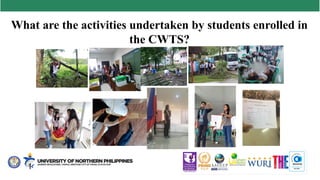
53.
What are theactivities undertaken by students enrolled in
the CWTS?
LITERACY
TRAINING
SERVICE
(LTS)
This a programdesigned to
train students to become
teachers of literacy and
numeric skills to school
children, out – of school
youth and other segments
of society in need of their
services.
56.
Specific Objectives ofLTS
Develop the desirable traits of a Filipino for their
growth and development
Inculcate the importance of functional literacy
and numeracy skills.
57.
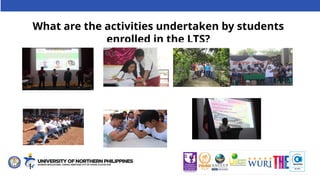
What are theactivities undertaken by students
enrolled in the LTS?
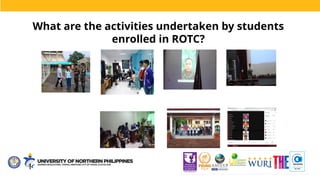
What are theactivities undertaken by students
enrolled in ROTC?
61.
What is RegionalAnnual Administrative Inspection
(RAATI)?
Section 9 b.3. Monitoring
Regional Annual Administrative Performance
Evaluation (RAAPE) or Regional Annual
Administrative Inspection (RAATI) is an annual
inspection conducted by the Major Service ResCom for
ROTCU based on parameters as prescribed by the
AFP in order to determine if trainings undertaken are
in consonance with the implementing guidelines.
62.
A One (1)Summer Program (OSP) in lieu of the
two (2) semester program of ROTC, CWTS, AND
LTS shall be designed, formulated, and adopted by
the DND, CHED, AND TESDA, subject to the
capabilities of the school and the AFP.
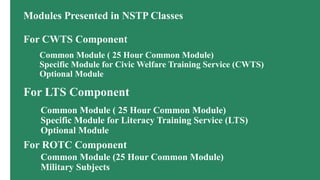
Modules Presented inNSTP Classes
For CWTS Component
Common Module ( 25 Hour Common Module)
Specific Module for Civic Welfare Training Service (CWTS)
Optional Module
For LTS Component
Common Module ( 25 Hour Common Module)
Specific Module for Literacy Training Service (LTS)
Optional Module
For ROTC Component
Common Module (25 Hour Common Module)
Military Subjects
76.
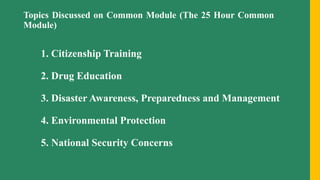
Topics Discussed onCommon Module (The 25 Hour Common
Module)
1. Citizenship Training
2. Drug Education
3. Disaster Awareness, Preparedness and Management
4. Environmental Protection
5. National Security Concerns
77.
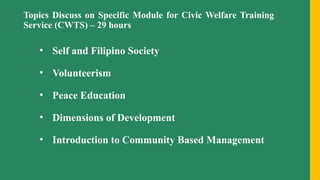
Topics Discuss onSpecific Module for Civic Welfare Training
Service (CWTS) – 29 hours
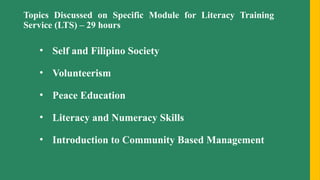
• Self and Filipino Society
• Volunteerism
• Peace Education
• Dimensions of Development
• Introduction to Community Based Management
78.
Topics Discussed onSpecific Module for Literacy Training
Service (LTS) – 29 hours
• Self and Filipino Society
• Volunteerism
• Peace Education
• Literacy and Numeracy Skills
• Introduction to Community Based Management
79.
Topics Discussed onOptional Module (for CWTS and LTS
Components) – 36 hours
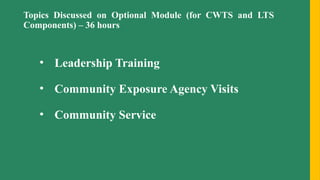
• Leadership Training
• Community Exposure Agency Visits
• Community Service
80.
Topics Discuss onBasic Reserve Officer Training Corps
(ROTC) in Military Science (MS1)
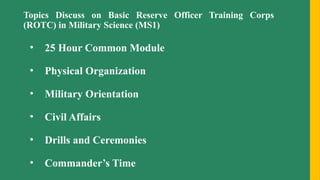
• 25 Hour Common Module
• Physical Organization
• Military Orientation
• Civil Affairs
• Drills and Ceremonies
• Commander’s Time
81.
Topics Discuss onBasic Reserve Officer Training Corps
(ROTC) in Military Science (MS2)
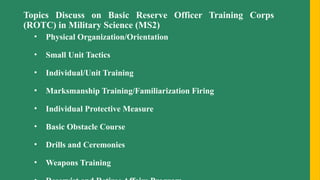
• Physical Organization/Orientation
• Small Unit Tactics
• Individual/Unit Training
• Marksmanship Training/Familiarization Firing
• Individual Protective Measure
• Basic Obstacle Course
• Drills and Ceremonies
• Weapons Training
What CHED issuancegoverned the Field Immersion
Phase of the NSTP during second semester?
CHED Memo Order No. 63 S. 2017 Policies and
Guidelines on Local Off- Campus Activities
7.2 Curricular activities are required off-campus
activities and are an integral part of the instructional
program. All students are expected to attend the scheduled
off-campus activity since it is part of the regularly
scheduled class time.
84.
CHED Memo OrderNo. 63 S. 2017 Policies and
Guidelines on Local Off-Campus Activities
Section 5. These set of policies and guidelines aim to guide HEIs in the conduct of off-campus activities in
order to developer the holistic experience of students and to provide:
5.1 access to efficient and interactive learning for students through meaningful off-campus
activities as part of their program requirement embodied in the approved curriculum:
5.2 quality off-campus activities necessary to the acquisition of relevant knowledge, skills,
and values;
5.3 mechanisms to exercise due diligence prior, during and after the activities for safety and
welfare of the students HEI’s personnel; and
5.4 mechanisms for the implementation of parallel activities to those students who will not be
participating in the activity
85.
Monitoring on theimplementation of the program
CHED monitors the implementation of the NSTP by submission of
Annual NSTP Performance Report, Self Assessment Instrument and
personally conducts inspection anytime of the year.
On the other hand the institution monitors and evaluates the
implementation of the program through the Program Projects and
Activities, and the Office Performance Commitment and Review
(OPCR) of the Office.
86.
EXEMPTION
a.1. Students whofinished or graduated from a
baccalaureate degree or two year technical-vocational
or associate course and pursuing or enrolled in
another or additional baccalaureate degree or two-
year technical-vocational or associate course in SY
2003-2004
87.
EXEMPTION
a.2. Students whocompleted any of the three NSTP
components but considered freshmen to the course
where they transferred or shifted ; and
a.3. Foreign students or aliens.
88.
What happens tothe graduate of CWTS and LTS
who are still students of UNP?
89.
What happens tothe graduate of ROTC who are still
students of UNP?
How does NSTPgraduate be given Serial Number?
NSTP student to pass NSTP 1 and NSTP 2 subjects and
after completion, student is awarded with NSTP Serial
Number. For CWTS and LTS, serial number is
requested from the Commission on Higher Education
(CHED) while serial number of ROTC is provided by
Department of National Defense (DND).
What are themandates of the NSRC reservist?
• RA10121 (PDRRM Act of 2010) mandates
• NSRC reservists to be organized, developed,
• trained and mobilized for DRRM and for other
• Purposes as provided for under RA 9163.
95.
Continuation . ..
The School-Based NSRC Units (SBNU) is to be
established in different Higher Education
Institutions (HEIs) under CHED as defined in the
Implementing Guidelines and Procedures (IGP)
on the Development, Organization, Training,
Administration, Utilizations, Mobilizations,
Operation, Accreditation, Protection and Funding
of the NSRC.
What is JointMemorandum Circular No. 1, S. 2019?
Guidelines for the Exemption of the SK Officials
from taking the NSTP-CWTS in Accordance with
Section 16 No. 2 of RA 10742
This Guidelines exempt SK officials- enrolled in
NSTP 2 (CWTS) of HEIS who satisfied the
criteria for exemption.
98.
Rule VI Miscella
Section12 Certificate of Completion
Certificate of Completion with corresponding
serial number issued by CHED, TESDA or DND,
shall be awarded to students who have
successfully complied with the program
requirements.
99.
Rule VI Miscella
Section12 Certificate of Completion
Certificate of Completion with corresponding
serial number issued by CHED, TESDA or DND,
shall be awarded to students who have
successfully complied with the program
requirements.
#3 1935 - all was required for defense preparation
1987 - after edsa people power revolution - voluntary na lang for female students because of the rising issues. Emphasis was now on civic duties and not military only
#4 1935 - all was required for defense preparation
1987 - after edsa people power revolution - voluntary na lang for female students because of the rising issues. Emphasis was now on civic duties and not military only
#6 1935 - all was required for defense preparation
1987 - after edsa people power revolution - voluntary na lang for female students because of the rising issues. Emphasis was now on civic duties and not military only
#7 RA 7077-This Act shall be known as the “Citizen Armed Force or Armed Forces of the Philippines Reservist Act.”
PD 1708- Dangerous Drugs Act of 1972
#8 RA 7077-This Act shall be known as the “Citizen Armed Force or Armed Forces of the Philippines Reservist Act.”
PD 1708- Dangerous Drugs Act of 1972
#9 RA 7077-This Act shall be known as the “Citizen Armed Force or Armed Forces of the Philippines Reservist Act.”
PD 1708- Dangerous Drugs Act of 1972
#10 RA 7077-This Act shall be known as the “Citizen Armed Force or Armed Forces of the Philippines Reservist Act.”
PD 1708- Dangerous Drugs Act of 1972
#11 RA 7077-This Act shall be known as the “Citizen Armed Force or Armed Forces of the Philippines Reservist Act.”
PD 1708- Dangerous Drugs Act of 1972
#12 RA 7077-This Act shall be known as the “Citizen Armed Force or Armed Forces of the Philippines Reservist Act.”
PD 1708- Dangerous Drugs Act of 1972
#14 RA 7077-This Act shall be known as the “Citizen Armed Force or Armed Forces of the Philippines Reservist Act.”
PD 1708- national Service Law
So ang NSTP ay updated na Law ng ROTC at military training na nagsimula sa dalawang batas na ra 7077 and pd 1708. Kumbaga na expand lang sya at nadagdagan ng components para mas maraming pagpilian ang students kung paano sila makaka help sa bayan.
#15 Ayon sa Section 2 ng R.A. 9163 (NSTP Law), tungkulin ng gobyerno na maglingkod at protektahan ang mga mamamayan.
Kapag sinabi namang responsibilidad ng mamamayan, ibig sabihin, dapat din nating ipagtanggol ang kaligtasan at seguridad ng bansa.
Bilang katuparan nito, pwedeng i-require ng gobyerno na mag-render tayo ng personal service, military service, o civil service.
Halimbawa sa Taglish:
“Kung iniisip mo, parang give-and-take lang ‘yan. Gobyerno ang nag-aalaga at nagpoprotekta sa atin, pero in return, may duty rin tayo na tulungan at ipagtanggol ang bansa kapag kailangan—pwedeng sa military training, pagtulong sa komunidad, o iba pang civic duties.”
#16 Civic consciousness - awareness and responsibility mo as a citizen to help community/country
#18 Volunteerism
Many volunteering opportunities exist, including education, public health, environmental, and more.
#21 Mobilized, that’s why on the second semester of the NSTP program especially for the LTS or CWTS the students are required to community and school-based projects.
#24 In law, may choice talaga. Pero sa totoong Buhay, naka align ito sa school policy or program
requorement para mas agn ang NSTP components sa career path ng estuante.
Kaya example, sa educ ay LTs, sa pssych etc CTWS tapos sa crim naman ay ROTC
*Hindi ibig Sabihin na bawal pumili, sadyang inaalign lang sa school policy at program requirement.
#36 Kung Hindi available sa school ang NSTP COMPONENT na gusto mo, pwede Kang mahg enroll sa iBang school para doon Kunin ang NSTP mo.
#39 Considering that the NSTP grade is not included no the GWA/GPA, and if the student have a grade lower than 2.5 he/she will be disqualified to earned a latin honor. Same as through with the 5.0 and UD based on the guidelines of the Office University Registrar in the selection or eligibility of the student to qualifiy as latin honor,
#40 They will be given a tasks based on their capabilities.
#53 Clean up drive, tree planting, blood donation, feeding program, first aid training, livelihood training, recycling, community sports programs to promote healthy lifestyle.
Psychology - mental health programs, anti bullying, peer counseling
Archi - community mapping or site planning, designing small public spaces like parks waiting sheds, safety assessments.
BSBA - financial literacy for community, small business workshops, organizing livelihood fairs
BFA painting at VISCOM - mural painting, art therapy sessions para sa children and elderly, posters, art workshops
#57 Pagturo ng reading, writing, basic math. Remedial classes - lalo sa mga nasa HS na pero Hindi pa rin makabasa. Creating learning materials, tutoring, etc.
#60 Basic military training, disaster response, community service missions.
#61 Yearly check up ng ROTC units. To see ng AFP if Tama or ayon sa rules yung training at drills ng ROTC sa school.
Hazing, forced participation kahit may medical restriction.
#62 Summer class kapag Hindi ka nakatake ng 2 semesters, pero kailangan pa itong I approve. At depende if kaya ng school
#84 Rules t make sure na safe at makakatulong sa learning ng students. As well as an alternate activity sa mga Hindi makakasama
#85 For the NSTP implementers, there is a Teaching Efficiency Rating (TER) instrument administered by the IFDO/OVPAA.
#86 Kung tapos ka na sa Isang degree or 2 year course tapos kumuha ka ng Isang kurso pa ulit, exempted ka na sa pagkuha ng NSTP.
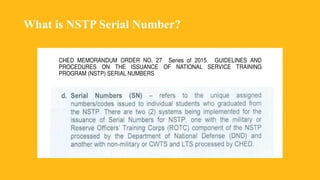
#92 SN- is a unique assigned number/codes issued to individual students who graduated from any of the NSTP Components by the virtue of CMO no.27 s. 2015 guidelines and procedures of the issuance of NSTP serial numbers
#95 Parang back up sila ng gobyerno in terms of sakuna or kapag may pangangailangan sa community.
#97 Kapag SK ka at nagpapatupad ng clean up drives, feeding program, pasok ka sa criteria for exemption, kaya pwedeng magpasa ng proof like SK appointment papers, certification sa barangay pero inr reality ay kailangan pa rin nilang mag attend.