Module 1
Introduction of Big Data
What is Big Data?
Large
datasets, complex and changeable
Cannot be stored, managed, and processed
adequately by traditional software management
and software tools.
Solutions?
• Relying on the Technology that handle , process
and analyze large quantities of data.
Types of Solutions:
• Structured
• Multi-Structured
• Unstructured
The need of Big Data…
• In social networking, media and commerce sites, data
growth increasing exponentially and so on for the future.
Analyzing and managing these data properly is the key to
business expansion and growth.
Data Creation
• Every Year, the
world created
• more and more Zeta
bytes of data
• Managing this data
became crucial to
extract more value
in retail, finance,
media and
publishing.
Challenges
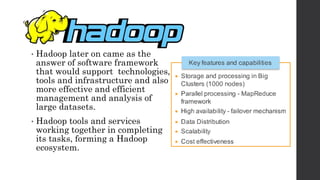
• Hadoop later on came as the
answer of software framework
that would support technologies,
tools and infrastructure and also
more effective and efficient
management and analysis of
large datasets.
• Hadoop tools and services
working together in completing
its tasks, forming a Hadoop
ecosystem.
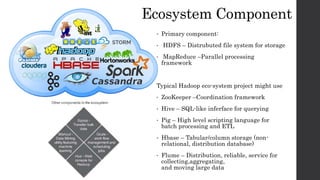
• Primary component:
• HDFS – Distrubuted file system for storage
• MapReduce –Parallel processing
framework
Typical Hadoop eco-system project might use
• ZooKeeper –Coordination framework
• Hive – SQL-like inferface for querying
• Pig – High level scripting language for
batch processing and ETL
• Hbase – Tabular/column storage (non-
relational, distribution database)
• Flume – Distribution, reliable, service for
collecting,aggregating,
and moving large data
Ecosystem Component
Big Data’s Characteristic
Volume
Variety
Velocity
Complexity
Validity
Stored Data
Processing
- Batch-based stored
- Real-Time Data-stream processing
Batch Based Stored Data Processing
• Process large volumes of data
• Can be periodic or one-time processing
• Batch results are produced after data is
collected, entered and processed
• Separate techniques or programs for input,
processing and output
Real Time Data Processing
•Data captured, processed, and
acted 24/7
•Computing data real-time
• Advantages of Real-time:
System scales elastically based on need
Instant Results
Parallel processing is available
Tools and Techniques for analyzing
big Data
The choice of tools mostly driven by:
Who is going to use the data
+
the business requirement for a particular
scenario
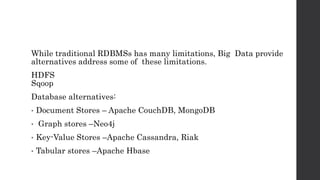
While traditional RDBMSs has many limitations, Big Data provide
alternatives address some of these limitations.
HDFS
Sqoop
Database alternatives:
• Document Stores – Apache CouchDB, MongoDB
• Graph stores –Neo4j
• Key-Value Stores –Apache Cassandra, Riak
• Tabular stores –Apache Hbase
Accessing the Big Data
• SQL like connectivity initiates for big data: Impala, Hive and Stinger
Other NoSQL BI Tools: Datameer, Karmasphere and Platfora
• These big data later can be used in:
-Sandboxes for data science projects
-Analytics development using map reduce
-Analytics-query performance enablers
-Search indexes on multi structured data in Hadoop
- Analyzing multi structured Big data Using search
- Data visualization and in memory data in big data enviroment
Considering Using big Data
Is your scenario really require a Big Data
Solution?
Does the solution need to handle data
variety?
Does the solution require ability to deal
with high data velocity?
Does the solution handle high data
volume?
Can the solution handle complexity?
How can you optimize the solution?
Case
Study:
Social
Media
Analytics
Using people’s history on internet, what they buy, what they search giving a rough view
of attitude on a product.
More, these output can be used to study:
customer satisfaction, churn prediction, financial performance, stock performance.
Hourglass
Is a framework that it much easier to write
incremental Hadoop jobs to perform
computation efficiently
Sekian
dan terima kasih

Modul_1_Introduction_to_Big_Data.pptx

  • 1.
  • 2.
    What is BigData? Large datasets, complex and changeable Cannot be stored, managed, and processed adequately by traditional software management and software tools.
  • 3.
    Solutions? • Relying onthe Technology that handle , process and analyze large quantities of data. Types of Solutions: • Structured • Multi-Structured • Unstructured
  • 4.
    The need ofBig Data… • In social networking, media and commerce sites, data growth increasing exponentially and so on for the future. Analyzing and managing these data properly is the key to business expansion and growth.
  • 5.
    Data Creation • EveryYear, the world created • more and more Zeta bytes of data • Managing this data became crucial to extract more value in retail, finance, media and publishing.
  • 6.
  • 7.
    • Hadoop lateron came as the answer of software framework that would support technologies, tools and infrastructure and also more effective and efficient management and analysis of large datasets. • Hadoop tools and services working together in completing its tasks, forming a Hadoop ecosystem.
  • 8.
    • Primary component: •HDFS – Distrubuted file system for storage • MapReduce –Parallel processing framework Typical Hadoop eco-system project might use • ZooKeeper –Coordination framework • Hive – SQL-like inferface for querying • Pig – High level scripting language for batch processing and ETL • Hbase – Tabular/column storage (non- relational, distribution database) • Flume – Distribution, reliable, service for collecting,aggregating, and moving large data Ecosystem Component
  • 9.
  • 10.
    Stored Data Processing - Batch-basedstored - Real-Time Data-stream processing
  • 11.
    Batch Based StoredData Processing • Process large volumes of data • Can be periodic or one-time processing • Batch results are produced after data is collected, entered and processed • Separate techniques or programs for input, processing and output
  • 12.
    Real Time DataProcessing •Data captured, processed, and acted 24/7 •Computing data real-time • Advantages of Real-time: System scales elastically based on need Instant Results Parallel processing is available
  • 13.
    Tools and Techniquesfor analyzing big Data The choice of tools mostly driven by: Who is going to use the data + the business requirement for a particular scenario
  • 14.
    While traditional RDBMSshas many limitations, Big Data provide alternatives address some of these limitations. HDFS Sqoop Database alternatives: • Document Stores – Apache CouchDB, MongoDB • Graph stores –Neo4j • Key-Value Stores –Apache Cassandra, Riak • Tabular stores –Apache Hbase
  • 15.
    Accessing the BigData • SQL like connectivity initiates for big data: Impala, Hive and Stinger Other NoSQL BI Tools: Datameer, Karmasphere and Platfora • These big data later can be used in: -Sandboxes for data science projects -Analytics development using map reduce -Analytics-query performance enablers -Search indexes on multi structured data in Hadoop - Analyzing multi structured Big data Using search - Data visualization and in memory data in big data enviroment
  • 16.
    Considering Using bigData Is your scenario really require a Big Data Solution? Does the solution need to handle data variety? Does the solution require ability to deal with high data velocity? Does the solution handle high data volume? Can the solution handle complexity? How can you optimize the solution?
  • 17.
    Case Study: Social Media Analytics Using people’s historyon internet, what they buy, what they search giving a rough view of attitude on a product. More, these output can be used to study: customer satisfaction, churn prediction, financial performance, stock performance.
  • 18.
    Hourglass Is a frameworkthat it much easier to write incremental Hadoop jobs to perform computation efficiently
  • 19.