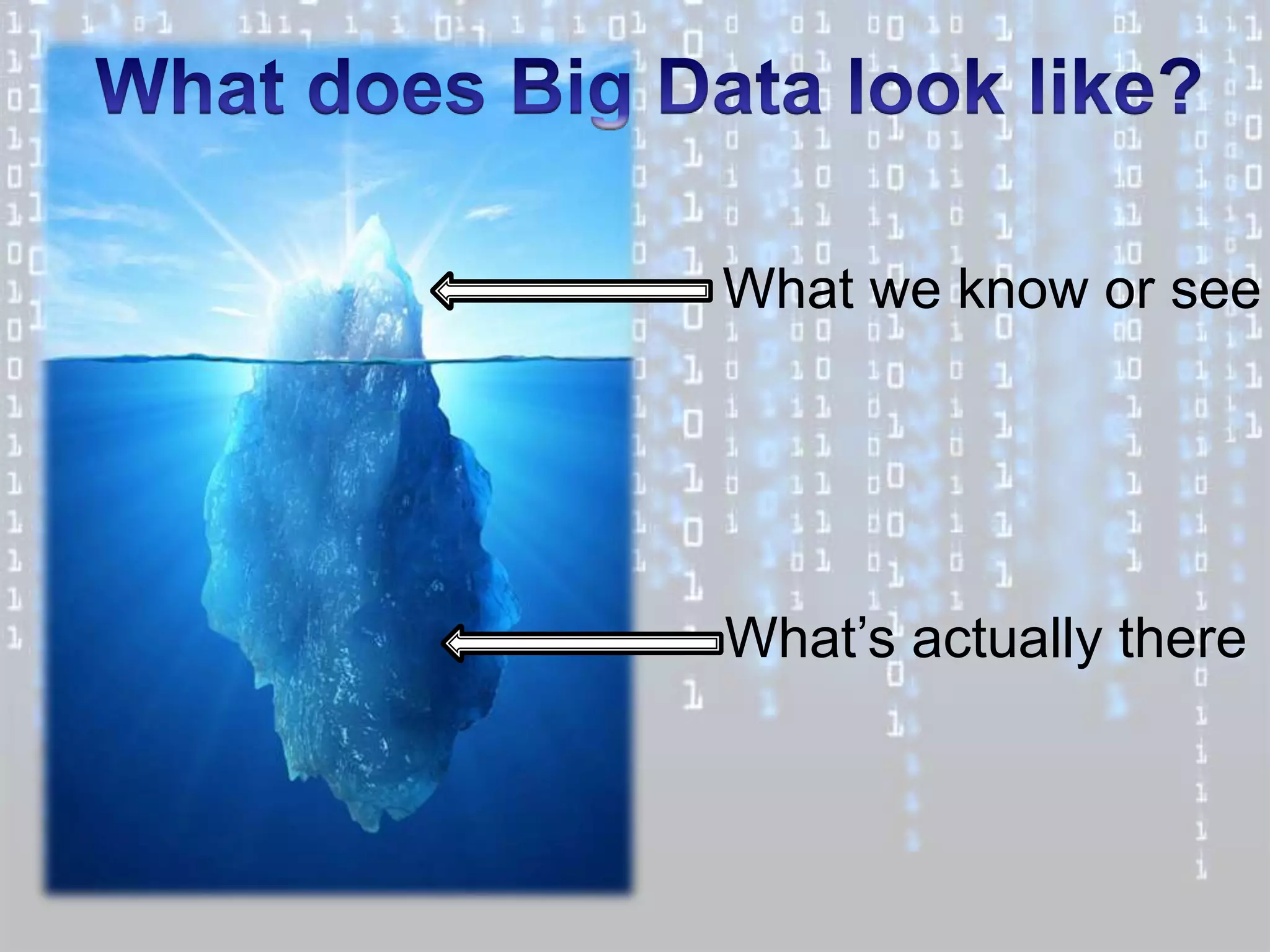
What we know or see


What’s actually there
• Wikipedia : In information technology, big data is a collection
  of data sets so large and complex that it becomes difficult to
  process using on-hand database management tools. The
  challenges include capture, curation, storage, search, sharing,
  analysis, and visualization.
• IDC : Big data technologies describe a new generation of
  technologies and architectures, designed to economically
  extract value from very large volumes of a wide variety of
  data, by enabling high velocity capture, discovery, and/or
  analysis.
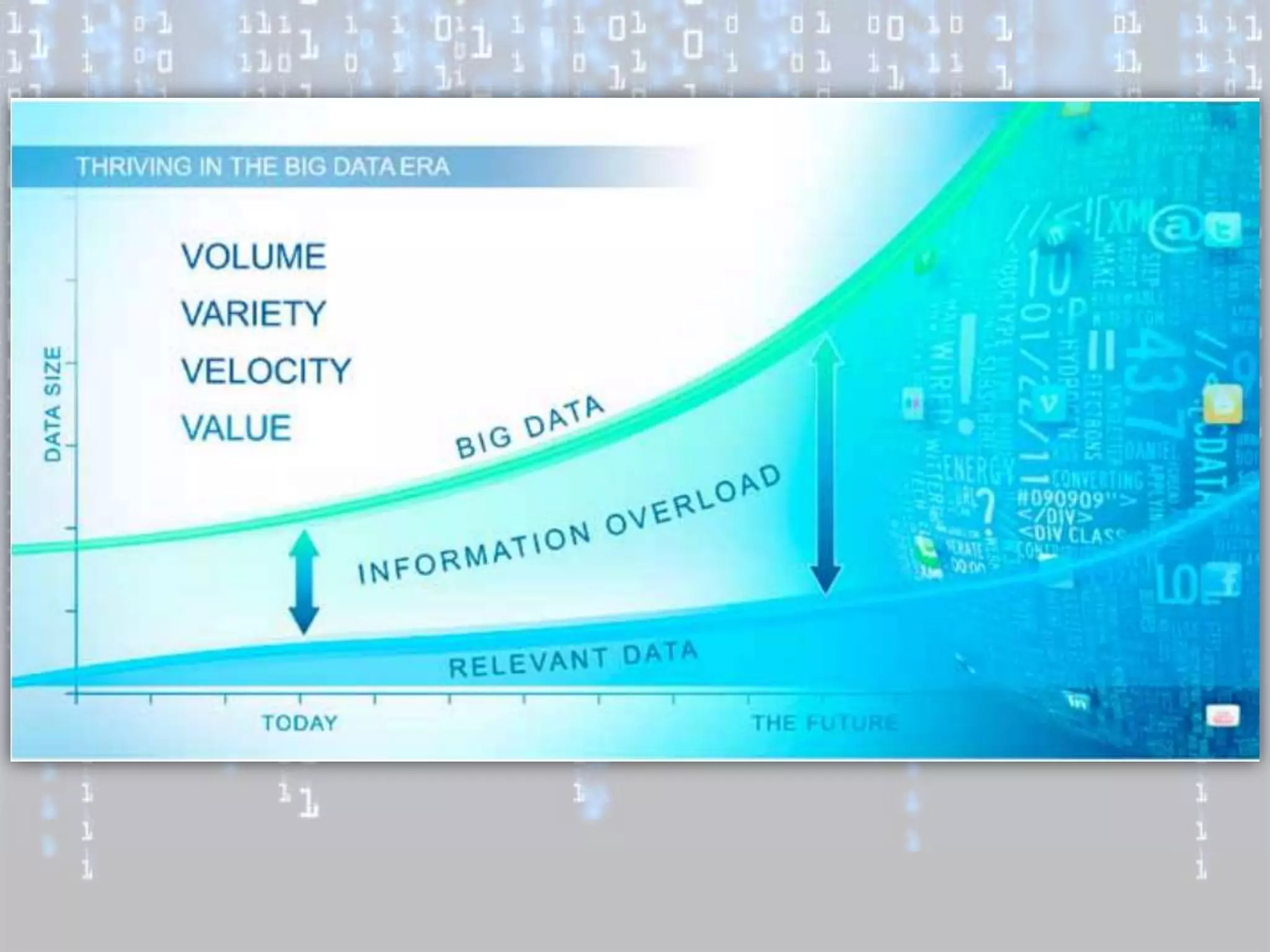
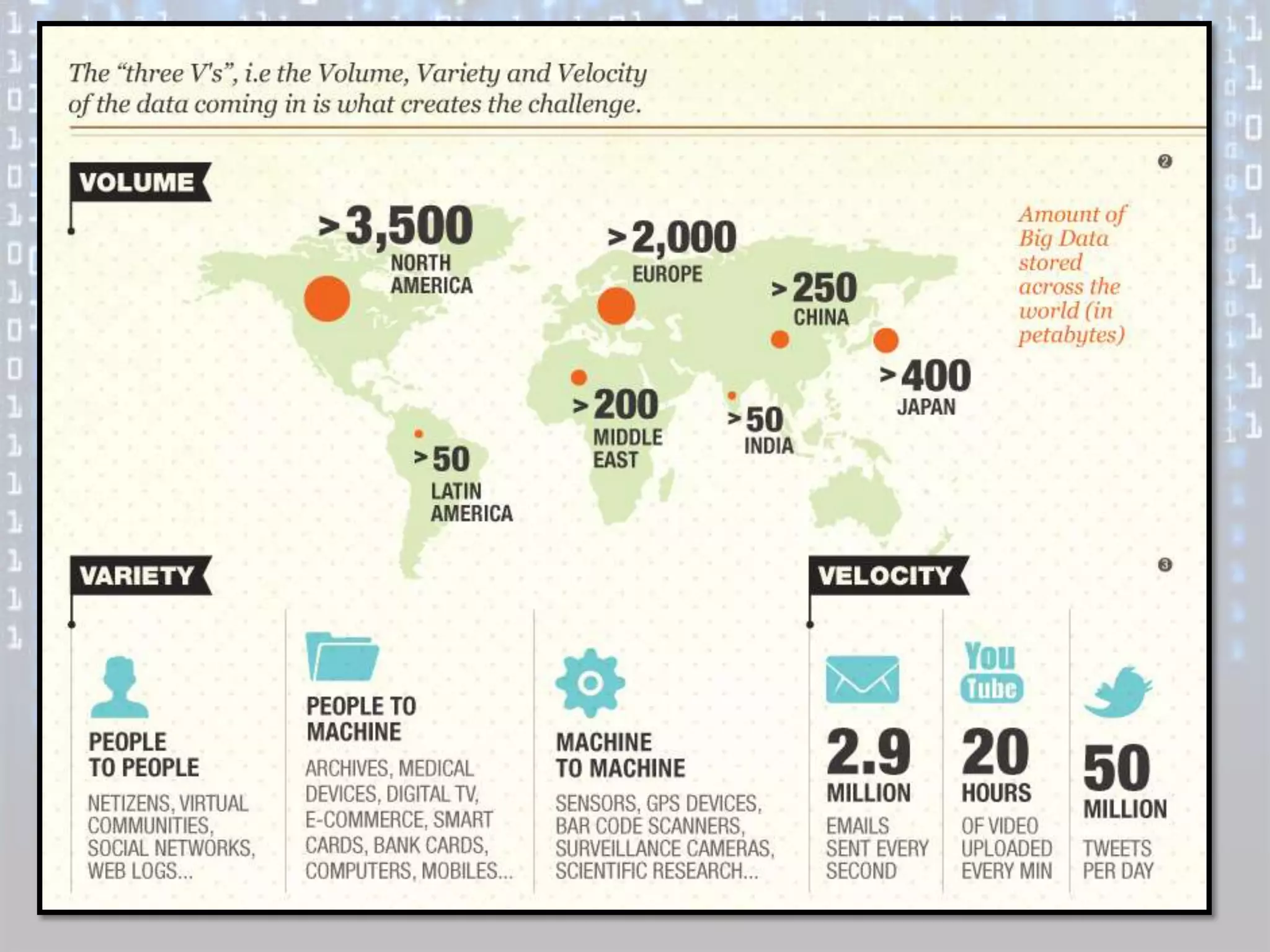
• IBM says that ”three characteristics define big data:”
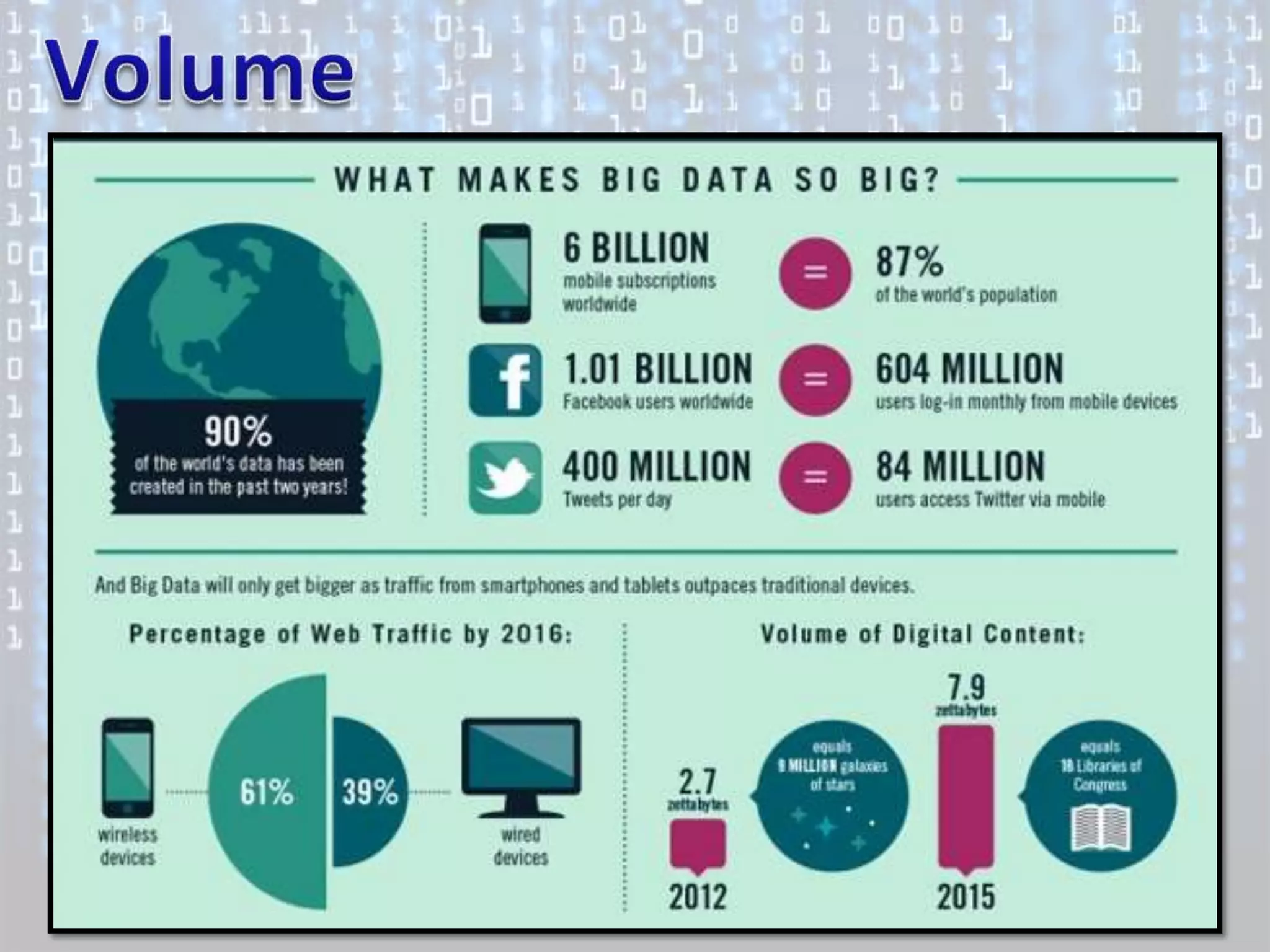
   – Volume (Terabytes -> Zettabytes)
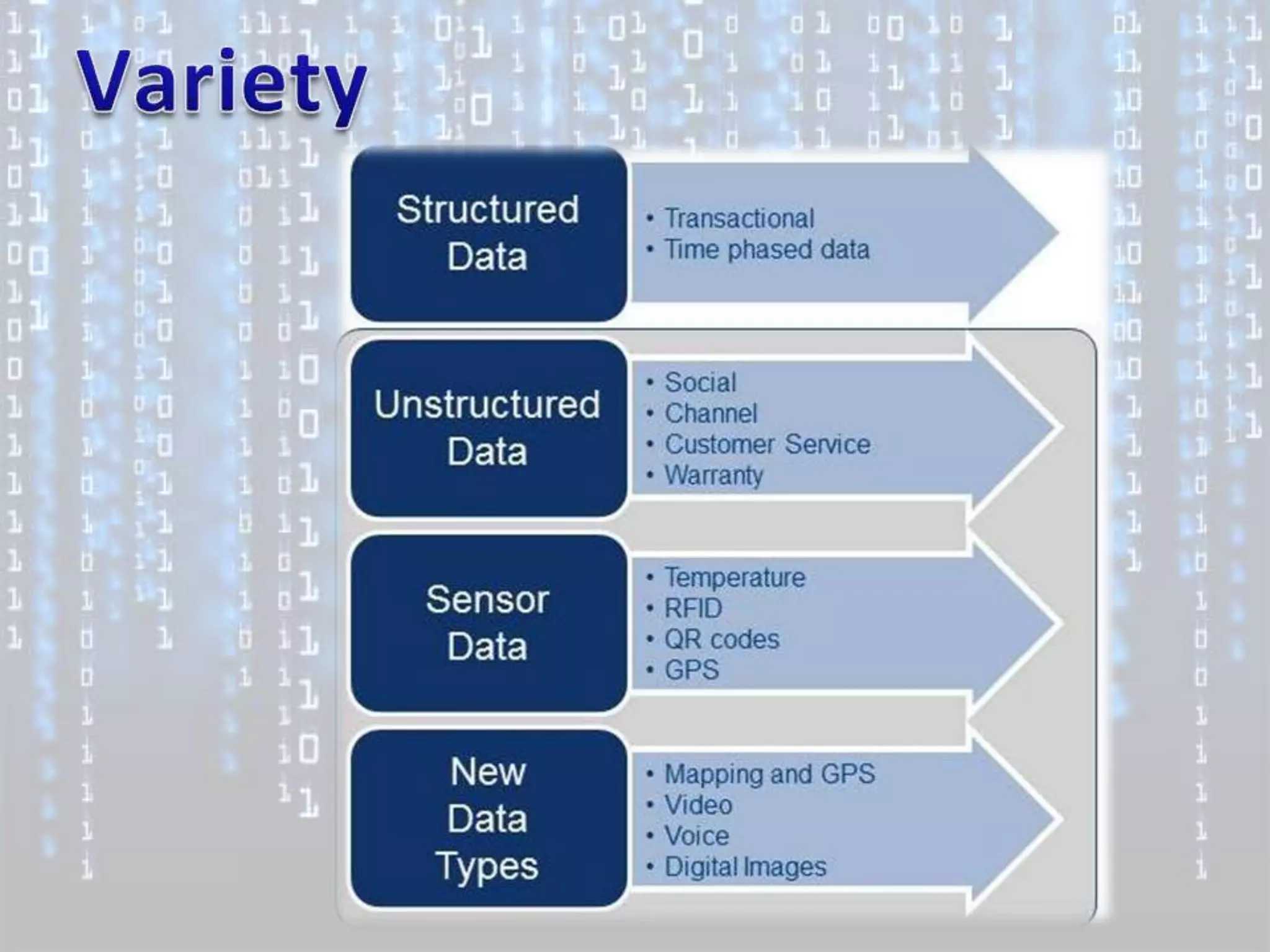
   – Variety (Structured -> Semi-structured -> Unstructured)
   – Velocity (Batch -> Streaming Data)
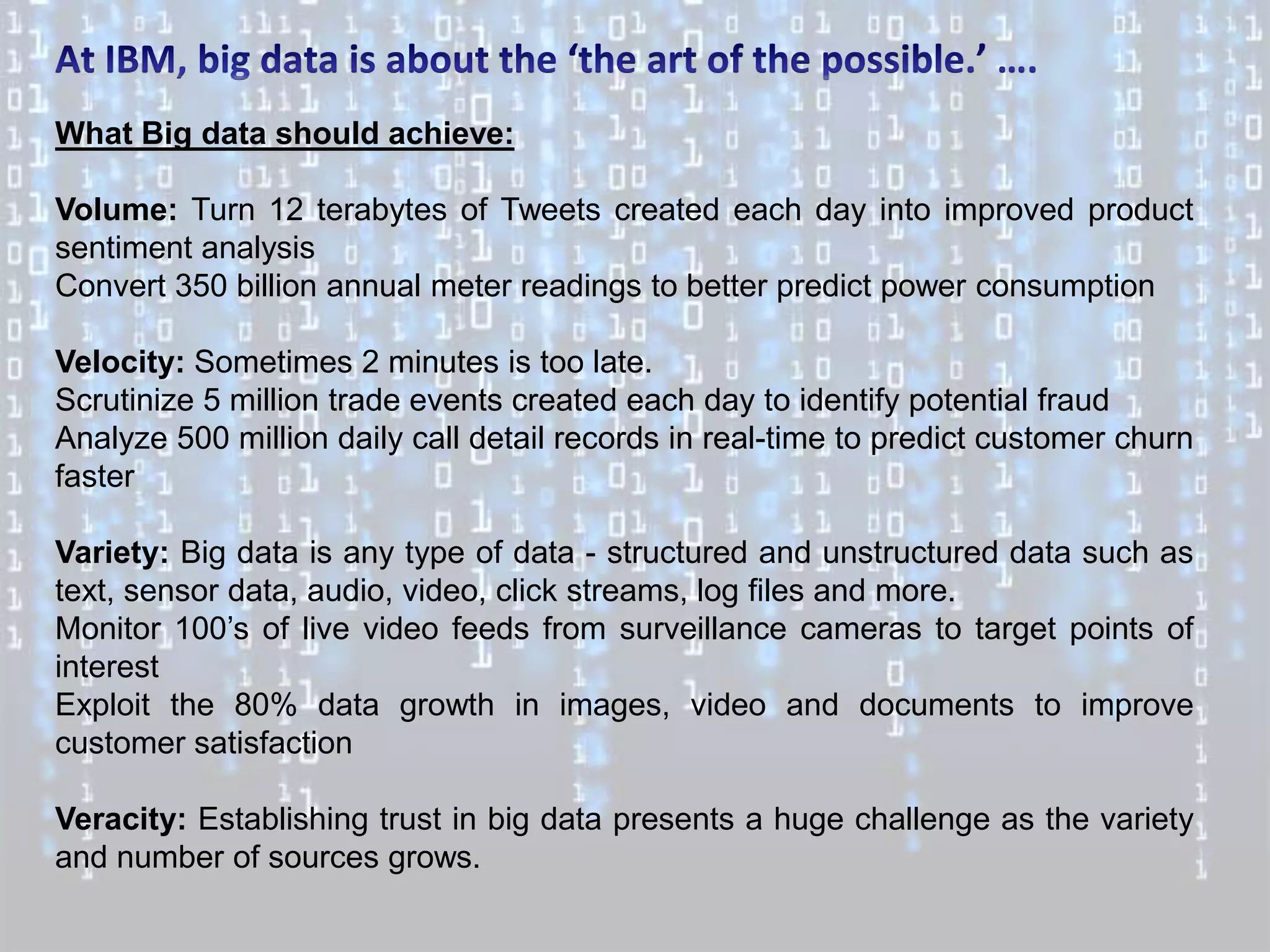
What Big data should achieve:

Volume: Turn 12 terabytes of Tweets created each day into improved product
sentiment analysis
Convert 350 billion annual meter readings to better predict power consumption

Velocity: Sometimes 2 minutes is too late.
Scrutinize 5 million trade events created each day to identify potential fraud
Analyze 500 million daily call detail records in real-time to predict customer churn
faster

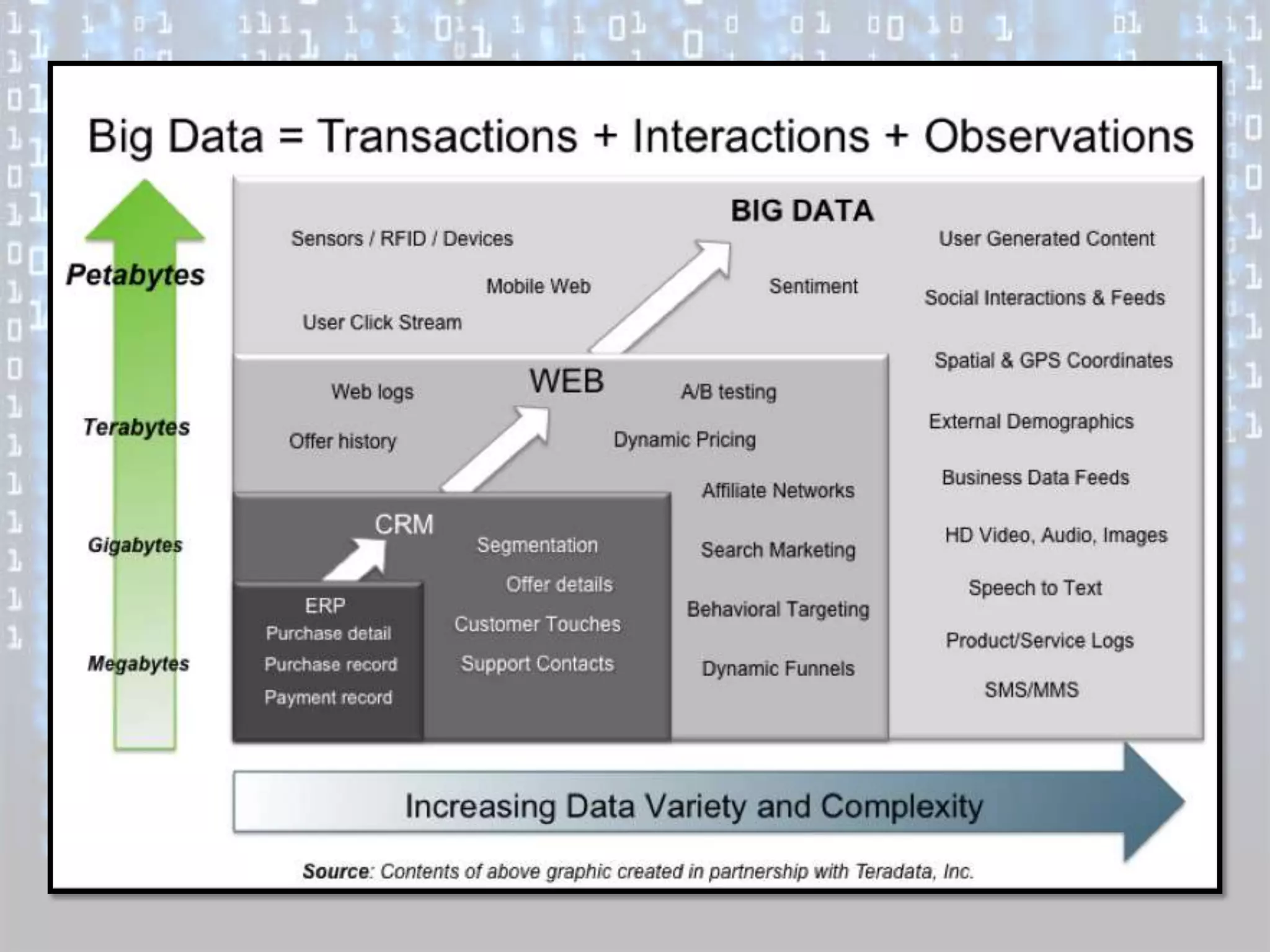
Variety: Big data is any type of data - structured and unstructured data such as
text, sensor data, audio, video, click streams, log files and more.
Monitor 100’s of live video feeds from surveillance cameras to target points of
interest
Exploit the 80% data growth in images, video and documents to improve
customer satisfaction

Veracity: Establishing trust in big data presents a huge challenge as the variety
and number of sources grows.
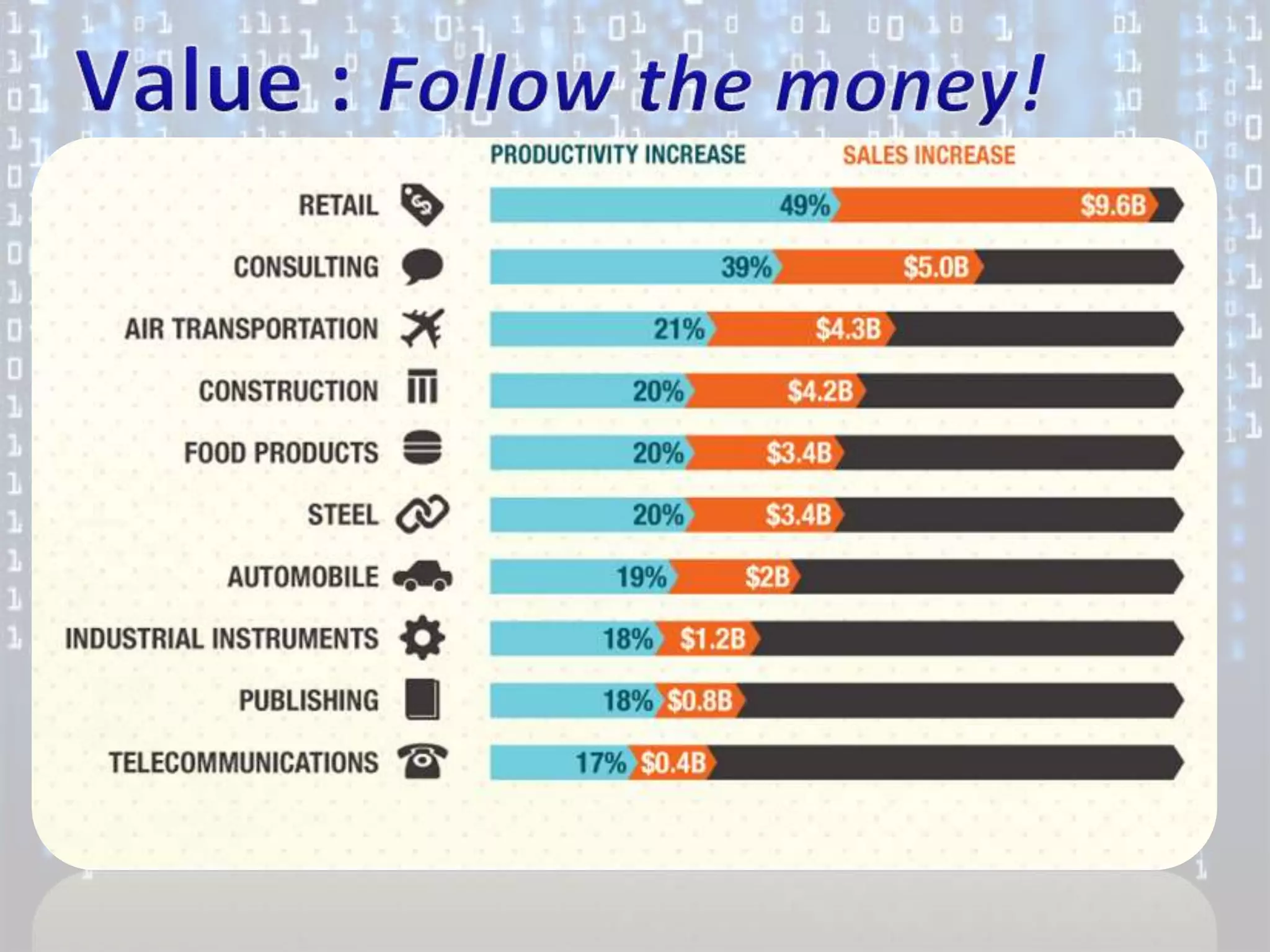
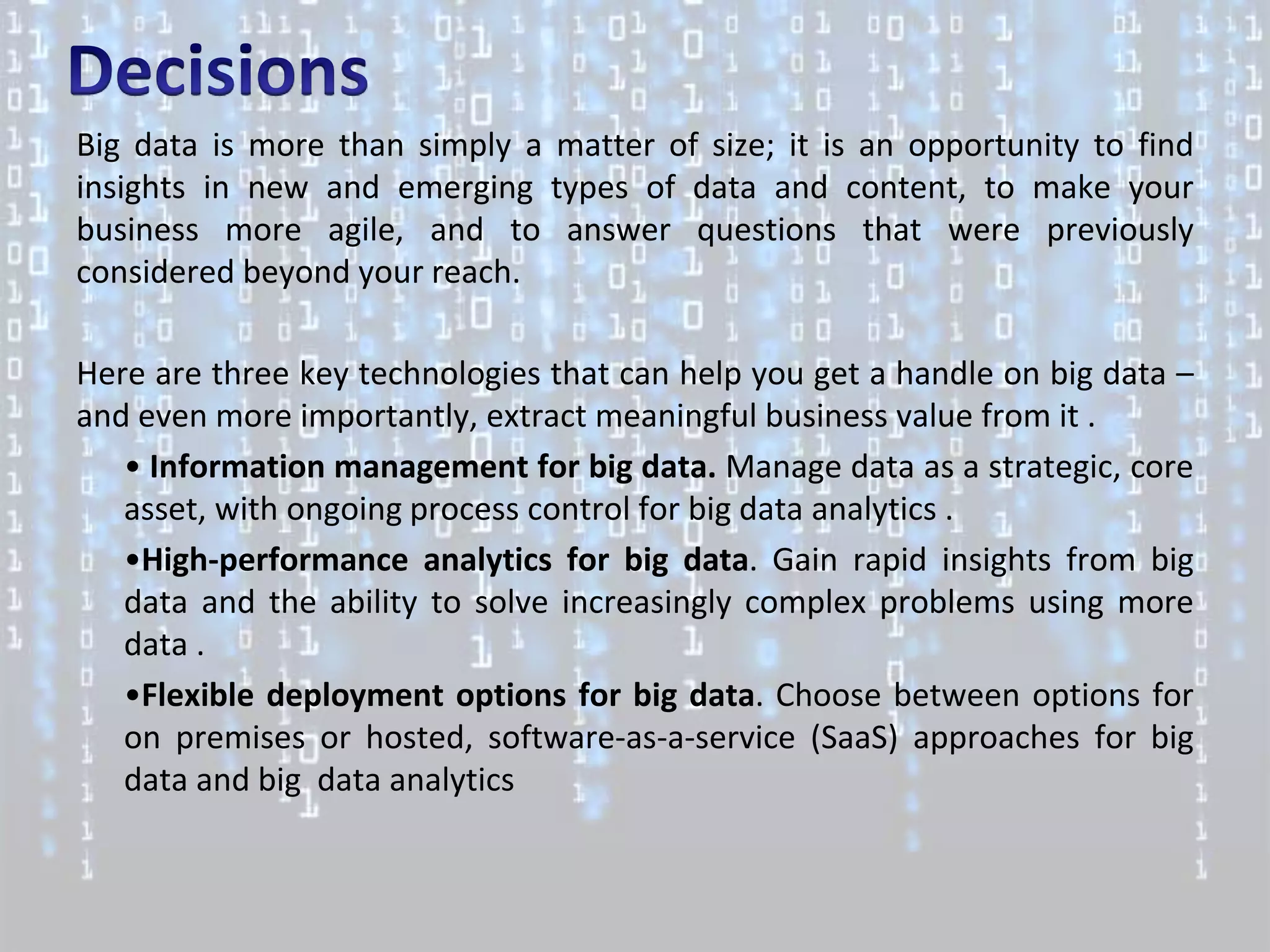
Big data is more than simply a matter of size; it is an opportunity to find
insights in new and emerging types of data and content, to make your
business more agile, and to answer questions that were previously
considered beyond your reach.

Here are three key technologies that can help you get a handle on big data –
and even more importantly, extract meaningful business value from it .
   • Information management for big data. Manage data as a strategic, core
   asset, with ongoing process control for big data analytics .
   •High-performance analytics for big data. Gain rapid insights from big
   data and the ability to solve increasingly complex problems using more
   data .
   •Flexible deployment options for big data. Choose between options for
   on premises or hosted, software-as-a-service (SaaS) approaches for big
   data and big data analytics
• Massively Parallel Processing (MPP) – This involves a coordinated
  processing of a program by multiple processors (200 or more in number).
  Each of the processors makes use of its own operating system and
  memory and works on different parts of the program. Each part
  communicates via messaging interface. An MPP system is also known as
  “loosely coupled” or “shared nothing” system.

• Distributed file system or network file system allows client nodes to
  access files through a computer network. This way a number of users
  working on multiple machines will be able to share files and storage
  resources. The client nodes will not be able to access the block storage
  but can interact through a network protocol. This enables a restricted
  access to the file system depending on the access lists or capabilities on
  both servers and clients which is again dependent on the protocol.
• Apache Hadoop is key technology used to handle big data, its analytics
  and stream computing. Apache Hadoop is an open source software
  project that enables the distributed processing of large data sets across
  clusters of commodity servers. It can be scaled up from a single server to
  thousands of machines and with a very high degree of fault tolerance.
  Instead of relying on high-end hardware, the resiliency of these clusters
  comes from the software’s ability to detect and handle failures at the
  application layer.

• Data Intensive Computing is a class of parallel computing application
  which uses a data parallel approach to process big data. This works based
  on the principle of collocation of data and programs or algorithms used to
  perform computation. Parallel and distributed system of inter-connected
  stand alone computers that work together as a single integrated
  computing resource is used to process / analyze big data.
• HDFS:
- Large files are split into parts
- Move file parts into a cluster
- Fault-tolerant through replication across nodes while being rack-aware
- Bookkeeping via NameNode
• MapReduce
- Move algorithms close to the data by structuring them for parallel
   execution so that each task works on a part of the data. The power of
   Simplicity!
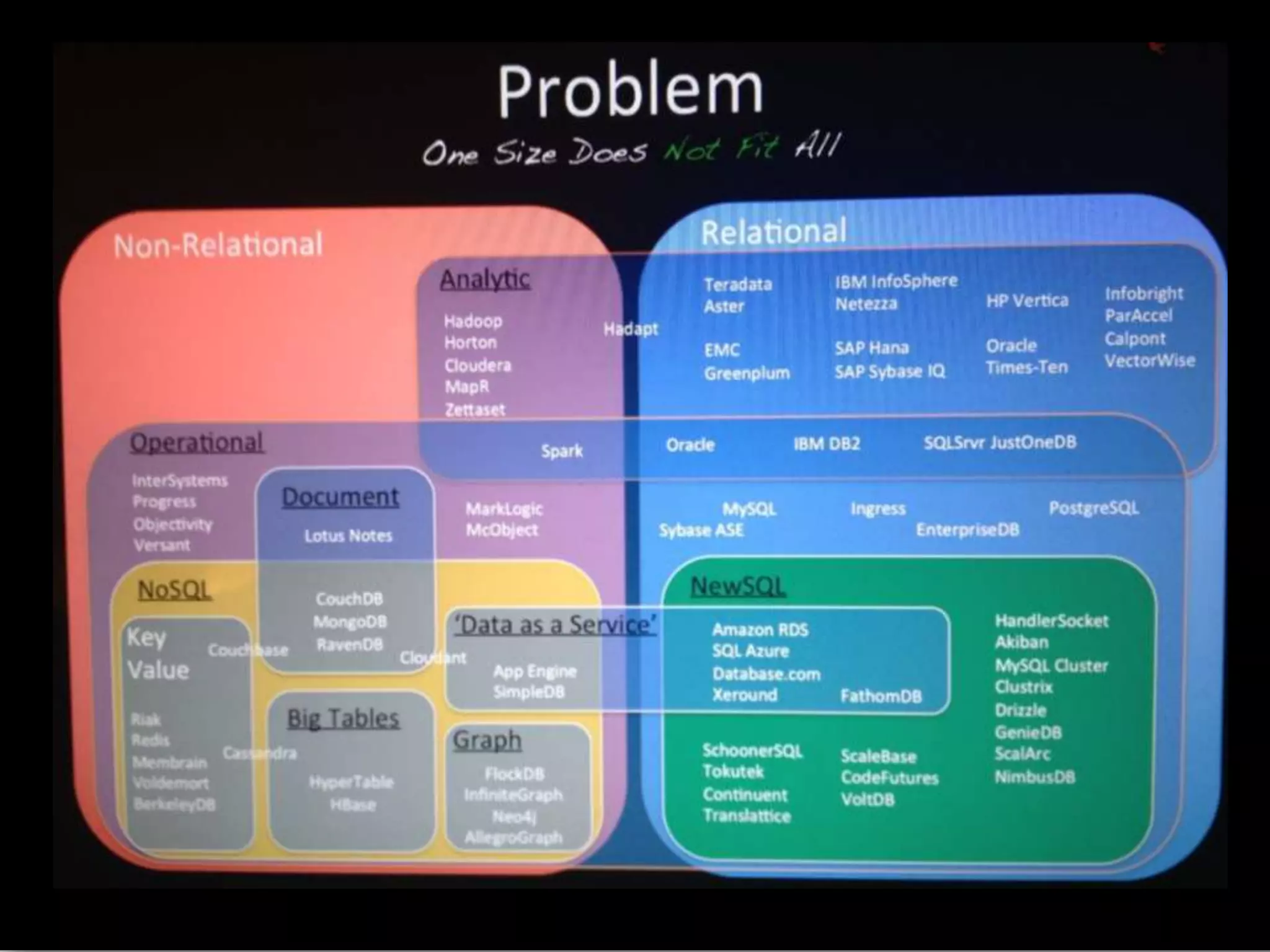
• noSQL:
- Old technology – before RDBMS
- Sequential files
- Hierarchical DB
- Network DB
- Graph DB (Neo4j, AllegroGraph)
- Document Stores (Lotus Domino, MongoDB, JackRabbit)
- Memory Caches
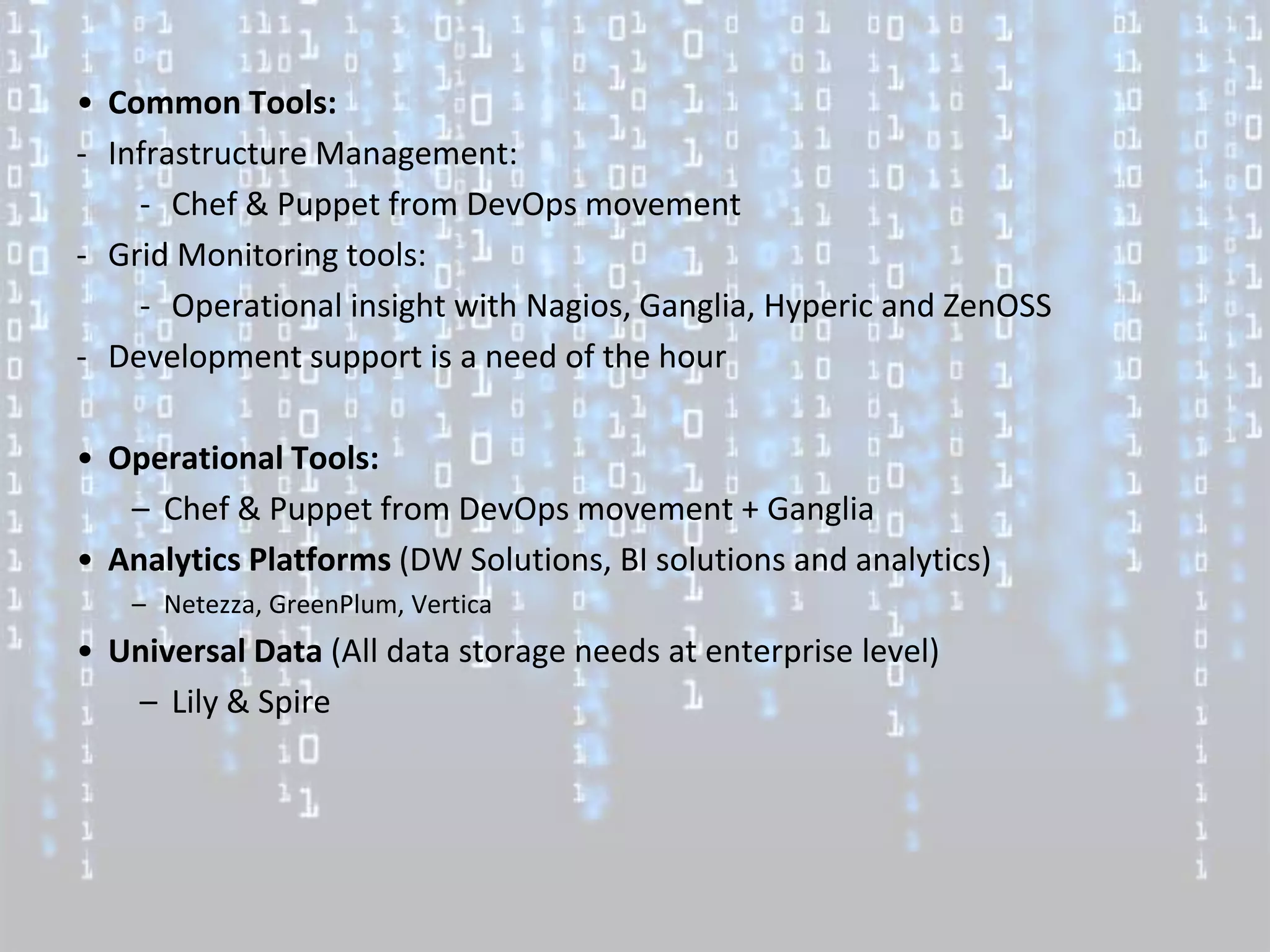
• Common Tools:
- Infrastructure Management:
    - Chef & Puppet from DevOps movement
- Grid Monitoring tools:
    - Operational insight with Nagios, Ganglia, Hyperic and ZenOSS
- Development support is a need of the hour

• Operational Tools:
   – Chef & Puppet from DevOps movement + Ganglia
• Analytics Platforms (DW Solutions, BI solutions and analytics)
   – Netezza, GreenPlum, Vertica
• Universal Data (All data storage needs at enterprise level)
   – Lily & Spire
Source links and some more useful
information…
•   http://www.sas.com/resources/whitepaper/wp_46345.pdf
•   http://wikibon.org/blog/big-data-statistics/
•   http://wikibon.org/blog/big-data-infographics/
•   http://www.marketingtechblog.com/ibm-big-data-marketing/
•   http://blogs.gartner.com/doug-laney/
•   http://www-01.ibm.com/software/data/bigdata/
•   http://en.wikipedia.org/wiki/Big_data
•   http://mike2.openmethodology.org/wiki/Big_Data_Definition
•   http://pinterest.com/rtkrum/cool-infographics-gallery
•   http://www.go-gulf.com/blog/category/blog/seo-sem/
•   http://www.forbes.com/sites/davefeinleib/2012/07/24/big-data-trends/
•   http://hortonworks.com/wp-content/uploads/2012/05/bigdata_diagram.png
•   http://visual.ly/big-data
•   http://csrc.nist.gov/groups/SMA/forum/documents/june2012presentations/fcsm_june20
    12_cooper_mell.pdf
•   http://www.ramcoblog.com/big-data-technologies-a-quick-way-to-get-through-more
Big Data

Big Data

  • 2.
    What we knowor see What’s actually there
  • 4.
    • Wikipedia :In information technology, big data is a collection of data sets so large and complex that it becomes difficult to process using on-hand database management tools. The challenges include capture, curation, storage, search, sharing, analysis, and visualization. • IDC : Big data technologies describe a new generation of technologies and architectures, designed to economically extract value from very large volumes of a wide variety of data, by enabling high velocity capture, discovery, and/or analysis. • IBM says that ”three characteristics define big data:” – Volume (Terabytes -> Zettabytes) – Variety (Structured -> Semi-structured -> Unstructured) – Velocity (Batch -> Streaming Data)
  • 28.
    What Big datashould achieve: Volume: Turn 12 terabytes of Tweets created each day into improved product sentiment analysis Convert 350 billion annual meter readings to better predict power consumption Velocity: Sometimes 2 minutes is too late. Scrutinize 5 million trade events created each day to identify potential fraud Analyze 500 million daily call detail records in real-time to predict customer churn faster Variety: Big data is any type of data - structured and unstructured data such as text, sensor data, audio, video, click streams, log files and more. Monitor 100’s of live video feeds from surveillance cameras to target points of interest Exploit the 80% data growth in images, video and documents to improve customer satisfaction Veracity: Establishing trust in big data presents a huge challenge as the variety and number of sources grows.
  • 29.
    Big data ismore than simply a matter of size; it is an opportunity to find insights in new and emerging types of data and content, to make your business more agile, and to answer questions that were previously considered beyond your reach. Here are three key technologies that can help you get a handle on big data – and even more importantly, extract meaningful business value from it . • Information management for big data. Manage data as a strategic, core asset, with ongoing process control for big data analytics . •High-performance analytics for big data. Gain rapid insights from big data and the ability to solve increasingly complex problems using more data . •Flexible deployment options for big data. Choose between options for on premises or hosted, software-as-a-service (SaaS) approaches for big data and big data analytics
  • 31.
    • Massively ParallelProcessing (MPP) – This involves a coordinated processing of a program by multiple processors (200 or more in number). Each of the processors makes use of its own operating system and memory and works on different parts of the program. Each part communicates via messaging interface. An MPP system is also known as “loosely coupled” or “shared nothing” system. • Distributed file system or network file system allows client nodes to access files through a computer network. This way a number of users working on multiple machines will be able to share files and storage resources. The client nodes will not be able to access the block storage but can interact through a network protocol. This enables a restricted access to the file system depending on the access lists or capabilities on both servers and clients which is again dependent on the protocol.
  • 32.
    • Apache Hadoopis key technology used to handle big data, its analytics and stream computing. Apache Hadoop is an open source software project that enables the distributed processing of large data sets across clusters of commodity servers. It can be scaled up from a single server to thousands of machines and with a very high degree of fault tolerance. Instead of relying on high-end hardware, the resiliency of these clusters comes from the software’s ability to detect and handle failures at the application layer. • Data Intensive Computing is a class of parallel computing application which uses a data parallel approach to process big data. This works based on the principle of collocation of data and programs or algorithms used to perform computation. Parallel and distributed system of inter-connected stand alone computers that work together as a single integrated computing resource is used to process / analyze big data.
  • 33.
    • HDFS: - Largefiles are split into parts - Move file parts into a cluster - Fault-tolerant through replication across nodes while being rack-aware - Bookkeeping via NameNode • MapReduce - Move algorithms close to the data by structuring them for parallel execution so that each task works on a part of the data. The power of Simplicity! • noSQL: - Old technology – before RDBMS - Sequential files - Hierarchical DB - Network DB - Graph DB (Neo4j, AllegroGraph) - Document Stores (Lotus Domino, MongoDB, JackRabbit) - Memory Caches
  • 34.
    • Common Tools: -Infrastructure Management: - Chef & Puppet from DevOps movement - Grid Monitoring tools: - Operational insight with Nagios, Ganglia, Hyperic and ZenOSS - Development support is a need of the hour • Operational Tools: – Chef & Puppet from DevOps movement + Ganglia • Analytics Platforms (DW Solutions, BI solutions and analytics) – Netezza, GreenPlum, Vertica • Universal Data (All data storage needs at enterprise level) – Lily & Spire
  • 42.
    Source links andsome more useful information… • http://www.sas.com/resources/whitepaper/wp_46345.pdf • http://wikibon.org/blog/big-data-statistics/ • http://wikibon.org/blog/big-data-infographics/ • http://www.marketingtechblog.com/ibm-big-data-marketing/ • http://blogs.gartner.com/doug-laney/ • http://www-01.ibm.com/software/data/bigdata/ • http://en.wikipedia.org/wiki/Big_data • http://mike2.openmethodology.org/wiki/Big_Data_Definition • http://pinterest.com/rtkrum/cool-infographics-gallery • http://www.go-gulf.com/blog/category/blog/seo-sem/ • http://www.forbes.com/sites/davefeinleib/2012/07/24/big-data-trends/ • http://hortonworks.com/wp-content/uploads/2012/05/bigdata_diagram.png • http://visual.ly/big-data • http://csrc.nist.gov/groups/SMA/forum/documents/june2012presentations/fcsm_june20 12_cooper_mell.pdf • http://www.ramcoblog.com/big-data-technologies-a-quick-way-to-get-through-more

Editor's Notes

  • #5 IDC = Definition critical with regards to introduction of Gartner’s principle of 3V’s of Big DataIBM = adds the benchmark of what the 3V’s should be talking about for Big Data
  • #42 Can markets still do without big data?
  • #43 Source links as well as additional information on the subject
  • #44 It’s December!