SIMÓN BOLÍVAR UNIVERSITY Departamento de Formación General y Ciencias Básicas  English III for Customs and Transport Administration MODES OF TRANSPORTATION FC-1233 Term April – July 2011
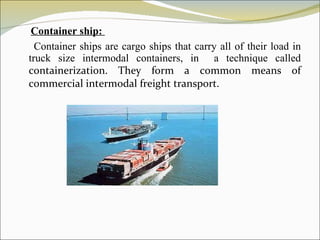
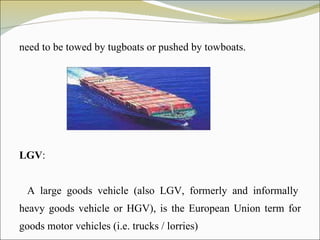
Container ship:  Container ships are cargo ships that carry all of their load in truck size intermodal containers, in  a technique called  containerization. They form a common means of commercial intermodal freight transport.
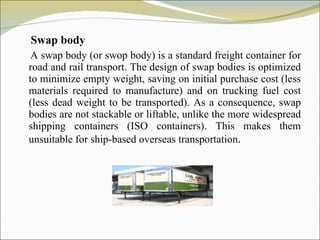
Swap body A swap body (or swop body) is a standard freight container for road and rail transport. The design of swap bodies is optimized to minimize empty weight, saving on initial purchase cost (less materials required to manufacture) and on trucking fuel cost (less dead weight to be transported). As a consequence, swap bodies are not stackable or liftable, unlike the more widespread shipping containers (ISO containers).  This makes them unsuitable for ship-based overseas transportation .
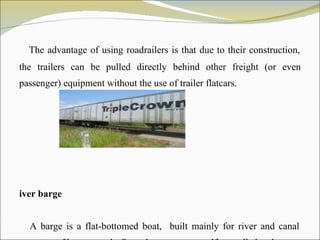
Grappler lift: It´s a type of container or container handling similar  to a straddle carrier. Road-railer trailer: A Roadrailer or RoadRailer is a highway trailer,  or semi-trailer,  that is specially-equipped for use in railroad intermodal service.
The advantage of using roadrailers is that due to their construction, the trailers can be pulled directly behind other freight (or even passenger) equipment without the use of trailer flatcars.  River barge A barge is a flat-bottomed boat,  built mainly for river and canal transport of heavy goods. Some barges are not self-propelled and
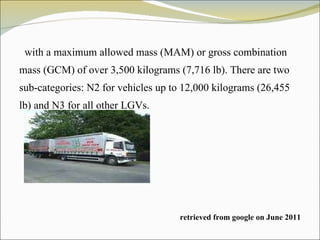
need to be towed by tugboats or pushed by towboats. LGV : A large goods vehicle (also LGV, formerly and informally heavy goods vehicle or HGV), is the European Union term for goods motor vehicles (i.e. trucks / lorries)
with a maximum allowed mass (MAM) or gross combination mass (GCM) of over 3,500 kilograms (7,716 lb). There are two sub-categories: N2 for vehicles up to 12,000 kilograms (26,455 lb) and N3 for all other LGVs. retrieved from google on June 2011

Modes of transportation.ppp.[1]

  • 1.
    SIMÓN BOLÍVAR UNIVERSITYDepartamento de Formación General y Ciencias Básicas English III for Customs and Transport Administration MODES OF TRANSPORTATION FC-1233 Term April – July 2011
  • 2.
    Container ship: Container ships are cargo ships that carry all of their load in truck size intermodal containers, in a technique called containerization. They form a common means of commercial intermodal freight transport.
  • 3.
    Swap body Aswap body (or swop body) is a standard freight container for road and rail transport. The design of swap bodies is optimized to minimize empty weight, saving on initial purchase cost (less materials required to manufacture) and on trucking fuel cost (less dead weight to be transported). As a consequence, swap bodies are not stackable or liftable, unlike the more widespread shipping containers (ISO containers). This makes them unsuitable for ship-based overseas transportation .
  • 4.
    Grappler lift: It´sa type of container or container handling similar to a straddle carrier. Road-railer trailer: A Roadrailer or RoadRailer is a highway trailer, or semi-trailer, that is specially-equipped for use in railroad intermodal service.
  • 5.
    The advantage ofusing roadrailers is that due to their construction, the trailers can be pulled directly behind other freight (or even passenger) equipment without the use of trailer flatcars. River barge A barge is a flat-bottomed boat, built mainly for river and canal transport of heavy goods. Some barges are not self-propelled and
  • 6.
    need to betowed by tugboats or pushed by towboats. LGV : A large goods vehicle (also LGV, formerly and informally heavy goods vehicle or HGV), is the European Union term for goods motor vehicles (i.e. trucks / lorries)
  • 7.
    with a maximumallowed mass (MAM) or gross combination mass (GCM) of over 3,500 kilograms (7,716 lb). There are two sub-categories: N2 for vehicles up to 12,000 kilograms (26,455 lb) and N3 for all other LGVs. retrieved from google on June 2011