Fermentation
Presenting
Preethi S
II Msc Biochemistry
FERMENTATION
Fermentation is the anaerobic breakdown
of carbohydrates and other organic compounds into
alcohols , organic acids ,gases ,etc .with the help of
microorganism or enzymes.
Fermentation widely used in food
fermentation and pharmaceuticals.
Sterilization of microbes
Sterilization of Culture Media and Gases:
a. Sterility of the media containing the nutrients.
b. Sterility of incoming and outgoing air.
c. Sterility of the bioreactor.
d. Prevention of contamination during
fermentation.
Sterilization of Culture Media:
The constituents of culture media, water and
containers contribute to the contamination by
vegetative cells and spores. The media must be free
from contamination before use in fermentation.
Heat sterilization:
Heat is the most widely used sterilization technique.
It maintain quality and quantity of contamination.
Physical methods:
The physical methods such as filtration,
centrifugation, and adsorption (to ion-exchangers or
activated carbon) are used.
Batch sterilization:
The culture media are subjected to sterilization at 121°C
in batch volumes, in the bioreactor.
Batch sterilization can be done by injecting the steam
into the medium (direct method) or injecting the steam
into interior coils (indirect method).
 For the direct batch sterilization, the steam should be
pure, and free from all chemical additives (that usually
come from steam manufacturing process).
Continuous sterilization:
Continuous sterilization is carried out at 140°C for
a very short period of time ranging from 30 to 120
seconds.
This is based on the principle that the time
required for killing microorganisms is much shorter
at higher temperature.
 Continuous sterilization is carried out by directly
injecting the steam or by means of heat exchangers.
Batch
fermentation
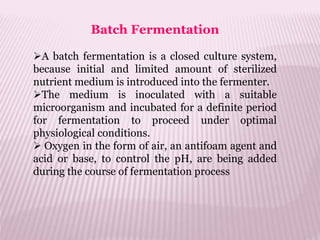
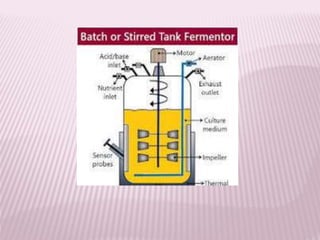
Batch Fermentation
A batch fermentation is a closed culture system,
because initial and limited amount of sterilized
nutrient medium is introduced into the fermenter.
The medium is inoculated with a suitable
microorganism and incubated for a definite period
for fermentation to proceed under optimal
physiological conditions.
 Oxygen in the form of air, an antifoam agent and
acid or base, to control the pH, are being added
during the course of fermentation process
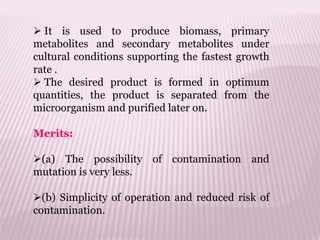
 It is used to produce biomass, primary
metabolites and secondary metabolites under
cultural conditions supporting the fastest growth
rate .
 The desired product is formed in optimum
quantities, the product is separated from the
microorganism and purified later on.
Merits:
(a) The possibility of contamination and
mutation is very less.
(b) Simplicity of operation and reduced risk of
contamination.
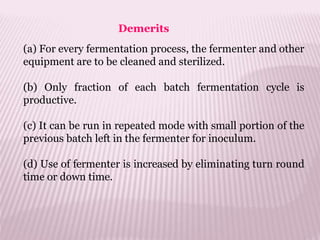
(a) For every fermentation process, the fermenter and other
equipment are to be cleaned and sterilized.
(b) Only fraction of each batch fermentation cycle is
productive.
(c) It can be run in repeated mode with small portion of the
previous batch left in the fermenter for inoculum.
(d) Use of fermenter is increased by eliminating turn round
time or down time.
Demerits
(f) Running costs are greater for preparing and
maintaining stock cultures.
(g) Increased, frequency of sterilization may also
cause greater stress on instrumentation and probes.
(h) Fresh sterilized medium and pure culture are to
be made for every fermentation process.
(i) Yield of the desired product may also vary.
(j) There will be a non-productive period of
shutdown between one batch productive
fermentation to the other,
(k) More personal are required.
Continuous
fermentation
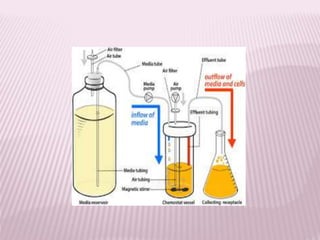
 It is a closed system of fermentation, run for indefinite
period.
 In this method, fresh nutrient medium is added
continuously or intermittently to the fermenter and
equivalent amount of used medium with
microorganisms is withdrawn continuously or
intermittently for the recovery of cells or fermentation
products .
Continuous Fermentation
A continuous fermentation is generally carried out in
the following ways:
(a) Single Stage Fermentation:
In this process, a single fermenter is inoculated
and the nutrient medium and culture are kept in
continuous operation by balancing the input and output
of nutrient medium and harvested culture, respectively.
b) Recycle Fermentation:
In this method, a portion of the medium is
withdrawn and added to the culture vessel.
Thus, the culture is recycled to the fermentation
vessel.
This method is generally adopted in the
hydrocarbon fermentation process.
The recycling of cells provides a higher population
of cells in the fermenter which results in greater
productivity of the desired product.
(c) Multiple Stage Fermentation:
In this process, two or more fermenters are
employed simultaneously and the fermentation is
operated in a sequence.
 Different phases of fermentation process like
growth phase and synthetic phase are carried out in
different fermenters.
Generally, growth phase is allowed in the first
fermenter, synthetic phase in the second and
subsequent fermenters.
This process is adapted particularly to those
fermentations in which growth and synthetic
activities of the microorganisms are not
simultaneous.
(a) Merits:
1. The fermenter is continuously used with little or no
shutdown time.
2. Only little quantity of initial inoculum is needed and there
is no need of additional inoculum.
3. It facilitates maximum and continuous production of the
desired product.
4. There is optimum utilization of even slow utilizable
substances like hydrocarbons.
(b) Demerits
1. Possibility of contamination and mutation because of
prolonged incubation and continuous fermentation, are
more.
2. Possibility of wastage of nutrient medium because of
continuous withdrawal for product isolation.
3. The process becomes more complex and difficult to
accomplish when the desired products are antibiotics
rather than a microbial cells.
4. Lack of knowledge of dynamic aspects of growth and
synthesis of product by microorganism used in
fermentation.
Applications
Continuous culture fermentation has been used for
the production of single cell protein, antibiotics,
organic solvents, starter cultures etc.
Pilot plants or production plants have been installed
for production of beer, fodder yeast, vinegar, baker’s
yeast.
 A wide variety of microorganisms are used for this
type of fermentation
Fed batch
fermentation
It is a modification to the batch fermentation. In this
process substrate is added periodically in instalments as
the fermentation progresses, due to which the substrate is
always at an optimal concentration.
This is essential as some secondary metabolites are
subjected to catabolite repression by high concentration of
either glucose, or other carbohydrate or nitrogen
compounds present in the medium.
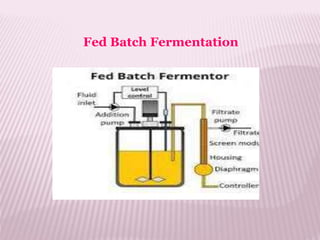
Fed Batch Fermentation
 The critical elements of the nutrient medium are
added in low amount in the beginning of the
fermentation .
This method is generally employed for the production
of substances such as penicillin.
The fed-batch fermentation may be of three types:
(i) Variable Volume Fed Batch Culture:
The same medium is added resulting in an increase in
volume
ii) Fixed Volume Fed Batch Culture:
A very concentrated solution of the limiting substrate
is added at a very little amount resulting in an
insignificant increase in the volume of medium.
(iii) Cyclic Fed Batch Culture:
As it is not possible to measure the substrate
concentration by following direct methods during
fermentation, which is necessary for controlling the
feeding process, generally indirect methods are
employed. For example – in the production of organic
acids, the pH value may be used to determine the rate
of glucose utilization.
Advantages
1. Production of high cell densities due to extension of
working time (particularly growth associated products).
2. Controlled conditions in the provision of substrates
during fermentation, particularly regarding the
concentration of specific substrates for e.g. the carbon
source.
3. Control over the production of, by products or
catabolite repression, effects due to limited provision of
substrates solely required for product formation.
4. The mode of operation can overcome and control
deviations in the organism’s growth pattern as found in
batch fermentation.
5. Allows the replacement of water loss, by evaporation.
6. Alternative mode of operation for fermentations
dealing with toxic substances or low solubility
compounds.
7. Increase of antibiotic marked plasmid stability by
producing the correspondent antibiotic during the time
span of the fermentation.
8. No additional special piece of equipment is required as
compared with the batch fermentation.
9. It is an effective method for the production of certain
chemicals, which are produced at optimum level when
the medium is exhausted like penicillin.
Disadvantages
1. It is not possible to measure the concentration of
feeding substrate by following direct methods like
chromatography.
2. It requires precious analysis of the
microorganism. Its requirements and the under-
standing of its physiology with productivity is
essential.
3. It requires a substantial amount of operator skill
for the set-up of fermentation and development of
the process.
4. In a cyclic fed batch culture, care should be
taken in the design of the process to ensure that
toxins do not accumulate to inhibitory levels and
that nutrients other than those incorporated into
the fed medium become limited also, if many
cycles are run. The accumulation of non-
producing or low producing variants may result.
5. The quantities of components to control must
be above the detection limits of the available
measuring equipment.
Applications
1. It facilitates in avoidance of repressive effect.
2. It has control over organisms growth rate and O2 requirement.
3. In maintaining concentration of both the biomass and non-limiting
nutrient substrates constant.
4. Production phase may be extended under controlled conditions
and overcome problems associated with the use of repressive rapidly
metabolized substrates.
5. Shift in growth rate may provide an opportunity to optimum
product synthesis.
6. It facilitates to overcome viscosity problems or its toxicity at higher
concentration.
Anaerobic
fermentation
Anaerobic Fermentation
A fermentation carried out in the absence of oxygen is
called as anaerobic fermentation.
There are two types of anaerobic microorganisms viz,
obligate anaerobic microorganisms and facultative
anaerobic microorganisms
They remain active in the absence of oxygen and
produce optimum amount of the desired product.
 The facultative anaerobes like lactic acid bacteria are
able to withstand small amount of oxygen.
(a) Merits:
1. Production of economically valuables byproducts like
carbon dioxide and hydrogen gas during anaerobic
fermentation, which may fetch some profits to the
manufacturers.
(b) Demerits:
1. Manufacturers may have to spend more money in
providing extra provisions to the fermenter like exhaust
pump in order to enforce anaerobic conditions.
2. It requires special media like viscous media whose
preparation requires certain costly chemicals.
Aerobic
fermentation
Aerobic Fermentation:
A fermentation process carried out in the
presence of oxygen is called as aerobic
fermentation.
In most of the commercial processes and majority
of the products of human utility are produced by
this type of fermentation.
Fermentation can be surface culture or static and
submerged.
Fermentation , Sterization in fermentation and Its Tupes

Fermentation , Sterization in fermentation and Its Tupes

  • 1.
  • 2.
    FERMENTATION Fermentation is theanaerobic breakdown of carbohydrates and other organic compounds into alcohols , organic acids ,gases ,etc .with the help of microorganism or enzymes. Fermentation widely used in food fermentation and pharmaceuticals.
  • 3.
  • 4.
    Sterilization of CultureMedia and Gases: a. Sterility of the media containing the nutrients. b. Sterility of incoming and outgoing air. c. Sterility of the bioreactor. d. Prevention of contamination during fermentation.
  • 5.
    Sterilization of CultureMedia: The constituents of culture media, water and containers contribute to the contamination by vegetative cells and spores. The media must be free from contamination before use in fermentation. Heat sterilization: Heat is the most widely used sterilization technique. It maintain quality and quantity of contamination. Physical methods: The physical methods such as filtration, centrifugation, and adsorption (to ion-exchangers or activated carbon) are used.
  • 6.
    Batch sterilization: The culturemedia are subjected to sterilization at 121°C in batch volumes, in the bioreactor. Batch sterilization can be done by injecting the steam into the medium (direct method) or injecting the steam into interior coils (indirect method).  For the direct batch sterilization, the steam should be pure, and free from all chemical additives (that usually come from steam manufacturing process).
  • 7.
    Continuous sterilization: Continuous sterilizationis carried out at 140°C for a very short period of time ranging from 30 to 120 seconds. This is based on the principle that the time required for killing microorganisms is much shorter at higher temperature.  Continuous sterilization is carried out by directly injecting the steam or by means of heat exchangers.
  • 9.
  • 10.
    Batch Fermentation A batchfermentation is a closed culture system, because initial and limited amount of sterilized nutrient medium is introduced into the fermenter. The medium is inoculated with a suitable microorganism and incubated for a definite period for fermentation to proceed under optimal physiological conditions.  Oxygen in the form of air, an antifoam agent and acid or base, to control the pH, are being added during the course of fermentation process
  • 12.
     It isused to produce biomass, primary metabolites and secondary metabolites under cultural conditions supporting the fastest growth rate .  The desired product is formed in optimum quantities, the product is separated from the microorganism and purified later on. Merits: (a) The possibility of contamination and mutation is very less. (b) Simplicity of operation and reduced risk of contamination.
  • 13.
    (a) For everyfermentation process, the fermenter and other equipment are to be cleaned and sterilized. (b) Only fraction of each batch fermentation cycle is productive. (c) It can be run in repeated mode with small portion of the previous batch left in the fermenter for inoculum. (d) Use of fermenter is increased by eliminating turn round time or down time. Demerits
  • 14.
    (f) Running costsare greater for preparing and maintaining stock cultures. (g) Increased, frequency of sterilization may also cause greater stress on instrumentation and probes. (h) Fresh sterilized medium and pure culture are to be made for every fermentation process. (i) Yield of the desired product may also vary. (j) There will be a non-productive period of shutdown between one batch productive fermentation to the other, (k) More personal are required.
  • 15.
  • 16.
     It isa closed system of fermentation, run for indefinite period.  In this method, fresh nutrient medium is added continuously or intermittently to the fermenter and equivalent amount of used medium with microorganisms is withdrawn continuously or intermittently for the recovery of cells or fermentation products . Continuous Fermentation
  • 18.
    A continuous fermentationis generally carried out in the following ways: (a) Single Stage Fermentation: In this process, a single fermenter is inoculated and the nutrient medium and culture are kept in continuous operation by balancing the input and output of nutrient medium and harvested culture, respectively.
  • 19.
    b) Recycle Fermentation: Inthis method, a portion of the medium is withdrawn and added to the culture vessel. Thus, the culture is recycled to the fermentation vessel. This method is generally adopted in the hydrocarbon fermentation process. The recycling of cells provides a higher population of cells in the fermenter which results in greater productivity of the desired product.
  • 20.
    (c) Multiple StageFermentation: In this process, two or more fermenters are employed simultaneously and the fermentation is operated in a sequence.  Different phases of fermentation process like growth phase and synthetic phase are carried out in different fermenters. Generally, growth phase is allowed in the first fermenter, synthetic phase in the second and subsequent fermenters. This process is adapted particularly to those fermentations in which growth and synthetic activities of the microorganisms are not simultaneous.
  • 21.
    (a) Merits: 1. Thefermenter is continuously used with little or no shutdown time. 2. Only little quantity of initial inoculum is needed and there is no need of additional inoculum. 3. It facilitates maximum and continuous production of the desired product. 4. There is optimum utilization of even slow utilizable substances like hydrocarbons.
  • 22.
    (b) Demerits 1. Possibilityof contamination and mutation because of prolonged incubation and continuous fermentation, are more. 2. Possibility of wastage of nutrient medium because of continuous withdrawal for product isolation. 3. The process becomes more complex and difficult to accomplish when the desired products are antibiotics rather than a microbial cells. 4. Lack of knowledge of dynamic aspects of growth and synthesis of product by microorganism used in fermentation.
  • 23.
    Applications Continuous culture fermentationhas been used for the production of single cell protein, antibiotics, organic solvents, starter cultures etc. Pilot plants or production plants have been installed for production of beer, fodder yeast, vinegar, baker’s yeast.  A wide variety of microorganisms are used for this type of fermentation
  • 24.
  • 25.
    It is amodification to the batch fermentation. In this process substrate is added periodically in instalments as the fermentation progresses, due to which the substrate is always at an optimal concentration. This is essential as some secondary metabolites are subjected to catabolite repression by high concentration of either glucose, or other carbohydrate or nitrogen compounds present in the medium. Fed Batch Fermentation
  • 26.
  • 27.
     The criticalelements of the nutrient medium are added in low amount in the beginning of the fermentation . This method is generally employed for the production of substances such as penicillin. The fed-batch fermentation may be of three types: (i) Variable Volume Fed Batch Culture: The same medium is added resulting in an increase in volume
  • 28.
    ii) Fixed VolumeFed Batch Culture: A very concentrated solution of the limiting substrate is added at a very little amount resulting in an insignificant increase in the volume of medium. (iii) Cyclic Fed Batch Culture: As it is not possible to measure the substrate concentration by following direct methods during fermentation, which is necessary for controlling the feeding process, generally indirect methods are employed. For example – in the production of organic acids, the pH value may be used to determine the rate of glucose utilization.
  • 29.
    Advantages 1. Production ofhigh cell densities due to extension of working time (particularly growth associated products). 2. Controlled conditions in the provision of substrates during fermentation, particularly regarding the concentration of specific substrates for e.g. the carbon source. 3. Control over the production of, by products or catabolite repression, effects due to limited provision of substrates solely required for product formation. 4. The mode of operation can overcome and control deviations in the organism’s growth pattern as found in batch fermentation.
  • 30.
    5. Allows thereplacement of water loss, by evaporation. 6. Alternative mode of operation for fermentations dealing with toxic substances or low solubility compounds. 7. Increase of antibiotic marked plasmid stability by producing the correspondent antibiotic during the time span of the fermentation. 8. No additional special piece of equipment is required as compared with the batch fermentation. 9. It is an effective method for the production of certain chemicals, which are produced at optimum level when the medium is exhausted like penicillin.
  • 31.
    Disadvantages 1. It isnot possible to measure the concentration of feeding substrate by following direct methods like chromatography. 2. It requires precious analysis of the microorganism. Its requirements and the under- standing of its physiology with productivity is essential. 3. It requires a substantial amount of operator skill for the set-up of fermentation and development of the process.
  • 32.
    4. In acyclic fed batch culture, care should be taken in the design of the process to ensure that toxins do not accumulate to inhibitory levels and that nutrients other than those incorporated into the fed medium become limited also, if many cycles are run. The accumulation of non- producing or low producing variants may result. 5. The quantities of components to control must be above the detection limits of the available measuring equipment.
  • 33.
    Applications 1. It facilitatesin avoidance of repressive effect. 2. It has control over organisms growth rate and O2 requirement. 3. In maintaining concentration of both the biomass and non-limiting nutrient substrates constant. 4. Production phase may be extended under controlled conditions and overcome problems associated with the use of repressive rapidly metabolized substrates. 5. Shift in growth rate may provide an opportunity to optimum product synthesis. 6. It facilitates to overcome viscosity problems or its toxicity at higher concentration.
  • 34.
  • 35.
    Anaerobic Fermentation A fermentationcarried out in the absence of oxygen is called as anaerobic fermentation. There are two types of anaerobic microorganisms viz, obligate anaerobic microorganisms and facultative anaerobic microorganisms They remain active in the absence of oxygen and produce optimum amount of the desired product.  The facultative anaerobes like lactic acid bacteria are able to withstand small amount of oxygen.
  • 37.
    (a) Merits: 1. Productionof economically valuables byproducts like carbon dioxide and hydrogen gas during anaerobic fermentation, which may fetch some profits to the manufacturers. (b) Demerits: 1. Manufacturers may have to spend more money in providing extra provisions to the fermenter like exhaust pump in order to enforce anaerobic conditions. 2. It requires special media like viscous media whose preparation requires certain costly chemicals.
  • 38.
  • 39.
    Aerobic Fermentation: A fermentationprocess carried out in the presence of oxygen is called as aerobic fermentation. In most of the commercial processes and majority of the products of human utility are produced by this type of fermentation. Fermentation can be surface culture or static and submerged.