Modernism: 1914 -1945
An Overview
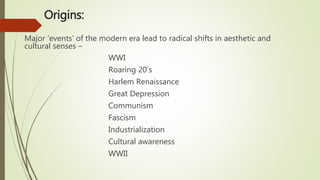
Origins:
Major ‘events’ of the modern era lead to radical shifts in aesthetic and
cultural senses –
WWI
Roaring 20’s
Harlem Renaissance
Great Depression
Communism
Fascism
Industrialization
Cultural awareness
WWII
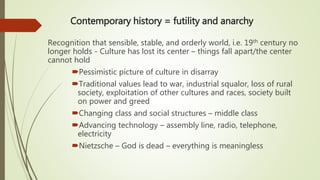
Contemporary history = futility and anarchy
Recognition that sensible, stable, and orderly world, i.e. 19th century no
longer holds - Culture has lost its center – things fall apart/the center
cannot hold
Pessimistic picture of culture in disarray
Traditional values lead to war, industrial squalor, loss of rural
society, exploitation of other cultures and races, society built
on power and greed
Changing class and social structures – middle class
Advancing technology – assembly line, radio, telephone,
electricity
Nietzsche – God is dead – everything is meaningless
Cause/effect world of 19th century leads to a
 Relativistic universe
 Structured world – surface depth only – what one sees is all there is.
 Focus on individual attempting to make or establish his or her place – or the
collective group trying to establish their place – in world
 The self is alienated from the world –
Gertrude Stein – “the lost generation”
Langston Hughes – “a dream deffered”
T. S. Eliot – “disassociation of sensibility”
W.E.B. Dubois – “double consciousness”
Authority rests in the individual – rather than traditional sites i.e.
society, institutions of society
 Individual judgment and “lived experience” (phenomenological)
seat of meaning for experience(s)
 Ideas that focused on the nature and the functioning of the
individual and on individual perception became areas of study –
psychology, psychotherapy, movements such as cubism and
impressionism
 Search for underlying hidden structures and operational laws that
motivate human behavior and govern phenomena – structuralism
 Move to the mystical and the symbolic as a means of recovering a
sense of the holy in experience.
Contributing factors to the sense of loss include:
 the challenges to 19th century science and its confidence in its ability to
explain the universe;
 industrialization and the consequent displacement of persons from their
previous physical and psychic groundings;
 the association of Christianity with capitalism, and with an oppressive
often hypocritical moralism;
 the critical historical study of biblical texts and the consequent challenge
to revelation;
 the popularization of evolutionary theory;
 a growing awareness of a variety of cultures which had differing but
cogent world-views;
 changes in philosophical thought which suggested that 'reality' was an
internal and changeable, not an externally validated, concept, and that
what is considered 'real' is based on the desire for power, not on any
objective warrant.
Characteristics of Modernist works:
 Alienation from society and loneliness
 Procrastination – an inability to function
 Agonized recollections of the past – flashbacks to the past
 Inability to feel or experience love
 Constant fear of death
 World as a Wasteland
 Man as the creator of his/her own myth
Themes in modernist works:
 Alienation and violence
 Historical discontinuity
 Rejection of history
 Decadence and decay
 Loss and despair
 Race relations
 Unavoidable change – inevitable change
 Sense of place – belonging – local color
 Regionalistic writing –i.e. Frost, Sandburg, Southern Writer

Modernism overview pptx

  • 1.
  • 2.
    Origins: Major ‘events’ ofthe modern era lead to radical shifts in aesthetic and cultural senses – WWI Roaring 20’s Harlem Renaissance Great Depression Communism Fascism Industrialization Cultural awareness WWII
  • 3.
    Contemporary history =futility and anarchy Recognition that sensible, stable, and orderly world, i.e. 19th century no longer holds - Culture has lost its center – things fall apart/the center cannot hold Pessimistic picture of culture in disarray Traditional values lead to war, industrial squalor, loss of rural society, exploitation of other cultures and races, society built on power and greed Changing class and social structures – middle class Advancing technology – assembly line, radio, telephone, electricity Nietzsche – God is dead – everything is meaningless
  • 4.
    Cause/effect world of19th century leads to a  Relativistic universe  Structured world – surface depth only – what one sees is all there is.  Focus on individual attempting to make or establish his or her place – or the collective group trying to establish their place – in world  The self is alienated from the world – Gertrude Stein – “the lost generation” Langston Hughes – “a dream deffered” T. S. Eliot – “disassociation of sensibility” W.E.B. Dubois – “double consciousness”
  • 5.
    Authority rests inthe individual – rather than traditional sites i.e. society, institutions of society  Individual judgment and “lived experience” (phenomenological) seat of meaning for experience(s)  Ideas that focused on the nature and the functioning of the individual and on individual perception became areas of study – psychology, psychotherapy, movements such as cubism and impressionism  Search for underlying hidden structures and operational laws that motivate human behavior and govern phenomena – structuralism  Move to the mystical and the symbolic as a means of recovering a sense of the holy in experience.
  • 6.
    Contributing factors tothe sense of loss include:  the challenges to 19th century science and its confidence in its ability to explain the universe;  industrialization and the consequent displacement of persons from their previous physical and psychic groundings;  the association of Christianity with capitalism, and with an oppressive often hypocritical moralism;  the critical historical study of biblical texts and the consequent challenge to revelation;  the popularization of evolutionary theory;  a growing awareness of a variety of cultures which had differing but cogent world-views;  changes in philosophical thought which suggested that 'reality' was an internal and changeable, not an externally validated, concept, and that what is considered 'real' is based on the desire for power, not on any objective warrant.
  • 7.
    Characteristics of Modernistworks:  Alienation from society and loneliness  Procrastination – an inability to function  Agonized recollections of the past – flashbacks to the past  Inability to feel or experience love  Constant fear of death  World as a Wasteland  Man as the creator of his/her own myth
  • 8.
    Themes in modernistworks:  Alienation and violence  Historical discontinuity  Rejection of history  Decadence and decay  Loss and despair  Race relations  Unavoidable change – inevitable change  Sense of place – belonging – local color  Regionalistic writing –i.e. Frost, Sandburg, Southern Writer