Downloaded 25 times


![References
[1] Consulting I: July-September 2010. Pain proposal patient survey.
[2]
https://www.wivisp.be/epidemio/epinl/CROSPNL/HISNL/his08nl/belangrijkste20%resultaten_NL.pdf.
[3] Gifford L, Butler D: The integration of pain sciences into clinical practice. . J Hand Ther
1997, 10:86-95.
[4] Gifford L: Pain, the tissues and the nervous system: a conceptual model. Physiotherapy
1998, 84:27-36.
[5] Seminowicz DA, Wideman TH, Naso L, Hatami-Khoroushahi Z, Fallatah S, Ware MA,
Jarzem P, Bushnell MC, Shir Y, Ouellet JA, Stone LS: Effective treatment of chronic low
back pain in humans reverses abnormal brain anatomy and function. J Neurosci 2011,
31:7540-50.
[6] Schmidt-Wilcke T, Leinisch E, Ganssbauer S, Draganski B, Bogdahn U, Altmeppen J,
May A: Affective components and intensity of pain correlate with structural differences in
gray matter in chronic back pain patients. Pain 2006, 125:89-97.
[7] Apkarian AV, Sosa Y, Sonty S, Levy RM, Harden RN, Parrish TB, Gitelman DR: Chronic
back pain is associated with decreased prefrontal and thalamic gray matter density. J Neurosci
2004, 24:10410-5.
[8] Buckalew N, Haut MW, Morrow L, Weiner D: Chronic pain is associated with brain
volume loss in older adults: preliminary evidence. Pain medicine (Malden, Mass 2008, 9:2408.
[9] Wood PB: Variations in brain gray matter associated with chronic pain. Current
rheumatology reports 2010, 12:462-9.
[10] Ung H, Brown JE, Johnson KA, Younger J, Hush J, Mackey S: Multivariate
Classification of Structural MRI Data Detects Chronic Low Back Pain. Cereb Cortex 2012.
[11] Giesecke T, Gracely RH, Grant MA, Nachemson A, Petzke F, Williams DA, Clauw DJ:
Evidence of augmented central pain processing in idiopathic chronic low back pain. Arthritis
and rheumatism 2004, 50:613-23.
[12] Siddall PJ, Stanwell P, Woodhouse A, Somorjai RL, Dolenko B, Nikulin A, Bourne R,
Himmelreich U, Lean C, Cousins MJ, Mountford CE: Magnetic resonance spectroscopy
detects biochemical changes in the brain associated with chronic low back pain: a preliminary
report. Anesthesia and analgesia 2006, 102:1164-8.
[13] Roussel N, Nijs J, Meeus M, Mylius V, Fayt C, Oostendorp RA: Central sensitization
and altered central pain processing in idiopathic chronic low back pain: fact or myth? The
Clinical journal of pain 2013, in press.
[14] Van Oosterwijck J, Nijs J, Meeus M, Paul L: Evidence for central sensitization in chronic
whiplash: A systematic literature review. European journal of pain (London, England) 2012.
[15] Herren-Gerber R, Weiss S, Arendt-Nielsen L, Petersen-Felix S, Di Stefano G, Radanov
BP, Curatolo M: Modulation of central hypersensitivity by nociceptive input in chronic pain
after whiplash injury. Pain medicine (Malden, Mass 2004, 5:366-76.
[16] Jull G, Sterling M, Kenardy J, Beller E: Does the presence of sensory hypersensitivity
influence outcomes of physical rehabilitation for chronic whiplash?--A preliminary RCT. Pain
2007, 129:28-34.
[17] Sterling M, Jull G, Vicenzino B, Kenardy J: Sensory hypersensitivity occurs soon after
whiplash injury and is associated with poor recovery. Pain 2003, 104:509-17.
[18] Sterling M, Treleaven J, Edwards S, Jull G: Pressure pain thresholds in chronic whiplash
associated disorder: Further evidence of altered central pain processing. J Musculoskelet Pain
2002, 10:69-81.
19](https://image.slidesharecdn.com/modernneurosciapproachcsppaper13-140205045636-phpapp02/75/Modern-neurosciapproachcs-ppaper13-19-2048.jpg)
![[19] Yang CC, Lee JC, Kromm BG, Ciol MA, Berger RE: Pain sensitization in male chronic
pelvic pain syndrome: why are symptoms so difficult to treat? The Journal of urology 2003,
170:823-6; discussion 6-7.
[20] Staud R: Evidence for shared pain mechanisms in osteoarthritis, low back pain, and
fibromyalgia. Current rheumatology reports 2011, 13:513-20.
[21] Van Oosterwijck J, Nijs J, Meeus M, Van Loo M, Paul L: Lack of endogenous pain
inhibition during exercise in people with chronic whiplash associated disorders: an
experimental study. J Pain 2012, 13:242-54.
[22] Daenen L, Nijs J, Roussel N, Wouters K, Van Loo M, Cras P: Dysfunctional pain
inhibition in patients with chronic whiplash-associated disorders: an experimental study.
Clinical rheumatology 2013, 32:23-31.
[23] Woolf CJ: Central sensitization: implications for the diagnosis and treatment of pain.
Pain 2011, 152:S2-15.
[24] Tsao H, Danneels LA, Hodges PW: ISSLS prize winner: Smudging the motor brain in
young adults with recurrent low back pain. Spine (Phila Pa 1976) 2011, 36:1721-7.
[25] D'Hooge R, Hodges P, Tsao H, Hall L, Macdonald D, Danneels L: Altered trunk muscle
coordination during rapid trunk flexion in people in remission of recurrent low back pain. J
Electromyogr Kinesiol 2013, 23:173-81.
[26] Hodges PW: The role of the motor system in spinal pain: implications for rehabilitation
of the athlete following lower back pain. Journal of science and medicine in sport / Sports
Medicine Australia 2000, 3:243-53.
[27] Cagnie B, Dirks R, Schouten M, Parlevliet T, Cambier D, Danneels L: Functional
reorganization of cervical flexor activity because of induced muscle pain evaluated by muscle
functional magnetic resonance imaging. Manual therapy 2011, 16:470-5.
[28] Roussel N, De Kooning M, Schutt A, Mottram S, Truijen S, Nijs J, Daenen L: Motor
control and low back pain in dancers. International journal of sports medicine 2013, 34:13843.
[29] Roussel N, Nijs J, Truijen S, Vervecken L, Mottram S, Stassijns G: Altered breathing
patterns during lumbopelvic motor control tests in chronic low back pain: a case-control
study. Eur Spine J 2009, 18:1066-73.
[30] Danneels LA VG, Cambier DC, Witvrouw EE. De Cuyper HJ. : Clinical science award
2000 : CT imaging of trunk muscles in chronic low back pain patients and healthy control
subjects. . European Spine Journal 2000, 9:266-72.
[31] Danneels LA CP, Cools AM, Vanderstraeten GG, Cambier DC, Witvrouw EE, De
Cuyper HJ. : Differences in multifidus and iliocostalis lumborum activity between healthy
subjects and patients with subacute and chronic low back pain. European Spine Journal 2002,
11:13-9.
[32] Hides JA, Richardson CA, Jull GA: Multifidus muscle recovery is not automatic after
resolution of acute, first-episode low back pain. Spine (Phila Pa 1976) 1996, 21:2763-9.
[33] D'hooge R, Cagnie B, Crombez G, Vanderstraeten G, Achten E, Danneels L: Lumbar
muscle dysfunction during remission of unilateral recurrent nonspecific low-back pain:
evaluation with muscle functional MRI. Clinical Journal of Pain 2013, 29:187-94.
[34] D'hooge R, Cagnie B, Crombez G, Vanderstraeten G, Dolphens M, Danneels L:
Increased intramuscular fatty infiltration without differences in lumbar muscle cross-sectional
area during remission of unilateral recurrent low back pain. Manual therapy 2012, 17:584-8.
[35] Macedo LG, Latimer J, Maher CG, Hodges PW, McAuley JH, Nicholas MK, Tonkin L,
Stanton CJ, Stanton TR, Stafford R: Effect of motor control exercises versus graded activity
in patients with chronic nonspecific low back pain: a randomized controlled trial. Physical
therapy 2012, 92:363-77.
20](https://image.slidesharecdn.com/modernneurosciapproachcsppaper13-140205045636-phpapp02/75/Modern-neurosciapproachcs-ppaper13-20-2048.jpg)
![[36] Unsgaard-Tondel M, Fladmark AM, Salvesen O, Vasseljen O: Motor control exercises,
sling exercises, and general exercises for patients with chronic low back pain: a randomized
controlled trial with 1-year follow-up. Physical therapy 2010, 90:1426-40.
[37] Falla D, O'Leary S, Farina D, Jull G: The change in deep cervical flexor activity after
training is associated with the degree of pain reduction in patients with chronic neck pain. The
Clinical journal of pain 2012, 28:628-34.
[38] Ask T, Strand LI, Skouen JS: The effect of two exercise regimes; motor control versus
endurance/strength training for patients with whiplash-associated disorders: a randomized
controlled pilot study. Clinical rehabilitation 2009, 23:812-23.
[39] Wang XQ, Zheng JJ, Yu ZW, Bi X, Lou SJ, Liu J, Cai B, Hua YH, Wu M, Wei ML,
Shen HM, Chen Y, Pan YJ, Xu GH, Chen PJ: A Meta-Analysis of Core Stability Exercise
versus General Exercise for Chronic Low Back Pain. PloS one 2012, 7:e52082.
[40] Baliki MN, Petre B, Torbey S, Herrmann KM, Huang L, Schnitzer TJ, Fields HL,
Apkarian AV: Corticostriatal functional connectivity predicts transition to chronic back pain.
Nature neuroscience 2012, 15:1117-9.
[41] Obermann M, Nebel K, Schumann C, Holle D, Gizewski ER, Maschke M, Goadsby PJ,
Diener HC, Katsarava Z: Gray matter changes related to chronic posttraumatic headache.
Neurology 2009, 73:978-83.
[42] Gwilym SE, Keltner JR, Warnaby CE, Carr AJ, Chizh B, Chessell I, Tracey I:
Psychophysical and functional imaging evidence supporting the presence of central
sensitization in a cohort of osteoarthritis patients. Arthritis and rheumatism 2009, 61:1226-34.
[43] Rodriguez-Raecke R, Niemeier A, Ihle K, Ruether W, May A: Brain gray matter
decrease in chronic pain is the consequence and not the cause of pain. J Neurosci 2009,
29:13746-50.
[44] Flor H, Braun C, Elbert T, Birbaumer N: Extensive reorganization of primary
somatosensory cortex in chronic back pain patients. Neuroscience letters 1997, 224:5-8.
[45] Masse-Alarie H, Flamand VH, Moffet H, Schneider C: Corticomotor control of deep
abdominal muscles in chronic low back pain and anticipatory postural adjustments.
Experimental brain research Experimentelle Hirnforschung Experimentation cerebrale 2012,
218:99-109.
[46] Tsao H, Galea MP, Hodges PW: Reorganization of the motor cortex is associated with
postural control deficits in recurrent low back pain. Brain 2008, 131:2161-71.
[47] Tsao H, Galea MP, Hodges PW: Driving plasticity in the motor cortex in recurrent low
back pain. European journal of pain (London, England) 2010, 14:832-9.
[48] Nijs J, Van Houdenhove B, Oostendorp RA: Recognition of central sensitization in
patients with musculoskeletal pain: Application of pain neurophysiology in manual therapy
practice. Manual therapy 2010, 15:135-41.
[49] Staud R, Craggs JG, Robinson ME, Perlstein WM, Price DD: Brain activity related to
temporal summation of C-fiber evoked pain. Pain 2007, 129:130-42.
[50] Millan MJ: Descending control of pain. Progress in neurobiology 2002, 66:355-474.
[51] Zhuo M: A synaptic model for pain: long-term potentiation in the anterior cingulate
cortex. Molecules and cells 2007, 23:259-71.
[52] Suarez-Roca H, Leal L, Silva JA, Pinerua-Shuhaibar L, Quintero L: Reduced GABA
neurotransmission underlies hyperalgesia induced by repeated forced swimming stress.
Behavioural brain research 2008, 189:159-69.
[53] Seifert F, Maihofner C: Central mechanisms of experimental and chronic neuropathic
pain: findings from functional imaging studies. Cellular and molecular life sciences : CMLS
2009, 66:375-90.
21](https://image.slidesharecdn.com/modernneurosciapproachcsppaper13-140205045636-phpapp02/75/Modern-neurosciapproachcs-ppaper13-21-2048.jpg)
![[54] Puentedura EJ, Louw A: A neuroscience approach to managing athletes with low back
pain. Physical therapy in sport : official journal of the Association of Chartered
Physiotherapists in Sports Medicine 2012, 13:123-33.
[55] Lumley MA, Cohen JL, Borszcz GS, Cano A, Radcliffe AM, Porter LS, Schubiner H,
Keefe FJ: Pain and emotion: a biopsychosocial review of recent research. Journal of clinical
psychology 2011, 67:942-68.
[56] Mease PJ, Hanna S, Frakes EP, Altman RD: Pain mechanisms in osteoarthritis:
understanding the role of central pain and current approaches to its treatment. The Journal of
rheumatology 2011, 38:1546-51.
[57] Meeus M, Vervisch S, De Clerck LS, Moorkens G, Hans G, Nijs J: Central sensitization
in patients with rheumatoid arthritis: a systematic literature review. Seminars in arthritis and
rheumatism 2012, 41:556-67.
[58] Nijs J, Van Oosterwijck J, De Hertogh W: Rehabilitation of chronic whiplash: treatment
of cervical dysfunctions or chronic pain syndrome? Clinical rheumatology 2009, 28:243-51.
[59] Kaya S HL, Willems T, Roussel N, Meeus M: Central sensitization in urogynecological
chronic pelvic pain: A systematic literature review. . Pain physician 2013:in press.
[60] Crombez G, Vlaeyen JW, Heuts PH, Lysens R: Pain-related fear is more disabling than
pain itself: evidence on the role of pain-related fear in chronic back pain disability. Pain 1999,
80:329-39.
[61] Vlaeyen JW, Kole-Snijders AM, Boeren RG, van Eek H: Fear of movement/(re)injury in
chronic low back pain and its relation to behavioral performance. Pain 1995, 62:363-72.
[62] Leeuw M, Goossens ME, Linton SJ, Crombez G, Boersma K, Vlaeyen JW: The fearavoidance model of musculoskeletal pain: current state of scientific evidence. Journal of
behavioral medicine 2007, 30:77-94.
[63] Wideman TH, Asmundson GG, Smeets RJ, Zautra AJ, Simmonds MJ, Sullivan MJ,
Haythornthwaite JA, Edwards RR: Rethinking the fear avoidance model: toward a
multidimensional framework of pain-related disability. Pain 2013, 154:2262-5.
[64] Ang DC, Chakr R, Mazzuca S, France CR, Steiner J, Stump T: Cognitive-behavioral
therapy attenuates nociceptive responding in patients with fibromyalgia: a pilot study.
Arthritis care & research 2010, 62:618-23.
[65] de Lange FP, Koers A, Kalkman JS, Bleijenberg G, Hagoort P, van der Meer JW, Toni I:
Increase in prefrontal cortical volume following cognitive behavioural therapy in patients with
chronic fatigue syndrome. Brain 2008, 131:2172-80.
[66] Louw A, Diener I, Butler DS, Puentedura EJ: The effect of neuroscience education on
pain, disability, anxiety, and stress in chronic musculoskeletal pain. Archives of physical
medicine and rehabilitation 2011, 92:2041-56.
[67] Nijs J, Paul van Wilgen C, Van Oosterwijck J, van Ittersum M, Meeus M: How to
explain central sensitization to patients with 'unexplained' chronic musculoskeletal pain:
practice guidelines. Manual therapy 2011, 16:413-8.
[68] Van Oosterwijck J, Nijs J, Meeus M, Truijen S, Craps J, Van den Keybus N, Paul L: Pain
neurophysiology education improves cognitions, pain thresholds, and movement performance
in people with chronic whiplash: a pilot study. Journal of rehabilitation research and
development 2011, 48:43-58.
[69] Moseley GL: Evidence for a direct relationship between cognitive and physical change
during an education intervention in people with chronic low back pain. European journal of
pain (London, England) 2004, 8:39-45.
[70] Moseley GL: Widespread brain activity during an abdominal task markedly reduced after
pain physiology education: fMRI evaluation of a single patient with chronic low back pain.
The Australian journal of physiotherapy 2005, 51:49-52.
22](https://image.slidesharecdn.com/modernneurosciapproachcsppaper13-140205045636-phpapp02/75/Modern-neurosciapproachcs-ppaper13-22-2048.jpg)
![[71] Moseley GL: Joining forces – combining cognition-targeted motor control training with
group or individual pain physiology education: a successful treatment for chronic low back
pain. . J Manual Manipulative Ther 2003, 11:88-94.
[72] Moseley GL, Nicholas MK, Hodges PW: A randomized controlled trial of intensive
neurophysiology education in chronic low back pain. The Clinical journal of pain 2004,
20:324-30.
[73] Moseley GL: Combined physiotherapy and education is efficacious for chronic low back
pain. The Australian journal of physiotherapy 2002, 48:297-302.
[74] Butler D, Moseley GL: Explain pain: Adelaide: NOI Group Publishing, 2003.
[75] van Wilgen CP, Keizer D: The sensitization model to explain how chronic pain exists
without tissue damage. Pain management nursing : official journal of the American Society of
Pain Management Nurses 2012, 13:60-5.
[76] Sullivan MJL, Bishop SR, Pivik J: The pain catastrophizing scale: development and
validation. Psychol Asses 1995, 7:524-32.
[77] Richardson CA, Jull GA: Muscle control-pain control. What exercises would you
prescribe? Manual therapy 1995, 1:2-10.
[78] Comerford MJ, Mottram SL: Functional stability re-training: principles and strategies for
managing mechanical dysfunction. Manual therapy 2001, 6:3-14.
[79] Sahrmann SA: Does postural assessment contribute to patient care? The Journal of
orthopaedic and sports physical therapy 2002, 32:376-9.
[80] Leeuw M, Goossens ME, van Breukelen GJ, Boersma K, Vlaeyen JW: Measuring
perceived harmfulness of physical activities in patients with chronic low back pain: the
Photograph Series of Daily Activities--short electronic version. J Pain 2007, 8:840-9.
[81] George SZ, Valencia C, Zeppieri G, Jr., Robinson ME: Development of a self-report
measure of fearful activities for patients with low back pain: the fear of daily activities
questionnaire. Physical therapy 2009, 89:969-79.
[82] Trost Z, France CR, Thomas JS: Examination of the photograph series of daily activities
(PHODA) scale in chronic low back pain patients with high and low kinesiophobia. Pain
2009, 141:276-82.
[83] Boudreau SA, Farina D, Falla D: The role of motor learning and neuroplasticity in
designing rehabilitation approaches for musculoskeletal pain disorders. Man Ther 2010,
15:410-4.
23](https://image.slidesharecdn.com/modernneurosciapproachcsppaper13-140205045636-phpapp02/75/Modern-neurosciapproachcs-ppaper13-23-2048.jpg)
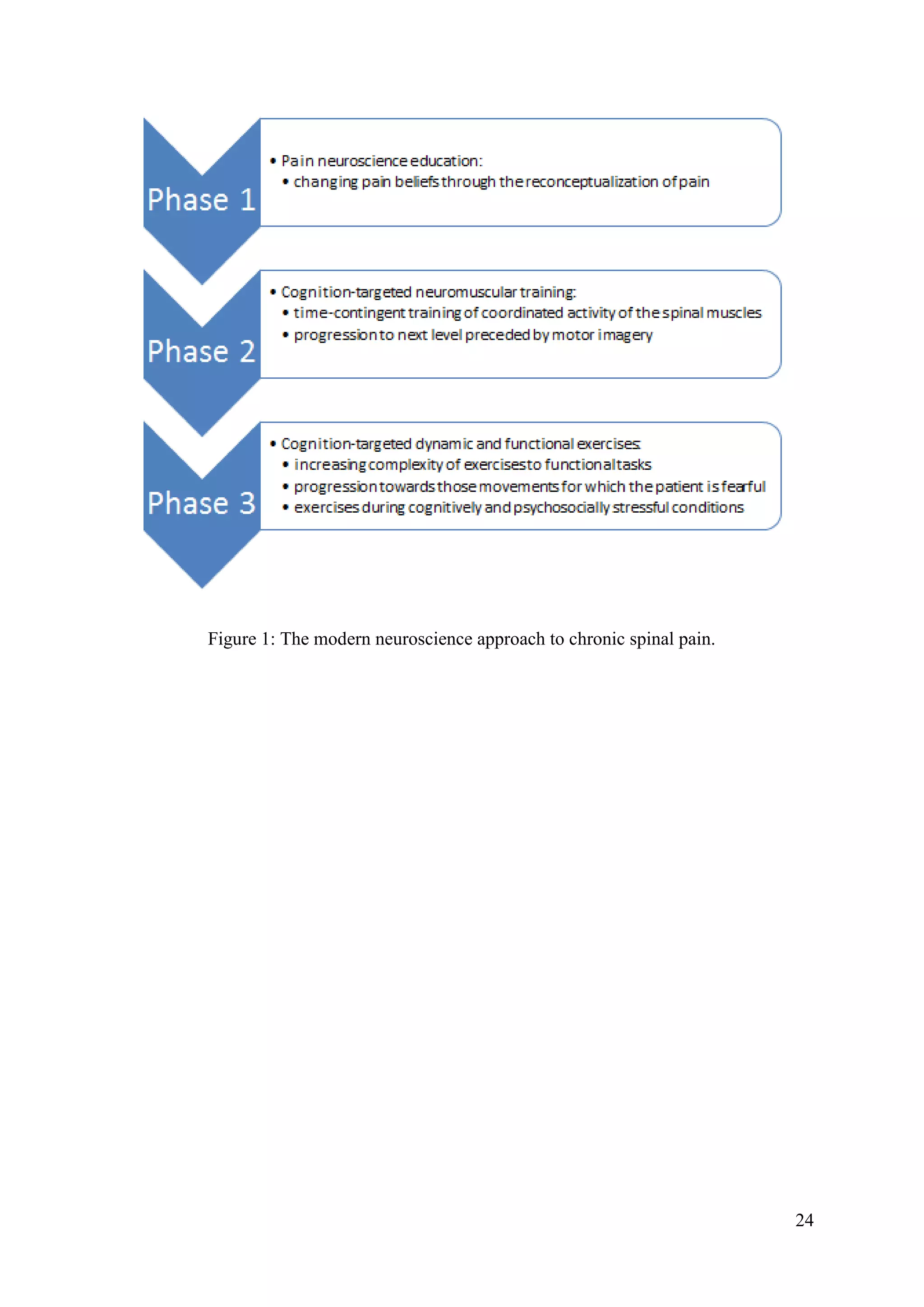

This document describes a modern neuroscience approach for treating chronic spinal pain that combines pain neuroscience education with cognition-targeted motor control training. It discusses evidence that chronic spinal pain patients have abnormalities in brain structure and function, including decreased grey matter density, impaired motor control-related brain areas, and a sensitized brain due to central sensitization. The proposed approach has three phases: 1) Therapeutic pain neuroscience education to reconceptualize pain and explain central sensitization, 2) Cognition-targeted motor control training to address motor dysfunction, 3) Both 1) and 2) together to target peripheral and central mechanisms of chronic spinal pain.


