




Models of Technology
Integration
LaQuata Sumter
Feb. 6, 2018
Models of technology integration
• Identify technology integration models past-present
• Trends in research
•BYOD
•flipped classroom
• Practice and theory of designing instruction for
technology implementation
Past and Present
Technology Integration Models
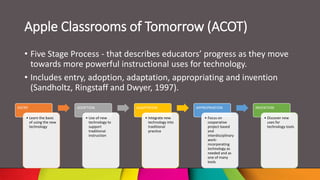
Apple Classrooms of Tomorrow (ACOT)
• Five Stage Process - that describes educators’ progress as they move
towards more powerful instructional uses for technology.
• Includes entry, adoption, adaptation, appropriating and invention
(Sandholtz, Ringstaff and Dwyer, 1997).
ENTRY
• Learn the basic
of using the new
technology
ADOPTION
• Use of new
technology to
support
traditional
instruction
ADAPTATION
• Integrate new
technology into
traditional
practice
APPROPRIATION
• Focus on
cooperative
project based
and
interdisciplinary
work-
incorporating
technology as
needed and as
one of many
tools
INVENTION
• Discover new
uses for
technology tools
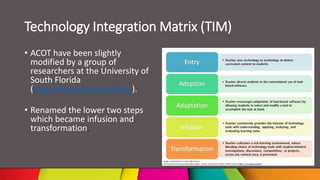
Technology Integration Matrix (TIM)
• ACOT have been slightly
modified by a group of
researchers at the University of
South Florida
(http://fcit.usf.edu/matrix/).
• Renamed the lower two steps
which became infusion and
transformation.
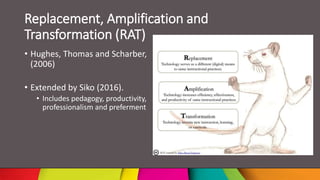
Replacement, Amplification and
Transformation (RAT)
• Hughes, Thomas and Scharber,
(2006)
• Extended by Siko (2016).
• Includes pedagogy, productivity,
professionalism and preferment
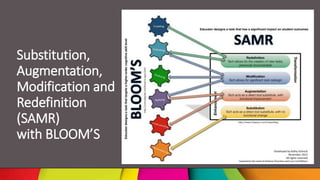
Substitution, Augmentation, Modification and
Redefinition (SAMR)
• Developed by Dr. Ruben
Puentedura
• Model designed to help
educators infuse technology into
teaching and learning.
Substitution,
Augmentation,
Modification and
Redefinition
(SAMR)
with BLOOM’S
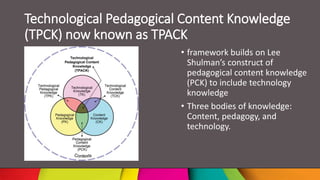
Technological Pedagogical Content Knowledge
(TPCK) now known as TPACK
• framework builds on Lee
Shulman’s construct of
pedagogical content knowledge
(PCK) to include technology
knowledge
• Three bodies of knowledge:
Content, pedagogy, and
technology.
CheckPoint
http://www.laquatasumter.net/PhD
LearningTech/jeopardy-game/
Trends in research
BYOD & Flipped classroom
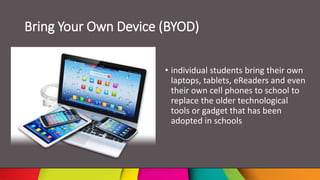
Bring Your Own Device (BYOD)
• individual students bring their own
laptops, tablets, eReaders and even
their own cell phones to school to
replace the older technological
tools or gadget that has been
adopted in schools
Discussion Board Post
Visit:
http://www.laquatasumter.net/PhDLearningTech/byod-discussion/
PassWord:
UNTLT2019#
Flipped Classroom
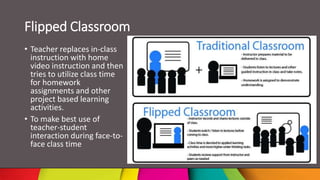
• Teacher replaces in-class
instruction with home
video instruction and then
tries to utilize class time
for homework
assignments and other
project based learning
activities.
• To make best use of
teacher-student
interaction during face-to-
face class time
Practice and theory of designing
instruction for technology
implementation
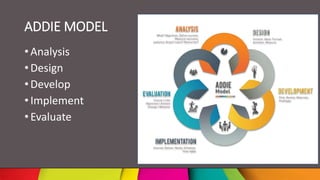
ADDIE MODEL
• Analysis
• Design
• Develop
• Implement
• Evaluate
References
• Florida Center for Instructional Technology (n.d.). The technology integration matrix. Retrieved, February 1, 2018, from
http://fcit.usf.edu/matrix/index.php
• Hughes, J., Thomas, R. & Scharber, C. (2006). Assessing Technology Integration: The RAT – Replacement, Amplification, and Transformation –
Framework. In C. Crawford, R. Carlsen, K. McFerrin, J. Price, R. Weber & D. Willis (Eds.), Proceedings of SITE 2006–Society for Information Technology
& Teacher Education International Conference (pp. 1616-1620). Orlando, Florida, USA: Association for the Advancement of Computing in Education
(AACE). Retrieved February 1, 2018 from https://www.learntechlib.org/p/22293/.
• Kolb (2017). Learning first, technology second. The educator’s guide to designing authentic lessons. ISTE.
• Mishra, P., & Koehler, M. J. (2006). Technological Pedagogical Content Knowledge: A new framework for teacher knowledge. Teachers College Record,
108(6), 1017-1054.
• Puentedura, R. (2011) Beyond Substitution: The SAMR Model. 2011 Summer Tech Institute. http://msad75summertechnologyinstitute.wordpress.com
• Abaffy, L. (2011). Does anyone have an idea for a manageable, bring-your-own-device policy?. ENR: Engineering News-Record, 267(18), 18.
• Harris, C. (2012). Going Mobile. School Library Journal, 58(1), 14.
• Norris, C., & Soloway, E. (2011). BYOD as the catalyst to transform classroom culture. District Administration, 47(9), 114.
• Norris, C., & Soloway, E. (2011). From banning to BYOD. District Administration,47(5), 94.
• Puente, K. (2012). High school pupils bring their own devices. District Administration, 48(2), 64.
• Puenta, K. (2012). Leadership for mobile learning. District Administration, 48(2), 64.
• Garrison, R.D., and Kanuka, H. (2004). Blended learning: Uncovering its transformative potential in higher education. Internet and Higher Education
7(2), 95-105.
• Sams, A. (2011) Learning, Innovation & Tech Bombs & Breakthroughs. The Flipped Class: Shedding light on the confusion, critique, and hype retrieved
from http://www.thedailyriff.com/articles/the-flipped-class-shedding-light-on-the-confusion-critique-and-hype-801.php
• So, H.J. & Brush, T.A. (2008). Students perceptions of collaborative learning, social presence and satisfaction in a blended learning environment:
Relationships and critical factors. Computers and Education 51, 318-336.
• Strayer, J. (2012). How learning in an inverted classroom influences cooperation, innovation and task orientation. Learning environments research.
Models of technology integration

Models of technology integration

  • 1.
  • 2.
    Models of technologyintegration • Identify technology integration models past-present • Trends in research •BYOD •flipped classroom • Practice and theory of designing instruction for technology implementation
  • 3.
    Past and Present TechnologyIntegration Models
  • 4.
    Apple Classrooms ofTomorrow (ACOT) • Five Stage Process - that describes educators’ progress as they move towards more powerful instructional uses for technology. • Includes entry, adoption, adaptation, appropriating and invention (Sandholtz, Ringstaff and Dwyer, 1997). ENTRY • Learn the basic of using the new technology ADOPTION • Use of new technology to support traditional instruction ADAPTATION • Integrate new technology into traditional practice APPROPRIATION • Focus on cooperative project based and interdisciplinary work- incorporating technology as needed and as one of many tools INVENTION • Discover new uses for technology tools
  • 5.
    Technology Integration Matrix(TIM) • ACOT have been slightly modified by a group of researchers at the University of South Florida (http://fcit.usf.edu/matrix/). • Renamed the lower two steps which became infusion and transformation.
  • 6.
    Replacement, Amplification and Transformation(RAT) • Hughes, Thomas and Scharber, (2006) • Extended by Siko (2016). • Includes pedagogy, productivity, professionalism and preferment
  • 7.
    Substitution, Augmentation, Modificationand Redefinition (SAMR) • Developed by Dr. Ruben Puentedura • Model designed to help educators infuse technology into teaching and learning.
  • 8.
  • 9.
    Technological Pedagogical ContentKnowledge (TPCK) now known as TPACK • framework builds on Lee Shulman’s construct of pedagogical content knowledge (PCK) to include technology knowledge • Three bodies of knowledge: Content, pedagogy, and technology.
  • 10.
  • 11.
    Trends in research BYOD& Flipped classroom
  • 12.
    Bring Your OwnDevice (BYOD) • individual students bring their own laptops, tablets, eReaders and even their own cell phones to school to replace the older technological tools or gadget that has been adopted in schools
  • 13.
  • 14.
    Flipped Classroom • Teacherreplaces in-class instruction with home video instruction and then tries to utilize class time for homework assignments and other project based learning activities. • To make best use of teacher-student interaction during face-to- face class time
  • 15.
    Practice and theoryof designing instruction for technology implementation
  • 16.
    ADDIE MODEL • Analysis •Design • Develop • Implement • Evaluate
  • 17.
    References • Florida Centerfor Instructional Technology (n.d.). The technology integration matrix. Retrieved, February 1, 2018, from http://fcit.usf.edu/matrix/index.php • Hughes, J., Thomas, R. & Scharber, C. (2006). Assessing Technology Integration: The RAT – Replacement, Amplification, and Transformation – Framework. In C. Crawford, R. Carlsen, K. McFerrin, J. Price, R. Weber & D. Willis (Eds.), Proceedings of SITE 2006–Society for Information Technology & Teacher Education International Conference (pp. 1616-1620). Orlando, Florida, USA: Association for the Advancement of Computing in Education (AACE). Retrieved February 1, 2018 from https://www.learntechlib.org/p/22293/. • Kolb (2017). Learning first, technology second. The educator’s guide to designing authentic lessons. ISTE. • Mishra, P., & Koehler, M. J. (2006). Technological Pedagogical Content Knowledge: A new framework for teacher knowledge. Teachers College Record, 108(6), 1017-1054. • Puentedura, R. (2011) Beyond Substitution: The SAMR Model. 2011 Summer Tech Institute. http://msad75summertechnologyinstitute.wordpress.com • Abaffy, L. (2011). Does anyone have an idea for a manageable, bring-your-own-device policy?. ENR: Engineering News-Record, 267(18), 18. • Harris, C. (2012). Going Mobile. School Library Journal, 58(1), 14. • Norris, C., & Soloway, E. (2011). BYOD as the catalyst to transform classroom culture. District Administration, 47(9), 114. • Norris, C., & Soloway, E. (2011). From banning to BYOD. District Administration,47(5), 94. • Puente, K. (2012). High school pupils bring their own devices. District Administration, 48(2), 64. • Puenta, K. (2012). Leadership for mobile learning. District Administration, 48(2), 64. • Garrison, R.D., and Kanuka, H. (2004). Blended learning: Uncovering its transformative potential in higher education. Internet and Higher Education 7(2), 95-105. • Sams, A. (2011) Learning, Innovation & Tech Bombs & Breakthroughs. The Flipped Class: Shedding light on the confusion, critique, and hype retrieved from http://www.thedailyriff.com/articles/the-flipped-class-shedding-light-on-the-confusion-critique-and-hype-801.php • So, H.J. & Brush, T.A. (2008). Students perceptions of collaborative learning, social presence and satisfaction in a blended learning environment: Relationships and critical factors. Computers and Education 51, 318-336. • Strayer, J. (2012). How learning in an inverted classroom influences cooperation, innovation and task orientation. Learning environments research.

Editor's Notes

  • #5 Apple Company provided K-12 schools with computers, software, printers, and professional development. During those periods, several researchers have tried various ways to integrate technology for instruction and assessment. Over the years, various models of technology integration have been proposed for education. Sandholtz, et al., (1997) stated that Apple Classrooms of Tomorrow (ACOT) research resulted in a five stage process that describes educators’ progress as they move towards more powerful instructional uses for technology.
  • #6 They renamed the lower two steps which became infusion and transformation. The model developed by University of South Florida was referred to as the Technology Integration Matrix.
  • #7 However, this model has been extended by Siko (2016). The extension includes pedagogy, productivity, professionalism and preferment.
  • #10  The development of TPACK by teachers is critical to effective teaching with technology.  For teacher knowledge is described in detail, as a complex interaction among three bodies of knowledge: Content, pedagogy, and technology. The interaction of these bodies of knowledge, both theoretically and in practice, produces the types of flexible knowledge needed to successfully integrate technology use into teaching.
  • #13 During the period of tight budget cuts, the K-12 schools look for other contracting option to replace previous technology that has always been used to teach students. Old technologies like laptops and PCs. One of the alternatives considered is that individual students should bring their own laptops, tablets, eReaders and even their own cell phones to school to replace the older technological tools or gadget that has been adopted in schools. The new method will enable students to reach outside of their classroom walls to work together with other students. They also meet with experts in the field. Whenever the students are at home, they use their cell phones, laptops and tablets to do their schoolwork. In the 21st century, collaboration is not the only important component of students but research available to the student is vast. With BYOD, the students can now enjoy the best of both worlds. According to Puente (2012), he reported success with BYOD because administration found less student misbehavior and more student involvement.
  • #15  The trend of flipping a classroom occurs when the teacher replaces in-class instruction with home video instruction and then tries to utilize class time for homework assignments and other project based learning activities. The reason for the flipped classroom is to make best use of teacher-student interaction during face-to-face class time. A flipped classroom uses the project-based learning, integrates technology, and supports the classroom time to reinforce the learning process. However, the initial learning of the lessons happens at home through videos and this gives students an opportunity to learn at their own pace. Garrison and Kanuka (2004) stated that whenever students enter the classroom, the teacher can create teaching and learning opportunities through the differentiation of content, process, assessment and/or learning environment. In a flipped classroom teachers are afforded the opportunity to develop stable learning environments. Interactive technologies make it possible for educators to qualitatively reconceptualise the teaching and learning dynamic (Strayer, p. 3, 2012).
  • #17 Researchers and practitioners have tried to define and create models of design with the intent to improve instruction for technology implementation. The progression of analyzing, designing, developing, implementing, and evaluating (ADDIE) forms the basic process that is a distinct component of instructional design regardless of which model is used (Gustafson and Branch, 1997). According to Branch (2009) the ADDIE process as follows: The Analyzes stage, this involves the identification of the probable causes for the performance gap. The next stage is the “Design”, this involves the verification of the desired performances and appropriate testing methods. The development stage involves the generation and validation of the learning resources. The “Implement” stage involves the preparation of the learning environment and engage the students. The last stage is the “evaluation stage”, this stage involves the assessment of quality of the instructional products and processes, both before and after implementation (p. 3).