Modal Verbs
▹ Verbs that have always the same form
▸ There is no s at the ending in the third person singular, no
ing and no ed form
▸ Examples:
⬩ Can (past form: could)
⬩ May (Past form: might)
⬩ Will
⬩ Shall
⬩ Should
⬩ Must
⬩ Ought to
Modal verbs are different from normal verbs as…
▹ They don't use an 's' for the third person singular.
▹ They make questions by inversion ('she can go'
becomes 'can she go?').
▹ They are followed directly by the infinitive of
another verb (without 'to').
They can be used when we want to say how sure we are that something happened / is
happening / will happen.
We often call these 'modals of deduction' or 'speculation' or 'certainty' or 'probability'.
Ability ▹ We use 'can' and 'could' to talk
about a skill or ability.
▸ I can swim very fast
▸ I could be a very good trainer
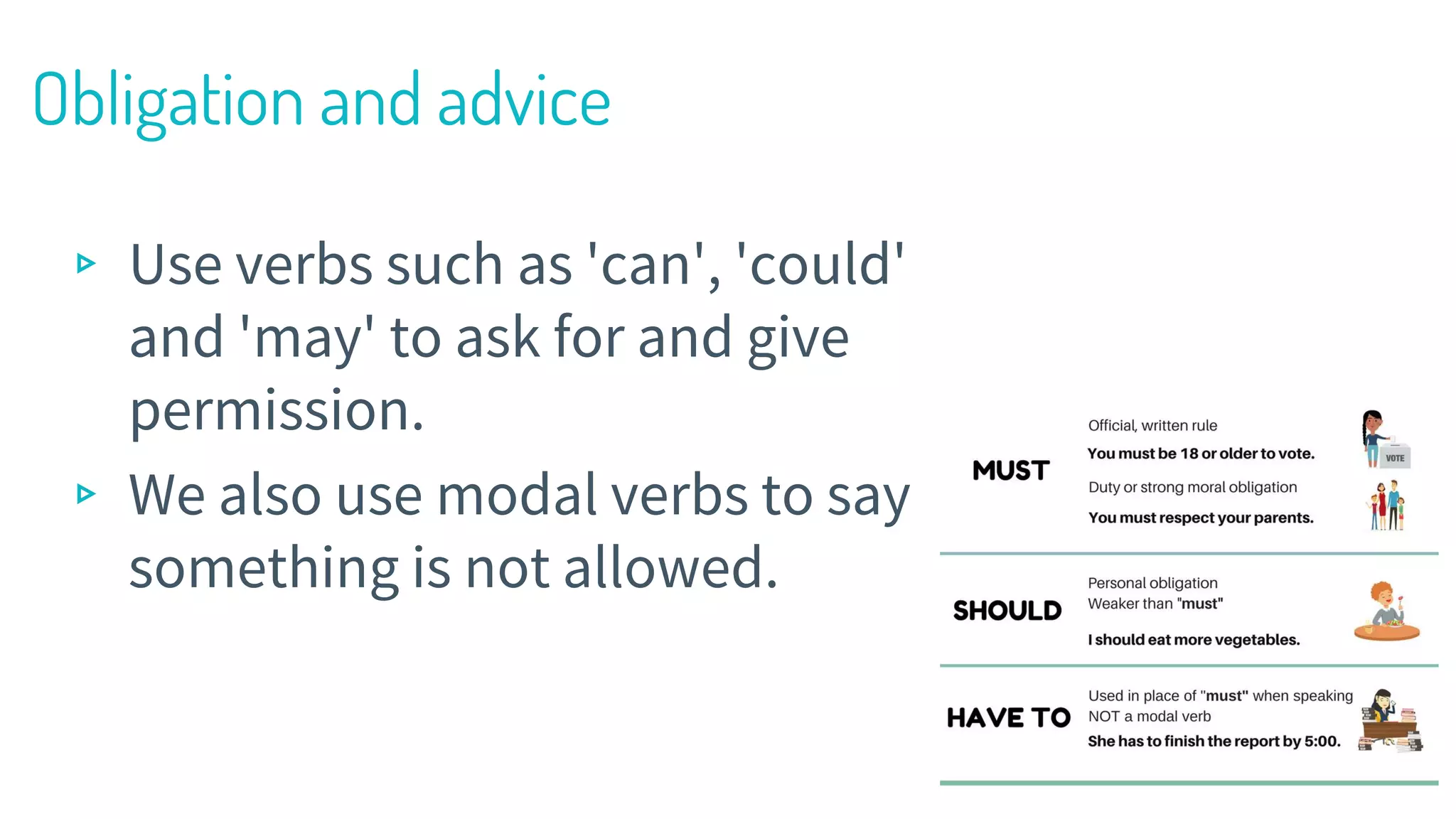
Obligation and advice
▹ Use verbs such as 'can', 'could'
and 'may' to ask for and give
permission.
▹ We also use modal verbs to say
something is not allowed.
Habits ▹ Use 'will' and 'would' to talk about
habits or things we usually do, or
did in the past.
Will can also be used as a preposition
Could have, should have, would have
▹ These past modal verbs are all used
hypothetically, to talk about things that
didn't really happen in the past.
▸ Could have + past participle
⬩ means that something was possible in the past, or
you had the ability to do something in the past, but
that you didn't do it.
⬩ “I could have stayed up late, but I decided to go to
bed early.»
▹ Couldn't have + past participle
▸ means that something wasn't possible
in the past, even if you had wanted to
do it.
⬩ I couldn't have arrived any earlier.
There was a terrible traffic jam
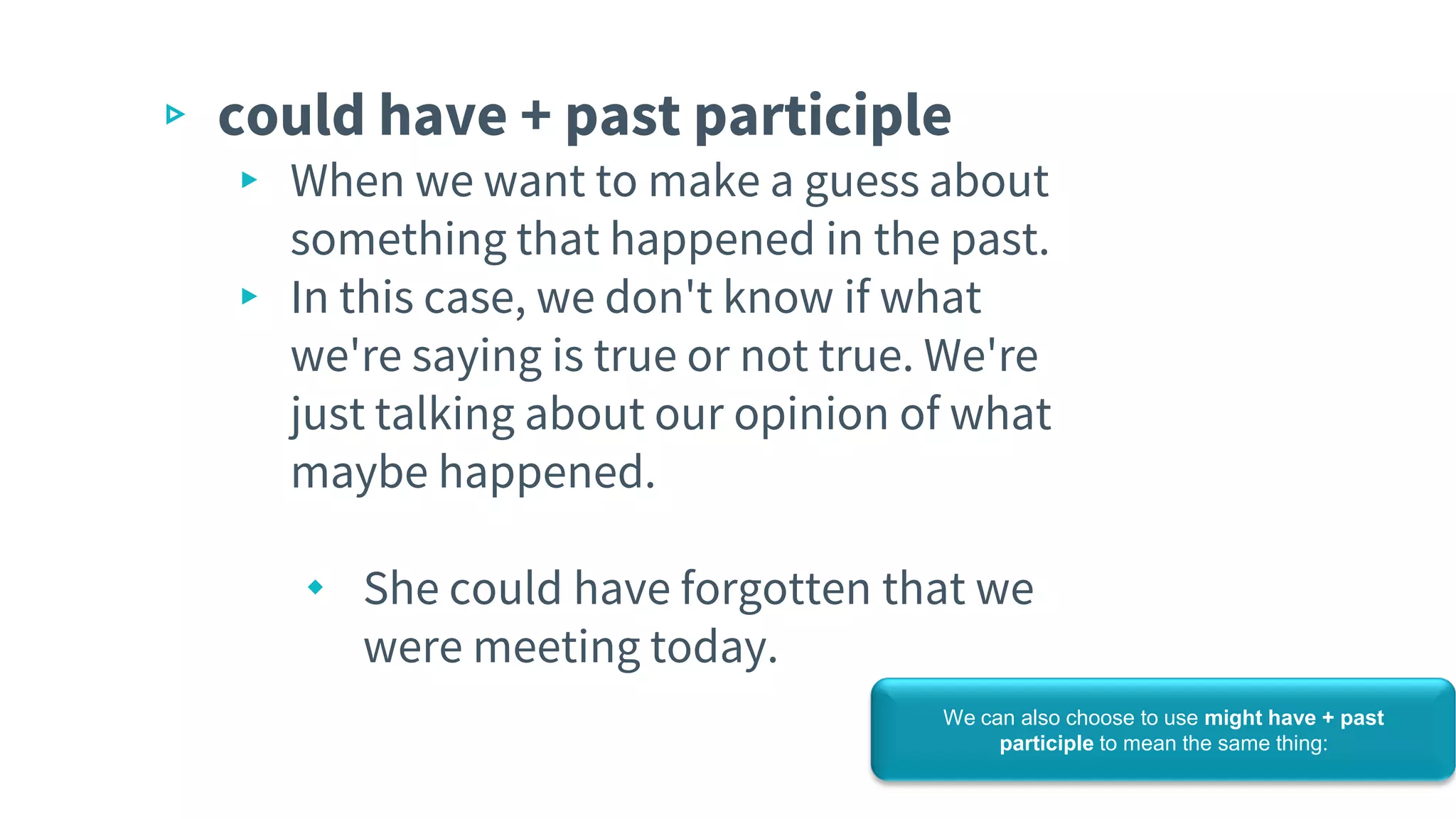
▹ could have + past participle
▸ When we want to make a guess about
something that happened in the past.
▸ In this case, we don't know if what
we're saying is true or not true. We're
just talking about our opinion of what
maybe happened.
⬩ She could have forgotten that we
were meeting today.
We can also choose to use might have + past
participle to mean the same thing:
Should have + past
participle
▹ can mean something that would
have been a good idea, but that you
didn't do it.
▹ Like giving advice about the past
when you say it to someone else, or
regretting what you did or didn't do
when you're talking about yourself.
Shouldn't have + past participle means that something wasn't a good idea,
but you did it anyway.
▹ We can also use should have + past
participle to talk about something that, if
everything is normal and okay, we think
has already happened.
▸ But we're not certain that everything is fine, so
we use 'should have' and not the present perfect
or past simple. It's often used with 'by now'.
⬩ John should have finished work by now
Would have + past participle
▹ Part of the third conditional
▸ If I had had enough money, I would have
bought a car
▹ Because 'would' (and will) can also be used to show
if you want to do something or not (volition), we can
also use would have + past participle to talk about
something you wanted to do but didn't. This is very
similar to the third conditional, but we don't need an
'if clause'.
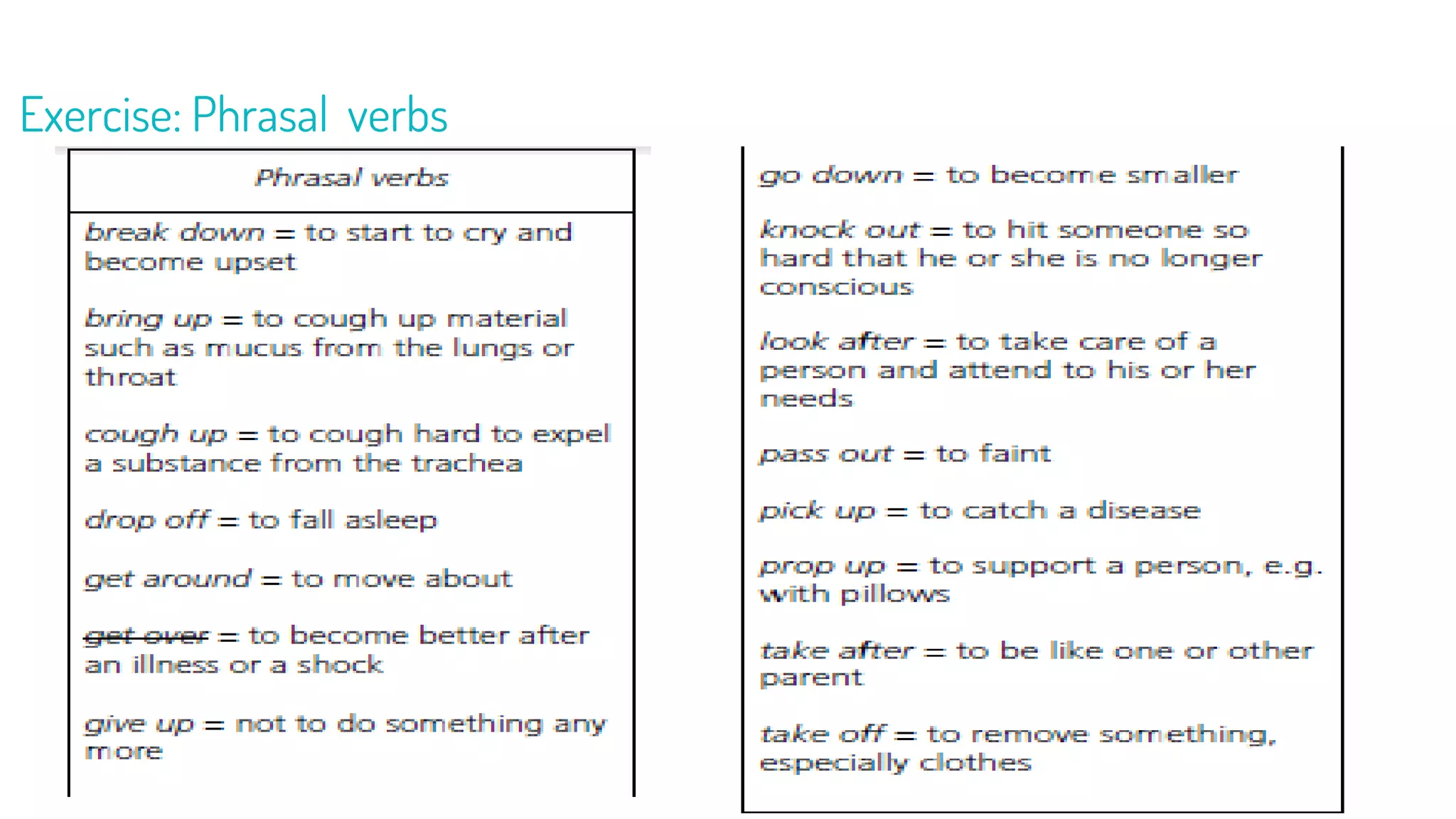
Phrasal verbs
▹ Verbs made up of 2 words: verb +
preposition:
▸ Example:
Exercise: Phrasal verbs
Exercise: use the correct phrasal verb to
complete sentences
▹ He ___________his cold.
▹ The nurses are _______________her very
well.
▹ He must have _______________ the disease
when he was travelling in Africa.
▹ She often _______________ in front of the TV.
▹ When we told her that her father was ill, she
_______________.
▹ She _______________ and cried as she
described the symptoms to the doctor.
▹ He _______________ his father.
▹ The doctor asked him to _______________
his shirt.
▹ He was _______________ mucus.

modal verbs

  • 2.
    Modal Verbs ▹ Verbsthat have always the same form ▸ There is no s at the ending in the third person singular, no ing and no ed form ▸ Examples: ⬩ Can (past form: could) ⬩ May (Past form: might) ⬩ Will ⬩ Shall ⬩ Should ⬩ Must ⬩ Ought to
  • 3.
    Modal verbs aredifferent from normal verbs as… ▹ They don't use an 's' for the third person singular. ▹ They make questions by inversion ('she can go' becomes 'can she go?'). ▹ They are followed directly by the infinitive of another verb (without 'to'). They can be used when we want to say how sure we are that something happened / is happening / will happen. We often call these 'modals of deduction' or 'speculation' or 'certainty' or 'probability'.
  • 5.
    Ability ▹ Weuse 'can' and 'could' to talk about a skill or ability. ▸ I can swim very fast ▸ I could be a very good trainer
  • 6.
    Obligation and advice ▹Use verbs such as 'can', 'could' and 'may' to ask for and give permission. ▹ We also use modal verbs to say something is not allowed.
  • 7.
    Habits ▹ Use'will' and 'would' to talk about habits or things we usually do, or did in the past. Will can also be used as a preposition
  • 8.
    Could have, shouldhave, would have ▹ These past modal verbs are all used hypothetically, to talk about things that didn't really happen in the past. ▸ Could have + past participle ⬩ means that something was possible in the past, or you had the ability to do something in the past, but that you didn't do it. ⬩ “I could have stayed up late, but I decided to go to bed early.»
  • 9.
    ▹ Couldn't have+ past participle ▸ means that something wasn't possible in the past, even if you had wanted to do it. ⬩ I couldn't have arrived any earlier. There was a terrible traffic jam
  • 10.
    ▹ could have+ past participle ▸ When we want to make a guess about something that happened in the past. ▸ In this case, we don't know if what we're saying is true or not true. We're just talking about our opinion of what maybe happened. ⬩ She could have forgotten that we were meeting today. We can also choose to use might have + past participle to mean the same thing:
  • 11.
    Should have +past participle ▹ can mean something that would have been a good idea, but that you didn't do it. ▹ Like giving advice about the past when you say it to someone else, or regretting what you did or didn't do when you're talking about yourself. Shouldn't have + past participle means that something wasn't a good idea, but you did it anyway.
  • 12.
    ▹ We canalso use should have + past participle to talk about something that, if everything is normal and okay, we think has already happened. ▸ But we're not certain that everything is fine, so we use 'should have' and not the present perfect or past simple. It's often used with 'by now'. ⬩ John should have finished work by now
  • 13.
    Would have +past participle ▹ Part of the third conditional ▸ If I had had enough money, I would have bought a car ▹ Because 'would' (and will) can also be used to show if you want to do something or not (volition), we can also use would have + past participle to talk about something you wanted to do but didn't. This is very similar to the third conditional, but we don't need an 'if clause'.
  • 15.
    Phrasal verbs ▹ Verbsmade up of 2 words: verb + preposition: ▸ Example:
  • 17.
  • 18.
    Exercise: use thecorrect phrasal verb to complete sentences ▹ He ___________his cold. ▹ The nurses are _______________her very well. ▹ He must have _______________ the disease when he was travelling in Africa. ▹ She often _______________ in front of the TV.
  • 19.
    ▹ When wetold her that her father was ill, she _______________. ▹ She _______________ and cried as she described the symptoms to the doctor. ▹ He _______________ his father. ▹ The doctor asked him to _______________ his shirt. ▹ He was _______________ mucus.