Mode Choice
• In most situations, a traveler has a choice of
modes
– Transit, walk, bike, carpool, motorcycle, drive
alone
• Mode choice/mode split determines # of trips
between zones made by auto or other mode,
usually transit
Characteristics Influencing Mode Choice
• Availability of parking
• Income
• Availability of transit
• Auto ownership
• Type of trip
– Work trip more likely transit
– Special trip – trip to airport or baseball stadium served by transit
– Shopping, recreational trips by auto
• Stage in life
– Old and young are more likely to be transit dependent
Characteristics Influencing Mode Choice
• Cost
– Parking costs, gas prices, maintenance?
– Transit fare
• Safety
• Time
– Transit usually more time consuming (not in NYC or DC …)
• Image
– In some areas perception is that only poor ride transit
– In others (NY) everyone rides transit
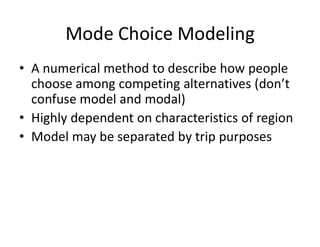
Mode Choice Modeling
• A numerical method to describe how people
choose among competing alternatives (don’t
confuse model and modal)
• Highly dependent on characteristics of region
• Model may be separated by trip purposes
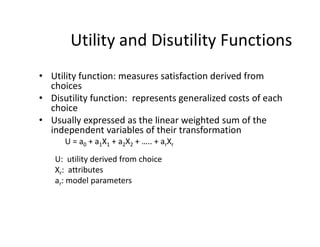
Utility and Disutility Functions
• Utility function: measures satisfaction derived from
choices
• Disutility function: represents generalized costs of each
choice
• Usually expressed as the linear weighted sum of the
independent variables of their transformation
U = a0 + a1X1 + a2X2 + ….. + arXr
U: utility derived from choice
Xr: attributes
ar: model parameters
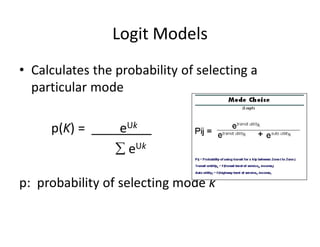
Logit Models
• Calculates the probability of selecting a
particular mode
p(K) = ____eUk__
 eUk
p: probability of selecting mode k
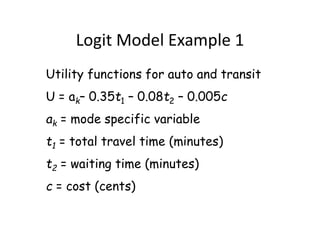
Logit Model Example 1
Utility functions for auto and transit
U = ak– 0.35t1 – 0.08t2 – 0.005c
ak = mode specific variable
t1 = total travel time (minutes)
t2 = waiting time (minutes)
c = cost (cents)
Logit Model Example 1 (cont)
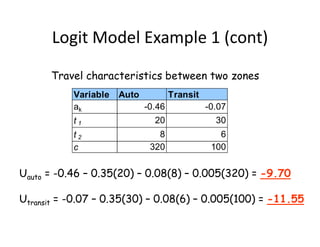
Travel characteristics between two zones
Uauto = -0.46 – 0.35(20) – 0.08(8) – 0.005(320) = -9.70
Utransit = -0.07 – 0.35(30) – 0.08(6) – 0.005(100) = -11.55
Variable Auto Transit
ak -0.46 -0.07
t 1 20 30
t 2 8 6
c 320 100
Logit Model Example 1 (cont)
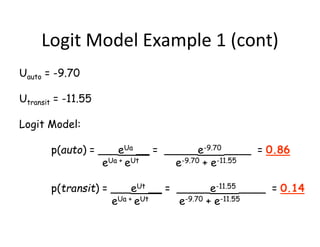
Uauto = -9.70
Utransit = -11.55
Logit Model:
p(auto) = ___eUa __ = _____e-9.70 ____ = 0.86
eUa + eUt e-9.70 + e-11.55
p(transit) = ___eUt __ = _____e-11.55 ____ = 0.14
eUa + eUt e-9.70 + e-11.55
Logit Model Example 2
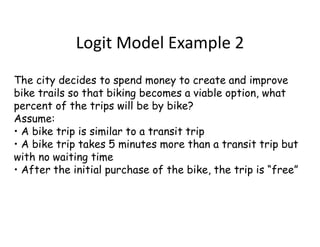
The city decides to spend money to create and improve
bike trails so that biking becomes a viable option, what
percent of the trips will be by bike?
Assume:
• A bike trip is similar to a transit trip
• A bike trip takes 5 minutes more than a transit trip but
with no waiting time
• After the initial purchase of the bike, the trip is “free”
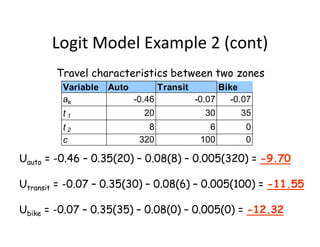
Travel characteristics between two zones
Uauto = -0.46 – 0.35(20) – 0.08(8) – 0.005(320) = -9.70
Utransit = -0.07 – 0.35(30) – 0.08(6) – 0.005(100) = -11.55
Ubike = -0.07 – 0.35(35) – 0.08(0) – 0.005(0) = -12.32
Variable Auto Transit Bike
ak -0.46 -0.07 -0.07
t 1 20 30 35
t 2 8 6 0
c 320 100 0
Logit Model Example 2 (cont)
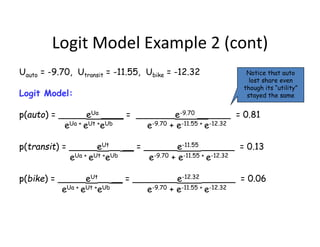
Uauto = -9.70, Utransit = -11.55, Ubike = -12.32
Logit Model:
p(auto) = _____eUa ____ = _______e-9.70 ______ = 0.81
eUa + eUt +eUb e-9.70 + e-11.55 + e-12.32
p(transit) = _____eUt__ __ = ______e-11.55 ______ = 0.13
eUa + eUt +eUb e-9.70 + e-11.55 + e-12.32
p(bike) = _____eUt__ __ = ________e-12.32 ______ = 0.06
eUa + eUt +eUb e-9.70 + e-11.55 + e-12.32
Notice that auto
lost share even
though its “utility”
stayed the same
Logit Model Example 2 (cont)

Modal Choice ppt.pdf

  • 1.
    Mode Choice • Inmost situations, a traveler has a choice of modes – Transit, walk, bike, carpool, motorcycle, drive alone • Mode choice/mode split determines # of trips between zones made by auto or other mode, usually transit
  • 2.
    Characteristics Influencing ModeChoice • Availability of parking • Income • Availability of transit • Auto ownership • Type of trip – Work trip more likely transit – Special trip – trip to airport or baseball stadium served by transit – Shopping, recreational trips by auto • Stage in life – Old and young are more likely to be transit dependent
  • 3.
    Characteristics Influencing ModeChoice • Cost – Parking costs, gas prices, maintenance? – Transit fare • Safety • Time – Transit usually more time consuming (not in NYC or DC …) • Image – In some areas perception is that only poor ride transit – In others (NY) everyone rides transit
  • 4.
    Mode Choice Modeling •A numerical method to describe how people choose among competing alternatives (don’t confuse model and modal) • Highly dependent on characteristics of region • Model may be separated by trip purposes
  • 5.
    Utility and DisutilityFunctions • Utility function: measures satisfaction derived from choices • Disutility function: represents generalized costs of each choice • Usually expressed as the linear weighted sum of the independent variables of their transformation U = a0 + a1X1 + a2X2 + ….. + arXr U: utility derived from choice Xr: attributes ar: model parameters
  • 6.
    Logit Models • Calculatesthe probability of selecting a particular mode p(K) = ____eUk__  eUk p: probability of selecting mode k
  • 7.
    Logit Model Example1 Utility functions for auto and transit U = ak– 0.35t1 – 0.08t2 – 0.005c ak = mode specific variable t1 = total travel time (minutes) t2 = waiting time (minutes) c = cost (cents)
  • 8.
    Logit Model Example1 (cont) Travel characteristics between two zones Uauto = -0.46 – 0.35(20) – 0.08(8) – 0.005(320) = -9.70 Utransit = -0.07 – 0.35(30) – 0.08(6) – 0.005(100) = -11.55 Variable Auto Transit ak -0.46 -0.07 t 1 20 30 t 2 8 6 c 320 100
  • 9.
    Logit Model Example1 (cont) Uauto = -9.70 Utransit = -11.55 Logit Model: p(auto) = ___eUa __ = _____e-9.70 ____ = 0.86 eUa + eUt e-9.70 + e-11.55 p(transit) = ___eUt __ = _____e-11.55 ____ = 0.14 eUa + eUt e-9.70 + e-11.55
  • 10.
    Logit Model Example2 The city decides to spend money to create and improve bike trails so that biking becomes a viable option, what percent of the trips will be by bike? Assume: • A bike trip is similar to a transit trip • A bike trip takes 5 minutes more than a transit trip but with no waiting time • After the initial purchase of the bike, the trip is “free”
  • 11.
    Travel characteristics betweentwo zones Uauto = -0.46 – 0.35(20) – 0.08(8) – 0.005(320) = -9.70 Utransit = -0.07 – 0.35(30) – 0.08(6) – 0.005(100) = -11.55 Ubike = -0.07 – 0.35(35) – 0.08(0) – 0.005(0) = -12.32 Variable Auto Transit Bike ak -0.46 -0.07 -0.07 t 1 20 30 35 t 2 8 6 0 c 320 100 0 Logit Model Example 2 (cont)
  • 12.
    Uauto = -9.70,Utransit = -11.55, Ubike = -12.32 Logit Model: p(auto) = _____eUa ____ = _______e-9.70 ______ = 0.81 eUa + eUt +eUb e-9.70 + e-11.55 + e-12.32 p(transit) = _____eUt__ __ = ______e-11.55 ______ = 0.13 eUa + eUt +eUb e-9.70 + e-11.55 + e-12.32 p(bike) = _____eUt__ __ = ________e-12.32 ______ = 0.06 eUa + eUt +eUb e-9.70 + e-11.55 + e-12.32 Notice that auto lost share even though its “utility” stayed the same Logit Model Example 2 (cont)