The University of Opportunity
6CV005 Transport Technologies and
Planning
Modal Split
6CV005TransportTechnologies and Planning
The University of Opportunity
 Understanding of the purpose of the modal split step
 Application of the logit model
Learning Outcomes
6CV005TransportTechnologies and Planning
The University of Opportunity
Introduction
 each trip can be made using different modes of transport
 modal split analysis is concerned with the estimation of the
proportion of trips that will be made by each mode
 in the simplest case this involves distinction between trips
made by private cars and public transport means
3
6CV005TransportTechnologies and Planning
The University of Opportunity
Modal split analysis
 depending on the needs of the planning process, modal split
analysis can be performed:
– during the trip generation process (e.g. number of trips made by each
mode can be estimated based on the characteristics of the point of
origin)
– between trip generation and distribution (e.g. number of trips made by
a car can be affected by trip attraction properties, for example parking
availability)
– between trip distribution and traffic assignment, where attributes
related to the use of a mode (ie. cost, travel time, etc.) can be used for
the estimation of the modal split.
4
6CV005TransportTechnologies and Planning
The University of Opportunity
Factors influencing modal choice
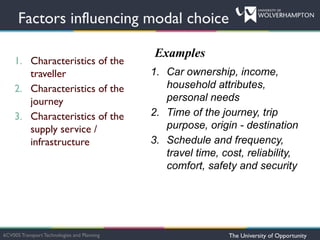
1. Characteristics of the
traveller
2. Characteristics of the
journey
3. Characteristics of the
supply service /
infrastructure
1. Car ownership, income,
household attributes,
personal needs
2. Time of the journey, trip
purpose, origin - destination
3. Schedule and frequency,
travel time, cost, reliability,
comfort, safety and security
Examples
6CV005TransportTechnologies and Planning
The University of Opportunity
Logit Model
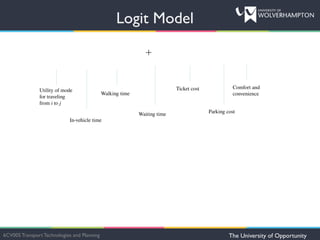
 The binary logit model expresses the choice of mode as a
probability distribution
 This is based on the utility of each mode following the analysis
of a number of attributes related to that utility
 The utility of each mode can be estimated using its Utility
Function
6CV005TransportTechnologies and Planning
The University of Opportunity
Logit Model
Utility of mode
for traveling
from i to j
Walking time
In-vehicle time
Waiting time
Ticket cost
+
Parking cost
Comfort and
convenience
6CV005TransportTechnologies and Planning
The University of Opportunity
Logit Model (Binary)
This relationship is expressed using a logit curve, and the
proportion of trips being made by a specific mode can be given by:
6CV005TransportTechnologies and Planning
The University of Opportunity
Lecture Example 1
Let the number of trips from zone i to zone j is 5,000, and two
modes are available with characteristics as shown in the table
below.
Compute the trips made by bus, and the total fare collected from
those trips. Calculate number of trips made by bus and total fare
collected if the ticket prices is reduced to 6.
What should be the cost of the bus fare so that 3,000 trips are
made by bus
car 20 - 18 4
bus 30 5 3 9
-0.03 -0.04 -0.06 -0.1 -0.1
6CV005TransportTechnologies and Planning
The University of Opportunity
Logit Model (Multinomial)
This binary version of the logit model can be easily extended for
more than two modes.
where:
: utility of mode k for trip from i to j
n : number of modes
6CV005TransportTechnologies and Planning
The University of Opportunity
Lecture Example 2
Let the number of trips from i to j is
5,000, and three modes are available
with characteristics given in the table
below. Compute the trips made by
the three modes and the fare
required to travel by each mode.
train 12 10 2 4
car 20 - 18 4
bus 30 5 3 6
-0.03 -0.04 -0.06 -0.1 -0.1
6CV005TransportTechnologies and Planning

Modal Split Modal Split Modal SplitV2.pptx

  • 1.
    The University ofOpportunity 6CV005 Transport Technologies and Planning Modal Split 6CV005TransportTechnologies and Planning
  • 2.
    The University ofOpportunity  Understanding of the purpose of the modal split step  Application of the logit model Learning Outcomes 6CV005TransportTechnologies and Planning
  • 3.
    The University ofOpportunity Introduction  each trip can be made using different modes of transport  modal split analysis is concerned with the estimation of the proportion of trips that will be made by each mode  in the simplest case this involves distinction between trips made by private cars and public transport means 3 6CV005TransportTechnologies and Planning
  • 4.
    The University ofOpportunity Modal split analysis  depending on the needs of the planning process, modal split analysis can be performed: – during the trip generation process (e.g. number of trips made by each mode can be estimated based on the characteristics of the point of origin) – between trip generation and distribution (e.g. number of trips made by a car can be affected by trip attraction properties, for example parking availability) – between trip distribution and traffic assignment, where attributes related to the use of a mode (ie. cost, travel time, etc.) can be used for the estimation of the modal split. 4 6CV005TransportTechnologies and Planning
  • 5.
    The University ofOpportunity Factors influencing modal choice 1. Characteristics of the traveller 2. Characteristics of the journey 3. Characteristics of the supply service / infrastructure 1. Car ownership, income, household attributes, personal needs 2. Time of the journey, trip purpose, origin - destination 3. Schedule and frequency, travel time, cost, reliability, comfort, safety and security Examples 6CV005TransportTechnologies and Planning
  • 6.
    The University ofOpportunity Logit Model  The binary logit model expresses the choice of mode as a probability distribution  This is based on the utility of each mode following the analysis of a number of attributes related to that utility  The utility of each mode can be estimated using its Utility Function 6CV005TransportTechnologies and Planning
  • 7.
    The University ofOpportunity Logit Model Utility of mode for traveling from i to j Walking time In-vehicle time Waiting time Ticket cost + Parking cost Comfort and convenience 6CV005TransportTechnologies and Planning
  • 8.
    The University ofOpportunity Logit Model (Binary) This relationship is expressed using a logit curve, and the proportion of trips being made by a specific mode can be given by: 6CV005TransportTechnologies and Planning
  • 9.
    The University ofOpportunity Lecture Example 1 Let the number of trips from zone i to zone j is 5,000, and two modes are available with characteristics as shown in the table below. Compute the trips made by bus, and the total fare collected from those trips. Calculate number of trips made by bus and total fare collected if the ticket prices is reduced to 6. What should be the cost of the bus fare so that 3,000 trips are made by bus car 20 - 18 4 bus 30 5 3 9 -0.03 -0.04 -0.06 -0.1 -0.1 6CV005TransportTechnologies and Planning
  • 10.
    The University ofOpportunity Logit Model (Multinomial) This binary version of the logit model can be easily extended for more than two modes. where: : utility of mode k for trip from i to j n : number of modes 6CV005TransportTechnologies and Planning
  • 11.
    The University ofOpportunity Lecture Example 2 Let the number of trips from i to j is 5,000, and three modes are available with characteristics given in the table below. Compute the trips made by the three modes and the fare required to travel by each mode. train 12 10 2 4 car 20 - 18 4 bus 30 5 3 6 -0.03 -0.04 -0.06 -0.1 -0.1 6CV005TransportTechnologies and Planning