Section 4
Achievements of
Ancient China
Chapter 5
Ancient China
The
Silk Road
• Wudi’s victories
brought China into
contact with the people
of Central Asia
• Trade introduced new
foods such as grapes,
walnuts, and garlic
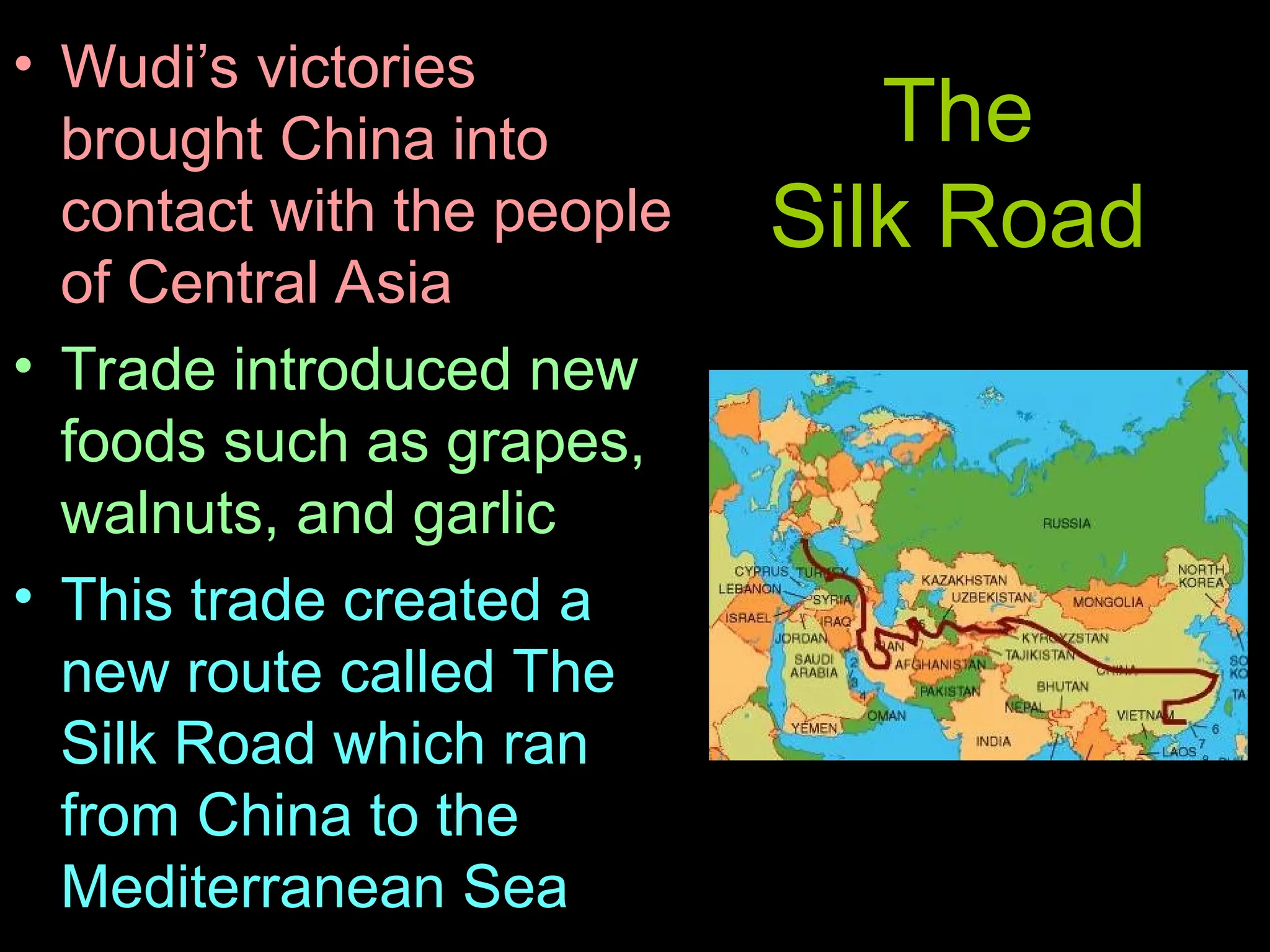
• This trade created a
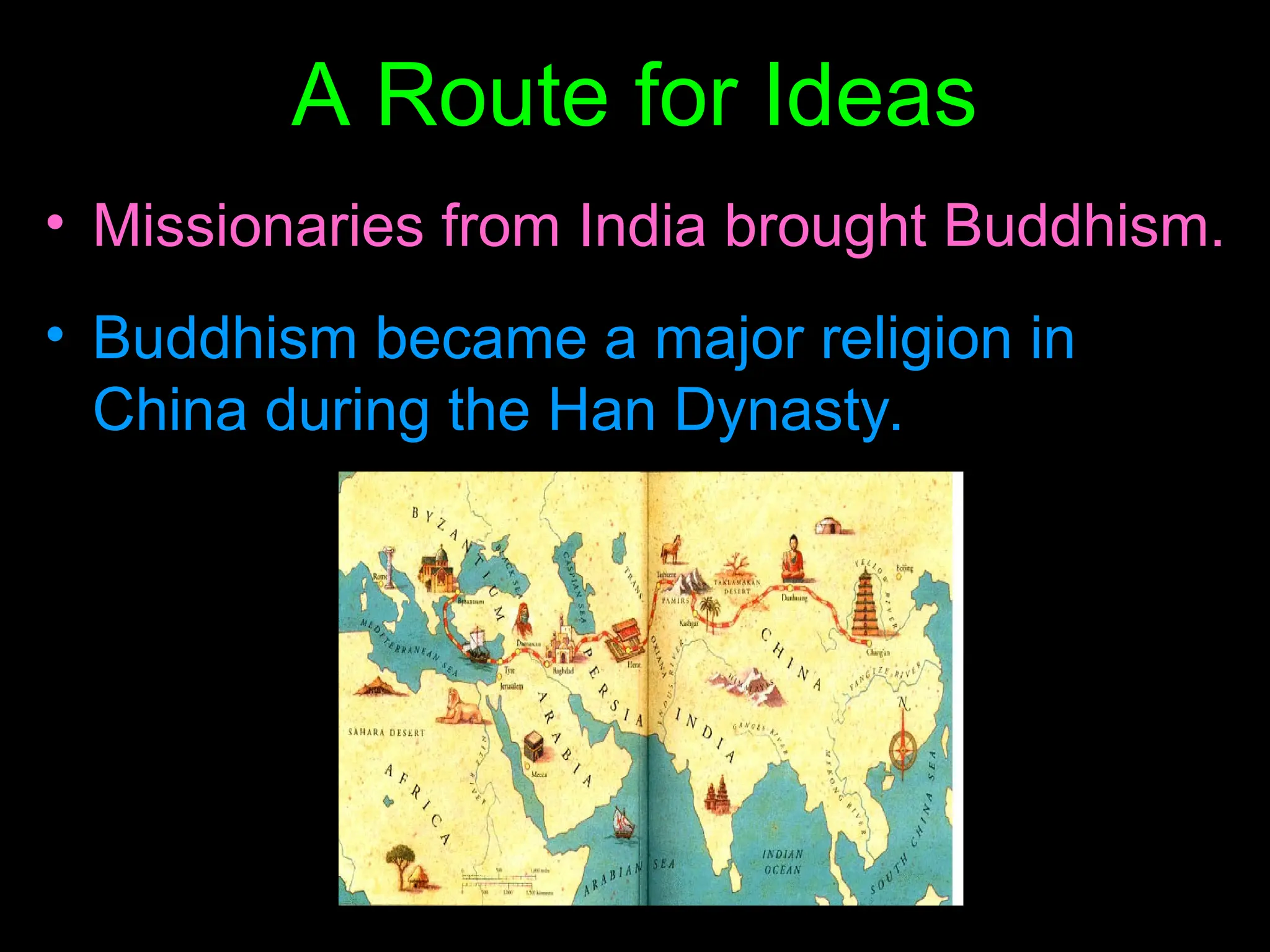
new route called The
Silk Road which ran
from China to the
Mediterranean Sea
Connecting
Roads
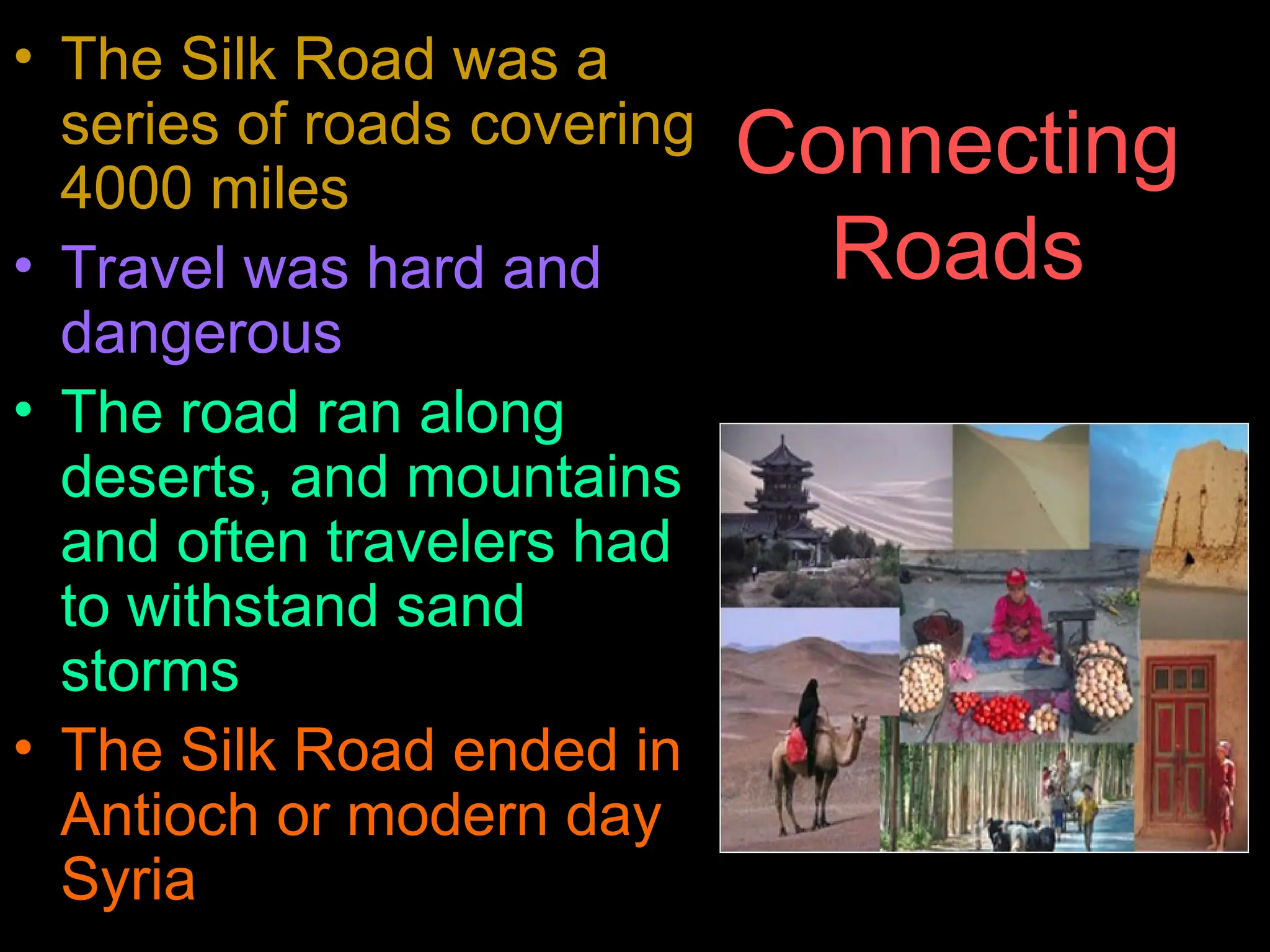
• The Silk Road was a
series of roads covering
4000 miles
• Travel was hard and
dangerous
• The road ran along
deserts, and mountains
and often travelers had
to withstand sand
storms
• The Silk Road ended in
Antioch or modern day
Syria
A Route for
Goods
• Most travelers did
not travel the entire
Silk Road.
• Goods were passed
from trader to trader;
the price rose at
each trade.
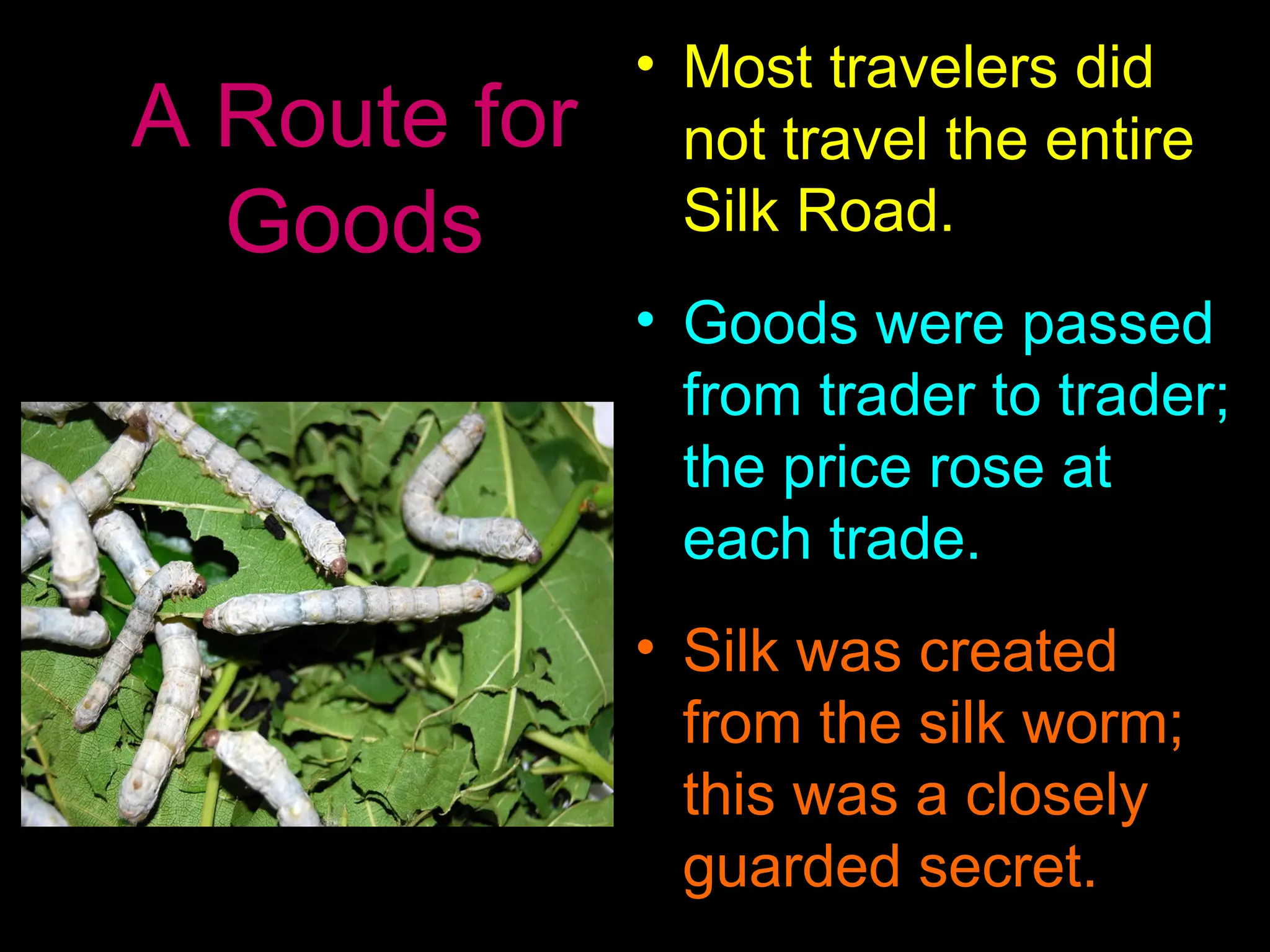
• Silk was created
from the silk worm;
this was a closely
guarded secret.
• The Silk Road got its name from silk – a
valuable cloth originally made only in
China.
• Han Dynasty farmers developed new
methods for raising silkworms.
• Workers could dye the silk and weave it
into clothing.
• The penalty for revealing this secret
was death.
A Route for Ideas
• Missionaries from India brought Buddhism.
• Buddhism became a major religion in
China during the Han Dynasty.
Reading Check
• What are silkworms?
• Silkworms are caterpillars that
make silk.
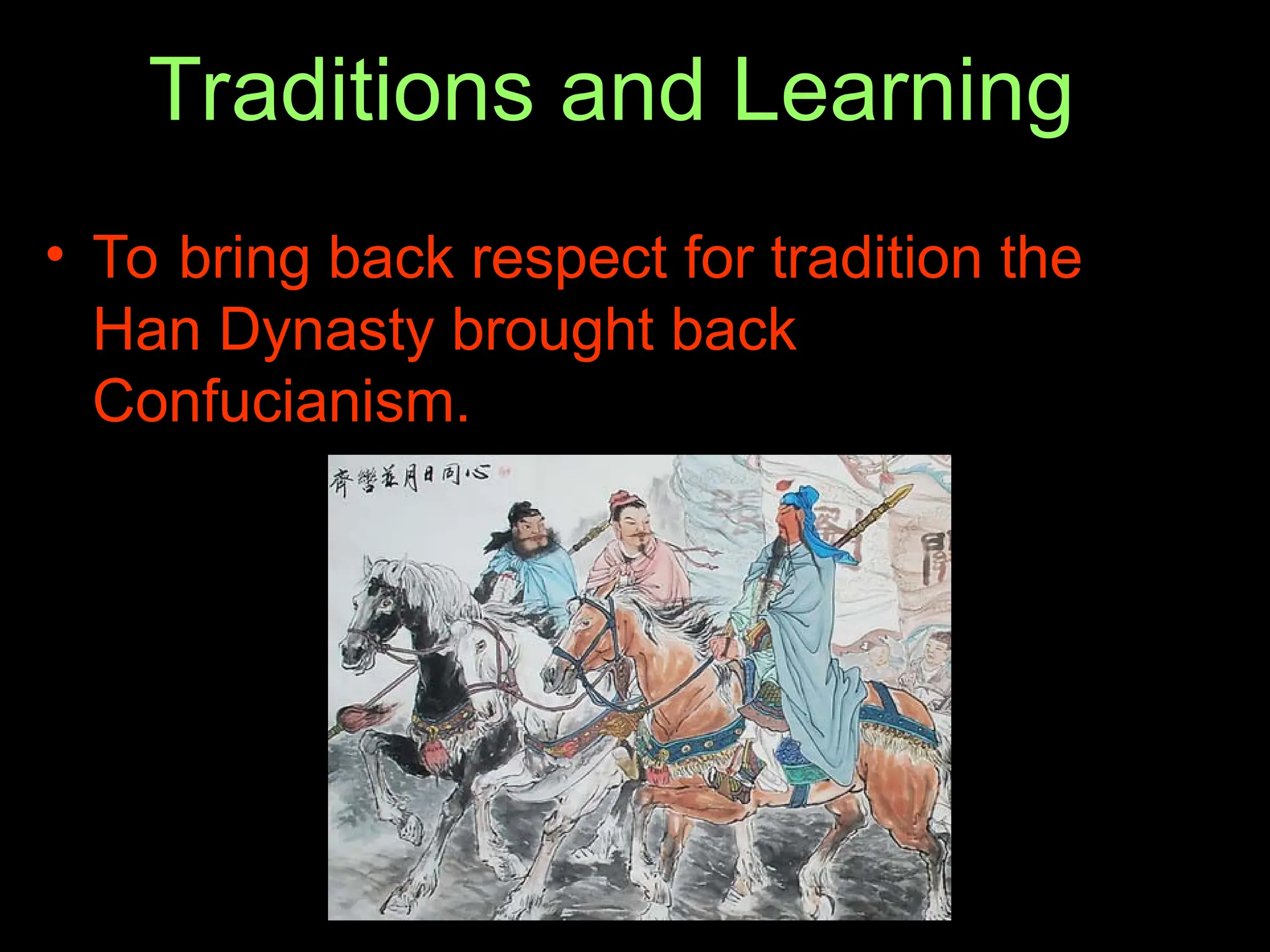
Traditions and Learning
• To bring back respect for tradition the
Han Dynasty brought back
Confucianism.
Respect for Learning
• Confucianism and Buddhism were
both worshipped.
• Confucianism was used as a test for
the members of civil service.
• The arts and learning grew under the
Han Dynasty
A History of China
• Chinese people had little knowledge of
their history; no one was sure of each
rulers accomplishments.
• “Historical Records” written by Sima
Qian
Reading Check
• What problem did Sima Qian solve?
• Before his work, Historical Records,
Chinese people knew little of their
history.
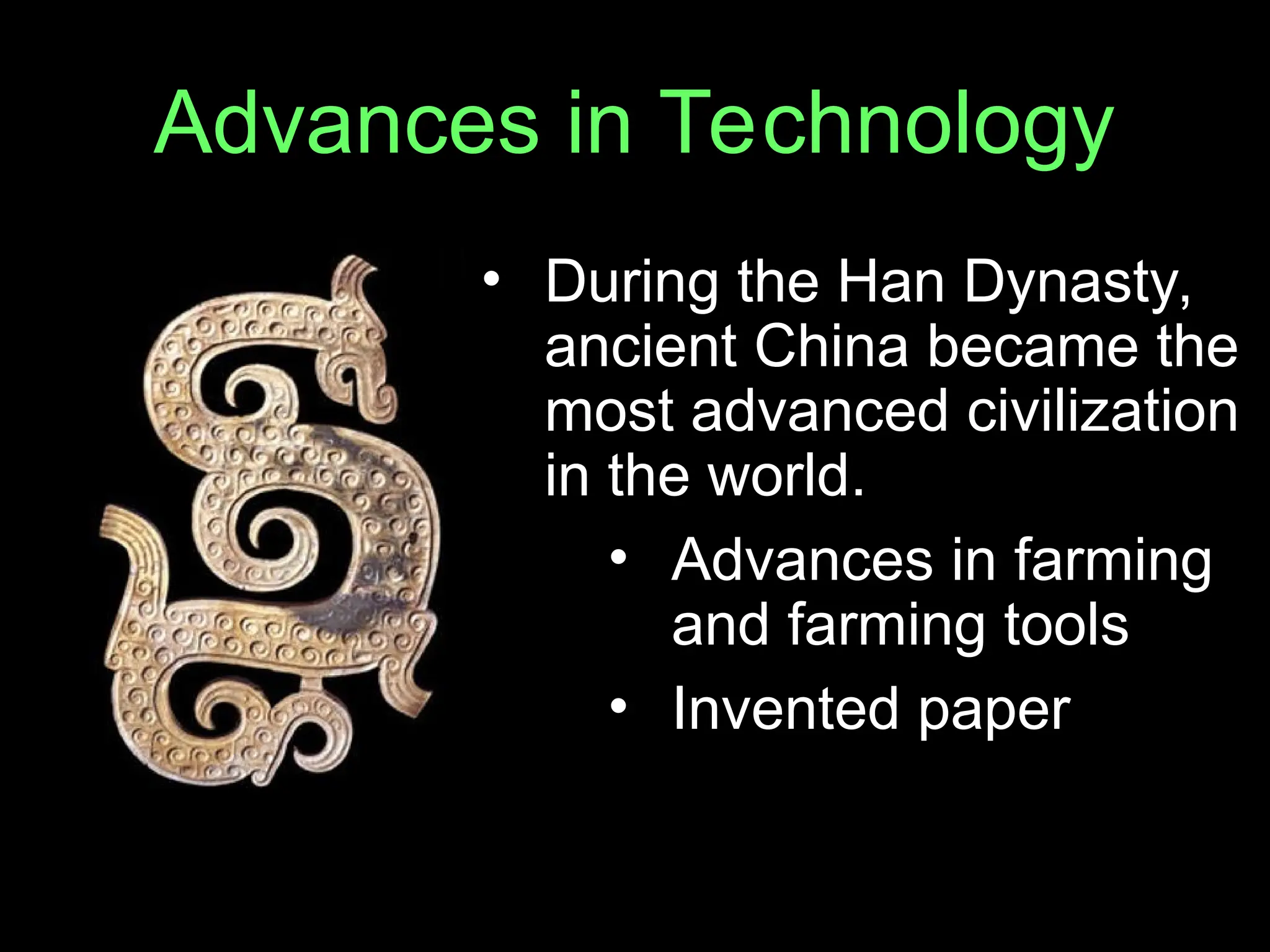
Advances in Technology
• During the Han Dynasty,
ancient China became the
most advanced civilization
in the world.
• Advances in farming
and farming tools
• Invented paper
• In medicine, acupuncture was invented.
• Discovered the circulatory system.
• In technology,
• they invented an iron plow,
• rudder for steering ships,
• the seismoscope for detecting
earthquakes,
• a compass,
• and a wheelbarrow for hauling goods.
Invention of Paper
• Chinese first used wooden scrolls and
bones to keep records.
• Later they wrote on silk.
• Then, around 105 AD, the Chinese
invented paper.
• They made the paper from tree bark,
hemp, and old rags.
• The materials were soaked in water,
beaten into a pulp, and dried flat on
screens.
Reading Check
• What did the Chinese write on before
they invented paper?
• The Chinese wrote on wooden
scrolls, bones, and silk, before the
invention of paper.
Section Assessment
• 1. (a) Locate
• Describe the route of the Silk Road.
• The Silk Road began in Chang’an, went
through Persia and Mesopotamia, and
ended in Antioch.
• 1. (b) Infer
• Why were the secrets of silk-
making so closely guarded?
• People would not be willing to pay high
prices for silk cloth if they knew how to
make it themselves.
• 2. (a) List
• In what ways did the Han dynasty
show a respect for Chinese
Traditions?
• The Han dynasty encouraged people to
study Confucius’ teachings and
supported Chinese arts and
scholarship.
• 2. (b) Draw Conclusions
• Describe the importance of Sima
Qian’s role in preserving Chinese
traditions.
• He helped the Chinese people to
remember their past. His work may
have been a model for historians of
other civilizations.
• 3. (a) Recall
• Name three important inventions or
achievements during the Han dynasty.
• Important inventions or achievements were:
• paper
• wheelbarrow
• iron farming tools, such as the plow
• rudder
• compass
• seismoscope
• acupuncture
• 3. (b) Predict
• How did the achievements of the
Han dynasty affect later generations
of Chinese people, as well as other
peoples?
• Later generations of Chinese received
the practical benefits from the
inventions and achievements and also a
sense of national pride.
Chapter 5 Section 4 Achievements of Ancient China.ppt

  • 1.
    Section 4 Achievements of AncientChina Chapter 5 Ancient China
  • 2.
    The Silk Road • Wudi’svictories brought China into contact with the people of Central Asia • Trade introduced new foods such as grapes, walnuts, and garlic • This trade created a new route called The Silk Road which ran from China to the Mediterranean Sea
  • 3.
    Connecting Roads • The SilkRoad was a series of roads covering 4000 miles • Travel was hard and dangerous • The road ran along deserts, and mountains and often travelers had to withstand sand storms • The Silk Road ended in Antioch or modern day Syria
  • 4.
    A Route for Goods •Most travelers did not travel the entire Silk Road. • Goods were passed from trader to trader; the price rose at each trade. • Silk was created from the silk worm; this was a closely guarded secret.
  • 5.
    • The SilkRoad got its name from silk – a valuable cloth originally made only in China. • Han Dynasty farmers developed new methods for raising silkworms. • Workers could dye the silk and weave it into clothing. • The penalty for revealing this secret was death.
  • 6.
    A Route forIdeas • Missionaries from India brought Buddhism. • Buddhism became a major religion in China during the Han Dynasty.
  • 7.
    Reading Check • Whatare silkworms? • Silkworms are caterpillars that make silk.
  • 8.
    Traditions and Learning •To bring back respect for tradition the Han Dynasty brought back Confucianism.
  • 9.
    Respect for Learning •Confucianism and Buddhism were both worshipped. • Confucianism was used as a test for the members of civil service. • The arts and learning grew under the Han Dynasty
  • 10.
    A History ofChina • Chinese people had little knowledge of their history; no one was sure of each rulers accomplishments. • “Historical Records” written by Sima Qian
  • 11.
    Reading Check • Whatproblem did Sima Qian solve? • Before his work, Historical Records, Chinese people knew little of their history.
  • 12.
    Advances in Technology •During the Han Dynasty, ancient China became the most advanced civilization in the world. • Advances in farming and farming tools • Invented paper
  • 13.
    • In medicine,acupuncture was invented. • Discovered the circulatory system. • In technology, • they invented an iron plow, • rudder for steering ships, • the seismoscope for detecting earthquakes, • a compass, • and a wheelbarrow for hauling goods.
  • 14.
    Invention of Paper •Chinese first used wooden scrolls and bones to keep records. • Later they wrote on silk. • Then, around 105 AD, the Chinese invented paper. • They made the paper from tree bark, hemp, and old rags. • The materials were soaked in water, beaten into a pulp, and dried flat on screens.
  • 15.
    Reading Check • Whatdid the Chinese write on before they invented paper? • The Chinese wrote on wooden scrolls, bones, and silk, before the invention of paper.
  • 16.
    Section Assessment • 1.(a) Locate • Describe the route of the Silk Road. • The Silk Road began in Chang’an, went through Persia and Mesopotamia, and ended in Antioch.
  • 17.
    • 1. (b)Infer • Why were the secrets of silk- making so closely guarded? • People would not be willing to pay high prices for silk cloth if they knew how to make it themselves.
  • 18.
    • 2. (a)List • In what ways did the Han dynasty show a respect for Chinese Traditions? • The Han dynasty encouraged people to study Confucius’ teachings and supported Chinese arts and scholarship.
  • 19.
    • 2. (b)Draw Conclusions • Describe the importance of Sima Qian’s role in preserving Chinese traditions. • He helped the Chinese people to remember their past. His work may have been a model for historians of other civilizations.
  • 20.
    • 3. (a)Recall • Name three important inventions or achievements during the Han dynasty. • Important inventions or achievements were: • paper • wheelbarrow • iron farming tools, such as the plow • rudder • compass • seismoscope • acupuncture
  • 21.
    • 3. (b)Predict • How did the achievements of the Han dynasty affect later generations of Chinese people, as well as other peoples? • Later generations of Chinese received the practical benefits from the inventions and achievements and also a sense of national pride.