What’s up with
Comparing Mobile Instant Messaging
Behaviors with Traditional SMS
Karen Church
Yahoo! Labs
Rodrigo de Oliveira
Telefonica Research
Presented at Mobile HCI 2013 - 30th August 2013, Munich, Germany
SMS or Short Message Service
8 trillion
SMS Messages sent globally in 2011
- Mobile Messaging Futures 2012-2016
Mobile Instant Messaging Apps
How and why people (teenagers) have
adopted SMS in their daily lives, e.g Grinter
& Eldridge 2001 & 2003, Taylor & Harper
2002
Different countries and demographics, e.g.
Ito 2005, Kasesniemi & Rautiainen 2002, Kim
et al 2007, Battestini et al. 2010
Past research on SMS behaviors
27 billion
messages per day handled by WhatsApp
- The Next Web, June 2013
Differences in the perceptions
and motives of use between
WhatsApp and SMS….
WhatsApp
•  MIM application for
smartphones
•  Runs on many mobile
platforms (Android, iOS,
Blackberry, etc)
•  No cost
•  Requires data plan/
internet connection
Groups
•  Beyond 1:1
communication
•  Supports group based
chats.
Beyond text
•  Sharing of images,
videos, sounds,
locations, etc.
Social Cues
Social Cues
Status
Social Cues
2 ticks!
message
delivery
VSs
1!
2!
Procedure
interviews survey
8 themes
Phase 1: Interview
John (P1)
36
Phd Student
2 years
Mike (P2)
29
Mobile dev
2 years
Oliver (P3)
35
HR Developer
2 years
Dean (P7)
31
Researcher
1 year
Eric (P8)
40
Project Mgr
3 years
Cathy (P4)
24
HR Intern
2 years
Laura (P5)
45
Teacher
3 months
Beth (P3)
36
Business owner
2.5 years
Ann (P9)
30
PA
2 years
Phase 1: 9 participants
Icon source: http://www.thenounproject.com
1.  Review of daily communication needs
2.  Perceived value of WhatsApp, reason
for adoption and history of use
3.  Motives and intent of SMS and
WhatsApp focusing on factors like cost,
trust, privacy
Phase 1: Interview
Phase 2: Survey
Image source: http://lighthouse8.com/wp-content/uploads/2012/04/people.jpg
131
subjects
70 61
20 – 60
age range
33.7
average age
Spain
living in / from
54.4%
Pay for SMS
Phase 2: Survey
1.  Expected behavior
2.  Actual usage behavior (reported)
3.  Two groups:
•  SMS payers (N=71)
•  SMS nonpayers (N=60)
Image source: http://lighthouse8.com/wp-content/uploads/2012/04/people.jpg
1. cost
“
“
Using WhatsApp is a
guarantee the other party
won’t pay. I might not
care. And now I don’t care
because sending SMS for
me is unlimited but maybe
other people care.
57 %
SMS Payers believe they would not
change their frequency of SMS usage
even if SMS was free
(χ2 = 19, 803, p < .001)
Negative Correlations
•  between paying for SMS and
frequency of SMS usage with clients
(ρ = −.35, p < .01) and for business
purposes (ρ = −.22, p = .03).
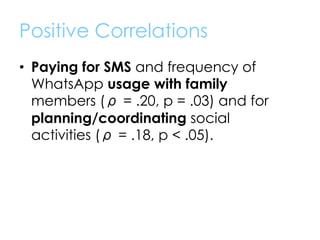
Positive Correlations
•  Paying for SMS and frequency of
WhatsApp usage with family
members (ρ = .20, p = .03) and for
planning/coordinating social
activities (ρ = .18, p < .05).
41 %
SMS Payers reported not
seeing any value in SMS
compared to WhatsApp
41 %
SMS Payers reported not
seeing any value in SMS
compared to WhatsApp
22 %
SMS Non-Payers reported
not seeing any value in SMS
compared to WhatsApp
2. social
influence
Recommended by friends
“
“
I was using SMS and
everyone had WhatsApp
and everyone was saying,
you are the last one and it
costs money to talk with you
so get WhatsApp
3. nature/
intent
“
“
With WhatsApp maybe you type
more, but the conversation is more
fluid. You type a sentence and
someone sends a sentence and
then you type another one. I have
the feeling that if it’s WhatsApp, it’s
an open conversation. It is similar to
if you were talking in person
“ “
I can say much more things
than 120 characters and I
don’t have to think about
the whole message. I can
be more natural
On-the-fly social planning
6 different intents
1.  Chatting,
2.  Planning/coordination of social activities,
3.  Sharing personal news,
4.  Interacting with groups of people,
5.  Business/work related communications,
6.  Receiving ads
Less than once per
month
About once per
month
About once per week
Several times per
week
About once per day
Several times per day
4. community,
sense of
connection
“ “
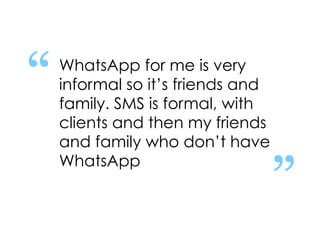
WhatsApp for me is very
informal so it’s friends and
family. SMS is formal, with
clients and then my friends
and family who don’t have
WhatsApp
WhatsApp
•  Used significantly more often than
SMS across all communities (p < .01)
•  Used most often with partners than
any other community (p < .01)
•  Higher frequency of usage with
family, close friends and friends than
with work colleagues or clients (p < .
001)
8 of 9 participants used groups
5. immediacy,
privacy &
expectation
“ “
I tend to think that SMS is
not as fast as WhatsApp. I
don’t know why but I think
maybe people are more
aware of WhatsApp and
not so aware of SMS
Status
“ “
people read too much into
when you’re online and
when you replied to
messages or why you
didn’t reply and they try to
guess why and sometimes
this is annoying
42 %
Considered SMS to have fewer privacy
issues than WhatsApp
34 %
Considered privacy as the most valuable
aspect of SMS
2 ticks!
7 of 9Participants thought that
2 ticks = message read
“ “
I don’t like it very much
because if I don’t want to
answer straight away, I
don’t want them to know
that I’ve seen the message
“
“
If I send a message and you
are busy at least answer and
say that you’re busy...... if
you’re online, it sort of means
that it’s in front of you and
you are doing other stuff and
you are ignoring me...
47 %
Revealing last access time is a privacy
concern
6. reliability &
guarantee
6 of 9Participants though that SMS is more
reliable for message delivery
Reasons included
•  SMS is a paid service and money
increases reliability of a service
•  SMS is an older, more established
service
•  For others it depended on their past
experience with one service or
another
– Bad past experience = bad perception
	
  
“ “It’s happened to me that
I’ve sent messages and
they arrived very late, like 1
day or 2 days late
30 %
WhatsApp messages have a better
chance of being delivered that SMS.
7. choice of
technology
Choice of SMS or WhatsApp?
•  Does the recipient have WhatsApp?
•  Is it formal? Or informal communication?
•  Do I want or need the message to be
delivered immediately?
8. coping
mechanisms
5 of the participants always switch phone to
silent mode
Negative Correlations
•  between how often participants use
WhatsApp with clients and how often
they turn on the phone’s silent mode
(ρ = −.41, p = .001)
Business communications
•  Frequency of using WhatsApp for
business is reversely related to the
frequency of muting phone
notifications (ρ = −.23, p = .02).
•  Same for using SMS for business (ρ =
−.29, p = .006)
Image source: http://www.huffingtonpost.com/2013/04/01/mobile-messaging-apps_n_2991747.html
WhatsApp use in general….
1.  Used more often, closer-knit groups
2.  More conversational
3.  Perceived as more immediate
4.  More chatting and on-the-fly planning
Image source: http://www.huffingtonpost.com/2013/04/01/mobile-messaging-apps_n_2991747.html
1.  Privacy concerns and last access
2.  Delivery notifications, i.e. 2 ticks
3.  Increased expectations of fast response
Problems with WhatsApp
Future work
1.  Explore behavior by combining logging
of real-life usage with reported usage
2.  Different demographics and cultures
3.  How to handle abundance of mobile
notifications?
thank you! Qs?
Karen Church
www.karenchurch.com
kchurch@yahoo-inc.com
@karenchurch
Full Paper available here - http://dl.acm.org/citation.cfm?id=2493225
Images from - http://www.sxc.hu or where acknowledged

WhatsUp With WhatsApp? Comparing Mobile Instant Messaging Behaviors with Traditional SMS

  • 1.
    What’s up with ComparingMobile Instant Messaging Behaviors with Traditional SMS Karen Church Yahoo! Labs Rodrigo de Oliveira Telefonica Research Presented at Mobile HCI 2013 - 30th August 2013, Munich, Germany
  • 2.
    SMS or ShortMessage Service
  • 3.
    8 trillion SMS Messagessent globally in 2011 - Mobile Messaging Futures 2012-2016
  • 4.
  • 5.
    How and whypeople (teenagers) have adopted SMS in their daily lives, e.g Grinter & Eldridge 2001 & 2003, Taylor & Harper 2002 Different countries and demographics, e.g. Ito 2005, Kasesniemi & Rautiainen 2002, Kim et al 2007, Battestini et al. 2010 Past research on SMS behaviors
  • 7.
    27 billion messages perday handled by WhatsApp - The Next Web, June 2013
  • 8.
    Differences in theperceptions and motives of use between WhatsApp and SMS….
  • 9.
    WhatsApp •  MIM applicationfor smartphones •  Runs on many mobile platforms (Android, iOS, Blackberry, etc) •  No cost •  Requires data plan/ internet connection
  • 10.
  • 11.
    Beyond text •  Sharingof images, videos, sounds, locations, etc.
  • 12.
  • 13.
  • 14.
  • 15.
  • 16.
  • 17.
  • 18.
    John (P1) 36 Phd Student 2years Mike (P2) 29 Mobile dev 2 years Oliver (P3) 35 HR Developer 2 years Dean (P7) 31 Researcher 1 year Eric (P8) 40 Project Mgr 3 years Cathy (P4) 24 HR Intern 2 years Laura (P5) 45 Teacher 3 months Beth (P3) 36 Business owner 2.5 years Ann (P9) 30 PA 2 years Phase 1: 9 participants Icon source: http://www.thenounproject.com
  • 19.
    1.  Review ofdaily communication needs 2.  Perceived value of WhatsApp, reason for adoption and history of use 3.  Motives and intent of SMS and WhatsApp focusing on factors like cost, trust, privacy Phase 1: Interview
  • 20.
    Phase 2: Survey Imagesource: http://lighthouse8.com/wp-content/uploads/2012/04/people.jpg
  • 21.
    131 subjects 70 61 20 –60 age range 33.7 average age Spain living in / from 54.4% Pay for SMS
  • 22.
    Phase 2: Survey 1. Expected behavior 2.  Actual usage behavior (reported) 3.  Two groups: •  SMS payers (N=71) •  SMS nonpayers (N=60) Image source: http://lighthouse8.com/wp-content/uploads/2012/04/people.jpg
  • 23.
  • 24.
    “ “ Using WhatsApp isa guarantee the other party won’t pay. I might not care. And now I don’t care because sending SMS for me is unlimited but maybe other people care.
  • 25.
    57 % SMS Payersbelieve they would not change their frequency of SMS usage even if SMS was free (χ2 = 19, 803, p < .001)
  • 26.
    Negative Correlations •  betweenpaying for SMS and frequency of SMS usage with clients (ρ = −.35, p < .01) and for business purposes (ρ = −.22, p = .03).
  • 27.
    Positive Correlations •  Payingfor SMS and frequency of WhatsApp usage with family members (ρ = .20, p = .03) and for planning/coordinating social activities (ρ = .18, p < .05).
  • 28.
    41 % SMS Payersreported not seeing any value in SMS compared to WhatsApp
  • 29.
    41 % SMS Payersreported not seeing any value in SMS compared to WhatsApp 22 % SMS Non-Payers reported not seeing any value in SMS compared to WhatsApp
  • 30.
  • 31.
  • 32.
    “ “ I was usingSMS and everyone had WhatsApp and everyone was saying, you are the last one and it costs money to talk with you so get WhatsApp
  • 33.
  • 34.
    “ “ With WhatsApp maybeyou type more, but the conversation is more fluid. You type a sentence and someone sends a sentence and then you type another one. I have the feeling that if it’s WhatsApp, it’s an open conversation. It is similar to if you were talking in person
  • 35.
    “ “ I cansay much more things than 120 characters and I don’t have to think about the whole message. I can be more natural
  • 36.
  • 37.
    6 different intents 1. Chatting, 2.  Planning/coordination of social activities, 3.  Sharing personal news, 4.  Interacting with groups of people, 5.  Business/work related communications, 6.  Receiving ads
  • 38.
    Less than onceper month About once per month About once per week Several times per week About once per day Several times per day
  • 39.
  • 40.
    “ “ WhatsApp forme is very informal so it’s friends and family. SMS is formal, with clients and then my friends and family who don’t have WhatsApp
  • 41.
    WhatsApp •  Used significantlymore often than SMS across all communities (p < .01) •  Used most often with partners than any other community (p < .01) •  Higher frequency of usage with family, close friends and friends than with work colleagues or clients (p < . 001)
  • 42.
    8 of 9participants used groups
  • 43.
  • 44.
    “ “ I tendto think that SMS is not as fast as WhatsApp. I don’t know why but I think maybe people are more aware of WhatsApp and not so aware of SMS
  • 45.
  • 46.
    “ “ people readtoo much into when you’re online and when you replied to messages or why you didn’t reply and they try to guess why and sometimes this is annoying
  • 47.
    42 % Considered SMSto have fewer privacy issues than WhatsApp
  • 48.
    34 % Considered privacyas the most valuable aspect of SMS
  • 49.
  • 50.
    7 of 9Participantsthought that 2 ticks = message read
  • 51.
    “ “ I don’tlike it very much because if I don’t want to answer straight away, I don’t want them to know that I’ve seen the message
  • 52.
    “ “ If I senda message and you are busy at least answer and say that you’re busy...... if you’re online, it sort of means that it’s in front of you and you are doing other stuff and you are ignoring me...
  • 53.
    47 % Revealing lastaccess time is a privacy concern
  • 54.
  • 55.
    6 of 9Participantsthough that SMS is more reliable for message delivery
  • 56.
    Reasons included •  SMSis a paid service and money increases reliability of a service •  SMS is an older, more established service •  For others it depended on their past experience with one service or another – Bad past experience = bad perception  
  • 57.
    “ “It’s happenedto me that I’ve sent messages and they arrived very late, like 1 day or 2 days late
  • 58.
    30 % WhatsApp messageshave a better chance of being delivered that SMS.
  • 59.
  • 60.
    Choice of SMSor WhatsApp? •  Does the recipient have WhatsApp? •  Is it formal? Or informal communication? •  Do I want or need the message to be delivered immediately?
  • 61.
  • 62.
    5 of theparticipants always switch phone to silent mode
  • 63.
    Negative Correlations •  betweenhow often participants use WhatsApp with clients and how often they turn on the phone’s silent mode (ρ = −.41, p = .001)
  • 64.
    Business communications •  Frequencyof using WhatsApp for business is reversely related to the frequency of muting phone notifications (ρ = −.23, p = .02). •  Same for using SMS for business (ρ = −.29, p = .006)
  • 65.
  • 66.
    WhatsApp use ingeneral…. 1.  Used more often, closer-knit groups 2.  More conversational 3.  Perceived as more immediate 4.  More chatting and on-the-fly planning Image source: http://www.huffingtonpost.com/2013/04/01/mobile-messaging-apps_n_2991747.html
  • 68.
    1.  Privacy concernsand last access 2.  Delivery notifications, i.e. 2 ticks 3.  Increased expectations of fast response Problems with WhatsApp
  • 69.
    Future work 1.  Explorebehavior by combining logging of real-life usage with reported usage 2.  Different demographics and cultures 3.  How to handle abundance of mobile notifications?
  • 70.
    thank you! Qs? KarenChurch www.karenchurch.com kchurch@yahoo-inc.com @karenchurch Full Paper available here - http://dl.acm.org/citation.cfm?id=2493225 Images from - http://www.sxc.hu or where acknowledged