The Mobile Internet Report
                                  Key Themes*

                                                                  December 15, 2009

                        *This presentation excerpts highlights of the key themes from Morgan Stanley’s
                     Mobile Internet Report, published 12/15/09 (available at www.ms.com/techresearch).

Morgan Stanley does and seeks to do business with companies covered in Morgan Stanley Research. As a result, investors should be aware that the firm may have a conflict of interest that could
affect the objectivity of Morgan Stanley Research. Investors should consider Morgan Stanley Research as only a single factor in making their investment decision. Customers of Morgan Stanley in
the US can receive independent, third-party research on companies covered in Morgan Stanley Research, at no cost to them, where such research is available. Customers can access this
independent research at www.morganstanley.com/equityresearch or can call 1-800-624-2063 to request a copy of this research.
For analyst certification and other important disclosures, refer to the Disclosure Section, located at the end of this report.
Morgan Stanley Research – Contributors

US Internet                                                                US Telecom
Mary Meeker                            mary.meeker@       (212) 761-8042   Simon Flannery           simon.flannery@      (212) 761-6432
Scott Devitt                             scott.devitt@             -3365    Sean Ittel                   sean.ittel@              -7220
 Liang Wu                                  liang.wu@               -6320
 Colter Van Domelen             colter.van.domelen@                -7678   EU Telecom
                                                                           Nick Delfas                  nick.delfas@ +44 20 7425-6611
US Hardware                                                                Sean Gardiner             sean.gardiner@   +971 4 709-7120
Katy Huberty                       kathryn.huberty@       (212) 761-6249
 Mathew Schneider                mathew.schneider@                 -3483   Japan Telecom
                                                                           Hironori Tanaka             hiro.tanaka@     +81 3 5424-5336
US Communications Equipment
Ehud Gelblum                         ehud.gelblum@        (212) 761-8564   APAC Telecom
 Avi Silver                              avi.silver@               -4226   Navin Killa                   navin.killa@ +852 2848-5422
                                                                           Vinay Jaising              vinay.jaising@ +91 22 2209-7780
Japan Internet                                                             Yvonne Chow               yvonne.chow@     +852 2848-8262
Naoshi Nema                           naoshi.nema@       +81 3 5424-5320
                                                                           China Internet
EU Communications Equipment                                                Richard Ji                     richard.ji@   +852 2848-6926
James Dawson                        james.dawson@ +44 20 7425-9646
Patrick Standaert                 patrick.standaert@         -9290         US Cable / Media
                                                                           Benjamin Swinburne   benjamin.swinburne@      (212) 761-7527
US Semiconductors
Mark Lipacis                          mark.lipacis@       (415) 576-2190   US Software
Sanjay Devgan                       sanjay.devgan@                 -2382   Adam Holt                    adam.holt@       (415) 576-2320

APAC Technology
Jasmine Lu                               jasmine.lu@     +852 2239-1348
Bill Lu                                       bill.lu@   +852 2848-5214
Keon Han                                  keon.han@      +82 2 399-4933

We acknowledge the contributions of Ravi Lath to this report.
                                                                                                                                           2
                                                                                                    Note: All e-mail: @morganstanley.com
What You are Reading –
              The Mobile Internet Report Key Themes
Morgan Stanley’s global technology and telecom analysts set out to do a deep dive into the rapidly
emerging and changing mobile Internet market. We wanted to create a data-rich, theme-based
framework for thinking about how the market may develop. We intend to expand and edit the
framework as the market evolves. A lot has changed since we published ‘The Internet Report’ in
1995 on the web (www.ms.com/techresearch). We decided to create most of this report as a
PowerPoint presentation and publish it on the web, expecting that bits and pieces of it will be cut /
pasted / redistributed and debated / dismissed / lauded. Our goal is to get our thoughts / data into
the growing conversation about what may be the biggest technology trend ever, one that may help
make us all more informed in ways that are unique to the web circa 2009, and beyond.

We present our thoughts in three ways:

1) ‘The Mobile Internet Report Setup’ – a 92-slide presentation which excerpts highlights of the key
themes from the report.

2) ‘The Mobile Internet Report Key Themes’ – a 659-slide presentation which drills down on
thoughts covered in ‘The Mobile Internet Report.’

3) ‘The Mobile Internet Report’ – a 424-page report which explores 8 major themes in depth and
includes the two aforementioned slide presentations + related text.

Each piece is available online at www.ms.com/techresearch
                                                                                                        3
Context

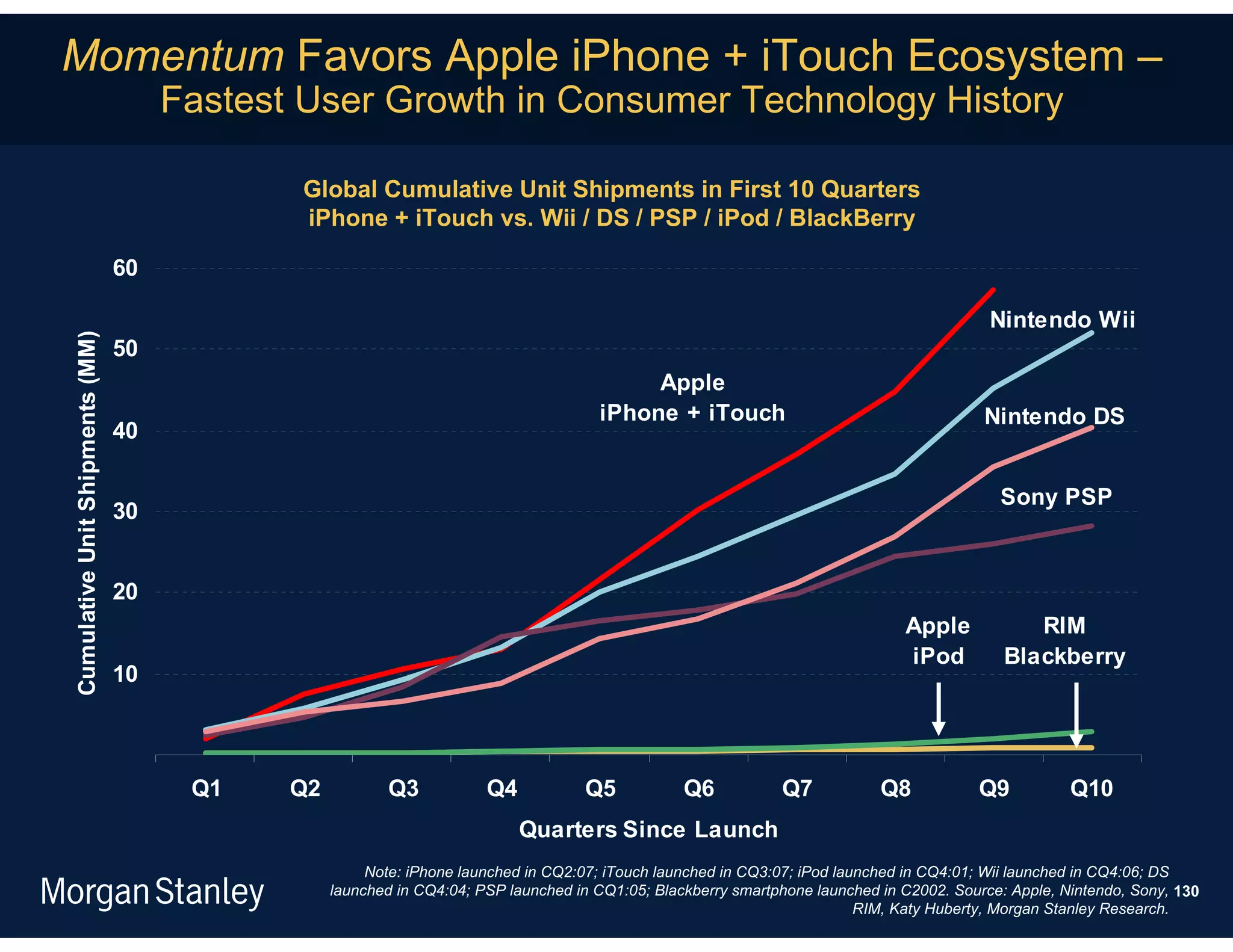
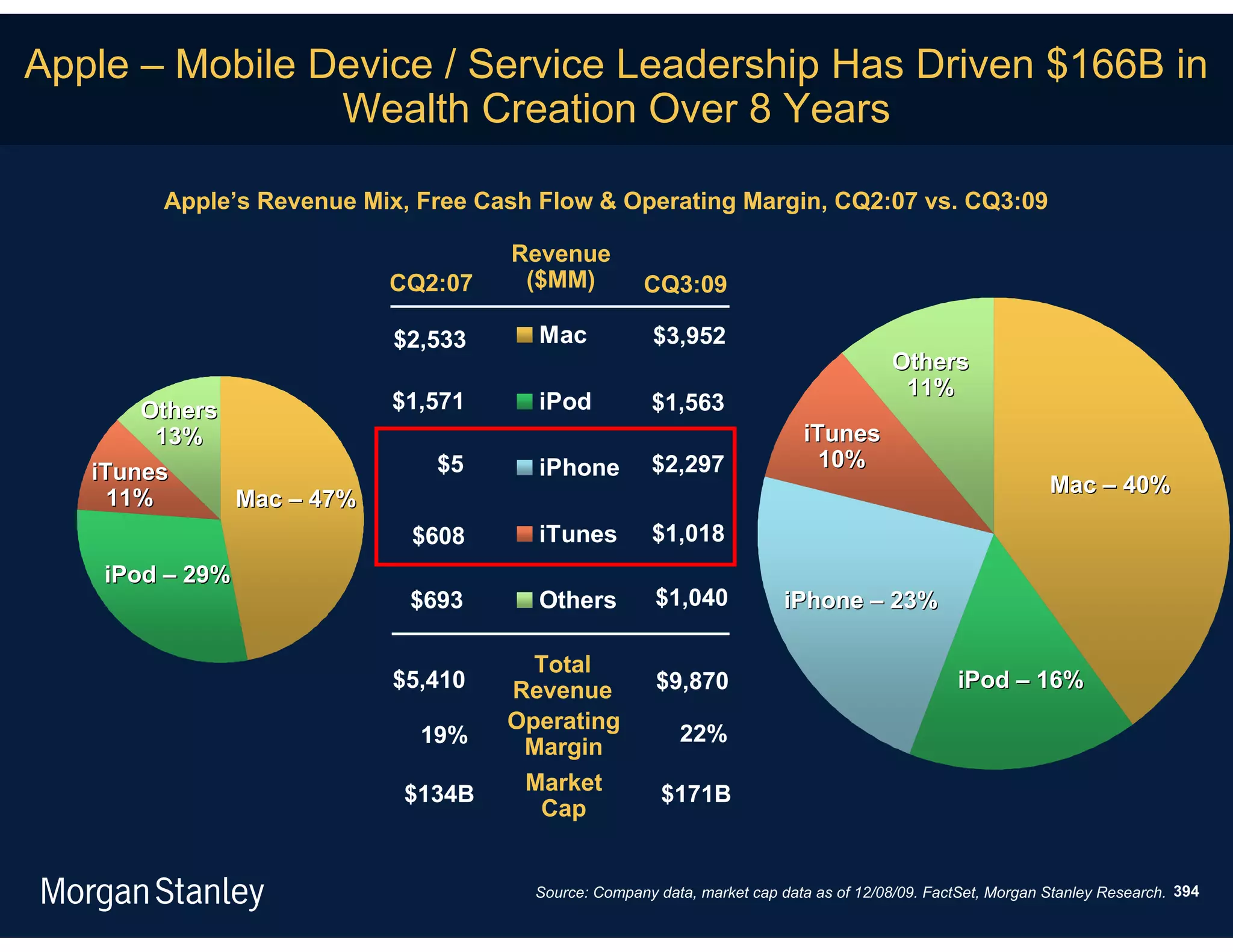
Apple’s iPhone / iTouch / iTunes ecosystem may prove to be the fastest-
ramping + most disruptive technology product / service launch the world
has ever seen.

With Internet + cellular networks at its core, Apple, in effect, has empowered
tens of millions (and growing rapidly) consumers with cloud-based devices
that allow them to easily do “remote-controlly” type things in real time that
have been in the imaginations of science fiction writers for decades.

Consumers love Apple’s products and are voting with their time and money.

It’s a rare business that doesn’t need to take note of what Apple +
consumers are doing and determine how to adapt to the mobile Internet
over the coming decade.


                                                                             4
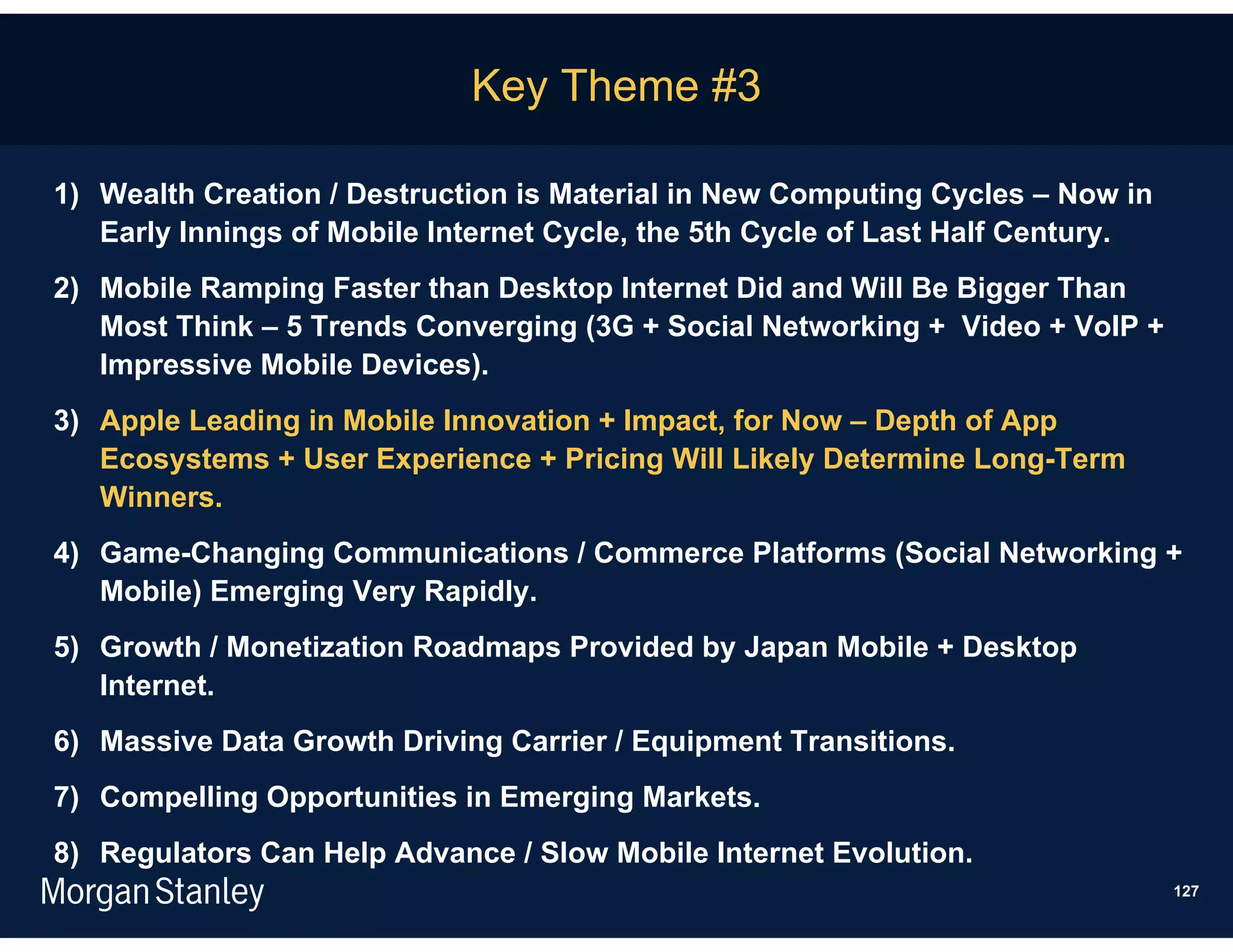
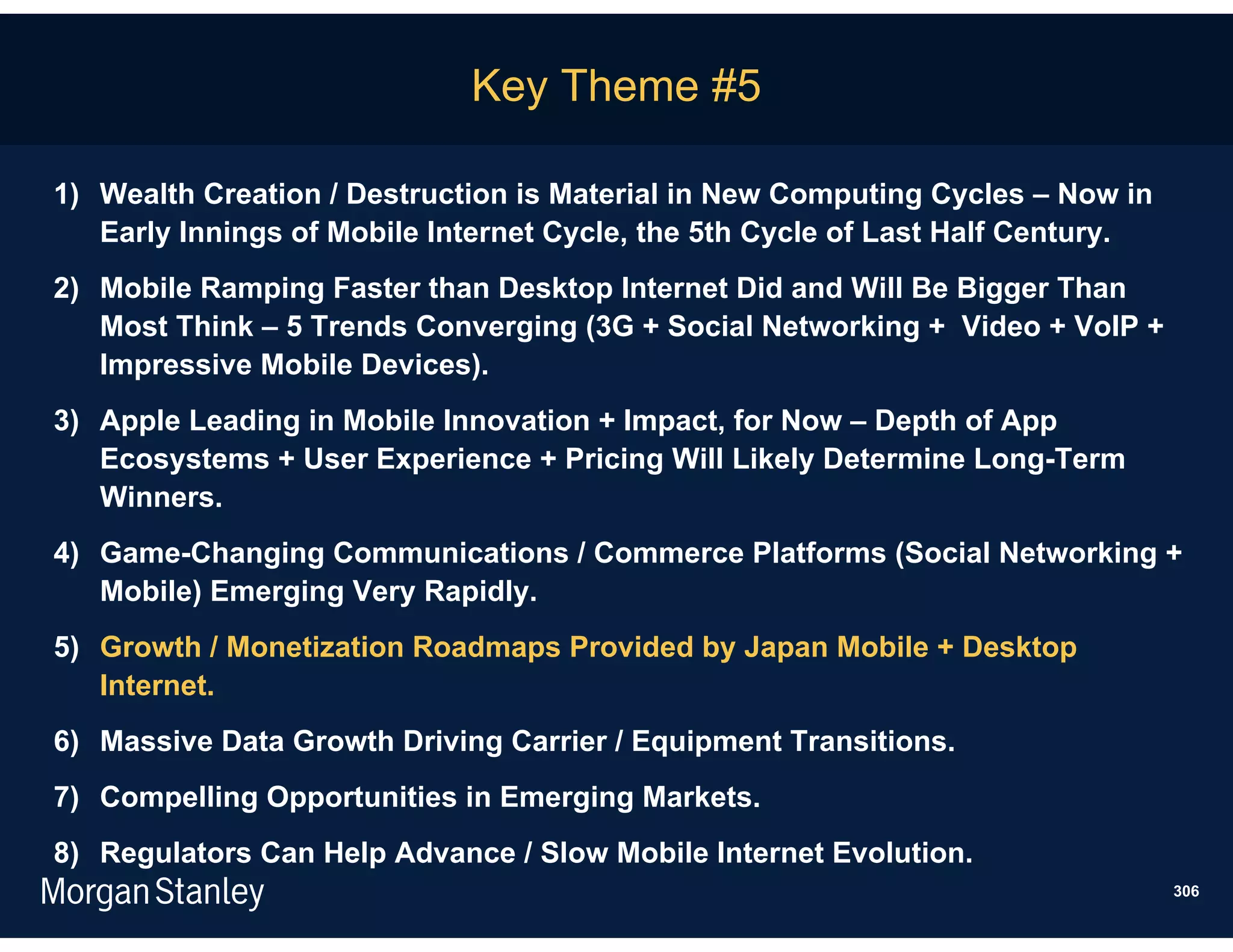
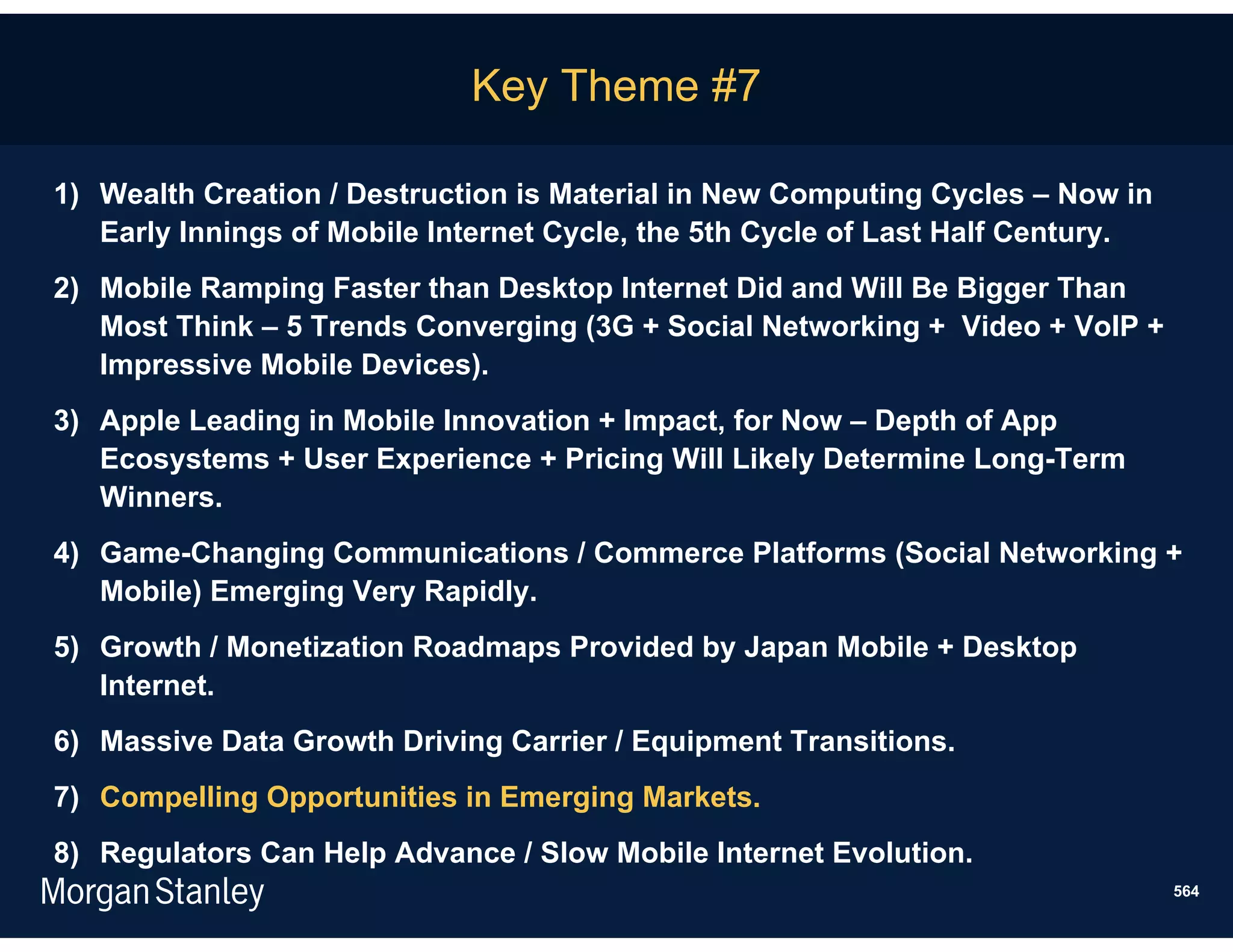
Key Mobile Internet Themes

1) Wealth Creation / Destruction is Material in New Computing Cycles – Now in
   Early Innings of Mobile Internet Cycle, the 5th Cycle of Last Half Century.
2) Mobile Ramping Faster than Desktop Internet Did and Will Be Bigger Than
   Most Think – 5 Trends Converging (3G + Social Networking + Video + VoIP +
   Impressive Mobile Devices).
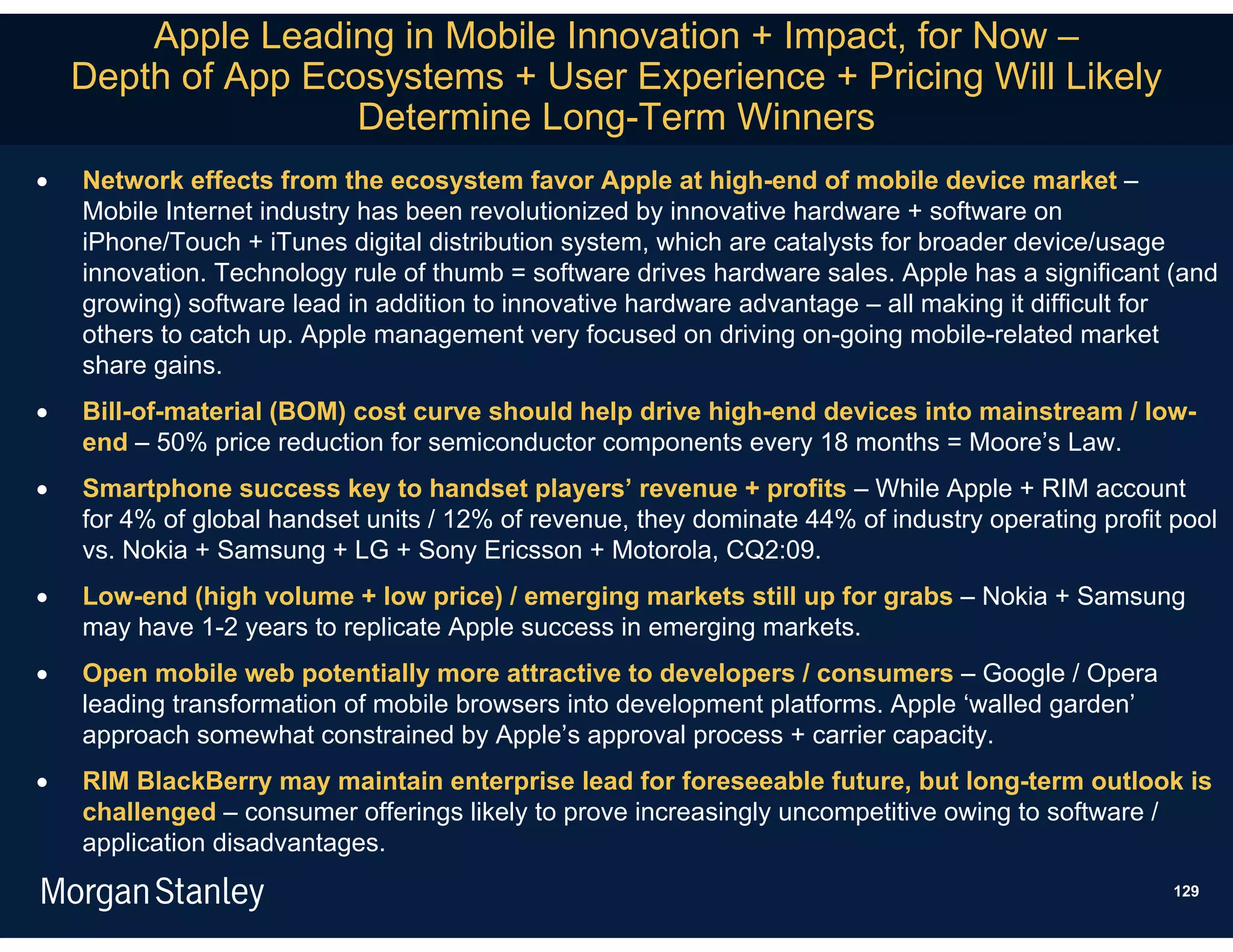
3) Apple Leading in Mobile Innovation + Impact, for Now – Depth of App
   Ecosystems + User Experience + Pricing Will Likely Determine Long-Term
   Winners.
4) Game-Changing Communications / Commerce Platforms (Social Networking +
   Mobile) Emerging Very Rapidly.
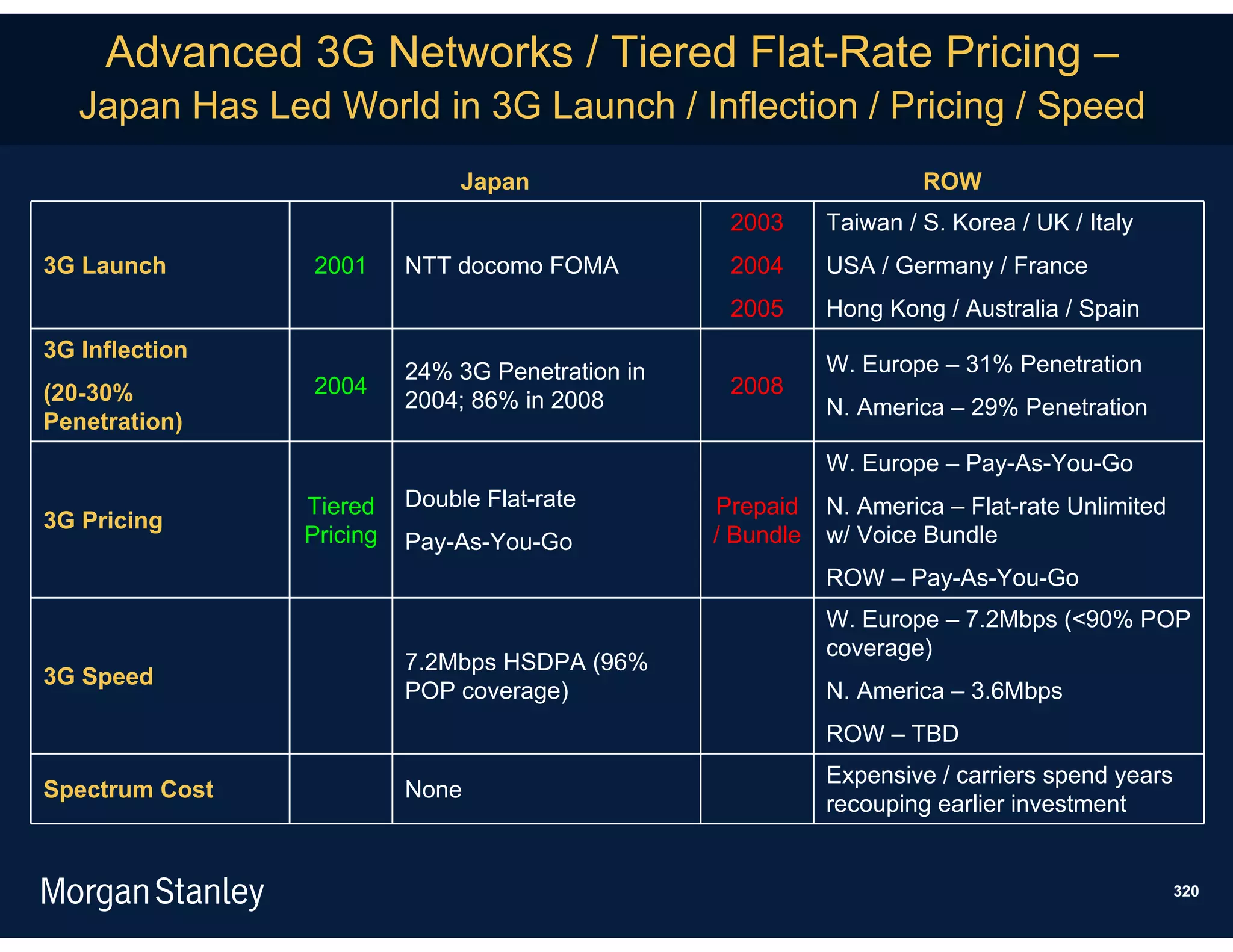
5) Growth / Monetization Roadmaps Provided by Japan Mobile + Desktop
   Internet.
6) Massive Data Growth Driving Carrier / Equipment Transitions.
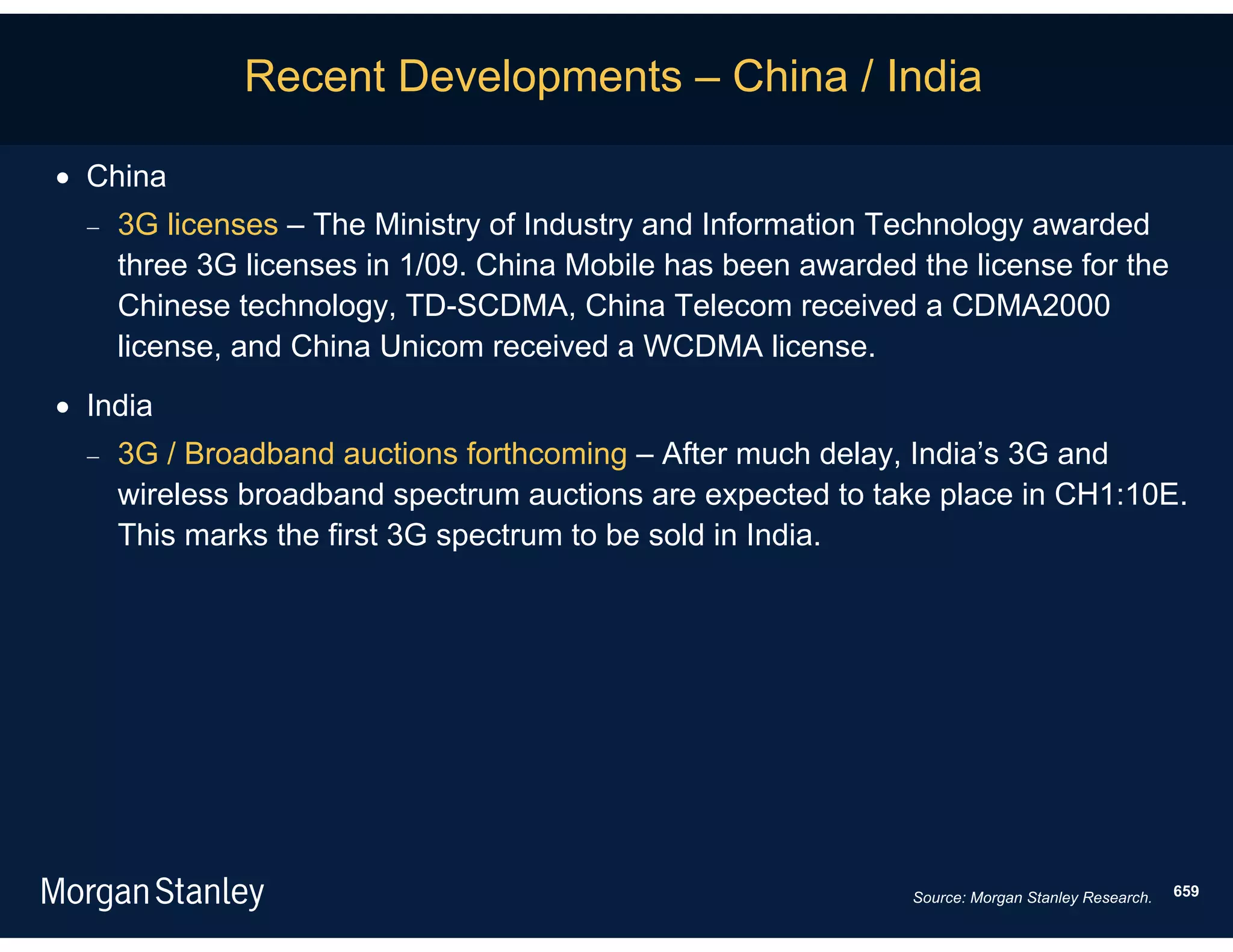
7) Compelling Opportunities in Emerging Markets.
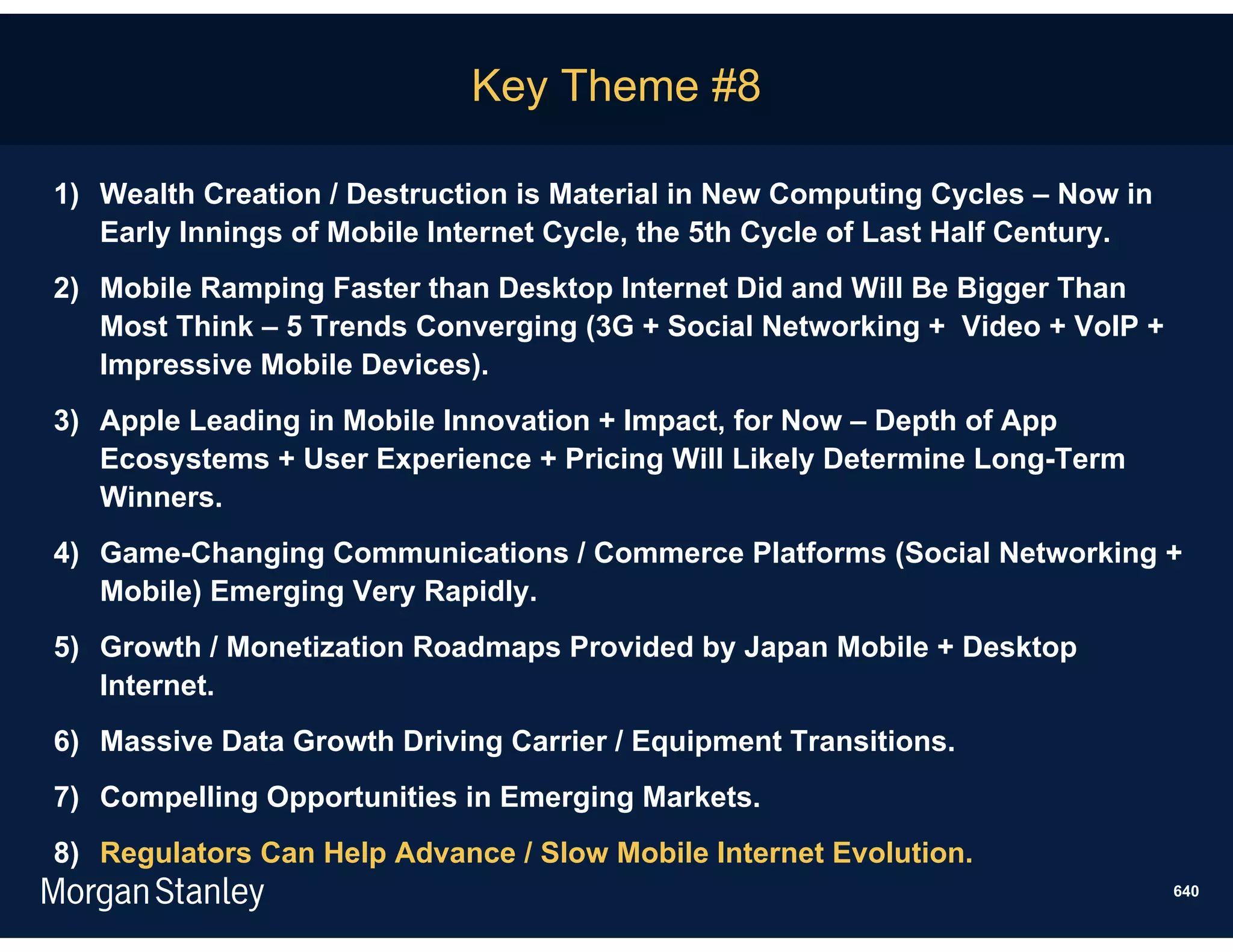
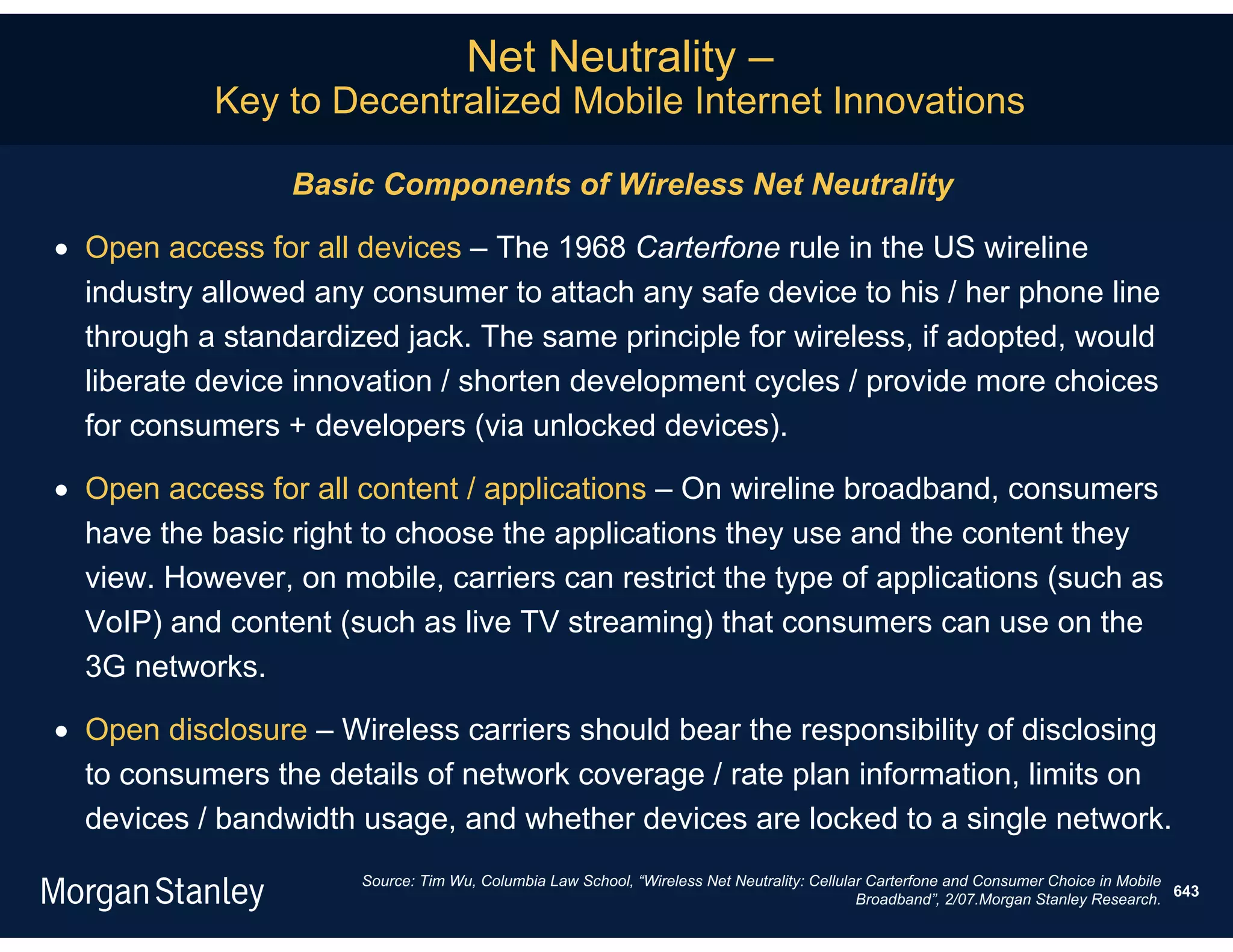
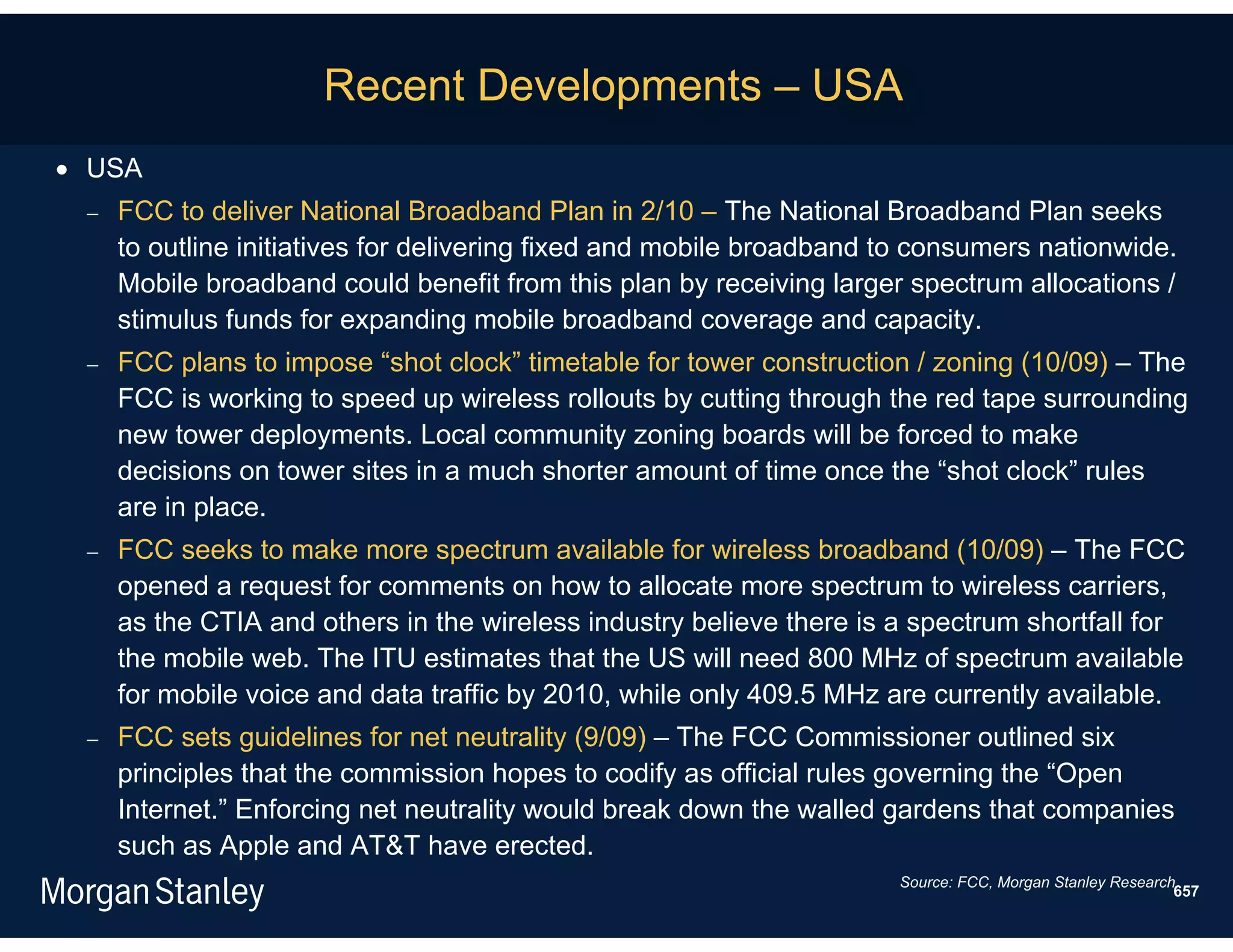
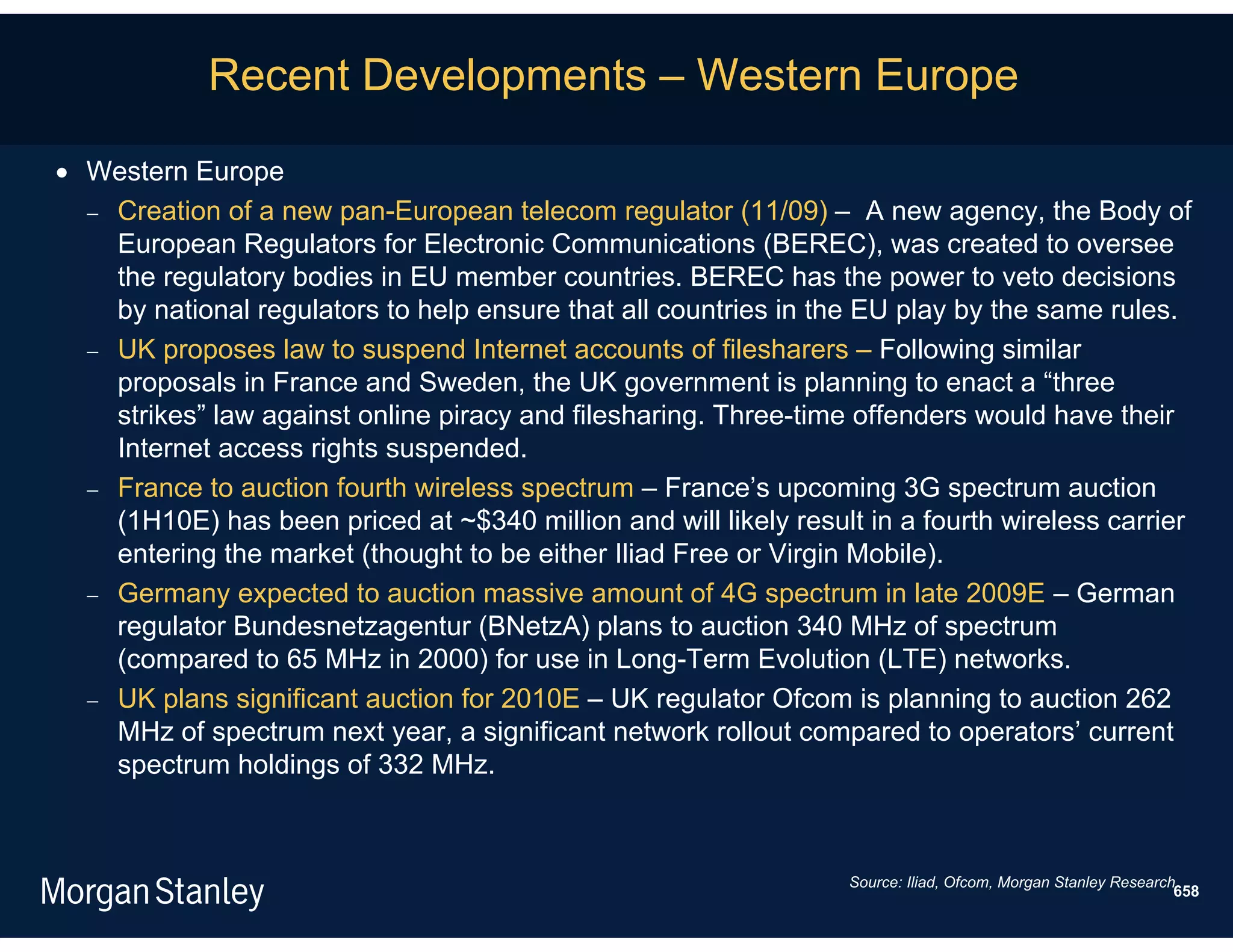
8) Regulators Can Help Advance / Slow Mobile Internet Evolution.
                                                                                 5
Key Mobile Internet Themes…
1) Wealth Creation / Destruction Is Material in New Computing Cycles – Now
   in Early Innings of Mobile Internet Cycle, the 5th Cycle of Last Half Century
   – History proves that massive technology changes typically shift dynamics
   between incumbents / attackers creating winners / losers. A handful of
   incumbents (like Apple, Google, Amazon.com and Skype) appear especially well
   positioned for mobile changes.
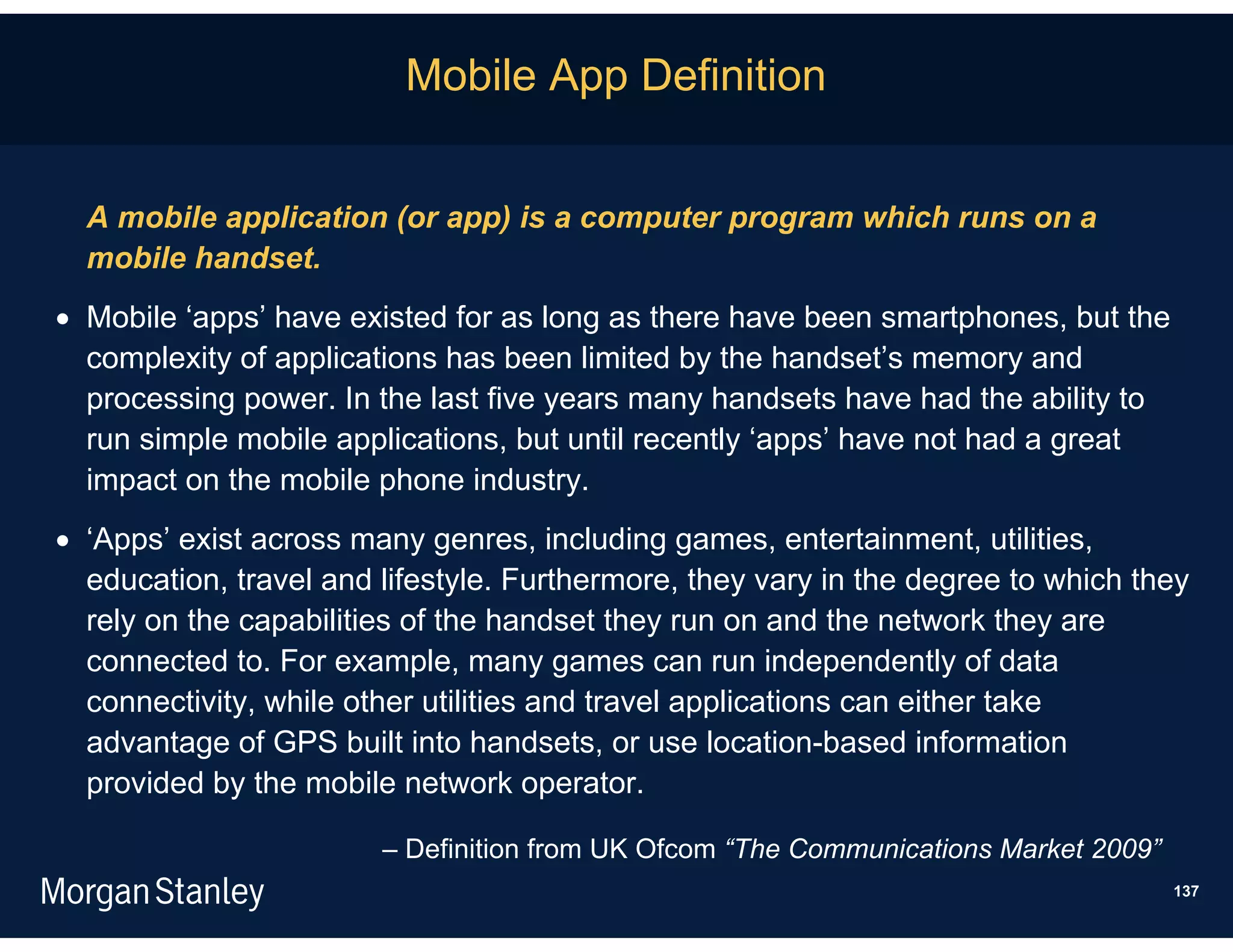
2) Mobile Ramping Faster than Desktop Internet Did and Will Be Bigger Than Most
   Think – 5 Trends Converging (3G + Social Networking + Video + VoIP +
   Impressive Mobile Devices) – The explosive Apple iPhone / iTouch ramp shows
   us that usage of mobile devices on IP-based networks should surprise to the
   upside for years to come. 3G adoption is hitting inflection points across many
   markets, enabling consumers to engage in a broad range of IP-based usage
   models (social networking / VoIP / video) via powerful mobile Internet-enabled
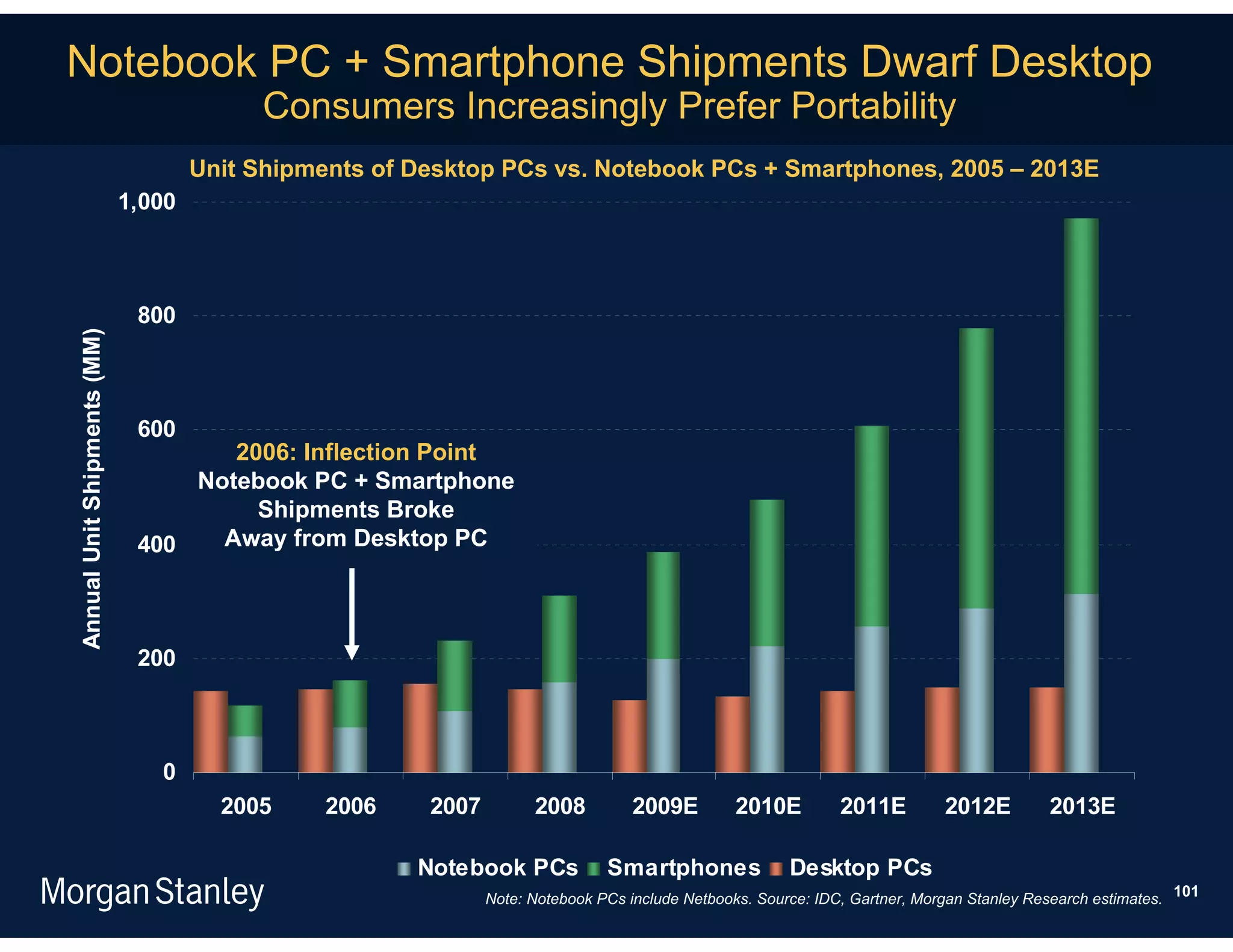
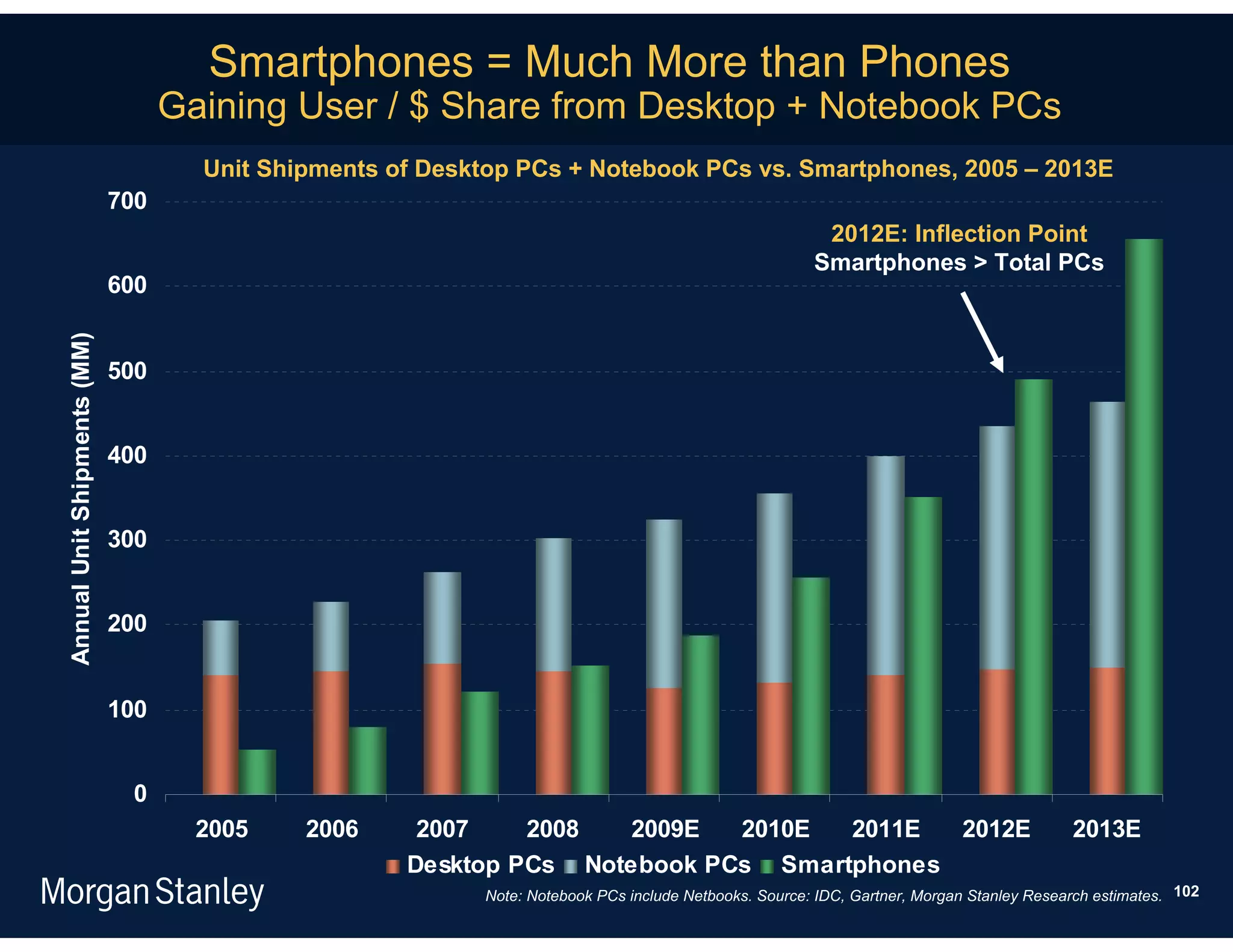
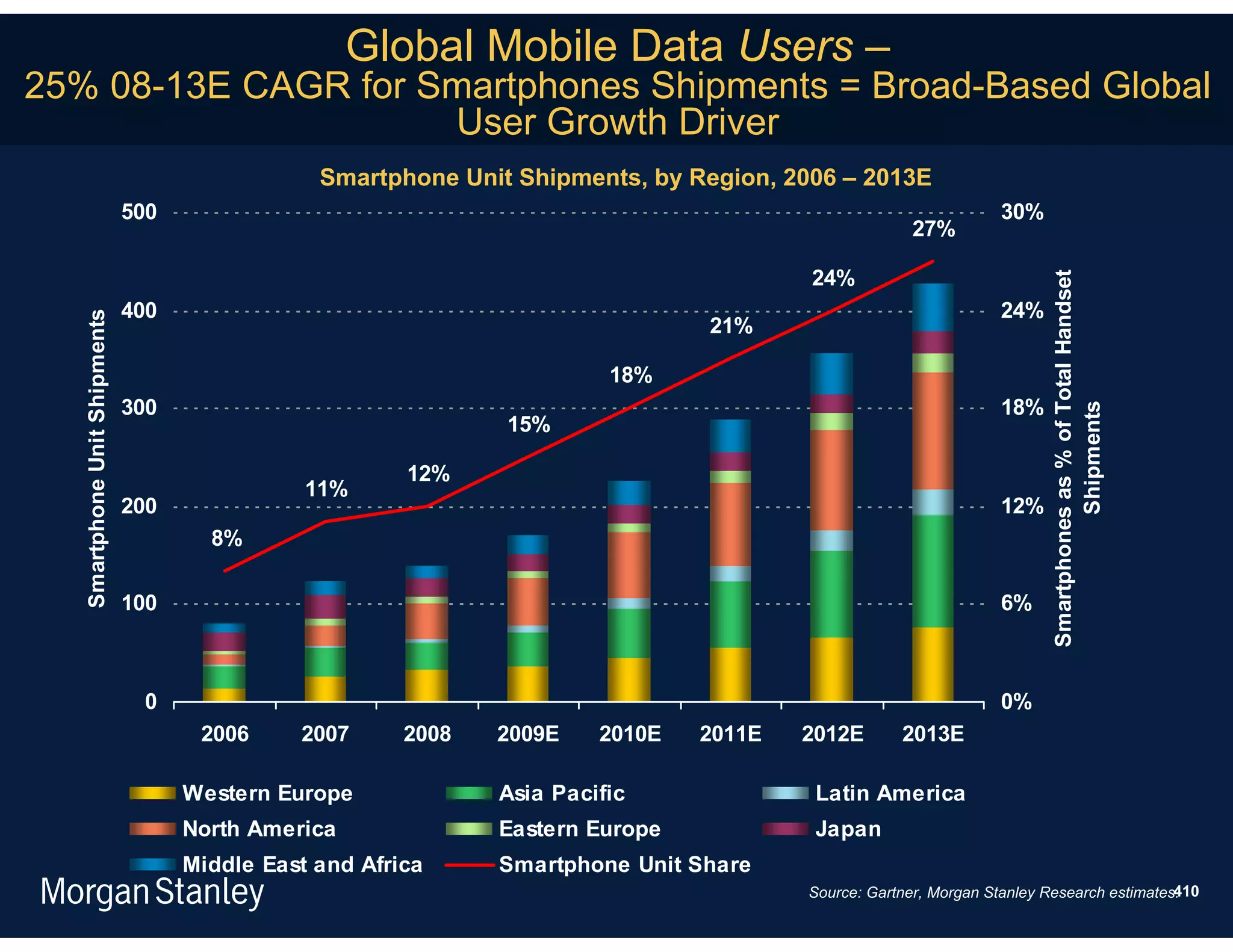
   devices. We predict Smartphones will out-ship the global notebook + netbook
   market in 2010E and out-ship the global PC market (notebook + netbook +
   desktop) by 2012E.
                                                                                    6
…Key Mobile Internet Themes…

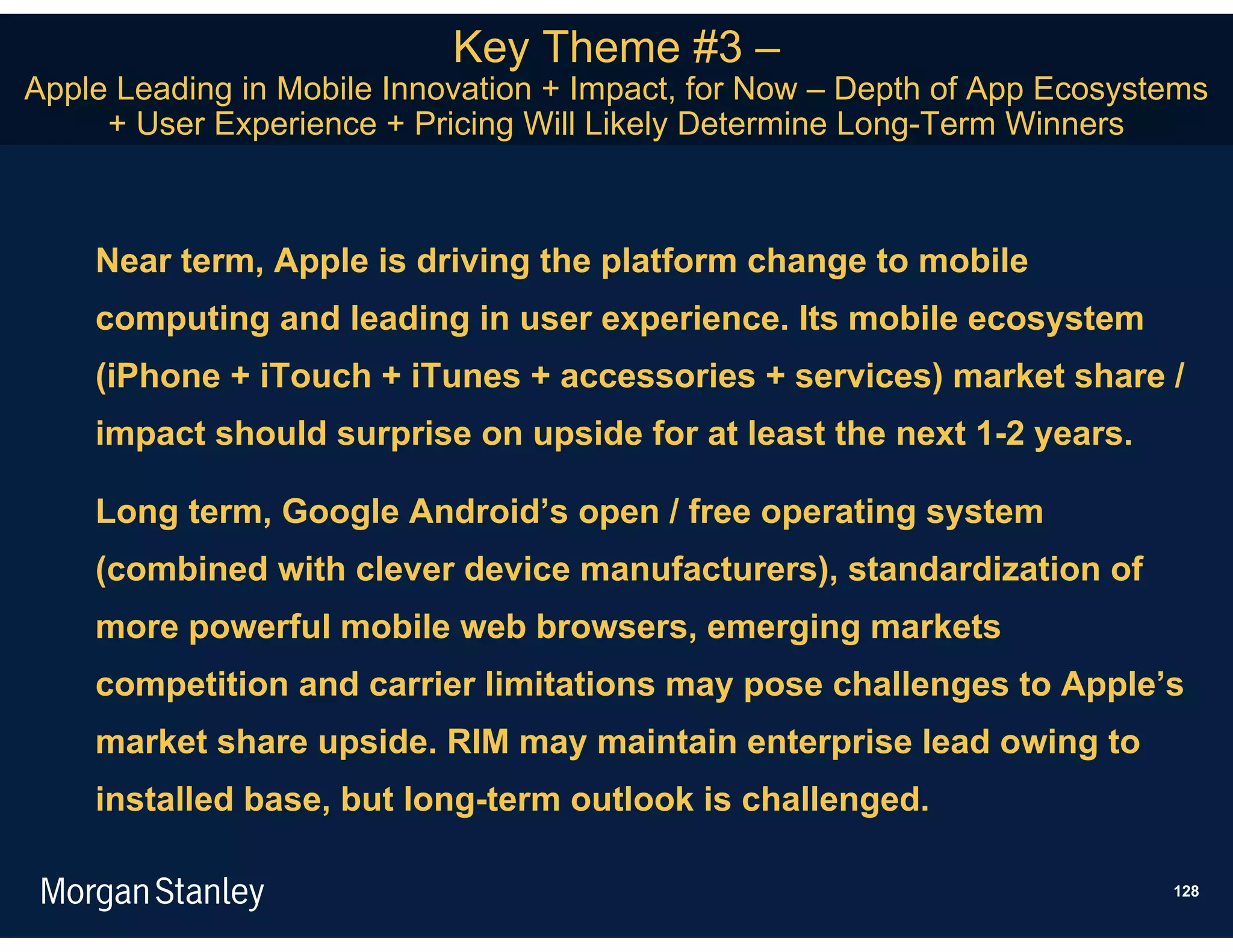
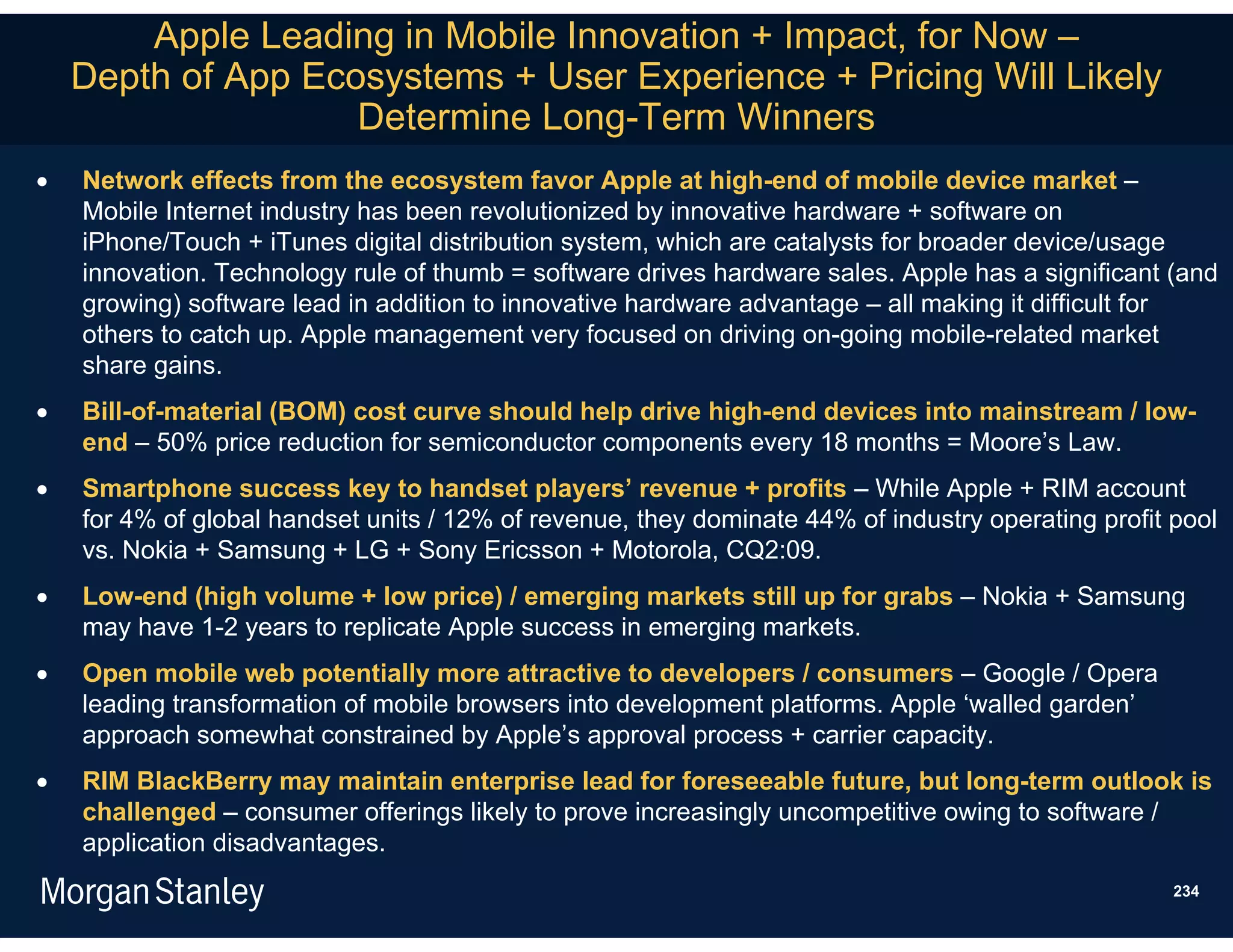
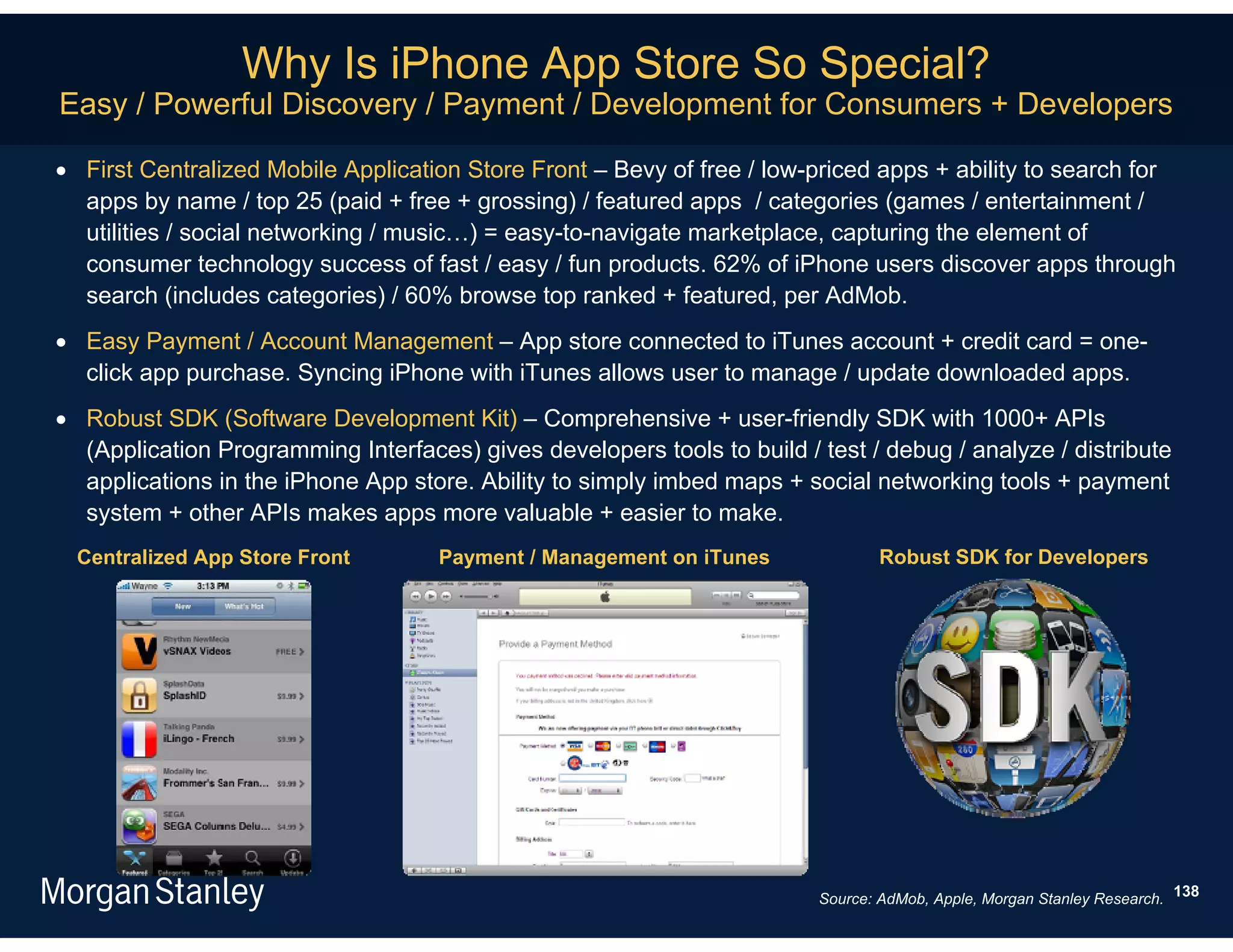
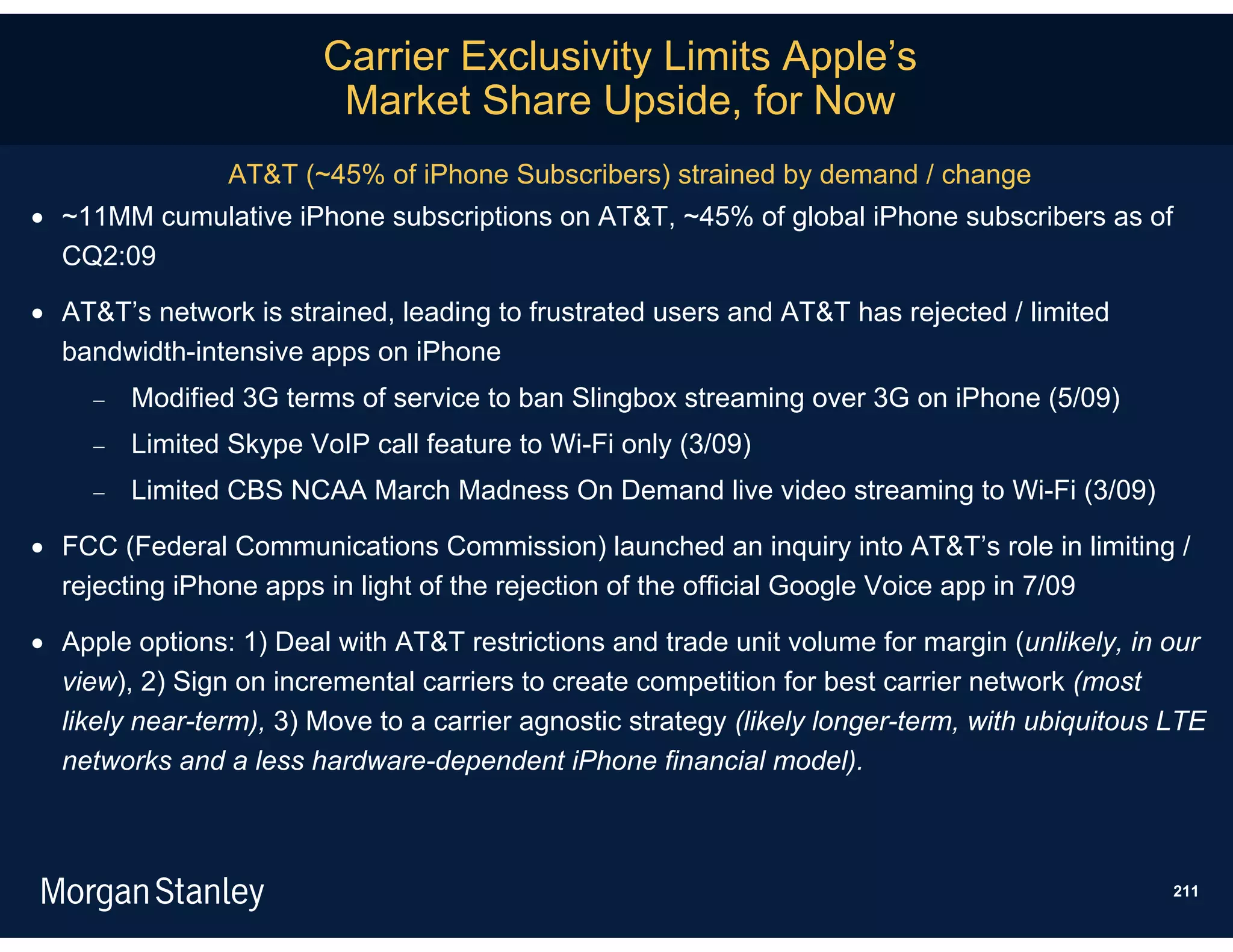
3) Apple Leading in Mobile Innovation + Impact, for Now – Depth of App
   Ecosystems + User Experience + Pricing Will Likely Determine Long-Term
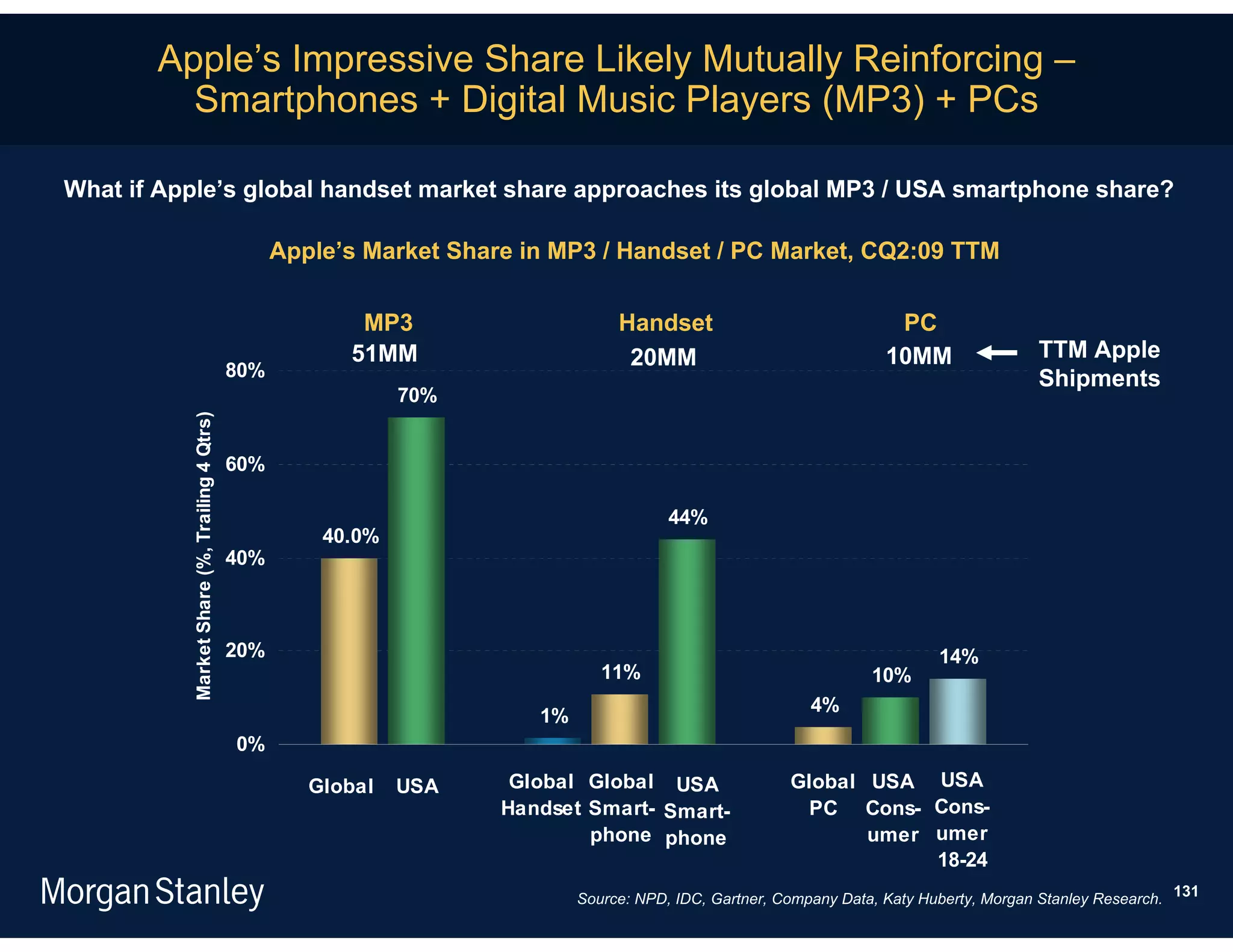
   Winners – Near term, Apple is driving the platform change to mobile computing
   and leading in user experience. Its mobile ecosystem (iPhone + iTouch + iTunes
   + accessories + services) market share / impact should surprise on the upside
   for at least the next 1-2 years. Longer term, Google Android’s open / free
   operating system (combined with clever device manufacturers), emerging
   markets competition, and carrier limitations may pose challenges to Apple’s
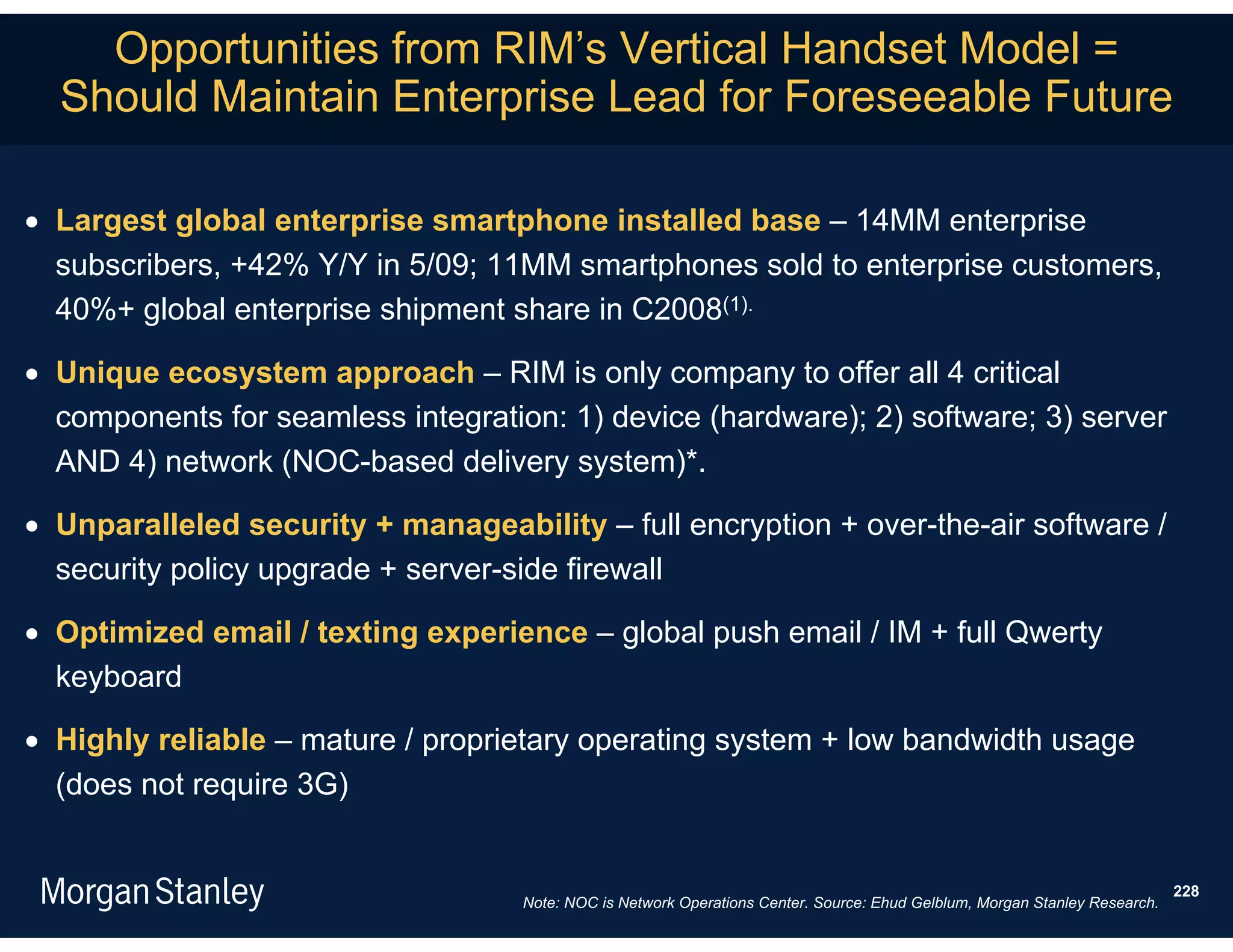
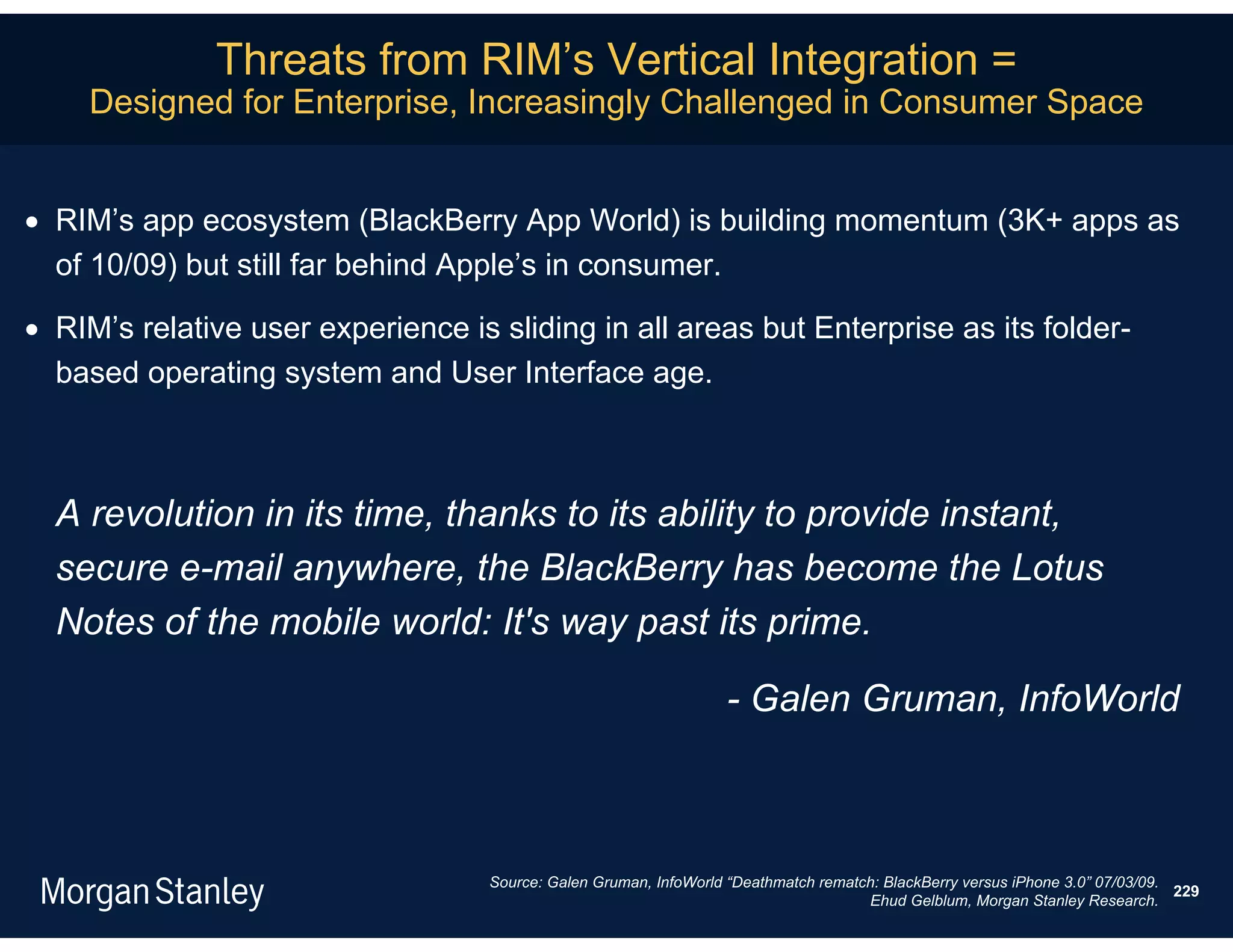
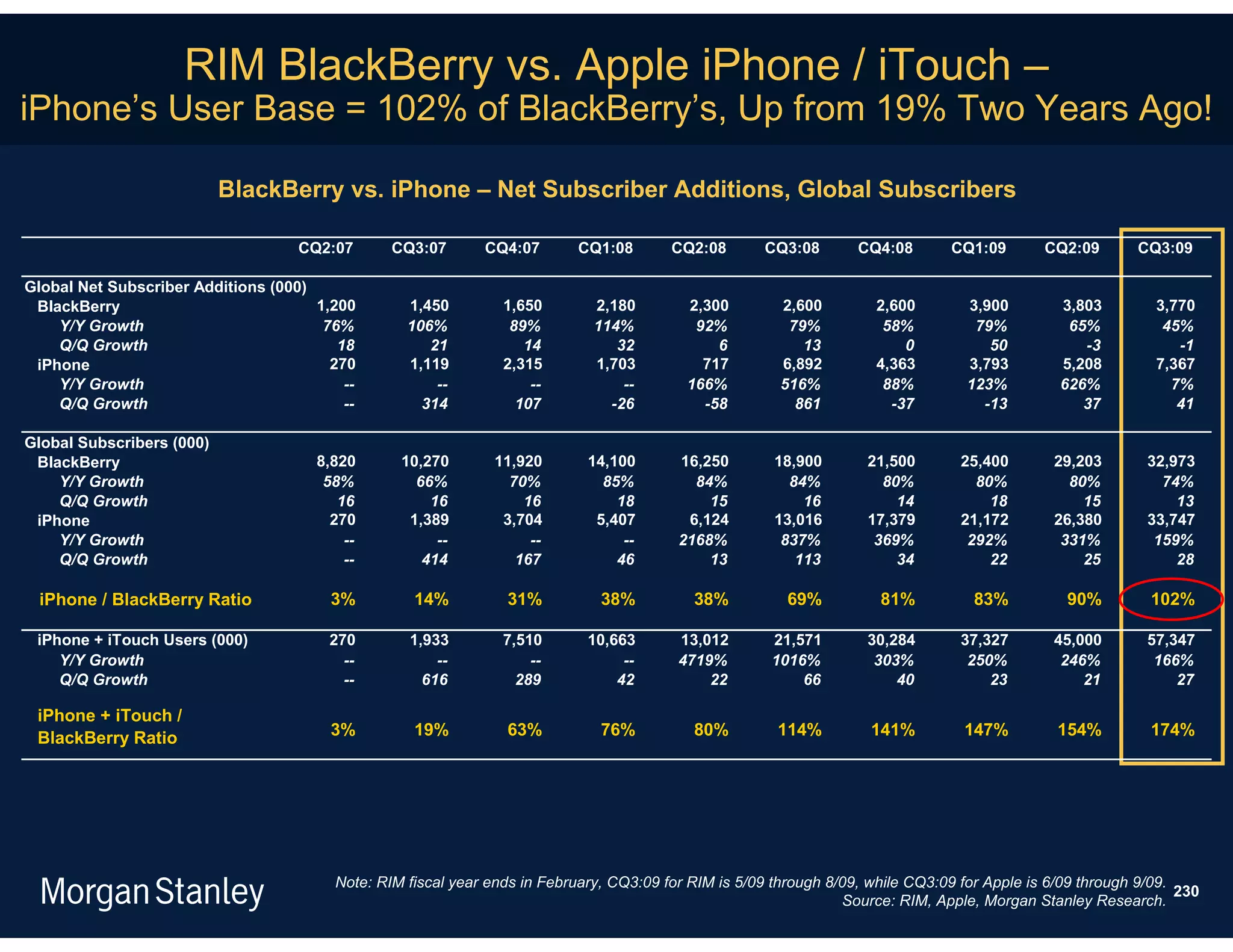
   market share upside. RIM may maintain enterprise lead, owing to installed base,
   but long-term outlook is challenged.


                                                                                     7
…Key Mobile Internet Themes…

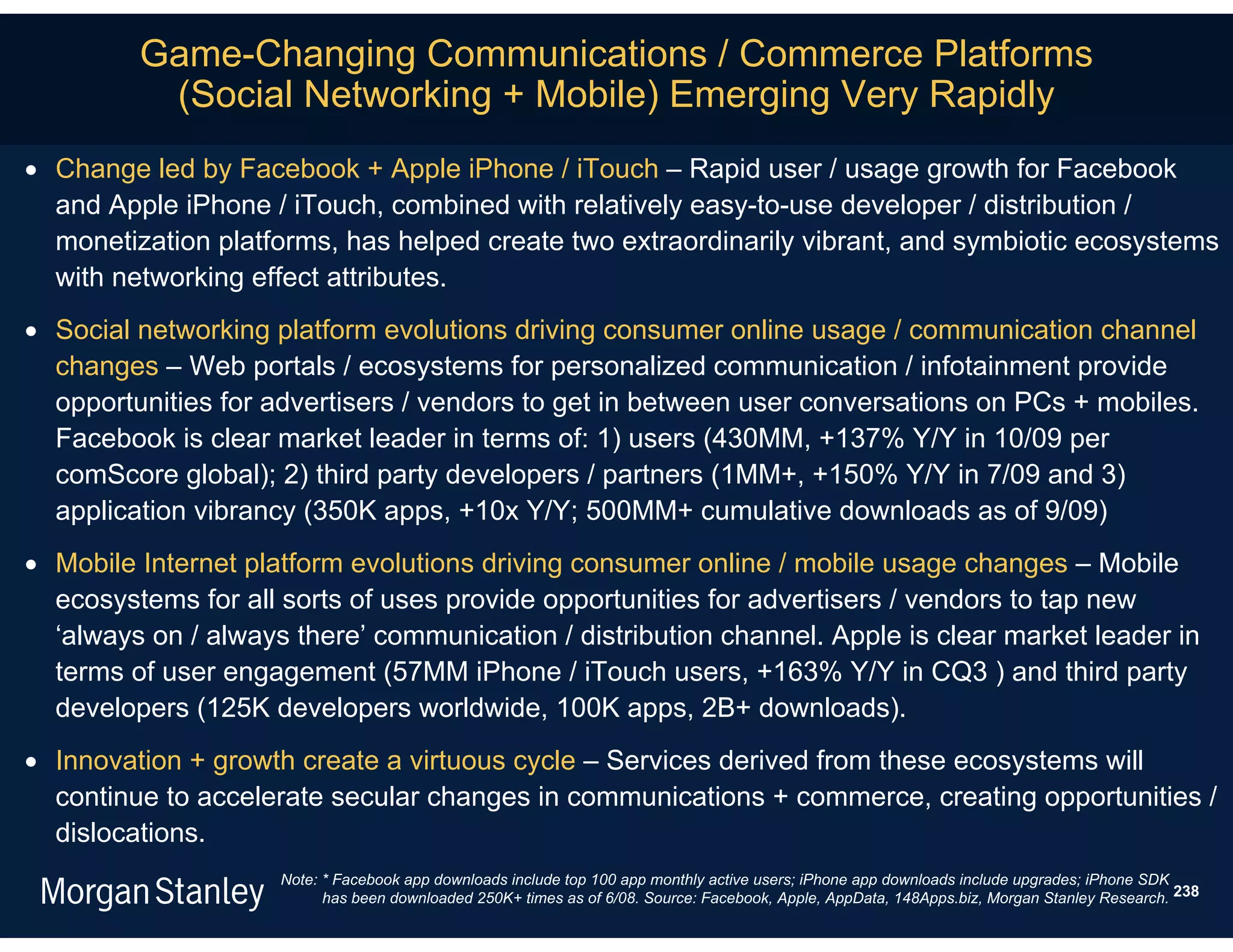
4) Game-Changing Communications / Commerce Platforms (Social
  Networking + Mobile) Emerging Very Rapidly – Improvements in social
  networking and mobile computing platforms (led by Facebook + Apple
  ecosystems) are fundamentally changing the ways people communicate with
  each other and the ways developers / advertisers / vendors can reach
  consumers. Mobile devices are evolving as remote controls for continually
  expanding types of real-time, cloud-based services – including emerging
  location-based services – creating opportunities + dislocations, empowering
  consumers in unprecedented + transformative ways.

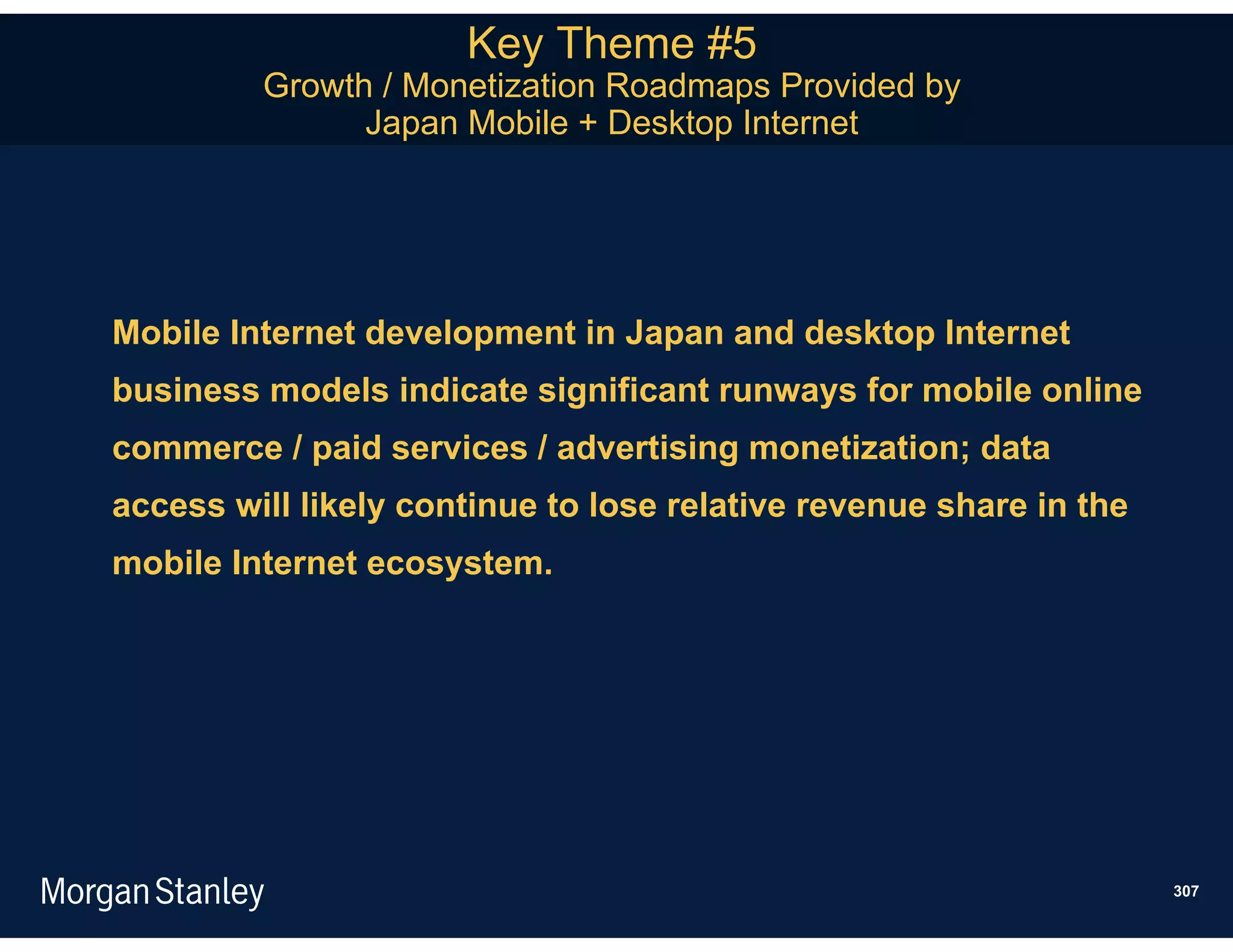
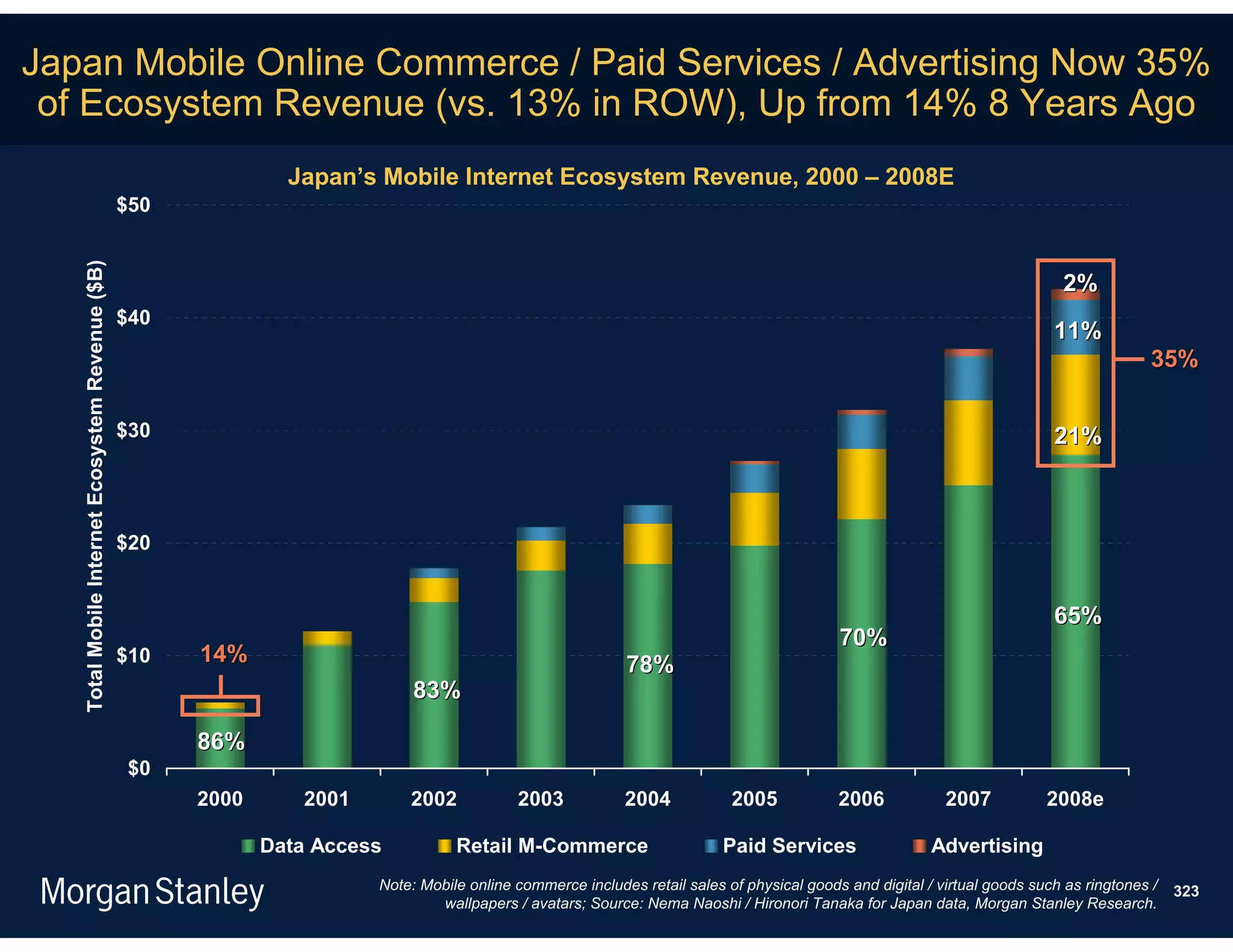
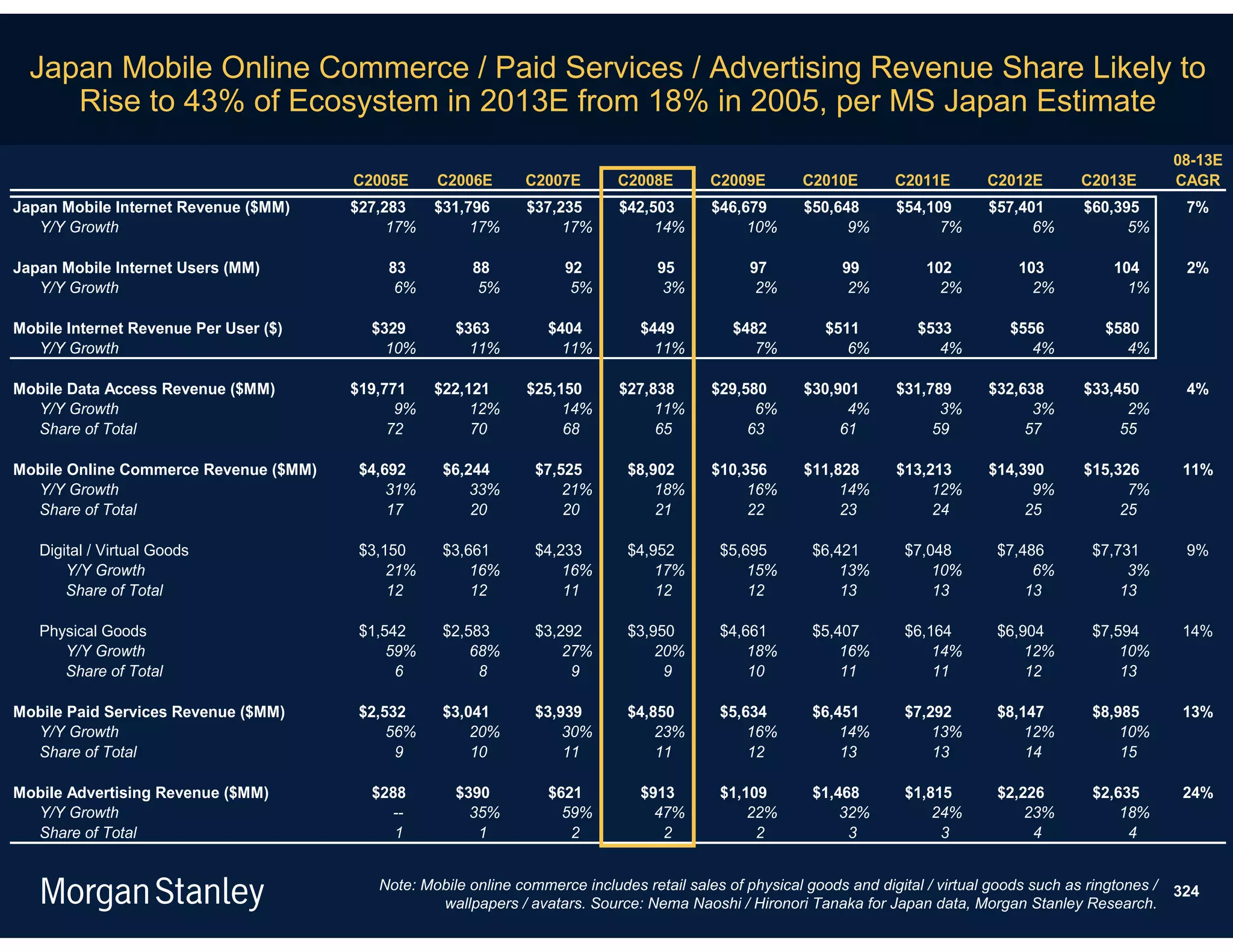
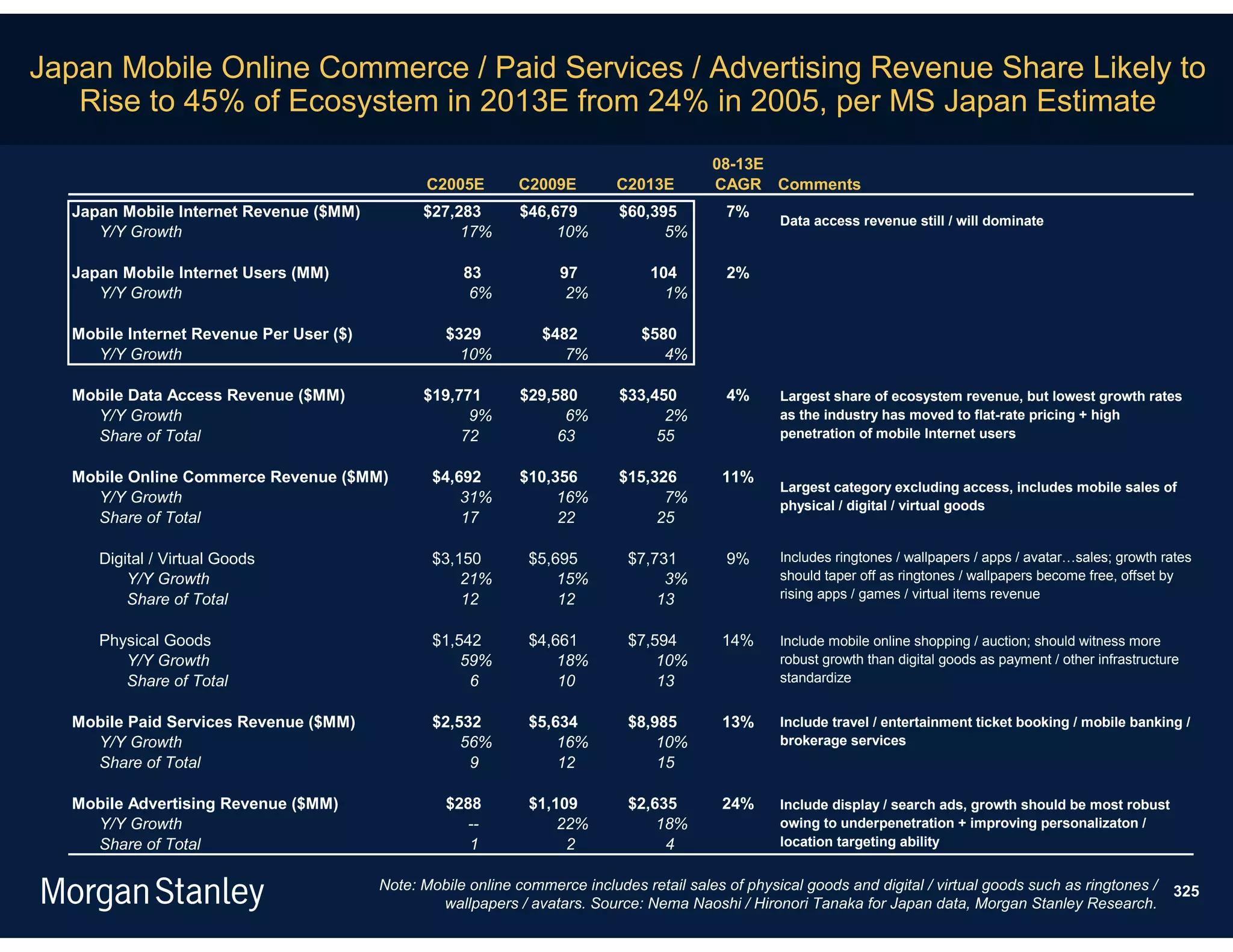
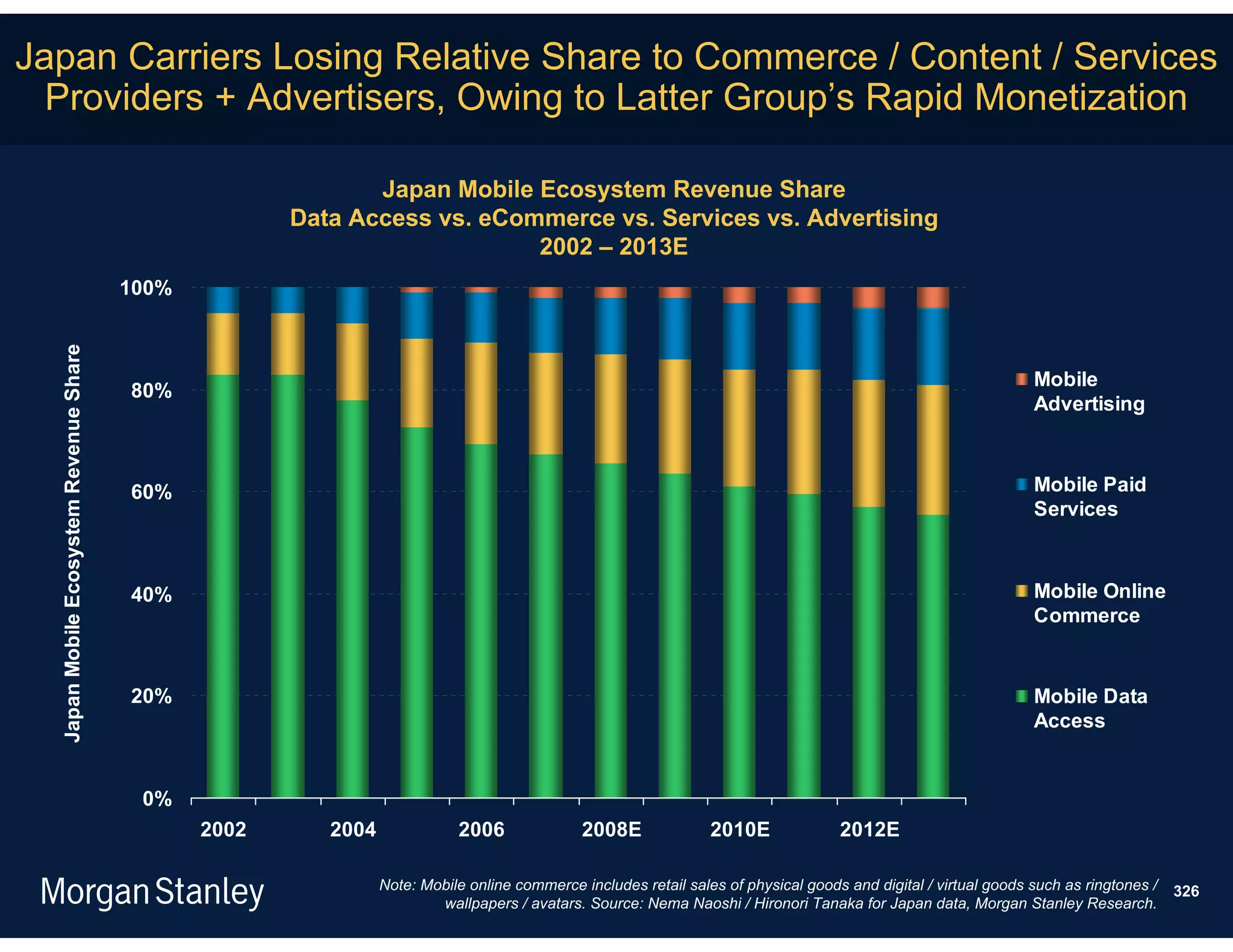
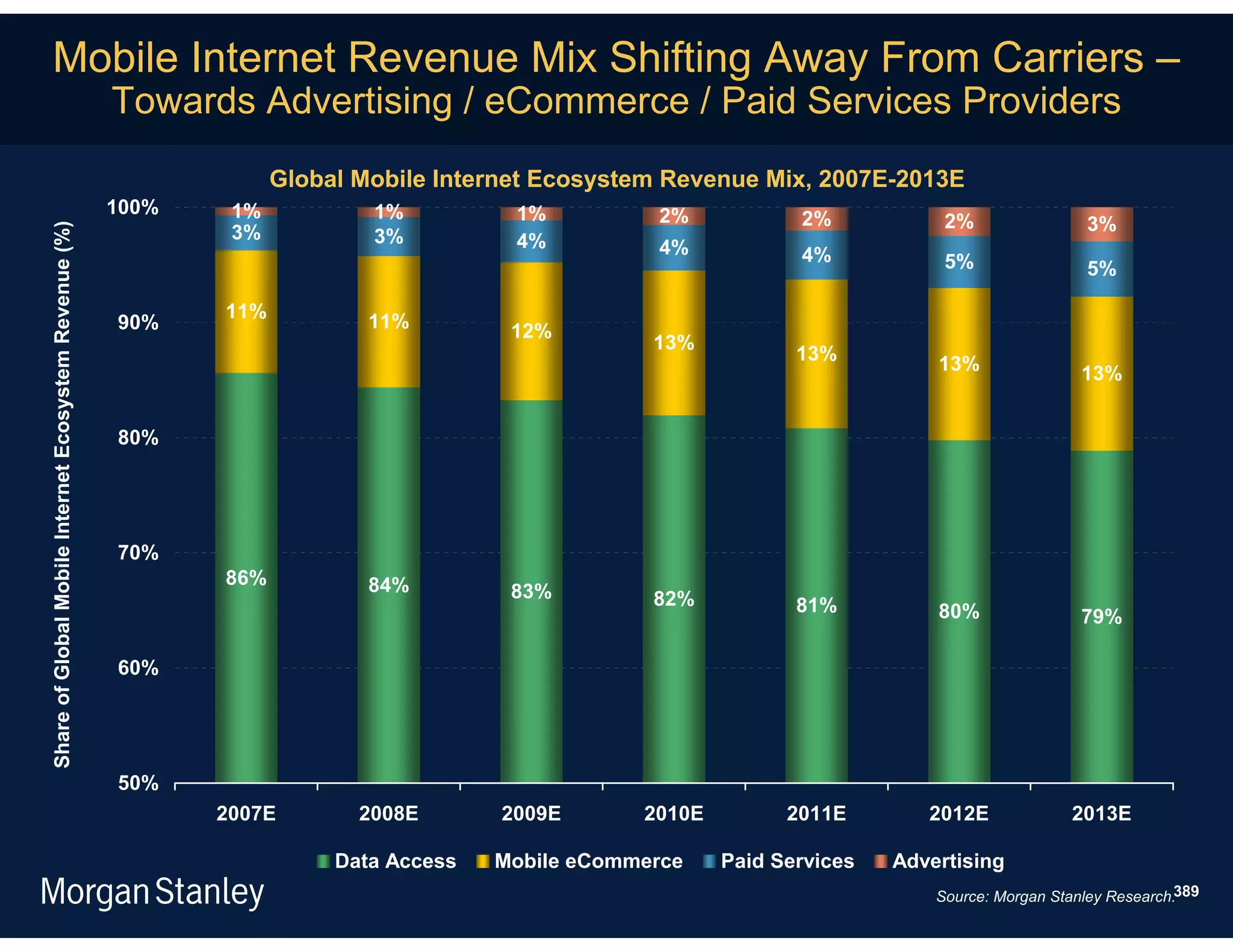
5) Growth / Monetization Roadmaps Provided by Japan Mobile + Desktop
  Internet – Mobile Internet development in Japan and desktop Internet business
  models indicate significant runways for mobile online commerce / paid services /
  advertising monetization; data access likely will continue to lose relative
  revenue share in the mobile Internet ecosystem.
                                                                                     8
…Key Mobile Internet Themes

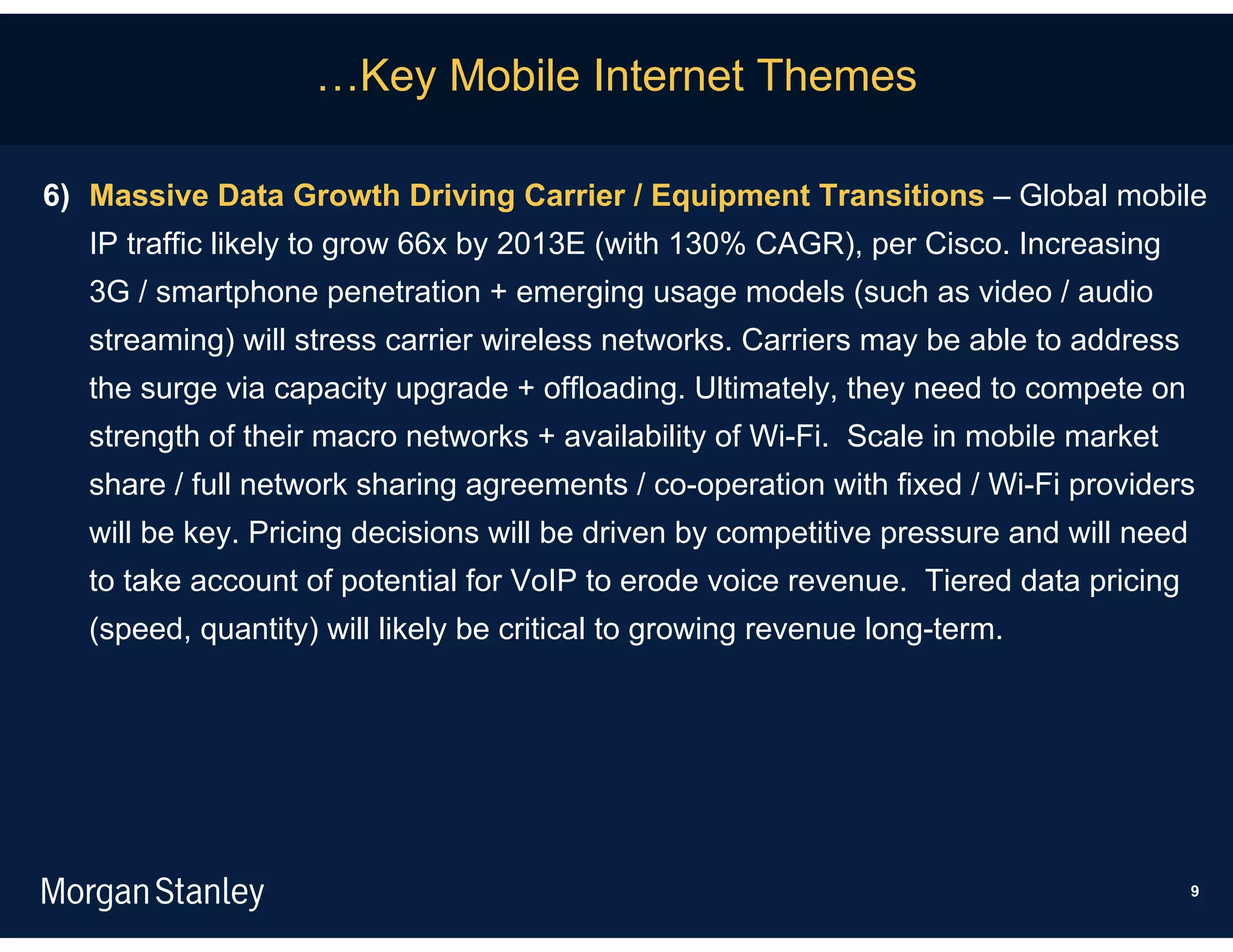
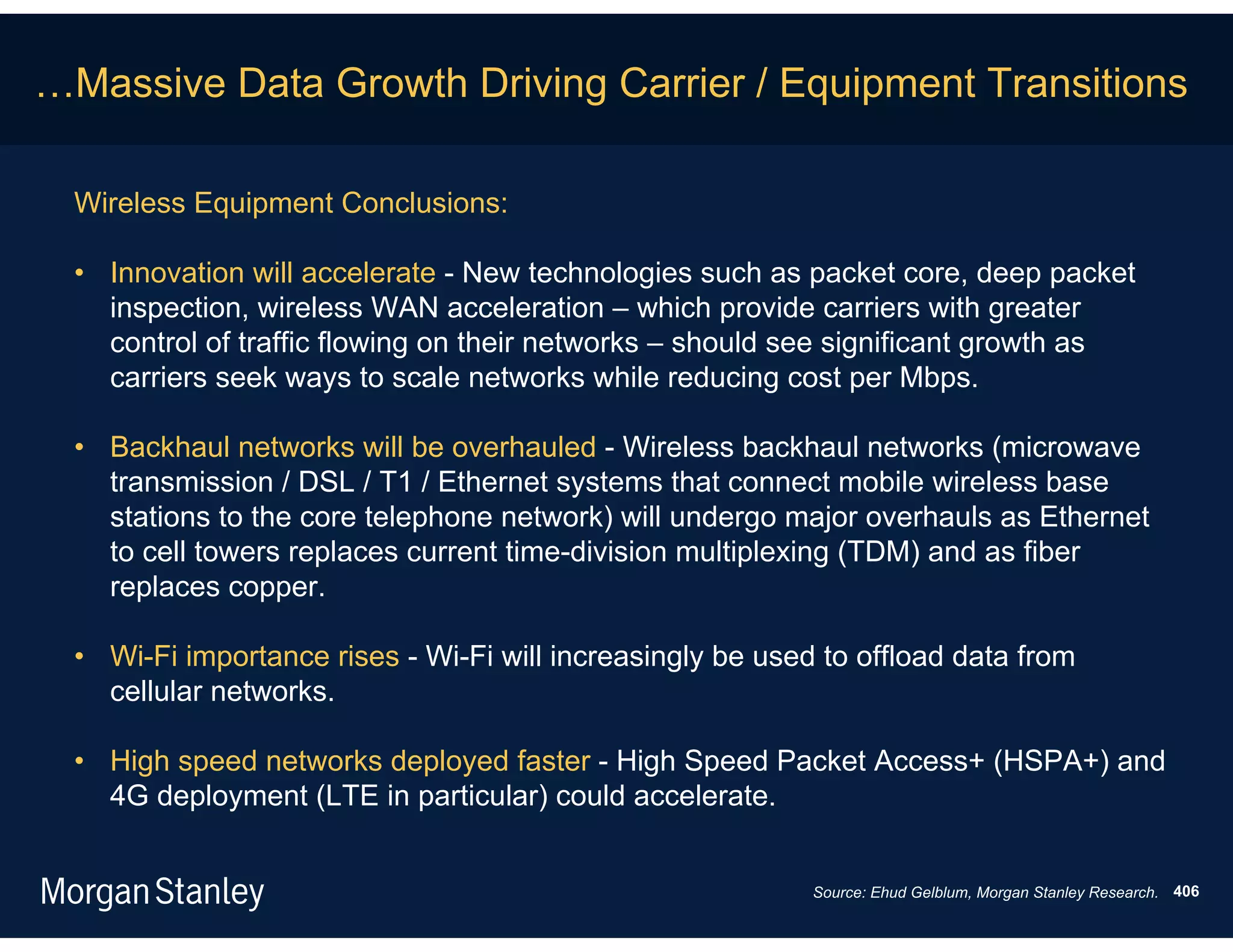
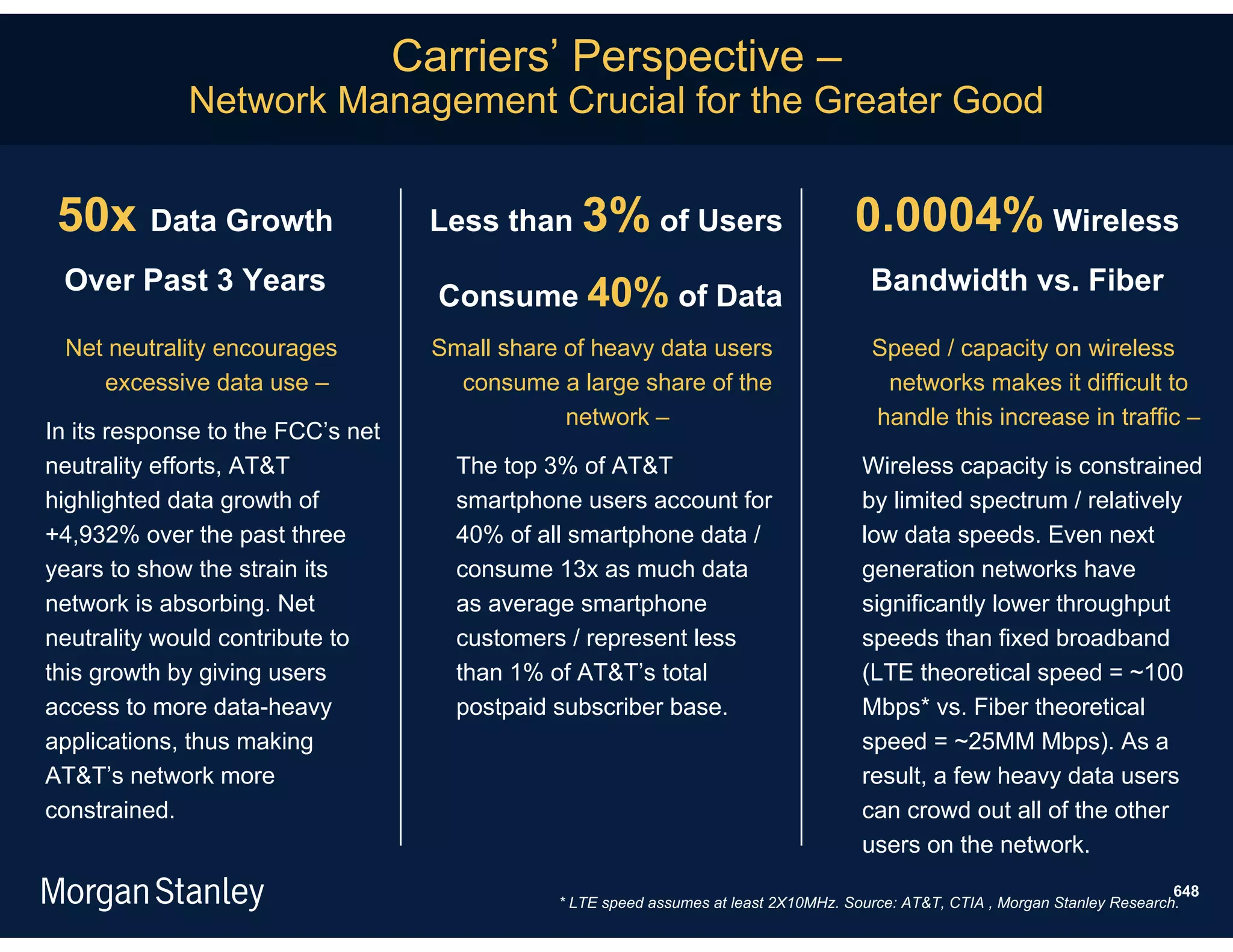
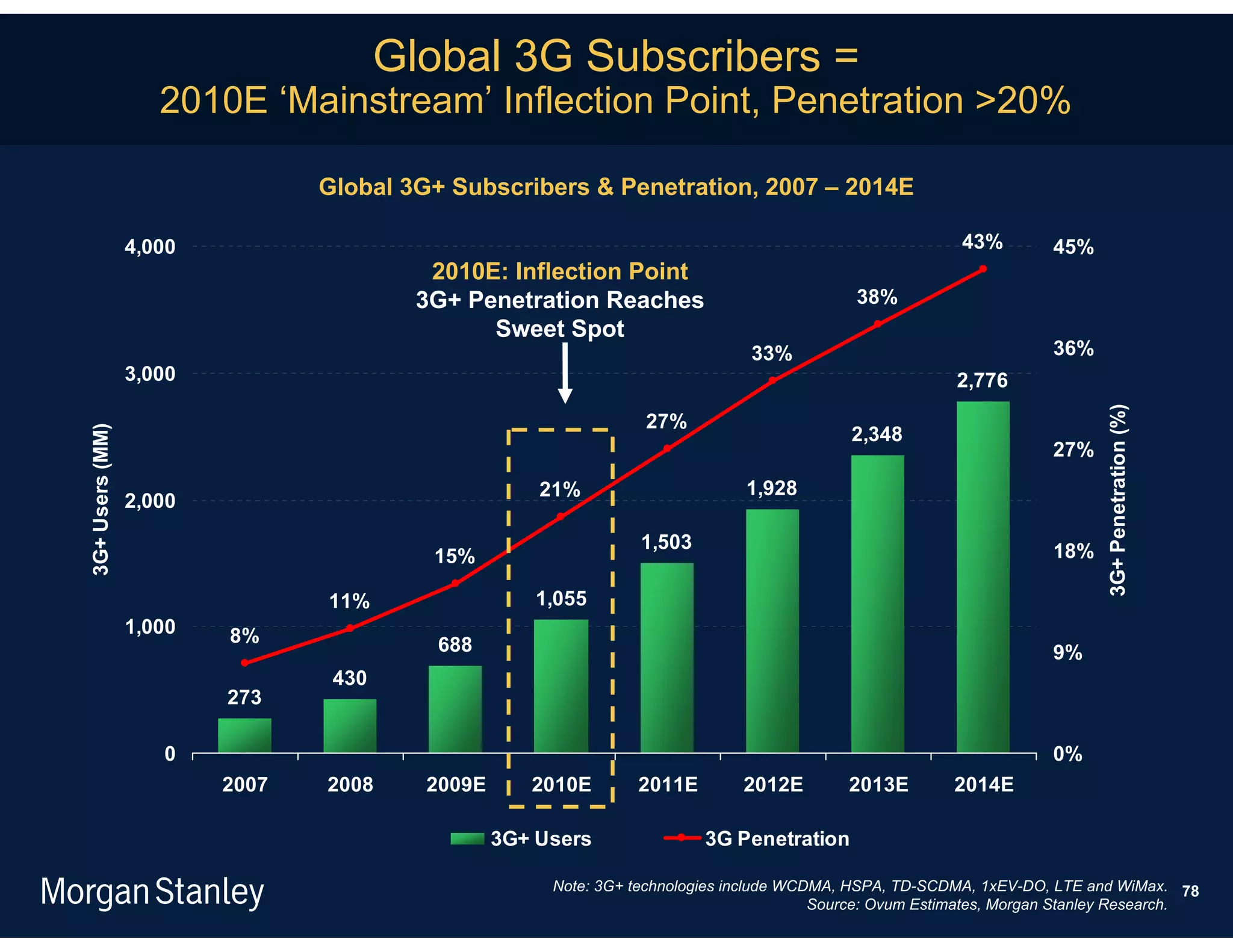
6) Massive Data Growth Driving Carrier / Equipment Transitions – Global mobile
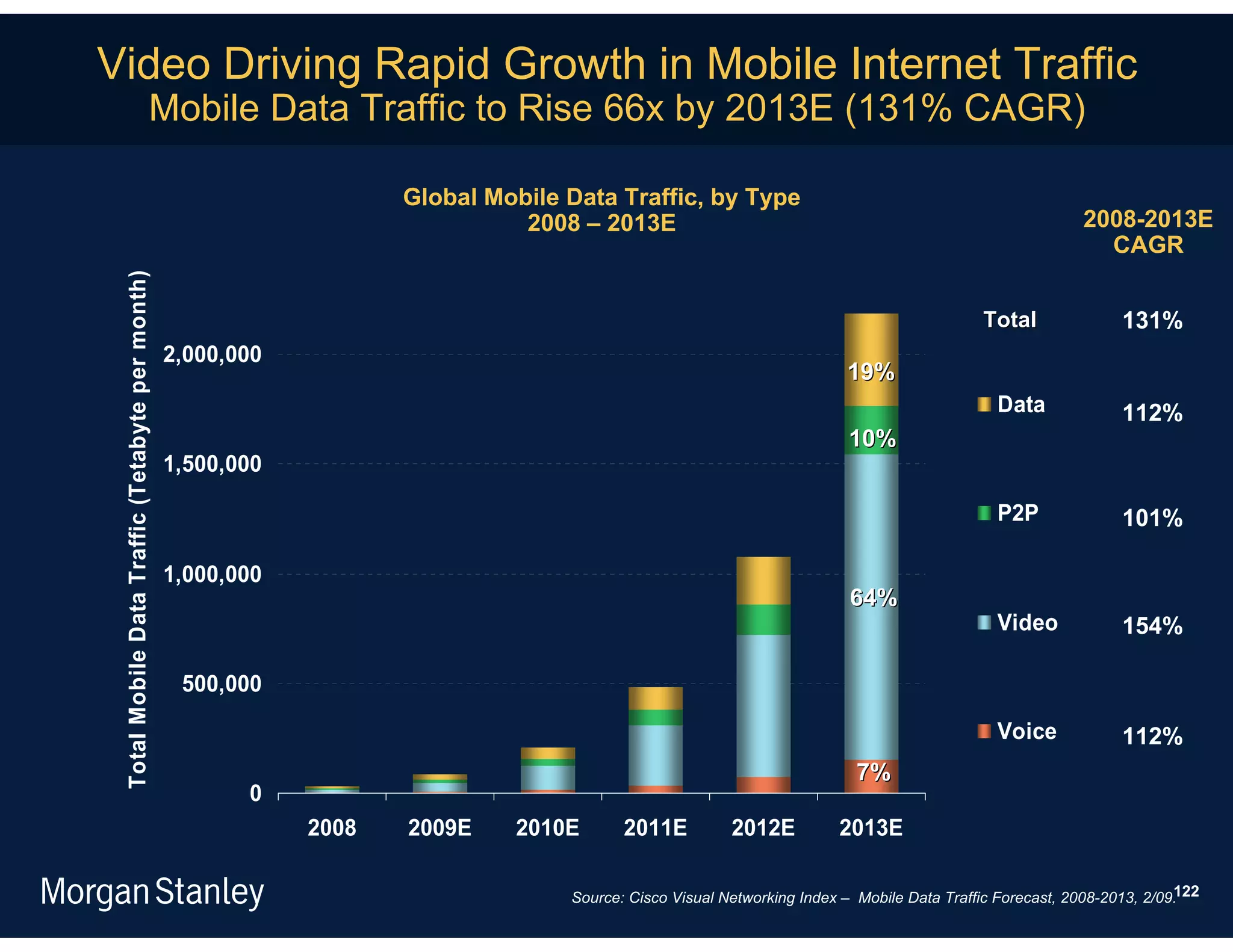
   IP traffic likely to grow 66x by 2013E (with 130% CAGR), per Cisco. Increasing
   3G / smartphone penetration + emerging usage models (such as video / audio
   streaming) will stress carrier wireless networks. Carriers may be able to address
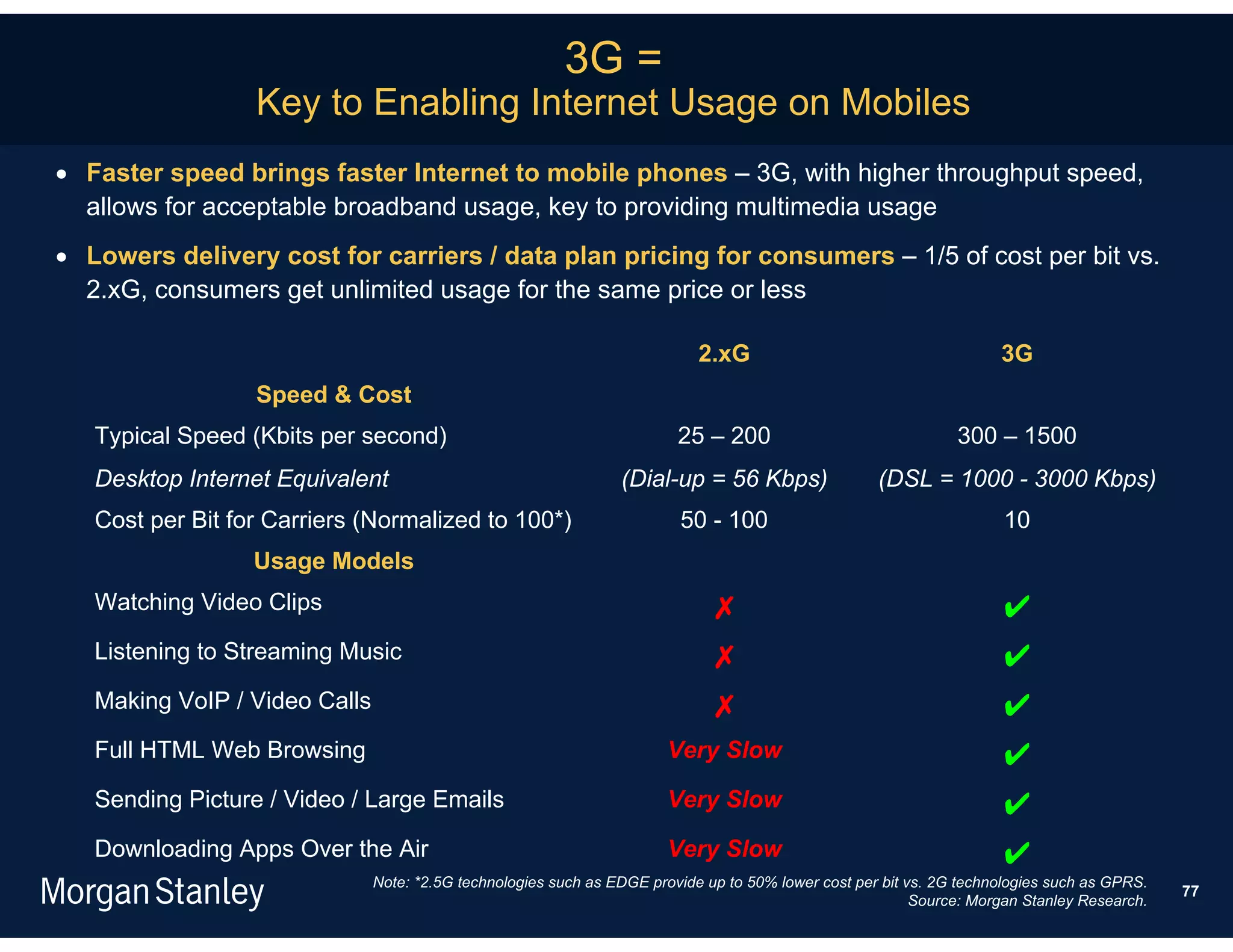
   the surge via capacity upgrade + offloading. Ultimately, they need to compete on
   strength of their macro networks + availability of Wi-Fi. Scale in mobile market
   share / full network sharing agreements / co-operation with fixed / Wi-Fi providers
   will be key. Pricing decisions will be driven by competitive pressure and will need
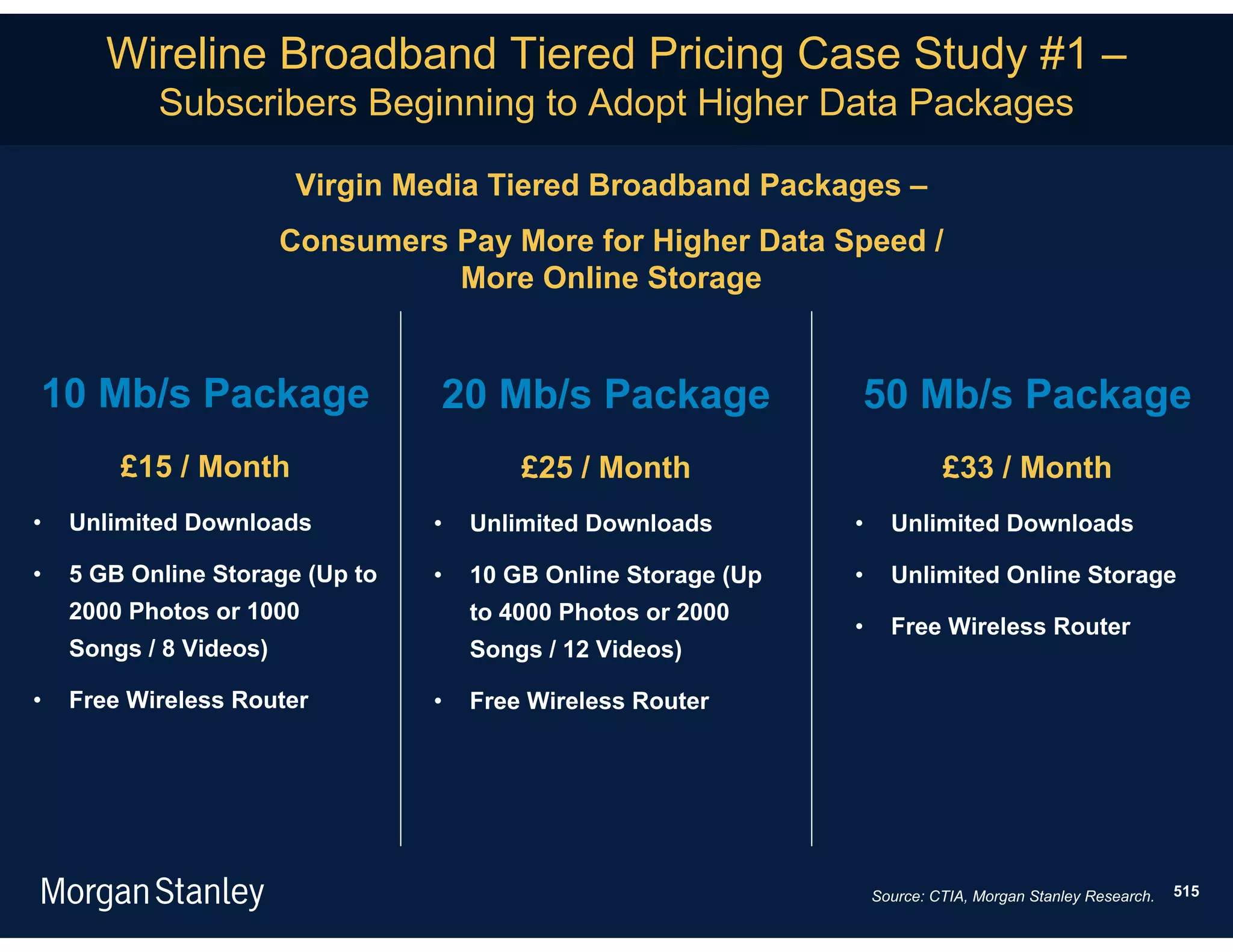
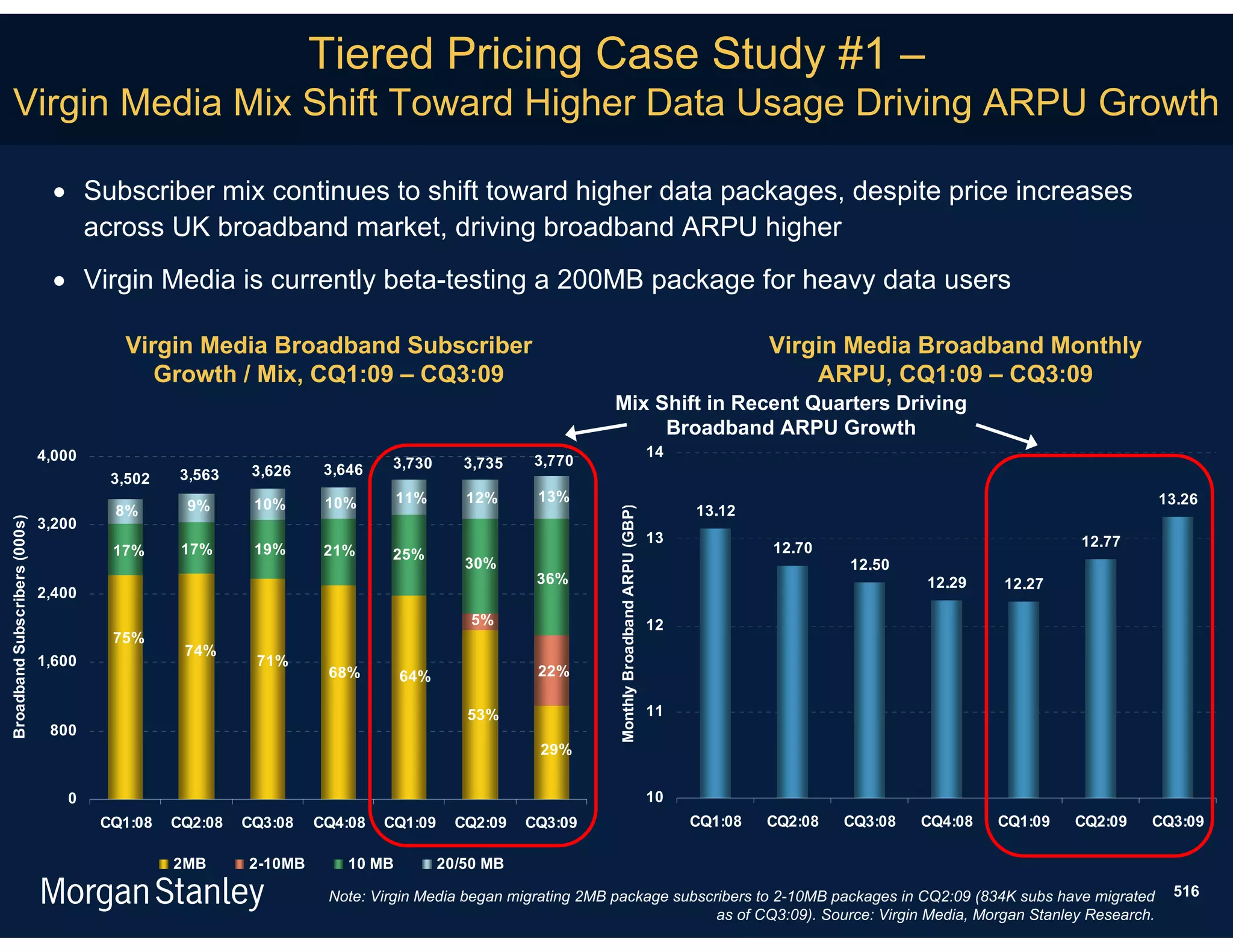
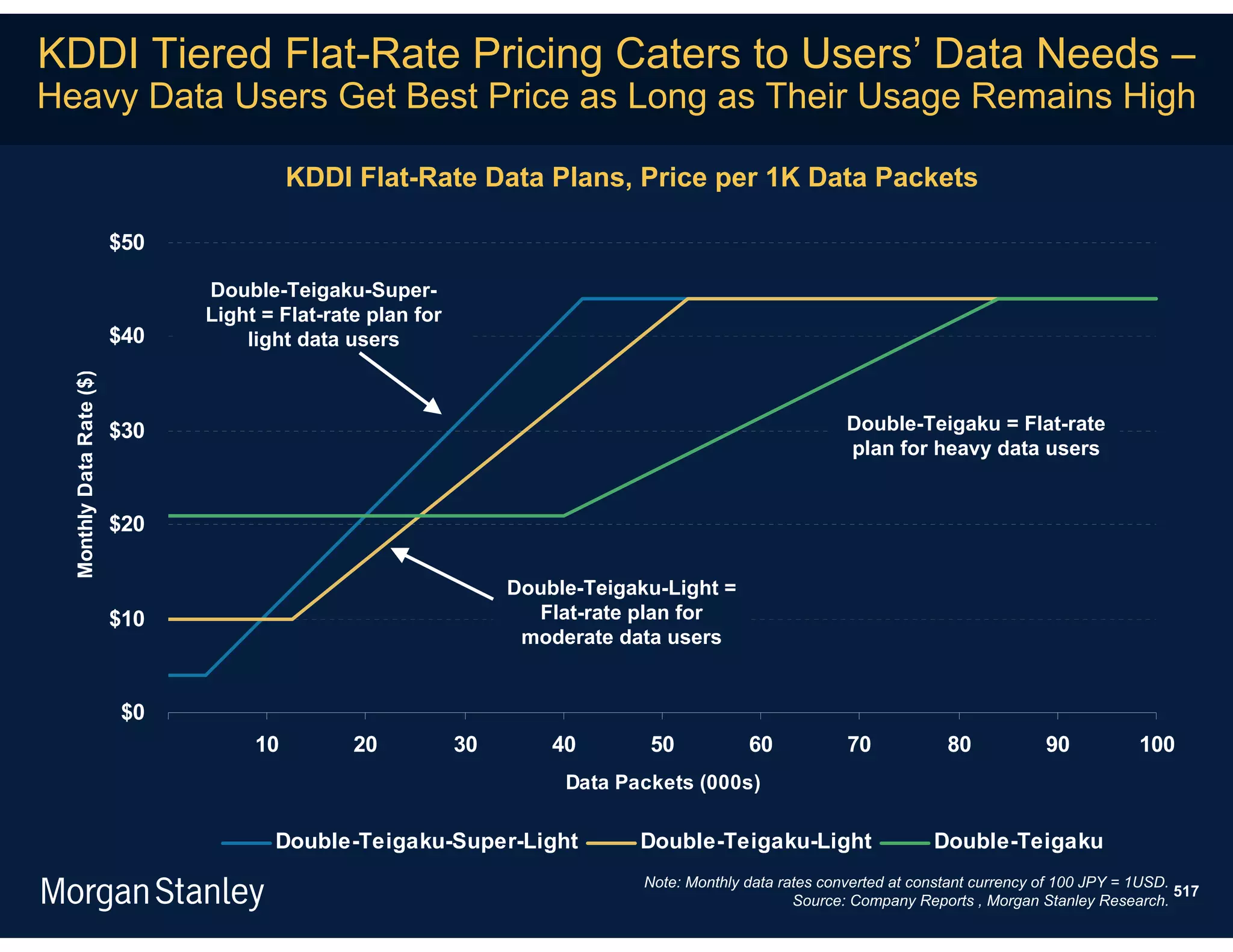
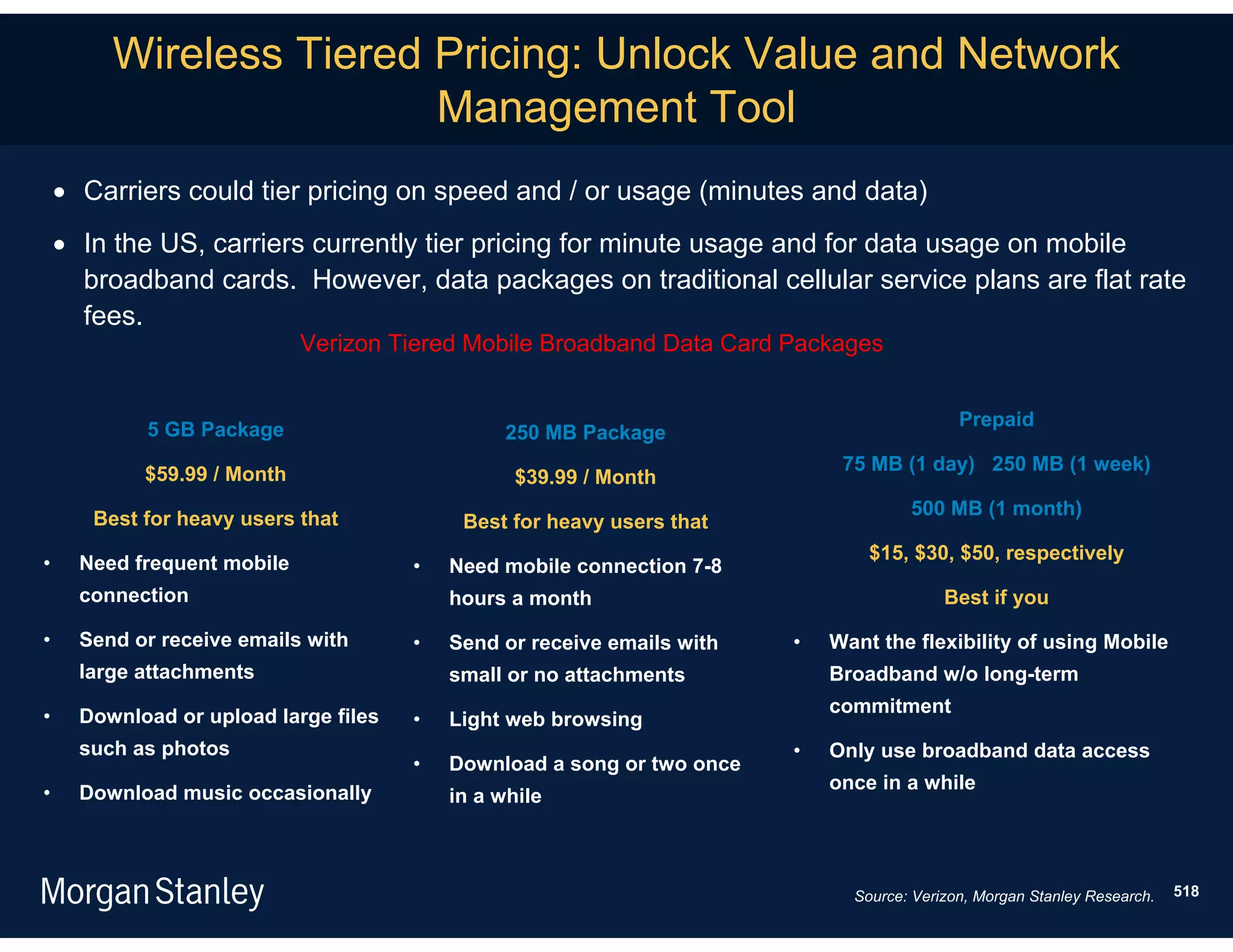
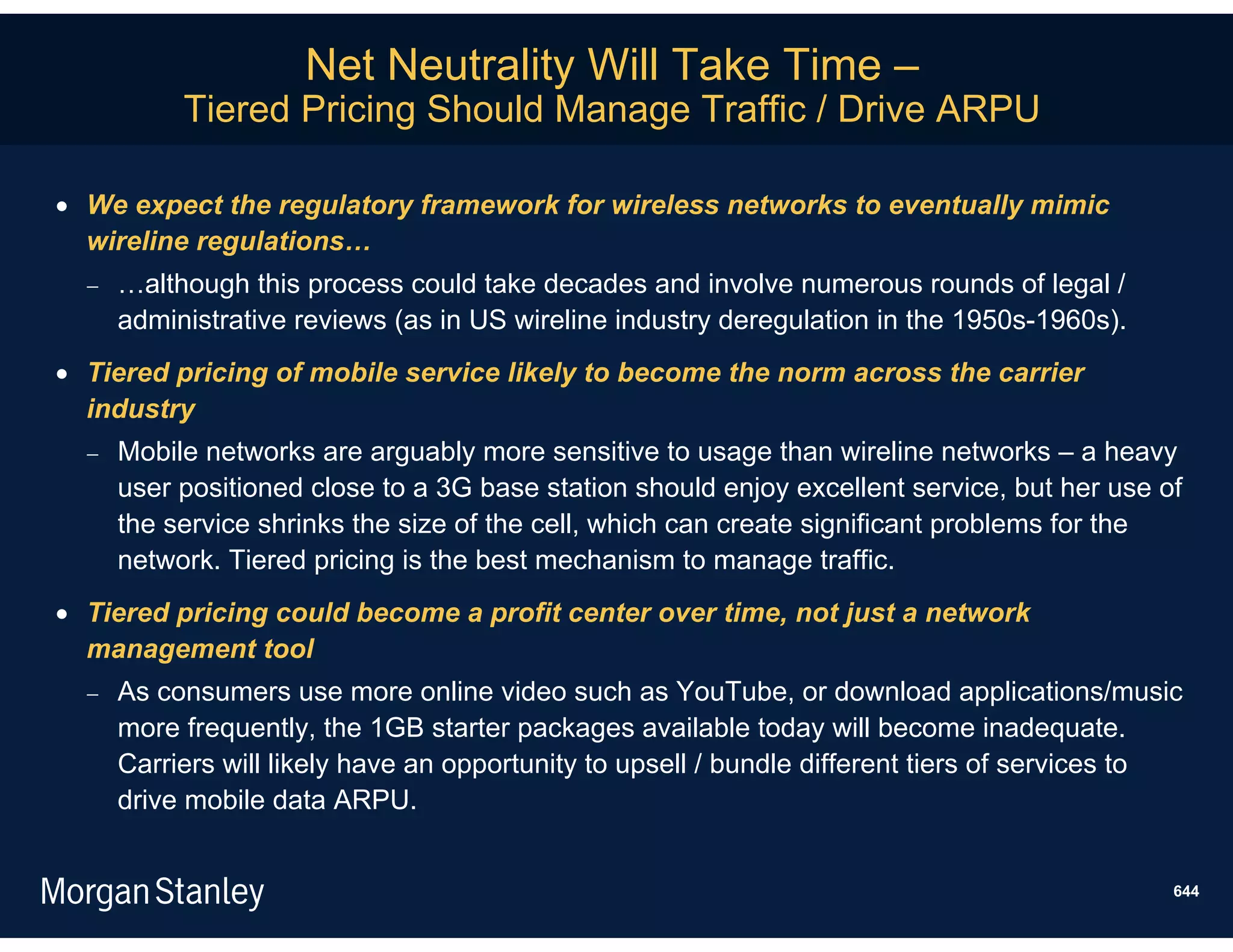
   to take account of potential for VoIP to erode voice revenue. Tiered data pricing
   (speed, quantity) will likely be critical to growing revenue long-term.


                                                                                         9
…Key Mobile Internet Themes

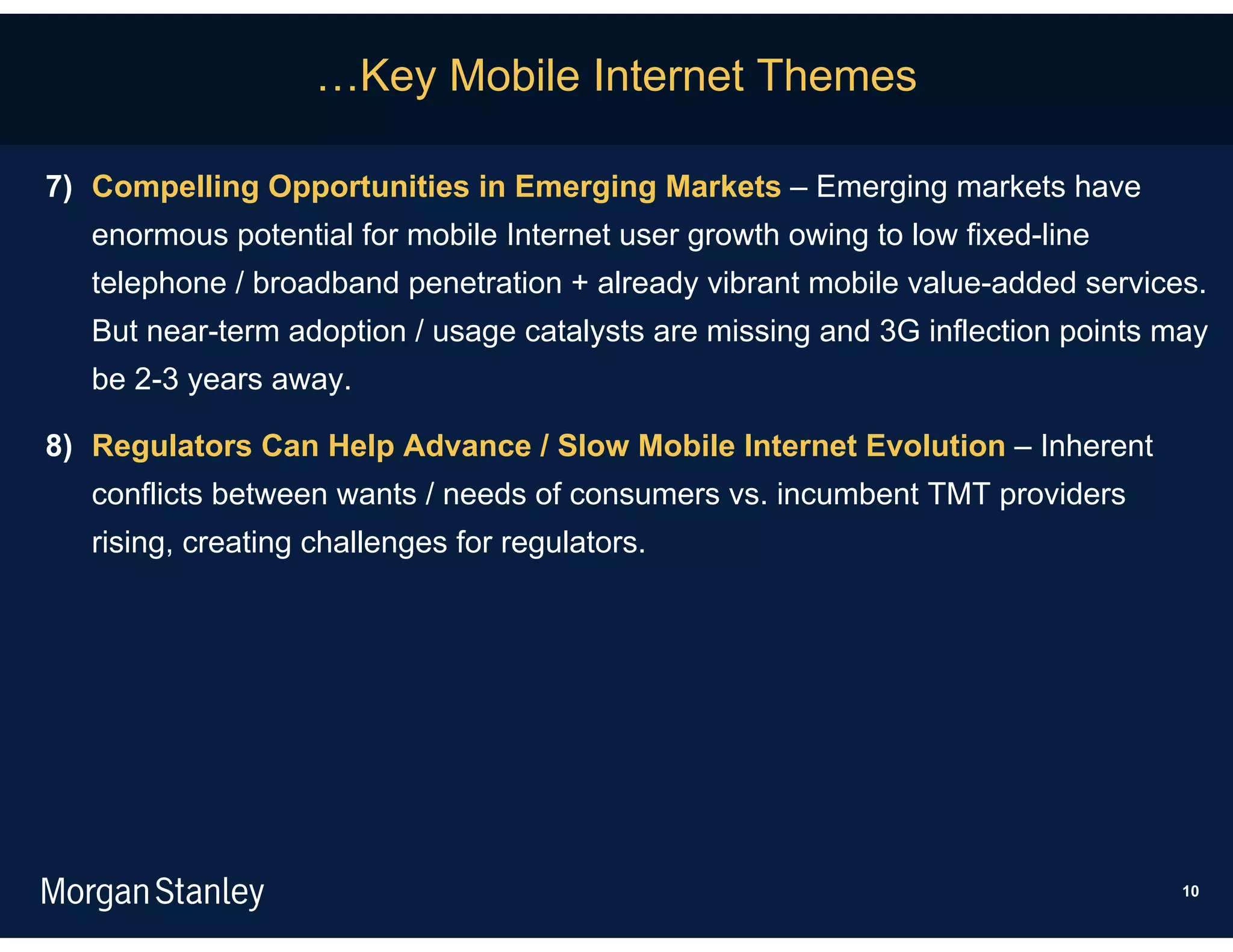
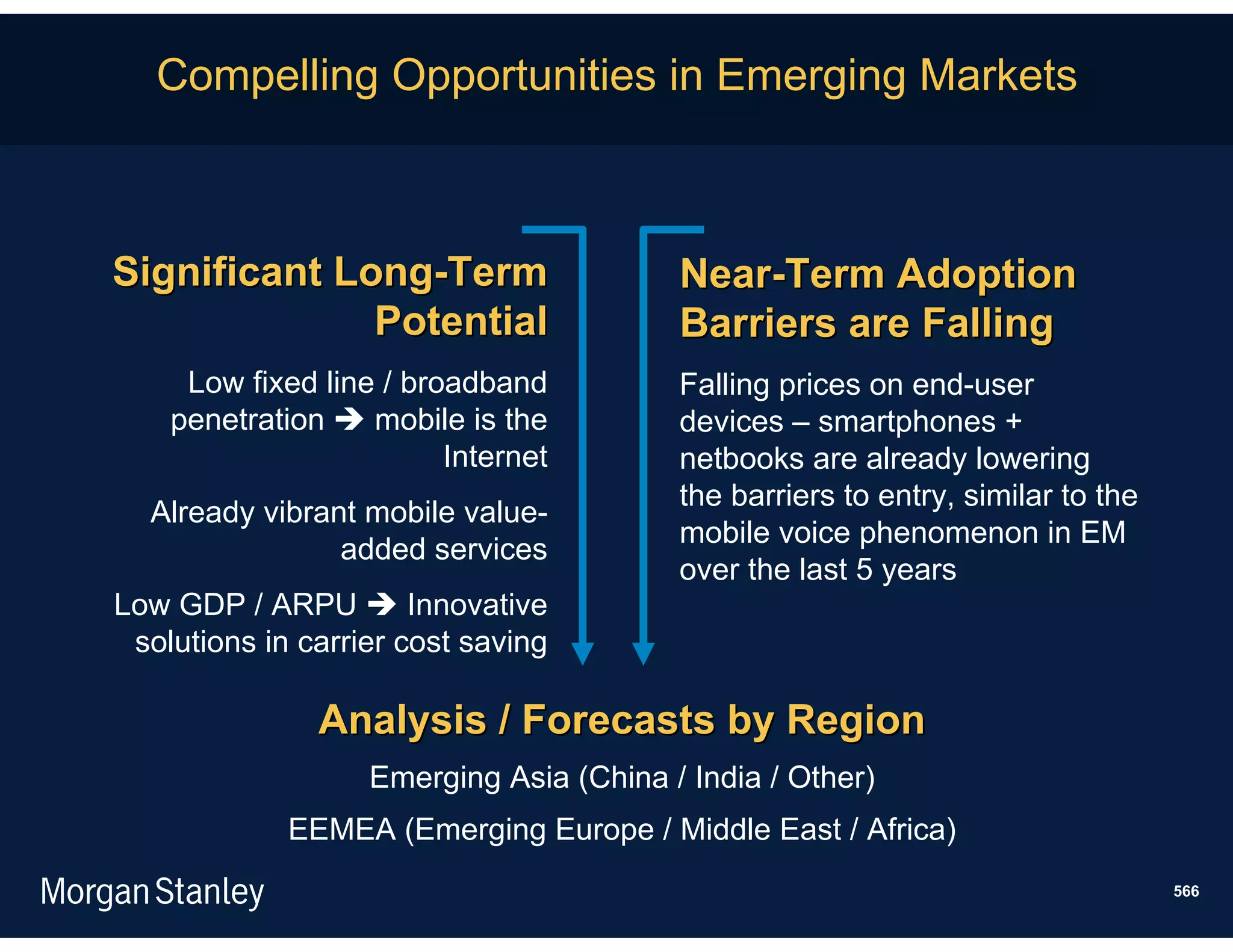
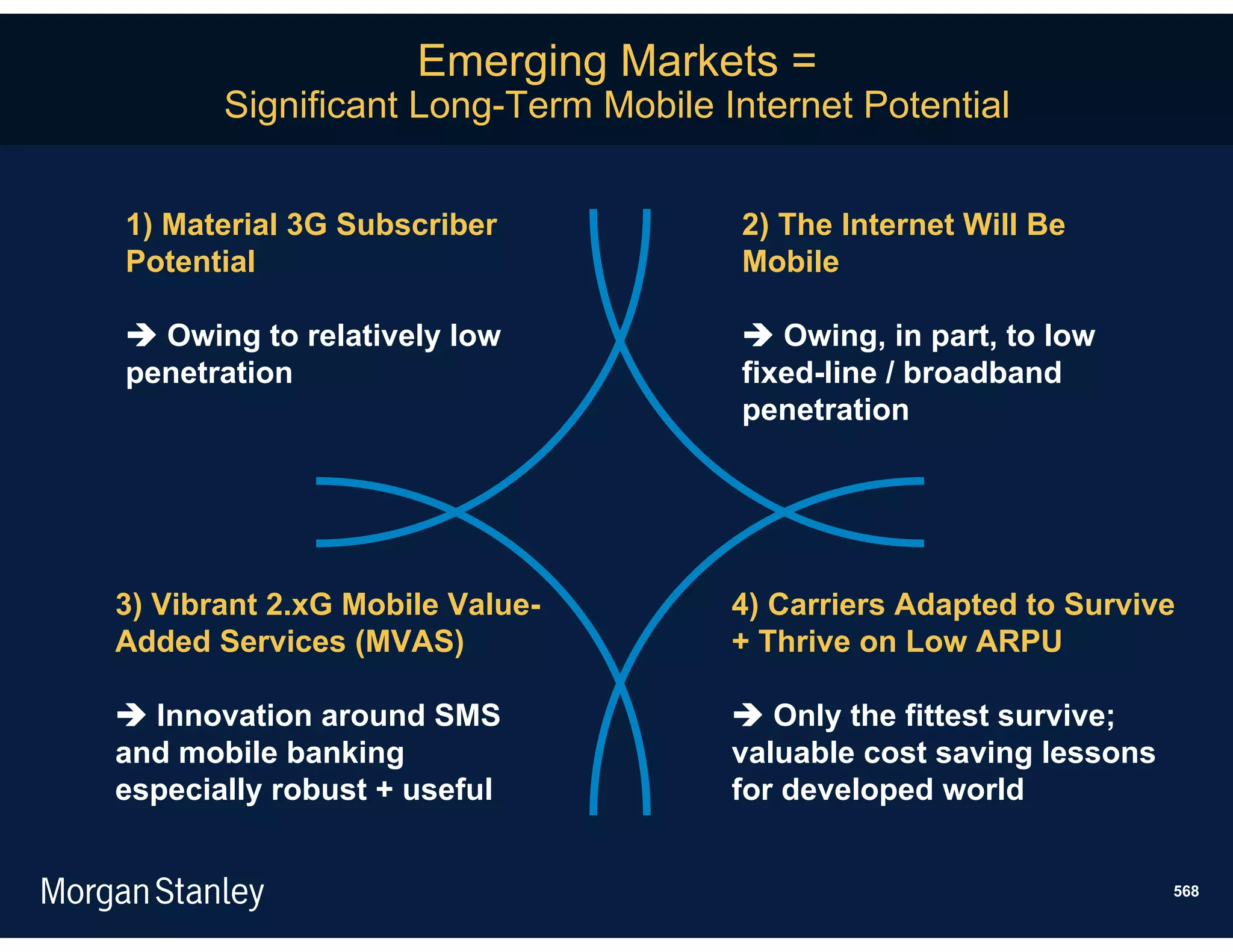
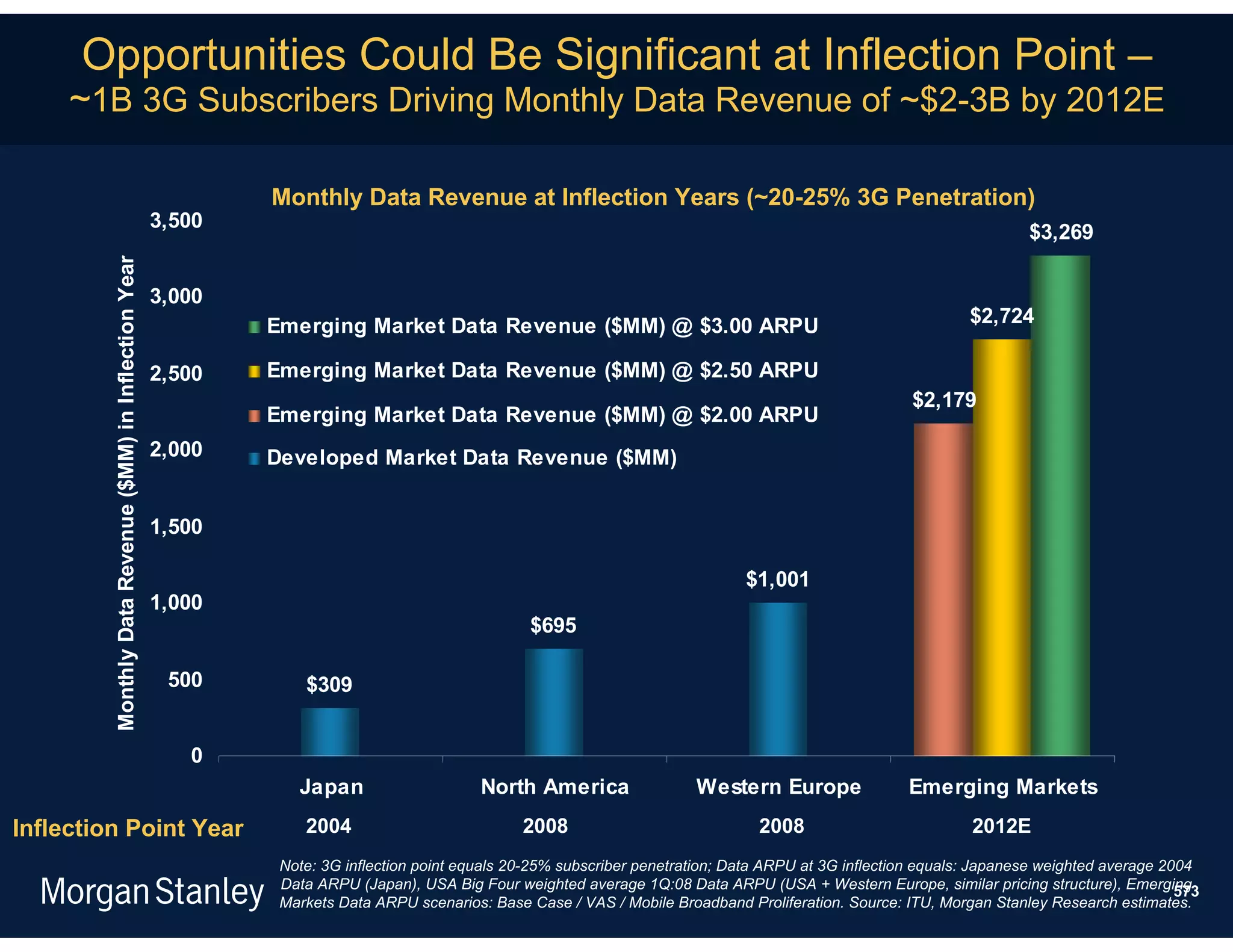
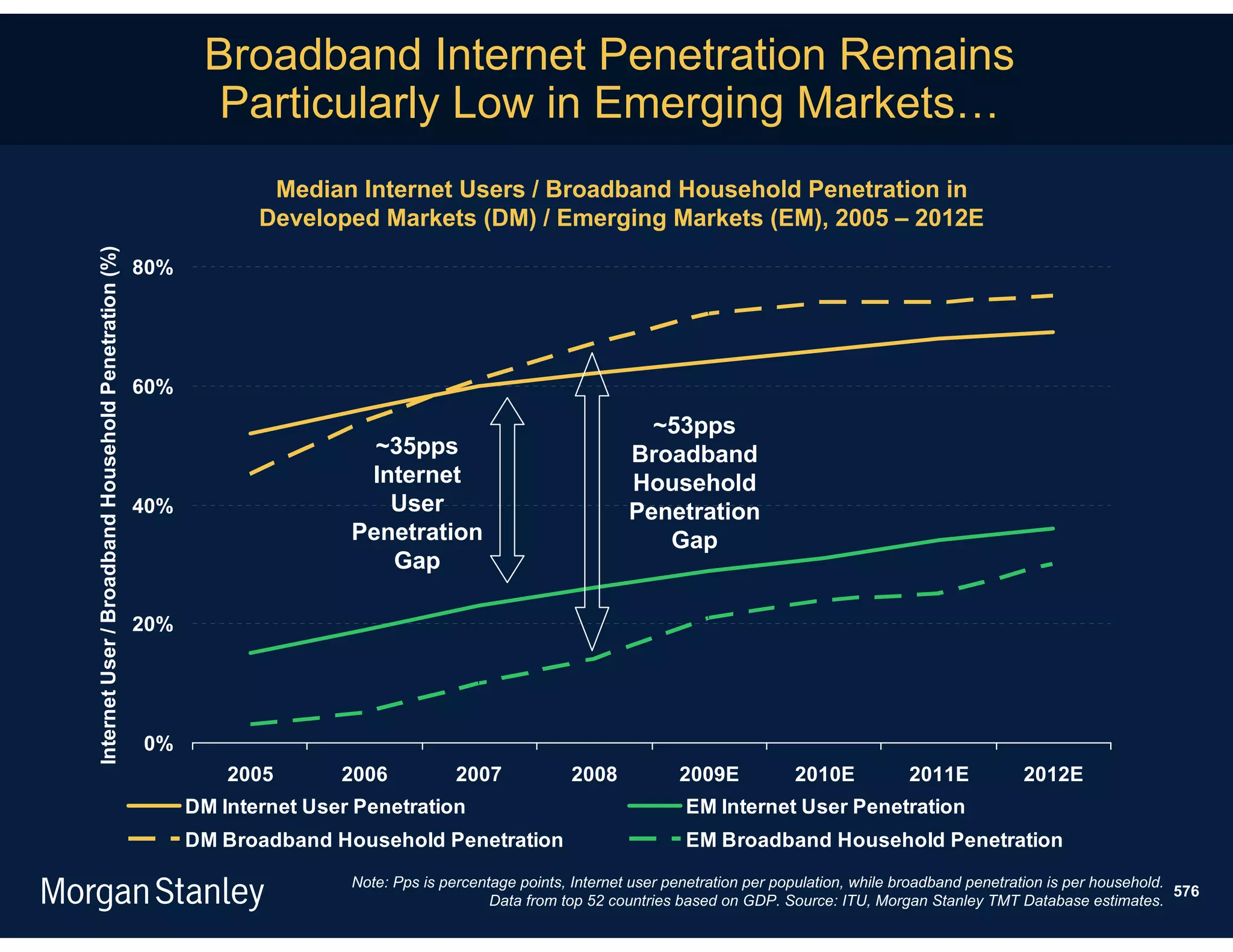
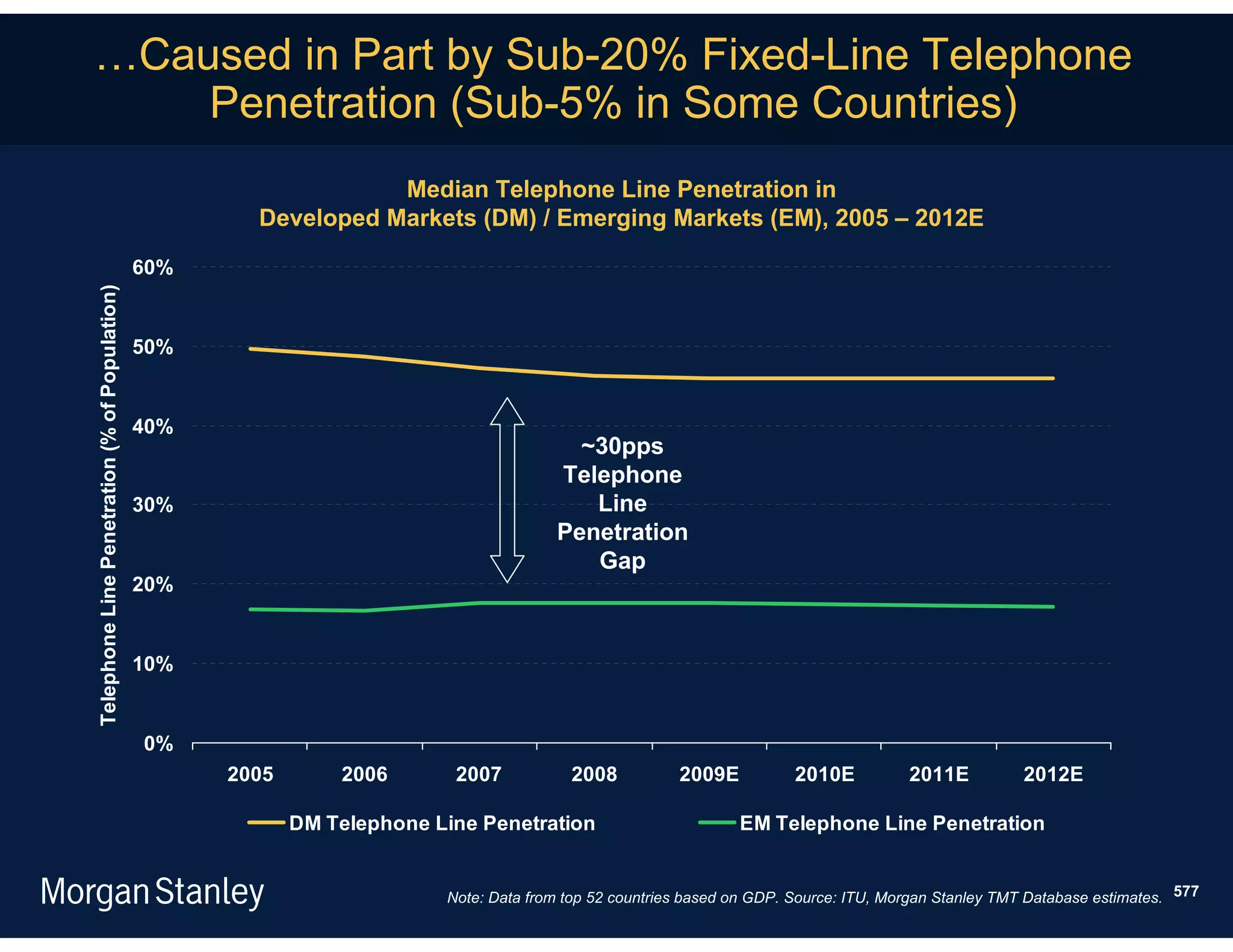
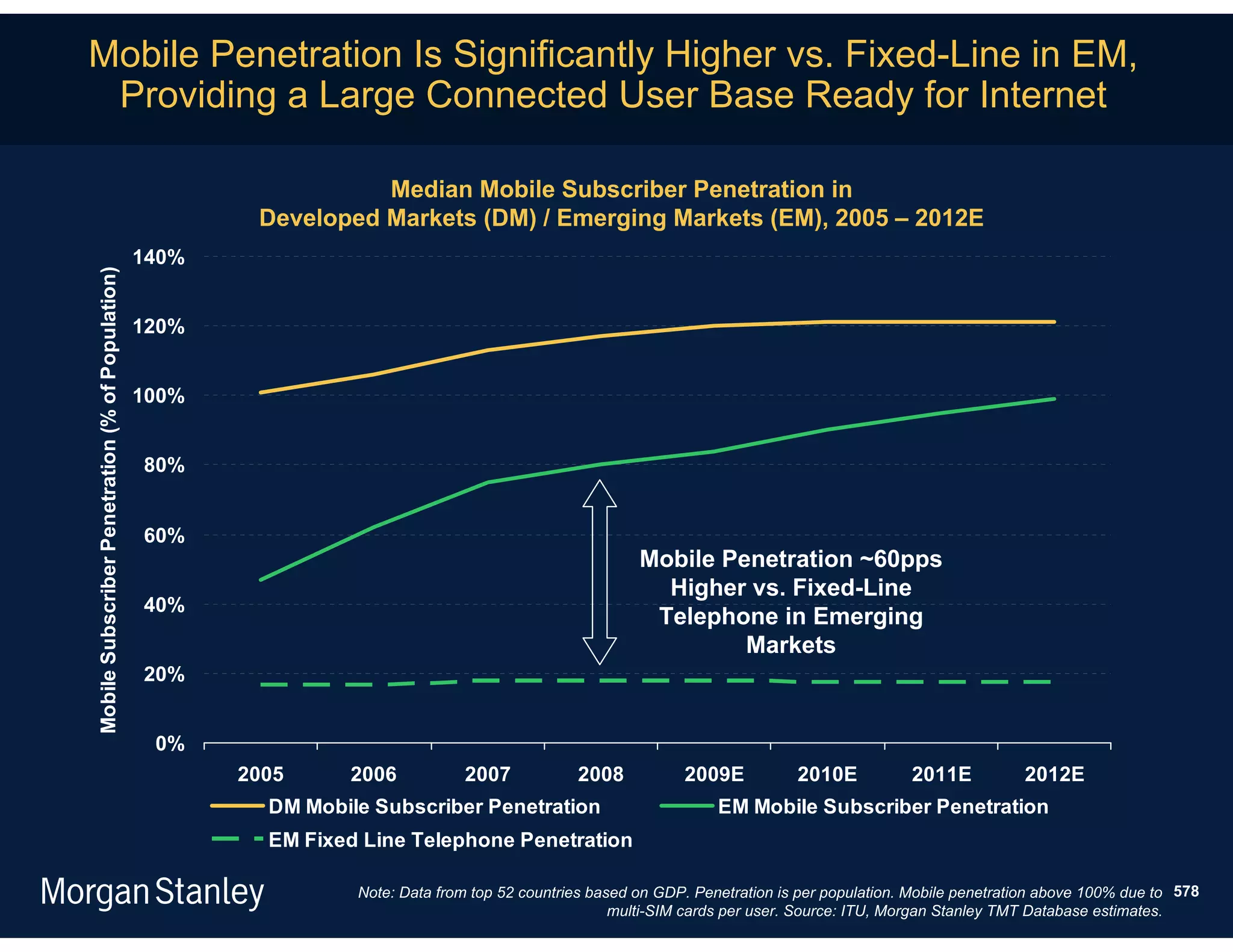
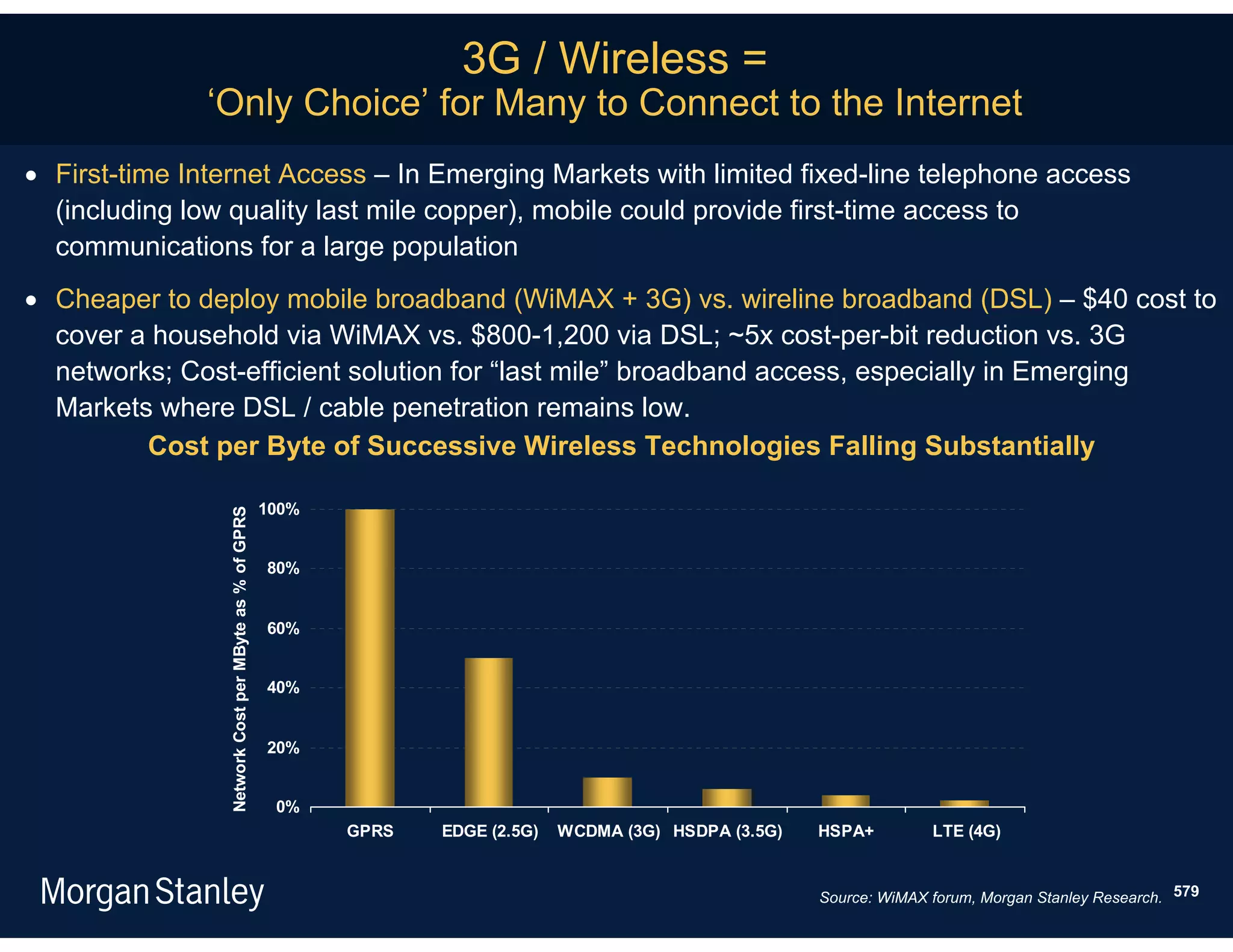
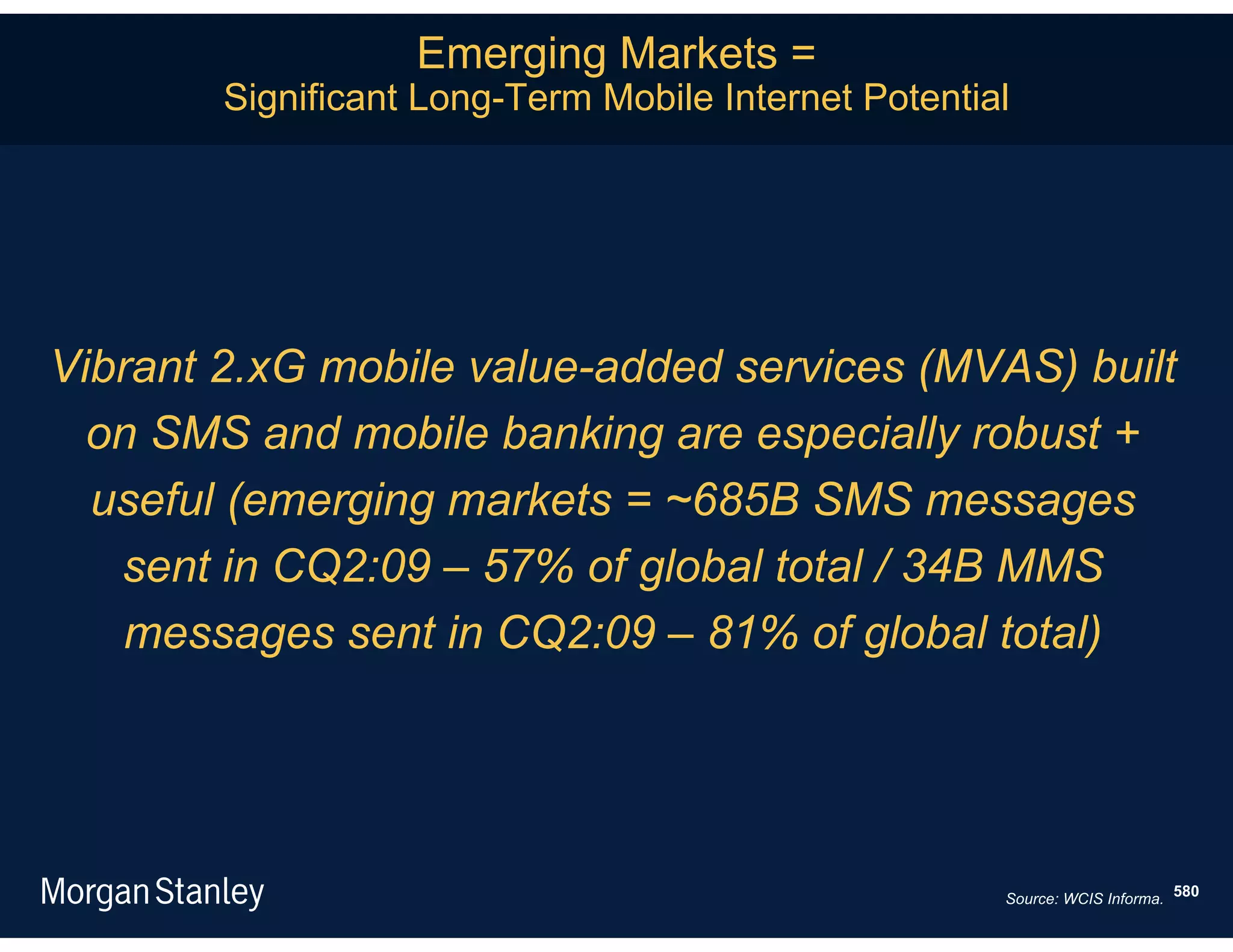
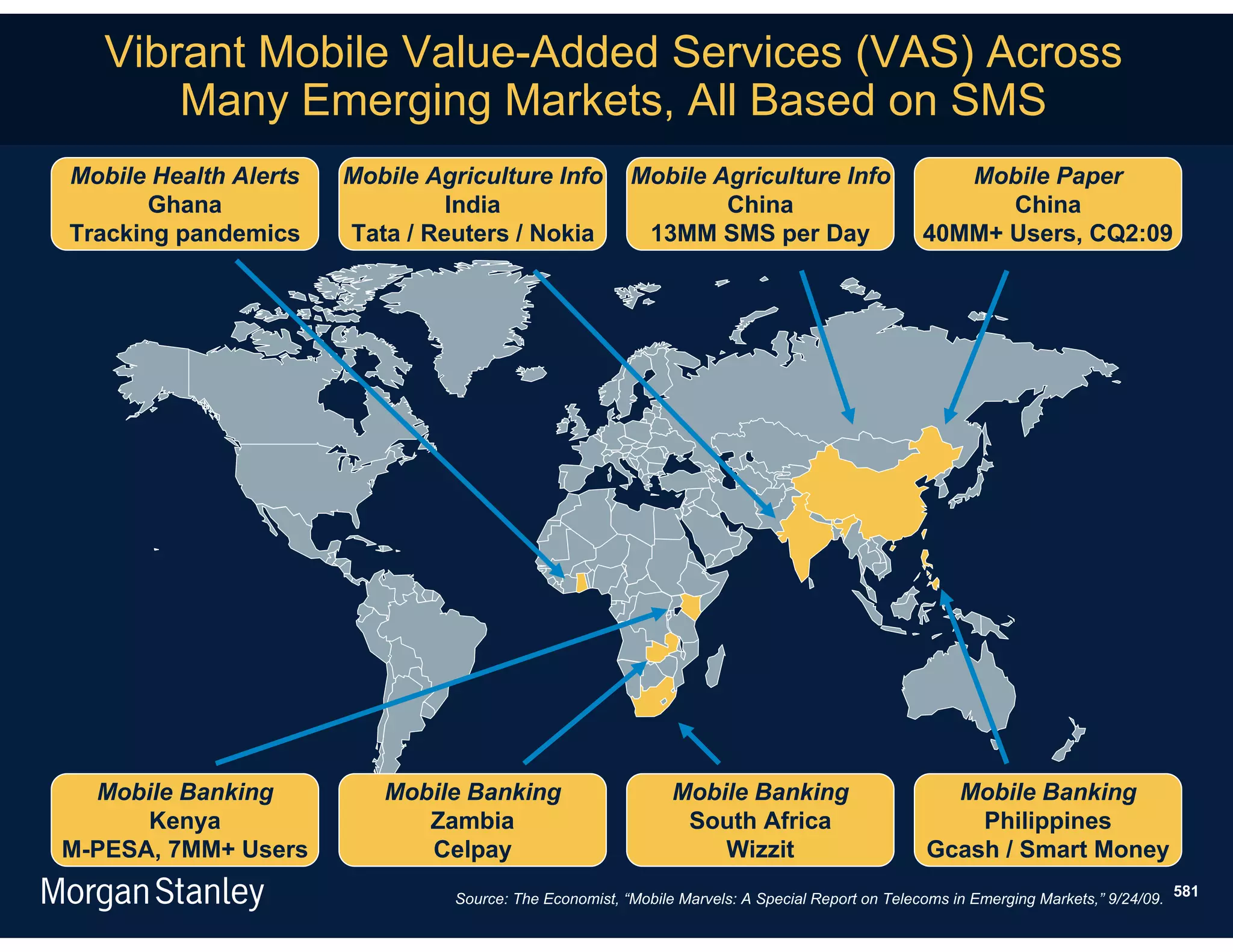
7) Compelling Opportunities in Emerging Markets – Emerging markets have
   enormous potential for mobile Internet user growth owing to low fixed-line
   telephone / broadband penetration + already vibrant mobile value-added services.
   But near-term adoption / usage catalysts are missing and 3G inflection points may
   be 2-3 years away.

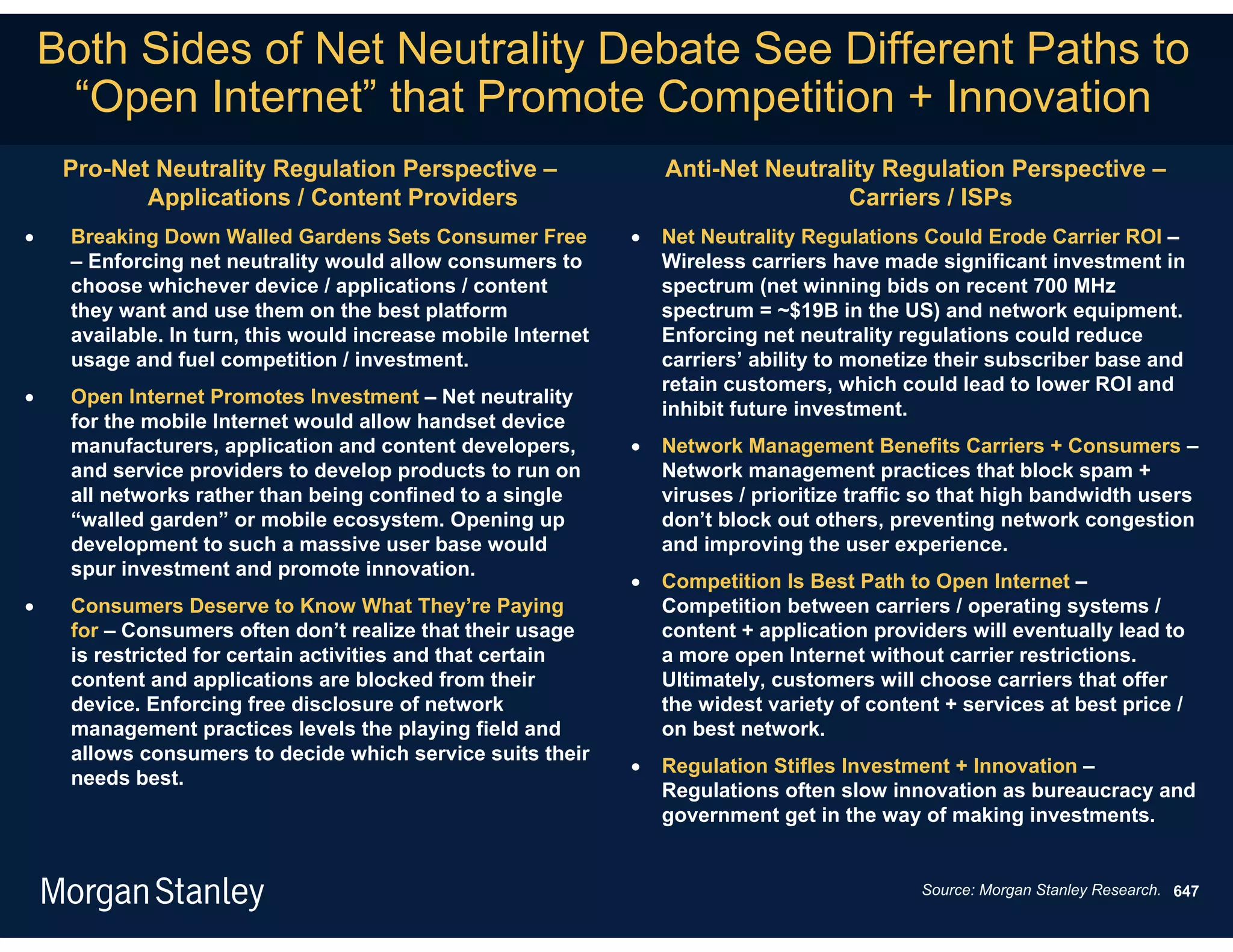
8) Regulators Can Help Advance / Slow Mobile Internet Evolution – Inherent
   conflicts between wants / needs of consumers vs. incumbent TMT providers
   rising, creating challenges for regulators.


                                                                                  10
Key Theme #1


               11
Key Theme #1

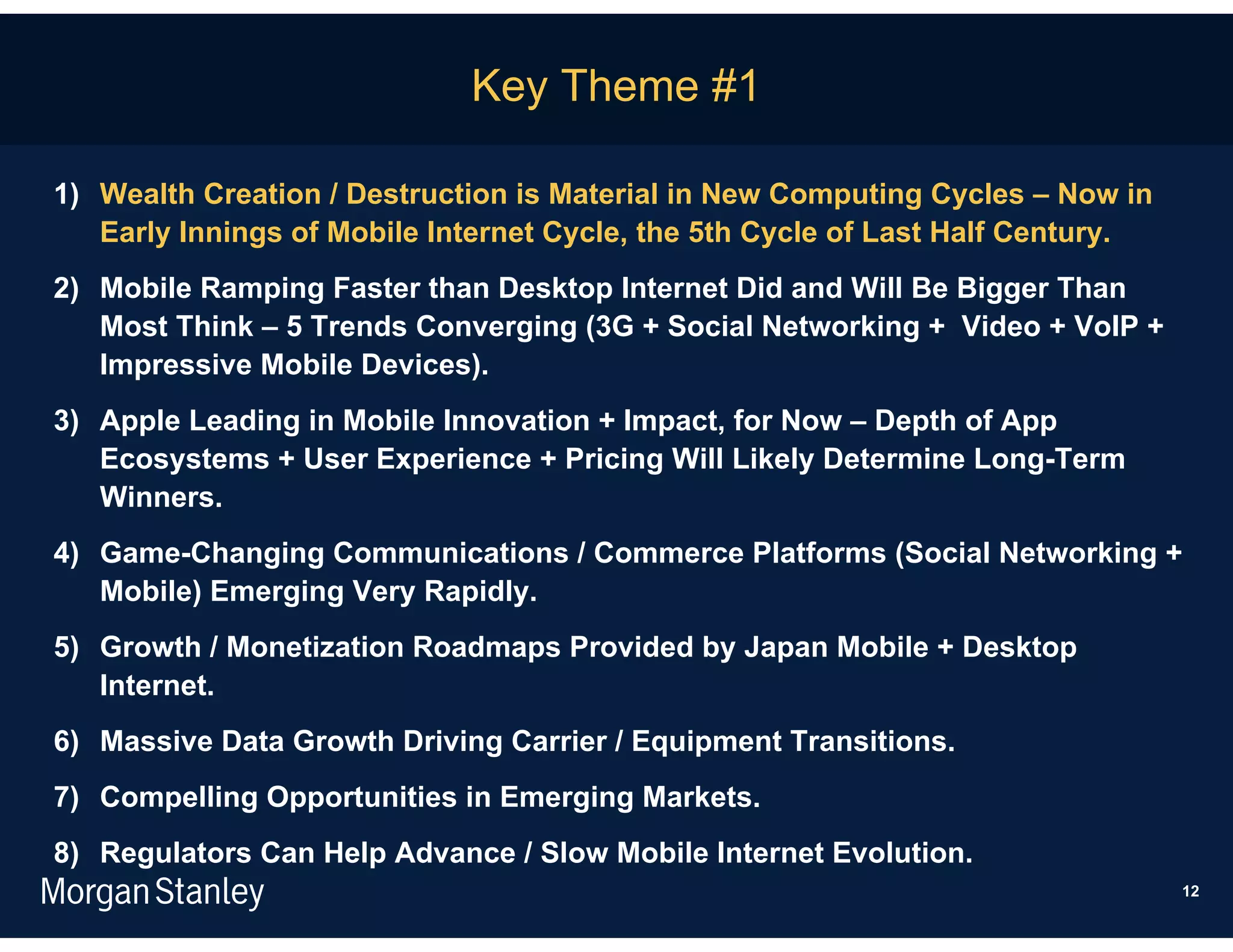
1) Wealth Creation / Destruction is Material in New Computing Cycles – Now in
   Early Innings of Mobile Internet Cycle, the 5th Cycle of Last Half Century.
2) Mobile Ramping Faster than Desktop Internet Did and Will Be Bigger Than
   Most Think – 5 Trends Converging (3G + Social Networking + Video + VoIP +
   Impressive Mobile Devices).
3) Apple Leading in Mobile Innovation + Impact, for Now – Depth of App
   Ecosystems + User Experience + Pricing Will Likely Determine Long-Term
   Winners.
4) Game-Changing Communications / Commerce Platforms (Social Networking +
   Mobile) Emerging Very Rapidly.
5) Growth / Monetization Roadmaps Provided by Japan Mobile + Desktop
   Internet.
6) Massive Data Growth Driving Carrier / Equipment Transitions.
7) Compelling Opportunities in Emerging Markets.
8) Regulators Can Help Advance / Slow Mobile Internet Evolution.
                                                                                 12
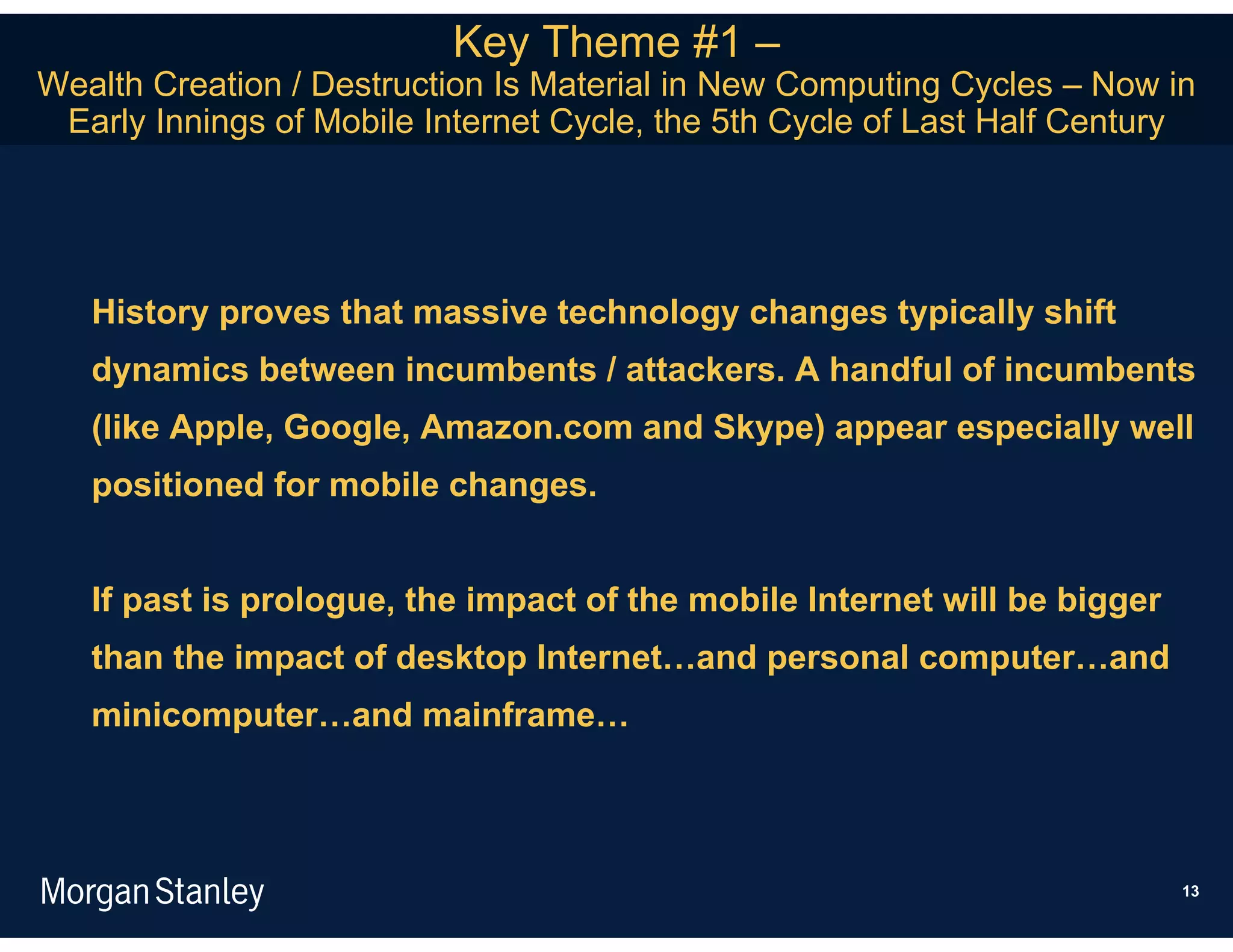
Key Theme #1 –
Wealth Creation / Destruction Is Material in New Computing Cycles – Now in
 Early Innings of Mobile Internet Cycle, the 5th Cycle of Last Half Century


   History proves that massive technology changes typically shift
   dynamics between incumbents / attackers. A handful of incumbents
   (like Apple, Google, Amazon.com and Skype) appear especially well
   positioned for mobile changes.


   If past is prologue, the impact of the mobile Internet will be bigger
   than the impact of desktop Internet…and personal computer…and
   minicomputer…and mainframe…


                                                                           13
Paul Saffo Opined About the Internet in 1995 -
              Here We Are 14 Years Later

It's a very consistent pattern in this business that collectively as
a society and as individuals we all suffer from what I call macro-
myopia. A pattern where our hopes and our expectations or our
fears about the threatened impact of some new technology
causes us to overestimate its short-term impacts and reality
always fails to meet those inflated expectations. And as a result
our disappointment then leads us to turn around and
underestimate the long-term implications and I can guarantee
you this time will be no different. The short-term impact of this
stuff [the Internet] will be less than the hype would suggest but
the long-term implications will be vastly larger than we can
possibly imagine today.
                                             - Paul Saffo, 6/12/1995
               Note: Paul Saffo was a director of the Institute for the Future, a consulting group that studies technology and future trends.   14
                                                                                    Source: Interview with PBS in Palo Alto, CA. 6/12/1995.
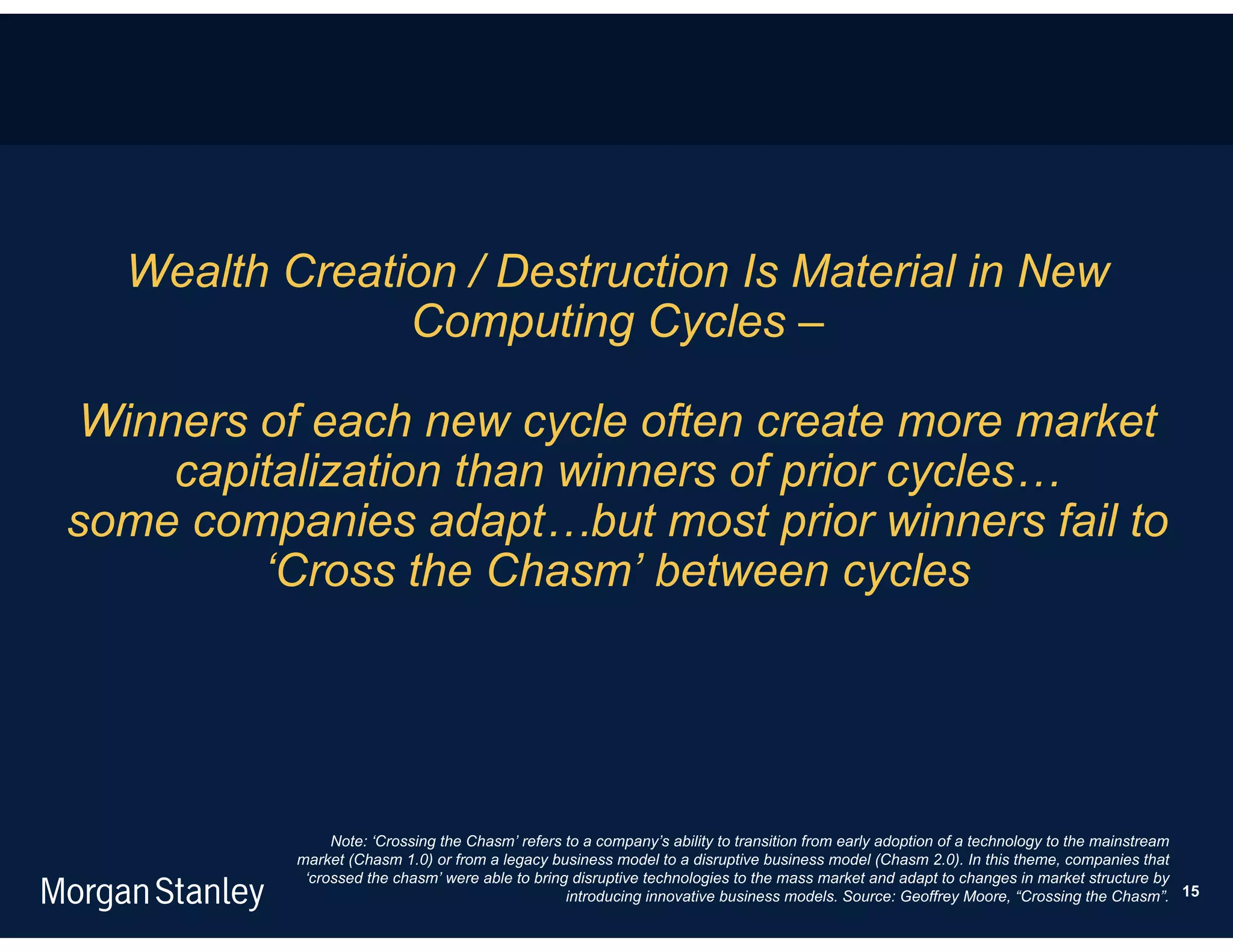
Wealth Creation / Destruction Is Material in New
               Computing Cycles –

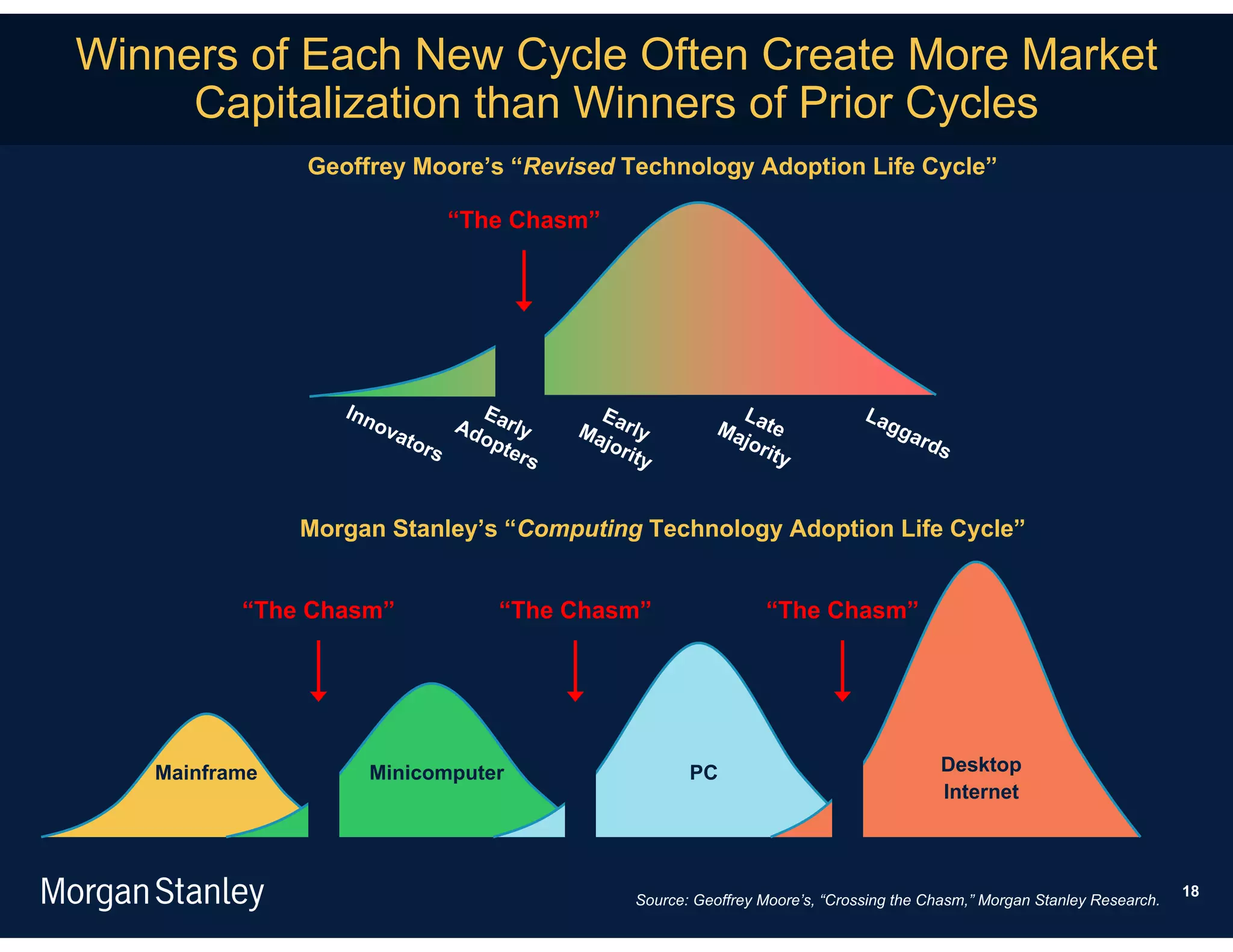
 Winners of each new cycle often create more market
     capitalization than winners of prior cycles…
some companies adapt…but most prior winners fail to
         ‘Cross the Chasm’ between cycles


               Note: ‘Crossing the Chasm’ refers to a company’s ability to transition from early adoption of a technology to the mainstream
          market (Chasm 1.0) or from a legacy business model to a disruptive business model (Chasm 2.0). In this theme, companies that
           ‘crossed the chasm’ were able to bring disruptive technologies to the mass market and adapt to changes in market structure by
                                                 introducing innovative business models. Source: Geoffrey Moore, “Crossing the Chasm”. 15
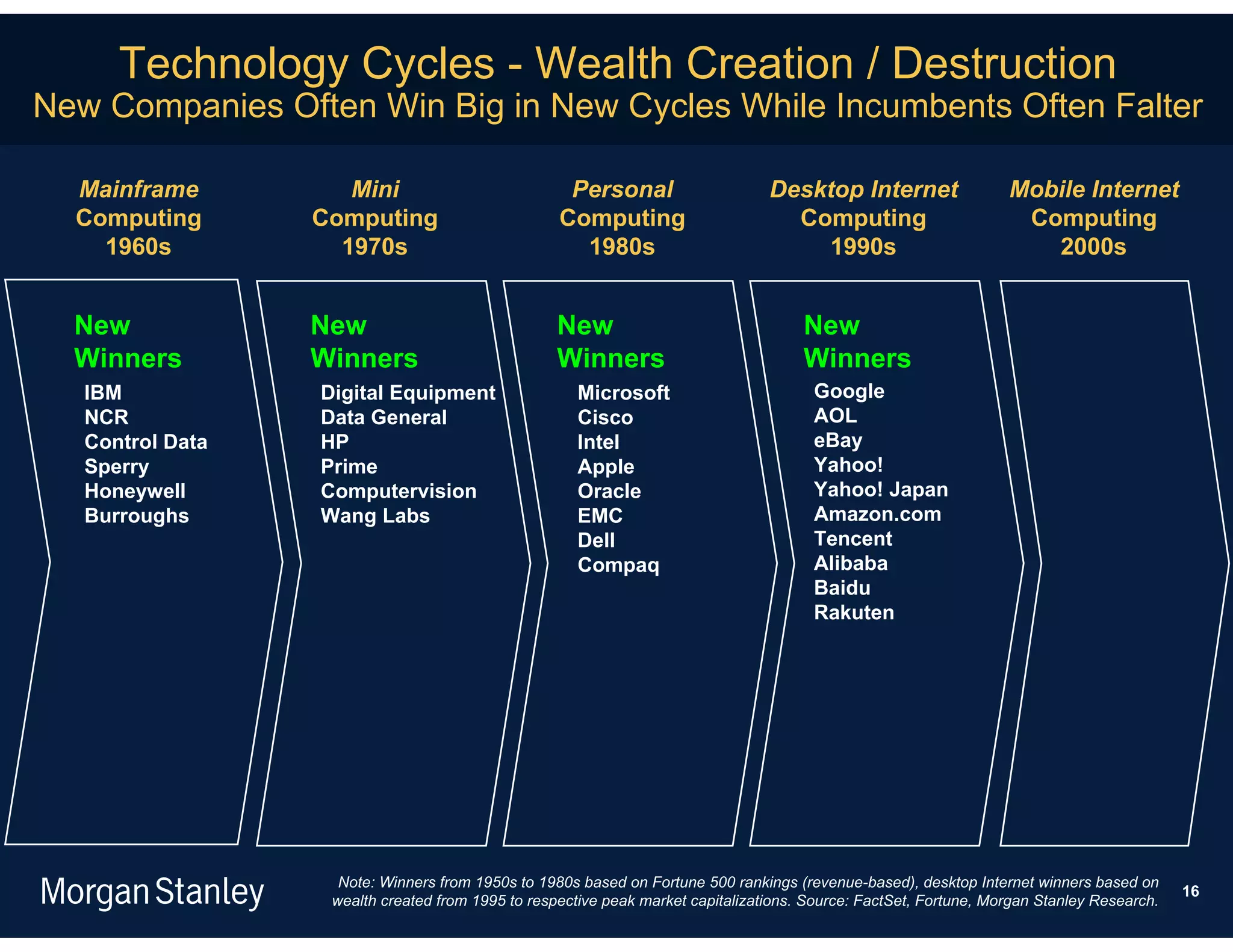
Technology Cycles - Wealth Creation / Destruction
New Companies Often Win Big in New Cycles While Incumbents Often Falter

  Mainframe          Mini                           Personal                     Desktop Internet                  Mobile Internet
  Computing       Computing                        Computing                       Computing                        Computing
    1960s           1970s                            1980s                           1990s                            2000s


  New             New                              New                                New
  Winners         Winners                          Winners                            Winners
   IBM            Digital Equipment                   Microsoft                        Google
   NCR            Data General                        Cisco                            AOL
   Control Data   HP                                  Intel                            eBay
   Sperry         Prime                               Apple                            Yahoo!
   Honeywell      Computervision                      Oracle                           Yahoo! Japan
   Burroughs      Wang Labs                           EMC                              Amazon.com
                                                      Dell                             Tencent
                                                      Compaq                           Alibaba
                                                                                       Baidu
                                                                                       Rakuten


                    Note: Winners from 1950s to 1980s based on Fortune 500 rankings (revenue-based), desktop Internet winners based on
                                                                                                                                            16
                   wealth created from 1995 to respective peak market capitalizations. Source: FactSet, Fortune, Morgan Stanley Research.
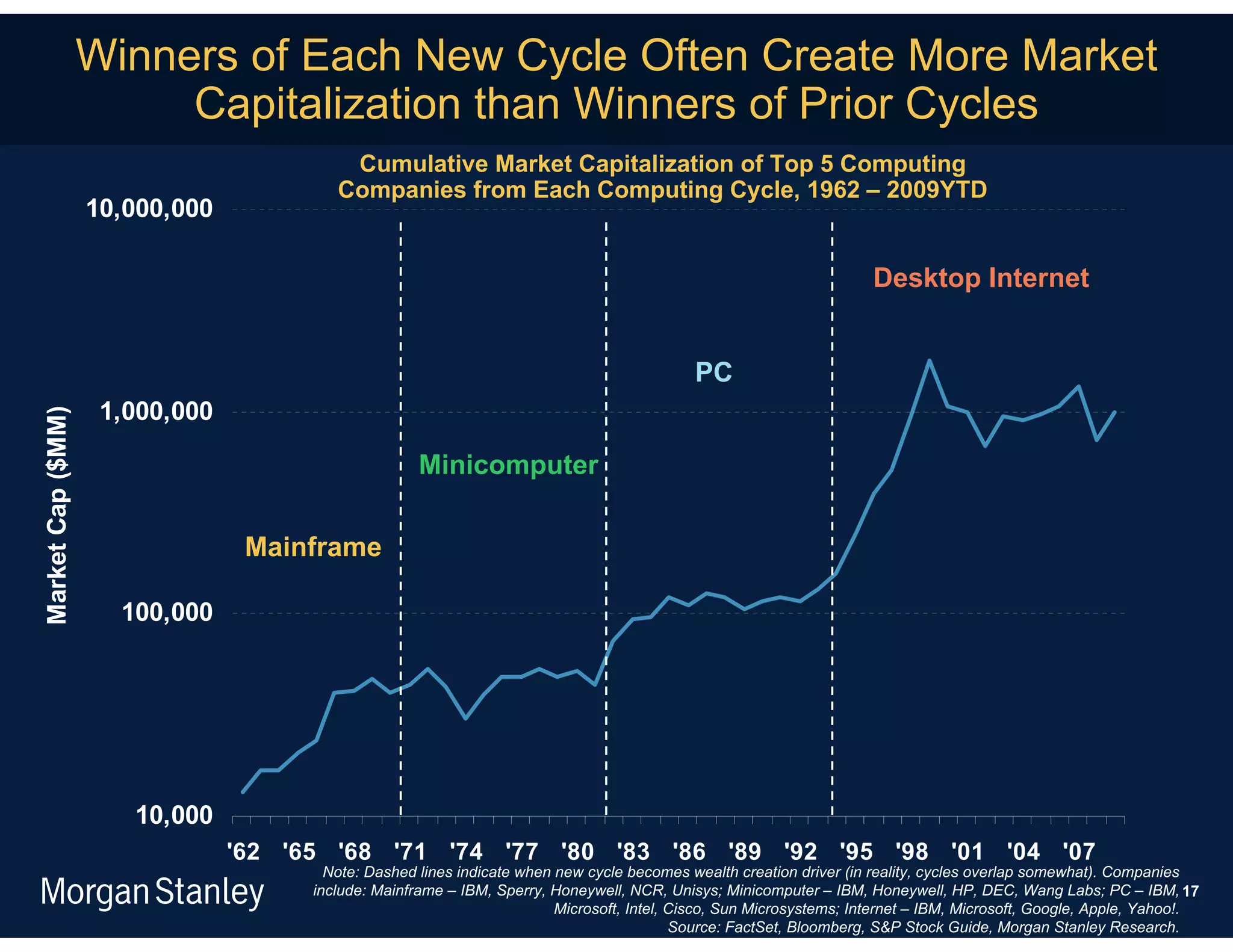
Winners of Each New Cycle Often Create More Market
                        Capitalization than Winners of Prior Cycles
                                          Cumulative Market Capitalization of Top 5 Computing
                                         Companies from Each Computing Cycle, 1962 – 2009YTD
                   10,000,000

                                                                                                                      Desktop Internet


                                                                                            PC
                    1,000,000
Market Cap ($MM)


                                                     Minicomputer


                                 Mainframe

                     100,000


                      10,000
                                '62 '65 '68 '71 '74 '77 '80 '83 '86 '89 '92 '95 '98 '01 '04 '07
                                        Note: Dashed lines indicate when new cycle becomes wealth creation driver (in reality, cycles overlap somewhat). Companies
                                      include: Mainframe – IBM, Sperry, Honeywell, NCR, Unisys; Minicomputer – IBM, Honeywell, HP, DEC, Wang Labs; PC – IBM, 17
                                                                         Microsoft, Intel, Cisco, Sun Microsystems; Internet – IBM, Microsoft, Google, Apple, Yahoo!.
                                                                                           Source: FactSet, Bloomberg, S&P Stock Guide, Morgan Stanley Research.
Winners of Each New Cycle Often Create More Market
     Capitalization than Winners of Prior Cycles
               Geoffrey Moore’s “Revised Technology Adoption Life Cycle”

                               “The Chasm”


                  Inn             E          E                  L                 La
                     ov
                       ato      Ad arly    Ma arly            Ma ate                 gg
                                                                                       ard
                                  op         j or               j or
                          r   s     ter          it y               it y                  s
                                       s


               Morgan Stanley’s “Computing Technology Adoption Life Cycle”


          “The Chasm”               “The Chasm”                      “The Chasm”


   Mainframe        Minicomputer                          PC                                Desktop
                                                                                            Internet


                                                                                                                              18
                                                   Source: Geoffrey Moore’s, “Crossing the Chasm,” Morgan Stanley Research.
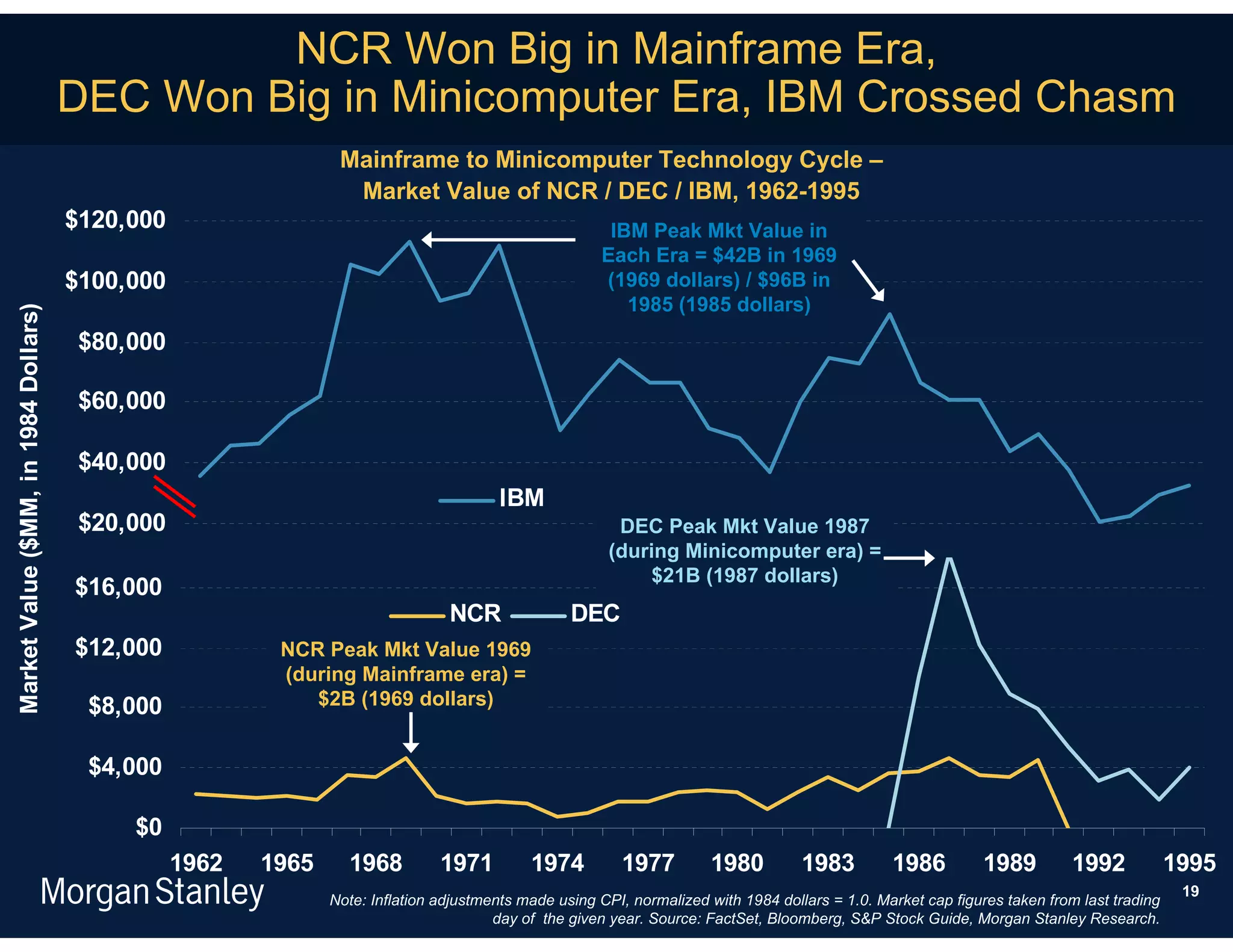
NCR Won Big in Mainframe Era,
                                      DEC Won Big in Minicomputer Era, IBM Crossed Chasm
                                                                Mainframe to Minicomputer Technology Cycle –
                                                                 Market Value of NCR / DEC / IBM, 1962-1995
                                      $120,000                                                         IBM Peak Mkt Value in
                                                                                                      Each Era = $42B in 1969
                                      $100,000                                                        (1969 dollars) / $96B in
                                                                                                         1985 (1985 dollars)
Market Value ($MM, in 1984 Dollars)


                                       $80,000

                                       $60,000

                                       $40,000
                                                                                       IBM
                                       $20,000                                                           DEC Peak Mkt Value 1987
                                                                                                        (during Minicomputer era) =
                                                                                                            $21B (1987 dollars)
                                      $16,000
                                                                                NCR               DEC
                                      $12,000            NCR Peak Mkt Value 1969
                                                         (during Mainframe era) =
                                       $8,000               $2B (1969 dollars)


                                       $4,000

                                           $0
                                                 1962   1965     1968          1971         1974         1977         1980          1983         1986          1989         1992            1995
                                                                                                                                                                                             19
                                                               Note: Inflation adjustments made using CPI, normalized with 1984 dollars = 1.0. Market cap figures taken from last trading
                                                                                       day of the given year. Source: FactSet, Bloomberg, S&P Stock Guide, Morgan Stanley Research.
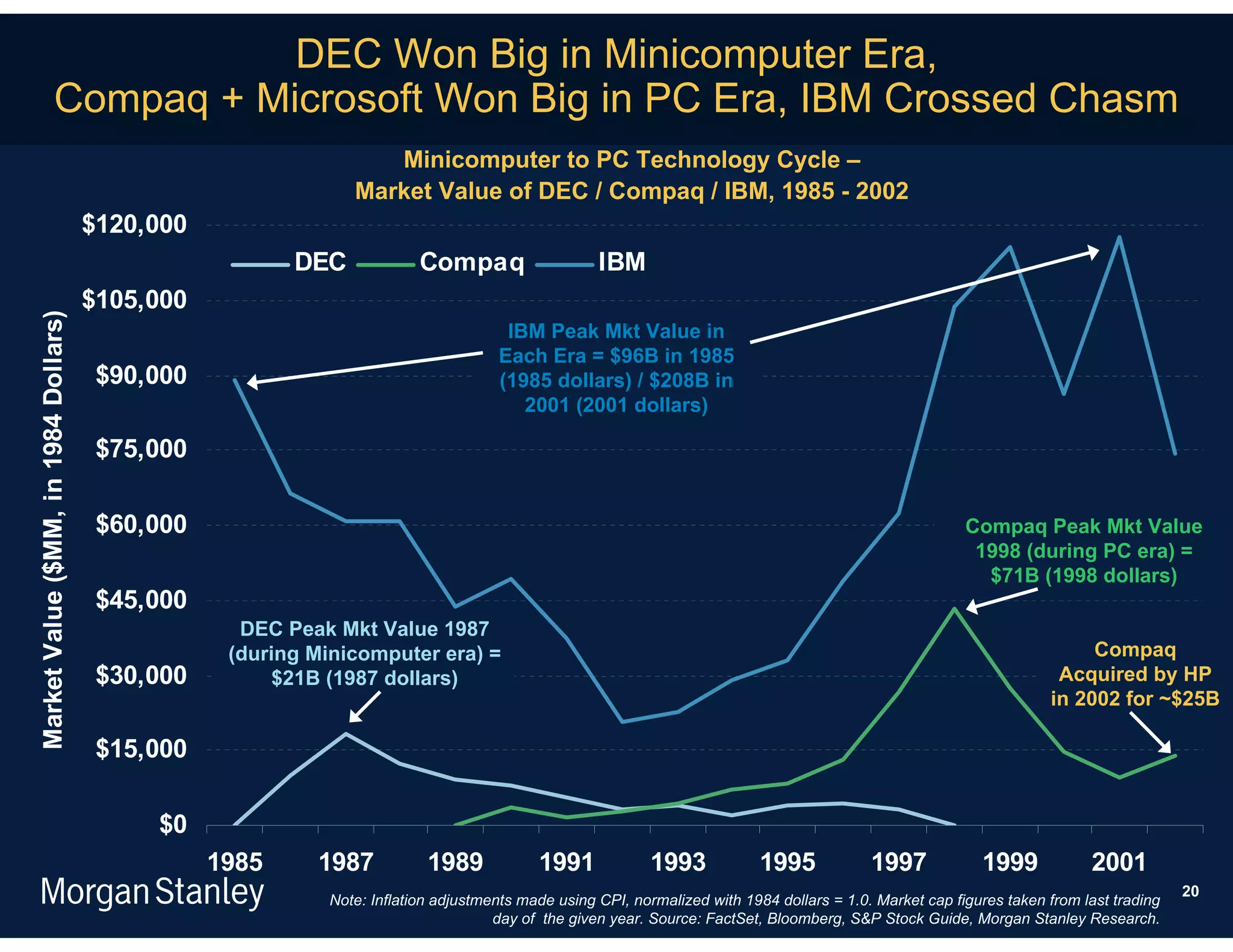
DEC Won Big in Minicomputer Era,
                  Compaq + Microsoft Won Big in PC Era, IBM Crossed Chasm
                                                                 Minicomputer to PC Technology Cycle –
                                                              Market Value of DEC / Compaq / IBM, 1985 - 2002
                                      $120,000
                                                        DEC             Compaq                    IBM
                                      $105,000
Market Value ($MM, in 1984 Dollars)


                                                                                    IBM Peak Mkt Value in
                                                                                   Each Era = $96B in 1985
                                       $90,000                                     (1985 dollars) / $208B in
                                                                                      2001 (2001 dollars)

                                       $75,000

                                       $60,000                                                                                                          Compaq Peak Mkt Value
                                                                                                                                                         1998 (during PC era) =
                                                                                                                                                          $71B (1998 dollars)
                                       $45,000
                                                   DEC Peak Mkt Value 1987
                                                  (during Minicomputer era) =                                                                                            Compaq
                                       $30,000        $21B (1987 dollars)                                                                                            Acquired by HP
                                                                                                                                                                    in 2002 for ~$25B

                                       $15,000

                                           $0
                                                 1985     1987           1989            1991             1993            1995            1997            1999            2001
                                                                                                                                                                                        20
                                                           Note: Inflation adjustments made using CPI, normalized with 1984 dollars = 1.0. Market cap figures taken from last trading
                                                                                   day of the given year. Source: FactSet, Bloomberg, S&P Stock Guide, Morgan Stanley Research.
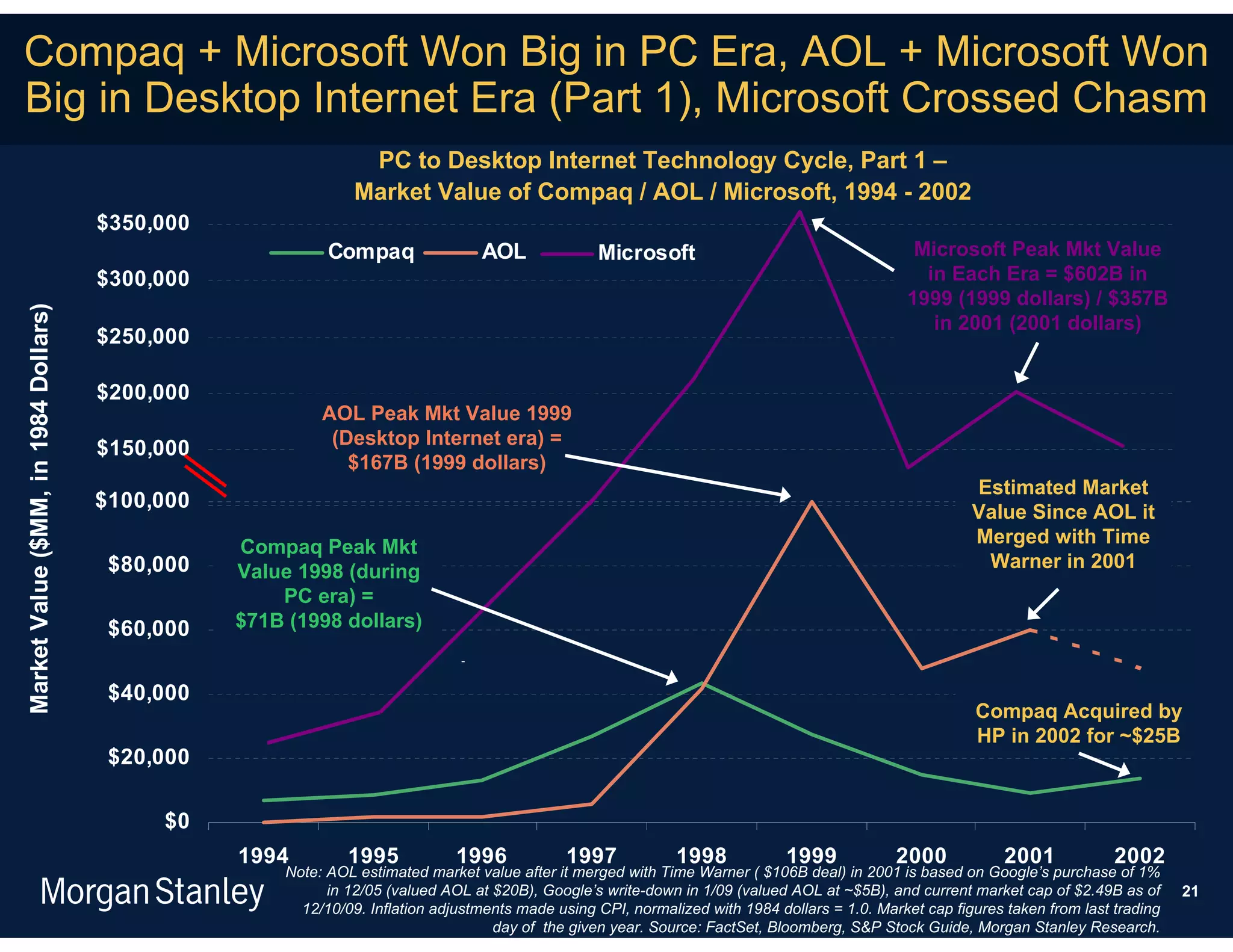
Compaq + Microsoft Won Big in PC Era, AOL + Microsoft Won
Big in Desktop Internet Era (Part 1), Microsoft Crossed Chasm
                                                                 PC to Desktop Internet Technology Cycle, Part 1 –
                                                                Market Value of Compaq / AOL / Microsoft, 1994 - 2002
                                      $350,000
                                                            Compaq                AOL              Microsoft                                     Microsoft Peak Mkt Value
                                      $300,000                                                                                                    in Each Era = $602B in
                                                                     Microsoft                                                                  1999 (1999 dollars) / $357B
Market Value ($MM, in 1984 Dollars)


                                                                                                                                                   in 2001 (2001 dollars)
                                      $250,000

                                      $200,000
                                                           AOL Peak Mkt Value 1999
                                                            (Desktop Internet era) =
                                      $150,000
                                                              $167B (1999 dollars)
                                                                                                                                                          Estimated Market
                                      $100,000
                                                                                                                                                          Value Since AOL it
                                                                                                                                                          Merged with Time
                                                 Compaq Peak Mkt
                                       $80,000                                                                                                             Warner in 2001
                                                 Value 1998 (during
                                                     PC era) =
                                       $60,000   $71B (1998 dollars)
                                                                   Compaq                 AOL
                                       $40,000
                                                                                                                                                          Compaq Acquired by
                                                                                                                                                          HP in 2002 for ~$25B
                                       $20,000

                                           $0
                                                 1994          1995            1996            1997            1998            1999            2000            2001            2002
                                                      Note: AOL estimated market value after it merged with Time Warner ( $106B deal) in 2001 is based on Google’s purchase of 1%
                                                            in 12/05 (valued AOL at $20B), Google’s write-down in 1/09 (valued AOL at ~$5B), and current market cap of $2.49B as of      21
                                                        12/10/09. Inflation adjustments made using CPI, normalized with 1984 dollars = 1.0. Market cap figures taken from last trading
                                                                                    day of the given year. Source: FactSet, Bloomberg, S&P Stock Guide, Morgan Stanley Research.
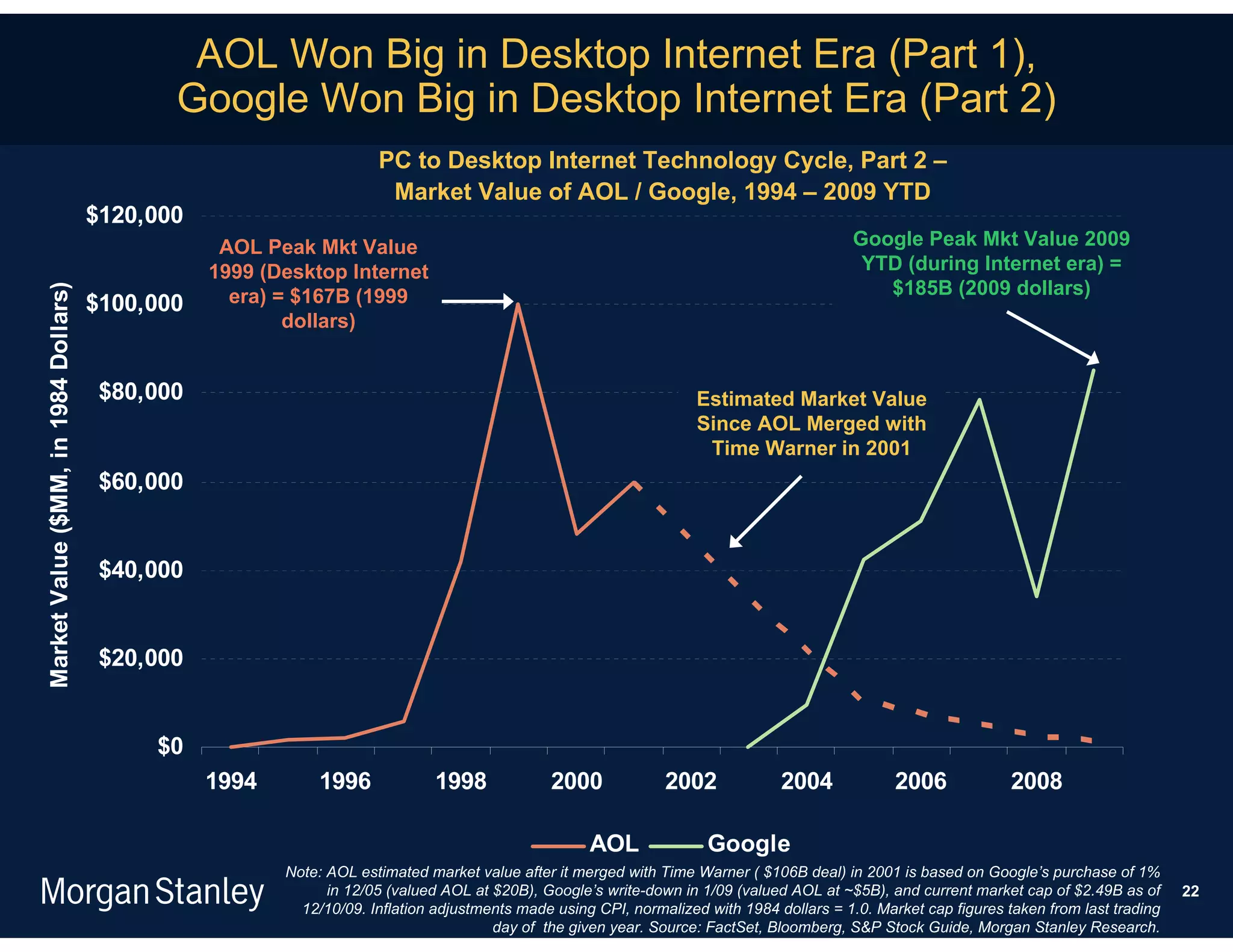
AOL Won Big in Desktop Internet Era (Part 1),
                                             Google Won Big in Desktop Internet Era (Part 2)
                                                                     PC to Desktop Internet Technology Cycle, Part 2 –
                                                                      Market Value of AOL / Google, 1994 – 2009 YTD
                                      $120,000
                                                  AOL Peak Mkt Value                                                                       Google Peak Mkt Value 2009
                                                 1999 (Desktop Internet                                                                     YTD (during Internet era) =
                                                                                                                                              $185B (2009 dollars)
Market Value ($MM, in 1984 Dollars)


                                      $100,000     era) = $167B (1999
                                                         dollars)


                                       $80,000                                                                      Estimated Market Value
                                                                                                                    Since AOL Merged with
                                                                                                                     Time Warner in 2001
                                       $60,000


                                       $40,000


                                       $20,000


                                           $0
                                                 1994       1996             1998             2000             2002             2004             2006             2008

                                                                                                    AOL              Google
                                                        Note: AOL estimated market value after it merged with Time Warner ( $106B deal) in 2001 is based on Google’s purchase of 1%
                                                              in 12/05 (valued AOL at $20B), Google’s write-down in 1/09 (valued AOL at ~$5B), and current market cap of $2.49B as of      22
                                                          12/10/09. Inflation adjustments made using CPI, normalized with 1984 dollars = 1.0. Market cap figures taken from last trading
                                                                                      day of the given year. Source: FactSet, Bloomberg, S&P Stock Guide, Morgan Stanley Research.
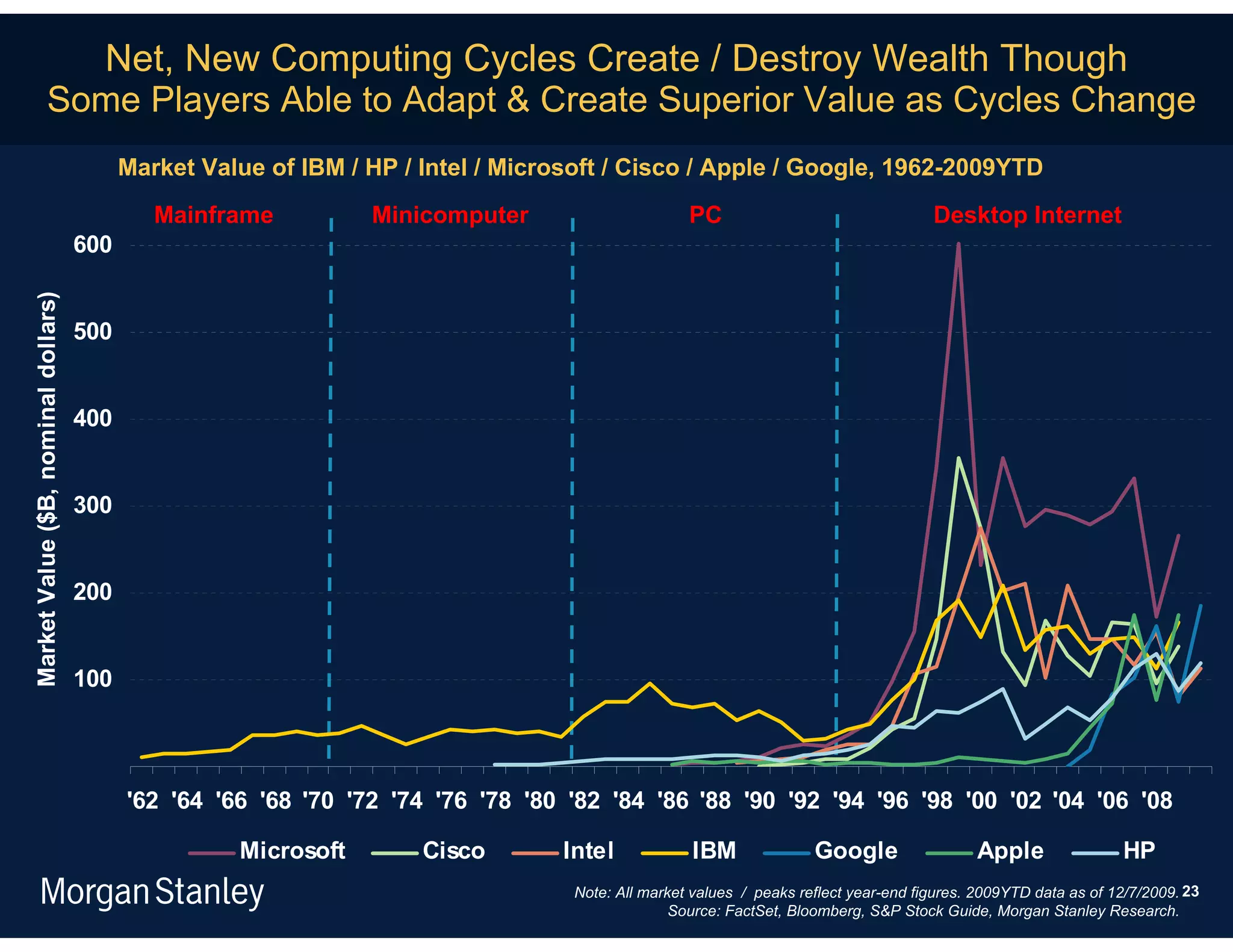
Net, New Computing Cycles Create / Destroy Wealth Though
                 Some Players Able to Adapt & Create Superior Value as Cycles Change
                                           Market Value of IBM / HP / Intel / Microsoft / Cisco / Apple / Google, 1962-2009YTD
                                              Mainframe          Minicomputer                      PC                                 Desktop Internet
                                     600
Market Value ($B, nominal dollars)


                                     500


                                     400


                                     300


                                     200


                                     100


                                           '62 '64 '66 '68 '70 '72 '74 '76 '78 '80 '82 '84 '86 '88 '90 '92 '94 '96 '98 '00 '02 '04 '06 '08

                                                     Microsoft        Cisco       Intel             IBM              Google                  Apple                HP
                                                                                   Note: All market values / peaks reflect year-end figures. 2009YTD data as of 12/7/2009. 23
                                                                                                 Source: FactSet, Bloomberg, S&P Stock Guide, Morgan Stanley Research.
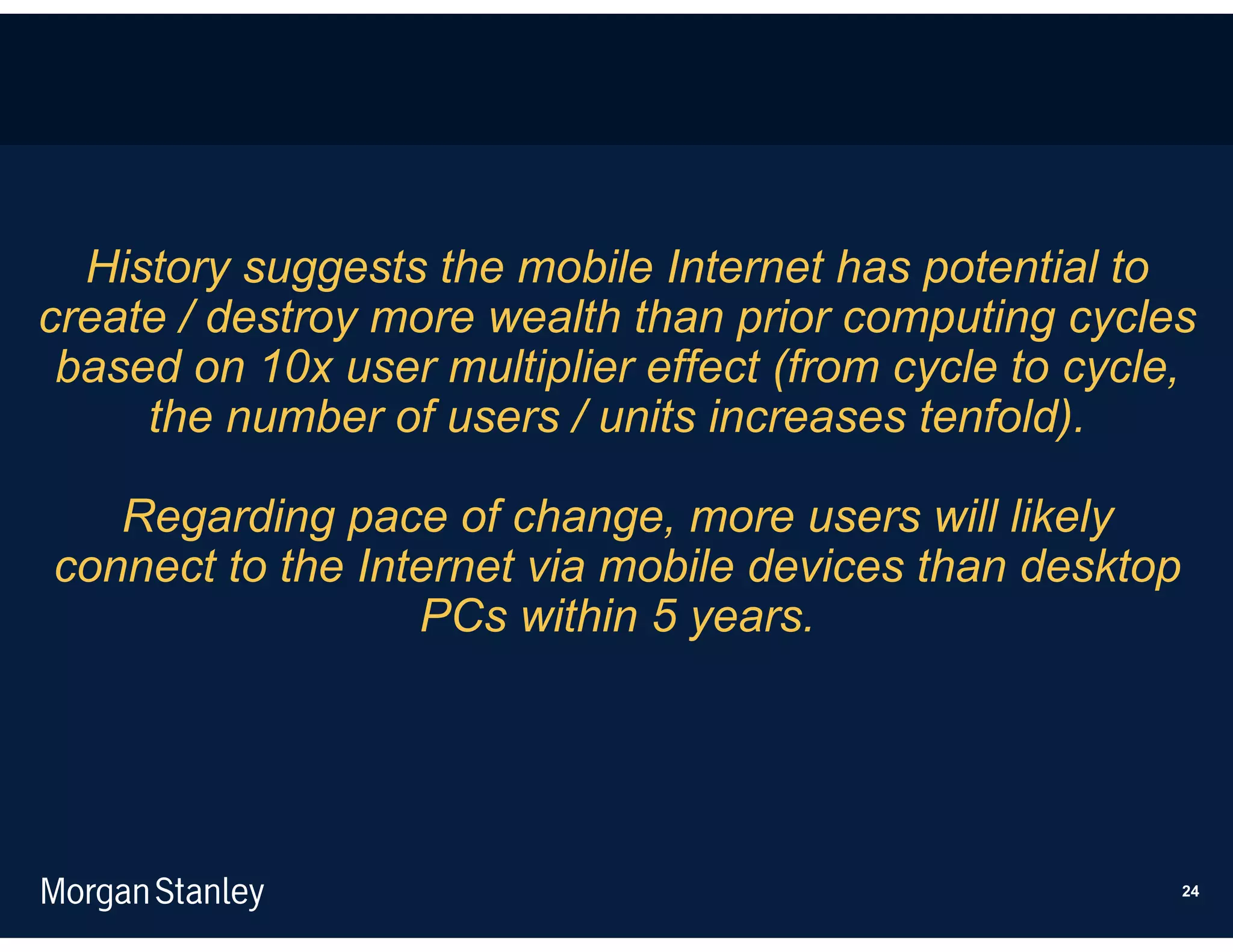
History suggests the mobile Internet has potential to
create / destroy more wealth than prior computing cycles
 based on 10x user multiplier effect (from cycle to cycle,
     the number of users / units increases tenfold).

   Regarding pace of change, more users will likely
connect to the Internet via mobile devices than desktop
                  PCs within 5 years.


                                                          24
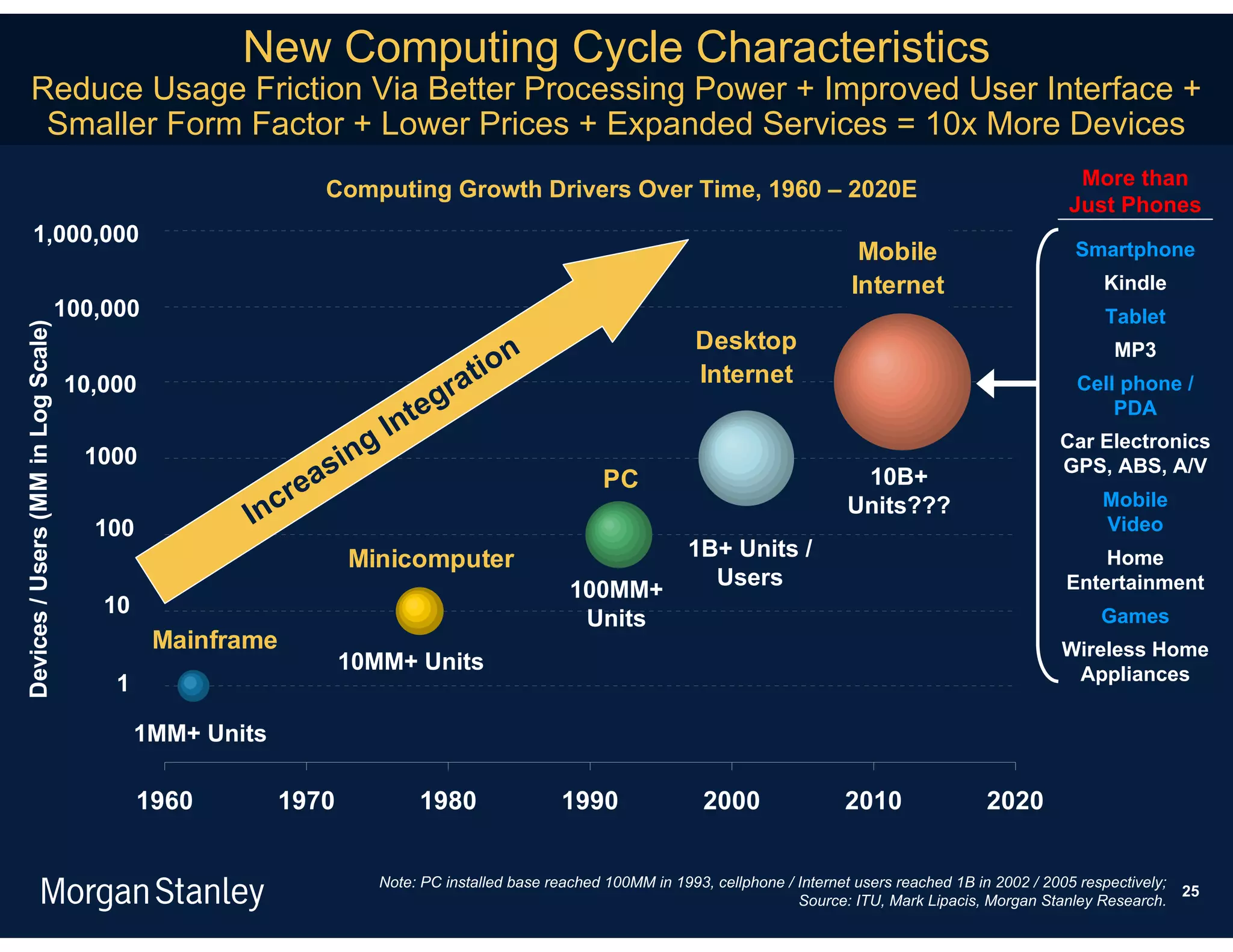
New Computing Cycle Characteristics
       Reduce Usage Friction Via Better Processing Power + Improved User Interface +
        Smaller Form Factor + Lower Prices + Expanded Services = 10x More Devices
                                                                                                                                                                       More than
                                                              Computing Growth Drivers Over Time, 1960 – 2020E
                                                                                                                                                                      Just Phones
         1,000,000
                                                                                                                                        Mobile                         Smartphone
                                                                                                                                       Internet                             Kindle
                                    100,000                                                                                                                                 Tablet
Devices / Users (MM in Log Scale)


                                                                                   n                             Desktop                                                     MP3
                                                                              atio                               Internet
                                    10,000
                                                                            gr
                                                                                                                                                                        Cell phone /
                                                                          e
                                                                      Int
                                                                                                                                                                            PDA

                                                                ing
                                                                                                                                                                     Car Electronics
                                      1000
                                                              s                                                                                                      GPS, ABS, A/V
                                                            ea                                      PC                                  10B+
                                                     In   cr                                                                           Units???                            Mobile
                                       100                                                                                                                                 Video
                                                                 Minicomputer                                   1B+ Units /                                               Home
                                                                                                                  Users                                               Entertainment
                                                                                               100MM+
                                        10                                                                                                                                 Games
                                                                                                Units
                                              Mainframe                                                                                                              Wireless Home
                                                                 10MM+ Units                                                                                          Appliances
                                         1

                                             1MM+ Units

                                             1960         1970           1980                 1990                2000                2010                 2020


                                                                    Note: PC installed base reached 100MM in 1993, cellphone / Internet users reached 1B in 2002 / 2005 respectively;
                                                                                                                                                                                        25
                                                                                                                               Source: ITU, Mark Lipacis, Morgan Stanley Research.
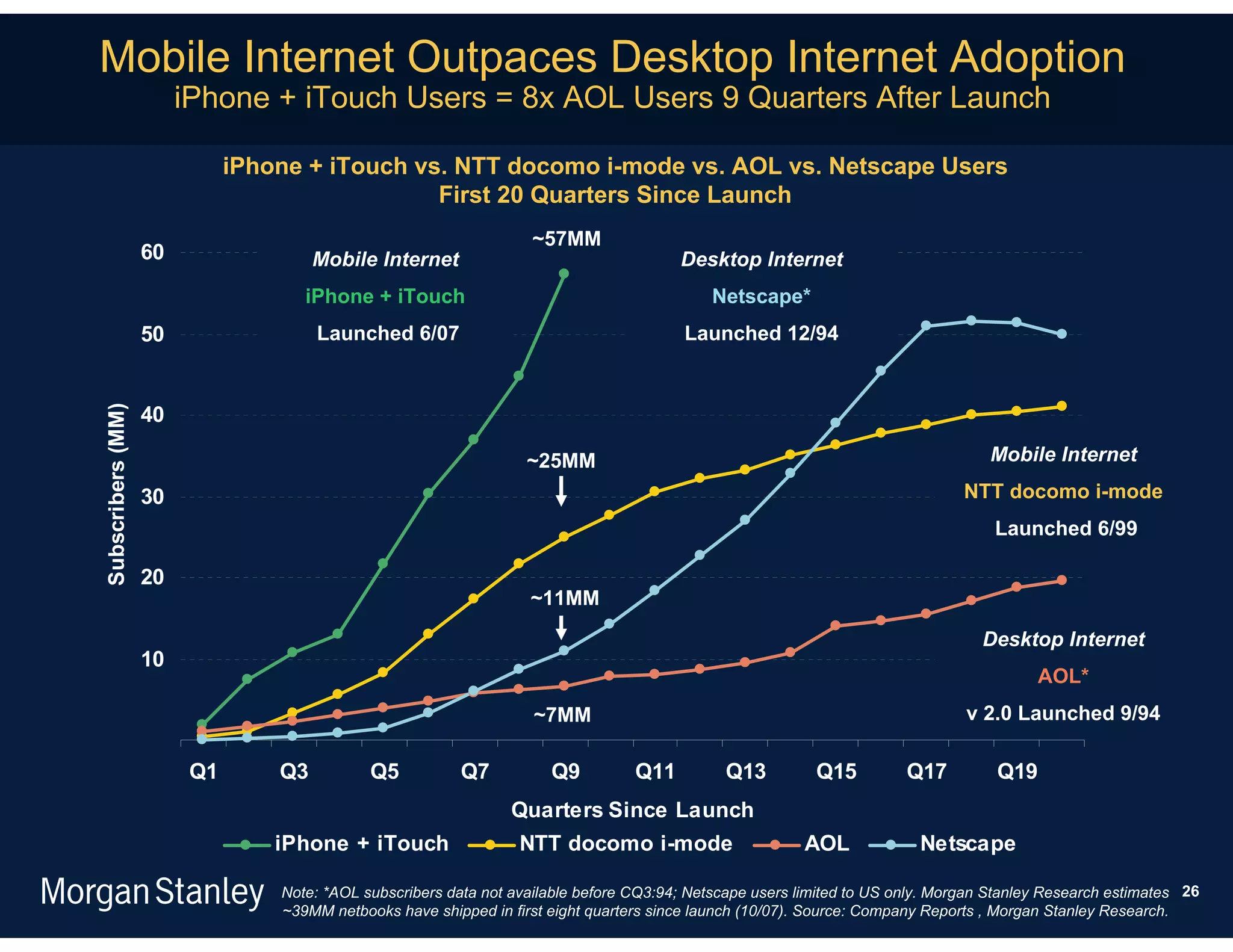
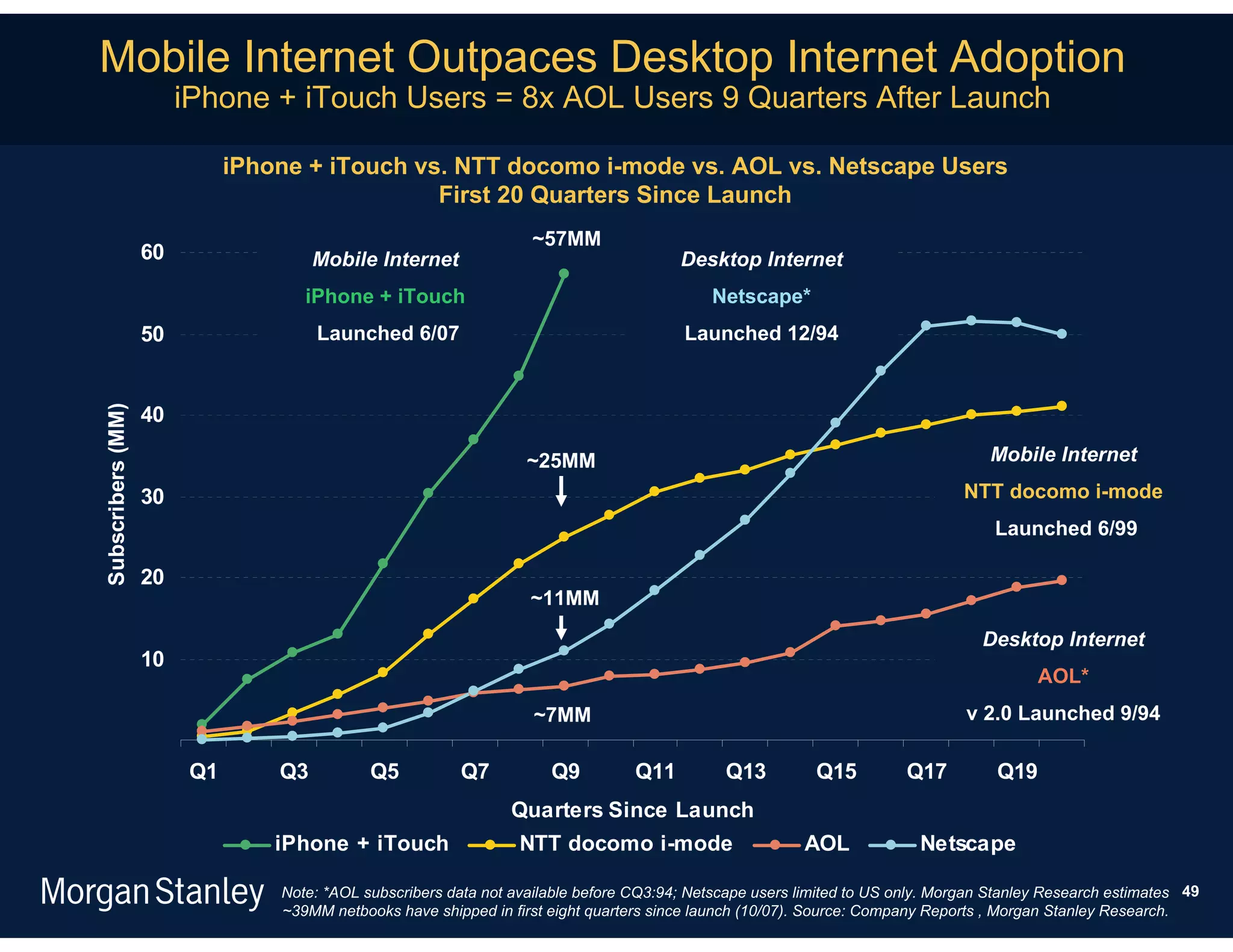
Mobile Internet Outpaces Desktop Internet Adoption
                        iPhone + iTouch Users = 8x AOL Users 9 Quarters After Launch

                              iPhone + iTouch vs. NTT docomo i-mode vs. AOL vs. Netscape Users
                                                First 20 Quarters Since Launch
                                                                     ~57MM
                   60                  Mobile Internet                                   Desktop Internet
                                     iPhone + iTouch                                          Netscape*
                   50                  Launched 6/07                                      Launched 12/94


                   40
Subscribers (MM)


                                                                    ~25MM                                                           Mobile Internet

                   30                                                                                                            NTT docomo i-mode
                                                                                                                                     Launched 6/99

                   20
                                                                    ~11MM

                                                                                                                                   Desktop Internet
                   10
                                                                                                                                           AOL*
                                                                     ~7MM                                                        v 2.0 Launched 9/94

                         Q1       Q3          Q5           Q7          Q9          Q11         Q13          Q15          Q17         Q19
                                                                  Quarters Since Launch
                                  iPhone + iTouch                  NTT docomo i-mode                      AOL              Netscape

                                  Note: *AOL subscribers data not available before CQ3:94; Netscape users limited to US only. Morgan Stanley Research estimates 26
                                  ~39MM netbooks have shipped in first eight quarters since launch (10/07). Source: Company Reports , Morgan Stanley Research.
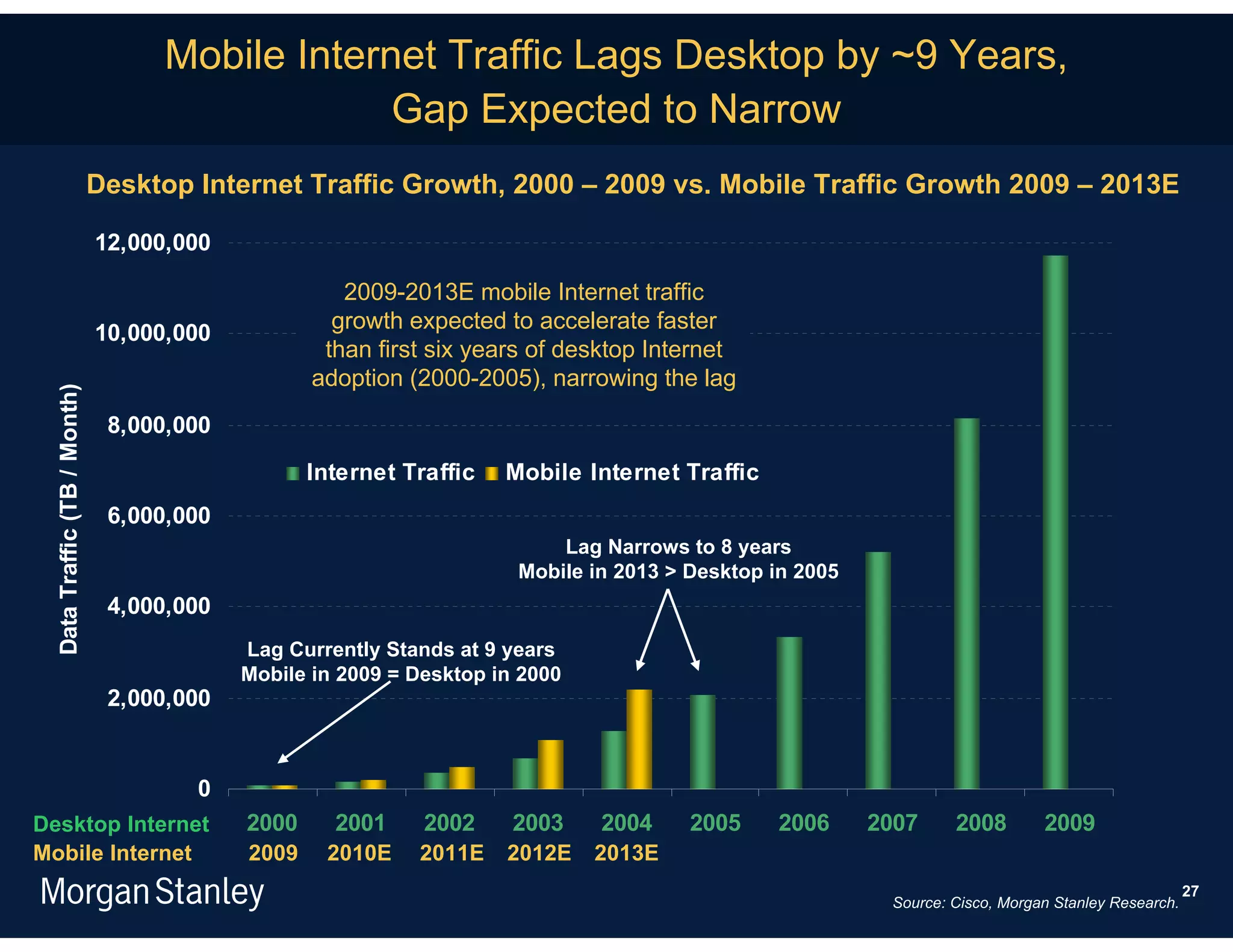
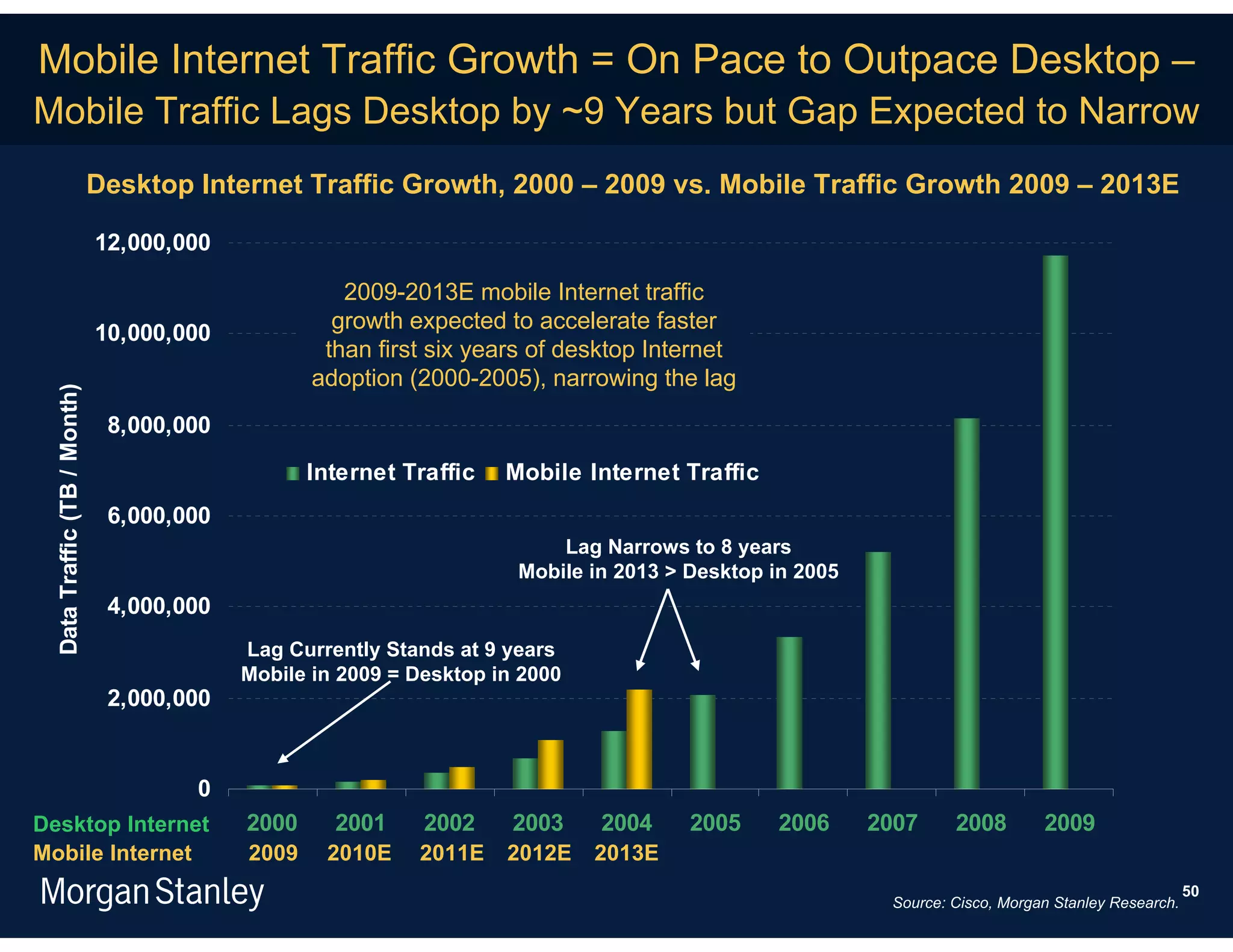
Mobile Internet Traffic Lags Desktop by ~9 Years,
                                                 Gap Expected to Narrow
                              Desktop Internet Traffic Growth, 2000 – 2009 vs. Mobile Traffic Growth 2009 – 2013E

                              12,000,000

                                                     2009-2013E mobile Internet traffic
                                                    growth expected to accelerate faster
                              10,000,000
                                                   than first six years of desktop Internet
                                                  adoption (2000-2005), narrowing the lag
  Data Traffic (TB / Month)


                               8,000,000

                                                  Internet Traffic   Mobile Internet Traffic
                               6,000,000
                                                                          Lag Narrows to 8 years
                                                                      Mobile in 2013 > Desktop in 2005
                               4,000,000
                                           Lag Currently Stands at 9 years
                                           Mobile in 2009 = Desktop in 2000
                               2,000,000


                                      0
Desktop Internet                           2000     2001     2002     2003    2004     2005    2006      2007     2008        2009
Mobile Internet                            2009    2010E    2011E    2012E    2013E
                                                                                                                                                    27
                                                                                                          Source: Cisco, Morgan Stanley Research.
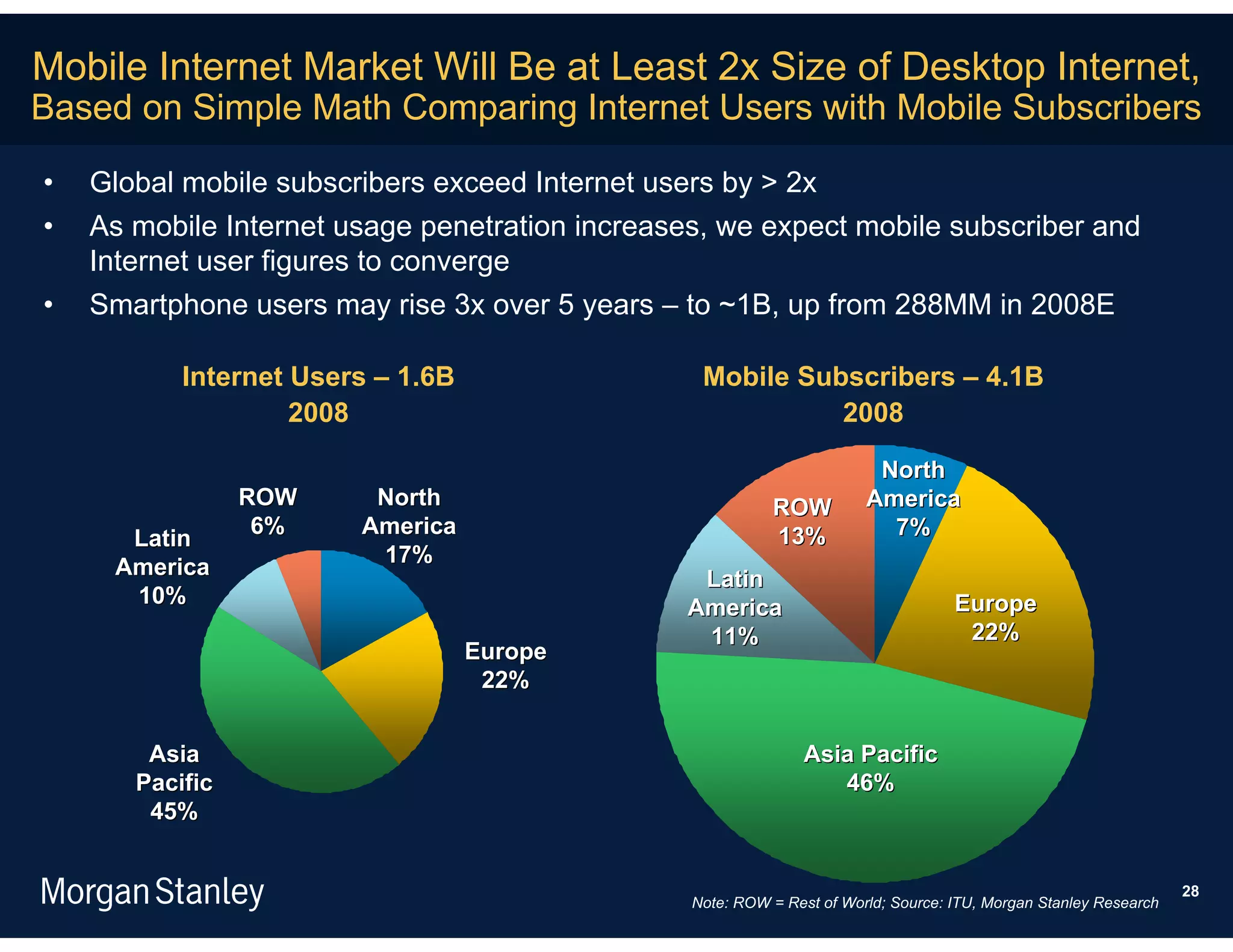
Mobile Internet Market Will Be at Least 2x Size of Desktop Internet,
Based on Simple Math Comparing Internet Users with Mobile Subscribers

•   Global mobile subscribers exceed Internet users by > 2x
•   As mobile Internet usage penetration increases, we expect mobile subscriber and
    Internet user figures to converge
•   Smartphone users may rise 3x over 5 years – to ~1B, up from 288MM in 2008E

           Internet Users – 1.6B                  Mobile Subscribers – 4.1B
                    2008                                    2008

                                                                         North
                 ROW     North                             ROW          America
                  6%    America                            13%            7%
      Latin
                         17%
     America
                                                 Latin
      10%                                                                           Europe
                                                America
                                                 11%                                 22%
                                   Europe
                                    22%


        Asia                                                    Asia Pacific
       Pacific                                                     46%
        45%


                                                                                                                   28
                                                 Note: ROW = Rest of World; Source: ITU, Morgan Stanley Research
Pace of company change related to mobile Internet is
           evolving at a very rapid clip


                                                       29
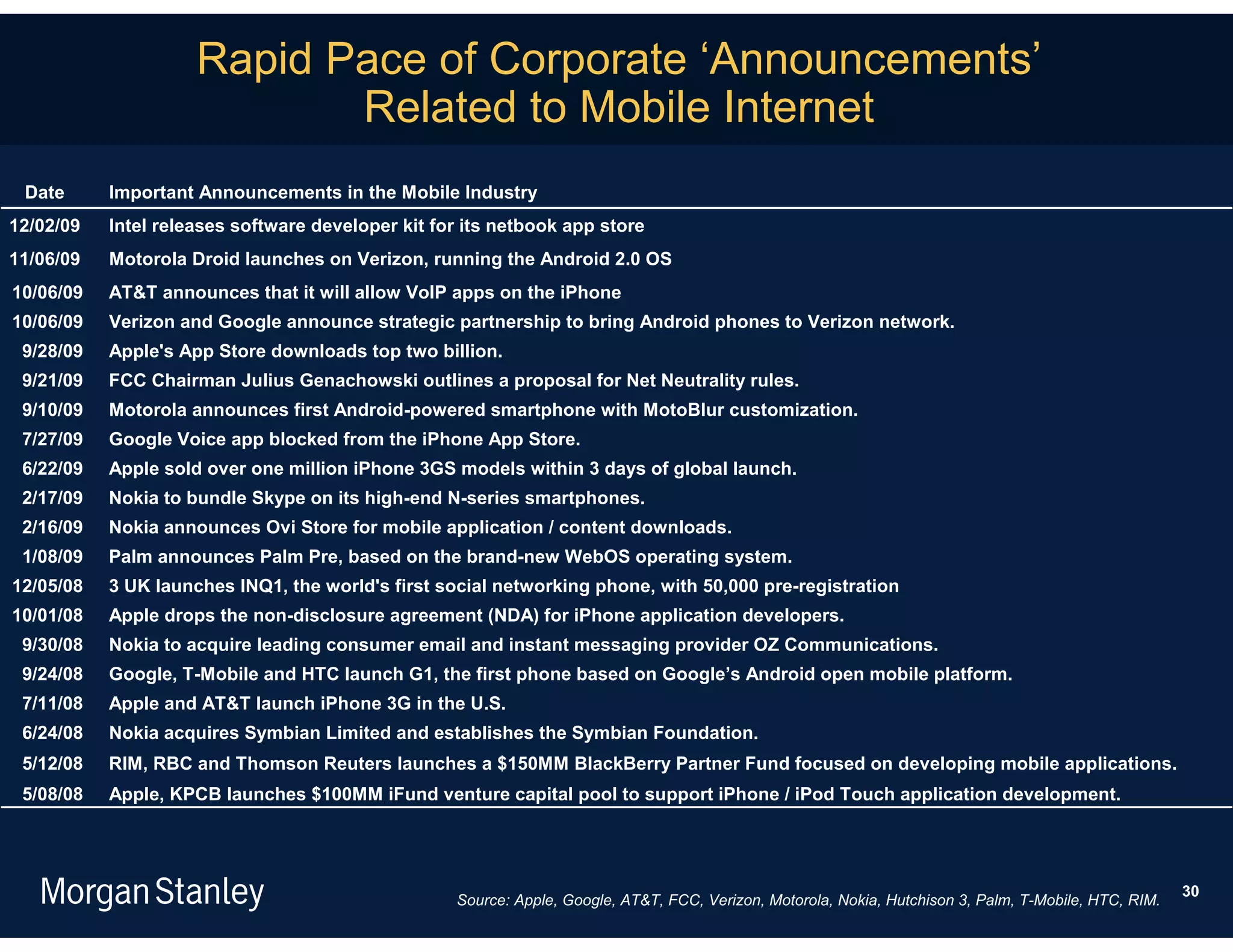
Rapid Pace of Corporate ‘Announcements’
                            Related to Mobile Internet
 Date      Important Announcements in the Mobile Industry
12/02/09   Intel releases software developer kit for its netbook app store
11/06/09   Motorola Droid launches on Verizon, running the Android 2.0 OS
10/06/09   AT&T announces that it will allow VoIP apps on the iPhone
10/06/09   Verizon and Google announce strategic partnership to bring Android phones to Verizon network.
 9/28/09   Apple's App Store downloads top two billion.
 9/21/09   FCC Chairman Julius Genachowski outlines a proposal for Net Neutrality rules.
 9/10/09   Motorola announces first Android-powered smartphone with MotoBlur customization.
 7/27/09   Google Voice app blocked from the iPhone App Store.
 6/22/09   Apple sold over one million iPhone 3GS models within 3 days of global launch.
 2/17/09   Nokia to bundle Skype on its high-end N-series smartphones.
 2/16/09   Nokia announces Ovi Store for mobile application / content downloads.
 1/08/09   Palm announces Palm Pre, based on the brand-new WebOS operating system.
12/05/08   3 UK launches INQ1, the world's first social networking phone, with 50,000 pre-registration
10/01/08   Apple drops the non-disclosure agreement (NDA) for iPhone application developers.
 9/30/08   Nokia to acquire leading consumer email and instant messaging provider OZ Communications.
 9/24/08   Google, T-Mobile and HTC launch G1, the first phone based on Google’s Android open mobile platform.
 7/11/08   Apple and AT&T launch iPhone 3G in the U.S.
 6/24/08   Nokia acquires Symbian Limited and establishes the Symbian Foundation.
 5/12/08   RIM, RBC and Thomson Reuters launches a $150MM BlackBerry Partner Fund focused on developing mobile applications.
 5/08/08   Apple, KPCB launches $100MM iFund venture capital pool to support iPhone / iPod Touch application development.


                                                                                                                                                        30
                                                   Source: Apple, Google, AT&T, FCC, Verizon, Motorola, Nokia, Hutchison 3, Palm, T-Mobile, HTC, RIM.
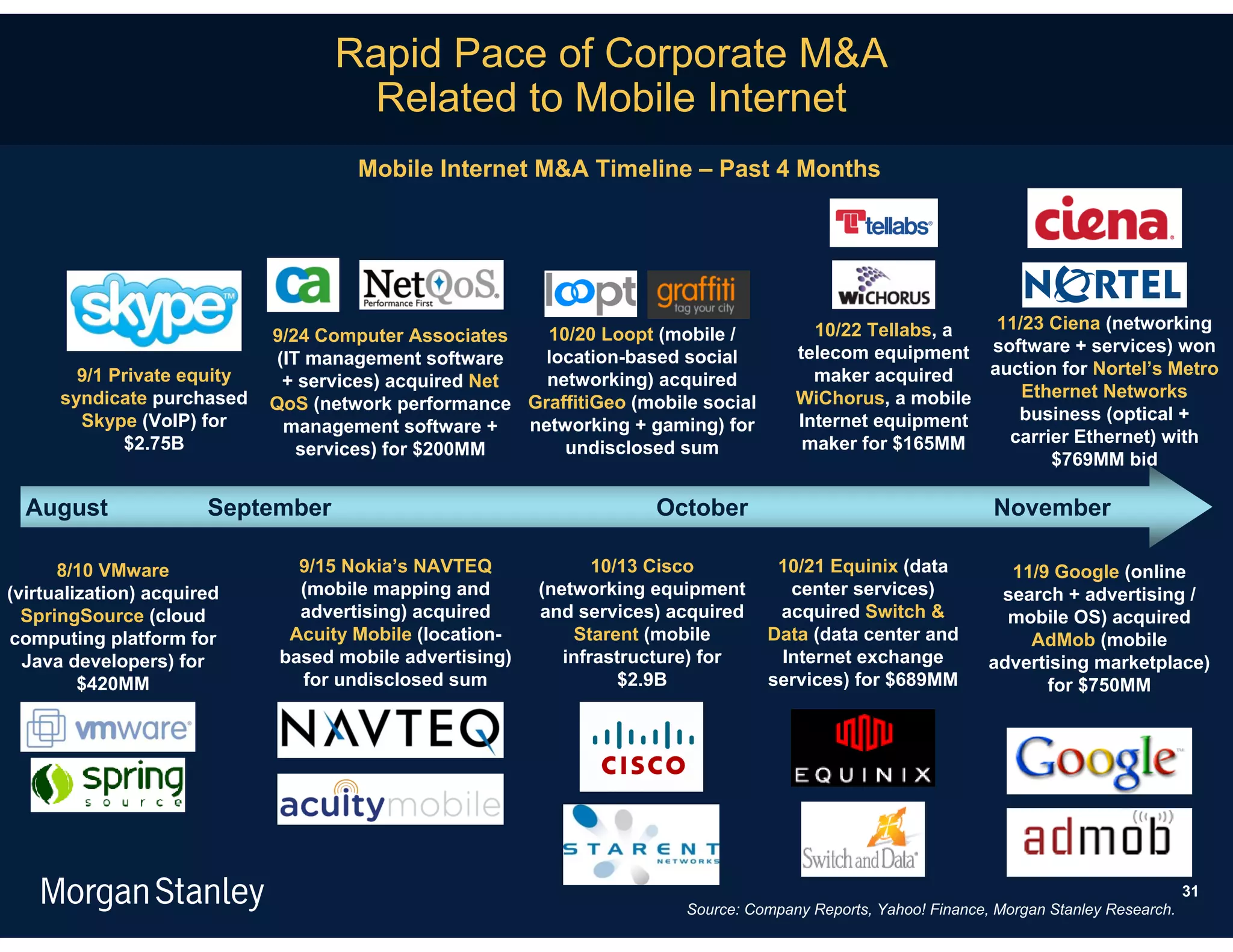
Rapid Pace of Corporate M&A
                                    Related to Mobile Internet
                                      Mobile Internet M&A Timeline – Past 4 Months


                                                                                         10/22 Tellabs, a  11/23 Ciena (networking
                             9/24 Computer Associates     10/20 Loopt (mobile /
                              (IT management software     location-based social        telecom equipment software + services) won
        9/1 Private equity                                                               maker acquired   auction for Nortel’s Metro
                               + services) acquired Net   networking) acquired
      syndicate purchased                                                              WiChorus, a mobile     Ethernet Networks
                             QoS (network performance GraffitiGeo (mobile social
        Skype (VoIP) for                                                               Internet equipment    business (optical +
                               management software +    networking + gaming) for
             $2.75B                                                                     maker for $165MM    carrier Ethernet) with
                                 services) for $200MM       undisclosed sum
                                                                                                                 $769MM bid

  August               September                                      October                                    November

      8/10 VMware               9/15 Nokia’s NAVTEQ              10/13 Cisco        10/21 Equinix (data            11/9 Google (online
(virtualization) acquired       (mobile mapping and       (networking equipment      center services)             search + advertising /
  SpringSource (cloud           advertising) acquired     and services) acquired    acquired Switch &              mobile OS) acquired
computing platform for         Acuity Mobile (location-       Starent (mobile      Data (data center and             AdMob (mobile
  Java developers) for        based mobile advertising)      infrastructure) for    Internet exchange            advertising marketplace)
         $420MM                 for undisclosed sum                 $2.9B          services) for $689MM                for $750MM


                                                                                                                                             31
                                                                         Source: Company Reports, Yahoo! Finance, Morgan Stanley Research.
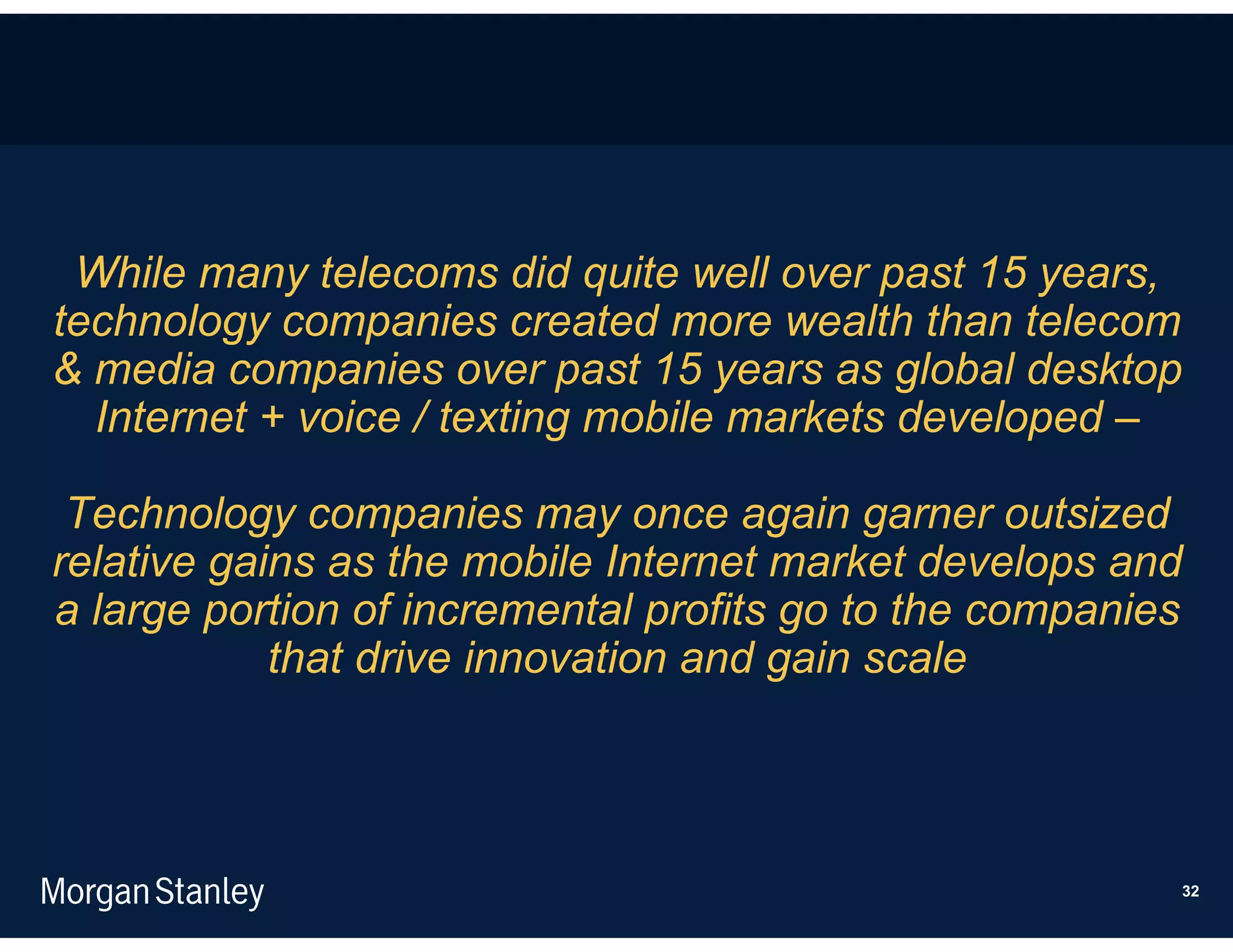
While many telecoms did quite well over past 15 years,
technology companies created more wealth than telecom
& media companies over past 15 years as global desktop
  Internet + voice / texting mobile markets developed –

 Technology companies may once again garner outsized
relative gains as the mobile Internet market develops and
a large portion of incremental profits go to the companies
            that drive innovation and gain scale


                                                         32
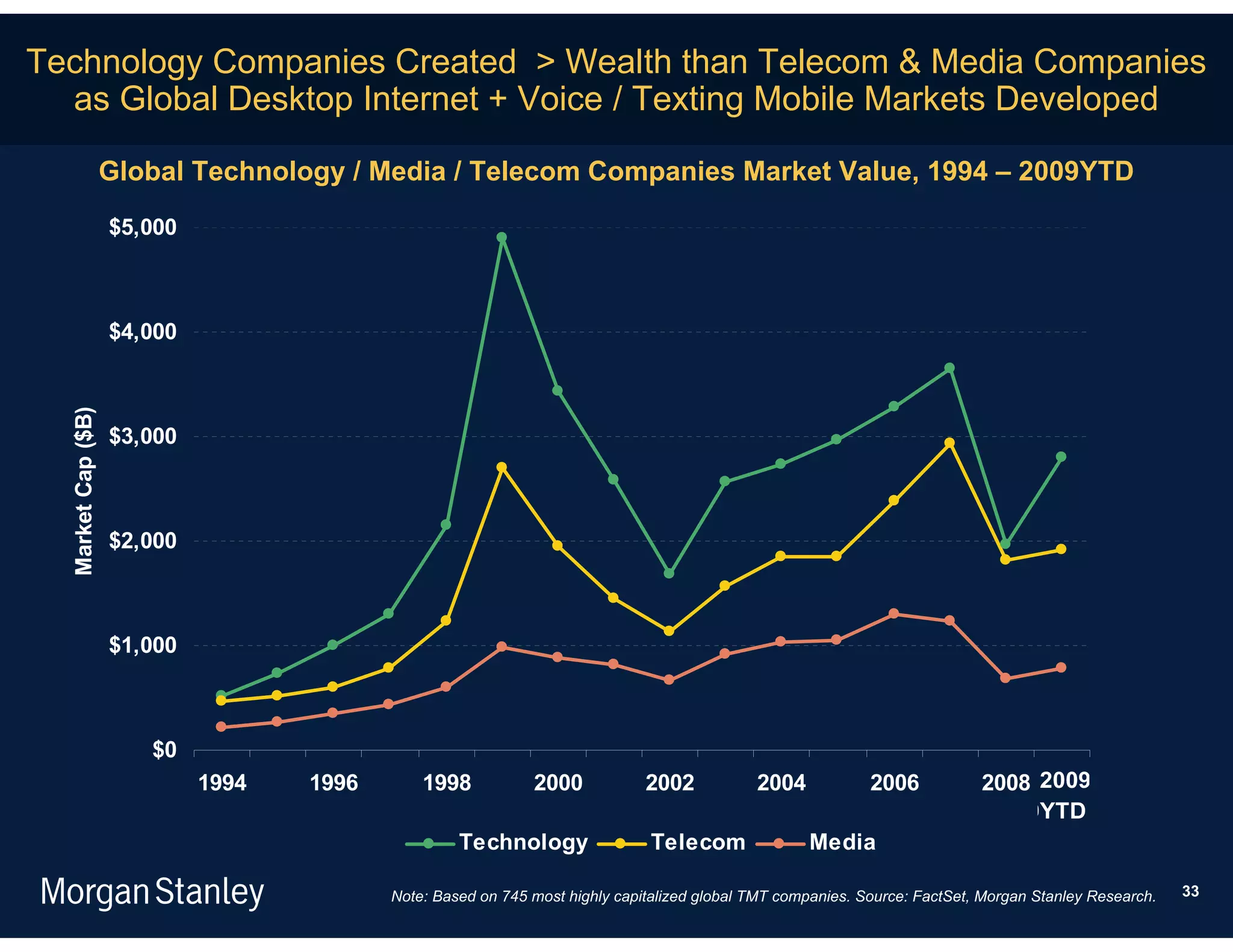
Technology Companies Created > Wealth than Telecom & Media Companies
  as Global Desktop Internet + Voice / Texting Mobile Markets Developed

                    Global Technology / Media / Telecom Companies Market Value, 1994 – 2009YTD
                    $5,000


                    $4,000
  Market Cap ($B)


                    $3,000


                    $2,000


                    $1,000


                       $0
                             1994   1996       1998           2000            2002           2004            2006           2008 2009
                                                                                                                                9YTD
                                                    Technology                Telecom               Media

                                           Note: Based on 745 most highly capitalized global TMT companies. Source: FactSet, Morgan Stanley Research.   33
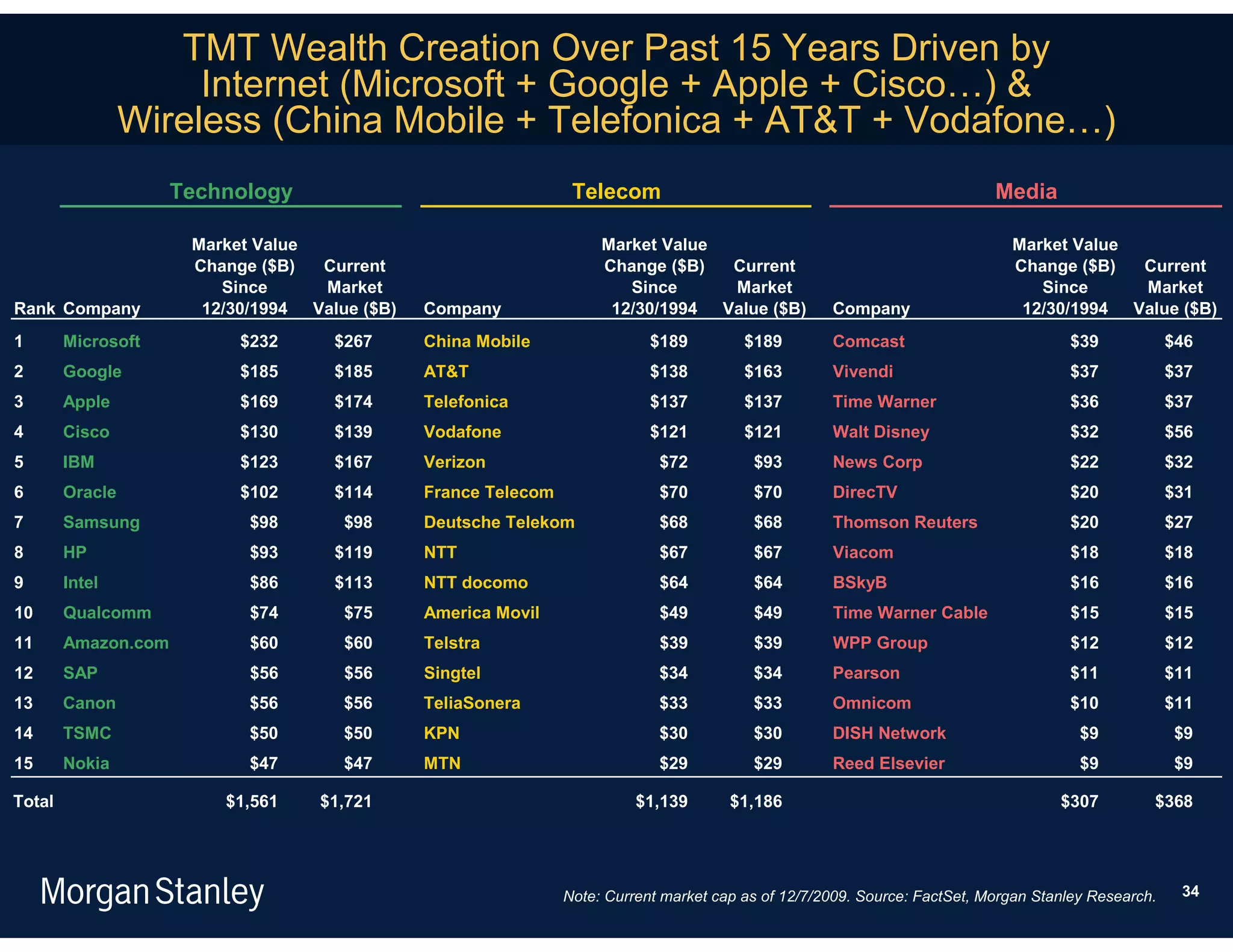
TMT Wealth Creation Over Past 15 Years Driven by
                      Internet (Microsoft + Google + Apple + Cisco…) &
                 Wireless (China Mobile + Telefonica + AT&T + Vodafone…)
                     Technology                                  Telecom                                                    Media

                      Market Value                                   Market Value                                             Market Value
                      Change ($B)  Current                           Change ($B)  Current                                     Change ($B)  Current
                         Since     Market                               Since     Market                                         Since     Market
Rank Company           12/30/1994 Value ($B)   Company                12/30/1994 Value ($B)          Company                   12/30/1994 Value ($B)
1       Microsoft          $232      $267      China Mobile                 $189         $189        Comcast                          $39             $46
2       Google             $185      $185      AT&T                         $138         $163        Vivendi                          $37             $37
3       Apple              $169      $174      Telefonica                   $137         $137        Time Warner                      $36             $37
4       Cisco              $130      $139      Vodafone                     $121         $121        Walt Disney                      $32             $56
5       IBM                $123      $167      Verizon                       $72          $93        News Corp                        $22             $32
6       Oracle             $102      $114      France Telecom                $70          $70        DirecTV                          $20             $31
7       Samsung             $98       $98      Deutsche Telekom              $68          $68        Thomson Reuters                  $20             $27
8       HP                  $93      $119      NTT                           $67          $67        Viacom                           $18             $18
9       Intel               $86      $113      NTT docomo                    $64          $64        BSkyB                            $16             $16
10      Qualcomm            $74       $75      America Movil                 $49          $49        Time Warner Cable                $15             $15
11      Amazon.com          $60       $60      Telstra                       $39          $39        WPP Group                        $12             $12
12      SAP                 $56       $56      Singtel                       $34          $34        Pearson                          $11             $11
13      Canon               $56       $56      TeliaSonera                   $33          $33        Omnicom                          $10             $11
14      TSMC                $50       $50      KPN                           $30          $30        DISH Network                       $9             $9
15      Nokia               $47       $47      MTN                           $29          $29        Reed Elsevier                      $9             $9

Total                    $1,561    $1,721                                 $1,139       $1,186                                        $307         $368


                                                                Note: Current market cap as of 12/7/2009. Source: FactSet, Morgan Stanley Research.    34
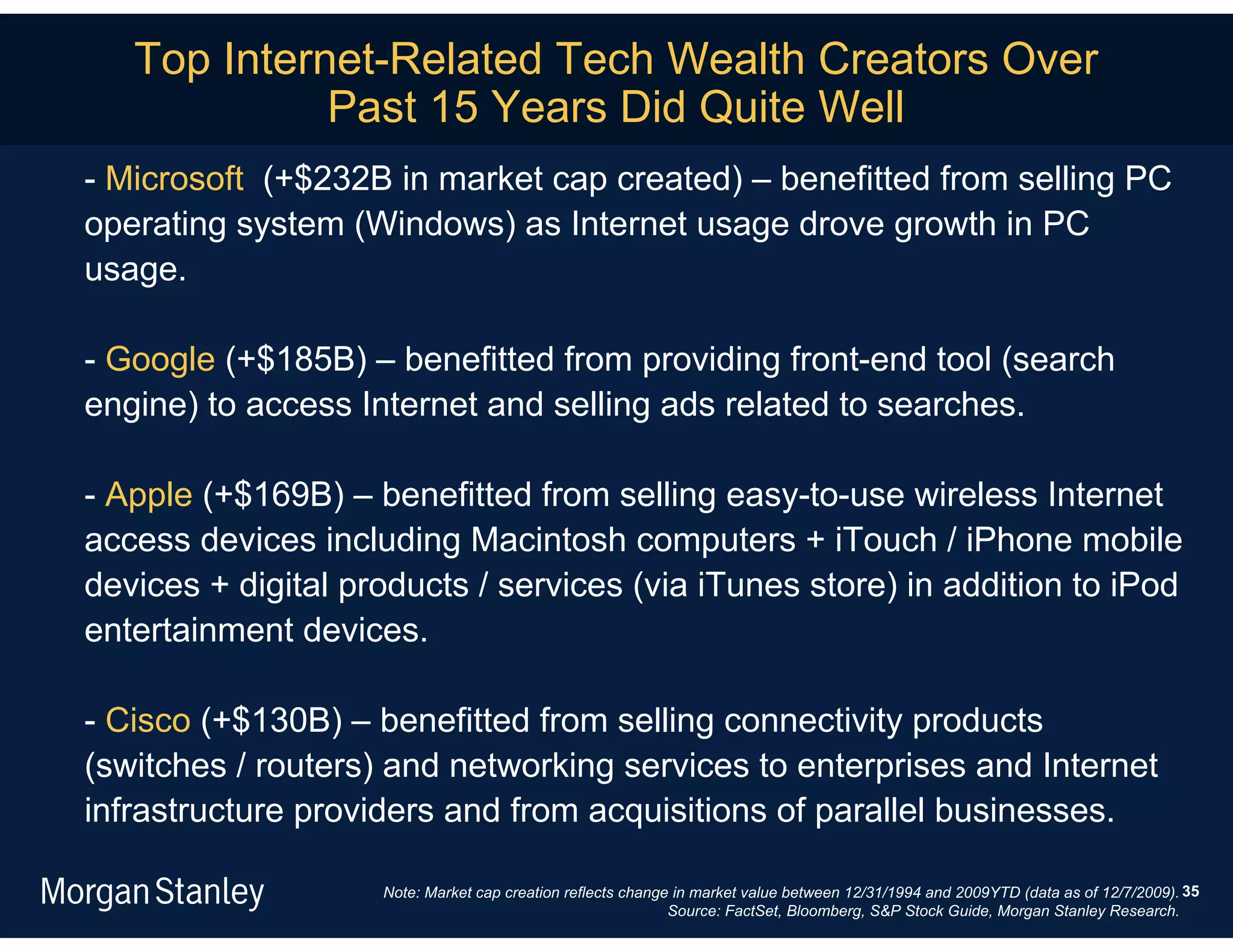
Top Internet-Related Tech Wealth Creators Over
             Past 15 Years Did Quite Well
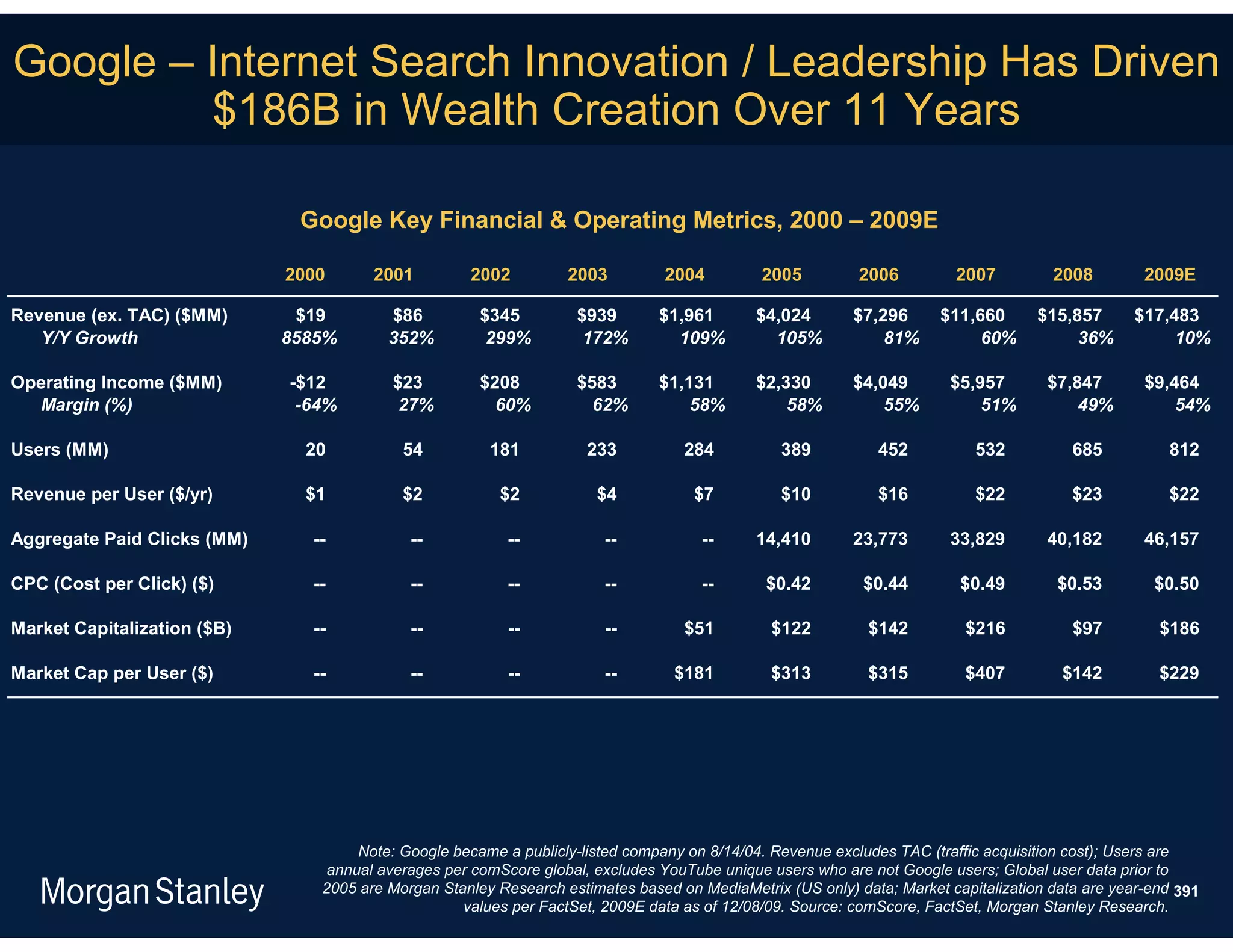
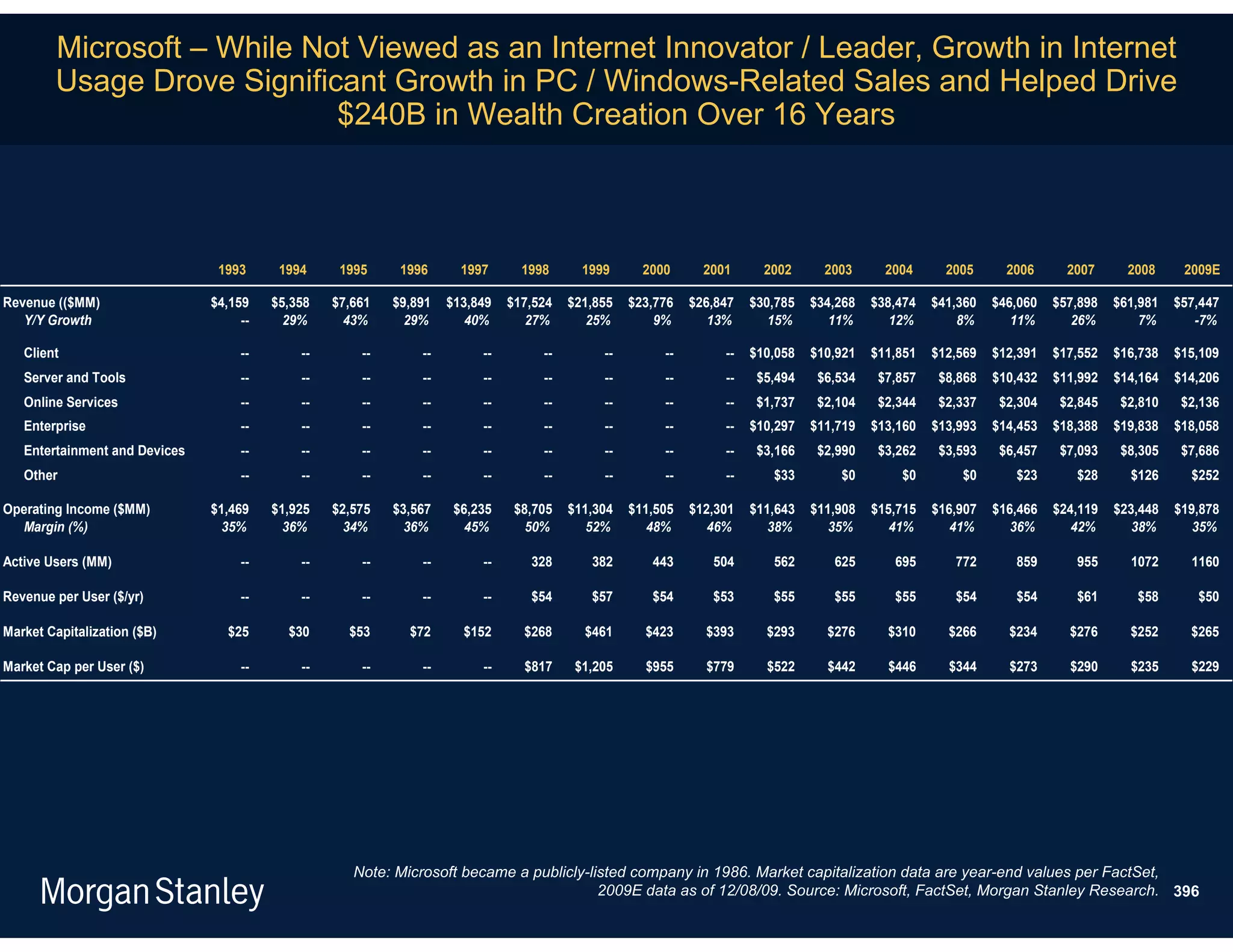
- Microsoft (+$232B in market cap created) – benefitted from selling PC
operating system (Windows) as Internet usage drove growth in PC
usage.

- Google (+$185B) – benefitted from providing front-end tool (search
engine) to access Internet and selling ads related to searches.

- Apple (+$169B) – benefitted from selling easy-to-use wireless Internet
access devices including Macintosh computers + iTouch / iPhone mobile
devices + digital products / services (via iTunes store) in addition to iPod
entertainment devices.

- Cisco (+$130B) – benefitted from selling connectivity products
(switches / routers) and networking services to enterprises and Internet
infrastructure providers and from acquisitions of parallel businesses.

                    Note: Market cap creation reflects change in market value between 12/31/1994 and 2009YTD (data as of 12/7/2009). 35
                                                             Source: FactSet, Bloomberg, S&P Stock Guide, Morgan Stanley Research.
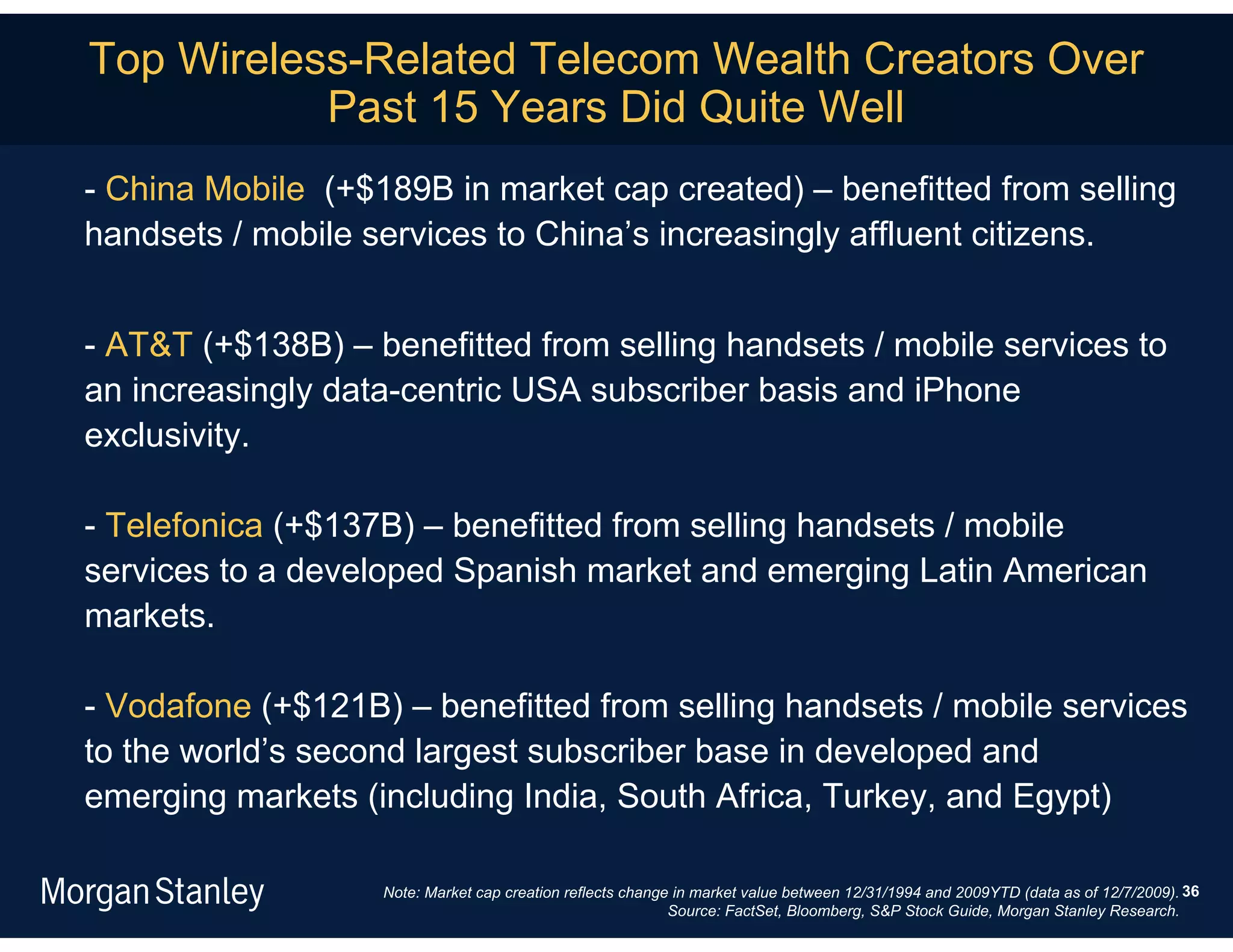
Top Wireless-Related Telecom Wealth Creators Over
           Past 15 Years Did Quite Well
- China Mobile (+$189B in market cap created) – benefitted from selling
handsets / mobile services to China’s increasingly affluent citizens.


- AT&T (+$138B) – benefitted from selling handsets / mobile services to
an increasingly data-centric USA subscriber basis and iPhone
exclusivity.

- Telefonica (+$137B) – benefitted from selling handsets / mobile
services to a developed Spanish market and emerging Latin American
markets.

- Vodafone (+$121B) – benefitted from selling handsets / mobile services
to the world’s second largest subscriber base in developed and
emerging markets (including India, South Africa, Turkey, and Egypt)

                   Note: Market cap creation reflects change in market value between 12/31/1994 and 2009YTD (data as of 12/7/2009). 36
                                                            Source: FactSet, Bloomberg, S&P Stock Guide, Morgan Stanley Research.
We Know What Happened Over Past 15 Years,
Who Wins Big Over Next 5+ Years as Internet Meets
                   Mobile?

We know execution is key and it’s extremely difficult to
             predict human error…


                                                           37
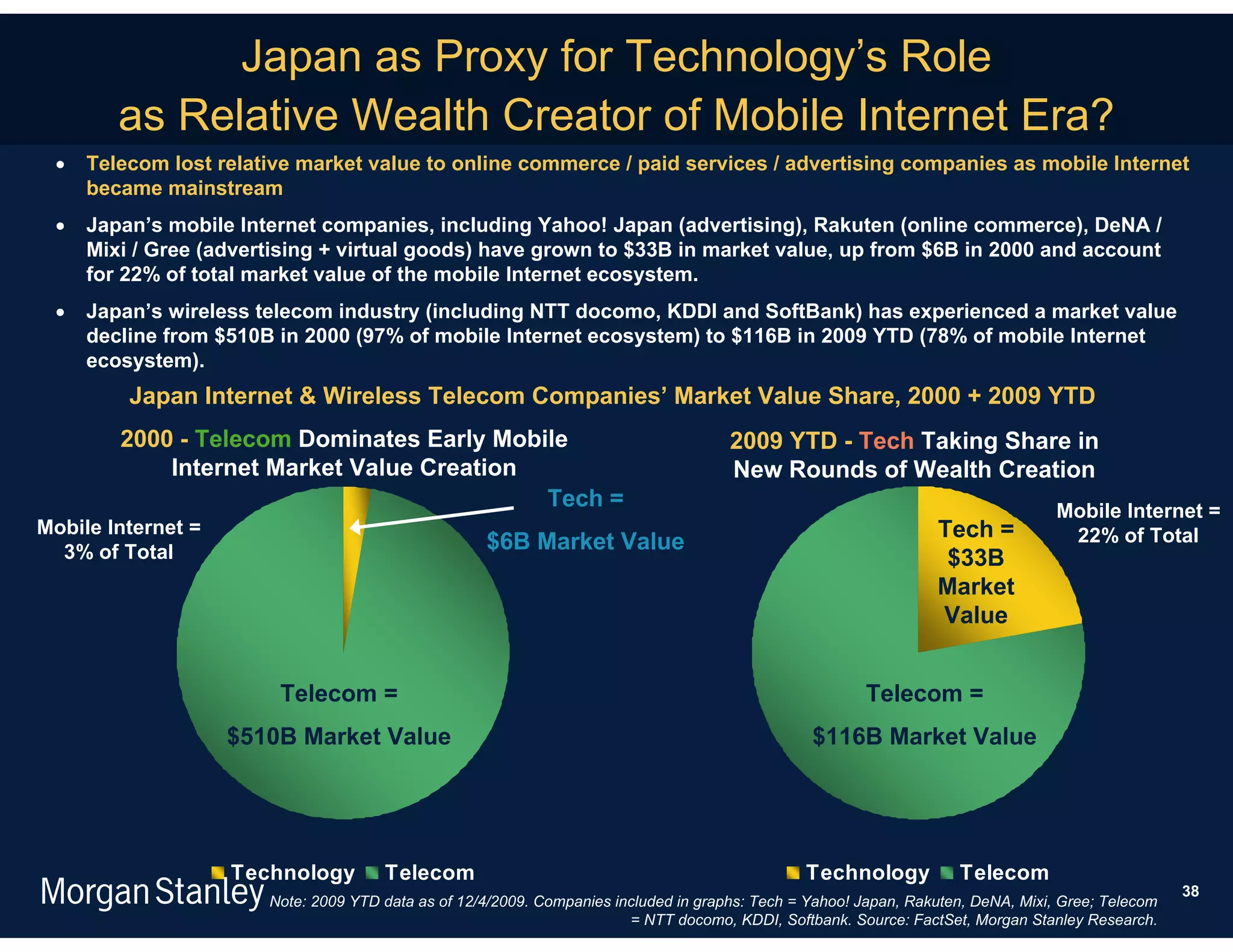
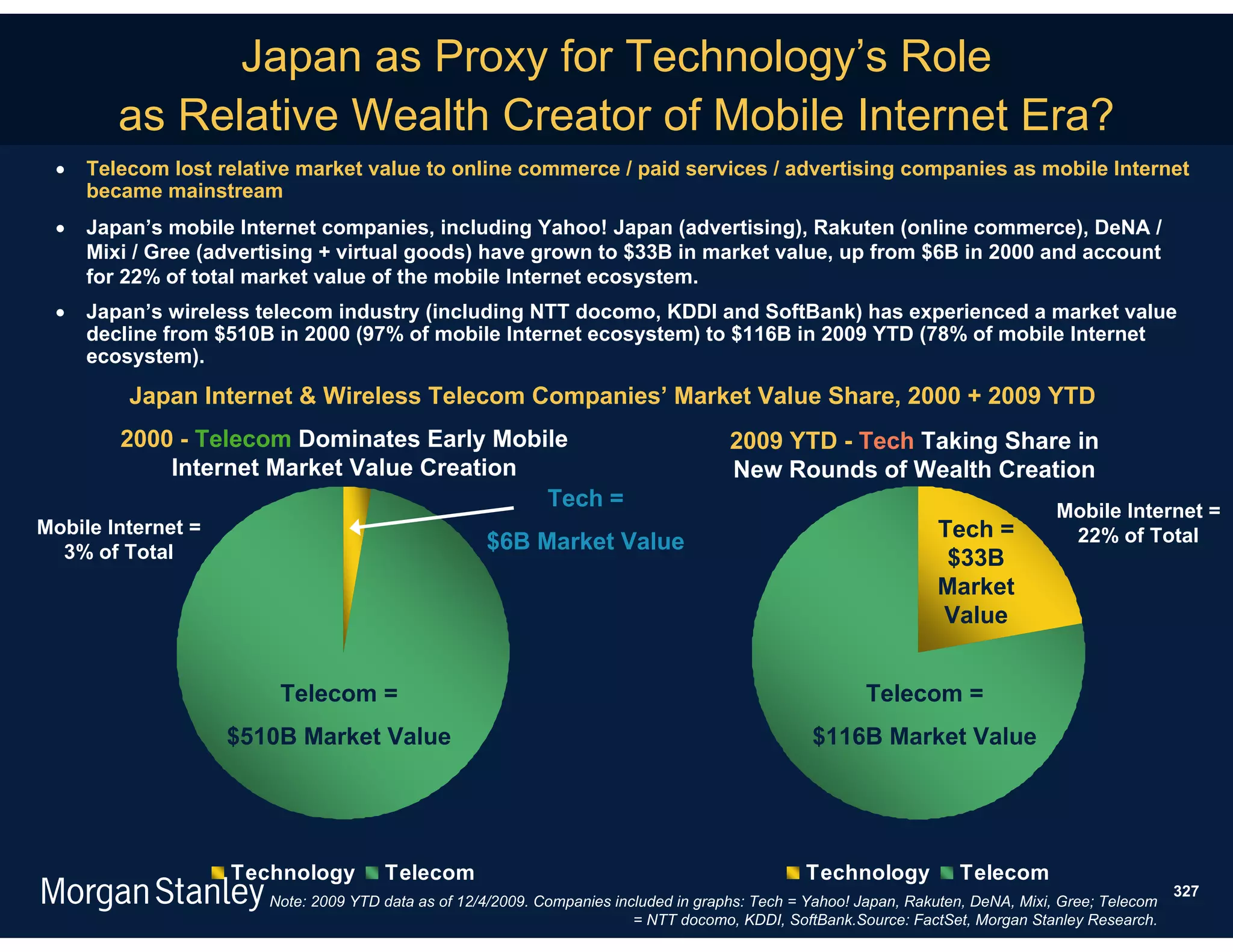
Japan as Proxy for Technology’s Role
        as Relative Wealth Creator of Mobile Internet Era?
    Telecom lost relative market value to online commerce / paid services / advertising companies as mobile Internet
     became mainstream
    Japan’s mobile Internet companies, including Yahoo! Japan (advertising), Rakuten (online commerce), DeNA /
     Mixi / Gree (advertising + virtual goods) have grown to $33B in market value, up from $6B in 2000 and account
     for 22% of total market value of the mobile Internet ecosystem.
    Japan’s wireless telecom industry (including NTT docomo, KDDI and SoftBank) has experienced a market value
     decline from $510B in 2000 (97% of mobile Internet ecosystem) to $116B in 2009 YTD (78% of mobile Internet
     ecosystem).
         Japan Internet & Wireless Telecom Companies’ Market Value Share, 2000 + 2009 YTD
        2000 - Telecom Dominates Early Mobile                                         2009 YTD - Tech Taking Share in
            Internet Market Value Creation                                            New Rounds of Wealth Creation
                                           Tech =                                                                                  Mobile Internet =
Mobile Internet =                                                                                                 Tech =            22% of Total
  3% of Total                                       $6B Market Value
                                                                                                                   $33B
                                                                                                                  Market
                                                                                                                  Value


                        Telecom =                                                                       Telecom =
                    $510B Market Value                                                           $116B Market Value


                    Technology        Telecom                                                   Technology           Telecom
                                                                                                                                                    38
                       Note: 2009 YTD data as of 12/4/2009. Companies included in graphs: Tech = Yahoo! Japan, Rakuten, DeNA, Mixi, Gree; Telecom
                                                                        = NTT docomo, KDDI, Softbank. Source: FactSet, Morgan Stanley Research.
Mobile Internet Likely to Follow Timing & Development
                     Patterns of Desktop Internet Market

Timing & Development of Internet Market Segment – From Our 1996 Internet Retailing Report


                                                                                      nt]
                                                                             s / C ns /
                                                                                  onte
                                                             s]


                                                                                  io
                                                        tform


                                                                      Ser pplicat
                                                   [Pla


                                                                         vice
                                                                         [A


                                                                                                    Mobile Internet
              2005               …              …                 …                  2011E        Timeline (ex. Japan)


                                                                                                                                                     39
                Note: Original chart (black text) from Morgan Stanley’s Internet Retailing Report, published in 1996. Red text augmented in 11/09.
                                                                                                                 Source: Morgan Stanley Research.
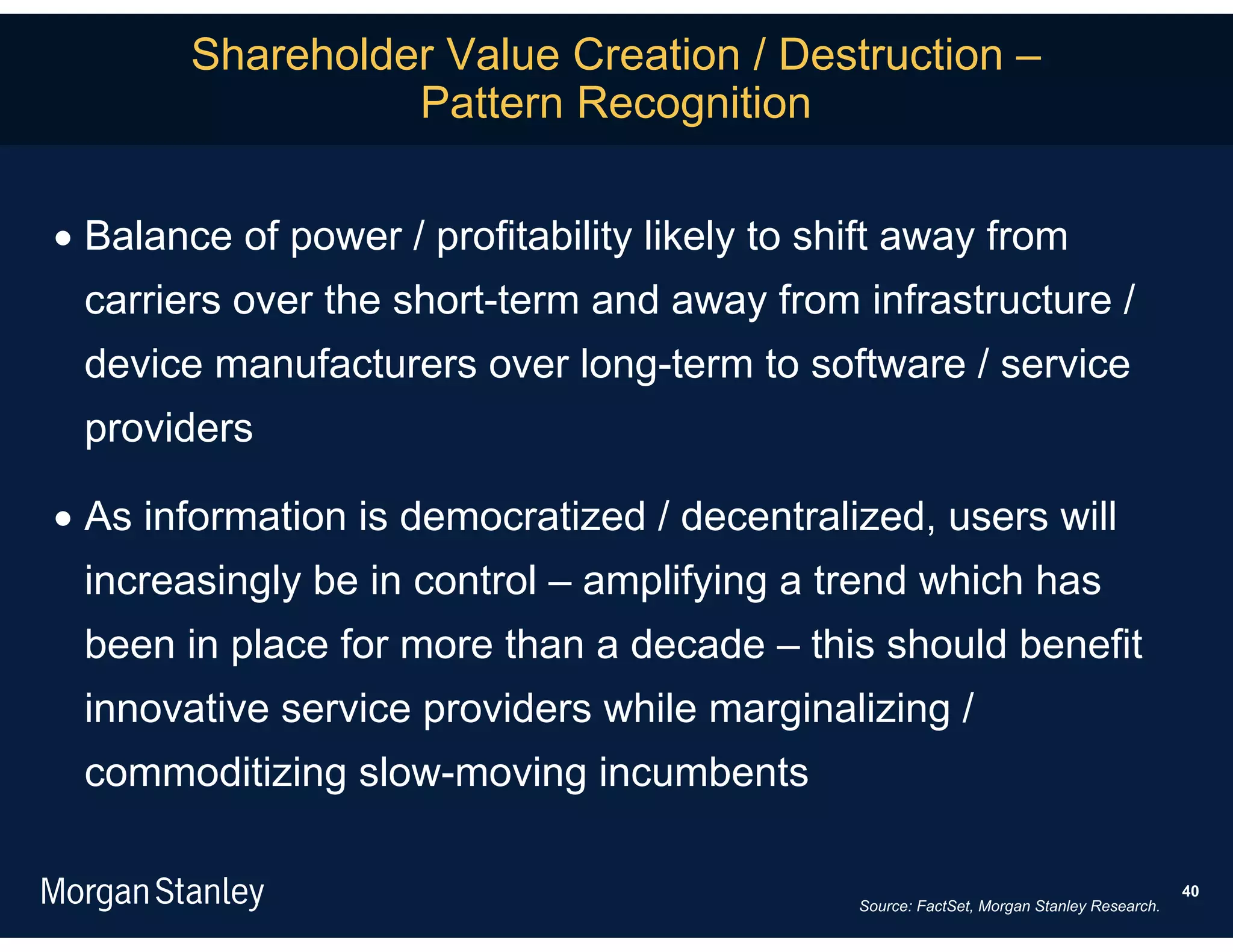
Shareholder Value Creation / Destruction –
                  Pattern Recognition

 Balance of power / profitability likely to shift away from
 carriers over the short-term and away from infrastructure /
 device manufacturers over long-term to software / service
 providers

 As information is democratized / decentralized, users will
 increasingly be in control – amplifying a trend which has
 been in place for more than a decade – this should benefit
 innovative service providers while marginalizing /
 commoditizing slow-moving incumbents

                                                                                           40
                                               Source: FactSet, Morgan Stanley Research.
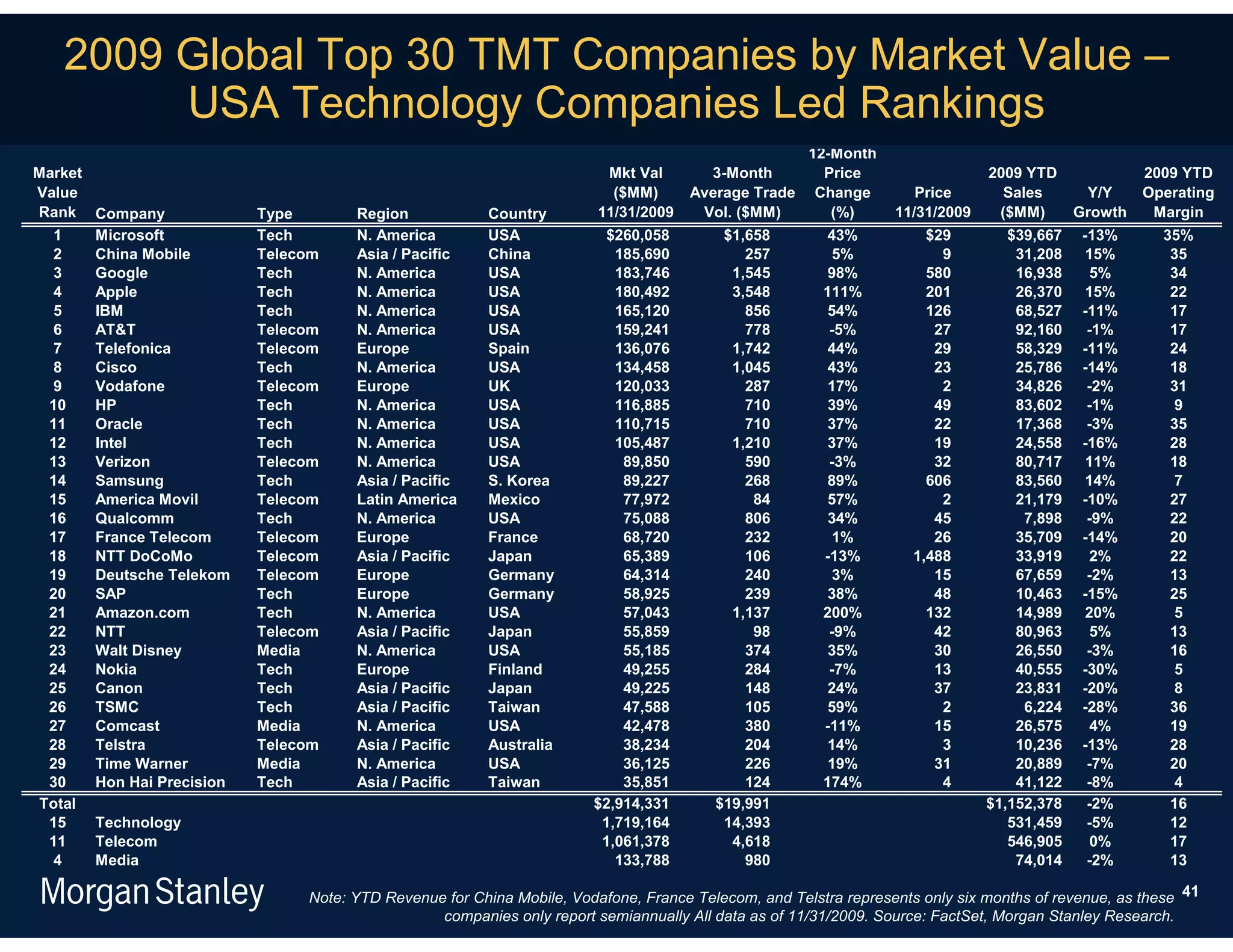
2009 Global Top 30 TMT Companies by Market Value –
        USA Technology Companies Led Rankings
                                                                                                     12-Month
Market                                                                   Mkt Val       3-Month         Price                  2009 YTD              2009 YTD
Value                                                                     ($MM)      Average Trade    Change        Price       Sales       Y/Y     Operating
Rank Company               Type       Region            Country         11/31/2009    Vol. ($MM)        (%)      11/31/2009    ($MM)       Growth    Margin
  1    Microsoft           Tech       N. America        USA             $260,058         $1,658        43%            $29        $39,667    -13%      35%
  2    China Mobile        Telecom    Asia / Pacific    China             185,690           257          5%             9         31,208     15%       35
  3    Google              Tech       N. America        USA               183,746         1,545         98%           580         16,938      5%       34
  4    Apple               Tech       N. America        USA               180,492         3,548        111%           201         26,370     15%       22
  5    IBM                 Tech       N. America        USA               165,120           856         54%           126         68,527    -11%       17
  6    AT&T                Telecom    N. America        USA               159,241           778         -5%            27         92,160     -1%       17
  7    Telefonica          Telecom    Europe            Spain             136,076         1,742         44%            29         58,329    -11%       24
  8    Cisco               Tech       N. America        USA               134,458         1,045         43%            23         25,786    -14%       18
  9    Vodafone            Telecom    Europe            UK                120,033           287         17%             2         34,826     -2%       31
 10    HP                  Tech       N. America        USA               116,885           710         39%            49         83,602     -1%        9
 11    Oracle              Tech       N. America        USA               110,715           710         37%            22         17,368     -3%       35
 12    Intel               Tech       N. America        USA               105,487         1,210         37%            19         24,558    -16%       28
 13    Verizon             Telecom    N. America        USA                89,850           590         -3%            32         80,717     11%       18
 14    Samsung             Tech       Asia / Pacific    S. Korea           89,227           268         89%           606         83,560     14%        7
 15    America Movil       Telecom    Latin America     Mexico             77,972            84         57%             2         21,179    -10%       27
 16    Qualcomm            Tech       N. America        USA                75,088           806         34%            45          7,898     -9%       22
 17    France Telecom      Telecom    Europe            France             68,720           232          1%            26         35,709    -14%       20
 18    NTT DoCoMo          Telecom    Asia / Pacific    Japan              65,389           106        -13%         1,488         33,919      2%       22
 19    Deutsche Telekom    Telecom    Europe            Germany            64,314           240          3%            15         67,659     -2%       13
 20    SAP                 Tech       Europe            Germany            58,925           239         38%            48         10,463    -15%       25
 21    Amazon.com          Tech       N. America        USA                57,043         1,137        200%           132         14,989     20%        5
 22    NTT                 Telecom    Asia / Pacific    Japan              55,859            98         -9%            42         80,963      5%       13
 23    Walt Disney         Media      N. America        USA                55,185           374         35%            30         26,550     -3%       16
 24    Nokia               Tech       Europe            Finland            49,255           284         -7%            13         40,555    -30%        5
 25    Canon               Tech       Asia / Pacific    Japan              49,225           148         24%            37         23,831    -20%        8
 26    TSMC                Tech       Asia / Pacific    Taiwan             47,588           105         59%             2          6,224    -28%       36
 27    Comcast             Media      N. America        USA                42,478           380        -11%            15         26,575      4%       19
 28    Telstra             Telecom    Asia / Pacific    Australia          38,234           204         14%             3         10,236    -13%       28
 29    Time Warner         Media      N. America        USA                36,125           226         19%            31         20,889     -7%       20
 30    Hon Hai Precision   Tech       Asia / Pacific    Taiwan             35,851           124        174%             4         41,122     -8%        4
Total                                                                  $2,914,331       $19,991                               $1,152,378     -2%       16
 15    Technology                                                       1,719,164        14,393                                  531,459     -5%       12
 11    Telecom                                                          1,061,378         4,618                                  546,905      0%       17
  4    Media                                                              133,788           980                                   74,014     -2%       13

                                Note: YTD Revenue for China Mobile, Vodafone, France Telecom, and Telstra represents only six months of revenue, as these 41
                                                 companies only report semiannually All data as of 11/31/2009. Source: FactSet, Morgan Stanley Research.
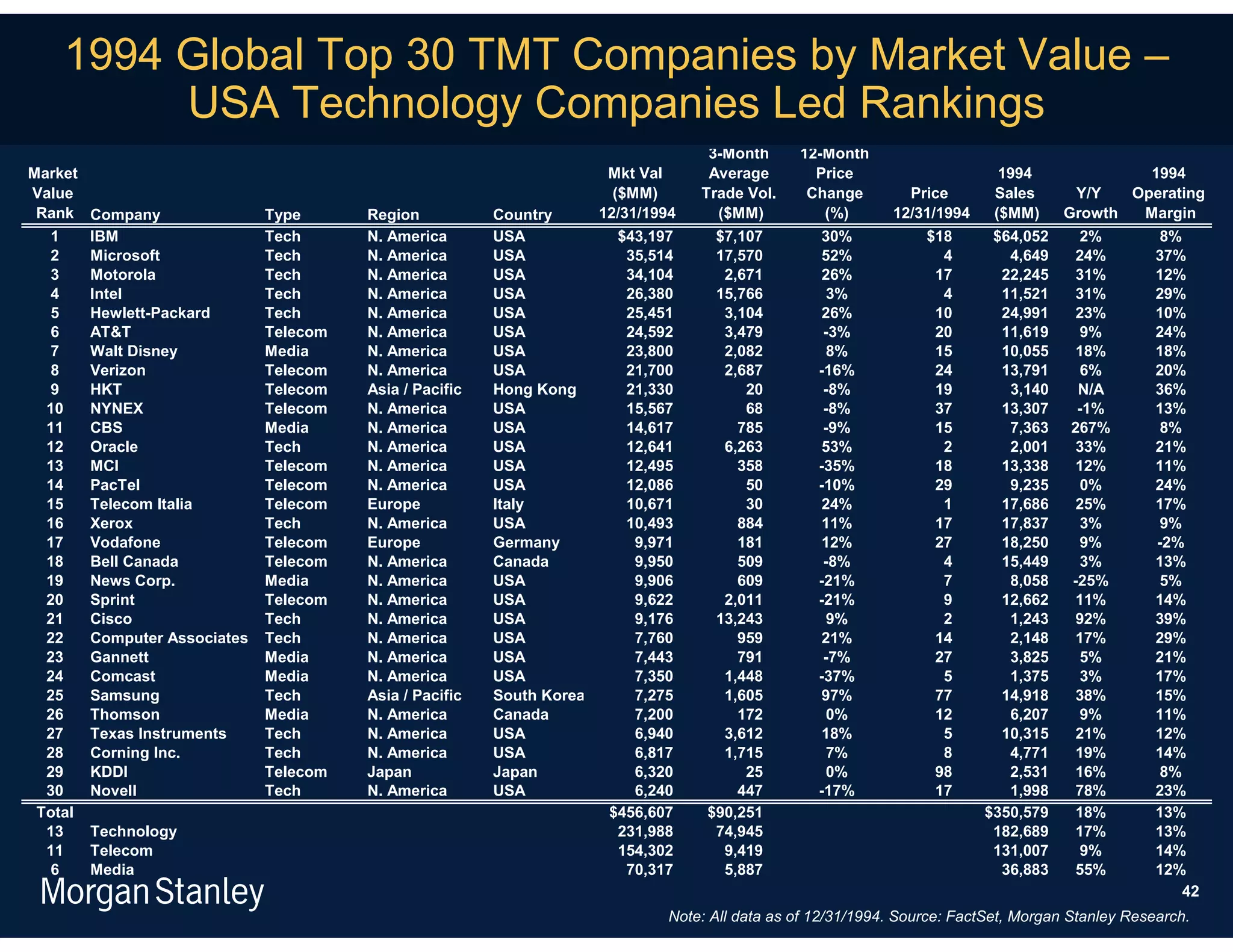
1994 Global Top 30 TMT Companies by Market Value –
         USA Technology Companies Led Rankings
                                                                                    3-Month      12-Month
Market                                                                 Mkt Val      Average        Price                      1994              1994
Value                                                                   ($MM)      Trade Vol.     Change        Price        Sales      Y/Y   Operating
 Rank Company                Type      Region           Country       12/31/1994     ($MM)          (%)       12/31/1994     ($MM)     Growth  Margin
   1   IBM                   Tech      N. America       USA             $43,197      $7,107         30%            $18      $64,052      2%         8%
   2   Microsoft             Tech      N. America       USA              35,514      17,570         52%              4        4,649      24%        37%
   3   Motorola              Tech      N. America       USA              34,104       2,671          26%            17       22,245      31%        12%
   4   Intel                 Tech      N. America       USA              26,380      15,766          3%              4       11,521      31%        29%
   5   Hewlett-Packard       Tech      N. America       USA              25,451       3,104          26%            10       24,991      23%        10%
   6   AT&T                  Telecom   N. America       USA              24,592       3,479          -3%            20       11,619       9%        24%
   7   Walt Disney           Media     N. America       USA              23,800       2,082          8%             15       10,055      18%        18%
   8   Verizon               Telecom   N. America       USA              21,700       2,687         -16%            24       13,791       6%        20%
   9   HKT                   Telecom   Asia / Pacific   Hong Kong        21,330          20          -8%            19        3,140      N/A        36%
  10   NYNEX                 Telecom   N. America       USA              15,567          68          -8%            37       13,307      -1%        13%
  11   CBS                   Media     N. America       USA              14,617         785          -9%            15        7,363     267%         8%
  12   Oracle                Tech      N. America       USA              12,641       6,263          53%             2        2,001      33%        21%
  13   MCI                   Telecom   N. America       USA              12,495         358         -35%            18       13,338      12%        11%
  14   PacTel                Telecom   N. America       USA              12,086          50         -10%            29        9,235       0%        24%
  15   Telecom Italia        Telecom   Europe           Italy            10,671          30          24%             1       17,686      25%        17%
  16   Xerox                 Tech      N. America       USA              10,493         884          11%            17       17,837       3%         9%
  17   Vodafone              Telecom   Europe           Germany           9,971         181         12%             27       18,250      9%         -2%
  18   Bell Canada           Telecom   N. America       Canada            9,950         509          -8%             4       15,449      3%         13%
  19   News Corp.            Media     N. America       USA               9,906         609         -21%             7        8,058     -25%        5%
  20   Sprint                Telecom   N. America       USA               9,622       2,011         -21%             9       12,662      11%        14%
  21   Cisco                 Tech      N. America       USA               9,176      13,243          9%              2        1,243      92%        39%
  22   Computer Associates   Tech      N. America       USA               7,760         959         21%             14        2,148      17%        29%
  23   Gannett               Media     N. America       USA               7,443         791          -7%            27        3,825       5%        21%
  24   Comcast               Media     N. America       USA               7,350       1,448         -37%             5        1,375       3%        17%
  25   Samsung               Tech      Asia / Pacific   South Korea       7,275       1,605         97%             77       14,918      38%        15%
  26   Thomson               Media     N. America       Canada            7,200         172          0%             12        6,207       9%        11%
  27   Texas Instruments     Tech      N. America       USA               6,940       3,612         18%              5       10,315      21%        12%
  28   Corning Inc.          Tech      N. America       USA               6,817       1,715          7%              8        4,771      19%        14%
  29   KDDI                  Telecom   Japan            Japan             6,320          25          0%             98        2,531     16%         8%
  30   Novell                Tech      N. America       USA               6,240         447         -17%            17        1,998      78%        23%
 Total                                                                 $456,607     $90,251                                $350,579      18%        13%
  13   Technology                                                       231,988      74,945                                 182,689      17%        13%
  11   Telecom                                                          154,302       9,419                                 131,007       9%        14%
   6   Media                                                             70,317       5,887                                  36,883      55%        12%
                                                                                                                                                        42
                                                                               Note: All data as of 12/31/1994. Source: FactSet, Morgan Stanley Research.
Key Theme #2


               43
Key Theme #2

1) Wealth Creation / Destruction is Material in New Computing Cycles – Now in
   Early Innings of Mobile Internet Cycle, the 5th Cycle of Last Half Century.
2) Mobile Ramping Faster than Desktop Internet Did and Will Be Bigger Than
   Most Think – 5 Trends Converging (3G + Social Networking + Video + VoIP +
   Impressive Mobile Devices).
3) Apple Leading in Mobile Innovation + Impact, for Now – Depth of App
   Ecosystems + User Experience + Pricing Will Likely Determine Long-Term
   Winners.
4) Game-Changing Communications / Commerce Platforms (Social Networking +
   Mobile) Emerging Very Rapidly.
5) Growth / Monetization Roadmaps Provided by Japan Mobile + Desktop
   Internet.
6) Massive Data Growth Driving Carrier / Equipment Transitions.
7) Compelling Opportunities in Emerging Markets.
8) Regulators Can Help Advance / Slow Mobile Internet Evolution.
                                                                                 44
Key Theme #2 –
  Mobile Ramping Faster than Desktop Internet Did and Will Be Bigger Than Most Think –
5 Trends Converging (3G + Social Networking + Video + VoIP + Impressive Mobile Devices)


      The explosive Apple iPhone / iTouch ramp shows us that
      usage of mobile devices on IP-based networks should
      surprise to the upside for years to come. 3G adoption is
      hitting inflection points across many markets, enabling
      consumers to engage in a broad range of IP-based usage
      models (social networking / VoIP / video) via powerful
      mobile Internet-enabled devices.


                                                                                    45
Mobile Ramping Faster than Desktop Internet Did and Will Be Bigger
 Than Most Think – 5 Trends Converging (3G + Social Networking +
            Video + VoIP + Impressive Mobile Devices)
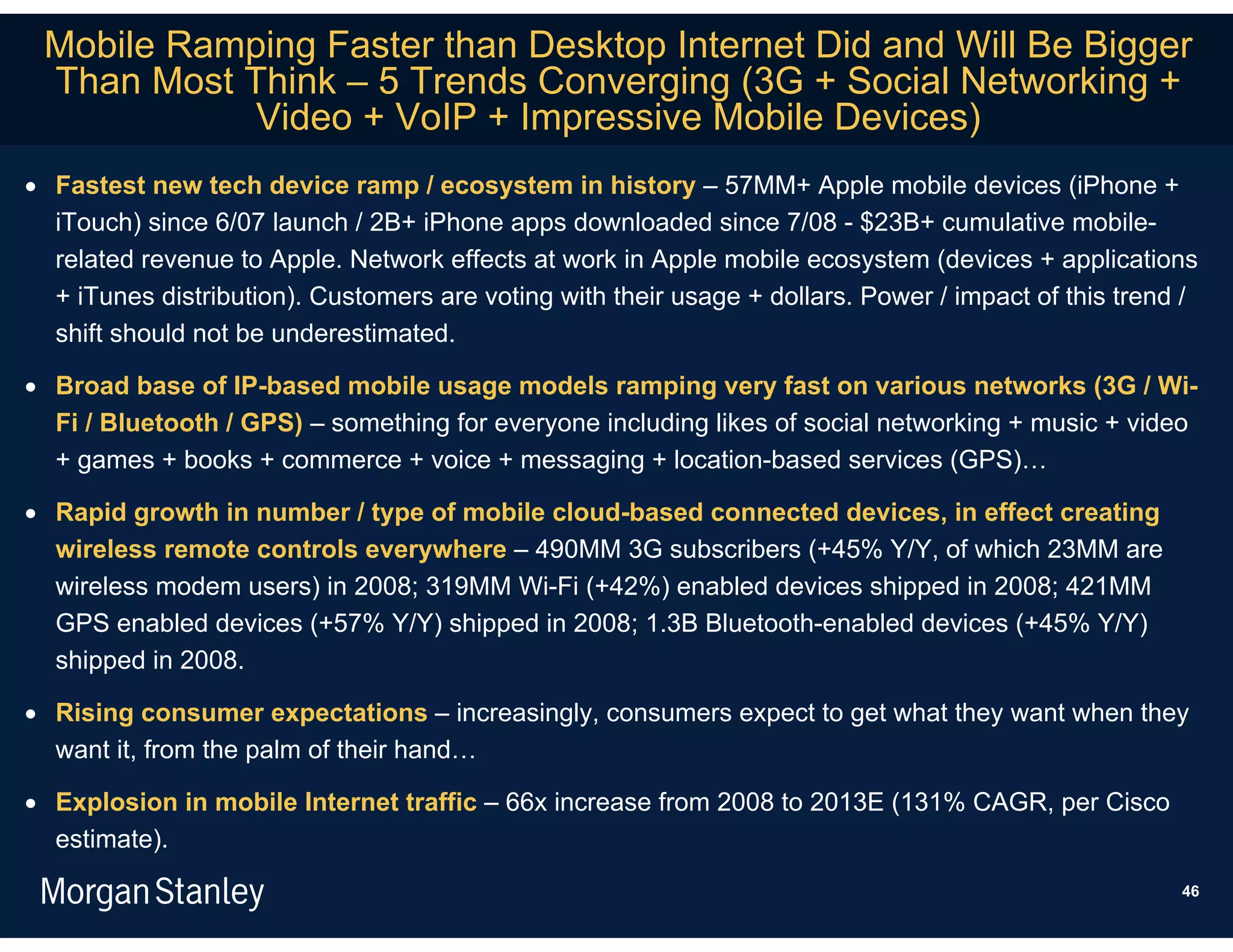
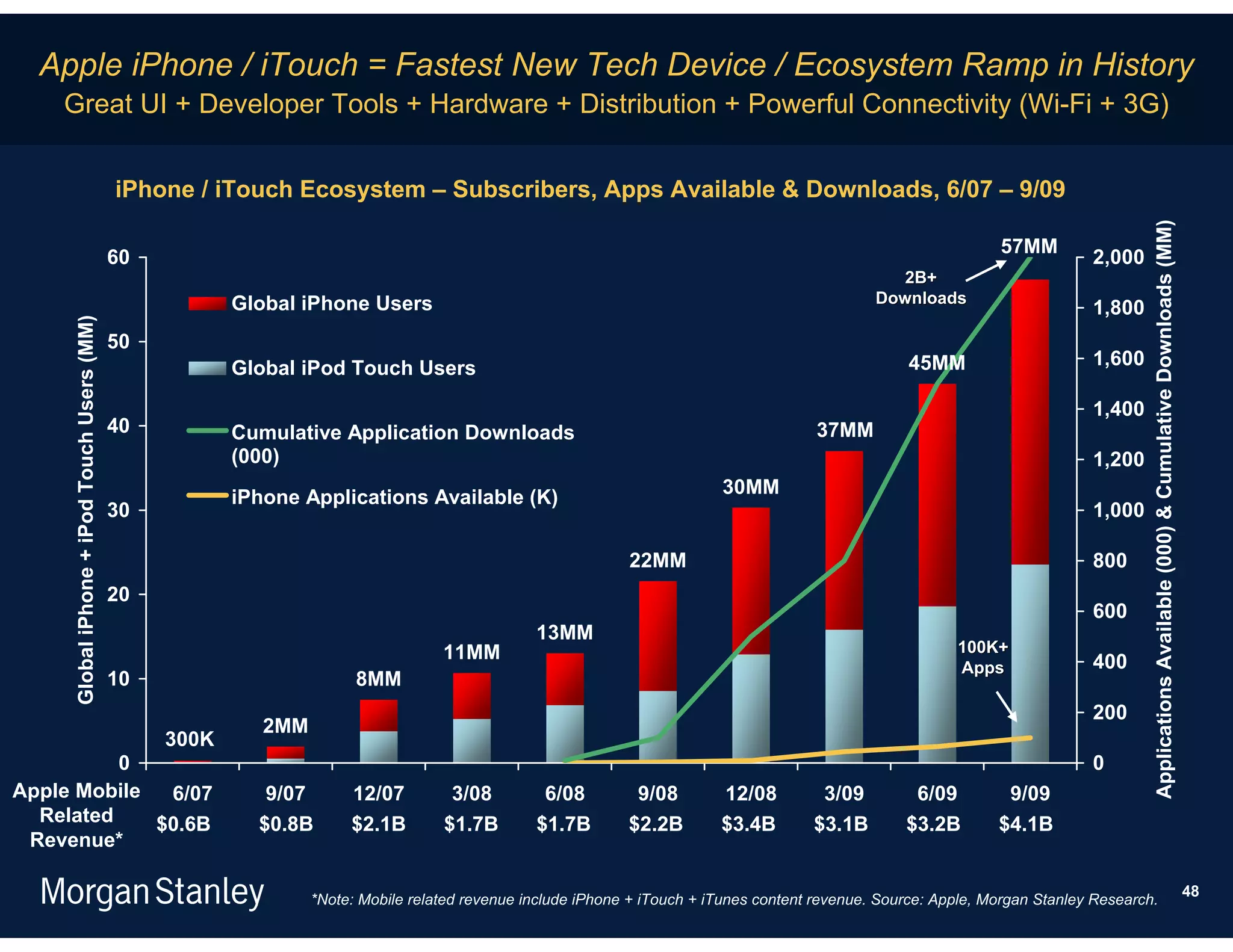
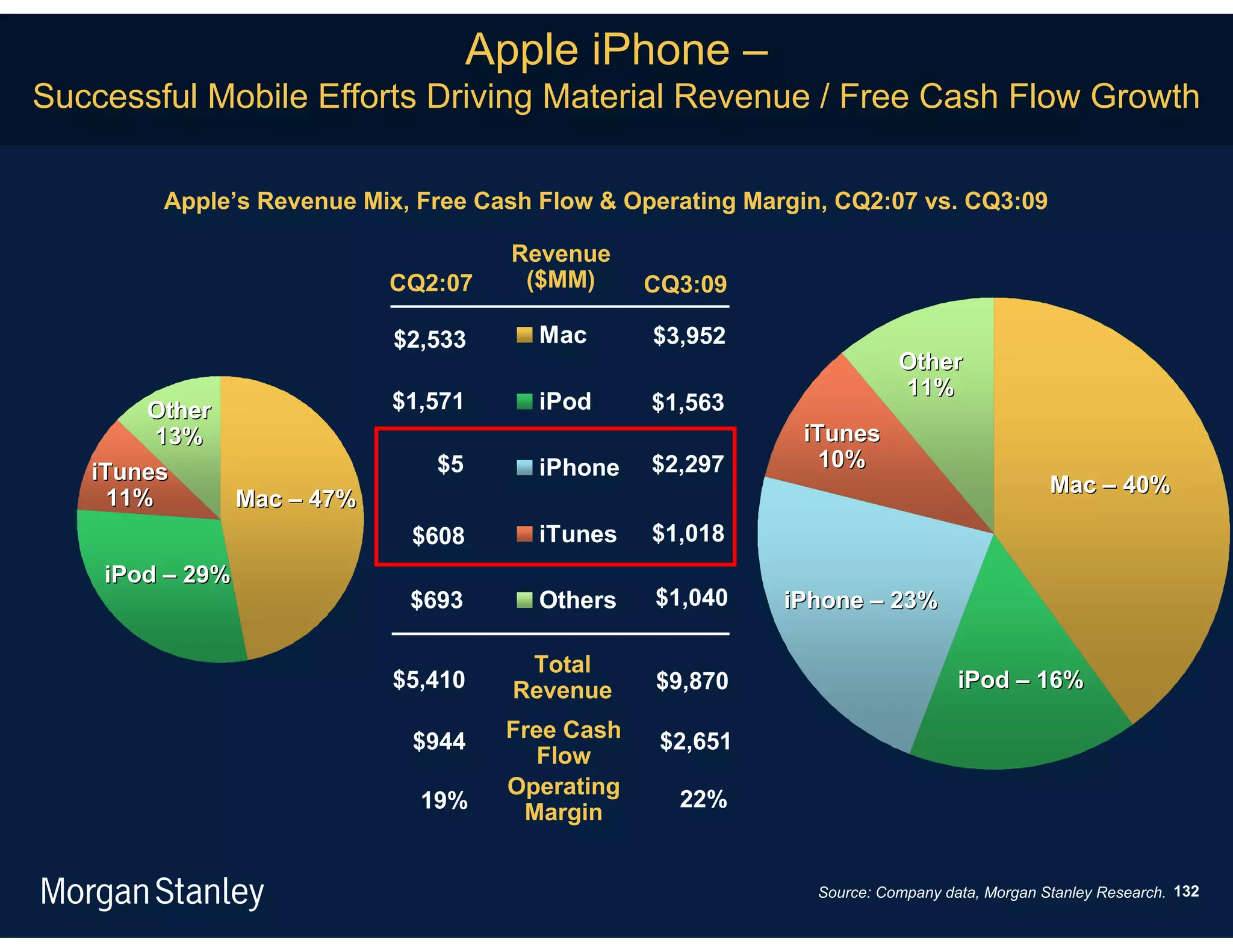
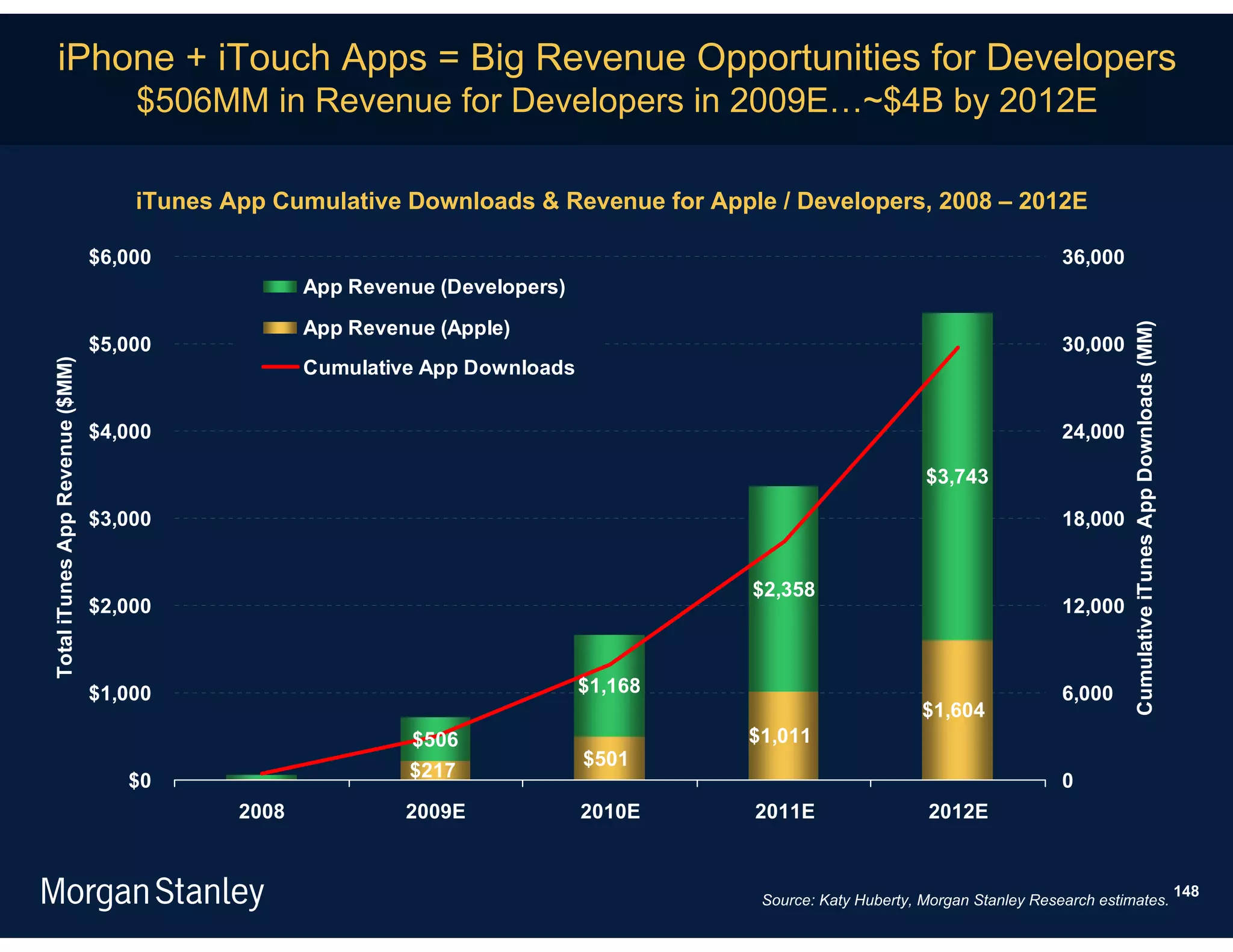
 Fastest new tech device ramp / ecosystem in history – 57MM+ Apple mobile devices (iPhone +
  iTouch) since 6/07 launch / 2B+ iPhone apps downloaded since 7/08 - $23B+ cumulative mobile-
  related revenue to Apple. Network effects at work in Apple mobile ecosystem (devices + applications
  + iTunes distribution). Customers are voting with their usage + dollars. Power / impact of this trend /
  shift should not be underestimated.

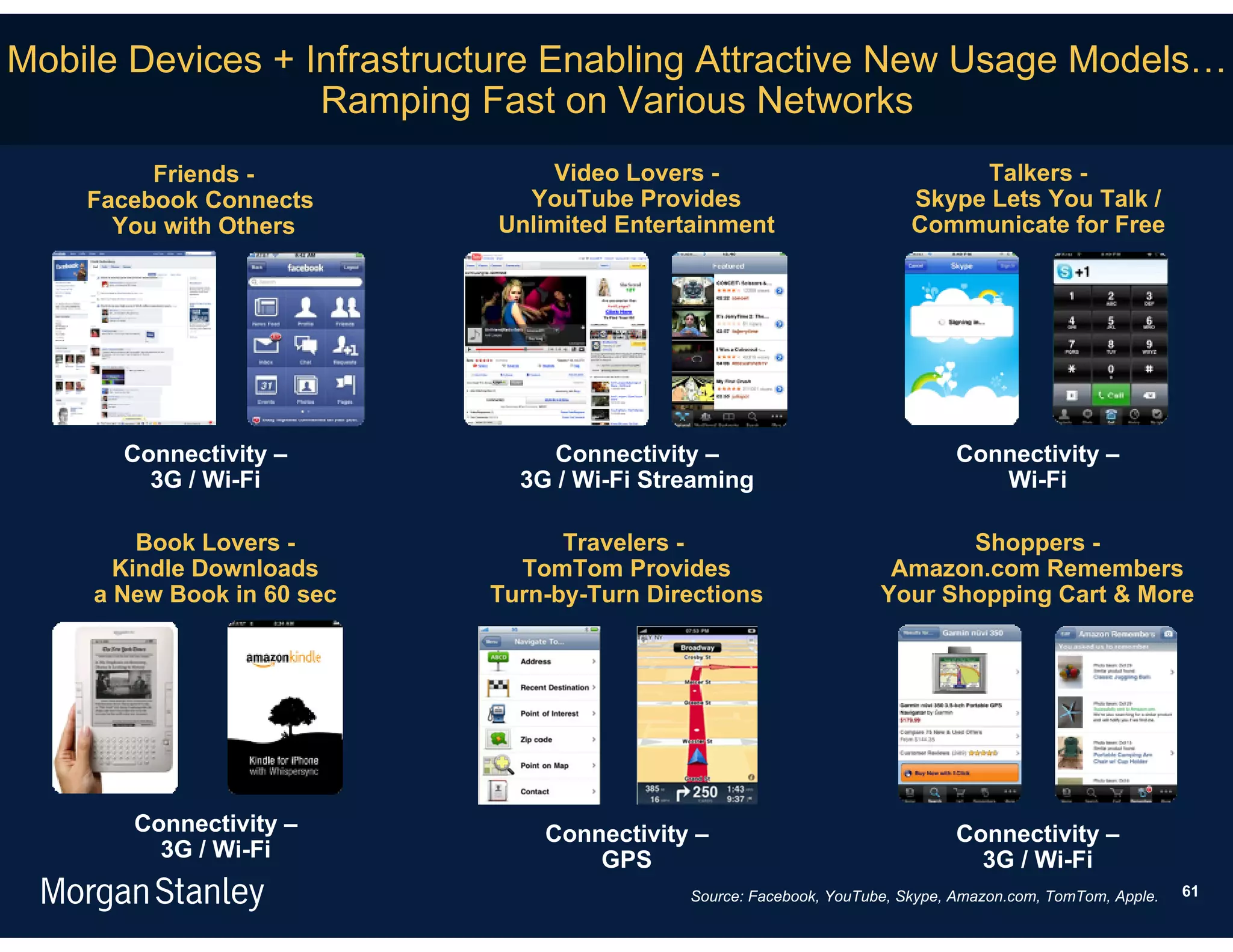
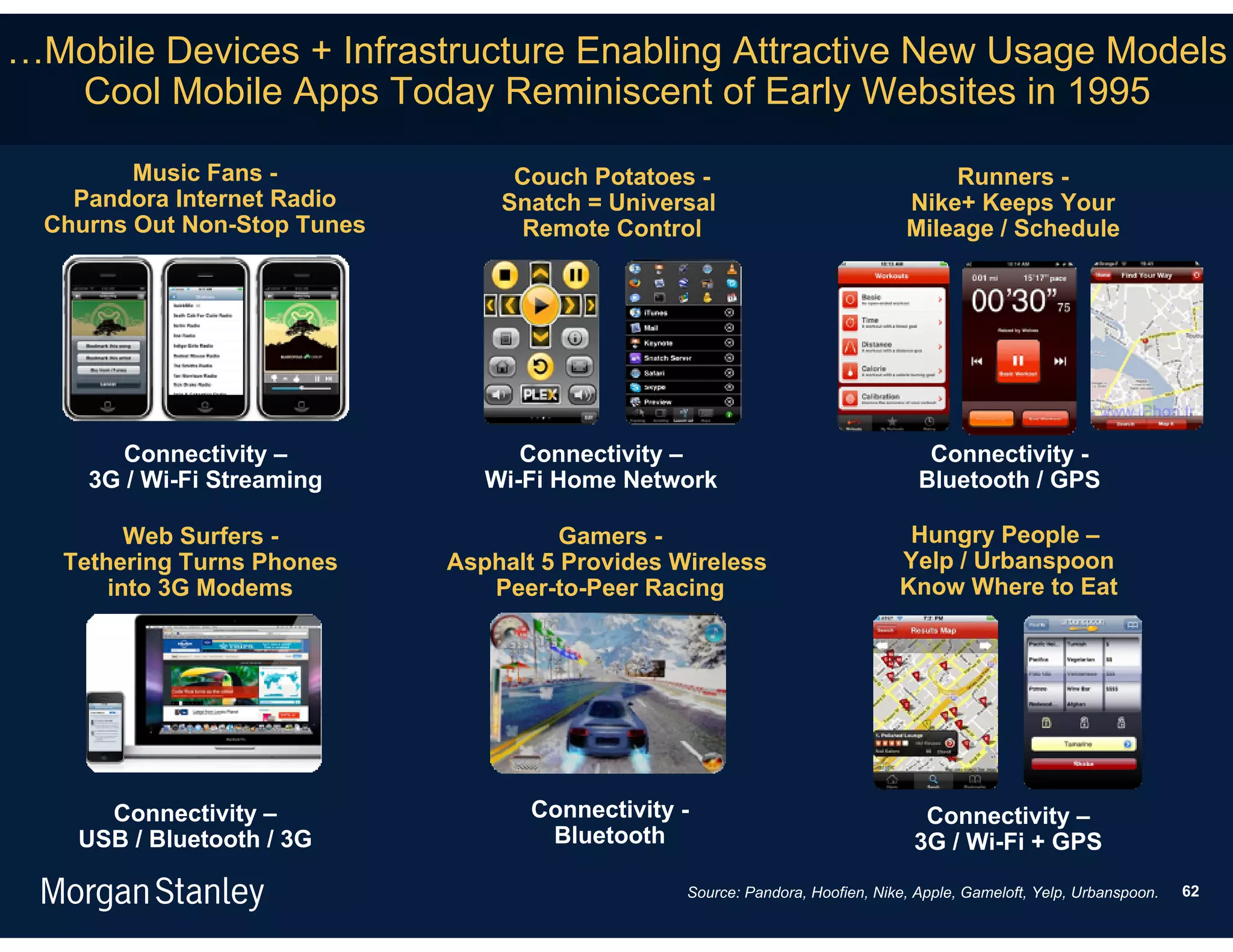
 Broad base of IP-based mobile usage models ramping very fast on various networks (3G / Wi-
  Fi / Bluetooth / GPS) – something for everyone including likes of social networking + music + video
  + games + books + commerce + voice + messaging + location-based services (GPS)…

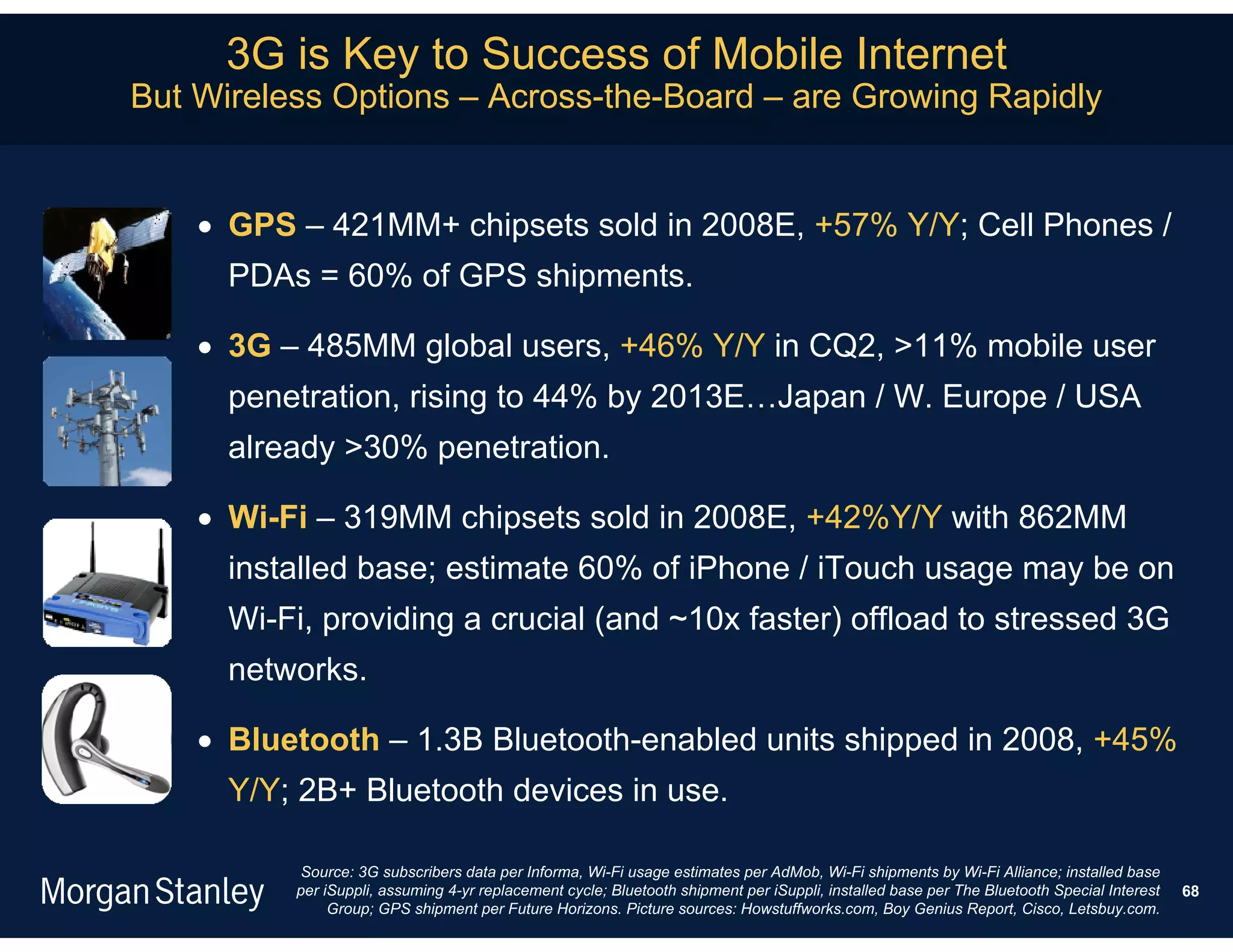
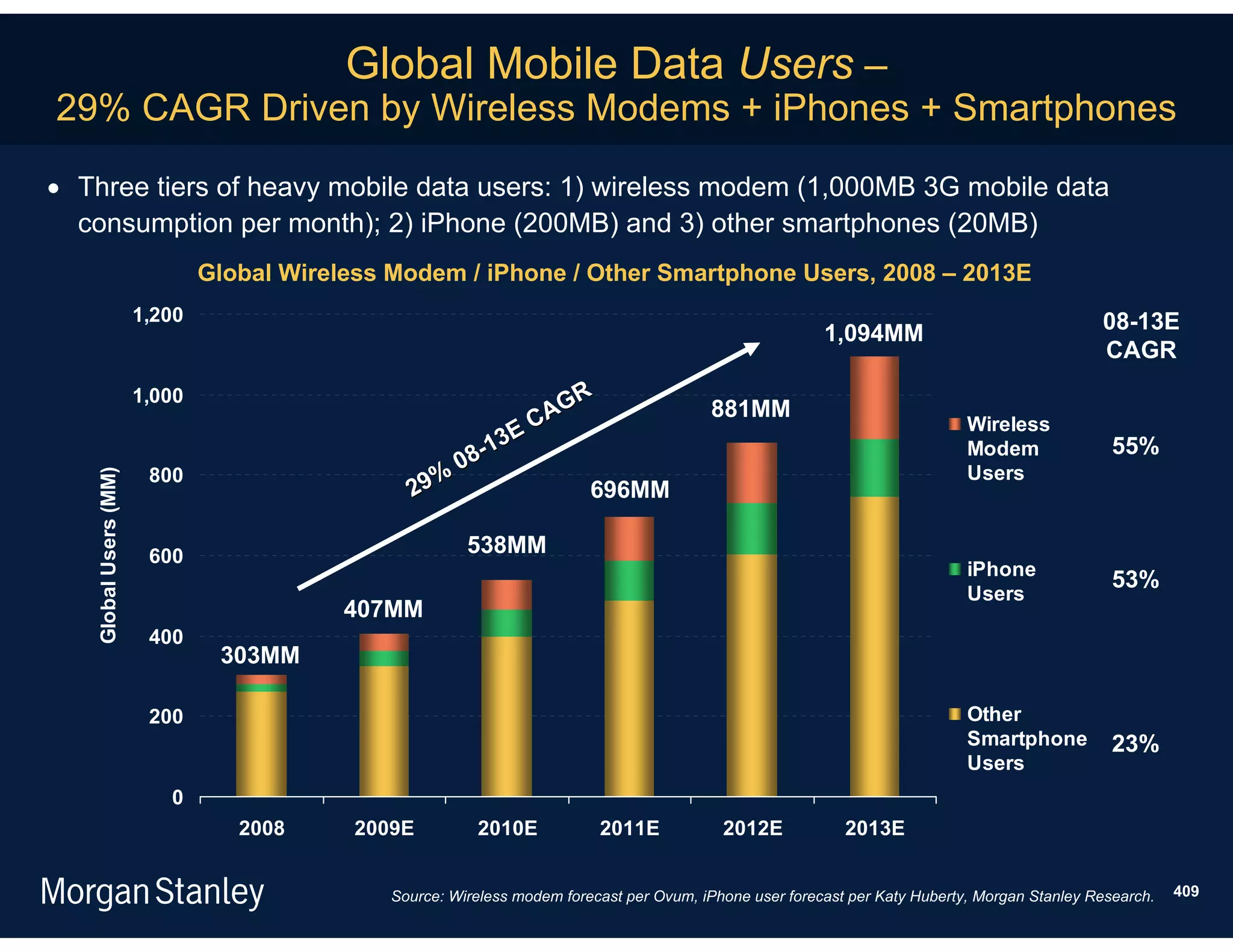
 Rapid growth in number / type of mobile cloud-based connected devices, in effect creating
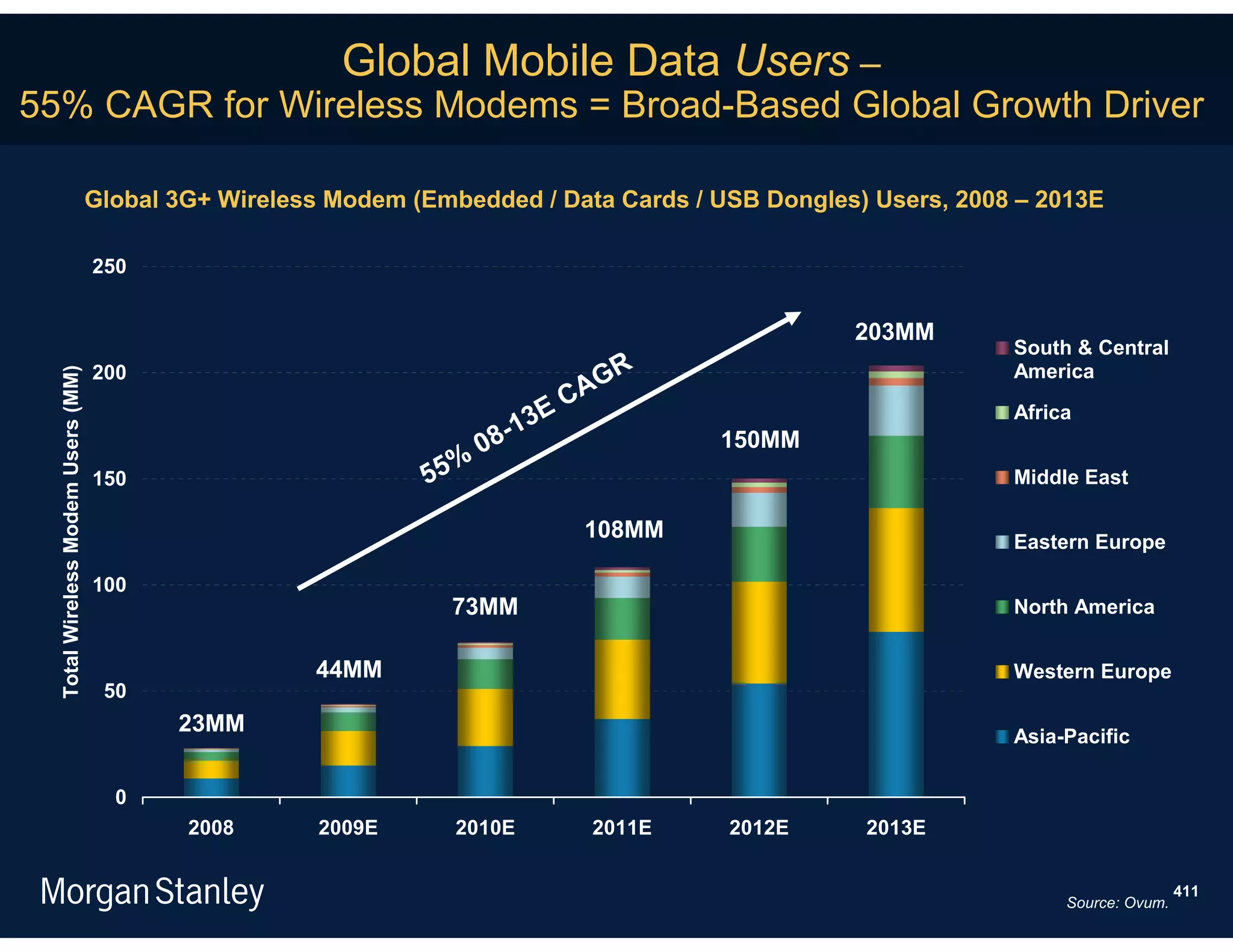
  wireless remote controls everywhere – 490MM 3G subscribers (+45% Y/Y, of which 23MM are
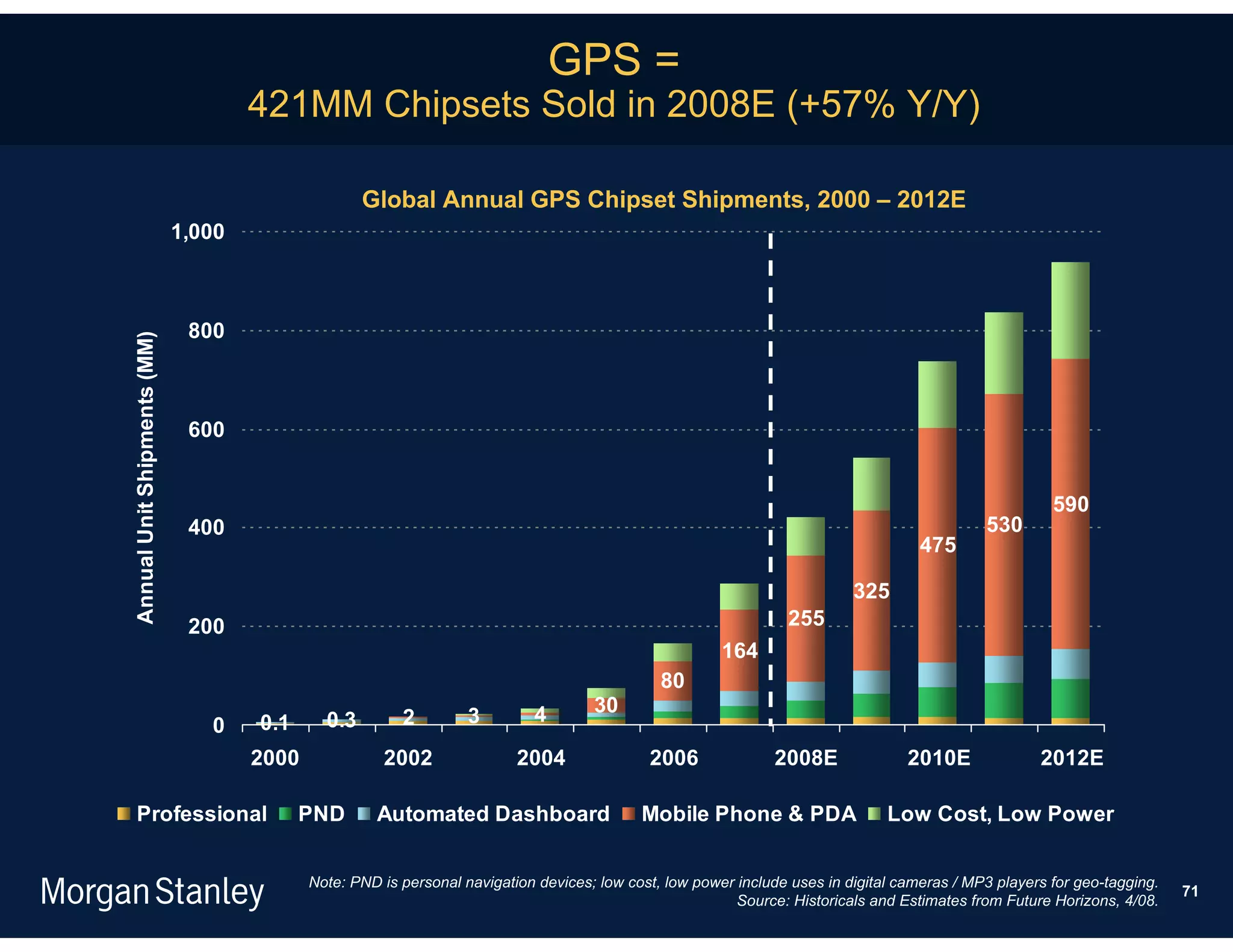
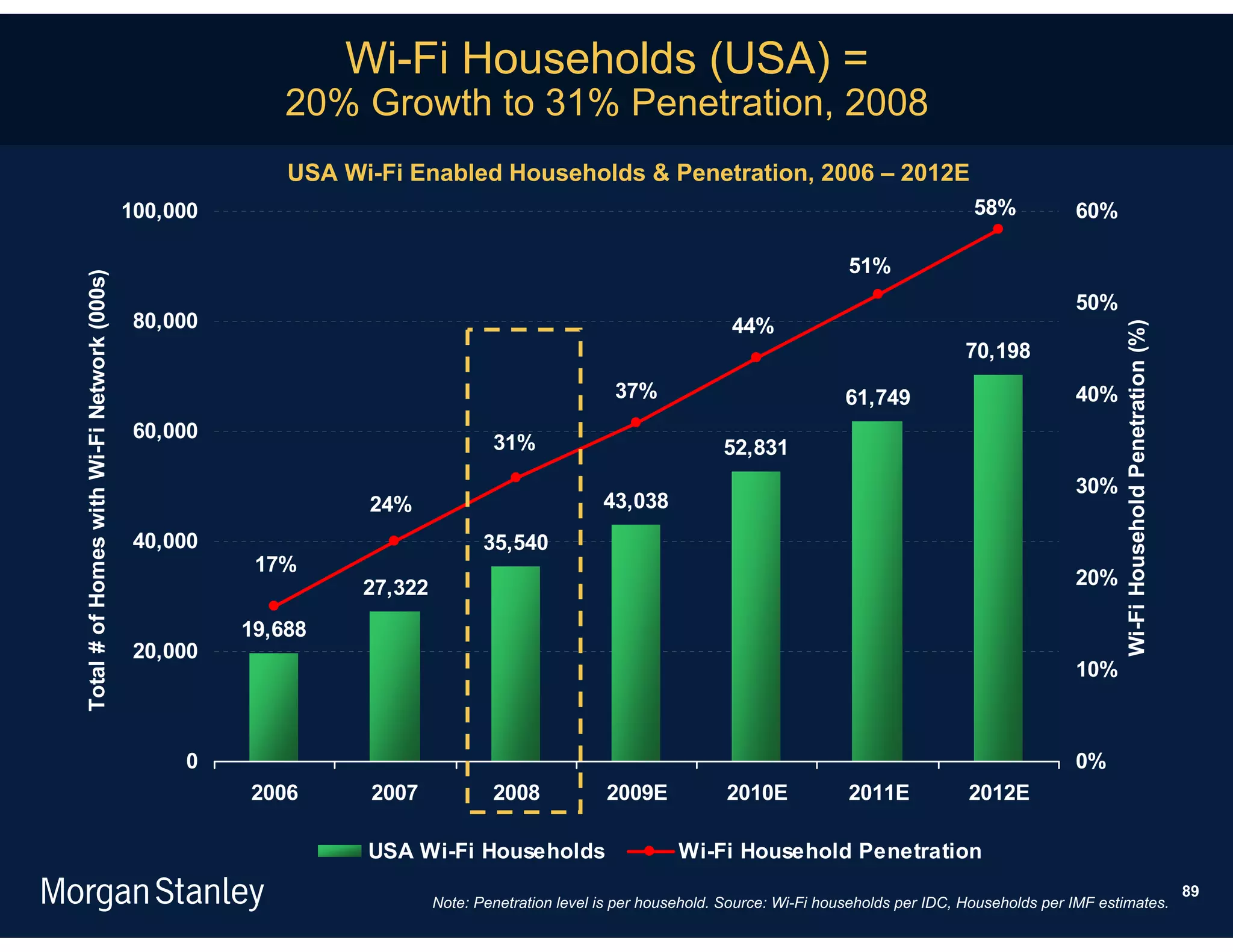
  wireless modem users) in 2008; 319MM Wi-Fi (+42%) enabled devices shipped in 2008; 421MM
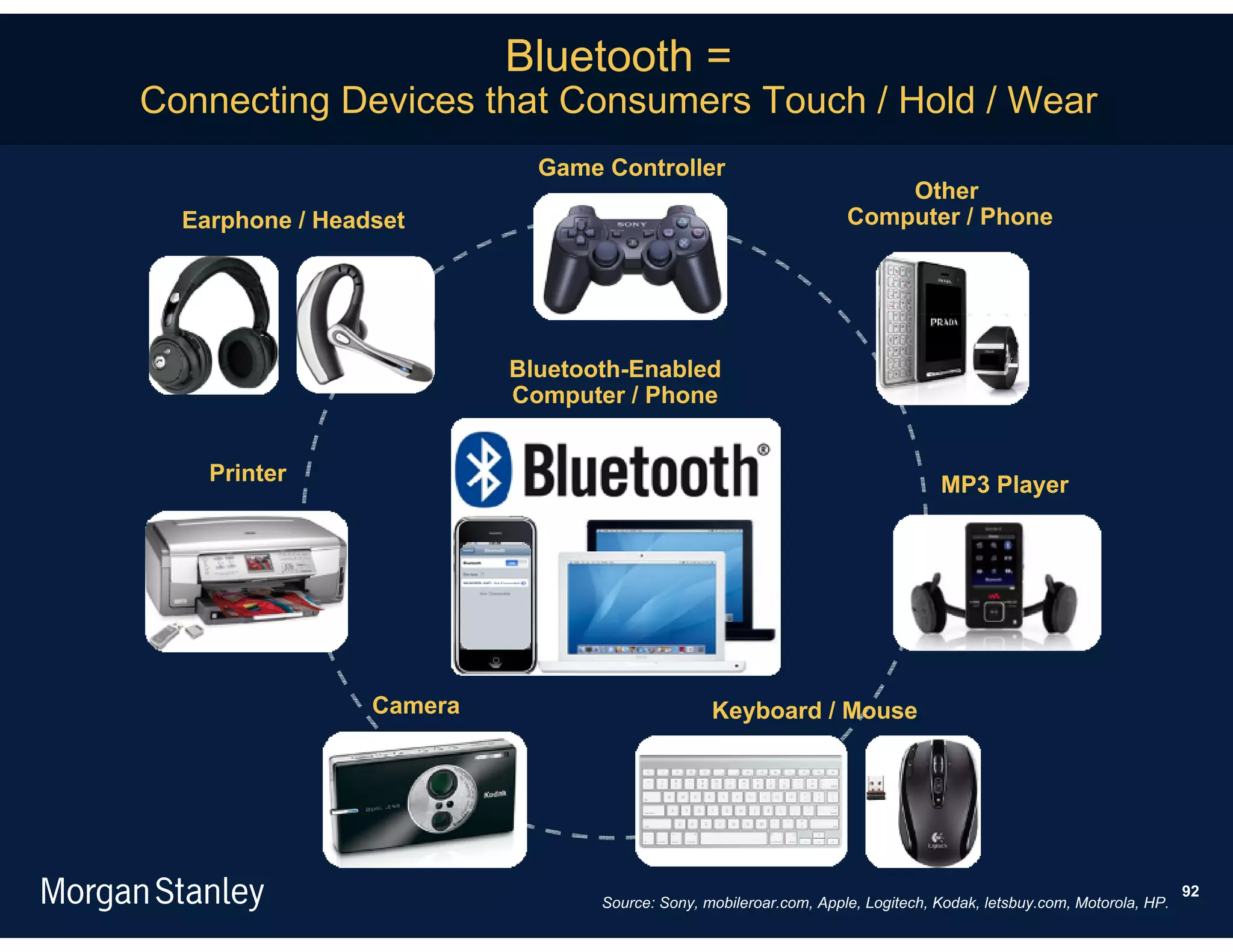
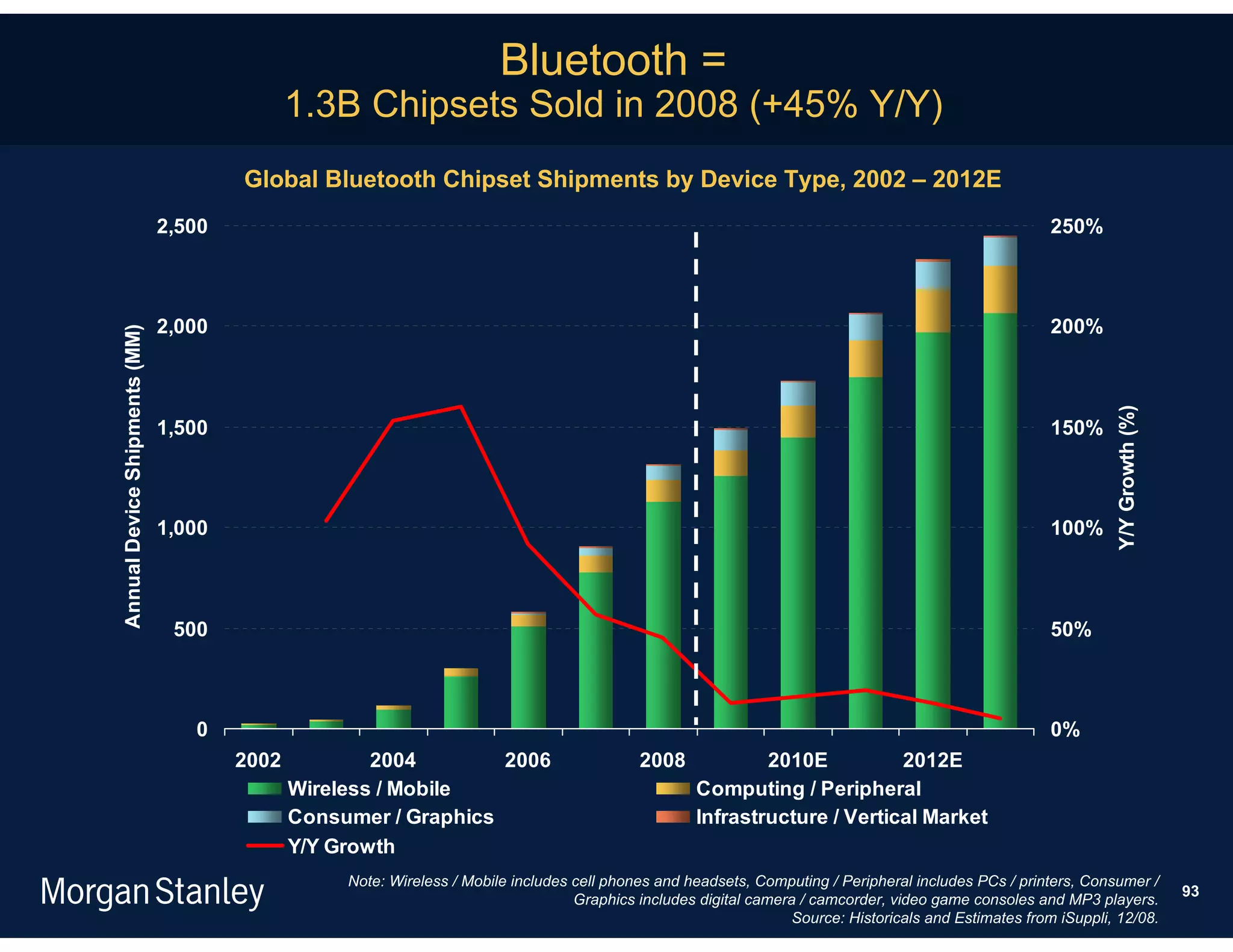
  GPS enabled devices (+57% Y/Y) shipped in 2008; 1.3B Bluetooth-enabled devices (+45% Y/Y)
  shipped in 2008.

 Rising consumer expectations – increasingly, consumers expect to get what they want when they
  want it, from the palm of their hand…

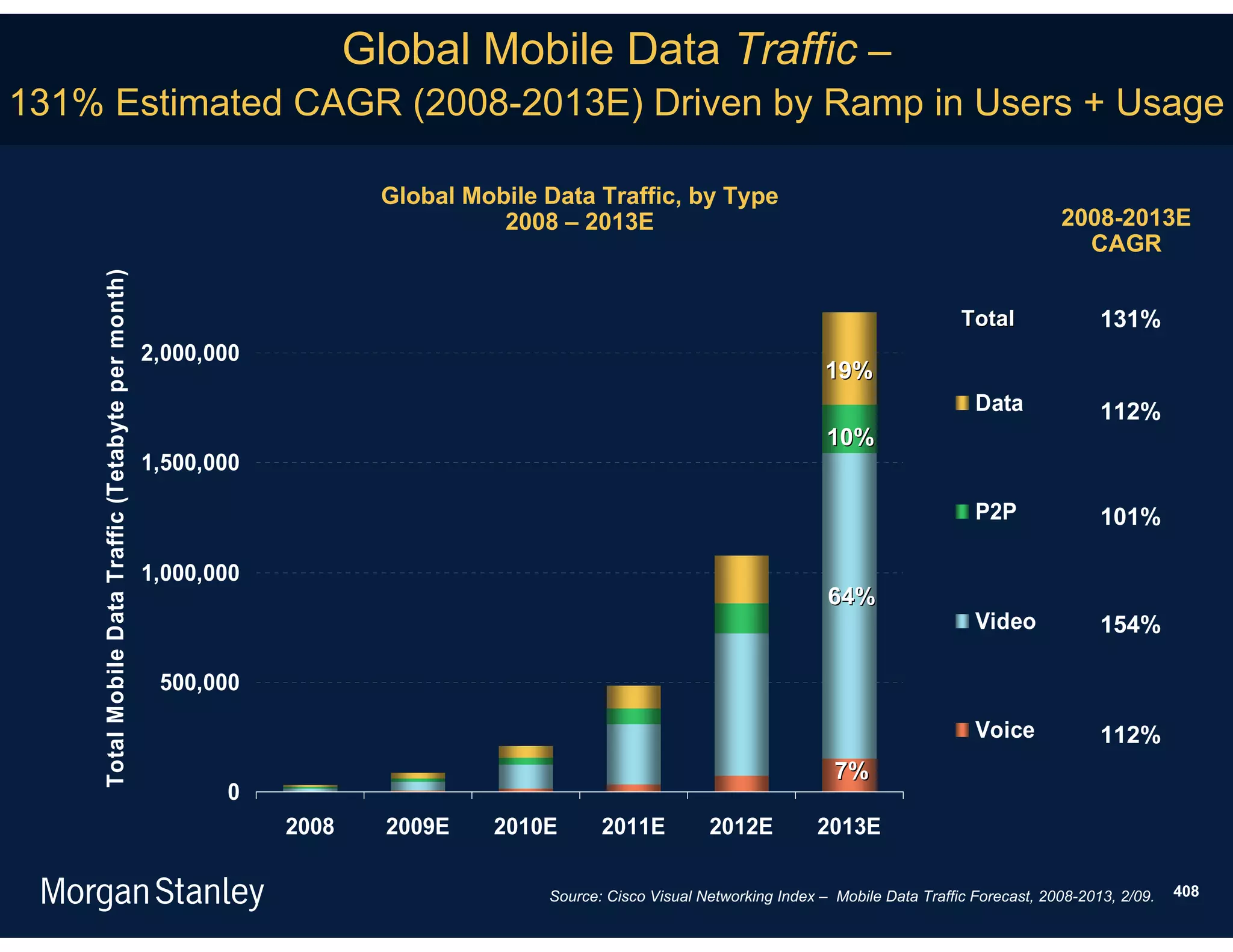
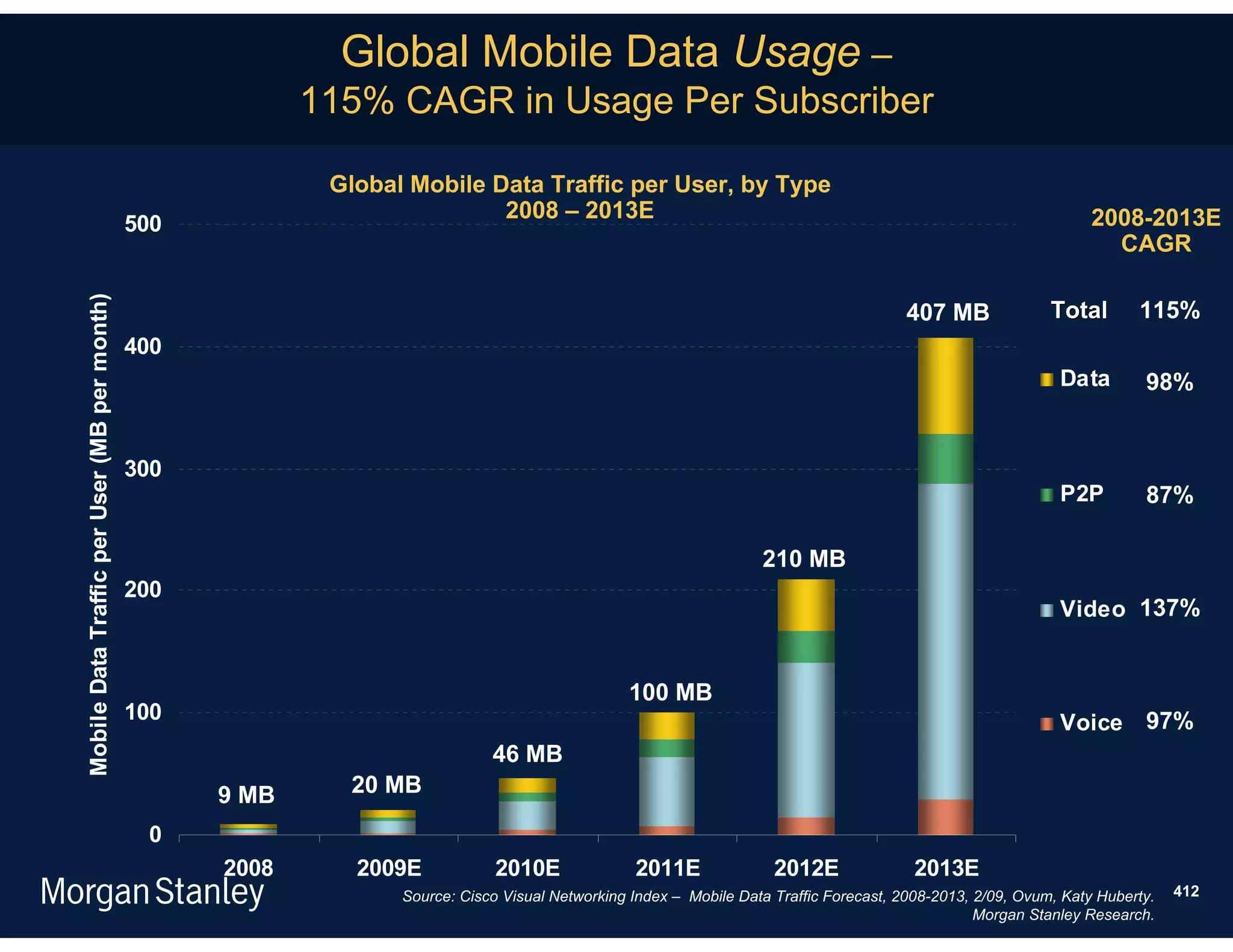
 Explosion in mobile Internet traffic – 66x increase from 2008 to 2013E (131% CAGR, per Cisco
  estimate).
                                                                                                       46
Apple iPhone + iTouch = Fastest new tech device ramp /
 ecosystem in history. Customers are voting with their
  usage + dollars. Power / impact of this trend / shift
            should not be underestimated


                                                      47
Apple iPhone / iTouch = Fastest New Tech Device / Ecosystem Ramp in History
    Great UI + Developer Tools + Hardware + Distribution + Powerful Connectivity (Wi-Fi + 3G)


                                             iPhone / iTouch Ecosystem – Subscribers, Apps Available & Downloads, 6/07 – 9/09


                                                                                                                                                                                        Applications Available (000) & Cumulative Downloads (MM)
                                                                                                                                                                  57MM
                                             60                                                                                                                                2,000
                                                                                                                                                    2B+
                                                         Global iPhone Users                                                                     Downloads
                                                                                                                                                                               1,800
     Global iPhone + iPod Touch Users (MM)


                                             50
                                                         Global iPod Touch Users                                                                     45MM                      1,600

                                                                                                                                                                               1,400
                                             40          Cumulative Application Downloads                                                37MM
                                                         (000)                                                                                                                 1,200
                                                         iPhone Applications Available (K)                                 30MM
                                             30                                                                                                                                1,000

                                                                                                              22MM                                                             800
                                             20
                                                                                                                                                                               600
                                                                                                 13MM
                                                                                    11MM                                                                    100K+
                                                                                                                                                            Apps               400
                                             10                         8MM
                                                                                                                                                                               200
                                                            2MM
                                                  300K
          0                                                                                                                                                                    0
Apple Mobile  6/07                                          9/07       12/07         3/08         6/08         9/08        12/08         3/09         6/09         9/09
  Related    $0.6B                                         $0.8B       $2.1B        $1.7B        $1.7B        $2.2B        $3.4B        $3.1B        $3.2B        $4.1B
 Revenue*

                                                                                                                                                                                                                                                   48
                                                                  *Note: Mobile related revenue include iPhone + iTouch + iTunes content revenue. Source: Apple, Morgan Stanley Research.
Mobile Internet Outpaces Desktop Internet Adoption
                        iPhone + iTouch Users = 8x AOL Users 9 Quarters After Launch

                              iPhone + iTouch vs. NTT docomo i-mode vs. AOL vs. Netscape Users
                                                First 20 Quarters Since Launch
                                                                     ~57MM
                   60                  Mobile Internet                                   Desktop Internet
                                     iPhone + iTouch                                          Netscape*
                   50                  Launched 6/07                                      Launched 12/94


                   40
Subscribers (MM)


                                                                    ~25MM                                                           Mobile Internet

                   30                                                                                                            NTT docomo i-mode
                                                                                                                                     Launched 6/99

                   20
                                                                    ~11MM

                                                                                                                                   Desktop Internet
                   10
                                                                                                                                           AOL*
                                                                     ~7MM                                                        v 2.0 Launched 9/94

                         Q1       Q3          Q5           Q7          Q9          Q11         Q13          Q15          Q17         Q19
                                                                  Quarters Since Launch
                                  iPhone + iTouch                  NTT docomo i-mode                      AOL              Netscape

                                  Note: *AOL subscribers data not available before CQ3:94; Netscape users limited to US only. Morgan Stanley Research estimates 49
                                  ~39MM netbooks have shipped in first eight quarters since launch (10/07). Source: Company Reports , Morgan Stanley Research.
Mobile Internet Traffic Growth = On Pace to Outpace Desktop –
Mobile Traffic Lags Desktop by ~9 Years but Gap Expected to Narrow
                              Desktop Internet Traffic Growth, 2000 – 2009 vs. Mobile Traffic Growth 2009 – 2013E

                              12,000,000

                                                     2009-2013E mobile Internet traffic
                                                    growth expected to accelerate faster
                              10,000,000
                                                   than first six years of desktop Internet
                                                  adoption (2000-2005), narrowing the lag
  Data Traffic (TB / Month)


                               8,000,000

                                                  Internet Traffic   Mobile Internet Traffic
                               6,000,000
                                                                          Lag Narrows to 8 years
                                                                      Mobile in 2013 > Desktop in 2005
                               4,000,000
                                           Lag Currently Stands at 9 years
                                           Mobile in 2009 = Desktop in 2000
                               2,000,000


                                      0
Desktop Internet                           2000     2001     2002     2003    2004     2005    2006      2007     2008        2009
Mobile Internet                            2009    2010E    2011E    2012E    2013E
                                                                                                                                                    50
                                                                                                          Source: Cisco, Morgan Stanley Research.
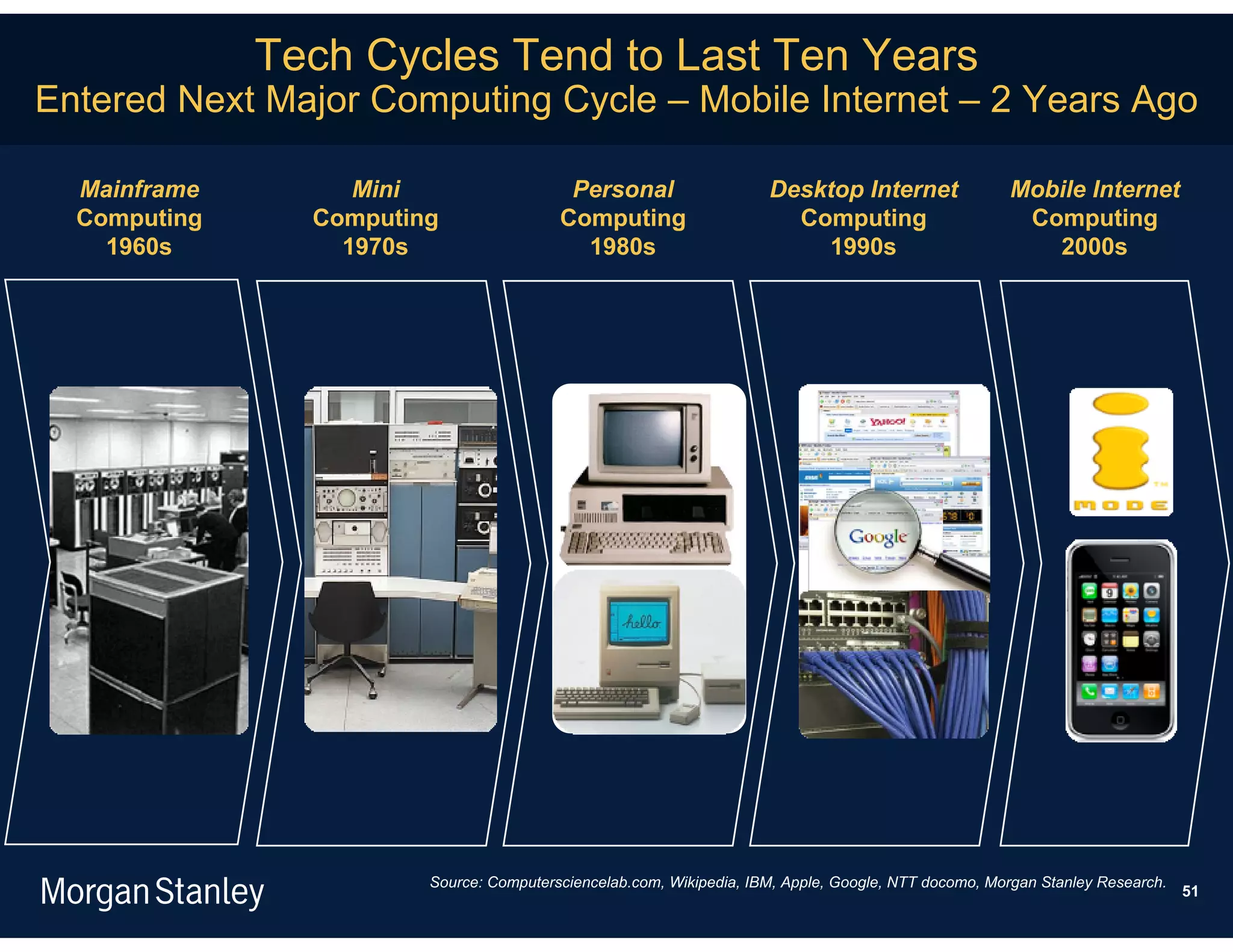
Tech Cycles Tend to Last Ten Years
Entered Next Major Computing Cycle – Mobile Internet – 2 Years Ago

  Mainframe        Mini                   Personal                   Desktop Internet                Mobile Internet
  Computing     Computing                Computing                     Computing                      Computing
    1960s         1970s                    1980s                         1990s                          2000s


                        Source: Computersciencelab.com, Wikipedia, IBM, Apple, Google, NTT docomo, Morgan Stanley Research.
                                                                                                                              51
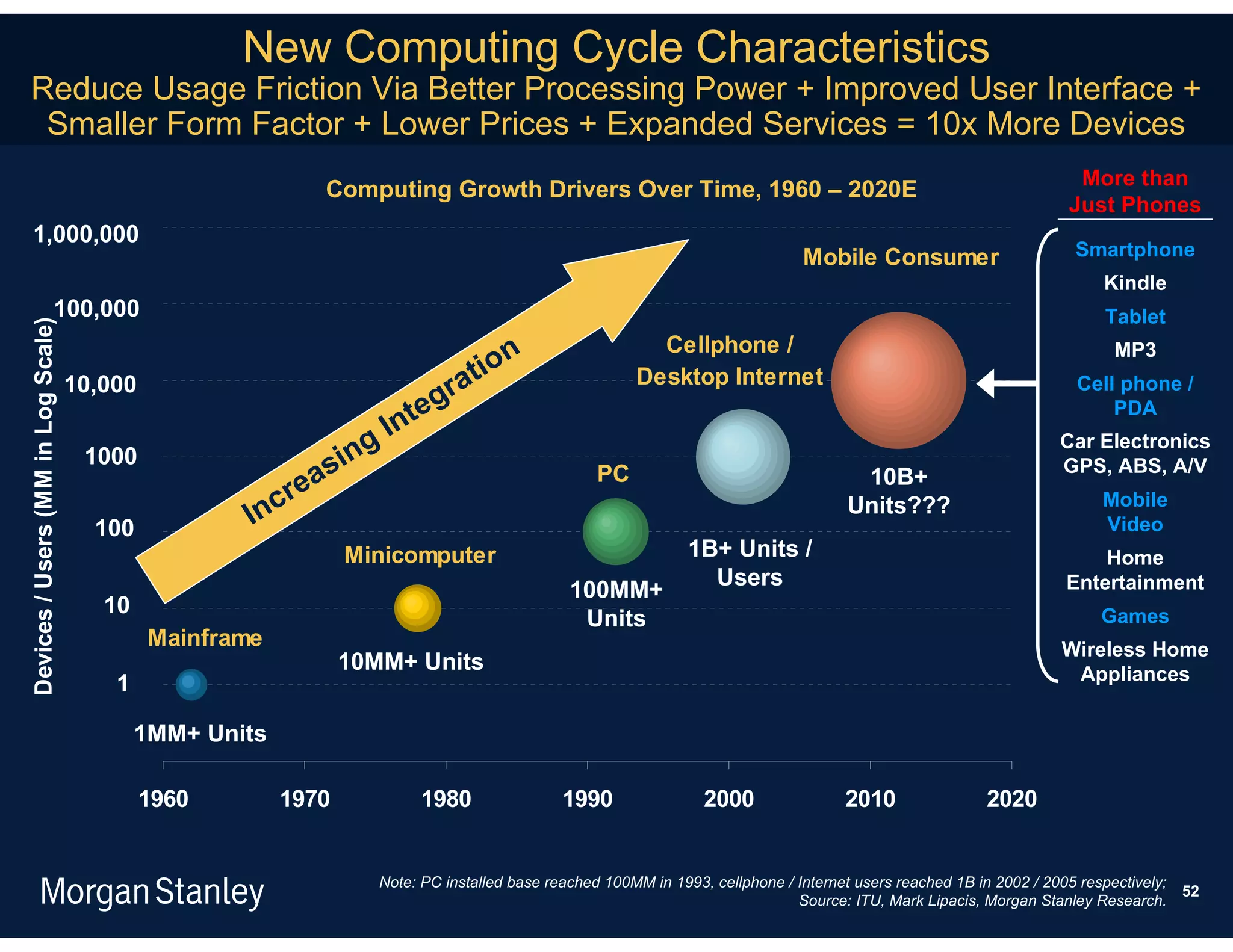
New Computing Cycle Characteristics
 Reduce Usage Friction Via Better Processing Power + Improved User Interface +
  Smaller Form Factor + Lower Prices + Expanded Services = 10x More Devices
                                                                                                                                                                       More than
                                                              Computing Growth Drivers Over Time, 1960 – 2020E
                                                                                                                                                                      Just Phones
   1,000,000
                                                                                                                                Mobile Consumer                        Smartphone
                                                                                                                                                                            Kindle
                             100,000                                                                                                                                        Tablet
Devices / Users (MM in Log Scale)


                                                                                   n                      Cellphone /                                                        MP3
                                                                              atio                      Desktop Internet
                                    10,000
                                                                            gr
                                                                                                                                                                        Cell phone /
                                                                          e
                                                                      Int
                                                                                                                                                                            PDA

                                                                ing
                                                                                                                                                                     Car Electronics
                                     1000
                                                              s                                                                                                      GPS, ABS, A/V
                                                            ea                                     PC                                   10B+
                                                     In   cr                                                                           Units???                            Mobile
                                      100                                                                                                                                  Video
                                                                 Minicomputer                                   1B+ Units /                                               Home
                                                                                                                  Users                                               Entertainment
                                                                                               100MM+
                                       10                                                                                                                                  Games
                                                                                                Units
                                             Mainframe                                                                                                               Wireless Home
                                                                 10MM+ Units                                                                                          Appliances
                                        1

                                            1MM+ Units

                                             1960         1970            1980                1990                2000                2010                 2020


                                                                    Note: PC installed base reached 100MM in 1993, cellphone / Internet users reached 1B in 2002 / 2005 respectively;
                                                                                                                                                                                        52
                                                                                                                               Source: ITU, Mark Lipacis, Morgan Stanley Research.
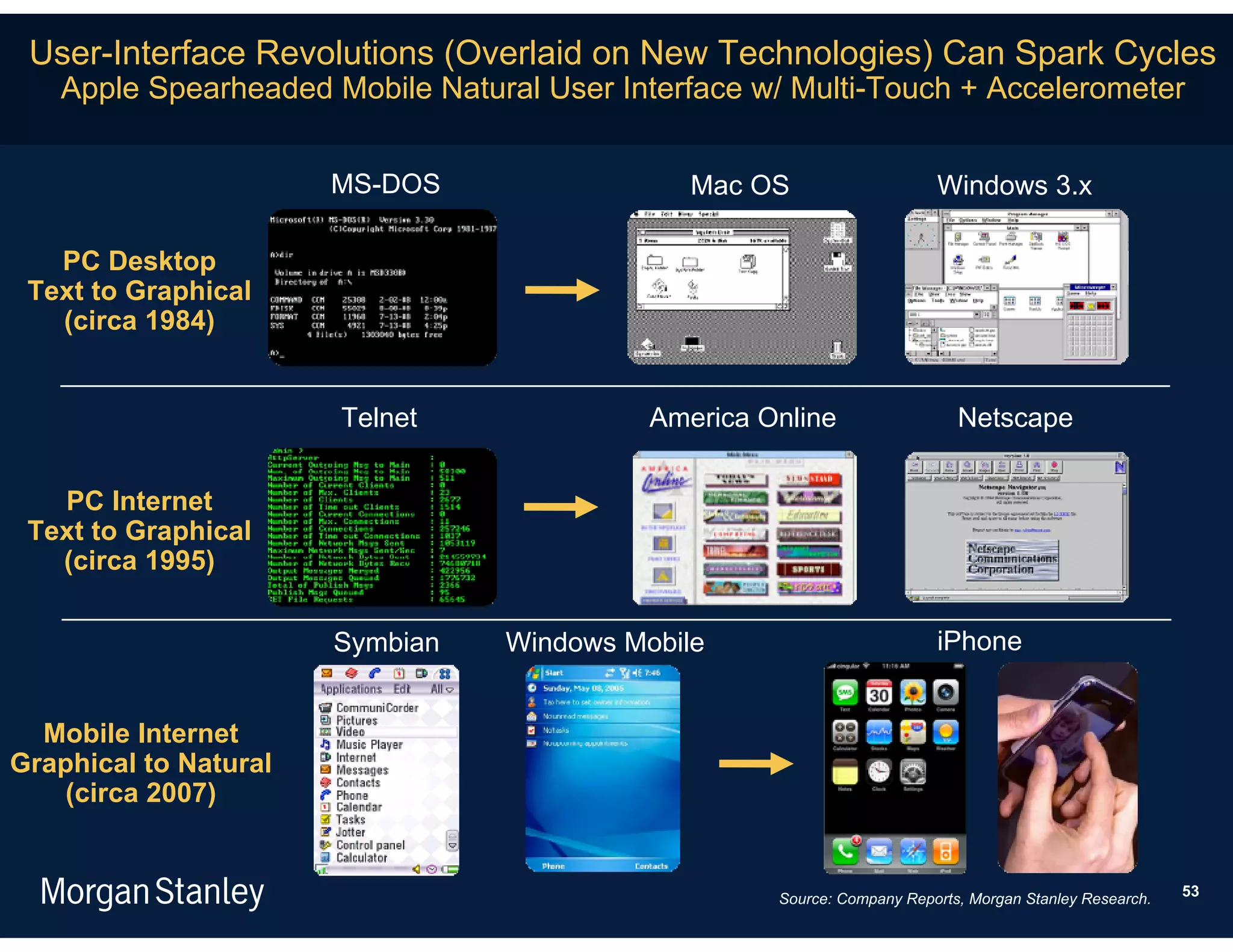
User-Interface Revolutions (Overlaid on New Technologies) Can Spark Cycles
   Apple Spearheaded Mobile Natural User Interface w/ Multi-Touch + Accelerometer


                       MS-DOS                 Mac OS                    Windows 3.x

   PC Desktop
 Text to Graphical
   (circa 1984)


                       Telnet              America Online                  Netscape


   PC Internet
 Text to Graphical
   (circa 1995)

                       Symbian   Windows Mobile                         iPhone


  Mobile Internet
Graphical to Natural
    (circa 2007)


                                                    Source: Company Reports, Morgan Stanley Research.   53
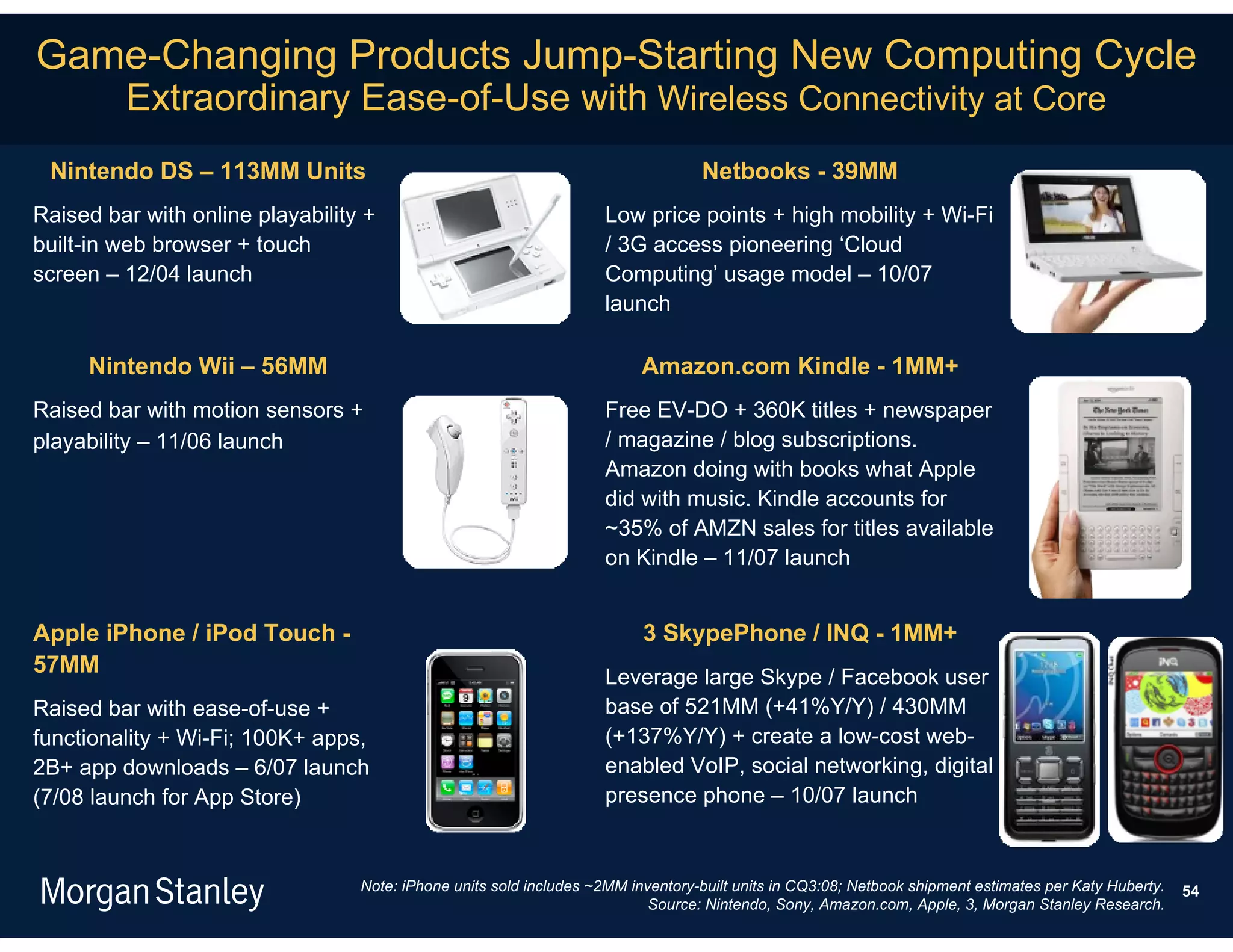
Game-Changing Products Jump-Starting New Computing Cycle
         Extraordinary Ease-of-Use with Wireless Connectivity at Core
 Nintendo DS – 113MM Units                                                        Netbooks - 39MM
Raised bar with online playability +                                Low price points + high mobility + Wi-Fi
built-in web browser + touch                                        / 3G access pioneering ‘Cloud
screen – 12/04 launch                                               Computing’ usage model – 10/07
                                                                    launch

     Nintendo Wii – 56MM                                                  Amazon.com Kindle - 1MM+
Raised bar with motion sensors +                                    Free EV-DO + 360K titles + newspaper
playability – 11/06 launch                                          / magazine / blog subscriptions.
                                                                    Amazon doing with books what Apple
                                                                    did with music. Kindle accounts for
                                                                    ~35% of AMZN sales for titles available
                                                                    on Kindle – 11/07 launch


Apple iPhone / iPod Touch -                                               3 SkypePhone / INQ - 1MM+
57MM                                                                Leverage large Skype / Facebook user
Raised bar with ease-of-use +                                       base of 521MM (+41%Y/Y) / 430MM
functionality + Wi-Fi; 100K+ apps,                                  (+137%Y/Y) + create a low-cost web-
2B+ app downloads – 6/07 launch                                     enabled VoIP, social networking, digital
(7/08 launch for App Store)                                         presence phone – 10/07 launch


                                  Note: iPhone units sold includes ~2MM inventory-built units in CQ3:08; Netbook shipment estimates per Katy Huberty.   54
                                                                           Source: Nintendo, Sony, Amazon.com, Apple, 3, Morgan Stanley Research.
Broad base of IP-based mobile usage models ramping
           very fast on various networks
           (3G / Wi-Fi / Bluetooth / GPS)


                                                     55
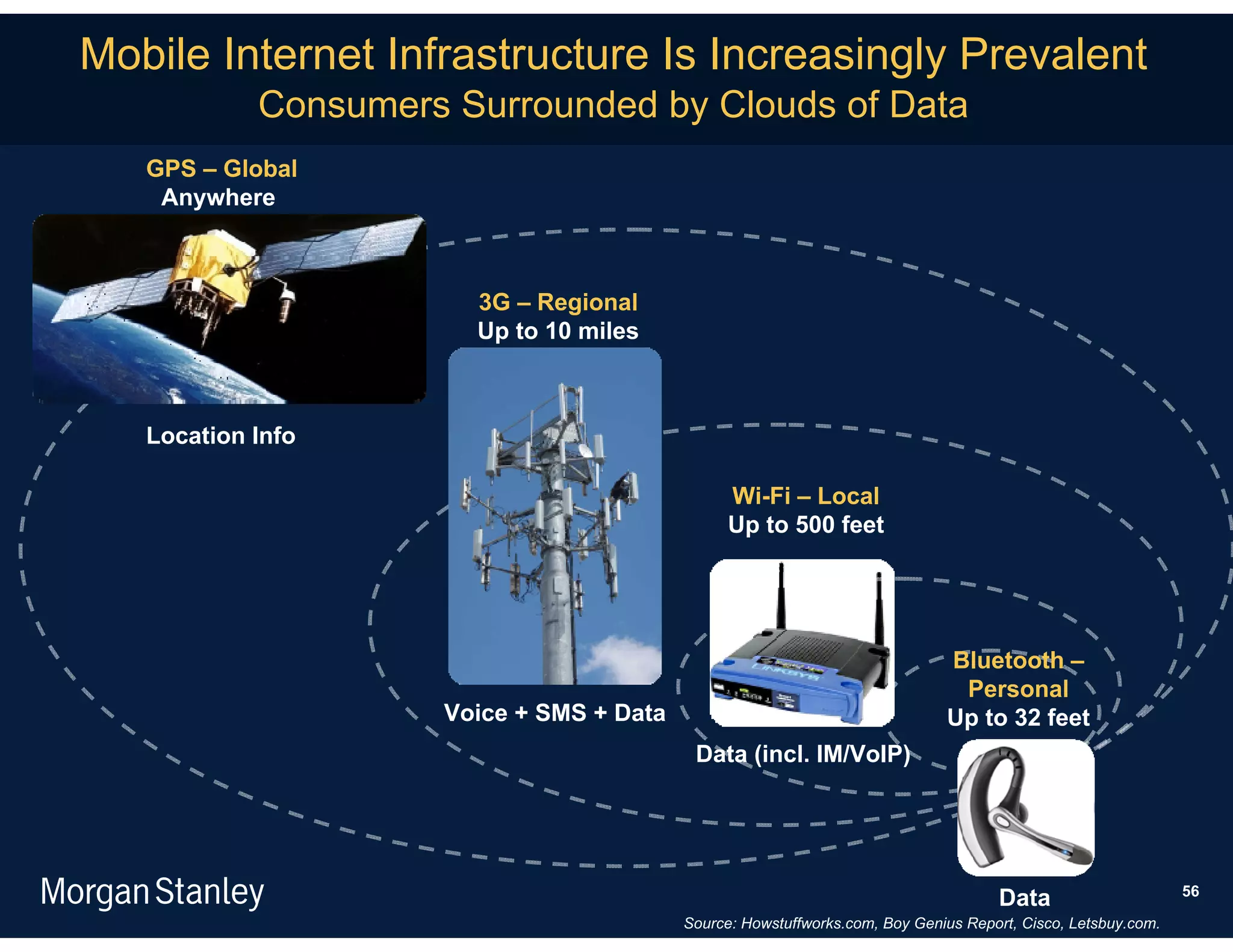
Mobile Internet Infrastructure Is Increasingly Prevalent
            Consumers Surrounded by Clouds of Data
   GPS – Global
    Anywhere


                       3G – Regional
                       Up to 10 miles


   Location Info

                                                Wi-Fi – Local
                                                Up to 500 feet


                                                                             Bluetooth –
                                                                              Personal
                     Voice + SMS + Data                                      Up to 32 feet
                                           Data (incl. IM/VoIP)


                                                                                                              56
                                                                                    Data
                                          Source: Howstuffworks.com, Boy Genius Report, Cisco, Letsbuy.com.
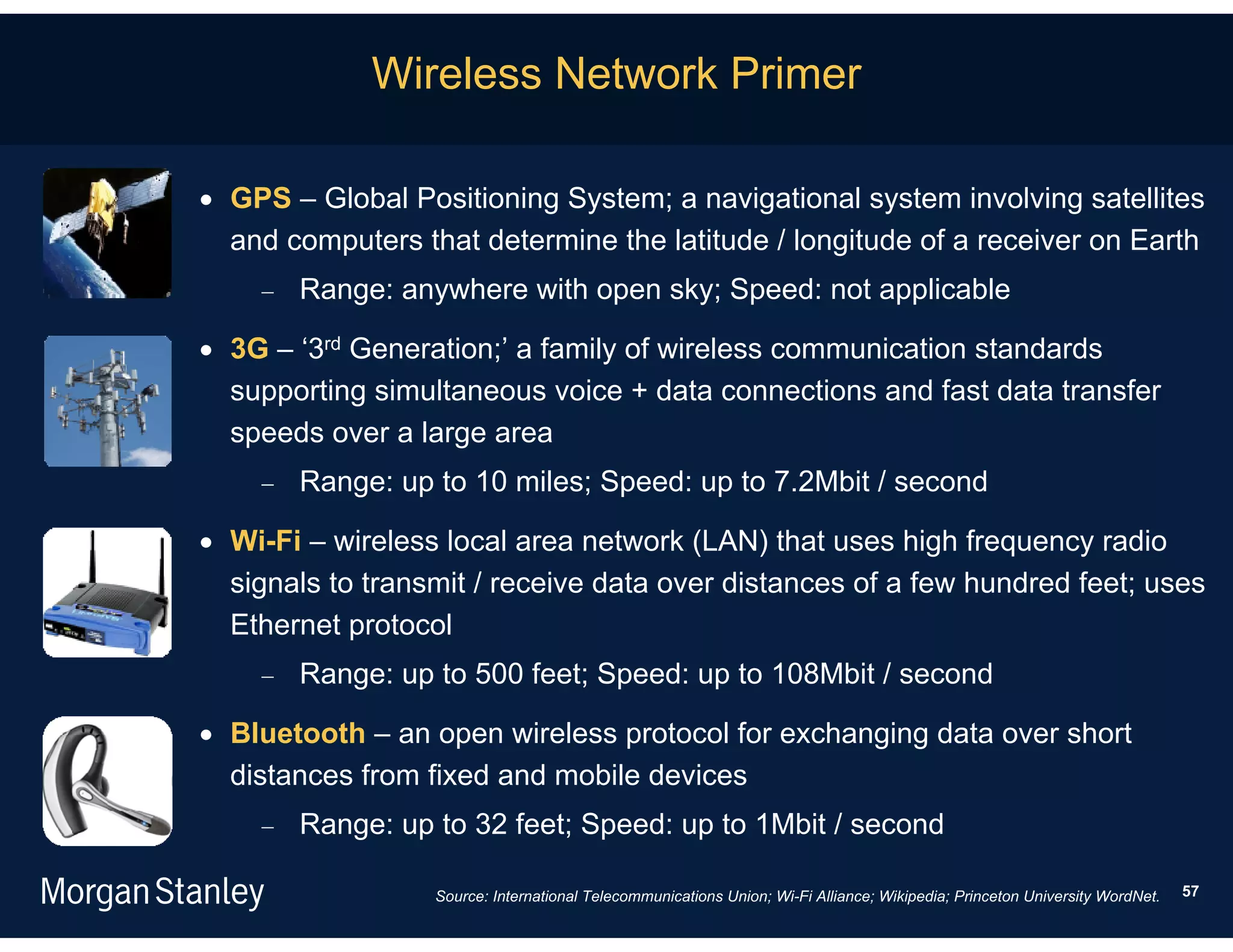
Wireless Network Primer

 GPS – Global Positioning System; a navigational system involving satellites
  and computers that determine the latitude / longitude of a receiver on Earth
       Range: anywhere with open sky; Speed: not applicable

 3G – ‘3rd Generation;’ a family of wireless communication standards
  supporting simultaneous voice + data connections and fast data transfer
  speeds over a large area
       Range: up to 10 miles; Speed: up to 7.2Mbit / second

 Wi-Fi – wireless local area network (LAN) that uses high frequency radio
  signals to transmit / receive data over distances of a few hundred feet; uses
  Ethernet protocol
       Range: up to 500 feet; Speed: up to 108Mbit / second

 Bluetooth – an open wireless protocol for exchanging data over short
  distances from fixed and mobile devices
       Range: up to 32 feet; Speed: up to 1Mbit / second

                  Source: International Telecommunications Union; Wi-Fi Alliance; Wikipedia; Princeton University WordNet.   57
Software Is a Gas, It Expands to Fill Its Container
          – Nathan Myhrvold, former Microsoft CTO
  Increased hardware capability driving software innovation as
   applications (leveraging GPS / accelerometer / multi-touch)
attempt to maximize hardware potential…and optimize for Wi-Fi
  thus putting utilization pressure on cellular networks. Simply,
    consumers want high-bandwidth (wired / wireless) 24x7.


                                                               58
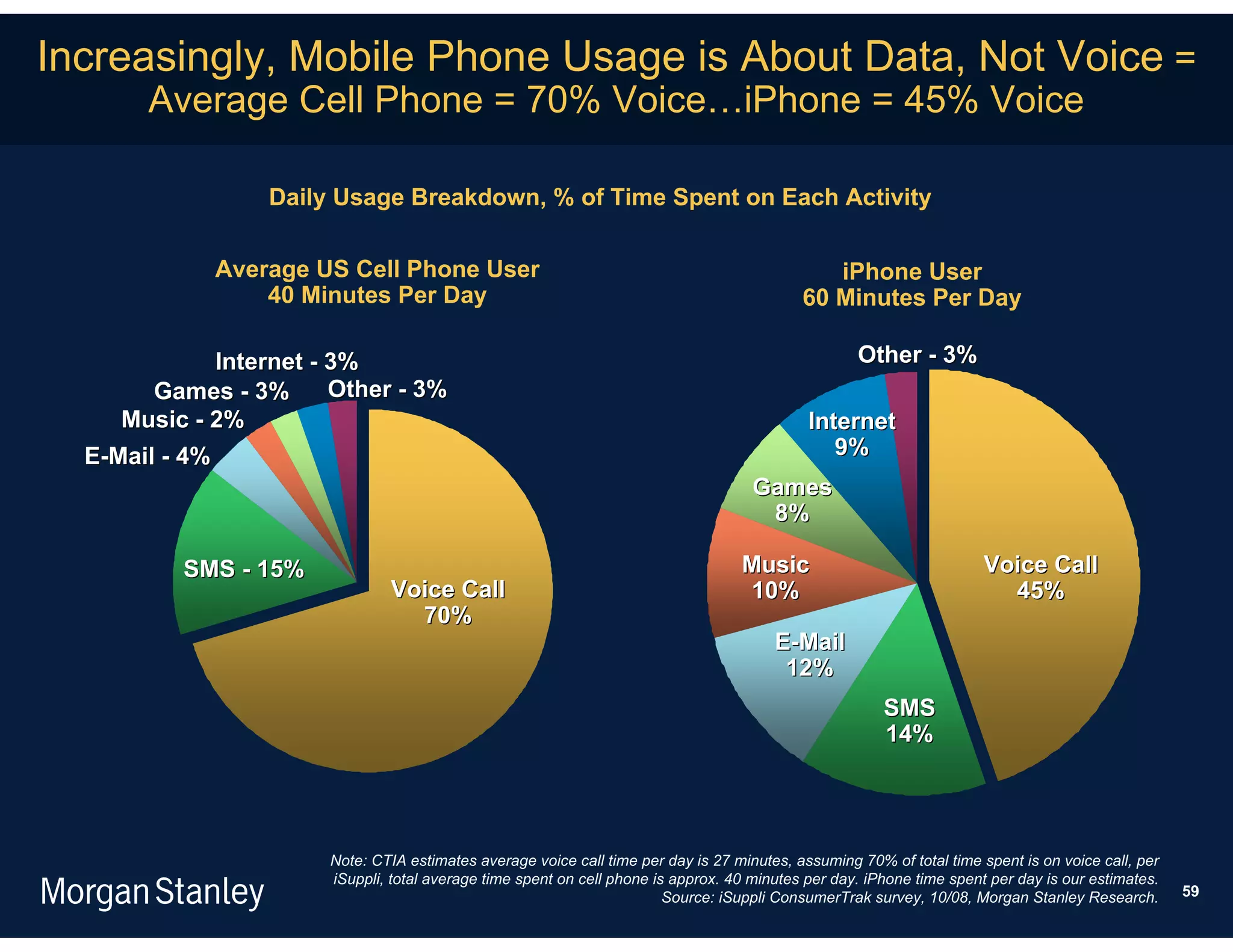
Increasingly, Mobile Phone Usage is About Data, Not Voice =
       Average Cell Phone = 70% Voice…iPhone = 45% Voice

                  Daily Usage Breakdown, % of Time Spent on Each Activity

             Average US Cell Phone User                                                         iPhone User
                 40 Minutes Per Day                                                          60 Minutes Per Day

              Internet - 3%                                                                          Other - 3%
        Games - 3%       Other - 3%
     Music - 2%                                                                               Internet
  E-Mail - 4%                                                                                    9%
                                                                                      Games
                                                                                       8%

          SMS - 15%                                                                 Music                               Voice Call
                                Voice Call                                          10%                                   45%
                                  70%
                                                                                         E-Mail
                                                                                          12%
                                                                                                         SMS
                                                                                                         14%


                        Note: CTIA estimates average voice call time per day is 27 minutes, assuming 70% of total time spent is on voice call, per
                        iSuppli, total average time spent on cell phone is approx. 40 minutes per day. iPhone time spent per day is our estimates.
                                                                          Source: iSuppli ConsumerTrak survey, 10/08, Morgan Stanley Research.       59
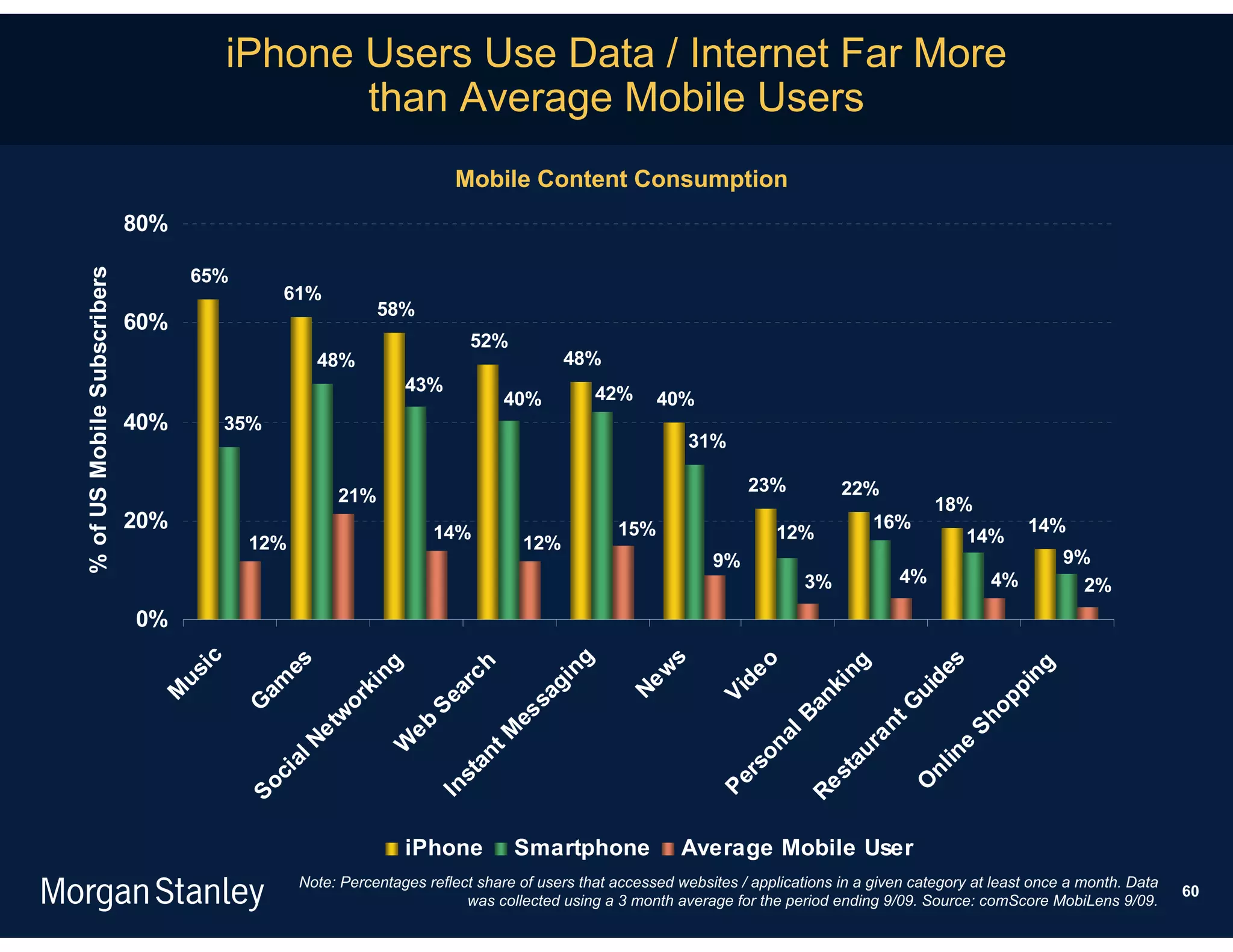
iPhone Users Use Data / Internet Far More
                                                 than Average Mobile Users
                                                                        Mobile Content Consumption
                             80%

                                    65%
% of US Mobile Subscribers


                                                 61%
                                                             58%
                             60%
                                                                           52%
                                                    48%                                 48%
                                                                 43%                         42%
                                                                                40%                   40%
                             40%          35%
                                                                                                           31%

                                                                                                                   23%           22%
                                                       21%                                                                                     18%
                             20%                                     14%                        15%                     12%
                                                                                                                                      16%                   14%
                                           12%                                    12%                                                              14%
                                                                                                              9%                                                  9%
                                                                                                                            3%            4%           4%           2%
                             0%
                                     ic


                                                                    ng


                                                                                                     s
                                                                     es


                                                                                                                                          s
                                                                                                                                          o


                                                                                                                                         ng
                                                                    ch
                                                                    ng


                                                                                                                                        ng
                                                                                                    w


                                                                                                                                       de
                                   us


                                                                                                                de
                                            am


                                                                 gi


                                                                                                 Ne


                                                                                                                                      ki
                                                                ar


                                                                                                                                      pi
                                                                 ki


                                                                                                                                     ui
                                                                                                              Vi
                               M


                                                               sa


                                                                                                                                   an
                                                              or


                                                              Se


                                                                                                                                   op
                                           G


                                                                                                                                   G
                                                            es
                                                            tw


                                                                                                                               lB


                                                                                                                               Sh
                                                                                                                                nt
                                                          eb


                                                         tM
                                                         Ne


                                                                                                                            na


                                                                                                                             ra
                                                        W


                                                                                                                             e
                                                                                                                         au


                                                                                                                          in
                                                     an


                                                                                                                  o
                                                      al


                                                                                                                rs


                                                                                                                       nl
                                                                                                                       st
                                                   ci


                                                   st


                                                                                                              Pe


                                                                                                                     O
                                           So


                                                                                                                    Re
                                                In


                                                                 iPhone          Smartphone               Average Mobile User
                                                  Note: Percentages reflect share of users that accessed websites / applications in a given category at least once a month. Data
                                                                                                                                                                                   60
                                                                          was collected using a 3 month average for the period ending 9/09. Source: comScore MobiLens 9/09.
Mobile Devices + Infrastructure Enabling Attractive New Usage Models…
                  Ramping Fast on Various Networks
         Friends -              Video Lovers -                              Talkers -
    Facebook Connects        YouTube Provides                          Skype Lets You Talk /
      You with Others      Unlimited Entertainment                     Communicate for Free


      Connectivity –            Connectivity –                               Connectivity –
        3G / Wi-Fi           3G / Wi-Fi Streaming                               Wi-Fi

        Book Lovers -            Travelers -                              Shoppers -
      Kindle Downloads       TomTom Provides                        Amazon.com Remembers
    a New Book in 60 sec   Turn-by-Turn Directions                 Your Shopping Cart & More


       Connectivity –          Connectivity –                                Connectivity –
         3G / Wi-Fi                GPS                                         3G / Wi-Fi
                                           Source: Facebook, YouTube, Skype, Amazon.com, TomTom, Apple.   61
…Mobile Devices + Infrastructure Enabling Attractive New Usage Models
  Cool Mobile Apps Today Reminiscent of Early Websites in 1995

         Music Fans -              Couch Potatoes -                                 Runners -
    Pandora Internet Radio        Snatch = Universal                            Nike+ Keeps Your
  Churns Out Non-Stop Tunes        Remote Control                               Mileage / Schedule


        Connectivity –              Connectivity –                                 Connectivity -
     3G / Wi-Fi Streaming        Wi-Fi Home Network                               Bluetooth / GPS

         Web Surfers -                  Gamers -                                Hungry People –
   Tethering Turns Phones     Asphalt 5 Provides Wireless                      Yelp / Urbanspoon
       into 3G Modems            Peer-to-Peer Racing                           Know Where to Eat


      Connectivity –                 Connectivity -                               Connectivity –
    USB / Bluetooth / 3G              Bluetooth                                  3G / Wi-Fi + GPS
                                                  Source: Pandora, Hoofien, Nike, Apple, Gameloft, Yelp, Urbanspoon.   62
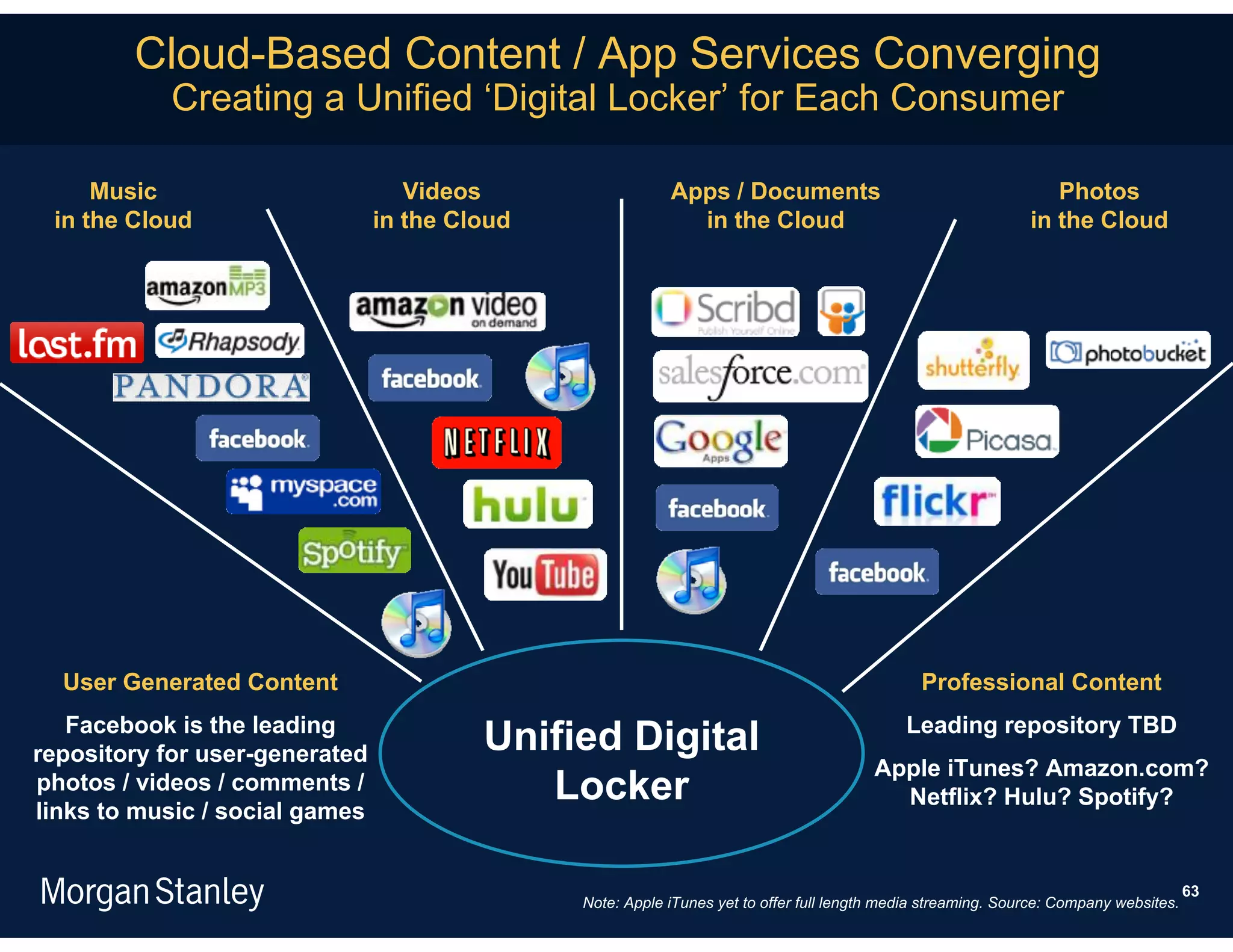
Cloud-Based Content / App Services Converging
           Creating a Unified ‘Digital Locker’ for Each Consumer

     Music                         Videos                  Apps / Documents                                       Photos
 in the Cloud                   in the Cloud                 in the Cloud                                      in the Cloud


  User Generated Content                                                                       Professional Content
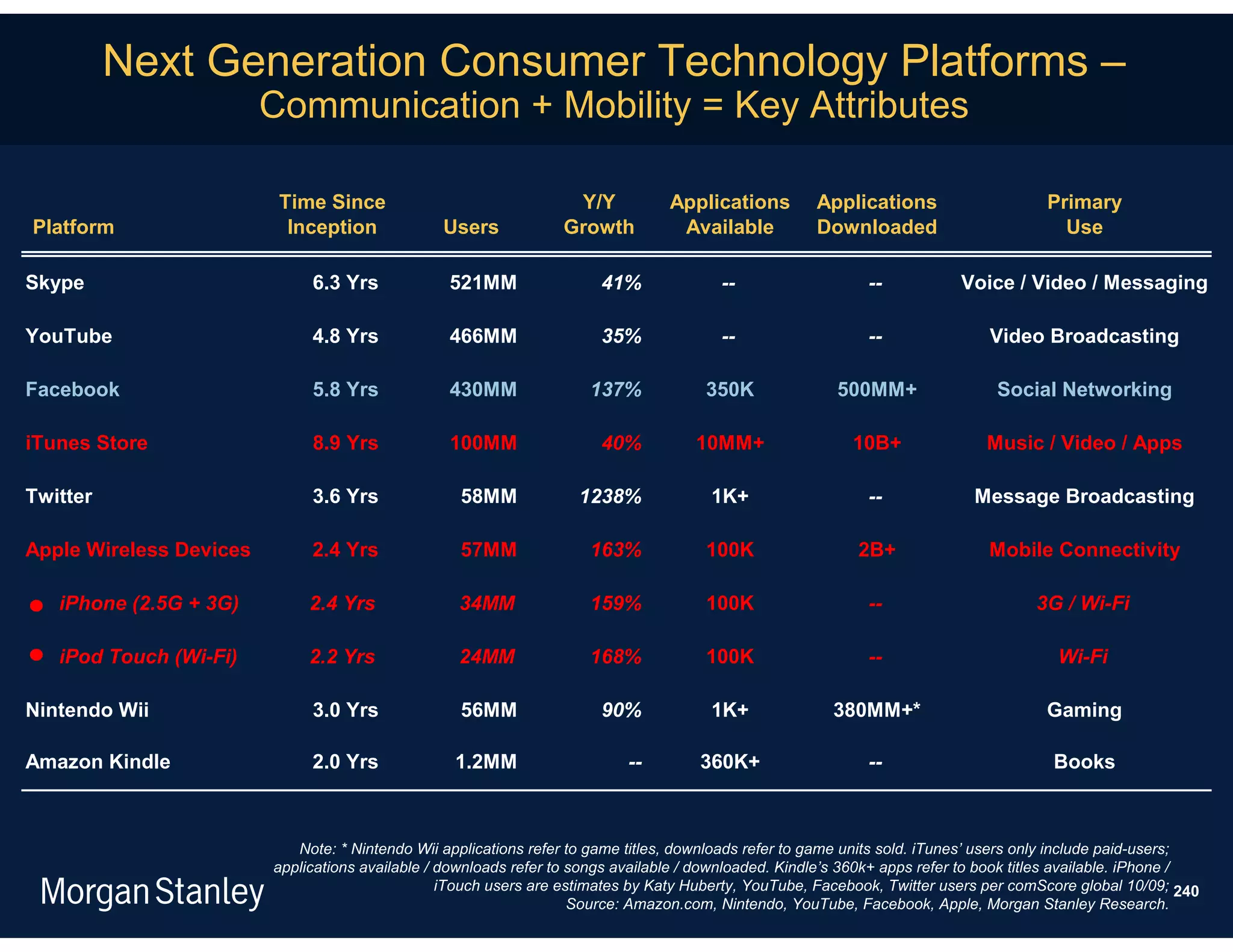
   Facebook is the leading                                                                   Leading repository TBD
repository for user-generated            Unified Digital
                                                                                         Apple iTunes? Amazon.com?
photos / videos / comments /
links to music / social games
                                            Locker                                         Netflix? Hulu? Spotify?


                                                                                                                                        63
                                               Note: Apple iTunes yet to offer full length media streaming. Source: Company websites.
Consumer Expectations Will Continue to Rise
If They Have It on Their Desktop They’ll Want It (and More) on Their Mobile

  Many consumers now expect to do the likes of the following anywhere / anytime –

     know when everyone in their universal address books is online

     get real-time dinner reservation availability and directions while riding the bus

     get nearby movie showtimes and purchase tickets while at dinner

     watch Yankees games live on phone

     read real-time Bloomberg and New York Times news stories during commute

     upload photos to Facebook and distribute while on a mountaintop

     control home DVRs / TVs / stereos / PCs / security systems from one mobile
      device

     comparison shop (with barcode scan assist option) for best prices while walking
      around a retail outlet

     transfer funds from savings to checking account while standing at a bar
                                                                                          64
Machine to Machine (M2M) Takes on New Proportions in Mobile –
      Mobile Sensors Bring “Internet of Things” Back into Spotlight
   Emergence of wireless sensors driving new M2M applications – Sensors / smartphones /
    other wireless Internet devices collect broad variety of data from surrounding environment +
    innovative M2M applications process data in real-time in ways that were not possible /
    relevant on desktop Internet.
   Abundance of sensors could contribute materially to data traffic growth – Network capacity
    decisions will need to take traffic from sensors into account as they become imbedded in
    more products and collect / transmit larger sets of data.
                                          Internet of Things
                      Enablers                                             Obstacles
     RFID – Enables unobtrusive / cost-effective       Network ubiquity – In order to communicate with
     identification + real-time tracing of objects     an abundance of objects, network + capacity have
                                                       to be everywhere
     Sensors – Collect data on environmental
     changes in real-time                              Privacy – If everything around us is collecting
                                                       data, data protection and privacy concerns
     Smartphones – Able to scan bar codes /            become paramount
     communicate with RFID tags and process
     data anywhere / anytime                           Standardization – Variety of nanotechnologies
                                                       pursuing an ‘Internet of Things’ makes
                                                       compatibility between objects difficult
                                      When Will Everything Be
                                     Connected to the Internet?
                                               2012? 2020?
                                                                      Source: Qualcomm, Morgan Stanley Research.   65
Implicit + Explicit Participatory Sensing Amass Large, Credible
      Datasets to Develop Effective Real-Time Consumer Applications
          Implicit – Mobile Millennium Project                                                           Explicit – Trapster
   Nokia + UC Berkeley + Navteq + Caltrans + US DOT                              Users explicitly upload data to Trapster – Participants
    SafeTrip 21 teamed up to map real-time traffic data by                         who have downloaded the Trapster smartphone app
    crowd-sourcing sensory data from millions of mobile                            (supported by iPhone / RIM / Anrdoid / Nokia) upload
    devices                                                                        the location of speed traps by pressing a button on
                                                                                   their phone as they drive by (location data from
   Mobile Millennium Traffic Pilot App on GPS device or
                                                                                   smartphone’s GPS / wireless location is relayed to
    smartphone – Devices implicitly send data to network +
                                                                                   Trapster).
    receive real-time update on GPS application.
                                                                                  Continuous feedback makes data more reliable – As
   Location + Speed – Virtual trip lines trigger position +
                                                                                   more users report the same speed trap, the data is
    speed updates when participating vehicles drive by /
                                                                                   given a higher level of credibility.
    Mobile Millennium system architecture receives signal +
    processes data + relays real-time traffic information to                      Users receive speed trap warnings in real-time based
    users in its ecosystem.                                                        on their location – As a user approaches a speed trap
                                                                                   identified by other Trapster users, the application gives
   Real-time – Smartphone processing power + wireless
                                                                                   them a specific warning based on the data’s credibility.
    network infrastructure enable real-time, online traffic
    update with <1 minute delay.                                             iPhone App + Online Trap Map Alert Drivers of Speed Traps
    Virtual Trip Lines Collect Data from Vehicles Passing By


                              Note: Morgan Stanley does not endorse the behavior of driving over the speed limit or navigating apps / websites while driving. 66
                                                                                  Source: Mobile Millennium Project, Trapster, Morgan Stanley Research.
Rapid growth in number / type of mobile cloud-based
connected devices, in effect, creating wireless remote
                controls everywhere


                                                         67
3G is Key to Success of Mobile Internet
But Wireless Options – Across-the-Board – are Growing Rapidly


     GPS – 421MM+ chipsets sold in 2008E, +57% Y/Y; Cell Phones /
      PDAs = 60% of GPS shipments.

     3G – 485MM global users, +46% Y/Y in CQ2, >11% mobile user
      penetration, rising to 44% by 2013E…Japan / W. Europe / USA
      already >30% penetration.

     Wi-Fi – 319MM chipsets sold in 2008E, +42%Y/Y with 862MM
      installed base; estimate 60% of iPhone / iTouch usage may be on
      Wi-Fi, providing a crucial (and ~10x faster) offload to stressed 3G
      networks.

     Bluetooth – 1.3B Bluetooth-enabled units shipped in 2008, +45%
      Y/Y; 2B+ Bluetooth devices in use.

          Source: 3G subscribers data per Informa, Wi-Fi usage estimates per AdMob, Wi-Fi shipments by Wi-Fi Alliance; installed base
          per iSuppli, assuming 4-yr replacement cycle; Bluetooth shipment per iSuppli, installed base per The Bluetooth Special Interest   68
               Group; GPS shipment per Future Horizons. Picture sources: Howstuffworks.com, Boy Genius Report, Cisco, Letsbuy.com.
GPS proliferation (and related location-based services)
                     are big deals.


                                                          69
GPS =
      Network Adds Location-Based Personalization to Devices
  Directions – Google Maps on smartphones / Garmin / Navteq devices + GPS offer
   location + driving / walking / public transit directions.
  Businesses – Be it a restaurant / hotel / store / cab company, GPS location info instantly
   leads to a better starting point.
  Products – Location + availability = shopper’s dream world.
  Friends – Loopt / Google Latitude / Joyity / Local… share friends’ + your own location.

   Find Your Way on        CallACab Finds       ShopSavvy Gives You                     Find Your Friends’
iPhone via Google Maps   Nearest Cab Company    Cheapest Price Locally                  Location on Loopt


                                                                                                                       70
                                                     Source: CallACab, Big In Japan, Loopt, Morgan Stanley Research.
GPS =
                                     421MM Chipsets Sold in 2008E (+57% Y/Y)

                                                    Global Annual GPS Chipset Shipments, 2000 – 2012E
                             1,000


                              800
Annual Unit Shipments (MM)


                              600


                                                                                                                                                        590
                              400                                                                                                             530
                                                                                                                                     475

                                                                                                                           325
                              200                                                                                255
                                                                                                        164
                                                                                               80
                                                                   3        4        30
                                0    0.1      0.3        2
                                     2000             2002                2004               2006              2008E               2010E              2012E

   Professional                            PND       Automated Dashboard                    Mobile Phone & PDA                  Low Cost, Low Power


                                            Note: PND is personal navigation devices; low cost, low power include uses in digital cameras / MP3 players for geo-tagging.
                                                                                                                                                                           71
                                                                                                          Source: Historicals and Estimates from Future Horizons, 4/08.
Location-Based Services + Real-Time Thinking / Awareness
Mobile Internet Unlocking Power of Data on Physical Location


Thanks to the iPhone 3G and, to a lesser extent, Google’s Android
phone, millions of people are now walking around with a gizmo in their
pocket that not only knows where they are but also plugs into the
Internet to share that info, merge it with online databases, and find out
what – and who – is in the immediate vicinity…Simply put, location
changes everything. This one input – our coordinates – has the potential
to change all the outputs. Where we shop, who we talk to, what we read,
what we search for, where we go – they all change once we merge
location and the Web.

                          – Mathew Honan, WIRED magazine, 1/19/09


                                                                                       72
                                                             Source: WIRED magazine.
WIRED Magazine – “Inside the GPS Revolution”
    Top 10 Location-Based Mobile Applications, 1/09
                     Name               Platform         Price     Tagline
        1
                1    Trapster       iPhone, BlackBerry   Free      Drive Fast, Avoid the Cops
                2    iNAP                iPhone          $1        Sleep Easy, We'll Wake You
                3    Joyity              Android         Free      Play Tag With Strangers
                4    Cab4Me              Android         Free      Call a Cab the Easy Way

2               5
                6
                     ShopSavvy
                     Google Earth
                                         Android
                                         iPhone
                                                         Free
                                                         Free
                                                                   Scan a Barcode, Find a Deal
                                                                   See the World Through Google's Eyes
                7    Locale              Android         Free      Train Your Phone to Know Its Place
                8    GoSkyWatch          iPhone          $10       Look Up! Be a Stellar Student
                9    SafetyNet           Android         Free      Dark Alley? Call for Help
                10   SitOrSquat     iPhone, BlackBerry   Free      Go Here When You Gotta Go


                                          3                                               10
            8


                                                               Source: WIRED magazine, Issue 17.02, 01/19/09,   73
More GPS-Enabled Apps
 Nearby Vendors + People + Content + Services at Your Fingertips
      Zillow – iPhone             FourSquare– iPhone / RIM                      Sherpa – Android


 Shows real estate info on       Uses to GPS to broadcast               Augments search results w/
 every home around your          which bars + restaurants                GPS, based on interests /
         location                 you visit to your friends             preferences / places visited

   OpenTable – iPhone              Priceline.com – iPhone                    Yelp – iPhone 3GS (Free)


Uses GPS to find / reserve      Finds hotel deals in your area                 Uses GPS to display
 restaurant tables nearby         or other cities of interest               location-aware markers of
                                                                             nearby points of interest
                                                                                                                   74
                                                          Source: Wired, GigaOm, Company data, company websites.
3G proliferation is a big deal.


                                  75
3G =
              Key to Ubiquitous Wireless Internet Connectivity
 Cellular networks (2.xG) have ubiquitous coverage – 6B (90%) global population coverage /
  4B+ subscribers on various cellular networks in 2009E

 3G increasingly adds Internet connectivity to ubiquitous coverage – optimized for data, not
  voice…512Kbit/second average download speed on par with basic fixed-line broadband speed 5
  years ago
                       Global GSM / 3G* (WCDMA) Coverage Map, 2009


                                                                                                                                   76
                        Note: In addition to WCDMA, 3G standards also include HSPA, CDMA EV-DO and TD-SCDMA. Source: GSMA, 1/09.
3G =
                  Key to Enabling Internet Usage on Mobiles
 Faster speed brings faster Internet to mobile phones – 3G, with higher throughput speed,
  allows for acceptable broadband usage, key to providing multimedia usage
 Lowers delivery cost for carriers / data plan pricing for consumers – 1/5 of cost per bit vs.
  2.xG, consumers get unlimited usage for the same price or less

                                                                            2.xG                                      3G
                  Speed & Cost
   Typical Speed (Kbits per second)                                      25 – 200                               300 – 1500
   Desktop Internet Equivalent                                   (Dial-up = 56 Kbps)                 (DSL = 1000 - 3000 Kbps)
   Cost per Bit for Carriers (Normalized to 100*)                        50 - 100                                     10
                  Usage Models
   Watching Video Clips                                                      ✗                                        ✔
   Listening to Streaming Music                                              ✗                                        ✔
   Making VoIP / Video Calls                                                 ✗                                        ✔
   Full HTML Web Browsing                                               Very Slow                                     ✔
   Sending Picture / Video / Large Emails                               Very Slow                                     ✔
   Downloading Apps Over the Air                                        Very Slow                                     ✔
                               Note: *2.5G technologies such as EDGE provide up to 50% lower cost per bit vs. 2G technologies such as GPRS.
                                                                                                                                              77
                                                                                                           Source: Morgan Stanley Research.
Global 3G Subscribers =
                    2010E ‘Mainstream’ Inflection Point, Penetration >20%

                                Global 3G+ Subscribers & Penetration, 2007 – 2014E

                 4,000                                                                                   43%         45%
                                          2010E: Inflection Point
                                         3G+ Penetration Reaches                            38%
                                               Sweet Spot
                                                                               33%                                   36%
                 3,000                                                                                   2,776


                                                                                                                            3G+ Penetration (%)
                                                                 27%
                                                                                           2,348
3G+ Users (MM)


                                                                                                                     27%
                                                     21%                      1,928
                 2,000

                                                                 1,503                                               18%
                                          15%

                                11%                 1,055
                 1,000   8%               688                                                                        9%
                                 430
                         273

                    0                                                                                                0%
                         2007   2008     2009E      2010E       2011E         2012E        2013E        2014E

                                                 3G+ Users               3G Penetration

                                                      Note: 3G+ technologies include WCDMA, HSPA, TD-SCDMA, 1xEV-DO, LTE and WiMax. 78
                                                                                        Source: Ovum Estimates, Morgan Stanley Research.
3G Penetration Inflection Points Vary by Region
             W. Europe + N. America = 2007–2008, ROW = 2010E-2014E
                                   3G* Connections & Penetration by Region, 2007 – 2014E
(All connection numbers in 000s)           2007           2008         2009E          2010E          2011E          2012E          2013E          2014E

   Western Europe                        79,617        126,724        205,962        299,220        381,422        448,691        499,686        549,615
     3G Penetration                        17%            25%            39%            54%            67%            77%            85%            92%

   Japan                                 72,690         88,434        101,320        110,823        116,581        120,463        123,217        124,770
      3G Penetration                       72%            84%            91%            96%            98%            99%            99%           100%

   Asia / Pacific (ex. Japan)            50,163         83,514        151,192        295,230        482,981        693,995        918,063      1,135,626
      3G Penetration                        4%             5%             7%            13%            19%            25%            31%            37%

   North America                         53,307         83,460        116,575        145,683        177,451        204,835        231,271        260,575
      3G Penetration                       20%            29%            38%            46%            54%            61%            67%            74%

   Eastern Europe                          8,785        19,918         40,944         72,321        120,291        139,960        166,288        199,977
      3G Penetration                         2%            5%             9%            16%            26%            29%            34%            40%

   Middle East & Africa                    5,781        18,424         50,409         91,085        165,564        239,805        309,251        383,238
      3G Penetration                         1%            3%             7%            12%            19%            25%            30%            35%

   South & Central America                 3,126          9,265        21,875         40,448         59,107         80,087        100,027        122,258
      3G Penetration                         1%             2%            4%             7%            10%            12%            15%            17%

   Total                                273,469        429,739        688,278      1,054,810      1,503,397      1,927,837      2,347,804      2,776,058
      3G Penetration                        8%            11%            15%            21%            27%            33%            38%            43%

                                    Note: Regions ranked by 2008 absolute numbers of 3G connections. 3G* technologies include WCDMA, HSPA, TD-SCDMA,
                                                                                                                                                       79
                                                                            1xEV-DO, LTE and WiMax. Source: Ovum Estimates, Morgan Stanley Research.
Significant Growth in Global 3G Wireless Market –
Opportunities for Developers / Vendors Reside in Developed Markets, for Now

  485MM Global 3G Users, Only 11% Subscriber Penetration (CQ2:09), Implying Upside –
   Global 3G net subscriber growth of +46% Y/Y in CQ2:09 points to strong adoption trends.

  Developed Markets Driving Growth, for Now – USA led world with 6.6MM 3G net additions in
   CQ2:09 (or 18% of global 3G net adds), followed by Japan with 3.0MM (or 8%). Together,
   the top ten countries – USA, Japan, South Korea, UK, Brazil, Germany, Russia, Spain,
   France and Poland – supported 61% of global 3G net additions in CQ2.

  Emerging Markets 3G Penetration Still Very Low, Significant Room for Growth – 3G+
   penetration in most emerging markets <10% + penetration in BRIC countries <1% vs.
   developed market penetration =~15-85%. Based on CQ2:09 data, a 5% increase in BRIC
   3G+ penetration = 72MM new 3G+ subscribers.

  3G Penetration Could Surpass 100% in Developed Markets, Driven by Data-Only Devices –
   Despite high 3G+ penetration in developed markets (87% in Japan / 71% in S. Korea), future
   growth opportunity in data-only devices with cellular communication capabilities (dongles for
   netbooks / notebook PCs / eReaders / digital cameras / camcorders…) remains big. Verizon
   Wireless in USA sees potential for 400% data device penetration, implying 4-5 devices per
   user on their 3G / 4G networks.
                    Note: BRIC penetration is calculated as total BRIC 3G subscribers / total BRIC mobile subscribers – on a per country basis, Brazil
                   (4% penetration) and Russia (3% penetration) have greater than 1% 3G penetration. 3G includes CDMA 1x EV-DO and Rev. A / B, 80
                                                                               WCDMA, HSPA; Source: Informa WCIS+, Morgan Stanley Research.
3G Growth Still Concentrated in Developed Markets –
            USA Surpassed Japan to Become Largest Market in CQ1:09
                      CQ2:09 3G     3G                           3G Sub Growth               3G Net Adds     % of Global    2G +3G        Implied 2G Net
Rank       Country    Subs (000) Penetration CQ2 Net Adds         Y/Y     Q/Q         Y/Y Growth %of 3G Subs 3G Net Adds Net Adds (000) Adds (Losses) (000)
 1     USA             103,110        37%        6,599            55%      7%               21%           6%       18%         3,207            -3,392
 2     Japan            94,813         87        2,987            16       3               -10            3          8         1,002            -1,985
 3     South Korea      33,849         71        1,973            24       6               -26            6          5           839            -1,135
 4     Italy            26,773         33          784            21       3               328            3          2        -1,660            -2,444
 5     UK               21,711         29        1,844            52       9                29            8          5           269            -1,575
 6     Germany          20,408         20        1,603            43       9                -7            8          4           147            -1,456
 7     Spain            20,192         38        1,394            47       7               -18            7          4           411              -983
 8     France           14,337         25        1,314            75     10                 62            9          4           831              -483
 9     Australia        12,689         52          923            41       8               -16            7          3           700              -223
 10    Indonesia        11,994          9        1,195            71     11                 -2           10          3         1,639               444
 11    Poland           11,821         27        1,293            93     12                 48           11          4           414              -880
 12    Taiwan            6,719         27          777            94     13                 33           12          2           483              -294
 13    Malaysia          6,276         22          805           151     15                 24           13          2           351              -454
 14    Brazil            5,730          4        1,720           481     43               -853           30          5         6,101             4,381
 15    South Africa      5,413         11          568           101     12                 73           10          2         1,292               724
 16    Russia            5,224          3        1,418           426     37                 75           27          4         6,678             5,259
 17    Portugal          4,973         33          307            31       7                33            6          1           155              -152
 18    Saudi Arabia      4,498         14          514            47     13                150           11          1         2,698             2,184
 19    Sweden            4,382         37          248            35       6               -31            6          1            57              -191
 20    Canada            4,309         20          649            75     18                228           15          2           307              -342
 21    Netherlands       4,133         22          324            38       8                42            8          1           278               -45
 22    Austria           3,949         37          356            53     10                 41            9          1           123              -233
 23    Romania           3,914         14          346            65     10                 50            9          1           684               338
 24    Israel            3,629         39          358            50     11                 30           10          1           110              -248
 25    Greece            3,155         17          372           134     13                 94           12          1           471                99
 26    Egypt             2,904          6          364           103     14                145           13          1         3,809             3,445
 27    Hong Kong         2,777         28          163            23       6                -5            6          0           178                15
 28    Singapore         2,739         41          136            28       5               -37            5          0           106               -30
 29    UAE               2,684         26          106            19       4                 0            4          0            76               -31
 30    Philippines       2,617          4          199            59       8               -22            8          1         1,772             1,573
       Top 30          451,723        25%       31,640            44%      8%               23%           7%       88%        33,527             1,887
       Global          484,974        11%       36,130            46%      8%               29%           7%      100%       142,704           106,574


                                Note: *Informa reports a slightly lower global 3G subscriptions and penetration level vs. Ovum due to the exclusion of 4G and the use of
                                                                                                                                                                      81
                                 different sources. 3G includes CDMA 1x EV-DO and Rev. A / B, WCDMA, HSPA; Source: Informa WCIS+, Morgan Stanley Research.
USA Surpassed Japan as Largest 3G Country in the World in CQ1:09 –
  USA Taking Over Baton as Mobile Internet Leader in Innovation + Users


                                             3G Users in Japan vs. USA, CQ2:07 – CQ2:09

                                                                                                                           103
                   105
                                                                                                             97       95
                                                                                                        92
                                                                                          88
                   90                                                        85
                                                                   81                          82
                                                         78
                                               72                                 75
                   75              68                                   66
                         63
   3G Users (MM)


                                                              61
                   60                               55
                                        49
                   45         38

                   30

                   15

                     0
                         CQ2:07    CQ3:07     CQ4:07     CQ1:08    CQ2:08    CQ3:08      CQ4:08        CQ1:09        CQ2:09


                                         Japan 3G Subscribers                 USA 3G Subscribers


                                                                                       Source: Informa WCIS+, Morgan Stanley Research.   82
USA Likely to Remain Most Dynamic 3G Market
                     for Next 1-2 Years
 3G penetration is still relatively low - at 37% of total USA wireless subscribers in CQ2:09,
  up nicely from 21% in C2007, providing ample room for upside.
 USA is largest market (at 45% of units sold in CQ2:09) for hottest device in high-end
  wireless market - Apple's iPhone - and momentum should likely stay in place, in part, as
  Apple rolls out improved devices every 12 months or so.
 Carrier competition (AT&T with iPhone vs. Verizon with BlackBerries / Android phones and
  LTE upgrade vs. T-Mobile with Google Android vs. Sprint with Palm Pre...) creating a bevy
  of compelling consumer opportunities.
 Software / application innovation – Focused on bringing best of Internet (video / social
  networks / apps…) + more (location / push notification…) to mobile devices – occurring at
  feverish pace, likely ensuring consumers will increasingly find high-end 3G-enabled devices
  to be useful / fun / economical. Best of Silicon Valley is back to what to what they do well…
 USA shares essential market characteristics for 3G success with Japan – High postpaid
  subscriber ratio + low smartphone price through carrier subsidy + flat-rate data plans. USA
  surpassed Japan as world’s largest 3G nation in CQ1:09, and will likely support more than
  2x Japan’s 3G+ subscribers when USA 3G+ penetration reaches 71% in 2013E.
 W. Europe could lag USA in mobile development – Fragmented market + relatively low
  (~40%) post-paid ratio + smaller developer community likely to slow down mobile Internet
  development in W. Europe vs. USA.
                                                                                                 83
Beyond 3G
WiMAX = First Commercialized 4G Network Based on IP Infrastructure
 Faster Speed Driving More Usage – Average download speed of 5-10Mbit/s vs. 1Mbit/s for 3G;
  Monthly data usage on WiMAX networks approaching 10GBytes in Russia vs. 1GB for iPhone.
 Cheaper vs. DSL / 3G – $40 to bring broadband to a household via WiMAX vs. $800-1,200 via
  DSL; ~5x cost-per-bit reduction vs. 3G networks; Cost-efficient solution for “last mile” broadband
  access, especially in Emerging Markets (EM) where DSL / cable penetration remain low.
 Real Deployment – 4MM global users, up 120% Y/Y in 2008; 434MM global population
  coverage as of 2/09, 86% in Emerging Markets; 484 networks (+59% Y/Y) deployed in 141
  countries as of 6/09, 76% in EM; 90% of planned deployment in EM.
                                             Global WiMAX Population                                      Global WiMAX Planned
                                             Coverage by Region, 2/09                                   Deployment by Region, 6/09

                               250
                                                     Emerging                 Developed                     N. America
                                     205MM            Markets                  Markets                          8%
    Population Coverage (MM)


                               200
                                                                                                       W. Europe     Asia Pacific
                               150                                                                        2%            27%

                               100
                                              72MM                                                 Latin America
                                                      50MM      45MM                                    14%
                                50                                       35MM       28MM                                        Middle East
                                                                                                                               & Africa - 23%
                                 0
                                                                                                             E. Europe
                                     APAC      MEA    LatAm   E. Europe W. Europe     N.                        16%
                                                                                    America

                                                                                              Source: Global subscribers per In-Stat, other data per WiMax Forum.   84
Wi-Fi proliferation is a big deal.


                                     85
Wi-Fi =
Increasingly Connects Devices in Homes / Businesses / Schools
                       Portable Media Players

       Notebook PCs                                         Entertainment Systems –
                                                              Wii / Xbox 306 / PS3


                           Wi-Fi Router


      Wi-Fi Enabled                                               Internet Connected TVs
      Smartphones


                         Home Appliances –
                       Smart Fridge / Speakers…


                                                                                                             86
                                                Source: Sony, Nintendo, HP, Bose, Apple, RIM, LG, Cisco, .
Wi-Fi’s High Speed + Wide Availability =
         Crucial to Offload Stressed Carrier 3G Network Traffic
 42% of 34MM iPhone usage on Wi-Fi(1) + 100% of 24MM iTouch usage on Wi-Fi
 iPhone users may be in Wi-Fi enabled location 70% of time, based on our swag
 ~65% of implied 57MM iPhone + iTouch combo usage on Wi-Fi, not on cellular networks
Wi-Fi = ~10x Faster than Existing 3G Network                                                                 AT&T Wi-Fi Usage Up 5x in CQ3:09
 Downlink Transfer Rates (Mbit/s)
                                                                                                             30
 -200            0       200             400              600
                                                                                                                                              25.4MM


                                                                          Quarterly Wi-Fi Connections (MM)
    Next-Gen                                                                                                 25
      Wi-Fi

         LTE                                                                                                 20
                                        Next-Gen
        WiMax                         Technologies
                                                                                                             15                                 Up
                                                                                                                                              5x Y/Y
         Wi-Fi                        Current-Gen
                                      Technologies                                                           10

           3G
                                                                                                              5 3.4MM
        EDGE

                         Typical Throughput Range                                                             0
                     Theoretical Throughput Range                                                                 CQ1:08   CQ3:08E   CQ1:09   CQ3:09
                      Note: (1) AdMob Mobile Metrics Report, 11/08. Next-Gen Wi-Fi (802.11n) standardized by IEEE in CH2:09. Uplink transfer rates,
                      which are typically lower than downlink speeds, are excluded in this graph; Real world transfer rates could be significantly slower
                     depending on the range / obstruction / simultaneous users, etc.. We estimate iPhone users in Wi-Fi hotspot 70% of time. Source: 87
                                                                                                  AdMob, AT&T, Morgan Stanley Research estimates.
Wi-Fi =
                                                  319MM(1) Chipsets Sold in 2008 (+42% Y/Y)

                                                    Global Wi-Fi Chipset Sales & Y/Y Growth by Category, 2008

                                            160
                                                    +23% Y/Y
Total Units of Wi-Fi Enabled Devices (MM)


                                            120


                                                                             +33% Y/Y
                                             80
                                                     144MM
                                                                                                         +52% Y/Y
                                                                                                                                        +51% Y/Y

                                             40                                 71MM
                                                                                                             56MM
                                                                                                                                         48MM

                                              0
                                                  Notebook PCs /              Portable                 Cellular Wi-Fi                 Stationary
                                                    Netbooks                 Consumer                     Phones                      Consumer
                                                                             Electronic                                               Electronic
                                                                              Devices                                                  Devices

                                                        Note: (1) 387MM (+26% Y/Y) including routers and other Wi-Fi access points; Portable consumer electronic devices include
                                                      handheld gaming devices, cameras, portable music players; stationary consumer electronic devices include gaming consoles,
                                                                         digital televisions, set-top boxes, and printers. Source: In-Stat, Wi-Fi Alliance, Morgan Stanley Research. 88
Wi-Fi Households (USA) =
                                                           20% Growth to 31% Penetration, 2008
                                                           USA Wi-Fi Enabled Households & Penetration, 2006 – 2012E
                                             100,000                                                                                                   58%           60%

                                                                                                                                     51%
Total # of Homes with Wi-Fi Network (000s)


                                                                                                                                                                     50%
                                              80,000                                                                44%


                                                                                                                                                                            Wi-Fi Household Penetration (%)
                                                                                                                                                      70,198
                                                                                                    37%                             61,749                           40%
                                              60,000
                                                                                  31%                              52,831
                                                                                                                                                                     30%
                                                                 24%                              43,038
                                              40,000                             35,540
                                                        17%
                                                                 27,322                                                                                              20%

                                                       19,688
                                              20,000
                                                                                                                                                                     10%


                                                  0                                                                                                                  0%
                                                       2006      2007             2008            2009E            2010E             2011E            2012E

                                                                 USA Wi-Fi Households                        Wi-Fi Household Penetration
                                                                                                                                                                                                              89
                                                                          Note: Penetration level is per household. Source: Wi-Fi households per IDC, Households per IMF estimates.
Wi-Fi Households (Global) =
Should Continue to Rise & Begin to Mirror Broadband Penetration

             Regional Broadband & Wi-Fi Household Penetration, 2008E

     80%

           64%          63%              63%
     60%


     40%
                             28%
                                                          21%
     20%     16%                              17%                          17%              15%

                                                                                                  3%          5%

      0%
           Japan         N.                W.               E.             Latin APAC ex.                      ROW
                       America           Europe           Europe          America Japan
                 Broadband Penetration                             Wi-Fi Penetration *
             Note: * Wi-Fi household penetration calculated by dividing total home Wi-Fi network connections (data by IDC, only available for N.
                  America, W. Europe and APAC) by total households in each region. ROW is Rest of World. Wi-Fi household penetration data 90
                     unavailable for E. Europe, Latin America and ROW. Source: ITU, IDC, Impress R&D, Morgan Stanley Research estimates.
Bluetooth proliferation is a big deal.


                                         91
Bluetooth =
Connecting Devices that Consumers Touch / Hold / Wear
                            Game Controller
                                                                       Other
  Earphone / Headset                                               Computer / Phone


                          Bluetooth-Enabled
                          Computer / Phone


    Printer                                                                     MP3 Player


                 Camera                         Keyboard / Mouse


                                                                                                                    92
                                 Source: Sony, mobileroar.com, Apple, Logitech, Kodak, letsbuy.com, Motorola, HP.
Bluetooth =
                                              1.3B Chipsets Sold in 2008 (+45% Y/Y)
                                       Global Bluetooth Chipset Shipments by Device Type, 2002 – 2012E
                               2,500                                                                                                                      250%


                               2,000                                                                                                                      200%
Annual Device Shipments (MM)


                                                                                                                                                                   Y/Y Growth (%)
                               1,500                                                                                                                      150%


                               1,000                                                                                                                      100%


                                500                                                                                                                       50%


                                  0                                                                                                                       0%
                                       2002           2004        2006                       2008             2010E          2012E
                                              Wireless / Mobile                                       Computing / Peripheral
                                              Consumer / Graphics                                     Infrastructure / Vertical Market
                                              Y/Y Growth
                                                   Note: Wireless / Mobile includes cell phones and headsets, Computing / Peripheral includes PCs / printers, Consumer /
                                                                                                                                                                                    93
                                                                                    Graphics includes digital camera / camcorder, video game consoles and MP3 players.
                                                                                                                    Source: Historicals and Estimates from iSuppli, 12/08.
‘Smartphone’ primer.


                       94
What Is a ‘Smartphone?’

 We define a smartphone as a mobile device that in addition to performing basic
  phone functions (voice calls / SMS / contact database…) :
       runs on an operating system;
       has Internet / email access;
       provides a standardized interface and platform for application developers;
       supports advanced digital functions like music, video, gaming, pictures,
        browsing, and messaging (some support navigation + mobile TV).

 Over time, the term ‘smartphone’ will likely be replaced by something like ‘mobile
  device’ as more types of devices will increasingly have more features (from talk to
  game play to remote control…) and will run on multiple types of networks.
  Smartphone / notebook / netbook…feature sets will continue to evolve / blur.


                                                                                     95
Smartphone =
                               Desktop Internet + More
 Personal – typically used by a single user, smartphones stay in your pocket during the day, and charge on
  your nightstand during the night; 60% of users carry their phones with them at all times, even when at home
 Powerful – high-end smartphones today have processing power = average PC 8 years ago. Fast / dual-core
  CPU (600Mhz+) / large memory (8GB+) / 3D graphics / high-resolution screen becoming standard
 Always Connected – always-on 3G / Wi-Fi connections give consumers Internet access anytime / anywhere
 Location Aware – GPS / cellular location info provides context when searching / browsing on the Internet
 Easy Payment / Authentication – soft-linked iTunes account / hard-wired mobile identification number (MIN)
  to provide easy authentication for micropayments + Wi-Fi authorizations
 Apple iPhone / iTouch = Best example of personal + powerful + connected devices, with enhanced ease of
  use from natural user interface

     Personal               Powerful                   Connected                    Location Aware                     Easy Payment


                                                                                                                                              96
                                    Notes: Cell phone user study conducted in 2008. Source: Knowledge Networks, marketingcharts.com, Apple.
Smartphone of 2009 =
                As Powerful as PC of 2001
Apple iPhone 3GS                                                          Apple iMac G3/600

                       As Powerful…


                                 =
                     …But Fits Easily In
                       Your Pocket


    6/8/2009                Introduction Date                                    7/18/2001
    600 MHz                 Processor Speed                                       600 MHz
    256 MB                    Standard RAM                                         256 MB
   16 / 32GB                Storage Capacity                                         40GB
    320x480                Display Resolution                                     800x600
4.5” x 2.4” x 0.5”               Dimensions                              15.0” x 15.0” x 17.1”
  $599 - $699                         Price                                    $999 - $1299
                                                                                                                   97
                     Notes: iMac G3/600 includes 1GB maximum RAM. Source: EveryMac.com, Morgan Stanley Research.
Smartphones =
Capable of Many PC Functions + as Powerful as 2001 PC
     PC functions…           Can it be done on a smartphone?
                                         supports VoIP + traditional voice calls on the
     Voice Calls via IP      Yes, and…
                                         go, better than PC

     E-Mail                  Yes, and…   push notification on mobile, better than PC

     Social Networking       Yes, and…   can be done on the go, better than PC

                                         with location awareness / real-time updates,
     Acquiring News / Info   Yes, and…
                                         better than PC

                                         Lack of bandwidth / Flash support limits
     Watching Video          Yes, but…
                                         usage on mobile

                                         mobile processing / battery still not powerful
     Playing Games           Yes, but…
                                         enough for serious 3D gaming

                                         mobile storage still limited, cloud service
     Entertainment Hub       Yes, but…
                                         depends on connectivity

                                         still cannot do serious Word / Excel /
     Productivity Center     Not yet
                                         PowerPoint editing on any mobile platform

                                                                     Source: Morgan Stanley Research.   98
Mobile Internet –
             Leveraging the Evolution of Client-Server Computing
                            Smartphone = The New PC
Consumer


                                 Smartphone functions / usage mimicking PCs / desktop Internet
                            PC = The New Server (DVD / CD Collection, TV, Address Book…)
                                 PCs (along with the cloud) are becoming home media servers,
                                 storing / backing up and providing content to / from smartphones


                            Clouds = The New Datacenters
   Enterprise / Consumer


                                 Clouds are storing / processing data in environments which are
                                 accessible to multiple and increasingly mobile devices
                                 Clouds are providing the basic infrastructure for a new generation of
                                 web / mobile applications
                            Applications = Smartphone ‘Secret Sauce’
                                 Apps providing essential / differentiating functions for smartphones

                                                                                                        99
Smartphones Shake Up ‘Personal Computing’ Market Share
        Apple + RIM = Clear Share Gainers in Fastest Growing Category


                     Global Vendor Unit Shipments & Market Share, LTM (CQ2:08-CQ2:09)

                 PCs                                   Handsets                   Notebook PCs + Smartphones
          281MM Units, +1% Y/Y                  1,178 MM Units, -3% Y/Y             306 MM Units, +16% Y/Y

                 LTM Market Share                      LTM Market Share                       LTM Market Share
Vendor          CQ2:08     CQ2:09    Vendor            CQ2:08   CQ2:09     Vendor             CQ2:08   CQ2:09
HP               18.5%      19.6%    Nokia              39.4%     38.0%    Nokia               24.9%         23.6%
Dell              15.0       13.8    Samsung             14.8      17.9    HP                    10.4         12.5
Acer              9.4        12.0    LG Electronics       8.0       8.8    RIM                   6.9          11.2
Lenovo            7.8        7.7     Sony Ericsson        8.5       7.2    Apple                 4.5          10.4
Toshiba           4.4        5.2     Motorola            10.9       6.6    Acer                  7.4          10.0
Asus              2.5        3.9     RIM                  1.5       2.6    Dell                  7.0           7.5
Apple             3.3        3.6     Apple                0.5       1.7    Toshiba               4.7           5.6


                                                                          Source: IDC and Morgan Stanley Research 100
Notebook PC + Smartphone Shipments Dwarf Desktop
                                          Consumers Increasingly Prefer Portability
                                     Unit Shipments of Desktop PCs vs. Notebook PCs + Smartphones, 2005 – 2013E
                             1,000


                              800
Annual Unit Shipments (MM)


                              600
                                     2006: Inflection Point
                                  Notebook PC + Smartphone
                                       Shipments Broke
                              400   Away from Desktop PC


                              200


                                0
                                       2005     2006    2007         2008         2009E         2010E          2011E         2012E         2013E

                                                       Notebook PCs            Smartphones              Desktop PCs
                                                               Note: Notebook PCs include Netbooks. Source: IDC, Gartner, Morgan Stanley Research estimates. 101
Smartphones = Much More than Phones
                                   Gaining User / $ Share from Desktop + Notebook PCs
                                     Unit Shipments of Desktop PCs + Notebook PCs vs. Smartphones, 2005 – 2013E
                             700
                                                                                                        2012E: Inflection Point
                                                                                                       Smartphones > Total PCs
                             600
Annual Unit Shipments (MM)


                             500


                             400


                             300


                             200


                             100


                              0
                                     2005    2006     2007    2008  2009E   2010E  2011E  2012E                                           2013E
                                                     Desktop PCs Notebook PCs Smartphones
                                                           Note: Notebook PCs include Netbooks. Source: IDC, Gartner, Morgan Stanley Research estimates. 102
Impressive / Rapid Growing Smartphone Share
              Especially in Developed Markets
           Smartphone Share of Total Handset Shipments, by Region, CQ3:08 + CQ3:09


                                                                                     52%
     Japan                                                                         50%

                                               25%
N. America                               21%

                                           23%
 W. Europe                              20%

                           8%
    EEMEA                  8%

                       7%
Asia Pacific          6%

                      5%
    Lat Am          3%

               0%          10%        20%            30%         40%            50%                60%
                                   Smartphone Shipment Share, CQ3:09
                            Smartphone Share - CQ3:08      Smartphone Share - CQ3:09
                                                                                                                     103
                                                                         Source: Gartner, Morgan Stanley Research.
Wireless Devices =
Come in Various Shapes / Sizes


                                 104
Consumer Internet-Enabled Devices –
                          Three Types
          WPD                            PID                                                  SIT
   Wireless Pocketable             Portable Internet                                  Stationary Internet
         Devices                       Devices                                             Terminals

<6’ screen; mobile Internet      8-12’ screen, book /                                 20+’ screen, home
 in your pocket wherever        magazine-sized Internet                            entertainment + smarter
          you go                  tablet in your tote                                     appliance

       Smartphone               Netbook / Notebook PC                                 Internet-Enabled TV


  Handheld Gaming /           eBook Reader / Internet Tablet
    Media Devices
                                                                                  Game Console / Appliance


                                 Source: Apple, RIM, HTC, Acer, HP, tech.yahoo.com, LG, Nintendo, Sony, Amazon.com, Nokia. 105
Ramp in High-Speed* Wireless Internet-Enabled Devices –
                                   Global Shipments Expected to Remain Strong
(All metrics in millions, except growth rates)                               2006E            2007E             2008E             2009E             2010E             2011E             2012E             2013E             08-13E CAGR
Total Internet Enabled Wireless Devices **                                      291              434               592               686               893              1,114             1,309             1,503               20%
     Y/Y Growth                                                                  40%              49%               36%               16%               30%                25%               17%               15%
           Total 3G-Enabled Devices                                              135               219               319               385               548               708               843               990                25%
              Y/Y Growth                                                          89%               62%               45%               21%               42%               29%               19%               17%
           Total Wi-Fi Enabled Devices                                           171               252               328               387               486               633               817             1,039                26%
              Y/Y Growth                                                          21%               47%               31%               18%               26%               30%               29%               27%

                                                                (1)
    Wireless Stationary Internet Terminals (SIT)                                  34                51                60                 57               67                 66                64                62                1%
         Y/Y Growth                                                              -81%               52%               18%                -6%              17%                -1%               -3%               -3%
           Gaming Consoles                                                         29               47                56                 51               58                 54               48                42                 -5%
             Y/Y Growth                                                            -4%              60%               18%                -9%              14%                -7%             -11%              -12%
           Home Appliances                                                         4                  4                5                 6                 9                12                16                20                33%
             Y/Y Growth                                                           10%                -2%              12%               30%               42%               40%               30%               25%

    Portable Internet Devices (PID)                                                81              109               146               171               207               265               325               376                21%
         Y/Y Growth                                                                 --               --               34%               18%               21%               28%               23%               15%
           Notebook PCs                                                           81               108               127               131               152               183               218               247                14%
              Y/Y Growth                                                          28%               34%               18%                3%               16%               20%               20%               13%
           Netbooks                                                                 --                0              16                 34                40                49                58                 63               32%
              Y/Y Growth                                                            --                --           5067%               118%               20%               20%               20%                 8%
           Internet Tablets (2)                                                     --                --                 1               2                 8                24                36                49               117%
               Y/Y Growth                                                           --                --                --             100%              300%              200%               50%               35%
           Embedded / Other Devices (3)                                             --                1                2                 4                 7                10                13                17                53%
             Y/Y Growth                                                             --                --             100%              100%               65%               45%               35%               30%

                                                      (4)
    Wireless Pocketable Devices (WPD)                                            177               274               386               457               619               783               920             1,065                23%
         Y/Y Growth                                                               60%               55%               41%               19%               35%               27%               17%               16%
           3G-Enabled Smartphones (5)                                             32                61                92               131               205               316               491               656                48%
              Y/Y Growth                                                          99%               91%               51%               42%               56%               54%               55%               34%
                      Wi-Fi Enabled Smartphones                                   15                37                56                87               141               226               351               526                57%
                         Y/Y Growth                                              200%              150%               52%               55%               63%               60%               55%               50%
                         % of Total Smartphones                                   18                30                36                46                55                64                72                80
           Wireless Multimedia Players (6)                                         42               54                66                 72                71                76                77                75                2%
              Y/Y Growth                                                            8%              30%               22%                 8%               -1%                6%                2%               -2%
           3G-Enabled Feature / Basic Phones                                     103               158               227               255               343               392               352               334                 8%
              Y/Y Growth                                                          86%               54%               43%               12%               35%               14%              -10%               -5%
                                          Note: * High-speed = download speed of 512Kbit/s or above, generally includes all 3G / Wi-Fi devices, excludes GPRS / CDMA1x / EDGE devices. ** Total 3G and Wi-Fi enabled devices do not add up
                                                 to total Internet enabled wireless devices as many smartphones contain both Wi-Fi and 3G chips. 1) Include wirelessly connected game consoles and home appliances such as TV, Roku, VUDU,
                                          phones, refrigerators, etc.; 2) Internet tablets include 8-10 inch devices such as the eBook readers, large screen media players and Apple tablets; 3) Embedded / other devices include wireless personal
                                          navigation devices, standalone cameras / video cameras; 4) Include all connected devices that fit into your pockets and that were intended to be carried around at all times; 5) We define smartphone 106
                                                                                                                                                                                                                                                 as
                                          a) runs on an operating system; b) has Internet / email access; c) supports advanced functions like music, video, gaming, pictures, browsing, and messaging (some support navigation + mobile TV) and
                                            d) provides a standardized interface and platform for application developers. 6) Include Wi-Fi enabled small screen media players like the iTouch, handheld gaming devices such as the Nintendo DS /
                                                                                                                                                                                    Sony PSP; Source: Morgan Stanley Research global estimates.
Significant Growth in 3G + Smartphone Users –
     2.3B 3G (+3x) + 1.3B (+3x) Smartphone Users by 2013E
                           Global 2.5G & Below / 3G & Above / Smartphone Wireless Subscribers, 2006 – 2013E
                          5,000
                                                                                                  2.5G Peak = CH2:10E

                                                                                          4,083           4,067           3,989
                                                                          3,935                                                          3,848
                          4,000
                                                           3,602
Global Subscribers (MM)


                                              3,080
                          3,000
                                  2,455
                                                                                                                                              2,348

                                                                                                                              1,928
                          2,000
                                                                                                              1,503
                                                                                                                                                 1,281
                                                                                              1,055
                                                                                                                                   947
                          1,000                                                 688                                694
                                                                430                                 521
                                                                  299             396
                                                 273 206
                                     153128
                             0
                                     2006        2007          2008           2009E           2010E           2011E           2012E          2013E

                          Total 2.5G & Below Subscribers              Total 3G+ Subscribers                 Total Smartphone Subscribers


                                                        Note: 2G / 3G subscribers by OVUM 6/09, smartphone subscribers by Morgan Stanley Research. E = estimates 107
Powerful Devices + IP-Based Infrastructure +
Easy-to-Use Software = Unified Communications


                                                108
Unified Communication (UC)
Voice (~4B Global Mobile Users) / SMS (3B) Reincarnating as VoIP (550MM) + IM (520MM)


  IP-Based Mobile Infrastructure – IP-based 3G+ / Wi-Fi networks are rapidly replacing aging
   TDM (Time Division Multiplexing) / switchboard-based telecommunication networks.
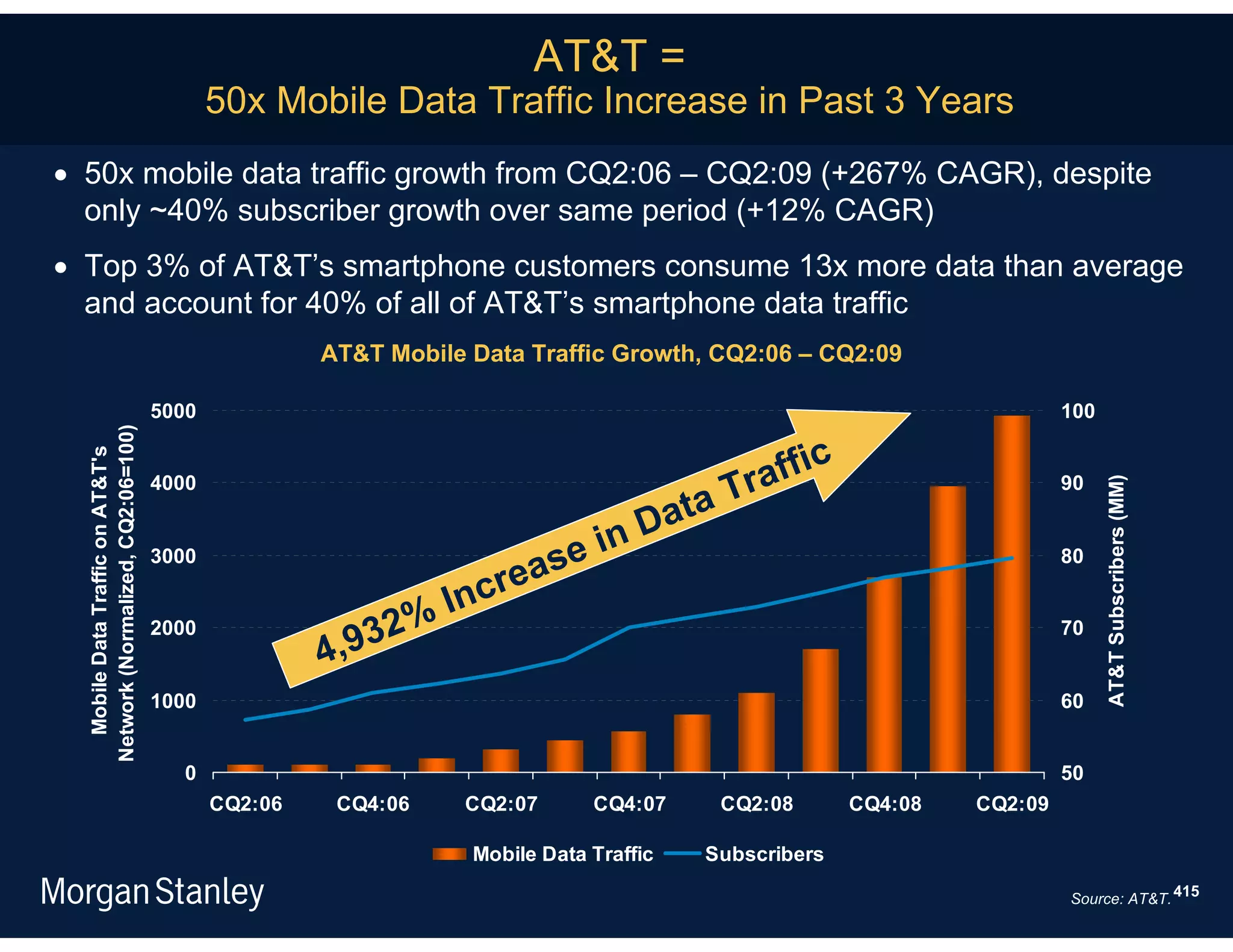
  Powerful Smartphones – High speed connectivity + ability to download / install VoIP + IM
   applications such as Skype / Google Voice / AIM = ideal device for Unified Communication.
  Easy-to-Use Software – Emergence of enterprise + consumer software solutions provide a
   unified address book for each user and streamlines various forms of communication.
  Unified Communications, Enabled by IP Networks + Smartphones + Software – Line
   between telecom and technology is blurring at a rapid pace as all forms of communication
   are converging to a universal packet-based IP (Internet Protocol) standard.
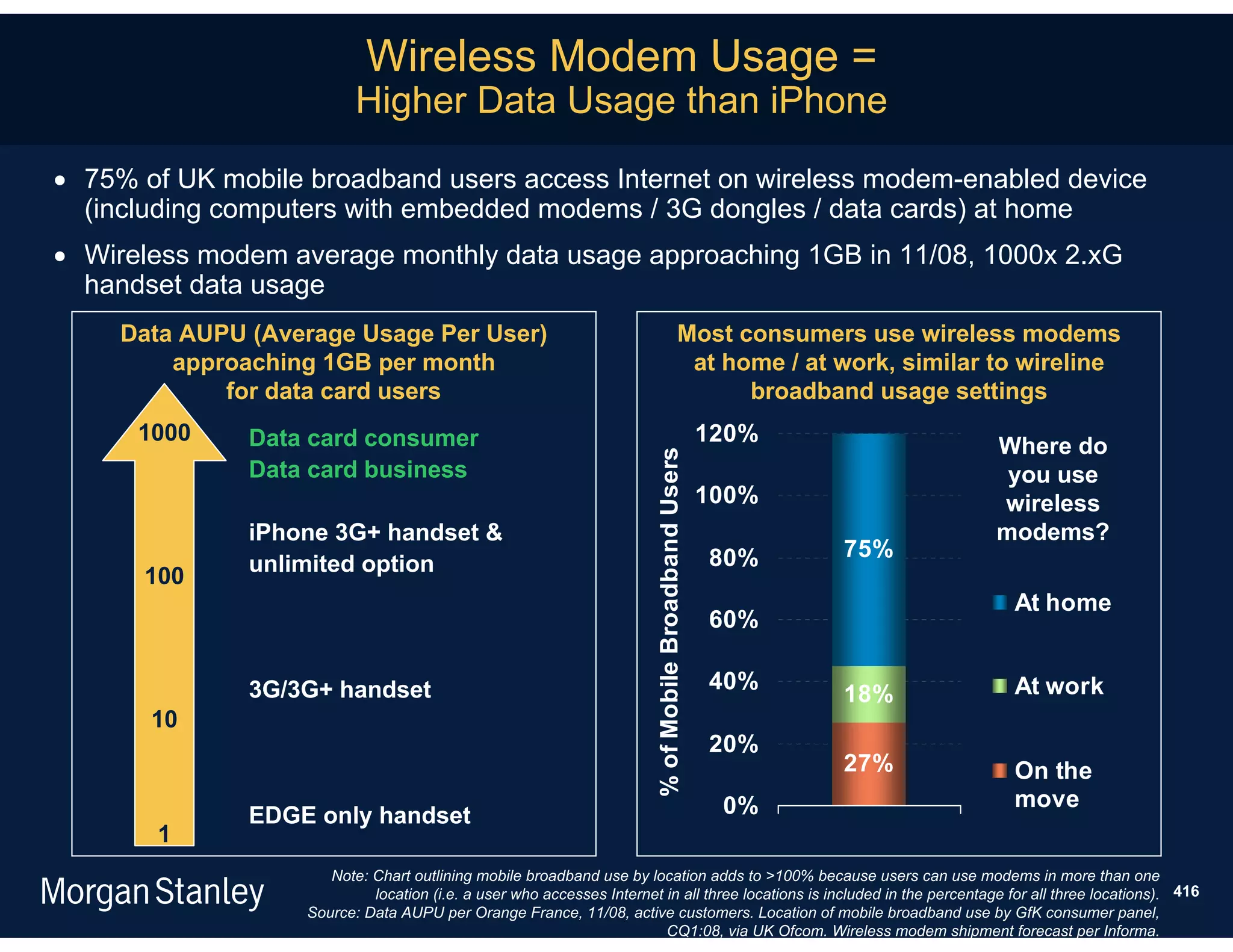
  Mobile = The Ultimate UC Platform, owing to its ‘always-there’ presence and ‘always-on’
   connectivity – In an ideal UC world, users get all his / her communications (multiple phone
   lines / e-mail accounts / IM accounts / voice mail / SMS / MMS / Facebook Wall messages /
   Twitter messages…) consolidated into a single place (likely a website), which they can
   access from anywhere with an Internet connection and manage all conversations in real time
   and in collaboration with friends and co-workers.


                                                                                              109
Unified Address Book
   Picture / Presence / Email / Phone # / Location All in One Place
 Traditionally, email addresses were stored in Outlook / Yahoo! Mail…; IM buddy lists were
  stored in AIM / Windows Live Messenger…; Phone contacts were stored in business card
  holders / cell phones; Pictures were stored in photo books…
 Today, enterprise users + consumers are beginning to see the benefits of a unified address
  book that consolidates all relevant info about a person into one entry on the web and on the
  phones.
              INQ1 –                      Palm Pre –                        Google Voice –
      Integrated Contacts +      ‘Synergy’ Feature Links Each         SMS / Voicemail / Universal
     Presence from Skype /         Person’s Picture / Email /         Phone Number, Accessible
    Facebook / Windows Live       Phone / Fax / Social Profiles           on Web + Mobile


                                                                  Source: INQ, Palm, Google, Morgan Stanley Research. 110
If VoIP Leader Skype Were a Carrier, it Would be Largest ‘Carrier’ in World
          521MM Registered Users (+41% Y/Y) & +8% of Cross-Border Calling Minutes
                                                                     Subscribers      Y/Y        Blended         Y/Y           Market
Rank* Company                          Type            Region           (MM)         Growth     ARPU (US$)      Growth        Cap ($B)

 1    China Mobile                Wireless             China              493           19%          $11           -10%          $192              Skype (5)
 2    Vodafone                    Wireless            Europe              303            23           37               3           123
 3    Telefonica Moviles / O2     Wireless         Europe / LatAm         206              9          41              -9           137            521MM
 4    China Telecom               Wireline             China              194             -9          11              4             38           Registered
 5    America Movil               Wireless             LatAm              194            13           13               4            80             Users
 6    Telenor                     Wireless          Europe / Asia         172              8          20              -3            24
 7    T-Mobile                    Wireless          Europe / USA          150              6          37              -3            64           (+41% Y/Y)
 8    China Unicom                Wireless             China              145            10            6              -4            32
  9   Orange                      Wireless             Europe             129              9          50               0             69
 10   Bharti Airtel               Wireless              India             111             43           5             -22             25
                      (1)
11    China Unicom                Wireline             China              108             10           9             -18            32
12    MTN Group                   Wireless             Africa             108             34          15               -2           28
13    Mobile TeleSystems          Wireless            Europe              101               2          8              -28           20
14    Orascom                     Wireless          Africa / Asia          89             12           6              -11           24
15    Verizon Wireless            Wireless              USA                86               6         51                -2          86
16    AT&T Mobility               Wireless              USA                82               9         51                 1         155
17    Telkom Indonesia            Wireless              Asia               80             32           3              -13           19
18    Telecom Italia Mobile       Wireless         Europe / LatAm          72               2         37                 2          30
19    VimpelCom                   Wireless             Russia              61             20          13                 7           6
20    NTT docomo                  Wireless             Japan               55               2         61                -8          64
            (2)
21    AT&T                        Wireline              USA                54             -3          80               -1          155
22    Deutsche Telekom            Wireline            Europe               54             -2          62                0           64
23    BSNL (3)                    Wireless              India              52             44           3              -35            --
24    Turkcell                    Wireless             Europe              49              -4         13              -24           15
25    China Telecom               Wireless             China               47              --          8            --              38

      Total                                                              3,195           10%         $23             2%        $1,520
                                Note: *Ranking is by based on subscribers. subs / ARPU data as of latest quarter (CQ3:09 or CH1:09 for some carriers who report on
                                semi-annual basis). Market Cap as of 11/17/09. Total market value excluding duplicates = $1,231MM; (1) China Netcom merged with
                                China Unicom in 10/08; (2) AT&T / Verizon / DT’s wireline ARPU is revenue per RGU (revenue generating unit) and include business
                                                                                                                                                                  111
                                  lines; (3) BSNL is owned by the Indian government. (5) Subscriber figure for Skype is registered user amount as of CQ3:09, cross-
                                     border calling minutes as of C2008, per Telegeography. Source: Company Reports, Telegeography, Morgan Stanley Research.
With VoIP, a Phone Is Still a Phone, but Very Different
Skype VoIP (521MM Users, +41% Y/Y, CQ3) on Multiple IP-Enabled Devices

           Skype on PC / Laptop            Skype on Netbooks / Internet Tablets


                                                       Skype on …

                                        3 SkypePhone     Cordless            Wi-Fi
                                                          Phone              Phone

           Skype on Smartphones


                                                                Source: Skype / eBay. 112
VoIP = Material Impact on Traditional Switched Access Lines
                                                  17MM+ Lines Lost to Cable / VoIP(1) in USA Since CQ2:01

                                                               USA Total Switched Access Line Losses, CQ1:04 – CQ3:09

                                                            1Q04A      4Q04A         3Q05A          2Q06A          1Q07A          4Q07A          3Q08A          2Q09A
  Quarterly Switched Access Line Net Loss (000)


                                                    0                                                                                                                         0%


                                                                                                                                                                                       Switched Access Line Y/Y Growth (%)
                                                   (500)                                                                                                                      -2%


                                                  (1,000)                                                                                                                     -4%


                                                  (1,500)                                                                                                                     -6%


                                                  (2,000)                                                                                                                     -8%


                                                  (2,500)                                                                                                                     -10%

                                                                    Net Lines Lost to Wireless + Others
                                                  (3,000)                                                                                                                     -12%
                                                                    Net Lines Lost to Cable (VoIP)

                                                                    Y/Y growth


                                                                      Note: (1) 17MM cumulative cable telephony net adds in USA from CQ2:01 to CQ3:09, all cable telephony operates on VoIP
                                                                                                                                                                                                                             113
                                                                                                                                     technology. Source: Morgan Stanley Telecom Research.
VoIP Impact on Enterprise Communications
Improves Productivity(1) by 3x + Reduces Costs by 55%(2)
                                         Productivity Improvement & Annual Cost Savings from VoIP Systems

                                 3500%                                                                                                                       180


                                                                                                                                                                    Annual Productivity Saving ($)
 VoIP Taks (% faster than TDM)


                                 3000%       Productivity Improvement (% faster than tradtional
                                                                                                                                                             160
                                             voice solution)                                                                                                 140
                                 2500%
                                                                                                                                                             120
                                             Annual Productivity Savings per Task per
                                 2000%       Employee ($)                                                                                                    100
                                 1500%                                                                                                                       80
                                                                                                                                                             60
                                 1000%
                                                                                                                                                             40
                                 500%                                                                                                                        20
                                   0%                                                                                                                        0
                                                                              l


                                                                             x
                                                                          ng


                                                                             ll
                                                                            g
                                                                              l


                                                                            p


                                                                            x

                                                                          lls


                                                                          ge
                                                                           ld


                                                                            ll
                                                                           ai
                                                                          ai


                                                                         fa
                                                                         ca
                                                                        tin


                                                                         fa
                                                                       am


                                                                        ca
                                                                      ho


                                                                      em
                                                                     em


                                                                      ca
                                                                       ci


                                                                       id

                                                                     ve
                                                                    nd
                                                                    ee


                                                                    er
                                                                   en
                                                                     C


                                                                   nd


                                                                    br
                                                                   ic
                                                                 on


                                                                   d
                                                                  ic


                                                                  ei
                                                                 sf
                                                                 gr


                                                                Se


                                                                ar
                                                                er


                                                              ra
                                                               vo
                                                              vo


                                                                o

                                                              ec
                                                             an
                                                              ll


                                                             di
                                                            rw
                                                             nf
                                                              e
                                                           ca


                                                           be


                                                            R
                                                            s
                                                          fic
                                                            d


                                                          Tr


                                                          au
                                                         co


                                                         Fo
                                                         es
                                                         ar


                                                        m
                                                       of
                        e


                                                       p
                                                      rw


                                                      cc
                      ac


                                                      ay


                                                     nu


                                                    tu
                                                     d

                                                    A
                                                  Fo
       Pl


                                                    w
                                                  or


                                                  e

                                                Se
                                                 e-


                                               on
                                               ec


                                              re


                                           ph
                                            R


                                           th


                                       up
                                         p
                                     t-u


                                    ok
                                   Se


                                  Lo


                                                     Note: (1) Productivity improvement limited to voice / fax tasks; (2) cost saving calculation based on costs of the IP PBX,
                                                    hardware, software and licensing vs. equivalent capability on traditional switched line infrastructure, TDM is time-division 114
                                                                                       multiplexing. Source: Intel, “The Business Case for Enterprise VoIP”, published 2/06.
Google Voice
Putting User in Control of Voice Communications via IP Networks

 Google Voice – Launched on 3/11/09 (currently has 1.4MM users(1) / 570K of which use it
  everyday), gives user a universal address book + single telephone number, to which all
  calls to user’s home / office / cellphone can be forwarded
 Voicemail transcription + SMS + future integration with Gmail + $0.02 per minute
  International VoIP call(2)
 Google Voice mobile app launched for Android / BlackBerry in 7/09, offers full native
  contact / dialer / SMS integration
                                                                     Fully Integrated w/
Universal Address Book / Transcribed Voicemail / SMS on the Web Android Dialer / Address Book


                     Note: (1) Google Voice user number includes Grand Central, which was launched in 2005 and acquired by Google in 2007. 115
                                                        (2) $0.02 per minute rate apply to selected countries. Source: Google, BusinessWeek.
Powerful Devices + New Usage Models =
    Connecting Users in Real-Time


                                        116
Social Networking –
Global Phenomenon, Facebook Leading, Though Many Regional Strongholds

                            Global Social Networking Web Sites*
              830MM Unique Users, +20% Y/Y; 188MM Total Minutes, +25% Y/Y, 10/09


                                                                                                                      QQ (Alumni +
                                                                                                                     Mini) – Tencent
         Facebook                                                             Vkontakte                                68MM users
        430MM users                                                          23MM users                                +138% Y/Y1
         +137% Y/Y                                                            +22% Y/Y
                                                 Skyrock                                 Baidu Space                         CyWorld
           MySpace                             21MM users                                63MM users                         21MM users
         110MM users                            +10% Y/Y                                  +33% Y/Y                           +4% Y/Y
       -14% since 10/08
                                                                                          Kaixin001                            Mixi
          Twitter                                                                        25MM users                         14MM users
        58MM users,                                                                      +325% Y/Y                           +4% Y/Y
        +1238% Y/Y
                                                                                                     Friendster
                       Hi5                                                                          18MM users
                   47MM users                                                                         -47% Y/Y
                    -18% Y/Y
                      Orkut
                   54MM users
                    +20% Y/Y

                                * Global social networking websites exclude application-based networks such as IM networks. 1) QQ.com social
                           networks (Tencent properties) Y/Y growth since 1/09, data unavailable prior to 1/09 for QQ.com Mini. Usage stats are
                          ‘unique visitors’, per comScore global 10/09, may differ materially from company-disclosed ‘registered accounts’ stats. 117
                                 Other notable social networks include Windows Live Profiles, 56.com, Deviantart, Digg, Buzz Media, and Bebo.
                                                                                             Source: comScore 10/09, Morgan Stanley Research.
Facebook (+ YouTube) =
                    Largest Share Gainers of Global Online Usage Over Past 3 Years

                                                        Share of Global Online Time Spent, 6/06 – 10/09

                            14%


                            12%
% Share of Global Minutes


                            10%


                            8%


                            6%


                            4%


                            2%


                            0%
                                  6/06   9/06   12/06   3/07   6/07   9/07   12/07   3/08    6/08   9/08   12/08      3/09      6/09      9/09

                                         Yahoo.com        Msn.com       Google.com          YouTube.com        Facebook.com


                                                                                                                                                     118
                                                                                                                   Source: comScore global, 10/09.
Facebook = Garnering Rising Share of Communications
Unified Communications + Multimedia Creation Tool / Repository in Your Pocket


               Messages        VoIP Calls

                                                                   Connectivity /
                                                                     Presence
                                                                    provided by
                                                                   Mobile Phone
      Chat
                                      Play Games


     Wall Posts
                                                        +
                               Share Videos / Music /
                                 Photos / Stories

             Status Updates


                                                        Source: Facebook, how-to-travel-the-world.com. 119
Japan Social Networking Trends Show Importance of Mobile –
                              Mixi Mobile Page Views = 72% vs. 17% 3 Years Ago
                          Mixi’s (Japan’s Leading Social Network) Monthly Page Views, Mobile vs. PC, CQ2:06 – CQ3:09

                          16,000


                          14,000


                          12,000
Monthly Page Views (MM)


                          10,000
                                                                                                                                                               72%

                           8,000


                           6,000


                           4,000

                                                                                                                                                               28%
                           2,000


                               -
                                   2Q06 3Q06 4Q06 1Q07 2Q07 3Q07 4Q07 1Q08 2Q08 3Q08 4Q08 1Q09 2Q09 3Q09
                                                                               Desktop                   Mobile

                                            Note: Mixi is one of Japan’s leading social networking sites on PC and mobile with 18MM registered users as of 9/30/09. It
                                                                                                                                                                         120
                                          monetizes mobile usage via sales of avatars, customized homepages and other premium services. Source: Company reports,
                                                                                                                                           Morgan Stanley Research
Powerful Devices (like iPhone) + New Usage Models
     (Video / Audio Streaming + Browsing) =
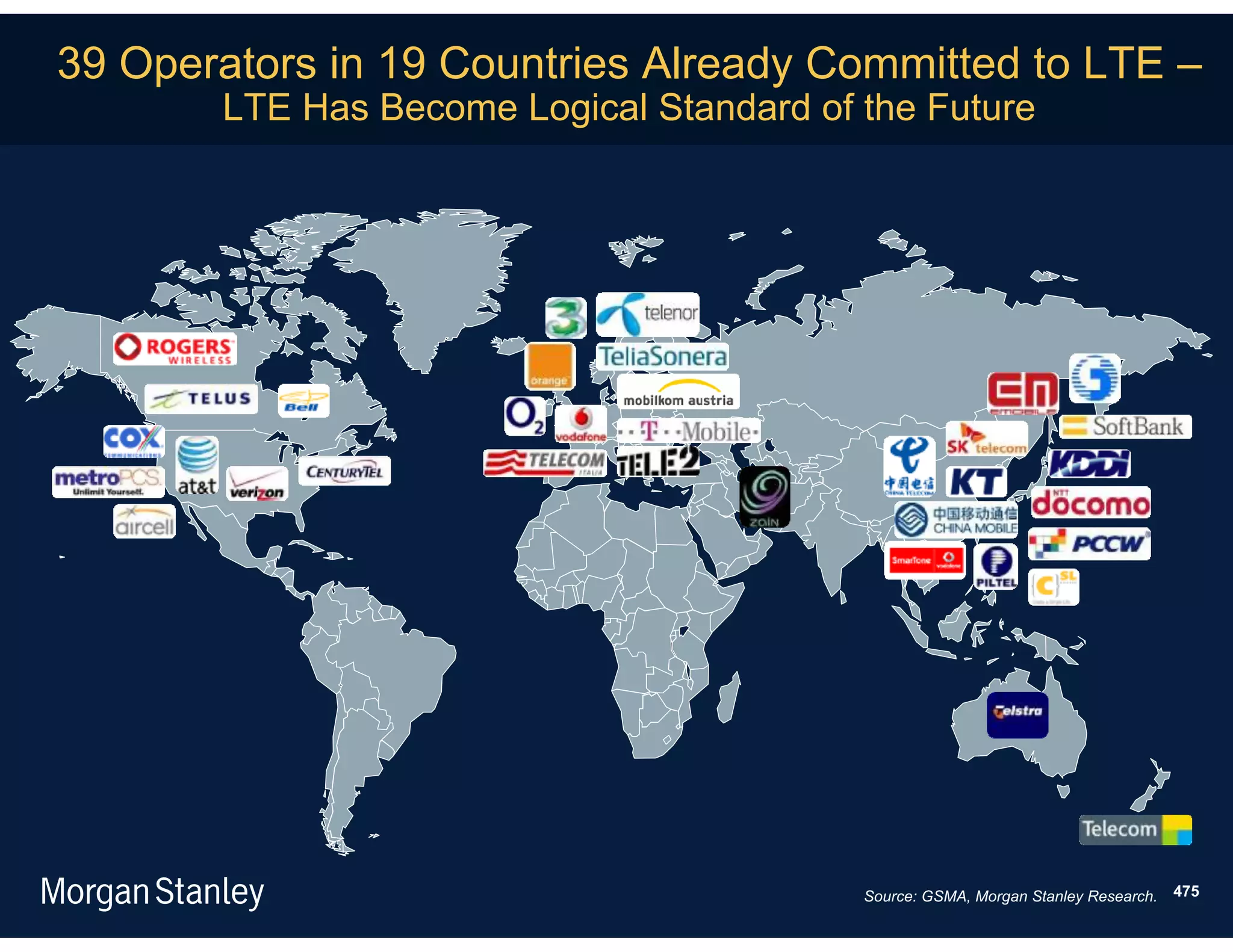
   Driving Explosive Mobile Data Traffic Growth


                                                    121
Video Driving Rapid Growth in Mobile Internet Traffic
                                            Mobile Data Traffic to Rise 66x by 2013E (131% CAGR)
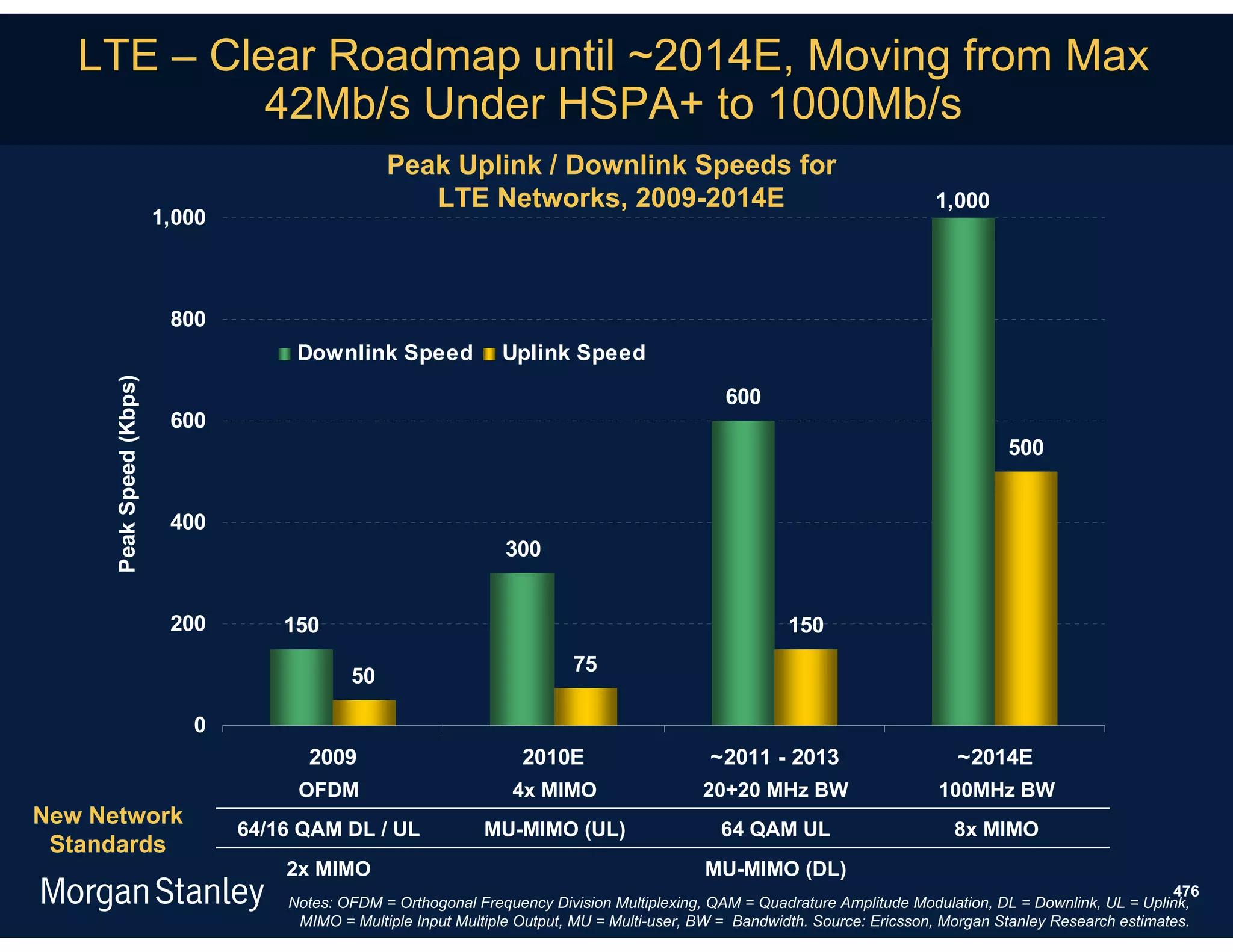
                                                                     Global Mobile Data Traffic, by Type
                                                                               2008 – 2013E                                                               2008-2013E
                                                                                                                                                            CAGR
 Total Mobile Data Traffic (Tetabyte per month)


                                                                                                                                            Total               131%
                                                  2,000,000
                                                                                                                         19%
                                                                                                                                              Data              112%
                                                                                                                         10%
                                                  1,500,000

                                                                                                                                              P2P               101%

                                                  1,000,000
                                                                                                                          64%
                                                                                                                                              Video             154%

                                                   500,000

                                                                                                                                              Voice             112%
                                                                                                                          7%
                                                         0
                                                              2008   2009E    2010E       2011E          2012E          2013E

                                                                                                                                                                        122
                                                                                   Source: Cisco Visual Networking Index – Mobile Data Traffic Forecast, 2008-2013, 2/09.
Video = High Usage + High Bandwidth Consumption
                                     YouTube USA IP Traffic > 2000 Total USA Internet Traffic

                                                               Internet Traffic per Month
                                   100,000
IP Traffic (Terabytes per month)


                                    80,000

                                                                                       100,000
                                                                                       TB / Mo
                                    60,000
                                                                                       (Global)


                                    40,000


                                    20,000                                              30,500                                        33,000
                                                    25,000                              TB / Mo                                       TB / Mo
                                                    TB / Mo                              (USA)

                                        0
                                             USA Internet Backbone,               YouTube, 5/08                              China P2P Video
                                                 2000 Year End                                                               Streaming, 1/08


                                                                      Note: Monthly traffic are estimates by Cisco. Source: Cisco, Approaching the Zettabyte Era, 6/08. 123
Consumers Have Voted for Video on Desktop
                        Mobile Usage Likely to Follow

 466MM YouTube global users, +35% Y/Y; 73B minutes of video
  watched, +70% Y/Y, 10/09

 42MM Hulu USA users, +77% Y/Y, 10/09

 167MM online video USA users, +14% Y/Y; 109B minutes of video
  watched, +169% Y/Y, 10/09

 54MM global Internet-enabled set-top boxes (Xbox360, Sony PS3, TiVo,
  Slingbox, Vudu, Roku…), +59% Y/Y in 2008 – transforming TVs into
  Internet streaming / on-demand video terminals

 Mobile video usage could surprise on upside – 32% of Americans have
  used Internet on mobile devices (4/09), up from 24% (12/07).


                   Source: YouTube users per comScore media metrix (global) unique visitors; Hulu users per comScore video metrix (USA)
                                                                                                                                          124
               unique viewers, mobile Internet usage per Pew Internet & American Life Project; YouTube, Netflix, Morgan Stanley Research.
Mobile Ramping Faster than Desktop Internet Did and Will Be Bigger
 Than Most Think – 5 Trends Converging (3G + Social Networking +
            Video + VoIP + Impressive Mobile Devices)
 Fastest new tech device ramp / ecosystem in history – 57MM+ Apple mobile devices (iPhone +
  iTouch) since 6/07 launch / 2B+ iPhone apps downloaded since 7/08 - $23B+ cumulative mobile-
  related revenue to Apple. Network effects at work in Apple mobile ecosystem (devices + applications
  + iTunes distribution). Customers are voting with their usage + dollars. Power / impact of this trend /
  shift should not be underestimated.

 Broad base of IP-based mobile usage models ramping very fast on various networks (3G / Wi-
  Fi / Bluetooth / GPS) – something for everyone including likes of social networking + music + video
  + games + books + commerce + voice + messaging + location-based services (GPS)…

 Rapid growth in number / type of mobile cloud-based connected devices, in effect creating
  wireless remote controls everywhere – 490MM 3G subscribers (+45% Y/Y, of which 23MM are
  wireless modem users) in 2008; 319MM Wi-Fi (+42%) enabled devices shipped in 2008; 421MM
  GPS enabled devices (+57% Y/Y) shipped in 2008; 1.3B Bluetooth-enabled devices (+45% Y/Y)
  shipped in 2008.

 Rising consumer expectations – increasingly, consumers expect to get what they want when they
  want it, from the palm of their hand…

 Explosion in mobile Internet traffic – 66x increase from 2008 to 2013E (131% CAGR, per Cisco
  estimate).
                                                                                                      125
Key Theme #3


               126
Key Theme #3

1) Wealth Creation / Destruction is Material in New Computing Cycles – Now in
   Early Innings of Mobile Internet Cycle, the 5th Cycle of Last Half Century.
2) Mobile Ramping Faster than Desktop Internet Did and Will Be Bigger Than
   Most Think – 5 Trends Converging (3G + Social Networking + Video + VoIP +
   Impressive Mobile Devices).
3) Apple Leading in Mobile Innovation + Impact, for Now – Depth of App
   Ecosystems + User Experience + Pricing Will Likely Determine Long-Term
   Winners.
4) Game-Changing Communications / Commerce Platforms (Social Networking +
   Mobile) Emerging Very Rapidly.
5) Growth / Monetization Roadmaps Provided by Japan Mobile + Desktop
   Internet.
6) Massive Data Growth Driving Carrier / Equipment Transitions.
7) Compelling Opportunities in Emerging Markets.
8) Regulators Can Help Advance / Slow Mobile Internet Evolution.
                                                                                 127
Key Theme #3 –
Apple Leading in Mobile Innovation + Impact, for Now – Depth of App Ecosystems
     + User Experience + Pricing Will Likely Determine Long-Term Winners


    Near term, Apple is driving the platform change to mobile
    computing and leading in user experience. Its mobile ecosystem
    (iPhone + iTouch + iTunes + accessories + services) market share /
    impact should surprise on upside for at least the next 1-2 years.

    Long term, Google Android’s open / free operating system
    (combined with clever device manufacturers), standardization of
    more powerful mobile web browsers, emerging markets
    competition and carrier limitations may pose challenges to Apple’s
    market share upside. RIM may maintain enterprise lead owing to
    installed base, but long-term outlook is challenged.

                                                                           128
Apple Leading in Mobile Innovation + Impact, for Now –
    Depth of App Ecosystems + User Experience + Pricing Will Likely
                    Determine Long-Term Winners
   Network effects from the ecosystem favor Apple at high-end of mobile device market –
    Mobile Internet industry has been revolutionized by innovative hardware + software on
    iPhone/Touch + iTunes digital distribution system, which are catalysts for broader device/usage
    innovation. Technology rule of thumb = software drives hardware sales. Apple has a significant (and
    growing) software lead in addition to innovative hardware advantage – all making it difficult for
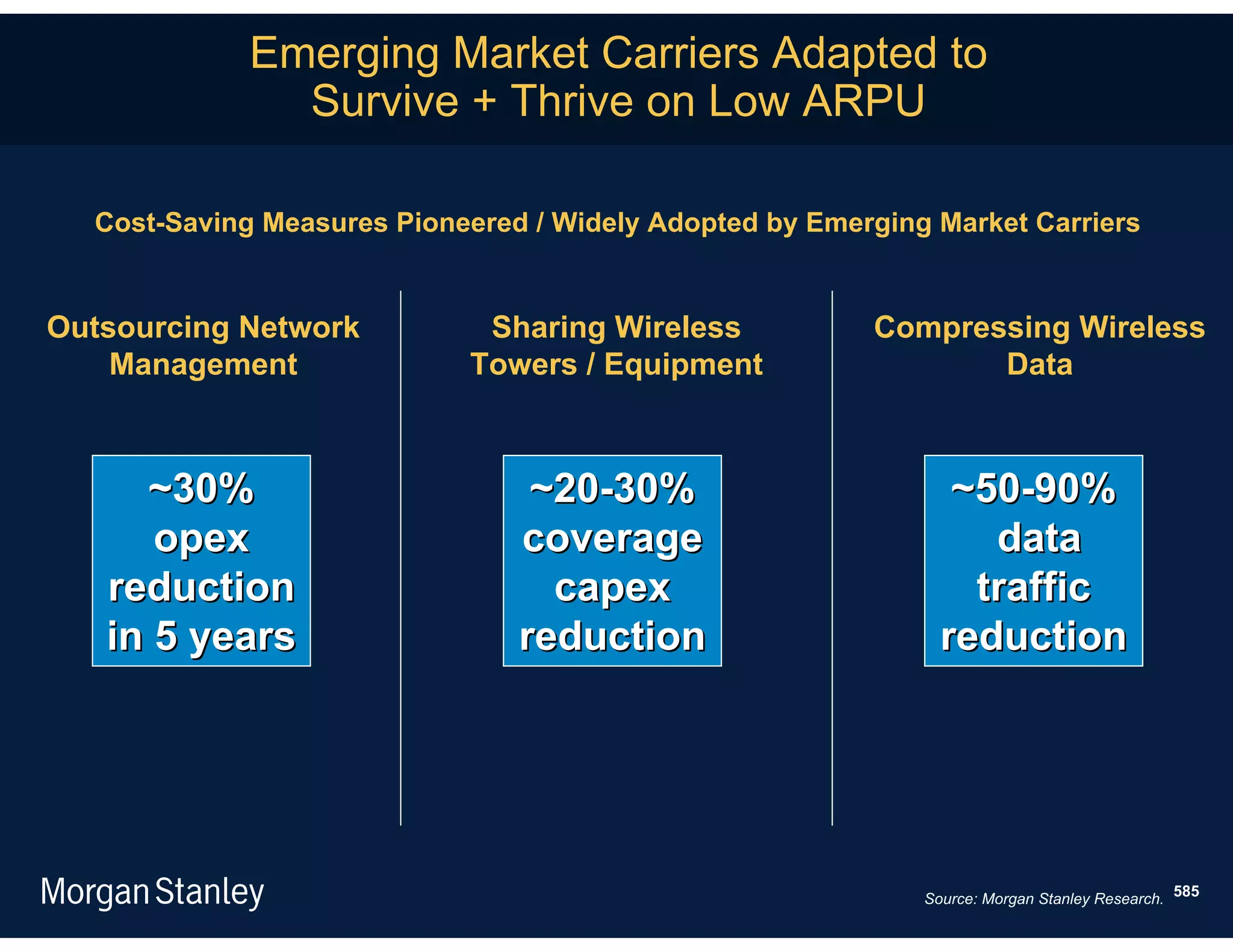
    others to catch up. Apple management very focused on driving on-going mobile-related market
    share gains.
   Bill-of-material (BOM) cost curve should help drive high-end devices into mainstream / low-
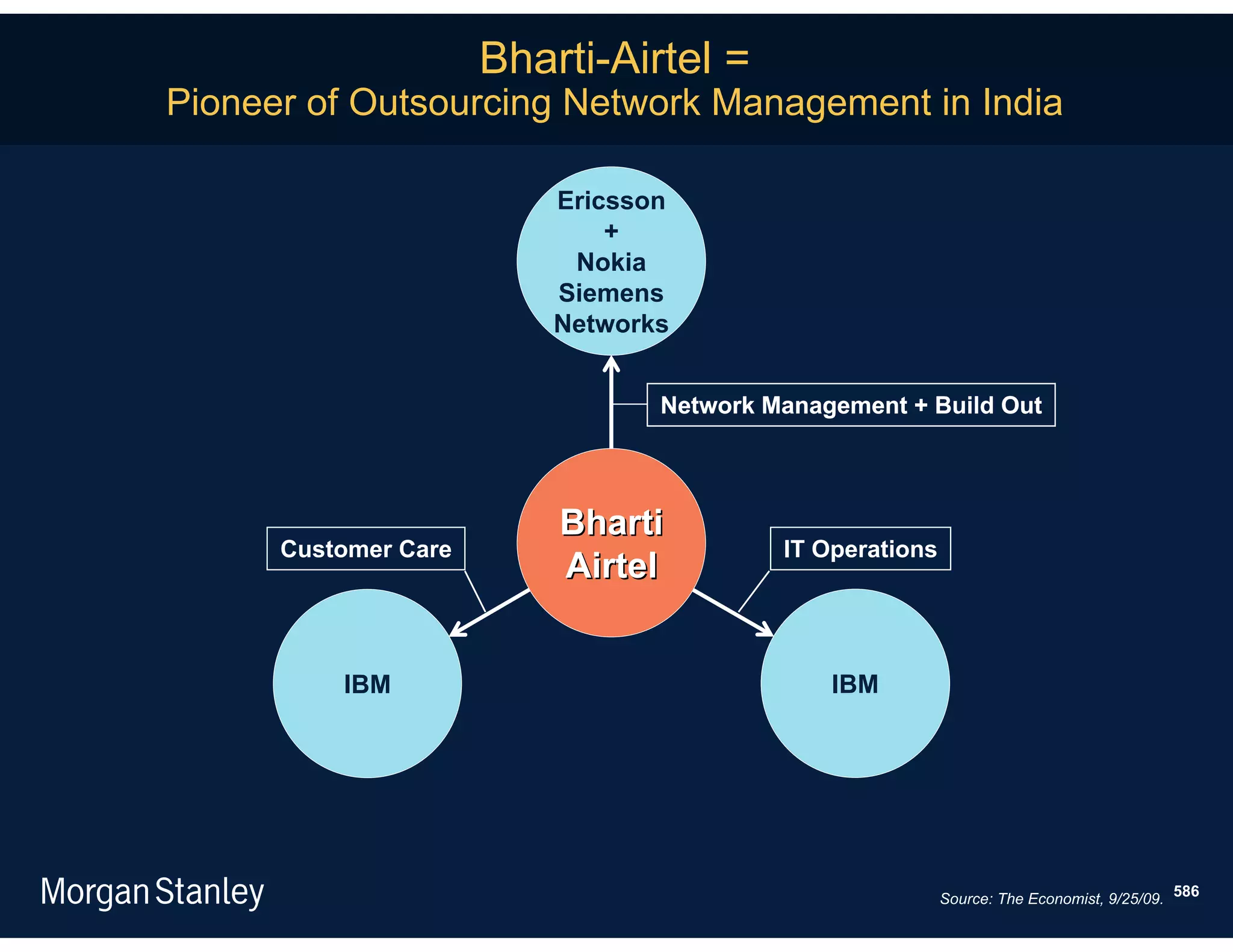
    end – 50% price reduction for semiconductor components every 18 months = Moore’s Law.
   Smartphone success key to handset players’ revenue + profits – While Apple + RIM account
    for 4% of global handset units / 12% of revenue, they dominate 44% of industry operating profit pool
    vs. Nokia + Samsung + LG + Sony Ericsson + Motorola, CQ2:09.
   Low-end (high volume + low price) / emerging markets still up for grabs – Nokia + Samsung
    may have 1-2 years to replicate Apple success in emerging markets.
   Open mobile web potentially more attractive to developers / consumers – Google / Opera
    leading transformation of mobile browsers into development platforms. Apple ‘walled garden’
    approach somewhat constrained by Apple’s approval process + carrier capacity.
   RIM BlackBerry may maintain enterprise lead for foreseeable future, but long-term outlook is
    challenged – consumer offerings likely to prove increasingly uncompetitive owing to software /
    application disadvantages.
                                                                                                    129
Momentum Favors Apple iPhone + iTouch Ecosystem –
                                      Fastest User Growth in Consumer Technology History

                                             Global Cumulative Unit Shipments in First 10 Quarters
                                             iPhone + iTouch vs. Wii / DS / PSP / iPod / BlackBerry

                                 60

                                                                                                                                            Nintendo Wii
Cumulative Unit Shipments (MM)


                                 50
                                                                                           Apple
                                                                                      iPhone + iTouch                                      Nintendo DS
                                 40

                                                                                                                                             Sony PSP
                                 30


                                 20
                                                                                                                                Apple            RIM
                                                                                                                                iPod          Blackberry
                                 10


                                       Q1    Q2          Q3            Q4           Q5            Q6           Q7            Q8           Q9           Q10
                                                                            Quarters Since Launch
                                                       Note: iPhone launched in CQ2:07; iTouch launched in CQ3:07; iPod launched in CQ4:01; Wii launched in CQ4:06; DS
                                                  launched in CQ4:04; PSP launched in CQ1:05; Blackberry smartphone launched in C2002. Source: Apple, Nintendo, Sony, 130
                                                                                                                           RIM, Katy Huberty, Morgan Stanley Research.
Apple’s Impressive Share Likely Mutually Reinforcing –
         Smartphones + Digital Music Players (MP3) + PCs

What if Apple’s global handset market share approaches its global MP3 / USA smartphone share?

                                                    Apple’s Market Share in MP3 / Handset / PC Market, CQ2:09 TTM

                                                           MP3                      Handset                              PC
                                                          51MM                       20MM                               10MM                TTM Apple
                                              80%                                                                                           Shipments
                                                                70%
          Market Share (%, Trailing 4 Qtrs)


                                              60%

                                                                                           44%
                                                        40.0%
                                              40%


                                              20%                                                                              14%
                                                                                  11%                                 10%
                                                                                                              4%
                                                                          1%
                                              0%

                                                       Global   USA     Global Global USA                  Global USA USA
                                                                       Handset Smart- Smart-                 PC Cons- Cons-
                                                                               phone phone                        umer umer
                                                                                                                       18-24
                                                                               Source: NPD, IDC, Gartner, Company Data, Katy Huberty, Morgan Stanley Research. 131
Apple iPhone –
Successful Mobile Efforts Driving Material Revenue / Free Cash Flow Growth

        Apple’s Revenue Mix, Free Cash Flow & Operating Margin, CQ2:07 vs. CQ3:09

                                     Revenue
                          CQ2:07      ($MM)     CQ3:09

                          $2,533      Mac       $3,952
                                                                       Other
                                                                       11%
        Other             $1,571      iPod      $1,563
         13%                                                iTunes
                              $5      iPhone    $2,297        10%
   iTunes
                                                                                           Mac – 40%
     11%      Mac – 47%
                            $608      iTunes    $1,018
    iPod – 29%
                            $693      Others    $1,040     iPhone – 23%

                                      Total
                          $5,410     Revenue    $9,870                         iPod – 16%

                            $944    Free Cash    $2,651
                                       Flow
                                    Operating
                             19%                  22%
                                     Margin


                                                             Source: Company data, Morgan Stanley Research. 132
iTunes App Store = Shot Heard ‘Round the World –
        Recalls AOL’s Easy-to-Use Online Internet Platform in 1990s


 Apple's iPhone efforts remind us of the success of America Online (later AOL)
  in the early-to-mid 1990s when America Online overlaid an easy-to-use access
  / content environment on a very messy / geeky Internet. Apple is 2-year old
  newcomer in the smartphone market (where players like Nokia, Microsoft and
  RIMM have been in the market for 13, 8, and 7 years, respectively). But Apple
  has changed the way users / carriers / developers think about the mobile
  Internet and mobile devices by:
     placing an easy-to-use application store widget on the iPhone home screen
      linked to its iTunes distribution channel, and
     creating an easy-to-use and monetizable application development
      environment for developers.


                                                                                  133
AOL Wealth Creation from Easy-to-Use ‘Walled Garden’ –
  Peak Market Valuation of $210B in CQ4:99, Up from $500MM in CQ1:94


                                         AOL Subscribers & Market Value, CQ1:94 – CQ1:00

                   25                                                                                                             $200


                   20                                                                                                             $160


                                                                                                                                          Market Value ($B)
Subscribers (MM)


                   15                                                                                                             $120


                   10                                                                                                             $80


                    5                                                                                                             $40


                    0                                                                                                             $
                        3/94   9/94   3/95   9/95   3/96   9/96   3/97   9/97     3/98      9/98      3/99       9/99      3/00

                                                    Subscribers (MM)        Market Value ($B)


                                                                          Note: Peak market value of $210B on 12/10/99. Source: FactSet, AOL. 134
iTunes App Store = The Killer Mobile App!
                                              Unprecedented Ramp to 100K+ Applications

                                                         iTunes App Store # of Apps & Games, 7/08 – 9/09
                                                                   Apps             Games              M/M Growth Rates                                      100%

                                     100


                                                                                                                                                             80%
Total Apps + Games Available (000)


                                      80


                                                                                                                                                                      M/M Growth Rates (%)
                                                                                                                                                             60%
                                      60


                                                                                                                                                             40%
                                      40
                                           App Store
                                            Launch
                                            7/11/08
                                      20                                                                                                                     20%


                                                                                                                                                             0%
                                           7/08   9/08        11/08         1/09         3/09         5/09         7/09          9/09        11/09

                                                       Note: Apple announced that total apps / downloads reached 100K / 2B as of 11/09. Data from 148Apps.biz reflects active
                                                                                                                                                                                 135
                                                                 applications in the store, leading to a lower number than cumulative applications to date as released by Apple.
                                                                                                                        Source: Apple, 148Apps.biz, Morgan Stanley Research.
iPhone App Downloads =
                                           Growing at Accelerating Rate
                                       iPhone App Downloads, First 14 Months Since Launch

                       2,000


                       1,600
Apps Downloaded (MM)


                       1,200


                        800


                        400


                          0
                               07/08   09/08    11/08     01/09       03/09             05/09            07/09            09/09

                                                        Cumulative App Downloads
                                                                                                                                           136
                                                                  Source: Apple, Kleiner Perkins Caulfield & Byers, Morgan Stanley Research.
Mobile App Definition


  A mobile application (or app) is a computer program which runs on a
  mobile handset.
 Mobile ‘apps’ have existed for as long as there have been smartphones, but the
  complexity of applications has been limited by the handset’s memory and
  processing power. In the last five years many handsets have had the ability to
  run simple mobile applications, but until recently ‘apps’ have not had a great
  impact on the mobile phone industry.
 ‘Apps’ exist across many genres, including games, entertainment, utilities,
  education, travel and lifestyle. Furthermore, they vary in the degree to which they
  rely on the capabilities of the handset they run on and the network they are
  connected to. For example, many games can run independently of data
  connectivity, while other utilities and travel applications can either take
  advantage of GPS built into handsets, or use location-based information
  provided by the mobile network operator.

                        – Definition from UK Ofcom “The Communications Market 2009”
                                                                                      137
Why Is iPhone App Store So Special?
Easy / Powerful Discovery / Payment / Development for Consumers + Developers

 First Centralized Mobile Application Store Front – Bevy of free / low-priced apps + ability to search for
  apps by name / top 25 (paid + free + grossing) / featured apps / categories (games / entertainment /
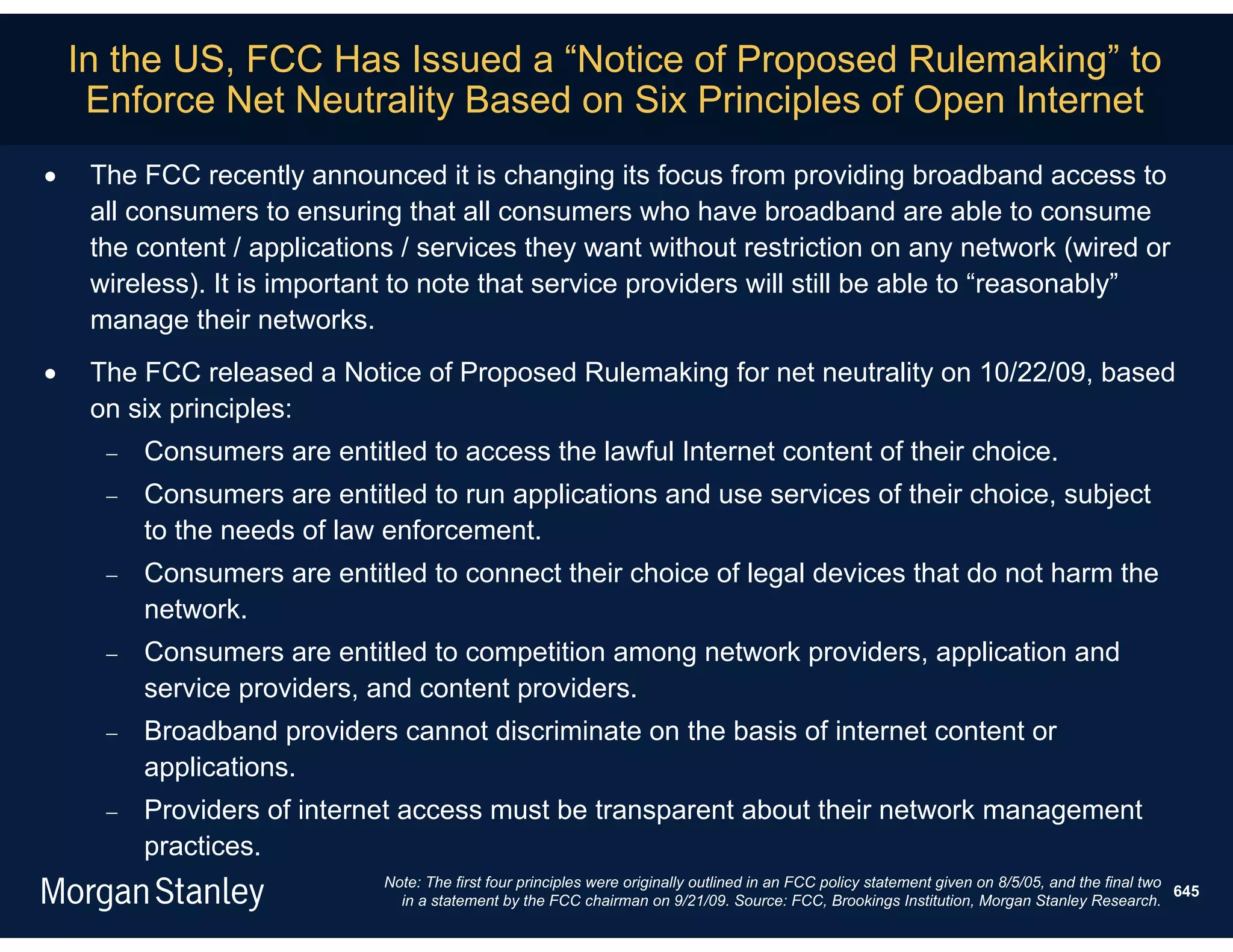
  utilities / social networking / music…) = easy-to-navigate marketplace, capturing the element of
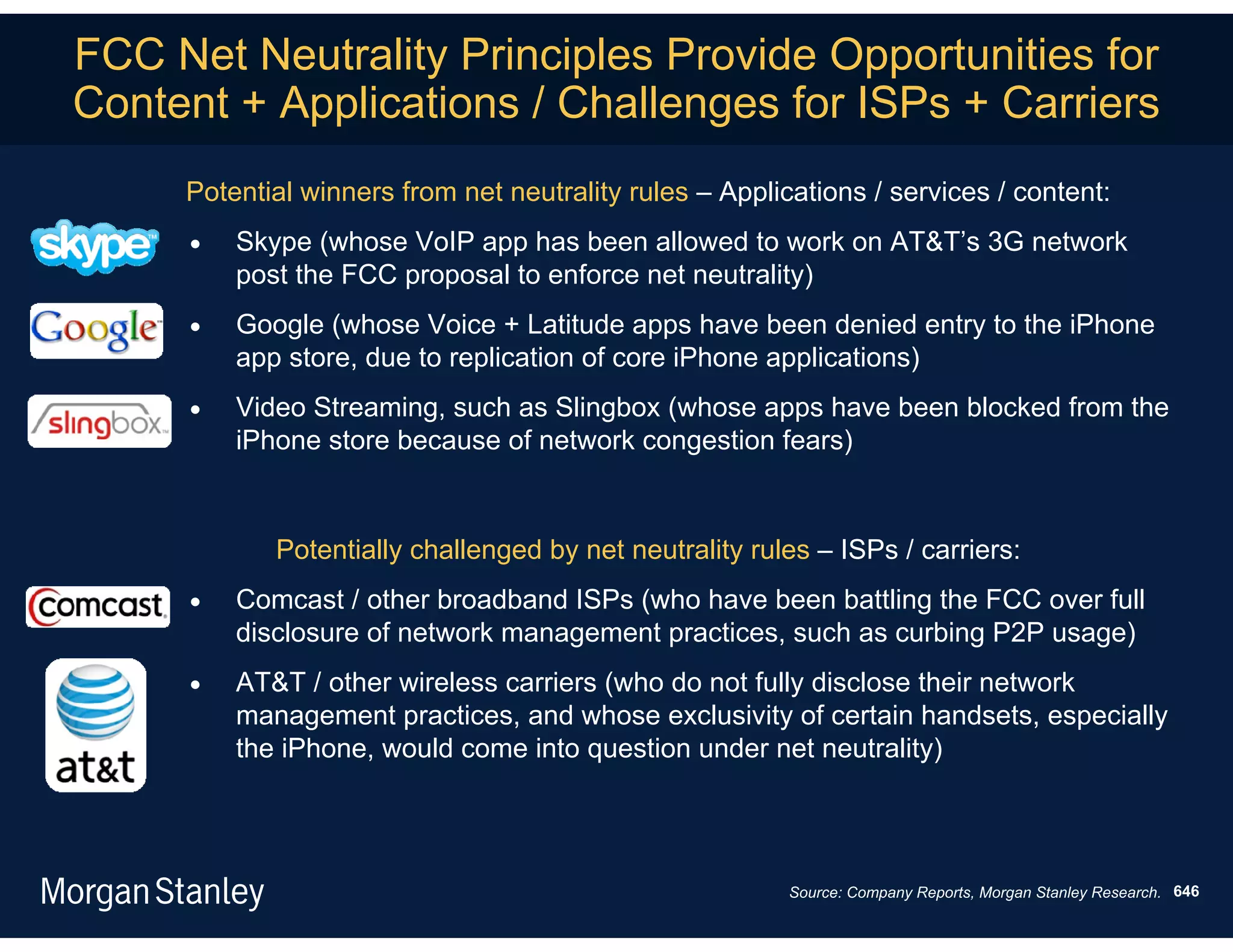
  consumer technology success of fast / easy / fun products. 62% of iPhone users discover apps through
  search (includes categories) / 60% browse top ranked + featured, per AdMob.
 Easy Payment / Account Management – App store connected to iTunes account + credit card = one-
  click app purchase. Syncing iPhone with iTunes allows user to manage / update downloaded apps.
 Robust SDK (Software Development Kit) – Comprehensive + user-friendly SDK with 1000+ APIs
  (Application Programming Interfaces) gives developers tools to build / test / debug / analyze / distribute
  applications in the iPhone App store. Ability to simply imbed maps + social networking tools + payment
  system + other APIs makes apps more valuable + easier to make.
  Centralized App Store Front        Payment / Management on iTunes             Robust SDK for Developers


                                                                         Source: AdMob, Apple, Morgan Stanley Research. 138
Users / Developers / Apple =
Likely to Benefit from iPhone App Ecosystem’s Network Effects
  Network Effect is a positive change in the benefit, or surplus, that a user derives
  from a good or service when the number of other users consuming the same
  kind of good or service increases.

      Better Economics                                                               Rising Number of
      Attract More Developers                                                        Available Apps (65K+)
      to the iPhone Platform,                                                        Increases Consumer
      Creating More Apps      .                                             .        Choice


       More Downloads                                                               More Apps Drive More
                                   .                                        .
       Leads to Higher                                                              Consumers To Purchase
       Profitability for                                                            iPhones (26MM+) and
       Developers                                                                   Download iPhone Apps
                                                                                    (1.5B+)

                        Note: Network Effect may also be referred to as “positive network externalities.” Source: Morgan Stanley Research. 139
In technology, the system with most applications +
      best application ecosystem usually wins.
Simply, consumers often want the system with most
options & developers develop for system with most
       consumers. Historic trends favor Apple


                                                      140
Apple iPhone / iTouch = 2B+ App Downloads (+~14x) –
             (~35 per User) – Games + Books + Entertainment Lead

                    # of Apps                                           # of Paid                       Paid as % of
Category              (000s)              % of Total                   Apps (000s)                     Category Total
Games                  22.6                  19.1%                            15.7                              69%
Entertainment          17.2                   14.6                            12.5                               72
Books                  14.8                   12.5                            13.5                               91
Travel                  7.9                    6.7                             7.1                               89
Utilities               7.7                    6.5                             5.5                               71
Education               7.7                    6.5                             6.4                               83
Lifestyle               6.7                    5.6                             4.7                               71
Reference               4.7                    4.0                             3.9                               82
Music                   4.0                    3.4                             2.2                               56
Sports                  3.7                    3.1                             2.8                               76
Navigation              3.0                    2.5                             2.4                               81
Productivity            3.0                    2.5                             2.2                               73
Business                2.7                    2.3                             1.4                               54
News                    2.7                    2.2                             1.7                               64
Health & Fitness        2.5                    2.1                             2.0                               79
Social Networking       2.1                    1.8                             1.1                               52
Photography             1.7                    1.5                             1.4                               80
Finance                 1.7                    1.4                             1.1                               66
Medical                 1.4                    1.2                             1.1                               78
Weather                 0.5                    0.4                             0.4                               80
Total                 118.4                                                   89.1                              75%
                              Note: Data as of 12/8/09. Apple announced that total apps / downloads reached 100K / 2B as of 11/09. 141
                                                                        Source: Mobclix, Apple iTunes, Morgan Stanley Research.
Most Downloaded Paid iPhone Apps –
                Games Have Largest Share by Far
Name             Category        Price   Description
Crash Bandicoot                          Kart racing game featuring tilt controls for steering /
                Games            $5.99
Nitro Kart 3D                            multiple race modes / impressive images / music

                                         Lifelike pond simulation includes water sounds /
Koi Pond         Entertainment   0.99
                                         interaction - feeding fish
                                         3D puzzle game where player moves bumpers / sliders /
Enigmo           Games           2.99    accelerators / sponges to divert various streams of
                                         flowing liquid toward their destination
                                         Classic puzzle game with intuitive touch controls / two
Bejeweled 2      Games           2.99
                                         modes of play

                                         Interactive glass of beer that allows user to tilt to sip
iBeer            Entertainment   0.99
                                         beer / shake for foam / pour beer from iPhone to iPhone

                                         Bike racing game featuring tilt controls / touch screen
Moto Chaser      Games           1.99
                                         acceleration / multiple characters + race tracks / music
                                         Simple guitar interface allows user to play electric /
Pocket Guitar    Music           0.99    acoustic guitar + bass+ ukelele with various sound
                                         effects
                                         Interactive fishing game using tilt controls to bait / cast
Flick Fishing    Games           0.99
                                         / reel in fish in various locations

                                         Classic puzzle game includes touch screen controls /
Tetris           Games           4.99
                                         new modes of play / music + sound effects
                                         Classic poker game includes lifelike players and
Texas Hold'em    Games           4.99    interface / tournament play / online play for up to nine
                                         iPhones

                                                                                                       Source: Apple, 8/09. 142
Most Downloaded Free iPhone Apps –
              Games Still Lead but Not as Dominant
Name                     Category            Description
                                             Mobile front-end of the online site, allows users to chat
Facebook                 Social Networking
                                             / send messages / share photos + interests

                                             Users can view aerial maps of any available city / area,
Google Earth             Travel
                                             using touch screen to zoom in /out

                                             Creates customized interent radio stations that stream
Pandora Radio            Music
                                             music based on songs / artists users like
                                             Rhythmic music game in which user taps and shakes
Tap Tap Revenge          Games               screen to create certain beats of a song- includes online
                                             play
                                             Application identifies artist / song title / album for songs
Shazam                   Music
                                             playing on other audio devices

                                             3D remake of the classic game utilizes touch screen
PAC-MAN Lite             Games
                                             controls

                                             Large selection of iPhone backgrounds that can be
Backgrounds              Entertainment
                                             uploaded into your phone background library

                                             Interactive air hockey game that allows users to play
Touch Hockey: FS5        Games
                                             solo or online against friends
                                             Users employ sensitive tilt controls to move ball to the
Labyrinth Lite Edition   Games               end of the puzzle in this remake of the classic wooden
                                             puzzle game

Flashlight.              Utilities           Fills screen with bright white light to use as flash light


                                                                                                          Source: Apple. 8/09. 143
Digital Dislocations Still in Early Innings of Disintermediation –
      Never Underestimate What Motivated Developers Will Create

 Commerce – World’s largest retail mall (the Internet) in your pocket / location +
  product aware physical retail opportunities / OTA (over-the-air) delivery of digital
  media content / on-the-go travel booking services…
 News – real-time news stories uploaded from users via Twitter / Fox News UReport /
  OTA push notifications of breaking news via AP iPhone app


  Amazon.com iPhone App    Fandango iPhone App    ShopSavvy
                                                                              AP News w/       Fox News UReport
    Millions of Products     Buy Movie Tickets Price Comparison
                                                                            Push Notification Everyone’s a Reporter
       In Your Pocket         While At Dinner   In Your Pocket


                                                 Source: Amazon.com, Fandango.com, Biggu.com, apnews.com, whatsoniphone.com. 144
iPhone Apps for Nearly Everyone –
                     Lots of Disintermediation Already…More to Come
    Existing              Potentially Displaced by…                                …iPhone Solutions                               Existing Product
    Products                                                                                                                      Shipments / Users
                      Wi-Fi enabled VoIP Apps (Skype /                Free calling + online status + IM / SMS                                1B
Landline Phone        Fring / Truphone…)                              integration                                               2008 global phone lines

                      Pandora / Spotify / iMeem / Last.fm /           Personalized radio station based on genre                           233MM*
Standalone Radio      Public Radio (app)…                             / artist                                                    2008E USA listeners

Portable DVD /        Integrated iPod Function / YouTube /            Better UI / local storage not a limit (for                           130MM
Multimedia Players    tv.com / [Hulu] / [Netflix]                     streaming apps)                                           2009E global shipments

Low-end Digital       Built-in Camera / Nationwide                    3.0 Megapixels / tap to select focus / anti-                         103MM
Camera                Insurance app…                                  shake shutter / OTA sharing on Facebook
                                                                      / Flickr / email / Nationwide Insurance app               2009E global shipments

                                                                      Better UI / local storage not a limit (for                           62MM
MP3 Players           Integrated iPod Function / Spotify              streaming apps)                                           2009E global shipments

                      Built-in Google Maps / App Store                Same basic function + always-on Internet                             48MM
GPS Devices           (ATT Navigator…)                                connection                                                2009E global shipments
Portable Gaming       Tap Tap Revenge / Bejeweled / Flight            Lower ASP / instant OTA download / multi-                            48MM
Devices               Control…                                        touch control                                             2009E global shipments
Low-end               Built-in Video Capture Function /               Built-in video editing / OTA upload to                               14MM
Camcorders            FOX News UReport…                               YouTube / OTA upload to FOX News                          2009E global shipments
Standalone Voice      Built-in Voice Recorder                         Digitized / easy to manage / sync with PC                               --
Recorder
Compass               Built-in Electronic Compass                     Synergy with built-in maps feature                                      --

Audible Dictionary    Lonely Planet Mobile Phrasebook                 Available in 10 languages, 600+ spoken                                  --
                                                                      phrases in each language

                                 Note: *OTA = Over the Air; 233MM radio listeners in USA, per SNL Kagan / Arbitron. Source: Future Horizons, iSuppli, IDC, 145
                                                                                                                               Morgan Stanley Research.
iPhone + iTouch = Attractive Platform for Developers –
Reaching More Macintosh OS Users on Mobile than Macs Since CQ4:08

                                    Mac vs. iPhone + iTouch Installed Base, CQ1:02 – CQ4:10E
                      120


                                                                                                    CQ4:08 –
                      100                                                                       Inflection Point
                                                                                               iPhone + iTouch
                                                                                                 Installed Base
                      80                                                                     Surpassed Macintosh
Installed Base (MM)


                                                                                                 Installed Base


                      60


                      40


                      20


                        CQ1:02   CQ1:03   CQ1:04        CQ1:05         CQ1:06         CQ1:07         CQ1:08         CQ1:09        CQ1:10E

                                          Mac Installed Base                    iPhone + Touch Installed Base
                                          Note: Macintosh installed base assumes 3-year replacement cycle, iPhone / iTouch assume 2-year replacement cycle.
                                                                                                                                                            146
                                                                                                     Source: Apple, Katy Huberty Morgan Stanley Research.
Mobile Developer Mind Share / Focus Rising –
iPhone Development Job Listings Up ~10x in < 2 Years

   Job Listings for iPhone / Symbian / Android                                                                         Job Increase
    BlackBerry / Windows Mobile, 3/08 – 9/09                                                       Platform             Since 3/08


                                                                                                   Android                +7,088%


                                                                                                    iPhone                   +952%


                                                                                                   Symbian                   +511%


                                                                                                 BlackBerry                  +109%


                                                                                                  Windows                      +56%
                                                                                                   Mobile


          Note: Data as of 9/30/09, job trends derived from job listings indexed by Simply Hired, a job search engine based on matching
                                                                                                                                         147
                                                                                                         keywords. Source: Simply Hired.
iPhone + iTouch Apps = Big Revenue Opportunities for Developers
                                     $506MM in Revenue for Developers in 2009E…~$4B by 2012E

                                     iTunes App Cumulative Downloads & Revenue for Apple / Developers, 2008 – 2012E

                                 $6,000                                                                                           36,000
                                                    App Revenue (Developers)

                                                    App Revenue (Apple)


                                                                                                                                            Cumulative iTunes App Downloads (MM)
                                 $5,000                                                                                           30,000
                                                    Cumulative App Downloads
Total iTunes App Revenue ($MM)


                                 $4,000                                                                                           24,000

                                                                                                               $3,743

                                 $3,000                                                                                           18,000


                                                                                        $2,358
                                 $2,000                                                                                           12,000


                                 $1,000                                        $1,168                                             6,000
                                                                                                               $1,604
                                                             $506                       $1,011
                                                                               $501
                                    $0                       $217
                                                                                                                                  0
                                             2008            2009E             2010E    2011E                  2012E


                                                                                                                                                                                   148
                                                                                         Source: Katy Huberty, Morgan Stanley Research estimates.
Powerful mobile device usage trends favor
Apple iPhone, and to lesser degree, Google Android


                                                     149
iPhone + Android Mobile Internet Usage Much Higher than Shipment Share =
           Implies High Probability of On-Going Share Gains Based on Consumer Voting

 Global Smartphone Share of HTML Mobile Page View / Mobile Internet + Apps Usage / Unit Shipments
          70%
                65%

          60%
                                                            HTML Mobile Page Views Share (Net Applications, 4/09)
                  50%
          50%                                               Mobile Internet + Apps Usage Share (AdMob, 10/09)
                                 45%
                                                            Global Unit Shipment Share (Gartner, CQ3:09)
          40%
% Share


          30%
                             25%
                                                                              21%
          20%         17%

                                                 11%
          10%               7%                 8%                                                                           8%          8%
                                                                          7%
                                                                                                                  6%                              5%
                                                         4%          3%
                                                                                           2% 3%     1%
                                                                                                                       3%
                                                                                                                                             1%
          0%
                 iPhone     Symbian             Android                  RIM                   Palm               Windows                  Other
                                 Note: Net Applications collects data from ~160MM monthly visitors on mobile devices that render full HTML pages and
                                                                                                                                                      150
                                                                                                       Javascript. Visits to WAP pages are excluded.
                                                              Source: AdMob Mobile Metrics Report (10/09), Net Applications (4/09), Gartner (CQ3:09).
iPhone / Android Gaining Mobile Internet Usage Share -
              Symbian (Nokia) + RIM + Windows Mobile Losing Share

              Worldwide Mobile Internet Usage Share by Smartphone Opearting Systems
                                            4/08 - 10/09
100%                                                                  1%
       5%                6%                    5%                     4%                     3%
                                                                                             2%                     7%                    11%
                                                                      8%                     5%                     2%
                                               9%                                                                   4%
                         13%                                                                                                               3%
       20%                                                                                   9%                                            3%
80%                                                                   9%                                            7%
                                              10%                                                                                          7%
                         11%
                         4%                   15%
60% 25%                                                              32%
                                                                                            43%
                                                                                                                   45%
                                                                                                                                          50%
       5%
40%
                         64%
                                              59%
                                                                     44%
20% 43%                                                                                     36%                    33%
                                                                                                                                          25%


 0%
       4/08       6/08         8/08          10/08          12/08            2/09           4/09           6/09           8/09           10/09
               Symbian           iPhone             RIM           Windows                Palm            Android              Other
                               Note: Usage share represents % of total ad requests coming from the operating system, data may not be representative.
                                                                                                                                                     151
                                                                                 iPhone OS usage data excludes iPod Touch. Source: AdMob, 10/09.
Symbian Still Dominates Smartphone Unit Share –
                                                           but Rapidly Losing Share to Apple

                            45              Quarterly Worldwide Smartphone Sales by Operating System
                            40
Unit Shipments (MM)


                            35
                            30
                            25
                            20
                            15
                            10
                             5
                             0
                                 CQ1:06          CQ3:06        CQ1:07             CQ3:07              CQ1:08             CQ3:08             CQ1:09              CQ3:09

                            Nokia Symbian    RIM BlackBerry     Microsoft Windows Mobile             Apple iPhone        Linux      Google Android          Palm      Others


                            14
                            12
    Unit Shipments (M M )


                            10
                             8
                             6
                             4
                             2


                                          EMEA            North America             APAC ex. Japan                   Japan                   Latin America
                                                                                                                                                                              152
                                                           Source: Gartner CQ3:09, iPhone OS unit shipment would have been higher (roughly double) if including iPod Touch.
Mobile Internet Operating System Competitive Landscape –
          Probability-Weighted Scenarios (2009-2012E)
              Apple Continues to Gain Material Market
                       Share, Android Gains
          First-mover advantage + innovation with iPhone ecosystem;
          lowers cost/friction of partnering for carriers, handset providers,
          software developers. Apple continues to gain share while rest of
          market is free-for-all. Wi-Fi becomes increasingly important.
          Google Android makes impressive inroads and RIM Blackberry
          maintains most of its enterprise users. Products with best HTML5
          browsers gain share.
                                       70%


       Ebb & Flow
      4-Horse Race            20%              10%        Total Fragmentation
   Apple iPhone; Nokia                                  Winners and losers determined
   Symbian; RIM Blackberry;                             by companies with hottest
   Google Android – market                              products. Carriers retain lots of
   shares vary by region.                               control. Apple; Google; Nokia;
                                                        RIM; Windows Mobile; Palm
                                                        WebOS; INQ1...


                                                                      Source: Morgan Stanley Research.153
Apple willing to move down cost curve –
Benefits from scale, vertical integration vs. competition


                                                        154
Handset Device Price / Volume Pyramid, CQ3:09

                                Typical Handset Device Price / Volume Pyramid


                                                                                                                     Global Unit              Handset
Price*   Device    Monthly                                                                                           Shipments                Market
         Cost1      Fee2                                          iPhone                                              (CQ3:09)               Unit Share

$600      ~$240       $70                                                                                                  7MM                     2%


                                                                                                                     Global Unit              Handset
Price*   Device    Monthly
                                                       Other Smartphones                                             Shipments                Market
         Cost1      Fee2
                                                                                                                      (CQ3:09)               Unit Share
$350      ~$240       $70
                                                                                                                          34MM                    11%

                                                                                                                     Global Unit              Handset
Price*   Device   Monthly                                                                                            Shipments                Market
         Cost1     Fee2                                    Feature Phone
                                                                                                                      (CQ3:09)               Unit Share
$100     ~$75       $45                                                                                                  268MM                    87%


                   * Price = retail price without contract. 1) Device cost represents cost to the manufacturer, calculated as: retail price * (1-gross margin).
                       2) Monthly fees are 2-year contract with minimum voice + data package. iPhone price and BOM costs are for iPhone 3GS (16GB).
                                                                                               Source: AT&T, Company Reports, Morgan Stanley Research. 155
Tech Hardware Cost Curve = High-End Quickly Becomes Low-End -
     Computer / Electronic Product ASPs Decline 15% per Year
                                                                 US Producer Price Index for Computer & Electronic Product Manufacturers, 1991-2008
                                                                                              (Index Value = 100 in 2006)
                                                             900
  U.S. PPI for Computer & Electronic Product Manufacturers


                                                             800

                                                                                                        AS
                                                             700                                           P
                                                                                                             D
                                                                                                           Ov ecli
                                                                                                             er ne
                  (Index value = 100 in 2006)


                                                             600                                               Pa of
                                                                                                                   st 15
                                                                                                                     17 %
                                                                                                                       Ye CA
                                                             500                                                         a r GR
                                                                                                                            s

                                                             400


                                                             300


                                                             200


                                                             100


                                                             -
                                                                    1991      1993       1995          1997           1999           2001           2003           2005           2007

                                                                           U.S. PPI for Computer & Electronic Product Manufacturers                    Logarithmic Trendline

                                                                                                Note: Assume ASP Index = Producer Price Index. Source: BLS, Katy Huberty, Morgan Stanley Research.156
High-End Quickly Becomes Low-End –
                                                    Lower Average Selling Prices Help Stimulate Demand

                                                  Regression of Global Handset Average Selling Price vs. Unit Shipments, 2000-2008
                                            1,400
                                                                                                 Correlation(1) = -92%
Global Handset Annual Unit Shipments (MM)


                                            1,200


                                            1,000


                                             800


                                             600


                                             400


                                             200


                                              -
                                                  $140       $150           $160           $170            $180           $190           $200            $210           $220           $230
                                                                                         Global Handset Average Selling Price ($)
                                                  Global Handset ASP (x) vs. Unit Shipments (y)                      Linear Trendline (y = -13.836x + 3253.9 R2 = 0.8378)
                                                             Note: (1) Negative correlation since Handset ASP & unit shipment have an inverse relationship, i.e. lower price = more unit shipment.157
                                                                                                                                                               Source: Morgan Stanley Research.
Lower BOM (Bill-Of-Material) Costs + Prices Stimulate Smartphone Demand –
        iPhone 3G Price to $99 from $199 = 89% Demand Increase

                                                                           Hypothetical iPhone Pricing Points & Number of Survey Respondents
                                                                                  Showing "Extreme Interests" in the iPhone 3G, 11/08
     Number of Survey Respondents Showing "Extreme Interests"


                                                                350


                                                                300


                                                                250
                                                                                   89% Increase
                          in iPhone 3G


                                                                200                 in Demand


                                                                150
                                                                                                             From $199 to $99

                                                                                                                                                   From $299 to $199,
                                                                100
                                                                                                                                                    19% Increase in
                                                                                                                                                       Demand
                                                                 50


                                                                  0
                                                                      $0           $50              $100               $150                $200               $250               $300
                                                                                                       Hypothetical iPhone 3G Price
                                                                                                                                                                                                       158
                                                                                      Note: From Morgan Stanley’s 11/08 survey of 802 U.S. consumers. Source: Katy Huberty, Morgan Stanley Research.
iPhone 3G BOM = 33% Lower than iPhone 2.5G at Launch –
                                Trend Likely to Continue

                                                    iPhone 2.5G                    iPhone 3G
     Component                                         (6/07)                        (6/08)                    % Change

     8GB NAND Storage                                        $70                          $23                       -67%
     LCD Display                                              34                           20                        -40
     Baseband Chip (1)                                        11                           15                         33
     Application Processor                                    19                           14                        -27
     2 MP Camera Module                                       11                            7                        -36
     SDRAM                                                    11                            5                        -54
     Wi-Fi Chipset                                            15                            4                        -74
     Lithium-Ion Battery                                      12                            4                        -67
     RF Transceiver                                            5                            4                        -10
     Accelerometer                                             2                            2                        -11
     Charger                                                   2                            2                        -18
     Bluetooth Chip                                            4                            2                        -47
     Other                                                    61                           72                         17

     Total Bill-of-Material Costs                          $256                         $173                        -33%

                  Note: (1) Baseband chip cost increased 33% due to iPhone 3G’s use of HSDPA (3G)-capable chip vs. original iPhone’s EDGE
                                                                                                                                          159
                                                                                                   (2.5G) baseband chip. Source: iSuppli.
Apple iTunes platform key differentiator –
Expands user experience + adds incremental revenue
          stream for Apple + developers


                                                 160
Apple iTunes App Revenue =
                         Could Surpass iTunes Video Revenue by 2011E

                         Apple iTunes Song / Video / Apps Download Revenue, 2008 – 2012E

                $4,000                                               Apps Revenue to
                                                                     Surpass Video in
                                                                          2011E


                                                                                                                          CAGR
                $3,000
Revenue ($MM)


                                                                                                                 Songs = +13%

                $2,000
                                                                                                                 Video = +29%

                $1,000
                                                                                                                 Apps = +203%

                   $0
                          C2008        C2009E       C2010E             C2011E                 C2012E

                               Song Revenue      Video Revenue             Apps Revenue
                                                        Note: App revenue for Apple represents 30% of total iTunes App ecosystem revenue. 161
                                                                                                        Source: Morgan Stanley Research.
Apple iTunes Store Revenue –
$6B in Revenue from 17B Song + Video + App Downloads in 2012E?
                                                   2008A                2009E                2010E                2011E                2012E
  iTunes Content Revenue ($MM)                         $2,571               $3,358               $4,263               $5,120               $6,234
             Y/Y Growth                                  45%                  31%                  27%                  20%                  22%

           Songs                                        $2,125               $2,540               $2,978               $3,144              $3,431
              Y/Y Growth                                  43%                  20%                   17%                   6%                  9%
           Videos                                        $428                 $601                  $784                 $965              $1,199
              Y/Y Growth                                  49%                  41%                   30%                  23%                24%
           Apps                                            $19                $217                 $501                $1,011              $1,604
              Y/Y Growth                                    --               1041%                 131%                 102%                 59%

  Item Average Selling Price (ASP - $)                    $0.87                $0.61               $0.51                $0.42                $0.36

           Songs ASP                                      $0.92                $0.97               $0.99                $0.99                $0.99
           Videos ASP                                     $1.99                $1.99               $1.99                $1.99                $1.99
           Apps ASP                                       $0.04                $0.08               $0.10                $0.12                $0.12

  Items Downloaded (MM)                                  2,970               5,467                8,407              12,082               17,434
             Y/Y Growth                                     74%                 84%                  54%                 44%                  44%

           Songs Downloaded                              2,310               2,633                3,008                3,175               3,466
              Y/Y Growth                                    48%                 14%                  14%                   6%                  9%
           Videos Downloaded                               215                 302                  394                  485                 602
              Y/Y Growth                                    49%                 41%                  30%                  23%                 24%
           Apps Downloaded                                 445               2,531                5,005                8,422              13,366
              Y/Y Growth                                     --               469%                   98%                  68%                 59%

  Cumulative Downloads (MM)                              6,694              12,161               20,568              32,650               50,085

           Songs Downloaded                              5,815               8,448               11,456              14,632               18,098
           Videos Downloaded                               434                 736                1,130               1,615                2,218
           Apps Downloaded                                 445               2,976                7,982              16,403               29,769

                           Note: Revenue only includes Apple’s revenue, does not include revenue for developers. App revenue for Apple represents 30% 162
                                                                   of total iTunes App ecosystem revenue. Source: Morgan Stanley Research estimates.
Apple leads race for handset profit share –
Similar to Microsoft’s historical desktop lead


                                                 163
Smartphone Success Key to Handset Vendor Revenue & Profitability –
 Apple + RIM = 4% Share of Handset Vendor Unit Shipments in 2008
                                                                   Top 7 Global Handset OEM Unit Shipments Share, 2005 – 2010E

                                                        100%                    1%                         1%
                                                                                             1%                                  3%
  Unit Shipments Market Share Among Top 7 Vendors (%)


                                                                                                           2%                                          3%
                                                                  9%            8%           8%                                  4%                    4%
                                                                                                          10%
                                                                  8%            9%                                              13%                   13%
                                                                                            11%
                                                        80%                                               10%
                                                                                                                                 6%                    6%
                                                                  17%          14%
                                                                                            17%
                                                                                                          20%
                                                                                                                                24%                   24%
                                                        60%
                                                                  24%          26%          17%
                                                                                                          10%
                                                                                                                                 6%                    6%
                                                        40%


                                                                                            46%           47%                   46%                   44%
                                                        20%       43%          42%


                                                         0%
                                                                  2005         2006         2007          2008                 2009E                 2010E
                                                          Nokia   Motorola   Samsung   Sony Ericsson   LG Electronics        Research in Motion             Apple

                                                                                                           Source: Company reports, Morgan Stanley Research estimates. 164
Apple + RIM = 13% Share of Handset Vendor Revenues in 2008 –
                                                         Gaining Share of Revenue vs. Motorola / Nokia

                                                           Top 7 Global Handset OEM Revenue Share, 2005 – 2010E

                                               100%                    2%                         7%
                                                          9%                        3%
                                                                       8%                                              12%
 Revenue Share Share Among Top 7 Vendors (%)


                                                                                                                                            15%
                                                                                    9%            6%
                                                         10%
                                                                      12%                                              10%
                                               80%                                                10%                                       10%
                                                                                   14%
                                                         19%          16%                         13%                  13%
                                                                                                                                            13%
                                                                                   16%
                                               60%                                                                      8%
                                                                                                  13%                                        8%

                                                         24%          25%          15%                                 19%
                                                                                                  10%                                       19%
                                               40%
                                                                                                                        7%
                                                                                                                                             5%


                                               20%       38%                       41%            40%
                                                                      37%
                                                                                                                       31%                  30%


                                                0%
                                                         2005         2006         2007           2008                2009E                2010E
                                                 Nokia   Motorola   Samsung   Sony Ericsson   LG Electronics        Research in Motion             Apple


                                                                                                  Source: Company reports, Morgan Stanley Research estimates. 165
Apple + RIM = 34% Share of Handset Vendor Operating Profits in 2008 –
Leading Smartphone Duos’ Profit Share = 3x Revenue Share = 9x Unit Share

                                                               Top 7 Global Handset OEM Operating Profit Share, 2005 – 2010E

                                                100%      3%              4%
                                                                          1%
                                                          8%
  Revenue Share Share Among Top 7 Vendors (%)


                                                                         12%           7%
                                                                                                    21%
                                                                                       6%
                                                80%       20%            13%                                                                 40%
                                                                                      12%                              41%
                                                                                                     13%
                                                                                      13%
                                                60%       21%            20%                         9%
                                                                                                     1%
                                                                                                     9%                20%                   17%

                                                40%                                                                    10%                   9%

                                                                                      61%                              15%                   11%
                                                          48%            50%                         55%                                      2%
                                                20%
                                                                                                                       29%                   26%

                                                 0%                                   -4%                               -5%
                                                                                                     -9%                                     -5%
                                                                                                                        -9%

                                                -20%
                                                          2005           2006         2007           2008             2009E                 2010E
                                                  Nokia   Motorola    Samsung    Sony Ericsson   LG Electronics      Research in Motion            Apple


                                                                                                            Source: Company reports, Morgan Stanley Research. 166
Apple / RIM – Smartphone Leaders Command Outsized Handset
Operating Profit / Revenue Share vs. Handset Unit Shipment Share

                                                                        Apple / RIM Operating Profit / Revenue / Unit Shipment Share
                                                                           Among Top 7 Global Handset Vendors, 2006 – 2010E
% Share of Op. Profit / Revenue / Unit Shipments Among


                                                         50%


                                                                                                                                                                   Apple Op. Profit Share
                                                         40%
            Top 7 Global Handset Vendors


                                                                                                                                                                   RIM Op. Profit Share

                                                         30%                                                                                                       Line 3

                                                                                                                                                                   Apple Revenue Share
                                                         20%
                                                                                                                                                                   RIM Revenue Share

                                                                                                                                                                   Line 6
                                                         10%
                                                                                                                                                                   Apple Unit Share

                                                                                                                                                                   RIM Unit Share
                                                         0%
                                                               2006             2007               2008              2009E              2010E


                                                                      Note: Top 7 global handset vendors based on revenue, includes Nokia, Samsung, Sony Ericsson, LG, RIM, Motorola and Apple.
                                                                                                                                                                                                167
                                                                                                                                             Source: Company reports, Morgan Stanley Research.
Highest Handset Vendor Operating Margins at High End of Market –
        20%+ for Smartphones vs. 8% for Low-End Vendors

                                                       Operating Margins for Handset Manufacturers, CQ1:05-CQ2:09

                                           40%
   Handset Business Operating Margin (%)


                                           30%


                                           20%


                                           10%


                                            0%


                                           -10%


                                           -20%        Motorola                               Nokia                                     Samsung
                                                       Sony Ericsson                          LG Electronics                            Research In Motion
                                           -30%         Apple iPhone*
                                                  CQ1:05 CQ3:05 CQ1:06              CQ3:06         CQ1:07        CQ3:07         CQ1:08        CQ3:08         CQ1:09

                                                          Note: *Apple does not disclose iPhone gross / operating margins, company overall EBIDTA margin was ~22% in CQ2:09, which
                                                              includes lower-margin businesses such as iPod / iTunes / Mac and higher margin businesses such as iPhone, software and 168
                                                                                                         services. Source: Company reports, James Dawson, Morgan Stanley Research.
PC Platform Leaders (Microsoft + Intel) Won in Client Market and
           Garnered 80% of PC Profit Share in 2000
                 Operating Profit Share: PC Vendors in ‘00 vs. Handset Vendors in ‘08


                                                                1%
Handset Market in '08        -9%             55%              9%   9% 13%            21%


     PC Market in '00                       42%                   36%              4% 8%        9%


                      -20%     0%          20%        40%        60%              80%              100%

     Nokia                   Motorola               Samsung                   Sony Ericsson
     LG Electronics          Research in Motion     Apple                     Microsoft
     Intel                   HP                     Compaq                    Dell


                                                                   Source: Company reports, Morgan Stanley Research. 169
Apple’s platform approach can survive carrier
   business model evolution – Highest probability
outcome is Apple continues to innovate + lower total
cost of ownership to increase market share; but even
   in a scenario without carrier subsidies iPhone
         earnings power is $20+ longer-term.


                                                       170
Apple iPhone Base Case + Upside Cases Handset Share –
        Lots of Running Room + Potential Share Gains for Apple
   • Our Question – What if Apple lowers iPhone price to $99 without a subsidy by
   2012E, forcing carriers to compete on service plan price and network quality?

   • Our Answer – iPhone could account for 1/3 of global handset market share /
   iPhone business alone could be worth $275 per share*, 41% upside to recent
   share prices.
                      F2009E                                                                     F2012E
                    Current Model            Base Case                Bull Case I              Bull Case II            Market Leadership
 Global Handset
                           2%                      4%                      10%                      15%                          33%
     Share
 iPhone Business
   Valuation Per          $98                     $120                     $385                     $308                         $275
      Share
iPhone Business
Valuation as % of
  Current Apple           50%                     62%                     198%                     158%                         141%
   Share Price
     ($198)

                     Note: Market leadership scenario assumes 484MM annual shipments and 726MM installed user base in F2012E. *Valuation is per
                                                                                                                                                  171
                                                 share, based on 2009 P/E of 20x and 2012 P/E of 12x. Apple shares closed at $194.67 on 12/11/09.
                                                                                 Source: Apple, Katy Huberty, Morgan Stanley Research estimates.
iPhone Market Leadership Scenario Assumptions

• iPhone ASP: Drops to $99, below current market average of ~$200
• Carrier Subsidy: Apple forgoes carrier subsidies to force competition on
  service plan pricing and network investments
• iPhone Bill-of-Materials: 33% annual decrease, similar to last two years
• Market Share: Apple captures 1/3 of handset shipments in light of: 1) low
  handset price; 2) competition for subscribers (attractive pricing, better
  networks); 3) no limitations on carrier distribution / compatibility.
• Accessory/Service/Content: MobileMe and AppleCare attach rate of 2% and
  5% respectively, $123 / user / year of app/content downloads and 1
  accessory / user / year
• Gross Margin: iPhone device gross margin of 24% (based on ASP and BOM
  assumptions above); add-on revenue gross margin of 69% given nature of
  services + high software content + low incremental costs


                                                                              172
Scenarios for Apple iPhone Market Share Potential
          iPhone Business Alone Could Be Worth [$108-346B](1)
                                                      F2009                                                   F2012
                                                                                      Bull Case - Broaden Bull Case - Broaden          Bull Case - Market
                                                                                      distribution: Stable  to low-end: Half            Leadership: No
                                                                                     Subsidy / Modest BOM  Subsidy / Average          Subsidy / Aggressive
                                                   Current Model       Base Case             Decline          BOM Decline                BOM Decline
iPhone price to consumer                                    $200               $99                     $99                     $99                     $99
Average subsidy                                              400               387                      400                     200                     -
Assumed annual BOM decrease                                                     1%                    -10%                    -15%                     -33%
iPhone costs                                                 240               248                     206                     152                       75
iPhone gross Margin                                          60%               49%                     59%                     49%                     24%
iPhone gross Profit                                        7,463            14,885                  43,985                  33,026                  11,524


iPhone device revenue                                    $12,439           $30,664                 $74,850                 $67,275                 $47,916
iPhone shipments                                               21               63                     150                     225                     484
iPhone installed base                                          32              116                     255                     360                     726
Global handset share                                           2%               4%                     10%                     15%                     33%


Other iPhone revenue                                        $976            $3,570                  $7,457                  $9,892                 $38,265
Other revenue per iPhone                                     $30               $31                     $29                     $27                     $53


Total iPhone revenue                                     $13,415           $34,234                 $82,307                 $77,167                 $86,181
Gross profit margin                                          61%               51%                     60%                     53%                     44%
Operating margin                                             46%               39%                     52%                     45%                     36%
Total iPhone EPS                                           $4.90            $10.04                  $32.04                  $25.63                  $22.90
iPhone business valuation (12x F2012 EPS)                     $98             $120                     $385                    $308                    $275
iPhone revenue % of total apple                              31%               45%                     67%                     65%                     68%


iPhone business valuation as % of
current Apple share price ($195)                            50%               62%                   198%                     158%                    141%
                                     Note: (1) based on valuation of $120-385 per share and 899.8 shares. Valuation is per share, based on 2009 P/E of 20x
                                                                                                                                                           173
                                  and 2012 P/E of 12x. Apple shares closed at $194.67 on 12/11/09. Source: Apple, Katy Huberty, Morgan Stanley Research.
Apple Will Likely Do What It Always Does –
            Introduce One Evolutionary Product after Another,
            Creating Challenging Environment for Competitors

                  Timeline of Key Apple Mobile Device Launches, 2001 – 2010E

       iPod                                            iPhone                                     iPhone for           Apple Tablet?
       10/01, 5-10GB of                                6/07, revolutionary                        China?               C2010E,
       storage + easy-to-                              multi-touch phone                          CQ4:09E              revolutionizing
       use user interface in                           + iPod + mobile                                                 netbooks /
       compact package                                 Internet device                                                 eBooks?


2001          2003                                     2007                      2008                    2009                     2010E

                iTunes Music Store             iPod Touch                    iPhone 3G +                  iPhone                New
                4/03, 6MM+ songs               9/07, Wi-Fi only              App Store                    3GS                   iPhone /
                priced at $0.99 from           iPhone with no                7/08, faster                 6/09, faster          Service
                all major music labels         service contract              connection + 3rd             models +              Plan?
                + easy sync with iPod          required                      party application            lower price           Mid-
                devices                                                      development /                ($99 with             Summer,
                                                                             distribution                 contract)             2010
                                                                             changed                      for entry-
                                                                             landscape of                 level
                                                                             smartphone /                 iPhone
                                                                             mobile device
                                                                             industry


                                   Note: Apple iPhone for China, new iPhone / service plan, tablet information are Katy Huberty’s estimates.174
                                                                                                  Source: Apple, Morgan Stanley Research.
The Apple Tablet?
                    Potential Should Not Be Underestimated

         Everything Customers Love About the iPhone / iTouch, on a Larger Screen?

 App Store / Games / eBooks / Wi-Fi / Safari Browser / Music Cover Flow / iTunes LP /
  HD Movies & TV Shows / Multi-Touch / Accelerometer / More…

 Expected availability in USA in C2010E
             One of the Many Alleged Pictures of the Apple Tablet, per Gizmodo


                                                            Source: Gizmodo. Morgan Stanley Research Estimates. 175
Apple’s Potential Long-Term Challenges


                                         176
Apple –
                 Potential Long-Term Challenges

1. Google Android’s open + low cost features + motivated partners may
   drive Android’s unit market share upside over long-term

2. Mobile web could replace operating systems as standard development
   platform, eroding Apple’s early lead with its native app ecosystem

3. Incumbents (like Nokia) could have Apple-like potential (if they execute)
   in emerging markets where 3G penetration likely to remain low for next
   few years

4. Exclusive carrier deals could limit Apple’s market share upside – AT&T
   (~45% of iPhone subscribers) strained by demand / change

5. Insufficient battery capacity could continue to prevent effective multi-
   tasking (running simultaneous applications)
                                                                              177
Apple’s Potential Long-Term Challenge #1 -
 Google Android’s open + low-cost features + motivated partners may drive
           Android’s unit market share upside over long-term.


 Our View: Android is iPhone’s biggest platform threat, though
both have potential significant market share upside from weaker
       players before battle moves to Apple’s backyard.


                                                                        178
Google Android’s Open + Low Cost Features + Motivated Partners May Drive
          Android’s Unit Market Share Upside Over Long-Term

                                  Google Experience Phone
                                                                                        HTC Magic –

                                  Default theme + deep integration                   “with Google”
                                  with all Google services (Search /                 logo on the back
                                  Gmail / Voice / Maps / YouTube /
                                  Browser…) + unrestricted access
                                    to all apps in Android Market


        White-Box / non-                                          Mixed Google / OEM
       Google Brand Phone
                                              Free                 Experience Phone

        Core operating system +                                 Motoblur customized themes +
         browser from Google,                                    selected Google services +
      everything else from 3rd party                                 cloud-based backup

                  China Mobile Ophone –                                             Motorola Droid –

               Carrier-branded mail / app                                 Motoblur UI with social
               store / value-added services                               networking integration /
               built on top of Android core                               customizable screens / Android
                                                                          Market


                                                                                                                        179
                                                                       Source: Company data, Morgan Stanley Research.
Mobile Software / Content Ecosystem =
                         Likely to Become More Open over Time

    Walled Garden              Walled Garden II                          Unwalled Garden*                                 Open
    Rest of World            Apple / Nokia / WinMo                            Japan                                Android / Mobile Web
• Carriers approve all      • Device makers                          • Carriers promote                           • No need for content
  content, which              approve all content,                     official ‘deck’ but also                     approval
  appears on the              which appears on                         welcome 3rd party
  official ‘deck’;            the App Store;                           ‘off-deck’ content                         • Developers get 70%
                                                                                                                    (Android) to 100%
• Developers only get       • Developers get 70%                     • Developers get 90%                           (mobile web) of
  30-50% of revenue +         of revenue +                             of revenue +                                 revenue +
  proprietary                 standardized local                       standardized web                             standardized SDK /
  environment                 SDK                                      environment                                  web environment

• Users get limited         • Users get more                         • Users get more apps                        • Users get everything
  selection / long wait       apps, but not all                        + content                                    available

       Closed                                             Semi-Open                                                            Open


                                                                                                                                                        180
                            Note: *the term ‘Unwalled Garden’ courtesy of Christopher Billich of Infinita. Source: Infinita, Morgan Stanley Research.
Apple may believe its platform management is a prudent
way to ensure high quality content, but there is a fine line
between platform quality and overly strict reviews that risk
          stifling development and innovation.

As developers run up against approval delays and possible
 rejection from the App Store, Apple – as gatekeeper to the
largest mobile application distribution platform – could wind
   up building a problematic walled garden for developers.


                                                                181
Closed App Store Model Has Challenged iPhone Developers / Users –
    Application Rejections / Limitations; Opportunity for Android?
                                     Censor /
 App Name       Function                         Rejection / Limitation                   Official (Speculated) Reasoning
                                      Date
                Universal phone                  Official app on hold for
                                                                                          Duplicating iPhone’s native dialer /
                number / free         Apple      review; all 3rd party apps
 Google Voice                                                                             contact book / SMS function + uploading
                SMS / low-cost        (7/09)     using Google Voice services
                                                                                          user contact book to Google server
                VoIP call                        rejected

                                      Apple                                               UI elements look the same as native
 iTweetReply    Twitter client                   Rejected
                                      (7/09)                                              iPhone SMS app, causing confusion
                                                                                          Redirecting TV signal to a personal
                Streams TV
                                      AT&T                                                computer specifically prohibited under
 Sling Player   signal to PC /                   Limited to Wi-Fi only
                                      (5/09)                                              terms of service (too much stress to
                mobile terminals                                                          AT&T’s overburdened 3G network)
                Free VoIP calls /                Limited to Wi-Fi only for
                IM to Skype          Various     SkypeOut calls;                          VoIP user experience over 3G subpar
 Skype          users; low-cost      Carriers*   Banned from 3G & carrier-
                VoIP calls to         (3/09)     owned Wi-Fi networks by T-               3G network is shared utility
                phones                           Mobile Germany

 NCAA March     Streams live          AT&T       Live video streaming limited             None (3G network could not handle
 Madness        video to mobile       (3/09)     to Wi-Fi only                            capacity demand)

                Share location
 Google                               Apple      Local app rejected;                      Causing confusion with native iPhone
                with friends on
 Latitude                            (CH1:09)    Re-launched as web app                   Maps app
                Google Maps
                Browse / listen to    Apple
 Podcaster                                       Rejected                                 Duplicating iTunes function
                podcasts              (9/08)


                                                                                     Note: AT&T has lifted restriction on VoIP over 3G in 10/09.
                                                                                                                                                182
                                                            Source: Google Mobile Blog, Skype, Engadget, PC World, Morgan Stanley Research.
In Technology, Products with Most / Best Apps Usually Win –
                       In Mobile, Apple is Clear Leader and
               Newcomer Android Has Quickly Surpassed the Old Guard
                             Android                Windows                                      Samsung             LG
               iPhone App     App        Blackberry  Mobile         Palm App      Nokia Ovi       Mobile          Application    Sony Ericsson Verizon Vcast
                  Store      Market      App World Marketplace       Catalog        Store       Applications        Store        Playnow Arena App Store


Launch Date       7/08        10/08         4/09     CH2:09E           6/09           5/09           1/09             7/09          CQ4:09E           CQ4:09E


Number of
                 100K+         15K          3.5K        --              525           6K             3.7K             1.4K             3.7K               --
Apps

Apps
                  2B+         40MM           --         --             1MM           50MM              --              --                --               --
Downloaded

                             Google
Billing                                              Carrier /               Carrier /  Credit Card /              Carrier /     Carrier / Credit    Carrier /
                 iTunes     Checkout /     PayPal               Credit Card
System                                              Credit Card             Credit Card   PayPal                  Credit Card         Card          Credit Card
                             Carrier


Developer
                  70%          70%          80%        70%             70%            70%            70%              80%                --             70%
Share


Developer       $99 One      $25 One     $200 One    $99 One         $99 One
                                                                                     Free            Free              --              Free               --
Fee              Time         Time         Time       Time            Time

                Apple /
Notable                      Carrier      Carrier     Carrier       Non-native      Carrier       Potential     Potential     Potential     Potential
                Carrier
Restrictions                Demands      Demands     Demands          SDK          Demands      compatability compatability compatability compatability
               Demands

Client          Phone +       Phone                                   Phone        Phone +
                                         Phone Only Phone Only                                    Web Only       Phone + Web      Phone + Web Phone + Web
presence         iTunes        Only                                    Only         Web


                                                                Note: Developer share = percentage of revenue that accrues to developer vs. app store owner. 183
                                                             Source: Gizmodo, Distimo (12/09 app store overview), jkontherun.com, Morgan Stanley Research.
Google Android Leading a Different Design Concept –
      Unique UI + App Distribution Models Taking Shape in Non-Apple World

         Live Widget User Interface                       Open App Distribution
•   Available on Android / Palm WebOS /        •   Available on Android / Palm / Nokia
    Nokia Symbian / Windows Mobile                 Symbian / Windows Mobile
•   Customizable home screen with live         •   Option for side loading applications via
                                                   web links / PC downloads
    updates for Facebook / Twitter / weather
                                               •   Less restrictive centralized app store vs.
    / stock quotes / news feeds
                                                   Apple
•   Unique from iPhone’s static icon grid
                                                   Download Foursquare Directly from the Website
    home screen design

         Live Facebook / Twitter Feeds
        Keep You Updated in Real-Time


                                                           Scan Bar Code to Download App
                                                                                                                        184
                                                    Source: Android Market, Motorola, Nokia, Morgan Stanley Research.
Multitudes of Android Phones –
 Tens / Hundreds of Models, Likely to Be Cost-Competitive
Announced – 12 Devices                                           Upcoming / Potential – 20+ Devices


                         Note: Some device pictures not available. Source: Phandroid, the BoyGeniusReport, Morgan Stanley Research. 185
But Prolific Hardware / Software Designs May Challenge App Developers –
               Potential Compatibility Issues May Limit Scale


       Significant Variations                       Potential Variations
Require Compatibility Testing / Re-Coding    May Require Additional Testing / Coding


 Inclusion / Exclusion of 3D Graphics Chip         Application Processor Speed

     Camera Autofocus / Fixed-focus          Baseband (WCDMA / CDMA / TD-SCDMA)

   Inclusion / Exclusion of Camera Flash                UI Customizations
   Operating System Software Release             OEM / Carrier-Branded App Store
                Versions                                Customizations
   Inclusion / Exclusion of Accelerometer              Camera Mega Pixels

       Inclusion / Exclusion of GPS             Physical Keyboard / Soft Keyboard

      Single SIM / Dual SIM Support                    Multi-Touch Support


                                                                                                         186
                                                        Source: Company data, Morgan Stanley Research.
Android’s Conundrum
               Positives                                        Negatives

Open-Source Smartphone Platform-of-              Sub-Optimal User Experience
   Choice
                                                    Device manufacturers complain about
   Most robust open-source alternative to           Google’s lack of technical support when
    iPhone platform with incentivized partners       it comes to developing new Android
                                                     smartphones
   Free software for device manufacturers /
    carriers                                     Fragmented Hardware
Second Most Vibrant Developer Community             “Customization without fragmentation”
                                                     easier said than done;
   10K+ apps in Android Market, second only
    to iPhone App Store                             Varying processor architecture /
                                                     capability / speed, along with different
   Least restrictive application approval
                                                     screen size / resolution presents
    policies + flexible revenue sharing with
                                                     challenge for software developers to
    carriers
                                                     optimize for best hardware utilization
   Easy alternative of side-loading
                                                    Note that ShopSavvy - the most
    applications
                                                     popular barcode-scanning app on
Potential Scalability from Beyond                    Android platform - initially did not work
    Smartphones                                      on Samsung’s first Android phone
                                                     because Samsung’s customized
   iTunes App Store benefitted tremendously
                                                     hardware (the addition of camera flash)
    from iTouch users; Android is making
                                                     interfered camera autofocus feature.
    inroads on media devices
                                                                                                 187
Handset / Smartphone Market Share Varies in Key Markets –
With So Many Partners, Android Runs Fragmentation Risk Globally / Regionally

                     Regional Handset / Smartphone Market Share by Vendor, CQ3:09
                                              Handset Vendor Market Share
        N. America                    W. Europe                               Asia Pacific                                 Japan
Handset Vendor       Share   Handset Vendor              Share        Handset Vendor                Share        Handset Vendor                Share
Samsung                25%   Nokia                           39%      Nokia                             42%      Sharp                             26%
LG Electronics         22%   Samsung                         25%      Others                            19%      Panasonic                         15%
Motorola               17%   Sony Ericsson                   10%      Samsung                           15%      Fujitsu                           12%
Research In Motion     13%   LG Electronics                  11%      LG Electronics                     5%      Other                             11%
Apple                   7%   Apple                            5%      ZTE                                3%      Sony Ericsson                      7%
Nokia                   6%   Research In Motion               3%      Motorola                           2%      Toshiba                            6%
Kyocera                 3%   HTC                              2%      Huawei                             2%      Kyocera                            5%
HTC                     2%   Others                           2%      Sony Ericsson                      2%      Apple                              5%
UTStarcom               1%   Motorola                         1%      Tianyu                             2%      Casio                              3%
Sony Ericsson           1%   Vodafone                         1%      Lenovo                             2%      Samsung                            2%


                                           Smartphone Vendor Market Share
Smartphone Vendor    Share   Smartphone Vendor           Share        Smartphone Vendor             Share        Smartphone Vendor             Share
Research In Motion     51%   Nokia                           48%      Nokia                             75%      Fujitsu                           24%
Apple                  29%   Apple                           20%      Apple                              8%      Sharp                             21%
HTC                     6%   Research In Motion              15%      HTC                                6%      Panasonic Communications          20%
Palm                    5%   HTC                             10%      Research In Motion                 4%      Other                             20%
Nokia                   4%   Samsung                          5%      Samsung                            3%      Apple                             10%
Samsung                 2%   Sony Ericsson                    1%      Motorola                           2%      HTC                                2%
Sharp                   1%   O2                               0%      Others                             1%      Toshiba                            1%
T-Mobile                1%   T-Mobile                         0%      LG Electronics                     0%      Research In Motion                 1%
Verizon                 0%   HP                               0%      Sony Ericsson                      0%      Sony Ericsson                      0%
LG Electronics          0%   Others                           0%      Lenovo                             0%      Nokia                              0%


    Green Font = Vendor Supports Android Platform

                                  Note: Other vendors that support Android OS include LG Electronics, Sony Ericsson, Acer, Archos, Lenovo, Huawei, 188
                                                                    and Dell. Source: Gartner CQ3:09, Company Reports, Morgan Stanley Research.
Next Generation Android Smartphones Positioned for Success?
v2.0 Operating System + Competitive Hardware + Established USA 3G Network
 Unified Address Book – Android 2.0 adds two-way contact sync from multiple sources + unified email
  inbox + quick access to a person’s various phone / email / IM / SMS / physical addresses.
 Additional Software Improvement – Searchable SMS / Microsoft Exchange support / variable screen
  size + resolution / unified local + web search box / voice command / revamped browser (with Flash
  support in C2010E)…
 Competitive Hardware – Android 2.0 debuted on the Motorola Droid, which supports a 550MHz
  processor (comparable to iPhone 3GS / Palm Pre and faster than all previous Android phones) + a high
  resolution (480x854 pixels) screen.
 USA’s Largest 3G Network – Launched on Verizon’s 3G network on 11/06/09, reaching USA’s largest
  subscriber base (89MM subs) with the largest 3G coverage.

  Quick Contact        Unified Inbox                    Moto Droid…                 …Operating on VZW’s 3G Network


                       Note: Moto Droid will run TI OMAP3430 processor. Source: Boy Genius Report, Motorola, Verizon, Morgan Stanley Research. 189
The Google Phone –
            Potential to Disrupt Existing Smartphone Market?

 On 12/14/09, Google indicated it would begin selling its own Android phone (possibly
  manufactured by HTC, according to media reports). We think Google has a good shot at
  share gains from other players (excluding Apple) in the smartphone market. Consider the
  factors in Google's favor: 1) in the USA, many AT&T iPhone customers have complained
  about AT&T's 3G network quality; 2) while the iPhone is an impressive product, it's
  relatively homogeneous; 3) while the email / Windows syncing on BlackBerries is world-
  class, RIM's app selection + user experience is not; and 4) owing to the large mobile usage
  data set from early iPhone users, we have a good sense of what mobile consumers want.
 Now, if you are Google, what would you do? Maybe something like what Dell Computer did
  in the 1980s / 1990s, when it broke the mold of the PC market: 1) sell devices directly; 2)
  build-to-order; 3) offer extreme customization - You want a blue phone, a red phone? You
  want enterprise apps? You want Wi-Fi only because you are always in a hot spot and you
  are on a low budget? You want travel apps because you feel like you live on airplanes?
  You want cellular coverage optimized for 200-mile radius around Peoria, Illinois? You want
  whatever?; and you offer these via a NikeID-type web site with 24x7 phone
  support...customize your phone (and your carrier) and 'Your Name Here" phone arrives at
  your door - and your software is stored in the cloud and is accessible by simply signing into
  your Google account.
 We don't know exactly what Google's up to, and it is facing very tough competition, but we
  do know that in epic battles like the one that's developing around the mobile Internet...with
  the best and brightest in the hunt...this is a war game and the smartest players are trying to
  find the holes and stay / get ahead on the field.

                                                                           Source: Engadget, TechCrunch. 190
Apple’s Potential Long-Term Challenge #2 –
       Mobile Web = Becoming Platform-of-Choice?


 Our View: Low risk to Apple in near-term but important to
monitor longer-term as quality of web apps improve and new
                  payment models emerge.


                                                             191
Mobile Web =
                             Becoming Platform-of-Choice?
  Native Apps (programs written using operating system-specific APIs) = Better User
   Experience, for Now – Current generation of web apps suffer from weak browser support (UI
   / rendering / access to local hardware + information / interactivity)
  Next-Gen Web Apps = Faster + More Features – HTML5 enables web apps to access local
   storage / 3D chips / GPS, leading to more UI customization and better user experience
   Current Web App –           Current Local App –       Next-Gen Web App –             Next-Gen Web App –
Most of Screen Real Estate     Same Content, More       HTML5 Local Caching =           HTML5 Location API =
Went to Browser Navigation    Polished UI + Layout =    Faster Response + More         Real Time GPS Tracking
   Bars + Empty Space         Better User Experience   Functions in Gmail Mobile         in Google Latitude


                                                                                                                     192
                                                                     Source: CBS, Google, Morgan Stanley Research.
Native Apps
       Benefits                                              Challenges

For Consumers                                 For Consumers
   Better user experience in apps vs. in        Only available on one device
    browsers                                     Manual update process is cumbersome
   Easier discovery from centralized store   For Developers
    front + user reviews
                                                 Higher development + maintenance
For Developers                                    cost vs. web apps
   Easer to ensure consistent user              Not scalable beyond one platform –
    experience from customized UI / fixed         need significant extra resources to
    screen resolution / input methods, etc.       support additional platforms
   Better performance + more features vs.       Application approval process long and
    web apps from access to local                 unpredictable
    hardware / content
                                                 Limited visibility beyond app stores
   Carrier network independent
                                                 Subject to ~30% revenue sharing with
   Integrated billing service                    device manufacturers or carriers
For Platform Owners                           For Platform Owners
   Competitive advantage from unique            Tangible cost of running / maintaining
    application ecosystem                         app stores / billings / approvals

                                                                                           193
Web Apps
         Benefits                                          Challenges

For Consumers                                 For Consumers
   Available on all platforms / connected       Lower usability due to UI design limitations
    devices
                                                 Lower performance due to added browser
   Easier discovery from centralized store       layer
    front + user reviews
                                                 Harder to discover cool apps without store
For Developers                                    front / user reviews (initially)
   Low development cost / high ROI –         For Developers
    simpler language (HTML / JavaScript) +
                                                 Limited HTML5-compliant browser support
    + shorter / cheaper debugging process
                                                  in the near term
    + much larger potential reach
                                                 Performance-critical apps will likely remain
   Low maintenance cost
                                                  local
   Free from carrier / device manufacturer
                                                 Unproven discovery (search) / billings
    approval control / revenue share
                                                  support on mobile web
   Integrated billing service
                                                 Unproven monetization models – advertising
For Platform Owners                               / subscription / paid access / virtual goods?
   Competitive advantage from unique            Dependent on wireless data connection – no
    application ecosystems                        3G / Wi-Fi = no web app
                                              For Platform Owners
                                                 No competitive advantage                     194
Native Apps Should Always Have Performance / Functionality Edge –
  Truly Immersive Game / Entertainment Apps Likely to Remain Native

    Native Apps Have Faster 3D Graphics +                             Native Apps Have Access to
    Shorter Loading Time (vs. Web Apps) –                                Dialer / Contact Info –
              Crucial for Games                                      Essential for VoIP / Phone Apps


Native Apps Have Voice Input via Microphone –                  Native Apps Have Access to Camera –
    Key for Immersive Entertainment Apps                       Required for Augmented Reality Apps


                             Note: Pictures included above are (from top left, clock-wise) Doom Resurrection on iPhone; Skype on iPhone;
                                                         Google Voice on Android; Layar Reality Browser on Android; Ocarina on iPhone. 195
                                                           Source: ID Software; Skype, Google; Layar; Smule, Morgan Stanley Research.
Adobe Flash Could Be a Dark Horse in Mobile App Platforms Race –
      De Facto Interactive Desktop Web App Platform Now Going Mobile
    70% of today’s web videos (YouTube + Hulu) / 75% of web games / apps are programmed to run in Adobe Flash
     environment…
    …but the most advanced mobile browsers (iPhone / Android / WebOS) do not support Flash, creating a duller
     mobile web + forcing all web videos to be re-encoded for mobile
    Adobe announced Flash 10.1 on 10/5/09, extending full Flash support to RIM BlackBerry / Google Android /
     Nokia Symbian / Palm WebOS / Microsoft Windows Mobile by 2010E
    Adobe also created Open Screen Project in 5/08 (joined by Google / Intel / RIM / Motorola / Palm / Nvidia / MTV /
     Cisco / ARM / LG / Verizon Wireless…) to expand Flash runtime environment beyond desktop and mobile
     screens, into embedded / TV screens
    And, maybe, just maybe, Flash will include an embedded payment option someday…

                   Adobe Flash 10.1 Beta on Palm Pre (WebKit-Based Mobile Browser)
           Watching Web Videos                       Playing Web Games                               Listening to Web Music


                              Note: A lite version of Flash was previously developed for Nokia Symbian / Windows Mobile / Opera Mobile browsers, but 196
                                                                                                                  suffers from reduced functionality;
                             Source: Adobe, video screen shots courtesy of Open Screen Project via Engadget, Keith Weiss Morgan Stanley Research.
Apple =
        Likely Well Positioned to Navigate Web App Challenges
• Apple is well aware of benefits / challenges of web apps vs. native apps, having promoted
(but with limited success with) web apps in iPhone 2.5G and experienced unprecedented
success in native apps in iPhone 3G
• Causal / Information-centric mobile apps may be unlikely to generate material profits for
native app developers in near-term
• Current mobile app monetization opportunities often belong to more powerful / immersive
apps, and they will likely remain native (OS-dependent)
•With relatively slow 3G throughput speeds (300 -1500 Kbps vs. 1000 – 3000 Kbps on DSL),
native apps have the advantage of not requiring constant connectivity (many native apps
operated independent of the network, whereas web apps must always be connected)
• Profitability and scalability are key drivers for mobile developer economics – Apple has
proven leadership in both areas and should prove to be the long-term winner
• In long term, mobile browsers could assume the OS platform role for most causal /
information-centric applications, while gaming / immersive entertainment apps could remain
native
• Apple likely will remain the biggest winner for native app platforms, while all other OS
platforms likely converge towards HTML5 web standards
• If it plays the right cards, Apple may win with both local and web applications
                                                                                              197
Apple’s Potential Long-Term Challenge #3 –
Do Incumbents Have Apple-Like Potential In Emerging Markets?


   Our View: Perhaps Apple’s biggest risk given relatively high
    prices of iPhone + English language bias of iPhone apps +
relatively slow deployment of 3G in emerging markets. All which
 may provide regional incumbent handset leaders more time to
  ‘catch up’ to Apple and endeavor to emulate some of Apple’s
   winning attributes in their own products. In addition, certain
  markets (like China) already has a developed mobile Internet
         ecosystem based on 2.xG Value-Added Services.


                                                               198
Do Incumbents Have Apple-Like Potential
                                        in Emerging Markets?

Handset Market Share by Type, Smartphones vs. Feature Phones vs. Basic Phones, C2009E

                             100%
                                          6%
                                                        Smartphone
                                                       ASP: $250-350        20%                      20%
                             80%          28%
   Unit Shipment Share (%)


                             60%
                                                       Feature Phone
                                                       ASP: $100-200        68%                     64%
                             40%
                                         66%

                             20%
                                                       Basic Phone
                                                       ASP: $30-60          12%                     16%
                              0%
                                    Asia Pacific ex.                   Western Europe       North America
                                        Japan

                                                                                                                                199
                                                                               Source: James Dawson, Morgan Stanley Research.
Emerging Market Handsets Outpace Developed World –
                                       Account for 68% of Global Shipments in 2009E

                                       Unit Shipments of Handsets – Developed vs. Emerging, 2002 – 2013E

                               1,400
                                                            2005                               2009E:
Total Handset Shipments (MM)


                               1,200                  Inflection Point                 Emerging Markets > 2/3
                                                    Emerging Markets                    of Global Shipments
                                                    Break Away from
                               1,000                 From Developed
                                                           World
                                800

                                600

                                400

                                200

                                  0
                                       2002         2004         2006                  2008                 2010E                 2012E

                                                               Developed              Emerging
                                                                 Note: Developed includes North America, Western Europe, Japan; Emerging includes ROW. 200
                                                                                                          Source: IDC, Gartner, Morgan Stanley Research.
Smartphones Not Relevant in Emerging Markets, So Far –
                             <10% of RIM / Apple / Palm Shipments to Emerging Markets
                                   Global Handset Unit Shipments to Developed Markets & Emerging Markets, C2008
                             500


                                                     Global Handset                                        Global Pure-Play Smartphone
                                                   Leaders by Shipment                                         Leaders by Shipment
                             400
2008 Handset Shipment (MM)


                                                   1) High Total Shipment                                    1) Low Total Shipment
                                                      Volume                                                    Volume
                             300
                                                   2) High % Share Shipped                                   2) Low % Share Shipped to
                                    83%
                                                      to Emerging Markets                                       Emerging Markets


                             200


                                             59%

                             100
                                                        54%           53%
                                                                                     61%
                                                                                                     4%             9%            28%             9%
                                    17%      41%
                                                        46%           47%                                          91%            72%
                                                                                     39%            96%                                          91%
                              0
                                   Nokia   Samsung    Motorola        LG            Sony            RIM           Apple           HTC           Palm
                                                                                  Ericsson
                                                          Developed Markets                         Emerging Markets
                                                            Note: Pure-play smartphone leaders exclude Japanese manufacturers whose phones only work in Japan. 201
                                                                                                                    Source: Gartner, Morgan Stanley Research.
Largest Untapped 3G Markets Offer Chance for Nokia –
      Nokia 2.xG Market Share / Brand / Distribution Is Very Powerful

                                Top 10 Emerging Markets by Mobile Subscribers
                       CQ2:09                                                   C2008                                                 Handset Sold
                        Total             3G                 3G                Handset            Leading          Vendor            Through Retail
                     Subscribers      Subscribers         Penetration         Shipments           Handset          Market             (non-Carrier)
Rank    Country         (MM)             (MM)                (%)                (MM)              Vendor          Share (%)           Channel (%)

 1       China          673                   1                   0%              180              Nokia                38%                   86%
 2       India          415                   1                  0                124              Nokia               54                     67
 3      Russia          198                   5                  3                 35              Nokia               35                     87
 4       Brazil         162                   6                  4                 48              Nokia               34                     56
 5     Indonesia        140                  12                  9                 28              Nokia*              59*                    99
 6      Pakistan         95                   --                 --                19              Nokia*              59*                    --
 7      Mexico           80                   1                  1                 25              Nokia               35                     --
 8      Vietnam          87                   --                 --                15              Nokia*              59*                    --
 9     Phillipines       74                   3                  4                 14              Nokia*              59*                    --
 10     Nigeria          66                   1                  1                 14              Nokia               62                     91

        Top 10          1,990                29                 1%                502              Nokia              43%                     --

Large subscriber base + high handset                                             Nokia’s key to success in leading
shipment volume + low 3G penetration create                                      emerging markets = strong retail (non-
opportunity for 3G handset vendors                                               carrier) handset distribution network
                                Note: * Handset shipments / market share data based on Gartner’s estimates for APAC ex. China / India / S. Korea / Japan, 202
                                shipments data weighted by each countries’ subscriber share. Source: Gartner, Informa WCIS+, Morgan Stanley Research.
Retail Sales (Not Carrier Sales) –
Dominate Emerging Market Handset Distribution, a Nokia Stronghold

                                                                    Handset Sales From Retail (non-Carrier) Channels, C2008E

                                                        99%
                                                100%
 % of Handset Sales from Non-Carrier Channels


                                                              91%
                                                                     87%   86%
                                                                                  83%
                                                80%                                       77%

                                                                                                   67%

                                                60%                                                        57%      56%     54%
                                                                                                                                    49%     49%      47%     46%
                                                                                                                                                                      42%
                                                40%
                                                                                                                                                                                33%
                                                                                                                                                                                        27%

                                                20%


                                                 0%


                                                                                                                            lia
                                                                                                    a
                                                        ri a


                                                                                                                                                                                        A
                                                          a


                                                                                                           y


                                                                                                                    il
                                                                                  ly


                                                                                                                                                                       n
                                                                                                                                           n


                                                                                                                                                             ce
                                                         ia


                                                                           a


                                                                                                                                                                                da
                                                                                          ea


                                                                                                                                                   K.
                                                                                                                            ey
                                                        si


                                                                                                 di


                                                                                                                  az
                                                                         in


                                                                                                        an


                                                                                                                                                                     ai
                                                                                                                                        pa


                                                                                                                                                                                     US
                                                       ss


                                                                               Ita


                                                                                                                          ra


                                                                                                                                                U.


                                                                                                                                                           an


                                                                                                                                                                              na
                                                                                       or
                                                      ge


                                                                                                                         rk
                                                    ne


                                                                                               In


                                                                                                                                                                  Sp
                                                                      Ch


                                                                                                               Br
                                                                                                       m


                                                                                                                                      Ja
                                                                                                                        st
                                                   Ru


                                                                                                                      Tu
                                                                                      K


                                                                                                                                                        Fr
                                                   Ni


                                                                                                                                                                           Ca
                                                  do


                                                                                                    er


                                                                                                                     Au
                                                                                   S.


                                                                                                   G
                                                In


                                                                   Emerging Markets                                                Developed Markets
                                                       C2008 Handset Shipments: 819MM, +12% Y/Y                          C2008 Handset Shipments: 387MM, -8% Y/Y

                                                                                 Source: Sales channel estimates per Gartner, 7/08, handset shipment per Gartner and Morgan Stanley Research. 203
Nokia = 4x Apple R&D Spend* –
Potential to Create Localized Models for Emerging Markets or Inefficient Spending?


                                             R&D Expenses Among Major Handset Vendors, C2008


                             $8,000
                                                                                                                                                     Nokia
                                                                                                                                      $7,150
                                                                                                                                                     Total
  C2008 R&D Expenses ($MM)


                             $6,000                                                                                                               Equipment
                                                                                                                                                   & Other
                                                                                                                                      $4,597
                                                                                                                         $4,109
                             $4,000                                                                        $3,623
                                                                                             $3,041

                                                                                                                                                    Devices
                             $2,000
                                                                               $1,332
                                                                 $1,109
                                             $596   $610
                                      $362

                                $0
                                      LG     RIM    Dell          Apple         Sony       Samsung Ericsson Motorola                   Nokia


                                                           Note: *Excludes R&D spend on equipment & others. Source: James Dawson, Morgan Stanley Research. 204
Apple’s Success Has Been Proven in High Post-Paid Ratio* Countries –
Emerging Markets w/ Low Post-Paid Ratio / Low GDP Are Uncharted Territory
 Rank by Top 25         iPhone                Annual GDP per C2008 Mobile Post-Paid                             Pre-Paid
  Post- Countries by   Sold Since C2008 Post-     Capita      Subscribers Subscribers                          Subscribers
 Paid % Subscribers    6/07 (MM)    Paid %    (PPP $ in 000s)    (MM)        (MM)                                 (MM)
    1   S. Korea           0              99%             $26K                    46                46                0
    2   Japan              1              98               35                    106               104                2              S. Korea / Japan –
                                                                                                                                     Domestic mobile Internet
    3   USA               13              89               47                    270               240               30
                                                                                                                                     offerings already more
    4   France             2              66               34                     57                38               20
                                                                                                                                     advanced than iPhone
    5   Spain              1              59               31                     52                31               21
    6   Germany            2              46               35                    102                47               55
    7   Poland             0              45               17                     44                20               24
    8   UK                 2              37               36                     76                28               48
    9   China              0              29                6                    619               180              439              Proven Success for iPhone
                                                                                                                                     – Developed countries w/
   10   Turkey             0              21               14                     66                14               52
                                                                                                                                     high GDP / high post-paid
   11   Brazil             0              20               10                    152                30              122              customers
   12   South Africa       0              17               10                     48                 8               40
   13   Italy              1              15               31                     87                13               74
   14   Russia             1              12               16                    188                22              166
   15   Mexico             0              11               13                     78                 9               69
                                                                                                                                     Uncharted Territory for
   16   Thailand           0              11                8                     62                 7               55              iPhone – Developing
   17   India              0              10                3                    331                33              298              countries w/ low GDP / very
   18   Iran               0               8               11                     48                 4               44              low post-paid ratio / high
   19   Vietnam            0               8                3                     69                 5               64              overall subscribers
   20   Ukraine            0               7                --                    51                 3               48
   21   Bangladesh         0               3                --                    45                 2               44
   22   Philippines        0               3                4                     68                 2               66
   23   Indonesia          0               3                4                    131                 4              127
   24   Pakistan           0               3                3                     90                 2               88
   25   Nigeria            0               0                2                     63                 0               63

        Total            26MM                                                 2,950MM             891MM          2,059MM
                                 Note: Post-paid subscribers typically sign a 1-2 year contract, paying carriers a fixed minimum amount + extra usage charges
                               each month after they used the service. High post-paid ratio allows carriers to lock in a stable / recurring revenue stream, which 205
                                        may be used to subsidize handset costs. iPhone units sold in each county are estimates based on AdMob usage data.
                                                                                              Source: Informa WCIS+, IMF, AdMob, Morgan Stanley Research.
In China, Local iPhone Brand Dilution + China Mobile =
             Challenging Apple’s Growth Potential
  Clone / Jailbroken / Crippled Official iPhones                                                 China Mobile
 Potential brand dilution of iPhone resulting from                World’s largest mobile operator with 508MM
     –   Local iPhone clones – Significantly                        subscribers in 11/09
         cheaper, varying quality, unlocked SIM, no                Developed in-house smartphone operating system
         3G                                                         OMS (Open Mobile System) based on Google
     –   Jailbroken iPhone – Estimated 1MM+ in                      Android, with global handset OEM support from
         China; Non-Apple experience, 3rd party                     Samsung, LG, HTC, Dell, Lenovo…
         app store
                                                                   Launched cross-platform (OMS/Android, Symbian,
     –   China-specific iPhone – No Wi-Fi, no                       Windows Mobile) Mobile Market app store in 8/09,
         iTunes Store, crippled App Store, high                     giving developers 70% revenue share
         cost (¥5,000 = $735)
                                                                                                                      OMS Operating
            iPhone Clones in China                                 Mobile Market App Store                              System


                                                                                                                                            206
                                                  Source: China Mobile, Cnet Asia, VentureBeat, Financial Times, Morgan Stanley Research.
White-Box “Shanzhai” Smartphones =
             Proliferating Chinese Handset Market
 “Shanzhai” (which means “mountain village”) smartphones originally refer to inexpensive
  local copies of known products such as the iPhone / BlackBerry
 Enabled by commoditized chipsets / parts from MediaTek / local providers
 Featured products include the Buddhist phone (special design / wallpaper) / PSP phone
  (w/ Nintendo NES emulator built-in) / Paparazzi phone (w/ detachable 6x optical zoom
  lens) / Watch phone
Buddhist Phone            PSP Phone            Paparazzi Phone            Watch Phone


                                                                             Source: Tom Online.   207
MediaTek Driving Adoption of Low-End White-Box Smartphones –
A Serious Challenger to Western Chipset Vendors in Emerging Markets
  Why has MediaTek been successful so far?
        Lowers barrier of entry for Chinese local handset makers to compete with global
         OEMs. Chinese handset makers does not have the R&D expertise of Nokia /
         Samsung. MediaTek offers a pre-packaged all-in-one solution that enables fast time
         to market.
        MediaTek-powered phones offer a different value proposition than global OEM
         brands. Nokia offers a very basic and reliable phone at rock bottom price; Chinese
         handset makers offer a feature rich phone (but lower quality) at slightly higher price.
        One of the few chipset vendors to offer a complete set of chips. In addition to selling
         baseband chips, MediaTek offers RF, Bluetooth, GPS, Wi-Fi, touchscreen controller,
         etc.
  Likelihood of continued success in other markets / future 3G / smartphone world?
        MediaTek plays “fast follower” strategy in 3G and smartphones. Although its market
         share initially will not be as high as in 2G feature phone, we believe it will pick up.
        The company is the #1 player for TD-SCDMA, China’s homegrown 3G technology.
        MediaTek offers a 2G smartphone solution to emerging markets (EM). Its bet is that
         EM consumers want the look / feel / function of a smartphone, but may not
         necessarily want to use / pay for the data services extensively.
                                                             Source: Company data, Bill Lu, Morgan Stanley Research. 208
Don’t Expect Apple to Stand Still
  Apple Will Continue to Enter New Markets, Including Pre-Paid

We are also focused on geographic rollouts. We spent time this quarter on the Middle
East and Asia and rolled out Saudi Arabia, UAE, Indonesia, Malaysia, Thailand, to name
a few. And we’re obviously focused on more in the future. So between the product plans
that we’ve got and the App Store and the software that you’ve seen and then things I
can’t talk about, we have a plan that we believe continues to make us the leader in the
space, continues to keep us years ahead of others, and one of the things that we will
make sure is that we don’t leave a price umbrella for people.
                                          - Tim Cook, Apple COO, F2Q09 Earnings Call

…we sell by prepay in markets that are predominantly prepay, and I think we have more
to learn in that environment. I think this is an environment where we’re still a beginner in
some ways and I think can make drastic improvements. I think our business model
works quite well in the post-paid category, but prepay is an opportunity for us. We are
trying it in markets where post-pay is the dominant of the two, and we’re trying it where
prepay is the dominant. So we have multiple things going on right now, and hopefully
we’ll learn from that and improve as we move forward.
                                              - Tim Cook, Apple COO, F3Q09 Earnings Call
                                                                                               209
Apple’s Potential Long-Term Challenge #4 –
Carrier Exclusivity Limits Apple’s Market Share Upside, for Now


Our View: We look for Apple to broaden distribution in Canada,
          Europe, Asia in 2010 and US in 2010/11


                                                             210
Carrier Exclusivity Limits Apple’s
                          Market Share Upside, for Now
                 AT&T (~45% of iPhone Subscribers) strained by demand / change
 ~11MM cumulative iPhone subscriptions on AT&T, ~45% of global iPhone subscribers as of
  CQ2:09

 AT&T’s network is strained, leading to frustrated users and AT&T has rejected / limited
  bandwidth-intensive apps on iPhone
        Modified 3G terms of service to ban Slingbox streaming over 3G on iPhone (5/09)
        Limited Skype VoIP call feature to Wi-Fi only (3/09)
        Limited CBS NCAA March Madness On Demand live video streaming to Wi-Fi (3/09)

 FCC (Federal Communications Commission) launched an inquiry into AT&T’s role in limiting /
  rejecting iPhone apps in light of the rejection of the official Google Voice app in 7/09

 Apple options: 1) Deal with AT&T restrictions and trade unit volume for margin (unlikely, in our
  view), 2) Sign on incremental carriers to create competition for best carrier network (most
  likely near-term), 3) Move to a carrier agnostic strategy (likely longer-term, with ubiquitous LTE
  networks and a less hardware-dependent iPhone financial model).


                                                                                                 211
Morgan Stanley iPhone Interest Survey, 11/2008
    Carrier Exclusivity = One of Top 3 Adoption Barriers in USA

 Morgan Stanley Conducted iPhone Interest Survey of 2,500 US Consumers in
  11/08 – Results focus on adoption barriers for consumers who expressed “extreme
  interest” in iPhone, but had not purchased

 #1 Purchase Barrier = Monthly Plan Cost ($95) – 55% of interested respondents cited
  service costs as reason for not purchasing

 #2 Purchase Barrier = Device Price ($199 / $299) – High iPhone price kept 53% of
  interested respondents from purchasing; price reduction to $100 increases unit demand
  89% among respondents

 #3 Purchase Barrier = Carrier Exclusivity (AT&T) – 41% of interested respondents
  would not purchase iPhone due to carrier exclusivity – citing coverage / pricing issues
  with AT&T + switching costs from existing carriers

 Device Design / Features = Less Relevant Adoption Barriers – various design /
  feature issues represented barriers = 15% cited battery life, 9% virtual keyboard, 7%
  limited memory, 7% limited enterprise email, 4% low megapixel camera

                    Note: Morgan Stanley surveyed 2,500 U.S. consumers, result here taken from 1,065 respondents who indicated some levels of212
                                                              interests in iPhone. Source: Katy Huberty, Nick Delfas, Morgan Stanley Research.
iPhone Price Cut to $99 Would Eliminate #2 Adoption Barrier –
   #1 / #3 Barriers = High Monthly Fee + AT&T Exclusivity in USA

              Factors Preventing US Consumers from Purchasing iPhone, MS Survey, 11/08
              55% of survey respondents cited high cost of monthly plan as a barrier for iPhone adoption

                                   60%      55%
                                                            53%                               Already addressed as Apple cut iPhone
                                                                                              3G (8GB) price to $99 w/ contract in 6/09
                                   50%
      Each Adoption Barriers (%)
       % of Respondents Citing


                                                                       41%                    30% indicated that AT&T was the sole
                                   40%                                                        reason for not adopting iPhone in USA;

                                   30%                                                   We note that this adoption barrier is
                                                                                         likely to be a US phenomenon for longer
                                                                                         than in W. Europe*                      20%
                                   20%                                                15%
                                                                                                     9%
                                   10%                                                                           7%           7%
                                                                                                                                         4%

                                    0%


                                                                                                                 y


                                                                                                                              l


                                                                                                                                                   er
                                                                      r


                                                                                     fe
                                                           e


                                                                                                rd
                                           an


                                                                                                                                         a
                                                                                                                            ai
                                                                    rie


                                                                                                              or
                                                        ic


                                                                                                                                       er


                                                                                                                                                 th
                                                                                  Li


                                                                                                 a


                                                                                                                       Em
                                         Pl


                                                     ev


                                                                                                          em
                                                                  ar


                                                                                              bo


                                                                                                                                    am


                                                                                                                                                O
                                                                             ry
                                       ly


                                                    D


                                                                 C


                                                                                          ey


                                                                                                                                             ll
                                                                                                                        e
                                                                                                       M
                                                                             te


                                                                                                                                  lC
                                     th


                                                                                                                     ris


                                                                                                                                             A
                                                 of


                                                               of


                                                                          at


                                                                                          K


                                                                                                      d
                                   on


                                                                                                                                e
                                                                                                   ite


                                                                                                                  rp
                                                            ty


                                                                        B
                                               t


                                                                                                                             ix
                                                                                          l
                                            os


                                                                                       ua
                              M


                                                          vi


                                                                                                               te


                                                                                                                           aP
                                                                                                  m
                                            C


                                                                                    rt
                                                        si
                     of


                                                                                                           En
                                                                                                Li


                                                                                                                         eg
                                                                                  Vi
                                                        u
           t


                                                     cl
        os


                                                                                                          d


                                                                                                                       M
                                                                                                        ite
                                                  Ex


                                                                                                                     w
      C


                                                                                                       m


                                                                                                                  Lo
                                                                                                     Li


                                                  Note: Morgan Stanley surveyed 2,500 U.S. consumers, result here taken from 1,065 respondents who indicated some levels of
                                                interests in iPhone. All other factors include negative press coverage and personal recommendations. * in the US, there are only
                                                             two GSM / WCDMA networks (AT&T + T-Mobile), but in Europe there are on average four GSM / WCDMA networks.213
                                                                                                                    Source: Katy Huberty, Nick Delfas, Morgan Stanley Research.
Ending Carrier Exclusivity –
     Carrier Competition = Lower Prices for Consumers

iPhone and Service Plan Pricing Fell at Low End, Post Carrier Exclusivity in France


                                                                                             Monthly
                                                                                           Min. Service
 Carrier            8GB 3G            16GB 3GS                    32GB 3GS                     Plan
 Orange                € 99                € 149                      € 229                        € 48

 SFR                    99                   149                        229                         49

 Bouygues               69                   149                        229                      27, 45


                               Note: Orange had initial exclusivity while SFR and Bouygues began offering the device in 2Q09;
                                                                                                                                214
                                             Pricing as of Sept. ‘09. Bouygues’ €27 plan includes lower minutes and features.
                                                                         Source: Company websites, Morgan Stanley Research.
Ending Carrier Exclusivity =
                                      Could Double iPhone’s Shipment Share

                                       Apple iPhone Market Share, Current vs. Multi-Carrier Model Potential
                                14%

                                                       Current          Multi Carrier Model Potential
                                       12%
                                12%
Apple iPhone Market Share (%)


                                                10%                                                                         10%
                                10%
                                                           9%          9%

                                8%


                                6%
                                      5%      5%
                                                      4%                             4%                                 4%
                                4%
                                                                  3%                              3%
                                                                                2%           2%                                       2%
                                2%


                                0%
                                      USA    Canada     UK        Japan       Germany         Spain            .        Top 6         Global
                                                                                                                       Markets

                                                        Note: Current share based on CQ2:09 LTM. Source: Gartner, Katy Huberty, Morgan Stanley Research.   215
Apple’s Potential Long-Term Challenge #5 –
Battery Technology Constraining iPhone Functions (e.g. Multi-Tasking)


  Our View: Apple will address with new semiconductor
technologies over time (though its acquisition of PA Semi),
potentially providing an even more sustainable design lead
                     versus competitors.


                                                                        216
Battery Technology
                         Constraining iPhone Functions (Multi-Tasking…)

                          Selected Mobile Phone Processor Speed vs. Battery Capacity, 2004 - 2009


                        700                                                                                                                      3500
                                  Processor Speed            - 6x Increase, 04-09                                     600MHz
                        600                                                                                                                      3000
                                  Battery Capacity
                                                             - 0.3x* Increase, 04-09
Processor Speed (MHz)


                                                                                                                                                          Battery Capacity (mAh)
                        500                                                                                                                      2500
                                                                                        412MHz
                        400                                                                                                                      2000
                                                         312MHz
                        300                                                                                                                      1500
                                                                                               1150mAH                        1150mAH
                                                                 1000mAH
                        200         900mAH                                                                                                       1000

                              104MHz
                        100                                                                                                                      500


                          0                                                                                                                      0
                               Nokia 3120            RIM BlackBerry 8700                iPhone EDGE                     iPhone 3GS
                                Released
                                                                2005                          2007                          2009
                                  2004

                                     Note: * Nokia 3120 supports a smaller form factor than BlackBerry / iPhone; While processor speed increased significantly, the
                                                                                                                                                                    217
                                power consumption did not increased 6x owing to improving silicon technologies. Source: Company data, Morgan Stanley Research.
P.A. Semi Acquisition –
                    Harbinger of Things To Come for Apple?

 Facts
         Apple acquired P.A. Semi, a low-power fabless chipmaker, for $278MM in April 2008
         P.A. Semi has top-notch chip engineering talent (150+ people), led by founder Dan
          Dobberpuhl, who worked on several well known processor platforms including DEC
          Alpha, Itanium, Opteron and UltraSPARC
         P.A. Semi is focused on maximizing performance per watt
         Steve Jobs said that “…PA Semi is going to do system-on-chips for iPhones and iPods”
          according to the New York Times

 Implications
         In the face of rising competition, the PA Semi deal could signal an attempt by Apple to
          further differentiate the iPhone device/platform from a chip and performance per watt
          perspective
         Although there is already healthy innovation amongst chipmakers in energy efficient
          chips, successful execution of a proprietary, high-performance per watt platform would
          likely provide an important strategic differentiation for Apple

                                                                                                    218
Implications of New Horizontal Business Model for Handset
                           Industry –

 1)Apps development should happen faster as more common
       platforms exist across separate vendor handsets

2)We will live in a world with multiple mobile Operating Systems
   for several more years until the final shakeout happens. In
    addition to Apple and most likely Android, at most two of
 Symbian, Palm, Blackberry and Windows could survive 3 years
                              from now.


                                                                                           219
                                          Source: Ehud Gelblum, Morgan Stanley Research.
Handset Industry Now Divided between
   Vertical / Horizontal Business Models

  Vertical Model             Horizontal Model


BB Enterprise Server


 ‘Shadow Network’
  (BB SRP Server)         Operating                    Device
                           System                     Hardware
 Software (BB OS)
                          (Android)                (G1/Magic…)

    Hardware
(BB Bold / Storm…)


                                                                                  220
                             Source: RIM, Google, HTC, Morgan Stanley Research.
Apple’s Vertical Handset Model =
Producing Best-in-Class Multi-Media User Experience

                         Best-in-Class Multi-Media Experience
                             iPhone SDK provides developers with
                              robust tools to write innovative apps
                             iTunes / App Store provides over-the-air
      iPhone SDK              distribution for developers for music /
                              video / apps and easy discovery +
   iTunes / App Store         content management / backup storage
                              for consumers

      iPhone OS
                             iPhone OS designed with intuitive UI +
                              multi-touch capability + advanced
                              browser
    iPhone / iTouch          iPhone / iTouch hardware supports
       Hardware
                              powerful processors + a bevy of
                              sensors + touch screen, all designed to
                              take advantage of the iPhone OS +
                              SDK
                                                                                     221
                                                  Source: Morgan Stanley Research.
Opportunities from Apple’s Vertical Integration =
Best-in-Class Multimedia Experience Materializing into a Formidable Gaming Platform

  57MM global iPhone + iTouch installed base as of CQ3:09, on track to surpass Sony PSP
   as the 2nd largest handheld platform in CQ4:09E
  21K+ game & entertainment titles in iTunes App Store, 7x available game titles on
   Nintendo DS; 35x available titles on Sony PSP, per comScore 9/09
  Lower ASP on equivalent gaming titles vs. Sony PSP / Nintendo DS
  Instant over-the-air download vs. physical discs / cartridges
  Equally / more powerful 3D capability vs. Sony PSP / Nintendo DS


                                                                                                             222
                                                                   Source: Apple, Morgan Stanley Research.
Apple iPhone + iTouch = On Track to Become 2nd Largest Handheld Gaming
  Platform, Surpassing Sony PSP in CQ4:09E / Nintendo DS in CQ3:11E

                                                 Global Installed Base, Nintendo DS vs. Sony PSP vs. Apple
                                                             iPhone / iTouch, CQ4:04 – CQ3:12E
                                      300,000
  Cumulative Installed Base (000's)


                                      250,000
                                                                                                         Apple Tablet Launch
                                                                                                               C2010E
                                      200,000

                                      150,000

                                      100,000

                                       50,000

                                             0
                                            04


                                                    05


                                                           06


                                                                     07


                                                                                07


                                                                                            08


                                                                                                        09


                                                                                                                    E


                                                                                                                                E


                                                                                                                                            E


                                                                                                                                                        E
                                                                                                                  10


                                                                                                                              10


                                                                                                                                          11


                                                                                                                                                      12
                                          4:


                                                  3:


                                                         2:


                                                                  1:


                                                                              4:


                                                                                          3:


                                                                                                      2:


                                                                                                                1:


                                                                                                                            4:


                                                                                                                                        3:


                                                                                                                                                    2:
                                         Q


                                                 Q


                                                         Q


                                                                Q


                                                                            Q


                                                                                        Q


                                                                                                    Q


                                                                                                              Q


                                                                                                                          Q


                                                                                                                                      Q


                                                                                                                                                  Q
                                        C


                                                 C


                                                         C


                                                                C


                                                                           C


                                                                                      C


                                                                                                  C


                                                                                                             C


                                                                                                                         C


                                                                                                                                    C


                                                                                                                                                C
                                                         Nintendo DS                 Sony PSP                  Apple iPhone + iTouch

                                                             Source: Company reports, iPhone + iTouch forecast per Katy Huberty, Nintendo DS forecast per Masahiro Ono, 223
                                                                                                                        Sony PSP forecast per Morgan Stanley Research.
iPhone Gaming Usage Stacks Up Well
                                                     vs. Nintendo DS + Sony PSP
                                                    Average Weekly Playing Time in US (% of Users + Hrs), by Device
                                   3.5                                                                                                                           100%
                                                                                                                    5%              5%             10%


                                                                                                                                                                           Average Weekly Playing Time (% of Users)
                                                    3.0                                                             9%
                                           2.8                      2.8                                                            13%
                                   3.0
Average Weekly Playing Time Hrs)


                                                                                                                                                   12%
                                                                                                                                                                 80%
                                   2.5                                                                                                             12%
                                                                                                                   35%             31%
                                                                             iPhone Gaming Usage ≈                                                               60%
                                   2.0                                       Other Handheld Gaming
                                                                               Devices – Large % of
                                                                              Users Casually Play for
                                   1.5                                          1-2 Hours / Week
                                                                                                                                                                 40%
                                                                                                                                                   66%
                                   1.0
                                                                                                                   51%             51%
                                                                                                                                                                 20%
                                   0.5

                                   0.0                                                                                                                           0%
                                         Nintendo   Sony         iPhone               -               -     Nintendo Sony    iPhone
                                            DS      PSP                                                        DS      PSP
                                                                                                       1-2 Hrs    3-4 Hrs  5-10 Hrs                               11+Hrs
                                                                                                                                                                                        224
                                                          Note: Morgan Stanley surveyed 2,500 consumers in the US / UK on videogame hardware and software in CQ4:09. Source:
                                                                                                                                    Masahiro Ono, Morgan Stanley Research.
Apple iTouch –
      Key Companion to iPhone’s Vertical Integration Success

 24MM+ sold worldwide in 9 quarters since 9/07 launch
 Lower barrier of entry ($199 retail price with no monthly fees / contract) with
  nearly all of iPhone’s functionalities
 Fast processor (27% higher clock speed vs. iPhone*) + Powerful 3D capabilities
  (OpenGL|ES v2.0*) + Wi-Fi enabled + intuitive input (multi-touch / gesture / tilt /
  shake…)


                       Note: iTouch 2nd-Gen processor runs at 533Mhz while iPhone 3G processor runs at 412Mhz; OpenGL |ES v 2.0 only    225
                                 available on iTouch 3rd-Gen 16GB / 32GB models. Source: comScore via Apple Keynote on 9/9/09, Apple.
Apple iTouch vs. iPhone –
10% of iPhone Total Cost of Ownership with 80% of Functionality*
                                                                   iPhone 3G (8GB)                      iTouch 3rd-Gen (8GB)
             Total Cost of Ownership                                        $1899                                     $199
     Device Price                                                             $99                                     $199
     Monthly Plan (w/ 2-year contract)                             $75 (x 24 months)                                    $0
              Features & Functions
     Accelerometer                                                             ✔                                       ✔
     App Store                                                                 ✔                                       ✔
     Bluetooth                                                                 ✔                                       ✔
     Cellular Connectivity (Voice / 3G Data)                                   ✔                                       ✗
     iTunes Store                                                              ✔                                       ✔
     Built-in Microphone                                                       ✔                                       ✗
     Multi-Touch Display                                                       ✔                                       ✔
     Safari Web Browser                                                        ✔                                       ✔
     Location Awareness                                                        ✔                                       ✔
     Wi-Fi                                                                     ✔                                       ✔
                        Note: *Total cost of ownership = device price + 2-year contract fees. Monthly plan from AT&T includes entry-level $39.99   226
                       voice plan + $29.99 data plan + $5 for 200 SMS messages. iPod Touch does not have GPS, but can acquire location info
                                                                                                                 via Wi-Fi. Source: Apple, AT&T.
RIM’s Vertical Handset Model =
Producing Best-in-Class Messaging Experience

                        Best-in-Class Messaging Experience
                           BlackBerry Enterprise Server syncs
                            with Microsoft’s Exchange Server in
BB Enterprise Server        real-time for new email messages /
                            calendar events
 ‘Shadow Network’          BlackBerry SRP Server identifies
  (BB SRP Server)           message recipient’s location + pushes
                            the message with minimum delay
 Software (BB OS)          BlackBerry OS designed with push
                            notification + software security
    Hardware                measures
(BB Bold / Storm…)         BlackBerry devices support large /
                            tactical physical keyboard for quick /
                            accurate typing

                                                                                  227
                                               Source: Morgan Stanley Research.
Opportunities from RIM’s Vertical Handset Model =
  Should Maintain Enterprise Lead for Foreseeable Future

 Largest global enterprise smartphone installed base – 14MM enterprise
  subscribers, +42% Y/Y in 5/09; 11MM smartphones sold to enterprise customers,
  40%+ global enterprise shipment share in C2008(1).

 Unique ecosystem approach – RIM is only company to offer all 4 critical
  components for seamless integration: 1) device (hardware); 2) software; 3) server
  AND 4) network (NOC-based delivery system)*.

 Unparalleled security + manageability – full encryption + over-the-air software /
  security policy upgrade + server-side firewall

 Optimized email / texting experience – global push email / IM + full Qwerty
  keyboard

 Highly reliable – mature / proprietary operating system + low bandwidth usage
  (does not require 3G)


                                                                                                                             228
                                    Note: NOC is Network Operations Center. Source: Ehud Gelblum, Morgan Stanley Research.
Threats from RIM’s Vertical Integration =
     Designed for Enterprise, Increasingly Challenged in Consumer Space


 RIM’s app ecosystem (BlackBerry App World) is building momentum (3K+ apps as
  of 10/09) but still far behind Apple’s in consumer.

 RIM’s relative user experience is sliding in all areas but Enterprise as its folder-
  based operating system and User Interface age.


  A revolution in its time, thanks to its ability to provide instant,
  secure e-mail anywhere, the BlackBerry has become the Lotus
  Notes of the mobile world: It's way past its prime.

                                                                    - Galen Gruman, InfoWorld


                                    Source: Galen Gruman, InfoWorld “Deathmatch rematch: BlackBerry versus iPhone 3.0” 07/03/09.
                                                                                                                                 229
                                                                                      Ehud Gelblum, Morgan Stanley Research.
RIM BlackBerry vs. Apple iPhone / iTouch –
iPhone’s User Base = 102% of BlackBerry’s, Up from 19% Two Years Ago!

                           BlackBerry vs. iPhone – Net Subscriber Additions, Global Subscribers

                                    CQ2:07       CQ3:07       CQ4:07        CQ1:08       CQ2:08        CQ3:08       CQ4:08        CQ1:09       CQ2:09        CQ3:09

Global Net Subscriber Additions (000)
 BlackBerry                           1,200        1,450         1,650        2,180        2,300         2,600         2,600        3,900        3,803         3,770
    Y/Y Growth                         76%         106%           89%         114%          92%           79%           58%          79%          65%           45%
    Q/Q Growth                           18           21            14           32            6            13             0           50           -3            -1
 iPhone                                 270        1,119         2,315        1,703          717         6,892         4,363        3,793        5,208         7,367
    Y/Y Growth                            --           --            --           --       166%          516%           88%         123%         626%            7%
    Q/Q Growth                            --         314           107          -26          -58           861           -37          -13           37            41

Global Subscribers (000)
 BlackBerry                           8,820       10,270        11,920       14,100       16,250        18,900        21,500       25,400       29,203        32,973
    Y/Y Growth                         58%          66%           70%          85%          84%           84%           80%          80%          80%           74%
    Q/Q Growth                           16           16            16           18           15            16            14           18           15            13
 iPhone                                 270        1,389         3,704        5,407        6,124        13,016        17,379       21,172       26,380        33,747
    Y/Y Growth                            --           --            --           --      2168%          837%          369%         292%         331%          159%
    Q/Q Growth                            --         414           167           46           13           113            34           22           25            28

 iPhone / BlackBerry Ratio              3%          14%          31%           38%          38%           69%          81%           83%          90%         102%

 iPhone + iTouch Users (000)            270        1,933         7,510       10,663       13,012        21,571       30,284        37,327       45,000        57,347
    Y/Y Growth                            --           --            --           --      4719%         1016%         303%          250%         246%          166%
    Q/Q Growth                            --         616           289           42           22            66           40            23           21            27

 iPhone + iTouch /
 BlackBerry Ratio                       3%          19%          63%           76%          80%          114%         141%          147%         154%         174%


                                         Note: RIM fiscal year ends in February, CQ3:09 for RIM is 5/09 through 8/09, while CQ3:09 for Apple is 6/09 through 9/09.
                                                                                                                                                                   230
                                                                                                                  Source: RIM, Apple, Morgan Stanley Research.
Horizontal Handset Model Finally Emerging after
             Two Decades of Vertical Players

 Major vertical players (hardware / software vertically integrated) such as
  Motorola, Nokia and Sony-Ericsson have fallen behind, while Samsung, LG,
  HTC have all gone multi-platform and de-emphasized home-grown operating
  systems (with Motorola and Sony Ericsson finally following suit). Nokia, Apple,
  Palm, and RIMM are only ones left pursuing complete vertical strategies.

 Motorola is creating MOTO BLUR as a middleware layer above the Google
  Android operating system. There could be opportunities for software players to
  standardize new layers in the stack across multiple vendors. Facebook has
  become one such new layer in the stack and is turning itself from an application
  into a platform.


                                                                                                          231
                                                         Source: Ehud Gelblum, Morgan Stanley Research.
Implications of New Horizontal Business Model –
                       Handset Industry


 Google attempting to “Windowize” the handset world

     Microsoft has been trying for 5 years with little success

     Falloff of vertical players Motorola, Sony-Ericsson and Nokia and accelerating
      complexity Smartphone Operating Systems (OS) created opening for
      potentially first successful 3rd party OS in Android

     Google’s Chrome OS could also find a foothold in netbooks and even
      smartphones

     Nokia’s Symbian is also open to handset vendors and is undergoing a radical
      overhaul of its User Interface in 2010E


                                                                                                           232
                                                          Source: Ehud Gelblum, Morgan Stanley Research.
Opportunities / Benefits from Horizontal Handset Model

       Horizontal Model                     Benefits

                                Leveling the competitive field for
                                 operating systems
                                Freeing up R&D resources at
                                 smaller device manufacturers to
                                 concentrate on hardware
                                 innovation
    Operating       Device      Providing ample room for
     System        Hardware      customization / differentiation for
    (Android)    (G1/Magic…)
                                 OEMs / carriers
                                Potentially standardizing
                                 development platform, mirroring
                                 the path of the desktop PC
                                 industry
                                                                                   233
                                                Source: Morgan Stanley Research.
Apple Leading in Mobile Innovation + Impact, for Now –
    Depth of App Ecosystems + User Experience + Pricing Will Likely
                    Determine Long-Term Winners
   Network effects from the ecosystem favor Apple at high-end of mobile device market –
    Mobile Internet industry has been revolutionized by innovative hardware + software on
    iPhone/Touch + iTunes digital distribution system, which are catalysts for broader device/usage
    innovation. Technology rule of thumb = software drives hardware sales. Apple has a significant (and
    growing) software lead in addition to innovative hardware advantage – all making it difficult for
    others to catch up. Apple management very focused on driving on-going mobile-related market
    share gains.
   Bill-of-material (BOM) cost curve should help drive high-end devices into mainstream / low-
    end – 50% price reduction for semiconductor components every 18 months = Moore’s Law.
   Smartphone success key to handset players’ revenue + profits – While Apple + RIM account
    for 4% of global handset units / 12% of revenue, they dominate 44% of industry operating profit pool
    vs. Nokia + Samsung + LG + Sony Ericsson + Motorola, CQ2:09.
   Low-end (high volume + low price) / emerging markets still up for grabs – Nokia + Samsung
    may have 1-2 years to replicate Apple success in emerging markets.
   Open mobile web potentially more attractive to developers / consumers – Google / Opera
    leading transformation of mobile browsers into development platforms. Apple ‘walled garden’
    approach somewhat constrained by Apple’s approval process + carrier capacity.
   RIM BlackBerry may maintain enterprise lead for foreseeable future, but long-term outlook is
    challenged – consumer offerings likely to prove increasingly uncompetitive owing to software /
    application disadvantages.
                                                                                                    234
Key Theme #4


               235
Key Theme #4

1) Wealth Creation / Destruction is Material in New Computing Cycles – Now in
   Early Innings of Mobile Internet Cycle, the 5th Cycle of Last Half Century.
2) Mobile Ramping Faster than Desktop Internet Did and Will Be Bigger Than
   Most Think – 5 Trends Converging (3G + Social Networking + Video + VoIP +
   Impressive Mobile Devices).
3) Apple Leading in Mobile Innovation + Impact, for Now – Depth of App
   Ecosystems + User Experience + Pricing Will Likely Determine Long-Term
   Winners.
4) Game-Changing Communications / Commerce Platforms (Social Networking +
   Mobile) Emerging Very Rapidly.
5) Growth / Monetization Roadmaps Provided by Japan Mobile + Desktop
   Internet.
6) Massive Data Growth Driving Carrier / Equipment Transitions.
7) Compelling Opportunities in Emerging Markets.
8) Regulators Can Help Advance / Slow Mobile Internet Evolution.
                                                                                 236
Key Theme #4 –
      Game-Changing Communications / Commerce Platforms
       (Social Networking + Mobile) Emerging Very Rapidly


Improvements in social networking and mobile computing
platforms (led by Facebook + Apple ecosystems) are fundamentally
changing ways people communicate with each other and ways
developers / advertisers / vendors can reach consumers.


Mobile devices are evolving as remote controls for ever expanding
types of real-time cloud-based services, including emerging
category of location-based services, creating opportunities +
dislocations, empowering consumers in unprecedented +
transformative ways.


                                                                    237
Game-Changing Communications / Commerce Platforms
          (Social Networking + Mobile) Emerging Very Rapidly
 Change led by Facebook + Apple iPhone / iTouch – Rapid user / usage growth for Facebook
  and Apple iPhone / iTouch, combined with relatively easy-to-use developer / distribution /
  monetization platforms, has helped create two extraordinarily vibrant, and symbiotic ecosystems
  with networking effect attributes.
 Social networking platform evolutions driving consumer online usage / communication channel
  changes – Web portals / ecosystems for personalized communication / infotainment provide
  opportunities for advertisers / vendors to get in between user conversations on PCs + mobiles.
  Facebook is clear market leader in terms of: 1) users (430MM, +137% Y/Y in 10/09 per
  comScore global); 2) third party developers / partners (1MM+, +150% Y/Y in 7/09 and 3)
  application vibrancy (350K apps, +10x Y/Y; 500MM+ cumulative downloads as of 9/09)
 Mobile Internet platform evolutions driving consumer online / mobile usage changes – Mobile
  ecosystems for all sorts of uses provide opportunities for advertisers / vendors to tap new
  ‘always on / always there’ communication / distribution channel. Apple is clear market leader in
  terms of user engagement (57MM iPhone / iTouch users, +163% Y/Y in CQ3 ) and third party
  developers (125K developers worldwide, 100K apps, 2B+ downloads).
 Innovation + growth create a virtuous cycle – Services derived from these ecosystems will
  continue to accelerate secular changes in communications + commerce, creating opportunities /
  dislocations.
                     Note: * Facebook app downloads include top 100 app monthly active users; iPhone app downloads include upgrades; iPhone SDK
                           has been downloaded 250K+ times as of 6/08. Source: Facebook, Apple, AppData, 148Apps.biz, Morgan Stanley Research. 238
Facebook and Apple iPhone / iTouch Are
Leading the Charge. User / Usage Growth
 Combined with Developer / Distribution /
 Monetization Platforms Has Created Two
           Vibrant Ecosystems.


                                            239
Next Generation Consumer Technology Platforms –
                         Communication + Mobility = Key Attributes

                          Time Since                               Y/Y            Applications         Applications                     Primary
Platform                   Inception             Users            Growth           Available           Downloaded                         Use

Skype                         6.3 Yrs             521MM                 41%              --                    --           Voice / Video / Messaging

YouTube                       4.8 Yrs             466MM                 35%              --                    --               Video Broadcasting

Facebook                      5.8 Yrs             430MM               137%             350K               500MM+                 Social Networking

iTunes Store                  8.9 Yrs             100MM                 40%           10MM+                 10B+                Music / Video / Apps

Twitter                       3.6 Yrs               58MM             1238%              1K+                    --             Message Broadcasting

Apple Wireless Devices        2.4 Yrs               57MM              163%             100K                  2B+                Mobile Connectivity

   iPhone (2.5G + 3G)         2.4 Yrs              34MM               159%             100K                    --                      3G / Wi-Fi

   iPod Touch (Wi-Fi)         2.2 Yrs              24MM               168%             100K                    --                         Wi-Fi

Nintendo Wii                  3.0 Yrs               56MM                90%             1K+               380MM+*                       Gaming

Amazon Kindle                 2.0 Yrs              1.2MM                    --        360K+                    --                        Books


                            Note: * Nintendo Wii applications refer to game titles, downloads refer to game units sold. iTunes’ users only include paid-users;
                         applications available / downloads refer to songs available / downloaded. Kindle’s 360k+ apps refer to book titles available. iPhone /
                                                  iTouch users are estimates by Katy Huberty, YouTube, Facebook, Twitter users per comScore global 10/09; 240
                                                                     Source: Amazon.com, Nintendo, YouTube, Facebook, Apple, Morgan Stanley Research.
Facebook + Apple iPhone / iTouch =
Driving Independent / Overlapping Innovation in Social Networking + Mobile Platforms


                         Facebook                           Apple iPhone
                                                              / iTouch


                        430MM users                            57MM users
                         +137% Y/Y                              +163% Y/Y
   Social
                                                                                                               Mobile
 Networking             350K+ Apps                          100K+ Apps
                     500MM+ Downloads                      2B+ Downloads


                              Note: Facebook data as of 10/09, Apple data as of 9/09. Source: PC World, comScore, Facebook, Apple. 241
Social networking platform evolutions are driving
        change in consumer online usage /
    communication channels. Web portals for
personalized communication / infotainment enable
   advertisers / vendors to get in between user
         conversations on PCs + Mobiles


                                                     242
Social Networks –
Underpinning of Integrated Communications Platforms


                                                      243
Communication Channels Vary by Generation –
In Person…SMS…Facebook Wall…Email…Phone…US Postal Service


         Kids (Zach 5 & Jackson 3 yrs.)
         Kids (Zach 5 & Jackson 3 yrs.)                                   Grandparents (Dom & Ida)
                                                                          Grandparents (Dom & Ida)
                Hugs and Kisses
                Hugs and Kisses                                            Birthday card with $25
                                                                            Birthday card with $25
                                          XOXO


Brother (James -- High School)
Brother (James High School)                                                                Mom (Victoria)
                                                                                            Mom (Victoria)
  Text Message via Mobile
   Text Message via Mobile                                                             Phone call (45 minutes!!!)
                                                                                       Phone call (45 minutes!!!)


                                           Birthday Boy (Tom Zawacki)
                                           Birthday Boy (Tom Zawacki)
                                          Happy Birthday from my Family
                                          Happy Birthday from my Family


           Brother (Rob -- College)
           Brother (Rob College)
                                                                                        Wife (Melissa)
                                                                                        Wife (Melissa)
         Wrote on my Facebook Wall
         Wrote on my Facebook Wall
                                                                                        Funny email
                                                                                         Funny email
                                                                                                                       244
                                                                              Source: Tom Zawacki – CEO of Lemonade.
Social Networking Driving Consumer Online Usage Changes –
                                  E-Mail = Archaic for Most Kids


                  Worldwide Share of                             Younger Users ‘Connect’ Via Social
                    Online Time (1)                            Networks While Older Users Use E-Mail (2)
                            6%


                                                                        % of Total Minutes of Respective Web Domain
                    14%                                                                                               50%
                                               35%
                                                                                                                                   41%
                                                                                                                      40%
                  8%
   Category                                                                                                                                      28%
 didn’t exist 3                                                                                                       30%
                                                                                                                                                        23%
  years ago
                                                                                                                      20%
                                                                                                                            10%
            16%                               22%                                                                     10%

                                                                                                                      0%
                       All Other
                                                                                                                            Yahoo! Mail          Facebook
                       Communications
                       Social Connections
                                                                                                                                  Age 12-24   Age 45+
                       Shopping & Travel
                       Entertainment & Leisure
                       Work, Business & Education


                                                                                                                                                              245
                                                    Source: (1) comScore ‘Digital World – State of the Internet’ 6/08; (2) comScore global 8/09.
Power of Social Networks = Combining Internet + Personal
                                    Consumers’ Most Important Sources of Information


                                                 Importance as Source of Information

                                   100%
                                           80%                                                              73%
   % of Users Age 17+ Responding


                                   80%
     Important / Very Important


                                                        68%
                                                                  63%               63%
                                   60%


                                   40%


                                   20%


                                    0%
                                          Internet   Television   Radio        Newspaper                 Personal
                                                                                                          Source


                                                                                                                                      246
                                                                          Source: USC Annenberg School: Digital Future Report 2007.
Social Networks –
     Gaining Material Share of Internet Usage / Traffic


                               Alexa Global Traffic Rankings
                 2005 (1)                                                                           2009 (2)
Rank                 Web site                                                      Rank                 Web site
  1             yahoo.com                                                             1             google.com
  2              msn.com                                                              2           facebook.com
  3             google.com                                                            3             yahoo.com
  4              ebay.com                                                             4            youtube.com
  5            amazon.com                                                             5               live.com
  6            microsoft.com                                                          6           wikipedia.org
  7            myspace.com                                                            7            blogger.com
  8            google.co.uk                                                           8              baidu.com
  9               aol.com                                                             9               msn.com
  10              go.com                                                              10            yahoo.co.jp

Traffic rank is based on three months of aggregated historical traffic data from Alexa Toolbar users and is a combined measure of
page views / users (geometric mean of the two quantities averaged over time).


                                                           (1) Rankings as of 12/31/05, excludes Microsoft Passport; (2) Rankings as of 12/12/09
                                                                                                                                                 247
                                                                               Source: Alexa Global Traffic Rankings, Morgan Stanley Research.
Social Networking –
Global Phenomenon, Facebook Leading, Though Many Regional Strongholds

                            Global Social Networking Web Sites*
              830MM Unique Users, +20% Y/Y; 188MM Total Minutes, +25% Y/Y, 10/09


                                                                                                                      QQ (Alumni +
                                                                                                                     Mini) – Tencent
         Facebook                                                             Vkontakte                                68MM users
        430MM users                                                          23MM users                                +138% Y/Y1
         +137% Y/Y                                                            +22% Y/Y
                                                 Skyrock                                 Baidu Space                         CyWorld
           MySpace                             21MM users                                63MM users                         21MM users
         110MM users                            +10% Y/Y                                  +33% Y/Y                           +4% Y/Y
       -14% since 10/08
                                                                                          Kaixin001                            Mixi
          Twitter                                                                        25MM users                         14MM users
        58MM users,                                                                      +325% Y/Y                           +4% Y/Y
        +1238% Y/Y
                                                                                                     Friendster
                       Hi5                                                                          18MM users
                   47MM users                                                                         -47% Y/Y
                    -18% Y/Y
                      Orkut
                   54MM users
                    +20% Y/Y

                                * Global social networking websites exclude application-based networks such as IM networks. 1) QQ.com social
                           networks (Tencent properties) Y/Y growth since 1/09, data unavailable prior to 1/09 for QQ.com Mini. Usage stats are
                          ‘unique visitors’, per comScore global 10/09, may differ materially from company-disclosed ‘registered accounts’ stats. 248
                                 Other notable social networks include Windows Live Profiles, 56.com, Deviantart, Digg, Buzz Media, and Bebo.
                                                                                             Source: comScore 10/09, Morgan Stanley Research.
Facebook Platform –
                               A Hub for Communications

 Facebook - with its large and rapidly growing base of users (430MM global users, +137% Y/Y,
  10/09, per comScore) – is changing the way a generation of younger people communicate - as
  an 18-year old acquaintance of ours says, “if it’s not on Facebook, it didn’t happen.”
 When Facebook opened its APIs in 4/07, developers took to the platform like ducks to water
  and applications growth / usage exploded.
 Essence of this trend is that consumers expect to have the option to be connected in an ultra
  personalized real-time way (on their terms) 24x7.
 Facebook is monetizing its platform through advertising partnerships with likes of Microsoft and
  sale of virtual goods (like virtual chips and virtual gifts). We believe Facebook has created an
  environment that will increasingly be target rich for advertisers (plus shoppers) and, in spirit,
  may develop in a way similar to Google’s sponsored search monetization where users welcome
  the right ads in the right place at the right time. As Facebook increasingly becomes the user-
  preferred repository of content (user generated + professional), the importance of ‘search‘ will
  likely continue to rise for Facebook.
 Facebook, with its large user + application base + growth, in our view, has built barriers to entry
  with its ecosystem of users / connections / developers / applications. While an estimated ~17%
  of Facebook users (65MM mobile users) currently access the service via mobiles, we assume
  this number will rise to +90% within five years. Thus creating an even more powerful network –
  an extremely important mobile communication platforms.
                                                                                                                     249
                                                               Source: Facebook, comScore, Morgan Stanley Research
Facebook -
                                Impressive User / Usage / Developer / Application Growth
 430MM visitors, +137% Y/Y (350MM+ monthly active users / 175MM+ daily active users), 91B minutes
  (#1 globally site, surpassed YouTube in 8/09), +170% Y/Y in 10/09

 1MM+ developers / entrepreneurs, +150% Y/Y; 350K+ applications built to date, +10x Y/Y; 200+
  applications with 1MM+ monthly active users; 500MM+ cumulative downloads

 15K+ websites / devices / applications have implemented Facebook Connect (a single sign-on service)
  since 12/08 launch
                                500
                                                                        Facebook Global Traffic                                                     100

                                450                                                                                                                 90
   Total Unique Visitors (MM)


                                400                                                                                                                 80


                                                                                                                                                          Total Minutes (B)
                                350                                                                                                                 70

                                300                                                                                                                 60

                                250                                                                                                                 50

                                200                                                                                                                 40

                                150                                                                                                                 30

                                100                                                                                                                 20

                                50                                                                                                                  10

                                 0                                                                                                                  0
                                      Jul-07 Sep-07 Nov-07 Jan-08 Mar-08 May-08 Jul-08 Sep-08 Nov-08 Jan-09 Mar-09 May-09 Jul-09 Sep-09

                                                                    Total Unique Visitors (MM)     Total Minutes (B)

                                                                                                                                                                              250
                                                                                            Source: comScore global 10/09, Facebook 12/09, Morgan Stanley Research.
Facebook –
   Next Generation Portal for Desktops + Mobiles
Facebook Homepage on Desktop –                    Facebook Homepage on Mobile –
     Source of Infotainment                          Stay Connected on the Go

                                    Tabbed              Customizable Home
                                   Browsing               Screen Widgets

                                  Activity /
                                 News Feeds
                                  on ‘Wall’

                                 ‘Engagement
                                     Ads’
                                  Encourage
                                     Viral
                                   Spreading

                                 Easy Sharing
                                   of Picture /
                                 Video Content
                                  + Comments

                                  Third-party
                                 Applications /
                                 Social Games

                                                              Focus on
                                    Online             Notifications / Chats /
                                   Chatting             Staying Connected

                                                                                       251
                                                                    Source: Facebook
Facebook – Unified Communication on iPhone –
Call / Text Friends Directly from Facebook Using Friends Tab as a Contact List

   Icons within Friends Tab        Once a Contact Is Selected,            Selecting Mobile Will
 Indicate Which Friends Have        Users Can Call (Mobile)                Prompt the User to
   Added Their Contact Info              or Text (SMS)                    Either Call or Cancel


                                                                                    (999) 999-9999


                    Select the Phone Icon to           Select “Mobile” to Call
                      Call or Text a Friend           Friend without Having to
                                                          Leave Facebook


                                                                                                               252
                                                                  Source: Facebook, Morgan Stanley Research.
Facebook –
                                  Largest Share Gainer of Online Usage Over Past 3 Years

                                                        Share of Global Online Time Spent, 6/06 – 10/09

                            14%


                            12%
% Share of Global Minutes


                            10%


                            8%


                            6%


                            4%


                            2%


                            0%
                                  6/06   9/06   12/06   3/07   6/07   9/07   12/07   3/08    6/08   9/08   12/08      3/09      6/09      9/09

                                         Yahoo.com        Msn.com       Google.com          YouTube.com        Facebook.com


                                                                                                                                                     253
                                                                                                                   Source: comScore global, 10/09.
Facebook –
        Potential to Take Share of Future Online / Mobile Search?
 Google Mobile – Desktop search engine / layout adapted to mobile, local results prioritized, recently
  integrated real-time results
 Apple iPhone – Spotlight provides universal local search results, easily accessible by sliding left of
  iPhone home screen, goal of integrating other types of search results?
 Facebook – Powered by Microsoft Bing (for now), able to search through updates / news feeds /
  apps…potential should not be underestimated as Facebook increasingly becomes a larger repository for
  real-time user generated content and garners incremental usage share

           Google –                                iPhone –                              Facebook –
    Desktop Search Adapted              Universal Search of Contacts               Cross-Category Search
      to Mobile; Location-               / Emails / Calendar Events /            Among Profiles / News Feeds
            Aware                           Media Files / Apps…                    / Posts / Pages / Apps…


                                                                   Source: Google, Apple, Facebook, Morgan Stanley Research. 254
Facebook / Twitter Replacing Traditional Communications Networks?
          All-In-One Solution for Messaging + Voice Communications

   Facebook has evolved to provide an all-in-one communications solution that satisfies
    users’ varying demands
   Timeline of Facebook’s communication channels – direct messages (time-delayed
    private emails)  wall posts (time-delayed public messages)  online chats (real-time
    private messages)  status updates (real-time public messages)  voice chats (real-
    time multimedia, enabled by third-party VoIP developer Vivox), video chat next?
   Twitter has also extended well beyond its original communication form (short messages)
    to include picture / videos (via links) and voice calls (via Jajah VoIP application)
                Vivox –                                        Jajah –
      Easy Calling / Chatting With             Reply to Call Twitter Followers Without
         Friends on Facebook                     Giving Away Real Phone Numbers


                                                                         Source: Facebook, Vivox, Jajah. 255
Communication on Facebook Is Not Only Unified, but More Effective & Fun –
      Combining Media + Communication Provides More Context

    We used to think of communications as relatively partitioned from other modes of
    things that we do…But Facebook, because of their investment in photos,
    because of the nature of how they implemented the Wall and the little previews
    of things, and then ultimately apps, they’ve blended social media and
    communications in a way that kind of informed everyone that communications
    are richer when you bring other media into it, and I think that’s tremendous.
                               -- Ray Ozzie, Chief Software Architect, Microsoft, 10/7/09
        Communication via                     Communication via     Communication via
        Facebook is richer                     SMS is text only         Email
                               Text
                                                                                             No
                             Pictures                                                    Attachment
                                                           Text                            Picture
                             Comments                      Only                           Previews

                              Videos

                               Apps


                                                              Source: TechCrunch IT, 10/09, Apple, Facebook. 256
Communication on Twitter Not Only Crowd-Sourced, but Real-Time –
            Creating Transformative News Channel


  What matters isn’t any individual Twitter message and
  whether it’s right or wrong. It’s the organism as a whole,
  the aggregate, that lets people stream what they’re
  witnessing in real time to the world. That aggregate
  stream gives us more information, faster, than anything
  before. It’s news, and it’s incredibly valuable.
                               - Michael Arrington, TechCrunch


                                                   Source: TechCrunch, 11/08. 257
Facebook Garnering Rising Share of Communications -
Unified Communications + Multimedia Creation Tool / Repository in Your Pocket


               Messages        VoIP Calls

                                                                   Connectivity /
                                                                     Presence
                                                                    provided by
                                                                   Mobile Phone
      Chat
                                      Play Games


     Wall Posts
                                                        +
                               Share Videos / Music /
                                 Photos / Stories

             Status Updates


                                                        Source: Facebook, how-to-travel-the-world.com. 258
Facebook Users =
Heavy Content Creators / Sharers


                                   259
Facebook Usage –
 Millions of Stories / Pictures / Videos / Events Shared Every Day


3.5 Billion       2.5 Billion 14 Million 3.5 Million
Per Week          Per Month         Per Month         Per Month


Shared Pieces
                     Photos            Videos                Events
  of Content
                    Uploaded          Uploaded               Created
 (web links /
news stories /
 blog posts /
   notes…)

                                                     Source: Facebook, as of 12/09. 260
Top 10 Facebook Applications –
  Games Dominate with Seven of the Top Ten Apps
                                           Monthly
Name             Category    Developer   Active Users                               Description
                                                        Build your farm by growing crops + tending to animals / visit
Farmville         Games       Zynga         63MM
                                                        neighbors + see their farms

                                                        Facebook users organize communities and action groups
Causes           Education    Causes        35MM        focused upon specific issues or nonprofit organizations in an
                                                        effort to positively impact the world
                                                        Open a virtual restaurant, where users choose which dishes to
Café World        Games       Zynga         28MM        serve / how the restaurant is decorated / earn virtual cash from
                                                        your customers
                                                        Start a Mafia family with your friends / organize crimes to earn
Mafia Wars        Games       Zynga         26MM
                                                        cash / buy weapons / recruit new members

                                                        Adopt baby fish to live in your customized aquarium, feed them
Happy Aquarium    Games      CrowdStar      24MM
                                                        and watch them grow

                                                        Play games with your pets / compete against other pets / explore
Pet Society       Games       Playfish      21MM
                                                        virtual world with your pet

                 Friends &    Family
FamilyLink.com                              21MM        Use Facebook to find relatives and build your family tree
                  Family     Link.com

                                                        Hang out with friends in a virtual world with stores / casinos /
YoVille           Games       Zynga         20MM
                                                        amusement parks / gyms and more

Texas HoldEm                                            Play poker against friends or others / gift chips to your friends /
                  Games       Zynga         19MM
Poker                                                   improve your global ranking by wining more chips

                                                        Design, grow, and maintain your own farm / play games / send
Farm Town         Games      Slashkey       18MM
                                                        gifts to your friends
                                                                                             Source: Appdata, as of 11/09. 261
Facebook Connect –
Expanding Content Creation / Sharing to Mobile Apps / Websites
 A single sign-on service, adopted by 80K+ websites / applications since 12/08 launch
 Launched on mobile in 3/09, in partnership with developers of popular iPhone apps
  including Zynga (Live Poker), Playfish (Who Has the Biggest Brain?), Tapulous (Tap
  Tap Revenge 2), Urbanspoon, SGN (Agency Wars / iBowl), Flixster (Movies)…
 Allows users to bring their identity (Facebook profile / friends / privacy preferences)
  when they use mobile apps / browse mobile websites + share information about what
  they do online with friends.


       iBowl –                 iBowl –              Urbanspoon –           Flixster Movie –
    Challenge Your       Post Your Scores to      Share Restaurant         Share Personal
   Facebook Friends           Facebook            Recommendations          Movie Reviews


                                                                                 Source: Facebook. 262
Facebook =
A Platform for Advertisers / Vendors


                                       263
Social Influence Marketing (SIM) –
 More Effective than Traditional Banner / Video Ads

Ranking of Consumer Trust Among Various Advertising Mediums, per Razorfish


                Note: This data is based on a Razorfish survey, conducted by TNS Cymfony, a content aggregator that determines the
                                                                                                                                         264
             overall sentiment for a brand or industry based on the proportion of positive conversations about a given brand or industry
             that appear on blogs, review sites, and message boards. Source: The Razorfish Social Influence Marketing Report, 2009.
Facebook –
Opportunity for Advertisers to Monetize Digital “Word of Mouth”


 Become a Fan of the Page…          …Friends Notified via News Feeds


                                                                               265
                                                           Source: Facebook.
Facebook –
Opportunity for Retailers to Leverage Platform to Sell Physical + Digital Goods

      Retailers can leverage users’ personal info (hobbies / birthdays / wall messages…) +
    Facebook’s platform support (300MM+ user base / payment…) for physical + virtual goods

         Users Could Buy Actual Flowers…                      …Or Virtual Flowers


                                                                                                               266
                                                            Source: 1-800-FLOWERS.com, TechCrunch, Facebook.
Facebook –
                     Advertiser / Vendor Successes

 Adobe “Real or Fake?” Ad Campaign – Interactive                                          Adobe “Real or Fake?”
  game + Facebook engagement ads = 6% click-                                              Ad Campaign on Facebook
  through rate vs. <1% online average; 5.5K new fans
  / 100K additional page views in first 2 weeks of
  campaign in CQ3:08.
 Gossip Girl Facebook Page + Ads – 75MM organic
  News Feed stories sent to friends of fans from 4/08
  to 9/08; 1.5MM fans of Gossip Girl Page vs. 4MM
  show viewers; drove 3.4MM season 2 premiere
  viewers, +13% Y/Y.
 Vanity URL – Starbucks added 656K Facebook fans
  in 7/09 to 3.7MM, +27% M/M vs. average M/M
  growth of ~5-6%; Victoria’s Secret added 525K fans
  in 7/09, +59% M/M vs. average M/M growth of ~1-
  2%, post Facebook vanity URL launch.

                     Note: Average monthly growth calculated as growth in fan base over last 31 days. Source: Inside Facebook, Facebook. 267
Facebook –
                             Gaining Share of Display Ad Views, Second Only to Yahoo!
                                           Share of US Display Ad Market by Ad Views, 1/09 – 7/09
                             15%

                                               Facebook
                                              Market Share
                             12%              Gain = ~2% in
                                                 CH1:09
Share of Display Ad Market


                              9%


                              6%


                              3%


                              0%
                                   Yahoo        Facebook          Fox               Microsoft                 AOL                Google
                                                              Interactive
                                                    January 09                  July 09
                                                              Note: Excludes ads delivered via ad networks. Source: comScore, Morgan Stanley Research.268
Social Networks in General =
Platforms for Advertisers / Vendors


                                      269
Twitter –
Broadcast Channel for Consumer + Real-Time CRM for Advertisers / Retailers
  Twitter – 58M global unique visitors, +12x Y/Y, 1B minutes, +29x Y/Y in 10/09
  Real-time mini-broadcasting (one-to-many vs. Facebook’s one-to-one); Large ecosystem
   with complementary sites (twitpic, etc.) + third-party applications on Facebook / iPhone…
  Valuable feedback / information to marketers + companies, who can search / monitor / join
   their customers’ Twitter conversation
  Already utilized (via Salesforce.com / CoTweet…) by major brands including Whole Foods,
   Starbucks, Microsoft, JetBlue, Ford, Pepsi, Sprint, Coca-Cola…
    Chance to Directly                 Daily / Hourly Deals                        Monitor Keywords Real Time
  Respond to Customers                 Instantly to Mobile                             on Salesforce.com


                  Source: comScore global 10/09, Twitter.com, Salesforce.com, CoTweet, Retailer Twitter Aggregation, Morgan Stanley Research.   270
LinkedIn –
                       Social Network for Professionals
 Leading social network for professionals – ~50MM users access the site to find jobs / attract
  clients / establish partnerships / collaborate on projects / conduct market research.
  According to Charlene Li, founder of research house Altimeter Group, “The number one way
  you find a job is through referral and LinkedIn is the biggest referral network out there."
 Mobile applications allow constant connectivity to professional network – LinkedIn has
  developed mobile applications for iPhone and Palm Pre, allowing users to update their
  status (seeking employment / company is looking to hire / seeking strategic partnership…) /
  receive updates from network / send messages to connections / search employer +
  employee profiles / invite new connections all on-the-go.
 LinkedIn is successfully monetizing its network – The company generates revenue from job
  postings / advertising / licensing software for internal recruiting / premium subscriptions, and
  according to founder Reid Hoffman, LinkedIn has been profitable for several years.
                                                         LinkedIn Profile Aggregates
     LinkedIn for iPhone      LinkedIn for Pre           Necessary Professional Info

                                                                                                      Current Job


                                                                                                        Past Job


                                                                                                       Education

                                                                 Source: LinkedIn, Fortune, Morgan Stanley Research. 271
Foursquare –
Social Networking + Location-Awareness + Real-Time Streams + Games
    Location-Aware – Using iPhone’s GPS, Foursquare users can check nearby venues / see where their
     friends are / check in when they arrive at a new location.
    Social Networking – Foursquare accounts are linked to Facebook and Twitter, allowing users to view
     profile pages of people in same venue (links directly to Facebook app) + read their Twitter feeds
     (embedded in Foursquare app) + add as a friend.
    Real-Time Information Streams – Checking in to a venue notifies all of your friends where you are /
     your foursquare streams lists where your friends have checked in, making it easier to find people
     nearby and connect.
    Social Gaming – Foursquare users earn points when they check in to a given venue / whoever has the
     most points at a given location is titled the “mayor” and often receives promotions and special deals
     from the bar / restaurant.
  Search Locations     See Who Is Checked in     See Where Your         Read Twitter Feeds            Check in to a Location
    Where Other         to a Venue / Who the      Friends Have          from Nearby Users              to Receive Points /
Foursquare Users Are   Visits Most Frequently ‘Checked-In’ Real-Time                                    Earn Promotions


                                                                                                                               272
                                                                       Source: Techcrunch, BoredLA, Morgan Stanley Research.
Like Twitter and Facebook, Foursquare taps into our inner
    exhibitionist self — a malady of the post-Internet era. It
   allows everyone to be a Ruth Reichl, the legendary food
critic — an arbiter of taste. With a narcissistic quotient that is
higher than a genius’s IQ, it’s only a matter of time before it’s
discovered by everyone from dithering fashion editors to pro
athletes and pop stars. And when that happens, yet another
              tech pop phenomenon will be born.

               – Om Malik, founder of The GigaOM Network


                                                                 273
Social Networks Can Drive Substantial Ad Revenue –
                                             Tencent’s Ad Revenue Grew @ 77% CAGR 04-09E


                                                       Tencent’s Online Advertising Revenue, 2003 – 2009E
                                            $160                                                                                                      $0.50
 Tencent Online Advertising Revenue ($MM)


                                                                                                                                                               Tencent Online Ad Revenue per User ($/yr)
                                                                                                                 R
                                                                                                              CAG                                     $0.40
                                            $120
                                                                                                          nue
                                                                                                       eve
                                                                                                    AdR                                               $0.30
                                                                                               line
                                             $80                                             On
                                                                                        E
                                                                                     -09
                                                                                   04                                                                 $0.20
                                                                               %
                                                                             77
                                             $40
                                                                                                                                                      $0.10


                                              $-                                                                                                      $-
                                                     2003       2004       2005           2006           2007            2008          2009E

                                                   Tencent Online Advertising Revenue ($MM)             Online Ad Revenue per User ($/yr)

                                                                          Note: Assuming constant exchange rate 1USD = 6.8RMB. Online ad ARPU is per active user account.
                                                                                                                                                                         274
                                                                                                                    Source: Tencent, Richard Ji, Morgan Stanley Research.
Advertising Follows Eyeballs –
Global Internet = $46 Annualized Ad Revenue per User vs. $28 Four Years Ago

                               CQ3:05 Annualized Global CQ3:09 Annualized Global Ad
                                Ad Revenue per User ($)    Revenue per User ($)

  Total Internet                                   $28.20                                                $46.41

  Global Internet Users (MM)                           644                                                1,165

  Google (ex. YouTube)                             $10.22                                                $20.06

  Yahoo!                                             $6.94                                                 $6.26

  MySpace                                                 --                                               $3.55

  Microsoft                                          $2.97                                                 $2.37

  AOL                                                $7.66                                                 $4.29

  YouTube                                                 --                                               $0.59


                          Source: Global online ad revenue per ZenithOptimedia 12/05 and 10/09. Google and Yahoo! ad revenue are net
                            revenue (ex. Traffic Acquisition Cost). Google revenue per user excludes YouTube users who are not Google
                                    users. Unique user data per comScore global, which reports a lower global Internet user stat vs. ITU. 275
Facebook =
Vibrant Developer / Application Ecosystem


                                            276
Facebook -
Vibrant Developer / Application Platform Ecosystem = 350K Apps*, +10x Y/Y

                                                                                  Top 100 Apps'
                        # of                                                      Monthly Active                      # of Apps w/
 Category           Applications                    % of Total                     Users (MM)                         1MM+ MAUs

 Games                        13,537                     23%                                418                                56

 Lifestyle                      4,778                      8                                 42                                 8

 Utilities                      4,604                      8                                 59                                 8

 Education                      2,279                      4                                 66                                 5

 Entertainment                  2,015                      3                                 76                                11

 Business                       1,981                      3                                  5                                 1

 Sports                         1,431                      2                                  5                                 0

 Just For Fun                      400                     1                                 44                                10

 Friends & Family                    61                    0                                 37                                 3

 Overall*                     59,427                                                        752                               102
                      * Category breakdown per Facebook, one application can belong to multiple categories or belong to no category; Overall*
                        statistics per AppData, which reports a lower active apps count than Facebook’s reported 350,000+ apps “built to date” .
                                                                             Source: Facebook, AppData as of 11/09, Morgan Stanley Research. 277
Facebook Developer Monetization -
                         Virtual Goods


Users Spend Real Money        …6 Virtual Coins Can Buy a Virtual Strawberry For
  for Virtual Coins….                    Users’ Beloved Virtual Pets


                                                            Source: Pet Society by Playfish. 278
Developer / Application Success on Facebook –
  Zynga + Playfish Proving the Virtual Goods Model Works

            Zynga                                                            PlayFish
 $67MM revenue* in 2009E                                         $30MM revenue* in 2009E
 183MM monthly active users                                      60MM monthly active users
 36 apps                                                         10 apps
    Apps      Users      Description                                          Apps             Users               Description
              (MM)                                                                             (MM)
                      Grow virtual fruits /                                  Pet                              Play games with your
  FarmVille    63     vegetables / raise
                                                                            Society                21         pets / decorate your
                      animals on your farm                                                                    house…

    Café              Open a virtual                                      Restaurant                          Run your own virtual
    World      28     restaurant / pick menu
                                                                             City                  18         restaurant / create
                      and sell food to friends                                                                your own menu…
                      Start a Mafia family w/                                                                 Tend to your virtual
    Mafia      26     friends, run 3 virtual                                Country                 8         farm and harvest your
    Wars              crime businesses /                                     Story                            crops to pass various
                      earn respect                                                                            quests / challenges
                      Hang out / play games                                 Word                              Create 3-6 letter words
   YoVille     20     / adopt a pet… in a
                                                                          Challenge                 3         from 6 given letters as
                      virtual world                                                                           fast as you can

    Texas                                                                  Who Has                            Mini-games for your
                      Online poker w/ virtual                                The
   HoldEm      19     chips                                                                         2         daily brain workout /
    Poker                                                                  Biggest                            compare scores with
                                                                            Brain?                            friends
                        * Revenue estimates limited to virtual goods sales; revenue / active users stats are limited to Facebook platform. 279
                                                      Source: AppData, AllFacebook.com, Zynga, Playfish, Inside Social Games, 11/09.
Developer / Application Success on Facebook –
                          Encouraging Data Points

 Playdom sold > $200,000 worth of virtual pink Volkswagen Beetles in two days
  (in the Sorority Life application), per Facebook.

 There are 7 games on Facebook with more monthly active users than all of
  players on World of Warcraft - which holds a Guinness World Record for most
  popular multi-player online game of all time.

 It took McDonald's more than 55 years to open 32,000 restaurants worldwide,
  compared to only four weeks for Facebook users to open more than 1.5 million
  virtual restaurants on Playfish’s Restaurant City app, a game in which users
  start their own restaurants / employ friends as chefs + waiters / compete with
  other restaurants in their area.

 Zynga’s Farmville had 354 users on 6/20/09 and 29M users as of 8/09,
  according to Compete.

                                                              Source: Facebook, Playfish, Compete. 280
China Serves as Proxy & Leads World in Virtual Goods Monetization –
                         $2 Monthly ARPU  $1.5B Revenue in 2008E

                                    Virtual Goods Sales in China, 2006E – 2013E


                                       2006E     2007E           2008E          2009E           2010E           2011E           2012E          2013E

Total virtual item sales ($MM)         $547     $889          $1,464         $2,207          $3,132          $4,307          $5,763         $7,359
 Y/Y Growth                              --       62%             65%            51%             42%             38%             34%            28%


Game virtual item sales ($MM)          $296     $490            $841         $1,288          $1,858          $2,564          $3,418         $4,439
 Y/Y Growth                              --       66%             72%            53%             44%             38%             33%            30%

 Paying gamers (MM)                     18         26              37             46              55              64              74             84
  Y/Y Growth                            --         44%             43%            25%             20%             17%             15%            14%

 ARPU (US$ per Month)                   $1         $2              $2             $2              $3              $3              $4             $4
  Y/Y Growth                            --         15%             20%            23%             20%             18%             16%            14%

Non-game virtual item sales ($MM)      $252     $399            $623            $918         $1,274          $1,743          $2,346         $2,920
 Y/Y Growth                              --       58%             56%             47%            39%             37%             35%            25%


                                               Note: Non-game virtual items include virtual gifts / ringtones / wallpapers / avatars + accessories.
                                                                                                                                                    281
                                                                                       Source: Richard Ji, Morgan Stanley Research estimates.
Tencent = Virtual Goods Leader in China –
                                                      Wealth Creation from Virtual Goods / Services > $35B(1)
Tencent Desktop / Mobile Virtual Goods / Services Revenue & Market Capitalization, CQ1:03 – CQ3:09
                                                    $500                                                                                                                    $35,000

                                                                 Mobile Virtual Goods / Services Revenue ($MM)
   Tencent Virtual Goods / Services Revenue ($MM)


                                                                                                                                                                            $30,000
                                                                 Desktop Virtual Goods / Services Revenue ($MM)
                                                    $400
                                                                 Market Capitalization ($MM)


                                                                                                                                                                                        Market Capitalization ($MM)
                                                                                                                                                                            $25,000


                                                    $300
                                                                                                                                                                            $20,000


                                                                                                                                                                            $15,000
                                                    $200


                                                                                                                                                                            $10,000

                                                    $100
                                                                                                                                                                            $5,000


                                                      $0                                                                                                                    $-
                                                           1Q 2Q 3Q 4Q 1Q 2Q 3Q 4Q 1Q 2Q 3Q 4Q 1Q 2Q 3Q 4Q 1Q 2Q 3Q 4Q 1Q 2Q 3Q 4Q 1Q 2Q 3Q

                                                              2003         2004           2005              2006              2007              2008           2009
                                                                                  Note: (1) wealth creation based on Tencent’s market value on 12/3/09. Assumes 1USD = 6.8RMB = 7.7HKD. 282
                                                                                                                                        Source: Tencent, FactSet, Morgan Stanley Research.
Tencent Business Model Overview –
High-Margin Virtual Goods / Services Drove $1B Revenue (+87% Y/Y) in 2008
 Largest social network in the world – 485MM active IM user accounts in CQ3:09, +37% Y/Y,
  per Tencent.
 Largest Internet company in China by revenue and market value – $2B annualized CQ3
  revenue in 2009, +66% Y/Y; $35B market value in 12/09; $988MM annualized CQ3 op. profits
  in 2009, +107% Y/Y, 50% margin.
 Primary monetization (88% of 2008 revenue) = virtual goods (game & non-game) + mobile.
       Desktop / Mobile VAS (Value-Added Services)                                                      Advertising
   $719MM, +96% Y/Y / $205MM, +73% Y/Y 2008 Revenue                                                  $121MM, +68% Y/Y

    Fee-based IM                            Fee-based IM                                          IM Client-end
    Premium QQ, QQ Xing                     Mobile QQ

    Non-Game Virtual Goods
    QQ Show, QQ Pet…                        Content-based SMS                                     QQ.com

    Online Games                            2.5G                                                  Search
    Casual / MMORPG                         MMS / WAP…


    Digital Goods                           Mobile Voice VAS                                      Social Networking
    e-card, e-magazine…                     IVR + CRBT                                            Sites
                  Note: Tencent has several social networking properties operating under the QQ brand. Each user can register multiple IM accounts
                  with Tencent; MMORPG is Massive Multiplayer Online Role Playing Game; IVR is Interactive Voice Response; CRBT is Color Ring- 283
                                         Back Tone. Chart courtesy of plus8star consulting. Source: Tencent, plus8star, Morgan Stanley Research.
Tencent’s Virtual Goods(1) –
                                       Ample Upside for Paying Subscribers and ARPU

Virtual Goods Paying Subscribers                                                                                                      Virtual Goods ARPU
        – Tripled from 05-08                                                                                                     – Expanded 40% CAGR (05-08)

                                60                                                                                               $3.0                                   $2.83
                                                                      50MM


                                                                                                Monthly Virtual Goods ARPU ($)
 IVAS Paying Subscribers (MM)


                                50                                                                                               $2.5                           $2.39


                                40                                                                                               $2.0                   $1.80
                                                          31MM                                                                                  $1.59
                                30                                                                                               $1.5

                                20                 18MM                                                                          $1.0   $0.88
                                            13MM
                                     11MM
                                10                                                                                               $0.5

                                 0                                                                                                $-
                                     2005   2006   2007    2008       2009E                                                             2005    2006    2007    2008    2009E


To date, only 9% of Tencent active users are paying, with an average daily spending of ~US$0.10.


                                                    Note: (1) Virtual goods revenue include all Tencent’s IVAS (Internet Value Added Services) revenue except for a small 284
                                                            percentage (~5%) of QQ membership revenue. Source: Company data, Richard Ji, Morgan Stanley Research.
Mobile =
Future of Social Networks


                            285
Facebook –
                                     Powerful Mobile User + Usage Growth

 65MM mobile active users in 8/09, 6x Y/Y Mobile Facebook users = ~50% more active
  than non-mobile Facebook users.
 1MM users commented on their friends’ status changes on mobile within first 24 hours
  of this feature’s launch.
 180+ carriers in 60 countries promoting / deploying Facebook mobile products.
 Potential to be the next generation contact book + messaging center.

                                        Facebook Mobile Active Users, 1/07 – 8/09
                                70
     Active Mobile Users (MM)


                                60
                                50
                                40
                                30
                                20
                                10
                                 0
                                     7
                                    07

                                    07


                                     8
                                    07

                                    07

                                    07


                                    08

                                    08

                                    08

                                    08

                                    08


                                    09

                                    09

                                    09

                                    09
                                   /0


                                  /0
                                 1/

                                 3/

                                 5/


                                 9/
                                 7/


                                 1/

                                 3/

                                 5/

                                 7/

                                 9/


                                 1/

                                 3/

                                 5/

                                 7/
                                11


                                11


                                                          Note: Intra-quarter mobile active users are estimates, Source: Facebook, as of 12/09. 286
Mobile Social Networking in Japan
~2.5x Greater (and Rising) than Desktop Social Networking per Mixi
                          Mixi’s (Japan’s Leading Social Network) Monthly Page Views, Mobile vs. PC, CQ2:06 – CQ3:09

                          16,000


                          14,000


                          12,000
Monthly Page Views (MM)


                          10,000
                                                                                                                                                             72%
                           8,000


                           6,000


                           4,000


                           2,000                                                                                                                             28%

                               -
                                   2Q06 3Q06 4Q06 1Q07 2Q07 3Q07 4Q07 1Q08 2Q08 3Q08 4Q08 1Q09 2Q09 3Q09
                                                                            Desktop                   Mobile

                                                Note: Mixi is one of Japan’s leading social networking sites on PC and mobile with 18MM registered users as of 9/09. It
                                                                                                                                                                        287
                                                                     monetizes mobile usage via sales of avatars, customized homepages and other premium services.
                                                                                                                 Source: Mixi, Naoshi Nema, Morgan Stanley Research.
Social Networks Symbiotic with Mobile –
                 Owing to Continuous Connectivity

Top 10 USA Desktop Web Domains                                   Top 10 USA Mobile Web Domains
     by Unique Visitors (9/09)                                       by Unique Visitors (9/09)

    1) Yahoo.com                                                         1) Google.com
    2) Google.com                                                        2) Facebook.com
    3) YouTube.com                                                       3) Yahoo.com
    4) Facebook.com                                                      4) Myspace.com
    5) MSN.com                                                           5) Wikipedia.org
    6) Live.com                                                          6) My.opera.com
    7) Wikipedia.org                                                     7) CNN.com
    8) Bing.com                                                          8) Youtube.com
    9) Myspace.com                                                       9) Espn.go.com
    10)AOL.com                                                           10)BBC.co.uk

                                                                                                                                         288
           Source: Desktop web traffic per comScore Media Metrix US 10/09; mobile traffic per Opera State of Mobile Web Report (US) 10/09.
Facebook Symbiotic with Mobile –
Shockingly Easy to Share Experiences + Collaborate with Friends Real Time


  Take a picture           Upload it to your      Your friends read about                    Hear what your
 while on vacation      photos and tag yourself     it in their news feed                 friends have to say


   Take Photo and         Easy to Like / Tag /     Photos + Comments                       Click on Friends’
Automatically Imbed       Post Photos Taken            Sent Directly                       Pictures to Add
 It in Status Update          on iPhone             Friends’ New Feed                         Comments


                                                                                                                      289
                                                          Source: Simonblog.com, Facebook, Morgan Stanley Research.
Mobile Internet platform evolutions are
  driving consumer online / mobile usage
    changes. Mobile ecosystems create
opportunities for advertisers / vendors to tap
 a new ‘always on / always there’ channel.
Real-time location info improves targeting.


                                                 290
Carriers’ ‘Walled Gardens’ =
Strained Mobile Development for More than a Decade


                                                 291
Carriers’ ‘Walled Gardens’ =
           Strained Mobile Development for More than a Decade

“Day in the Life” of Mobile Software Developer During Carrier Walled Garden Era…


   Develop for multiple (hundreds) of proprietary operating systems / handsets with
    various capabilities, resulting in limited scalability
   Give large portion of theoretical profits to carriers
   Live at whim of carrier / device manufacturer strategy / business process shifts
   Compete with global footprint (Finland / Korea / Japan / Taiwan) of other developers
    for consumer market share
   Endure long development times – often 18 months from inception of idea to getting
    app onto carrier deck of a phone
   Deal with constraints related to no alternative distribution channels besides official
    wireless carrier decks (for most users) + side loading (for advanced users)
   Deal with lack of payment systems other than carrier billing systems


                                                                                             292
Apple Unshackled Developers + Consumers from Carrier Walled Gardens –
    Leveraging 96MM+ iTunes Users Trained to Purchase Digital Goods Apple’s Way


 iTunes on PC    Linked Credit Cards / Gift Cards   iTunes on iPhone    App Store on iPhone


                One-Click Purchase                                Tap to Buy


                                                                                                 293
                                                                                Source: Apple.
‘Walled Gardens’ Collapsed Extremely Rapidly –
     UK Mobile Users Are Fleeing from Carriers’ Portal Sites

                           Mobile Web Sites’ Share of UK Mobile Internet Users

                                2007                                                                     2008
   Carriers
                                                                          Google                                              82%
                                        57%


    Google                        44%                                         BBC                                  56%


      BBC                       34%                                         Nokia                                  56%


     Nokia                24%                                          Facebook                            40%


    Yahoo!          15%                                                Webmails                        31%


      eBay         11%                                                  YouTube                      30%


  Microsoft        11%                                                 Microsoft                     28%


  Webmails         10%                                                 Wikipedia                     27%


Amazon.com         7%                                                     Yahoo!                    25%


  Wikipedia        7%                                                    Carriers                  22%

              0%    20%     40%       60%     80%   100%                            0%      20%       40%      60%       80%      100%

                                                                        Note: Share of users refers to the percent of users who have accessed these
                                                                                                                                                  294
                                                    sites on a mobile phone during each year; i.e. 82% of UK mobile Internet users accessed Google
                                                      in 2008, up from 44% in 2007. Source: Nokia Siemens Networks, Nokia UK Smartphone Study.
Mobile Commerce =
  Accelerator for Offline to Online Retail Transition


It’s like having a Wal-Mart or BestBuy in your pocket.

                         – Neil Young, CEO, ngmoco:)


                                                         295
Japan – Mobile Retail / Auction Commerce Already Material –
18% (and Rising) of Rakuten’s CQ3:09 Online Commerce Revenue Derived from Mobile

                                           Rakuten’s Online Commerce Revenue, Desktop vs. Mobile, 2004-2008                                           CQ3:09
                                                                                                                                                    Y/Y Growth

                                  $1,000
                                                                                                                                                      Total
                                                             Desktop eCommerce Revenue ($MM)                                                         Rakuten
                                                             Mobile eCommerce Revenue ($MM)                                                           Online
                                                                                                                                                    Commerce
                                   $800
Rakuten eCommerce Revenue ($MM)


                                                            % Mobile Share of Total eCommerce
                                                                                                                                                         19%


                                   $600
                                                                                                                                                      Desktop

                                                                                                                                                         17%
                                   $400


                                                                                                                                                       Mobile
                                   $200
                                                                                                                                                         30%

                                                                                                                                16%
                                              4%            7%                  10%                     14%
                                     $0
                                             C2004         C2005                C2006                  C2007                   C2008


                                                                   Note: Rakuten Ichiba is Japan’s leading eCommerce company, eCommerce revenue excludes travel. 296
                                                                                                      Source: Company data, Nema Naoshi, Morgan Stanley Research.
15 Years for Online to Reach 4% of USA Commerce Revenue –
                 Will It Take <10 Years for Mobile to Get to Same Level?

                          USA eCommerce % Share(1) of Total Retail Sales, CQ3:00 – CQ4:12E

            6%
                                                                                             eCommerce
                                                                                             Penetration
                                                                                            4% in CQ1:09
            5%


            4%
  % Share


            3%
                                                                                                                           Mobile
                                                                                                                         eCommerce
                                                                                                                         Penetration?
            2%


            1%


            0%
              Q3:00      Q1:02        Q3:03            Q1:05           Q3:06           Q1:08           Q3:09            Q1:11           Q3:12

                      eCommerce % Share of USA Retail Sales                  Linear Trendline (y = 0.0947x + 0.9526 R^2 = 0.9622)

                                 Note: (1) Adjusted for eBay by adding eBay US gross merchandise volume and subtracting eBay US transaction revenue; 297
                                                                                   Source: US Dept. of Commerce (CQ1:09), Morgan Stanley Research.
Amazon.com Revolutionizing Commerce –
          With Constant Product Improvements


Amazon.com in 1995                Amazon.com in 2009

                       Search      1-Click       Same Day                …Or Free
                     Suggestion   Purchase       Shipping…               Shipping


                       Video      Customer      Recommend-                3rd-Party
                      Preview      Review       ation Engine               Selling
                                             Source: Amazon.com, Morgan Stanley Research. 298
Mobile Revolutionizing Commerce –
                           With Constant Product Improvements


 Location-Based Services – Enable real-time physical retail / service opportunities
 Transparent Pricing – Instant local + online price comparison could disrupt retailers
 Deep Discounts – Invitation-only time-based selective sales gaining traction
 Immediate Gratification – OTA (over-the-air) instant digital product + content delivery


Location-Based Services        Transparent Pricing         Deep Discounts           Immediate Gratification
Priceline.com iPhone App     ShopSavvy Android App         Gilt iPhone App          iTunes Store on iPhone
    Finds hotel deals         Comparison shopping         Designer handbags           Music / video / apps
       in your area         among online + local stores     Up to 70% Off             delivered wirelessly


                                                                      Source: Company Reports, Morgan Stanley Research. 299
Transparent Pricing -
                              Likely to Disrupt Retail

 ShopSavvy – Allows mobile users to scan product barcodes (using mobile digital camera)
  and retrieve best pricing information from web + local stores in <30 seconds.
 For web results, user can go to site or email link to friends…for local results (via GPS /
  cellular tower geo-locating), user can see store locations / get directions / call stores.
 Additional functions include price alerts (notifies user when price is cheaper / hit user’s
  preset price target) / wish lists / search history.


      Step 1:                Step 2:                 Step 3:                           Step 4:
    Tap Search            Scan Barcode             See Results                      Click to Buy


                                                                Source: Big In Japan, Morgan Stanley Research.   300
Deep Discounts –
      Invitation-Only Time-Based Selective Sales Gaining Traction

• Gilt Groupe offers online ‘flash’ sales of designer apparel at heavily discounted prices in a limited
time frame
• Launched in 2007, 622K unique visitors in USA in 10/09, up 207% Y/Y, per Compete
• Provides brands with more control over quantity / time-frame / pricing in online invite-only settings
vs. offline discount chain stores.
• Incentives for viral growth – $25 credit when referral makes first purchase
• Mobile application pushes the latest deal to the palm of consumers in real-time


                                                                                 Source: Gilt Groupe, Compete.   301
Immediate Gratification –
        OTA (Over-the-Air) Instant Digital Product + Content Delivery

    Print Books          eBook on Phone / Kindle        Analog               Physical                      Digital Audio
Physical Distribution   Wireless Delivery in 60 sec    Cassette              Audio CD                     Streaming on
   circa 200AD                  circa 2007            circa 1970s           circa 1990s                   Mobile Phones
                                                                                                            circa 2008


Nintendo GameBoy         Digital Games Purchase         Analog               Physical                      Digital Video
Physical Cartridge            Over 3G / Wi-Fi             VHS               VCD / DVD                     Streaming on
     circa 1989                  circa 2008           circa 1970s           circa 1990s                   Mobile Phones
                                                                                                            circa 2008


                                                      Source: Nintendo, Apple, Amazon.com, Google, Spotify, CBS Interactive. 302
Traditional Retailers Using Pings to Customer Cell Phones
         to Better Manage Physical Store Layouts
            Path Intelligence Bridging the Gap Between Offline Retail and Online Data Analytics

                    Traditional Retail
                       Research
                  Conduct infrequent market    Use anonymous sensors installed in
                                                                                                  Track the number of users
                  surveys (~1000 people per     high-traffic areas (8MM+ people per
                                                                                                   that visit a certain site /
                   survey), data unable to      quarter) to collect real-time location
                                                                                                      usage on the site /
Data Collection    detect rapid changes in      data (year-round) from passive cell
                                                                                                  marketing effectiveness by
                    consumer behavior or        phone pings / monitor the path that
                                                                                                  anonymously aggregating
                  reflect spontaneous, one-    consumers + passengers take (~1000
                                                                                                      traffic information
                          time events                     people per hour)
                                                 Retail dwell time – highlights the
                                                  impact that the amount of time a                   Unique visitors / page
                     Footfall (number of
                                                 shopper spends in a store has on                 views / keywords searched
Metrics /           consumers that visit a
                                                spending. Their research has found                  / clicks / cost per click /
Analysis            store), doesn’t reflect
                                               that a 1% increase in daily dwell time                   click-through rate
                    amount of time spent
                                               was associated with a 1.3% increase                        (Conversions)
                                                              in sales.
                                                Sell crowd data to retailers who can               Sell data to retailers and
                                                  map consumer traffic in order to                 advertisers who want to
                    Sell market research
                                               optimize the layout of retail space and             drive more traffic to their
                   reports to retailers and
Monetization      advertisers that highlight
                                                maximize occupancy + productivity /                 sites / ads and increase
                                                sell to advertisers who want to know              the number of eCommerce
                   broad consumer trends
                                               where to place an advertisement most                 transactions that result
                                               effectively based on consumer traffic                     from each visit 303
                                                          Source: Path Intelligence, O’Reilly Media, CNET, Morgan Stanley Research.
Game-Changing Communications / Commerce Platforms
          (Social Networking + Mobile) Emerging Very Rapidly
 Change led by Facebook + Apple iPhone / iTouch – Rapid user / usage growth for Facebook
  and Apple iPhone / iTouch, combined with relatively easy-to-use developer / distribution /
  monetization platforms, has helped create two extraordinarily vibrant, and symbiotic ecosystems
  with networking effect attributes.
 Social networking platform evolutions driving consumer online usage / communication channel
  changes – Web portals / ecosystems for personalized communication / infotainment provide
  opportunities for advertisers / vendors to get in between user conversations on PCs + mobiles.
  Facebook is clear market leader in terms of: 1) users (430MM, +137% Y/Y in 10/09 per
  comScore global); 2) third party developers / partners (1MM+, +150% Y/Y in 7/09 and 3)
  application vibrancy (350K apps, +10x Y/Y; 500MM+ cumulative downloads as of 9/09)
 Mobile Internet platform evolutions driving consumer online / mobile usage changes – Mobile
  ecosystems for all sorts of uses provide opportunities for advertisers / vendors to tap new
  ‘always on / always there’ communication / distribution channel. Apple is clear market leader in
  terms of user engagement (57MM iPhone / iTouch users, +163% Y/Y in CQ3 ) and third party
  developers (125K developers worldwide, 100K apps, 2B+ downloads).
 Innovation + growth create a virtuous cycle – Services derived from these ecosystems will
  continue to accelerate secular changes in communications + commerce, creating opportunities /
  dislocations.
                     Note: * Facebook app downloads include top 100 app monthly active users; iPhone app downloads include upgrades; iPhone SDK
                           has been downloaded 250K+ times as of 6/08. Source: Facebook, Apple, AppData, 148Apps.biz, Morgan Stanley Research. 304
Key Theme #5


               305
Key Theme #5

1) Wealth Creation / Destruction is Material in New Computing Cycles – Now in
   Early Innings of Mobile Internet Cycle, the 5th Cycle of Last Half Century.
2) Mobile Ramping Faster than Desktop Internet Did and Will Be Bigger Than
   Most Think – 5 Trends Converging (3G + Social Networking + Video + VoIP +
   Impressive Mobile Devices).
3) Apple Leading in Mobile Innovation + Impact, for Now – Depth of App
   Ecosystems + User Experience + Pricing Will Likely Determine Long-Term
   Winners.
4) Game-Changing Communications / Commerce Platforms (Social Networking +
   Mobile) Emerging Very Rapidly.
5) Growth / Monetization Roadmaps Provided by Japan Mobile + Desktop
   Internet.
6) Massive Data Growth Driving Carrier / Equipment Transitions.
7) Compelling Opportunities in Emerging Markets.
8) Regulators Can Help Advance / Slow Mobile Internet Evolution.
                                                                                 306
Key Theme #5
         Growth / Monetization Roadmaps Provided by
               Japan Mobile + Desktop Internet


Mobile Internet development in Japan and desktop Internet
business models indicate significant runways for mobile online
commerce / paid services / advertising monetization; data
access will likely continue to lose relative revenue share in the
mobile Internet ecosystem.


                                                                    307
How Mobile Internet Revenue May Evolve

 Look to Japan’s mobile Internet ecosystem…
     Japan outpaces rest of world (ROW) in revenue mix, monetization of non-data access
      services, 3G penetration, applications + services, pricing models and devices. ROW is
      roughly where Japan was 5-10 years ago.
     Online commerce, paid services, advertising have gained material share in Japan and
      show how a thriving mobile Internet ecosystem can evolve
              Mobile Online Commerce – Physical merchandise / digital content / virtual goods represent
               large revenue streams with proofs of concept in several markets (and not just in Japan)
              Mobile Paid Services – Location awareness and always-on connectivity make paid services
               more relevant and useful
              Mobile Advertising – Personalized, location-aware ads increase engagement

 …and to the desktop Internet ecosystem
     Advertising and online commerce should ramp on mobiles (where paying for premium
      content is already well established)
     Discontinuities between media time and ad spending / CPMs should disappear as “ads
      follow eyeballs”

 See our global forecasts for monetizing mobile ecosystem later in this section
                                                                                                           308
Japan has led world by 5-10 years
   in most mobile Internet areas


                                    309
ROW’s Mobile Internet Revenue Mix in 2008 = Japan’s in 2000 –
                                         Data Access = 66% in Japan vs. 88% in ROW in 2008

                                                                    Mobile Internet Revenue Mix

                                                World ex. Japan                                                Japan
                                                     1%                                                                        2%
                                         100%        2%                                              4%
                                                                                                                                                          Mobile
                                                     9%                                             10%                       11%
                                                                                                                                                          Advertising
    % Share of Mobile Internet Revenue


                                         80%
                                                                                                                              21%
                                                                                                                                                          Mobile Paid
                                                                                                                                                          Services
                                         60%

                                                                      Déjà vu?
                                                     88%                                            86%
                                         40%                                                                                                              Mobile Online
                                                                                                                              66%                         Commerce


                                         20%
                                                                                                                                                          Mobile Data
                                                                                                                                                          Access
                                          0%
                                                  ROW 2008E                                   Japan 2000E               Japan 2008E
                                                    $194B                                          $6B                      $43B
                                                   Revenue                                       Revenue                   Revenue

                                                              Note: Mobile online commerce includes retail sales of physical goods and digital / virtual goods such as ringtones /   310
                                                                      wallpapers / avatars; Source: Nema Naoshi / Hironori Tanaka for Japan data, Morgan Stanley Research.
ROW’s Mobile Internet Revenue Mix in 2008 =
                       Japan’s in 2000

 Why Relevant?
      Revenue mix among data access / online commerce / paid services / advertising reflects
       advanced stages of mobile ecosystem development in Japan – the most developed
       market for mobile Internet in the world. We believe this market serves as a proxy for
       ROW and illustrates how the mobile Internet in ROW will likely develop over next 5 years
       given how 3G penetration / handset capability are evolving.
 What’s Changed?
      Japan’s mobile online commerce / paid services / advertising industries have
       consistently gained relative mobile ecosystem revenue share (34% of revenue in 2008E
       vs. 14% in 2000), while at margin, carriers have lost relative share (66% of total revenue
       vs. 86% in 2000) while still growing absolute revenue at 10% CAGR from 2003-2008E.
 What Does It Mean for rest of world (ROW)?
      ROW mobile revenue mix in 2008E mirrored Japan’s mix in 2000 when carriers’ data
       access fees dominated mobile Internet ecosystem revenue. We believe online commerce
       / paid services / advertising developers and vendors in ROW will gain material revenue
       share vs. carriers over the next five-plus years.


                           Note: Mobile online commerce includes retail sales of physical goods and digital / virtual goods such as ringtones /   311
                                   wallpapers / avatars; Source: Nema Naoshi / Hironori Tanaka for Japan data, Morgan Stanley Research.
Mobile Revenue (ex. Data Access) per User –
                                  ROW Likely to Remain Below Japan’s 2005 Level Until 2013E

                                         Mobile Internet eCommerce / Services / Advertising Annual Revenue per User
                                                              Japan vs. ROW, 2004E – 20013E
                                  $300

                                                                                                                                                                     $256
                                  $250                                                                                                                $238
Annual Mobile Internet Revenue
 (ex. Data Access) per User ($)


                                                                                                                                       $219
                                                                                                                        $199
                                  $200
                                                                                                         $176
                                                                                          $155
                                  $150                                     $131
                                                             $111
                                  $100             $90                                                                                                                    $91
                                          $68                                                                                                              $72
                                                                                 $61            $57            $56            $58           $62
                                   $50


                                    $0
                                          2004E     2005E     2006E          2007E          2008E          2009E          2010E          2011E         2012E          2013E

                                                Japan Mobile Internet eCommerce / Services / Advertising Annual Revenue per User ($)
                                                ROW Mobile Internet eCommerce / Services / Advertising Annual Revenue per User ($)

                                                            Note: Mobile online commerce includes retail sales of physical goods and digital / virtual goods such as ringtones /   312
                                                                    wallpapers / avatars; Source: Nema Naoshi / Hironori Tanaka for Japan data, Morgan Stanley Research.
Mobile Revenue (ex. Data Access) per User

 Why Relevant?

     Revenue per user (ex. access) provides a key metric / input in sizing potential
      market for mobile online commerce / paid services / advertising.

 What’s Changed?

     Japan’s mobile annual revenue per user (ex. access) has risen 2x to $155 per user
      per year in 2008E from $68 per user per year in 2004 indicating new product /
      services in online commerce / paid services / advertising have driven / can drive
      revenue upside even when user growth is moderate.

 What Does It Mean for ROW?

     ROW mobile annual revenue per user (at $57) trailed Japan’s $155 in 2008E. We
      expect mobile annual revenue per user in ROW to decline slightly in the near term
      owing to mobile Internet users growing faster than revenue, while annual revenue
      per user should reaccelerate in 2010E owing to proliferation of mobile commerce /
      advertising / services.

                        Note: Mobile online commerce includes retail sales of physical goods and digital / virtual goods such as ringtones /   313
                                wallpapers / avatars; Source: Nema Naoshi / Hironori Tanaka for Japan data, Morgan Stanley Research.
3G Penetration –
Developed / Emerging Markets at Japan’s Level 4 / 8 Years Ago, Respectively…

                                     3G Penetration, Japan vs. N. America / W. Europe vs. ROW, 2002 – 2013E

                             100%

                                                                        Japan
                             80%
   3G User Penetration (%)


                                                                                                          N. America /
                                                                                                           W. Europe
                             60%
                                                                          ~4 Years
                                                                                                                             ROW
                             40%

                                                                              ~8 Years
                             20%


                              0%
                                    2002   2003   2004   2005   2006   2007      2008   2009E 2010E 2011E 2012E 2013E
                                                          Japan 3G Penetration
                                                          N. America / W. Europe 3G Penetration
                                                          ROW 3G Penetration


                                                                                         Source: Ovum, Informa WCIS+, Morgan Stanley Research. 314
3G Penetration –
…Developed / Emerging Markets at Japan’s Level 4 / 8 Years Ago, Respectively


   Why Relevant?

       3G penetration / subscribers reveals potential audience size of mobile online
        commerce / paid services / advertising.

   What’s Changed?

       Japan’s 3G penetration hit inflection point (20-25% penetration level) in 2004 and
        quickly reached 86% in 2008. High 3G penetration provided the scale required for
        mobile developers / vendors / advertisers to effectively reach audiences.

   What Does It Mean for ROW?

       3G penetration in USA / W. Europe hit inflection point in 2008E, while Emerging
        Markets should hit inflection points between 2010E – 2014E. We expect rapid ramp
        in usage / monetization of mobile online commerce / paid services / advertising
        following 3G inflection points in ROW.


                                                         Source: Ovum, Informa WCIS+, Morgan Stanley Research. 315
What Japan did right to build the leading mobile
  ecosystem – with developers, networks, devices,
content, apps, and services – and what the rest of the
                   world did wrong


                                                     316
Why Has Japan Led the World in Mobile? =
          Highly Developed Service / Network / Handset Ecosystems

    Rich Content / Apps / Services                                        •     97MM mobile Internet users, 90%
                                                                                of Japanese mobile users
                                                                          •     95MM 3G Users
                                                                          •     61% of 16-24 year-olds use 1+
                                                                                hour daily
Advanced 3G Networks / Flat-Rate Pricing                                  •     42% (and rising fast) carrier ARPU
                                                                                derived from mobile data
                                                                          •     40% of mobile Internet users on
                                                                                flat-rate data plans
                                                                          •     $43B total mobile Internet revenue,
 Powerful / Internet-Enabled Handsets
                                                                                +14% Y/Y in 2008E
                                                                          •     $425 per user per year spent on
                                                                                mobile Internet (access /
                                                                                commerce / services / advertising)

                      Note: Mobile Internet users per Morgan Stanley Research, 3G users per Ovum, usage data per Infinita Japan, ARPU data per 317
                                       Informa, flat-rate % / mobile Internet revenue per Hironori Tanaka, Nema Naoshi, Morgan Stanley Research.
Key Decisions Got Japan on Mobile Fast Track –
            Developer / Network / Consumer-Friendly Environment
               What Japan Did Right                                   What ROW Did Wrong…
                in 1999 / early 2000s
•   Developer Friendly – 90% revenue share to          •   Developer Unfriendly – <50% revenue share to
    mobile developers + off-deck access cost the
                                                           mobile developers + tightly controlled official
    same as on-deck
                                                           deck by carriers
•   Technology Friendly – No spectrum license
    cost (freeing up carrier capex to focus on         •   Technology Unfriendly – High spectrum license
    network buildout) + passed on unsophisticated          costs (carriers spend years recouping initial
    SMS / MMS, directly implemented free mobile            investment) + still milking SMS / MMS cash
    email
                                                           cows
•   Scalability Friendly – No fragmentation among
    handset capabilities (carriers control device      •   Scalability Unfriendly – Thousands of different
    roadmap) + nearly all handsets are Internet-           handset models / capabilities based on
    enabled early on                                       proprietary platforms
•   User / Usage Friendly – Flat-rate data plans
                                                       •   User / Usage Unfriendly – Charges mobile data
•   Forward-Thinking Industry Leader – NTT
    docomo (one of Japan's largest conglomerates)          bit by bit + bundling with ‘overpriced’ voice

    actively adopted these developer / user friendly       packages
    measures and ensured rapid mobile Internet
    adoption
                                                                                                             318
Rich Content / Apps / Services –
           Japan Started in 1999 / 2000 vs. ROW in 2006 / 2007

                    Japan             Japan            ROW                  ROW
                    Launch            Services        Launch               Services
Mobile Content
                    1999     NTT docomo i-mode        2007     iTunes Store on iPhone
Platform
Mobile Apps                                           2007 /   Nokia N-Gage / iPhone App
                    2000     docomo i-appli
Platform                                              2008     Store
Location Aware                                        2007 /
                    2001     docomo i-area                     Nokia N95 / iPhone
Services                                              2008
Mobile Video
                    2001     docomo i-motion          2007     YouTube widget on iPhone
Streaming
Mobile Picture
                                                      2006 /   iPhone / BlackBerry / Windows
Uploading /         2002     docomo i-shot
                                                      2007     Mobile
Sharing
                             “Osaifu-Keitai” mobile
Mobile Payment      2004 /                                     PayPal? / Google CheckOut? /
                             wallet / DCMX mobile      TBD
Solutions           2005                                       iTunes? / Facebook Connect?
                             credit card
Desktop-class Web                                              iPhone Safari Browser (WebKit-
                    2004     i-mode full browser      2007
Browser                                                        based)
Mobile Coupon                “ToruCa” eCoupon                  Yowza!! / Cellfire / mobiQpons /
                    2005                              2009
Promotions                   Delivery                          Coupon Sherpa…

                                                                                                  319
Advanced 3G Networks / Tiered Flat-Rate Pricing –
   Japan Has Led World in 3G Launch / Inflection / Pricing / Speed
                               Japan                                  ROW
                                                   2003      Taiwan / S. Korea / UK / Italy
3G Launch       2001      NTT docomo FOMA          2004      USA / Germany / France
                                                   2005      Hong Kong / Australia / Spain
3G Inflection
                          24% 3G Penetration in              W. Europe – 31% Penetration
(20-30%         2004                               2008
                          2004; 86% in 2008                  N. America – 29% Penetration
Penetration)
                                                             W. Europe – Pay-As-You-Go
                Tiered    Double Flat-rate        Prepaid    N. America – Flat-rate Unlimited
3G Pricing
                Pricing   Pay-As-You-Go           / Bundle   w/ Voice Bundle
                                                             ROW – Pay-As-You-Go
                                                             W. Europe – 7.2Mbps (<90% POP
                                                             coverage)
                          7.2Mbps HSDPA (96%
3G Speed
                          POP coverage)                      N. America – 3.6Mbps
                                                             ROW – TBD
                                                             Expensive / carriers spend years
Spectrum Cost             None
                                                             recouping earlier investment


                                                                                                320
Powerful / Internet-Enabled Handsets –
Japan’s Feature Phones More Sophisticated than ROW’s Smartphones
                Best-Selling                                                               Best-Selling
          ‘Feature’ Phone in Japan                                                       Smartphone in USA

           Sharp / docomo SH06A                                                 RIM BlackBerry Curve
     Targeted at Mainstream Consumers                               Targeted at High-end Consumers / Enterprises


     • 7.2Mbps 3G capable                                             •   3.1Mbps 3G capable (Verizon / Sprint)
     • 10 MP main camera w/ face-detection                            •   384Kbps 2.5G speed (AT&T / T-Mobile)
     • Front-facing secondary camera for                              •   2 MP main camera
       video conferencing                                             •   2.5” (240 x 320 dots) screen
     • 3.3” (480 x 854 dots) touch screen                             •   Full QWERTY keyboard
     • 1-seg (terrestrial) TV reception                               •   GPS
     • GPS
     • DCMX mobile credit card

                                                                                                                                             321
                   Note: Japan cell phone sales ranking per BCN in 7/09, USA data per NPD in CQ2:09. Technical specs per NTT docomo / RIM.
Japan wireless carriers have lost relative revenue
  share to rest of mobile ecosystem but still supported
    data revenue growth of 11% Y/Y in 2008 owing to
rising data ARPU from consumer adoption of tiered flat-
          rate data plans + robust usage growth


                                                      322
Japan Mobile Online Commerce / Paid Services / Advertising Now 35%
 of Ecosystem Revenue (vs. 13% in ROW), Up from 14% 8 Years Ago
                                                                 Japan’s Mobile Internet Ecosystem Revenue, 2000 – 2008E
                                                  $50
   Total Mobile Internet Ecosystem Revenue ($B)


                                                                                                                                                                              2%
                                                  $40
                                                                                                                                                                             11%
                                                                                                                                                                                            35%

                                                  $30                                                                                                                        21%


                                                  $20


                                                                                                                                                                             65%
                                                                                                                                             70%
                                                  $10   14%                                                  78%
                                                                              83%

                                                        86%
                                                   $0
                                                        2000      2001       2002            2003            2004            2005            2006            2007           2008e

                                                               Data Access          Retail M-Commerce                       Paid Services                  Advertising
                                                                         Note: Mobile online commerce includes retail sales of physical goods and digital / virtual goods such as ringtones /   323
                                                                                 wallpapers / avatars; Source: Nema Naoshi / Hironori Tanaka for Japan data, Morgan Stanley Research.
Japan Mobile Online Commerce / Paid Services / Advertising Revenue Share Likely to
     Rise to 43% of Ecosystem in 2013E from 18% in 2005, per MS Japan Estimate
                                                                                                                                                                 08-13E
                                       C2005E     C2006E       C2007E        C2008E        C2009E        C2010E       C2011E        C2012E        C2013E         CAGR
Japan Mobile Internet Revenue ($MM)    $27,283    $31,796       $37,235      $42,503       $46,679       $50,648       $54,109      $57,401        $60,395        7%
   Y/Y Growth                               17%        17%           17%          14%           10%            9%            7%           6%             5%

Japan Mobile Internet Users (MM)           83          88            92            95            97            99          102           103           104        2%
   Y/Y Growth                               6%          5%            5%            3%            2%            2%           2%            2%            1%

Mobile Internet Revenue Per User ($)     $329        $363          $404         $449          $482          $511          $533          $556          $580
  Y/Y Growth                               10%         11%           11%          11%            7%            6%            4%            4%            4%

Mobile Data Access Revenue ($MM)       $19,771    $22,121      $25,150       $27,838       $29,580       $30,901       $31,789      $32,638        $33,450        4%
  Y/Y Growth                                 9%        12%          14%           11%            6%            4%            3%           3%             2%
  Share of Total                            72         70           68            65            63            61            59           57             55

Mobile Online Commerce Revenue ($MM)    $4,692     $6,244        $7,525        $8,902      $10,356       $11,828       $13,213      $14,390        $15,326        11%
  Y/Y Growth                                31%        33%           21%           18%          16%           14%           12%           9%             7%
  Share of Total                            17         20            20            21           22            23            24           25             25

   Digital / Virtual Goods              $3,150     $3,661        $4,233        $4,952       $5,695        $6,421        $7,048        $7,486        $7,731        9%
       Y/Y Growth                           21%        16%           16%           17%          15%           13%           10%            6%            3%
       Share of Total                       12         12            11            12           12            13            13            13            13

   Physical Goods                       $1,542     $2,583        $3,292        $3,950       $4,661        $5,407        $6,164        $6,904        $7,594        14%
      Y/Y Growth                            59%        68%           27%           20%          18%           16%           14%           12%           10%
      Share of Total                         6          8             9             9           10            11            11            12            13

Mobile Paid Services Revenue ($MM)      $2,532     $3,041        $3,939        $4,850       $5,634        $6,451        $7,292        $8,147        $8,985        13%
  Y/Y Growth                                56%        20%           30%           23%          16%           14%           13%           12%           10%
  Share of Total                             9         10            11            11           12            13            13            14            15

Mobile Advertising Revenue ($MM)         $288        $390          $621         $913        $1,109        $1,468        $1,815        $2,226        $2,635        24%
  Y/Y Growth                               --          35%           59%          47%           22%           32%           24%           23%           18%
  Share of Total                            1           1             2            2             2             3             3             4             4


                                          Note: Mobile online commerce includes retail sales of physical goods and digital / virtual goods such as ringtones /   324
                                                  wallpapers / avatars. Source: Nema Naoshi / Hironori Tanaka for Japan data, Morgan Stanley Research.
Japan Mobile Online Commerce / Paid Services / Advertising Revenue Share Likely to
   Rise to 45% of Ecosystem in 2013E from 24% in 2005, per MS Japan Estimate
                                                                                          08-13E
                                                C2005E       C2009E         C2013E        CAGR Comments
  Japan Mobile Internet Revenue ($MM)          $27,283       $46,679        $60,395         7%
                                                                                                    Data access revenue still / will dominate
     Y/Y Growth                                     17%           10%             5%

  Japan Mobile Internet Users (MM)                   83            97            104        2%
     Y/Y Growth                                       6%            2%             1%

  Mobile Internet Revenue Per User ($)            $329           $482           $580
    Y/Y Growth                                      10%             7%             4%

  Mobile Data Access Revenue ($MM)             $19,771       $29,580        $33,450         4%      Largest share of ecosystem revenue, but lowest growth rates
    Y/Y Growth                                       9%            6%             2%                as the industry has moved to flat-rate pricing + high
    Share of Total                                  72            63             55                 penetration of mobile Internet users


  Mobile Online Commerce Revenue ($MM)          $4,692       $10,356        $15,326         11%
                                                                                                    Largest category excluding access, includes mobile sales of
    Y/Y Growth                                      31%           16%             7%                physical / digital / virtual goods
    Share of Total                                  17            22             25

     Digital / Virtual Goods                    $3,150         $5,695         $7,731        9%      Includes ringtones / wallpapers / apps / avatar…sales; growth rates
         Y/Y Growth                                 21%            15%             3%               should taper off as ringtones / wallpapers become free, offset by
         Share of Total                             12             12             13                rising apps / games / virtual items revenue


     Physical Goods                             $1,542         $4,661         $7,594        14%     Include mobile online shopping / auction; should witness more
        Y/Y Growth                                  59%            18%            10%               robust growth than digital goods as payment / other infrastructure
        Share of Total                               6             10             13                standardize


  Mobile Paid Services Revenue ($MM)            $2,532         $5,634         $8,985        13%     Include travel / entertainment ticket booking / mobile banking /
    Y/Y Growth                                      56%            16%            10%               brokerage services
    Share of Total                                   9             12             15

  Mobile Advertising Revenue ($MM)                $288         $1,109         $2,635        24%     Include display / search ads, growth should be most robust
    Y/Y Growth                                      --             22%            18%               owing to underpenetration + improving personalizaton /
    Share of Total                                   1              2              4                location targeting ability


                                         Note: Mobile online commerce includes retail sales of physical goods and digital / virtual goods such as ringtones /        325
                                                 wallpapers / avatars. Source: Nema Naoshi / Hironori Tanaka for Japan data, Morgan Stanley Research.
Japan Carriers Losing Relative Share to Commerce / Content / Services
  Providers + Advertisers, Owing to Latter Group’s Rapid Monetization

                                                              Japan Mobile Ecosystem Revenue Share
                                                       Data Access vs. eCommerce vs. Services vs. Advertising
                                                                           2002 – 2013E
                                         100%
  Japan Mobile Ecosystem Revenue Share


                                                                                                                                                                  Mobile
                                         80%
                                                                                                                                                                  Advertising


                                         60%                                                                                                                      Mobile Paid
                                                                                                                                                                  Services


                                         40%                                                                                                                      Mobile Online
                                                                                                                                                                  Commerce


                                         20%                                                                                                                      Mobile Data
                                                                                                                                                                  Access


                                          0%
                                                2002      2004              2006               2008E              2010E              2012E

                                                                 Note: Mobile online commerce includes retail sales of physical goods and digital / virtual goods such as ringtones /   326
                                                                         wallpapers / avatars. Source: Nema Naoshi / Hironori Tanaka for Japan data, Morgan Stanley Research.
Japan as Proxy for Technology’s Role
        as Relative Wealth Creator of Mobile Internet Era?
    Telecom lost relative market value to online commerce / paid services / advertising companies as mobile Internet
     became mainstream
    Japan’s mobile Internet companies, including Yahoo! Japan (advertising), Rakuten (online commerce), DeNA /
     Mixi / Gree (advertising + virtual goods) have grown to $33B in market value, up from $6B in 2000 and account
     for 22% of total market value of the mobile Internet ecosystem.
    Japan’s wireless telecom industry (including NTT docomo, KDDI and SoftBank) has experienced a market value
     decline from $510B in 2000 (97% of mobile Internet ecosystem) to $116B in 2009 YTD (78% of mobile Internet
     ecosystem).
         Japan Internet & Wireless Telecom Companies’ Market Value Share, 2000 + 2009 YTD
        2000 - Telecom Dominates Early Mobile                                         2009 YTD - Tech Taking Share in
            Internet Market Value Creation                                            New Rounds of Wealth Creation
                                           Tech =                                                                                  Mobile Internet =
Mobile Internet =                                                                                                 Tech =            22% of Total
  3% of Total                                       $6B Market Value
                                                                                                                   $33B
                                                                                                                  Market
                                                                                                                  Value


                        Telecom =                                                                       Telecom =
                    $510B Market Value                                                           $116B Market Value


                    Technology        Telecom                                                   Technology           Telecom
                                                                                                                                                    327
                       Note: 2009 YTD data as of 12/4/2009. Companies included in graphs: Tech = Yahoo! Japan, Rakuten, DeNA, Mixi, Gree; Telecom
                                                                         = NTT docomo, KDDI, SoftBank.Source: FactSet, Morgan Stanley Research.
Mobile Internet Likely to Follow Timing & Development
                     Patterns of Desktop Internet Market

Timing & Development of Internet Market Segment – From Our 1996 Internet Retailing Report


                                                                                      nt]
                                                                             s / C ns /
                                                                                  onte
                                                             s]


                                                                                  io
                                                        tform


                                                                      Ser pplicat
                                                   [Pla


                                                                         vice
                                                                         [A


                                                                                                    Mobile Internet
              2005               …              …                 …                  2011E        Timeline (ex. Japan)


                                                                                                                                                     328
                Note: Original chart (black text) from Morgan Stanley’s Internet Retailing Report, published in 1996. Red text augmented in 11/09.
                                                                                                                 Source: Morgan Stanley Research.
Japan mobile monetization models
provide detailed roadmaps for ROW


                                    329
Japan Provides a Roadmap for Mobile Internet Monetization –
               In ROW, Apple’s Driving Bus, for Now
 Mobile Online Commerce – 13% of Japan’s online commerce revenue ($9B, +18% Y/Y)
  derived from mobile in 2008 vs. ~1% in USA; 8% of Japan’s total retail commerce derived
  from online.
      18% of Rakuten’s online commerce business derived from mobile in CQ1:09, rising
        from 3% in CQ1:04. With $1B in 2009E online commerce revenue, Rakuten is
        Japan’s largest online commerce company. We believe <1% of Amazon’s online
        commerce revenue comes from mobile online commerce, for now.
 Mobile Paid Services – Mobile accounts for a material share of Japan’s online paid
  services revenue ($5B in 2008, +23% Y/Y, including travel / entertainment booking,
  commissions on online brokerage and auctions), owing to recent product and service
  innovations. In contrast, mobile accounts for <1% of online paid services revenue in the
  USA.
      14% of Rakuten Travel’s gross ticket bookings (and rising) derived from mobile in
        CQ1:09.
 Mobile Advertising – 17% of Japan’s online advertising revenue ($1B, +47% Y/Y) came
  from mobile in 2008, vs. ~5% in USA; 10% of Japan’s total advertising revenue came from
  online vs. 12% in USA; Mobile on track to surpass radio advertising revenue in 2009E in
  Japan.
      33% of Google Japan’s total searches came from mobile devices in 2008.

                           Note: Mobile online commerce includes retail sales of physical goods and digital / virtual goods such as ringtones /   330
                                   wallpapers / avatars; Source: Naoshi Nema / Hironori Tanaka for Japan data, Morgan Stanley Research.
Japan’s Mobile Online Commerce / Paid Services / Advertising Revenue Drivers –
                  Likely a Preview of What’s to Come in ROW

                                                                       Mobile Paid Services
           Mobile Online Commerce
                                                     Book Travel                 Check in               Pay for
                                                      Itineraries                 Flights             Food / Goods
Physical Goods Virtual Goods    Mobile TV
   Rakuten     Chipuyatown     w/ Shopping


                                                                        Mobile Advertising

               Digital Goods                           QR Code                   Mobile             Brand Ads w/
                  Games                                Scanning                 Coupons            Social Networks


                                  Rolling /
                               Interactive Ads


                                                                                                                             331
                                                 Source: Japan related pictures courtesy of Infinita, Morgan Stanley Research.
Mobile Online Commerce –
Physical merchandise / digital content / virtual goods
  represent large revenue streams with proofs of
            concept in several markets


                                                     332
Mobile Online Commerce –
           Promising Data Points for ROW Monetization Upside


 Mobile Physical Goods (general merchandise) – Bigger Opportunity than Most
  People Realize
       18% of Rakuten Ichiba’s (Japan’s largest online shopping mall) online
        commerce sales derived from mobile in calendar 1Q09, up 30-40% Y/Y.

 Digital Content (music / video / apps…) – Proven Monetization on Mobile
       $217MM iTunes App revenue in 2009E, ~$3 per user.
       $3.4B iTunes content (mostly music) revenue in 2009E, ~$34 per user.

 Virtual Goods (avatars…) – More than Just Toys, Small Payments Can Lead to Big
  Revenue
       $2B+ global virtual goods revenue in 2008E, led by Tencent (China’s largest
        online IM / games community) with $723MM, up 95% Y/Y, ~$1.60 per user.


                        Note: iTunes apps / content revenue are Morgan Stanley estimates; Tencent’s user data based on active users who have
                                                                                                                                                333
                                                 used site in last 30 days. Virtual goods revenue are Plus8Star / Inside Virtual Goods estimates.
                                                  Source: Rakuten, Apple, Tencent, Plus8Star, Inside Virtual Goods, Morgan Stanley Research.
Mobile Physical Goods (General Merchandise) –
  Bigger opportunity than most people realize


                                                334
Japan – Physical Products Gaining Share in Online Commerce –
Traditional Premium Content (Ringtones / Wallpaper…) Losing Relative Share

                                                            Japan Mobile eCommerce Revenue Mix, 2002 – 2008E
                                                     100%                                                                                                                        2008E Category
                                                                                                                                                                                   Y/Y Growth
                                                              16%
         % Share of Total Mobile eCommerce Revenue


                                                                                                                                                                    Physical
                                                                                                      33%                                                           Products              20%
                                                     80%      7%
                                                                                                                                                  44%
                                                                                                                                                                    Screen /                0
                                                              9%                                                                                                    Wallpaper
                                                                                                       5%                                                           Fortune
                                                     60%                                                                                                                                   10
                                                              22%                                                                                  3%
                                                                                                      13%
                                                                                                                                                   5%               eBooks               100

                                                     40%                                              12%                                         10%               Deco-mail             80

                                                                                                                                                  15%               Game                  10
                                                              45%
                                                     20%
                                                                                                      34%
                                                                                                                                                                    Other Digital         30
                                                                                                                                                  18%               Content

                                                      0%                                                                                                            Ringtone               0
                                                             2002        2003          2004           2005          2006           2007          2008E
   Japan Mobile
eCommerce Revenue                                            $2.1B      $2.7B          $3.6B         $4.7B          $6.2B          $7.5B          $8.9B

   Y/Y Growth                                                  --         29%            33%           31%            32%            21%            19%
                                                                Note: Other Digital includes mobile virtual goods; ringtone includes full-track ring music; physical products include mobile retail 335
                                                                                                                       shopping and auction. Source: Nema Naoshi, Morgan Stanley Research.
Japan – Mobile Retail / Auction Commerce Already Material –
18% (and Rising) of Rakuten’s CQ3:09 Online Commerce Revenue Derived from Mobile

                                           Rakuten’s Online Commerce Revenue, Desktop vs. Mobile, 2004-2008                                           CQ3:09
                                                                                                                                                    Y/Y Growth

                                  $1,000
                                                                                                                                                      Total
                                                             Desktop eCommerce Revenue ($MM)                                                         Rakuten
                                                             Mobile eCommerce Revenue ($MM)                                                           Online
                                                                                                                                                    Commerce
                                   $800
Rakuten eCommerce Revenue ($MM)


                                                            % Mobile Share of Total eCommerce
                                                                                                                                                         19%


                                   $600
                                                                                                                                                      Desktop

                                                                                                                                                         17%
                                   $400


                                                                                                                                                       Mobile
                                   $200
                                                                                                                                                         30%

                                                                                                                                16%
                                              4%            7%                  10%                     14%
                                     $0
                                             C2004         C2005                C2006                  C2007                   C2008


                                                                   Note: Rakuten Ichiba is Japan’s leading eCommerce company, eCommerce revenue excludes travel. 336
                                                                                                      Source: Company data, Nema Naoshi, Morgan Stanley Research.
ROW Also Making Inroads into Mobile Commerce Market –
               Transparent Pricing = Likely to Disrupt Retail

  ShopSavvy – Allows mobile users to scan product barcodes (using mobile digital camera)
   and retrieve best pricing information from web + local stores in <30 seconds.
  For web results, user can go to site or email link to friends…for local results (via GPS /
   cellular tower geo-locating), user can see store locations / get directions / call stores.
  Additional functions include price alerts (notifies user when price is cheaper / hit user’s
   preset price target) / wish lists / search history.


       Step 1:                Step 2:                 Step 3:                           Step 4:
     Tap Search            Scan Barcode             See Results                      Click to Buy


                                                                 Source: Big In Japan, Morgan Stanley Research.   337
ROW – Mobile Coupons on Smartphones Have Potential
   to Generate Material Retail Store Traffic / Sales

    Coupon Sherpa –            mobiQpons –                       Yowza!! –
Discounts Easily Granted   Shows Coupons Based             Location Aware + Easy
Via Smartphone Barcode       on Store Proximity           Sharing of Coupons with
 Scanning at Checkout                                             Friends


                                                  Source: Company Data, Morgan Stanley Research.   338
ROW – Branded Mobile Apps Could Drive
    Incremental Store Traffic / Purchases

   Chipotle iPhone App –                                           Starbucks Card on iPhone –
Locate, Order and Pay Tacos                                          Balance Management +
     / Burritos on Your                                            Barcodes Scanning for Easy
 Phone…and Skip the Line                                                Checkout (Limited
    When You Pick Up                                                      Availability*)


            Note: *Barcode scanning for easy checkout currently only available in Seattle, WA, Cupertino, CA, and Mountain View, CA.   339
                                                                                   Source: Company Data, Morgan Stanley Research.
ROW – Push Notification Enables
Effortless Monitoring of Auction Process
 eBay iPhone App –               eBay iPhone App –
Manage Auctions From   ‘Auction Ending Soon’ Reminder Pushed
    Your Pocket           to Your iPhone Screen Wirelessly


                                    Source: Company Data, Morgan Stanley Research.   340
Digital Content (Music / Video / Apps…) –
      Proven monetization on mobile


                                            341
Digital Content –
      Apple iTunes Shows Monetization Potential with $41 Annual Spending per User

                       Apple iTunes Content Revenue / Download / User Model, 2006E-2012E

                                                                                                                               CAGR
($ in millions, except for per user data)   C2006     C2007     C2008    C2009E    C2010E        C2011E       C2012E          C08-12E

 iTunes Content Revenue ($MM)               $1,225    $1,768    $2,571    $3,358     $4,263        $5,120        $6,234          25%
          Y/Y Growth                         113%       44%       45%       31%        27%           20%           22%

 Cumulative Downloads (MM)                   2,021     3,724     6,694   12,161     20,568        32,650        50,085           65%

         Songs Downloaded                    1,946     3,505     5,815    8,448     11,456        14,632        18,098
         Videos Downloaded                      75       219       434      736      1,130         1,615         2,218
         Apps Downloaded                         --        --      445    2,976      7,982        16,403        29,769

 Cumulative Registered Users (MM)               31        46        75      103         130          161           197           28%
          Y/Y Growth                           68%       48%       62%      39%         26%          24%           23%

 iTunes Revenue Per User ($)                   $46       $44       $41      $36          $35          $34           $34          -5%
          Y/Y Growth                            9%       -4%       -7%     -12%          -3%          -3%           -1%

 Item Downloads Per User                        45       43         47       59          70            81            95          19%
          Y/Y Growth                            4%       -5%       10%      26%         18%           17%           17%


                                                                             Source: Katy Huberty, Morgan Stanley Research estimates. 342
Digital Content –
Mobile Games / Music / Books Revenue Grew @ 44% CAGR in Japan

                            Japan Mobile Games / Full-Track Songs / Digital Books Revenue, 2005-2013E
                   $4,000


                   $3,000
   Revenue ($MM)


                                                      E
                                                 5-08
                   $2,000                     R,0
                                          CAG
                                      %
                                   44

                   $1,000


                      $0
                            2005      2006         2007   2008E    2009E       2010E      2011E         2012E        2013E
                                                  Games     Full-Track Songs      Digital Books
                                                                                 Source: Nema Naoshi, Morgan Stanley Research estimates 343
                                                                                                                                      .
Virtual Goods –
More than just toys, small payments can lead to
                  big revenue


                                                  344
Tencent Business Model Overview –
High-Margin Virtual Goods / Services Drove $1B Revenue (+87% Y/Y) in 2008
 Largest social network in the world – 485MM active IM user accounts in CQ3:09, +37% Y/Y,
  per Tencent.
 Largest Internet company in China by revenue and market value – $2B annualized CQ3
  revenue in 2009, +66% Y/Y; $35B market value in 12/09; $988MM annualized CQ3 op. profits
  in 2009, +107% Y/Y, 50% margin.
 Primary monetization (88% of 2008 revenue) = virtual goods (game & non-game) + mobile.
       Desktop / Mobile VAS (Value-Added Services)                                                      Advertising
   $719MM, +96% Y/Y / $205MM, +73% Y/Y 2008 Revenue                                                  $121MM, +68% Y/Y

    Fee-based IM                            Fee-based IM                                          IM Client-end
    Premium QQ, QQ Xing                     Mobile QQ

    Non-Game Virtual Goods
    QQ Show, QQ Pet…                        Content-based SMS                                     QQ.com

    Online Games                            2.5G                                                  Search
    Casual / MMORPG                         MMS / WAP…


    Digital Goods                           Mobile Voice VAS                                      Social Networking
    e-card, e-magazine…                     IVR + CRBT                                            Sites
                  Note: Tencent has several social networking properties operating under the QQ brand. Each user can register multiple IM accounts
                  with Tencent; MMORPG is Massive Multiplayer Online Role Playing Game; IVR is Interactive Voice Response; CRBT is Color Ring- 345
                                         Back Tone. Chart courtesy of plus8star consulting. Source: Tencent, plus8star, Morgan Stanley Research.
Tencent – Many Ways to Monetize Largest Online Social Community –
  Online Auctions / Advertising / Virtual Goods / Online Games / IM
      Online Auction Site        Social Games Integrated With IM                  Premium IM


  Virtual Goods – Avatar Sales        Real time multi-player
                                          online games


                                                                   Source: plus8* consulting, Tencent. 346
Japan – Virtual / Digital Goods on Mobile –
           Proven Monetization Model, Along with Advertising

      Advertising               Virtual Goods             Digital Goods / Games

   Brand Banner Ads       Direct Sales of Avatars   Real-time Multi-player Online Games


Location-Based Services     Avatar Accessories              Flash-based games


                                                                     Source: plus8* consulting. 347
Monetization Mix of Japan’s #1 Mobile Social Network –
      ~50% Advertising / ~50% Virtual + Digital Goods
              DeNA Moba-ge-town (14MM Mobile Users / $294MM C2008 Mobile Revenue)
                          Revenue Share Breakdown, CQ2:07 – CQ2:09
    100%                                                       2%        4%        4%
                                                                                              9%              Games & Others
               25%                                                                                    Sales of in-game virtual items
                      35%                                                                             (weapons, fishing gear, etc)
     80%                       42%
                                         47%       48%        45%                 39%
                                                                        46%
                                                                                             43%
                                                                                                              Avatar Sales
     60%                                                                                              Direct sales of avatars


               54%                                                                21%
                      44%
     40%                       36%                 27%        26%                                             Affiliate Advertising
                                         32%                            26%                  22%
                                                                                                      By becoming registered members
                                                                                                      of sponsor sites, users earn Moba-
                                                                                                      gold to purchase avatars
     20%                                                                          36%
                                                   25%        27%       24%                  26%
               21%    21%      22%       21%                                                                  Advertising
                                                                                                      Banners, contextual text / search
       0%                                                                                             ads
              2Q07 3Q07 4Q07 1Q08 2Q08 3Q08 4Q08 1Q09 2Q09
Subscribers
                6      7          9        10         11        12         12        13         14
   (MM)
Y/Y Growth     570%   345%     234%      124%        79%       57%        43%       36%        34%

                       Note: DeNA’s Moba-ge-town is Japan’s largest mobile social networks with 12MM mobile users and $294MM mobile revenue in
                                                                                                                                               348
                                                                                                 C2008. Source: DeNA, Morgan Stanley Research.
China Serves as Proxy & Leads World in Virtual Goods Monetization –
             $2 Monthly ARPU  $1.5B Revenue in 2008E

                                         Virtual Goods Sales in China, 2006E – 2013E


                                              2006E          2007E           2008E          2009E           2010E          2011E           2012E          2013E

Total virtual item sales ($MM)                $547           $889         $1,464         $2,207          $3,132         $4,307          $5,763          $7,359
 Y/Y Growth                                     --             62%            65%            51%             42%            38%             34%             28%


Game virtual item sales ($MM)                 $296           $490           $841         $1,288          $1,858         $2,564          $3,418          $4,439
 Y/Y Growth                                     --             66%            72%            53%             44%            38%             33%             30%

 Paying gamers (MM)                              18            26              37             46              55             64              74             84
  Y/Y Growth                                     --            44%             43%            25%             20%            17%             15%            14%

 ARPU (US$ per Month)                            $1            $2              $2             $2              $3             $3              $4             $4
  Y/Y Growth                                     --            15%             20%            23%             20%            18%             16%            14%

Non-game virtual item sales ($MM)             $252           $399           $623            $918         $1,274         $1,743          $2,346          $2,920
 Y/Y Growth                                     --             58%            56%             47%            39%            37%             35%             25%


                             Source: Non-game virtual items include virtual gifts / ringtones / wallpapers / avatars + accessories. Richard Ji, Morgan Stanley 349
                                                                                                                                          Research estimates.
Tencent = Virtual Goods Leader in China –
                                                      Wealth Creation from Virtual Goods / Services > $35B(1)
Tencent Desktop / Mobile Virtual Goods / Services Revenue & Market Capitalization, CQ1:03 – CQ3:09
                                                    $500                                                                                                                    $35,000

                                                                 Mobile Virtual Goods / Services Revenue ($MM)
   Tencent Virtual Goods / Services Revenue ($MM)


                                                                                                                                                                            $30,000
                                                                 Desktop Virtual Goods / Services Revenue ($MM)
                                                    $400
                                                                 Market Capitalization ($MM)


                                                                                                                                                                                        Market Capitalization ($MM)
                                                                                                                                                                            $25,000


                                                    $300
                                                                                                                                                                            $20,000


                                                                                                                                                                            $15,000
                                                    $200


                                                                                                                                                                            $10,000

                                                    $100
                                                                                                                                                                            $5,000


                                                      $0                                                                                                                    $-
                                                           1Q 2Q 3Q 4Q 1Q 2Q 3Q 4Q 1Q 2Q 3Q 4Q 1Q 2Q 3Q 4Q 1Q 2Q 3Q 4Q 1Q 2Q 3Q 4Q 1Q 2Q 3Q

                                                              2003         2004           2005              2006              2007              2008           2009
                                                                                  Note: (1) wealth creation based on Tencent’s market value on 12/3/09. Assumes 1USD = 6.8RMB = 7.7HKD. 350
                                                                                                                                        Source: Tencent, FactSet, Morgan Stanley Research.
Developer / Application Success on Facebook –
  Zynga + Playfish Proving the Virtual Goods Model Works

            Zynga                                                               PlayFish
 $67MM revenue* in 2009E                                            $30MM revenue* in 2009E
 183MM monthly active users                                         60MM monthly active users
 36 apps                                                            10 apps
    Apps      Users          Description                                         Apps             Users               Description
              (MM)                                                                                (MM)
                        Grow virtual fruits /                                   Pet                              Play games with your
  FarmVille    63       vegetables / raise
                                                                               Society                21         pets / decorate your
                        animals on your farm                                                                     house…

    Café                Open a virtual                                       Restaurant                          Run your own virtual
    World      28       restaurant / pick menu
                                                                                City                  18         restaurant / create
                        and sell food to friends                                                                 your own menu…
                        Start a Mafia family w/                                                                  Tend to your virtual
    Mafia      26       friends, run 3 virtual                                 Country                 8         farm and harvest your
    Wars                crime businesses /                                      Story                            crops to pass various
                        earn respect                                                                             quests / challenges
                        Hang out / play games                                  Word                              Create 3-6 letter words
   YoVille     20       / adopt a pet… in a
                                                                             Challenge                 3         from 6 given letters as
                        virtual world                                                                            fast as you can

    Texas                                                                     Who Has                            Mini-games for your
                        Online poker w/ virtual                                 The
   HoldEm      19       chips                                                                          2         daily brain workout /
    Poker                                                                     Biggest                            compare scores with
                                                                               Brain?                            friends
                      Note: *Revenue estimates limited to virtual goods sales; revenue / active users stats are limited to Facebook platform. 351
                                                              Source: AppData, All Facebook, Zynga, Playfish, Inside Social Games, 11/09.
Mobile Paid Services –
Ample upside from location awareness + omnipresence


                                                  352
Japan Mobile Paid Services 5 Years Ahead of USA
       I-Mode Travel Booking / Concert Tickets / Mobile Banking
                       Osaifu - Keitai       au Travel              Citi Cards Mobile


   Japan Began
 Offering Mobile
     Banking /
 Travel Services
  in 2003 – 2004


                    Mobile Banking / Buy   Book Travel /              Mobile Banking
                      Concert Tickets      View Itinerary

                    Pizza Hut iPhone App    OpenTable                     Fandango


   USA Mobile
Services Launched
 on the iPhone in
   2008 – 2009


                    Click on Toppings to   Add / Change              Buy Movie Tickets
                    Create Pizza / Order   Reservations /             / Read Reviews /
                    at Nearest Pizza Hut   Read Reviews                 Watch Trailers
                                                    Source: Company data, Morgan Stanley Research. 353
Japan Mobile Paid Services –
                                               $5B Revenue in 2008E, Up from $1B in 2003
                                                        Japan Mobile Paid Services Revenue, 2002 – 2013E

                                             Japan Mobile Transactions Revenue ($MM)
                                    $8,000
                                              (Includes commissions of online
Total Paid Services Revenue ($MM)


                                              brokerage, auction, public gambling)


                                             Japan Mobile Services Revenue ($MM)
                                    $6,000

                                              (Includes hotel, air, train, entertainment
                                              ticketing)
                                                                                 E
                                    $4,000                                   3-08
                                                                       R   ,0
                                                                   CAG
                                                               %
                                                             33

                                    $2,000


                                        $-
                                             2002    2003    2004     2005      2006       2007   2008E   2009E     2010E      2011E      2012E      2013E


                                                                                                      Source: Naoshi Nema, Morgan Stanley Research estimates. 354
Rakuten Travel –
    Mobile Gross Hotel Bookings = 14% of Total in CQ1:09, Up From ~7% in CQ4:06

                                                        Rakuten Travel Gross Bookings, Desktop vs. Mobile                                                               CQ1:09
                                                                        CQ4:06 – CQ1:09                                                                               Y/Y Growth
                                        $800                                                                                     16%
Quarterly Gross Travel Bookings ($MM)


                                                                                                                                                                       Rakuten
                                                                                                                                                                     Travel Gross
                                        $600                                                                                     12%                                  Bookings


                                                                                                                                         % of Bookings from Mobile
                                                                                                                                                                         +9%


                                        $400                                                                                     8%
                                                                                                                                                                      Desktop

                                                                                                                                                                        +7%


                                        $200                                                                                     4%
                                                                                                                                                                       Mobile

                                                                                                                                                                        +22%

                                          $0                                                                                     0%
                                               CQ4:06        CQ2:07        CQ4:07      CQ2:08            CQ4:08

                                                   Mobile Gross Bookings      Desktop Gross Bookings            % Mobile

                                                                                                Note: Rakuten is one of the largest Internet conglomerates in Japan. 355
                                                                                                       Source: Naoshi Nema, Morgan Stanley Research estimates.
Priceline.com Negotiator in Your Pocket –
Location-Aware / Real-Time Hotel Reservation to Disrupt Lodging Business?

   Free Hotel Negotiator iPhone App from Priceline.com – Designed for travelers who are on
    the road or at an airport in need of a hotel room
   Capturing Last-Minute Hotel Deals – Users can book rooms up to 11pm ET on the night of
    check-in, giving them up to 50% discounts + helping hotels fill vacancies
   Location-Aware – Give a shake to see winning hotel bids for the neighborhood you’re
    standing in and surrounding areas
   Crowd-Sourcing – Each hotel rated / reviewed by fellow users
   Real-Time – Instant response to users’ bid + one-page easy check-out

    Shake iPhone          Average Savings/          Slide to Name                  More Tools…
    to Find Deals          User Reviews              Your Price


                                                             Source: Priceline.com, Morgan Stanley Research. 356
Mobile Advertising –
Personalization + location-aware ads in your hand


                                                    357
Japan – Mobile Advertising –
Already 1% of Total Ad Spending / 5% of Yahoo! Japan Revenue


                  Japan                                                                      USA
            Total Ad Spending                                                         Total Ad Spending
        $66,926MM in 2008, -5% Y/Y                                               $192,065MM in 2008, -5% Y/Y


                                  $6B                                                                                   $28B
$67B          $7B                              $913MM                 $192B                $28B                                      $320MM


                                            1.3% of Total                                                                    0.2% of Total

Other Media     Desktop Internet          Mobile                        Other Media              Desktop Internet               Mobile


                        Note: Original chart per Cirius Technologies – Location-based Mobile Ad: A Lesson From Japan; data updated for 2008.
                                                                                                                                             358
                                    Source: Dentsu for Japan data, eMarketer for USA mobile data, Ben Swinburne, Morgan Stanley Research.
Japan – Mobile Advertising –
                                   24% CAGR from 2008 to 2013E, Driven by Search

                                   Japan Mobile Ad Spending ($MM) by Format, Display vs. Search 2007 – 2013E
                                 $3,000
Total Mobile Ad Spending ($MM)


                                 $2,500
                                                                                                              $796
                                 $2,000
                                                                                               $627

                                                                                  $482
                                 $1,500
                                                                       $357

                                 $1,000                      $255                                           $1,839
                                                   $170                                      $1,600
                                                                                 $1,333
                                           $85                         $1,111
                                  $500                       $854
                                                   $743
                                          $536
                                    $0
                                          2007     2008E    2009E      2010E      2011E       2012E          2013E

                                                             Display            Search
                                                                                    Source: Naoshi Nema, Morgan Stanley Research estimates. 359
Upside to Mobile Search Advertising –
                                        Desktop Internet Search a Roadmap for Mobile Search?

                                                     Five-Year Internet Advertising Revenue Mix, Search vs. Display
                                                  USA Desktop Internet 2002-2006 vs. Japan Mobile Internet 2007-2011E

                                        100%
USA Desktop Internet Ad Spending ($B)


                                                                                                                    14%        19%
                                               21%                                                                                        23%       24%        27%
                                        80%
                                                      46%
                                                                52%       56%        56%
                                                                                                    Search
                                        60%


                                                                                                                    86%        81%
                                        40%    79%                                                  Display                              77%        76%        73%
                                                      54%
                                                                48%       44%        44%
                                        20%


                                         0%


                                                                                                                           E


                                                                                                                                      E


                                                                                                                                                E


                                                                                                                                                           E
                                             02


                                                     03


                                                            04


                                                                      05


                                                                                06


                                                                                                                07
                                                                                              .


                                                                                                        .


                                                                                                                         08


                                                                                                                                    09


                                                                                                                                              10


                                                                                                                                                         11
                                           20


                                                   20


                                                          20


                                                                    20


                                                                              20


                                                                                                              20

                                                                                                                       20


                                                                                                                                  20


                                                                                                                                            20


                                                                                                                                                       20
                                           USA Desktop Internet Ad Spending                                    Japan Mobile Internet Ad Spending


                                                          Note: Japan mobile ad spending per Naoshi Nema, USA desktop Internet ad spending per IAB, display includes rich media
                                                                                                                                                                                 360
                                                                                                                                                       ads (e.g. video / flash…)
Upside to Mobile Search Advertising –
Location Info = Better Search Results = Higher Click-Through + Cost-Per-Click

    Location Awareness              Location Awareness          Location Awareness
  Built into Mobile Browser   Already Showing More Targeted   Yet to Improve Targeting
                                   Mobile Search Results       of Mobile Search Ads


 Automatically Utilizes GPS     Local Theater Showtimes       Generic Shopping Ads w/
  / Cellular Tower Location      Instead of Generic Info       No Location Preference


                                                                 Source: Morgan Stanley Research. 361
Upside to Mobile Search Advertising –
Advertisers Increasingly Prefer Action / Click Based Billings on Mobile

              Survey of Preferred Compensation Models in Mobile Advertising in Japan, 2006 & 2007

                     70%
                           64%      Time / Impression                                                   Action / Click
                                      Based Billing                                                     Based Billing
                     60%                                                                                                           57%
                              51%
                                            49%
                     50%                                                                                                     46%
   % of Respondent


                                                                                                               41%
                     40%                          38%

                                                                                                         29%
                     30%

                     20%
                                                                      2006               2007
                     10%

                     0%
                            Fixed              CPM                    .                    .                CPA               Paid
                            Time                                                                                             Search


                             Note: *Examples include “one banner on top page for one week.” CPM is cost per thousand impressions, CPA is Cost Per Action.
                                                                                                                                                           362
                                                                                                             Source: D2 Communications, 5/07 via Infinita.
Heavy Search / Display Advertising in Japan Highlights Potential in USA –
         SMS Still Dominates USA Mobile Advertising Market

                                                    Mobile Ad Spending by Format, Display vs. Search vs. SMS, 2008
                                                                              ($MM)

                                                        Mobile Subscribers: 270MM                                      Mobile Subscribers: 98MM
                                                           ARPU: $1 per Year                                             ARPU: $10 per Year
                                           $1,000
     2007 Total Mobile Ad Spending ($MM)


                                                                                                 SMS

                                            $800                                                                                   $170
                                                                                                 Search

                                            $600                                                 Display


                                            $400
                                                                                                       ?                           $743


                                            $200                        $192

                                                                         $58
                                                                         $70
                                              $0
                                                                         USA                                                       Japan

                                                             Note: Original chart per Cirius Technologies – Location-based Mobile Ad: A Lesson From Japan; data updated for 2008.
                                                                                                                                                                                  363
                                                                                               Source: Dentsu, eMarketer, Informa WCIS+, Naoshi Nema, Morgan Stanley Research.
SMS Still Dominates USA Mobile Advertising Market –
                                                                  Owing to Ubiquitous Reach
 In USA, text messaging has become the primary communication method for many mobile users. SMS
  volumes have been rising exponentially every year and the steady proliferation of intercarrier MMS
  agreements has contributed to steep growth in multimedia messaging as well.
 Moreover, even accounting for the advance of smartphones and the accompanying growth in mobile
  Internet usage, a sizable portion of the global mobile subscriber population will likely still be using
  standard or feature phones (we estimate unit shipments of 1.1B standard / feature phones in 2013E,
  72% of global handset shipments) or not accessing the mobile Web as late as 2013.

                                                   USA Monthly SMS Exchanged / SMS per User per Month, 6/00 – 6/08
                                       80,000                                                                                                             75B     400
  Total SMS exchanged per Month (MM)


                                                                                                                                                                        Monthly SMS per User
                                       60,000                                                                                                                     300
                                                                                                                                                   48B

                                       40,000                                                                                                                     200
                                                                                                                                           29B

                                                                                                                                    19B
                                       20,000                                                                                                                     100
                                                                                                                            13B
                                                                                                                     10B
                                                                                                             7B
                                                                                               3B      5B
                                                                   1B      1B    1B      2B
                                           0                                                                                                                      0
                                                Jun-00   Jun-01   Jun-02        Jun-03        Jun-04        Jun-05         Jun-06         Jun-07         Jun-08

                                                              Total SMS exchanged per Month                  Monthly SMS per user
                                                                                                Source: Explanation per eMarketer, data per CTIA, Morgan Stanley Research. 364
Interactive Video Advertising Revolution Underway in USA –
         Enabled by High-Resolution Screens + Powerful Browsers
  Bigger Screens – iPhone screen’s 480x320 resolution provides 4x screen real estate vs. typical feature
   phone’s (Motorola V3’s) 176x220 screen, leaving enough space for banner ads in addition to content +
   displaying vivid / high-resolution pictures.
  Powerful Browsers – WebKit-based browsers on iPhone / Android / Palm devices are capable of
   rendering complex / interactive content vs. feature phone / previous generation smartphone’s crippled
   browsers.
  AdMob / Electronic Arts Interactive Video Campaign – Launched EA interactive video ad promoting
   Madden 10 within other EA apps (Tap Tap Revenge…) / ad includes options to buy app or console game
   (redirects either to Amazon.com or iPhone app store) / leverages large, high-resolution screen to display
   in-game experience + powerful browser to seamlessly direct user from advertisement to purchase page.

  While EA’s Tap Tap     Madden 10 Ad Shows                                                                      Clicking ‘Get App’
Revenge App is Loading, Video Preview of the               Clicking ‘Buy Now’ Redirects                          Redirects to App
 Madden 10 Interactive     Game and Gives                    to Amazon.com Page for                                Store Page for
  Video Ad Launches     Options for Purchasing                       Madden 10                                       Madden 10


                                        Note: CTR is Click Through Rates. Source: AdMob, Advertising Age, Chitika, Morgan Stanley Research. 365
With Social / Gaming iPhone App VW Reaches a Bigger and
 Better Target Audience at Lower Cost than TV Spot Ads
  iPhone app costs significantly less than other marketing channels – Advertising on mobile platform costs
   ~$500K per year for app development and agency costs vs. ~$130K for a single 30-second network TV
   spot (VW spent ~$60MM marketing the first-generation GTI through network TV spots and other
   marketing channels).
  Mobile platform reaches larger base of core audience – While network TV spot reaches ~21MM viewers
   (for the most-watched show on TV, CBS’s “NCIS”), iPhone + iTouch base of ~57MM gives app larger
   addressable population that’s closer to VW’s target audience
  Social + gaming nature of app create viral effect – Within the app, users race virtual GTIs around a race
   track to earn points (user with most points each week wins a real GTI from VW) / players can upload
   videos to YouTube + send messages to other players via Twitter. Social + gaming characteristics create
   more buzz around the app + increase traction among young, tech-savvy audience they are targeting.


         Look Under the Hood of a Virtual GTI                 Race a Virtual GTI Against Other Users


                                       Note: Network TV price per show reflects average price for CBS’s NCIS during the week ending Oct. 18. 366
                                                                               Source: Advertising Age, NY Times, Morgan Stanley Research.
Desktop Internet Monetization Evolution =
So far, very different than mobile Internet monetization


                                                       367
Advertising + eCommerce (Vendor + Advertiser Paid) =
        Dominate Desktop Internet Revenue…
                          Revenue Mix for Top 50 Global Internet
                              (ex. Data Access) Companies
                                      2008E – $91B

   30% - Users Pay for Instant Access


                                                                                                               Advertising
                                                                                                                  40%

                                                                                                              eCommerce
                                                                                                                 35%
     Digital Content
    (Music, Video…)
           5%                                                                                                Paid Services
                                                                                                                  25%


                  Note: eCommerce is limited to online retail goods sales; paid services include online banking, travel services…; top 50 global
                                   Internet companies ranked by 2008 revenue. Source: FactSet, company data, Morgan Stanley Research.368
…While Premium Content Revenue (User Paid) =
      Dominate Mobile Internet Revenue

       Revenue Mix (ex. Data Access) for Global Mobile Internet
                            2008E – $37B


                                                                                                         Advertising
                                                                                                            5%
76% - Users Pay
  for Instant                                                                                           eCommerce
    Access                                                                                                 73%

                                                                                                       Paid Services
           Digital Content                                                                                  22%
        (Wallpaper, Ringtone,
        Downloadable Game,
          Music, Video…)
                 54%


              Note: eCommerce is limited to online retail goods sales; paid services include online banking, travel services; Source: IDC,
                                                                                eMarketer, Juniper Research, Morgan Stanley Research.369
Why Are Users Willing to Pay So Much More for Content
              on Mobile Devices than on Desktop PCs?
      Users Are Willing to Pay for Content            Users are LESS Willing to Pay for Content
        On Mobile Internet Owing to…                      On Desktop Internet Owing to…

•   Easy-to-Use / Secure Payment Systems         •   Difficult-to-Use / Fragmented Payment
    – ‘Embedded’ systems (like carrier billing       Mechanisms That Are More Susceptible
    + iTunes) allow real-time payments;              to Security Issues – Too many payment
•   Small Price Tags – Most content /                options for vendors / consumers +
    subscriptions carry sub-$5 price tags            widespread fraud
•   Walled Gardens Reduce Piracy –               •   Often Expensive + Cumbersome to
    Content exists in proprietary                    Purchase Legal Content – $15+ per
    environments, difficult to get pirated           movie / DRM protection limits usage
    content onto mobile devices                  •   Open Internet + Piracy – Most content in
•   Established Store Fronts – Carrier decks         digital formats is available for free
    / iTunes store allow easy discovery /            (newspaper / pictures) or for illegal
    purchase                                         download (music / video / applications)
•   Personalization – More important on          •   Lack of Centralized / Large-Scale
    mobiles than desktops                            Marketplace for Legal Content Discovery
                                                     / Purchase – Few players beyond iTunes
                                                     + Amazon.com                              370
At Margin, Advertising + Online Commerce Likely to Ramp on
       Mobiles, Content Purchases Likely to Ramp on Desktops

•   If iTunes existed in 1995 and key content providers agreed to partner with Apple,
    monetization of digital content would have evolved on the desktop Internet very
    differently and (we believe) positively. Without a centralized clearing house (like
    iTunes), content providers relied for the most part on advertising for revenue.
•   The proof of concept for monetizing digital content: Apple’s cumulative ~$9B in
    iTunes store-related revenue (CQ2:03 – CQ3:09).
•   In the future, both consumers and advertisers / vendors will supply revenue
    growth for digital content + advertising + commerce on both mobiles and
    desktops.
•   For advertisers / vendors, market direction (and payment mechanisms) are clearly
    forming to allow creative players to drive new forms of revenue on both mobiles
    and desktops.


                                                                                      371
Mobile Online Commerce / Paid Services / Advertising
                      Outlook
 Mobile Virtual / Digital Goods Growth Should Be Robust
    If mobile trends in Japan / virtual goods trends in China hold for ROW,
      virtual goods monetization should benefit from established mobile payment
      models. Most virtual items support vast selection + sub-$5 price tags
    Digital goods such as games / full-track music / books should sustain rapid
      growth while decorative digital goods such as ringtones / wallpapers likely to
      face declining sales owing to carriers losing control of the ‘walled garden’
 Mobile Paid Services Have Room to Grow
    Underdeveloped / fragmented mobile payment solutions reflect the need for
      a unified / large-scale mobile payment solution
    Location awareness should drive innovation / monetization of services such
      as travel booking
 Mobile Advertising Could Have Significant Upside
    Advertising formula (search + display) proven to have higher ROI on
      desktop Internet vs. traditional media
    Mobile’s location-awareness + outsized time spent should translate into
      improved ROI over time on mobiles

                                                                Source: Morgan Stanley Research. 372
Users Often Pay for Content as Long as It’s Well
                Packaged + Easy to Pay for


           USA TV Industry May Provide a Useful Proxy for Mobile


 Cable + satellite subscription revenue of $71B (48% of 2008 total) grew at a 12%
  CAGR since 2000

 Pay-per-view revenue of $3.3B (2% of total) supported a 20% CAGR

 Advertising revenue - traditionally the dominant revenue driver - grew at only a
  2% CAGR to $72B in revenue and saw its overall share decline to 49% of USA
  TV revenue in 2008 from 67% in 2000.


                    Note: Advertising includes broadcast & cable TV ad revenue, subscription excludes Internet / phone portion of cable / telco / 373
                                                                  satellite service revenue. Source: Ben Swinburne, Morgan Stanley Research.
USA TV Industry Revenue Mix –
Subscription + Pay Per View to 50% of Revenue in 2008 from 33% in 2000
                                                  US Total TV Revenue Breakdown, 2000 - 2008
                                                    2000                                     2008                                 Change from 2000-2008
                                           Amount ($MM)           % Share           Amount ($MM) % Share                         Amount ($MM) % Share

                            Advertising          $60,257             67%                 $71,861                 49%                 $11,604               -18%
                            Subscription          28,332               32                  70,682                48                   42,350                 16
                            Pay Per View             780                 1                  3,307                 2                     2,527                  1

                            Total                $89,369                               $145,851                                      $56,482
                            $160
                                                                                                                                                             $3
                                                                                                                                            $3
                                                                                                                            $3
USA Total TV Revenue ($B)


                                                                                                            $2
                            $120                                                           $2
                                                                             $1                                                                            $71
                                                           $1                                                              $59             $65
                                     $1    $1                                                             $54
                                                                                          $50
                             $80                          $41             $45
                                    $28    $38


                             $40                                                                                           $72             $71             $72
                                    $60                                   $61             $68             $68
                                           $55            $58


                               $
                                    2000   2001          2002            2003             2004            2005            2006             2007            2008

                                                                Advertising         Subscription          Pay Per View
                                             Note: Advertising includes broadcast & cable TV ad revenue, subscription excludes Internet / phone portion of cable / telco / 374
                                                                                           satellite service revenue. Source: Ben Swinburne, Morgan Stanley Research.
View of Paid vs. Ad-Supported Content Types

                                                 Operators need to find the
                                                 optimum balance between
                                                 access, content and
                                                 advertising revenues                 The first step is to
                                                                                      identify those services
Mass market                 Premier
                                                         Existing, linear             that users will pay for
                   Access League sports                  TV programmes                and those that they will
                                                                                      not…
                            Messaging                                   Radio
                                                          Social
                                              News,
                                                        networking
                                              weather
                       Music                                                VoIP
                     downloads
                                                                        Utility
                           Games
                                                                                      …And then decide
                                                                                      whether those
                                 Navigation
                                                                                      services will be mass
                                                                                      market or confined to
                      Blockbuster                                                     a more targeted
                         films
 Segmented                                                                            market segment


              Pay something for               Not pay (much) for                  “Free” – ad
                                              – ad supported                      subsidized
                                                                                                  Source: OVUM. 375
Media Time Spent vs. Ad Spend Still Out of Whack
                          Internet / Mobile (upside…) vs. Newspaper / Magazine / TV (downside…)

                                          % of Time Spent in Media vs. % of Advertising Spending, USA 2009E

                                    50%
                                           Time Spent                    Ad Spend
% of Total Media Consumption Time


                                    40%
                                                                                                                 39%
      or Advertising Spending


                                    30%
                                                                                                        31%
                                                                                                                                      28%
                                                    26%
                                                                                                                                                             ~$30B
                                    20%                                                                                                                      opportunity

                                                                          16%
                                    10%     12%                                                                                                13%
                                                                                   9%


                                    0%
                                               Print                         Radio                           TV                         Internet


                                            Note: Time spent data per NA Technographics (2009), ad spend data per VSS, Internet advertising opportunity assumes online ad
                                                                                                                                                                          376
                                                                                  spend share matches time spent share, per Yahoo!. Source: Yahoo! Investor Day, 10/09.
Media Time Spent vs. Ad Spend Out of Whack


Companies are spending up to 12% to 13% on digital
[advertising]. We know we spend up to 20% of our time
online, so in theory spending should be up at 20%. It's just
natural conservatism, resistance to change and inability to
adapt to change. I believe when digital budgets get to 20%,
which will be in four or five years, we will be spending 30%
of our time online.
                    - Sir Martin Sorrell, CEO of WPP Group


                                      Source: WSJ.com Interview with Sir Martin Sorrell, 9/22/09. 377
Offline CPMs Materially Higher Than Online CPMs =
               Potential for Significant Dislocation / Arbitrage


                                 CPM Comparisons


Broadcast TV
Cable TV
Newspaper
Spot TV
Internet
Magazine
Radio
Out-of-Home

CPM               <$2    $6    $10    $14    $18          $22           $26           $30         >$34


                                                                                                            378
                                             Source: Media Dynamics, 6/08, Morgan Stanley Media Research.
History Proves That Ads Follow Eyeballs -
                                              It Just Takes Time
Morgan Stanley Global Estimates ‘The Internet Advertising Report, 1996’                                                  2008 – We’re @


                                                                                                                          Internet Users:

                                                                                                                                 1.6B(1)


                                                                                                                              Online Ad
                                                                                                                              Revenue:

                                                                                                                                $48B(2)


                                                                                                                            Ad Revenue
                                                                                                                             per User:

                                                                                                                                  $30(3)


           Note: (1) ITU, Morgan Stanley Research estimate, comScore reports a lower number for global unique visitors due to their sampling method;
                                      (2) ZenithOptimedia; (3) Using comScore’s #s, global online ad revenue per unique user would have been ~$53; 379
                                                    Source: ITU, ZenithOptimedia, Morgan Stanley Research, www.morganstanley.com/techresearch.
Global Mobile Internet Ecosystem –
Hypothetical monetization forecasts using current /
   Japan / desktop steady state assumptions


                                                      380
Global Mobile Advertising Scenario Assumptions –
                 Using 2008 Data as a Base Case

  Global Mobile Steady State
        $2B global mobile advertising revenue
        543MM global mobile Internet users
      $3.69 annual mobile ad ARPU (average revenue per user)

  Japan Mobile Steady State
        $913MM mobile advertising revenue
        95MM mobile Internet users
      $9.61 annual mobile ad ARPU

  Global Desktop Steady State
        $48B global desktop Internet advertising revenue
        1.6B global Internet users
      $30 annual desktop Internet ad ARPU*
             Note: *$30 annual desktop Internet ARPU based on 1.6B global Internet users per ITU. We note that comScore reports a lower
                  number for global unique visitors vs. ITU due to their sampling method / definition of unique visitors; using comScore’s #s,
                    global online ad revenue per unique user would have been ~$46; global online ad revenue per Zenith Optimedia; mobile 381
                  advertising revenue worldwide and in Japan per MS Research. Source: ITU, ZenithOptimedia, Morgan Stanley Research.
Global Mobile Advertising Scenarios –
                                                           Will Mobile Mimic Desktop?
                                      Global Mobile Advertising Revenue vs. Mobile Internet Users, 2008E – 2013E
                                                      Using Various Steady-State Assumptions
                                $50                                                                                                                               1,600
                                           Mobile Ad Revenue @ $4 / User
                                                                                                                                                         $46
                                           (Global Mobile Steady State)
                                $45
                                           Mobile Ad Revenue @ $10 / User                                                                                         1,400
                                                                                                                                  $41
                                           (Japan Mobile Steady State)
                                $40
                                           Mobile Ad Revenue @ $30 / User


                                                                                                                                                                          Global Mobile Internet Users (MM)
                                                                                                                                                                  1,200
Global Mobile Ad Revenue ($B)


                                           (Global Desktop Steady State)                                    $35
                                $35
                                           Global Mobile Internet Users
                                                                                                                                                                  1,000
                                $30                                                  $28

                                $25                                                                                                                               800
                                                               $22

                                $20
                                                                                                                                                                  600
                                                                                                                                                   $15
                                $15                                                                                         $13
                                                                                                      $11                                                         400
                                $10                                             $9
                                                          $7
                                                                                                                       $5                     $6
                                                                                                 $4                                                               200
                                 $5                  $3                    $3
                                      $2

                                  $                                                                                                                               0
                                       2008E           2009E                 2010E                 2011E                  2012E                 2013E
                                                     Note: We estimate global mobile advertising revenue in 2008E to be ~$5B and global mobile Internet users (ex. pure SMS
                                                                        users) in 2008E to be ~543MM, which translate into $9 mobile ad revenue per user per year in 2008E. 382
                                                                                                                                         Source: Morgan Stanley Research.
Global Mobile Online Commerce / Paid Services Scenario Assumptions –
                   Using 2008 Data as a Base Case

     Global Mobile Steady State
           $35B global mobile online commerce / paid services revenue
           543MM global mobile Internet users
         $65 mobile online commerce / paid services ARPU

     Japan Mobile Steady State
           $14B mobile online commerce / paid services revenue
           95MM mobile Internet users
         $145 mobile online commerce / paid services ARPU

     Global Desktop Steady State
           $400B global online commerce / paid services revenue
           1.6B global Internet users
         $250 online ad ARPU

                   Note: We estimate global mobile eCommerce / services revenue in 2008E to be ~$35B and global mobile Internet users (ex.
                 pure SMS users) in 2008E to be ~543MM, which translate into $65 mobile eCommerce / services revenue per user per year in
                      2008E. Japan mobile eCommerce / services revenue totaled $14B, with ~95MM mobile Internet users in 2008E; Desktop 383
                         Internet eCommerce / services revenue totaled ~$400B, with ~1.6B users in 2008. Source: Morgan Stanley Research.
Five-Year Global Mobile eCommerce / Services Scenarios –
                                                                              Japan + Desktop Imply Significant Upside
                                                                          Global Mobile eCommerce / Services Revenue, 2008E – 2013E
                                                                                   Using Various Steady-State Assumptions
                                                             $500
Global Mobile Online Commerce / Paid Services Revenue ($B)


                                                                     Mobile Online Commerce / Paid Services Revenue @ $65/User
                                                             $450    (Global Mobile Steady State)

                                                                     Mobile Online Commerce / Paid Services Revenue @ $145/User
                                                             $400    (Japan Mobile Steady State)                                                                                           $382

                                                             $350    Mobile Online Commerce / Paid Services Revenue @ $250/User                                     $339
                                                                     (Global Desktop Steady State)
                                                             $300                                                        $289


                                                             $250                                                     $235
                                                                                                                                                                                      $221
                                                                                                                                                               $196
                                                             $200                              $182
                                                                                                                                        $167

                                                             $150                                                $136
                                                                                          $105                                                                                   $99
                                                             $100                                                                                         $88
                                                                                                                                   $75
                                                                                                            $61
                                                                                     $47
                                                              $50   $35


                                                                $
                                                                      2008E              2009E                  2010E                  2011E                  2012E                  2013E
                                                                                  Note: We estimate global mobile eCommerce / services revenue in 2008E to be ~$35B and global mobile Internet users (ex.
                                                                                pure SMS users) in 2008E to be ~543MM, which translate into $65 mobile eCommerce / services revenue per user per year in
                                                                                     2008E. Japan mobile eCommerce / services revenue totaled $14B, with ~95MM mobile Internet users in 2008E; Desktop 384
                                                                                        Internet eCommerce / services revenue totaled ~$400B, with ~1.6B users in 2008. Source: Morgan Stanley Research.
Global Mobile Internet Ecosystem –
 Base-case monetization forecasts


                                     385
Global Mobile Internet Software / Services Revenue –
                                                            27% CAGR to $107B by 2013E, Up From $37B in 2008E

                                                             Global Mobile Internet Software / Services Revenue, 2007E-2013E                                                       08-13E
                                                                                                                                                                                   CAGR
Global Mobile Internet Software / Services Revenue ($B)


                                                          $120
                                                                                                                                          $107B


                                                          $100                                                             $91B                               Advertising             50%

                                                          $80                                               $75B

                                                                                                                                                              Paid Services 25
                                                                                             $61B
                                                          $60
                                                                                    $48B

                                                          $40              $37B                                                                               Online
                                                                                                                                                              Commerce
                                                                                                                                                                                      20
                                                                  $28B

                                                          $20


                                                            $0
                                                                 2007E    2008E    2009E    2010E          2011E           2012E          2013E

                                                                                              Note: Data forecasts here are not steady-state forecasts, thus may differ from previous slides.
                                                                                                                                                                                             386
                                                                                                                                                         Source: Morgan Stanley Research.
Global Mobile Internet Ecosystem Revenue –
24% CAGR to $411B (ex. SMS) by 2013E, Up From $141B in 2008E

                                                           Global Mobile Internet Ecosystem Revenue, 2007E-2013E                                          08-13E
                                                                                                                                                          CAGR
                                                $600
Global Mobile Internet Ecosystem Revenue ($B)


                                                                                                                                      Mobile                 50%
                                                $500                                                     )
                                                                                                       MS                             Advertising
                                                                                                     .S
                                                                                               R (ex
                                                                                         C   AG
                                                                                                                                      Mobile Paid
                                                                                     13E                                                                     25
                                                $400
                                                                                  08-                                                 Services
                                                                           24%
                                                $300                                                                                  Mobile Online
                                                                                                                                                             20
                                                                                                                                      Commerce

                                                $200
                                                                                                                                      Non-SMS Data 24


                                                $100
                                                                                                                                      SMS                     0

                                                  $0
                                                       C2007E   C2008E   C2009E     C2010E       C2011E      C2012E   C2013E

                                                                                                                        Source: Morgan Stanley Research estimates. 387
Global Mobile Internet Ecosystem Revenue + Users –
          1.5B+ Users, Each Spending ~$270 per Year* by 2013E
                                                                                                                                        08-13E
                                             C2007E      C2008E    C2009E        C2010E       C2011E        C2012E         C2013E       CAGR
Global Mobile Internet Revenue ($B)            $195        $237      $284           $336          $392          $449          $509        17%
   Y/Y Growth                                  --            22%       20%            18%           17%           14%           13%

Global Mobile Internet Revenue ex. SMS ($B       103        141       187            238           294           351           411        24%
   Y/Y Growth                                  --            37%       32%            28%           23%           19%           17%

Global Mobile Internet Users (MM)                385        543       728            941         1,156         1,356          1,528       23%
   Y/Y Growth                                  --            41%       34%            29%           23%           17%            13%

Global Internet Revenue Per User ($)*          $268        $260      $257           $253          $255          $259          $269
   Y/Y Growth                                  --            -3%       -1%            -1%            0%            2%            4%

Mobile Data Access Revenue ($B)                $167        $200      $237           $276          $317          $358          $401        15%
  Y/Y Growth                                   --            20%       18%            16%           15%           13%           12%
  Share of Total                                  86         84        83             82            81            80            79

   SMS Revenue ($B)                              $92        $96       $98            $98           $98           $98           $98        0%
     Y/Y Growth                                --             4%        2%             0%            0%            0%            0%
     Share of Data Access                         55         48        41             35            31            27            24

   Non-SMS Data Revenue ($B)                     $75       $104      $139           $178          $219          $260          $303        24%
      Y/Y Growth                               --            39%       34%            28%           23%           19%           17%
      Share of Data Access                        45         52        59             65            69            73            76

Mobile Online Commerce Revenue ($B)              $21        $27       $34            $42           $51           $59           $68        20%
  Y/Y Growth                                   --            30%       26%            24%           20%           17%           15%
  Revenue per User ($/year)                     $54         $50       $47            $45           $44           $44           $45

Mobile Paid Services Revenue ($B)                 $6         $8       $10            $13           $17           $20           $24        25%
  Y/Y Growth                                   --            35%       30%            28%           25%           22%           20%
  Revenue per User ($/year)                     $15         $15       $14            $14           $14           $15           $16

Mobile Advertising Revenue ($B)                     $1      $2        $3              $5            $8           $11           $15        50%
  Y/Y Growth                                   --           50%       60%             60%           55%           40%           35%
  Revenue per User ($/year)                         $3      $4        $4              $5            $7            $8           $10
                                                                            Note: * Excluding SMS spending, Source: Morgan Stanley Research.388
Mobile Internet Revenue Mix Shifting Away From Carriers –
                                                        Towards Advertising / eCommerce / Paid Services Providers
                                                                     Global Mobile Internet Ecosystem Revenue Mix, 2007E-2013E
                                                        100%    1%           1%          1%          2%            2%            2%                 3%
Share of Global Mobile Internet Ecosystem Revenue (%)


                                                                3%           3%          4%          4%            4%            5%                 5%

                                                               11%           11%
                                                        90%                              12%
                                                                                                     13%
                                                                                                                   13%          13%                13%


                                                        80%


                                                        70%
                                                               86%           84%         83%         82%           81%          80%                79%

                                                        60%


                                                        50%
                                                               2007E        2008E       2009E       2010E         2011E        2012E              2013E

                                                                          Data Access   Mobile eCommerce    Paid Services   Advertising
                                                                                                                                Source: Morgan Stanley Research.389
Rapid revenue + market capitalization growth of recent
     Internet leaders demonstrates how innovative
          products can drive change + success


                                                     390
Google – Internet Search Innovation / Leadership Has Driven
         $186B in Wealth Creation Over 11 Years

                              Google Key Financial & Operating Metrics, 2000 – 2009E

                             2000      2001         2002          2003          2004         2005          2006         2007          2008         2009E

Revenue (ex. TAC) ($MM)       $19        $86          $345         $939        $1,961       $4,024        $7,296      $11,660       $15,857      $17,483
   Y/Y Growth                8585%       352%          299%         172%         109%         105%            81%          60%           36%          10%

Operating Income ($MM)       -$12        $23          $208         $583        $1,131       $2,330        $4,049        $5,957       $7,847        $9,464
  Margin (%)                  -64%        27%           60%          62%           58%          58%           55%           51%          49%           54%

Users (MM)                     20          54          181           233          284           389          452           532           685          812

Revenue per User ($/yr)        $1          $2           $2            $4            $7          $10          $16           $22           $23          $22

Aggregate Paid Clicks (MM)     --           --            --           --            --     14,410        23,773        33,829       40,182        46,157

CPC (Cost per Click) ($)       --           --            --           --            --       $0.42        $0.44         $0.49         $0.53        $0.50

Market Capitalization ($B)     --           --            --           --         $51         $122          $142          $216           $97         $186

Market Cap per User ($)        --           --            --           --        $181         $313          $315          $407         $142          $229


                                     Note: Google became a publicly-listed company on 8/14/04. Revenue excludes TAC (traffic acquisition cost); Users are
                                 annual averages per comScore global, excludes YouTube unique users who are not Google users; Global user data prior to
                                2005 are Morgan Stanley Research estimates based on MediaMetrix (US only) data; Market capitalization data are year-end 391
                                                   values per FactSet, 2009E data as of 12/08/09. Source: comScore, FactSet, Morgan Stanley Research.
Tencent – Virtual Goods Leadership in China Has Driven
             $35B in Wealth Creation Over 11 Years

                             2001        2002           2003           2004           2005           2006            2007           2008          2009E

Revenue ($MM)                  $7           $39           $108           $168           $210           $412            $562        $1,052          $1,803
   Y/Y Growth                   --          436%           179%            56%            25%            96%             36%           87%             71%

   Virtual Goods (IVAS)        $0             $6            $34            $65          $116           $268            $370           $723         $1,391
   Mobile (MVAS)               $6            $29            $69            $94            $76          $103            $119           $206           $268
   Advertising                 $1             $3             $5             $8            $17            $39            $73           $121           $139
   Other                       $0             $1             $1             $1             $1             $1             $1             $2             $5

Operating Income ($MM)        $2             $21            $49            $69            $71          $171            $240           $477           $877
  Margin (%)                  21%             54%            46%            41%            34%           42%             43%            45%            49%

Active Users (MM)              22             49             68            108            168            217            266            338            446

Revenue per User ($/yr)        $0             $1             $2             $2             $1             $2             $2             $3             $4

Market Capitalization ($B)      --              --             --           $1             $2             $6            $14            $12            $35

Market Cap per User ($)         --              --             --          $10            $11            $29            $51            $34            $78


                                   Note: Tencent became a publicly-listed company on 6/16/04. Virtual goods revenue reported as IVAS (Internet Value-Added
                                  Services) revenue; Mobile revenue reported as MVAS (Mobile Value-Added Services) revenue. Active users are averages of
                                 number of active QQ accounts during the year. Market capitalization data are year-end values per FactSet, 2009E data as of
                             12/05/09. Revenue and Op. Income data assume constant exchange rate 1USD = 6.8RMB. Source: comScore, FactSet, Tencent, 392
                                                                                                                                 Morgan Stanley Research.
Amazon.com – Online Shopping Experience / Logistics
     Leadership Has Driven $58B in Wealth Creation Over 15 Years


                              1996   1997     1998       1999      2000       2001      2002       2003      2004       2005      2006       2007      2008       2009E

Revenue ($MM)                 $16    $148      $610     $1,640     $2,762    $3,122     $3,933    $5,264     $6,921    $8,490 $10,711 $14,836 $19,166 $23,694
   Y/Y Growth                   --    839%      313%      169%         68%       13%        26%       34%        31%       23%     26%     39%     29%     24%

   Media                        --      --        --         --    $2,176    $2,456     $3,099    $4,049     $5,102    $5,931     $7,066    $9,243    $11,083    $12,307
   EGM                          --      --        --         --     $481       $594      $747     $1,103     $1,686    $2,329     $3,361    $5,209     $7,541    $10,748
   Other                        --      --        --         --     $104        $73       $87       $112      $133       $230      $284       $384      $542       $639

Operating Income ($MM)         -$6    -$32      -$61     -$352      -$317      -$45      $180       $361      $490       $559      $501       $849     $1,094     $1,495
  Margin (%)                  -38%     -22%      -10%      -21%       -11%       -1%        5%         7%        7%         7%        5%         6%         6%         6%

Active Customers (MM)           --      --        --        14        20         25        31         39        47         55        64         76        88        101

Revenue per Customer ($/yr)     --      --        --      $116      $139       $126      $127       $133      $147       $154      $167       $195      $218       $234

Market Capitalization ($B)      --     $1       $17        $26        $6         $4        $7        $21       $18        $20       $16        $39       $22        $58

Market Cap per User ($)         --      --        --    $1,863      $281       $163      $236       $537      $386       $357      $255       $507      $249       $575


                                              Note: Amazon.com became a publicly-listed company on 5/17/97. EGM is Electronics and other General Merchandises.
                                              Market capitalization data are year-end values per FactSet, 2009E data as of 12/08/09. Source: Amazon.com, FactSet,
                                                                                                                                         Morgan Stanley Research. 393
Apple – Mobile Device / Service Leadership Has Driven $166B in
                Wealth Creation Over 8 Years

        Apple’s Revenue Mix, Free Cash Flow & Operating Margin, CQ2:07 vs. CQ3:09

                                    Revenue
                          CQ2:07     ($MM)          CQ3:09

                          $2,533      Mac             $3,952
                                                                                      Others
                                                                                       11%
       Others             $1,571      iPod           $1,563
         13%                                                              iTunes
                              $5      iPhone         $2,297                 10%
   iTunes
                                                                                                            Mac – 40%
     11%      Mac – 47%
                            $608      iTunes         $1,018
    iPod – 29%
                            $693      Others          $1,040            iPhone – 23%

                                      Total
                          $5,410    Revenue           $9,870                                   iPod – 16%
                                    Operating
                             19%                         22%
                                     Margin
                           $134B     Market            $171B
                                      Cap


                                      Source: Company data, market cap data as of 12/08/09. FactSet, Morgan Stanley Research. 394
Some companies can benefit from technology changes
      by being in the right place at the right time


                                                  395
Microsoft – While Not Viewed as an Internet Innovator / Leader, Growth in Internet
        Usage Drove Significant Growth in PC / Windows-Related Sales and Helped Drive
                            $240B in Wealth Creation Over 16 Years


                                1993      1994     1995     1996      1997      1998      1999      2000      2001      2002      2003      2004      2005      2006      2007      2008     2009E

Revenue (($MM)                 $4,159    $5,358   $7,661   $9,891   $13,849   $17,524   $21,855   $23,776   $26,847   $30,785   $34,268   $38,474   $41,360   $46,060   $57,898   $61,981   $57,447
   Y/Y Growth                       --     29%      43%      29%       40%       27%       25%        9%       13%       15%       11%       12%        8%       11%       26%        7%       -7%

   Client                           --       --       --       --        --        --        --        --        --   $10,058   $10,921   $11,851   $12,569   $12,391   $17,552   $16,738   $15,109
   Server and Tools                 --       --       --       --        --        --        --        --        --    $5,494    $6,534    $7,857    $8,868   $10,432   $11,992   $14,164   $14,206
   Online Services                  --       --       --       --        --        --        --        --        --    $1,737    $2,104    $2,344    $2,337    $2,304    $2,845    $2,810    $2,136
   Enterprise                       --       --       --       --        --        --        --        --        --   $10,297   $11,719   $13,160   $13,993   $14,453   $18,388   $19,838   $18,058
   Entertainment and Devices        --       --       --       --        --        --        --        --        --    $3,166    $2,990    $3,262    $3,593    $6,457    $7,093    $8,305    $7,686
   Other                            --       --       --       --        --        --        --        --        --      $33        $0        $0        $0       $23       $28      $126      $252

Operating Income ($MM)         $1,469    $1,925   $2,575   $3,567    $6,235    $8,705   $11,304   $11,505   $12,301   $11,643   $11,908   $15,715   $16,907   $16,466   $24,119   $23,448   $19,878
  Margin (%)                     35%       36%      34%      36%       45%       50%       52%       48%       46%       38%       35%       41%       41%       36%       42%       38%       35%

Active Users (MM)                   --       --       --       --        --      328       382       443       504       562       625       695       772       859       955      1072      1160

Revenue per User ($/yr)             --       --       --       --        --      $54       $57       $54       $53       $55       $55       $55       $54       $54       $61       $58       $50

Market Capitalization ($B)        $25      $30      $53      $72      $152      $268      $461      $423      $393      $293      $276      $310      $266      $234      $276      $252      $265

Market Cap per User ($)             --       --       --       --        --     $817     $1,205     $955      $779      $522      $442      $446      $344      $273      $290      $235      $229


                                                     Note: Microsoft became a publicly-listed company in 1986. Market capitalization data are year-end values per FactSet,
                                                                                         2009E data as of 12/08/09. Source: Microsoft, FactSet, Morgan Stanley Research. 396
How Mobile Internet Revenue May Evolve

 Look to Japan’s mobile Internet ecosystem…
    Japan outpaces rest of world (ROW) in revenue mix, monetization of non-data
     access services, 3G penetration, applications + services, pricing models and
     devices. ROW is roughly where Japan was 5-10 years ago.
    Online commerce, paid services, advertising have gained material share in
     Japan and show how a thriving mobile Internet ecosystem can evolve
            Mobile Online Commerce – Physical merchandise / digital content / virtual goods
             represent large revenue streams with proofs of concept in several markets (and
             not just in Japan)
            Mobile Paid Services – Location awareness and always-on connectivity make
             paid services more relevant and useful
            Mobile Advertising – Personalized, location-aware ads increase engagement

 …and to the desktop Internet ecosystem
    Advertising and online commerce should ramp on mobiles (where paying for
     premium content is already well established)
    Discontinuities between media time and ad spending / CPMs should disappear
     as “ads follow eyeballs”
                                                                                           397
Key Theme #6


               398
Key Theme #6

1) Wealth Creation / Destruction is Material in New Computing Cycles – Now in
   Early Innings of Mobile Internet Cycle, the 5th Cycle of Last Half Century.
2) Mobile Ramping Faster than Desktop Internet Did and Will Be Bigger Than
   Most Think – 5 Trends Converging (3G + Social Networking + Video + VoIP +
   Impressive Mobile Devices).
3) Apple Leading in Mobile Innovation + Impact, for Now – Depth of App
   Ecosystems + User Experience + Pricing Will Likely Determine Long-Term
   Winners.
4) Game-Changing Communications / Commerce Platforms (Social Networking +
   Mobile) Emerging Very Rapidly.
5) Growth / Monetization Roadmaps Provided by Japan Mobile + Desktop
   Internet.
6) Massive Data Growth Driving Carrier / Equipment Transitions.
7) Compelling Opportunities in Emerging Markets.
8) Regulators Can Help Advance / Slow Mobile Internet Evolution.
                                                                                 399
Key Theme #6 –
Massive Data Growth Driving Carrier / Equipment Transitions


Global mobile IP traffic likely to grow 66x by 2013E (with 130% CAGR),
per Cisco. Increasing 3G / smartphone penetration + emerging usage
models (such as video / audio streaming) will stress carrier wireless
networks. Carriers may be able to address the surge via capacity
upgrade + offloading. Ultimately, they need to compete on strength of
their macro networks + availability of Wi-Fi. Scale in mobile market
share / full network sharing agreements / co-operation with fixed / Wi-
Fi providers will be key. Pricing decisions will be driven by
competitive pressure and will need to take account of potential for
VoIP to erode voice revenue. Tiered data pricing (speed, quantity) will
likely be critical to growing revenue long-term.


                                                                          400
Key Theme #6 –
Massive Data Growth Driving Carrier / Equipment Transitions


Cisco estimates mobile IP traffic likely to grow 66x by 2013E (+130% CAGR).


Rising smartphone penetration + video / audio streaming will significantly stress
   current carrier wireless network capacity.


“Always on” functionality creates “push” business models designed to use
   available bandwidth.


“Nature abhors a vacuum,” per Aristotle

“An unused / always-on data pipe will be filled, especially when it is continually
  available to a user,” per Morgan Stanley Research


                                                          Source: Cisco, Morgan Stanley Research. 401
Resolving the Capex Conundrum –
             Why Surging Demand Won’t Bankrupt the Carriers
The Carrier Capex Conundrum
• A wireless subscriber in the US averages ~735 minutes of voice traffic per year; this
  represents ~50 MB of voice traffic on the wireless networks each month from voice alone

• A wireless subscriber in Europe averages ~200 minutes of voice traffic per year; this
  represents ~15 MB of voice traffic on the wireless networks each month from voice alone

• A typical iPhone user today generates ~150MB of data traffic per month, or ~3x a voice
  subscriber in the US and over ~10x a European voice user

• To make matters worse, the ~150MB / month of data traffic (iPhone user) is expected to
  increase over time as data user penetration (still low today) is expected to reach 50%+ by
  2013E
Conventional wisdom would suggest that a reliable data network would cost carriers
~3x the amount they have spent to date building a voice network (given that data
traffic per user = ~3x voice traffic per voice user) and that they would have to do it
quickly (over the next 2-3 years) to keep pace with the explosion in data traffic that is
likely to take place in the coming years – essentially bankrupting the carriers!

But this is NOT the case!
                                                                Source: Ehud Gelblum, Morgan Stanley Research. 402
The Carriers’ Capex Conundrum…

• While data traffic quickly overtakes voice traffic, the actual network capacity needed to
  handle 1MB of data traffic is at most 1/5th of the capacity needed to handle voice traffic and
  oftentimes even less.

• Voice networks (radio equipment) are extremely overbuilt for the traffic they actually carry to
  allow for smooth handoff as users travel without dropping the phone call. Data sessions -
  on the other hand - can handle pauses of multiple seconds and sometimes longer while a
  voice call cannot withstand anything longer than a 100ms pause before breaking down.

• So a data user, while generating 3x the traffic of a US voice user, actually needs just 60%
  (3/5) of the network (radio equipment) capacity of a voice user.

                               Average Monthly Traffic by Wireless User Type
                                                                                                 Assumes 3x traffic
                                                                150                               on iPhone vs. US
                     160
  Monthly Wireless


                                                                                                   Voice User, but
    Traffic (MB)


                     120                                                                         Only 1/5th Capacity
                                                                                                  Needed for Data
                      80      50                                                                      vs. Voice
                                                                                       30
                      40                       15
                       0
                           USA Voice    W. Europe Voice     iPhone Data      Effective iPhone
                                                                          Source: Ehud Gelblum, Morgan Stanley Research. 403
…The Carriers’ Capex Conundrum

• While the radio equipment part of wireless networks are over 5x overbuilt for
  voice, the Backhaul part of wireless networks is built 1:1 with voice traffic

• Therefore…
The growing data traffic is more of an immediate problem for
backhaul than it is for the radio networks.

For the radio part, a data user today using 150MB / month requires
60% of the network spend of a US voice user despite generating 3x
the amount of traffic.

AT&T’s network constraints in key markets (New York + San
Francisco) should improve as more spectrum + backhaul is deployed
+ networks are upgraded to HSPA 7.2. We expect significant
improvements to start in early C2010E, with network capacity
gradually increasing throughout C2010E
                                                        Source: Ehud Gelblum, Morgan Stanley Research. 404
Massive Data Growth Driving Carrier / Equipment Transitions…

Wireless Carrier Conclusions:

• Rising data demands can be met by technologies currently available – Carriers should be
  able to meet rising bandwidth demands by upgrading their networks to High Speed Packet
  Access+ (HSPA+) and 4G (LTE).

• In order to meet rising data demand, capex does not have to surge – Carriers can leverage
  much of their existing infrastructure when augmenting their networks, and in some cases
  only software upgrades are needed. With lower unit cost curves and more efficient
  technologies, this means the carriers will get more bang for their buck than in previous
  network upgrades. Wi-Fi and femtocell deployment will also help offload traffic from the
  cellular network.

• Implementation of tiered pricing will help manage network load and more broadly penetrate
  the market - Tiered data pricing plans (a la cable TV) will likely be a key lever that carriers
  use to manage network traffic. The top 3% of data subscribers typically consume over 40%
  of total data traffic. Moving these subscribers to higher revenue buckets should help
  alleviate the network strain. Introducing lower usage plans for a lower price should also spur
  more adoption.

• Long-term, scale is more important than ever - Access to spectrum and ability to upgrade
  networks lead to large-scale players winning and smaller players consolidating.

                                                                Source: Simon Flannery, Morgan Stanley Research. 405
…Massive Data Growth Driving Carrier / Equipment Transitions

  Wireless Equipment Conclusions:

  • Innovation will accelerate - New technologies such as packet core, deep packet
    inspection, wireless WAN acceleration – which provide carriers with greater
    control of traffic flowing on their networks – should see significant growth as
    carriers seek ways to scale networks while reducing cost per Mbps.

  • Backhaul networks will be overhauled - Wireless backhaul networks (microwave
    transmission / DSL / T1 / Ethernet systems that connect mobile wireless base
    stations to the core telephone network) will undergo major overhauls as Ethernet
    to cell towers replaces current time-division multiplexing (TDM) and as fiber
    replaces copper.

  • Wi-Fi importance rises - Wi-Fi will increasingly be used to offload data from
    cellular networks.

  • High speed networks deployed faster - High Speed Packet Access+ (HSPA+) and
    4G deployment (LTE in particular) could accelerate.


                                                            Source: Ehud Gelblum, Morgan Stanley Research. 406
Global Mobile Data Trends Imply Ongoing
Improvements; Investments in Carrier Networks
    Needed to Meet Rising Usage Demand


                                                407
Global Mobile Data Traffic –
131% Estimated CAGR (2008-2013E) Driven by Ramp in Users + Usage

                                                                         Global Mobile Data Traffic, by Type
                                                                                   2008 – 2013E                                                                2008-2013E
                                                                                                                                                                 CAGR
    Total Mobile Data Traffic (Tetabyte per month)


                                                                                                                                                 Total               131%
                                                     2,000,000
                                                                                                                              19%
                                                                                                                                                   Data              112%
                                                                                                                              10%
                                                     1,500,000

                                                                                                                                                   P2P               101%

                                                     1,000,000
                                                                                                                              64%
                                                                                                                                                   Video             154%

                                                      500,000

                                                                                                                                                   Voice             112%
                                                                                                                               7%
                                                            0
                                                                 2008     2009E   2010E       2011E          2012E           2013E

                                                                                       Source: Cisco Visual Networking Index – Mobile Data Traffic Forecast, 2008-2013, 2/09.   408
Global Mobile Data Users –
29% CAGR Driven by Wireless Modems + iPhones + Smartphones

 Three tiers of heavy mobile data users: 1) wireless modem (1,000MB 3G mobile data
  consumption per month); 2) iPhone (200MB) and 3) other smartphones (20MB)
                               Global Wireless Modem / iPhone / Other Smartphone Users, 2008 – 2013E
                       1,200                                                                                                                   08-13E
                                                                                                         1,094MM
                                                                                                                                               CAGR
                       1,000                                    R
                                                            CAG                           881MM
                                                                                                                             Wireless
                                                       -13E                                                                  Modem               55%
                                                     08                                                                      Users
                        800                        %
   Global Users (MM)


                                                29               696MM

                        600                             538MM
                                                                                                                             iPhone
                                                                                                                                                 53%
                                                                                                                             Users
                                           407MM
                        400
                                303MM

                        200                                                                                                  Other
                                                                                                                             Smartphone          23%
                                                                                                                             Users
                          0
                                  2008     2009E         2010E            2011E            2012E            2013E


                                              Source: Wireless modem forecast per Ovum, iPhone user forecast per Katy Huberty, Morgan Stanley Research.   409
Global Mobile Data Users –
25% 08-13E CAGR for Smartphones Shipments = Broad-Based Global
                     User Growth Driver
                                                 Smartphone Unit Shipments, by Region, 2006 – 2013E
                               500                                                                                 30%
                                                                                                       27%

                                                                                         24%


                                                                                                                         Smartphones as % of Total Handset
                               400                                                                                 24%
   Smartphone Unit Shipments


                                                                                 21%

                                                                          18%
                               300                                                                                 18%


                                                                                                                                   Shipments
                                                                15%

                                                         12%
                                                11%
                               200                                                                                 12%
                                       8%

                               100                                                                                 6%


                                0                                                                                  0%
                                      2006     2007      2008   2009E    2010E   2011E   2012E       2013E

                                     Western Europe             Asia Pacific              Latin America
                                     North America              Eastern Europe            Japan
                                     Middle East and Africa     Smartphone Unit Share
                                                                                                                                           410
                                                                                         Source: Gartner, Morgan Stanley Research estimates.
Global Mobile Data Users –
55% CAGR for Wireless Modems = Broad-Based Global Growth Driver

                                    Global 3G+ Wireless Modem (Embedded / Data Cards / USB Dongles) Users, 2008 – 2013E

                                    250


                                                                                                     203MM
                                                                                                               South & Central
                                    200                                               GR                       America
  Total Wireless Modem Users (MM)


                                                                               E   CA                          Africa
                                                                         8 -1 3              150MM
                                                                     0
                                                                 %
                                    150                        55                                              Middle East

                                                                                    108MM                      Eastern Europe

                                    100
                                                                 73MM                                          North America


                                                      44MM                                                     Western Europe
                                     50
                                           23MM                                                                Asia-Pacific

                                      0
                                            2008       2009E      2010E              2011E   2012E   2013E


                                                                                                                                    411
                                                                                                                    Source: Ovum.
Global Mobile Data Usage –
                                                           115% CAGR in Usage Per Subscriber

                                                            Global Mobile Data Traffic per User, by Type
                                                                           2008 – 2013E                                                                            2008-2013E
                                              500
                                                                                                                                                                     CAGR
Mobile Data Traffic per User (MB per month)


                                                                                                                                         407 MB              Total       115%
                                              400
                                                                                                                                                              Data        98%


                                              300
                                                                                                                                                              P2P         87%

                                                                                                                    210 MB
                                              200
                                                                                                                                                              Video 137%


                                                                                                 100 MB
                                              100                                                                                                             Voice       97%
                                                                              46 MB
                                                    9 MB     20 MB

                                               0
                                                    2008      2009E            2010E              2011E               2012E               2013E
                                                                  Source: Cisco Visual Networking Index – Mobile Data Traffic Forecast, 2008-2013, 2/09, Ovum, Katy Huberty.   412
                                                                                                                                                   Morgan Stanley Research.
Company- and Product-level Mobile Data Trends
     Confirm Need for Network Upgrades


                                                413
Japan = Leading Indicator for Mobile Data Usage –
                                            8x Increase in Per-User Mobile Data Traffic, 2004 – 2008
                                                   NTT docomo Average Mobile Page Views per User per Day, 4/01 – 2/09

                                     90
                                                                                                                                                      81
                                     80


                                                                                                                                                               8x Usage Increase Per User, 04-08
                                     70
Mobile Page Views per User per Day


                                                                              Flat-Rate Service                HSDPA
                                                                                 Introduced                  Introduced                                74
                                     60


                                     50


                                     40


                                     30
                                            3G (FOMA)
                                            Introduced
                                     20


                                     10
                                                                                                                                                      1.2
                                     0
                                          2001           2002          2003        2004           2005       2006         2007           2008

                                                                Total Web Access      3G (FOMA) Web Access          2G (Mova) Web Access

                                                                                                                                                                                              414
                                                                                                                      Source: NTT docomo, Morgan Stanley Research.
AT&T =
                                            50x Mobile Data Traffic Increase in Past 3 Years
 50x mobile data traffic growth from CQ2:06 – CQ2:09 (+267% CAGR), despite
  only ~40% subscriber growth over same period (+12% CAGR)
 Top 3% of AT&T’s smartphone customers consume 13x more data than average
  and account for 40% of all of AT&T’s smartphone data traffic
                                                     AT&T Mobile Data Traffic Growth, CQ2:06 – CQ2:09

                                     5000                                                                                100
  Network (Normalized, CQ2:06=100)


                                                                                                   c
                                                                                             af f i
    Mobile Data Traffic on AT&T's


                                     4000
                                                                                          Tr                             90


                                                                                                                               AT&T Subscribers (MM)
                                                                                    ata
                                                                                in D
                                     3000
                                                                     re ase                                              80


                                                               % I nc
                                                           2
                                                       ,93
                                     2000                                                                                70
                                                     4
                                     1000                                                                                60


                                        0                                                                                50
                                            CQ2:06    CQ4:06      CQ2:07       CQ4:07     CQ2:08       CQ4:08   CQ2:09

                                                                   Mobile Data Traffic   Subscribers

                                                                                                                         Source: AT&T. 415
Wireless Modem Usage =
                          Higher Data Usage than iPhone
 75% of UK mobile broadband users access Internet on wireless modem-enabled device
  (including computers with embedded modems / 3G dongles / data cards) at home
 Wireless modem average monthly data usage approaching 1GB in 11/08, 1000x 2.xG
  handset data usage
     Data AUPU (Average Usage Per User)                                                     Most consumers use wireless modems
         approaching 1GB per month                                                           at home / at work, similar to wireline
             for data card users                                                                  broadband usage settings
      1000     Data card consumer                                                                    120%
                                                                                                                           Where do


                                                                       % of Mobile Broadband Users
               Data card business                                                                                           you use
                                                                                                     100%                  wireless
               iPhone 3G+ handset &                                                                                        modems?
                                                                                                     80%    75%
               unlimited option
      100
                                                                                                                              At home
                                                                                                     60%

               3G/3G+ handset                                                                        40%                      At work
                                                                                                            18%
       10
                                                                                                     20%
                                                                                                            27%               On the
                                                                                                      0%                      move
               EDGE only handset
       1
                      Note: Chart outlining mobile broadband use by location adds to >100% because users can use modems in more than one
                            location (i.e. a user who accesses Internet in all three locations is included in the percentage for all three locations). 416
                   Source: Data AUPU per Orange France, 11/08, active customers. Location of mobile broadband use by GfK consumer panel,
                                                                        CQ1:08, via UK Ofcom. Wireless modem shipment forecast per Informa.
Data = Increasingly Dominating Network Traffic Share
     for Wireless Carriers in Developed Markets

                                 100%
                                                           NTT docomo Data Traffic =
                                                          ~90% of Total Network Traffic
% of Network Traffic From Data


                                 80%


                                 60%

                                                                                                                           Vodafone Data Traffic = ~70%
                                                                                                                             of Total Network Traffic
                                 40%


                                 20%


                                  0%
                                        CQ2:05   CQ4:05   CQ2:06      CQ4:06          CQ2:07         CQ4:07          CQ2:08         CQ4:08          CQ2:09

                                                   NTT docomo Data Traffic Share                           Vodafone Data Traffic Share

                                                            Note: Assumes voice calls = ~12 bits / second of traffic; Vodafone traffic data not available prior to CQ2:07.   417
                                                                                                                      Source: Company data, Morgan Stanley Research.
NTT docomo (Japan) Data Traffic Growing at +54% CAGR,
         Voice Traffic Declining at -2% CAGR
                                                NTT docomo Mobile Data / Voice Traffic per Subscriber,
                                                                CQ2:05 – CQ3:09
                                140


                                120
  Traffic (MB / User / Month)


                                100


                                80


                                60


                                40


                                20


                                 0
                                      CQ2:05   CQ4:05   CQ2:06   CQ4:06   CQ2:07     CQ4:07         CQ2:08         CQ4:08        CQ2:09

                                                         Data Traffic per 3G User    Voice Traffic per User
                                                                                                                                                      418
                                                                                    Source: Company data, Hironori Tanaka, Morgan Stanley Research.
European Market Supporting Data and Voice Trends
                                          Similar to Japan
                                      Voice / Data Traffic on Vodafone’s European Network, CQ2:07 – CQ3:09

                         15


                                                        Data Traffic Up ~4x
                                                          Since CQ2:07
                                                                                                                           Data Traffic 2.5x
Traffic (PB / Quarter)


                         10                                                                                                 Voice Traffic –
                                                                                                                          Implies ~70% Data
                                                                                                                           Traffic on VOD’s
                                                                                                                               Network


                          5

                                                                               Voice Traffic Roughly Flat
                                 Data Traffic = ~45% of VOD’s                        Since CQ2:07
                                  Network Traffic in CQ2:07
                          0
                            07


                                     07


                                              07


                                                      08


                                                                08


                                                                        08


                                                                                  08


                                                                                           09


                                                                                                          09


                                                                                                                       09
                          2:


                                   3:


                                            4:


                                                    1:


                                                              2:


                                                                      3:


                                                                                         1:


                                                                                                        2:
                                                                                4:


                                                                                                                     3:
                         CQ


                                 CQ


                                          CQ


                                                   CQ


                                                            CQ


                                                                     CQ


                                                                              CQ


                                                                                       CQ


                                                                                                     CQ


                                                                                                                  CQ
                                                           Voice Traffic      Data Traffic
                                                                                             Source: Company Reports, Morgan Stanley Research.   419
Mobile Internet Bandwidth Consumption =
            Web Browsing Is Highly Bandwidth-Intensive
                       Mobile Data Bandwidth vs. Airtime Consumption


Bandwidth                          69%                                4%         16%             11%


  Minutes              32%                     30%                  14%                   24%


            0%   10%     20%    30%      40%    50%       60%       70%         80%         90%        100%

                 Web Browsing         Email          Peer-to-Peer            Other


                                                                                                                         420
                                                                Source: Alcatel-Lucent, 6/09, Morgan Stanley Research.
Smartphone Data Usage Will Rise
                 with Ramp in Features + Functions
 Rising usage of video / audio streaming over 3G + constant background information updates
  could drive material mobile data traffic growth


   INQ phones with      Motorola phones with     Palm WebOS phones               Nokia phones with
   Facebook photo       constant background       with multi-tasking /           live TV streaming
   sharing / Last.fm        updates from          background music                   over 3G via
   music streaming /     Facebook / Twitter /        streaming via                   SlingPlayer
    Skype chats +         email / weather /             Pandora
        calling              contact info


                                                            Source: Company data, Morgan Stanley Research.   421
Accelerated Innovation in Software + Services
           Will Reinforce Mobile Internet Usage Growth


          7/09                     Future Data Intensive Apps / Usage Models?


Sharing Video Clips Wirelessly   Movie Streaming                   Video Calling /
  - Enabled by iPhone 3GS          by Netflix?                 Conferencing on Skype?


                                                         Source: Company data, Morgan Stanley Research.   422
Near Term, Mobile Internet Usage Surge Is Straining
 Carrier Networks in Densely Populated Areas in the
             USA and Western Europe


                                                      423
Networks Congestion Mostly Limited to High Density Markets in USA –
Carrier Investments Likely Focus on Increasing Capacity in Strained Markets

     Downlink Speed / Uplink Speed / Reliability, by Carrier in Key USA Markets


                                                                                                                              Slow Speeds +
                                                                                                                              Low Reliability
                                                                                                                                   Suggest
                                                                                                                                  Capacity
                                                                                                                               Improvement
                                                                                                                                Is Needed in
                                                                                                                                   Densely
                                                                                                                                 Populated
                                                                                                                                   Markets


                          Notes: Bold indicates best mark for given city; Reliability refers to percent of 1-minute performance tests in which the
                                                                                                                                                     424
                                                                            service was available, uninterrupted, and faster than dial-up speed.
                                                                       Source: PC World, Novarum, Ehud Gelblum, Morgan Stanley Research.
European Mobile Network Utilization Averaging ~30%, per Vodafone –
      Mobile Data Congestion = Concern in Selected Markets

      Vodafone’s Isolated Capacity Issue
•   European Network Average Utilization =
    30%
•   Only 5% of European Sites at High
    Utilization Rates (~90% Utilization in Peak
    Hours)
•   Capacity Issue Is Not Network-Wide, Only
    Need to Focus on Isolated / Congested
    Markets in Short Term
•   As iPhone Enters More of Vodafone’s
    Markets, Utilization Likely to Rise


      Vodafone Markets Without iPhone
      Vodafone Markets With iPhone
      Vodafone Markets With iPhone
      Starting C2010E


                                                  Source: Vodafone, Morgan Stanley Research.   425
Aggregate Mobile Network Capacity Can Meet Surging
Demand; Congestion Problems Lie at Cell Site Level in
             Densely Populated Areas


                                                    426
As Data Usage Becomes More Important, Cell Sites Are
            More a Determinant of Coverage than Capacity
• Cell sites have always been a good proxy for determining a carrier’s coverage, a vital
component to voice. We expect total US cell sites to reach 246K by YE2009, a 50%
increase from 2003.
• However, as data usage becomes more important, the total number of cell sites will only
be part of the picture. The other part is how much capacity can be squeezed out of each
individual cell site.
                              Total Cell Sites in USA, 2006E – 2010E

                             2006E        2007E               2008E                   2009E                   2010E
 Sprint                      61,000       65,000              65,200                  65,400                  65,500
 AT&T                        48,000       49,000              50,000                  52,000                  54,000
 Verizon                     27,500       29,500              31,500                  41,500                  43,500
 Alltel                       7,500        7,750               8,000
 T-Mobile                    35,400       37,900              44,000                 47,000                   49,000
 US Cellular                  5,925        6,383               6,877                  7,043                    7,250
 Leap Wireless                4,330        6,190               8,890                 10,500                   10,750
 MetroPCS                     3,400        5,500               8,000                 10,500                   10,750
 Clearwire                    1,200        2,249               8,000                 12,000                   20,000
 Total                      194,255      209,472             230,467                245,943                  260,750

                                          Note: # of cell sites does not equal # of wireless towers. Verizon acquired Alltel in 2009.
                                                                                                                                        427
                                                                    Source: Simon Flannery, Morgan Stanley Research estimates.
Individual Carrier Cell Site Totals Less Important as We Transition from
a Voice-Dominated (Coverage) World to a Data-Dominated (Capacity) World

 • Verizon - which is widely regarded as having the best voice and 3G coverage -
 has fewer cell sites than each of the other national wireless providers (AT&T,
 Sprint, and T-Mobile). This is partially explained by the CDMA technology and the
 frequency deployed (850 MHz).

 • Individual carrier cell site totals are unlikely to surge as they did during the initial
 phase of expanding coverage for voice. Instead, carriers will work on upgrading
 and overlaying existing cell sites with new technologies (2G to 3G to 4G).
 Therefore, much of the existing infrastructure from previous deployments can be
 leveraged.

 • Cell splitting (having two cell sites cover an area where there used to be only
 one) was the common method of increasing capacity historically. However, with
 new technologies (like HSPA and LTE) in the market, carriers will be able to
 upgrade existing cell sites, which is far less costly than adding new cell sites.


                                                             Source: Simon Flannery, Morgan Stanley Research.   428
Aggregate Mobile Data Network Supply
                              Can Meet Surging Demand
                                                                 2008E              2009E             2010E              2011E              2012E              2013E

  N. America Mobile Subscribers (MM)                                243                271               289                301                312                322
  N. America Total Cell Sites                                  253,514            270,537           286,825            303,325            319,825            336,325
  Backhaul Lines (T1s) per Cell Site                                   4                  4                 4                  4                  4                    4
  T1 Capacity (Mbit/s)                                               1.5               1.5                1.5                1.5                1.5                1.5
  Total Seconds in a Year                                 31,104,000         31,104,000         31,104,000         31,104,000        31,104,000         31,104,000
  N. America Aggregate Capacity (TB/yr)                     5,913,968          6,311,094         6,691,054          7,075,966          7,460,878          7,845,790

  N. America Mobile Data Usage (TB/yr)                         75,709            205,175            492,071         1,091,319          2,419,467          4,777,125
   Data Usage per Sub per Month (MB/mo)                            26                 63                142               302                646              1,235
  N. America Mobile Voice Usage (TB/yr)                       145,177            162,372            172,769           180,165            186,729            192,852
   Voice Usage per Sub per Month (MB/mo)                           50                 50                 50                50                 50                 50

  N. America Voice and Data Usage (TB/yr)                     220,886            367,547            664,839         1,271,484          2,606,196          4,969,977
  THEORETICAL Utilization Rate                                     4%                 6%               10%                18%               35%                63%

• Yes, aggregate supply in North America - assuming capacity of 4 T1s or 6 Mbps per cell site - will be able to
handle aggregate demand well through 2013 without any upgrades to the network.
• However, this is an incorrect way of determining whether aggregate cell sites will be able to cope with the
surging demand. Not every cell site is created equal. A Times Square cell site does not equal a rural cell site.
• Aggregate supply would include down times, like night time, because the cell sites still are pumping out
capacity every second. Even if you adjust the annual seconds and remove 12 hours per day, aggregate
supply will still be able to meet demand without any upgrades through 2012E.

• What is the correct way to analyze demand vs. supply and how will the carriers manage this?
                                Note: Aggregate capacity equation: (Total cell sites) * (T1s per cell site * T1 capacity) / (8 bits per Byte) * (Seconds per year) /
                                                                                                                                                                           429
                                                                       1MM. Theoretical utilization assumes usage equally spread out in 24 hours everyday.
                                                                                                 Source: Simon Flannery, Morgan Stanley Research estimates.
Congestion Problems (Voice + Data) Lie at Cell Site Level in
                Densely Populated Areas

• In our view, the best way to analyze network demand vs. supply is at the
  cell site level during peak load times rather than throughout the whole day.
• Certain markets like New York and San Francisco have high population
  density and high smartphone penetration, and, thus, are the most
  susceptible to network capacity constraints.
• Therefore, wireless carriers will likely target capacity constrained cell sites
  in these markets first, focusing on technology upgrades (HSPA 3.6 to
  HSPA 7.2) and backhaul upgrades (T1s to fiber-based Ethernet or
  microwave).
• By analyzing breaking points at the cell site level using theoretical
  scenarios based on heavy data sub penetration, heavy data subscriber
  monthly usage and network technology deployed, we illustrate how
  carriers should be able to cope with surging demand during peak network
  load at the cell site level.

                                                     Source: Simon Flannery, Morgan Stanley Research.   430
Network Congestion in High Density Areas Should Improve
Owing to Relatively Cost-Effective Nature of Capacity Investment

  High density areas represent the biggest area of concern for carriers – In these
   areas, networks run the risk of heavy data users congesting network and
   crowding out light data / voice users. Vodafone recently reported that only ~5%
   of sites are suffering high utilization (defined as 90% utilization during peak
   times, while the rest of the network averages ~30% utilization), but these sites
   are often used by a large number of people and need to be improved to
   reasonable network performance.
  Increasing capacity is less costly than increasing coverage – Whereas coverage
   investment requires erecting towers, laying miles of backhaul, and maintaining a
   scattered network, capacity investment in high-density, urban areas (where fiber
   / towers are already in place) requires only upgrading technology on the towers.
   As a result, these hotspots should be easier to address, and carrier capex should
   translate into more capacity than historical precedent (where coverage was main
   focus) might suggest.


                                                        Source: Ehud Gelblum, Morgan Stanley Research.   431
At Cell Site Level, Heavy Mobile Data
    Usage Can Cripple a Network


                                        432
Total Network Capacity on a Cell Site Level
                         = 21.6 Mbps

• Assume each cell tower in a major market has 3 sectors / 2 carriers in each
  sector / each carrier holds 3.6Mbps of capacity. Then that tower has capacity of:

                  3 Sectors * 2 Carriers * 3.6 Mbps = 21.6 Mbps


                       Major Market Cell Tower = 21.6 Mbps Capacity


                Each Sector
                Has 2 Carriers


                                                                   Each Carrier Has
                                                                   3.6Mbps of Capacity


                                                             Source: Ehud Gelblum, Morgan Stanley Research. 433
Currents Cellular Networks Were Designed to Handle
                  Peak Voice Traffic

            In a densely populated urban market…


                       Total Network Capacity = 21.6Mbit/s


                       Current Cell Sites Planned and Built for Peak
                       Voice Traffic at 75% Utilization = 16.2Mbit/s…


                       Peak Simultaneous Voice Users = 1350

                       (Average Voice User Traffic = 12 Kbit/s)


                                            Source: Ehud Gelblum, Morgan Stanley Research. 434
However, As Smartphone Penetration Climbs, Current Networks
  Can Barely Handle Incremental Data Traffic in Peak Times

                       Network Utilization (Given Capacity From 3 Sector / 2 Carrier / HSPA 3.6 Mbps Cell Site)
                          vs. Smartphone Penetration (Given Smartphone Users Consume 150 MB / Month)

                       120%

                       100%
 Network Utilization


                       80%

                       60%

                       40%                                     Where We Are Today
                                                ~25% Smartphone Penetration in USA in CQ3:09
                       20%                  ~80-90% Network Utilization in Major Market in Peak Times


                        0%
                               0%


                                       5%


                                                10%


                                                         15%


                                                                  20%


                                                                          25%


                                                                                    30%


                                                                                                35%


                                                                                                            40%


                                                                                                                        45%
                                                         Smartphone Penetration
                                               Peak Mobile Traffic Demand (% of Capacity)
                                               Warning Sign (75% Utilization Level)

                                                                                                                                           435
                                                                                          Source: Ehud Gelblum, Morgan Stanley Research.
Raw Network Capacity Can Be Added
       in a Variety of Ways


                                    436
Overview of a Mobile Data Network


 Technology           Sectors        T1 / Fiber /
                                                          Wireline Internet
2G / 3G / 4G /    # of Directions   Microwave to
                                                             Backbone
    Wi-Fi          Per Cell Site      Cell Site


       Radio Access                 Backhaul        Core Network


               Carriers
           # of Spectrums
                In Use


                                                    Source: Illustration per France Telecom.
                                                                                               437
Capacity Issue Lies at the Edge of Mobile Networks –
       Core Internet Routing + Transport Layers Should Have
              Ample Capacity for Mobile Data Growth
 Despite 131% CAGR growth, mobile data traffic likely to account for <4% of total
  global IP traffic through 2013E, and remains <1% now
                                                           Mobile Traffic as % of Global IP Traffic, 2008 – 2013E
                                                     5%
        Mobile IP Traffic as % of Global IP Traffi


                                                                                                                                     3.9%
                                                     4%


                                                     3%
                                                                                                                   2.5%


                                                     2%                                          1.6%

                                                                                1.0%
                                                     1%              0.6%
                                                          0.3%

                                                     0%
                                                          2008      2009E       2010E            2011E            2012E             2013E

                                                                                                                                                                      438
                                                                                        Source: Cisco Visual Networking Index – Forecast and Methodology, 2008 – 2013.
Wireless Capacity –
                      Where Does It Lie in the Network?

  Capacity can be constrained at two points along a wireless data transmission:

When Traffic is Received / Sent Between        When Traffic is Received / Sent Between
   Wireless Subscriber and Cell Site                 Cell Site and Wired Network
3 Factors Determine Cell Site Capacity       3 Backhaul Technologies Determine Capacity

Sectors – How many directions the spectrum   T1 – Most common and readily available. 1 line
  signal is divided into at the cell site…      offers 1.5 Mbps. Wireless carriers typically
  usually 3 sectors.                            have 12 T1 lines (in high-density markets) at
                                                the cell site providing for 12 x 1.5 Mbps = 18
Carriers – # of spectrum channels. More
                                                Mbps.
  spectrum increases capacity. 3G HSPA,
  for instance, uses 2 x 5 MHz = 10 MHz.     Fiber – Preferred to T1 but limited availability.
                                                Offers speed of up to 1Gbps.
Technology – 2G, 3G, 4G and various
  evolutions of each.                        Microwave – Equipment resides on the tower
                                                and spectrum is needed to deploy. 3rd party
                                                service providers like FiberTower and TTM
                                                provide access in select markets, currently
                                                offering the equivalent of 30 T1s or 45 Mbps
                                                which is scalable to 400-600 Mbps.
                                                                     Source: Morgan Stanley Research.   439
Raw Network Capacity Can Be Added in a Variety of Ways

             Short-Term Network Improvements (Next 12-24 Months)
 HSPA Upgrade          Transition to Ethernet / Fiber +                         Offloading Traffic
                           Microwave Backhaul                                  via Wi-Fi / Femtocell


                Long-Term Network Improvements (Next 2-4 Years)

Network Management               Rollout of LTE                                  Optimize Spectrum
   Technologies                                                                    / Propagation


                                     Source: WiChorus, 3GPP.org, WiMax.org, Ehud Gelblum, Morgan Stanley Research. 440
Network Improvement Timeline

Step    Action                                                                                             Timeframe


1      HSPA Upgrades                                                                                      2009 – 2011


2      Transition to Ethernet / Fiber + Microwave Backhaul                                                2009 – 2011


3      Offloading Traffic via Wi-Fi / Femtocell                                                           2009 – 2011


                                                                                                          2010 – 2012
4      Install Mobile Packet Core Gateways


5      Rollout of LTE
                                                                                   $1,200 MM 2010 – 2013
                                                                                    $__MM


6      Optimize Spectrum / Propagation                                                                    2010 – 2013

                          Note: Network improvement includes capacity / speed / coverage and pertains to market improvement is added.   441
                                                                  Source: Simon Flannery, Ehud Gelblum, Morgan Stanley Research.
Short-term Network Improvements –
HSPA Upgrades / Transition to Ethernet
 + Fiber + Microwave Backhaul / Wi-Fi
          + Femtocell Offload


                                         442
Short-Term Network Improvements –
          HSPA Upgrades


                                    443
Technology Innovation Quickly Driving Down
                                        Mobile Data Cost per Bit in the Radio Access Network

                                                    Mobile Broadband Cost per Bit Decreases Exponentially
                                                     with Each Generation of Technological Advancement

                                      100%
Network Cost per MByte as % of GPRS


                                      80%


                                      60%
                                                                                ~50% Cost per Bit               >>50% Cost per Bit
                                                                                 Reduction from                  Reduction from
                                                                                WCDMA to HSPA                      HSPA to LTE
                                      40%


                                      20%


                                       0%
                                             GPRS        EDGE (2.5G)   WCDMA (3G)   HSDPA (3.5G)          HSPA+                  LTE (4G)


                                                                                                                                                  444
                                                                                           Source: Ovum, Telstra, Nokia Siemens Networks, 2008.
Short-term Network Improvements –
    Wireless Backhaul Upgrade


                                    445
Substantial Backhaul Ramp Necessary to Handle Data Traffic Surge –
Scalability + Low Cost-per-Bit Nature of Packet-Based Backhaul Should
            Help Carriers Keep Opex Budgets Under Control

                                               Mobile Traffic                  Network Opex from TDM
                                                                               Backhaul (T1 / E1) =
                                                                               ~$400-600 Monthly
                                                                               Lease on Each T1 Line
                                                                               (1.5Mb/s), per Yankee
                                                                               Group


                                                                                              Carrier Revenue


                                                                                   Network Opex from Carrier
                                                                                   Ethernet Backhaul (Fiber /
                                                                                   Microwave) Backhaul (600-
                                                                                   1,000Mb/s capacity) =
                                                                                   ~$400–2,500 Monthly
                                                                                   Lease


           Voice Dominates Traffic                  Data Dominates Traffic

                                     Source: Yankee Group via ADC, Nokia Siemens via 3G Americas, Morgan Stanley Research.   446
Wireless Backhaul Capacity Expected to Increase 12x By 2012E –
Fiber / Microwave / Ethernet Expected to Cope With Mobile Data Surge
   Today backhaul requires an average capacity of ~25 Mbps in markets with high data traffic –
    widely held industry view is that it is expected to reach 300 Mbps by 2012, representing 129%
    CAGR.
   Fiber and microwave deployments will be necessary to meet the rising backhaul demands
   AT&T actively deploying fiber and layering Ethernet connectivity – Currently, 38% of 3G cell
    sites are fiber fed + the company expects to reach 40% by year-end C2009 and 90% by
    C2011E.
                                                            Backhaul Capacity, 2009 – 2012E
                                                                                                               300
                                                300
              Backhaul Capacity (Mb / second)


                                                250

                                                200

                                                150
                                                                                      100
                                                100
                                                                       50
                                                50     25

                                                 0
                                                      Today           2010E          2011E                   2012E                               447
                                                                                            Source: AT&T, FiberTower, Morgan Stanley Research.
Carriers Expected to Upgrade from Copper / DSL to Fiber / Microwave –
Backhaul Technology Decisions Come Down to Coverage vs. Capacity
                                 Comparison of Backhaul Technologies
                   Copper / xDSL            Fiber                    Microwave                     Hybrid Fiber-
                                                                                                   Microwave
  Capacity         Up to 100 Mbps,          >1Gbps                   Up to 1 Gbps,                 Up to 1 Gbps,
                   depending on # of                                 depending on                  depending on
                   pairs used / quality /                            distance and                  distance and
                   distance                                          topology                      topology

  Coverage         Limited and variable     Economically             Tradeoff between              Very good (>70%)
                   based on quality and     limited to ~1000 ft      capacity and
                   availability of plant    from fiber backbone      coverage

  Cost             Low incremental cost,    Distance limited         Moderate and                  Ability to optimize for
                   where viable                                      relatively fixed              particular scenario

  Quality          Variable depending on    High (>99.99%)           High (>99.99%)                High (>99.99%)
                   quality of plant

  TDM + Ethernet   Yes (using separate      Yes                      Yes                           Yes
                   pairs or pseudo wires)
  Support
  Conclusions      Lacks scalability +      Highest capacity         Lowest total cost             Optimal solution as it
                   difficulty handling      technology with          of ownership and              provides coverage +
                   increased data traffic   flexibility for future   relatively high               capacity at low cost
                                            capacity upgrades        capacity vs. DSL              per bit transferred


                                                                     Source: FiberTower, Ericsson, Morgan Stanley Research.   448
Mobile Internet Implications for Wireless Backhaul Providers
                                             Key Dynamics
    Transition from TDM backhaul to Ethernet creates economies of scale for carriers,
     reducing opex while increasing capacity
    Transition from copper / DSL backhaul technologies to fiber / microwave dramatically
     increases capacity / is scalable for subsequent wireless standards

                                            Backhaul Implications
                    Cable/Fiber                                                      Microwave
       • Highest capacity backhaul                          • Lowest total cost of ownership of any
         technology, with speeds up to                        backhaul technology
         1Gb/s
                                                            • Significantly faster than copper / DSL
       • Despite superior throughput, it is                   (with capacity scalable to 600Mb/s)
         only economically feasible to lay                    and cheaper than Fiber ($400/month
         fiber to sites within 1,000 feet of                  vs. $2,500/month)
         a cell site

                                       Potential Backhaul Beneficiaries

            ATT, Verizon, Qwest, Comcast,                                        FiberTower, TTM,
                  TimeWarnerCable                                              DragonWave, Ericsson

                                                          Source: Simon Flannery, Ehud Gelblum, Morgan Stanley Research.   449
Short-term Network Improvements –
       Wi-Fi Offload / Leverage


                                    450
Wi-Fi Moves from Carrier Foe to Friend as It Is
             Used to Offload Traffic from Cellular
Optimized Wi-Fi Can Be…                   10x
                                          Faster
                                          vs. 3G Speed

             35MM*                                                                70%
                                          Strategic
             Hotspots                      Option                                 Cheaper
        Global Free / Paid /             For Carriers                             vs. 3G Networks Cost
         Community Wi-Fi                                                          per Bit + 3G Monthly
            Access Points                                                         Data Plans


                                                862MM
                                                    Devices
                                     Large and Growing
                                    Installed Base, 2008
                       * 35MM Wi-Fi networks discovered / registered by WeFi members, including 275K public free and paid access points;
                                                                                                                                             451
                    community access points include neighborhood / building / office / broadcast home Wi-Fi networks. Global total number of
                       Wi-Fi access points likely to be much higher. Source: AT&T, In-Stat, Wi-Fi Alliance, WeFi. Morgan Stanley Research.
Optimized Wi-Fi = ~10x Faster than Existing 3G Networks –
            Next-Gen Wi-Fi Is ~2x Faster than Future 4G Networks
 Wi-Fi 10x faster than 3G – Optimized Wi-Fi hotspots support an average ~22Mbits per second throughput
  speed vs. 3G’s 1-3Mbit/s.
 Smaller Coverage Area = Higher Bandwidth Share – Wi-Fi’s limited coverage area (an average of 100 feet
  radius vs. cellular antenna’s 1.5-5+ mile radius) typically translates into fewer users per access point, thus
  ensuring each user has a bigger share of throughput bandwidth.

         Theoretical and Typical Throughput Speeds for Various Wireless Data Technologies
               Downlink Transfer Rates (Mbit/s)
                 -100            0            100             200             300             400             500             600


              Next-Gen Wi-Fi


                         LTE


                        WiMax


                         Wi-Fi


                           3G


                        EDGE

                                     Theoretical Throughput Range                            Typical Throughput Range

                           Note: Next-Gen Wi-Fi (802.11n) officially standardized by IEEE in 9/09, earlier draft 802.11n products have been sold since 2008
                           / 2009. Uplink Transfer rates, typically lower than downlink speeds, are excluded in this graph. Real world transfer rates could be 452
                                        significantly slower depending on range / obstruction / simultaneous users / etc. Source: Morgan Stanley Research.
Wi-Fi Significantly Cheaper for Carriers + Consumers –
Little Incremental Capex Translates into Low Access / Device Costs

 Wi-Fi network gives carriers 70% cost advantage – AT&T reported 70% cost advantage
  from offloading data traffic from 3G network onto Wi-Fi, owing in part to zero licensing
  costs for 2.4Ghz spectrum + cheaper equipment costs.

 Less capex for integrated (wireline + wireless) carriers – Incremental capital investment on
  each Wi-Fi access point is trivial (~$50-100) vs. each 3G cellular site (~$2K monthly lease
  expense for the tower operators + $150 monthly T1 backhaul connection line). Therefore,
  a large Wi-Fi network could be a crucial asset for carriers who are seeking to determine
  how they can offer a world-class customer experience cost effectively.

 Consumers enjoy lower access fees / equipment costs – Wi-Fi consumers benefit from
  little-to-very low incremental service cost (free to $20 per month) vs. $30+ per month for
  3G data plans / relatively low upfront costs on Wi-Fi equipment and devices (<$50 for a
  router + ~$5 per Wi-Fi chipset in end-devices).

 Next generation Wi-Fi will maintain its “low cost” feature – 802.11n standard will support
  low device cost + little incremental service cost vs. LTE’s high device cost + recurring
  monthly fee. In our view, Wi-Fi will continue to thrive even when 4G arrives.


                                                                     Source: AT&T, Morgan Stanley Research. 453
Wi-Fi Enabled Devices to Grow at ~20% CAGR to 2013E –
    Smartphones Drive Growth as Wi-Fi Becomes Standard Feature
 864MM Wi-Fi Enabled Devices in Use in 2008, Likely to Reach 2B+ by 2013E – We forecast
  Wi-Fi enabled device shipments (excluding routers / access points) will grow at a 19% CAGR to
  747MM in 2013E, up from 319MM in 2008E, benefitting companies like Broadcom / Atheros…
 Pocketable / Mobile Internet Devices Driving Growth – Among all Wi-Fi enabled devices, we
  expect particularly strong growth to come from Internet tablets (+82% CAGR to 20MM units in
  2013E), Wi-Fi enabled smartphones (+44% CAGR to 350MM units in 2013E), netbooks (+25%
  CAGR to 37MM units in 2013E) and emerging categories such as embedded consumer
  electronic devices (cameras, video cameras…).
 Wi-Fi to become standard on smartphones – By 2013E, we estimate 80% of total smartphone
  shipments may have Wi-Fi, up from 40% of smartphones sold globally in 2008.
 Auto-authentication improves handoff between Wi-Fi 3G network – AT&T supports auto-
  authentication on the iPhone (introduced CQ2:09, with iPhone OS 3.0), a software upgrade
  allowing users to seamlessly switch between 3G and Wi-Fi networks without being prompted –
  enables broadband coverage on whichever network is more reliable in a given location.
 High speed + wide availability improves mobile device user experience – 74% of people who
  had Wi-Fi on their mobile phone used it / 77% of Wi-Fi enabled mobile phones users were
  completely / very satisfied with their devices - a higher rate of satisfaction than reported by
  users of mobile phones without Wi-Fi, per ABI Research, 3/09.
                                                              Source: ABI Research, Informa, Morgan Stanley Research. 454
Wi-Fi Network Coverage in Home and Densely Populated Areas Driving
          Increased Usage on Smartphones / Other Devices
   We estimate the average iPhone user may be in Wi-Fi covered environment ~70% of time
    – For average iPhone user in USA (average age 38, average household income $75K,
    45% of iPhone users have household income above $90K, per Morgan Stanley Research),
    most households / offices / schools are likely to be Wi-Fi enabled.

   Wi-Fi household penetration rising steadily – In Japan / North America / Western Europe,
    Wi-Fi household penetration reached 16% / 28% / 17% in 2008E (8MM Wi-Fi connected
    homes in Japan / 38MM in N. America / 29MM in W. Europe in 2008E), compared with
    broadband household penetration of 64% / 63% / 63% in 2008E. USA Wi-Fi household
    penetration estimated to surpass 50% in 2011E.

   Higher population density + Internet use make Wi-Fi effective in non-home settings – AT&T
    + T-Mobile have blanketed major airports / hotels / book stores / coffee shops with Wi-Fi
    access points. AT&T currently supports 20K+ access points across the USA, with ~7K
    Starbucks stores (out of 11K, as of 4/09) providing complimentary / cheap wireless Internet
    access. Globally, there are an estimated 35MM public / community Wi-Fi hotspots,
    including 59K access points at hotels / resorts and 40K access points in restaurants /
    cafes.
                                                    Source: WeFi, JiWire, ITU, IDC, Impress R&D, Morgan Stanley Research. 455
Smartphone Users Resort to Wi-Fi Offload in Cities
                                        with Slow Transmission Speeds and Low Reliability
                                                         US Smartphone Wi-Fi Usage Share by Market

                                       14%
                                                             AT&T’s New York network had slowest download /
% Share of US Smartphone Wi-Fi Usage


                                       12%                    upload speed in PC World’s 3G Tests (included
                                                               AT&T / Verizon / Sprint networks in 12 cities)
                                       10%                   iPhone / other smartphone users opting for Wi-Fi in
                                                                        slower / less reliable markets
                                       8%


                                       6%


                                       4%


                                       2%


                                       0%
                                                    LA


                                                                                                                                 n
                                                                                    go


                                                                                                     a
                                                                       an


                                                                                                                   s
                                               rk


                                                                                                                                                            on
                                                                                                                                              tle
                                                         C


                                                                                                   hi


                                                                                                                 la


                                                                                                                              to
                                                         D
                                             Yo


                                                                                  ca
                                                                    Fr


                                                                                                                                            at


                                                                                                                                                          st
                                                                                                 lp


                                                                                                               al


                                                                                                                            os


                                                                                                                                          Se


                                                                                                                                                        ou
                                                                                                             D
                                                                                hi


                                                                                               de
                                                                  n
                                         ew


                                                                                                                           B
                                                                Sa


                                                                               C


                                                                                                                                                      H
                                                                                           il a
                                        N


                                                                                         Ph


                                                         Note: Wi-Fi usage share based on percent of ad requests received on AdMob’s network from IP addresses in given   456
                                                                                                                    city. Source: AdMob 1/09, Morgan Stanley Research.
~7,000 AT&T Wi-Fi Access Points at Starbucks Stores Across USA –
          Creating the Next Generation ‘Internet Cafés’

    Starbucks w/ Wi-Fi in                      Starbucks w/ Wi-Fi in                                Starbucks w/ Wi-Fi in
       Manhattan, NY                          Downtown Seattle, WA                                  Downtown Chicago, IL


                                                                                                                                                 457
                   Note: Starbucks provides complimentary 2 hours per day of Wi-Fi access for all Starbucks card holders. Source: Google Maps.
Wi-Fi Case Study #1 –
Offloading Material Wireless Data Traffic for Integrated Carriers (AT&T)
   15MM Wi-Fi Connections on AT&T’s Network, +3x Y/Y in CQ2:09 – While total wireless
    data traffic (on macro 3G / 2G networks) increased 4x Y/Y on AT&T’s network, Wi-Fi is
    proving to be an essential alternative in data clusters like hotels, sports venues, and
    colleges. AT&T estimates 74MM total Wi-Fi connections in 2009E, +3x Y/Y.

                                                       Monthly Connections by User on AT&T Wi-Fi Network, 1/09-6/09
                                                   6
            Total Monthly Wi-Fi Connections (MM)


                                                          iPhone Wi-Fi Connections Increased 3X M/M in 6/09 (M/M) to
                                                          ~30% Share of Total Connections, Following Improved Wi-Fi
                                                                        Management in iPhone 3.0 OS

                                                   4


                                                   2


                                                   0
                                                          1/09         2/09         3/09         4/09           5/09            6/09

                                         All Other          iPhone    LaptopConnect / Blackberry        Membership / Starbucks Loyalty

                                                                                                                       Source: AT&T, Morgan Stanley Research. 458
Wi-Fi Case Study #2 –
   Boosting Value Proposition for Wireline-Only Companies (Iliad)
 Iliad (France’s 2nd largest broadband company) – Pre-installing Wi-Fi on home TV / DSL
  set-top boxes and turning each subscribers’ set-top box into one of the 3MM potential opt-
  in community hotspots across France for sharing.
 90%+ coverage of Paris metro area, 176K+ activated hotspots across France.
 Strong privacy / security control via opt-in / separate public and private network IP
  address / managed public Wi-Fi speed (1Mbps to 25% of full bandwidth)
 Free community Wi-Fi + attractive triple-play pricing  consistent organic broadband
  market share gains – Iliad commands 51% of unbundled (deregulated) broadband
  subscriber market in France in CQ2:09, up from 41% in CQ2:06.
     Iliad’s Free Wi-Fi Hotspot Coverage in Paris (Red = Strong Signal; Blue = Weak Signal)


                                                               Source: Iliad, freebox-wifi.fr, Morgan Stanley Research. 459
Wi-Fi Case Study #3 –
       Wireless-Only Companies Must Purchase Wi-Fi Access

 Wireless companies need access to a strong Wi-Fi network, in our view.
 In dense European cities, this can be achieved by access to a fixed network
  provider that has opened its consumer Wi-Fi boxes (Iliad, BT).
 In the US it is more likely going to be through owned or third party Wi-Fi
  networks.
     O2 UK is paying BT for access to its ~500K BTFon points of presence, plus
      Openzone POPs in dense areas. This is key to transferring iPhone Internet
      access traffic away from the macro network. BT recently took over the
      Starbucks Wi-Fi concession in UK/Ireland from O2.
     T-Mobile USA markets 10,000 hotspot locations in the US. These include
      brand-name locations such as Starbucks (though run by AT&T), Barnes &
      Noble, Hyatt Hotels and selected airports.
 As use of Wi-Fi hand-off of Internet access increases, the cost to wireless-only
  companies of providing a large number of hotspots is also likely to increase.

                                                           Source: Nick Delfas, Morgan Stanley Research. 460
Bottom Line =
                       Wi-Fi Offload Will Be Used as Often as Possible in Overloaded Areas
                        Mobile video expected to be primary driver of mobile data growth + requires high-speed connection to
                         ensure quality streaming – By 2013E, mobile video traffic expected to reach ~1,400 PB / month (64% of
                         all mobile data traffic) / demands high throughput speed and low latency.
                        Mobile video is a stationary activity, for the most part – It’s doubtful you can watch TV on your phone
                         and walk at the same time so most video watching is done in a stationary place where Wi-Fi (when
                         accessible) is the cheaper option by far. The two exceptions are in a car or on a train.
                        ~42% of iPhone traffic + 100% of iTouch traffic on Wi-Fi = implies ~65% of Apple mobile Internet
                         devices on Wi-Fi.

                                   Mobile Video Traffic, 2008 – 2013E                                                AT&T Wi-Fi Hotspots
                       1,500,000


                       1,200,000
Traffic (TB / Month)


                        900,000


                        600,000


                        300,000


                              0
                                   2008   2009E   2010E     2011E   2012E     2013E

                                                    Video Traffic
                                                                     Source: Cisco Visual Networking Survey, AT&T, Ehud Gelblum, Morgan Stanley Research estimates. 461
What Effect Will Short-Term Network
 Improvements Have on Capacity?


                                      462
HSPA + Backhaul Upgrades Should Reduce Peak Utilization to ~60-70%
   by 2010E Despite Rising Smartphone Penetration + Data Usage

                Network Utilization (Given Capacity From 3 Sector / 2 Carrier / HSPA 7.2 Mbps Cell Site)
                   vs. Smartphone Penetration (Given Smartphone Users Consume 300 MB / Month)


                            100%


                            80%
      Network Utilization


                            60%


                            40%
                                                  Where We Will Be by Year-end 2010E
                                                  ~40% Smartphone Penetration in USA
                            20%
                                        ~60-70% Network Utilization in Major Market in Peak Times

                             0%
                                   0%   10%      20%       30%       40%       50%         60%          70%
                                                     Smartphone Penetration
                                              Peak Mobile Traffic Demand (% of Capacity)
                                              Warning Sign (75% Utilization Level)


                                                                                   Source: Ehud Gelblum, Morgan Stanley Research.   463
Long-term Network Improvements –
Network Management Technologies / Rollout of LTE /
        Spectrum Allocation + Optimization


                                                     464
Long-term Network Improvements –
 Network Management Technologies


                                   465
Advanced Mobile Packet Core Gateway Market
                 Should See Exponential Growth
 Starent Networks – Acquired by Cisco at 5.5x EV /                                  WiChorus – Acquired by Tellabs at 6.5x
             2010E Revenue Multiple                                                     EV / 2010E* Revenue Multiple


 Mobile packet core technologies become very important in 3G and 4G, granting carriers greater control
  of the data traffic flowing through their network through the use of the following:
        Quality of Service, Traffic Shaping and Prioritization, Deep Packet Inspection, WAN Acceleration
        Push Services such as automatic daily news and video feeds are inevitable and can be pushed
         themselves to less sensitive times for the network.
                                                                                                                                                   466
                           * WiChorus revenue refers to shipment volume, due to accounting rules that force them to recognize revenue over time.
                                                                          Source: Starent, WiChorus, Ehud Gelblum, Morgan Stanley Research.
Good News =
Proprietary Network Optimization Could Save Up to 50% of Bandwidth

   Web Page File Size Reductions (%) via Mobile Optimization at Various UK Mobile Operators

                                        60%
                                                                                               Proprietary network optimizations
                                                                                               employed at T-Mobile UK and O2
                                        50%
     Web Page File Size Reduction (%)


                                                                                               UK cut web page sizes by ~50% vs.
                                                                                               fixed broadband
                                        40%


                                        30%


                                        20%


                                        10%


                                        0%
                                              T-Mobile UK        O2     Vodafone UK Orange UK                        3UK             O2        Fixed
                                                              Optimized                                                          Unoptimized Broadband

                                                                             Orange.co.uk                       Informatm.com

                                                            Note: O2 Optimized is the standard O2 network, O2 unoptimized is a special access account set up for test purpose only. 467
                                                                                             Source: Informa Telecoms & Media, UK Mobile Broadband Measurements whitepaper.
Deep Packet Inspection (DPI) Prioritizes Traffic to Highest Value Users /
 Applications, Preventing Peer-to-Peer from Crowding Out Other Users
  DPI / bandwidth management systems enable carriers to prioritize high-value traffic (voice / VoIP / web
   browsing) and shift low-value traffic (peer-to-peer) to off-peak times – Reduces congestion on the radio
   access network, typically the most bandwidth-constrained / expensive (highest capex requirement) link
   on a wireless network, alleviating some of the need for infrastructure investment.
  DPI technologies identify different types of traffic in real time, giving carriers a higher degree of control
   over which applications / subscribers get more bandwidth / higher speeds – DPI technologies inspect
   data packet header information to determine the type of application (VoIP / HTTP browsing / video
   streaming / SMS) + type of subscriber (heavy data user that pays more per month to get higher speeds /
   more bandwidth vs. light data user). Access to real-time / granular information about traffic on the
   network enables carriers to prioritize / limit each subscriber’s speed / bandwidth based on the type of
   subscriber / application being accessed / time of day (peak vs. off-peak).

                             Hypothetical DPI Network Bandwidth Management System
                                                            Bundle Rates        Max Rates            Base Station Rate
 High-Speed Sub –          VoIP Traffic (High Value)
   Pays 2X Low
                                                                                    3
 Speed Sub to Get    HTTP Browsing Traffic (Medium Value)
  Highest Priority                                                                 Mbps
    Data Traffic            P2P Traffic (Low Value)            1Mbps
                                                                                                               7
                                                                                                              Mbps
                           VoIP Traffic (High Value)
  Low-Speed Sub      HTTP Browsing Traffic (Medium Value)                          512
                                                                                   Kbps
                            P2P Traffic (Low Value)            64Kbps

                                                                                                                            468
                                                                                   Source: Arbor Networks DPI Whitepaper.
Long-term Network Improvements –
          Upgrade to LTE


                                   469
LTE (4G) Could Improve ROI for Carriers vs. 3G –
                                                    USA / Japan Deployment Should Begin in 2010E / 2011E
                                                                  Wireless Data Technology Roadmap, 1995 – 2010E
                                  100Mbps
                                                                                                                                                       LTE
                                                                                                                                 HSPA
                                                                                                                                                     100Mbps
                                                                                                                                Evolution
                                                                                                                                22/44Mbps
                                                                                                               HSDPA                                    UMB
                                                                                                                                                      100Mbps
Theoretical Max Speed (bits per second)


                                                                                                                  14.4Mbps

                                          10Mbps                                                               7.2Mbps

                                                                                                             3.6Mbps
                                                                                                                         EV-DO Rev.A
                                                                                                                             3.1Mbps


                                                                                                 EV-DO Rev.0                           4G Standard
                                                                                                   2.4Mbps
                                           1Mbps                                                                                       【Japan】
                                                                                                                                        NTTdocomo:        W-CDMA ⇒ LTE
                                                                            W-CDMA                                                      Softbank Mobile : W-CDMA ⇒ LTE
                                                                            384kbps                                                     KDDI(au):        CDMA2000⇒ LTE
                                                                                                                                        eMobile :         W-CDMA ⇒ LTE
                                                                                                                                       【Europe】
                                                                                  CDMA2000 1x                                           Vodafone:         W-CDMA ⇒ LTE
                                                                                      144kbps                                           Orange:           W-CDMA ⇒ LTE
                                          100kbps
                                                                                                                                        T-Mobile:         W-CDMA ⇒ LTE
                                                                 cdmaOne                                                                O2:               W-CDMA ⇒ LTE
                                                                  64kbps                                                               【USA】
                                                                                       PDC
                                                                                      28.8kbps                                          AT&T:              W-CDMA ⇒ LTE
                                           10kbps       PDC                                                                             Verizon:        CDMA2000 ⇒ LTE
                                                       9.6kbps


                                                        1995               2000                                 2005                                  2010
                                                                                                                                                                             470
                                                                                                                                Source: Morgan Stanley Research estimates.
HSPA / LTE Buildout Roadmap –
      Successive Wireless Technologies Increase Network Capacity / Speed
                                     3.5G + 4G Network Buildout, 2009 – 2012E

               300M


               250M
                                                                                                                  AT&T (HSPA 3.6)

               200M                                                                                               AT&T (HSPA 7.2)
Covered POPs


                                                                                                                  T-Mobile (HSPA 7.2)

               150M
                                                                                                                  VZ (EV-DO Rev. A)

                                                                                                                  T-Mobile (HSPA 21.1)
               100M
                                                                                                                  AT&T (LTE)

                                                                                                                  VZ (LTE)
               50M


                0M
                      1H09   2009E      2010E      2011E     2012E           2013E           2014E


                                                                                                                                      471
                                                           Source: Simon Flannery, Ehud Gelblum, Morgan Stanley Research estimates.
Technology Innovation Quickly Driving Down
                                        Mobile Data Cost per Bit in the Radio Access Network

                                                    Mobile Broadband Cost per Bit Decreases Exponentially
                                                     with Each Generation of Technological Advancement

                                      100%
Network Cost per MByte as % of GPRS


                                      80%


                                      60%
                                                                                ~50% Cost per Bit               >>50% Cost per Bit
                                                                                 Reduction from                  Reduction from
                                                                                WCDMA to HSPA                      HSPA to LTE
                                      40%


                                      20%


                                       0%
                                             GPRS        EDGE (2.5G)   WCDMA (3G)   HSDPA (3.5G)          HSPA+                  LTE (4G)


                                                                                                                                                  472
                                                                                           Source: Ovum, Telstra, Nokia Siemens Networks, 2008.
LTE = 24x Theoretical Bandwidth of 3G –
Potentially Saving Carriers from Strained Networks

                   HSPA                                                     LTE
                                              Carrier
                                            Frequency
  Bandwidth
                                               4x

                    5MHz                                                   20MHz


                      Q                                                      Q


    Data                                   Transmitable
  Modulation                       I       Data Volume /                                  I
                                              1.5 x


                   16-QAM                                                 64-QAM
                     4-bit                                                  6-bit


                                           Transmitable
 Transmission                              Data Volume /
  Multiplexing
                                               4x

                 without MIMO                                             4x4 MIMO

                                       ・Bandwidth Expansion
                             ・Multiplication of Data Modulation Formula
                                 ・Mutiplexed Transmission by MIMO
                               Improve Transmission Speed 24x Max

                                                                                                                       473
                                                                   Source: Hironori Tanaka, Morgan Stanley Research.
LTE Separates Data from Voice Allowing for Higher Data Traffic
             without Cannibalizing Voice Bandwidth
                       2G                   3G                                     4G
                                   WCDMA / HSPA – 5 MHz
                  GSM / GPRS /          of Traffic                    LTE – 10-20 MHz of
                   EDGE – 200                                               Traffic
                  KHz of Traffic


GSM Track


   Voice Traffic

   Data Traffic
                  CDMA / IS-95 –    1X / EV-DO – 2 x 1.25
                   1.25 MHz of          MHz of Traffic
                      Traffic


CDMA Track
                                                                              Still Uses 3G Channel
                                                                              for Voice Traffic

                                                            Source: Ehud Gelblum, Morgan Stanley Research.   474
39 Operators in 19 Countries Already Committed to LTE –
       LTE Has Become Logical Standard of the Future


                                          Source: GSMA, Morgan Stanley Research.   475
LTE – Clear Roadmap until ~2014E, Moving from Max
            42Mb/s Under HSPA+ to 1000Mb/s
                                                  Peak Uplink / Downlink Speeds for
                                                     LTE Networks, 2009-2014E                                                1,000
                         1,000


                          800
                                      Downlink Speed              Uplink Speed
     Peak Speed (Kbps)


                                                                                                 600
                          600
                                                                                                                                       500


                          400
                                                                  300


                          200        150                                                                 150
                                                                            75
                                             50

                            0
                                       2009                          2010E                    ~2011 - 2013                      ~2014E
                                      OFDM                         4x MIMO                   20+20 MHz BW                     100MHz BW
New Network
                                 64/16 QAM DL / UL             MU-MIMO (UL)                     64 QAM UL                       8x MIMO
 Standards
                                     2x MIMO                                                  MU-MIMO (DL)
                                                                                                                                                               476
                                     Notes: OFDM = Orthogonal Frequency Division Multiplexing, QAM = Quadrature Amplitude Modulation, DL = Downlink, UL = Uplink,
                                      MIMO = Multiple Input Multiple Output, MU = Multi-user, BW = Bandwidth. Source: Ericsson, Morgan Stanley Research estimates.
LTE Introduction Cost Should Be Lower than Those of WCDMA –
           Lower CAPEX = Improved ROI for Carriers

              Introduction Costs Comparison, PDC vs. WCDMA vs. LTE


    (Price)
               PDC Unit Price


                                     WCDMA Unit Price


                                                               LTE Unit Price
                LTE introduction costs not as
                  high as those for WCDMA,
                 thanks to the low unit price
                      since the beginning

                           2002                 2010                                (Year)

                                                                                                                477
                                                Source: Hironori Tanaka, Kyoko Sano, Morgan Stanley Research.
Long-term Network Improvements –
Spectrum Allocations + Optimization


                                      478
New Lower Spectrum Allocations, Such as 700MHz Spectrum
                 in USA Help Lower Capex by Broadening Reach
 Propagation advantage could help lower capex – Lower frequency blocks of
  spectrum propagate further – handsets are able to receive stronger signals when
  they are further from a cell tower.


                                                        700 MHz
                                                                      Simplified Friis Transmission Equation:

                                                        850 MHz

                                                        1900 MHz
Strength of Signal Received on


                                                        2100 MHz           Where:
                                                        2500 MHz                   Prec = Power level by the
                                                                                    time the signal reaches the
        Given Network


                                                                                    handset
                                                                                   Psent = Power transmitted
                                                                                    from the tower
                                                                                   freq = Spectrum frequency
                                                                                   dist = Distance from tower


                                 0   1        2         3         4   5
                                         Distance From Tower (Mi)                                                            479
                                                                            Source: Ehud Gelblum, Morgan Stanley Research.
New Lower Spectrum Allocations, Such as 700MHz Spectrum
     in USA Helps Lower Capex by Broadening Reach
    Better propagation characteristics on lower frequency networks translates
                     into fewer required towers / lower capex

   Cell Site Coverage on 1900 MHz                Cell Site Coverage on 700 MHz
          Spectrum Network                             Spectrum Network


       Cell Sites Used by 1900                       Cell Sites Used by 700 MHz
       MHz Network                                   Network
       Distance Covered by 1900                      Distance Covered by 700
       MHz Cell Site (normalized                     MHz Cell Site (normalized
       radius = 1)                                   radius = ~2-3)


                                                      Source: Ehud Gelblum, Morgan Stanley Research.   480
Newer Wireless Standards =
                                                                         Much Greater Spectral Efficiency
                                                                  Link + System Spectral Efficiency for Successive Wireless Standards
Spectral Efficiency ((Bit/S)/Hz), per Site for System SE


                                                           25
                                                                         Current Networks                                                                 Next-Gen Networks


                                                           20


                                                           15


                                                           10


                                                           5


                                                           0
                                                                GSM       EDGE                WCDMA                 HSDPA                 Wi-Max                 Wi-Fi                  LTE

                                                                             Link Spectral Efficiency                       System Spectral Efficiency
                                                                            Note: Link Spectral Efficiency refers to the extent to which the given standard utilizes its frequency spectrum allocation,   481
                                                                        measured in the rate of information transmission over a given bandwidth. System Spectral Efficiency is the transmission rate
                                                                                              for a given area or system (a cell site in this case). Source: Ehud Gelblum, Morgan Stanley Research.
Several Carriers Plan to Exploit New Lower Spectrum Allocations
    for LTE, Leveraging Better Propagation Characteristics
  Many carriers putting low frequency spectrum to use for LTE – Verizon + AT&T have both
   committed to using newly auctioned 700 MHz spectrum for LTE rollouts in 2010E (VZ) and
   2011E (AT&T). In addition, Vodafone is currently running trials and plans to deploy LTE in
   the 800 MHz band.
  Digital Dividend – Transition from analog to digital terrestrial TV is expected to free up large
   bands of spectrum (~400 MHz of spectrum currently in use by analog TV) in many markets
   (700 MHz band auctioned in US is the result of digital dividend).
  Refarming – Reallocating spectrum bands to higher value uses, could help carriers in
   Europe, where regulators began refarming the spectrum in 7/09.

                                 MHz of Spectrum within Given Frequency, by Carrier
       Denotes            At&t           Verizon             NTT                    VOD (UK +               China
       Frequency Band                                                               Italy +
                                                             docomo                 Germany)
                                                                                                            Mobile
       Expected for LTE

       700 MHz                 20            32                      --                      --                    --

       800-900 MHz               25           25                    58                     80                     48

       1700-1900 MHz             34           21                    30                      52                   70
       2100 MHz                  12           13                    40                      70                    15
                                             Note: Vodafone spectrum holdings for three biggest markets (France, Italy, Germany).   482
                                                                              Source: Ehud Gelblum, Morgan Stanley Research.
What effect will long-term network
 improvements have on capacity?


                                     483
Next-Gen Networks / Spectrum Optimization / Network Management Should
Keep Utilization in ~50% Range as Data Usage Approaches = 1GB per Month

                           Network Utilization (Given Capacity from 3 Sector / 2 Carrier / HSPA+ 21.1 Mbps Cell
                           Site) vs. Smartphone Penetration (Given Smartphone Users Consume 1GB / Month)

                          100%


                          80%
    Network Utilization


                          60%


                          40%

                                                                   Where We Will Be by Year-end 2012E
                          20%                                     ~50% Smartphone Penetration in USA
                                                        ~50% Network Utilization in Major Market in Peak Times

                           0%
                                 0%    10%     20%     30%      40%         50%          60%         70%         80%         90%
                                                       Smartphone Penetration
                                                Peak Mobile Traffic Demand (% of Capacity)
                                                Warning Sign (75% Capacity Utilization)

                                                                                                                                                  484
                                                          Note: 1GB Smartphone data use is per user per month. Source: Morgan Stanley Research.
Raw Network Capacity Improvement Can Fit Within
Existing Capex Budget as Spend on 2.5G and 3G Rolls
Off and Is Replaced by More Efficient Technologies that
          Can Leverage Existing Infrastructure


                                                      485
Phasing of Wireless Carrier Capex –
Overall Capex to Sales Ratio to Remain Nearly Constant

     Typical Phasing of Wireless Capex in European Countries, per France Telecom


                                                                        Source: France Telecom.   486
Underlying Technology Improvements (Related to Scalability) + Falling Wireless Data
Networking Equipment ASPs (Related to Low-Cost Manufacturers like Huawei + ZTE)
           Have Helped Carriers Scale Networks at Lower Relative Costs

   Mobile Broadband Cost per Bit Decreasing                                                    Wireless Data Networking Equipment Cost
 Exponentially w/ Each Generation of Technology                                                   Declining Rapidly from 2001 to 2008


                                        100%                                                   $3,000
  Network Cost per MByte as % of GPRS


                                                                                               $2,500
                                        80%

                                                                                                                             Lo
                                                                                               $2,000                          we
                                                                                                                                 r
                                                                Lo


                                        60%                                                                                           Co
                                                                  we


                                                                                                                                        st


                                                                                         ASP
                                                                     r


                                                                                               $1,500
                                                                       Co
                                                                         st


                                        40%
                                                                                               $1,000


                                        20%
                                                                                                $500


                                         0%                                                       $0
                                               GPRS   EDGE     WCDMA   HSDPA     HSPA+                  2001 2002 2003 2004 2005 2006 2007 2008
                                                      (2.5G)    (3G)    (3.5G)
                                                                                                  WCDMA              GSM/GPRS/EDGE                   CDMA


                                                                                                         Source: Dell ‘Oro, Telstra, Nokia Siemens Networks, 2008. 487
Breaking Down OPEX and Capex Myths - New Technologies Should
     Easily Handle Demand w/o a Surge in OPEX and CAPEX
                                                    2009E     2010E     2011E     2012E       2013E

 Estimated Demand at Cell Site (Mbps)                 25       50        100       300         600
 OPEX - Backhaul
 T1s Needed to Meet Demand (1 T1 = 1.5 Mbps)         17        33         67       200        400
 Monthly Expense (1 T1 = $150)                     $2,500    $5,000    $10,000   $30,000    $60,000

 Fiber-based Ethernet Needed (1 Fiber Scalable 1,00    2        2         2         2           2
 Monthly Expense (1 Fiber = $2,500)                 $5,000   $5,000    $5,000    $5,000      $5,000         Need two for
 Microwave (1 Dish Scalable to 400 Mbps)              2         2         2         2           2
                                                                                                            redundancy
 Monthly Expense (1 Dish = $400)                    $800      $800      $800      $800        $800
 Capex for Technology (3G to 4G) per Cell Site
 Initial 3G Deployment (HSPA 3.6)                 $100,000   $97,000   $94,090   $91,267     $88,529
 Upgrade to HSPA 7.2 = 2x Capacity                 $25,000   $24,750   $24,503   $24,257    $24,015
 Upgrade to HSPA 21.1 = 5x Capacity                $80,000   $77,600   $75,272   $73,014     $70,823
 Upgrade to LTE = +10x Capacity                    $85,000   $83,300   $81,634   $80,001     $78,401

 • Based on our estimated demand forecasts, the economics of using T1s, an operating
 expenditure (OPEX), are becoming less desirable. Technologies such as fiber-based
 Ethernet and microwave, which offer more capacity, have now become the technology
 of choice to meet the rising data demands without having to incur greater OPEX.
 • Furthermore, carriers likely will be able to leverage existing infrastructure from when
 3G technologies were initially deployed. For instance, to double capacity to HSPA 7.2
 (which is a software upgrade), a carrier needs to spend less than 25% of what it cost to
 initially deploy HSPA 3.6.

                                                                                 Source: Simon Flannery, Morgan Stanley Research. 488
Case Study - 2010E Capex Analysis for AT&T
 Significant Network Improvement Can Come from Stable Capex
                                                                                                 Network
Step   Action                                                       Est. Cost                  Improvement*


1      Adding Carriers (850 MHz and other)                        $1,200 MM                              +50%


                                                                  $1,000 MM                            +100%
2      Software (HSPA 7.2 Upgrades and other)


                                                                  $1,200 MM                              +50%
3      New Cell Sites: Coverage and Capacity


                                                                     $100 MM
4      Wi-Fi Augmentation


5      Network Maintenance                                        $1,200 MM
                                                                   $__MM

6      Other                                                      $1,200 MM


       TOTAL                                   $5,900 MM, -2% Y/Y
                                   * Network improvement pertains to individual markets where technology is deployed.   489
                                                  Source: Simon Flannery, Ehud Gelblum, Morgan Stanley Research.
Case Study –
       2010E Opex Analysis for AT&T to Improve Its Network

As Backhaul Demand Increases, It Becomes More Economically Feasible to Utilize
Fiber or Microwave Technologies, Owing to Higher Opex Cost per Bit on T1 Lines.


Step     Potential Action                                                                Opex Savings*


1        Cell Site Fiber Deployments                                                                30%


                                                                                                     30%
2        Cell Site Microwave Deployments


         TOTAL                                                                                           30%


                                           * Opex savings pertains to individual markets where technology is deployed.   490
                                                   Source: Simon Flannery, Ehud Gelblum, Morgan Stanley Research.
AT&T Plans to Increase Capacity in Key Markets by Adding
 Spectrum + Backhaul + Upgrading Network to HSPA 7.2
      Most of AT&T’s Network Issues Have Been Focused in Two Key Markets:
                          San Francisco and New York

 San Francisco – In aggregate, we expect capacity to increase by ~2-4x sometime before
  the end of CQ2:10E. Insufficient radio access network (RAN) capacity, in addition to
  relatively slow zoning approval process, has been the major constraint in AT&T’s San
  Francisco network. The ramp in traffic has required more spectrum + faster networks
  than planned. AT&T has effectively doubled capacity with the recent 10 MHz deployment
  in the 850 MHz band. AT&T is currently upgrading its network to HSPA 7.2, which should
  double RAN capacity again via a software upgrade with minimal capex. It is also
  transitioning to fiber backhaul, doubling backhaul capacity.

 New York – RAN capacity constraints have been the major issue here as well, and
  improvement should be continuous throughout C2010. Deploying 10 MHz of spectrum in
  the 850 MHz band in CH2:09 has reduced some congestion, bringing total 3G spectrum
  to 20 MHz. In the next few months, upgrading radio network controller (RNC) equipment
  will push utilization capability beyond 75-80% (without the network breaking down) and
  make room for up to 30 MHz of total spectrum. Throughout C2010E, we expect AT&T to
  upgrade the New York network to HSPA 7.2 + provision for additional backhaul capacity.


                                                                                                       491
                                                                    Source: Morgan Stanley Research.
Case Study – Network Sharing / Upgrades Allowed Vodafone to
                                 Maintain Flat Fixed Asset Investment + Stable Capex-to-Sales Ratio
                                               and Still Handle Increase in Data Traffic
                                   Improved capital efficiency helps manage data traffic surge – Cost savings from network
                                    sharing (~55% of new sites in Europe are shared) + network upgrades to HSPA+ (50%
                                    performance boost between 21.6Mbps and 7.2 Mbps) allow Vodafone to more effectively
                                    deploy capital to cope with ramp in data traffic (~15 PB of data in FQ2:10 vs. <5 PB in
                                    FQ2:08).

                                             Vodafone Fixed Asset Investment by                                                      Vodafone Capex-to-Sales Ratio,
                                                Region, FH1:08/09 – FH1:09/10                                                               FH1:07 – FH1:10
                                 3.0B                                                                                     14%


                                                                                                                                                                 12.4%          12.9%
                                 2.5B               0.2                             0.2
Fixed Asset Investment (GBP B)


                                                    0.2                             0.2                                   12%       12.1%
                                                                                                                                                                                        12.0%


                                                                                                   Capex to Sales Ratio
                                 2.0B                                               0.5                                                              11.2%
                                                    0.6
                                                                                                                                       11.2%
                                                                                                                                                              10.5%
                                 1.5B                                               0.5                                   10%
                                                    0.4


                                 1.0B

                                                                                                                          8%
                                                    1.2                             1.2
                                 0.5B


                                 0.0B                                                                                     6%
                                                CH1: 08/09                      CH1: 09/10                                      FH1:07 FH2:07   FH1:08   FH2:08 FH1:09     FH2:09 FH1:10

                                    Europe   Africa + C. Europe   India   Asia Pac. + ME   Other                                                    Capex to Sales Ratio

                                                                                                                                                                                         492
                                                                                                                                                Source: Morgan Stanley Research estimates.
Network Sharing Is Becoming Increasingly Popular in
   W. Europe + India + Canada as Way to Reduce Capex Overlap
                                                                   Sweden –
                                                                                                                          Active Network Sharing
                             UK –                          Telenor + Tele2 joint LTE
                   T-Mobile UK + 3UK (1Q08)              network rollout in 2010 (1Q09)
                                                                                                                         Passive Network Sharing


           UK –                                                                                                                    Canada –
 Vodafone + both Orange /                                                                                                        Bell Canada +
   Telefónica O2 (1Q09)                                                                                                         TELUS + SaskTel
                                                                                                                                     (3Q09)


           Ireland –                                                                    Germany –
Vodafone + Telefónica O2 (1Q09)                                                         Vodafone +
                                                                                       Telefónica O2
                                                                                           (1Q09)

                                                                                                                                    India–
            Spain –
                                                                                                                          Vodafone + both Bharti
Vodafone + Telefonica O2 (1Q09)
                                                                                                                       Intratel / Idea Cellular (1Q07)
                                                                                  Czech Republic –
          Spain –                                                                   Vodafone +
  Vodafone + Orange (4Q07)                                                         Telefónica O2
                                                                                       (1Q09)


                                         Italy –
                             Vodafone + Telecom Italia (4Q07)
                         Note: Active network sharing involves sharing antennas, antenna systems, transmission systems, and channel elements. Passive
                                                                                                                                                              493
                              network sharing involves sharing electrical / fiber optic cables, masts, power supply, air conditioning, alarm systems, and the
                                                         physical space / structures surrounding a tower. Source: Informa, ICT, Morgan Stanley Research.
While Capex / Opex Likely Remain under Control,
 Carrier Business Models May Be Challenged as
Mobile Voice / Texting Revenue Are under Pressure
+ Mobile Data Pricing Scheme Yet to Be Optimized

   We Think Carriers with Scale Will Dominate
            Competitive Landscape


                                                    494
In the USA and W. Europe, Carrier Voice &
Messaging Revenue Mother Lode Is under
Pressure as Voice ARPU Declines / Texting
Matures and Usage of Competitive Forms of
       Mobile Communication Rises
(Social Networking / email / VoIP / Wi-Fi…)


                                              495
Carriers Getting 86% of Revenue from 31% of Traffic –
                 Increasing Imbalance Destined to Challenge Carriers’ Existing
                                      Business Models
  North America Mobile Revenue / Traffic Mix by Application, 2008 + 2013E
                           100%
                                       14%                Data Revenue
                                                          Share = ~20%
                                        8%
                           80%                            Usage Share
  % of Traffic / Revenue


                                                                                                 69%
                           60%
                                                                                                                               95%

                           40%         78%
                                                           Voice Revenue
                                                            Share = 2.5x
                           20%                              Usage Share                          31%


                                                                                                                                5%
                            0%
                                  2008 Revenue                         .                    2008 Traffic                 2013E Traffic
                                    $189B                                                  6.1 PB / Month
                                                                                                       Voice Revenue / Month
                                                                                                               388.3 PB
                                  SMS Revenue                                                               Data Traffic
                                  Data Revenue                                                              Voice Traffic
                                  Voice Revenue
                                  Note: SMS data travels through a separate cellular control channel, which does not consume normal voice / data bandwidth. North
                                                                                                                                                                  496
                                     American Revenue figures based off of AT&T Mobility (USA), Verizon Wireless (USA), Sprint Nextel (USA), T-Mobile USA, Bell
                                             Wireless (Canada), and Rogers Wireless (Canada). Source: Company Reports , Morgan Stanley Research estimates.
Premium Voice + SMS Revenue Share Likely to Decline –
                      from 79% of 2008E Wireless Carrier Revenue to 60-70% in 2012E


                           US Voice / Data / SMS Revenue                                                                   Western Europe Voice / Data / SMS
                               Share, 2007 – 2012E                                                                           Revenue Share, 2007 – 2012E
                    100%                                                                                            100%
                           6%       8%         8%      8%       8%         8%                                              10%        10%         10%    10%       9%      9%
                           10%
                                   14%                                                                                     8%         11%
                                              18%                                                                                                 13%    16%
                    80%                               23%                                                           80%                                            18%     21%
                                                               27%        31%


                                                                                          W. Europe Revenue Share
USA Revenue Share


                    60%                                                                                             60%


                    40%    84%                                                                                      40%    82%        79%
                                   79%                                                                                                            77%    74%
                                              74%                                                                                                                  72%     70%
                                                      69%
                                                               65%        61%

                    20%                                                                                             20%


                     0%                                                                                              0%
                           2007    2008       2009E   2010E    2011E     2012E                                             2007       2008    2009E      2010E    2011E   2012E

                              Voice Revenue    Data Revenue   SMS Revenue                                                         Voice Revenue    Data Revenue   SMS Revenue


                                                                Note: Western Europe revenue share based on top five markets (UK, France, Germany, Italy, and Spain). 497
                                                                                                        Source: Company data, Morgan Stanley Research estimates.
Mobile Voice Revenue Likely to Decline
                                            as Market Matures + Competition Increases

                                              Mobile Voice Revenue, USA vs. Western Europe*, 2007 – 2012E                                                 07-12E
                                                                                                                                                          CAGR

                                     $130

                                                                    USA                   W. Europe
Total Wireless Voice Revenue ($MM)


                                     $125                                                                                                              W. Europe

                                                                                                                                                           -4%
                                     $120


                                     $115
                                                                                                                                                            USA

                                     $110
                                                                                                                                                            -2%

                                     $105


                                     $100
                                               2007       2008         2009E               2010E                2011E               2012E


                                                                   Note: *Western Europe revenues include top five markets (Germany / Italy / UK / Spain / France). 498
                                                                                       Source: Simon Flannery, Nick Delfas, Morgan Stanley Research estimates.
Rapid Consumer / Business Adoption of VoIP + Wi-Fi
   Could Further Pressure Carriers’ Voice Revenue
 521MM Global Skype Users, +41% Y/Y in CQ2:09; surpassed China Mobile as the
  largest global ‘carrier’ in CQ3:09E; 26B Skype-to-Skype (free) minutes, +72% Y/Y; 3B
  SkypeOut minutes (low-cost Skype to phone), +57% Y/Y
 35% of Skype’s registered accounts are business users
 12MM+ Skype downloads on Windows Mobile Phones; 5MM+ downloads on iPhone +
  iTouch; Skype mobile application available on 89% of smartphone platforms
 Skype now allowed to run on AT&T’s 3G network for VoIP calling, 10/09
 ~60% of 45MM iPhone + iTouch usage on Wi-Fi, 31% of USA household (36MM) Wi-Fi
  penetration, creating easy environment for mobile VoIP usage

                                Skype Provides Compelling Value for Users vs. Traditional Telecom Offerings,
                            Cost per Minute Benchmark, Skype vs. USA / Singapore / UK Wireless Industry Average, 2008
                                                                                                                    $0.190
                        $0.20
  Cost per Minute ($)


                        $0.15

                        $0.10                                                              $0.080
                                                                        $0.060
                        $0.05
                                                      $0.021
                                      Free
                        $0.00
                                  Skype-to-Skype     SkypeOut        USA Wireless    Singapore Wireless          UK Wireless
                                                                                                                                              499
                                                                                    Source: FCC CRMS Report, 1/09, Morgan Stanley Research.
VoIP Impact on Traditional Switched Access Lines
                                                17MM+ Lines Lost to Cable / VoIP* in USA Since CQ2:01

                                                              USA Total Switched Access Line Losses, CQ1:04 – CQ3:09

                                                           1Q04A        4Q04A         3Q05A           2Q06A         1Q07A          4Q07A          3Q08A          2Q09A
Quarterly Switched Access Line Net Loss (000)


                                                   0                                                                                                                            0%


                                                                                                                                                                                        Switched Access Line Y/Y Growth (%)
                                                  (500)                                                                                                                         -2%


                                                 (1,000)                                                                                                                        -4%


                                                 (1,500)                                                                                                                        -6%


                                                 (2,000)                                                                                                                        -8%


                                                 (2,500)                                                                                                                        -10%

                                                                   Net Lines Lost to Wireless + Others
                                                 (3,000)                                                                                                                        -12%
                                                                   Net Lines Lost to Cable (VoIP)

                                                                   Y/Y growth


                                                                   * 17MM cumulative cable telephony net adds in USA from CQ2:01 to CQ3:09, all cable telephony operates on VoIP technology.
                                                                                                                                                                                                                              500
                                                                                                                                                 Source: Morgan Stanley Telecom Research.
VoIP International Long Distance (ILD) Minute Growth
      Accelerating at 31% Share (vs. Switched) in 2008
             VoIP International Long Distance Minutes, Non-Skype / Skype, 2005-2008
                                                                                                         05-08
                                                       2005         2006         2007         2008       CAGR Comments
Total International Long Distance
Minutes (B)                                             272          313           343          385         12%
    Y/Y Growth                                             --        15%          10%          12%
Switched Traffic ILD Minutes (B)                        219          237           250          266          7%     Switched traffic still growing, albeit
                                                                                                                    at 6-8%, owing to strong usage
Share of Total ILD (%)                                  81%          76%          73%           69%
                                                                                                                    demand and decreasing cost to end
Y/Y Growth                                                 --           8            6             6                users


VoIP ILD Minutes (B)                                      53           76           93          119         31%
                                                                                                                    VoIP minutes rose to 31% of
Share of Total ILD (%)                                  19%          24%          27%           31%                 International calls, up from 0% in
                                                                                                                    1998
Y/Y Growth                                                 --          44           22           29

    Non-Skype VoIP ILD Minutes (B)                        45           62           72           89         25%
                                                                                                                    Carrier / cable / other 3rd party VoIP
      Share of Total ILD(%)                            17%           20%          21%          23%                  services now at 23% of total ILD
                                                                                                                    minutes, up from 0% in 1998
      Y/Y Growth                                           --          37           16           23

    Skype ILD Minutes (B)                                  8           14           21           31         59%
                                                                                                                    Skype call minutes now at 8% of
      Share of Total ILD (%)                             3%           4%           6%            8%
                                                                                                                    total, up from 0% in 2003
      Y/Y Growth                                           --          81           49           50

    Total Skype Minutes (B)                                --          36            49           73                42% of all Skype call minutes are
      ILD Share of Total Skype                             --        38%          42%          42%                  International calls


                                   Note: Non-Skype VoIP includes VoIP services offered by traditional telecom companies, cable companies, and other third- 501
                                                              party vendors / wholesalers. Source: Telegeography / PriMetrica, Morgan Stanley Research.
Wireless Voice Revenue at Risk as VoIP over Wi-Fi Usage Grows –
~6% Implied Revenue at Risk, Though iPhone / iTouch Usage Implies VoIP Trend Could Accelerate

                               A    Mobile Users at Risk = 40%
                        Overlapping broadband and mobile subscriber bases =
                              mobile users with access to Wi-Fi network.
                          35% Broadband Wi-Fi Penetration ÷ 90% Mobile
                         Penetration 100% Broadband Base Affected = 40%

                               A    = 40% of Mobile Users
                                               X
                               B    = 30% of Calls on Wi-Fi Network
                                               X
                               C    = 50% of Calls Subject to VoIP Pricing
                                    (incoming in Europe paid at termination rate)
                                             =

                             Implied Revenue at Risk = 6.0%
        Calls on Wi-Fi Network = 30%                         Calls Subject to VoIP Pricing = 50%
 B     Assumes calls on Wi-Fi network                          Incoming calls charged at mobile                          C
       are made from home / estimated                          termination rates / outgoing calls
        30% of mobile calls made from                        are charged at the VoIP rate. Assume
           home or open Wi-Fi area                             that incoming / outgoing calls are
                                                                         equally split
                                                                                                                        502
                                                                        Source: Nick Delfas, Morgan Stanley Research.
Mobile Texting Revenue Growth Slowing Down
                               in USA and Declining in W. Europe

                               Mobile Texting Revenue, USA vs. Western Europe*, 2007 – 2012E                                                07-12E
                                                                                                                                            CAGR

                         $20

                                                      USA                  W. Europe
                                                                                                                                         W. Europe

                                                                                                                                             -2%
Total SMS Revenue ($B)


                         $15


                                                                                                                                              USA

                         $10
                                                                                                                                             10%


                          $5
                                2007        2008        2009E                2010E                2011E               2012E


                                                     Note: *Western Europe revenues include top five markets (Germany / Italy / UK / Spain / France). 503
                                                                         Source: Simon Flannery, Nick Delfas, Morgan Stanley Research estimates.
With Profitable Voice / Texting Revenue Base at Risk,
Carriers Must Push Higher Data Usage and Revenue to
        Replace Declining Core Voice Revenue


                                                     504
Global Mobile Voice TTM Revenue of $675B Still ~6x TTM Data
  Revenue in CQ2:09, but Voice Revenue Is Under Pressure
                                    Global Mobile Voice Revenue for Major Carriers by Region, CQ1:08 – CQ2:09

                                    $210B

                                                       $181B      $187B                                     MEA
                                    $180B    $172B                          $167B
                                                                                                  $164B
  Total Non-SMS Data Revenue ($B)


                                                                                      $157B
                                                                                                            E. Europe
                                    $150B


                                    $120B                                                                   Latin America


                                     $90B                                                                   Western Europe


                                     $60B
                                                                                                            N. America


                                     $30B
                                                                                                            Asia Pacific

                                       $B
                                             CQ1:08    CQ2:08     CQ3:08    CQ4:08     CQ1:09    CQ2:09
                                                                                                                                  505
                                                                                                          Source: Informa WCDM.
Global Mobile Data TTM Revenue Market Size / Growth
        Strong at $108B / +23% Y/Y in CQ2:09
  Global Mobile Non-SMS Data Revenue for Major Carriers by Region, CQ1:08 – CQ2:09

                                                                                                                                  $29B
                                    $30B
                                                                                              $27B               $27B
                                                                                                                                                  MEA
                                                                            $25B
                                    $25B                   $24B
  Total Non-SMS Data Revenue ($B)


                                           $23B
                                                                                                                                                  E. Europe

                                    $20B

                                                                                                                                                  Lat. America

                                    $15B
                                                                                                                                                  W. Europe

                                    $10B
                                                                                                                                                  N. America

                                    $5B
                                                                                                                                                  Asia Pacific

                                     $B
                                           CQ1:08        CQ2:08            CQ3:08            CQ4:08            CQ1:09            CQ2:09
                                                                                                                                                                           506
                                                    Note: Informa tracked carriers’ total TTM non-SMS mobile data revenue (shown in chart above) totaled $88B in CQ2:08,
                                                                                                               leading to a 23% Y/Y growth rate. Source: Informa WCDM.
Mobile Data Pricing Models in Flux –
    Flat-rate Pricing Drives Adoption / Usage
while Tiered Pricing Enables Necessary Network
                   Management


                                                 507
Flat-Rate Pricing = Necessary for User / Usage Growth
Spurred Wireless Voice Subscriber + Usage Growth in Cell Phone Early Days

                                                         AT&T Wireless’s Subscribers & Usage, CQ4:95 – CQ4:03

                                   25                                                                                                                   500


                                                                                                                                                              USA Average MOU per Month (minutes)
  AT&T Wireless Subscribers (MM)


                                   20                                                                                                                   400


                                                               Digital One Rate
                                   15                                                                                                                   300
                                                               Plan Introduced
                                                                     (5/98)


                                   10                                                                                                                   200


                                    5                                                                                                                   100


                                    0                                                                                                                   0
                                        12/95   9/96    6/97      3/98    12/98    9/99    6/00        3/01       12/01       9/02        6/03
                                                       AT&T Wireless Subscribers          USA Average Minutes-of-Use per Month

                                                                                                  Note: USA Average MOU per month are post-paid subscribers only. 508
                                                                                                      Source: CTIA, FCC, company data, Morgan Stanley Research.
Flat-Rate Pricing = Necessary for User / Usage Growth
Spurred Online Subscriber + Usage Growth in Desktop Internet Early Days

                                                      AOL’s Subscribers and Usage, CQ4:94 – CQ2:00
                            25                                                                                                            70


                                                                                                                                          60
                            20

                                                                                                                                          50
AOL N.A. Subscribers (MM)


                                                                                                                                               Avg. Minutes ( / User / Day)
                                                       Flat-rate Pricing
                                                       Plan Introduced
                            15
                                                            (10/96)                                                                       40


                                                                                                                                          30
                            10


                                                                                                                                          20

                            5
                                                                                                                                          10


                            0                                                                                                             0
                                 9/94   3/95   9/95   3/96   9/96   3/97   9/97   3/98   9/98    3/99   9/99   3/00   9/00     3/01

                                                 AOL N. America Subscribers (MM)                Usage (Minutes/sub/day)

                                                                                                                 Source: Morgan Stanley Research. 509
Flat-Rate Pricing = Necessary for User / Usage Growth
                                 Spurred 3G Subscriber + Mobile Data Usage Growth at NTT docomo
                                                 NTT docomo 3G (FOMA) Subscribers and Average Data Packets
                                                           per 3G User per Day, CQ4:02 – CQ1:09
                                 60                                                                                                              80


                                                     Flat-Rate 3G Data                                                                           70
                                 50
                                                      Plan Introduced
NTT docomo 3G Subscribers (MM)


                                                                                                                                                      Average Usage (Packet per day)
                                                            3/04                                                                                 60

                                 40
                                                                                                                                                 50


                                 30                                                                                                              40


                                                                                                                                                 30
                                 20

                                                                                                                                                 20

                                 10
                                                                                                                                                 10


                                  0                                                                                                              0
                                      12/02   6/03   12/03   6/04   12/04   6/05   12/05   6/06   12/06   6/07   12/07     6/08     12/08

                                                      NTT docomo 3G Subscribers (MM)        Average Usage (Packets per Day)
                                                                                                                                                                                       510
                                                                                                             Source: NTT docomo, Morgan Stanley Research.
Flat-Rate Wireless Data Plans –
                           Proven to Encourage Mobile Internet Usage

             Google Mobile Search Page Views, MetroPCS vs. Unnamed Global Carrier,
                                          2/08 – 2/09
Search Page Views
 (Absolute Scale)


                    2/08       4/08    6/08               8/08              10/08                12/08              2/09

                                              Note: “Global Carrier” unnamed, for illustrative purpose only. Source: Vic Gundotra, Google.   511
KDDI’s Flat-Rate Helped Slow Down ARPU Decline
                                  + Attract New Subscribers vs. Peers
                                ARPU / Net Adds for Japan’s 3 Major Wireless Carriers, CQ1:03 – CQ4:05
                     $80             Nov 2003
                                                                                                                                 1,000
                              KDDI Launches First Flat-
                               rate Mobile Data Plan

                     $75                                                                                                         800


                                                                                                                                         Subscribers Quarterly Net Adds (000)
                     $70                                                                                                         600
Monthly ARPU (US$)


                     $65                                                                                                         400


                     $60                                                                                                         200


                     $55                                                                                                         0


                     $50                                                                                                         -200
                             1Q03              3Q03       1Q04          3Q04           1Q05                 3Q05
                           KDDI (au) ARPU                  NTT DoCoMo ARPU                    Softbank ARPU
                           KDDI Quarterly Net Adds         NTT DoCoMo Quarterly Net Adds      Softbank Quarterly Net Adds
                                                                                                                                                                                512
                                                                                           Source: Company reports, Morgan Stanley Research.
Flat-Rate Pricing May Also Encourage a Small Number of
     Heavy Users to Cripple a Shared Mobile Network
                                                             Global Mobile Data Bandwidth Usage Share by Application Type
                                                                       Global Average vs. Top 5% Users, CQ2:09

                                                                                                             Top 5% Users Account for 42% of Total Bandwidth on P2P
     Share of Global Mobile Data Bandwidth Usage (%)


                                                       40%

                                                                                                                      Global Average               Top 5% Users

                                                       30%


                                                       20%
                                                                                               42%

                                                                 32%
                                                                                                                                          22%
                                                       10%                              22%                    21%                     19%
                                                                       15%                                            13%
                                                                                                                                                               6% 8%
                                                       0%
                                                                  HTTP                      P2P                 HTTP                    HTTP                 Other App
                                                                Browsing                                      Streaming               Download

                                                              Note: Data based on statistics collected from mobile networks around the world and include data card usage. P2P traffic refers to file
                                                                 sharing applications based on protocols such as BitTorrent, eDonkey and Gnutella, which is only available on PCs via data card.
                                                                                                                Source: Allot Communications, Global Mobile Broadband Traffic Report, Q2/2009.     513
Tiered Pricing =
            Key to Providing Network Management + Capturing
              Incremental Revenue from Mobile Data Growth

•   We expect tiered pricing of mobile services to become the norm across the
    carrier industry

    All major carriers in Japan have adopted tiered flat-rate data plans, ranging from
    ~$4 per month for light users to ~$45 per month for heavy users. Similarly, all
    major carriers in the US / W. Europe utilize tiered flat-rate voice plans.

•   Tiered pricing could become a profit center over time, not just a network
    management tool

    As consumers use more online videos or download applications / music more
    frequently, the “starter” 1GB packages available today will become increasingly
    inadequate. It will be up to the operators to upsell consumers successfully. A key
    challenge will be to give the consumer a clear “clock” of usage that does not
    unnecessarily complicate the experience. We doubt that it will ever be feasible to
    charge differentially for location or time to take account of network capacity issues
    – the marketing message would become too complex, and in general there are
    likely to be spectrum or engineering solutions to network capacity constraints.


                                                                 Source: Nick Delfas, Morgan Stanley Research. 514
Wireline Broadband Tiered Pricing Case Study #1 –
           Subscribers Beginning to Adopt Higher Data Packages

                         Virgin Media Tiered Broadband Packages –
                        Consumers Pay More for Higher Data Speed /
                                  More Online Storage


10 Mb/s Package                   20 Mb/s Package               50 Mb/s Package
        £15 / Month                      £25 / Month                         £33 / Month
•   Unlimited Downloads          •   Unlimited Downloads        •     Unlimited Downloads

•   5 GB Online Storage (Up to   •   10 GB Online Storage (Up   •     Unlimited Online Storage
    2000 Photos or 1000              to 4000 Photos or 2000
                                                                •     Free Wireless Router
    Songs / 8 Videos)                Songs / 12 Videos)

•   Free Wireless Router         •   Free Wireless Router


                                                                    Source: CTIA, Morgan Stanley Research.   515
Tiered Pricing Case Study #1 –
   Virgin Media Mix Shift Toward Higher Data Usage Driving ARPU Growth

                                 Subscriber mix continues to shift toward higher data packages, despite price increases
                                  across UK broadband market, driving broadband ARPU higher
                                 Virgin Media is currently beta-testing a 200MB package for heavy data users

                                         Virgin Media Broadband Subscriber                                                                              Virgin Media Broadband Monthly
                                            Growth / Mix, CQ1:09 – CQ3:09                                                                                   ARPU, CQ1:09 – CQ3:09
                                                                                                          Mix Shift in Recent Quarters Driving
                                                                                                               Broadband ARPU Growth
                               4,000                                                                                                      14
                                                                            3,730      3,735    3,770
                                                 3,563    3,626    3,646
                                        3,502
                                                                   10%        11%      12%      13%                                                                                                  13.26
                                        8%       9%       10%                                                                                  13.12


                                                                                                           Monthly Broadband ARPU (GBP)
Broadband Subscribers (000s)


                               3,200
                                                                                                                                          13                                                12.77
                                        17%      17%      19%      21%      25%                                                                         12.70
                                                                                       30%                                                                       12.50
                                                                                                36%                                                                       12.29    12.27
                               2,400
                                                                                        5%                                                12
                                        75%
                                                 74%
                               1,600                      71%
                                                                   68%        64%               22%

                                                                                       53%                                                11
                                800
                                                                                                29%


                                  0                                                                                                       10
                                       CQ1:08   CQ2:08   CQ3:08   CQ4:08   CQ1:09     CQ2:09   CQ3:09                                          CQ1:08   CQ2:08   CQ3:08   CQ4:08   CQ1:09   CQ2:09   CQ3:09

                                                2MB      2-10MB       10 MB         20/50 MB

                                                                   Note: Virgin Media began migrating 2MB package subscribers to 2-10MB packages in CQ2:09 (834K subs have migrated                    516
                                                                                                                        as of CQ3:09). Source: Virgin Media, Morgan Stanley Research.
KDDI Tiered Flat-Rate Pricing Caters to Users’ Data Needs –
Heavy Data Users Get Best Price as Long as Their Usage Remains High

                                          KDDI Flat-Rate Data Plans, Price per 1K Data Packets

                          $50

                                Double-Teigaku-Super-
                                Light = Flat-rate plan for
                          $40       light data users
  Monthly Data Rate ($)


                          $30                                                                              Double-Teigaku = Flat-rate
                                                                                                           plan for heavy data users


                          $20

                                                                  Double-Teigaku-Light =
                          $10                                       Flat-rate plan for
                                                                   moderate data users


                          $0
                                     10         20           30       40       50            60            70            80            90           100
                                                                       Data Packets (000s)

                                       Double-Teigaku-Super-Light             Double-Teigaku-Light                     Double-Teigaku
                                                                               Note: Monthly data rates converted at constant currency of 100 JPY = 1USD.
                                                                                                                                                          517
                                                                                                    Source: Company Reports , Morgan Stanley Research.
Wireless Tiered Pricing: Unlock Value and Network
                         Management Tool
     Carriers could tier pricing on speed and / or usage (minutes and data)
     In the US, carriers currently tier pricing for minute usage and for data usage on mobile
      broadband cards. However, data packages on traditional cellular service plans are flat rate
      fees.
                             Verizon Tiered Mobile Broadband Data Card Packages


            5 GB Package                                                                     Prepaid
                                                 250 MB Package

            $59.99 / Month                                                    75 MB (1 day) 250 MB (1 week)
                                                  $39.99 / Month

       Best for heavy users that                                                      500 MB (1 month)
                                            Best for heavy users that

•     Need frequent mobile                                                       $15, $30, $50, respectively
                                       •   Need mobile connection 7-8
      connection                           hours a month                                   Best if you

•     Send or receive emails with      •   Send or receive emails with   •   Want the flexibility of using Mobile
      large attachments                    small or no attachments           Broadband w/o long-term

•     Download or upload large files                                         commitment
                                       •   Light web browsing
      such as photos                                                     •   Only use broadband data access
                                       •   Download a song or two once
                                                                             once in a while
•     Download music occasionally          in a while


                                                                               Source: Verizon, Morgan Stanley Research.   518
Bell Canada Combo Plans Bring Tiered Pricing to iPhone –
Carrier Hopes to Drive Incremental ARPU While Managing Network
  •    Bell Canada rolled out iPhone combo plans in 11/09 – Tiered pricing based on
       different monthly data buckets + voice plans / unlimited Wi-Fi usage at Starbucks /
       tethering (using iPhone as wireless modem for notebook / netbook, an application
       that is blocked on AT&T’s iPhone)
                                                          Premium Plans Include Call
                                                          Display / Visual Voicemail /
                                                          Call Waiting + Conferencing
           Additional Data
                                                               / Message Center                     C$95 Combo
          Costs C$0.03 / MB                                                                         2 GB of data
             US Roaming =                                        C$75 Combo
               $6 / MB!
                                                                  2 GB of data

                                  C$55 Combo                                                   •500 local
                                   1 GB of data                •400 local anytime              anytime mins
        C$45 Combo
                                                               mins                            •50 bonus local
       500 MB of data                                          •50 bonus local                 mins
                                •300 local anytime
                                                               mins                            •Nationwide Fab
      •100 local anytime mins   mins
                                                               •Nationwide Fab
      •50 bonus local mins      •50 bonus local mins                                           Five (unlimited
                                •Local Fab Five                Five (unlimited call
      •Local Fab Five
                                                               + text)                         call + text)
      (unlimited call + text)   (unlimited call + text)
                                •Unlimited night +             •Unlimited night +              •Unlimited night
      •Unlimited night +
      weekend mins              weekend mins                   weekend mins                    + weekend mins

                                                                                         Source: BCE, Morgan Stanley Research. 519
Wireless Carrier Revenue in USA / W. Europe
               Likely to Diverge

USA Likely to Grow at 2% CAGR through 2013E
  W. Europe Likely to Decline at -1% CAGR
                through 2013E


                                               520
Base Case USA / W. Europe Carrier Outlooks –
                          at a Glance
 USA wireless service revenue will likely rise at 2% CAGR to $175B in 2013E, up from
  $151B in 2008.
     Subscriber growth likely to remain at 5% CAGR; despite ~93% mobile subscriber
      penetration in CQ3:09, growth will continue due to increased penetration of data
      cards (~8MM users in 2009E growing to ~32MM in 2013E), netbooks, eReaders,
      and other mobile Internet devices. Verizon estimates mobile device penetration
      could reach ~400-500% in the US (owing to electronics, digital media, automotive
      and a variety of other devices being connected to the wireless Internet in years to
      come)
     Voice ARPU decline @ -6% CAGR through 2013E
     Data ARPU growth @ 15% CAGR through 2013E
 W. European wireless service revenue peaked at €103B in the top 5 markets in 2008,
  and is expected to decline at -1% CAGR from 2008 to 2013E
     Subscriber growth hard to measure given multiple SIMs – current SIM growth is
      5% – we expect increased penetration of netbooks + eReaders to contribute
      materially to mobile device growth between 2009E and 2013E
                                                                                                                                521
                                       Source: Ovum, Verizon, Simon Flannery, Nick Delfas, Morgan Stanley Research estimates.
USA Wireless Carrier Service Revenues –
                                                    Upside / Base / Downside Cases at a Glance

                                                           USA Wireless Carriers Service Revenues, C2002 – C2015E


                                             $250                                                              (6.7% '09-'15E CAGR) $236B
USA Wireless Carrier Service Revenues ($B)


                                             $225

                                             $200                                                                        (2.5% '09-'15E CAGR)
                                                                                                                                        $175B $181B
                                             $175                                                                      $168B
                                                                                                      $156B
                                             $150                                      $141B

                                             $125                        $115B                                (-2.1% '09-'15E CAGR) $132B

                                             $100          $90B

                                             $75

                                             $50
                                                                                                      2009E

                                                                                                               2010E

                                                                                                                       2011E

                                                                                                                                2012E

                                                                                                                                        2013E

                                                                                                                                                 2014E

                                                                                                                                                         2015E
                                                    2002

                                                           2003

                                                                  2004

                                                                         2005

                                                                                2006

                                                                                        2007

                                                                                               2008


                                                                                                   Note: Revenue forecast excludes M2M (machine to machine) wireless data 522
                                                                                               revenues. Source: CTIA, Simon Flannery, Morgan Stanley Research estimates.
Key Scenario Drivers for US Wireless Industry
                      Service Revenue

         6.7%       Data takes off and helps wireless service revenues hold in the mid to high single digits of
                    growth. The advent of tiered data pricing helps push data penetration higher. This is
Upside   ’09-’15E
                    further supported by the launch of 4G networks. Wireless broadband speeds on 4G
         Service
Case                networks satisfy consumer bandwidth needs, setting the stage for wireless broadband
         Revenue
                    substitution. We estimate a 20.1% ’09-’15 data revenue CAGR.
         CAGR

                    Subscriber growth continues to slow and penetration (excluding M2M) reaches 97% by
                    2015. Voice increasingly becomes commoditized and the rise of unlimited voice
                    packages drives price/MOU from $0.051 in 2008 to $0.036 in 2015. We estimate a -3.1%
         2.5%       ’09-’15 voice revenue CAGR. Carriers push to get subscribers on text messaging bundles
                    is successful and by 2011 the market reaches maturation. We estimate text messaging
Base     ’09-’15E   to fall to 16% of data revenues from roughly 30% today and to have 2.0% ’09-’15 CAGR.
         Service    Non-messaging data revenue represents the main growth engine for service revenue
Case
         Revenue    growth, driven by rising smartphone adoption and data card uptake. Smartphone and
         CAGR       feature phone penetration reaches 60% penetration by 2015. 4G network coverage
                    becomes more ubiquitous by 2013 and a tiered pricing structure begins to emerge. The
                    lines between data and voice begin to become blurred as VoIP becomes more prevalent
                    yet the current pricing structure for separate voice and data packages still dominates.

                    Wireless price wars plague the industry. Voice becomes highly commoditized and is the
         -2.1%
Down-               main lever the carriers pull to wage the war. We estimate a -6.1% ’09-’15 voice revenue
         ’09-’15E   CAGR. Carriers enabling VoIP applications over their networks are the best equipped to
side
         Service    survive, benefitting from the more cost efficient IP architecture. Data is also faced with
Case     Revenue    intense pricing competition and the carriers ultimately move towards the dumb pipe
         CAGR       model.
                                                                                                                             523
                                                                Source: Simon Flannery, Morgan Stanley Research estimates.
Implied USA Wireless Carrier Operating Profits –
                                          Upside / Base / Downside Cases at a Glance

                                                        USA Wireless Carriers EBITDA, C2002 – C2015E

                                   $100                                                        (7.8% '09-'15E CAGR) $93B
                                    $90
USA Wireless Carrier EBITDA ($B)


                                    $80                                                                      (3.0% '09-'15E CAGR)

                                    $70                                                                                      $67B              $69B
                                                                                                             $64B
                                    $60                                                     $57B
                                                                             $52B
                                    $50
                                                               $41B
                                                                                                    (-2.1% '09-'15E CAGR) $48B
                                    $40
                                                 $29B
                                    $30
                                    $20
                                    $10
                                     $0
                                          2002

                                                 2003

                                                        2004

                                                               2005

                                                                      2006

                                                                              2007

                                                                                     2008

                                                                                            2009E

                                                                                                     2010E

                                                                                                             2011E

                                                                                                                     2012E

                                                                                                                              2013E

                                                                                                                                       2014E

                                                                                                                                                2015E
                                                                                              Source: CTIA, Simon Flannery, Morgan Stanley Research estimates. 524
USA Wireless Revenue Base Case Scenario Implies Revenue Growth Decelerates –
         Strong Data Revenue Growth, Though Voice Revenue Declines


    USA Wireless Industry Revenue Growth Contribution Breakdown, Data vs. Voice, 2002 – 2015E

                                           20%

                                                                                    Service Revenue Growth due to Data
         Revenue Growth Contribution (%)


                                                 1%
                                           15%                                      Service Revenue Growth due to Voice
                                                        1% 3%


                                           10%
                                                                      4%
                                                 16%                         6% 6%
                                                        14% 13%
                                           5%
                                                                      7%                   6%
                                                                                                  6% 6%           6% 5%
                                                                             5% 5%                                      4%                4%
                                                                                                                           2%
                                           0%                                              0%
                                                                                                  -2% -2% -2% -2% -2% -2% -1%


                                           -5%
                                                                                                  2009E

                                                                                                          2010E

                                                                                                                  2011E

                                                                                                                          2012E

                                                                                                                                  2013E

                                                                                                                                          2014E

                                                                                                                                                  2015E
                                                 2002

                                                        2003

                                                               2004

                                                                      2005

                                                                             2006

                                                                                    2007

                                                                                           2008


                                                                                                                                                                       525
                                                                                                          Source: Simon Flannery, Morgan Stanley Research estimates.
ARPU Trend So Far Backs Up Our Assumption –
USA Data ARPU Growth Has Mostly Offset Voice ARPU Declines

                    Average US Wireless Carrier ARPU (Average Revenue per User)
                                   Breakdown, CQ1:05 – CQ2:09
$60


      $50    $50
                    $49
$50                        $47    $46    $45    $46
                                                       $44           $43
                                                              $43           $43
                                                                                   $41
                                                                                           $39      $39     $39
$40                                                                                                                 $37     $36     $36


$30


$20
                                                                                                                      $13     $13     $14
                                                                                                      $12     $12
                                                                                    $10       $11
                                                                       $9    $10
$10                                                      $8     $8
                                    $6     $6     $7
                      $5     $5
        $3     $4

$0
      1Q05          3Q05          1Q06          3Q06          1Q07          3Q07            1Q08            3Q08            1Q09

                                 Voice ARPU              Data ARPU                  Total Average ARPU

                                                                                                                                            526
                                                                                         Source: Simon Flannery, Morgan Stanley Research.
Total ARPU Expected to Decline Slightly on Voice Pressure
       but Receive Lift from Non-Text Data in 2011E
          Average US Wireless Carrier Monthly ARPU (Average Revenue per
                          User) Breakdown, 2002 – 2015E
    $60
          $52 $53     $54    $51
                                   $50    $50 $50 $49               $49 $50          $50 $50          $50
    $50                      2                              $49
                                    4      5   7
                                           3       9        11     13       16       17
    $40                                        4                                              19       20
                                                   4
                                                             4
                                                                    4
                                                                             4
    $30                                                                               4        4        4
          52     52   51
                             48
                                   44     42
    $20                                        39
                                                      36    34     32       30       29       27       27
    $10


    $0
          2002        2004         2006        2008        2010E          2012E            2014E
                             Voice ARPU             Text ARPU             Non-Text Data ARPU

                                                                                                                          527
                                                             Source: Simon Flannery, Morgan Stanley Research estimates.
Wireless Voice Revenue in USA Peaked in 2008 –
                                          2.6% 09-13E CAGR Driven by 13% Data Revenue CAGR

                                           Base-Case USA Wireless Industry Service Revenue, Data vs. Voice, 2002 – 2015E
                                          200
                                                                                                                                               $181
                                                                                                                               $175 $178
USA Total Wireless Service Revenue ($B)


                                                                                                                      $172
                                                                                                       $162 $168
                                          160                                                   $156
                                                                                         $151
                                                                                  $141
                                                                           $127          32     41     50      60      68       75       81      85
                                                                    $115          23
                                          120                              15
                                                             $104   9
                                                       $90
                                                $78
                                           80

                                                                         118 118 115 112
                                                             100 107 112                 108 105 100
                                                       88                                                                                97      96
                                           40   77


                                           0
                                                2002         2004      2006      2008                2010E     2012E    2014E
                                                               Wireless Voice Revenue                 Wireless Data Revenue
                                                                                                                                                                     528
                                                                                                        Source: Simon Flannery, Morgan Stanley Research estimates.
Non-Text Revenue =
                                                      Key to Data Revenue Growth
                                                   USA Wireless Carrier Total Data Revenue, 2002 – 2015E

                                       $100
Total USA Wireless Data Revenue ($B)


                                                                             Text Messaging               Non-Text Data    $85
                                                                                                                       $81
                                       $80                                                                       $75
                                                                                                            $68
                                                                                                        $60
                                       $60
                                                                                                 $50
                                                                                          $41                                   67      71
                                                                                                                        61
                                       $40                                         $32                          54
                                                                                                        46
                                                                             $23                 37
                                                                                          29
                                       $20                            $15           21
                                                                 $9          14
                                                          $5          10
                                              $1     $2                                          13     14      14      14      14      14
                                                                 6           9     11     12
                                                           3           6
                                        $0
                                              2002        2004        2006         2008         2010E         2012E          2014E


                                                                                                                                                               529
                                                                                                  Source: Simon Flannery, Morgan Stanley Research estimates.
Western Europe – Big Five Markets Outlook
         Germany, Italy, UK, France and Spain


        UK
  75MM Mobile Users
   18MM 3G Users

                                                                                    Germany
                                                                                103MM Mobile Users
                                                                                  18MM 3G Users
    France
57MM Mobile Users
 10MM 3G Users


                                                                                            Italy
     Spain                                                                             88MM Mobile Users
52MM Mobile Users                                                                       27MM 3G Users
 17MM 3G Users


                                                                                                                           530
                      Note: Mobile / 3G users stats as of year end 2008. Source: Informa WCIS+, Morgan Stanley Research.
W. Europe* Wireless Service Revenues –
                                                              Upside / Base / Downside Cases at a Glance

                                                               W. Europe Wireless Carriers Service Revenues, C2002 – C2015E
                                                   $200
W. Europe Wireless Carrier Service Revenues ($B)


                                                   $180
                                                                                                                      (2.1%, ’09E-’15E CAGR)                   $173B


                                                   $160 $153B $152B
                                                                        $147B    $146B        $146B           $145B                            $145B           $145B
                                                                                                                              $144B

                                                   $140                                                                      (-0.2%, ’09E-’15E CAGR)


                                                   $120
                                                                                                                    (-3.8%, ’09E-’15E CAGR)                    $115B


                                                   $100
                                                       2007    2008     2009E    2010E        2011E           2012E           2013E            2014E           2015E

                                                                                      * Only includes the top five W. European markets, Germany, UK, France, Spain and Italy. 531
                                                                                                                      Source: Nick Delfas, Morgan Stanley Research estimates.
Base Case – W. Europe Total Wireless Service Revenue
       Peaked in 2008, 08-12E CAGR = -1.2%

                                         Top Five W. European Markets* Wireless Service Revenue, 2007 – 2012E
                                                                                       08-12E CAGR =                                                               08-12E
                                                                                                     -1.2%
                                        $160                                                                                                                       CAGR
 Total Wireless Service Revenue ($MM)


                                                $12         $17
                                                                               $20               $23
                                                $15                                                                 $27               $30
                                                            $15                                                                                         Data         16%
                                        $120                                   $15
                                                                                                 $14
                                                                                                                    $14               $13


                                         $80                                                                                                            SMS          -4%

                                               $125        $120               $114              $109               $105              $102
                                         $40
                                                                                                                                                        Voice        -4%


                                          $0
                                               2007         2008             2009E             2010E              2011E             2012E


                                                      * Top 5 markets include Germany, UK, France, Spain and Italy; Assume constant currency of 1GBP = €1.2; €1 = 1.5USD.
                                                                                                                                                                           532
                                                                                                                   Source: Nick Delfas, Morgan Stanley Research estimates.
Implied W. Europe Wireless Carrier EBITDA –
                                                     Upside / Base / Downside Cases at a Glance

                                                   Top 5 W. European Country Wireless Carriers EBITDA, C2007 – C2015E

                                           $60                                                                       (0.8%, ’09E-’15E CAGR) $58B
                                                 $57B
                                                        $55B
W. Europe Wireless Carriers' EBITDA ($B)


                                           $55                   $53B
                                                                              $52B
                                                                                              $51B
                                                                                                              $50B
                                           $50                                                                                $49B           $49B            $48B

                                                                                                                       (-1.5%, ’09E-’15E CAGR)
                                           $45


                                           $40
                                                                                                                     (-5.0%, ’09E-’15E CAGR) $39B

                                           $35


                                           $30
                                              2007      2008    2009E        2010E           2011E           2012E           2013E           2014E           2015E
                                                                     Note: EBITDA forecast based on five largest markets in W. Europe (UK, Germany, France, Italy, Spain). 533
                                                                                                Source: Company data, Nick Delfas, Morgan Stanley Research estimates.
Key Scenario Drivers for W. Europe Wireless Industry
                   Service Revenue

                    Data growth continues and offsets the decline in voice revenues, resulting in wireless
         0.8%       service revenue growth. The popularity of smartphones helps push data penetration
                    higher, which is further supported by the launch of LTE services on 4G networks. Some
Upside   ’09-’15E   countries (e.g. Germany, maybe Spain) continue with higher mobile interconnection rates
Case     Service    for an extended period, as stipulated by the European Commission (€c1.5-€c3.0 by year-
         Revenue    end 2012) . In-market consolidation in UK stabilizes prices, followed by potential further
         CAGR       consolidation in Germany and Italy. Delay in the award of the fourth 3G license in France
                    and launch of commercial services boosts French incumbent positions.


                    Subscriber growth continues to slow and penetration stabilizes. Voice revenues continue
         -1.5%
                    their steady decline with data revenues unable to make up the shortfall. European
Base     ’09-’15E   Commission specifies mobile termination rates of €c1.5-€c3.0 by year-end 2012, and
Case     Service    thereafter expect further falls or a move to Bill & Keep. Deflation of SMS revenues driven
         Revenue    by i) the extremely high price per bit implied by current pricing and ii) the rise of the
         CAGR       mobile internet and therefore of email and IM, allowing per bit pricing of messages.


         -5.0%      Price wars plague the industry driven by disruptive players like 3, Wind, and a new
Down-               French entrant. No slowdown in the rate of wireless revenue decline post cyclical macro
         ’09-’15E
side     Service
                    recovery and MOU decline substantially. Competition authorities block in-market
                    consolidation. SMS declines fast and termination rates fall fast / move to Receiving Party
Case     Revenue
                    Pays.
         CAGR


                                                                                                                            534
                                                                  Source: Nick Delfas, Morgan Stanley Research estimates.
Scale, Access to Spectrum and Capital Are King –
  Expect a New Wave of Carrier Consolidation


                                                   535
10 Attributes of Winning Wireless Carriers in Mobile Internet Era…

1)   Spectrum - Wireless spectrum is a scarce commodity, particularly in most attractive parts of frequency
     bands. We believe that those carriers that have ample spectrum are best positioned to succeed long-term.
     4G networks are likely to need significant spectrum assets to maximize capacity and speeds. It also
     matters: 1) where spectrum is; 2) whether spectrum is compatible with global standards; 3) whether
     frequency penetrates buildings. WiMAX is being built out at 2.5/3.5Ghz with attractive spectrum allocations,
     but questions about propagation remain.
2)   Capital - Wireless is a capital intensive business dominated by large well financed operators. New entrants
     are challenged, particularly in these capital constrained times. Several cable operators in USA and Canada
     have recently acquired spectrum but have held back from building out networks in part because of the
     associated near-term dilution to earnings.
3)   Scale - Incumbent operators have significant advantages related to scale. Brand, distribution, capital and
     operating productivity are all enhanced with scale. Typically the largest operators have the highest margins.
     This should give those operators advantages in the move to 4G. Network mergers, such as TMO / ORA / 3
     in the UK, will become increasingly important to marginal players if they are to compete in the long term on
     mobile Internet access.
4)   Technology - While LTE has emerged as the global standard next generation wireless network (with 30+
     carriers already committed to rolling it out over the next five years), WiMAX is seeing significant rollouts
     particularly in emerging markets, but also in the US with Clearwire. In near-term, many GSM operators will
     continue to introduce higher-speed versions of HSPA offering up to 42 Megabits per second. Development
     of a robust 4G ecosystem with attractive handsets and low infrastructure prices is very important to the long
     term business model.
5)   Market Structure - One of the key determinants of success is the number of players in a market and relative
     market shares. Concentrated markets like Canada have relatively high margin structures. Within a given
     market, margins typically track relative market shares quite closely.

                                                                   Source: Simon Flannery, Nick Delfas, Morgan Stanley Research. 536
…10 Attributes of Winning Wireless Carriers in Mobile Internet Era

6)   Pricing models - Japan and the US are the leading markets for wireless data revenue. They both share a
     post-paid contract business model. Contract pricing allows carriers to subsidize expensive smartphones in
     return for multi-year commitments for consumers to pay a monthly recurring charge. Tiered data (and
     voice) plans are also important drivers of industry growth. Many emerging markets are primarily driven by
     prepaid which can make data pricing more challenging for carriers. Other pricing distinctions such as
     calling party pays, or unlimited on net calling, can impact revenues, as can usage caps in a data world.
7)   Backhaul - Cisco recently predicted mobile data traffic volumes would grow 66x from 2008 to 2013E. This
     will put a huge strain on wireless networks. Perhaps the weakest link in the chain is wireless backhaul,
     connecting the tower to the rest of the carrier’s network. Currently, the majority of towers are connected
     with copper, which is fine for voice traffic, but is already struggling to cope with rising data traffic. Carriers
     are looking at alternative backhaul solutions - primarily fiber and microwave.
8)   (Exclusive) Devices - In many markets we are seeing device manufacturers sign exclusive deals with
     certain carriers. The Apple iPhone (with AT&T) is the most obvious example of this, and the deals have
     often been an important driver of market share gains (and losses). The carriers have had to agree to
     improved economics for the handset manufacturer to access these exclusive deals, which could lead in the
     long-term to a shifting of the economic surplus from the carriers to the handset manufacturer.
9)   Regulation - Wireless regulations often differ widely from country to country driving significant differences in
     returns. Availability and cost of spectrum is a key factor. Anti-trust policy is also important as carriers seek
     to consolidate. Inter-connection, roaming and termination rates have been a huge issue in a number of
     markets, particularly in Europe, and have arguably hindered growth in wireless traffic.
10) Brand, Customer Service, Distribution - Wireless carriers often rival some of the largest consumer brands
    such as car makers and fast food outlets when it comes to brand advertising spending.

                                                                       Source: Simon Flannery, Nick Delfas, Morgan Stanley Research. 537
Aspiration for Scale Likely to Drive Carrier Consolidation –
       Leading to Operating Efficiencies + Improving Capex ROI

 Scale is a key competitive advantage in mobile Internet era
     Middle-tiered carriers around world are getting squeezed as high-end
      customers gravitate toward largest carriers with best network coverage / speed
      + most handset choices, while low-end customers flock to pre-paid / regional
      carriers
     Scale (large subscriber / revenue base) enables larger national carriers to
      purchase more spectrum / spend more on capex  build a better network 
      gain larger share of subscribers and revenue  command a larger / healthier
      balance sheet  spend more on capex (while maintain / lower capex-to-sales
      ratio)
 Merger between T-Mobile UK + Orange UK (announced on September 8, 2009)
  may signal the beginning of mid-tier carrier consolidation
     There are now only three 3G networks in UK, down from five in 11/07, as TMO
      UK and 3 UK were already sharing a network
     The new TMO / ORA / 3 network will have 1.8x the revenue and subscribers of
      the number 3 network, Vodafone.
                                                          Source: Nick Delfas, Morgan Stanley Research. 538
Scale = Key Competitive Advantage for Incumbents

                   Higher Revenue /
                Stronger Balance Sheet

                    Higher Capex
                       Budget

                   More Spectrum
                     Holdings            More Subscribers /
 Larger Scale
                                             Revenues
                   Better Network
                  Coverage / Quality

                     Better Brand
                     Recognition

                  Larger Distribution
                       Network


                                            Source: Morgan Stanley Research. 539
Scale Provides Access to Wireless Spectrum –
                                             Key Competitive Advantage in a Capacity-Driven World
 Spectrum (radio frequency bands) is necessary for deployment of wireless services and is typically
  controlled by a regulatory body (like FCC in the US). Regulatory bodies auction spectrum to public
  and usually attach a license term and build requirements.
 Low frequency spectrum (700-900MHz) makes for effective long-distance wireless connections.
 High-frequency spectrum (1700-1900 MHz) maximizes data throughput over network.
                                                          Global Wireless Spectrum Holdings by Carriers, 2009
                                    150

                                                                          700 MHz      800-900 MHz          1700-1900 MHz            2100 MHz   2500 MHz
    Total Spectrum Holdings (MHz)


                                    120


                                        90


                                        60


                                        30


                                        0
                                                                                                                er PN


                                                                                                                                      I
                                                                                                            )
                                                                  R


                                                                                                                                                         )


                                                                                                                                             eM ly)
                                                                                  n g &T


                                                                                                                            er DD
                                                      o


                                                                                                                                            T- ind
                                                                                              )

                                                                                              )
                                             (F es


                                                                                                    M


                                                                                                                                            So int

                                                                                                                                                       k
                                                                                              )


                                                                                                            K


                                                                                                                                                       s
                                                                                    m )


                                                                                                                                            ab UK
                                                                                                                       y)
                                                                 n


                                                                                                                                                     ile
                                                                                                                                                     ile
                                                     e)


                                                                                 ob UK

                                                                                           K


                                                                                                                                   y)
                                              do e


                                                                               f o ( UK


                                                                                           y)
                                                                                           y
                                                               SF
                                                    m


                                                                                                                                                    o'
                                                                                                                                                   an
                                                                                                        (U
                                                              zo


                                                                                                  TI
                                         TT wir


                                                                              (G Ital


                                                                                                                K


                                                                                                                                                    a
                                                                             da e (U


                                                                                                                    an
                                                  nc
                                                   u


                                                                                                                                                   r
                                                                                                                                an
                                                                                         T


                                                                                                                                                ob
                                                                                       an


                                                                                                                                                 ob
                                                                                                                                 K


                                                                                                                                                 W


                                                                                                                                                  C
                                                 co


                                                                                                                                                  (


                                                                                                                                                (It
                                                                                                                                               Sp
                                                 yg


                                                                                        (


                                                                                                                                               ftb
                                                            ri

                                                                                       A


                                                                                                        2


                                                                                                                                                3
                                                                                                                  m
                                                ra
                                               ar


                                                                                      e


                                                                                                                              m
                                                                                    ne


                                                                                                                                              le
                                                                          ile e (


                                                                                                                                              M
                                                          Ve


                                                                                                    O
                                             ou


                                                                                                                                              3
                                                                                    il
                                             le


                                                                                  er
                                                                                 fo

                                                                                  n


                                                                                                                (G
                                    C


                                           B


                                                                                ra


                                                                                                                            (G
                                          e


                                                                                                                                          C
                                                                             M
                                        ng


                                                                      O


                                                                  T - od a


                                                                                                                2
                                        N


                                                                           T-


                                                                                                                            e
                                                                         Vo


                                                                                                            O
                                      ra


                                                                                                                         on
                                                                       ob
                                                                        V
                                    O


                                                                                                                      af
                                                                     M


                                                                                                                       d
                                                                                                                    Vo


                                                                                                                                                                               540
                                                          Source: Company Reports , UMTSworld.com, MIC (Japan), FCC (USA), Nick Delfas, Simon Flannery, Morgan Stanley Research.
USA Spectrum Holdings –
             Larger Carriers Better Positioned than Smaller Ones

 Big 4 Wireless Carrier Holdings
        AT&T – GSM 2G and 3G service deployed in cellular and PCS bands. AWS is unused and in 2010E
         the 700MHz band will be used for 4G trials with commercial deployments in 2010E.
        Sprint – iDEN deployed in cellular band and CDMA 2G and 3G in the PCS band. Sprint has unused
         2.5 GHz spectrum via its 51% ownership in Clearwire, which is deploying 4G WiMAX in this band.
        T-Mobile – GSM 2G service deployed in the PCS band. GSM 3G deployed in the AWS band.
         To move to 4G must secure more spectrum or refarm existing spectrum.
        Verizon – CDMA 2G and 3G in the cellular and PCS bands. Deploying 4G LTE in the 700 band and is
         expected to cover 100 million people by year-end 2010. AWS band has no announced plans for use.
 Potential Upcoming Auctions
        700 MHz D-Block – late 2010 / early 2011? 10 MHz in the 700 MHz band
        AWS-3 – mid-2010? 25 MHz in 2.1 GHz band

          (top 100 markets)   Cellular   PCS      AWS        700     2.5 GHz         Total       (MHz)
          AT&T                  25       34        12        20          0             91
          Verizon               25       21        13        32          0             91
          T-Mobile               0       27        27         0          0             54
          Sprint                17       36         0         0          0             53
          Cable Co's             0        0        19         0         0             19
          Clearwire              0        0        0          0        150            150


                                                                      Source: Company data, Morgan Stanley Research 541
Challengers Lacking in Scale Can Gain Market Share
                                via Heavy 3G Capex Spending
 Hutchison 3 sold 50% of 3 Australia to Vodafone in 6/09 to gain scale
 Morgan Stanley Asia analyst expects Hutchison 3 to be EBIT-positive in 2010E

               Hutchinson 3 – EBIT vs. Market Share in Australia / UK / Italy, 2003 - 2008

                        2003      2004      2005    2006      2007        2008
               10%                                                                     5,000
                                                                                                               Hutchison 3 has disrupted
                                                                                                                  several markets with
                                                                                                                 heavy 3G investment +
                5%                                                                     2,500                   innovative handsets (INQ1
                                                                                                                phone includes Skype +
                                                                                                                     Facebook)…


                                                                                                EBIT ($000s)
Market Share


                0%                                                                     0


                                                                                                               …But, given six years of
               -5%                                                                     -2,500                  EBIT loss, the jury is still
                                                                                                                 out on whether this
                                                                                                                strategy can generate
                                                                                                                  long-term returns
               -10%                                                                    -5,000
                               EBIT                         Australia Market Share
                               UK Market Share              Italy Market Share
                                                                                          Note: EBIT exchange rate of 7.75HKD = 1USD. 542
                                                                                 Source: WCIS, company data, Morgan Stanley Research.
Exclusive Devices (such as iPhone) Could also Impact
Near-to-Medium-Term Operating Results for Carriers


                                                   543
Hot “Hero” Phones with Exclusivity Mitigate
                                                    “The Best Network Takes All” Effect in Near / Medium Term

                              AT&T’s iPhone exclusivity lured many potential customers away from Verizon
                               Wireless in USA, per ChangeWave Research surveys
                                                               % of Respondents Who Plan to Switch to AT&T vs.
                                                              Verizon Wireless Over the Next 6 Months, 6/05 – 3/09

                                           40%
                                                                     1/07 – Apple                     1/08 – Apple               1/09 – Apple announced
% of Respondents Who Plan to Switch Over


                                                                 announced iPhone +               announced iPhone 3G                   iPhone 3GS
                                                                   AT&T exclusivity
                                           30%
           the Next 6 Months


                                           20%


                                           10%
                                                                                          AT&T                  Verizon


                                           0%
                                                 6/05   9/05 12/05   3/06   6/06   9/06   12/06   3/07   6/07    9/07   12/07 3/08     6/08     9/08 12/08      3/09


                                                                                                                                     Source: ChangeWave Research. 544
But Carrying the iPhone Is Mixed Blessing for Carriers Financially –
Heavy Subsidy + Data Consumption Lower iPhone Customers’ Life-Time Value
                                   AT&T                   Verizon                           Sprint                           AT&T

   Two-Year Customer
   Value Analysis from
    Carrying Different
  Smartphones / Dongles            AT&T
                                USBConnect               Motorola                            Palm                       iPhone 3GS
                                 Quicksilver              Droid                               Pre                         (16GB)
Two-Year Contract Value* to
Carriers
                                   $860           $1,700–3,020                     $1,050–1,770                     $1,600–2,920
     Revenue for Carriers
Device Cost to Consumers             $0                     $200                            $150                             $200

Average Monthly Plan (x 24)         $60                      $95                             $70                              $95

Unlimited Monthly Plan (x 24)       $60                     $150                            $100                             $150

       Cost for Carriers

Devices Subsidy                     $100                    $300                            $300                             $400

Opex Cost per Month (x 24)          $20                      $20                             $20                              $20


                                       * Assume average monthly voice / data / SMS plan selected, pricing typical on AT&T’s network in USA. 545
                                                                                             Source: BillShrink, Morgan Stanley Research.
iPhone Exclusivity Attracts Loyal and High ARPU Subscribers to AT&T
but Carries a Fairly High Cost – Heavy Subsidies / Capex / Competition
        Benefits of iPhone Exclusivity                          Costs of iPhone Exclusivity
   High ARPU Customers – $95 average monthly            Heavy Subsidy – AT&T subsidizes each
    ARPU for an iPhone user ($30 -$45 data                iPhone $400 (16GB iPhone 3GS costs $599
    ARPU) is significantly higher than the average        wholesale / $199 with two-year plan) / an
    postpaid subscriber ARPU of ~$51 in C2009E            estimated $960MM in subsidies in CQ2:09 led
    (~$15 data ARPU).                                     to ~$0.11 in EPS erosion.
   Loyal Customer Base – Combination of                 Heavy Data Traffic Strains Network / Forces
    intuitive user interface / vibrant ecosystem with     Capital Investment – AT&T data traffic
    abundance of apps / easy payment system               increased ~50x over the past three years,
    has created somewhat of a cult following for          owing in part to the impressive ramp of the
    the iPhone. As a result, AT&T has the lowest          iPhone (iPhone users consume 6-10x more
    churn in years. Monthly churn for AT&T (1.4%)         data than the average phone user). As iPhone
    + Verizon imply that customers stay with each         users / data traffic continue to grow, AT&T will
    carrier for an average of ~5-6 years.                 have to invest significantly in spectrum and
                                                          their network.
   Attracts New Customers – iPhone accounted
    for ~63% of post-paid net adds in CQ3:09,            Enables Competitive Technologies – iPhone’s
    luring high ARPU subscribers away from other          always-on connectivity + robust computing
    carriers.                                             power has encouraged developers to create
                                                          applications that could erode AT&T’s core
                                                          SMS / Voice Revenue (such as Skype, AIM,
                                                          Facebook).
                                                                            Source: AT&T, Morgan Stanley Research. 546
Competitive Share Gain Opportunities Keep Carriers in
 Search of Next Hot Handset and Afraid of Network Outages

 Global wireless carriers continue to compete to offer iPhone as they see it as a
  way to gain share of high-value customers / reduce churn.
 Apple is broadening its distribution to multiple carriers in the same country (UK /
  Canada…).
 In markets that will become competitive as multiple carriers offer iPhones,
  carriers that have paying customers who hate their service will find that their
  customers simply go to another vendor.
 Competition to offer the best 3G+ services will intensify…

         Getting iPhone was top of my to-do list.
                                          -- Tom Alexander, CEO of Orange, 10/07
         It’s clear that the iPhone has worked pretty well in the UK market and not
         having it has penalized us [losing 159K customers].
                        -- Vittorio Colao, CEO of Vodafone, CQ1:09 Earnings Call

                                                                                                                   547
                                                 Source: The Telegraph, 10/02/09. Vodafone CQ1:09 Earnings Call.
Scenario: AT&T Loses iPhone Exclusivity to Verizon

If AT&T were to lose iPhone exclusivity to Verizon in June 2010 what would be the impact?


Positive
Negative                              AT&T                          Verizon


Network Capacity:


Churn


Margins


iPhone Subscribers                    ???


                                                            Source: Simon Flannery, Morgan Stanley Research.   548
Scenario: AT&T Loses iPhone Exclusivity to Verizon Part II

 Losing iPhone exclusivity would be a net negative for AT&T, given that the company would
  no longer garner the vast majority of US iPhone sales (a few unlocked iPhones are used on
  T-Mobile USA’s network), but would rather likely split new sales with Verizon.
 Churn would likely climb as some subscribers, displeased with AT&T’s network quality, opt for
  Verizon’s network – however, the immediacy + magnitude of the impact remain uncertain.
  AT&T’s iPhone installed base may or may not climb, hence the “???” in the table on the
  previous slide. We note that of the estimated ~11.9MM installed based, 61% (~7.2MM) have
  purchased iPhones in C2009 and, therefore, would still fall under contract until at least 2011.
  Those that are able to churn away could be offset by future AT&T iPhone net adds (post loss
  of exclusivity).
 However, losing exclusivity would ease the capacity crunch at AT&T as future sales would
  likely be split with Verizon / some AT&T subscribers would migrate to Verizon. This, coupled
  with other iPhone and smartphone sales such as the Motorola Droid, will pressure capacity
  on Verizon’s network.
 Margins should improve at AT&T while Verizon’s margins may experience pressure near
  term, due to the high iPhone subsidy.


                                                              Source: Simon Flannery, Morgan Stanley Research.   549
Scenario: AT&T Loses iPhone Exclusivity to Verizon Part III

 AT&T activated 7.2MM iPhones in the first nine months of C2009 (shaded area on bottom
  right chart), which are likely on two-year contracts / are unable to immediately churn away
  free of charge if / when Verizon were to begin selling the iPhone in June C2010E.
 We estimate AT&T has an installed base of ~11.9MM iPhone subscribers, of which 61% were
  added in C2009.

                                       AT&T iPhone Subscribers & % of Postpaid Base                                                                                         AT&T iPhone Activations, 2Q07 – 3Q09

                                  16                                                           19% 20%                                                             4,000
 AT&T's iPhone Subscribers (MM)


                                                                                                                                                                                  ‘In contract’


                                                                                                         iPhone as % of Postpaid Base
                                                                                                                                        iPhone Activations (000)
                                                                                         17%                                                                                                                                   3,200
                                                                                   15%            16%                                                                          customers by 6/10
                                  12                                        14%                                                                                    3,000
                                                                      12%                                                                                                            2,315               2,400           2,400
                                                                                                  12%
                                                                10%                                                                                                                                          1,900
                                   8                      9%                                                                                                       2,000                                          1,600
                                                                                                                                                                                           1,440
                                                                                                  8%
                                                    6%                                                                                                                        1,119
                                   4                                                                                                                               1,000                           688
                                              2%                                                  4%
                                        0%
                                                                                                  0%                                                                000
                                       2Q07        4Q07        2Q08         4Q08     2Q09                                                                                  2Q07      4Q07        2Q08        4Q08        2Q09
                                                     ESTIMATED iPHONE SUBS (000s)
                                                                                                                                                                                       iPhone Activations (000s)
                                                     iPHONE % POSTPAID BASE


                                                                                                                                                                                  Source: Simon Flannery, Morgan Stanley Research.   550
Opportunities for Network Equipment Vendors Likely
 Reside in Network Services vs. Selling Equipment


                                                     551
Opportunities for Network Equipment Vendors –
              Not on Equipment Side but in Services
1) Network upgrades required – Increased mobile data traffic and theoretical ROI for carriers mean LTE is the
   logical way forward BUT…
2) Carriers get more for less – Continuous equipment price erosion, even for better and faster technologies,
   could result in driving the equipment industry ex-growth.
3) All about services now – As a result, equipment vendors will increasingly turn to services to find new pockets
   of growth.
         Worldwide Wireless Equipment Average Selling Price per Voice Channel,2011E– 2011E
                 Worldwide Wireless Equipment Average Selling Prices, 2001 – 2001
                     $2,500


                     $2,000


                     $1,500
               ASP


                     $1,000


                      $500


                        $0
                              2001           2003   2005            2007                2009e               2011e

                                     WCDMA           GSM/GPRS/EDGE                              CDMA

                                                           Source: Dell’oro, Patrick Standaert, Morgan Stanley Research estimates.   552
Total Wireless Equipment Revenue Expected to Be Flat, 09-13E –
                     Owing to ASP Erosion
                                                                     Worldwide Wireless Equipment Manufacturers’ Revenue, 2001-2013E
                                                        $50
 Total Wireless Equipment Manufacturers' Revenue ($B)


                                                        $40                                                                                                                    LTE


                                                                                                                                                                               WiMAX

                                                        $30

                                                                                                                                                                               WCDMA


                                                        $20                                                                                                                    CDMA


                                                                                                                                                                               TDMA
                                                        $10

                                                                                                                                                                               GSM/GPRS/E
                                                                                                                                                                               DGE

                                                        $0
                                                              2001    2002   2003   2004   2005    2006     2007     2008    2009E 2010E 2011E 2012E 2013E

                                                                                           Note: WCDMA includes HSPA, WiMAX excludes Fixed WiMAX (802.16d). Source: Dell’oro estimates.   553
Services Drivers for the Carriers Are Evident –
                                                       but Dilutive to Vendor Margins Early Days

                           1) Technology migration (2G to 3G to 4G, all IP, etc.)         3) Consumer focus
                                                                                                                                                                   Cost savings
                           2) Competence needs (network management skills, etc.)          4) Financial pressures (FCF, dividend, etc.)


                                         Typical Opex Savings for Carriers                                                 Typical Margin Profile for Vendors
                         100                                                                                          10.0%


                         80                                                                                           7.5%
Operating Expenditures


                         60                                                                                           5.0%
                                            Opex Savings = ~30% over 5 Years


                                                                                                      Profit Margin
                         40                                                                                           2.5%


                                                                                                                      0.0%
                         20
                                                                                                                              Year 1     Year 2   Year 3    Year 4    Year 5    Year 6

                                                                                                                      -2.5%
                          0
                               Carrier      Cost      Year 2   Year 3   Year 4   Year 5     Final
                               OPEX       Reduction                                         Opex
                                                                                                                      -5.0%
                                           Year 1                                         Structure


                                                                                                                                                                                       554
                                                                                                                       Source: Patrick Standaert, Morgan Stanley Research estimates.
Network Services Is Now ~$80B Addressable Market –
~11% Growth Y/Y, High Single Digit Growth Expected Going Forward

                                    Carrier Network Services – Vendor Revenue vs. Internal
                                                Service Spending, 2006-2008E
                       $250

                                                                                                $21        Current Addressable Market –
                                                                    $19
                                                                                                            ~$80B in Service Revenue,
                       $200              $18                                                                     ~11% Y/Y Growth
                                                                                                $60
                                                                    $54                                          Higher Growth Services
Service Revenue ($B)


                                         $48
                                                                                                                   Managed Services
                       $150
                                                                                                                       Consulting
                                                                                                                  Systems Integration

                       $100                                                                                      Lower Growth Services
                                                                                                                       Education
                                        $146                        $152                       $156
                                                                                                                    Support Services
                        $50                                                                                         Network Rollout


                         $0
                                         2006                       2007                       2008E
                       Operator Internal Services Spending   Professional Services   Network Roll-Out Services

                                                                                                          Source: Ericsson, E&Y study 2007. 555
Mobile Internet Implications for Equipment Vendors
                                             Key Dynamics
  Carrier capex is not projected to increase materially, so networking / infrastructure
   equipment vendors don’t broadly win in the mobile Internet
  However, three areas of this industry do stand to benefit materially: carrier Ethernet +
   mobile packet core / DPI vendors + managed services providers

            What Types of Equipment / Services Will Carriers Need for Next-Gen Networks
             Backhaul                     Mobile Packet Core / DPI              Telecom Managed Services
• Carrier Ethernet – carriers will • Mobile packet core / deep packet        • Wireless carriers have
  increasingly depend on IP-         inspection technologies will grant        recently begun outsourcing
  based, high-bandwidth Ethernet     carriers a higher degree of control       the architecture / build out /
  technology to connect base         over the traffic on their networks        management their networks
  stations to the network                                                      to equipment + managed
                                   • These technologies allow carriers to
  backbone, allowing them to                                                   service providers as a way to
                                     prioritize high-value (VoIP / web
  alleviate some of the network                                                reduce capex and make the
                                     browsing) traffic in real-time +
  bandwidth bottlenecks at the                                                 transition to next-generation
                                     redirect low-value traffic (P2P) to
  backhaul level.                                                              networks more efficient
                                     off-peak periods of the day
                                       Equipment Beneficiaries
 Fujitsu, Huawei, Juniper Networks,         Cisco, Huawei, Nokia                      Ericsson, Alcatel
    Alcatel-Lucent, DragonWave                    Siemens                           Lucent, Nokia Siemens

                                                                      Source: Ehud Gelblum, Morgan Stanley Research.   556
Mobile / 3G Subscriber Trends by Country / Carrier


                                                     557
Mobile / 3G Subscriber Trends by Country / Carrier…
                                         CQ3:09 Mobile                         Share            CQ3:09 3G                             Share
Country     Wireless Carrier            Subscribers (MM)           Share       Trend         Subscribers (MM)             Share       Trend

China                                            698                                                   5
            China Mobile                         508                73%           ↓                   1.7                  37%           ↓
            China Unicom                         143                21%           ↓                   0.5                  10%           ↓
            China Telecom                        47                  7%           ↑                   2.4                  53%           ↑

India                                            452
            Bharti                               111                24%           ↓                    --                   --           --
            Reliance                              84                19%           ↓                    --                   --           --
            Vodafone Essar                        83                18%           ↓                    --                   --           --
            BSNL                                 53                 12%           ↓                    --                   --           --
            Idea Cellular                         51                11%           ↓                    --                   --           --
            Tata Teleservices                     35                8%            ↑                    --                   --           --
            Aircel                                26                6%            ↑                    --                   --           --

USA                                              279                                                  112
            Verizon                               89                32%           ↑                    55                  49%           ↓
            AT&T                                 82                 29%           ↑                    41                  36%           ↑
            Sprint / Nextel                       47                17%           ↓                    13                  11%           ↓
            T-Mobile USA                          33                12%           ↓                     3                  2%            ↑

Russia                                           205                                                   7
            Mobile TeleSystems                   69                 33%           ↓                   2.8                  39%           ↑
            VimpelCom                            51                 25%           ↓                   2.7                  39%           ↑
            MegaFon                              48                 24%           ↑                   0.7                  10%           ↓
            Tele2                                13                 6%            ↑                    --                   --           --

Brazil                                           168                                                   7
            Vivo                                 49                 29%           ↓                    2                   35%           ↓
            Claro                                 42                25%           ↓                    3                   42%           ↓
            TIM Brasil                           40                 24%           --                   1                   13%           ↓
            Telemar PCS                           28                17%           ↓                    1                   8%            ↑

Indonesia                                        148                                                  14
            Telkomsel                            72                 49%           ↓                    8                   57%           ↓
            Indosat                              29                 19%           ↓                    3                   21%           ↑
            Excelcomindo                         27                 18%           ↑                   1                    6%            ↓
            3 Indonesia                           7                 5%            ↑                    1                   6%            ↑
                                 Note: Includes 30 countries with 30MM+ mobile subscribers, ranked in order of total subscribers; share trend is 558
                                                                    up if CQ3 market share is greater than CQ2 share. Source: Informa WCIS+.
…Mobile / 3G Subscriber Trends by Country / Carrier…
                                         CQ3:09 Mobile                         Share            CQ3:09 3G                             Share
Country       Wireless Carrier          Subscribers (MM)           Share       Trend         Subscribers (MM)             Share       Trend

Japan                                            110                                                  98
           NTT docomo                            55                 50%           ↓                   51                   53%           ↓
           KDDI                                  31                 28%           --                  24                   25%           --
           Softbank                              21                 19%           ↑                   20                   21%           ↑

Germany                                          103                                                  22
           T-Mobile                               39                38%           ↓                    6                   27%           ↑
           Vodafone D2                            31                31%           ↓                   10                   43%           ↓
           E-Plus                                17                 17%           ↑                    2                   8%            ↓
           O2                                    15                 15%           ↑                    5                   23%           ↑

Vietnam                                           97                                                  <1
           Viettel                                46                47%           ↑                   --                    --           --
           MobiFone                               25                25%           ↓                   --                    --           --
           VinaPhone                              20                20%           ↓                   --                    --           --

Pakistan                                          96
           PMCL                                   30                31%           ↑                    --                   --           --
           Telenor                                22                22%           ↑                    --                   --           --
           PTML                                   19                20%           ↓                    --                   --           --
           Warid Telecom                          18                19%           ↑                    --                   --           --
           China Mobile                            7                7%            ↑                    --                   --           --

Italy                                             82                                                  28
           Telecom Italia                         32                39%           ↓                    7                   26%           ↓
           Vodafone Italia                        26                32%           ↓                   11                   41%           ↑
           Wind                                   18                22%           ↑                    3                   11%           ↑
           3 Italia                                6                7%            ↑                    6                   22%           ↓

Mexico                                            81                                                   2
           Radiomovil Dipsa                       58                72%           ↓                   0.7                  48%           ↑
           Telefonica Moviles                     17                20%           ↑                   0.1                  4%            ↑
           Lusacell                                3                4%            ↓                   0.7                  48%           ↓
           Nextel                                  3                4%            ↑                    --                   --           --


                                 Note: Includes 30 countries with 30MM+ mobile subscribers, ranked in order of total subscribers; share trend is 559
                                                                    up if CQ3 market share is greater than CQ2 share. Source: Informa WCIS+.
…Mobile / 3G Subscriber Trends by Country / Carrier…
                                             CQ3:09 Mobile                         Share            CQ3:09 3G                             Share
Country       Wireless Carrier              Subscribers (MM)           Share       Trend         Subscribers (MM)             Share       Trend

UK                                                    77                                                  24
              O2                                      22                28%           ↑                    5                   22%           ↑
              T-Mobile                                17                22%           ↓                    2                   8%            ↑
              Vodafone                                17                22%           --                   7                   30%           ↑
              Orange                                  17                22%           ↓                    5                   20%           --
              3 UK                                     5                6%            ↑                    5                   20%           ↓

Philippines                                           72                                                   2
              Smart Communications                    39                54%           ↑                    2                   78%           ↑
              Global Telecom                          23                32%           ↓                   0.5                  22%           ↓
              Digitel Mobile                          10                13%           ↑                    --                   --           --

Nigeria                                               69                                                   1
              MTN Nigeria                             29                42%           ↑                   0.6                  66%           ↓
              Globacom                                16                24%           ↓                   0.3                  34%           ↑
              Zain Nigeria                            15                22%           ↑                    --                   --           --

Thailand                                              64                                                  <1
              AIS                                     28                44%           ↑                   --                    --           --
              DTAC                                    19                30%           ↓                   --                    --           --
              True Move                               15                24%           ↑                   --                    --           --

Turkey                                                64
              Turkcell                                36                56%           ↓                    --                   --           --
              Vodafone                                16                25%           ↑                    --                   --           --
              AVEA                                    12                19%           ↓                    --                   --           --

Iran                                                  62
              TCI                                     35                56%           --                   --                   --           --
              MTN Irancell                            21                33%           ↑                    --                   --           --

France                                                59                                                  16
              Orange                                  27                47%           --                   7                   44%           ↓
              SFR                                     21                36%           ↓                    8                   50%           ↓
              Bouygues                                10                17%           ↑                    1                   6%            ↑

                                     Note: Includes 30 countries with 30MM+ mobile subscribers, ranked in order of total subscribers; share trend is 560
                                                                        up if CQ3 market share is greater than CQ2 share. Source: Informa WCIS+.
…Mobile / 3G Subscriber Trends by Country / Carrier…

                                            CQ3:09 Mobile                         Share            CQ3:09 3G                             Share
Country        Wireless Carrier            Subscribers (MM)           Share       Trend         Subscribers (MM)             Share       Trend

Spain                                               54                                                   22
               Telefónica Móviles                   24                 45%           ↓                    8                   38%           ↑
               Vodafone Espana                      16                 30%           ↑                    8                   35%           ↓
               Orange                               12                 23%           ↑                    5                   21%           ↑

Egypt                                               52                                                    3
               ECMS                                 23                 45%           ↓                   0.7                  22%           ↓
               Vodafone Egypt                       22                 43%           ↓                   1.5                  48%           ↓
               Etisalat Misr                         6                 12%           ↑                    1                   30%           ↑

Bangladesh                                          51
               GrameenPhone                         22                 43%           ↓                    --                   --           --
               Orascom                              12                 24%           ↑                    --                   --           --
               Axiata                               11                 22%           ↑                    --                   --           --

Ukraine                                             51                                                   <1
               Kyivstar                             22                 44%           ↓                   --                    --           --
               MTS Ukraine                          18                 35%           ↓                   --                    --           --
               Astelit                              8                  15%           ↓                   --                    --           --

South Africa                                        50                                                    6
               Vodacom                              26                 51%           ↓                    3                   59%           ↓
               MTN                                  16                 33%           ↓                    2                   41%           ↑
               Cell C                                8                 15%           ↑                    --                   --           --

S. Korea                                            48                                                   35
               SK Telecom                           24                 50%           --                  20                   57%           ↓
               KTF                                  15                 31%           --                  13                   38%           ↑
               LG Telecom                            9                 18%           --                   2                   5%            ↓


                                    Note: Includes 30 countries with 30MM+ mobile subscribers, ranked in order of total subscribers; share trend is 561
                                                                       up if CQ3 market share is greater than CQ2 share. Source: Informa WCIS+.
…Mobile / 3G Subscriber Trends by Country / Carrier

                                             CQ3:09 Mobile                         Share            CQ3:09 3G                             Share
Country        Wireless Carrier             Subscribers (MM)           Share       Trend         Subscribers (MM)             Share       Trend

Argentina                                            47                                                   <1
               AMX                                   17                 35%           ↓                   0.2                  29%           ↑
               Telefónica Móviles                    15                 33%           ↑                   0.3                  40%           ↓
               Telecom Personal                      14                 30%           ↑                   0.2                  32%           ↓

Poland                                               44                                                   12
               Polkomtel                             14                 32%           ↓                    2                   17%           --
               Orange                                14                 31%           --                   5                   43%           ↓
               Polska Telefonia Cyfrowa              13                 30%           ↑                    2                   18%           ↑
               P4                                     3                 6%            ↑                    3                   23%           ↑

Colombia                                             40                                                   <1
               Comcel                                27                 69%           ↑                   0.4                  55%           ↓
               Telefónica Móviles                     9                 22%           ↓                   0.2                  23%           ↑
               Colombia Movil                         4                  9%           ↑                   0.2                  22%           ↑

Saudi Arabia                                         35                                                    5
               Saudi Telecom Company                 18                 51%           ↓                    1                   17%           --
               Etihad Etisalat                       13                 36%           ↓                    3                   64%           ↓
               SMTC                                   4                 12%           ↑                    1                   20%           ↑

Venezuela                                            30                                                    1
               Movilnet                              13                 43%           ↑                   0.9                  73%           ↑
               Telcel                                11                 35%           ↓                   0.3                  23%           ↓
               Corporación Digitel                    7                 22%           ↑                   0.1                  5%            ↑


                                     Note: Includes 30 countries with 30MM+ mobile subscribers, ranked in order of total subscribers; share trend is 562
                                                                        up if CQ3 market share is greater than CQ2 share. Source: Informa WCIS+.
Key Theme #7


               563
Key Theme #7

1) Wealth Creation / Destruction is Material in New Computing Cycles – Now in
   Early Innings of Mobile Internet Cycle, the 5th Cycle of Last Half Century.
2) Mobile Ramping Faster than Desktop Internet Did and Will Be Bigger Than
   Most Think – 5 Trends Converging (3G + Social Networking + Video + VoIP +
   Impressive Mobile Devices).
3) Apple Leading in Mobile Innovation + Impact, for Now – Depth of App
   Ecosystems + User Experience + Pricing Will Likely Determine Long-Term
   Winners.
4) Game-Changing Communications / Commerce Platforms (Social Networking +
   Mobile) Emerging Very Rapidly.
5) Growth / Monetization Roadmaps Provided by Japan Mobile + Desktop
   Internet.
6) Massive Data Growth Driving Carrier / Equipment Transitions.
7) Compelling Opportunities in Emerging Markets.
8) Regulators Can Help Advance / Slow Mobile Internet Evolution.
                                                                                 564
Key Theme #7 –
        Compelling Opportunities in Emerging Markets


Emerging Markets (EM) have material potential for mobile Internet user
growth. Low penetration of fixed-line telephone + already vibrant mobile
VAS mean that for many EM users and small / medium enterprises
(SMEs), the Internet will only be mobile.

We are still in the nascent stages of the market, but there are already
encouraging signs of adoption of mobile broadband driven by falling
prices for already low-cost ‘netbooks’, availability of smartphones, and
rollout of 3G.

We expect carriers in emerging Asia & Africa to be better positioned
than carriers in Eastern Europe and the Middle East when markets hit
inflection points, driven by stronger subscriber growth.


                                                                           565
Compelling Opportunities in Emerging Markets


Significant Long-Term                    Near-Term Adoption
              Potential                  Barriers are Falling
     Low fixed line / broadband          Falling prices on end-user
    penetration  mobile is the          devices – smartphones +
                         Internet        netbooks are already lowering
                                         the barriers to entry, similar to the
  Already vibrant mobile value-
                                         mobile voice phenomenon in EM
                added services
                                         over the last 5 years
Low GDP / ARPU  Innovative
 solutions in carrier cost saving

               Analysis / Forecasts by Region
                   Emerging Asia (China / India / Other)
             EEMEA (Emerging Europe / Middle East / Africa)
                                                                                 566
Emerging Markets =
Significant Long-Term Mobile Internet Potential


                                                  567
Emerging Markets =
       Significant Long-Term Mobile Internet Potential


1) Material 3G Subscriber            2) The Internet Will Be
Potential                            Mobile

 Owing to relatively low             Owing, in part, to low
penetration                          fixed-line / broadband
                                     penetration


3) Vibrant 2.xG Mobile Value-        4) Carriers Adapted to Survive
Added Services (MVAS)                + Thrive on Low ARPU

 Innovation around SMS               Only the fittest survive;
and mobile banking                   valuable cost saving lessons
especially robust + useful           for developed world


                                                                    568
Emerging Markets =
  Significant Long-Term Mobile Internet Potential


   While 3G penetration is low today, we
estimate material level of 3G subscribers at
           2012 inflection point


                                                    569
EM - Material 3G Subscriber Potential While Still
                              at Relatively Low Penetration Levels
                              Emerging Markets 3G Subscribers by Region, 2007 – 2014E
                                                                                                                                  2009E-2014E
                      2,000                                                                                                          CAGR
                                                                     Rising to 24% by                               Total                47%
                                                                          2012E
                      1,600
                                                                                                                     Lat Am              41%
3G Subscribers (MM)


                      1,200
                                                                                                                     MEA                 50%


                       800
                                       Only 7% Penetration
                                                                                                                     E. Europe           37%
                                             in 2009E

                       400

                                                                                                                     Asia Pacific 50%

                         0
                              2007   2008    2009E   2010E      2011E        2012E        2013E        2014E

                                                                                                                                                 570
                                                             Note: 3G technologies include WCDMA, HSPA, TD-SCDMA, 1xEV-DO, LTE and WiMAX.
                                                                                              Source: Ovum estimates, Morgan Stanley Research.
At Inflection Point, Long-Term EM Opportunity at Different Order of Magnitude –
           by 2012, EM 3G Users = ~6x Total Developed Market 3G Users

                                      3G Subscribers in Year of 3G Inflection Point (~20-25% Penetration)
                              1,200
                                                                                                                                        1,090
                                                      EM 3G Users by 2012E =
                              1,000
                                                   ~61x Japan 3G users (2004)
                                                     ~17x USA 3G users (2008)
        3G Subscribers (MM)


                               800
                                            ~12x Western Europe 3G users (2008)

                               600

                                      3G Subscribers at 20-25% Inflection Point
                               400


                               200
                                                                         63                               91
                                          18
                                 0
                                        Japan                  North America                   Western Europe                 Emerging Markets
Inflection Point Year                    2004                          2008                            2008                             2012E


                                                                                                                                                                     571
                                           Note: 3G inflection point equals roughly 20-25% subscriber penetration. Source: ITU, Morgan Stanley Research estimates.
Emerging Market Mobile Data Revenue Assumptions in
     2012E When 3G Users Hit Inflection Point
    Base Case ARPU Assumption
        $2.00 monthly data ARPU (20% of total ARPU*)
        1.1B Emerging Market 3G subscribers
        $2.2B monthly mobile data revenue
    VAS Upside Case ARPU Assumption
        $2.50 monthly data ARPU (25% of total ARPU)
            $2.00 base case ARPU + $0.50 incremental ARPU from Value
             Added Services such as mobile paper / mobile TV…)
        1.1B Emerging Market 3G subscribers
        $2.7B monthly mobile data revenue

    Bull Case ARPU Assumption
        $3.00 monthly data ARPU (30% of total ARPU)
             $2.50 VAS upside case ARPU + $0.50 incremental ARPU from
               notebook mobile broadband usage replacing desktop dial-up /
               broadband usage)
        1.1B Emerging Market 3G subscribers
        $3.2B monthly mobile data revenue
              Note: 2012E Total ARPU estimate of $10 based on current EM ARPU of roughly $10, 20% data revenue share based on current
             average data revenue share for large-scale carriers (conservative / in-line given China Mobile’s 1H09 monthly ARPU of ~$10.50 /
               23% data revenue share). VAS incremental ARPU of $0.50 are our estimates based on the incremental revenue carriers could
             generate over the next four years from mobile market / mobile TV / other new offerings. Mobile broadband / data card incremental 572
                                                                      ARPU based on our estimates. Source: ITU, Morgan Stanley Research.
Opportunities Could Be Significant at Inflection Point –
     ~1B 3G Subscribers Driving Monthly Data Revenue of ~$2-3B by 2012E

                                                                 Monthly Data Revenue at Inflection Years (~20-25% 3G Penetration)
                                                         3,500
                                                                                                                                                                           $3,269
         Monthly Data Revenue ($MM) in Inflection Year


                                                         3,000
                                                                 Emerging Market Data Revenue ($MM) @ $3.00 ARPU                                                   $2,724

                                                         2,500   Emerging Market Data Revenue ($MM) @ $2.50 ARPU
                                                                                                                                                           $2,179
                                                                 Emerging Market Data Revenue ($MM) @ $2.00 ARPU
                                                         2,000   Developed Market Data Revenue ($MM)


                                                         1,500

                                                                                                                                   $1,001
                                                         1,000
                                                                                                     $695

                                                          500        $309


                                                            0
                                                                    Japan                     North America                 Western Europe                Emerging Markets
Inflection Point Year                                                2004                           2008                             2008                          2012E
                                                                  Note: 3G inflection point equals 20-25% subscriber penetration; Data ARPU at 3G inflection equals: Japanese weighted average 2004
                                                                  Data ARPU (Japan), USA Big Four weighted average 1Q:08 Data ARPU (USA + Western Europe, similar pricing structure), Emerging   573
                                                                  Markets Data ARPU scenarios: Base Case / VAS / Mobile Broadband Proliferation. Source: ITU, Morgan Stanley Research estimates.
Emerging Markets =
 Significant Long-Term Mobile Internet Potential


The Internet will be mobile owing, in part,
to low fixed-line / broadband penetration


                                                   574
Over Time, Impact of Mobile Internet in Emerging Markets
               Will Likely Be Significant


The reason why mobile phones are so valuable to people in the poor
world is that they are providing access to telecommunications for the
very first time, rather than just being portable adjuncts to existing
fixed-line phones, as in the rich world. “For you it was incremental -
here it's revolutionary,” says Isaac Nsereko of MTN, Africa's biggest
operator. According to a recent study, adding an extra ten mobile
phones per 100 people in a typical developing country boosts growth
in GDP per person by 0.8 percentage points.
                           - The Economist, “Mobile Marvels, a Special
                   Report on Telecoms in Emerging Markets,” 9/24/09

                                                                         575
Broadband Internet Penetration Remains
                                                              Particularly Low in Emerging Markets…
                                                                    Median Internet Users / Broadband Household Penetration in
                                                                   Developed Markets (DM) / Emerging Markets (EM), 2005 – 2012E
Internet User / Broadband Household Penetration (%)


                                                      80%


                                                      60%
                                                                                                                      ~53pps
                                                                              ~35pps                                Broadband
                                                                             Internet                               Household
                                                      40%                      User                                 Penetration
                                                                            Penetration                                Gap
                                                                               Gap

                                                      20%


                                                      0%
                                                                2005       2006            2007            2008            2009E            2010E           2011E            2012E
                                                            DM Internet User Penetration                                    EM Internet User Penetration
                                                            DM Broadband Household Penetration                              EM Broadband Household Penetration
                                                                            Note: Pps is percentage points, Internet user penetration per population, while broadband penetration is per household.
                                                                                                                                                                                                    576
                                                                                                Data from top 52 countries based on GDP. Source: ITU, Morgan Stanley TMT Database estimates.
…Caused in Part by Sub-20% Fixed-Line Telephone
    Penetration (Sub-5% in Some Countries)
                                                                  Median Telephone Line Penetration in
                                                       Developed Markets (DM) / Emerging Markets (EM), 2005 – 2012E

                                               60%
Telephone Line Penetration (% of Population)


                                               50%


                                               40%
                                                                                          ~30pps
                                                                                        Telephone
                                               30%                                         Line
                                                                                        Penetration
                                                                                           Gap
                                               20%


                                               10%


                                               0%
                                                     2005       2006       2007           2008           2009E           2010E          2011E           2012E

                                                            DM Telephone Line Penetration                        EM Telephone Line Penetration


                                                                          Note: Data from top 52 countries based on GDP. Source: ITU, Morgan Stanley TMT Database estimates. 577
Mobile Penetration Is Significantly Higher vs. Fixed-Line in EM,
 Providing a Large Connected User Base Ready for Internet

                                                                    Median Mobile Subscriber Penetration in
                                                          Developed Markets (DM) / Emerging Markets (EM), 2005 – 2012E
                                                  140%
Mobile Subscriber Penetration (% of Population)


                                                  120%


                                                  100%


                                                  80%


                                                  60%
                                                                                                          Mobile Penetration ~60pps
                                                                                                            Higher vs. Fixed-Line
                                                  40%
                                                                                                           Telephone in Emerging
                                                                                                                   Markets
                                                  20%


                                                   0%
                                                         2005     2006            2007           2008           2009E           2010E           2011E           2012E
                                                           DM Mobile Subscriber Penetration                          EM Mobile Subscriber Penetration
                                                           EM Fixed Line Telephone Penetration

                                                                   Note: Data from top 52 countries based on GDP. Penetration is per population. Mobile penetration above 100% due to 578
                                                                                                       multi-SIM cards per user. Source: ITU, Morgan Stanley TMT Database estimates.
3G / Wireless =
              ‘Only Choice’ for Many to Connect to the Internet
 First-time Internet Access – In Emerging Markets with limited fixed-line telephone access
  (including low quality last mile copper), mobile could provide first-time access to
  communications for a large population
 Cheaper to deploy mobile broadband (WiMAX + 3G) vs. wireline broadband (DSL) – $40 cost to
  cover a household via WiMAX vs. $800-1,200 via DSL; ~5x cost-per-bit reduction vs. 3G
  networks; Cost-efficient solution for “last mile” broadband access, especially in Emerging
  Markets where DSL / cable penetration remains low.
         Cost per Byte of Successive Wireless Technologies Falling Substantially

                                                      100%
                Network Cost per MByte as % of GPRS


                                                      80%


                                                      60%


                                                      40%


                                                      20%


                                                       0%
                                                             GPRS   EDGE (2.5G)   WCDMA (3G) HSDPA (3.5G)   HSPA+         LTE (4G)


                                                                                                            Source: WiMAX forum, Morgan Stanley Research. 579
Emerging Markets =
        Significant Long-Term Mobile Internet Potential


Vibrant 2.xG mobile value-added services (MVAS) built
  on SMS and mobile banking are especially robust +
  useful (emerging markets = ~685B SMS messages
   sent in CQ2:09 – 57% of global total / 34B MMS
    messages sent in CQ2:09 – 81% of global total)


                                                      Source: WCIS Informa. 580
Vibrant Mobile Value-Added Services (VAS) Across
       Many Emerging Markets, All Based on SMS
Mobile Health Alerts   Mobile Agriculture Info          Mobile Agriculture Info                    Mobile Paper
       Ghana                    India                           China                                 China
Tracking pandemics     Tata / Reuters / Nokia            13MM SMS per Day                       40MM+ Users, CQ2:09


  Mobile Banking          Mobile Banking                      Mobile Banking                       Mobile Banking
      Kenya                  Zambia                            South Africa                          Philippines
M-PESA, 7MM+ Users           Celpay                               Wizzit                         Gcash / Smart Money
                                Source: The Economist, “Mobile Marvels: A Special Report on Telecoms in Emerging Markets,” 9/24/09. 581
Mobile Paper =
    EM Moves Ahead in Next Stage of Newspaper Distribution

 Mobile Paper = abbreviated newspaper delivered to mobile phones via SMS /
  MMS twice a day, launched in 7/04 in China
 40MM+ subscribers on China Mobile’s network as of CQ2:09 (~40% of
  107MM daily newspaper circulations in China, vs. New York Times daily
  circulation of 1MM / global nytimes.com user of 21MM, per comScore 10/09

       Mobile Paper vs. Traditional Newspaper vs. Internet News Strength & Weakness
                          Mobility
                           5
                           4
                           3                                                          Mobile Paper
       Multi-Media                        Interactivity
                           2
                           1
                           0                                                          Traditional
                                                                                      Newspaper


                                                                                      Internet News
           Speed                          Reliability


                           Reach

                                                   Source: China Internet Network Information Center (CNNIC), comScore. 582
Emerging Asia VAS Revenue Share Already Leading W. Europe –
  Likely a Leading Indicator of Mobile Internet Potential in EM
                                       Non-SMS Revenue as Percentage of Total Mobile Data Revenue, CQ2:06 – CQ1:08
                                                                                                                                                  64%              64%
                                                                                                                61%              61%
                                     60%
                                                                                                55%
Non-SMS as % of Total Data Revenue


                                     50%                                       47%                                                                         47%
                                                                                        44%              44%              44%              44%
                                           43%         43%             43%                                                                   42%
                                                                                                                              41%                              41%
                                                              40%                                            40%
                                     40%                                                    39%
                                                 35%      35%              36%


                                     30%


                                     20%


                                     10%


                                     0%
                                           CQ2:06       CQ3:06           CQ4:06           CQ1:07          CQ2:07           CQ3:07           CQ4:07           CQ1:08
                                                                      Asia (ex. Japan)                  Western Europe                     USA
                                                       Note: Japan adopted mobile email as the default messaging technology with the introduction of i-Mode in 1999, thus 100% of
                                                       its MVAS revenue is non-SMS. For other markets, non-SMS mobile usage includes mobile Internet, email, MMS (multimedia 583
                                                                                    messages), mp3, and color ringtone downloads. Source: Informa, Morgan Stanley Research.
Emerging Markets =
   Significant Long-Term Mobile Internet Potential


 Carriers adapted to survive + thrive on low
ARPU, providing valuable cost saving lessons
            for developed world


                                                     584
Emerging Market Carriers Adapted to
               Survive + Thrive on Low ARPU

  Cost-Saving Measures Pioneered / Widely Adopted by Emerging Market Carriers


Outsourcing Network          Sharing Wireless            Compressing Wireless
    Management              Towers / Equipment                  Data


     ~30%                        ~20-30%                        ~50-90%
      opex                      coverage                          data
   reduction                      capex                          traffic
   in 5 years                   reduction                      reduction


                                                             Source: Morgan Stanley Research. 585
Bharti-Airtel =
Pioneer of Outsourcing Network Management in India

                          Ericsson
                              +
                           Nokia
                          Siemens
                          Networks


                                 Network Management + Build Out


                          Bharti
      Customer Care                       IT Operations
                          Airtel


        IBM + ___
          IBM                                 IBM


                                                          Source: The Economist, 9/25/09. 586
Bharti-Airtel =
Cost Savings from Outsourcing Reflected in Improved Financial Metrics


                                              Bharti Airtel’s Gross Revenue & Opex / Gross Revenue, 2Q03 – 1Q09

                                   120,000                                                                                             60%


                                   100,000                                                                                             50%
 Quarterly Gross Revenue (Rs MM)


                                                                                                                                              Opex / Gross Revenue (%)
                                    80,000                                                                                             40%


                                    60,000                                                                                             30%


                                    40,000                                                                                             20%


                                    20,000                                                                                             10%


                                        0                                                                                              0%
                                             F2Q03   F1Q04   F4Q04     F3Q05   F2Q06     F1Q07         F4Q07          F3Q08

                                                               Gross Revenue     Opex / Gross Revenue

                                                                                       Source: Company data, Vinay Jaising, Morgan Stanley Research. 587
Sharing Wireless Towers / Equipment –
      Potentially Reducing Capex / Opex for Chinese Carriers


 China’s Ministry of Industry and Information Technology and the state-
  owned Assets Supervision and Administration Commission jointly
  published a notice on 9/28/08 to limit the redundant network construction
  of Chinese telecommunications operators and to avoid the waste of
  resources caused by the redundant systems.

 All wireless carriers in China (China Mobile / Unicom / Telecom) will
  share resources such as telecom towers, engine rooms, access
  transmissions, optical fiber, indoor distribution, and power sources. They
  will realize the cooperation through exchange of resources and leasing.


                                                         Source: China Wireless News, 11/08. 588
Compressing Wireless Data Could Reduce Mobile Data Traffic
            on Carrier Networks by Up to 90%

           Opera Mini Monthly Mobile Data Usage, Actual vs. Projected, 1/06 – 9/09
                                                                                                                               2,500
         Projected Data Usage without Compression                    2+ petabytes in 9/09

         Actual Data Usage with Opera Compression                   227 terabytes in 9/09


                                                                                                                                        Mobile Data Usage (Tera Bytes per Month)
                                                                                                                               2,000


                                                                                                                               1,500


                                                                                                                               1,000


                                                                                                                               500


                                                                                                                               0
  1/06     5/06   9/06    1/07       5/07        9/07        1/08       5/08        9/08        1/09        5/09        9/09


                          Note: Projected data traffic assumes a compression ration of 90%, i.e. projected = 10x actual traffic. Source: Opera. 589
Wireless Data Compression =
                        Big Cost Saver in Emerging Markets
  Server-Side Compression – Utilized by Opera Mini mobile browser (36MM global users,
   +150% Y/Y in 9/09) to provide up to 90% file size reduction
  Especially Popular in Emerging Markets – 8 of top 10 countries (incl. all top 7) ranked by
   Opera Mini users are emerging markets
  Significant Cost Savings – Up to 90% lower mobile data cost on a pay-as-you-go basis

Top Opera Mini                 Mobile Data Consumption                         Mobile Data Cost                   Monthly Savings*
Emerging Countries             (MB per User per Month)                          (US$ per MB)                       (US$ per User)

Poland                                            6                                     $0.88                                $44

China                                             2                                      1.50                                 32

Vietnam                                           5                                      0.61                                 29

Indonesia                                         6                                      0.43                                 23

Ukraine                                          10                                      0.17                                 15

Russia                                            7                                      0.22                                 13

South Africa                                      4                                      0.27                                 10

India                                             6                                      0.12                                  6
                 Note: Monthly savings assume ~90% compression ratio and do not take into account pricing for users who have unlimited data plans.
                                                                                                                                  Source: Opera. 590
Emerging Markets -
Some Near-Term 3G Adoption Barriers


                                      591
3G Penetration Inflection Point Depends, in Part, on
                                       Falling Equipment Prices

                            3G Penetration, Japan vs. N. America / W. Europe vs. Emerging Markets, 2002 – 2013E

                          100%

                                                                          Japan
                          80%
3G User Penetration (%)


                                                                                                               N. America /
                                                                                                                W. Europe
                          60%
                                           Catalyst –                Catalyst –
                                                                                                     Catalyst –
                                        Flat-Rate Pricing        iPhone / App Store
                                                                                                Falling Device Cost                      Emerging
                          40%
                                                                                                                                          Markets
                                  Inflection
                                 Sweet Spot
                          20%


                           0%
                                 2002     2003   2004   2005     2006    2007      2008    2009E 2010E 2011E 2012E 2013E
                                                            Japan 3G Penetration
                                                            N. America / W. Europe 3G Penetration
                                                            Emerging Markets 3G Penetration
                                                            Inflection Points
                                                                                    Source: Ovum, Informa WCIS+, Morgan Stanley Research estimates. 592
Near-Term 3G Adoption Barriers =
  Low Post-Paid Ratio + Lack of Low-Priced Mobile Data Plan


Low post-paid ratio, but prepaid       Lack of low-priced data plan
data packages becoming more
                                        limits usage of mobile Internet
prevalent
                                            On a relative scale, mobile data
 high device costs to users                 plan cost in emerging markets are
    Post-paid plans enable carriers         5-10x higher vs. developed
     to leverage expected future             markets (measured as annual
     revenue to subsidize high               data plan cost as % of per capita
     smartphone / netbook costs              GDP)
    Carriers in emerging markets
     with low post-paid ratios
     cannot afford to heavily
     subsidize devices given low
     ARPU and high churn
    iPhone remains prohibitively
     expensive in many EM
     countries
                                                        Source: Morgan Stanley Research. 593
Post-Paid Ratio Low + Declining in Emerging Markets –
                Leading to Higher Device Cost to Consumers

                                                Global Post-Paid Subscriber Ratios by Region, 2001-2008

                                 100%
                                                                                                                                Japan


                                                                                                                                N. America
                                 80%
Post-Paid Subscriber Share (%)


                                               Mobile Internet / 3G leaders all have high post-paid ratios
                                                                                                                                W. Europe
                                               Emerging Markets all have low + declining post-paid ratios
                                 60%                                                                                            APAC ex.
                                                                                                                                Japan

                                                                                                                                E. Europe
                                 40%
                                                                                                                                Latin America


                                 20%                                                                                            ROW


                                                                                                                                Worldwide
                                  0%
                                        2001       2002     2003      2004     2005     2006     2007        2008

                                                                                                  Source: Informa WCIS+, Morgan Stanley Research. 594
Low Post-Paid Ratio + Low GDP per Capita =
 Hurdle to Mass Adoption of 3G / Smartphone (like iPhone) in EM Countries

Rank by Top 25         iPhone                Annual GDP per C2008 Mobile Post-Paid               Pre-Paid
 Post- Countries by   Sold Since C2008 Post-     Capita      Subscribers Subscribers            Subscribers
Paid % Subscribers    6/07 (MM)    Paid %    (PPP $ in 000s)    (MM)        (MM)                   (MM)
   1   S. Korea           0         99%         $26K                 46              46               0              S. Korea / Japan –
   2   Japan              1         98           35                 106             104               2              Domestic mobile Internet
   3   USA               13         89           47                 270             240              30              offerings already more
   4   France             2         66           34                  57              38              20              advanced than iPhone
   5   Spain              1         59           31                  52              31              21
   6   Germany            2         46           35                 102              47              55
   7   Poland             0         45           17                  44              20              24
   8   UK                 2         37           36                  76              28              48              Proven success for iPhone
   9   China              0         29            6                 619             180             439              – Developed countries w/
  10   Turkey             0         21           14                  66              14              52              high GDP / high post-paid
  11   Brazil             0         20           10                 152              30             122              customers
  12   South Africa       0         17           10                  48               8              40
  13   Italy              1         15           31                  87              13              74
  14   Russia             1         12           16                 188              22             166
  15   Mexico             0         11           13                  78               9              69              Little success for iPhone,
  16   Thailand           0         11            8                  62               7              55              so far – Developing
  17   India              0         10            3                 331              33             298              countries w/ low GDP / very
                                                                                                                     low post-paid ratio / high
  18   Iran               0          8           11                  48               4              44
                                                                                                                     overall subscribers
  19   Vietnam            0          8            3                  69               5              64
  20   Ukraine            0          7            --                 51               3              48
  21   Bangladesh         0          3            --                 45               2              44
  22   Philippines        0          3            4                  68               2              66
  23   Indonesia          0          3            4                 131               4             127
  24   Pakistan           0          3            3                  90               2              88
  25   Nigeria            0          0            2                  63               0              63

       Total            26MM                                     2,950MM            891MM        2,059MM

                                                    Note: iPhone units sold in each county are estimates based on AdMob usage data, as of 9/09. 595
                                                                                 Source: Informa WCIS+, IMF, AdMob, Morgan Stanley Research.
High Device Costs =
Near-Term 3G Adoption Barrier in Cost-Conscious Emerging Markets
                             3G Mobile Device ASP as % of GDP per Capita, 2008                                  2008 3G
                                                                                                               Penetration

          Africa                                                                                                     2%

 Developing Asia                                                                                                     4

   Latin America                                                       Emerging Markets                              2

     Middle East                                                                                                     7


       E. Europe                                                                                                     2


 Developed Asia                                                                                                    75%

      W. Europe                                                       Developed Markets                            31


  North America                                                                                                    29


                   0%   1%        2%       3%       4%            5%            6%            7%            8%

                                                Source: Informa, Ovum, iSuppli, IMF, Yvonne Chow, Morgan Stanley Research. 596
High Monthly Data Plan Costs =
Near-Term 3G Adoption Barrier in Cost-Conscious Emerging Markets
                    Unlimited Mobile Data Plan Annual Cost as % of GDP per Capita, 2008                                  2008 3G
                                                                                                                        Penetration
       Egypt                                                                                                                    7%

      China                                                                                                                    <1


Saudi Arabia                                                                    Emerging Markets                               14


      Brazil                                                                                                                    1


      Russia                                                                                                                    1


      Japan                                                                                                                    86%

        USA                                                                    Developed Markets                               31

         UK                                                                                                                    24


               0%        10%         20%               30%                 40%                  50%                 60%
                                         Notes: Unlimited annual data plan price from Vodafone Egypt, China Mobile, Du (Saudi Arabia),
                                                                                                                                       597
                                                           Vivo (Brazil), MTS (Russia), NTT docomo (Japan), AT&T (USA), Orange UK.
                                             Source: Informa, Ovum, Company Reports, IMF, Yvonne Chow, Morgan Stanley Research.
Mobile Internet Operating Impact on EM Carriers is
                   Starting to Materialize
 In EM, we see mobile broadband as a source of new revenue for the telecom industry while
  in DM it is more of a substitution of revenues from fixed to mobile.

 To date, 3G subscriber take-up rate has been slow, but we believe technology and price
  points are now ready for mass adoption – 3G+ subscribers as percent of total on average
  increased ~1-3pps (% points) every year in Emerging Markets from 2005-2009. But,
  equipment price points are now significantly more attractive – US$250-300 for a netbook –
  and the WCDMA-based networks with HSPA+ are now ready for data speeds that are more
  comparable to fixed lines.

 Mobile data is already helping to grow revenues in EM – In Saudi Arabia, we have seen
  broadband revenue add 8 percentage points to Mobily’s revenue growth in 3Q09; in Kenya,
  mobile broadband and mobile banking added 12 percentage points.

 Impact on EBITDA margins is a positive – Mobile broadband typically carries a 10-15
  percentage points higher EBITDA margin than traditional voice. There are no interconnect
  costs at the gross margin level and it can leverage large amounts of opex from the traditional
  voice side of the business.


                                                               Source: Sean Gardiner, Morgan Stanley Research. 598
Emerging Markets
Regional Analysis / Forecast


                               599
Key Theme #7 –
Mobile Internet Potential in Emerging Markets Should Not Be Underestimated

  Regional outlook for mobile Internet impact on EM carriers –

      China - expect 3G and mobile Internet to be key driver for VAS revenue growth. China
       Mobile has advanced VAS platform, with mobile music, gaming, video, and the first
       carrier-controlled application store. However, China Mobile’s less advanced 3G
       technology (TD-SCDMA) has forced it to invest significantly in network infrastructure.
      India - expect Bharti and Reliance Communications to win spectrum in upcoming
       auction, owing to stronger balance sheets than new entrants. However, this could be a
       winner’s curse, as ROI on spectrum and network investment could be low for several
       years.
      Other Emerging Asia – mobile broadband already taking off in Malaysia / Philippines;
       Indonesia + Thailand have / planning to issue licenses. Given high literacy levels but
       limited fixed broadband, mobile is expected to be the main “access” point for Internet.
       Expect larger operators with balance sheet / spectrum / backhaul to benefit. These
       include Telkom Indonesia, AIS, PLDT and Axiata.
      E. Europe, Middle East and Africa – high mobile / low fixed-line penetration should
       drive mobile to become the primary Internet access. Expected beneficiaries include
       Safaricom and Mobily.

                                                                                                 600
Regional Analysis / Forecast - China


                                       601
China – Strong Subscriber Growth Offsets 3G Barriers in Short Term –
   3G Adoption / VAS Could Provide Significant Upside Long Term

       China – Long-Term Positives for 3G                                    China – Short-Term Barriers to 3G Adoption
 Mobile Internet usage surprisingly strong, despite                      Mobile leader awarded less-advanced 3G
  minimal 3G –                                                             technology
     China has high WAP Internet usage (45% of                             China Mobile (~74% mobile subscriber
      total users in 2008, up from 34% in 2007)                               market share in CQ4:08) was awarded the
      relative to most emerging markets, signifying                           3G license for TD-SCDMA, the homegrown
                                                                              Chinese 3G technology
      higher demand for mobile Internet / data
                                                                            Due to this technology disadvantage, we
 Mobile subscriber growth continues to provide                               foresee a potential massive share shift for 3G
  revenue tailwind for carriers despite falling ARPU                          subscribers, with China Mobile capturing only
     Despite declining ARPU in recent quarters (-7%                          ~40% of the market vs. 35% for China
      Y/Y in CQ1:09), China Mobile has continued to                           Telecom / 25% for China Unicom
      increase revenue (+16% Y/Y in C2008), driven                        3G handsets need substantial subsidies to reach
      by strong subscriber growth (+24% in 2008).                          attractive ASP for Chinese consumers
                                                                            3G handset prices have been declining
 Value-Added Services (VAS) Could Provide
                                                                               globally as components become less
  Incremental Revenue for Carriers –
                                                                               expensive, but we believe ASPs are still too
     China Mobile VAS revenue +37% in 2008,                                   high for Chinese consumers; carriers would
      owing to strength in Mobile Music and Mobile                             need to subsidize handsets down to ~$100 to
      Gaming                                                                   become attractive


                                Note: WAP stands for Wireless Application Protocol, an open standard used for mobile Internet access. WAP usage
                                                                                                                                                602
                                              calculated as GPRS (General Packet Radio Service) users as a percent of total mobile subscribers.
                                                                                              Source: Informa WCIS+, Morgan Stanley Research.
Chinese Consumers Are Ready for 3G –
155MM 2.xG Mobile Data Users, 46% of Internet Population in China in CH1:09

                                                       Internet and Mobile Data (2.xG) Users in China, CH1:07 – CH1:09

                                         400                                                                                                             60%
                                                 Internet Users in China (MM)
                                                 Mobile Data (2.xG) Users                                                            338


                                                                                                                                                                 Mobile Data Users as % of Internet Users
                                                                                                                                        46%
                                                 Mobile Data Users as % of Internet Users                    298
     Internet / Mobile Data Users (MM)


                                         300                                                                                                             45%
                                                                                                                39%
                                                                                     253

                                                               210
                                                                                        29%
                                         200     27%                                                                                                     30%
                                               162               24%
                                                                                                                                            155

                                                                                                                    118

                                         100                                                                                                             15%
                                                                                             73
                                                     44              50


                                           0                                                                                                             0%
                                               CH1:07           CH2:07                CH1:08                  CH2:08                  CH1:09


                                                                       Note: WAP stands for Wireless Application Protocol, an open standard used for mobile Internet access.
                                                                                                                                                                             603
                                                                                                                      Source: CNNIC, Richard Ji, Morgan Stanley Research.
Chinese Consumers Have Relatively Little Brand Loyalty to Wireless
  Carriers – 54% Would Switch Carriers to Get Ideal 3G Handset

                        Consumer Preference Between Handsets & Carriers in Choosing a 3G Service

                      60%
                                    54%

                      50%


                      40%
   % of Respondents


                      30%
                                                           23%

                      20%                                                              18%


                      10%
                                                                                                                        4%

                      0%
                            Switch Carrier to Get   Only Select Handsets Postpone 3G Handset                         Unsure
                            the Ideal 3G Handset     with Current Carrier Purchasing to Stay
                                                                          with Current Carrier

                                                                 Note: Result from CNNIC / CR-Nielsen’s survey of 9,988 Chinese consumers in 9/09.
                                                                                                                                                   604
                                                                  Source: CNNIC, CR-Nielsen, 2009 China Mobile Internet & 3G User Survey Report.
3G Creates New Battle Ground for China’s Wireless Carriers –
  China Telecom Gaining Share vs. China Mobile / Unicom


  Wireless
  Carrier


 3G Service
  Branding


    3G
               TD-SCDMA         WCDMA                       CDMA 1x EV-DO
Technology

   10/09
                 73%              20%                                    7%
Market Share

 10/09 Net       54%              13%                                   33%
Adds Share

                                  Source: Company data, Informa WCIS+, Morgan Stanley Research.   605
3G Already Impacting China’s
                           Mobile Portal / Search Usage Patterns
                         3G Adding Drag on China                                                       3G Boosting Baidu / Google’s
                          Mobile’s Portal Service                                                          Mobile Search Usage

                   60%     57%                                                                   60%
                         54%

                   50%                                                                           50%        48%


                   40%                                     All Mobile                                    38%
% of Respondents


                                                                                                 40%


                                                                              % of Respondents
                                                         Internet User
                                  31%            30%
                   30%              28%
                                                                                                 30%
                                              24%

                   20%                                     3G Mobile
                                                                                                 20%                  17%
                                                         Internet User

                                                                                                                            10% 10%
                   10%                                                                           10%               8%


                   0%                                                                            0%
                         Mobile    China      Other 3G                                                    Baidu    Google      Yicha
                         QQ.com    Mobile      Portals
                                  Monternet
                                                            Note: Result from CNNIC / CR-Nielsen’s survey of 9,988 Chinese consumers in 9/09.
                                                                                                                                              606
                                                             Source: CNNIC, CR-Nielsen, 2009 China Mobile Internet & 3G User Survey Report.
iPhone Costs Too High
             for Majority of Chinese Consumers

                  Acceptable 3G Handset Pricing for Chinese Consumers

   Unsure                4%

Above $735             3%
                                         iPhone costs $735 in China
 $662-$735              4%

 $588-$662        2%

 $515-$588          3%

 $441-$515                    5%

 $368-$441                                                14%

 $294-$368                                           13%

 $220-$294                                                                           20%

 $147-$220                                                                                       23%

Below $147                             10%

             0%             5%       10%                  15%                   20%                   25%
                                      % of Respondents
                                      Note: Result from CNNIC / CR-Nielsen’s survey of 9,988 Chinese consumers in 9/09.
                                                                                                                        607
                                       Source: CNNIC, CR-Nielsen, 2009 China Mobile Internet & 3G User Survey Report.
China Wireless Carrier Service Revenues –
                                                          Upside / Base / Downside Cases at a Glance

                                                                 China Wireless Carriers Service Revenues, 2004 – 2015E                                       09-15E
                                                                                                                                                              CAGR

                                                $140
                                                                                                                                                    $132B      8.8%
China Wireless Carriers Service Revenues ($B)


                                                $120                                                                               $111B
                                                                                                                                                    $116B 6.7%
                                                                                                                         $105B
                                                                                                               $99B
                                                $100                                                 $92B                                          $105B       5.1%
                                                                                             $85B
                                                                                      $79B
                                                $80                            $74B
                                                                        $66B
                                                                 $56B
                                                $60
                                                          $47B
                                                   $41B
                                                $40


                                                $20
                                                   2004   2005   2006   2007   2008 2009E 2010E 2011E 2012E 2013E 2014E 2015E

                                                                                                                 Note: Assume constant currency of US$ 1 = RMB 6.8.
                                                                                                                                                                    608
                                                                                              Source: Company data, Yvonne Chow, Morgan Stanley Research estimates
Key Scenario Drivers
         for China Wireless Industry Service Revenue
                    Better-than-expected 3G demand drives data revenue to grow faster than in the base
         8.8%       case, and contribution from data revenue will surpass that from voice in 10 years’ time. In
                    the bull case, we expect data revenue as a % of total industry service revenue to increase
Upside   ’09-’15E   from 13% in 2009E to 35% in 2015E, and data revenue growth for CU and CT to be faster
Case     Service    than the incumbent CM due to 3G technology advantage over the next 5 years. We
         Revenue    estimate (1) CU’s and CT’s data revenue as a % of total service revenue would increase
         CAGR       from 12% and 21% in 2009E, to 37% and 44% respectively; and (2) CM’s would rise from
                    13% in 2009E to 33% in 2015E.
                    Voice is expected to be a majority revenue driver for the China telco industry over the
                    next 10 years. But its contribution will be replaced gradually by data, helped by moderate
         6.7%
                    3G and mobile internet demand. We expect data revenue as a % of total industry service
Base     ’09-’15E   revenue to increase from 13% in 2009E to 27% in 2015E in the base case; data revenue
Case     Service    growth for CU and CT should be faster than for the incumbent CM due to 3G technology
         Revenue    advantages over the next 5 years. We estimate (1) CU’s and CT’s data revenue increases
         CAGR       from 11% and 20% in 2009E, to 28% and 33% in 2015E; and (2) CM’s rises from 12% in
                    2009E to 25% in 2015E.

         5.1%
Down-               Sluggish demand results in slow data revenue growth for the industry. We estimate (1)
         ’09-’15E   data increases as a % of total industry service revenue from 12% in 2009E to just 19% in
side
         Service    2015E; (2) CU’s and CT’s data revenue increases 11% and 19% in 2009E, to 24% and 26%
Case     Revenue    respectively; and (2) CM’s would rise from 12% in 2009E to 16% in 2015E.
         CAGR


                                                                       Note: Assume constant currency of US$ 1 = RMB 6.8.
                                                                                                                          609
                                                             Source: Company data, Yvonne Chow, Morgan Stanley Research
China Wireless Carrier Net Profits –
                                                      Upside / Base / Downside Cases at a Glance

                                                                China Wireless Carriers Net Profits, 2004 – 2015E                                       09-15E
                                                                                                                                                        CAGR

                                            $30                       Competition + 3G Ramp
                                                                       Lowering Profitability                                                $26B        5.2%
China Wireless Carriers' Net Profits ($B)


                                            $25
                                                                           $22B                                               $21B
                                                                                                                    $20B                     $23B         3.0%
                                                                                  $19B             $19B
                                            $20                     $18B                 $18B $19B
                                                                                                                                            $20B          1.3%
                                                             $14B
                                            $15
                                                      $12B
                                               $10B
                                            $10


                                            $5


                                            $0
                                              2004    2005   2006   2007   2008 2009E 2010E 2011E 2012E 2013E 2014E 2015E

                                                                                                             Note: Assume constant currency of US$ 1 = RMB 6.8.
                                                                                                                                                                610
                                                                                          Source: Company data, Yvonne Chow, Morgan Stanley Research estimates
China Wireless Revenue Base Case Scenario Implies Revenue
Growth Slows, but Majority of Growth to Come from Data Revenue

                                    China Wireless Industry Revenue Growth Contribution Breakdown, 2005– 2015E


                                    20%
                                                                                                                             Others

                                                                 We expect macro slowdown +
  Revenue Growth Contribution (%)


                                    15%
                                                                competition to specifically drive                            Non-SMS
                                                                 down 09 – 10E revenue growth
                                                                                                                             data

                                    10%
                                                                                                                             SMS


                                    5%                                                                                       Voice VAS


                                    0%                                                                                       Voice
                                          2005      2007       2009E       2011E            2013E             2015E

                                    -5%

                                                                                               Note: Assume constant currency of US$ 1 = RMB 6.8. 611
                                                                            Source: Company data, Yvonne Chow, Morgan Stanley Research estimates
Wireless Voice Revenue in China Should Be Relatively
Flat Going Forward; Revenue Growth to Come from Data

 Base-Case China Wireless Industry Service Revenue, Voice vs. Data vs. Others, 2004 – 2015E

                                         $120
                                                                     MS Forecasts
                                                                                                                               Others
 China Wireless Industry Revenues ($B)


                                         $100

                                                                                                                               Non-SMS
                                          $80                                                                                  data

                                                                                                                               SMS
                                          $60


                                          $40                                                                                  Voice VAS


                                          $20
                                                                                                                               Voice

                                           $0
                                                2004   2006   2008       2010E          2012E            2014E


                                                                                               Note: Assume constant currency of US$ 1 = RMB 6.8.
                                                                                                                                                  612
                                                                            Source: Company data, Yvonne Chow, Morgan Stanley Research estimates
Data ARPU Growth
Expected to Partially Offset Voice ARPU Decline for China
                                                      Average China Wireless Carrier Monthly ARPU (Average Revenue
                                                                   Per User) Breakdown, 2004 – 2015E
                                                $12
   China Wireless Industry Monthly ARPU (US$)


                                                       $0                                        09-15E C
                                                       $1    $1   $1     $1                               AGR        = -2 %
                                                $10    $0    $1               $1
                                                                  $1
                                                                         $1
                                                             $1   $1                 $1
                                                                         $1   $1
                                                $8                                         $1
                                                                              $1     $1              $2                                           Non-SMS
                                                                                                             $2       $2       $2      $2         data
                                                                                     $1    $1
                                                                                                     $1
                                                $6                                         $1                $1       $1
                                                                                                     $1                        $1      $1         SMS
                                                                                                             $1       $1
                                                      $10                                                                      $1      $1
                                                             $9   $8
                                                $4                       $8
                                                                              $8
                                                                                     $7                                                           Voice VAS
                                                                                           $6        $5      $5       $5       $5
                                                $2                                                                                     $4
                                                                                                                                                  Voice

                                                $0
                                                      2004        2006        2008        2010E            2012E             2014E


                                                                                                                   Note: Assume constant currency of US$ 1 = RMB 6.8.
                                                                                                                                                                      613
                                                                                                Source: Company data, Yvonne Chow, Morgan Stanley Research estimates
Regional Analysis / Forecast - India


                                       614
India – Near-term Barriers to 3G Adoption
             Huge Subscriber Base Drives Long-term Potential

         India – Long-Term Need for 3G                 India – Short-Term Barriers to 3G Adoption

 3G could provide necessary relief to traffic-        Expensive spectrum licenses increase carriers’
  constrained network                                   capital investment for initial 3G network /
                                                        lowers ROI
      3G networks, with significantly higher voice
                                                         Competitive auction for limited 3G spectrum
       efficiency than current 2G networks, could
                                                           (~10 carriers bidding for the 4 spectrum
       help reduce network congestion, especially
                                                           licenses not already allocated to
       in certain high traffic areas                       government owned MTNL / BSNL) will lead
 Mobile Internet access more likely than                  to a higher license fee initially
  desktop for affluent citizens                        Competitive market could pressure ARPU
      Low PC penetration + high literacy rate +         Indian market could have five 3G operators
       higher expectation of income growth for            for an addressable population of ~90 MM
       upper / middle class = increased demand            subs (vs. 4 main operators with ~270 MM
       for mobile Internet usage                          subs in USA), placing downward pressure
                                                          on ARPU.
 VAS adds incremental revenue for carriers
                                                       3G handset costs too high for prepaid users
      3G adoption has the potential to slow, or
                                                         Prepaid users are unlikely to trade up from
       possibly even stop, carrier ARPU declines
                                                          their current cheap handsets of ~$30 to 3G-
       for post-paid and high-end prepaid                 enabled handsets costing over ~$110
       subscribers by inducing higher VAS usage           (~10% of annual income for average
                                                          citizen).


                                                                   Source: Vinay Jaising, Morgan Stanley Research. 615
66% Mobile Subs Penetration by 2013E Will Stress Network in High
Density Areas, 3G a Necessary Relief Owing to Higher Voice Efficiency

                                   India Mobile Subscribers / Y/Y Growth / Population Penetration, 2000 – 2013E

                           900                                                                                                                 160%
                                                                                                                                    805MM
                           800                                                                                             741MM               140%


                                                                                                                                                        Y/Y Growth & Penetration Rates (%)
                           700                                                                                   659MM
                                                                                                                                               120%
 Mobile Subscribers (MM)


                           600                                                                           543MM
                                                                                                                                               100%
                           500
                                                                                                 392MM                                         80%
                           400
                                                                                                                                               60%
                           300                                                           261MM

                                                                                                                                               40%
                           200                                                   165MM
                                                                          99MM
                           100                                     57MM                                                                        20%
                                                            36MM
                                 2MM    4MM   6MM    14MM
                                                                                                                                               0%
                                 2000         2002          2004          2006           2008            2010E             2012E

                                         India Mobile Subscribers            Y/Y Growth                  Population Penetration


                                                                                                 Source: Vinay Jaising, Morgan Stanley Research estimates. 616
India – Upcoming Auction to Bring 3G to Massive Subscriber Base
      Incumbents Likely to Win Spectrum Given ~$1B Price Tag
   Indian government recently announced policies / pricing of upcoming 3G auction (expected by CH1:10E)
    – The minimum bids for 3G / WiMAX spectrum have been set at ~$715 MM / ~$357MM, respectively. A
    total of five 3G licenses + three WiMAX licenses will be sold, allowing five players to offer 3G services in
    every circle. One of the licenses has already been reserved for state-owned telecom carriers BSNL +
    MTNL, who are currently initiating their 3G network rollout and will pay the highest bid price for their
    spectrum allocation after the auction is completed.
   Incumbent 2G carriers with strong balance sheets will likely win spectrum auction – We believe Bharti,
    Reliance Communications, Vodafone, Idea, and Tata could be aggressive bidders, whereas we do not
    believe the new operator/entrants have the balance sheets to support 3G.

                 Morgan Stanley Estimate of India 3G Spectrum License Cost / Total 3G
                                Investment / Required Network Capex
                               India 3G Spectrum        Total 3G Investment ($MM), Capital Expenditure
                                Licence Cost per        based on Number of Players Required for Network
                                 Carrier ($MM)                5            10         Rollout ($MM)
Maximum Auction Price                 $1,300               $6,500           $13,000                       $4,570
Base Case Auction Price               $1,000               $5,000           $10,000                       $4,570
Minimum Auction Price                  $802                $4,010           $8,020                        $4,570


                                                                            Source: Vinay Jaising, Morgan Stanley Research. 617
Carriers Earn Incremental ARPU / Revenue from 3G Users –
     but Carriers Could Face Winners Curse If Capex Is too High
   Despite incremental revenue from 3G network, ROE looks unattractive – We believe 3G
    network rollout could lead to incremental business potential of ~$4.4-$6.6B, assuming
    incremental monthly ARPU of $4-6. However, we are bearish on 3G operations in India
    from a ROE perspective, as we believe there is a risk of a “Winner’s Curse”, since after
    paying for the license fee and incurring necessary capex for network expansion, it may be
    difficult for the operators to generate material returns on capital employed.

         Morgan Stanley Estimate of Incremental ARPU / Revenue from 3G Network Rollout

         Current Wireless Sub Base (MM)                  457
         Current Post-Paid Subs as % of Total            20%
         Current Post-Paid Subs                          91.4
         Average ARPU (FQ1:10E)                         $5.04
         Current Prepaid ARPU                           $3.36
         Current Post-Paid ARPU                        $18.88
         Addressable 3G Market (MM Subs)                  91

         3G Incremental ARPU Scenarios                  $4.00        $5.00              $6.00
         3G Incremental Industry Revenue ($MM)         $4,387       $5,484             $6,581
         EBITDA Margin                                   35%          35%                35%
         EBITDA ($MM)                                  $1,535       $1,919             $2,303


                                                                Source: Vinay Jaising, Morgan Stanley Research. 618
Base Case: Winning 3G Spectrum Does Not Equal Easy Profits as
High Capex + Moderate Incremental Revenue = Long Payback Periods

   Depending on auction price, initial capital investment on spectrum could take between 4
    and 7 years to pay back with five carriers entering the market – In our base case spectrum
    price scenario, we estimate spectrum license costs will be ~$1B and that it will take roughly
    four to six years for carriers to break even on this investment. Our maximum auction price
    scenario assumes an auction price of $1.3B, owing to increased competition for 3G
    licenses bidding up the spectrum price, which translates into a longer pay back period of 5
    to 7 years.

   Morgan Stanley Estimate of Average Payback Years for Spectrum + Network Capex – 5 Carriers
                                 Mininmum Spectrum Price    Base Spectrum Price Case        Maximum Spectrum Price Case
                                 Case (Spectrum = $802MM)    (Spectrum = $1,000MM)             (Spectrum = $1,300MM)

 Total Investment in Spectrum    4,010    4,010    4,010    5,000      5,000       5,000       6,500      6,500       6,500

 Total Investment on Network     4,570    4,570    4,570    4,570      4,570       4,570       4,570      4,570       4,570

 Total Capital Expenditure       8,580    8,580    8,580    9,570      9,570       9,570      11,070      11,070      11,070

 Incremental ARPU                 $4       $5       $6       $4         $5          $6          $4          $5         $6

 Incremental EBITDA ($MM)*       1,535    1,919    2,303    1,535      1,919       2,303       1,535      1,919       2,303

 Payback Years                    5.6      4.5      3.7      6.2        5.0         4.2         7.2         5.8        4.8


                                                                    Source: Vinay Jaising, Morgan Stanley Research estimates. 619
Bear Case: Winning 3G Spectrum Does Not Equal Easy Profits as
High Capex + Moderate Incremental Revenue = Long Payback Periods

   Depending on auction price, initial capital investment on spectrum could take between 6
    and 12 years to pay back with ten carriers entering the market – In our base case spectrum
    pricing scenario, we estimate spectrum license costs will be ~$1B and that it will take
    roughly five to seven years to recoup investment on spectrum and network equipment. Our
    bear case assumes an auction price of $1.3B, owing to increased competition for 3G
    licenses bidding up the spectrum price, which translates into a longer pay back period of 8
    to 12 years.


   Morgan Stanley Estimate of Average Payback Years for Spectrum + Network Capex – 10 Carriers
                                 Mininmum Spectrum Price    Base Spectrum Price Case         Maximum Spectrum Price Case
                                 Case (Spectrum = $802MM)    (Spectrum = $1,000MM)              (Spectrum = $1,300MM)

 Investment in Spectrum          8,020    8,020    8,020    10,000      10,000     10,000      13,000      13,000      13,000

 Investment on Network           4,570    4,570    4,570    4,570       4,570       4,570       4,570       4,570      4,570

 Total Capital Expenditure       12,590   12,590   12,590   14,570      14,570     14,570      17,570      17,570      17,570

 Incremental ARPU                 $4       $5       $6       $4          $5          $6          $4          $5          $6

 Incremental EBITDA ($MM)*       1,535    1,919    2,303    1,535       1,919       2,303       1,535       1,919      2,303

 Payback Years                    8.2      6.6      5.5      9.5          7.6        6.3        11.4         9.2         7.6


                                                                     Source: Vinay Jaising, Morgan Stanley Research estimates. 620
Capex Required for 3G Network Could Strain Carrier Balance Sheets –
Investments in 2010E Don’t Yield Incremental Returns for Several Years
   3G rollout is a positive for carriers’ networks, but a negative for their balance sheets –
    Although 3G (higher voice efficiency) would mitigate the spectrum constraint in highly
    congested areas, the significant capex associated with building a Pan-Indian network could
    lower the ROI of existing operators and strain their balance sheets.
                                            Reliance                                              Significant Capital
                          Bharti Airtel   Communication    Idea Cellular                          Investment Could
3G Spectrum Cost (MM)       $1,000           $1,000           $1,000                            Strain Carrier Balance
Annual Maintenance Cost      $500             $250             $200                                 Sheet in 2010E

                                                      Capex to Sales Ratio
                             F2007            F2008          F2009E              F2010E                F2011E
Bharti Airtel                 50%              53%            39%                 50%                   21%
Reliance Communication        59%             122%            79%                 53%                   25%
Idea Cellular                 40%              82%            59%                 83%                   36%
                                             Net Debt to Equity Ratio
                             F2008           F2009E           F2010E             F2011E
Bharti Airtel                 0.19            0.16              0.23              0.09
Reliance Communication        0.48            0.65              0.75              0.66            Carriers Forced to Take
Idea Cellular                  1.7            0.28              0.71              0.71            on Debt, but Won’t See
                                                                                                  Incremental Returns on
                                          Return on Capital Expenditure
                                                                                                    Capital Expenditures
                             F2008           F2009E           F2010E             F2011E
                                                                                                     for Several Years
Bharti Airtel                 30%             29%              24%                23%
Reliance Communication        12%             10%              10%                10%
Idea Cellular                 15%              7%               9%                11%


                                                                  Source: Vinay Jaising, Morgan Stanley Research estimates. 621
Regional Analysis / Forecast –
Emerging Asia (ex. China / India)


                                    622
Other Emerging Asia – Low Fixed-Line / High Mobile
   Penetration Creates Opportunities for Mobile Broadband

 Low Fixed line / broadband penetration in emerging Asia makes 3G / wireless
  broadband the only alternative for people seeking to “connect to the net”

     2008 Mobile vs. Fixed-Line Penetration Levels in Malaysia / Thailand / Philippines / Indonesia

                                          99%
                                   100%
                                                       91%


                                   80%                                     75%
      Population Penetration (%)


                                   60%


                                                                                                      39%
                                   40%


                                   20%          15%
                                                               10%
                                                                                    4%                          4%
                                    0%
                                           Malaysia     Thailand           Philippines                 Indonesia

                                                      Mobile         Fixed-Line

                                                                              Source: Company data, Navin Killa, Morgan Stanley Research. 623
Malaysia –
    Mobile Driving Total Broadband Subscriber + Penetration Growth

   Broadband growth has increased rapidly in the past 24 months due to increasing affordability, rising
    competition, and emerging wireless broadband solutions
   Celcom is the industry leader in wireless broadband. It reached a mobile broadband subscriber base of
    420,000 in CQ2:09, which gives it a market share of 65-70%
   P1, which launched its mobile broadband service last August, was believed to have around 80,000
    users by CQ2:09 and is targeting as many as 250,000 users by the end of C2009
   Digi has only recently launched 3G / wireless broadband, but its modest capex has prevented it from
    becoming a meaningful broadband competitor so far
              Malaysia Mobile / Fixed Broadband Subscribers and Penetration, 2002 – 2008
                                       2,000                                                                                  30%
               Wireless / Fixed Broadband Users


                                                          Mobile broadband subs ('000)


                                                                                                                                    Total Broadband Household
                                                          Fixed broadband subs ('000)                                         25%
                                       1,600
                                                          Total broadband household penetration


                                                                                                                                           Penetration (%)
                                                                                                                              20%
                                       1,200
                              (000)


                                                        Accelerating penetration levels,                                      15%
                                                        owing in part to mobile uptake
                                                  800
                                                                                                                              10%

                                                  400
                                                                                                                              5%

                                                  -                                                                           0%
                                                        2002    2003      2004     2005    2006        2007        2008
                                                                                                  Source: Company data, Navin Killa, Morgan Stanley Research. 624
Philippines –
                                                             Mobile Overtook Fixed-Line Broadband in 2008

   Broadband growth has picked up in Philippines since 2007 as several competing wireless
    technologies (HSPA / WiMAX…) have emerged
   While broadband household penetration is still low (mid-single digits), we expect the
    penetration level to double in the next 3-5 years
   There has been a steady increase in wireless broadband subscribers, who are now more
    than fixed broadband subscribers
                                            Philippines Mobile / Fixed Broadband Subscribers & Penetration, 2004 – 2009E
                                                       2,500                                                                            8%
           Fixed-Line / Mobile Broadband Users (000)


                                                                                                                                             Broadband Household Penetration (%)
                                                                   Mobile Broadband Subscribers
                                                       2,000                       >                                                    6%
                                                                 Fixed-Line Broadband Subscribers
                                                       1,500
                                                                                                                                        4%
                                                       1,000

                                                                                                                                        2%
                                                        500


                                                         -                                                                              0%
                                                                 2004       2005        2006    2007       2008           2009E
                                                                    Fixed-Line         Mobile    Broadband penetration (HH)

                                                                                                           Source: Navin Killa, Morgan Stanley Research estimates. 625
Philippines –
                                               Mobile Broadband Growth Remains Robust

   PLDT leads the broadband market with around 80% market share
   Both PLDT and Globe have shifted their broadband focus to wireless given low capex, ease
    of deployment and consumer preference
                                       PLDT / Globe Mobile Broadband Subscribers & Y/Y Growth, CQ3:05 – CQ2:09
                                       1,000                                                                                       400%
        Mobile Broadband Users (000)


                                         800
                                                                                                                                   300%


                                                                                                                                            Y/Y Growth
                                         600
                                                                                                                                   200%
                                         400

                                                                                                                                   100%
                                         200


                                         -                                                                                         0%
                                               3Q05   1Q06   3Q06     1Q07     3Q07       1Q08         3Q08         1Q09
                                                             Globe Mobile Broadband Subscribers (000)
                                                             PLDT Mobile Broadband Subscribers (000)
                                                             Combined Y/Y Growth (%)
                                                                                  Note: Globe mobile broadband subscriber data not available prior to CQ1:08. 626
                                                                                               Source: Company data, Navin Killa, Morgan Stanley Research.
Indonesia –
    Mobile Could Accelerate Still-Nascent Overall Broadband Adoption
   Broadband growth is picking up but lack of PC ownership and high cost of network upgrades has resulted
    in slower than expected broadband take-up
   Wireless broadband likely will be the preferred Internet access mechanism in a fixed line-starved country
    like Indonesia
   The outlook for wireless broadband growth is robust. All wireless operators have started pushing wireless
    broadband with Telkomsel’s product “Flash” already gaining popularity. We believe Telkomsel has a head-
    start over its competitors in this space
   Telkomsel’s access to TELKOM’s transmission / fiber infrastructure helps drive wireless broadband
    growth since backhaul costs are still prohibitively high in Indonesia
                Indonesia Broadband Subscribers & Household Penetration, 2005 – 2008
                                                800                                                                1.2%


                                                                                                                          Broadband Household Penetration
                                                      Broadband subs ('000)
                                                                                                                   1.0%
                  Total Broadband Users (000)


                                                600   Broadband penetration
                                                                                                                   0.8%


                                                                                                                                        (%)
                                                400                                                                0.6%


                                                                                                                   0.4%
                                                200
                                                                                                                   0.2%


                                                -                                                                  0.0%
                                                      2005              2006   2007                 2008
                                                                                                                                                            627
                                                                                      Source: Company data, Navin Killa, Morgan Stanley Research.
3G / HSPA in Emerging Asia –
                       Buildout Gaining Traction

 3G / HSPA is the most widely available alternative to “connect to the net.” With 3G
  networks in most EM Asian countries having been built in the last 12-18 months, the cost
  and time of upgrading these to HSPA+ speeds is quite low.

Country         Operator      Timing of 3G Network Build
Malaysia        Celcom        3G licenses awarded in March 2006, rollout started in the same year
                 Maxis        3G licenses awarded in March 2006, rollout started in the same year
                  Digi        DiGi acquired 3G spectrum from TIME dotCom in November 2007 and
                              started 3G rollout in 2008.
Indonesia      Telkomsel      3G licenses awarded in February 2006, rollout started in the same year
                 Indosat      3G licenses awarded in February 2006, rollout started in the same year
               Excelcom       3G licenses awarded in February 2006, rollout started in the same year
Thailand          AIS         The National Telecommunications Commission (NTC) is expected to
                              auction 3G spectrum in the next 6 months.
                 DTAC
               True Move
Philippines   Smart, Globe,   In early 2006, the NTC awarded 3G mobile spectrum to Smart, Globe,
                DigiTel       Digitel, and CURE (subsequently acquired by Smart). All operators
                              commenced network build in the same year.

                                                           Source: Company data, Navin Killa, Morgan Stanley Research. 628
WiMAX in Emerging Asia –
                           Still in Nascent Stages

 WiMAX deployment in Asia still in nascent stages – Malaysia and Philippines have seen
  WiMAX deployment, Indonesia has recently awarded licenses. India / Thailand yet to issue
  licenses. China working towards proprietary WiMAX version.
 Country       Comments

 Malaysia      Malaysian Communications and Multimedia Commission (MCMC) issued four WiMAX licenses using the 2.3GHz
               spectrum to REDtone, Greenpacket, YTL, and Asiaspace in March 2007.
               While Greenpacket, REDtone and Asiaspace have already launched their WiMAX services, YTL plans a nationwide
               rollout by July 2010.
               We think Malaysia would be an interesting case study for the viability of WiMAX as a fixed line broadband
               substitute in emerging markets.
               TM’s broadband service is still not available in several areas in Malaysia, and WiMAX could address the
               broadband market in semi-urban areas.

 Indonesia     Eight WiMAX licenses were awarded for different zones in July 2009, and services are expected to be
               commercially available from early 2010. Telkom expects that it will have services up and running by 1Q10 in
               Maluku, for which it won a license.

 Thailand      The National Telecommunications Commission (NTC) plans to issue WiMAX spectrum licenses after the auction
               of the 3G spectrum, which is expected to happen in the next 6 months. The NTC is considering whether to allow
               the 3G-licence winners to own the WiMAX licenses, as well.

 Philippines   Globe Telecom is the first to deploy WiMAX, with services initially available in selected areas in South Luzon,
               National Capital Region, Visayas, and Mindanao.
               Smart Communications has obtained an approval from the National Telecommunications Commission (NTC) to
               acquire the full ownership of Primeworld Digital Systems, which has a 30MHz bandwidth frequency assignment in
               the 2,300-2,400 MHz block, which means it can use the frequencies nationwide for WiMAX services.


                                                                         Source: Company data, Navin Killa, Morgan Stanley Research. 629
Regional Analysis / Forecast –
EEMEA (Eastern Europe, Middle East and Africa)


                                                 630
EEMEA – Carriers Leverage Cost-Effective Wireless Broadband
   to Supply Universal Internet Access + Increase Data Revenue
      EEMEA – Long-Term Need for 3G                 EEMEA – Short-Term Barriers to 3G Adoption
 Mobile broadband expected to grow                  Affordability of end user devices
  substantially
                                                          Netbooks currently retail for around
   Low PSTN penetration in most EEMEA
    countries gives mobile broadband                       US$250-300 in emerging markets;
    advantage over fixed broadband as Internet             operators say a more mass market price
    access solution                                        point is closer to US$150
   Mobile broadband is more cost-effective –
    $40 cost to cover a household via WiMAX          Affordability of 3G services still low in many
    vs. $800-1,200 via DSL; ~5x cost-per-bit          EEMEA regions
    reduction vs. 3G networks; cost-efficient             3G data plan monthly cost in EEMEA
    solution for “last mile” broadband access
                                                           remains in parity, in absolute dollar terms,
 Smartphone shipments expected to triple over             with developed world, but we are seeing an
  next five years, implying mobile Internet + VAS          increasing number of prepaid data plans,
  upside
                                                           which allow the user to spread the cost.
   Increased 3G penetration + more powerful
    devices drive mobile Internet / data usage            As a % of GDP, 3G data plan monthly costs
                                                           remain very expensive in the region.
 Technology advances reduce mobile network
  costs per MB
   Lower cost infrastructure + mobile
    broadband growth gives operators incentive
    to roll out transmission network
                                                                  Source: Sean Gardiner, Morgan Stanley Research. 631
EEMEA – Internet Users Expected to Double from 2009E to 2013E,
    with Mobile Broadband Supplying ~60% of Total Access
                                        Mobile / Fixed Broadband Subs, Internet Users, 2002-2013E
                         160                                                                                                   600


                                                                                                                       510
                         140
                                                                                                                               500

                         120
                                                                                                             411       60
                                                                                                                               400
    Subscribers (000s)


                         100


                                                                                                                                     Users (000s)
                                                                                                    311

                         80                                                                                   53               300
                                                                                            268
                                                                                    234
                                                                            210
                         60                                                                         47
                                                                     174                                                       200
                                                              138                           40
                         40                                                                                            83
                                                       112
                                                88                                                            59
                                                                                    32                                         100
                                         60
                         20    39                                           22                      38
                                                               10     15                    23
                                                        6                           12
                                0         1      3                           7
                                                               1      3
                          0                                                                                                    0
                               2002     2003   2004   2005   2006    2007   2008   2009e   2010e   2011e    2012e    2013e

                                      Mobile Broadband Subscribers     Fixed Broadband Subscribers         Internet Users
                                                                                                   Source: Morgan Stanley Research estimates. 632
Africa – Mobile Broadband Proliferation Enabling +88%
  Broadband Subscriber CAGR from 2009E - 2013E
                                                 Broadband Penetration by Region, 2002-2013E
                              25


                                                                                  95% of Internet Access Coming
                                                                                     From Mobile Broadband                 19
                              20
 Broadband Subscribers (MM)


                              15
                                                                                                            11


                              10


                                                                                             6


                              5
                                                                                 2

                                                                     1
                                                        0
                                    0      0
                                    0      0            0            1           1           1              1               1
                              0
                                   2006   2007         2008        2009e       2010e       2011e          2012e          2013e


                                                            Fixed Broadband   Mobile Broadband
                                                                                                   Source: Morgan Stanley Research estimates. 633
EEMEA – Smartphone Shipments Expected to Triple in Next 5 Years –
   More Powerful Devices / Connectivity = Mobile Internet Upside

                                                     Smartphone Shipments, 2002-2013E
                              80

                              70
                                                                2010E EEMEA Smartphone
  Smartphone Shipments (MM)


                              60                                 Shipments = Roughly as
                                                               Many Smartphone Shipments
                                                                    as the US in 2009E
                              50

                              40
                                                                                                                        MEA Expected
                                                                                                                        to Account for
                              30                                                                                           ~70% of
                                                                                                                         Smartphone
                              20                                                                                         Shipments in
                                                                                                                            2013E

                              10

                              0
                                   2006       2007     2008     2009E    2010E     2011E       2012E          2013E

                                          MEA Smartphone Shipments   Eastern Europe Smartphone Shipments
                                                                                           Source: Morgan Stanley Research estimates. 634
Middle East + Africa Have the Lowest Broadband
Penetration, Penetration Sweet Spot Likely 5+ Years Away
                                                     Broadband Penetration by Region, 2002-2013E
                              70


                              60


                              50
  Broadband Penetration (%)


                                                                                                           CIS / MENA Expected to Hit ~20-
                                                                                                             25% Broadband Inflection in
                              40                                                                            2013E, Other Regions Likely a
                                                                                                                  Year or More Away

                              30


                              20


                              10


                              0
                                   2002    2003   2004    2005    2006   2007    2008   2009e   2010e    2011e     2012e     2013e

                                     CIS      MENA       South Africa    Sub Sahara Africa      EMEA       GEMs          Developed
                                                                                                        Source: Morgan Stanley Research estimates. 635
Russia Wireless Service Revenues –
                                                              Upside / Base / Downside Cases at a Glance

                                                                     Russia Wireless Carriers Service Revenues, 2002 – 2015E                                                 09-15E
                                                                                                                                                                             CAGR
                                             $35
Russia Wireless Carriers' Net Profits ($B)


                                                                                                                                                                    $32B      5.7%
                                             $30
                                                                                                                                        $27B
                                                                                                                              $26B $27B                             $28B 3.5%
                                                                                                                         $25B
                                                                                                                $24B
                                             $25                                                      $23B
                                                                                               $22B

                                             $20                                        $18B
                                                                                                                                                                    $19B -3.0%
                                                                                $14B
                                             $15
                                                                        $10B
                                             $10                 $7B
                                                         $5B
                                                   $3B
                                              $5


                                              $0
                                                                                                  E

                                                                                                              E

                                                                                                              E

                                                                                                                                E

                                                                                                                                E

                                                                                                                                                   E

                                                                                                                                                   E
                                                02

                                                        03

                                                                04

                                                                        05

                                                                                06

                                                                                        07

                                                                                                 08

                                                                                                09

                                                                                                            10

                                                                                                            11

                                                                                                                              12

                                                                                                                              13

                                                                                                                                                 14

                                                                                                                                                 15
                                             20

                                                     20

                                                             20

                                                                     20

                                                                             20

                                                                                     20

                                                                                              20

                                                                                             20

                                                                                                         20

                                                                                                         20

                                                                                                                           20

                                                                                                                           20

                                                                                                                                              20

                                                                                                                                              20
                                                                                                                                 Note: Russian Ruble converted at 29.2RUB / 1USD.
                                                                                                                                                                                  636
                                                                                                      Source: Company data, Alexander Vassiouk, Morgan Stanley Research estimates
Key Scenario Drivers for Russia Wireless Industry
                      Service Revenue
         5.6%       Evidence of benefits from pricing strategy drive higher ARPU growth at 4.5% ’09-’15E
         ’09-’15E   CAGR. The growth in ARPU is supported by an increase in both data usage and data
Upside   RUB        revenue share (as a % of total service revenue). Total market size to reach to 1.8% of
Case     Service    Russia GDP in 2015E vs. 1.75% in 2009E.
         Revenue
         CAGR


         3.6%       Voice revenue remains as the majority revenue driver for the Russian mobile industry
                    over the next 10 years, though data revenue contribution is expected to gradually
         ’09-’15E
Base     RUB
                    increase. We expect ARPU falling 2-8% (on constant currency basis) in 2009 as a result of
Case                the worsening economic environment in 2009, followed by recovery from ’09-’15E at a
         Service
                    CAGR of ~ 3%. SIM-card penetration to stabilize at 150% by 2015 vs. current 143%. Total
         Revenue
                    market size to decrease to 1.6% of Russia GDP in 2015 vs. 1.75% in 2009E.
         CAGR


         -3.1%      A return to more aggressive competition in Russia’s mobile industry, as seen in 2004,
Down-    ’09-’15E
                    could result in ARPU declines. An additional risk comes from potential further top-line
                    pressure in the corporate segment in 2010E-2011E as sustained macro pressure prolongs
side     RUB
                    economic recovery. Total market size to fall to 1.1% of Russia GDP in 2015E vs. 1.75% in
         Service
                    2009E.
Case     Revenue
         CAGR


                                                                   Source: Alexander Vassiouk, Morgan Stanley Research. 637
Key Theme #7 –
        Compelling Opportunities in Emerging Markets


Emerging Markets (EM) have material potential for mobile Internet user
growth. Low penetration of fixed-line telephone + already vibrant mobile
VAS mean that for many EM users and small / medium enterprises
(SMEs), the Internet will only be mobile.

We are still in the nascent stages of the market, but there are already
encouraging signs of adoption of mobile broadband driven by the fall in
low cost ‘netbooks’, availability of smartphones, and rollout of 3G.

We expect carriers in emerging Asia & Africa to be better positioned than
carriers in Eastern Europe and the Middle East when markets hit
inflection points, driven by stronger subscriber growth.


                                                                           638
Key Theme #8


               639
Key Theme #8

1) Wealth Creation / Destruction is Material in New Computing Cycles – Now in
   Early Innings of Mobile Internet Cycle, the 5th Cycle of Last Half Century.
2) Mobile Ramping Faster than Desktop Internet Did and Will Be Bigger Than
   Most Think – 5 Trends Converging (3G + Social Networking + Video + VoIP +
   Impressive Mobile Devices).
3) Apple Leading in Mobile Innovation + Impact, for Now – Depth of App
   Ecosystems + User Experience + Pricing Will Likely Determine Long-Term
   Winners.
4) Game-Changing Communications / Commerce Platforms (Social Networking +
   Mobile) Emerging Very Rapidly.
5) Growth / Monetization Roadmaps Provided by Japan Mobile + Desktop
   Internet.
6) Massive Data Growth Driving Carrier / Equipment Transitions.
7) Compelling Opportunities in Emerging Markets.
8) Regulators Can Help Advance / Slow Mobile Internet Evolution.
                                                                                 640
Key Theme #8 –
Regulators Can Help Advance / Slow Mobile Internet Evolution


Regulation, in general, is favorable to mobile Internet
development, in our view. Net neutrality trends in the US
appear especially positive for applications, services, and
content, though they may be negative for ISPs and carriers.

Drags include potential overhead for carriers to provide
copyright protection, zoning laws, and high spectrum prices
in emerging markets.


                                                               641
Key Regulatory Issues for Mobile Internet
Potential Supports:
1. Net neutrality enforcement = key to drive decentralized mobile Internet innovation. Key question is
   whether regulators allow continued blocking of bandwidth-intensive apps on mobile or leave it to mobile
   operators to adopt tiered bandwidth pricing.
2. International data roaming price ceilings (SMS rates reduced to €0.11 per text message vs. regional
   average of €0.28 / data roaming capped at €1 per MB for travelers roaming within the European Union,
   which was not capped before) put into effect in 7/09, should encourage mobile Internet usage,
   particularly in Europe.
3. Increasing spectrum availability via the digital dividend (spectrum becomes available as cable TV is
   converted from analog to digital terrestrial) + spectrum “refarming” (reallocating spectrum bands to
   higher value uses) and new license auctions (especially in emerging markets such as China + India)
   would increase capacity on carrier networks.
Potential Drags:
1. Copyright protection – proposed laws (in France, UK, Sweden) to cut off persistent illegal file sharers
   could negatively impact innocent mobile Internet users who share an IP address with illegal filesharers
   (common in urban markets). While these proposed laws may encourage the development of mobile
   payment systems (as carriers create business models for legal filesharing / content delivery), they could
   also increase overhead for carriers.
2. Zoning laws could continue to slow 3G network rollout – network sharing (as shown by Vodafone + O2
   in W. Europe) may be a partial answer. In addition, there is potential for consumer pushback as 3G
   becomes more relevant for mobile users.
3. China / India 3G licenses (issued in 1/09 / expected in CQ4:09E, respectively) reshape the competitive
   landscape for carriers. High license prices or standards confusion could impede rollout / adoption.
                                                                                                                       642
                                                                             Source: ZDNet, Morgan Stanley Research.
Net Neutrality –
           Key to Decentralized Mobile Internet Innovations

                 Basic Components of Wireless Net Neutrality

 Open access for all devices – The 1968 Carterfone rule in the US wireline
  industry allowed any consumer to attach any safe device to his / her phone line
  through a standardized jack. The same principle for wireless, if adopted, would
  liberate device innovation / shorten development cycles / provide more choices
  for consumers + developers (via unlocked devices).

 Open access for all content / applications – On wireline broadband, consumers
  have the basic right to choose the applications they use and the content they
  view. However, on mobile, carriers can restrict the type of applications (such as
  VoIP) and content (such as live TV streaming) that consumers can use on the
  3G networks.

 Open disclosure – Wireless carriers should bear the responsibility of disclosing
  to consumers the details of network coverage / rate plan information, limits on
  devices / bandwidth usage, and whether devices are locked to a single network.
                      Source: Tim Wu, Columbia Law School, “Wireless Net Neutrality: Cellular Carterfone and Consumer Choice in Mobile
                                                                                                                                       643
                                                                                            Broadband”, 2/07.Morgan Stanley Research.
Net Neutrality Will Take Time –
           Tiered Pricing Should Manage Traffic / Drive ARPU

 We expect the regulatory framework for wireless networks to eventually mimic
  wireline regulations…
     …although this process could take decades and involve numerous rounds of legal /
      administrative reviews (as in US wireline industry deregulation in the 1950s-1960s).
 Tiered pricing of mobile service likely to become the norm across the carrier
  industry
     Mobile networks are arguably more sensitive to usage than wireline networks – a heavy
      user positioned close to a 3G base station should enjoy excellent service, but her use of
      the service shrinks the size of the cell, which can create significant problems for the
      network. Tiered pricing is the best mechanism to manage traffic.
 Tiered pricing could become a profit center over time, not just a network
  management tool
     As consumers use more online video such as YouTube, or download applications/music
      more frequently, the 1GB starter packages available today will become inadequate.
      Carriers will likely have an opportunity to upsell / bundle different tiers of services to
      drive mobile data ARPU.


                                                                                               644
In the US, FCC Has Issued a “Notice of Proposed Rulemaking” to
     Enforce Net Neutrality Based on Six Principles of Open Internet
    The FCC recently announced it is changing its focus from providing broadband access to
     all consumers to ensuring that all consumers who have broadband are able to consume
     the content / applications / services they want without restriction on any network (wired or
     wireless). It is important to note that service providers will still be able to “reasonably”
     manage their networks.
    The FCC released a Notice of Proposed Rulemaking for net neutrality on 10/22/09, based
     on six principles:
         Consumers are entitled to access the lawful Internet content of their choice.
         Consumers are entitled to run applications and use services of their choice, subject
          to the needs of law enforcement.
         Consumers are entitled to connect their choice of legal devices that do not harm the
          network.
         Consumers are entitled to competition among network providers, application and
          service providers, and content providers.
         Broadband providers cannot discriminate on the basis of internet content or
          applications.
         Providers of internet access must be transparent about their network management
          practices.
                              Note: The first four principles were originally outlined in an FCC policy statement given on 8/5/05, and the final two
                                                                                                                                                     645
                                in a statement by the FCC chairman on 9/21/09. Source: FCC, Brookings Institution, Morgan Stanley Research.
FCC Net Neutrality Principles Provide Opportunities for
Content + Applications / Challenges for ISPs + Carriers
     Potential winners from net neutrality rules – Applications / services / content:
        Skype (whose VoIP app has been allowed to work on AT&T’s 3G network
         post the FCC proposal to enforce net neutrality)
        Google (whose Voice + Latitude apps have been denied entry to the iPhone
         app store, due to replication of core iPhone applications)
        Video Streaming, such as Slingbox (whose apps have been blocked from the
         iPhone store because of network congestion fears)


            Potentially challenged by net neutrality rules – ISPs / carriers:
        Comcast / other broadband ISPs (who have been battling the FCC over full
         disclosure of network management practices, such as curbing P2P usage)
        AT&T / other wireless carriers (who do not fully disclose their network
         management practices, and whose exclusivity of certain handsets, especially
         the iPhone, would come into question under net neutrality)


                                                         Source: Company Reports, Morgan Stanley Research. 646
Both Sides of Net Neutrality Debate See Different Paths to
     “Open Internet” that Promote Competition + Innovation
     Pro-Net Neutrality Regulation Perspective –                   Anti-Net Neutrality Regulation Perspective –
            Applications / Content Providers                                       Carriers / ISPs
    Breaking Down Walled Gardens Sets Consumer Free              Net Neutrality Regulations Could Erode Carrier ROI –
     – Enforcing net neutrality would allow consumers to           Wireless carriers have made significant investment in
     choose whichever device / applications / content              spectrum (net winning bids on recent 700 MHz
     they want and use them on the best platform                   spectrum = ~$19B in the US) and network equipment.
     available. In turn, this would increase mobile Internet       Enforcing net neutrality regulations could reduce
     usage and fuel competition / investment.                      carriers’ ability to monetize their subscriber base and
                                                                   retain customers, which could lead to lower ROI and
    Open Internet Promotes Investment – Net neutrality
                                                                   inhibit future investment.
     for the mobile Internet would allow handset device
     manufacturers, application and content developers,           Network Management Benefits Carriers + Consumers –
     and service providers to develop products to run on           Network management practices that block spam +
     all networks rather than being confined to a single           viruses / prioritize traffic so that high bandwidth users
     “walled garden” or mobile ecosystem. Opening up               don’t block out others, preventing network congestion
     development to such a massive user base would                 and improving the user experience.
     spur investment and promote innovation.
                                                                  Competition Is Best Path to Open Internet –
    Consumers Deserve to Know What They’re Paying                 Competition between carriers / operating systems /
     for – Consumers often don’t realize that their usage          content + application providers will eventually lead to
     is restricted for certain activities and that certain         a more open Internet without carrier restrictions.
     content and applications are blocked from their               Ultimately, customers will choose carriers that offer
     device. Enforcing free disclosure of network                  the widest variety of content + services at best price /
     management practices levels the playing field and             on best network.
     allows consumers to decide which service suits their
                                                                  Regulation Stifles Investment + Innovation –
     needs best.
                                                                   Regulations often slow innovation as bureaucracy and
                                                                   government get in the way of making investments.


                                                                                              Source: Morgan Stanley Research. 647
Carriers’ Perspective –
             Network Management Crucial for the Greater Good


 50x Data Growth                    Less than 3% of Users                              0.0004% Wireless
 Over Past 3 Years                                                                       Bandwidth vs. Fiber
                                     Consume 40% of Data
 Net neutrality encourages           Small share of heavy data users                     Speed / capacity on wireless
    excessive data use –               consume a large share of the                       networks makes it difficult to
                                                 network –                               handle this increase in traffic –
In its response to the FCC’s net
neutrality efforts, AT&T               The top 3% of AT&T                               Wireless capacity is constrained
highlighted data growth of             smartphone users account for                     by limited spectrum / relatively
+4,932% over the past three            40% of all smartphone data /                     low data speeds. Even next
years to show the strain its           consume 13x as much data                         generation networks have
network is absorbing. Net              as average smartphone                            significantly lower throughput
neutrality would contribute to         customers / represent less                       speeds than fixed broadband
this growth by giving users            than 1% of AT&T’s total                          (LTE theoretical speed = ~100
access to more data-heavy              postpaid subscriber base.                        Mbps* vs. Fiber theoretical
applications, thus making                                                               speed = ~25MM Mbps). As a
AT&T’s network more                                                                     result, a few heavy data users
constrained.                                                                            can crowd out all of the other
                                                                                        users on the network.
                                                                                                                                  648
                                                * LTE speed assumes at least 2X10MHz. Source: AT&T, CTIA , Morgan Stanley Research.
What Could Regulators Do to Accelerate Adoption of
                    Mobile Internet?

   Enforce network neutrality by
        Attaching mandatory ‘open’ clause to future wireless spectrum auctions /
         allowing usage of unlicensed spectrums
        Bringing Carterfone doctrine to the mobile industry / eliminating
         discriminatory services for content + applications providers / investigating
         exclusive device agreements
        Requiring more detailed disclosure from carriers on pricing plans / Term of
         Usage limits

   Lower entry barriers in the wireless industry by
        Eliminating / subsidizing spectrum costs
        Eliminating / subsidizing wireless carrier capex spending (via utility tax)
        Lowering mobile termination / roaming costs
        Opening carrier networks to virtual operators

                                                                                        649
Regulations Do Make a Difference –
Broadband Unbundling Regulations = Key VoIP Adoption Drivers in France

                                   VoIP Household Penetration by Western European Country, 2Q07-2Q08
                             50%
                                                Broadband Unbundling
                                               has led to Increased VoIP
                             40%
VoIP Household Penetration


                                                  Adoption in France


                             30%


                             20%


                             10%


                             0%


                                                                                                               ria
                                                                                                              UK
                                                                                          ly
                                            m
                                           ay


                                                                                                                                                n
                                             s


                                                                                                                 l
                                            k
                                           ce


                                            y

                                          en


                                                                                                             nd


                                                                                                              ga
                                         nd


                                          ar


                                         an


                                                                                                                                             ai
                                                                                       Ita
                                         iu


                                                                                                            st
                                       an


                                       rw


                                       ed


                                                                                                          rtu


                                                                                                                                          Sp
                                     nm


                                                                                                           la
                                      la


                                      lg


                                     m


                                                                                                         Au
                                                                                                         er
                                    Fr


                                  No


                                 Sw
                                   er


                                  er
                                 Be


                                                                                                      Po
                                 De


                                                                                                     it z
                                th


                                G


                                                                                                   Sw
                             Ne


                                                                             2Q07         2Q08
                                          Note: Regulations were passed in 12/00 that provided unbundled access to the local loop in European markets. Large scale 650
                                              unbundling became material in France and other markets in 2004. Source: TeleGeography, Morgan Stanley Research.
Lower Mobile Data Roaming Fees =
       Encourage Usage Take-Off in Western Europe
 EU (European Union) Extends Roaming Regulations to Include SMS + Data –
  In 7/09, the EU agreed to extend caps on roaming charges to SMS and Data
  Usage for consumers who are travelling in other member states. This increases
  the value of a mobile data subscription to business and private consumers, in our
  view.
 SMS Roaming Fee Cap – New regulations limit the price for sending a text
  message (unlike the US, receiving a message is free for EU consumers) while
  abroad to €0.11 vs. prior regional average of €0.28.
 Data Roaming Fee Cap – New regulations limit the price for data usage while
  abroad to €1 per megabyte. This limit will decrease to €0.80 per megabyte in
  2010 and €0.50 per megabyte in 2011.
 Bill Shock Protection – By 3/10, carriers are required to install automatic data
  roaming cap of €50/month.
 Roaming Fee Disclosure – Carriers also required to adequately inform
  consumers of the charges that apply for data roaming services.
                                                                                     651
Copyright Protection in the Mobile Internet Era

      Who should have responsibility for protecting copyright holders? Courts do not have time to haul in
      the millions of ordinary users who pilfer copyright material online. Should the onus be imposed on
      carriers/ISPs, or should it be given to a specific enforcement authority, with the ability to cut off
      Internet service and impose jail terms, or are existing legal provisions adequate?

 The more successfully piracy is controlled, the easier mobile payment models will become to
  use
     Consumers who want to pay for content are more likely to do so via a simple payment system
      requiring many fewer keystrokes than credit card entry on the fixed internet. eBay’s PayPal could be
      particularly suited to the mobile internet. In the developing world, where credit cards and bank
      accounts are less prevalent, operators have an opportunity to leverage the prepaid account balances
      that already form the core of the money transfer market (e.g. Vodafone’s MPESA in Kenya).

 Overhead cost on carriers/ISPs from legal issues?
     As the legal position develops, carriers/ISPs may have growing responsibility for the content
      downloaded through them. This seems likely to create overhead costs in monitoring and, if
      necessary, blocking offensive or illegal material. At this stage it is not clear how much of these costs
      will be borne by the state, by responsibilities imposed on the carrier/ISP or by specific taxes. IT
      overheads could lead to further scale economies in carriers/ISPs, providing momentum towards
      consolidation.

                                                                                                            652
“Not in My Back Yard” (NIMBY) Protest Against Cell Site Construction –
     Slowing Network Rollout Despite High Demand for Bandwidth
    Area residents across the country have            Tower / telecom companies have turned to
   opposed the construction of cell towers in         “stealth towers” that disguise a cell tower
             their neighborhoods                       as a more aesthetically appealing object


Reasons for Opposing Cell Tower Construction –
 Negative aesthetic impact
                                                     Cell towers disguised as trees, flagpoles, water
 Reduced property value
                                                    tanks and other objects address some (aesthetic
 Adverse impacts on surrounding environment         impact, reduced property values), but not all of
 Negative health risks associated with cellular   the issues associated with cell tower construction
  microwaves
                                                                                                                      653
                                                           Source: Gizmodo, Business Week, Morgan Stanley Research.
US Zoning Regulations – Health / Environment Issues +
Lost Property Value Creating Obstacles for Wireless Network Rollout
 In the United States, wireless carriers have had difficulty building out their networks in
  certain residential areas because residents have opposed towers being built “in their back
  yard,” citing potential adverse health effects / property value depreciation / negative
  aesthetic impact.
 Currently, there are roughly 3,300 pending siting applications. 25% of the applications have
  been awaiting approval for over a year and more than 180 for over three years, per a 2008
  CTIA survey.
 The FCC approved tower siting “shot clock” rules in 11/09, requiring local authorities to
  grant / deny cell tower approval within a period of 90 days for co-located towers (shared by
  multiple operators) or 150 days for new towers, alleviating the problems that delays have
  caused in the past.
 Section 704 of the US Telecommunications Act of 1996 governs federal, state, and local
  oversight of cell site location for "personal wireless service" facilities. The Act established a
  framework for state and local zoning authorities’ jurisdiction over the construction,
  modification, and placement of cell towers. While local zoning authorities are able to
  prohibit certain cell site locations, the law gave the FCC the ability to preempt that authority
  if deemed necessary.
 Recently, many local authorities have contested Section 704 regulations and believe they
  should have the ability to prohibit cell site construction based on the negative
  environmental and human heath-related impacts of wireless technologies that they
  perceive. Local authorities in Los Angeles and Portland, OR, recently took measures
  against Section 704 health preemption and are calling on the FCC to change its
  regulations.

                                                                          Source: FCC, Morgan Stanley Research.
                                                                                                              654
3G Licenses Reshape China’s Competitive Landscape –
                Create Opportunity in Domestic Value Chain
 China’s Ministry of Industry and Information Technology issued three 3G licenses in 1/09
     China Mobile will operate TD-SCMA network (Chinese standard) / China Unicom –
      WCDMA (European standard) / China Telecom – CDMA EVDO (US standard)
 Implies potential massive share shift based on 1/09 Sina poll of 200,000 people
     ~40% would choose China Mobile for 3G services / 35% – China Telecom / 25% –
      China Unicom; note that this compares with current subscriber market share of 75% for
      China Mobile / 4% for China Telecom / 21% for China Unicom
     #3 player has most easily upgradeable service (CDMA EVDO), #2 player has best/most
      widely adopted (WCDMA), leader has worst/least widely adopted
 Regulator’s goals – Create more competitive wireless market, develop native telecom
  standard, stimulate domestic economy
 Key potential outcomes –
     More wireless options for biggest Internet population (298MM total, 118MM mobile
      users) – current Wi-Fi ban limits choice of services
     Level playing field for China’s wireless carriers
     More bargaining power in future negotiations with foreign patent holders
     Increased business for ZTE, Huawei, MediaTek, HTC, etc.
                                                                                              655
India 3G Network Regulations Now Settled –
                   Spectrum Auctions Getting Underway

 Following months of negotiations between the Finance Ministry and the India
  Telecom Department, the government has set the starting bid prices for 3G and
  WiMAX Spectrum
 3G and WiMAX networks will aim to bring efficient mobile broadband capability
  to one of the world’s largest and fastest growing telecommunications networks
 In 8/09, India set 35B Indian rupees (~$716MM) as the starting auction price for
  each of its four 3G wireless spectrum slots
     The government has already allotted a 3G slot to state-run BSNL
     The four spectrums on auction will be bid on by other telecom operators,
      including domestic companies (Bharti Airtel / Reliance Communications / Idea
      Cellular / Vodafone Essar) and foreign providers (Telenor / Emirates
      Telecommunications / NTT docomo)
 India also set the base price at 17.5B Indian rupees (~$358MM) for each of its 3
  WiMAX spectrum slots


                                                        Source: Vinay Jaising, Morgan Stanley Research.   656
Recent Developments – USA
 USA
    FCC to deliver National Broadband Plan in 2/10 – The National Broadband Plan seeks
     to outline initiatives for delivering fixed and mobile broadband to consumers nationwide.
     Mobile broadband could benefit from this plan by receiving larger spectrum allocations /
     stimulus funds for expanding mobile broadband coverage and capacity.
    FCC plans to impose “shot clock” timetable for tower construction / zoning (10/09) – The
     FCC is working to speed up wireless rollouts by cutting through the red tape surrounding
     new tower deployments. Local community zoning boards will be forced to make
     decisions on tower sites in a much shorter amount of time once the “shot clock” rules
     are in place.
    FCC seeks to make more spectrum available for wireless broadband (10/09) – The FCC
     opened a request for comments on how to allocate more spectrum to wireless carriers,
     as the CTIA and others in the wireless industry believe there is a spectrum shortfall for
     the mobile web. The ITU estimates that the US will need 800 MHz of spectrum available
     for mobile voice and data traffic by 2010, while only 409.5 MHz are currently available.
    FCC sets guidelines for net neutrality (9/09) – The FCC Commissioner outlined six
     principles that the commission hopes to codify as official rules governing the “Open
     Internet.” Enforcing net neutrality would break down the walled gardens that companies
     such as Apple and AT&T have erected.
                                                                      Source: FCC, Morgan Stanley Research.
                                                                                                          657
Recent Developments – Western Europe

 Western Europe
   Creation of a new pan-European telecom regulator (11/09) – A new agency, the Body of
    European Regulators for Electronic Communications (BEREC), was created to oversee
    the regulatory bodies in EU member countries. BEREC has the power to veto decisions
    by national regulators to help ensure that all countries in the EU play by the same rules.
   UK proposes law to suspend Internet accounts of filesharers – Following similar
    proposals in France and Sweden, the UK government is planning to enact a “three
    strikes” law against online piracy and filesharing. Three-time offenders would have their
    Internet access rights suspended.
   France to auction fourth wireless spectrum – France’s upcoming 3G spectrum auction
    (1H10E) has been priced at ~$340 million and will likely result in a fourth wireless carrier
    entering the market (thought to be either Iliad Free or Virgin Mobile).
   Germany expected to auction massive amount of 4G spectrum in late 2009E – German
    regulator Bundesnetzagentur (BNetzA) plans to auction 340 MHz of spectrum
    (compared to 65 MHz in 2000) for use in Long-Term Evolution (LTE) networks.
   UK plans significant auction for 2010E – UK regulator Ofcom is planning to auction 262
    MHz of spectrum next year, a significant network rollout compared to operators’ current
    spectrum holdings of 332 MHz.


                                                                   Source: Iliad, Ofcom, Morgan Stanley Research.
                                                                                                                658
Recent Developments – China / India

 China
     3G licenses – The Ministry of Industry and Information Technology awarded
      three 3G licenses in 1/09. China Mobile has been awarded the license for the
      Chinese technology, TD-SCDMA, China Telecom received a CDMA2000
      license, and China Unicom received a WCDMA license.
 India
     3G / Broadband auctions forthcoming – After much delay, India’s 3G and
      wireless broadband spectrum auctions are expected to take place in CH1:10E.
      This marks the first 3G spectrum to be sold in India.


                                                               Source: Morgan Stanley Research.   659
Disclosure Section
Morgan Stanley is currently acting as exclusive financial advisor to AdMob, Inc ("AdMob") in relation to their acquisition by Google Inc, as announced on November 9, 2009. The
proposed transaction is subject to customary closing conditions. AdMob has agreed to pay fees to Morgan Stanley for its services that are subject to the consummation of the proposed
transaction. Please refer to the notes at the end of the report.
Morgan Stanley & Co. International plc ("Morgan Stanley") is acting as financial adviser to Vimpelcom Ltd ("Newco"), Telenor ASA ("Telenor") and Altimo Holdings & Investments Ltd.
("Altimo") in connection with the possible restructuring of Telenor’s and Altimo’s shareholding in Open Joint Stock Company "Vimpel-Communications" ("VimpelCom") and Closed Joint
Stock Company Kyivstar G.S.M. In accordance with its general policy, Morgan Stanley currently expresses no rating or price target on VimpelCom or Telenor. This report and the
information herein are not intended to serve as an endorsement of the proposed transaction. This report was prepared solely upon information generally available to the public. No
representation is made that it is accurate and complete. This report is not a recommendation or an offer to buy or sell the securities mentioned. Please refer to the notes at the end of this
report.
Morgan Stanley & Co. Incorporated is acting as financial advisor to the Audit Committee of the Board of Directors of Clearwire Corporation ("Clearwire") in connection with Clearwire's
definitive agreement to raise new investment capital, along with Clearwire's common stock rights offering, as announced on November 10, 2009. Clearwire has agreed to pay fees to
Morgan Stanley for its financial advice. Please refer to the notes at the end of the report.
MTN does a sizable and growing portion of its business, and has assets and investments, in Iran and Sudan, which are generally subject to comprehensive sanctions programs
administered by the U.S. Department of the Treasury's Office of Foreign Assets Control ("OFAC") and by other countries and multi-national bodies. MTN also does business in Syria,
which is subject to certain blocking restrictions administered by OFAC and to other sanctions administered by the U.S. Departments of Commerce and State.
Morgan Stanley is currently acting as financial advisor to Verizon Wireless with respect to the proposed acquisition of certain of its wireless assets by AT&T, Inc. and Atlantic Tele-
Network, as required by the conditions of the regulatory approvals granted for Verizon Wireless' purchase of Alltel Corporation earlier this year. The proposed acquisitions are subject to
customary regulatory approvals, as well as other customary closing conditions. Verizon Wireless has agreed to pay fees to Morgan Stanley for its financial services. Please refer to the
notes at the end of the report.
Morgan Stanley Bank International Limited, Milan Branch, an affiliate of Morgan Stanley, is acting as financial advisor to Telecom Italia S.p.A. in relation to the sale of HanseNet
Telekommunikation GmbH from Telecom Italia S.p.A. to Telefonica S.A. This report and the information herein are not intended to serve as an endorsement or otherwise of the proposed
transaction.
Morgan Stanley & Co. Limited , an affiliate of Morgan Stanley, is acting as financial advisor to Portugal Telecom SGPS, S.A in relation to the sale of its equity stake in Médi Telecom, S.A
as announced on 1st September 2009. This report and the information herein are not intended to serve as an endorsement or otherwise of the proposed transaction. This report was
prepared solely upon information generally available to the public. No representation is made that it is accurate and complete. This report is not a recommendation or an offer to buy or
sell the securities mentioned. Please refer to the notes at the end of this report.
Morgan Stanley, S.V., S.A.U., an affiliate of Morgan Stanley, is acting as financial advisor to Sogecable S.A. in relation to the sale of 21% of its Pay TV business to Telefonica, S.A. as
announced on 25th November 2009. This report and the information herein are not intended to serve as an endorsement or otherwise of the proposed transaction. This report was
prepared solely upon information generally available to the public. No representation is made that it is accurate and complete. This report is not a recommendation or an offer to buy or
sell the securities mentioned. Please refer to the notes at the end of this report
Morgan Stanley & Co. Limited, an affiliate of Morgan Stanley, is acting as financial adviser to TDC A/S in relation to the merger of Sunrise Communications AG and Orange Switzerland
as announced on 25 November 2009. This report and the information herein are not intended to serve as an endorsement or otherwise of the proposed transaction. This report was
prepared solely upon information generally available to the public. No representation is made that it is accurate and complete. This report is not a recommendation or an offer to buy or
sell the securities mentioned. Please refer to the notes at the end of this report.


                                                                                                                                                                                              660
Disclosure Section (cont.)
Morgan Stanley Bank AG, an affiliate of Morgan Stanley, is acting as financial adviser to Deutsche Telekom AG on their purchase of STRATO AG and STRATO Rechenzentrum AG from
Freenet AG as announced on 19th November 2009. This report was prepared solely upon information generally available to the public. No representation is made that it is accurate and
complete. This report is not a recommendation or an offer to buy or sell the securities mentioned. Please refer to the notes at the end of this report.
Morgan Stanley & Co. International plc (Seoul Branch) ("Morgan Stanley")is currently acting as financial advisor to LG Telecom Ltd (LG Telecom) in relation to a proposed merger of LG
Telecom, LG Dacom Corporation (LG Dacom) and LG Powercom Corporation (LG Powercom) into a single entity as announced on Oct 15, 2009. The proposed merger is subject to
approval by shareholders of the three companies, as well as regulatory authorities and to other customary closing conditions. This report was prepared solely upon information generally
available to the public. No representation is made that it is accurate and complete. This report is not a recommendation or an offer to buy or sell the securities mentioned. LG Telecom
has agreed to pay fees to Morgan Stanley for its financial advice. Please refer to the notes at the end of this report.
Morgan Stanley is currently acting as financial advisor to Hewlett-Packard Company ("Hewlett-Packard") with respect to its proposed offer to acquire 3Com Corporation ("3Com"), as
announced on November 11, 2009. The proposed transaction is subject to the consent of the 3Com shareholders and other customary closing conditions. This report and the
information provided herein is not intended to (i) provide voting advice, (ii) serve as an endorsement of the proposed transaction, or (iii) result in the procurement, withholding or
revocation of a proxy or any other action by a security holder. Hewlett-Packard has agreed to pay fees to Morgan Stanley for its financial advice, including transaction fees that are
contingent upon the consummation of the proposed transaction. Please refer to the notes at the end of the report.
Morgan Stanley is currently acting as financial advisor to Comcast Corporation ("Comcast") with respect to its proposed formation of a joint venture with General Electric Co. ("GE")
consisting of the NBC Universal businesses and Comcast’s cable networks, regional sports networks and certain digital properties and certain unconsolidated investments. Morgan
Stanley is also providing financing in connection with this transaction. The proposed transaction is subject to regulatory approvals and other customary closing conditions. Comcast has
agreed to pay fees to Morgan Stanley for its financial services, including transaction fees and financing fees that are contingent upon the consummation of the proposed transaction.
Please refer to the notes at the end of the report.
The information and opinions in Morgan Stanley Research were prepared by Morgan Stanley & Co. Incorporated, and/or Morgan Stanley C.T.V.M. S.A. and their affiliates (collectively,
"Morgan Stanley").
For important disclosures, stock price charts and equity rating histories regarding companies that are the subject of this report, please see the Morgan Stanley Research Disclosure
Website at www.morganstanley.com/researchdisclosures, or contact your investment representative or Morgan Stanley Research at 1585 Broadway, (Attention: Research Management),
New York, NY, 10036 USA.


Analyst Certification
The following analysts hereby certify that their views about the companies and their securities discussed in this report are accurately expressed and that they have not received and will
not receive direct or indirect compensation in exchange for expressing specific recommendations or views in this report: Yvonne Chow, James Dawson, Nick Delfas, Sanjay Devgan,
Scott Devitt, Simon Flannery, Sean Gardiner, Ehud Gelblum, Keon Han, Adam Holt, Kathryn Huberty, Vinay Jaising, Navin Killa, Mark Lipacis, Bill Lu, Jasmine Lu, Mary Meeker, Naoshi
Nema, Patrick Standaert, Benjamin Swinburne, Hironori Tanaka.
Unless otherwise stated, the individuals listed on the cover page of this report are research analysts.

Global Research Conflict Management Policy
Morgan Stanley Research has been published in accordance with our conflict management policy, which is available at www.morganstanley.com/institutional/research/conflictpolicies.


                                                                                                                                                                                             661
Disclosure Section (cont.)
Important US Regulatory Disclosures on Subject Companies
The following analyst or strategist (or a household member) owns securities (or related derivatives) in a company that he or she covers or recommends in Morgan Stanley Research:
James Dawson - Telefonica (common or preferred stock); Bill Lu - Intel Corporation (common or preferred stock); Jasmine Lu - Acer Inc. (common or preferred stock); Mary Meeker -
Amazon.com (common or preferred stock), eBay (common or preferred stock), Microsoft (common or preferred stock), Time Warner Inc. (common or preferred stock), Yahoo! (common or
preferred stock). Morgan Stanley policy prohibits research analysts, strategists and research associates from investing in securities in their sub industry as defined by the Global Industry
Classification Standard ("GICS," which was developed by and is the exclusive property of MSCI and S&P). Analysts may nevertheless own such securities to the extent acquired under a
prior policy or in a merger, fund distribution or other involuntary acquisition.
As of November 30, 2009, Morgan Stanley beneficially owned 1% or more of a class of common equity securities of the following companies covered in Morgan Stanley Research: Acer
Inc., Adobe Systems, ADTRAN Inc., Alcatel-Lucent, Amazon.com, America Movil, Apple, Inc., Aruba Networks, Inc., AT&T, Inc., Blue Nile Inc, Cablevision Systems, CBS Corporation,
China Telecom, Cisco Systems, Inc., Comcast Corporation, DELL, DeNA, Deutsche Telekom, Digital River Inc, eAccess, eBay, FedEx Corporation, France Telecom, Google, GSI
COMMERCE, Hewlett-Packard, Hon Hai Precision, HTC Corporation, IAC/InterActiveCorp, Intel Corporation, Macquarie Group Limited, Mercadolibre Inc., Netflix Inc, Nintendo, Nokia,
OpenTable Inc., Palm, Inc., priceline.com, Qualcomm Inc., Rakuten, Research In Motion Ltd., Samsung Electronics, SBA Communications, Seagate Technology, Sohu.com Inc, Sony,
Starbucks Corp., Telecom Italia, Telefonica, Telekom Austria, Tellabs, Inc., Tencent Holdings Ltd., Time Warner Inc., Toshiba, Verizon Communications, Vistaprint N.V., Vodafone Group,
WebMD Health Corp., Yahoo!.
As of November 30, 2009, Morgan Stanley held a net long or short position of US$1 million or more of the debt securities of the following issuers covered in Morgan Stanley Research
(including where guarantor of the securities): 3Com Corporation, Adobe Systems, Alcatel-Lucent, America Movil, American Tower Corp., AT&T, Inc., Bharti Airtel Limited, Cablevision
Systems, CBS Corporation, China Mobile Limited, Cisco Systems, Inc., Coca-Cola Co., Comcast Corporation, Corning Inc., Crown Castle Corp., DELL, Deutsche Telekom, eBay, FedEx
Corporation, France Telecom, GSI COMMERCE, Hewlett-Packard, Hutchison Whampoa, IAC/InterActiveCorp, Iliad, Intel Corporation, Juniper Networks, Inc., KDDI, LG Electronics,
Limited Brands Inc, Macquarie Group Limited, Microsoft, Mobile TeleSystems, Motorola Inc., NIKE, Inc., Nokia, NTT DOCOMO, Palm, Inc., PepsiCo Inc., Samsung Electronics, Seagate
Technology, Sharp, SK Telecom, Softbank, Sprint Nextel Corporation, Telecom Italia, Telefonica, Telekom Austria, Telstra Corporation, Texas Instruments, Time Warner Inc., Toshiba,
Verizon Communications, Vodafone Group, Yahoo!, Yum! Brands, Inc., Rogers Communications, Inc., Ericsson, Sony.
Within the last 12 months, Morgan Stanley managed or co-managed a public offering (or 144A offering) of securities of Alcatel-Lucent, America Movil, American Tower Corp., Cablevision
Systems, Cisco Systems, Inc., Clearwire Corporation, Comcast Corporation, Crown Castle Corp., DELL, France Telecom, GSI COMMERCE, Hewlett-Packard, Microsoft, Netflix Inc,
Palm, Inc., PepsiCo Inc., Seagate Technology, Telecom Italia, Telefonica, Verizon Communications, Vodafone Group, Yum! Brands, Inc..
Within the last 12 months, Morgan Stanley has received compensation for investment banking services from Adobe Systems, Alcatel-Lucent, Amazon.com, America Movil, American
Tower Corp., ARM Holdings Plc, AT&T, Inc., Cablevision Systems, CBS Corporation, Cisco Systems, Inc., Clearwire Corporation, Coca-Cola Co., Comcast Corporation, Crown Castle
Corp., DELL, Deutsche Telekom, eBay, Etihad Etisalat, FedEx Corporation, France Telecom, Google, Gree, GSI COMMERCE, Hewlett-Packard, Hutchison Whampoa,
IAC/InterActiveCorp, Intel Corporation, Juniper Networks, Inc., KongZhong Corp, Lenovo, LG Electronics, Limited Brands Inc, Microsoft, Motorola Inc., Netflix Inc, NIKE, Inc., Nokia, NTT
DOCOMO, Palm, Inc., PepsiCo Inc., priceline.com, Qualcomm Inc., Seagate Technology, Sharp, SK Telecom, Softbank, Sprint Nextel Corporation, Starbucks Corp., Telecom Italia,
Telefonica, Texas Instruments, Time Warner Inc., Toshiba, Verizon Communications, Vodafone Group, Yum! Brands, Inc., Nationwide Financial Services, Ericsson.
In the next 3 months, Morgan Stanley expects to receive or intends to seek compensation for investment banking services from 3Com Corporation, Adobe Systems, ADTRAN Inc.,
Alcatel-Lucent, Amazon.com, America Movil, American Tower Corp., Apple, Inc., ARM Holdings Plc, AT&T, Inc., Blue Nile Inc, Cablevision Systems, CBS Corporation, China Mobile
Limited, China Telecom, Cisco Systems, Inc., Clearwire Corporation, Coca-Cola Co., Comcast Corporation, Corning Inc., Crown Castle Corp., DELL, Deutsche Telekom, Dice Holdings,
Inc., Digital River Inc, eBay, Etihad Etisalat, France Telecom, Glu Mobile Inc, Google, GSI COMMERCE, Hewlett-Packard, Hon Hai Precision, HTC Corporation, Hutchison Whampoa,
IAC/InterActiveCorp, Iliad, Infinera Corporation, Intel Corporation, Juniper Networks, Inc., Lenovo, LG Electronics, Macquarie Group Limited, Marvell Technology Group Ltd, MediaTek,
Mercadolibre Inc., Microsoft, Mobile TeleSystems, Motorola Inc., Netflix Inc, NIKE, Inc., Nintendo, Nokia, NTT DOCOMO, OpenTable Inc., Palm, Inc., PepsiCo Inc., priceline.com,
Qualcomm Inc., Rakuten, Research In Motion Ltd., Riverbed Technology, Inc., Safaricom, Samsung Electronics, SBA Communications, Seagate Technology, Sharp, SK Telecom, Sprint
Nextel Corporation, Starbucks Corp., TechTarget, Inc., Telecom Italia, Telefonica, Telekom Austria, Tellabs, Inc., Telstra Corporation, Tencent Holdings Ltd., Texas Instruments, Time
Warner Inc., Toshiba, Verizon Communications, Vimpelcom, Vistaprint N.V., Vodafone Group, WebMD Health Corp., Yahoo Japan, Yahoo!, Yum! Brands, Inc.. AdMob, Inc., Amobee ,
Facebook, Gilt Groupe, Inc., Huawei Technologies Co Ltd, MegaFon, Nationwide Financial Services, Ngmoco, Inc, Tom Online, Twitter, Inc., Viettel Corporation, Zillow.Com, Zynga
Game Network Inc., Ericsson, Sony
                                                                                                                                                                                            662
Disclosure Section (cont.)
Within the last 12 months, Morgan Stanley & Co. Incorporated has received compensation for products and services other than investment banking services from Amazon.com, America
Movil, Apple, Inc., AT&T, Inc., CBS Corporation, Cisco Systems, Inc., DELL, Deutsche Telekom, eBay, France Telecom, Google, Hewlett-Packard, Hutchison Whampoa,
IAC/InterActiveCorp, Intel Corporation, Lenovo, LG Electronics, Macquarie Group Limited, Microsoft, PepsiCo Inc., priceline.com, Qualcomm Inc., Rakuten, Samsung Electronics,
Seagate Technology, SK Telecom, Softbank, Starbucks Corp., Telecom Italia, Telefonica, Texas Instruments, Time Warner Inc., Verizon Communications, Vodafone Group, Yum!
Brands, Inc.
Within the last 12 months, Morgan Stanley has provided or is providing investment banking services to, or has an investment banking client relationship with, the following company:
3Com Corporation, Adobe Systems, ADTRAN Inc., Alcatel-Lucent, Amazon.com, America Movil, American Tower Corp., Apple, Inc., ARM Holdings Plc, AT&T, Inc., Blue Nile Inc,
Cablevision Systems, CBS Corporation, China Mobile Limited, China Telecom, Cisco Systems, Inc., Clearwire Corporation, Coca-Cola Co., Comcast Corporation, Corning Inc., Crown
Castle Corp., DELL, Deutsche Telekom, Dice Holdings, Inc., Digital River Inc, eBay, Etihad Etisalat, FedEx Corporation, France Telecom, Glu Mobile Inc, Google, Gree, GSI
COMMERCE, Hewlett-Packard, Hon Hai Precision, HTC Corporation, Hutchison Whampoa, IAC/InterActiveCorp, Iliad, Infinera Corporation, Intel Corporation, Juniper Networks, Inc.,
KongZhong Corp, Lenovo, LG Electronics, Limited Brands Inc, Macquarie Group Limited, Marvell Technology Group Ltd, MediaTek, Mercadolibre Inc., Microsoft, Mobile TeleSystems,
Motorola Inc., Netflix Inc, NIKE, Inc., Nintendo, Nokia, NTT DOCOMO, OpenTable Inc., Palm, Inc., PepsiCo Inc., priceline.com, Qualcomm Inc., Rakuten, Research In Motion Ltd.,
Riverbed Technology, Inc., Safaricom, Samsung Electronics, SBA Communications, Seagate Technology, Sharp, SK Telecom, Softbank, Sprint Nextel Corporation, Starbucks Corp.,
TechTarget, Inc., Telecom Italia, Telefonica, Telekom Austria, Tellabs, Inc., Telstra Corporation, Tencent Holdings Ltd., Texas Instruments, Time Warner Inc., Toshiba, Verizon
Communications, Vimpelcom, Vistaprint N.V., Vodafone Group, WebMD Health Corp., Yahoo Japan, Yahoo!, Yum! Brands, Inc., AdMob, Inc., Amobee, Facebook, Gilt Groupe, Inc.,
Huawei Technologies Co Ltd, Megafon, Nationwide Financial Services, Ngmoco, Inc, Tom Online, Twitter, Inc., Viettel Corporation, Zillow.Com, Zynga Game Network Inc., Broadcom
Corporation, Rogers Communications, Inc., Ericsson, Sony.
Within the last 12 months, Morgan Stanley has either provided or is providing non-investment banking, securities-related services to and/or in the past has entered into an agreement to
provide services or has a client relationship with the following company: 3Com Corporation, Acer Inc., Adobe Systems, ADTRAN Inc., Alcatel-Lucent, Amazon.com, America Movil,
American Tower Corp., Apple, Inc., ARM Holdings Plc, AT&T, Inc., CBS Corporation, China Unicom, Cisco Systems, Inc., Clearwire Corporation, Comcast Corporation, Corning Inc.,
Crown Castle Corp., DELL, DeNA, Deutsche Telekom, eAccess, eBay, FedEx Corporation, France Telecom, Google, Hewlett-Packard, Hon Hai Precision, Hutchison Whampoa,
IAC/InterActiveCorp, Intel Corporation, Juniper Networks, Inc., KongZhong Corp, Lenovo, LG Electronics, Macquarie Group Limited, Microsoft, Mobile TeleSystems, Motorola Inc., Netflix
Inc, NIKE, Inc., Nintendo, NTT DOCOMO, OpenTable Inc., PepsiCo Inc., priceline.com, Qualcomm Inc., Rakuten, Samsung Electronics, Seagate Technology, Sharp, SK Telecom,
Softbank, Sprint Nextel Corporation, Starbucks Corp., Telecom Italia, Telefonica, Telstra Corporation, Texas Instruments, Time Warner Inc., Toshiba, Verizon Communications, Vodafone
Group, Yum! Brands, Inc., Ericsson, Sony.
Within the last 12 months, an affiliate of Morgan Stanley & Co. Incorporated has received compensation for products and services other than investment banking services from
KongZhong Corp, Broadcom Corporation, Rogers Communications, Inc., Sony.
An employee, director or consultant of Morgan Stanley is a director of AT&T, Inc., Etihad Etisalat, Microsoft, Verizon Communications, Yahoo!.
Morgan Stanley & Co. Incorporated makes a market in the securities of 1-800-Flowers.com, Inc, 3Com Corporation, Adobe Systems, ADTRAN Inc., Amazon.com, American Tower Corp.,
Apple, Inc., Aruba Networks, Inc., AT&T, Inc., Blue Nile Inc, Cablevision Systems, CBS Corporation, Cisco Systems, Inc., Clearwire Corporation, Coca-Cola Co., Comcast Corporation,
Corning Inc., Crown Castle Corp., DELL, Dice Holdings, Inc., Digital River Inc, drugstore.com, eBay, EchoStar Corporation, FedEx Corporation, Google, GSI COMMERCE, Hewlett-
Packard, IAC/InterActiveCorp, Infinera Corporation, Intel Corporation, Juniper Networks, Inc., Limited Brands Inc, Marvell Technology Group Ltd, Mercadolibre Inc., Microsoft, Motorola
Inc., Netflix Inc, NETGEAR Inc, NIKE, Inc., Overstock.com Inc, Palm, Inc., PepsiCo Inc., priceline.com, Qualcomm Inc., Riverbed Technology, Inc., SBA Communications, Seagate
Technology, Shutterfly Inc, Sohu.com Inc, Sprint Nextel Corporation, Starbucks Corp., TechTarget, Inc., Tellabs, Inc., Texas Instruments, Time Warner Inc., Verizon Communications,
Vistaprint N.V., WebMD Health Corp., Western Digital, Yahoo!, Yum! Brands, Inc., Broadcom Corporation.
Skype is an eBay company
Urbanspoon is a wholly-owned business of IAC.
Victoria’s Secret is a subsidiary of Limited Brands


                                                                                                                                                                                       663
Disclosure Section (cont.)
Arqiva is owned by a consortium of investors led by MacQuarie Communications Infrastructure Group (MCG). MCG is managed by Macquarie Communications Infrastructure
Management Limited, a wholly owned subsidiary of Macquaries Group Limited.
The equity research analysts or strategists principally responsible for the preparation of Morgan Stanley Research have received compensation based upon various factors, including
quality of research, investor client feedback, stock picking, competitive factors, firm revenues and overall investment banking revenues.
The fixed income research analysts or strategists principally responsible for the preparation of Morgan Stanley Research have received compensation based upon various factors,
including quality, accuracy and value of research, firm profitability or revenues (which include fixed income trading and capital markets profitability or revenues), client feedback and
competitive factors. Fixed Income Research analysts' or strategists' compensation is not linked to investment banking or capital markets transactions performed by Morgan Stanley or the
profitability or revenues of particular trading desks.
Morgan Stanley and its affiliates do business that relates to companies/instruments covered in Morgan Stanley Research, including market making, providing liquidity and specialized
trading, risk arbitrage and other proprietary trading, fund management, commercial banking, extension of credit, investment services and investment banking. Morgan Stanley sells to and
buys from customers the securities/instruments of companies covered in Morgan Stanley Research on a principal basis. Morgan Stanley may have a position in the debt of the Company
or instruments discussed in this report.
Certain disclosures listed above are also for compliance with applicable regulations in non-US jurisdictions.

STOCK RATINGS
Morgan Stanley uses a relative rating system using terms such as Overweight, Equal-weight, Not-Rated or Underweight (see definitions below). Morgan Stanley does not assign ratings
of Buy, Hold or Sell to the stocks we cover. Overweight, Equal-weight, Not-Rated and Underweight are not the equivalent of buy, hold and sell. Investors should carefully read the
definitions of all ratings used in Morgan Stanley Research. In addition, since Morgan Stanley Research contains more complete information concerning the analyst's views, investors
should carefully read Morgan Stanley Research, in its entirety, and not infer the contents from the rating alone. In any case, ratings (or research) should not be used or relied upon as
investment advice. An investor's decision to buy or sell a stock should depend on individual circumstances (such as the investor's existing holdings) and other considerations.

Global Stock Ratings Distribution
(as of November 30, 2009)
For disclosure purposes only (in accordance with NASD and NYSE requirements), we include the category headings of Buy, Hold, and Sell alongside our ratings of Overweight, Equal-
weight, Not-Rated and Underweight. Morgan Stanley does not assign ratings of Buy, Hold or Sell to the stocks we cover. Overweight, Equal-weight, Not-Rated and Underweight are not
the equivalent of buy, hold, and sell but represent recommended relative weightings (see definitions below). To satisfy regulatory requirements, we correspond Overweight, our most
positive stock rating, with a buy recommendation; we correspond Equal-weight and Not-Rated to hold and Underweight to sell recommendations, respectively.

                                Coverage Universe             Investment Banking Clients (IBC)              Data include common stock and ADRs currently assigned ratings. An investor's decision to
                                                                                                            buy or sell a stock should depend on individual circumstances (such as the investor's
                                                                              % of        % of Rating
                                                                                                            existing holdings) and other considerations. Investment Banking Clients are companies
Stock Rating Category            Count     % of Total       Count        Total IBC          Category        from whom Morgan Stanley or an affiliate received investment banking compensation in
Overweight/Buy                      915          38%           284            41%                 31%       the last 12 months.


Equal-weight/Hold                  1077          45%           312            45%                 29%

Not-Rated/Hold                       25           1%              2             0%                 8%

Underweight/Sell                    384          16%            89            13%                 23%

Total                             2,401                        687

                                                                                                                                                                                                   664
Disclosure Section (cont.)
Analyst Stock Ratings
Overweight (O). The stock's total return is expected to exceed the average total return of the analyst's industry (or industry team's) coverage universe, on a risk-adjusted basis, over the
next 12-18 months.
Equal-weight (E). The stock's total return is expected to be in line with the average total return of the analyst's industry (or industry team's) coverage universe, on a risk-adjusted basis,
over the next 12-18 months.
Not-Rated (NR). Currently the analyst does not have adequate conviction about the stock's total return relative to the average total return of the analyst's industry (or industry team's)
coverage universe, on a risk-adjusted basis, over the next 12-18 months.
Underweight (U). The stock's total return is expected to be below the average total return of the analyst's industry (or industry team's) coverage universe, on a risk-adjusted basis, over
the next 12-18 months.
Unless otherwise specified, the time frame for price targets included in Morgan Stanley Research is 12 to 18 months.

Analyst Industry Views
Attractive (A): The analyst expects the performance of his or her industry coverage universe over the next 12-18 months to be attractive vs. the relevant broad market benchmark, as
indicated below.
In-Line (I): The analyst expects the performance of his or her industry coverage universe over the next 12-18 months to be in line with the relevant broad market benchmark, as indicated
below.
Cautious (C): The analyst views the performance of his or her industry coverage universe over the next 12-18 months with caution vs. the relevant broad market benchmark, as indicated
below.
Benchmarks for each region are as follows: North America - S&P 500; Latin America - relevant MSCI country index or MSCI Latin America Index; Europe - MSCI Europe; Japan - TOPIX;
Asia - relevant MSCI country index.


                                                                                                                                                                                                 665
Disclosure Section (cont.)
Stock Price, Price Target and Rating History (See Rating Definitions)


                                                                        666
Disclosure Section (cont.)
Stock Price, Price Target and Rating History (See Rating Definitions) (cont’d)


                                                                                 667
Disclosure Section (cont.)
Stock Price, Price Target and Rating History (See Rating Definitions) (cont’d)


                                                                                 668
Disclosure Section (cont.)
Important Disclosures for Morgan Stanley Smith Barney LLC Customers
Citi Investment Research & Analysis (CIRA) research reports may be available about the companies or topics that are the subject of Morgan Stanley Research. Ask your Financial
Advisor or use Research Center to view any available CIRA research reports in addition to Morgan Stanley research reports.
Important disclosures regarding the relationship between the companies that are the subject of Morgan Stanley Research and Morgan Stanley Smith Barney LLC, Morgan Stanley and
Citigroup Global Markets Inc. or any of their affiliates, are available on the Morgan Stanley Smith Barney disclosure website at www.morganstanleysmithbarney.com/researchdisclosures.
For Morgan Stanley and Citigroup Global Markets, Inc. specific disclosures, you may refer to www.morganstanley.com/researchdisclosures and
https://www.citigroupgeo.com/geopublic/Disclosures/index_a.html.
Each Morgan Stanley Equity Research report is reviewed and approved on behalf of Morgan Stanley Smith Barney LLC. This review and approval is conducted by the same person who
reviews the Equity Research report on behalf of Morgan Stanley. This could create a conflict of interest.

Other Important Disclosures
Morgan Stanley produces an equity research product called a "Tactical Idea." Views contained in a "Tactical Idea" on a particular stock may be contrary to the recommendations or views
expressed in research on the same stock. This may be the result of differing time horizons, methodologies, market events, or other factors. For all research available on a particular stock,
please contact your sales representative or go to Client Link at www.morganstanley.com.
For a discussion, if applicable, of the valuation methods and the risks related to any price targets, please refer to the latest relevant published research on these stocks.
Morgan Stanley Research does not provide individually tailored investment advice. Morgan Stanley Research has been prepared without regard to the individual financial circumstances
and objectives of persons who receive it. Morgan Stanley recommends that investors independently evaluate particular investments and strategies, and encourages investors to seek the
advice of a financial adviser. The appropriateness of a particular investment or strategy will depend on an investor's individual circumstances and objectives. The securities, instruments,
or strategies discussed in Morgan Stanley Research may not be suitable for all investors, and certain investors may not be eligible to purchase or participate in some or all of them.
Morgan Stanley Research is not an offer to buy or sell or the solicitation of an offer to buy or sell any security/instrument or to participate in any particular trading strategy. The "Important
US Regulatory Disclosures on Subject Companies" section in Morgan Stanley Research lists all companies mentioned where Morgan Stanley owns 1% or more of a class of common
equity securities of the companies. For all other companies mentioned in Morgan Stanley Research, Morgan Stanley may have an investment of less than 1% in securities/instruments or
derivatives of securities/instruments of companies and may trade them in ways different from those discussed in Morgan Stanley Research. Employees of Morgan Stanley not involved in
the preparation of Morgan Stanley Research may have investments in securities/instruments or derivatives of securities/instruments of companies mentioned and may trade them in ways
different from those discussed in Morgan Stanley Research. Derivatives may be issued by Morgan Stanley or associated persons
With the exception of information regarding Morgan Stanley, Morgan Stanley Research is based on public information. Morgan Stanley makes every effort to use reliable, comprehensive
information, but we make no representation that it is accurate or complete. We have no obligation to tell you when opinions or information in Morgan Stanley Research change apart from
when we intend to discontinue equity research coverage of a subject company. Facts and views presented in Morgan Stanley Research have not been reviewed by, and may not reflect
information known to, professionals in other Morgan Stanley business areas, including investment banking personnel.
Morgan Stanley Research personnel conduct site visits from time to time but are prohibited from accepting payment or reimbursement by the company of travel expenses for such visits.
The value of and income from your investments may vary because of changes in interest rates, foreign exchange rates, default rates, prepayment rates, securities/instruments prices,
market indexes, operational or financial conditions of companies or other factors. There may be time limitations on the exercise of options or other rights in securities/instruments
transactions. Past performance is not necessarily a guide to future performance. Estimates of future performance are based on assumptions that may not be realized. If provided, and
unless otherwise stated, the closing price on the cover page is that of the primary exchange for the subject company's securities/instruments.
Morgan Stanley may make investment decisions or take proprietary positions that are inconsistent with the recommendations or views in this report.


                                                                                                                                                                                                 669
Disclosure Section (cont.)
To our readers in Taiwan: Information on securities/instruments that trade in Taiwan is distributed by Morgan Stanley Taiwan Limited ("MSTL"). Such information is for your reference
only. Information on any securities/instruments issued by a company owned by the government of or incorporated in the PRC and listed in on the Stock Exchange of Hong Kong
("SEHK"), namely the H-shares, including the component company stocks of the Stock Exchange of Hong Kong ("SEHK")'s Hang Seng China Enterprise Index; or any
securities/instruments issued by a company that is 30% or more directly- or indirectly-owned by the government of or a company incorporated in the PRC and traded on an exchange in
Hong Kong or Macau, namely SEHK's Red Chip shares, including the component company of the SEHK's China-affiliated Corp Index is distributed only to Taiwan Securities Investment
Trust Enterprises ("SITE"). The reader should independently evaluate the investment risks and is solely responsible for their investment decisions. Morgan Stanley Research may not be
distributed to the public media or quoted or used by the public media without the express written consent of Morgan Stanley. Information on securities/instruments that do not trade in
Taiwan is for informational purposes only and is not to be construed as a recommendation or a solicitation to trade in such securities/instruments. MSTL may not execute transactions for
clients in these securities/instruments.
To our readers in Hong Kong: Information is distributed in Hong Kong by and on behalf of, and is attributable to, Morgan Stanley Asia Limited as part of its regulated activities in Hong
Kong. If you have any queries concerning Morgan Stanley Research, please contact our Hong Kong sales representatives.
Morgan Stanley Research is disseminated in Japan by Morgan Stanley Japan Securities Co., Ltd.; in Hong Kong by Morgan Stanley Asia Limited (which accepts responsibility for its
contents); in Singapore by Morgan Stanley Asia (Singapore) Pte. (Registration number 199206298Z) and/or Morgan Stanley Asia (Singapore) Securities Pte Ltd (Registration number
200008434H), regulated by the Monetary Authority of Singapore, which accepts responsibility for its contents; in Australia to "wholesale clients" within the meaning of the Australian
Corporations Act by Morgan Stanley Australia Limited A.B.N. 67 003 734 576, holder of Australian financial services license No. 233742, which accepts responsibility for its contents; in
Australia to "wholesale clients" and "retail clients" within the meaning of the Australian Corporations Act by Morgan Stanley Smith Barney Australia Pty Ltd (A.B.N. 19 009 145 555, holder
of Australian financial services license No. 240813, which accepts responsibility for its contents; in Korea by Morgan Stanley & Co International plc, Seoul Branch; in India by Morgan
Stanley India Company Private Limited; in Canada by Morgan Stanley Canada Limited, which has approved of, and has agreed to take responsibility for, the contents of Morgan Stanley
Research in Canada; in Germany by Morgan Stanley Bank AG, Frankfurt am Main and Morgan Stanley Private Wealth Management Limited, Niederlassung Deutschland, regulated by
Bundesanstalt fuer Finanzdienstleistungsaufsicht (BaFin); in Spain by Morgan Stanley, S.V., S.A., a Morgan Stanley group company, which is supervised by the Spanish Securities
Markets Commission (CNMV) and states that Morgan Stanley Research has been written and distributed in accordance with the rules of conduct applicable to financial research as
established under Spanish regulations; in the United States by Morgan Stanley & Co. Incorporated, which accepts responsibility for its contents. Morgan Stanley & Co. International plc,
authorized and regulated by the Financial Services Authority, disseminates in the UK research that it has prepared, and approves solely for the purposes of section 21 of the Financial
Services and Markets Act 2000, research which has been prepared by any of its affiliates. Morgan Stanley Private Wealth Management Limited, authorized and regulated by the
Financial Services Authority, also disseminates Morgan Stanley Research in the UK. Private U.K. investors should obtain the advice of their Morgan Stanley & Co. International plc or
Morgan Stanley Private Wealth Management representative about the investments concerned. RMB Morgan Stanley (Proprietary) Limited is a member of the JSE Limited and regulated
by the Financial Services Board in South Africa. RMB Morgan Stanley (Proprietary) Limited is a joint venture owned equally by Morgan Stanley International Holdings Inc. and RMB
Investment Advisory (Proprietary) Limited, which is wholly owned by FirstRand Limited.
The information in Morgan Stanley Research is being communicated by Morgan Stanley & Co. International plc (DIFC Branch), regulated by the Dubai Financial Services Authority (the
DFSA), and is directed at Professional Clients only, as defined by the DFSA. The financial products or financial services to which this research relates will only be made available to a
customer who we are satisfied meets the regulatory criteria to be a Professional Client.
The information in Morgan Stanley Research is being communicated by Morgan Stanley & Co. International plc (QFC Branch), regulated by the Qatar Financial Centre Regulatory
Authority (the QFCRA), and is directed at business customers and market counterparties only and is not intended for Retail Customers as defined by the QFCRA.
As required by the Capital Markets Board of Turkey, investment information, comments and recommendations stated here, are not within the scope of investment advisory activity.
Investment advisory service is provided in accordance with a contract of engagement on investment advisory concluded between brokerage houses, portfolio management companies,
non-deposit banks and clients. Comments and recommendations stated here rely on the individual opinions of the ones providing these comments and recommendations. These opinions
may not fit to your financial status, risk and return preferences. For this reason, to make an investment decision by relying solely to this information stated here may not bring about
outcomes that fit your expectations.


                                                                                                                                                                                            670
Disclosure Section (cont.)
MTN does a sizable and growing portion of its business, and has assets and investments, in Iran and Sudan, which are generally subject to comprehensive sanctions programs
administered by the U.S. Department of the Treasury's Office of Foreign Assets Control ("OFAC") and by other countries and multi-national bodies. MTN also does business in Syria,
which is subject to certain blocking restrictions administered by OFAC and to other sanctions administered by the U.S. Departments of Commerce and State.
The trademarks and service marks contained in Morgan Stanley Research are the property of their respective owners. Third-party data providers make no warranties or representations of
any kind relating to the accuracy, completeness, or timeliness of the data they provide and shall not have liability for any damages of any kind relating to such data. The Global Industry
Classification Standard ("GICS") was developed by and is the exclusive property of MSCI and S&P.
Morgan Stanley Research, or any portion thereof may not be reprinted, sold or redistributed without the written consent of Morgan Stanley.
Morgan Stanley Research is disseminated and available primarily electronically, and, in some cases, in printed form.
Additional information on recommended securities/instruments is available on request.


©2009 Morgan Stanley


                                                                                                                                                                                         671

Mobile internet report_key_themes_final

  • 1.
    The Mobile InternetReport Key Themes* December 15, 2009 *This presentation excerpts highlights of the key themes from Morgan Stanley’s Mobile Internet Report, published 12/15/09 (available at www.ms.com/techresearch). Morgan Stanley does and seeks to do business with companies covered in Morgan Stanley Research. As a result, investors should be aware that the firm may have a conflict of interest that could affect the objectivity of Morgan Stanley Research. Investors should consider Morgan Stanley Research as only a single factor in making their investment decision. Customers of Morgan Stanley in the US can receive independent, third-party research on companies covered in Morgan Stanley Research, at no cost to them, where such research is available. Customers can access this independent research at www.morganstanley.com/equityresearch or can call 1-800-624-2063 to request a copy of this research. For analyst certification and other important disclosures, refer to the Disclosure Section, located at the end of this report.
  • 2.
    Morgan Stanley Research– Contributors US Internet US Telecom Mary Meeker mary.meeker@ (212) 761-8042 Simon Flannery simon.flannery@ (212) 761-6432 Scott Devitt scott.devitt@ -3365 Sean Ittel sean.ittel@ -7220 Liang Wu liang.wu@ -6320 Colter Van Domelen colter.van.domelen@ -7678 EU Telecom Nick Delfas nick.delfas@ +44 20 7425-6611 US Hardware Sean Gardiner sean.gardiner@ +971 4 709-7120 Katy Huberty kathryn.huberty@ (212) 761-6249 Mathew Schneider mathew.schneider@ -3483 Japan Telecom Hironori Tanaka hiro.tanaka@ +81 3 5424-5336 US Communications Equipment Ehud Gelblum ehud.gelblum@ (212) 761-8564 APAC Telecom Avi Silver avi.silver@ -4226 Navin Killa navin.killa@ +852 2848-5422 Vinay Jaising vinay.jaising@ +91 22 2209-7780 Japan Internet Yvonne Chow yvonne.chow@ +852 2848-8262 Naoshi Nema naoshi.nema@ +81 3 5424-5320 China Internet EU Communications Equipment Richard Ji richard.ji@ +852 2848-6926 James Dawson james.dawson@ +44 20 7425-9646 Patrick Standaert patrick.standaert@ -9290 US Cable / Media Benjamin Swinburne benjamin.swinburne@ (212) 761-7527 US Semiconductors Mark Lipacis mark.lipacis@ (415) 576-2190 US Software Sanjay Devgan sanjay.devgan@ -2382 Adam Holt adam.holt@ (415) 576-2320 APAC Technology Jasmine Lu jasmine.lu@ +852 2239-1348 Bill Lu bill.lu@ +852 2848-5214 Keon Han keon.han@ +82 2 399-4933 We acknowledge the contributions of Ravi Lath to this report. 2 Note: All e-mail: @morganstanley.com
  • 3.
    What You areReading – The Mobile Internet Report Key Themes Morgan Stanley’s global technology and telecom analysts set out to do a deep dive into the rapidly emerging and changing mobile Internet market. We wanted to create a data-rich, theme-based framework for thinking about how the market may develop. We intend to expand and edit the framework as the market evolves. A lot has changed since we published ‘The Internet Report’ in 1995 on the web (www.ms.com/techresearch). We decided to create most of this report as a PowerPoint presentation and publish it on the web, expecting that bits and pieces of it will be cut / pasted / redistributed and debated / dismissed / lauded. Our goal is to get our thoughts / data into the growing conversation about what may be the biggest technology trend ever, one that may help make us all more informed in ways that are unique to the web circa 2009, and beyond. We present our thoughts in three ways: 1) ‘The Mobile Internet Report Setup’ – a 92-slide presentation which excerpts highlights of the key themes from the report. 2) ‘The Mobile Internet Report Key Themes’ – a 659-slide presentation which drills down on thoughts covered in ‘The Mobile Internet Report.’ 3) ‘The Mobile Internet Report’ – a 424-page report which explores 8 major themes in depth and includes the two aforementioned slide presentations + related text. Each piece is available online at www.ms.com/techresearch 3
  • 4.
    Context Apple’s iPhone /iTouch / iTunes ecosystem may prove to be the fastest- ramping + most disruptive technology product / service launch the world has ever seen. With Internet + cellular networks at its core, Apple, in effect, has empowered tens of millions (and growing rapidly) consumers with cloud-based devices that allow them to easily do “remote-controlly” type things in real time that have been in the imaginations of science fiction writers for decades. Consumers love Apple’s products and are voting with their time and money. It’s a rare business that doesn’t need to take note of what Apple + consumers are doing and determine how to adapt to the mobile Internet over the coming decade. 4
  • 5.
    Key Mobile InternetThemes 1) Wealth Creation / Destruction is Material in New Computing Cycles – Now in Early Innings of Mobile Internet Cycle, the 5th Cycle of Last Half Century. 2) Mobile Ramping Faster than Desktop Internet Did and Will Be Bigger Than Most Think – 5 Trends Converging (3G + Social Networking + Video + VoIP + Impressive Mobile Devices). 3) Apple Leading in Mobile Innovation + Impact, for Now – Depth of App Ecosystems + User Experience + Pricing Will Likely Determine Long-Term Winners. 4) Game-Changing Communications / Commerce Platforms (Social Networking + Mobile) Emerging Very Rapidly. 5) Growth / Monetization Roadmaps Provided by Japan Mobile + Desktop Internet. 6) Massive Data Growth Driving Carrier / Equipment Transitions. 7) Compelling Opportunities in Emerging Markets. 8) Regulators Can Help Advance / Slow Mobile Internet Evolution. 5
  • 6.
    Key Mobile InternetThemes… 1) Wealth Creation / Destruction Is Material in New Computing Cycles – Now in Early Innings of Mobile Internet Cycle, the 5th Cycle of Last Half Century – History proves that massive technology changes typically shift dynamics between incumbents / attackers creating winners / losers. A handful of incumbents (like Apple, Google, Amazon.com and Skype) appear especially well positioned for mobile changes. 2) Mobile Ramping Faster than Desktop Internet Did and Will Be Bigger Than Most Think – 5 Trends Converging (3G + Social Networking + Video + VoIP + Impressive Mobile Devices) – The explosive Apple iPhone / iTouch ramp shows us that usage of mobile devices on IP-based networks should surprise to the upside for years to come. 3G adoption is hitting inflection points across many markets, enabling consumers to engage in a broad range of IP-based usage models (social networking / VoIP / video) via powerful mobile Internet-enabled devices. We predict Smartphones will out-ship the global notebook + netbook market in 2010E and out-ship the global PC market (notebook + netbook + desktop) by 2012E. 6
  • 7.
    …Key Mobile InternetThemes… 3) Apple Leading in Mobile Innovation + Impact, for Now – Depth of App Ecosystems + User Experience + Pricing Will Likely Determine Long-Term Winners – Near term, Apple is driving the platform change to mobile computing and leading in user experience. Its mobile ecosystem (iPhone + iTouch + iTunes + accessories + services) market share / impact should surprise on the upside for at least the next 1-2 years. Longer term, Google Android’s open / free operating system (combined with clever device manufacturers), emerging markets competition, and carrier limitations may pose challenges to Apple’s market share upside. RIM may maintain enterprise lead, owing to installed base, but long-term outlook is challenged. 7
  • 8.
    …Key Mobile InternetThemes… 4) Game-Changing Communications / Commerce Platforms (Social Networking + Mobile) Emerging Very Rapidly – Improvements in social networking and mobile computing platforms (led by Facebook + Apple ecosystems) are fundamentally changing the ways people communicate with each other and the ways developers / advertisers / vendors can reach consumers. Mobile devices are evolving as remote controls for continually expanding types of real-time, cloud-based services – including emerging location-based services – creating opportunities + dislocations, empowering consumers in unprecedented + transformative ways. 5) Growth / Monetization Roadmaps Provided by Japan Mobile + Desktop Internet – Mobile Internet development in Japan and desktop Internet business models indicate significant runways for mobile online commerce / paid services / advertising monetization; data access likely will continue to lose relative revenue share in the mobile Internet ecosystem. 8
  • 9.
    …Key Mobile InternetThemes 6) Massive Data Growth Driving Carrier / Equipment Transitions – Global mobile IP traffic likely to grow 66x by 2013E (with 130% CAGR), per Cisco. Increasing 3G / smartphone penetration + emerging usage models (such as video / audio streaming) will stress carrier wireless networks. Carriers may be able to address the surge via capacity upgrade + offloading. Ultimately, they need to compete on strength of their macro networks + availability of Wi-Fi. Scale in mobile market share / full network sharing agreements / co-operation with fixed / Wi-Fi providers will be key. Pricing decisions will be driven by competitive pressure and will need to take account of potential for VoIP to erode voice revenue. Tiered data pricing (speed, quantity) will likely be critical to growing revenue long-term. 9
  • 10.
    …Key Mobile InternetThemes 7) Compelling Opportunities in Emerging Markets – Emerging markets have enormous potential for mobile Internet user growth owing to low fixed-line telephone / broadband penetration + already vibrant mobile value-added services. But near-term adoption / usage catalysts are missing and 3G inflection points may be 2-3 years away. 8) Regulators Can Help Advance / Slow Mobile Internet Evolution – Inherent conflicts between wants / needs of consumers vs. incumbent TMT providers rising, creating challenges for regulators. 10
  • 11.
  • 12.
    Key Theme #1 1)Wealth Creation / Destruction is Material in New Computing Cycles – Now in Early Innings of Mobile Internet Cycle, the 5th Cycle of Last Half Century. 2) Mobile Ramping Faster than Desktop Internet Did and Will Be Bigger Than Most Think – 5 Trends Converging (3G + Social Networking + Video + VoIP + Impressive Mobile Devices). 3) Apple Leading in Mobile Innovation + Impact, for Now – Depth of App Ecosystems + User Experience + Pricing Will Likely Determine Long-Term Winners. 4) Game-Changing Communications / Commerce Platforms (Social Networking + Mobile) Emerging Very Rapidly. 5) Growth / Monetization Roadmaps Provided by Japan Mobile + Desktop Internet. 6) Massive Data Growth Driving Carrier / Equipment Transitions. 7) Compelling Opportunities in Emerging Markets. 8) Regulators Can Help Advance / Slow Mobile Internet Evolution. 12
  • 13.
    Key Theme #1– Wealth Creation / Destruction Is Material in New Computing Cycles – Now in Early Innings of Mobile Internet Cycle, the 5th Cycle of Last Half Century History proves that massive technology changes typically shift dynamics between incumbents / attackers. A handful of incumbents (like Apple, Google, Amazon.com and Skype) appear especially well positioned for mobile changes. If past is prologue, the impact of the mobile Internet will be bigger than the impact of desktop Internet…and personal computer…and minicomputer…and mainframe… 13
  • 14.
    Paul Saffo OpinedAbout the Internet in 1995 - Here We Are 14 Years Later It's a very consistent pattern in this business that collectively as a society and as individuals we all suffer from what I call macro- myopia. A pattern where our hopes and our expectations or our fears about the threatened impact of some new technology causes us to overestimate its short-term impacts and reality always fails to meet those inflated expectations. And as a result our disappointment then leads us to turn around and underestimate the long-term implications and I can guarantee you this time will be no different. The short-term impact of this stuff [the Internet] will be less than the hype would suggest but the long-term implications will be vastly larger than we can possibly imagine today. - Paul Saffo, 6/12/1995 Note: Paul Saffo was a director of the Institute for the Future, a consulting group that studies technology and future trends. 14 Source: Interview with PBS in Palo Alto, CA. 6/12/1995.
  • 15.
    Wealth Creation /Destruction Is Material in New Computing Cycles – Winners of each new cycle often create more market capitalization than winners of prior cycles… some companies adapt…but most prior winners fail to ‘Cross the Chasm’ between cycles Note: ‘Crossing the Chasm’ refers to a company’s ability to transition from early adoption of a technology to the mainstream market (Chasm 1.0) or from a legacy business model to a disruptive business model (Chasm 2.0). In this theme, companies that ‘crossed the chasm’ were able to bring disruptive technologies to the mass market and adapt to changes in market structure by introducing innovative business models. Source: Geoffrey Moore, “Crossing the Chasm”. 15
  • 16.
    Technology Cycles -Wealth Creation / Destruction New Companies Often Win Big in New Cycles While Incumbents Often Falter Mainframe Mini Personal Desktop Internet Mobile Internet Computing Computing Computing Computing Computing 1960s 1970s 1980s 1990s 2000s New New New New Winners Winners Winners Winners IBM Digital Equipment Microsoft Google NCR Data General Cisco AOL Control Data HP Intel eBay Sperry Prime Apple Yahoo! Honeywell Computervision Oracle Yahoo! Japan Burroughs Wang Labs EMC Amazon.com Dell Tencent Compaq Alibaba Baidu Rakuten Note: Winners from 1950s to 1980s based on Fortune 500 rankings (revenue-based), desktop Internet winners based on 16 wealth created from 1995 to respective peak market capitalizations. Source: FactSet, Fortune, Morgan Stanley Research.
  • 17.
    Winners of EachNew Cycle Often Create More Market Capitalization than Winners of Prior Cycles Cumulative Market Capitalization of Top 5 Computing Companies from Each Computing Cycle, 1962 – 2009YTD 10,000,000 Desktop Internet PC 1,000,000 Market Cap ($MM) Minicomputer Mainframe 100,000 10,000 '62 '65 '68 '71 '74 '77 '80 '83 '86 '89 '92 '95 '98 '01 '04 '07 Note: Dashed lines indicate when new cycle becomes wealth creation driver (in reality, cycles overlap somewhat). Companies include: Mainframe – IBM, Sperry, Honeywell, NCR, Unisys; Minicomputer – IBM, Honeywell, HP, DEC, Wang Labs; PC – IBM, 17 Microsoft, Intel, Cisco, Sun Microsystems; Internet – IBM, Microsoft, Google, Apple, Yahoo!. Source: FactSet, Bloomberg, S&P Stock Guide, Morgan Stanley Research.
  • 18.
    Winners of EachNew Cycle Often Create More Market Capitalization than Winners of Prior Cycles Geoffrey Moore’s “Revised Technology Adoption Life Cycle” “The Chasm” Inn E E L La ov ato Ad arly Ma arly Ma ate gg ard op j or j or r s ter it y it y s s Morgan Stanley’s “Computing Technology Adoption Life Cycle” “The Chasm” “The Chasm” “The Chasm” Mainframe Minicomputer PC Desktop Internet 18 Source: Geoffrey Moore’s, “Crossing the Chasm,” Morgan Stanley Research.
  • 19.
    NCR Won Bigin Mainframe Era, DEC Won Big in Minicomputer Era, IBM Crossed Chasm Mainframe to Minicomputer Technology Cycle – Market Value of NCR / DEC / IBM, 1962-1995 $120,000 IBM Peak Mkt Value in Each Era = $42B in 1969 $100,000 (1969 dollars) / $96B in 1985 (1985 dollars) Market Value ($MM, in 1984 Dollars) $80,000 $60,000 $40,000 IBM $20,000 DEC Peak Mkt Value 1987 (during Minicomputer era) = $21B (1987 dollars) $16,000 NCR DEC $12,000 NCR Peak Mkt Value 1969 (during Mainframe era) = $8,000 $2B (1969 dollars) $4,000 $0 1962 1965 1968 1971 1974 1977 1980 1983 1986 1989 1992 1995 19 Note: Inflation adjustments made using CPI, normalized with 1984 dollars = 1.0. Market cap figures taken from last trading day of the given year. Source: FactSet, Bloomberg, S&P Stock Guide, Morgan Stanley Research.
  • 20.
    DEC Won Bigin Minicomputer Era, Compaq + Microsoft Won Big in PC Era, IBM Crossed Chasm Minicomputer to PC Technology Cycle – Market Value of DEC / Compaq / IBM, 1985 - 2002 $120,000 DEC Compaq IBM $105,000 Market Value ($MM, in 1984 Dollars) IBM Peak Mkt Value in Each Era = $96B in 1985 $90,000 (1985 dollars) / $208B in 2001 (2001 dollars) $75,000 $60,000 Compaq Peak Mkt Value 1998 (during PC era) = $71B (1998 dollars) $45,000 DEC Peak Mkt Value 1987 (during Minicomputer era) = Compaq $30,000 $21B (1987 dollars) Acquired by HP in 2002 for ~$25B $15,000 $0 1985 1987 1989 1991 1993 1995 1997 1999 2001 20 Note: Inflation adjustments made using CPI, normalized with 1984 dollars = 1.0. Market cap figures taken from last trading day of the given year. Source: FactSet, Bloomberg, S&P Stock Guide, Morgan Stanley Research.
  • 21.
    Compaq + MicrosoftWon Big in PC Era, AOL + Microsoft Won Big in Desktop Internet Era (Part 1), Microsoft Crossed Chasm PC to Desktop Internet Technology Cycle, Part 1 – Market Value of Compaq / AOL / Microsoft, 1994 - 2002 $350,000 Compaq AOL Microsoft Microsoft Peak Mkt Value $300,000 in Each Era = $602B in Microsoft 1999 (1999 dollars) / $357B Market Value ($MM, in 1984 Dollars) in 2001 (2001 dollars) $250,000 $200,000 AOL Peak Mkt Value 1999 (Desktop Internet era) = $150,000 $167B (1999 dollars) Estimated Market $100,000 Value Since AOL it Merged with Time Compaq Peak Mkt $80,000 Warner in 2001 Value 1998 (during PC era) = $60,000 $71B (1998 dollars) Compaq AOL $40,000 Compaq Acquired by HP in 2002 for ~$25B $20,000 $0 1994 1995 1996 1997 1998 1999 2000 2001 2002 Note: AOL estimated market value after it merged with Time Warner ( $106B deal) in 2001 is based on Google’s purchase of 1% in 12/05 (valued AOL at $20B), Google’s write-down in 1/09 (valued AOL at ~$5B), and current market cap of $2.49B as of 21 12/10/09. Inflation adjustments made using CPI, normalized with 1984 dollars = 1.0. Market cap figures taken from last trading day of the given year. Source: FactSet, Bloomberg, S&P Stock Guide, Morgan Stanley Research.
  • 22.
    AOL Won Bigin Desktop Internet Era (Part 1), Google Won Big in Desktop Internet Era (Part 2) PC to Desktop Internet Technology Cycle, Part 2 – Market Value of AOL / Google, 1994 – 2009 YTD $120,000 AOL Peak Mkt Value Google Peak Mkt Value 2009 1999 (Desktop Internet YTD (during Internet era) = $185B (2009 dollars) Market Value ($MM, in 1984 Dollars) $100,000 era) = $167B (1999 dollars) $80,000 Estimated Market Value Since AOL Merged with Time Warner in 2001 $60,000 $40,000 $20,000 $0 1994 1996 1998 2000 2002 2004 2006 2008 AOL Google Note: AOL estimated market value after it merged with Time Warner ( $106B deal) in 2001 is based on Google’s purchase of 1% in 12/05 (valued AOL at $20B), Google’s write-down in 1/09 (valued AOL at ~$5B), and current market cap of $2.49B as of 22 12/10/09. Inflation adjustments made using CPI, normalized with 1984 dollars = 1.0. Market cap figures taken from last trading day of the given year. Source: FactSet, Bloomberg, S&P Stock Guide, Morgan Stanley Research.
  • 23.
    Net, New ComputingCycles Create / Destroy Wealth Though Some Players Able to Adapt & Create Superior Value as Cycles Change Market Value of IBM / HP / Intel / Microsoft / Cisco / Apple / Google, 1962-2009YTD Mainframe Minicomputer PC Desktop Internet 600 Market Value ($B, nominal dollars) 500 400 300 200 100 '62 '64 '66 '68 '70 '72 '74 '76 '78 '80 '82 '84 '86 '88 '90 '92 '94 '96 '98 '00 '02 '04 '06 '08 Microsoft Cisco Intel IBM Google Apple HP Note: All market values / peaks reflect year-end figures. 2009YTD data as of 12/7/2009. 23 Source: FactSet, Bloomberg, S&P Stock Guide, Morgan Stanley Research.
  • 24.
    History suggests themobile Internet has potential to create / destroy more wealth than prior computing cycles based on 10x user multiplier effect (from cycle to cycle, the number of users / units increases tenfold). Regarding pace of change, more users will likely connect to the Internet via mobile devices than desktop PCs within 5 years. 24
  • 25.
    New Computing CycleCharacteristics Reduce Usage Friction Via Better Processing Power + Improved User Interface + Smaller Form Factor + Lower Prices + Expanded Services = 10x More Devices More than Computing Growth Drivers Over Time, 1960 – 2020E Just Phones 1,000,000 Mobile Smartphone Internet Kindle 100,000 Tablet Devices / Users (MM in Log Scale) n Desktop MP3 atio Internet 10,000 gr Cell phone / e Int PDA ing Car Electronics 1000 s GPS, ABS, A/V ea PC 10B+ In cr Units??? Mobile 100 Video Minicomputer 1B+ Units / Home Users Entertainment 100MM+ 10 Games Units Mainframe Wireless Home 10MM+ Units Appliances 1 1MM+ Units 1960 1970 1980 1990 2000 2010 2020 Note: PC installed base reached 100MM in 1993, cellphone / Internet users reached 1B in 2002 / 2005 respectively; 25 Source: ITU, Mark Lipacis, Morgan Stanley Research.
  • 26.
    Mobile Internet OutpacesDesktop Internet Adoption iPhone + iTouch Users = 8x AOL Users 9 Quarters After Launch iPhone + iTouch vs. NTT docomo i-mode vs. AOL vs. Netscape Users First 20 Quarters Since Launch ~57MM 60 Mobile Internet Desktop Internet iPhone + iTouch Netscape* 50 Launched 6/07 Launched 12/94 40 Subscribers (MM) ~25MM Mobile Internet 30 NTT docomo i-mode Launched 6/99 20 ~11MM Desktop Internet 10 AOL* ~7MM v 2.0 Launched 9/94 Q1 Q3 Q5 Q7 Q9 Q11 Q13 Q15 Q17 Q19 Quarters Since Launch iPhone + iTouch NTT docomo i-mode AOL Netscape Note: *AOL subscribers data not available before CQ3:94; Netscape users limited to US only. Morgan Stanley Research estimates 26 ~39MM netbooks have shipped in first eight quarters since launch (10/07). Source: Company Reports , Morgan Stanley Research.
  • 27.
    Mobile Internet TrafficLags Desktop by ~9 Years, Gap Expected to Narrow Desktop Internet Traffic Growth, 2000 – 2009 vs. Mobile Traffic Growth 2009 – 2013E 12,000,000 2009-2013E mobile Internet traffic growth expected to accelerate faster 10,000,000 than first six years of desktop Internet adoption (2000-2005), narrowing the lag Data Traffic (TB / Month) 8,000,000 Internet Traffic Mobile Internet Traffic 6,000,000 Lag Narrows to 8 years Mobile in 2013 > Desktop in 2005 4,000,000 Lag Currently Stands at 9 years Mobile in 2009 = Desktop in 2000 2,000,000 0 Desktop Internet 2000 2001 2002 2003 2004 2005 2006 2007 2008 2009 Mobile Internet 2009 2010E 2011E 2012E 2013E 27 Source: Cisco, Morgan Stanley Research.
  • 28.
    Mobile Internet MarketWill Be at Least 2x Size of Desktop Internet, Based on Simple Math Comparing Internet Users with Mobile Subscribers • Global mobile subscribers exceed Internet users by > 2x • As mobile Internet usage penetration increases, we expect mobile subscriber and Internet user figures to converge • Smartphone users may rise 3x over 5 years – to ~1B, up from 288MM in 2008E Internet Users – 1.6B Mobile Subscribers – 4.1B 2008 2008 North ROW North ROW America 6% America 13% 7% Latin 17% America Latin 10% Europe America 11% 22% Europe 22% Asia Asia Pacific Pacific 46% 45% 28 Note: ROW = Rest of World; Source: ITU, Morgan Stanley Research
  • 29.
    Pace of companychange related to mobile Internet is evolving at a very rapid clip 29
  • 30.
    Rapid Pace ofCorporate ‘Announcements’ Related to Mobile Internet Date Important Announcements in the Mobile Industry 12/02/09 Intel releases software developer kit for its netbook app store 11/06/09 Motorola Droid launches on Verizon, running the Android 2.0 OS 10/06/09 AT&T announces that it will allow VoIP apps on the iPhone 10/06/09 Verizon and Google announce strategic partnership to bring Android phones to Verizon network. 9/28/09 Apple's App Store downloads top two billion. 9/21/09 FCC Chairman Julius Genachowski outlines a proposal for Net Neutrality rules. 9/10/09 Motorola announces first Android-powered smartphone with MotoBlur customization. 7/27/09 Google Voice app blocked from the iPhone App Store. 6/22/09 Apple sold over one million iPhone 3GS models within 3 days of global launch. 2/17/09 Nokia to bundle Skype on its high-end N-series smartphones. 2/16/09 Nokia announces Ovi Store for mobile application / content downloads. 1/08/09 Palm announces Palm Pre, based on the brand-new WebOS operating system. 12/05/08 3 UK launches INQ1, the world's first social networking phone, with 50,000 pre-registration 10/01/08 Apple drops the non-disclosure agreement (NDA) for iPhone application developers. 9/30/08 Nokia to acquire leading consumer email and instant messaging provider OZ Communications. 9/24/08 Google, T-Mobile and HTC launch G1, the first phone based on Google’s Android open mobile platform. 7/11/08 Apple and AT&T launch iPhone 3G in the U.S. 6/24/08 Nokia acquires Symbian Limited and establishes the Symbian Foundation. 5/12/08 RIM, RBC and Thomson Reuters launches a $150MM BlackBerry Partner Fund focused on developing mobile applications. 5/08/08 Apple, KPCB launches $100MM iFund venture capital pool to support iPhone / iPod Touch application development. 30 Source: Apple, Google, AT&T, FCC, Verizon, Motorola, Nokia, Hutchison 3, Palm, T-Mobile, HTC, RIM.
  • 31.
    Rapid Pace ofCorporate M&A Related to Mobile Internet Mobile Internet M&A Timeline – Past 4 Months 10/22 Tellabs, a 11/23 Ciena (networking 9/24 Computer Associates 10/20 Loopt (mobile / (IT management software location-based social telecom equipment software + services) won 9/1 Private equity maker acquired auction for Nortel’s Metro + services) acquired Net networking) acquired syndicate purchased WiChorus, a mobile Ethernet Networks QoS (network performance GraffitiGeo (mobile social Skype (VoIP) for Internet equipment business (optical + management software + networking + gaming) for $2.75B maker for $165MM carrier Ethernet) with services) for $200MM undisclosed sum $769MM bid August September October November 8/10 VMware 9/15 Nokia’s NAVTEQ 10/13 Cisco 10/21 Equinix (data 11/9 Google (online (virtualization) acquired (mobile mapping and (networking equipment center services) search + advertising / SpringSource (cloud advertising) acquired and services) acquired acquired Switch & mobile OS) acquired computing platform for Acuity Mobile (location- Starent (mobile Data (data center and AdMob (mobile Java developers) for based mobile advertising) infrastructure) for Internet exchange advertising marketplace) $420MM for undisclosed sum $2.9B services) for $689MM for $750MM 31 Source: Company Reports, Yahoo! Finance, Morgan Stanley Research.
  • 32.
    While many telecomsdid quite well over past 15 years, technology companies created more wealth than telecom & media companies over past 15 years as global desktop Internet + voice / texting mobile markets developed – Technology companies may once again garner outsized relative gains as the mobile Internet market develops and a large portion of incremental profits go to the companies that drive innovation and gain scale 32
  • 33.
    Technology Companies Created> Wealth than Telecom & Media Companies as Global Desktop Internet + Voice / Texting Mobile Markets Developed Global Technology / Media / Telecom Companies Market Value, 1994 – 2009YTD $5,000 $4,000 Market Cap ($B) $3,000 $2,000 $1,000 $0 1994 1996 1998 2000 2002 2004 2006 2008 2009 9YTD Technology Telecom Media Note: Based on 745 most highly capitalized global TMT companies. Source: FactSet, Morgan Stanley Research. 33
  • 34.
    TMT Wealth CreationOver Past 15 Years Driven by Internet (Microsoft + Google + Apple + Cisco…) & Wireless (China Mobile + Telefonica + AT&T + Vodafone…) Technology Telecom Media Market Value Market Value Market Value Change ($B) Current Change ($B) Current Change ($B) Current Since Market Since Market Since Market Rank Company 12/30/1994 Value ($B) Company 12/30/1994 Value ($B) Company 12/30/1994 Value ($B) 1 Microsoft $232 $267 China Mobile $189 $189 Comcast $39 $46 2 Google $185 $185 AT&T $138 $163 Vivendi $37 $37 3 Apple $169 $174 Telefonica $137 $137 Time Warner $36 $37 4 Cisco $130 $139 Vodafone $121 $121 Walt Disney $32 $56 5 IBM $123 $167 Verizon $72 $93 News Corp $22 $32 6 Oracle $102 $114 France Telecom $70 $70 DirecTV $20 $31 7 Samsung $98 $98 Deutsche Telekom $68 $68 Thomson Reuters $20 $27 8 HP $93 $119 NTT $67 $67 Viacom $18 $18 9 Intel $86 $113 NTT docomo $64 $64 BSkyB $16 $16 10 Qualcomm $74 $75 America Movil $49 $49 Time Warner Cable $15 $15 11 Amazon.com $60 $60 Telstra $39 $39 WPP Group $12 $12 12 SAP $56 $56 Singtel $34 $34 Pearson $11 $11 13 Canon $56 $56 TeliaSonera $33 $33 Omnicom $10 $11 14 TSMC $50 $50 KPN $30 $30 DISH Network $9 $9 15 Nokia $47 $47 MTN $29 $29 Reed Elsevier $9 $9 Total $1,561 $1,721 $1,139 $1,186 $307 $368 Note: Current market cap as of 12/7/2009. Source: FactSet, Morgan Stanley Research. 34
  • 35.
    Top Internet-Related TechWealth Creators Over Past 15 Years Did Quite Well - Microsoft (+$232B in market cap created) – benefitted from selling PC operating system (Windows) as Internet usage drove growth in PC usage. - Google (+$185B) – benefitted from providing front-end tool (search engine) to access Internet and selling ads related to searches. - Apple (+$169B) – benefitted from selling easy-to-use wireless Internet access devices including Macintosh computers + iTouch / iPhone mobile devices + digital products / services (via iTunes store) in addition to iPod entertainment devices. - Cisco (+$130B) – benefitted from selling connectivity products (switches / routers) and networking services to enterprises and Internet infrastructure providers and from acquisitions of parallel businesses. Note: Market cap creation reflects change in market value between 12/31/1994 and 2009YTD (data as of 12/7/2009). 35 Source: FactSet, Bloomberg, S&P Stock Guide, Morgan Stanley Research.
  • 36.
    Top Wireless-Related TelecomWealth Creators Over Past 15 Years Did Quite Well - China Mobile (+$189B in market cap created) – benefitted from selling handsets / mobile services to China’s increasingly affluent citizens. - AT&T (+$138B) – benefitted from selling handsets / mobile services to an increasingly data-centric USA subscriber basis and iPhone exclusivity. - Telefonica (+$137B) – benefitted from selling handsets / mobile services to a developed Spanish market and emerging Latin American markets. - Vodafone (+$121B) – benefitted from selling handsets / mobile services to the world’s second largest subscriber base in developed and emerging markets (including India, South Africa, Turkey, and Egypt) Note: Market cap creation reflects change in market value between 12/31/1994 and 2009YTD (data as of 12/7/2009). 36 Source: FactSet, Bloomberg, S&P Stock Guide, Morgan Stanley Research.
  • 37.
    We Know WhatHappened Over Past 15 Years, Who Wins Big Over Next 5+ Years as Internet Meets Mobile? We know execution is key and it’s extremely difficult to predict human error… 37
  • 38.
    Japan as Proxyfor Technology’s Role as Relative Wealth Creator of Mobile Internet Era?  Telecom lost relative market value to online commerce / paid services / advertising companies as mobile Internet became mainstream  Japan’s mobile Internet companies, including Yahoo! Japan (advertising), Rakuten (online commerce), DeNA / Mixi / Gree (advertising + virtual goods) have grown to $33B in market value, up from $6B in 2000 and account for 22% of total market value of the mobile Internet ecosystem.  Japan’s wireless telecom industry (including NTT docomo, KDDI and SoftBank) has experienced a market value decline from $510B in 2000 (97% of mobile Internet ecosystem) to $116B in 2009 YTD (78% of mobile Internet ecosystem). Japan Internet & Wireless Telecom Companies’ Market Value Share, 2000 + 2009 YTD 2000 - Telecom Dominates Early Mobile 2009 YTD - Tech Taking Share in Internet Market Value Creation New Rounds of Wealth Creation Tech = Mobile Internet = Mobile Internet = Tech = 22% of Total 3% of Total $6B Market Value $33B Market Value Telecom = Telecom = $510B Market Value $116B Market Value Technology Telecom Technology Telecom 38 Note: 2009 YTD data as of 12/4/2009. Companies included in graphs: Tech = Yahoo! Japan, Rakuten, DeNA, Mixi, Gree; Telecom = NTT docomo, KDDI, Softbank. Source: FactSet, Morgan Stanley Research.
  • 39.
    Mobile Internet Likelyto Follow Timing & Development Patterns of Desktop Internet Market Timing & Development of Internet Market Segment – From Our 1996 Internet Retailing Report nt] s / C ns / onte s] io tform Ser pplicat [Pla vice [A Mobile Internet 2005 … … … 2011E Timeline (ex. Japan) 39 Note: Original chart (black text) from Morgan Stanley’s Internet Retailing Report, published in 1996. Red text augmented in 11/09. Source: Morgan Stanley Research.
  • 40.
    Shareholder Value Creation/ Destruction – Pattern Recognition  Balance of power / profitability likely to shift away from carriers over the short-term and away from infrastructure / device manufacturers over long-term to software / service providers  As information is democratized / decentralized, users will increasingly be in control – amplifying a trend which has been in place for more than a decade – this should benefit innovative service providers while marginalizing / commoditizing slow-moving incumbents 40 Source: FactSet, Morgan Stanley Research.
  • 41.
    2009 Global Top30 TMT Companies by Market Value – USA Technology Companies Led Rankings 12-Month Market Mkt Val 3-Month Price 2009 YTD 2009 YTD Value ($MM) Average Trade Change Price Sales Y/Y Operating Rank Company Type Region Country 11/31/2009 Vol. ($MM) (%) 11/31/2009 ($MM) Growth Margin 1 Microsoft Tech N. America USA $260,058 $1,658 43% $29 $39,667 -13% 35% 2 China Mobile Telecom Asia / Pacific China 185,690 257 5% 9 31,208 15% 35 3 Google Tech N. America USA 183,746 1,545 98% 580 16,938 5% 34 4 Apple Tech N. America USA 180,492 3,548 111% 201 26,370 15% 22 5 IBM Tech N. America USA 165,120 856 54% 126 68,527 -11% 17 6 AT&T Telecom N. America USA 159,241 778 -5% 27 92,160 -1% 17 7 Telefonica Telecom Europe Spain 136,076 1,742 44% 29 58,329 -11% 24 8 Cisco Tech N. America USA 134,458 1,045 43% 23 25,786 -14% 18 9 Vodafone Telecom Europe UK 120,033 287 17% 2 34,826 -2% 31 10 HP Tech N. America USA 116,885 710 39% 49 83,602 -1% 9 11 Oracle Tech N. America USA 110,715 710 37% 22 17,368 -3% 35 12 Intel Tech N. America USA 105,487 1,210 37% 19 24,558 -16% 28 13 Verizon Telecom N. America USA 89,850 590 -3% 32 80,717 11% 18 14 Samsung Tech Asia / Pacific S. Korea 89,227 268 89% 606 83,560 14% 7 15 America Movil Telecom Latin America Mexico 77,972 84 57% 2 21,179 -10% 27 16 Qualcomm Tech N. America USA 75,088 806 34% 45 7,898 -9% 22 17 France Telecom Telecom Europe France 68,720 232 1% 26 35,709 -14% 20 18 NTT DoCoMo Telecom Asia / Pacific Japan 65,389 106 -13% 1,488 33,919 2% 22 19 Deutsche Telekom Telecom Europe Germany 64,314 240 3% 15 67,659 -2% 13 20 SAP Tech Europe Germany 58,925 239 38% 48 10,463 -15% 25 21 Amazon.com Tech N. America USA 57,043 1,137 200% 132 14,989 20% 5 22 NTT Telecom Asia / Pacific Japan 55,859 98 -9% 42 80,963 5% 13 23 Walt Disney Media N. America USA 55,185 374 35% 30 26,550 -3% 16 24 Nokia Tech Europe Finland 49,255 284 -7% 13 40,555 -30% 5 25 Canon Tech Asia / Pacific Japan 49,225 148 24% 37 23,831 -20% 8 26 TSMC Tech Asia / Pacific Taiwan 47,588 105 59% 2 6,224 -28% 36 27 Comcast Media N. America USA 42,478 380 -11% 15 26,575 4% 19 28 Telstra Telecom Asia / Pacific Australia 38,234 204 14% 3 10,236 -13% 28 29 Time Warner Media N. America USA 36,125 226 19% 31 20,889 -7% 20 30 Hon Hai Precision Tech Asia / Pacific Taiwan 35,851 124 174% 4 41,122 -8% 4 Total $2,914,331 $19,991 $1,152,378 -2% 16 15 Technology 1,719,164 14,393 531,459 -5% 12 11 Telecom 1,061,378 4,618 546,905 0% 17 4 Media 133,788 980 74,014 -2% 13 Note: YTD Revenue for China Mobile, Vodafone, France Telecom, and Telstra represents only six months of revenue, as these 41 companies only report semiannually All data as of 11/31/2009. Source: FactSet, Morgan Stanley Research.
  • 42.
    1994 Global Top30 TMT Companies by Market Value – USA Technology Companies Led Rankings 3-Month 12-Month Market Mkt Val Average Price 1994 1994 Value ($MM) Trade Vol. Change Price Sales Y/Y Operating Rank Company Type Region Country 12/31/1994 ($MM) (%) 12/31/1994 ($MM) Growth Margin 1 IBM Tech N. America USA $43,197 $7,107 30% $18 $64,052 2% 8% 2 Microsoft Tech N. America USA 35,514 17,570 52% 4 4,649 24% 37% 3 Motorola Tech N. America USA 34,104 2,671 26% 17 22,245 31% 12% 4 Intel Tech N. America USA 26,380 15,766 3% 4 11,521 31% 29% 5 Hewlett-Packard Tech N. America USA 25,451 3,104 26% 10 24,991 23% 10% 6 AT&T Telecom N. America USA 24,592 3,479 -3% 20 11,619 9% 24% 7 Walt Disney Media N. America USA 23,800 2,082 8% 15 10,055 18% 18% 8 Verizon Telecom N. America USA 21,700 2,687 -16% 24 13,791 6% 20% 9 HKT Telecom Asia / Pacific Hong Kong 21,330 20 -8% 19 3,140 N/A 36% 10 NYNEX Telecom N. America USA 15,567 68 -8% 37 13,307 -1% 13% 11 CBS Media N. America USA 14,617 785 -9% 15 7,363 267% 8% 12 Oracle Tech N. America USA 12,641 6,263 53% 2 2,001 33% 21% 13 MCI Telecom N. America USA 12,495 358 -35% 18 13,338 12% 11% 14 PacTel Telecom N. America USA 12,086 50 -10% 29 9,235 0% 24% 15 Telecom Italia Telecom Europe Italy 10,671 30 24% 1 17,686 25% 17% 16 Xerox Tech N. America USA 10,493 884 11% 17 17,837 3% 9% 17 Vodafone Telecom Europe Germany 9,971 181 12% 27 18,250 9% -2% 18 Bell Canada Telecom N. America Canada 9,950 509 -8% 4 15,449 3% 13% 19 News Corp. Media N. America USA 9,906 609 -21% 7 8,058 -25% 5% 20 Sprint Telecom N. America USA 9,622 2,011 -21% 9 12,662 11% 14% 21 Cisco Tech N. America USA 9,176 13,243 9% 2 1,243 92% 39% 22 Computer Associates Tech N. America USA 7,760 959 21% 14 2,148 17% 29% 23 Gannett Media N. America USA 7,443 791 -7% 27 3,825 5% 21% 24 Comcast Media N. America USA 7,350 1,448 -37% 5 1,375 3% 17% 25 Samsung Tech Asia / Pacific South Korea 7,275 1,605 97% 77 14,918 38% 15% 26 Thomson Media N. America Canada 7,200 172 0% 12 6,207 9% 11% 27 Texas Instruments Tech N. America USA 6,940 3,612 18% 5 10,315 21% 12% 28 Corning Inc. Tech N. America USA 6,817 1,715 7% 8 4,771 19% 14% 29 KDDI Telecom Japan Japan 6,320 25 0% 98 2,531 16% 8% 30 Novell Tech N. America USA 6,240 447 -17% 17 1,998 78% 23% Total $456,607 $90,251 $350,579 18% 13% 13 Technology 231,988 74,945 182,689 17% 13% 11 Telecom 154,302 9,419 131,007 9% 14% 6 Media 70,317 5,887 36,883 55% 12% 42 Note: All data as of 12/31/1994. Source: FactSet, Morgan Stanley Research.
  • 43.
  • 44.
    Key Theme #2 1)Wealth Creation / Destruction is Material in New Computing Cycles – Now in Early Innings of Mobile Internet Cycle, the 5th Cycle of Last Half Century. 2) Mobile Ramping Faster than Desktop Internet Did and Will Be Bigger Than Most Think – 5 Trends Converging (3G + Social Networking + Video + VoIP + Impressive Mobile Devices). 3) Apple Leading in Mobile Innovation + Impact, for Now – Depth of App Ecosystems + User Experience + Pricing Will Likely Determine Long-Term Winners. 4) Game-Changing Communications / Commerce Platforms (Social Networking + Mobile) Emerging Very Rapidly. 5) Growth / Monetization Roadmaps Provided by Japan Mobile + Desktop Internet. 6) Massive Data Growth Driving Carrier / Equipment Transitions. 7) Compelling Opportunities in Emerging Markets. 8) Regulators Can Help Advance / Slow Mobile Internet Evolution. 44
  • 45.
    Key Theme #2– Mobile Ramping Faster than Desktop Internet Did and Will Be Bigger Than Most Think – 5 Trends Converging (3G + Social Networking + Video + VoIP + Impressive Mobile Devices) The explosive Apple iPhone / iTouch ramp shows us that usage of mobile devices on IP-based networks should surprise to the upside for years to come. 3G adoption is hitting inflection points across many markets, enabling consumers to engage in a broad range of IP-based usage models (social networking / VoIP / video) via powerful mobile Internet-enabled devices. 45
  • 46.
    Mobile Ramping Fasterthan Desktop Internet Did and Will Be Bigger Than Most Think – 5 Trends Converging (3G + Social Networking + Video + VoIP + Impressive Mobile Devices)  Fastest new tech device ramp / ecosystem in history – 57MM+ Apple mobile devices (iPhone + iTouch) since 6/07 launch / 2B+ iPhone apps downloaded since 7/08 - $23B+ cumulative mobile- related revenue to Apple. Network effects at work in Apple mobile ecosystem (devices + applications + iTunes distribution). Customers are voting with their usage + dollars. Power / impact of this trend / shift should not be underestimated.  Broad base of IP-based mobile usage models ramping very fast on various networks (3G / Wi- Fi / Bluetooth / GPS) – something for everyone including likes of social networking + music + video + games + books + commerce + voice + messaging + location-based services (GPS)…  Rapid growth in number / type of mobile cloud-based connected devices, in effect creating wireless remote controls everywhere – 490MM 3G subscribers (+45% Y/Y, of which 23MM are wireless modem users) in 2008; 319MM Wi-Fi (+42%) enabled devices shipped in 2008; 421MM GPS enabled devices (+57% Y/Y) shipped in 2008; 1.3B Bluetooth-enabled devices (+45% Y/Y) shipped in 2008.  Rising consumer expectations – increasingly, consumers expect to get what they want when they want it, from the palm of their hand…  Explosion in mobile Internet traffic – 66x increase from 2008 to 2013E (131% CAGR, per Cisco estimate). 46
  • 47.
    Apple iPhone +iTouch = Fastest new tech device ramp / ecosystem in history. Customers are voting with their usage + dollars. Power / impact of this trend / shift should not be underestimated 47
  • 48.
    Apple iPhone /iTouch = Fastest New Tech Device / Ecosystem Ramp in History Great UI + Developer Tools + Hardware + Distribution + Powerful Connectivity (Wi-Fi + 3G) iPhone / iTouch Ecosystem – Subscribers, Apps Available & Downloads, 6/07 – 9/09 Applications Available (000) & Cumulative Downloads (MM) 57MM 60 2,000 2B+ Global iPhone Users Downloads 1,800 Global iPhone + iPod Touch Users (MM) 50 Global iPod Touch Users 45MM 1,600 1,400 40 Cumulative Application Downloads 37MM (000) 1,200 iPhone Applications Available (K) 30MM 30 1,000 22MM 800 20 600 13MM 11MM 100K+ Apps 400 10 8MM 200 2MM 300K 0 0 Apple Mobile 6/07 9/07 12/07 3/08 6/08 9/08 12/08 3/09 6/09 9/09 Related $0.6B $0.8B $2.1B $1.7B $1.7B $2.2B $3.4B $3.1B $3.2B $4.1B Revenue* 48 *Note: Mobile related revenue include iPhone + iTouch + iTunes content revenue. Source: Apple, Morgan Stanley Research.
  • 49.
    Mobile Internet OutpacesDesktop Internet Adoption iPhone + iTouch Users = 8x AOL Users 9 Quarters After Launch iPhone + iTouch vs. NTT docomo i-mode vs. AOL vs. Netscape Users First 20 Quarters Since Launch ~57MM 60 Mobile Internet Desktop Internet iPhone + iTouch Netscape* 50 Launched 6/07 Launched 12/94 40 Subscribers (MM) ~25MM Mobile Internet 30 NTT docomo i-mode Launched 6/99 20 ~11MM Desktop Internet 10 AOL* ~7MM v 2.0 Launched 9/94 Q1 Q3 Q5 Q7 Q9 Q11 Q13 Q15 Q17 Q19 Quarters Since Launch iPhone + iTouch NTT docomo i-mode AOL Netscape Note: *AOL subscribers data not available before CQ3:94; Netscape users limited to US only. Morgan Stanley Research estimates 49 ~39MM netbooks have shipped in first eight quarters since launch (10/07). Source: Company Reports , Morgan Stanley Research.
  • 50.
    Mobile Internet TrafficGrowth = On Pace to Outpace Desktop – Mobile Traffic Lags Desktop by ~9 Years but Gap Expected to Narrow Desktop Internet Traffic Growth, 2000 – 2009 vs. Mobile Traffic Growth 2009 – 2013E 12,000,000 2009-2013E mobile Internet traffic growth expected to accelerate faster 10,000,000 than first six years of desktop Internet adoption (2000-2005), narrowing the lag Data Traffic (TB / Month) 8,000,000 Internet Traffic Mobile Internet Traffic 6,000,000 Lag Narrows to 8 years Mobile in 2013 > Desktop in 2005 4,000,000 Lag Currently Stands at 9 years Mobile in 2009 = Desktop in 2000 2,000,000 0 Desktop Internet 2000 2001 2002 2003 2004 2005 2006 2007 2008 2009 Mobile Internet 2009 2010E 2011E 2012E 2013E 50 Source: Cisco, Morgan Stanley Research.
  • 51.
    Tech Cycles Tendto Last Ten Years Entered Next Major Computing Cycle – Mobile Internet – 2 Years Ago Mainframe Mini Personal Desktop Internet Mobile Internet Computing Computing Computing Computing Computing 1960s 1970s 1980s 1990s 2000s Source: Computersciencelab.com, Wikipedia, IBM, Apple, Google, NTT docomo, Morgan Stanley Research. 51
  • 52.
    New Computing CycleCharacteristics Reduce Usage Friction Via Better Processing Power + Improved User Interface + Smaller Form Factor + Lower Prices + Expanded Services = 10x More Devices More than Computing Growth Drivers Over Time, 1960 – 2020E Just Phones 1,000,000 Mobile Consumer Smartphone Kindle 100,000 Tablet Devices / Users (MM in Log Scale) n Cellphone / MP3 atio Desktop Internet 10,000 gr Cell phone / e Int PDA ing Car Electronics 1000 s GPS, ABS, A/V ea PC 10B+ In cr Units??? Mobile 100 Video Minicomputer 1B+ Units / Home Users Entertainment 100MM+ 10 Games Units Mainframe Wireless Home 10MM+ Units Appliances 1 1MM+ Units 1960 1970 1980 1990 2000 2010 2020 Note: PC installed base reached 100MM in 1993, cellphone / Internet users reached 1B in 2002 / 2005 respectively; 52 Source: ITU, Mark Lipacis, Morgan Stanley Research.
  • 53.
    User-Interface Revolutions (Overlaidon New Technologies) Can Spark Cycles Apple Spearheaded Mobile Natural User Interface w/ Multi-Touch + Accelerometer MS-DOS Mac OS Windows 3.x PC Desktop Text to Graphical (circa 1984) Telnet America Online Netscape PC Internet Text to Graphical (circa 1995) Symbian Windows Mobile iPhone Mobile Internet Graphical to Natural (circa 2007) Source: Company Reports, Morgan Stanley Research. 53
  • 54.
    Game-Changing Products Jump-StartingNew Computing Cycle Extraordinary Ease-of-Use with Wireless Connectivity at Core Nintendo DS – 113MM Units Netbooks - 39MM Raised bar with online playability + Low price points + high mobility + Wi-Fi built-in web browser + touch / 3G access pioneering ‘Cloud screen – 12/04 launch Computing’ usage model – 10/07 launch Nintendo Wii – 56MM Amazon.com Kindle - 1MM+ Raised bar with motion sensors + Free EV-DO + 360K titles + newspaper playability – 11/06 launch / magazine / blog subscriptions. Amazon doing with books what Apple did with music. Kindle accounts for ~35% of AMZN sales for titles available on Kindle – 11/07 launch Apple iPhone / iPod Touch - 3 SkypePhone / INQ - 1MM+ 57MM Leverage large Skype / Facebook user Raised bar with ease-of-use + base of 521MM (+41%Y/Y) / 430MM functionality + Wi-Fi; 100K+ apps, (+137%Y/Y) + create a low-cost web- 2B+ app downloads – 6/07 launch enabled VoIP, social networking, digital (7/08 launch for App Store) presence phone – 10/07 launch Note: iPhone units sold includes ~2MM inventory-built units in CQ3:08; Netbook shipment estimates per Katy Huberty. 54 Source: Nintendo, Sony, Amazon.com, Apple, 3, Morgan Stanley Research.
  • 55.
    Broad base ofIP-based mobile usage models ramping very fast on various networks (3G / Wi-Fi / Bluetooth / GPS) 55
  • 56.
    Mobile Internet InfrastructureIs Increasingly Prevalent Consumers Surrounded by Clouds of Data GPS – Global Anywhere 3G – Regional Up to 10 miles Location Info Wi-Fi – Local Up to 500 feet Bluetooth – Personal Voice + SMS + Data Up to 32 feet Data (incl. IM/VoIP) 56 Data Source: Howstuffworks.com, Boy Genius Report, Cisco, Letsbuy.com.
  • 57.
    Wireless Network Primer GPS – Global Positioning System; a navigational system involving satellites and computers that determine the latitude / longitude of a receiver on Earth  Range: anywhere with open sky; Speed: not applicable  3G – ‘3rd Generation;’ a family of wireless communication standards supporting simultaneous voice + data connections and fast data transfer speeds over a large area  Range: up to 10 miles; Speed: up to 7.2Mbit / second  Wi-Fi – wireless local area network (LAN) that uses high frequency radio signals to transmit / receive data over distances of a few hundred feet; uses Ethernet protocol  Range: up to 500 feet; Speed: up to 108Mbit / second  Bluetooth – an open wireless protocol for exchanging data over short distances from fixed and mobile devices  Range: up to 32 feet; Speed: up to 1Mbit / second Source: International Telecommunications Union; Wi-Fi Alliance; Wikipedia; Princeton University WordNet. 57
  • 58.
    Software Is aGas, It Expands to Fill Its Container – Nathan Myhrvold, former Microsoft CTO Increased hardware capability driving software innovation as applications (leveraging GPS / accelerometer / multi-touch) attempt to maximize hardware potential…and optimize for Wi-Fi thus putting utilization pressure on cellular networks. Simply, consumers want high-bandwidth (wired / wireless) 24x7. 58
  • 59.
    Increasingly, Mobile PhoneUsage is About Data, Not Voice = Average Cell Phone = 70% Voice…iPhone = 45% Voice Daily Usage Breakdown, % of Time Spent on Each Activity Average US Cell Phone User iPhone User 40 Minutes Per Day 60 Minutes Per Day Internet - 3% Other - 3% Games - 3% Other - 3% Music - 2% Internet E-Mail - 4% 9% Games 8% SMS - 15% Music Voice Call Voice Call 10% 45% 70% E-Mail 12% SMS 14% Note: CTIA estimates average voice call time per day is 27 minutes, assuming 70% of total time spent is on voice call, per iSuppli, total average time spent on cell phone is approx. 40 minutes per day. iPhone time spent per day is our estimates. Source: iSuppli ConsumerTrak survey, 10/08, Morgan Stanley Research. 59
  • 60.
    iPhone Users UseData / Internet Far More than Average Mobile Users Mobile Content Consumption 80% 65% % of US Mobile Subscribers 61% 58% 60% 52% 48% 48% 43% 42% 40% 40% 40% 35% 31% 23% 22% 21% 18% 20% 14% 15% 12% 16% 14% 12% 12% 14% 9% 9% 3% 4% 4% 2% 0% ic ng s es s o ng ch ng ng w de us de am gi Ne ki ar pi ki ui Vi M sa an or Se op G G es tw lB Sh nt eb tM Ne na ra W e au in an o al rs nl st ci st Pe O So Re In iPhone Smartphone Average Mobile User Note: Percentages reflect share of users that accessed websites / applications in a given category at least once a month. Data 60 was collected using a 3 month average for the period ending 9/09. Source: comScore MobiLens 9/09.
  • 61.
    Mobile Devices +Infrastructure Enabling Attractive New Usage Models… Ramping Fast on Various Networks Friends - Video Lovers - Talkers - Facebook Connects YouTube Provides Skype Lets You Talk / You with Others Unlimited Entertainment Communicate for Free Connectivity – Connectivity – Connectivity – 3G / Wi-Fi 3G / Wi-Fi Streaming Wi-Fi Book Lovers - Travelers - Shoppers - Kindle Downloads TomTom Provides Amazon.com Remembers a New Book in 60 sec Turn-by-Turn Directions Your Shopping Cart & More Connectivity – Connectivity – Connectivity – 3G / Wi-Fi GPS 3G / Wi-Fi Source: Facebook, YouTube, Skype, Amazon.com, TomTom, Apple. 61
  • 62.
    …Mobile Devices +Infrastructure Enabling Attractive New Usage Models Cool Mobile Apps Today Reminiscent of Early Websites in 1995 Music Fans - Couch Potatoes - Runners - Pandora Internet Radio Snatch = Universal Nike+ Keeps Your Churns Out Non-Stop Tunes Remote Control Mileage / Schedule Connectivity – Connectivity – Connectivity - 3G / Wi-Fi Streaming Wi-Fi Home Network Bluetooth / GPS Web Surfers - Gamers - Hungry People – Tethering Turns Phones Asphalt 5 Provides Wireless Yelp / Urbanspoon into 3G Modems Peer-to-Peer Racing Know Where to Eat Connectivity – Connectivity - Connectivity – USB / Bluetooth / 3G Bluetooth 3G / Wi-Fi + GPS Source: Pandora, Hoofien, Nike, Apple, Gameloft, Yelp, Urbanspoon. 62
  • 63.
    Cloud-Based Content /App Services Converging Creating a Unified ‘Digital Locker’ for Each Consumer Music Videos Apps / Documents Photos in the Cloud in the Cloud in the Cloud in the Cloud User Generated Content Professional Content Facebook is the leading Leading repository TBD repository for user-generated Unified Digital Apple iTunes? Amazon.com? photos / videos / comments / links to music / social games Locker Netflix? Hulu? Spotify? 63 Note: Apple iTunes yet to offer full length media streaming. Source: Company websites.
  • 64.
    Consumer Expectations WillContinue to Rise If They Have It on Their Desktop They’ll Want It (and More) on Their Mobile Many consumers now expect to do the likes of the following anywhere / anytime –  know when everyone in their universal address books is online  get real-time dinner reservation availability and directions while riding the bus  get nearby movie showtimes and purchase tickets while at dinner  watch Yankees games live on phone  read real-time Bloomberg and New York Times news stories during commute  upload photos to Facebook and distribute while on a mountaintop  control home DVRs / TVs / stereos / PCs / security systems from one mobile device  comparison shop (with barcode scan assist option) for best prices while walking around a retail outlet  transfer funds from savings to checking account while standing at a bar 64
  • 65.
    Machine to Machine(M2M) Takes on New Proportions in Mobile – Mobile Sensors Bring “Internet of Things” Back into Spotlight  Emergence of wireless sensors driving new M2M applications – Sensors / smartphones / other wireless Internet devices collect broad variety of data from surrounding environment + innovative M2M applications process data in real-time in ways that were not possible / relevant on desktop Internet.  Abundance of sensors could contribute materially to data traffic growth – Network capacity decisions will need to take traffic from sensors into account as they become imbedded in more products and collect / transmit larger sets of data. Internet of Things Enablers Obstacles RFID – Enables unobtrusive / cost-effective Network ubiquity – In order to communicate with identification + real-time tracing of objects an abundance of objects, network + capacity have to be everywhere Sensors – Collect data on environmental changes in real-time Privacy – If everything around us is collecting data, data protection and privacy concerns Smartphones – Able to scan bar codes / become paramount communicate with RFID tags and process data anywhere / anytime Standardization – Variety of nanotechnologies pursuing an ‘Internet of Things’ makes compatibility between objects difficult When Will Everything Be Connected to the Internet? 2012? 2020? Source: Qualcomm, Morgan Stanley Research. 65
  • 66.
    Implicit + ExplicitParticipatory Sensing Amass Large, Credible Datasets to Develop Effective Real-Time Consumer Applications Implicit – Mobile Millennium Project Explicit – Trapster  Nokia + UC Berkeley + Navteq + Caltrans + US DOT  Users explicitly upload data to Trapster – Participants SafeTrip 21 teamed up to map real-time traffic data by who have downloaded the Trapster smartphone app crowd-sourcing sensory data from millions of mobile (supported by iPhone / RIM / Anrdoid / Nokia) upload devices the location of speed traps by pressing a button on their phone as they drive by (location data from  Mobile Millennium Traffic Pilot App on GPS device or smartphone’s GPS / wireless location is relayed to smartphone – Devices implicitly send data to network + Trapster). receive real-time update on GPS application.  Continuous feedback makes data more reliable – As  Location + Speed – Virtual trip lines trigger position + more users report the same speed trap, the data is speed updates when participating vehicles drive by / given a higher level of credibility. Mobile Millennium system architecture receives signal + processes data + relays real-time traffic information to  Users receive speed trap warnings in real-time based users in its ecosystem. on their location – As a user approaches a speed trap identified by other Trapster users, the application gives  Real-time – Smartphone processing power + wireless them a specific warning based on the data’s credibility. network infrastructure enable real-time, online traffic update with <1 minute delay. iPhone App + Online Trap Map Alert Drivers of Speed Traps Virtual Trip Lines Collect Data from Vehicles Passing By Note: Morgan Stanley does not endorse the behavior of driving over the speed limit or navigating apps / websites while driving. 66 Source: Mobile Millennium Project, Trapster, Morgan Stanley Research.
  • 67.
    Rapid growth innumber / type of mobile cloud-based connected devices, in effect, creating wireless remote controls everywhere 67
  • 68.
    3G is Keyto Success of Mobile Internet But Wireless Options – Across-the-Board – are Growing Rapidly  GPS – 421MM+ chipsets sold in 2008E, +57% Y/Y; Cell Phones / PDAs = 60% of GPS shipments.  3G – 485MM global users, +46% Y/Y in CQ2, >11% mobile user penetration, rising to 44% by 2013E…Japan / W. Europe / USA already >30% penetration.  Wi-Fi – 319MM chipsets sold in 2008E, +42%Y/Y with 862MM installed base; estimate 60% of iPhone / iTouch usage may be on Wi-Fi, providing a crucial (and ~10x faster) offload to stressed 3G networks.  Bluetooth – 1.3B Bluetooth-enabled units shipped in 2008, +45% Y/Y; 2B+ Bluetooth devices in use. Source: 3G subscribers data per Informa, Wi-Fi usage estimates per AdMob, Wi-Fi shipments by Wi-Fi Alliance; installed base per iSuppli, assuming 4-yr replacement cycle; Bluetooth shipment per iSuppli, installed base per The Bluetooth Special Interest 68 Group; GPS shipment per Future Horizons. Picture sources: Howstuffworks.com, Boy Genius Report, Cisco, Letsbuy.com.
  • 69.
    GPS proliferation (andrelated location-based services) are big deals. 69
  • 70.
    GPS = Network Adds Location-Based Personalization to Devices  Directions – Google Maps on smartphones / Garmin / Navteq devices + GPS offer location + driving / walking / public transit directions.  Businesses – Be it a restaurant / hotel / store / cab company, GPS location info instantly leads to a better starting point.  Products – Location + availability = shopper’s dream world.  Friends – Loopt / Google Latitude / Joyity / Local… share friends’ + your own location. Find Your Way on CallACab Finds ShopSavvy Gives You Find Your Friends’ iPhone via Google Maps Nearest Cab Company Cheapest Price Locally Location on Loopt 70 Source: CallACab, Big In Japan, Loopt, Morgan Stanley Research.
  • 71.
    GPS = 421MM Chipsets Sold in 2008E (+57% Y/Y) Global Annual GPS Chipset Shipments, 2000 – 2012E 1,000 800 Annual Unit Shipments (MM) 600 590 400 530 475 325 200 255 164 80 3 4 30 0 0.1 0.3 2 2000 2002 2004 2006 2008E 2010E 2012E Professional PND Automated Dashboard Mobile Phone & PDA Low Cost, Low Power Note: PND is personal navigation devices; low cost, low power include uses in digital cameras / MP3 players for geo-tagging. 71 Source: Historicals and Estimates from Future Horizons, 4/08.
  • 72.
    Location-Based Services +Real-Time Thinking / Awareness Mobile Internet Unlocking Power of Data on Physical Location Thanks to the iPhone 3G and, to a lesser extent, Google’s Android phone, millions of people are now walking around with a gizmo in their pocket that not only knows where they are but also plugs into the Internet to share that info, merge it with online databases, and find out what – and who – is in the immediate vicinity…Simply put, location changes everything. This one input – our coordinates – has the potential to change all the outputs. Where we shop, who we talk to, what we read, what we search for, where we go – they all change once we merge location and the Web. – Mathew Honan, WIRED magazine, 1/19/09 72 Source: WIRED magazine.
  • 73.
    WIRED Magazine –“Inside the GPS Revolution” Top 10 Location-Based Mobile Applications, 1/09 Name Platform Price Tagline 1 1 Trapster iPhone, BlackBerry Free Drive Fast, Avoid the Cops 2 iNAP iPhone $1 Sleep Easy, We'll Wake You 3 Joyity Android Free Play Tag With Strangers 4 Cab4Me Android Free Call a Cab the Easy Way 2 5 6 ShopSavvy Google Earth Android iPhone Free Free Scan a Barcode, Find a Deal See the World Through Google's Eyes 7 Locale Android Free Train Your Phone to Know Its Place 8 GoSkyWatch iPhone $10 Look Up! Be a Stellar Student 9 SafetyNet Android Free Dark Alley? Call for Help 10 SitOrSquat iPhone, BlackBerry Free Go Here When You Gotta Go 3 10 8 Source: WIRED magazine, Issue 17.02, 01/19/09, 73
  • 74.
    More GPS-Enabled Apps Nearby Vendors + People + Content + Services at Your Fingertips Zillow – iPhone FourSquare– iPhone / RIM Sherpa – Android Shows real estate info on Uses to GPS to broadcast Augments search results w/ every home around your which bars + restaurants GPS, based on interests / location you visit to your friends preferences / places visited OpenTable – iPhone Priceline.com – iPhone Yelp – iPhone 3GS (Free) Uses GPS to find / reserve Finds hotel deals in your area Uses GPS to display restaurant tables nearby or other cities of interest location-aware markers of nearby points of interest 74 Source: Wired, GigaOm, Company data, company websites.
  • 75.
    3G proliferation isa big deal. 75
  • 76.
    3G = Key to Ubiquitous Wireless Internet Connectivity  Cellular networks (2.xG) have ubiquitous coverage – 6B (90%) global population coverage / 4B+ subscribers on various cellular networks in 2009E  3G increasingly adds Internet connectivity to ubiquitous coverage – optimized for data, not voice…512Kbit/second average download speed on par with basic fixed-line broadband speed 5 years ago Global GSM / 3G* (WCDMA) Coverage Map, 2009 76 Note: In addition to WCDMA, 3G standards also include HSPA, CDMA EV-DO and TD-SCDMA. Source: GSMA, 1/09.
  • 77.
    3G = Key to Enabling Internet Usage on Mobiles  Faster speed brings faster Internet to mobile phones – 3G, with higher throughput speed, allows for acceptable broadband usage, key to providing multimedia usage  Lowers delivery cost for carriers / data plan pricing for consumers – 1/5 of cost per bit vs. 2.xG, consumers get unlimited usage for the same price or less 2.xG 3G Speed & Cost Typical Speed (Kbits per second) 25 – 200 300 – 1500 Desktop Internet Equivalent (Dial-up = 56 Kbps) (DSL = 1000 - 3000 Kbps) Cost per Bit for Carriers (Normalized to 100*) 50 - 100 10 Usage Models Watching Video Clips ✗ ✔ Listening to Streaming Music ✗ ✔ Making VoIP / Video Calls ✗ ✔ Full HTML Web Browsing Very Slow ✔ Sending Picture / Video / Large Emails Very Slow ✔ Downloading Apps Over the Air Very Slow ✔ Note: *2.5G technologies such as EDGE provide up to 50% lower cost per bit vs. 2G technologies such as GPRS. 77 Source: Morgan Stanley Research.
  • 78.
    Global 3G Subscribers= 2010E ‘Mainstream’ Inflection Point, Penetration >20% Global 3G+ Subscribers & Penetration, 2007 – 2014E 4,000 43% 45% 2010E: Inflection Point 3G+ Penetration Reaches 38% Sweet Spot 33% 36% 3,000 2,776 3G+ Penetration (%) 27% 2,348 3G+ Users (MM) 27% 21% 1,928 2,000 1,503 18% 15% 11% 1,055 1,000 8% 688 9% 430 273 0 0% 2007 2008 2009E 2010E 2011E 2012E 2013E 2014E 3G+ Users 3G Penetration Note: 3G+ technologies include WCDMA, HSPA, TD-SCDMA, 1xEV-DO, LTE and WiMax. 78 Source: Ovum Estimates, Morgan Stanley Research.
  • 79.
    3G Penetration InflectionPoints Vary by Region W. Europe + N. America = 2007–2008, ROW = 2010E-2014E 3G* Connections & Penetration by Region, 2007 – 2014E (All connection numbers in 000s) 2007 2008 2009E 2010E 2011E 2012E 2013E 2014E Western Europe 79,617 126,724 205,962 299,220 381,422 448,691 499,686 549,615 3G Penetration 17% 25% 39% 54% 67% 77% 85% 92% Japan 72,690 88,434 101,320 110,823 116,581 120,463 123,217 124,770 3G Penetration 72% 84% 91% 96% 98% 99% 99% 100% Asia / Pacific (ex. Japan) 50,163 83,514 151,192 295,230 482,981 693,995 918,063 1,135,626 3G Penetration 4% 5% 7% 13% 19% 25% 31% 37% North America 53,307 83,460 116,575 145,683 177,451 204,835 231,271 260,575 3G Penetration 20% 29% 38% 46% 54% 61% 67% 74% Eastern Europe 8,785 19,918 40,944 72,321 120,291 139,960 166,288 199,977 3G Penetration 2% 5% 9% 16% 26% 29% 34% 40% Middle East & Africa 5,781 18,424 50,409 91,085 165,564 239,805 309,251 383,238 3G Penetration 1% 3% 7% 12% 19% 25% 30% 35% South & Central America 3,126 9,265 21,875 40,448 59,107 80,087 100,027 122,258 3G Penetration 1% 2% 4% 7% 10% 12% 15% 17% Total 273,469 429,739 688,278 1,054,810 1,503,397 1,927,837 2,347,804 2,776,058 3G Penetration 8% 11% 15% 21% 27% 33% 38% 43% Note: Regions ranked by 2008 absolute numbers of 3G connections. 3G* technologies include WCDMA, HSPA, TD-SCDMA, 79 1xEV-DO, LTE and WiMax. Source: Ovum Estimates, Morgan Stanley Research.
  • 80.
    Significant Growth inGlobal 3G Wireless Market – Opportunities for Developers / Vendors Reside in Developed Markets, for Now  485MM Global 3G Users, Only 11% Subscriber Penetration (CQ2:09), Implying Upside – Global 3G net subscriber growth of +46% Y/Y in CQ2:09 points to strong adoption trends.  Developed Markets Driving Growth, for Now – USA led world with 6.6MM 3G net additions in CQ2:09 (or 18% of global 3G net adds), followed by Japan with 3.0MM (or 8%). Together, the top ten countries – USA, Japan, South Korea, UK, Brazil, Germany, Russia, Spain, France and Poland – supported 61% of global 3G net additions in CQ2.  Emerging Markets 3G Penetration Still Very Low, Significant Room for Growth – 3G+ penetration in most emerging markets <10% + penetration in BRIC countries <1% vs. developed market penetration =~15-85%. Based on CQ2:09 data, a 5% increase in BRIC 3G+ penetration = 72MM new 3G+ subscribers.  3G Penetration Could Surpass 100% in Developed Markets, Driven by Data-Only Devices – Despite high 3G+ penetration in developed markets (87% in Japan / 71% in S. Korea), future growth opportunity in data-only devices with cellular communication capabilities (dongles for netbooks / notebook PCs / eReaders / digital cameras / camcorders…) remains big. Verizon Wireless in USA sees potential for 400% data device penetration, implying 4-5 devices per user on their 3G / 4G networks. Note: BRIC penetration is calculated as total BRIC 3G subscribers / total BRIC mobile subscribers – on a per country basis, Brazil (4% penetration) and Russia (3% penetration) have greater than 1% 3G penetration. 3G includes CDMA 1x EV-DO and Rev. A / B, 80 WCDMA, HSPA; Source: Informa WCIS+, Morgan Stanley Research.
  • 81.
    3G Growth StillConcentrated in Developed Markets – USA Surpassed Japan to Become Largest Market in CQ1:09 CQ2:09 3G 3G 3G Sub Growth 3G Net Adds % of Global 2G +3G Implied 2G Net Rank Country Subs (000) Penetration CQ2 Net Adds Y/Y Q/Q Y/Y Growth %of 3G Subs 3G Net Adds Net Adds (000) Adds (Losses) (000) 1 USA 103,110 37% 6,599 55% 7% 21% 6% 18% 3,207 -3,392 2 Japan 94,813 87 2,987 16 3 -10 3 8 1,002 -1,985 3 South Korea 33,849 71 1,973 24 6 -26 6 5 839 -1,135 4 Italy 26,773 33 784 21 3 328 3 2 -1,660 -2,444 5 UK 21,711 29 1,844 52 9 29 8 5 269 -1,575 6 Germany 20,408 20 1,603 43 9 -7 8 4 147 -1,456 7 Spain 20,192 38 1,394 47 7 -18 7 4 411 -983 8 France 14,337 25 1,314 75 10 62 9 4 831 -483 9 Australia 12,689 52 923 41 8 -16 7 3 700 -223 10 Indonesia 11,994 9 1,195 71 11 -2 10 3 1,639 444 11 Poland 11,821 27 1,293 93 12 48 11 4 414 -880 12 Taiwan 6,719 27 777 94 13 33 12 2 483 -294 13 Malaysia 6,276 22 805 151 15 24 13 2 351 -454 14 Brazil 5,730 4 1,720 481 43 -853 30 5 6,101 4,381 15 South Africa 5,413 11 568 101 12 73 10 2 1,292 724 16 Russia 5,224 3 1,418 426 37 75 27 4 6,678 5,259 17 Portugal 4,973 33 307 31 7 33 6 1 155 -152 18 Saudi Arabia 4,498 14 514 47 13 150 11 1 2,698 2,184 19 Sweden 4,382 37 248 35 6 -31 6 1 57 -191 20 Canada 4,309 20 649 75 18 228 15 2 307 -342 21 Netherlands 4,133 22 324 38 8 42 8 1 278 -45 22 Austria 3,949 37 356 53 10 41 9 1 123 -233 23 Romania 3,914 14 346 65 10 50 9 1 684 338 24 Israel 3,629 39 358 50 11 30 10 1 110 -248 25 Greece 3,155 17 372 134 13 94 12 1 471 99 26 Egypt 2,904 6 364 103 14 145 13 1 3,809 3,445 27 Hong Kong 2,777 28 163 23 6 -5 6 0 178 15 28 Singapore 2,739 41 136 28 5 -37 5 0 106 -30 29 UAE 2,684 26 106 19 4 0 4 0 76 -31 30 Philippines 2,617 4 199 59 8 -22 8 1 1,772 1,573 Top 30 451,723 25% 31,640 44% 8% 23% 7% 88% 33,527 1,887 Global 484,974 11% 36,130 46% 8% 29% 7% 100% 142,704 106,574 Note: *Informa reports a slightly lower global 3G subscriptions and penetration level vs. Ovum due to the exclusion of 4G and the use of 81 different sources. 3G includes CDMA 1x EV-DO and Rev. A / B, WCDMA, HSPA; Source: Informa WCIS+, Morgan Stanley Research.
  • 82.
    USA Surpassed Japanas Largest 3G Country in the World in CQ1:09 – USA Taking Over Baton as Mobile Internet Leader in Innovation + Users 3G Users in Japan vs. USA, CQ2:07 – CQ2:09 103 105 97 95 92 88 90 85 81 82 78 72 75 75 68 66 63 3G Users (MM) 61 60 55 49 45 38 30 15 0 CQ2:07 CQ3:07 CQ4:07 CQ1:08 CQ2:08 CQ3:08 CQ4:08 CQ1:09 CQ2:09 Japan 3G Subscribers USA 3G Subscribers Source: Informa WCIS+, Morgan Stanley Research. 82
  • 83.
    USA Likely toRemain Most Dynamic 3G Market for Next 1-2 Years  3G penetration is still relatively low - at 37% of total USA wireless subscribers in CQ2:09, up nicely from 21% in C2007, providing ample room for upside.  USA is largest market (at 45% of units sold in CQ2:09) for hottest device in high-end wireless market - Apple's iPhone - and momentum should likely stay in place, in part, as Apple rolls out improved devices every 12 months or so.  Carrier competition (AT&T with iPhone vs. Verizon with BlackBerries / Android phones and LTE upgrade vs. T-Mobile with Google Android vs. Sprint with Palm Pre...) creating a bevy of compelling consumer opportunities.  Software / application innovation – Focused on bringing best of Internet (video / social networks / apps…) + more (location / push notification…) to mobile devices – occurring at feverish pace, likely ensuring consumers will increasingly find high-end 3G-enabled devices to be useful / fun / economical. Best of Silicon Valley is back to what to what they do well…  USA shares essential market characteristics for 3G success with Japan – High postpaid subscriber ratio + low smartphone price through carrier subsidy + flat-rate data plans. USA surpassed Japan as world’s largest 3G nation in CQ1:09, and will likely support more than 2x Japan’s 3G+ subscribers when USA 3G+ penetration reaches 71% in 2013E.  W. Europe could lag USA in mobile development – Fragmented market + relatively low (~40%) post-paid ratio + smaller developer community likely to slow down mobile Internet development in W. Europe vs. USA. 83
  • 84.
    Beyond 3G WiMAX =First Commercialized 4G Network Based on IP Infrastructure  Faster Speed Driving More Usage – Average download speed of 5-10Mbit/s vs. 1Mbit/s for 3G; Monthly data usage on WiMAX networks approaching 10GBytes in Russia vs. 1GB for iPhone.  Cheaper vs. DSL / 3G – $40 to bring broadband to a household via WiMAX vs. $800-1,200 via DSL; ~5x cost-per-bit reduction vs. 3G networks; Cost-efficient solution for “last mile” broadband access, especially in Emerging Markets (EM) where DSL / cable penetration remain low.  Real Deployment – 4MM global users, up 120% Y/Y in 2008; 434MM global population coverage as of 2/09, 86% in Emerging Markets; 484 networks (+59% Y/Y) deployed in 141 countries as of 6/09, 76% in EM; 90% of planned deployment in EM. Global WiMAX Population Global WiMAX Planned Coverage by Region, 2/09 Deployment by Region, 6/09 250 Emerging Developed N. America 205MM Markets Markets 8% Population Coverage (MM) 200 W. Europe Asia Pacific 150 2% 27% 100 72MM Latin America 50MM 45MM 14% 50 35MM 28MM Middle East & Africa - 23% 0 E. Europe APAC MEA LatAm E. Europe W. Europe N. 16% America Source: Global subscribers per In-Stat, other data per WiMax Forum. 84
  • 85.
    Wi-Fi proliferation isa big deal. 85
  • 86.
    Wi-Fi = Increasingly ConnectsDevices in Homes / Businesses / Schools Portable Media Players Notebook PCs Entertainment Systems – Wii / Xbox 306 / PS3 Wi-Fi Router Wi-Fi Enabled Internet Connected TVs Smartphones Home Appliances – Smart Fridge / Speakers… 86 Source: Sony, Nintendo, HP, Bose, Apple, RIM, LG, Cisco, .
  • 87.
    Wi-Fi’s High Speed+ Wide Availability = Crucial to Offload Stressed Carrier 3G Network Traffic  42% of 34MM iPhone usage on Wi-Fi(1) + 100% of 24MM iTouch usage on Wi-Fi  iPhone users may be in Wi-Fi enabled location 70% of time, based on our swag  ~65% of implied 57MM iPhone + iTouch combo usage on Wi-Fi, not on cellular networks Wi-Fi = ~10x Faster than Existing 3G Network AT&T Wi-Fi Usage Up 5x in CQ3:09 Downlink Transfer Rates (Mbit/s) 30 -200 0 200 400 600 25.4MM Quarterly Wi-Fi Connections (MM) Next-Gen 25 Wi-Fi LTE 20 Next-Gen WiMax Technologies 15 Up 5x Y/Y Wi-Fi Current-Gen Technologies 10 3G 5 3.4MM EDGE Typical Throughput Range 0 Theoretical Throughput Range CQ1:08 CQ3:08E CQ1:09 CQ3:09 Note: (1) AdMob Mobile Metrics Report, 11/08. Next-Gen Wi-Fi (802.11n) standardized by IEEE in CH2:09. Uplink transfer rates, which are typically lower than downlink speeds, are excluded in this graph; Real world transfer rates could be significantly slower depending on the range / obstruction / simultaneous users, etc.. We estimate iPhone users in Wi-Fi hotspot 70% of time. Source: 87 AdMob, AT&T, Morgan Stanley Research estimates.
  • 88.
    Wi-Fi = 319MM(1) Chipsets Sold in 2008 (+42% Y/Y) Global Wi-Fi Chipset Sales & Y/Y Growth by Category, 2008 160 +23% Y/Y Total Units of Wi-Fi Enabled Devices (MM) 120 +33% Y/Y 80 144MM +52% Y/Y +51% Y/Y 40 71MM 56MM 48MM 0 Notebook PCs / Portable Cellular Wi-Fi Stationary Netbooks Consumer Phones Consumer Electronic Electronic Devices Devices Note: (1) 387MM (+26% Y/Y) including routers and other Wi-Fi access points; Portable consumer electronic devices include handheld gaming devices, cameras, portable music players; stationary consumer electronic devices include gaming consoles, digital televisions, set-top boxes, and printers. Source: In-Stat, Wi-Fi Alliance, Morgan Stanley Research. 88
  • 89.
    Wi-Fi Households (USA)= 20% Growth to 31% Penetration, 2008 USA Wi-Fi Enabled Households & Penetration, 2006 – 2012E 100,000 58% 60% 51% Total # of Homes with Wi-Fi Network (000s) 50% 80,000 44% Wi-Fi Household Penetration (%) 70,198 37% 61,749 40% 60,000 31% 52,831 30% 24% 43,038 40,000 35,540 17% 27,322 20% 19,688 20,000 10% 0 0% 2006 2007 2008 2009E 2010E 2011E 2012E USA Wi-Fi Households Wi-Fi Household Penetration 89 Note: Penetration level is per household. Source: Wi-Fi households per IDC, Households per IMF estimates.
  • 90.
    Wi-Fi Households (Global)= Should Continue to Rise & Begin to Mirror Broadband Penetration Regional Broadband & Wi-Fi Household Penetration, 2008E 80% 64% 63% 63% 60% 40% 28% 21% 20% 16% 17% 17% 15% 3% 5% 0% Japan N. W. E. Latin APAC ex. ROW America Europe Europe America Japan Broadband Penetration Wi-Fi Penetration * Note: * Wi-Fi household penetration calculated by dividing total home Wi-Fi network connections (data by IDC, only available for N. America, W. Europe and APAC) by total households in each region. ROW is Rest of World. Wi-Fi household penetration data 90 unavailable for E. Europe, Latin America and ROW. Source: ITU, IDC, Impress R&D, Morgan Stanley Research estimates.
  • 91.
  • 92.
    Bluetooth = Connecting Devicesthat Consumers Touch / Hold / Wear Game Controller Other Earphone / Headset Computer / Phone Bluetooth-Enabled Computer / Phone Printer MP3 Player Camera Keyboard / Mouse 92 Source: Sony, mobileroar.com, Apple, Logitech, Kodak, letsbuy.com, Motorola, HP.
  • 93.
    Bluetooth = 1.3B Chipsets Sold in 2008 (+45% Y/Y) Global Bluetooth Chipset Shipments by Device Type, 2002 – 2012E 2,500 250% 2,000 200% Annual Device Shipments (MM) Y/Y Growth (%) 1,500 150% 1,000 100% 500 50% 0 0% 2002 2004 2006 2008 2010E 2012E Wireless / Mobile Computing / Peripheral Consumer / Graphics Infrastructure / Vertical Market Y/Y Growth Note: Wireless / Mobile includes cell phones and headsets, Computing / Peripheral includes PCs / printers, Consumer / 93 Graphics includes digital camera / camcorder, video game consoles and MP3 players. Source: Historicals and Estimates from iSuppli, 12/08.
  • 94.
  • 95.
    What Is a‘Smartphone?’  We define a smartphone as a mobile device that in addition to performing basic phone functions (voice calls / SMS / contact database…) :  runs on an operating system;  has Internet / email access;  provides a standardized interface and platform for application developers;  supports advanced digital functions like music, video, gaming, pictures, browsing, and messaging (some support navigation + mobile TV).  Over time, the term ‘smartphone’ will likely be replaced by something like ‘mobile device’ as more types of devices will increasingly have more features (from talk to game play to remote control…) and will run on multiple types of networks. Smartphone / notebook / netbook…feature sets will continue to evolve / blur. 95
  • 96.
    Smartphone = Desktop Internet + More  Personal – typically used by a single user, smartphones stay in your pocket during the day, and charge on your nightstand during the night; 60% of users carry their phones with them at all times, even when at home  Powerful – high-end smartphones today have processing power = average PC 8 years ago. Fast / dual-core CPU (600Mhz+) / large memory (8GB+) / 3D graphics / high-resolution screen becoming standard  Always Connected – always-on 3G / Wi-Fi connections give consumers Internet access anytime / anywhere  Location Aware – GPS / cellular location info provides context when searching / browsing on the Internet  Easy Payment / Authentication – soft-linked iTunes account / hard-wired mobile identification number (MIN) to provide easy authentication for micropayments + Wi-Fi authorizations  Apple iPhone / iTouch = Best example of personal + powerful + connected devices, with enhanced ease of use from natural user interface Personal Powerful Connected Location Aware Easy Payment 96 Notes: Cell phone user study conducted in 2008. Source: Knowledge Networks, marketingcharts.com, Apple.
  • 97.
    Smartphone of 2009= As Powerful as PC of 2001 Apple iPhone 3GS Apple iMac G3/600 As Powerful… = …But Fits Easily In Your Pocket 6/8/2009 Introduction Date 7/18/2001 600 MHz Processor Speed 600 MHz 256 MB Standard RAM 256 MB 16 / 32GB Storage Capacity 40GB 320x480 Display Resolution 800x600 4.5” x 2.4” x 0.5” Dimensions 15.0” x 15.0” x 17.1” $599 - $699 Price $999 - $1299 97 Notes: iMac G3/600 includes 1GB maximum RAM. Source: EveryMac.com, Morgan Stanley Research.
  • 98.
    Smartphones = Capable ofMany PC Functions + as Powerful as 2001 PC PC functions… Can it be done on a smartphone? supports VoIP + traditional voice calls on the Voice Calls via IP Yes, and… go, better than PC E-Mail Yes, and… push notification on mobile, better than PC Social Networking Yes, and… can be done on the go, better than PC with location awareness / real-time updates, Acquiring News / Info Yes, and… better than PC Lack of bandwidth / Flash support limits Watching Video Yes, but… usage on mobile mobile processing / battery still not powerful Playing Games Yes, but… enough for serious 3D gaming mobile storage still limited, cloud service Entertainment Hub Yes, but… depends on connectivity still cannot do serious Word / Excel / Productivity Center Not yet PowerPoint editing on any mobile platform Source: Morgan Stanley Research. 98
  • 99.
    Mobile Internet – Leveraging the Evolution of Client-Server Computing  Smartphone = The New PC Consumer Smartphone functions / usage mimicking PCs / desktop Internet  PC = The New Server (DVD / CD Collection, TV, Address Book…) PCs (along with the cloud) are becoming home media servers, storing / backing up and providing content to / from smartphones  Clouds = The New Datacenters Enterprise / Consumer Clouds are storing / processing data in environments which are accessible to multiple and increasingly mobile devices Clouds are providing the basic infrastructure for a new generation of web / mobile applications  Applications = Smartphone ‘Secret Sauce’ Apps providing essential / differentiating functions for smartphones 99
  • 100.
    Smartphones Shake Up‘Personal Computing’ Market Share Apple + RIM = Clear Share Gainers in Fastest Growing Category Global Vendor Unit Shipments & Market Share, LTM (CQ2:08-CQ2:09) PCs Handsets Notebook PCs + Smartphones 281MM Units, +1% Y/Y 1,178 MM Units, -3% Y/Y 306 MM Units, +16% Y/Y LTM Market Share LTM Market Share LTM Market Share Vendor CQ2:08 CQ2:09 Vendor CQ2:08 CQ2:09 Vendor CQ2:08 CQ2:09 HP 18.5% 19.6% Nokia 39.4% 38.0% Nokia 24.9% 23.6% Dell 15.0 13.8 Samsung 14.8 17.9 HP 10.4 12.5 Acer 9.4 12.0 LG Electronics 8.0 8.8 RIM 6.9 11.2 Lenovo 7.8 7.7 Sony Ericsson 8.5 7.2 Apple 4.5 10.4 Toshiba 4.4 5.2 Motorola 10.9 6.6 Acer 7.4 10.0 Asus 2.5 3.9 RIM 1.5 2.6 Dell 7.0 7.5 Apple 3.3 3.6 Apple 0.5 1.7 Toshiba 4.7 5.6 Source: IDC and Morgan Stanley Research 100
  • 101.
    Notebook PC +Smartphone Shipments Dwarf Desktop Consumers Increasingly Prefer Portability Unit Shipments of Desktop PCs vs. Notebook PCs + Smartphones, 2005 – 2013E 1,000 800 Annual Unit Shipments (MM) 600 2006: Inflection Point Notebook PC + Smartphone Shipments Broke 400 Away from Desktop PC 200 0 2005 2006 2007 2008 2009E 2010E 2011E 2012E 2013E Notebook PCs Smartphones Desktop PCs Note: Notebook PCs include Netbooks. Source: IDC, Gartner, Morgan Stanley Research estimates. 101
  • 102.
    Smartphones = MuchMore than Phones Gaining User / $ Share from Desktop + Notebook PCs Unit Shipments of Desktop PCs + Notebook PCs vs. Smartphones, 2005 – 2013E 700 2012E: Inflection Point Smartphones > Total PCs 600 Annual Unit Shipments (MM) 500 400 300 200 100 0 2005 2006 2007 2008 2009E 2010E 2011E 2012E 2013E Desktop PCs Notebook PCs Smartphones Note: Notebook PCs include Netbooks. Source: IDC, Gartner, Morgan Stanley Research estimates. 102
  • 103.
    Impressive / RapidGrowing Smartphone Share Especially in Developed Markets Smartphone Share of Total Handset Shipments, by Region, CQ3:08 + CQ3:09 52% Japan 50% 25% N. America 21% 23% W. Europe 20% 8% EEMEA 8% 7% Asia Pacific 6% 5% Lat Am 3% 0% 10% 20% 30% 40% 50% 60% Smartphone Shipment Share, CQ3:09 Smartphone Share - CQ3:08 Smartphone Share - CQ3:09 103 Source: Gartner, Morgan Stanley Research.
  • 104.
    Wireless Devices = Comein Various Shapes / Sizes 104
  • 105.
    Consumer Internet-Enabled Devices– Three Types WPD PID SIT Wireless Pocketable Portable Internet Stationary Internet Devices Devices Terminals <6’ screen; mobile Internet 8-12’ screen, book / 20+’ screen, home in your pocket wherever magazine-sized Internet entertainment + smarter you go tablet in your tote appliance Smartphone Netbook / Notebook PC Internet-Enabled TV Handheld Gaming / eBook Reader / Internet Tablet Media Devices Game Console / Appliance Source: Apple, RIM, HTC, Acer, HP, tech.yahoo.com, LG, Nintendo, Sony, Amazon.com, Nokia. 105
  • 106.
    Ramp in High-Speed*Wireless Internet-Enabled Devices – Global Shipments Expected to Remain Strong (All metrics in millions, except growth rates) 2006E 2007E 2008E 2009E 2010E 2011E 2012E 2013E 08-13E CAGR Total Internet Enabled Wireless Devices ** 291 434 592 686 893 1,114 1,309 1,503 20% Y/Y Growth 40% 49% 36% 16% 30% 25% 17% 15% Total 3G-Enabled Devices 135 219 319 385 548 708 843 990 25% Y/Y Growth 89% 62% 45% 21% 42% 29% 19% 17% Total Wi-Fi Enabled Devices 171 252 328 387 486 633 817 1,039 26% Y/Y Growth 21% 47% 31% 18% 26% 30% 29% 27% (1) Wireless Stationary Internet Terminals (SIT) 34 51 60 57 67 66 64 62 1% Y/Y Growth -81% 52% 18% -6% 17% -1% -3% -3% Gaming Consoles 29 47 56 51 58 54 48 42 -5% Y/Y Growth -4% 60% 18% -9% 14% -7% -11% -12% Home Appliances 4 4 5 6 9 12 16 20 33% Y/Y Growth 10% -2% 12% 30% 42% 40% 30% 25% Portable Internet Devices (PID) 81 109 146 171 207 265 325 376 21% Y/Y Growth -- -- 34% 18% 21% 28% 23% 15% Notebook PCs 81 108 127 131 152 183 218 247 14% Y/Y Growth 28% 34% 18% 3% 16% 20% 20% 13% Netbooks -- 0 16 34 40 49 58 63 32% Y/Y Growth -- -- 5067% 118% 20% 20% 20% 8% Internet Tablets (2) -- -- 1 2 8 24 36 49 117% Y/Y Growth -- -- -- 100% 300% 200% 50% 35% Embedded / Other Devices (3) -- 1 2 4 7 10 13 17 53% Y/Y Growth -- -- 100% 100% 65% 45% 35% 30% (4) Wireless Pocketable Devices (WPD) 177 274 386 457 619 783 920 1,065 23% Y/Y Growth 60% 55% 41% 19% 35% 27% 17% 16% 3G-Enabled Smartphones (5) 32 61 92 131 205 316 491 656 48% Y/Y Growth 99% 91% 51% 42% 56% 54% 55% 34% Wi-Fi Enabled Smartphones 15 37 56 87 141 226 351 526 57% Y/Y Growth 200% 150% 52% 55% 63% 60% 55% 50% % of Total Smartphones 18 30 36 46 55 64 72 80 Wireless Multimedia Players (6) 42 54 66 72 71 76 77 75 2% Y/Y Growth 8% 30% 22% 8% -1% 6% 2% -2% 3G-Enabled Feature / Basic Phones 103 158 227 255 343 392 352 334 8% Y/Y Growth 86% 54% 43% 12% 35% 14% -10% -5% Note: * High-speed = download speed of 512Kbit/s or above, generally includes all 3G / Wi-Fi devices, excludes GPRS / CDMA1x / EDGE devices. ** Total 3G and Wi-Fi enabled devices do not add up to total Internet enabled wireless devices as many smartphones contain both Wi-Fi and 3G chips. 1) Include wirelessly connected game consoles and home appliances such as TV, Roku, VUDU, phones, refrigerators, etc.; 2) Internet tablets include 8-10 inch devices such as the eBook readers, large screen media players and Apple tablets; 3) Embedded / other devices include wireless personal navigation devices, standalone cameras / video cameras; 4) Include all connected devices that fit into your pockets and that were intended to be carried around at all times; 5) We define smartphone 106 as a) runs on an operating system; b) has Internet / email access; c) supports advanced functions like music, video, gaming, pictures, browsing, and messaging (some support navigation + mobile TV) and d) provides a standardized interface and platform for application developers. 6) Include Wi-Fi enabled small screen media players like the iTouch, handheld gaming devices such as the Nintendo DS / Sony PSP; Source: Morgan Stanley Research global estimates.
  • 107.
    Significant Growth in3G + Smartphone Users – 2.3B 3G (+3x) + 1.3B (+3x) Smartphone Users by 2013E Global 2.5G & Below / 3G & Above / Smartphone Wireless Subscribers, 2006 – 2013E 5,000 2.5G Peak = CH2:10E 4,083 4,067 3,989 3,935 3,848 4,000 3,602 Global Subscribers (MM) 3,080 3,000 2,455 2,348 1,928 2,000 1,503 1,281 1,055 947 1,000 688 694 430 521 299 396 273 206 153128 0 2006 2007 2008 2009E 2010E 2011E 2012E 2013E Total 2.5G & Below Subscribers Total 3G+ Subscribers Total Smartphone Subscribers Note: 2G / 3G subscribers by OVUM 6/09, smartphone subscribers by Morgan Stanley Research. E = estimates 107
  • 108.
    Powerful Devices +IP-Based Infrastructure + Easy-to-Use Software = Unified Communications 108
  • 109.
    Unified Communication (UC) Voice(~4B Global Mobile Users) / SMS (3B) Reincarnating as VoIP (550MM) + IM (520MM)  IP-Based Mobile Infrastructure – IP-based 3G+ / Wi-Fi networks are rapidly replacing aging TDM (Time Division Multiplexing) / switchboard-based telecommunication networks.  Powerful Smartphones – High speed connectivity + ability to download / install VoIP + IM applications such as Skype / Google Voice / AIM = ideal device for Unified Communication.  Easy-to-Use Software – Emergence of enterprise + consumer software solutions provide a unified address book for each user and streamlines various forms of communication.  Unified Communications, Enabled by IP Networks + Smartphones + Software – Line between telecom and technology is blurring at a rapid pace as all forms of communication are converging to a universal packet-based IP (Internet Protocol) standard.  Mobile = The Ultimate UC Platform, owing to its ‘always-there’ presence and ‘always-on’ connectivity – In an ideal UC world, users get all his / her communications (multiple phone lines / e-mail accounts / IM accounts / voice mail / SMS / MMS / Facebook Wall messages / Twitter messages…) consolidated into a single place (likely a website), which they can access from anywhere with an Internet connection and manage all conversations in real time and in collaboration with friends and co-workers. 109
  • 110.
    Unified Address Book Picture / Presence / Email / Phone # / Location All in One Place  Traditionally, email addresses were stored in Outlook / Yahoo! Mail…; IM buddy lists were stored in AIM / Windows Live Messenger…; Phone contacts were stored in business card holders / cell phones; Pictures were stored in photo books…  Today, enterprise users + consumers are beginning to see the benefits of a unified address book that consolidates all relevant info about a person into one entry on the web and on the phones. INQ1 – Palm Pre – Google Voice – Integrated Contacts + ‘Synergy’ Feature Links Each SMS / Voicemail / Universal Presence from Skype / Person’s Picture / Email / Phone Number, Accessible Facebook / Windows Live Phone / Fax / Social Profiles on Web + Mobile Source: INQ, Palm, Google, Morgan Stanley Research. 110
  • 111.
    If VoIP LeaderSkype Were a Carrier, it Would be Largest ‘Carrier’ in World 521MM Registered Users (+41% Y/Y) & +8% of Cross-Border Calling Minutes Subscribers Y/Y Blended Y/Y Market Rank* Company Type Region (MM) Growth ARPU (US$) Growth Cap ($B) 1 China Mobile Wireless China 493 19% $11 -10% $192 Skype (5) 2 Vodafone Wireless Europe 303 23 37 3 123 3 Telefonica Moviles / O2 Wireless Europe / LatAm 206 9 41 -9 137 521MM 4 China Telecom Wireline China 194 -9 11 4 38 Registered 5 America Movil Wireless LatAm 194 13 13 4 80 Users 6 Telenor Wireless Europe / Asia 172 8 20 -3 24 7 T-Mobile Wireless Europe / USA 150 6 37 -3 64 (+41% Y/Y) 8 China Unicom Wireless China 145 10 6 -4 32 9 Orange Wireless Europe 129 9 50 0 69 10 Bharti Airtel Wireless India 111 43 5 -22 25 (1) 11 China Unicom Wireline China 108 10 9 -18 32 12 MTN Group Wireless Africa 108 34 15 -2 28 13 Mobile TeleSystems Wireless Europe 101 2 8 -28 20 14 Orascom Wireless Africa / Asia 89 12 6 -11 24 15 Verizon Wireless Wireless USA 86 6 51 -2 86 16 AT&T Mobility Wireless USA 82 9 51 1 155 17 Telkom Indonesia Wireless Asia 80 32 3 -13 19 18 Telecom Italia Mobile Wireless Europe / LatAm 72 2 37 2 30 19 VimpelCom Wireless Russia 61 20 13 7 6 20 NTT docomo Wireless Japan 55 2 61 -8 64 (2) 21 AT&T Wireline USA 54 -3 80 -1 155 22 Deutsche Telekom Wireline Europe 54 -2 62 0 64 23 BSNL (3) Wireless India 52 44 3 -35 -- 24 Turkcell Wireless Europe 49 -4 13 -24 15 25 China Telecom Wireless China 47 -- 8 -- 38 Total 3,195 10% $23 2% $1,520 Note: *Ranking is by based on subscribers. subs / ARPU data as of latest quarter (CQ3:09 or CH1:09 for some carriers who report on semi-annual basis). Market Cap as of 11/17/09. Total market value excluding duplicates = $1,231MM; (1) China Netcom merged with China Unicom in 10/08; (2) AT&T / Verizon / DT’s wireline ARPU is revenue per RGU (revenue generating unit) and include business 111 lines; (3) BSNL is owned by the Indian government. (5) Subscriber figure for Skype is registered user amount as of CQ3:09, cross- border calling minutes as of C2008, per Telegeography. Source: Company Reports, Telegeography, Morgan Stanley Research.
  • 112.
    With VoIP, aPhone Is Still a Phone, but Very Different Skype VoIP (521MM Users, +41% Y/Y, CQ3) on Multiple IP-Enabled Devices Skype on PC / Laptop Skype on Netbooks / Internet Tablets Skype on … 3 SkypePhone Cordless Wi-Fi Phone Phone Skype on Smartphones Source: Skype / eBay. 112
  • 113.
    VoIP = MaterialImpact on Traditional Switched Access Lines 17MM+ Lines Lost to Cable / VoIP(1) in USA Since CQ2:01 USA Total Switched Access Line Losses, CQ1:04 – CQ3:09 1Q04A 4Q04A 3Q05A 2Q06A 1Q07A 4Q07A 3Q08A 2Q09A Quarterly Switched Access Line Net Loss (000) 0 0% Switched Access Line Y/Y Growth (%) (500) -2% (1,000) -4% (1,500) -6% (2,000) -8% (2,500) -10% Net Lines Lost to Wireless + Others (3,000) -12% Net Lines Lost to Cable (VoIP) Y/Y growth Note: (1) 17MM cumulative cable telephony net adds in USA from CQ2:01 to CQ3:09, all cable telephony operates on VoIP 113 technology. Source: Morgan Stanley Telecom Research.
  • 114.
    VoIP Impact onEnterprise Communications Improves Productivity(1) by 3x + Reduces Costs by 55%(2) Productivity Improvement & Annual Cost Savings from VoIP Systems 3500% 180 Annual Productivity Saving ($) VoIP Taks (% faster than TDM) 3000% Productivity Improvement (% faster than tradtional 160 voice solution) 140 2500% 120 Annual Productivity Savings per Task per 2000% Employee ($) 100 1500% 80 60 1000% 40 500% 20 0% 0 l x ng ll g l p x lls ge ld ll ai ai fa ca tin fa am ca ho em em ca ci id ve nd ee er en C nd br ic on d ic ei sf gr Se ar er ra vo vo o ec an ll di rw nf e ca be R s fic d Tr au co Fo es ar m of e p rw cc ac ay nu tu d A Fo Pl w or e Se e- on ec re ph R th up p t-u ok Se Lo Note: (1) Productivity improvement limited to voice / fax tasks; (2) cost saving calculation based on costs of the IP PBX, hardware, software and licensing vs. equivalent capability on traditional switched line infrastructure, TDM is time-division 114 multiplexing. Source: Intel, “The Business Case for Enterprise VoIP”, published 2/06.
  • 115.
    Google Voice Putting Userin Control of Voice Communications via IP Networks  Google Voice – Launched on 3/11/09 (currently has 1.4MM users(1) / 570K of which use it everyday), gives user a universal address book + single telephone number, to which all calls to user’s home / office / cellphone can be forwarded  Voicemail transcription + SMS + future integration with Gmail + $0.02 per minute International VoIP call(2)  Google Voice mobile app launched for Android / BlackBerry in 7/09, offers full native contact / dialer / SMS integration Fully Integrated w/ Universal Address Book / Transcribed Voicemail / SMS on the Web Android Dialer / Address Book Note: (1) Google Voice user number includes Grand Central, which was launched in 2005 and acquired by Google in 2007. 115 (2) $0.02 per minute rate apply to selected countries. Source: Google, BusinessWeek.
  • 116.
    Powerful Devices +New Usage Models = Connecting Users in Real-Time 116
  • 117.
    Social Networking – GlobalPhenomenon, Facebook Leading, Though Many Regional Strongholds Global Social Networking Web Sites* 830MM Unique Users, +20% Y/Y; 188MM Total Minutes, +25% Y/Y, 10/09 QQ (Alumni + Mini) – Tencent Facebook Vkontakte 68MM users 430MM users 23MM users +138% Y/Y1 +137% Y/Y +22% Y/Y Skyrock Baidu Space CyWorld MySpace 21MM users 63MM users 21MM users 110MM users +10% Y/Y +33% Y/Y +4% Y/Y -14% since 10/08 Kaixin001 Mixi Twitter 25MM users 14MM users 58MM users, +325% Y/Y +4% Y/Y +1238% Y/Y Friendster Hi5 18MM users 47MM users -47% Y/Y -18% Y/Y Orkut 54MM users +20% Y/Y * Global social networking websites exclude application-based networks such as IM networks. 1) QQ.com social networks (Tencent properties) Y/Y growth since 1/09, data unavailable prior to 1/09 for QQ.com Mini. Usage stats are ‘unique visitors’, per comScore global 10/09, may differ materially from company-disclosed ‘registered accounts’ stats. 117 Other notable social networks include Windows Live Profiles, 56.com, Deviantart, Digg, Buzz Media, and Bebo. Source: comScore 10/09, Morgan Stanley Research.
  • 118.
    Facebook (+ YouTube)= Largest Share Gainers of Global Online Usage Over Past 3 Years Share of Global Online Time Spent, 6/06 – 10/09 14% 12% % Share of Global Minutes 10% 8% 6% 4% 2% 0% 6/06 9/06 12/06 3/07 6/07 9/07 12/07 3/08 6/08 9/08 12/08 3/09 6/09 9/09 Yahoo.com Msn.com Google.com YouTube.com Facebook.com 118 Source: comScore global, 10/09.
  • 119.
    Facebook = GarneringRising Share of Communications Unified Communications + Multimedia Creation Tool / Repository in Your Pocket Messages VoIP Calls Connectivity / Presence provided by Mobile Phone Chat Play Games Wall Posts + Share Videos / Music / Photos / Stories Status Updates Source: Facebook, how-to-travel-the-world.com. 119
  • 120.
    Japan Social NetworkingTrends Show Importance of Mobile – Mixi Mobile Page Views = 72% vs. 17% 3 Years Ago Mixi’s (Japan’s Leading Social Network) Monthly Page Views, Mobile vs. PC, CQ2:06 – CQ3:09 16,000 14,000 12,000 Monthly Page Views (MM) 10,000 72% 8,000 6,000 4,000 28% 2,000 - 2Q06 3Q06 4Q06 1Q07 2Q07 3Q07 4Q07 1Q08 2Q08 3Q08 4Q08 1Q09 2Q09 3Q09 Desktop Mobile Note: Mixi is one of Japan’s leading social networking sites on PC and mobile with 18MM registered users as of 9/30/09. It 120 monetizes mobile usage via sales of avatars, customized homepages and other premium services. Source: Company reports, Morgan Stanley Research
  • 121.
    Powerful Devices (likeiPhone) + New Usage Models (Video / Audio Streaming + Browsing) = Driving Explosive Mobile Data Traffic Growth 121
  • 122.
    Video Driving RapidGrowth in Mobile Internet Traffic Mobile Data Traffic to Rise 66x by 2013E (131% CAGR) Global Mobile Data Traffic, by Type 2008 – 2013E 2008-2013E CAGR Total Mobile Data Traffic (Tetabyte per month) Total 131% 2,000,000 19% Data 112% 10% 1,500,000 P2P 101% 1,000,000 64% Video 154% 500,000 Voice 112% 7% 0 2008 2009E 2010E 2011E 2012E 2013E 122 Source: Cisco Visual Networking Index – Mobile Data Traffic Forecast, 2008-2013, 2/09.
  • 123.
    Video = HighUsage + High Bandwidth Consumption YouTube USA IP Traffic > 2000 Total USA Internet Traffic Internet Traffic per Month 100,000 IP Traffic (Terabytes per month) 80,000 100,000 TB / Mo 60,000 (Global) 40,000 20,000 30,500 33,000 25,000 TB / Mo TB / Mo TB / Mo (USA) 0 USA Internet Backbone, YouTube, 5/08 China P2P Video 2000 Year End Streaming, 1/08 Note: Monthly traffic are estimates by Cisco. Source: Cisco, Approaching the Zettabyte Era, 6/08. 123
  • 124.
    Consumers Have Votedfor Video on Desktop Mobile Usage Likely to Follow  466MM YouTube global users, +35% Y/Y; 73B minutes of video watched, +70% Y/Y, 10/09  42MM Hulu USA users, +77% Y/Y, 10/09  167MM online video USA users, +14% Y/Y; 109B minutes of video watched, +169% Y/Y, 10/09  54MM global Internet-enabled set-top boxes (Xbox360, Sony PS3, TiVo, Slingbox, Vudu, Roku…), +59% Y/Y in 2008 – transforming TVs into Internet streaming / on-demand video terminals  Mobile video usage could surprise on upside – 32% of Americans have used Internet on mobile devices (4/09), up from 24% (12/07). Source: YouTube users per comScore media metrix (global) unique visitors; Hulu users per comScore video metrix (USA) 124 unique viewers, mobile Internet usage per Pew Internet & American Life Project; YouTube, Netflix, Morgan Stanley Research.
  • 125.
    Mobile Ramping Fasterthan Desktop Internet Did and Will Be Bigger Than Most Think – 5 Trends Converging (3G + Social Networking + Video + VoIP + Impressive Mobile Devices)  Fastest new tech device ramp / ecosystem in history – 57MM+ Apple mobile devices (iPhone + iTouch) since 6/07 launch / 2B+ iPhone apps downloaded since 7/08 - $23B+ cumulative mobile- related revenue to Apple. Network effects at work in Apple mobile ecosystem (devices + applications + iTunes distribution). Customers are voting with their usage + dollars. Power / impact of this trend / shift should not be underestimated.  Broad base of IP-based mobile usage models ramping very fast on various networks (3G / Wi- Fi / Bluetooth / GPS) – something for everyone including likes of social networking + music + video + games + books + commerce + voice + messaging + location-based services (GPS)…  Rapid growth in number / type of mobile cloud-based connected devices, in effect creating wireless remote controls everywhere – 490MM 3G subscribers (+45% Y/Y, of which 23MM are wireless modem users) in 2008; 319MM Wi-Fi (+42%) enabled devices shipped in 2008; 421MM GPS enabled devices (+57% Y/Y) shipped in 2008; 1.3B Bluetooth-enabled devices (+45% Y/Y) shipped in 2008.  Rising consumer expectations – increasingly, consumers expect to get what they want when they want it, from the palm of their hand…  Explosion in mobile Internet traffic – 66x increase from 2008 to 2013E (131% CAGR, per Cisco estimate). 125
  • 126.
  • 127.
    Key Theme #3 1)Wealth Creation / Destruction is Material in New Computing Cycles – Now in Early Innings of Mobile Internet Cycle, the 5th Cycle of Last Half Century. 2) Mobile Ramping Faster than Desktop Internet Did and Will Be Bigger Than Most Think – 5 Trends Converging (3G + Social Networking + Video + VoIP + Impressive Mobile Devices). 3) Apple Leading in Mobile Innovation + Impact, for Now – Depth of App Ecosystems + User Experience + Pricing Will Likely Determine Long-Term Winners. 4) Game-Changing Communications / Commerce Platforms (Social Networking + Mobile) Emerging Very Rapidly. 5) Growth / Monetization Roadmaps Provided by Japan Mobile + Desktop Internet. 6) Massive Data Growth Driving Carrier / Equipment Transitions. 7) Compelling Opportunities in Emerging Markets. 8) Regulators Can Help Advance / Slow Mobile Internet Evolution. 127
  • 128.
    Key Theme #3– Apple Leading in Mobile Innovation + Impact, for Now – Depth of App Ecosystems + User Experience + Pricing Will Likely Determine Long-Term Winners Near term, Apple is driving the platform change to mobile computing and leading in user experience. Its mobile ecosystem (iPhone + iTouch + iTunes + accessories + services) market share / impact should surprise on upside for at least the next 1-2 years. Long term, Google Android’s open / free operating system (combined with clever device manufacturers), standardization of more powerful mobile web browsers, emerging markets competition and carrier limitations may pose challenges to Apple’s market share upside. RIM may maintain enterprise lead owing to installed base, but long-term outlook is challenged. 128
  • 129.
    Apple Leading inMobile Innovation + Impact, for Now – Depth of App Ecosystems + User Experience + Pricing Will Likely Determine Long-Term Winners  Network effects from the ecosystem favor Apple at high-end of mobile device market – Mobile Internet industry has been revolutionized by innovative hardware + software on iPhone/Touch + iTunes digital distribution system, which are catalysts for broader device/usage innovation. Technology rule of thumb = software drives hardware sales. Apple has a significant (and growing) software lead in addition to innovative hardware advantage – all making it difficult for others to catch up. Apple management very focused on driving on-going mobile-related market share gains.  Bill-of-material (BOM) cost curve should help drive high-end devices into mainstream / low- end – 50% price reduction for semiconductor components every 18 months = Moore’s Law.  Smartphone success key to handset players’ revenue + profits – While Apple + RIM account for 4% of global handset units / 12% of revenue, they dominate 44% of industry operating profit pool vs. Nokia + Samsung + LG + Sony Ericsson + Motorola, CQ2:09.  Low-end (high volume + low price) / emerging markets still up for grabs – Nokia + Samsung may have 1-2 years to replicate Apple success in emerging markets.  Open mobile web potentially more attractive to developers / consumers – Google / Opera leading transformation of mobile browsers into development platforms. Apple ‘walled garden’ approach somewhat constrained by Apple’s approval process + carrier capacity.  RIM BlackBerry may maintain enterprise lead for foreseeable future, but long-term outlook is challenged – consumer offerings likely to prove increasingly uncompetitive owing to software / application disadvantages. 129
  • 130.
    Momentum Favors AppleiPhone + iTouch Ecosystem – Fastest User Growth in Consumer Technology History Global Cumulative Unit Shipments in First 10 Quarters iPhone + iTouch vs. Wii / DS / PSP / iPod / BlackBerry 60 Nintendo Wii Cumulative Unit Shipments (MM) 50 Apple iPhone + iTouch Nintendo DS 40 Sony PSP 30 20 Apple RIM iPod Blackberry 10 Q1 Q2 Q3 Q4 Q5 Q6 Q7 Q8 Q9 Q10 Quarters Since Launch Note: iPhone launched in CQ2:07; iTouch launched in CQ3:07; iPod launched in CQ4:01; Wii launched in CQ4:06; DS launched in CQ4:04; PSP launched in CQ1:05; Blackberry smartphone launched in C2002. Source: Apple, Nintendo, Sony, 130 RIM, Katy Huberty, Morgan Stanley Research.
  • 131.
    Apple’s Impressive ShareLikely Mutually Reinforcing – Smartphones + Digital Music Players (MP3) + PCs What if Apple’s global handset market share approaches its global MP3 / USA smartphone share? Apple’s Market Share in MP3 / Handset / PC Market, CQ2:09 TTM MP3 Handset PC 51MM 20MM 10MM TTM Apple 80% Shipments 70% Market Share (%, Trailing 4 Qtrs) 60% 44% 40.0% 40% 20% 14% 11% 10% 4% 1% 0% Global USA Global Global USA Global USA USA Handset Smart- Smart- PC Cons- Cons- phone phone umer umer 18-24 Source: NPD, IDC, Gartner, Company Data, Katy Huberty, Morgan Stanley Research. 131
  • 132.
    Apple iPhone – SuccessfulMobile Efforts Driving Material Revenue / Free Cash Flow Growth Apple’s Revenue Mix, Free Cash Flow & Operating Margin, CQ2:07 vs. CQ3:09 Revenue CQ2:07 ($MM) CQ3:09 $2,533 Mac $3,952 Other 11% Other $1,571 iPod $1,563 13% iTunes $5 iPhone $2,297 10% iTunes Mac – 40% 11% Mac – 47% $608 iTunes $1,018 iPod – 29% $693 Others $1,040 iPhone – 23% Total $5,410 Revenue $9,870 iPod – 16% $944 Free Cash $2,651 Flow Operating 19% 22% Margin Source: Company data, Morgan Stanley Research. 132
  • 133.
    iTunes App Store= Shot Heard ‘Round the World – Recalls AOL’s Easy-to-Use Online Internet Platform in 1990s  Apple's iPhone efforts remind us of the success of America Online (later AOL) in the early-to-mid 1990s when America Online overlaid an easy-to-use access / content environment on a very messy / geeky Internet. Apple is 2-year old newcomer in the smartphone market (where players like Nokia, Microsoft and RIMM have been in the market for 13, 8, and 7 years, respectively). But Apple has changed the way users / carriers / developers think about the mobile Internet and mobile devices by:  placing an easy-to-use application store widget on the iPhone home screen linked to its iTunes distribution channel, and  creating an easy-to-use and monetizable application development environment for developers. 133
  • 134.
    AOL Wealth Creationfrom Easy-to-Use ‘Walled Garden’ – Peak Market Valuation of $210B in CQ4:99, Up from $500MM in CQ1:94 AOL Subscribers & Market Value, CQ1:94 – CQ1:00 25 $200 20 $160 Market Value ($B) Subscribers (MM) 15 $120 10 $80 5 $40 0 $ 3/94 9/94 3/95 9/95 3/96 9/96 3/97 9/97 3/98 9/98 3/99 9/99 3/00 Subscribers (MM) Market Value ($B) Note: Peak market value of $210B on 12/10/99. Source: FactSet, AOL. 134
  • 135.
    iTunes App Store= The Killer Mobile App! Unprecedented Ramp to 100K+ Applications iTunes App Store # of Apps & Games, 7/08 – 9/09 Apps Games M/M Growth Rates 100% 100 80% Total Apps + Games Available (000) 80 M/M Growth Rates (%) 60% 60 40% 40 App Store Launch 7/11/08 20 20% 0% 7/08 9/08 11/08 1/09 3/09 5/09 7/09 9/09 11/09 Note: Apple announced that total apps / downloads reached 100K / 2B as of 11/09. Data from 148Apps.biz reflects active 135 applications in the store, leading to a lower number than cumulative applications to date as released by Apple. Source: Apple, 148Apps.biz, Morgan Stanley Research.
  • 136.
    iPhone App Downloads= Growing at Accelerating Rate iPhone App Downloads, First 14 Months Since Launch 2,000 1,600 Apps Downloaded (MM) 1,200 800 400 0 07/08 09/08 11/08 01/09 03/09 05/09 07/09 09/09 Cumulative App Downloads 136 Source: Apple, Kleiner Perkins Caulfield & Byers, Morgan Stanley Research.
  • 137.
    Mobile App Definition A mobile application (or app) is a computer program which runs on a mobile handset.  Mobile ‘apps’ have existed for as long as there have been smartphones, but the complexity of applications has been limited by the handset’s memory and processing power. In the last five years many handsets have had the ability to run simple mobile applications, but until recently ‘apps’ have not had a great impact on the mobile phone industry.  ‘Apps’ exist across many genres, including games, entertainment, utilities, education, travel and lifestyle. Furthermore, they vary in the degree to which they rely on the capabilities of the handset they run on and the network they are connected to. For example, many games can run independently of data connectivity, while other utilities and travel applications can either take advantage of GPS built into handsets, or use location-based information provided by the mobile network operator. – Definition from UK Ofcom “The Communications Market 2009” 137
  • 138.
    Why Is iPhoneApp Store So Special? Easy / Powerful Discovery / Payment / Development for Consumers + Developers  First Centralized Mobile Application Store Front – Bevy of free / low-priced apps + ability to search for apps by name / top 25 (paid + free + grossing) / featured apps / categories (games / entertainment / utilities / social networking / music…) = easy-to-navigate marketplace, capturing the element of consumer technology success of fast / easy / fun products. 62% of iPhone users discover apps through search (includes categories) / 60% browse top ranked + featured, per AdMob.  Easy Payment / Account Management – App store connected to iTunes account + credit card = one- click app purchase. Syncing iPhone with iTunes allows user to manage / update downloaded apps.  Robust SDK (Software Development Kit) – Comprehensive + user-friendly SDK with 1000+ APIs (Application Programming Interfaces) gives developers tools to build / test / debug / analyze / distribute applications in the iPhone App store. Ability to simply imbed maps + social networking tools + payment system + other APIs makes apps more valuable + easier to make. Centralized App Store Front Payment / Management on iTunes Robust SDK for Developers Source: AdMob, Apple, Morgan Stanley Research. 138
  • 139.
    Users / Developers/ Apple = Likely to Benefit from iPhone App Ecosystem’s Network Effects Network Effect is a positive change in the benefit, or surplus, that a user derives from a good or service when the number of other users consuming the same kind of good or service increases. Better Economics Rising Number of Attract More Developers Available Apps (65K+) to the iPhone Platform, Increases Consumer Creating More Apps . . Choice More Downloads More Apps Drive More . . Leads to Higher Consumers To Purchase Profitability for iPhones (26MM+) and Developers Download iPhone Apps (1.5B+) Note: Network Effect may also be referred to as “positive network externalities.” Source: Morgan Stanley Research. 139
  • 140.
    In technology, thesystem with most applications + best application ecosystem usually wins. Simply, consumers often want the system with most options & developers develop for system with most consumers. Historic trends favor Apple 140
  • 141.
    Apple iPhone /iTouch = 2B+ App Downloads (+~14x) – (~35 per User) – Games + Books + Entertainment Lead # of Apps # of Paid Paid as % of Category (000s) % of Total Apps (000s) Category Total Games 22.6 19.1% 15.7 69% Entertainment 17.2 14.6 12.5 72 Books 14.8 12.5 13.5 91 Travel 7.9 6.7 7.1 89 Utilities 7.7 6.5 5.5 71 Education 7.7 6.5 6.4 83 Lifestyle 6.7 5.6 4.7 71 Reference 4.7 4.0 3.9 82 Music 4.0 3.4 2.2 56 Sports 3.7 3.1 2.8 76 Navigation 3.0 2.5 2.4 81 Productivity 3.0 2.5 2.2 73 Business 2.7 2.3 1.4 54 News 2.7 2.2 1.7 64 Health & Fitness 2.5 2.1 2.0 79 Social Networking 2.1 1.8 1.1 52 Photography 1.7 1.5 1.4 80 Finance 1.7 1.4 1.1 66 Medical 1.4 1.2 1.1 78 Weather 0.5 0.4 0.4 80 Total 118.4 89.1 75% Note: Data as of 12/8/09. Apple announced that total apps / downloads reached 100K / 2B as of 11/09. 141 Source: Mobclix, Apple iTunes, Morgan Stanley Research.
  • 142.
    Most Downloaded PaidiPhone Apps – Games Have Largest Share by Far Name Category Price Description Crash Bandicoot Kart racing game featuring tilt controls for steering / Games $5.99 Nitro Kart 3D multiple race modes / impressive images / music Lifelike pond simulation includes water sounds / Koi Pond Entertainment 0.99 interaction - feeding fish 3D puzzle game where player moves bumpers / sliders / Enigmo Games 2.99 accelerators / sponges to divert various streams of flowing liquid toward their destination Classic puzzle game with intuitive touch controls / two Bejeweled 2 Games 2.99 modes of play Interactive glass of beer that allows user to tilt to sip iBeer Entertainment 0.99 beer / shake for foam / pour beer from iPhone to iPhone Bike racing game featuring tilt controls / touch screen Moto Chaser Games 1.99 acceleration / multiple characters + race tracks / music Simple guitar interface allows user to play electric / Pocket Guitar Music 0.99 acoustic guitar + bass+ ukelele with various sound effects Interactive fishing game using tilt controls to bait / cast Flick Fishing Games 0.99 / reel in fish in various locations Classic puzzle game includes touch screen controls / Tetris Games 4.99 new modes of play / music + sound effects Classic poker game includes lifelike players and Texas Hold'em Games 4.99 interface / tournament play / online play for up to nine iPhones Source: Apple, 8/09. 142
  • 143.
    Most Downloaded FreeiPhone Apps – Games Still Lead but Not as Dominant Name Category Description Mobile front-end of the online site, allows users to chat Facebook Social Networking / send messages / share photos + interests Users can view aerial maps of any available city / area, Google Earth Travel using touch screen to zoom in /out Creates customized interent radio stations that stream Pandora Radio Music music based on songs / artists users like Rhythmic music game in which user taps and shakes Tap Tap Revenge Games screen to create certain beats of a song- includes online play Application identifies artist / song title / album for songs Shazam Music playing on other audio devices 3D remake of the classic game utilizes touch screen PAC-MAN Lite Games controls Large selection of iPhone backgrounds that can be Backgrounds Entertainment uploaded into your phone background library Interactive air hockey game that allows users to play Touch Hockey: FS5 Games solo or online against friends Users employ sensitive tilt controls to move ball to the Labyrinth Lite Edition Games end of the puzzle in this remake of the classic wooden puzzle game Flashlight. Utilities Fills screen with bright white light to use as flash light Source: Apple. 8/09. 143
  • 144.
    Digital Dislocations Stillin Early Innings of Disintermediation – Never Underestimate What Motivated Developers Will Create  Commerce – World’s largest retail mall (the Internet) in your pocket / location + product aware physical retail opportunities / OTA (over-the-air) delivery of digital media content / on-the-go travel booking services…  News – real-time news stories uploaded from users via Twitter / Fox News UReport / OTA push notifications of breaking news via AP iPhone app Amazon.com iPhone App Fandango iPhone App ShopSavvy AP News w/ Fox News UReport Millions of Products Buy Movie Tickets Price Comparison Push Notification Everyone’s a Reporter In Your Pocket While At Dinner In Your Pocket Source: Amazon.com, Fandango.com, Biggu.com, apnews.com, whatsoniphone.com. 144
  • 145.
    iPhone Apps forNearly Everyone – Lots of Disintermediation Already…More to Come Existing Potentially Displaced by… …iPhone Solutions Existing Product Products Shipments / Users Wi-Fi enabled VoIP Apps (Skype / Free calling + online status + IM / SMS 1B Landline Phone Fring / Truphone…) integration 2008 global phone lines Pandora / Spotify / iMeem / Last.fm / Personalized radio station based on genre 233MM* Standalone Radio Public Radio (app)… / artist 2008E USA listeners Portable DVD / Integrated iPod Function / YouTube / Better UI / local storage not a limit (for 130MM Multimedia Players tv.com / [Hulu] / [Netflix] streaming apps) 2009E global shipments Low-end Digital Built-in Camera / Nationwide 3.0 Megapixels / tap to select focus / anti- 103MM Camera Insurance app… shake shutter / OTA sharing on Facebook / Flickr / email / Nationwide Insurance app 2009E global shipments Better UI / local storage not a limit (for 62MM MP3 Players Integrated iPod Function / Spotify streaming apps) 2009E global shipments Built-in Google Maps / App Store Same basic function + always-on Internet 48MM GPS Devices (ATT Navigator…) connection 2009E global shipments Portable Gaming Tap Tap Revenge / Bejeweled / Flight Lower ASP / instant OTA download / multi- 48MM Devices Control… touch control 2009E global shipments Low-end Built-in Video Capture Function / Built-in video editing / OTA upload to 14MM Camcorders FOX News UReport… YouTube / OTA upload to FOX News 2009E global shipments Standalone Voice Built-in Voice Recorder Digitized / easy to manage / sync with PC -- Recorder Compass Built-in Electronic Compass Synergy with built-in maps feature -- Audible Dictionary Lonely Planet Mobile Phrasebook Available in 10 languages, 600+ spoken -- phrases in each language Note: *OTA = Over the Air; 233MM radio listeners in USA, per SNL Kagan / Arbitron. Source: Future Horizons, iSuppli, IDC, 145 Morgan Stanley Research.
  • 146.
    iPhone + iTouch= Attractive Platform for Developers – Reaching More Macintosh OS Users on Mobile than Macs Since CQ4:08 Mac vs. iPhone + iTouch Installed Base, CQ1:02 – CQ4:10E 120 CQ4:08 – 100 Inflection Point iPhone + iTouch Installed Base 80 Surpassed Macintosh Installed Base (MM) Installed Base 60 40 20 CQ1:02 CQ1:03 CQ1:04 CQ1:05 CQ1:06 CQ1:07 CQ1:08 CQ1:09 CQ1:10E Mac Installed Base iPhone + Touch Installed Base Note: Macintosh installed base assumes 3-year replacement cycle, iPhone / iTouch assume 2-year replacement cycle. 146 Source: Apple, Katy Huberty Morgan Stanley Research.
  • 147.
    Mobile Developer MindShare / Focus Rising – iPhone Development Job Listings Up ~10x in < 2 Years Job Listings for iPhone / Symbian / Android Job Increase BlackBerry / Windows Mobile, 3/08 – 9/09 Platform Since 3/08 Android +7,088% iPhone +952% Symbian +511% BlackBerry +109% Windows +56% Mobile Note: Data as of 9/30/09, job trends derived from job listings indexed by Simply Hired, a job search engine based on matching 147 keywords. Source: Simply Hired.
  • 148.
    iPhone + iTouchApps = Big Revenue Opportunities for Developers $506MM in Revenue for Developers in 2009E…~$4B by 2012E iTunes App Cumulative Downloads & Revenue for Apple / Developers, 2008 – 2012E $6,000 36,000 App Revenue (Developers) App Revenue (Apple) Cumulative iTunes App Downloads (MM) $5,000 30,000 Cumulative App Downloads Total iTunes App Revenue ($MM) $4,000 24,000 $3,743 $3,000 18,000 $2,358 $2,000 12,000 $1,000 $1,168 6,000 $1,604 $506 $1,011 $501 $0 $217 0 2008 2009E 2010E 2011E 2012E 148 Source: Katy Huberty, Morgan Stanley Research estimates.
  • 149.
    Powerful mobile deviceusage trends favor Apple iPhone, and to lesser degree, Google Android 149
  • 150.
    iPhone + AndroidMobile Internet Usage Much Higher than Shipment Share = Implies High Probability of On-Going Share Gains Based on Consumer Voting Global Smartphone Share of HTML Mobile Page View / Mobile Internet + Apps Usage / Unit Shipments 70% 65% 60% HTML Mobile Page Views Share (Net Applications, 4/09) 50% 50% Mobile Internet + Apps Usage Share (AdMob, 10/09) 45% Global Unit Shipment Share (Gartner, CQ3:09) 40% % Share 30% 25% 21% 20% 17% 11% 10% 7% 8% 8% 8% 7% 6% 5% 4% 3% 2% 3% 1% 3% 1% 0% iPhone Symbian Android RIM Palm Windows Other Note: Net Applications collects data from ~160MM monthly visitors on mobile devices that render full HTML pages and 150 Javascript. Visits to WAP pages are excluded. Source: AdMob Mobile Metrics Report (10/09), Net Applications (4/09), Gartner (CQ3:09).
  • 151.
    iPhone / AndroidGaining Mobile Internet Usage Share - Symbian (Nokia) + RIM + Windows Mobile Losing Share Worldwide Mobile Internet Usage Share by Smartphone Opearting Systems 4/08 - 10/09 100% 1% 5% 6% 5% 4% 3% 2% 7% 11% 8% 5% 2% 9% 4% 13% 3% 20% 9% 3% 80% 9% 7% 10% 7% 11% 4% 15% 60% 25% 32% 43% 45% 50% 5% 40% 64% 59% 44% 20% 43% 36% 33% 25% 0% 4/08 6/08 8/08 10/08 12/08 2/09 4/09 6/09 8/09 10/09 Symbian iPhone RIM Windows Palm Android Other Note: Usage share represents % of total ad requests coming from the operating system, data may not be representative. 151 iPhone OS usage data excludes iPod Touch. Source: AdMob, 10/09.
  • 152.
    Symbian Still DominatesSmartphone Unit Share – but Rapidly Losing Share to Apple 45 Quarterly Worldwide Smartphone Sales by Operating System 40 Unit Shipments (MM) 35 30 25 20 15 10 5 0 CQ1:06 CQ3:06 CQ1:07 CQ3:07 CQ1:08 CQ3:08 CQ1:09 CQ3:09 Nokia Symbian RIM BlackBerry Microsoft Windows Mobile Apple iPhone Linux Google Android Palm Others 14 12 Unit Shipments (M M ) 10 8 6 4 2 EMEA North America APAC ex. Japan Japan Latin America 152 Source: Gartner CQ3:09, iPhone OS unit shipment would have been higher (roughly double) if including iPod Touch.
  • 153.
    Mobile Internet OperatingSystem Competitive Landscape – Probability-Weighted Scenarios (2009-2012E) Apple Continues to Gain Material Market Share, Android Gains First-mover advantage + innovation with iPhone ecosystem; lowers cost/friction of partnering for carriers, handset providers, software developers. Apple continues to gain share while rest of market is free-for-all. Wi-Fi becomes increasingly important. Google Android makes impressive inroads and RIM Blackberry maintains most of its enterprise users. Products with best HTML5 browsers gain share. 70% Ebb & Flow 4-Horse Race 20% 10% Total Fragmentation Apple iPhone; Nokia Winners and losers determined Symbian; RIM Blackberry; by companies with hottest Google Android – market products. Carriers retain lots of shares vary by region. control. Apple; Google; Nokia; RIM; Windows Mobile; Palm WebOS; INQ1... Source: Morgan Stanley Research.153
  • 154.
    Apple willing tomove down cost curve – Benefits from scale, vertical integration vs. competition 154
  • 155.
    Handset Device Price/ Volume Pyramid, CQ3:09 Typical Handset Device Price / Volume Pyramid Global Unit Handset Price* Device Monthly Shipments Market Cost1 Fee2 iPhone (CQ3:09) Unit Share $600 ~$240 $70 7MM 2% Global Unit Handset Price* Device Monthly Other Smartphones Shipments Market Cost1 Fee2 (CQ3:09) Unit Share $350 ~$240 $70 34MM 11% Global Unit Handset Price* Device Monthly Shipments Market Cost1 Fee2 Feature Phone (CQ3:09) Unit Share $100 ~$75 $45 268MM 87% * Price = retail price without contract. 1) Device cost represents cost to the manufacturer, calculated as: retail price * (1-gross margin). 2) Monthly fees are 2-year contract with minimum voice + data package. iPhone price and BOM costs are for iPhone 3GS (16GB). Source: AT&T, Company Reports, Morgan Stanley Research. 155
  • 156.
    Tech Hardware CostCurve = High-End Quickly Becomes Low-End - Computer / Electronic Product ASPs Decline 15% per Year US Producer Price Index for Computer & Electronic Product Manufacturers, 1991-2008 (Index Value = 100 in 2006) 900 U.S. PPI for Computer & Electronic Product Manufacturers 800 AS 700 P D Ov ecli er ne (Index value = 100 in 2006) 600 Pa of st 15 17 % Ye CA 500 a r GR s 400 300 200 100 - 1991 1993 1995 1997 1999 2001 2003 2005 2007 U.S. PPI for Computer & Electronic Product Manufacturers Logarithmic Trendline Note: Assume ASP Index = Producer Price Index. Source: BLS, Katy Huberty, Morgan Stanley Research.156
  • 157.
    High-End Quickly BecomesLow-End – Lower Average Selling Prices Help Stimulate Demand Regression of Global Handset Average Selling Price vs. Unit Shipments, 2000-2008 1,400 Correlation(1) = -92% Global Handset Annual Unit Shipments (MM) 1,200 1,000 800 600 400 200 - $140 $150 $160 $170 $180 $190 $200 $210 $220 $230 Global Handset Average Selling Price ($) Global Handset ASP (x) vs. Unit Shipments (y) Linear Trendline (y = -13.836x + 3253.9 R2 = 0.8378) Note: (1) Negative correlation since Handset ASP & unit shipment have an inverse relationship, i.e. lower price = more unit shipment.157 Source: Morgan Stanley Research.
  • 158.
    Lower BOM (Bill-Of-Material)Costs + Prices Stimulate Smartphone Demand – iPhone 3G Price to $99 from $199 = 89% Demand Increase Hypothetical iPhone Pricing Points & Number of Survey Respondents Showing "Extreme Interests" in the iPhone 3G, 11/08 Number of Survey Respondents Showing "Extreme Interests" 350 300 250 89% Increase in iPhone 3G 200 in Demand 150 From $199 to $99 From $299 to $199, 100 19% Increase in Demand 50 0 $0 $50 $100 $150 $200 $250 $300 Hypothetical iPhone 3G Price 158 Note: From Morgan Stanley’s 11/08 survey of 802 U.S. consumers. Source: Katy Huberty, Morgan Stanley Research.
  • 159.
    iPhone 3G BOM= 33% Lower than iPhone 2.5G at Launch – Trend Likely to Continue iPhone 2.5G iPhone 3G Component (6/07) (6/08) % Change 8GB NAND Storage $70 $23 -67% LCD Display 34 20 -40 Baseband Chip (1) 11 15 33 Application Processor 19 14 -27 2 MP Camera Module 11 7 -36 SDRAM 11 5 -54 Wi-Fi Chipset 15 4 -74 Lithium-Ion Battery 12 4 -67 RF Transceiver 5 4 -10 Accelerometer 2 2 -11 Charger 2 2 -18 Bluetooth Chip 4 2 -47 Other 61 72 17 Total Bill-of-Material Costs $256 $173 -33% Note: (1) Baseband chip cost increased 33% due to iPhone 3G’s use of HSDPA (3G)-capable chip vs. original iPhone’s EDGE 159 (2.5G) baseband chip. Source: iSuppli.
  • 160.
    Apple iTunes platformkey differentiator – Expands user experience + adds incremental revenue stream for Apple + developers 160
  • 161.
    Apple iTunes AppRevenue = Could Surpass iTunes Video Revenue by 2011E Apple iTunes Song / Video / Apps Download Revenue, 2008 – 2012E $4,000 Apps Revenue to Surpass Video in 2011E CAGR $3,000 Revenue ($MM) Songs = +13% $2,000 Video = +29% $1,000 Apps = +203% $0 C2008 C2009E C2010E C2011E C2012E Song Revenue Video Revenue Apps Revenue Note: App revenue for Apple represents 30% of total iTunes App ecosystem revenue. 161 Source: Morgan Stanley Research.
  • 162.
    Apple iTunes StoreRevenue – $6B in Revenue from 17B Song + Video + App Downloads in 2012E? 2008A 2009E 2010E 2011E 2012E iTunes Content Revenue ($MM) $2,571 $3,358 $4,263 $5,120 $6,234 Y/Y Growth 45% 31% 27% 20% 22% Songs $2,125 $2,540 $2,978 $3,144 $3,431 Y/Y Growth 43% 20% 17% 6% 9% Videos $428 $601 $784 $965 $1,199 Y/Y Growth 49% 41% 30% 23% 24% Apps $19 $217 $501 $1,011 $1,604 Y/Y Growth -- 1041% 131% 102% 59% Item Average Selling Price (ASP - $) $0.87 $0.61 $0.51 $0.42 $0.36 Songs ASP $0.92 $0.97 $0.99 $0.99 $0.99 Videos ASP $1.99 $1.99 $1.99 $1.99 $1.99 Apps ASP $0.04 $0.08 $0.10 $0.12 $0.12 Items Downloaded (MM) 2,970 5,467 8,407 12,082 17,434 Y/Y Growth 74% 84% 54% 44% 44% Songs Downloaded 2,310 2,633 3,008 3,175 3,466 Y/Y Growth 48% 14% 14% 6% 9% Videos Downloaded 215 302 394 485 602 Y/Y Growth 49% 41% 30% 23% 24% Apps Downloaded 445 2,531 5,005 8,422 13,366 Y/Y Growth -- 469% 98% 68% 59% Cumulative Downloads (MM) 6,694 12,161 20,568 32,650 50,085 Songs Downloaded 5,815 8,448 11,456 14,632 18,098 Videos Downloaded 434 736 1,130 1,615 2,218 Apps Downloaded 445 2,976 7,982 16,403 29,769 Note: Revenue only includes Apple’s revenue, does not include revenue for developers. App revenue for Apple represents 30% 162 of total iTunes App ecosystem revenue. Source: Morgan Stanley Research estimates.
  • 163.
    Apple leads racefor handset profit share – Similar to Microsoft’s historical desktop lead 163
  • 164.
    Smartphone Success Keyto Handset Vendor Revenue & Profitability – Apple + RIM = 4% Share of Handset Vendor Unit Shipments in 2008 Top 7 Global Handset OEM Unit Shipments Share, 2005 – 2010E 100% 1% 1% 1% 3% Unit Shipments Market Share Among Top 7 Vendors (%) 2% 3% 9% 8% 8% 4% 4% 10% 8% 9% 13% 13% 11% 80% 10% 6% 6% 17% 14% 17% 20% 24% 24% 60% 24% 26% 17% 10% 6% 6% 40% 46% 47% 46% 44% 20% 43% 42% 0% 2005 2006 2007 2008 2009E 2010E Nokia Motorola Samsung Sony Ericsson LG Electronics Research in Motion Apple Source: Company reports, Morgan Stanley Research estimates. 164
  • 165.
    Apple + RIM= 13% Share of Handset Vendor Revenues in 2008 – Gaining Share of Revenue vs. Motorola / Nokia Top 7 Global Handset OEM Revenue Share, 2005 – 2010E 100% 2% 7% 9% 3% 8% 12% Revenue Share Share Among Top 7 Vendors (%) 15% 9% 6% 10% 12% 10% 80% 10% 10% 14% 19% 16% 13% 13% 13% 16% 60% 8% 13% 8% 24% 25% 15% 19% 10% 19% 40% 7% 5% 20% 38% 41% 40% 37% 31% 30% 0% 2005 2006 2007 2008 2009E 2010E Nokia Motorola Samsung Sony Ericsson LG Electronics Research in Motion Apple Source: Company reports, Morgan Stanley Research estimates. 165
  • 166.
    Apple + RIM= 34% Share of Handset Vendor Operating Profits in 2008 – Leading Smartphone Duos’ Profit Share = 3x Revenue Share = 9x Unit Share Top 7 Global Handset OEM Operating Profit Share, 2005 – 2010E 100% 3% 4% 1% 8% Revenue Share Share Among Top 7 Vendors (%) 12% 7% 21% 6% 80% 20% 13% 40% 12% 41% 13% 13% 60% 21% 20% 9% 1% 9% 20% 17% 40% 10% 9% 61% 15% 11% 48% 50% 55% 2% 20% 29% 26% 0% -4% -5% -9% -5% -9% -20% 2005 2006 2007 2008 2009E 2010E Nokia Motorola Samsung Sony Ericsson LG Electronics Research in Motion Apple Source: Company reports, Morgan Stanley Research. 166
  • 167.
    Apple / RIM– Smartphone Leaders Command Outsized Handset Operating Profit / Revenue Share vs. Handset Unit Shipment Share Apple / RIM Operating Profit / Revenue / Unit Shipment Share Among Top 7 Global Handset Vendors, 2006 – 2010E % Share of Op. Profit / Revenue / Unit Shipments Among 50% Apple Op. Profit Share 40% Top 7 Global Handset Vendors RIM Op. Profit Share 30% Line 3 Apple Revenue Share 20% RIM Revenue Share Line 6 10% Apple Unit Share RIM Unit Share 0% 2006 2007 2008 2009E 2010E Note: Top 7 global handset vendors based on revenue, includes Nokia, Samsung, Sony Ericsson, LG, RIM, Motorola and Apple. 167 Source: Company reports, Morgan Stanley Research.
  • 168.
    Highest Handset VendorOperating Margins at High End of Market – 20%+ for Smartphones vs. 8% for Low-End Vendors Operating Margins for Handset Manufacturers, CQ1:05-CQ2:09 40% Handset Business Operating Margin (%) 30% 20% 10% 0% -10% -20% Motorola Nokia Samsung Sony Ericsson LG Electronics Research In Motion -30% Apple iPhone* CQ1:05 CQ3:05 CQ1:06 CQ3:06 CQ1:07 CQ3:07 CQ1:08 CQ3:08 CQ1:09 Note: *Apple does not disclose iPhone gross / operating margins, company overall EBIDTA margin was ~22% in CQ2:09, which includes lower-margin businesses such as iPod / iTunes / Mac and higher margin businesses such as iPhone, software and 168 services. Source: Company reports, James Dawson, Morgan Stanley Research.
  • 169.
    PC Platform Leaders(Microsoft + Intel) Won in Client Market and Garnered 80% of PC Profit Share in 2000 Operating Profit Share: PC Vendors in ‘00 vs. Handset Vendors in ‘08 1% Handset Market in '08 -9% 55% 9% 9% 13% 21% PC Market in '00 42% 36% 4% 8% 9% -20% 0% 20% 40% 60% 80% 100% Nokia Motorola Samsung Sony Ericsson LG Electronics Research in Motion Apple Microsoft Intel HP Compaq Dell Source: Company reports, Morgan Stanley Research. 169
  • 170.
    Apple’s platform approachcan survive carrier business model evolution – Highest probability outcome is Apple continues to innovate + lower total cost of ownership to increase market share; but even in a scenario without carrier subsidies iPhone earnings power is $20+ longer-term. 170
  • 171.
    Apple iPhone BaseCase + Upside Cases Handset Share – Lots of Running Room + Potential Share Gains for Apple • Our Question – What if Apple lowers iPhone price to $99 without a subsidy by 2012E, forcing carriers to compete on service plan price and network quality? • Our Answer – iPhone could account for 1/3 of global handset market share / iPhone business alone could be worth $275 per share*, 41% upside to recent share prices. F2009E F2012E Current Model Base Case Bull Case I Bull Case II Market Leadership Global Handset 2% 4% 10% 15% 33% Share iPhone Business Valuation Per $98 $120 $385 $308 $275 Share iPhone Business Valuation as % of Current Apple 50% 62% 198% 158% 141% Share Price ($198) Note: Market leadership scenario assumes 484MM annual shipments and 726MM installed user base in F2012E. *Valuation is per 171 share, based on 2009 P/E of 20x and 2012 P/E of 12x. Apple shares closed at $194.67 on 12/11/09. Source: Apple, Katy Huberty, Morgan Stanley Research estimates.
  • 172.
    iPhone Market LeadershipScenario Assumptions • iPhone ASP: Drops to $99, below current market average of ~$200 • Carrier Subsidy: Apple forgoes carrier subsidies to force competition on service plan pricing and network investments • iPhone Bill-of-Materials: 33% annual decrease, similar to last two years • Market Share: Apple captures 1/3 of handset shipments in light of: 1) low handset price; 2) competition for subscribers (attractive pricing, better networks); 3) no limitations on carrier distribution / compatibility. • Accessory/Service/Content: MobileMe and AppleCare attach rate of 2% and 5% respectively, $123 / user / year of app/content downloads and 1 accessory / user / year • Gross Margin: iPhone device gross margin of 24% (based on ASP and BOM assumptions above); add-on revenue gross margin of 69% given nature of services + high software content + low incremental costs 172
  • 173.
    Scenarios for AppleiPhone Market Share Potential iPhone Business Alone Could Be Worth [$108-346B](1) F2009 F2012 Bull Case - Broaden Bull Case - Broaden Bull Case - Market distribution: Stable to low-end: Half Leadership: No Subsidy / Modest BOM Subsidy / Average Subsidy / Aggressive Current Model Base Case Decline BOM Decline BOM Decline iPhone price to consumer $200 $99 $99 $99 $99 Average subsidy 400 387 400 200 - Assumed annual BOM decrease 1% -10% -15% -33% iPhone costs 240 248 206 152 75 iPhone gross Margin 60% 49% 59% 49% 24% iPhone gross Profit 7,463 14,885 43,985 33,026 11,524 iPhone device revenue $12,439 $30,664 $74,850 $67,275 $47,916 iPhone shipments 21 63 150 225 484 iPhone installed base 32 116 255 360 726 Global handset share 2% 4% 10% 15% 33% Other iPhone revenue $976 $3,570 $7,457 $9,892 $38,265 Other revenue per iPhone $30 $31 $29 $27 $53 Total iPhone revenue $13,415 $34,234 $82,307 $77,167 $86,181 Gross profit margin 61% 51% 60% 53% 44% Operating margin 46% 39% 52% 45% 36% Total iPhone EPS $4.90 $10.04 $32.04 $25.63 $22.90 iPhone business valuation (12x F2012 EPS) $98 $120 $385 $308 $275 iPhone revenue % of total apple 31% 45% 67% 65% 68% iPhone business valuation as % of current Apple share price ($195) 50% 62% 198% 158% 141% Note: (1) based on valuation of $120-385 per share and 899.8 shares. Valuation is per share, based on 2009 P/E of 20x 173 and 2012 P/E of 12x. Apple shares closed at $194.67 on 12/11/09. Source: Apple, Katy Huberty, Morgan Stanley Research.
  • 174.
    Apple Will LikelyDo What It Always Does – Introduce One Evolutionary Product after Another, Creating Challenging Environment for Competitors Timeline of Key Apple Mobile Device Launches, 2001 – 2010E iPod iPhone iPhone for Apple Tablet? 10/01, 5-10GB of 6/07, revolutionary China? C2010E, storage + easy-to- multi-touch phone CQ4:09E revolutionizing use user interface in + iPod + mobile netbooks / compact package Internet device eBooks? 2001 2003 2007 2008 2009 2010E iTunes Music Store iPod Touch iPhone 3G + iPhone New 4/03, 6MM+ songs 9/07, Wi-Fi only App Store 3GS iPhone / priced at $0.99 from iPhone with no 7/08, faster 6/09, faster Service all major music labels service contract connection + 3rd models + Plan? + easy sync with iPod required party application lower price Mid- devices development / ($99 with Summer, distribution contract) 2010 changed for entry- landscape of level smartphone / iPhone mobile device industry Note: Apple iPhone for China, new iPhone / service plan, tablet information are Katy Huberty’s estimates.174 Source: Apple, Morgan Stanley Research.
  • 175.
    The Apple Tablet? Potential Should Not Be Underestimated Everything Customers Love About the iPhone / iTouch, on a Larger Screen?  App Store / Games / eBooks / Wi-Fi / Safari Browser / Music Cover Flow / iTunes LP / HD Movies & TV Shows / Multi-Touch / Accelerometer / More…  Expected availability in USA in C2010E One of the Many Alleged Pictures of the Apple Tablet, per Gizmodo Source: Gizmodo. Morgan Stanley Research Estimates. 175
  • 176.
  • 177.
    Apple – Potential Long-Term Challenges 1. Google Android’s open + low cost features + motivated partners may drive Android’s unit market share upside over long-term 2. Mobile web could replace operating systems as standard development platform, eroding Apple’s early lead with its native app ecosystem 3. Incumbents (like Nokia) could have Apple-like potential (if they execute) in emerging markets where 3G penetration likely to remain low for next few years 4. Exclusive carrier deals could limit Apple’s market share upside – AT&T (~45% of iPhone subscribers) strained by demand / change 5. Insufficient battery capacity could continue to prevent effective multi- tasking (running simultaneous applications) 177
  • 178.
    Apple’s Potential Long-TermChallenge #1 - Google Android’s open + low-cost features + motivated partners may drive Android’s unit market share upside over long-term. Our View: Android is iPhone’s biggest platform threat, though both have potential significant market share upside from weaker players before battle moves to Apple’s backyard. 178
  • 179.
    Google Android’s Open+ Low Cost Features + Motivated Partners May Drive Android’s Unit Market Share Upside Over Long-Term Google Experience Phone HTC Magic – Default theme + deep integration “with Google” with all Google services (Search / logo on the back Gmail / Voice / Maps / YouTube / Browser…) + unrestricted access to all apps in Android Market White-Box / non- Mixed Google / OEM Google Brand Phone Free Experience Phone Core operating system + Motoblur customized themes + browser from Google, selected Google services + everything else from 3rd party cloud-based backup China Mobile Ophone – Motorola Droid – Carrier-branded mail / app Motoblur UI with social store / value-added services networking integration / built on top of Android core customizable screens / Android Market 179 Source: Company data, Morgan Stanley Research.
  • 180.
    Mobile Software /Content Ecosystem = Likely to Become More Open over Time Walled Garden Walled Garden II Unwalled Garden* Open Rest of World Apple / Nokia / WinMo Japan Android / Mobile Web • Carriers approve all • Device makers • Carriers promote • No need for content content, which approve all content, official ‘deck’ but also approval appears on the which appears on welcome 3rd party official ‘deck’; the App Store; ‘off-deck’ content • Developers get 70% (Android) to 100% • Developers only get • Developers get 70% • Developers get 90% (mobile web) of 30-50% of revenue + of revenue + of revenue + revenue + proprietary standardized local standardized web standardized SDK / environment SDK environment web environment • Users get limited • Users get more • Users get more apps • Users get everything selection / long wait apps, but not all + content available Closed Semi-Open Open 180 Note: *the term ‘Unwalled Garden’ courtesy of Christopher Billich of Infinita. Source: Infinita, Morgan Stanley Research.
  • 181.
    Apple may believeits platform management is a prudent way to ensure high quality content, but there is a fine line between platform quality and overly strict reviews that risk stifling development and innovation. As developers run up against approval delays and possible rejection from the App Store, Apple – as gatekeeper to the largest mobile application distribution platform – could wind up building a problematic walled garden for developers. 181
  • 182.
    Closed App StoreModel Has Challenged iPhone Developers / Users – Application Rejections / Limitations; Opportunity for Android? Censor / App Name Function Rejection / Limitation Official (Speculated) Reasoning Date Universal phone Official app on hold for Duplicating iPhone’s native dialer / number / free Apple review; all 3rd party apps Google Voice contact book / SMS function + uploading SMS / low-cost (7/09) using Google Voice services user contact book to Google server VoIP call rejected Apple UI elements look the same as native iTweetReply Twitter client Rejected (7/09) iPhone SMS app, causing confusion Redirecting TV signal to a personal Streams TV AT&T computer specifically prohibited under Sling Player signal to PC / Limited to Wi-Fi only (5/09) terms of service (too much stress to mobile terminals AT&T’s overburdened 3G network) Free VoIP calls / Limited to Wi-Fi only for IM to Skype Various SkypeOut calls; VoIP user experience over 3G subpar Skype users; low-cost Carriers* Banned from 3G & carrier- VoIP calls to (3/09) owned Wi-Fi networks by T- 3G network is shared utility phones Mobile Germany NCAA March Streams live AT&T Live video streaming limited None (3G network could not handle Madness video to mobile (3/09) to Wi-Fi only capacity demand) Share location Google Apple Local app rejected; Causing confusion with native iPhone with friends on Latitude (CH1:09) Re-launched as web app Maps app Google Maps Browse / listen to Apple Podcaster Rejected Duplicating iTunes function podcasts (9/08) Note: AT&T has lifted restriction on VoIP over 3G in 10/09. 182 Source: Google Mobile Blog, Skype, Engadget, PC World, Morgan Stanley Research.
  • 183.
    In Technology, Productswith Most / Best Apps Usually Win – In Mobile, Apple is Clear Leader and Newcomer Android Has Quickly Surpassed the Old Guard Android Windows Samsung LG iPhone App App Blackberry Mobile Palm App Nokia Ovi Mobile Application Sony Ericsson Verizon Vcast Store Market App World Marketplace Catalog Store Applications Store Playnow Arena App Store Launch Date 7/08 10/08 4/09 CH2:09E 6/09 5/09 1/09 7/09 CQ4:09E CQ4:09E Number of 100K+ 15K 3.5K -- 525 6K 3.7K 1.4K 3.7K -- Apps Apps 2B+ 40MM -- -- 1MM 50MM -- -- -- -- Downloaded Google Billing Carrier / Carrier / Credit Card / Carrier / Carrier / Credit Carrier / iTunes Checkout / PayPal Credit Card System Credit Card Credit Card PayPal Credit Card Card Credit Card Carrier Developer 70% 70% 80% 70% 70% 70% 70% 80% -- 70% Share Developer $99 One $25 One $200 One $99 One $99 One Free Free -- Free -- Fee Time Time Time Time Time Apple / Notable Carrier Carrier Carrier Non-native Carrier Potential Potential Potential Potential Carrier Restrictions Demands Demands Demands SDK Demands compatability compatability compatability compatability Demands Client Phone + Phone Phone Phone + Phone Only Phone Only Web Only Phone + Web Phone + Web Phone + Web presence iTunes Only Only Web Note: Developer share = percentage of revenue that accrues to developer vs. app store owner. 183 Source: Gizmodo, Distimo (12/09 app store overview), jkontherun.com, Morgan Stanley Research.
  • 184.
    Google Android Leadinga Different Design Concept – Unique UI + App Distribution Models Taking Shape in Non-Apple World Live Widget User Interface Open App Distribution • Available on Android / Palm WebOS / • Available on Android / Palm / Nokia Nokia Symbian / Windows Mobile Symbian / Windows Mobile • Customizable home screen with live • Option for side loading applications via web links / PC downloads updates for Facebook / Twitter / weather • Less restrictive centralized app store vs. / stock quotes / news feeds Apple • Unique from iPhone’s static icon grid Download Foursquare Directly from the Website home screen design Live Facebook / Twitter Feeds Keep You Updated in Real-Time Scan Bar Code to Download App 184 Source: Android Market, Motorola, Nokia, Morgan Stanley Research.
  • 185.
    Multitudes of AndroidPhones – Tens / Hundreds of Models, Likely to Be Cost-Competitive Announced – 12 Devices Upcoming / Potential – 20+ Devices Note: Some device pictures not available. Source: Phandroid, the BoyGeniusReport, Morgan Stanley Research. 185
  • 186.
    But Prolific Hardware/ Software Designs May Challenge App Developers – Potential Compatibility Issues May Limit Scale Significant Variations Potential Variations Require Compatibility Testing / Re-Coding May Require Additional Testing / Coding Inclusion / Exclusion of 3D Graphics Chip Application Processor Speed Camera Autofocus / Fixed-focus Baseband (WCDMA / CDMA / TD-SCDMA) Inclusion / Exclusion of Camera Flash UI Customizations Operating System Software Release OEM / Carrier-Branded App Store Versions Customizations Inclusion / Exclusion of Accelerometer Camera Mega Pixels Inclusion / Exclusion of GPS Physical Keyboard / Soft Keyboard Single SIM / Dual SIM Support Multi-Touch Support 186 Source: Company data, Morgan Stanley Research.
  • 187.
    Android’s Conundrum Positives Negatives Open-Source Smartphone Platform-of- Sub-Optimal User Experience Choice  Device manufacturers complain about  Most robust open-source alternative to Google’s lack of technical support when iPhone platform with incentivized partners it comes to developing new Android smartphones  Free software for device manufacturers / carriers Fragmented Hardware Second Most Vibrant Developer Community  “Customization without fragmentation” easier said than done;  10K+ apps in Android Market, second only to iPhone App Store  Varying processor architecture / capability / speed, along with different  Least restrictive application approval screen size / resolution presents policies + flexible revenue sharing with challenge for software developers to carriers optimize for best hardware utilization  Easy alternative of side-loading  Note that ShopSavvy - the most applications popular barcode-scanning app on Potential Scalability from Beyond Android platform - initially did not work Smartphones on Samsung’s first Android phone because Samsung’s customized  iTunes App Store benefitted tremendously hardware (the addition of camera flash) from iTouch users; Android is making interfered camera autofocus feature. inroads on media devices 187
  • 188.
    Handset / SmartphoneMarket Share Varies in Key Markets – With So Many Partners, Android Runs Fragmentation Risk Globally / Regionally Regional Handset / Smartphone Market Share by Vendor, CQ3:09 Handset Vendor Market Share N. America W. Europe Asia Pacific Japan Handset Vendor Share Handset Vendor Share Handset Vendor Share Handset Vendor Share Samsung 25% Nokia 39% Nokia 42% Sharp 26% LG Electronics 22% Samsung 25% Others 19% Panasonic 15% Motorola 17% Sony Ericsson 10% Samsung 15% Fujitsu 12% Research In Motion 13% LG Electronics 11% LG Electronics 5% Other 11% Apple 7% Apple 5% ZTE 3% Sony Ericsson 7% Nokia 6% Research In Motion 3% Motorola 2% Toshiba 6% Kyocera 3% HTC 2% Huawei 2% Kyocera 5% HTC 2% Others 2% Sony Ericsson 2% Apple 5% UTStarcom 1% Motorola 1% Tianyu 2% Casio 3% Sony Ericsson 1% Vodafone 1% Lenovo 2% Samsung 2% Smartphone Vendor Market Share Smartphone Vendor Share Smartphone Vendor Share Smartphone Vendor Share Smartphone Vendor Share Research In Motion 51% Nokia 48% Nokia 75% Fujitsu 24% Apple 29% Apple 20% Apple 8% Sharp 21% HTC 6% Research In Motion 15% HTC 6% Panasonic Communications 20% Palm 5% HTC 10% Research In Motion 4% Other 20% Nokia 4% Samsung 5% Samsung 3% Apple 10% Samsung 2% Sony Ericsson 1% Motorola 2% HTC 2% Sharp 1% O2 0% Others 1% Toshiba 1% T-Mobile 1% T-Mobile 0% LG Electronics 0% Research In Motion 1% Verizon 0% HP 0% Sony Ericsson 0% Sony Ericsson 0% LG Electronics 0% Others 0% Lenovo 0% Nokia 0% Green Font = Vendor Supports Android Platform Note: Other vendors that support Android OS include LG Electronics, Sony Ericsson, Acer, Archos, Lenovo, Huawei, 188 and Dell. Source: Gartner CQ3:09, Company Reports, Morgan Stanley Research.
  • 189.
    Next Generation AndroidSmartphones Positioned for Success? v2.0 Operating System + Competitive Hardware + Established USA 3G Network  Unified Address Book – Android 2.0 adds two-way contact sync from multiple sources + unified email inbox + quick access to a person’s various phone / email / IM / SMS / physical addresses.  Additional Software Improvement – Searchable SMS / Microsoft Exchange support / variable screen size + resolution / unified local + web search box / voice command / revamped browser (with Flash support in C2010E)…  Competitive Hardware – Android 2.0 debuted on the Motorola Droid, which supports a 550MHz processor (comparable to iPhone 3GS / Palm Pre and faster than all previous Android phones) + a high resolution (480x854 pixels) screen.  USA’s Largest 3G Network – Launched on Verizon’s 3G network on 11/06/09, reaching USA’s largest subscriber base (89MM subs) with the largest 3G coverage. Quick Contact Unified Inbox Moto Droid… …Operating on VZW’s 3G Network Note: Moto Droid will run TI OMAP3430 processor. Source: Boy Genius Report, Motorola, Verizon, Morgan Stanley Research. 189
  • 190.
    The Google Phone– Potential to Disrupt Existing Smartphone Market?  On 12/14/09, Google indicated it would begin selling its own Android phone (possibly manufactured by HTC, according to media reports). We think Google has a good shot at share gains from other players (excluding Apple) in the smartphone market. Consider the factors in Google's favor: 1) in the USA, many AT&T iPhone customers have complained about AT&T's 3G network quality; 2) while the iPhone is an impressive product, it's relatively homogeneous; 3) while the email / Windows syncing on BlackBerries is world- class, RIM's app selection + user experience is not; and 4) owing to the large mobile usage data set from early iPhone users, we have a good sense of what mobile consumers want.  Now, if you are Google, what would you do? Maybe something like what Dell Computer did in the 1980s / 1990s, when it broke the mold of the PC market: 1) sell devices directly; 2) build-to-order; 3) offer extreme customization - You want a blue phone, a red phone? You want enterprise apps? You want Wi-Fi only because you are always in a hot spot and you are on a low budget? You want travel apps because you feel like you live on airplanes? You want cellular coverage optimized for 200-mile radius around Peoria, Illinois? You want whatever?; and you offer these via a NikeID-type web site with 24x7 phone support...customize your phone (and your carrier) and 'Your Name Here" phone arrives at your door - and your software is stored in the cloud and is accessible by simply signing into your Google account.  We don't know exactly what Google's up to, and it is facing very tough competition, but we do know that in epic battles like the one that's developing around the mobile Internet...with the best and brightest in the hunt...this is a war game and the smartest players are trying to find the holes and stay / get ahead on the field. Source: Engadget, TechCrunch. 190
  • 191.
    Apple’s Potential Long-TermChallenge #2 – Mobile Web = Becoming Platform-of-Choice? Our View: Low risk to Apple in near-term but important to monitor longer-term as quality of web apps improve and new payment models emerge. 191
  • 192.
    Mobile Web = Becoming Platform-of-Choice?  Native Apps (programs written using operating system-specific APIs) = Better User Experience, for Now – Current generation of web apps suffer from weak browser support (UI / rendering / access to local hardware + information / interactivity)  Next-Gen Web Apps = Faster + More Features – HTML5 enables web apps to access local storage / 3D chips / GPS, leading to more UI customization and better user experience Current Web App – Current Local App – Next-Gen Web App – Next-Gen Web App – Most of Screen Real Estate Same Content, More HTML5 Local Caching = HTML5 Location API = Went to Browser Navigation Polished UI + Layout = Faster Response + More Real Time GPS Tracking Bars + Empty Space Better User Experience Functions in Gmail Mobile in Google Latitude 192 Source: CBS, Google, Morgan Stanley Research.
  • 193.
    Native Apps Benefits Challenges For Consumers For Consumers  Better user experience in apps vs. in  Only available on one device browsers  Manual update process is cumbersome  Easier discovery from centralized store For Developers front + user reviews  Higher development + maintenance For Developers cost vs. web apps  Easer to ensure consistent user  Not scalable beyond one platform – experience from customized UI / fixed need significant extra resources to screen resolution / input methods, etc. support additional platforms  Better performance + more features vs.  Application approval process long and web apps from access to local unpredictable hardware / content  Limited visibility beyond app stores  Carrier network independent  Subject to ~30% revenue sharing with  Integrated billing service device manufacturers or carriers For Platform Owners For Platform Owners  Competitive advantage from unique  Tangible cost of running / maintaining application ecosystem app stores / billings / approvals 193
  • 194.
    Web Apps Benefits Challenges For Consumers For Consumers  Available on all platforms / connected  Lower usability due to UI design limitations devices  Lower performance due to added browser  Easier discovery from centralized store layer front + user reviews  Harder to discover cool apps without store For Developers front / user reviews (initially)  Low development cost / high ROI – For Developers simpler language (HTML / JavaScript) +  Limited HTML5-compliant browser support + shorter / cheaper debugging process in the near term + much larger potential reach  Performance-critical apps will likely remain  Low maintenance cost local  Free from carrier / device manufacturer  Unproven discovery (search) / billings approval control / revenue share support on mobile web  Integrated billing service  Unproven monetization models – advertising For Platform Owners / subscription / paid access / virtual goods?  Competitive advantage from unique  Dependent on wireless data connection – no application ecosystems 3G / Wi-Fi = no web app For Platform Owners  No competitive advantage 194
  • 195.
    Native Apps ShouldAlways Have Performance / Functionality Edge – Truly Immersive Game / Entertainment Apps Likely to Remain Native Native Apps Have Faster 3D Graphics + Native Apps Have Access to Shorter Loading Time (vs. Web Apps) – Dialer / Contact Info – Crucial for Games Essential for VoIP / Phone Apps Native Apps Have Voice Input via Microphone – Native Apps Have Access to Camera – Key for Immersive Entertainment Apps Required for Augmented Reality Apps Note: Pictures included above are (from top left, clock-wise) Doom Resurrection on iPhone; Skype on iPhone; Google Voice on Android; Layar Reality Browser on Android; Ocarina on iPhone. 195 Source: ID Software; Skype, Google; Layar; Smule, Morgan Stanley Research.
  • 196.
    Adobe Flash CouldBe a Dark Horse in Mobile App Platforms Race – De Facto Interactive Desktop Web App Platform Now Going Mobile  70% of today’s web videos (YouTube + Hulu) / 75% of web games / apps are programmed to run in Adobe Flash environment…  …but the most advanced mobile browsers (iPhone / Android / WebOS) do not support Flash, creating a duller mobile web + forcing all web videos to be re-encoded for mobile  Adobe announced Flash 10.1 on 10/5/09, extending full Flash support to RIM BlackBerry / Google Android / Nokia Symbian / Palm WebOS / Microsoft Windows Mobile by 2010E  Adobe also created Open Screen Project in 5/08 (joined by Google / Intel / RIM / Motorola / Palm / Nvidia / MTV / Cisco / ARM / LG / Verizon Wireless…) to expand Flash runtime environment beyond desktop and mobile screens, into embedded / TV screens  And, maybe, just maybe, Flash will include an embedded payment option someday… Adobe Flash 10.1 Beta on Palm Pre (WebKit-Based Mobile Browser) Watching Web Videos Playing Web Games Listening to Web Music Note: A lite version of Flash was previously developed for Nokia Symbian / Windows Mobile / Opera Mobile browsers, but 196 suffers from reduced functionality; Source: Adobe, video screen shots courtesy of Open Screen Project via Engadget, Keith Weiss Morgan Stanley Research.
  • 197.
    Apple = Likely Well Positioned to Navigate Web App Challenges • Apple is well aware of benefits / challenges of web apps vs. native apps, having promoted (but with limited success with) web apps in iPhone 2.5G and experienced unprecedented success in native apps in iPhone 3G • Causal / Information-centric mobile apps may be unlikely to generate material profits for native app developers in near-term • Current mobile app monetization opportunities often belong to more powerful / immersive apps, and they will likely remain native (OS-dependent) •With relatively slow 3G throughput speeds (300 -1500 Kbps vs. 1000 – 3000 Kbps on DSL), native apps have the advantage of not requiring constant connectivity (many native apps operated independent of the network, whereas web apps must always be connected) • Profitability and scalability are key drivers for mobile developer economics – Apple has proven leadership in both areas and should prove to be the long-term winner • In long term, mobile browsers could assume the OS platform role for most causal / information-centric applications, while gaming / immersive entertainment apps could remain native • Apple likely will remain the biggest winner for native app platforms, while all other OS platforms likely converge towards HTML5 web standards • If it plays the right cards, Apple may win with both local and web applications 197
  • 198.
    Apple’s Potential Long-TermChallenge #3 – Do Incumbents Have Apple-Like Potential In Emerging Markets? Our View: Perhaps Apple’s biggest risk given relatively high prices of iPhone + English language bias of iPhone apps + relatively slow deployment of 3G in emerging markets. All which may provide regional incumbent handset leaders more time to ‘catch up’ to Apple and endeavor to emulate some of Apple’s winning attributes in their own products. In addition, certain markets (like China) already has a developed mobile Internet ecosystem based on 2.xG Value-Added Services. 198
  • 199.
    Do Incumbents HaveApple-Like Potential in Emerging Markets? Handset Market Share by Type, Smartphones vs. Feature Phones vs. Basic Phones, C2009E 100% 6% Smartphone ASP: $250-350 20% 20% 80% 28% Unit Shipment Share (%) 60% Feature Phone ASP: $100-200 68% 64% 40% 66% 20% Basic Phone ASP: $30-60 12% 16% 0% Asia Pacific ex. Western Europe North America Japan 199 Source: James Dawson, Morgan Stanley Research.
  • 200.
    Emerging Market HandsetsOutpace Developed World – Account for 68% of Global Shipments in 2009E Unit Shipments of Handsets – Developed vs. Emerging, 2002 – 2013E 1,400 2005 2009E: Total Handset Shipments (MM) 1,200 Inflection Point Emerging Markets > 2/3 Emerging Markets of Global Shipments Break Away from 1,000 From Developed World 800 600 400 200 0 2002 2004 2006 2008 2010E 2012E Developed Emerging Note: Developed includes North America, Western Europe, Japan; Emerging includes ROW. 200 Source: IDC, Gartner, Morgan Stanley Research.
  • 201.
    Smartphones Not Relevantin Emerging Markets, So Far – <10% of RIM / Apple / Palm Shipments to Emerging Markets Global Handset Unit Shipments to Developed Markets & Emerging Markets, C2008 500 Global Handset Global Pure-Play Smartphone Leaders by Shipment Leaders by Shipment 400 2008 Handset Shipment (MM) 1) High Total Shipment 1) Low Total Shipment Volume Volume 300 2) High % Share Shipped 2) Low % Share Shipped to 83% to Emerging Markets Emerging Markets 200 59% 100 54% 53% 61% 4% 9% 28% 9% 17% 41% 46% 47% 91% 72% 39% 96% 91% 0 Nokia Samsung Motorola LG Sony RIM Apple HTC Palm Ericsson Developed Markets Emerging Markets Note: Pure-play smartphone leaders exclude Japanese manufacturers whose phones only work in Japan. 201 Source: Gartner, Morgan Stanley Research.
  • 202.
    Largest Untapped 3GMarkets Offer Chance for Nokia – Nokia 2.xG Market Share / Brand / Distribution Is Very Powerful Top 10 Emerging Markets by Mobile Subscribers CQ2:09 C2008 Handset Sold Total 3G 3G Handset Leading Vendor Through Retail Subscribers Subscribers Penetration Shipments Handset Market (non-Carrier) Rank Country (MM) (MM) (%) (MM) Vendor Share (%) Channel (%) 1 China 673 1 0% 180 Nokia 38% 86% 2 India 415 1 0 124 Nokia 54 67 3 Russia 198 5 3 35 Nokia 35 87 4 Brazil 162 6 4 48 Nokia 34 56 5 Indonesia 140 12 9 28 Nokia* 59* 99 6 Pakistan 95 -- -- 19 Nokia* 59* -- 7 Mexico 80 1 1 25 Nokia 35 -- 8 Vietnam 87 -- -- 15 Nokia* 59* -- 9 Phillipines 74 3 4 14 Nokia* 59* -- 10 Nigeria 66 1 1 14 Nokia 62 91 Top 10 1,990 29 1% 502 Nokia 43% -- Large subscriber base + high handset Nokia’s key to success in leading shipment volume + low 3G penetration create emerging markets = strong retail (non- opportunity for 3G handset vendors carrier) handset distribution network Note: * Handset shipments / market share data based on Gartner’s estimates for APAC ex. China / India / S. Korea / Japan, 202 shipments data weighted by each countries’ subscriber share. Source: Gartner, Informa WCIS+, Morgan Stanley Research.
  • 203.
    Retail Sales (NotCarrier Sales) – Dominate Emerging Market Handset Distribution, a Nokia Stronghold Handset Sales From Retail (non-Carrier) Channels, C2008E 99% 100% % of Handset Sales from Non-Carrier Channels 91% 87% 86% 83% 80% 77% 67% 60% 57% 56% 54% 49% 49% 47% 46% 42% 40% 33% 27% 20% 0% lia a ri a A a y il ly n n ce ia a da ea K. ey si di az in an ai pa US ss Ita ra U. an na or ge rk ne In Sp Ch Br m Ja st Ru Tu K Fr Ni Ca do er Au S. G In Emerging Markets Developed Markets C2008 Handset Shipments: 819MM, +12% Y/Y C2008 Handset Shipments: 387MM, -8% Y/Y Source: Sales channel estimates per Gartner, 7/08, handset shipment per Gartner and Morgan Stanley Research. 203
  • 204.
    Nokia = 4xApple R&D Spend* – Potential to Create Localized Models for Emerging Markets or Inefficient Spending? R&D Expenses Among Major Handset Vendors, C2008 $8,000 Nokia $7,150 Total C2008 R&D Expenses ($MM) $6,000 Equipment & Other $4,597 $4,109 $4,000 $3,623 $3,041 Devices $2,000 $1,332 $1,109 $596 $610 $362 $0 LG RIM Dell Apple Sony Samsung Ericsson Motorola Nokia Note: *Excludes R&D spend on equipment & others. Source: James Dawson, Morgan Stanley Research. 204
  • 205.
    Apple’s Success HasBeen Proven in High Post-Paid Ratio* Countries – Emerging Markets w/ Low Post-Paid Ratio / Low GDP Are Uncharted Territory Rank by Top 25 iPhone Annual GDP per C2008 Mobile Post-Paid Pre-Paid Post- Countries by Sold Since C2008 Post- Capita Subscribers Subscribers Subscribers Paid % Subscribers 6/07 (MM) Paid % (PPP $ in 000s) (MM) (MM) (MM) 1 S. Korea 0 99% $26K 46 46 0 2 Japan 1 98 35 106 104 2 S. Korea / Japan – Domestic mobile Internet 3 USA 13 89 47 270 240 30 offerings already more 4 France 2 66 34 57 38 20 advanced than iPhone 5 Spain 1 59 31 52 31 21 6 Germany 2 46 35 102 47 55 7 Poland 0 45 17 44 20 24 8 UK 2 37 36 76 28 48 9 China 0 29 6 619 180 439 Proven Success for iPhone – Developed countries w/ 10 Turkey 0 21 14 66 14 52 high GDP / high post-paid 11 Brazil 0 20 10 152 30 122 customers 12 South Africa 0 17 10 48 8 40 13 Italy 1 15 31 87 13 74 14 Russia 1 12 16 188 22 166 15 Mexico 0 11 13 78 9 69 Uncharted Territory for 16 Thailand 0 11 8 62 7 55 iPhone – Developing 17 India 0 10 3 331 33 298 countries w/ low GDP / very 18 Iran 0 8 11 48 4 44 low post-paid ratio / high 19 Vietnam 0 8 3 69 5 64 overall subscribers 20 Ukraine 0 7 -- 51 3 48 21 Bangladesh 0 3 -- 45 2 44 22 Philippines 0 3 4 68 2 66 23 Indonesia 0 3 4 131 4 127 24 Pakistan 0 3 3 90 2 88 25 Nigeria 0 0 2 63 0 63 Total 26MM 2,950MM 891MM 2,059MM Note: Post-paid subscribers typically sign a 1-2 year contract, paying carriers a fixed minimum amount + extra usage charges each month after they used the service. High post-paid ratio allows carriers to lock in a stable / recurring revenue stream, which 205 may be used to subsidize handset costs. iPhone units sold in each county are estimates based on AdMob usage data. Source: Informa WCIS+, IMF, AdMob, Morgan Stanley Research.
  • 206.
    In China, LocaliPhone Brand Dilution + China Mobile = Challenging Apple’s Growth Potential Clone / Jailbroken / Crippled Official iPhones China Mobile  Potential brand dilution of iPhone resulting from  World’s largest mobile operator with 508MM – Local iPhone clones – Significantly subscribers in 11/09 cheaper, varying quality, unlocked SIM, no  Developed in-house smartphone operating system 3G OMS (Open Mobile System) based on Google – Jailbroken iPhone – Estimated 1MM+ in Android, with global handset OEM support from China; Non-Apple experience, 3rd party Samsung, LG, HTC, Dell, Lenovo… app store  Launched cross-platform (OMS/Android, Symbian, – China-specific iPhone – No Wi-Fi, no Windows Mobile) Mobile Market app store in 8/09, iTunes Store, crippled App Store, high giving developers 70% revenue share cost (¥5,000 = $735) OMS Operating iPhone Clones in China Mobile Market App Store System 206 Source: China Mobile, Cnet Asia, VentureBeat, Financial Times, Morgan Stanley Research.
  • 207.
    White-Box “Shanzhai” Smartphones= Proliferating Chinese Handset Market  “Shanzhai” (which means “mountain village”) smartphones originally refer to inexpensive local copies of known products such as the iPhone / BlackBerry  Enabled by commoditized chipsets / parts from MediaTek / local providers  Featured products include the Buddhist phone (special design / wallpaper) / PSP phone (w/ Nintendo NES emulator built-in) / Paparazzi phone (w/ detachable 6x optical zoom lens) / Watch phone Buddhist Phone PSP Phone Paparazzi Phone Watch Phone Source: Tom Online. 207
  • 208.
    MediaTek Driving Adoptionof Low-End White-Box Smartphones – A Serious Challenger to Western Chipset Vendors in Emerging Markets  Why has MediaTek been successful so far?  Lowers barrier of entry for Chinese local handset makers to compete with global OEMs. Chinese handset makers does not have the R&D expertise of Nokia / Samsung. MediaTek offers a pre-packaged all-in-one solution that enables fast time to market.  MediaTek-powered phones offer a different value proposition than global OEM brands. Nokia offers a very basic and reliable phone at rock bottom price; Chinese handset makers offer a feature rich phone (but lower quality) at slightly higher price.  One of the few chipset vendors to offer a complete set of chips. In addition to selling baseband chips, MediaTek offers RF, Bluetooth, GPS, Wi-Fi, touchscreen controller, etc.  Likelihood of continued success in other markets / future 3G / smartphone world?  MediaTek plays “fast follower” strategy in 3G and smartphones. Although its market share initially will not be as high as in 2G feature phone, we believe it will pick up.  The company is the #1 player for TD-SCDMA, China’s homegrown 3G technology.  MediaTek offers a 2G smartphone solution to emerging markets (EM). Its bet is that EM consumers want the look / feel / function of a smartphone, but may not necessarily want to use / pay for the data services extensively. Source: Company data, Bill Lu, Morgan Stanley Research. 208
  • 209.
    Don’t Expect Appleto Stand Still Apple Will Continue to Enter New Markets, Including Pre-Paid We are also focused on geographic rollouts. We spent time this quarter on the Middle East and Asia and rolled out Saudi Arabia, UAE, Indonesia, Malaysia, Thailand, to name a few. And we’re obviously focused on more in the future. So between the product plans that we’ve got and the App Store and the software that you’ve seen and then things I can’t talk about, we have a plan that we believe continues to make us the leader in the space, continues to keep us years ahead of others, and one of the things that we will make sure is that we don’t leave a price umbrella for people. - Tim Cook, Apple COO, F2Q09 Earnings Call …we sell by prepay in markets that are predominantly prepay, and I think we have more to learn in that environment. I think this is an environment where we’re still a beginner in some ways and I think can make drastic improvements. I think our business model works quite well in the post-paid category, but prepay is an opportunity for us. We are trying it in markets where post-pay is the dominant of the two, and we’re trying it where prepay is the dominant. So we have multiple things going on right now, and hopefully we’ll learn from that and improve as we move forward. - Tim Cook, Apple COO, F3Q09 Earnings Call 209
  • 210.
    Apple’s Potential Long-TermChallenge #4 – Carrier Exclusivity Limits Apple’s Market Share Upside, for Now Our View: We look for Apple to broaden distribution in Canada, Europe, Asia in 2010 and US in 2010/11 210
  • 211.
    Carrier Exclusivity LimitsApple’s Market Share Upside, for Now AT&T (~45% of iPhone Subscribers) strained by demand / change  ~11MM cumulative iPhone subscriptions on AT&T, ~45% of global iPhone subscribers as of CQ2:09  AT&T’s network is strained, leading to frustrated users and AT&T has rejected / limited bandwidth-intensive apps on iPhone  Modified 3G terms of service to ban Slingbox streaming over 3G on iPhone (5/09)  Limited Skype VoIP call feature to Wi-Fi only (3/09)  Limited CBS NCAA March Madness On Demand live video streaming to Wi-Fi (3/09)  FCC (Federal Communications Commission) launched an inquiry into AT&T’s role in limiting / rejecting iPhone apps in light of the rejection of the official Google Voice app in 7/09  Apple options: 1) Deal with AT&T restrictions and trade unit volume for margin (unlikely, in our view), 2) Sign on incremental carriers to create competition for best carrier network (most likely near-term), 3) Move to a carrier agnostic strategy (likely longer-term, with ubiquitous LTE networks and a less hardware-dependent iPhone financial model). 211
  • 212.
    Morgan Stanley iPhoneInterest Survey, 11/2008 Carrier Exclusivity = One of Top 3 Adoption Barriers in USA  Morgan Stanley Conducted iPhone Interest Survey of 2,500 US Consumers in 11/08 – Results focus on adoption barriers for consumers who expressed “extreme interest” in iPhone, but had not purchased  #1 Purchase Barrier = Monthly Plan Cost ($95) – 55% of interested respondents cited service costs as reason for not purchasing  #2 Purchase Barrier = Device Price ($199 / $299) – High iPhone price kept 53% of interested respondents from purchasing; price reduction to $100 increases unit demand 89% among respondents  #3 Purchase Barrier = Carrier Exclusivity (AT&T) – 41% of interested respondents would not purchase iPhone due to carrier exclusivity – citing coverage / pricing issues with AT&T + switching costs from existing carriers  Device Design / Features = Less Relevant Adoption Barriers – various design / feature issues represented barriers = 15% cited battery life, 9% virtual keyboard, 7% limited memory, 7% limited enterprise email, 4% low megapixel camera Note: Morgan Stanley surveyed 2,500 U.S. consumers, result here taken from 1,065 respondents who indicated some levels of212 interests in iPhone. Source: Katy Huberty, Nick Delfas, Morgan Stanley Research.
  • 213.
    iPhone Price Cutto $99 Would Eliminate #2 Adoption Barrier – #1 / #3 Barriers = High Monthly Fee + AT&T Exclusivity in USA Factors Preventing US Consumers from Purchasing iPhone, MS Survey, 11/08 55% of survey respondents cited high cost of monthly plan as a barrier for iPhone adoption 60% 55% 53% Already addressed as Apple cut iPhone 3G (8GB) price to $99 w/ contract in 6/09 50% Each Adoption Barriers (%) % of Respondents Citing 41% 30% indicated that AT&T was the sole 40% reason for not adopting iPhone in USA; 30% We note that this adoption barrier is likely to be a US phenomenon for longer than in W. Europe* 20% 20% 15% 9% 10% 7% 7% 4% 0% y l er r fe e rd an a ai rie or ic er th Li a Em Pl ev em ar bo am O ry ly D C ey ll e M te lC th ris A of of at K d on e ite rp ty B t ix l os ua M vi te aP m C rt si of En Li eg Vi u t cl os d M ite Ex w C m Lo Li Note: Morgan Stanley surveyed 2,500 U.S. consumers, result here taken from 1,065 respondents who indicated some levels of interests in iPhone. All other factors include negative press coverage and personal recommendations. * in the US, there are only two GSM / WCDMA networks (AT&T + T-Mobile), but in Europe there are on average four GSM / WCDMA networks.213 Source: Katy Huberty, Nick Delfas, Morgan Stanley Research.
  • 214.
    Ending Carrier Exclusivity– Carrier Competition = Lower Prices for Consumers iPhone and Service Plan Pricing Fell at Low End, Post Carrier Exclusivity in France Monthly Min. Service Carrier 8GB 3G 16GB 3GS 32GB 3GS Plan Orange € 99 € 149 € 229 € 48 SFR 99 149 229 49 Bouygues 69 149 229 27, 45 Note: Orange had initial exclusivity while SFR and Bouygues began offering the device in 2Q09; 214 Pricing as of Sept. ‘09. Bouygues’ €27 plan includes lower minutes and features. Source: Company websites, Morgan Stanley Research.
  • 215.
    Ending Carrier Exclusivity= Could Double iPhone’s Shipment Share Apple iPhone Market Share, Current vs. Multi-Carrier Model Potential 14% Current Multi Carrier Model Potential 12% 12% Apple iPhone Market Share (%) 10% 10% 10% 9% 9% 8% 6% 5% 5% 4% 4% 4% 4% 3% 3% 2% 2% 2% 2% 0% USA Canada UK Japan Germany Spain . Top 6 Global Markets Note: Current share based on CQ2:09 LTM. Source: Gartner, Katy Huberty, Morgan Stanley Research. 215
  • 216.
    Apple’s Potential Long-TermChallenge #5 – Battery Technology Constraining iPhone Functions (e.g. Multi-Tasking) Our View: Apple will address with new semiconductor technologies over time (though its acquisition of PA Semi), potentially providing an even more sustainable design lead versus competitors. 216
  • 217.
    Battery Technology Constraining iPhone Functions (Multi-Tasking…) Selected Mobile Phone Processor Speed vs. Battery Capacity, 2004 - 2009 700 3500 Processor Speed - 6x Increase, 04-09 600MHz 600 3000 Battery Capacity - 0.3x* Increase, 04-09 Processor Speed (MHz) Battery Capacity (mAh) 500 2500 412MHz 400 2000 312MHz 300 1500 1150mAH 1150mAH 1000mAH 200 900mAH 1000 104MHz 100 500 0 0 Nokia 3120 RIM BlackBerry 8700 iPhone EDGE iPhone 3GS Released 2005 2007 2009 2004 Note: * Nokia 3120 supports a smaller form factor than BlackBerry / iPhone; While processor speed increased significantly, the 217 power consumption did not increased 6x owing to improving silicon technologies. Source: Company data, Morgan Stanley Research.
  • 218.
    P.A. Semi Acquisition– Harbinger of Things To Come for Apple?  Facts  Apple acquired P.A. Semi, a low-power fabless chipmaker, for $278MM in April 2008  P.A. Semi has top-notch chip engineering talent (150+ people), led by founder Dan Dobberpuhl, who worked on several well known processor platforms including DEC Alpha, Itanium, Opteron and UltraSPARC  P.A. Semi is focused on maximizing performance per watt  Steve Jobs said that “…PA Semi is going to do system-on-chips for iPhones and iPods” according to the New York Times  Implications  In the face of rising competition, the PA Semi deal could signal an attempt by Apple to further differentiate the iPhone device/platform from a chip and performance per watt perspective  Although there is already healthy innovation amongst chipmakers in energy efficient chips, successful execution of a proprietary, high-performance per watt platform would likely provide an important strategic differentiation for Apple 218
  • 219.
    Implications of NewHorizontal Business Model for Handset Industry – 1)Apps development should happen faster as more common platforms exist across separate vendor handsets 2)We will live in a world with multiple mobile Operating Systems for several more years until the final shakeout happens. In addition to Apple and most likely Android, at most two of Symbian, Palm, Blackberry and Windows could survive 3 years from now. 219 Source: Ehud Gelblum, Morgan Stanley Research.
  • 220.
    Handset Industry NowDivided between Vertical / Horizontal Business Models Vertical Model Horizontal Model BB Enterprise Server ‘Shadow Network’ (BB SRP Server) Operating Device System Hardware Software (BB OS) (Android) (G1/Magic…) Hardware (BB Bold / Storm…) 220 Source: RIM, Google, HTC, Morgan Stanley Research.
  • 221.
    Apple’s Vertical HandsetModel = Producing Best-in-Class Multi-Media User Experience  Best-in-Class Multi-Media Experience  iPhone SDK provides developers with robust tools to write innovative apps  iTunes / App Store provides over-the-air iPhone SDK distribution for developers for music / video / apps and easy discovery + iTunes / App Store content management / backup storage for consumers iPhone OS  iPhone OS designed with intuitive UI + multi-touch capability + advanced browser iPhone / iTouch  iPhone / iTouch hardware supports Hardware powerful processors + a bevy of sensors + touch screen, all designed to take advantage of the iPhone OS + SDK 221 Source: Morgan Stanley Research.
  • 222.
    Opportunities from Apple’sVertical Integration = Best-in-Class Multimedia Experience Materializing into a Formidable Gaming Platform  57MM global iPhone + iTouch installed base as of CQ3:09, on track to surpass Sony PSP as the 2nd largest handheld platform in CQ4:09E  21K+ game & entertainment titles in iTunes App Store, 7x available game titles on Nintendo DS; 35x available titles on Sony PSP, per comScore 9/09  Lower ASP on equivalent gaming titles vs. Sony PSP / Nintendo DS  Instant over-the-air download vs. physical discs / cartridges  Equally / more powerful 3D capability vs. Sony PSP / Nintendo DS 222 Source: Apple, Morgan Stanley Research.
  • 223.
    Apple iPhone +iTouch = On Track to Become 2nd Largest Handheld Gaming Platform, Surpassing Sony PSP in CQ4:09E / Nintendo DS in CQ3:11E Global Installed Base, Nintendo DS vs. Sony PSP vs. Apple iPhone / iTouch, CQ4:04 – CQ3:12E 300,000 Cumulative Installed Base (000's) 250,000 Apple Tablet Launch C2010E 200,000 150,000 100,000 50,000 0 04 05 06 07 07 08 09 E E E E 10 10 11 12 4: 3: 2: 1: 4: 3: 2: 1: 4: 3: 2: Q Q Q Q Q Q Q Q Q Q Q C C C C C C C C C C C Nintendo DS Sony PSP Apple iPhone + iTouch Source: Company reports, iPhone + iTouch forecast per Katy Huberty, Nintendo DS forecast per Masahiro Ono, 223 Sony PSP forecast per Morgan Stanley Research.
  • 224.
    iPhone Gaming UsageStacks Up Well vs. Nintendo DS + Sony PSP Average Weekly Playing Time in US (% of Users + Hrs), by Device 3.5 100% 5% 5% 10% Average Weekly Playing Time (% of Users) 3.0 9% 2.8 2.8 13% 3.0 Average Weekly Playing Time Hrs) 12% 80% 2.5 12% 35% 31% iPhone Gaming Usage ≈ 60% 2.0 Other Handheld Gaming Devices – Large % of Users Casually Play for 1.5 1-2 Hours / Week 40% 66% 1.0 51% 51% 20% 0.5 0.0 0% Nintendo Sony iPhone - - Nintendo Sony iPhone DS PSP DS PSP 1-2 Hrs 3-4 Hrs 5-10 Hrs 11+Hrs 224 Note: Morgan Stanley surveyed 2,500 consumers in the US / UK on videogame hardware and software in CQ4:09. Source: Masahiro Ono, Morgan Stanley Research.
  • 225.
    Apple iTouch – Key Companion to iPhone’s Vertical Integration Success  24MM+ sold worldwide in 9 quarters since 9/07 launch  Lower barrier of entry ($199 retail price with no monthly fees / contract) with nearly all of iPhone’s functionalities  Fast processor (27% higher clock speed vs. iPhone*) + Powerful 3D capabilities (OpenGL|ES v2.0*) + Wi-Fi enabled + intuitive input (multi-touch / gesture / tilt / shake…) Note: iTouch 2nd-Gen processor runs at 533Mhz while iPhone 3G processor runs at 412Mhz; OpenGL |ES v 2.0 only 225 available on iTouch 3rd-Gen 16GB / 32GB models. Source: comScore via Apple Keynote on 9/9/09, Apple.
  • 226.
    Apple iTouch vs.iPhone – 10% of iPhone Total Cost of Ownership with 80% of Functionality* iPhone 3G (8GB) iTouch 3rd-Gen (8GB) Total Cost of Ownership $1899 $199 Device Price $99 $199 Monthly Plan (w/ 2-year contract) $75 (x 24 months) $0 Features & Functions Accelerometer ✔ ✔ App Store ✔ ✔ Bluetooth ✔ ✔ Cellular Connectivity (Voice / 3G Data) ✔ ✗ iTunes Store ✔ ✔ Built-in Microphone ✔ ✗ Multi-Touch Display ✔ ✔ Safari Web Browser ✔ ✔ Location Awareness ✔ ✔ Wi-Fi ✔ ✔ Note: *Total cost of ownership = device price + 2-year contract fees. Monthly plan from AT&T includes entry-level $39.99 226 voice plan + $29.99 data plan + $5 for 200 SMS messages. iPod Touch does not have GPS, but can acquire location info via Wi-Fi. Source: Apple, AT&T.
  • 227.
    RIM’s Vertical HandsetModel = Producing Best-in-Class Messaging Experience  Best-in-Class Messaging Experience  BlackBerry Enterprise Server syncs with Microsoft’s Exchange Server in BB Enterprise Server real-time for new email messages / calendar events ‘Shadow Network’  BlackBerry SRP Server identifies (BB SRP Server) message recipient’s location + pushes the message with minimum delay Software (BB OS)  BlackBerry OS designed with push notification + software security Hardware measures (BB Bold / Storm…)  BlackBerry devices support large / tactical physical keyboard for quick / accurate typing 227 Source: Morgan Stanley Research.
  • 228.
    Opportunities from RIM’sVertical Handset Model = Should Maintain Enterprise Lead for Foreseeable Future  Largest global enterprise smartphone installed base – 14MM enterprise subscribers, +42% Y/Y in 5/09; 11MM smartphones sold to enterprise customers, 40%+ global enterprise shipment share in C2008(1).  Unique ecosystem approach – RIM is only company to offer all 4 critical components for seamless integration: 1) device (hardware); 2) software; 3) server AND 4) network (NOC-based delivery system)*.  Unparalleled security + manageability – full encryption + over-the-air software / security policy upgrade + server-side firewall  Optimized email / texting experience – global push email / IM + full Qwerty keyboard  Highly reliable – mature / proprietary operating system + low bandwidth usage (does not require 3G) 228 Note: NOC is Network Operations Center. Source: Ehud Gelblum, Morgan Stanley Research.
  • 229.
    Threats from RIM’sVertical Integration = Designed for Enterprise, Increasingly Challenged in Consumer Space  RIM’s app ecosystem (BlackBerry App World) is building momentum (3K+ apps as of 10/09) but still far behind Apple’s in consumer.  RIM’s relative user experience is sliding in all areas but Enterprise as its folder- based operating system and User Interface age. A revolution in its time, thanks to its ability to provide instant, secure e-mail anywhere, the BlackBerry has become the Lotus Notes of the mobile world: It's way past its prime. - Galen Gruman, InfoWorld Source: Galen Gruman, InfoWorld “Deathmatch rematch: BlackBerry versus iPhone 3.0” 07/03/09. 229 Ehud Gelblum, Morgan Stanley Research.
  • 230.
    RIM BlackBerry vs.Apple iPhone / iTouch – iPhone’s User Base = 102% of BlackBerry’s, Up from 19% Two Years Ago! BlackBerry vs. iPhone – Net Subscriber Additions, Global Subscribers CQ2:07 CQ3:07 CQ4:07 CQ1:08 CQ2:08 CQ3:08 CQ4:08 CQ1:09 CQ2:09 CQ3:09 Global Net Subscriber Additions (000) BlackBerry 1,200 1,450 1,650 2,180 2,300 2,600 2,600 3,900 3,803 3,770 Y/Y Growth 76% 106% 89% 114% 92% 79% 58% 79% 65% 45% Q/Q Growth 18 21 14 32 6 13 0 50 -3 -1 iPhone 270 1,119 2,315 1,703 717 6,892 4,363 3,793 5,208 7,367 Y/Y Growth -- -- -- -- 166% 516% 88% 123% 626% 7% Q/Q Growth -- 314 107 -26 -58 861 -37 -13 37 41 Global Subscribers (000) BlackBerry 8,820 10,270 11,920 14,100 16,250 18,900 21,500 25,400 29,203 32,973 Y/Y Growth 58% 66% 70% 85% 84% 84% 80% 80% 80% 74% Q/Q Growth 16 16 16 18 15 16 14 18 15 13 iPhone 270 1,389 3,704 5,407 6,124 13,016 17,379 21,172 26,380 33,747 Y/Y Growth -- -- -- -- 2168% 837% 369% 292% 331% 159% Q/Q Growth -- 414 167 46 13 113 34 22 25 28 iPhone / BlackBerry Ratio 3% 14% 31% 38% 38% 69% 81% 83% 90% 102% iPhone + iTouch Users (000) 270 1,933 7,510 10,663 13,012 21,571 30,284 37,327 45,000 57,347 Y/Y Growth -- -- -- -- 4719% 1016% 303% 250% 246% 166% Q/Q Growth -- 616 289 42 22 66 40 23 21 27 iPhone + iTouch / BlackBerry Ratio 3% 19% 63% 76% 80% 114% 141% 147% 154% 174% Note: RIM fiscal year ends in February, CQ3:09 for RIM is 5/09 through 8/09, while CQ3:09 for Apple is 6/09 through 9/09. 230 Source: RIM, Apple, Morgan Stanley Research.
  • 231.
    Horizontal Handset ModelFinally Emerging after Two Decades of Vertical Players  Major vertical players (hardware / software vertically integrated) such as Motorola, Nokia and Sony-Ericsson have fallen behind, while Samsung, LG, HTC have all gone multi-platform and de-emphasized home-grown operating systems (with Motorola and Sony Ericsson finally following suit). Nokia, Apple, Palm, and RIMM are only ones left pursuing complete vertical strategies.  Motorola is creating MOTO BLUR as a middleware layer above the Google Android operating system. There could be opportunities for software players to standardize new layers in the stack across multiple vendors. Facebook has become one such new layer in the stack and is turning itself from an application into a platform. 231 Source: Ehud Gelblum, Morgan Stanley Research.
  • 232.
    Implications of NewHorizontal Business Model – Handset Industry  Google attempting to “Windowize” the handset world  Microsoft has been trying for 5 years with little success  Falloff of vertical players Motorola, Sony-Ericsson and Nokia and accelerating complexity Smartphone Operating Systems (OS) created opening for potentially first successful 3rd party OS in Android  Google’s Chrome OS could also find a foothold in netbooks and even smartphones  Nokia’s Symbian is also open to handset vendors and is undergoing a radical overhaul of its User Interface in 2010E 232 Source: Ehud Gelblum, Morgan Stanley Research.
  • 233.
    Opportunities / Benefitsfrom Horizontal Handset Model Horizontal Model Benefits  Leveling the competitive field for operating systems  Freeing up R&D resources at smaller device manufacturers to concentrate on hardware innovation Operating Device  Providing ample room for System Hardware customization / differentiation for (Android) (G1/Magic…) OEMs / carriers  Potentially standardizing development platform, mirroring the path of the desktop PC industry 233 Source: Morgan Stanley Research.
  • 234.
    Apple Leading inMobile Innovation + Impact, for Now – Depth of App Ecosystems + User Experience + Pricing Will Likely Determine Long-Term Winners  Network effects from the ecosystem favor Apple at high-end of mobile device market – Mobile Internet industry has been revolutionized by innovative hardware + software on iPhone/Touch + iTunes digital distribution system, which are catalysts for broader device/usage innovation. Technology rule of thumb = software drives hardware sales. Apple has a significant (and growing) software lead in addition to innovative hardware advantage – all making it difficult for others to catch up. Apple management very focused on driving on-going mobile-related market share gains.  Bill-of-material (BOM) cost curve should help drive high-end devices into mainstream / low- end – 50% price reduction for semiconductor components every 18 months = Moore’s Law.  Smartphone success key to handset players’ revenue + profits – While Apple + RIM account for 4% of global handset units / 12% of revenue, they dominate 44% of industry operating profit pool vs. Nokia + Samsung + LG + Sony Ericsson + Motorola, CQ2:09.  Low-end (high volume + low price) / emerging markets still up for grabs – Nokia + Samsung may have 1-2 years to replicate Apple success in emerging markets.  Open mobile web potentially more attractive to developers / consumers – Google / Opera leading transformation of mobile browsers into development platforms. Apple ‘walled garden’ approach somewhat constrained by Apple’s approval process + carrier capacity.  RIM BlackBerry may maintain enterprise lead for foreseeable future, but long-term outlook is challenged – consumer offerings likely to prove increasingly uncompetitive owing to software / application disadvantages. 234
  • 235.
  • 236.
    Key Theme #4 1)Wealth Creation / Destruction is Material in New Computing Cycles – Now in Early Innings of Mobile Internet Cycle, the 5th Cycle of Last Half Century. 2) Mobile Ramping Faster than Desktop Internet Did and Will Be Bigger Than Most Think – 5 Trends Converging (3G + Social Networking + Video + VoIP + Impressive Mobile Devices). 3) Apple Leading in Mobile Innovation + Impact, for Now – Depth of App Ecosystems + User Experience + Pricing Will Likely Determine Long-Term Winners. 4) Game-Changing Communications / Commerce Platforms (Social Networking + Mobile) Emerging Very Rapidly. 5) Growth / Monetization Roadmaps Provided by Japan Mobile + Desktop Internet. 6) Massive Data Growth Driving Carrier / Equipment Transitions. 7) Compelling Opportunities in Emerging Markets. 8) Regulators Can Help Advance / Slow Mobile Internet Evolution. 236
  • 237.
    Key Theme #4– Game-Changing Communications / Commerce Platforms (Social Networking + Mobile) Emerging Very Rapidly Improvements in social networking and mobile computing platforms (led by Facebook + Apple ecosystems) are fundamentally changing ways people communicate with each other and ways developers / advertisers / vendors can reach consumers. Mobile devices are evolving as remote controls for ever expanding types of real-time cloud-based services, including emerging category of location-based services, creating opportunities + dislocations, empowering consumers in unprecedented + transformative ways. 237
  • 238.
    Game-Changing Communications /Commerce Platforms (Social Networking + Mobile) Emerging Very Rapidly  Change led by Facebook + Apple iPhone / iTouch – Rapid user / usage growth for Facebook and Apple iPhone / iTouch, combined with relatively easy-to-use developer / distribution / monetization platforms, has helped create two extraordinarily vibrant, and symbiotic ecosystems with networking effect attributes.  Social networking platform evolutions driving consumer online usage / communication channel changes – Web portals / ecosystems for personalized communication / infotainment provide opportunities for advertisers / vendors to get in between user conversations on PCs + mobiles. Facebook is clear market leader in terms of: 1) users (430MM, +137% Y/Y in 10/09 per comScore global); 2) third party developers / partners (1MM+, +150% Y/Y in 7/09 and 3) application vibrancy (350K apps, +10x Y/Y; 500MM+ cumulative downloads as of 9/09)  Mobile Internet platform evolutions driving consumer online / mobile usage changes – Mobile ecosystems for all sorts of uses provide opportunities for advertisers / vendors to tap new ‘always on / always there’ communication / distribution channel. Apple is clear market leader in terms of user engagement (57MM iPhone / iTouch users, +163% Y/Y in CQ3 ) and third party developers (125K developers worldwide, 100K apps, 2B+ downloads).  Innovation + growth create a virtuous cycle – Services derived from these ecosystems will continue to accelerate secular changes in communications + commerce, creating opportunities / dislocations. Note: * Facebook app downloads include top 100 app monthly active users; iPhone app downloads include upgrades; iPhone SDK has been downloaded 250K+ times as of 6/08. Source: Facebook, Apple, AppData, 148Apps.biz, Morgan Stanley Research. 238
  • 239.
    Facebook and AppleiPhone / iTouch Are Leading the Charge. User / Usage Growth Combined with Developer / Distribution / Monetization Platforms Has Created Two Vibrant Ecosystems. 239
  • 240.
    Next Generation ConsumerTechnology Platforms – Communication + Mobility = Key Attributes Time Since Y/Y Applications Applications Primary Platform Inception Users Growth Available Downloaded Use Skype 6.3 Yrs 521MM 41% -- -- Voice / Video / Messaging YouTube 4.8 Yrs 466MM 35% -- -- Video Broadcasting Facebook 5.8 Yrs 430MM 137% 350K 500MM+ Social Networking iTunes Store 8.9 Yrs 100MM 40% 10MM+ 10B+ Music / Video / Apps Twitter 3.6 Yrs 58MM 1238% 1K+ -- Message Broadcasting Apple Wireless Devices 2.4 Yrs 57MM 163% 100K 2B+ Mobile Connectivity iPhone (2.5G + 3G) 2.4 Yrs 34MM 159% 100K -- 3G / Wi-Fi iPod Touch (Wi-Fi) 2.2 Yrs 24MM 168% 100K -- Wi-Fi Nintendo Wii 3.0 Yrs 56MM 90% 1K+ 380MM+* Gaming Amazon Kindle 2.0 Yrs 1.2MM -- 360K+ -- Books Note: * Nintendo Wii applications refer to game titles, downloads refer to game units sold. iTunes’ users only include paid-users; applications available / downloads refer to songs available / downloaded. Kindle’s 360k+ apps refer to book titles available. iPhone / iTouch users are estimates by Katy Huberty, YouTube, Facebook, Twitter users per comScore global 10/09; 240 Source: Amazon.com, Nintendo, YouTube, Facebook, Apple, Morgan Stanley Research.
  • 241.
    Facebook + AppleiPhone / iTouch = Driving Independent / Overlapping Innovation in Social Networking + Mobile Platforms Facebook Apple iPhone / iTouch 430MM users 57MM users +137% Y/Y +163% Y/Y Social Mobile Networking 350K+ Apps 100K+ Apps 500MM+ Downloads 2B+ Downloads Note: Facebook data as of 10/09, Apple data as of 9/09. Source: PC World, comScore, Facebook, Apple. 241
  • 242.
    Social networking platformevolutions are driving change in consumer online usage / communication channels. Web portals for personalized communication / infotainment enable advertisers / vendors to get in between user conversations on PCs + Mobiles 242
  • 243.
    Social Networks – Underpinningof Integrated Communications Platforms 243
  • 244.
    Communication Channels Varyby Generation – In Person…SMS…Facebook Wall…Email…Phone…US Postal Service Kids (Zach 5 & Jackson 3 yrs.) Kids (Zach 5 & Jackson 3 yrs.) Grandparents (Dom & Ida) Grandparents (Dom & Ida) Hugs and Kisses Hugs and Kisses Birthday card with $25 Birthday card with $25 XOXO Brother (James -- High School) Brother (James High School) Mom (Victoria) Mom (Victoria) Text Message via Mobile Text Message via Mobile Phone call (45 minutes!!!) Phone call (45 minutes!!!) Birthday Boy (Tom Zawacki) Birthday Boy (Tom Zawacki) Happy Birthday from my Family Happy Birthday from my Family Brother (Rob -- College) Brother (Rob College) Wife (Melissa) Wife (Melissa) Wrote on my Facebook Wall Wrote on my Facebook Wall Funny email Funny email 244 Source: Tom Zawacki – CEO of Lemonade.
  • 245.
    Social Networking DrivingConsumer Online Usage Changes – E-Mail = Archaic for Most Kids Worldwide Share of Younger Users ‘Connect’ Via Social Online Time (1) Networks While Older Users Use E-Mail (2) 6% % of Total Minutes of Respective Web Domain 14% 50% 35% 41% 40% 8% Category 28% didn’t exist 3 30% 23% years ago 20% 10% 16% 22% 10% 0% All Other Yahoo! Mail Facebook Communications Social Connections Age 12-24 Age 45+ Shopping & Travel Entertainment & Leisure Work, Business & Education 245 Source: (1) comScore ‘Digital World – State of the Internet’ 6/08; (2) comScore global 8/09.
  • 246.
    Power of SocialNetworks = Combining Internet + Personal Consumers’ Most Important Sources of Information Importance as Source of Information 100% 80% 73% % of Users Age 17+ Responding 80% Important / Very Important 68% 63% 63% 60% 40% 20% 0% Internet Television Radio Newspaper Personal Source 246 Source: USC Annenberg School: Digital Future Report 2007.
  • 247.
    Social Networks – Gaining Material Share of Internet Usage / Traffic Alexa Global Traffic Rankings 2005 (1) 2009 (2) Rank Web site Rank Web site 1 yahoo.com 1 google.com 2 msn.com 2 facebook.com 3 google.com 3 yahoo.com 4 ebay.com 4 youtube.com 5 amazon.com 5 live.com 6 microsoft.com 6 wikipedia.org 7 myspace.com 7 blogger.com 8 google.co.uk 8 baidu.com 9 aol.com 9 msn.com 10 go.com 10 yahoo.co.jp Traffic rank is based on three months of aggregated historical traffic data from Alexa Toolbar users and is a combined measure of page views / users (geometric mean of the two quantities averaged over time). (1) Rankings as of 12/31/05, excludes Microsoft Passport; (2) Rankings as of 12/12/09 247 Source: Alexa Global Traffic Rankings, Morgan Stanley Research.
  • 248.
    Social Networking – GlobalPhenomenon, Facebook Leading, Though Many Regional Strongholds Global Social Networking Web Sites* 830MM Unique Users, +20% Y/Y; 188MM Total Minutes, +25% Y/Y, 10/09 QQ (Alumni + Mini) – Tencent Facebook Vkontakte 68MM users 430MM users 23MM users +138% Y/Y1 +137% Y/Y +22% Y/Y Skyrock Baidu Space CyWorld MySpace 21MM users 63MM users 21MM users 110MM users +10% Y/Y +33% Y/Y +4% Y/Y -14% since 10/08 Kaixin001 Mixi Twitter 25MM users 14MM users 58MM users, +325% Y/Y +4% Y/Y +1238% Y/Y Friendster Hi5 18MM users 47MM users -47% Y/Y -18% Y/Y Orkut 54MM users +20% Y/Y * Global social networking websites exclude application-based networks such as IM networks. 1) QQ.com social networks (Tencent properties) Y/Y growth since 1/09, data unavailable prior to 1/09 for QQ.com Mini. Usage stats are ‘unique visitors’, per comScore global 10/09, may differ materially from company-disclosed ‘registered accounts’ stats. 248 Other notable social networks include Windows Live Profiles, 56.com, Deviantart, Digg, Buzz Media, and Bebo. Source: comScore 10/09, Morgan Stanley Research.
  • 249.
    Facebook Platform – A Hub for Communications  Facebook - with its large and rapidly growing base of users (430MM global users, +137% Y/Y, 10/09, per comScore) – is changing the way a generation of younger people communicate - as an 18-year old acquaintance of ours says, “if it’s not on Facebook, it didn’t happen.”  When Facebook opened its APIs in 4/07, developers took to the platform like ducks to water and applications growth / usage exploded.  Essence of this trend is that consumers expect to have the option to be connected in an ultra personalized real-time way (on their terms) 24x7.  Facebook is monetizing its platform through advertising partnerships with likes of Microsoft and sale of virtual goods (like virtual chips and virtual gifts). We believe Facebook has created an environment that will increasingly be target rich for advertisers (plus shoppers) and, in spirit, may develop in a way similar to Google’s sponsored search monetization where users welcome the right ads in the right place at the right time. As Facebook increasingly becomes the user- preferred repository of content (user generated + professional), the importance of ‘search‘ will likely continue to rise for Facebook.  Facebook, with its large user + application base + growth, in our view, has built barriers to entry with its ecosystem of users / connections / developers / applications. While an estimated ~17% of Facebook users (65MM mobile users) currently access the service via mobiles, we assume this number will rise to +90% within five years. Thus creating an even more powerful network – an extremely important mobile communication platforms. 249 Source: Facebook, comScore, Morgan Stanley Research
  • 250.
    Facebook - Impressive User / Usage / Developer / Application Growth  430MM visitors, +137% Y/Y (350MM+ monthly active users / 175MM+ daily active users), 91B minutes (#1 globally site, surpassed YouTube in 8/09), +170% Y/Y in 10/09  1MM+ developers / entrepreneurs, +150% Y/Y; 350K+ applications built to date, +10x Y/Y; 200+ applications with 1MM+ monthly active users; 500MM+ cumulative downloads  15K+ websites / devices / applications have implemented Facebook Connect (a single sign-on service) since 12/08 launch 500 Facebook Global Traffic 100 450 90 Total Unique Visitors (MM) 400 80 Total Minutes (B) 350 70 300 60 250 50 200 40 150 30 100 20 50 10 0 0 Jul-07 Sep-07 Nov-07 Jan-08 Mar-08 May-08 Jul-08 Sep-08 Nov-08 Jan-09 Mar-09 May-09 Jul-09 Sep-09 Total Unique Visitors (MM) Total Minutes (B) 250 Source: comScore global 10/09, Facebook 12/09, Morgan Stanley Research.
  • 251.
    Facebook – Next Generation Portal for Desktops + Mobiles Facebook Homepage on Desktop – Facebook Homepage on Mobile – Source of Infotainment Stay Connected on the Go Tabbed Customizable Home Browsing Screen Widgets Activity / News Feeds on ‘Wall’ ‘Engagement Ads’ Encourage Viral Spreading Easy Sharing of Picture / Video Content + Comments Third-party Applications / Social Games Focus on Online Notifications / Chats / Chatting Staying Connected 251 Source: Facebook
  • 252.
    Facebook – UnifiedCommunication on iPhone – Call / Text Friends Directly from Facebook Using Friends Tab as a Contact List Icons within Friends Tab Once a Contact Is Selected, Selecting Mobile Will Indicate Which Friends Have Users Can Call (Mobile) Prompt the User to Added Their Contact Info or Text (SMS) Either Call or Cancel (999) 999-9999 Select the Phone Icon to Select “Mobile” to Call Call or Text a Friend Friend without Having to Leave Facebook 252 Source: Facebook, Morgan Stanley Research.
  • 253.
    Facebook – Largest Share Gainer of Online Usage Over Past 3 Years Share of Global Online Time Spent, 6/06 – 10/09 14% 12% % Share of Global Minutes 10% 8% 6% 4% 2% 0% 6/06 9/06 12/06 3/07 6/07 9/07 12/07 3/08 6/08 9/08 12/08 3/09 6/09 9/09 Yahoo.com Msn.com Google.com YouTube.com Facebook.com 253 Source: comScore global, 10/09.
  • 254.
    Facebook – Potential to Take Share of Future Online / Mobile Search?  Google Mobile – Desktop search engine / layout adapted to mobile, local results prioritized, recently integrated real-time results  Apple iPhone – Spotlight provides universal local search results, easily accessible by sliding left of iPhone home screen, goal of integrating other types of search results?  Facebook – Powered by Microsoft Bing (for now), able to search through updates / news feeds / apps…potential should not be underestimated as Facebook increasingly becomes a larger repository for real-time user generated content and garners incremental usage share Google – iPhone – Facebook – Desktop Search Adapted Universal Search of Contacts Cross-Category Search to Mobile; Location- / Emails / Calendar Events / Among Profiles / News Feeds Aware Media Files / Apps… / Posts / Pages / Apps… Source: Google, Apple, Facebook, Morgan Stanley Research. 254
  • 255.
    Facebook / TwitterReplacing Traditional Communications Networks? All-In-One Solution for Messaging + Voice Communications  Facebook has evolved to provide an all-in-one communications solution that satisfies users’ varying demands  Timeline of Facebook’s communication channels – direct messages (time-delayed private emails)  wall posts (time-delayed public messages)  online chats (real-time private messages)  status updates (real-time public messages)  voice chats (real- time multimedia, enabled by third-party VoIP developer Vivox), video chat next?  Twitter has also extended well beyond its original communication form (short messages) to include picture / videos (via links) and voice calls (via Jajah VoIP application) Vivox – Jajah – Easy Calling / Chatting With Reply to Call Twitter Followers Without Friends on Facebook Giving Away Real Phone Numbers Source: Facebook, Vivox, Jajah. 255
  • 256.
    Communication on FacebookIs Not Only Unified, but More Effective & Fun – Combining Media + Communication Provides More Context We used to think of communications as relatively partitioned from other modes of things that we do…But Facebook, because of their investment in photos, because of the nature of how they implemented the Wall and the little previews of things, and then ultimately apps, they’ve blended social media and communications in a way that kind of informed everyone that communications are richer when you bring other media into it, and I think that’s tremendous. -- Ray Ozzie, Chief Software Architect, Microsoft, 10/7/09 Communication via Communication via Communication via Facebook is richer SMS is text only Email Text No Pictures Attachment Text Picture Comments Only Previews Videos Apps Source: TechCrunch IT, 10/09, Apple, Facebook. 256
  • 257.
    Communication on TwitterNot Only Crowd-Sourced, but Real-Time – Creating Transformative News Channel What matters isn’t any individual Twitter message and whether it’s right or wrong. It’s the organism as a whole, the aggregate, that lets people stream what they’re witnessing in real time to the world. That aggregate stream gives us more information, faster, than anything before. It’s news, and it’s incredibly valuable. - Michael Arrington, TechCrunch Source: TechCrunch, 11/08. 257
  • 258.
    Facebook Garnering RisingShare of Communications - Unified Communications + Multimedia Creation Tool / Repository in Your Pocket Messages VoIP Calls Connectivity / Presence provided by Mobile Phone Chat Play Games Wall Posts + Share Videos / Music / Photos / Stories Status Updates Source: Facebook, how-to-travel-the-world.com. 258
  • 259.
    Facebook Users = HeavyContent Creators / Sharers 259
  • 260.
    Facebook Usage – Millions of Stories / Pictures / Videos / Events Shared Every Day 3.5 Billion 2.5 Billion 14 Million 3.5 Million Per Week Per Month Per Month Per Month Shared Pieces Photos Videos Events of Content Uploaded Uploaded Created (web links / news stories / blog posts / notes…) Source: Facebook, as of 12/09. 260
  • 261.
    Top 10 FacebookApplications – Games Dominate with Seven of the Top Ten Apps Monthly Name Category Developer Active Users Description Build your farm by growing crops + tending to animals / visit Farmville Games Zynga 63MM neighbors + see their farms Facebook users organize communities and action groups Causes Education Causes 35MM focused upon specific issues or nonprofit organizations in an effort to positively impact the world Open a virtual restaurant, where users choose which dishes to Café World Games Zynga 28MM serve / how the restaurant is decorated / earn virtual cash from your customers Start a Mafia family with your friends / organize crimes to earn Mafia Wars Games Zynga 26MM cash / buy weapons / recruit new members Adopt baby fish to live in your customized aquarium, feed them Happy Aquarium Games CrowdStar 24MM and watch them grow Play games with your pets / compete against other pets / explore Pet Society Games Playfish 21MM virtual world with your pet Friends & Family FamilyLink.com 21MM Use Facebook to find relatives and build your family tree Family Link.com Hang out with friends in a virtual world with stores / casinos / YoVille Games Zynga 20MM amusement parks / gyms and more Texas HoldEm Play poker against friends or others / gift chips to your friends / Games Zynga 19MM Poker improve your global ranking by wining more chips Design, grow, and maintain your own farm / play games / send Farm Town Games Slashkey 18MM gifts to your friends Source: Appdata, as of 11/09. 261
  • 262.
    Facebook Connect – ExpandingContent Creation / Sharing to Mobile Apps / Websites  A single sign-on service, adopted by 80K+ websites / applications since 12/08 launch  Launched on mobile in 3/09, in partnership with developers of popular iPhone apps including Zynga (Live Poker), Playfish (Who Has the Biggest Brain?), Tapulous (Tap Tap Revenge 2), Urbanspoon, SGN (Agency Wars / iBowl), Flixster (Movies)…  Allows users to bring their identity (Facebook profile / friends / privacy preferences) when they use mobile apps / browse mobile websites + share information about what they do online with friends. iBowl – iBowl – Urbanspoon – Flixster Movie – Challenge Your Post Your Scores to Share Restaurant Share Personal Facebook Friends Facebook Recommendations Movie Reviews Source: Facebook. 262
  • 263.
    Facebook = A Platformfor Advertisers / Vendors 263
  • 264.
    Social Influence Marketing(SIM) – More Effective than Traditional Banner / Video Ads Ranking of Consumer Trust Among Various Advertising Mediums, per Razorfish Note: This data is based on a Razorfish survey, conducted by TNS Cymfony, a content aggregator that determines the 264 overall sentiment for a brand or industry based on the proportion of positive conversations about a given brand or industry that appear on blogs, review sites, and message boards. Source: The Razorfish Social Influence Marketing Report, 2009.
  • 265.
    Facebook – Opportunity forAdvertisers to Monetize Digital “Word of Mouth” Become a Fan of the Page… …Friends Notified via News Feeds 265 Source: Facebook.
  • 266.
    Facebook – Opportunity forRetailers to Leverage Platform to Sell Physical + Digital Goods Retailers can leverage users’ personal info (hobbies / birthdays / wall messages…) + Facebook’s platform support (300MM+ user base / payment…) for physical + virtual goods Users Could Buy Actual Flowers… …Or Virtual Flowers 266 Source: 1-800-FLOWERS.com, TechCrunch, Facebook.
  • 267.
    Facebook – Advertiser / Vendor Successes  Adobe “Real or Fake?” Ad Campaign – Interactive Adobe “Real or Fake?” game + Facebook engagement ads = 6% click- Ad Campaign on Facebook through rate vs. <1% online average; 5.5K new fans / 100K additional page views in first 2 weeks of campaign in CQ3:08.  Gossip Girl Facebook Page + Ads – 75MM organic News Feed stories sent to friends of fans from 4/08 to 9/08; 1.5MM fans of Gossip Girl Page vs. 4MM show viewers; drove 3.4MM season 2 premiere viewers, +13% Y/Y.  Vanity URL – Starbucks added 656K Facebook fans in 7/09 to 3.7MM, +27% M/M vs. average M/M growth of ~5-6%; Victoria’s Secret added 525K fans in 7/09, +59% M/M vs. average M/M growth of ~1- 2%, post Facebook vanity URL launch. Note: Average monthly growth calculated as growth in fan base over last 31 days. Source: Inside Facebook, Facebook. 267
  • 268.
    Facebook – Gaining Share of Display Ad Views, Second Only to Yahoo! Share of US Display Ad Market by Ad Views, 1/09 – 7/09 15% Facebook Market Share 12% Gain = ~2% in CH1:09 Share of Display Ad Market 9% 6% 3% 0% Yahoo Facebook Fox Microsoft AOL Google Interactive January 09 July 09 Note: Excludes ads delivered via ad networks. Source: comScore, Morgan Stanley Research.268
  • 269.
    Social Networks inGeneral = Platforms for Advertisers / Vendors 269
  • 270.
    Twitter – Broadcast Channelfor Consumer + Real-Time CRM for Advertisers / Retailers  Twitter – 58M global unique visitors, +12x Y/Y, 1B minutes, +29x Y/Y in 10/09  Real-time mini-broadcasting (one-to-many vs. Facebook’s one-to-one); Large ecosystem with complementary sites (twitpic, etc.) + third-party applications on Facebook / iPhone…  Valuable feedback / information to marketers + companies, who can search / monitor / join their customers’ Twitter conversation  Already utilized (via Salesforce.com / CoTweet…) by major brands including Whole Foods, Starbucks, Microsoft, JetBlue, Ford, Pepsi, Sprint, Coca-Cola… Chance to Directly Daily / Hourly Deals Monitor Keywords Real Time Respond to Customers Instantly to Mobile on Salesforce.com Source: comScore global 10/09, Twitter.com, Salesforce.com, CoTweet, Retailer Twitter Aggregation, Morgan Stanley Research. 270
  • 271.
    LinkedIn – Social Network for Professionals  Leading social network for professionals – ~50MM users access the site to find jobs / attract clients / establish partnerships / collaborate on projects / conduct market research. According to Charlene Li, founder of research house Altimeter Group, “The number one way you find a job is through referral and LinkedIn is the biggest referral network out there."  Mobile applications allow constant connectivity to professional network – LinkedIn has developed mobile applications for iPhone and Palm Pre, allowing users to update their status (seeking employment / company is looking to hire / seeking strategic partnership…) / receive updates from network / send messages to connections / search employer + employee profiles / invite new connections all on-the-go.  LinkedIn is successfully monetizing its network – The company generates revenue from job postings / advertising / licensing software for internal recruiting / premium subscriptions, and according to founder Reid Hoffman, LinkedIn has been profitable for several years. LinkedIn Profile Aggregates LinkedIn for iPhone LinkedIn for Pre Necessary Professional Info Current Job Past Job Education Source: LinkedIn, Fortune, Morgan Stanley Research. 271
  • 272.
    Foursquare – Social Networking+ Location-Awareness + Real-Time Streams + Games  Location-Aware – Using iPhone’s GPS, Foursquare users can check nearby venues / see where their friends are / check in when they arrive at a new location.  Social Networking – Foursquare accounts are linked to Facebook and Twitter, allowing users to view profile pages of people in same venue (links directly to Facebook app) + read their Twitter feeds (embedded in Foursquare app) + add as a friend.  Real-Time Information Streams – Checking in to a venue notifies all of your friends where you are / your foursquare streams lists where your friends have checked in, making it easier to find people nearby and connect.  Social Gaming – Foursquare users earn points when they check in to a given venue / whoever has the most points at a given location is titled the “mayor” and often receives promotions and special deals from the bar / restaurant. Search Locations See Who Is Checked in See Where Your Read Twitter Feeds Check in to a Location Where Other to a Venue / Who the Friends Have from Nearby Users to Receive Points / Foursquare Users Are Visits Most Frequently ‘Checked-In’ Real-Time Earn Promotions 272 Source: Techcrunch, BoredLA, Morgan Stanley Research.
  • 273.
    Like Twitter andFacebook, Foursquare taps into our inner exhibitionist self — a malady of the post-Internet era. It allows everyone to be a Ruth Reichl, the legendary food critic — an arbiter of taste. With a narcissistic quotient that is higher than a genius’s IQ, it’s only a matter of time before it’s discovered by everyone from dithering fashion editors to pro athletes and pop stars. And when that happens, yet another tech pop phenomenon will be born. – Om Malik, founder of The GigaOM Network 273
  • 274.
    Social Networks CanDrive Substantial Ad Revenue – Tencent’s Ad Revenue Grew @ 77% CAGR 04-09E Tencent’s Online Advertising Revenue, 2003 – 2009E $160 $0.50 Tencent Online Advertising Revenue ($MM) Tencent Online Ad Revenue per User ($/yr) R CAG $0.40 $120 nue eve AdR $0.30 line $80 On E -09 04 $0.20 % 77 $40 $0.10 $- $- 2003 2004 2005 2006 2007 2008 2009E Tencent Online Advertising Revenue ($MM) Online Ad Revenue per User ($/yr) Note: Assuming constant exchange rate 1USD = 6.8RMB. Online ad ARPU is per active user account. 274 Source: Tencent, Richard Ji, Morgan Stanley Research.
  • 275.
    Advertising Follows Eyeballs– Global Internet = $46 Annualized Ad Revenue per User vs. $28 Four Years Ago CQ3:05 Annualized Global CQ3:09 Annualized Global Ad Ad Revenue per User ($) Revenue per User ($) Total Internet $28.20 $46.41 Global Internet Users (MM) 644 1,165 Google (ex. YouTube) $10.22 $20.06 Yahoo! $6.94 $6.26 MySpace -- $3.55 Microsoft $2.97 $2.37 AOL $7.66 $4.29 YouTube -- $0.59 Source: Global online ad revenue per ZenithOptimedia 12/05 and 10/09. Google and Yahoo! ad revenue are net revenue (ex. Traffic Acquisition Cost). Google revenue per user excludes YouTube users who are not Google users. Unique user data per comScore global, which reports a lower global Internet user stat vs. ITU. 275
  • 276.
    Facebook = Vibrant Developer/ Application Ecosystem 276
  • 277.
    Facebook - Vibrant Developer/ Application Platform Ecosystem = 350K Apps*, +10x Y/Y Top 100 Apps' # of Monthly Active # of Apps w/ Category Applications % of Total Users (MM) 1MM+ MAUs Games 13,537 23% 418 56 Lifestyle 4,778 8 42 8 Utilities 4,604 8 59 8 Education 2,279 4 66 5 Entertainment 2,015 3 76 11 Business 1,981 3 5 1 Sports 1,431 2 5 0 Just For Fun 400 1 44 10 Friends & Family 61 0 37 3 Overall* 59,427 752 102 * Category breakdown per Facebook, one application can belong to multiple categories or belong to no category; Overall* statistics per AppData, which reports a lower active apps count than Facebook’s reported 350,000+ apps “built to date” . Source: Facebook, AppData as of 11/09, Morgan Stanley Research. 277
  • 278.
    Facebook Developer Monetization- Virtual Goods Users Spend Real Money …6 Virtual Coins Can Buy a Virtual Strawberry For for Virtual Coins…. Users’ Beloved Virtual Pets Source: Pet Society by Playfish. 278
  • 279.
    Developer / ApplicationSuccess on Facebook – Zynga + Playfish Proving the Virtual Goods Model Works Zynga PlayFish  $67MM revenue* in 2009E  $30MM revenue* in 2009E  183MM monthly active users  60MM monthly active users  36 apps  10 apps Apps Users Description Apps Users Description (MM) (MM) Grow virtual fruits / Pet Play games with your FarmVille 63 vegetables / raise Society 21 pets / decorate your animals on your farm house… Café Open a virtual Restaurant Run your own virtual World 28 restaurant / pick menu City 18 restaurant / create and sell food to friends your own menu… Start a Mafia family w/ Tend to your virtual Mafia 26 friends, run 3 virtual Country 8 farm and harvest your Wars crime businesses / Story crops to pass various earn respect quests / challenges Hang out / play games Word Create 3-6 letter words YoVille 20 / adopt a pet… in a Challenge 3 from 6 given letters as virtual world fast as you can Texas Who Has Mini-games for your Online poker w/ virtual The HoldEm 19 chips 2 daily brain workout / Poker Biggest compare scores with Brain? friends * Revenue estimates limited to virtual goods sales; revenue / active users stats are limited to Facebook platform. 279 Source: AppData, AllFacebook.com, Zynga, Playfish, Inside Social Games, 11/09.
  • 280.
    Developer / ApplicationSuccess on Facebook – Encouraging Data Points  Playdom sold > $200,000 worth of virtual pink Volkswagen Beetles in two days (in the Sorority Life application), per Facebook.  There are 7 games on Facebook with more monthly active users than all of players on World of Warcraft - which holds a Guinness World Record for most popular multi-player online game of all time.  It took McDonald's more than 55 years to open 32,000 restaurants worldwide, compared to only four weeks for Facebook users to open more than 1.5 million virtual restaurants on Playfish’s Restaurant City app, a game in which users start their own restaurants / employ friends as chefs + waiters / compete with other restaurants in their area.  Zynga’s Farmville had 354 users on 6/20/09 and 29M users as of 8/09, according to Compete. Source: Facebook, Playfish, Compete. 280
  • 281.
    China Serves asProxy & Leads World in Virtual Goods Monetization – $2 Monthly ARPU  $1.5B Revenue in 2008E Virtual Goods Sales in China, 2006E – 2013E 2006E 2007E 2008E 2009E 2010E 2011E 2012E 2013E Total virtual item sales ($MM) $547 $889 $1,464 $2,207 $3,132 $4,307 $5,763 $7,359 Y/Y Growth -- 62% 65% 51% 42% 38% 34% 28% Game virtual item sales ($MM) $296 $490 $841 $1,288 $1,858 $2,564 $3,418 $4,439 Y/Y Growth -- 66% 72% 53% 44% 38% 33% 30% Paying gamers (MM) 18 26 37 46 55 64 74 84 Y/Y Growth -- 44% 43% 25% 20% 17% 15% 14% ARPU (US$ per Month) $1 $2 $2 $2 $3 $3 $4 $4 Y/Y Growth -- 15% 20% 23% 20% 18% 16% 14% Non-game virtual item sales ($MM) $252 $399 $623 $918 $1,274 $1,743 $2,346 $2,920 Y/Y Growth -- 58% 56% 47% 39% 37% 35% 25% Note: Non-game virtual items include virtual gifts / ringtones / wallpapers / avatars + accessories. 281 Source: Richard Ji, Morgan Stanley Research estimates.
  • 282.
    Tencent = VirtualGoods Leader in China – Wealth Creation from Virtual Goods / Services > $35B(1) Tencent Desktop / Mobile Virtual Goods / Services Revenue & Market Capitalization, CQ1:03 – CQ3:09 $500 $35,000 Mobile Virtual Goods / Services Revenue ($MM) Tencent Virtual Goods / Services Revenue ($MM) $30,000 Desktop Virtual Goods / Services Revenue ($MM) $400 Market Capitalization ($MM) Market Capitalization ($MM) $25,000 $300 $20,000 $15,000 $200 $10,000 $100 $5,000 $0 $- 1Q 2Q 3Q 4Q 1Q 2Q 3Q 4Q 1Q 2Q 3Q 4Q 1Q 2Q 3Q 4Q 1Q 2Q 3Q 4Q 1Q 2Q 3Q 4Q 1Q 2Q 3Q 2003 2004 2005 2006 2007 2008 2009 Note: (1) wealth creation based on Tencent’s market value on 12/3/09. Assumes 1USD = 6.8RMB = 7.7HKD. 282 Source: Tencent, FactSet, Morgan Stanley Research.
  • 283.
    Tencent Business ModelOverview – High-Margin Virtual Goods / Services Drove $1B Revenue (+87% Y/Y) in 2008  Largest social network in the world – 485MM active IM user accounts in CQ3:09, +37% Y/Y, per Tencent.  Largest Internet company in China by revenue and market value – $2B annualized CQ3 revenue in 2009, +66% Y/Y; $35B market value in 12/09; $988MM annualized CQ3 op. profits in 2009, +107% Y/Y, 50% margin.  Primary monetization (88% of 2008 revenue) = virtual goods (game & non-game) + mobile. Desktop / Mobile VAS (Value-Added Services) Advertising $719MM, +96% Y/Y / $205MM, +73% Y/Y 2008 Revenue $121MM, +68% Y/Y Fee-based IM Fee-based IM IM Client-end Premium QQ, QQ Xing Mobile QQ Non-Game Virtual Goods QQ Show, QQ Pet… Content-based SMS QQ.com Online Games 2.5G Search Casual / MMORPG MMS / WAP… Digital Goods Mobile Voice VAS Social Networking e-card, e-magazine… IVR + CRBT Sites Note: Tencent has several social networking properties operating under the QQ brand. Each user can register multiple IM accounts with Tencent; MMORPG is Massive Multiplayer Online Role Playing Game; IVR is Interactive Voice Response; CRBT is Color Ring- 283 Back Tone. Chart courtesy of plus8star consulting. Source: Tencent, plus8star, Morgan Stanley Research.
  • 284.
    Tencent’s Virtual Goods(1)– Ample Upside for Paying Subscribers and ARPU Virtual Goods Paying Subscribers Virtual Goods ARPU – Tripled from 05-08 – Expanded 40% CAGR (05-08) 60 $3.0 $2.83 50MM Monthly Virtual Goods ARPU ($) IVAS Paying Subscribers (MM) 50 $2.5 $2.39 40 $2.0 $1.80 31MM $1.59 30 $1.5 20 18MM $1.0 $0.88 13MM 11MM 10 $0.5 0 $- 2005 2006 2007 2008 2009E 2005 2006 2007 2008 2009E To date, only 9% of Tencent active users are paying, with an average daily spending of ~US$0.10. Note: (1) Virtual goods revenue include all Tencent’s IVAS (Internet Value Added Services) revenue except for a small 284 percentage (~5%) of QQ membership revenue. Source: Company data, Richard Ji, Morgan Stanley Research.
  • 285.
    Mobile = Future ofSocial Networks 285
  • 286.
    Facebook – Powerful Mobile User + Usage Growth  65MM mobile active users in 8/09, 6x Y/Y Mobile Facebook users = ~50% more active than non-mobile Facebook users.  1MM users commented on their friends’ status changes on mobile within first 24 hours of this feature’s launch.  180+ carriers in 60 countries promoting / deploying Facebook mobile products.  Potential to be the next generation contact book + messaging center. Facebook Mobile Active Users, 1/07 – 8/09 70 Active Mobile Users (MM) 60 50 40 30 20 10 0 7 07 07 8 07 07 07 08 08 08 08 08 09 09 09 09 /0 /0 1/ 3/ 5/ 9/ 7/ 1/ 3/ 5/ 7/ 9/ 1/ 3/ 5/ 7/ 11 11 Note: Intra-quarter mobile active users are estimates, Source: Facebook, as of 12/09. 286
  • 287.
    Mobile Social Networkingin Japan ~2.5x Greater (and Rising) than Desktop Social Networking per Mixi Mixi’s (Japan’s Leading Social Network) Monthly Page Views, Mobile vs. PC, CQ2:06 – CQ3:09 16,000 14,000 12,000 Monthly Page Views (MM) 10,000 72% 8,000 6,000 4,000 2,000 28% - 2Q06 3Q06 4Q06 1Q07 2Q07 3Q07 4Q07 1Q08 2Q08 3Q08 4Q08 1Q09 2Q09 3Q09 Desktop Mobile Note: Mixi is one of Japan’s leading social networking sites on PC and mobile with 18MM registered users as of 9/09. It 287 monetizes mobile usage via sales of avatars, customized homepages and other premium services. Source: Mixi, Naoshi Nema, Morgan Stanley Research.
  • 288.
    Social Networks Symbioticwith Mobile – Owing to Continuous Connectivity Top 10 USA Desktop Web Domains Top 10 USA Mobile Web Domains by Unique Visitors (9/09) by Unique Visitors (9/09) 1) Yahoo.com 1) Google.com 2) Google.com 2) Facebook.com 3) YouTube.com 3) Yahoo.com 4) Facebook.com 4) Myspace.com 5) MSN.com 5) Wikipedia.org 6) Live.com 6) My.opera.com 7) Wikipedia.org 7) CNN.com 8) Bing.com 8) Youtube.com 9) Myspace.com 9) Espn.go.com 10)AOL.com 10)BBC.co.uk 288 Source: Desktop web traffic per comScore Media Metrix US 10/09; mobile traffic per Opera State of Mobile Web Report (US) 10/09.
  • 289.
    Facebook Symbiotic withMobile – Shockingly Easy to Share Experiences + Collaborate with Friends Real Time Take a picture Upload it to your Your friends read about Hear what your while on vacation photos and tag yourself it in their news feed friends have to say Take Photo and Easy to Like / Tag / Photos + Comments Click on Friends’ Automatically Imbed Post Photos Taken Sent Directly Pictures to Add It in Status Update on iPhone Friends’ New Feed Comments 289 Source: Simonblog.com, Facebook, Morgan Stanley Research.
  • 290.
    Mobile Internet platformevolutions are driving consumer online / mobile usage changes. Mobile ecosystems create opportunities for advertisers / vendors to tap a new ‘always on / always there’ channel. Real-time location info improves targeting. 290
  • 291.
    Carriers’ ‘Walled Gardens’= Strained Mobile Development for More than a Decade 291
  • 292.
    Carriers’ ‘Walled Gardens’= Strained Mobile Development for More than a Decade “Day in the Life” of Mobile Software Developer During Carrier Walled Garden Era…  Develop for multiple (hundreds) of proprietary operating systems / handsets with various capabilities, resulting in limited scalability  Give large portion of theoretical profits to carriers  Live at whim of carrier / device manufacturer strategy / business process shifts  Compete with global footprint (Finland / Korea / Japan / Taiwan) of other developers for consumer market share  Endure long development times – often 18 months from inception of idea to getting app onto carrier deck of a phone  Deal with constraints related to no alternative distribution channels besides official wireless carrier decks (for most users) + side loading (for advanced users)  Deal with lack of payment systems other than carrier billing systems 292
  • 293.
    Apple Unshackled Developers+ Consumers from Carrier Walled Gardens – Leveraging 96MM+ iTunes Users Trained to Purchase Digital Goods Apple’s Way iTunes on PC Linked Credit Cards / Gift Cards iTunes on iPhone App Store on iPhone One-Click Purchase Tap to Buy 293 Source: Apple.
  • 294.
    ‘Walled Gardens’ CollapsedExtremely Rapidly – UK Mobile Users Are Fleeing from Carriers’ Portal Sites Mobile Web Sites’ Share of UK Mobile Internet Users 2007 2008 Carriers Google 82% 57% Google 44% BBC 56% BBC 34% Nokia 56% Nokia 24% Facebook 40% Yahoo! 15% Webmails 31% eBay 11% YouTube 30% Microsoft 11% Microsoft 28% Webmails 10% Wikipedia 27% Amazon.com 7% Yahoo! 25% Wikipedia 7% Carriers 22% 0% 20% 40% 60% 80% 100% 0% 20% 40% 60% 80% 100% Note: Share of users refers to the percent of users who have accessed these 294 sites on a mobile phone during each year; i.e. 82% of UK mobile Internet users accessed Google in 2008, up from 44% in 2007. Source: Nokia Siemens Networks, Nokia UK Smartphone Study.
  • 295.
    Mobile Commerce = Accelerator for Offline to Online Retail Transition It’s like having a Wal-Mart or BestBuy in your pocket. – Neil Young, CEO, ngmoco:) 295
  • 296.
    Japan – MobileRetail / Auction Commerce Already Material – 18% (and Rising) of Rakuten’s CQ3:09 Online Commerce Revenue Derived from Mobile Rakuten’s Online Commerce Revenue, Desktop vs. Mobile, 2004-2008 CQ3:09 Y/Y Growth $1,000 Total Desktop eCommerce Revenue ($MM) Rakuten Mobile eCommerce Revenue ($MM) Online Commerce $800 Rakuten eCommerce Revenue ($MM) % Mobile Share of Total eCommerce 19% $600 Desktop 17% $400 Mobile $200 30% 16% 4% 7% 10% 14% $0 C2004 C2005 C2006 C2007 C2008 Note: Rakuten Ichiba is Japan’s leading eCommerce company, eCommerce revenue excludes travel. 296 Source: Company data, Nema Naoshi, Morgan Stanley Research.
  • 297.
    15 Years forOnline to Reach 4% of USA Commerce Revenue – Will It Take <10 Years for Mobile to Get to Same Level? USA eCommerce % Share(1) of Total Retail Sales, CQ3:00 – CQ4:12E 6% eCommerce Penetration 4% in CQ1:09 5% 4% % Share 3% Mobile eCommerce Penetration? 2% 1% 0% Q3:00 Q1:02 Q3:03 Q1:05 Q3:06 Q1:08 Q3:09 Q1:11 Q3:12 eCommerce % Share of USA Retail Sales Linear Trendline (y = 0.0947x + 0.9526 R^2 = 0.9622) Note: (1) Adjusted for eBay by adding eBay US gross merchandise volume and subtracting eBay US transaction revenue; 297 Source: US Dept. of Commerce (CQ1:09), Morgan Stanley Research.
  • 298.
    Amazon.com Revolutionizing Commerce– With Constant Product Improvements Amazon.com in 1995 Amazon.com in 2009 Search 1-Click Same Day …Or Free Suggestion Purchase Shipping… Shipping Video Customer Recommend- 3rd-Party Preview Review ation Engine Selling Source: Amazon.com, Morgan Stanley Research. 298
  • 299.
    Mobile Revolutionizing Commerce– With Constant Product Improvements  Location-Based Services – Enable real-time physical retail / service opportunities  Transparent Pricing – Instant local + online price comparison could disrupt retailers  Deep Discounts – Invitation-only time-based selective sales gaining traction  Immediate Gratification – OTA (over-the-air) instant digital product + content delivery Location-Based Services Transparent Pricing Deep Discounts Immediate Gratification Priceline.com iPhone App ShopSavvy Android App Gilt iPhone App iTunes Store on iPhone Finds hotel deals Comparison shopping Designer handbags Music / video / apps in your area among online + local stores Up to 70% Off delivered wirelessly Source: Company Reports, Morgan Stanley Research. 299
  • 300.
    Transparent Pricing - Likely to Disrupt Retail  ShopSavvy – Allows mobile users to scan product barcodes (using mobile digital camera) and retrieve best pricing information from web + local stores in <30 seconds.  For web results, user can go to site or email link to friends…for local results (via GPS / cellular tower geo-locating), user can see store locations / get directions / call stores.  Additional functions include price alerts (notifies user when price is cheaper / hit user’s preset price target) / wish lists / search history. Step 1: Step 2: Step 3: Step 4: Tap Search Scan Barcode See Results Click to Buy Source: Big In Japan, Morgan Stanley Research. 300
  • 301.
    Deep Discounts – Invitation-Only Time-Based Selective Sales Gaining Traction • Gilt Groupe offers online ‘flash’ sales of designer apparel at heavily discounted prices in a limited time frame • Launched in 2007, 622K unique visitors in USA in 10/09, up 207% Y/Y, per Compete • Provides brands with more control over quantity / time-frame / pricing in online invite-only settings vs. offline discount chain stores. • Incentives for viral growth – $25 credit when referral makes first purchase • Mobile application pushes the latest deal to the palm of consumers in real-time Source: Gilt Groupe, Compete. 301
  • 302.
    Immediate Gratification – OTA (Over-the-Air) Instant Digital Product + Content Delivery Print Books eBook on Phone / Kindle Analog Physical Digital Audio Physical Distribution Wireless Delivery in 60 sec Cassette Audio CD Streaming on circa 200AD circa 2007 circa 1970s circa 1990s Mobile Phones circa 2008 Nintendo GameBoy Digital Games Purchase Analog Physical Digital Video Physical Cartridge Over 3G / Wi-Fi VHS VCD / DVD Streaming on circa 1989 circa 2008 circa 1970s circa 1990s Mobile Phones circa 2008 Source: Nintendo, Apple, Amazon.com, Google, Spotify, CBS Interactive. 302
  • 303.
    Traditional Retailers UsingPings to Customer Cell Phones to Better Manage Physical Store Layouts Path Intelligence Bridging the Gap Between Offline Retail and Online Data Analytics Traditional Retail Research Conduct infrequent market Use anonymous sensors installed in Track the number of users surveys (~1000 people per high-traffic areas (8MM+ people per that visit a certain site / survey), data unable to quarter) to collect real-time location usage on the site / Data Collection detect rapid changes in data (year-round) from passive cell marketing effectiveness by consumer behavior or phone pings / monitor the path that anonymously aggregating reflect spontaneous, one- consumers + passengers take (~1000 traffic information time events people per hour) Retail dwell time – highlights the impact that the amount of time a Unique visitors / page Footfall (number of shopper spends in a store has on views / keywords searched Metrics / consumers that visit a spending. Their research has found / clicks / cost per click / Analysis store), doesn’t reflect that a 1% increase in daily dwell time click-through rate amount of time spent was associated with a 1.3% increase (Conversions) in sales. Sell crowd data to retailers who can Sell data to retailers and map consumer traffic in order to advertisers who want to Sell market research optimize the layout of retail space and drive more traffic to their reports to retailers and Monetization advertisers that highlight maximize occupancy + productivity / sites / ads and increase sell to advertisers who want to know the number of eCommerce broad consumer trends where to place an advertisement most transactions that result effectively based on consumer traffic from each visit 303 Source: Path Intelligence, O’Reilly Media, CNET, Morgan Stanley Research.
  • 304.
    Game-Changing Communications /Commerce Platforms (Social Networking + Mobile) Emerging Very Rapidly  Change led by Facebook + Apple iPhone / iTouch – Rapid user / usage growth for Facebook and Apple iPhone / iTouch, combined with relatively easy-to-use developer / distribution / monetization platforms, has helped create two extraordinarily vibrant, and symbiotic ecosystems with networking effect attributes.  Social networking platform evolutions driving consumer online usage / communication channel changes – Web portals / ecosystems for personalized communication / infotainment provide opportunities for advertisers / vendors to get in between user conversations on PCs + mobiles. Facebook is clear market leader in terms of: 1) users (430MM, +137% Y/Y in 10/09 per comScore global); 2) third party developers / partners (1MM+, +150% Y/Y in 7/09 and 3) application vibrancy (350K apps, +10x Y/Y; 500MM+ cumulative downloads as of 9/09)  Mobile Internet platform evolutions driving consumer online / mobile usage changes – Mobile ecosystems for all sorts of uses provide opportunities for advertisers / vendors to tap new ‘always on / always there’ communication / distribution channel. Apple is clear market leader in terms of user engagement (57MM iPhone / iTouch users, +163% Y/Y in CQ3 ) and third party developers (125K developers worldwide, 100K apps, 2B+ downloads).  Innovation + growth create a virtuous cycle – Services derived from these ecosystems will continue to accelerate secular changes in communications + commerce, creating opportunities / dislocations. Note: * Facebook app downloads include top 100 app monthly active users; iPhone app downloads include upgrades; iPhone SDK has been downloaded 250K+ times as of 6/08. Source: Facebook, Apple, AppData, 148Apps.biz, Morgan Stanley Research. 304
  • 305.
  • 306.
    Key Theme #5 1)Wealth Creation / Destruction is Material in New Computing Cycles – Now in Early Innings of Mobile Internet Cycle, the 5th Cycle of Last Half Century. 2) Mobile Ramping Faster than Desktop Internet Did and Will Be Bigger Than Most Think – 5 Trends Converging (3G + Social Networking + Video + VoIP + Impressive Mobile Devices). 3) Apple Leading in Mobile Innovation + Impact, for Now – Depth of App Ecosystems + User Experience + Pricing Will Likely Determine Long-Term Winners. 4) Game-Changing Communications / Commerce Platforms (Social Networking + Mobile) Emerging Very Rapidly. 5) Growth / Monetization Roadmaps Provided by Japan Mobile + Desktop Internet. 6) Massive Data Growth Driving Carrier / Equipment Transitions. 7) Compelling Opportunities in Emerging Markets. 8) Regulators Can Help Advance / Slow Mobile Internet Evolution. 306
  • 307.
    Key Theme #5 Growth / Monetization Roadmaps Provided by Japan Mobile + Desktop Internet Mobile Internet development in Japan and desktop Internet business models indicate significant runways for mobile online commerce / paid services / advertising monetization; data access will likely continue to lose relative revenue share in the mobile Internet ecosystem. 307
  • 308.
    How Mobile InternetRevenue May Evolve  Look to Japan’s mobile Internet ecosystem…  Japan outpaces rest of world (ROW) in revenue mix, monetization of non-data access services, 3G penetration, applications + services, pricing models and devices. ROW is roughly where Japan was 5-10 years ago.  Online commerce, paid services, advertising have gained material share in Japan and show how a thriving mobile Internet ecosystem can evolve  Mobile Online Commerce – Physical merchandise / digital content / virtual goods represent large revenue streams with proofs of concept in several markets (and not just in Japan)  Mobile Paid Services – Location awareness and always-on connectivity make paid services more relevant and useful  Mobile Advertising – Personalized, location-aware ads increase engagement  …and to the desktop Internet ecosystem  Advertising and online commerce should ramp on mobiles (where paying for premium content is already well established)  Discontinuities between media time and ad spending / CPMs should disappear as “ads follow eyeballs”  See our global forecasts for monetizing mobile ecosystem later in this section 308
  • 309.
    Japan has ledworld by 5-10 years in most mobile Internet areas 309
  • 310.
    ROW’s Mobile InternetRevenue Mix in 2008 = Japan’s in 2000 – Data Access = 66% in Japan vs. 88% in ROW in 2008 Mobile Internet Revenue Mix World ex. Japan Japan 1% 2% 100% 2% 4% Mobile 9% 10% 11% Advertising % Share of Mobile Internet Revenue 80% 21% Mobile Paid Services 60% Déjà vu? 88% 86% 40% Mobile Online 66% Commerce 20% Mobile Data Access 0% ROW 2008E Japan 2000E Japan 2008E $194B $6B $43B Revenue Revenue Revenue Note: Mobile online commerce includes retail sales of physical goods and digital / virtual goods such as ringtones / 310 wallpapers / avatars; Source: Nema Naoshi / Hironori Tanaka for Japan data, Morgan Stanley Research.
  • 311.
    ROW’s Mobile InternetRevenue Mix in 2008 = Japan’s in 2000  Why Relevant?  Revenue mix among data access / online commerce / paid services / advertising reflects advanced stages of mobile ecosystem development in Japan – the most developed market for mobile Internet in the world. We believe this market serves as a proxy for ROW and illustrates how the mobile Internet in ROW will likely develop over next 5 years given how 3G penetration / handset capability are evolving.  What’s Changed?  Japan’s mobile online commerce / paid services / advertising industries have consistently gained relative mobile ecosystem revenue share (34% of revenue in 2008E vs. 14% in 2000), while at margin, carriers have lost relative share (66% of total revenue vs. 86% in 2000) while still growing absolute revenue at 10% CAGR from 2003-2008E.  What Does It Mean for rest of world (ROW)?  ROW mobile revenue mix in 2008E mirrored Japan’s mix in 2000 when carriers’ data access fees dominated mobile Internet ecosystem revenue. We believe online commerce / paid services / advertising developers and vendors in ROW will gain material revenue share vs. carriers over the next five-plus years. Note: Mobile online commerce includes retail sales of physical goods and digital / virtual goods such as ringtones / 311 wallpapers / avatars; Source: Nema Naoshi / Hironori Tanaka for Japan data, Morgan Stanley Research.
  • 312.
    Mobile Revenue (ex.Data Access) per User – ROW Likely to Remain Below Japan’s 2005 Level Until 2013E Mobile Internet eCommerce / Services / Advertising Annual Revenue per User Japan vs. ROW, 2004E – 20013E $300 $256 $250 $238 Annual Mobile Internet Revenue (ex. Data Access) per User ($) $219 $199 $200 $176 $155 $150 $131 $111 $100 $90 $91 $68 $72 $61 $57 $56 $58 $62 $50 $0 2004E 2005E 2006E 2007E 2008E 2009E 2010E 2011E 2012E 2013E Japan Mobile Internet eCommerce / Services / Advertising Annual Revenue per User ($) ROW Mobile Internet eCommerce / Services / Advertising Annual Revenue per User ($) Note: Mobile online commerce includes retail sales of physical goods and digital / virtual goods such as ringtones / 312 wallpapers / avatars; Source: Nema Naoshi / Hironori Tanaka for Japan data, Morgan Stanley Research.
  • 313.
    Mobile Revenue (ex.Data Access) per User  Why Relevant?  Revenue per user (ex. access) provides a key metric / input in sizing potential market for mobile online commerce / paid services / advertising.  What’s Changed?  Japan’s mobile annual revenue per user (ex. access) has risen 2x to $155 per user per year in 2008E from $68 per user per year in 2004 indicating new product / services in online commerce / paid services / advertising have driven / can drive revenue upside even when user growth is moderate.  What Does It Mean for ROW?  ROW mobile annual revenue per user (at $57) trailed Japan’s $155 in 2008E. We expect mobile annual revenue per user in ROW to decline slightly in the near term owing to mobile Internet users growing faster than revenue, while annual revenue per user should reaccelerate in 2010E owing to proliferation of mobile commerce / advertising / services. Note: Mobile online commerce includes retail sales of physical goods and digital / virtual goods such as ringtones / 313 wallpapers / avatars; Source: Nema Naoshi / Hironori Tanaka for Japan data, Morgan Stanley Research.
  • 314.
    3G Penetration – Developed/ Emerging Markets at Japan’s Level 4 / 8 Years Ago, Respectively… 3G Penetration, Japan vs. N. America / W. Europe vs. ROW, 2002 – 2013E 100% Japan 80% 3G User Penetration (%) N. America / W. Europe 60% ~4 Years ROW 40% ~8 Years 20% 0% 2002 2003 2004 2005 2006 2007 2008 2009E 2010E 2011E 2012E 2013E Japan 3G Penetration N. America / W. Europe 3G Penetration ROW 3G Penetration Source: Ovum, Informa WCIS+, Morgan Stanley Research. 314
  • 315.
    3G Penetration – …Developed/ Emerging Markets at Japan’s Level 4 / 8 Years Ago, Respectively  Why Relevant?  3G penetration / subscribers reveals potential audience size of mobile online commerce / paid services / advertising.  What’s Changed?  Japan’s 3G penetration hit inflection point (20-25% penetration level) in 2004 and quickly reached 86% in 2008. High 3G penetration provided the scale required for mobile developers / vendors / advertisers to effectively reach audiences.  What Does It Mean for ROW?  3G penetration in USA / W. Europe hit inflection point in 2008E, while Emerging Markets should hit inflection points between 2010E – 2014E. We expect rapid ramp in usage / monetization of mobile online commerce / paid services / advertising following 3G inflection points in ROW. Source: Ovum, Informa WCIS+, Morgan Stanley Research. 315
  • 316.
    What Japan didright to build the leading mobile ecosystem – with developers, networks, devices, content, apps, and services – and what the rest of the world did wrong 316
  • 317.
    Why Has JapanLed the World in Mobile? = Highly Developed Service / Network / Handset Ecosystems Rich Content / Apps / Services • 97MM mobile Internet users, 90% of Japanese mobile users • 95MM 3G Users • 61% of 16-24 year-olds use 1+ hour daily Advanced 3G Networks / Flat-Rate Pricing • 42% (and rising fast) carrier ARPU derived from mobile data • 40% of mobile Internet users on flat-rate data plans • $43B total mobile Internet revenue, Powerful / Internet-Enabled Handsets +14% Y/Y in 2008E • $425 per user per year spent on mobile Internet (access / commerce / services / advertising) Note: Mobile Internet users per Morgan Stanley Research, 3G users per Ovum, usage data per Infinita Japan, ARPU data per 317 Informa, flat-rate % / mobile Internet revenue per Hironori Tanaka, Nema Naoshi, Morgan Stanley Research.
  • 318.
    Key Decisions GotJapan on Mobile Fast Track – Developer / Network / Consumer-Friendly Environment What Japan Did Right What ROW Did Wrong… in 1999 / early 2000s • Developer Friendly – 90% revenue share to • Developer Unfriendly – <50% revenue share to mobile developers + off-deck access cost the mobile developers + tightly controlled official same as on-deck deck by carriers • Technology Friendly – No spectrum license cost (freeing up carrier capex to focus on • Technology Unfriendly – High spectrum license network buildout) + passed on unsophisticated costs (carriers spend years recouping initial SMS / MMS, directly implemented free mobile investment) + still milking SMS / MMS cash email cows • Scalability Friendly – No fragmentation among handset capabilities (carriers control device • Scalability Unfriendly – Thousands of different roadmap) + nearly all handsets are Internet- handset models / capabilities based on enabled early on proprietary platforms • User / Usage Friendly – Flat-rate data plans • User / Usage Unfriendly – Charges mobile data • Forward-Thinking Industry Leader – NTT docomo (one of Japan's largest conglomerates) bit by bit + bundling with ‘overpriced’ voice actively adopted these developer / user friendly packages measures and ensured rapid mobile Internet adoption 318
  • 319.
    Rich Content /Apps / Services – Japan Started in 1999 / 2000 vs. ROW in 2006 / 2007 Japan Japan ROW ROW Launch Services Launch Services Mobile Content 1999 NTT docomo i-mode 2007 iTunes Store on iPhone Platform Mobile Apps 2007 / Nokia N-Gage / iPhone App 2000 docomo i-appli Platform 2008 Store Location Aware 2007 / 2001 docomo i-area Nokia N95 / iPhone Services 2008 Mobile Video 2001 docomo i-motion 2007 YouTube widget on iPhone Streaming Mobile Picture 2006 / iPhone / BlackBerry / Windows Uploading / 2002 docomo i-shot 2007 Mobile Sharing “Osaifu-Keitai” mobile Mobile Payment 2004 / PayPal? / Google CheckOut? / wallet / DCMX mobile TBD Solutions 2005 iTunes? / Facebook Connect? credit card Desktop-class Web iPhone Safari Browser (WebKit- 2004 i-mode full browser 2007 Browser based) Mobile Coupon “ToruCa” eCoupon Yowza!! / Cellfire / mobiQpons / 2005 2009 Promotions Delivery Coupon Sherpa… 319
  • 320.
    Advanced 3G Networks/ Tiered Flat-Rate Pricing – Japan Has Led World in 3G Launch / Inflection / Pricing / Speed Japan ROW 2003 Taiwan / S. Korea / UK / Italy 3G Launch 2001 NTT docomo FOMA 2004 USA / Germany / France 2005 Hong Kong / Australia / Spain 3G Inflection 24% 3G Penetration in W. Europe – 31% Penetration (20-30% 2004 2008 2004; 86% in 2008 N. America – 29% Penetration Penetration) W. Europe – Pay-As-You-Go Tiered Double Flat-rate Prepaid N. America – Flat-rate Unlimited 3G Pricing Pricing Pay-As-You-Go / Bundle w/ Voice Bundle ROW – Pay-As-You-Go W. Europe – 7.2Mbps (<90% POP coverage) 7.2Mbps HSDPA (96% 3G Speed POP coverage) N. America – 3.6Mbps ROW – TBD Expensive / carriers spend years Spectrum Cost None recouping earlier investment 320
  • 321.
    Powerful / Internet-EnabledHandsets – Japan’s Feature Phones More Sophisticated than ROW’s Smartphones Best-Selling Best-Selling ‘Feature’ Phone in Japan Smartphone in USA Sharp / docomo SH06A RIM BlackBerry Curve Targeted at Mainstream Consumers Targeted at High-end Consumers / Enterprises • 7.2Mbps 3G capable • 3.1Mbps 3G capable (Verizon / Sprint) • 10 MP main camera w/ face-detection • 384Kbps 2.5G speed (AT&T / T-Mobile) • Front-facing secondary camera for • 2 MP main camera video conferencing • 2.5” (240 x 320 dots) screen • 3.3” (480 x 854 dots) touch screen • Full QWERTY keyboard • 1-seg (terrestrial) TV reception • GPS • GPS • DCMX mobile credit card 321 Note: Japan cell phone sales ranking per BCN in 7/09, USA data per NPD in CQ2:09. Technical specs per NTT docomo / RIM.
  • 322.
    Japan wireless carriershave lost relative revenue share to rest of mobile ecosystem but still supported data revenue growth of 11% Y/Y in 2008 owing to rising data ARPU from consumer adoption of tiered flat- rate data plans + robust usage growth 322
  • 323.
    Japan Mobile OnlineCommerce / Paid Services / Advertising Now 35% of Ecosystem Revenue (vs. 13% in ROW), Up from 14% 8 Years Ago Japan’s Mobile Internet Ecosystem Revenue, 2000 – 2008E $50 Total Mobile Internet Ecosystem Revenue ($B) 2% $40 11% 35% $30 21% $20 65% 70% $10 14% 78% 83% 86% $0 2000 2001 2002 2003 2004 2005 2006 2007 2008e Data Access Retail M-Commerce Paid Services Advertising Note: Mobile online commerce includes retail sales of physical goods and digital / virtual goods such as ringtones / 323 wallpapers / avatars; Source: Nema Naoshi / Hironori Tanaka for Japan data, Morgan Stanley Research.
  • 324.
    Japan Mobile OnlineCommerce / Paid Services / Advertising Revenue Share Likely to Rise to 43% of Ecosystem in 2013E from 18% in 2005, per MS Japan Estimate 08-13E C2005E C2006E C2007E C2008E C2009E C2010E C2011E C2012E C2013E CAGR Japan Mobile Internet Revenue ($MM) $27,283 $31,796 $37,235 $42,503 $46,679 $50,648 $54,109 $57,401 $60,395 7% Y/Y Growth 17% 17% 17% 14% 10% 9% 7% 6% 5% Japan Mobile Internet Users (MM) 83 88 92 95 97 99 102 103 104 2% Y/Y Growth 6% 5% 5% 3% 2% 2% 2% 2% 1% Mobile Internet Revenue Per User ($) $329 $363 $404 $449 $482 $511 $533 $556 $580 Y/Y Growth 10% 11% 11% 11% 7% 6% 4% 4% 4% Mobile Data Access Revenue ($MM) $19,771 $22,121 $25,150 $27,838 $29,580 $30,901 $31,789 $32,638 $33,450 4% Y/Y Growth 9% 12% 14% 11% 6% 4% 3% 3% 2% Share of Total 72 70 68 65 63 61 59 57 55 Mobile Online Commerce Revenue ($MM) $4,692 $6,244 $7,525 $8,902 $10,356 $11,828 $13,213 $14,390 $15,326 11% Y/Y Growth 31% 33% 21% 18% 16% 14% 12% 9% 7% Share of Total 17 20 20 21 22 23 24 25 25 Digital / Virtual Goods $3,150 $3,661 $4,233 $4,952 $5,695 $6,421 $7,048 $7,486 $7,731 9% Y/Y Growth 21% 16% 16% 17% 15% 13% 10% 6% 3% Share of Total 12 12 11 12 12 13 13 13 13 Physical Goods $1,542 $2,583 $3,292 $3,950 $4,661 $5,407 $6,164 $6,904 $7,594 14% Y/Y Growth 59% 68% 27% 20% 18% 16% 14% 12% 10% Share of Total 6 8 9 9 10 11 11 12 13 Mobile Paid Services Revenue ($MM) $2,532 $3,041 $3,939 $4,850 $5,634 $6,451 $7,292 $8,147 $8,985 13% Y/Y Growth 56% 20% 30% 23% 16% 14% 13% 12% 10% Share of Total 9 10 11 11 12 13 13 14 15 Mobile Advertising Revenue ($MM) $288 $390 $621 $913 $1,109 $1,468 $1,815 $2,226 $2,635 24% Y/Y Growth -- 35% 59% 47% 22% 32% 24% 23% 18% Share of Total 1 1 2 2 2 3 3 4 4 Note: Mobile online commerce includes retail sales of physical goods and digital / virtual goods such as ringtones / 324 wallpapers / avatars. Source: Nema Naoshi / Hironori Tanaka for Japan data, Morgan Stanley Research.
  • 325.
    Japan Mobile OnlineCommerce / Paid Services / Advertising Revenue Share Likely to Rise to 45% of Ecosystem in 2013E from 24% in 2005, per MS Japan Estimate 08-13E C2005E C2009E C2013E CAGR Comments Japan Mobile Internet Revenue ($MM) $27,283 $46,679 $60,395 7% Data access revenue still / will dominate Y/Y Growth 17% 10% 5% Japan Mobile Internet Users (MM) 83 97 104 2% Y/Y Growth 6% 2% 1% Mobile Internet Revenue Per User ($) $329 $482 $580 Y/Y Growth 10% 7% 4% Mobile Data Access Revenue ($MM) $19,771 $29,580 $33,450 4% Largest share of ecosystem revenue, but lowest growth rates Y/Y Growth 9% 6% 2% as the industry has moved to flat-rate pricing + high Share of Total 72 63 55 penetration of mobile Internet users Mobile Online Commerce Revenue ($MM) $4,692 $10,356 $15,326 11% Largest category excluding access, includes mobile sales of Y/Y Growth 31% 16% 7% physical / digital / virtual goods Share of Total 17 22 25 Digital / Virtual Goods $3,150 $5,695 $7,731 9% Includes ringtones / wallpapers / apps / avatar…sales; growth rates Y/Y Growth 21% 15% 3% should taper off as ringtones / wallpapers become free, offset by Share of Total 12 12 13 rising apps / games / virtual items revenue Physical Goods $1,542 $4,661 $7,594 14% Include mobile online shopping / auction; should witness more Y/Y Growth 59% 18% 10% robust growth than digital goods as payment / other infrastructure Share of Total 6 10 13 standardize Mobile Paid Services Revenue ($MM) $2,532 $5,634 $8,985 13% Include travel / entertainment ticket booking / mobile banking / Y/Y Growth 56% 16% 10% brokerage services Share of Total 9 12 15 Mobile Advertising Revenue ($MM) $288 $1,109 $2,635 24% Include display / search ads, growth should be most robust Y/Y Growth -- 22% 18% owing to underpenetration + improving personalizaton / Share of Total 1 2 4 location targeting ability Note: Mobile online commerce includes retail sales of physical goods and digital / virtual goods such as ringtones / 325 wallpapers / avatars. Source: Nema Naoshi / Hironori Tanaka for Japan data, Morgan Stanley Research.
  • 326.
    Japan Carriers LosingRelative Share to Commerce / Content / Services Providers + Advertisers, Owing to Latter Group’s Rapid Monetization Japan Mobile Ecosystem Revenue Share Data Access vs. eCommerce vs. Services vs. Advertising 2002 – 2013E 100% Japan Mobile Ecosystem Revenue Share Mobile 80% Advertising 60% Mobile Paid Services 40% Mobile Online Commerce 20% Mobile Data Access 0% 2002 2004 2006 2008E 2010E 2012E Note: Mobile online commerce includes retail sales of physical goods and digital / virtual goods such as ringtones / 326 wallpapers / avatars. Source: Nema Naoshi / Hironori Tanaka for Japan data, Morgan Stanley Research.
  • 327.
    Japan as Proxyfor Technology’s Role as Relative Wealth Creator of Mobile Internet Era?  Telecom lost relative market value to online commerce / paid services / advertising companies as mobile Internet became mainstream  Japan’s mobile Internet companies, including Yahoo! Japan (advertising), Rakuten (online commerce), DeNA / Mixi / Gree (advertising + virtual goods) have grown to $33B in market value, up from $6B in 2000 and account for 22% of total market value of the mobile Internet ecosystem.  Japan’s wireless telecom industry (including NTT docomo, KDDI and SoftBank) has experienced a market value decline from $510B in 2000 (97% of mobile Internet ecosystem) to $116B in 2009 YTD (78% of mobile Internet ecosystem). Japan Internet & Wireless Telecom Companies’ Market Value Share, 2000 + 2009 YTD 2000 - Telecom Dominates Early Mobile 2009 YTD - Tech Taking Share in Internet Market Value Creation New Rounds of Wealth Creation Tech = Mobile Internet = Mobile Internet = Tech = 22% of Total 3% of Total $6B Market Value $33B Market Value Telecom = Telecom = $510B Market Value $116B Market Value Technology Telecom Technology Telecom 327 Note: 2009 YTD data as of 12/4/2009. Companies included in graphs: Tech = Yahoo! Japan, Rakuten, DeNA, Mixi, Gree; Telecom = NTT docomo, KDDI, SoftBank.Source: FactSet, Morgan Stanley Research.
  • 328.
    Mobile Internet Likelyto Follow Timing & Development Patterns of Desktop Internet Market Timing & Development of Internet Market Segment – From Our 1996 Internet Retailing Report nt] s / C ns / onte s] io tform Ser pplicat [Pla vice [A Mobile Internet 2005 … … … 2011E Timeline (ex. Japan) 328 Note: Original chart (black text) from Morgan Stanley’s Internet Retailing Report, published in 1996. Red text augmented in 11/09. Source: Morgan Stanley Research.
  • 329.
    Japan mobile monetizationmodels provide detailed roadmaps for ROW 329
  • 330.
    Japan Provides aRoadmap for Mobile Internet Monetization – In ROW, Apple’s Driving Bus, for Now  Mobile Online Commerce – 13% of Japan’s online commerce revenue ($9B, +18% Y/Y) derived from mobile in 2008 vs. ~1% in USA; 8% of Japan’s total retail commerce derived from online.  18% of Rakuten’s online commerce business derived from mobile in CQ1:09, rising from 3% in CQ1:04. With $1B in 2009E online commerce revenue, Rakuten is Japan’s largest online commerce company. We believe <1% of Amazon’s online commerce revenue comes from mobile online commerce, for now.  Mobile Paid Services – Mobile accounts for a material share of Japan’s online paid services revenue ($5B in 2008, +23% Y/Y, including travel / entertainment booking, commissions on online brokerage and auctions), owing to recent product and service innovations. In contrast, mobile accounts for <1% of online paid services revenue in the USA.  14% of Rakuten Travel’s gross ticket bookings (and rising) derived from mobile in CQ1:09.  Mobile Advertising – 17% of Japan’s online advertising revenue ($1B, +47% Y/Y) came from mobile in 2008, vs. ~5% in USA; 10% of Japan’s total advertising revenue came from online vs. 12% in USA; Mobile on track to surpass radio advertising revenue in 2009E in Japan.  33% of Google Japan’s total searches came from mobile devices in 2008. Note: Mobile online commerce includes retail sales of physical goods and digital / virtual goods such as ringtones / 330 wallpapers / avatars; Source: Naoshi Nema / Hironori Tanaka for Japan data, Morgan Stanley Research.
  • 331.
    Japan’s Mobile OnlineCommerce / Paid Services / Advertising Revenue Drivers – Likely a Preview of What’s to Come in ROW Mobile Paid Services Mobile Online Commerce Book Travel Check in Pay for Itineraries Flights Food / Goods Physical Goods Virtual Goods Mobile TV Rakuten Chipuyatown w/ Shopping Mobile Advertising Digital Goods QR Code Mobile Brand Ads w/ Games Scanning Coupons Social Networks Rolling / Interactive Ads 331 Source: Japan related pictures courtesy of Infinita, Morgan Stanley Research.
  • 332.
    Mobile Online Commerce– Physical merchandise / digital content / virtual goods represent large revenue streams with proofs of concept in several markets 332
  • 333.
    Mobile Online Commerce– Promising Data Points for ROW Monetization Upside  Mobile Physical Goods (general merchandise) – Bigger Opportunity than Most People Realize  18% of Rakuten Ichiba’s (Japan’s largest online shopping mall) online commerce sales derived from mobile in calendar 1Q09, up 30-40% Y/Y.  Digital Content (music / video / apps…) – Proven Monetization on Mobile  $217MM iTunes App revenue in 2009E, ~$3 per user.  $3.4B iTunes content (mostly music) revenue in 2009E, ~$34 per user.  Virtual Goods (avatars…) – More than Just Toys, Small Payments Can Lead to Big Revenue  $2B+ global virtual goods revenue in 2008E, led by Tencent (China’s largest online IM / games community) with $723MM, up 95% Y/Y, ~$1.60 per user. Note: iTunes apps / content revenue are Morgan Stanley estimates; Tencent’s user data based on active users who have 333 used site in last 30 days. Virtual goods revenue are Plus8Star / Inside Virtual Goods estimates. Source: Rakuten, Apple, Tencent, Plus8Star, Inside Virtual Goods, Morgan Stanley Research.
  • 334.
    Mobile Physical Goods(General Merchandise) – Bigger opportunity than most people realize 334
  • 335.
    Japan – PhysicalProducts Gaining Share in Online Commerce – Traditional Premium Content (Ringtones / Wallpaper…) Losing Relative Share Japan Mobile eCommerce Revenue Mix, 2002 – 2008E 100% 2008E Category Y/Y Growth 16% % Share of Total Mobile eCommerce Revenue Physical 33% Products 20% 80% 7% 44% Screen / 0 9% Wallpaper 5% Fortune 60% 10 22% 3% 13% 5% eBooks 100 40% 12% 10% Deco-mail 80 15% Game 10 45% 20% 34% Other Digital 30 18% Content 0% Ringtone 0 2002 2003 2004 2005 2006 2007 2008E Japan Mobile eCommerce Revenue $2.1B $2.7B $3.6B $4.7B $6.2B $7.5B $8.9B Y/Y Growth -- 29% 33% 31% 32% 21% 19% Note: Other Digital includes mobile virtual goods; ringtone includes full-track ring music; physical products include mobile retail 335 shopping and auction. Source: Nema Naoshi, Morgan Stanley Research.
  • 336.
    Japan – MobileRetail / Auction Commerce Already Material – 18% (and Rising) of Rakuten’s CQ3:09 Online Commerce Revenue Derived from Mobile Rakuten’s Online Commerce Revenue, Desktop vs. Mobile, 2004-2008 CQ3:09 Y/Y Growth $1,000 Total Desktop eCommerce Revenue ($MM) Rakuten Mobile eCommerce Revenue ($MM) Online Commerce $800 Rakuten eCommerce Revenue ($MM) % Mobile Share of Total eCommerce 19% $600 Desktop 17% $400 Mobile $200 30% 16% 4% 7% 10% 14% $0 C2004 C2005 C2006 C2007 C2008 Note: Rakuten Ichiba is Japan’s leading eCommerce company, eCommerce revenue excludes travel. 336 Source: Company data, Nema Naoshi, Morgan Stanley Research.
  • 337.
    ROW Also MakingInroads into Mobile Commerce Market – Transparent Pricing = Likely to Disrupt Retail  ShopSavvy – Allows mobile users to scan product barcodes (using mobile digital camera) and retrieve best pricing information from web + local stores in <30 seconds.  For web results, user can go to site or email link to friends…for local results (via GPS / cellular tower geo-locating), user can see store locations / get directions / call stores.  Additional functions include price alerts (notifies user when price is cheaper / hit user’s preset price target) / wish lists / search history. Step 1: Step 2: Step 3: Step 4: Tap Search Scan Barcode See Results Click to Buy Source: Big In Japan, Morgan Stanley Research. 337
  • 338.
    ROW – MobileCoupons on Smartphones Have Potential to Generate Material Retail Store Traffic / Sales Coupon Sherpa – mobiQpons – Yowza!! – Discounts Easily Granted Shows Coupons Based Location Aware + Easy Via Smartphone Barcode on Store Proximity Sharing of Coupons with Scanning at Checkout Friends Source: Company Data, Morgan Stanley Research. 338
  • 339.
    ROW – BrandedMobile Apps Could Drive Incremental Store Traffic / Purchases Chipotle iPhone App – Starbucks Card on iPhone – Locate, Order and Pay Tacos Balance Management + / Burritos on Your Barcodes Scanning for Easy Phone…and Skip the Line Checkout (Limited When You Pick Up Availability*) Note: *Barcode scanning for easy checkout currently only available in Seattle, WA, Cupertino, CA, and Mountain View, CA. 339 Source: Company Data, Morgan Stanley Research.
  • 340.
    ROW – PushNotification Enables Effortless Monitoring of Auction Process eBay iPhone App – eBay iPhone App – Manage Auctions From ‘Auction Ending Soon’ Reminder Pushed Your Pocket to Your iPhone Screen Wirelessly Source: Company Data, Morgan Stanley Research. 340
  • 341.
    Digital Content (Music/ Video / Apps…) – Proven monetization on mobile 341
  • 342.
    Digital Content – Apple iTunes Shows Monetization Potential with $41 Annual Spending per User Apple iTunes Content Revenue / Download / User Model, 2006E-2012E CAGR ($ in millions, except for per user data) C2006 C2007 C2008 C2009E C2010E C2011E C2012E C08-12E iTunes Content Revenue ($MM) $1,225 $1,768 $2,571 $3,358 $4,263 $5,120 $6,234 25% Y/Y Growth 113% 44% 45% 31% 27% 20% 22% Cumulative Downloads (MM) 2,021 3,724 6,694 12,161 20,568 32,650 50,085 65% Songs Downloaded 1,946 3,505 5,815 8,448 11,456 14,632 18,098 Videos Downloaded 75 219 434 736 1,130 1,615 2,218 Apps Downloaded -- -- 445 2,976 7,982 16,403 29,769 Cumulative Registered Users (MM) 31 46 75 103 130 161 197 28% Y/Y Growth 68% 48% 62% 39% 26% 24% 23% iTunes Revenue Per User ($) $46 $44 $41 $36 $35 $34 $34 -5% Y/Y Growth 9% -4% -7% -12% -3% -3% -1% Item Downloads Per User 45 43 47 59 70 81 95 19% Y/Y Growth 4% -5% 10% 26% 18% 17% 17% Source: Katy Huberty, Morgan Stanley Research estimates. 342
  • 343.
    Digital Content – MobileGames / Music / Books Revenue Grew @ 44% CAGR in Japan Japan Mobile Games / Full-Track Songs / Digital Books Revenue, 2005-2013E $4,000 $3,000 Revenue ($MM) E 5-08 $2,000 R,0 CAG % 44 $1,000 $0 2005 2006 2007 2008E 2009E 2010E 2011E 2012E 2013E Games Full-Track Songs Digital Books Source: Nema Naoshi, Morgan Stanley Research estimates 343 .
  • 344.
    Virtual Goods – Morethan just toys, small payments can lead to big revenue 344
  • 345.
    Tencent Business ModelOverview – High-Margin Virtual Goods / Services Drove $1B Revenue (+87% Y/Y) in 2008  Largest social network in the world – 485MM active IM user accounts in CQ3:09, +37% Y/Y, per Tencent.  Largest Internet company in China by revenue and market value – $2B annualized CQ3 revenue in 2009, +66% Y/Y; $35B market value in 12/09; $988MM annualized CQ3 op. profits in 2009, +107% Y/Y, 50% margin.  Primary monetization (88% of 2008 revenue) = virtual goods (game & non-game) + mobile. Desktop / Mobile VAS (Value-Added Services) Advertising $719MM, +96% Y/Y / $205MM, +73% Y/Y 2008 Revenue $121MM, +68% Y/Y Fee-based IM Fee-based IM IM Client-end Premium QQ, QQ Xing Mobile QQ Non-Game Virtual Goods QQ Show, QQ Pet… Content-based SMS QQ.com Online Games 2.5G Search Casual / MMORPG MMS / WAP… Digital Goods Mobile Voice VAS Social Networking e-card, e-magazine… IVR + CRBT Sites Note: Tencent has several social networking properties operating under the QQ brand. Each user can register multiple IM accounts with Tencent; MMORPG is Massive Multiplayer Online Role Playing Game; IVR is Interactive Voice Response; CRBT is Color Ring- 345 Back Tone. Chart courtesy of plus8star consulting. Source: Tencent, plus8star, Morgan Stanley Research.
  • 346.
    Tencent – ManyWays to Monetize Largest Online Social Community – Online Auctions / Advertising / Virtual Goods / Online Games / IM Online Auction Site Social Games Integrated With IM Premium IM Virtual Goods – Avatar Sales Real time multi-player online games Source: plus8* consulting, Tencent. 346
  • 347.
    Japan – Virtual/ Digital Goods on Mobile – Proven Monetization Model, Along with Advertising Advertising Virtual Goods Digital Goods / Games Brand Banner Ads Direct Sales of Avatars Real-time Multi-player Online Games Location-Based Services Avatar Accessories Flash-based games Source: plus8* consulting. 347
  • 348.
    Monetization Mix ofJapan’s #1 Mobile Social Network – ~50% Advertising / ~50% Virtual + Digital Goods DeNA Moba-ge-town (14MM Mobile Users / $294MM C2008 Mobile Revenue) Revenue Share Breakdown, CQ2:07 – CQ2:09 100% 2% 4% 4% 9% Games & Others 25% Sales of in-game virtual items 35% (weapons, fishing gear, etc) 80% 42% 47% 48% 45% 39% 46% 43% Avatar Sales 60% Direct sales of avatars 54% 21% 44% 40% 36% 27% 26% Affiliate Advertising 32% 26% 22% By becoming registered members of sponsor sites, users earn Moba- gold to purchase avatars 20% 36% 25% 27% 24% 26% 21% 21% 22% 21% Advertising Banners, contextual text / search 0% ads 2Q07 3Q07 4Q07 1Q08 2Q08 3Q08 4Q08 1Q09 2Q09 Subscribers 6 7 9 10 11 12 12 13 14 (MM) Y/Y Growth 570% 345% 234% 124% 79% 57% 43% 36% 34% Note: DeNA’s Moba-ge-town is Japan’s largest mobile social networks with 12MM mobile users and $294MM mobile revenue in 348 C2008. Source: DeNA, Morgan Stanley Research.
  • 349.
    China Serves asProxy & Leads World in Virtual Goods Monetization – $2 Monthly ARPU  $1.5B Revenue in 2008E Virtual Goods Sales in China, 2006E – 2013E 2006E 2007E 2008E 2009E 2010E 2011E 2012E 2013E Total virtual item sales ($MM) $547 $889 $1,464 $2,207 $3,132 $4,307 $5,763 $7,359 Y/Y Growth -- 62% 65% 51% 42% 38% 34% 28% Game virtual item sales ($MM) $296 $490 $841 $1,288 $1,858 $2,564 $3,418 $4,439 Y/Y Growth -- 66% 72% 53% 44% 38% 33% 30% Paying gamers (MM) 18 26 37 46 55 64 74 84 Y/Y Growth -- 44% 43% 25% 20% 17% 15% 14% ARPU (US$ per Month) $1 $2 $2 $2 $3 $3 $4 $4 Y/Y Growth -- 15% 20% 23% 20% 18% 16% 14% Non-game virtual item sales ($MM) $252 $399 $623 $918 $1,274 $1,743 $2,346 $2,920 Y/Y Growth -- 58% 56% 47% 39% 37% 35% 25% Source: Non-game virtual items include virtual gifts / ringtones / wallpapers / avatars + accessories. Richard Ji, Morgan Stanley 349 Research estimates.
  • 350.
    Tencent = VirtualGoods Leader in China – Wealth Creation from Virtual Goods / Services > $35B(1) Tencent Desktop / Mobile Virtual Goods / Services Revenue & Market Capitalization, CQ1:03 – CQ3:09 $500 $35,000 Mobile Virtual Goods / Services Revenue ($MM) Tencent Virtual Goods / Services Revenue ($MM) $30,000 Desktop Virtual Goods / Services Revenue ($MM) $400 Market Capitalization ($MM) Market Capitalization ($MM) $25,000 $300 $20,000 $15,000 $200 $10,000 $100 $5,000 $0 $- 1Q 2Q 3Q 4Q 1Q 2Q 3Q 4Q 1Q 2Q 3Q 4Q 1Q 2Q 3Q 4Q 1Q 2Q 3Q 4Q 1Q 2Q 3Q 4Q 1Q 2Q 3Q 2003 2004 2005 2006 2007 2008 2009 Note: (1) wealth creation based on Tencent’s market value on 12/3/09. Assumes 1USD = 6.8RMB = 7.7HKD. 350 Source: Tencent, FactSet, Morgan Stanley Research.
  • 351.
    Developer / ApplicationSuccess on Facebook – Zynga + Playfish Proving the Virtual Goods Model Works Zynga PlayFish  $67MM revenue* in 2009E  $30MM revenue* in 2009E  183MM monthly active users  60MM monthly active users  36 apps  10 apps Apps Users Description Apps Users Description (MM) (MM) Grow virtual fruits / Pet Play games with your FarmVille 63 vegetables / raise Society 21 pets / decorate your animals on your farm house… Café Open a virtual Restaurant Run your own virtual World 28 restaurant / pick menu City 18 restaurant / create and sell food to friends your own menu… Start a Mafia family w/ Tend to your virtual Mafia 26 friends, run 3 virtual Country 8 farm and harvest your Wars crime businesses / Story crops to pass various earn respect quests / challenges Hang out / play games Word Create 3-6 letter words YoVille 20 / adopt a pet… in a Challenge 3 from 6 given letters as virtual world fast as you can Texas Who Has Mini-games for your Online poker w/ virtual The HoldEm 19 chips 2 daily brain workout / Poker Biggest compare scores with Brain? friends Note: *Revenue estimates limited to virtual goods sales; revenue / active users stats are limited to Facebook platform. 351 Source: AppData, All Facebook, Zynga, Playfish, Inside Social Games, 11/09.
  • 352.
    Mobile Paid Services– Ample upside from location awareness + omnipresence 352
  • 353.
    Japan Mobile PaidServices 5 Years Ahead of USA I-Mode Travel Booking / Concert Tickets / Mobile Banking Osaifu - Keitai au Travel Citi Cards Mobile Japan Began Offering Mobile Banking / Travel Services in 2003 – 2004 Mobile Banking / Buy Book Travel / Mobile Banking Concert Tickets View Itinerary Pizza Hut iPhone App OpenTable Fandango USA Mobile Services Launched on the iPhone in 2008 – 2009 Click on Toppings to Add / Change Buy Movie Tickets Create Pizza / Order Reservations / / Read Reviews / at Nearest Pizza Hut Read Reviews Watch Trailers Source: Company data, Morgan Stanley Research. 353
  • 354.
    Japan Mobile PaidServices – $5B Revenue in 2008E, Up from $1B in 2003 Japan Mobile Paid Services Revenue, 2002 – 2013E Japan Mobile Transactions Revenue ($MM) $8,000 (Includes commissions of online Total Paid Services Revenue ($MM) brokerage, auction, public gambling) Japan Mobile Services Revenue ($MM) $6,000 (Includes hotel, air, train, entertainment ticketing) E $4,000 3-08 R ,0 CAG % 33 $2,000 $- 2002 2003 2004 2005 2006 2007 2008E 2009E 2010E 2011E 2012E 2013E Source: Naoshi Nema, Morgan Stanley Research estimates. 354
  • 355.
    Rakuten Travel – Mobile Gross Hotel Bookings = 14% of Total in CQ1:09, Up From ~7% in CQ4:06 Rakuten Travel Gross Bookings, Desktop vs. Mobile CQ1:09 CQ4:06 – CQ1:09 Y/Y Growth $800 16% Quarterly Gross Travel Bookings ($MM) Rakuten Travel Gross $600 12% Bookings % of Bookings from Mobile +9% $400 8% Desktop +7% $200 4% Mobile +22% $0 0% CQ4:06 CQ2:07 CQ4:07 CQ2:08 CQ4:08 Mobile Gross Bookings Desktop Gross Bookings % Mobile Note: Rakuten is one of the largest Internet conglomerates in Japan. 355 Source: Naoshi Nema, Morgan Stanley Research estimates.
  • 356.
    Priceline.com Negotiator inYour Pocket – Location-Aware / Real-Time Hotel Reservation to Disrupt Lodging Business?  Free Hotel Negotiator iPhone App from Priceline.com – Designed for travelers who are on the road or at an airport in need of a hotel room  Capturing Last-Minute Hotel Deals – Users can book rooms up to 11pm ET on the night of check-in, giving them up to 50% discounts + helping hotels fill vacancies  Location-Aware – Give a shake to see winning hotel bids for the neighborhood you’re standing in and surrounding areas  Crowd-Sourcing – Each hotel rated / reviewed by fellow users  Real-Time – Instant response to users’ bid + one-page easy check-out Shake iPhone Average Savings/ Slide to Name More Tools… to Find Deals User Reviews Your Price Source: Priceline.com, Morgan Stanley Research. 356
  • 357.
    Mobile Advertising – Personalization+ location-aware ads in your hand 357
  • 358.
    Japan – MobileAdvertising – Already 1% of Total Ad Spending / 5% of Yahoo! Japan Revenue Japan USA Total Ad Spending Total Ad Spending $66,926MM in 2008, -5% Y/Y $192,065MM in 2008, -5% Y/Y $6B $28B $67B $7B $913MM $192B $28B $320MM 1.3% of Total 0.2% of Total Other Media Desktop Internet Mobile Other Media Desktop Internet Mobile Note: Original chart per Cirius Technologies – Location-based Mobile Ad: A Lesson From Japan; data updated for 2008. 358 Source: Dentsu for Japan data, eMarketer for USA mobile data, Ben Swinburne, Morgan Stanley Research.
  • 359.
    Japan – MobileAdvertising – 24% CAGR from 2008 to 2013E, Driven by Search Japan Mobile Ad Spending ($MM) by Format, Display vs. Search 2007 – 2013E $3,000 Total Mobile Ad Spending ($MM) $2,500 $796 $2,000 $627 $482 $1,500 $357 $1,000 $255 $1,839 $170 $1,600 $1,333 $85 $1,111 $500 $854 $743 $536 $0 2007 2008E 2009E 2010E 2011E 2012E 2013E Display Search Source: Naoshi Nema, Morgan Stanley Research estimates. 359
  • 360.
    Upside to MobileSearch Advertising – Desktop Internet Search a Roadmap for Mobile Search? Five-Year Internet Advertising Revenue Mix, Search vs. Display USA Desktop Internet 2002-2006 vs. Japan Mobile Internet 2007-2011E 100% USA Desktop Internet Ad Spending ($B) 14% 19% 21% 23% 24% 27% 80% 46% 52% 56% 56% Search 60% 86% 81% 40% 79% Display 77% 76% 73% 54% 48% 44% 44% 20% 0% E E E E 02 03 04 05 06 07 . . 08 09 10 11 20 20 20 20 20 20 20 20 20 20 USA Desktop Internet Ad Spending Japan Mobile Internet Ad Spending Note: Japan mobile ad spending per Naoshi Nema, USA desktop Internet ad spending per IAB, display includes rich media 360 ads (e.g. video / flash…)
  • 361.
    Upside to MobileSearch Advertising – Location Info = Better Search Results = Higher Click-Through + Cost-Per-Click Location Awareness Location Awareness Location Awareness Built into Mobile Browser Already Showing More Targeted Yet to Improve Targeting Mobile Search Results of Mobile Search Ads Automatically Utilizes GPS Local Theater Showtimes Generic Shopping Ads w/ / Cellular Tower Location Instead of Generic Info No Location Preference Source: Morgan Stanley Research. 361
  • 362.
    Upside to MobileSearch Advertising – Advertisers Increasingly Prefer Action / Click Based Billings on Mobile Survey of Preferred Compensation Models in Mobile Advertising in Japan, 2006 & 2007 70% 64% Time / Impression Action / Click Based Billing Based Billing 60% 57% 51% 49% 50% 46% % of Respondent 41% 40% 38% 29% 30% 20% 2006 2007 10% 0% Fixed CPM . . CPA Paid Time Search Note: *Examples include “one banner on top page for one week.” CPM is cost per thousand impressions, CPA is Cost Per Action. 362 Source: D2 Communications, 5/07 via Infinita.
  • 363.
    Heavy Search /Display Advertising in Japan Highlights Potential in USA – SMS Still Dominates USA Mobile Advertising Market Mobile Ad Spending by Format, Display vs. Search vs. SMS, 2008 ($MM) Mobile Subscribers: 270MM Mobile Subscribers: 98MM ARPU: $1 per Year ARPU: $10 per Year $1,000 2007 Total Mobile Ad Spending ($MM) SMS $800 $170 Search $600 Display $400 ? $743 $200 $192 $58 $70 $0 USA Japan Note: Original chart per Cirius Technologies – Location-based Mobile Ad: A Lesson From Japan; data updated for 2008. 363 Source: Dentsu, eMarketer, Informa WCIS+, Naoshi Nema, Morgan Stanley Research.
  • 364.
    SMS Still DominatesUSA Mobile Advertising Market – Owing to Ubiquitous Reach  In USA, text messaging has become the primary communication method for many mobile users. SMS volumes have been rising exponentially every year and the steady proliferation of intercarrier MMS agreements has contributed to steep growth in multimedia messaging as well.  Moreover, even accounting for the advance of smartphones and the accompanying growth in mobile Internet usage, a sizable portion of the global mobile subscriber population will likely still be using standard or feature phones (we estimate unit shipments of 1.1B standard / feature phones in 2013E, 72% of global handset shipments) or not accessing the mobile Web as late as 2013. USA Monthly SMS Exchanged / SMS per User per Month, 6/00 – 6/08 80,000 75B 400 Total SMS exchanged per Month (MM) Monthly SMS per User 60,000 300 48B 40,000 200 29B 19B 20,000 100 13B 10B 7B 3B 5B 1B 1B 1B 2B 0 0 Jun-00 Jun-01 Jun-02 Jun-03 Jun-04 Jun-05 Jun-06 Jun-07 Jun-08 Total SMS exchanged per Month Monthly SMS per user Source: Explanation per eMarketer, data per CTIA, Morgan Stanley Research. 364
  • 365.
    Interactive Video AdvertisingRevolution Underway in USA – Enabled by High-Resolution Screens + Powerful Browsers  Bigger Screens – iPhone screen’s 480x320 resolution provides 4x screen real estate vs. typical feature phone’s (Motorola V3’s) 176x220 screen, leaving enough space for banner ads in addition to content + displaying vivid / high-resolution pictures.  Powerful Browsers – WebKit-based browsers on iPhone / Android / Palm devices are capable of rendering complex / interactive content vs. feature phone / previous generation smartphone’s crippled browsers.  AdMob / Electronic Arts Interactive Video Campaign – Launched EA interactive video ad promoting Madden 10 within other EA apps (Tap Tap Revenge…) / ad includes options to buy app or console game (redirects either to Amazon.com or iPhone app store) / leverages large, high-resolution screen to display in-game experience + powerful browser to seamlessly direct user from advertisement to purchase page. While EA’s Tap Tap Madden 10 Ad Shows Clicking ‘Get App’ Revenge App is Loading, Video Preview of the Clicking ‘Buy Now’ Redirects Redirects to App Madden 10 Interactive Game and Gives to Amazon.com Page for Store Page for Video Ad Launches Options for Purchasing Madden 10 Madden 10 Note: CTR is Click Through Rates. Source: AdMob, Advertising Age, Chitika, Morgan Stanley Research. 365
  • 366.
    With Social /Gaming iPhone App VW Reaches a Bigger and Better Target Audience at Lower Cost than TV Spot Ads  iPhone app costs significantly less than other marketing channels – Advertising on mobile platform costs ~$500K per year for app development and agency costs vs. ~$130K for a single 30-second network TV spot (VW spent ~$60MM marketing the first-generation GTI through network TV spots and other marketing channels).  Mobile platform reaches larger base of core audience – While network TV spot reaches ~21MM viewers (for the most-watched show on TV, CBS’s “NCIS”), iPhone + iTouch base of ~57MM gives app larger addressable population that’s closer to VW’s target audience  Social + gaming nature of app create viral effect – Within the app, users race virtual GTIs around a race track to earn points (user with most points each week wins a real GTI from VW) / players can upload videos to YouTube + send messages to other players via Twitter. Social + gaming characteristics create more buzz around the app + increase traction among young, tech-savvy audience they are targeting. Look Under the Hood of a Virtual GTI Race a Virtual GTI Against Other Users Note: Network TV price per show reflects average price for CBS’s NCIS during the week ending Oct. 18. 366 Source: Advertising Age, NY Times, Morgan Stanley Research.
  • 367.
    Desktop Internet MonetizationEvolution = So far, very different than mobile Internet monetization 367
  • 368.
    Advertising + eCommerce(Vendor + Advertiser Paid) = Dominate Desktop Internet Revenue… Revenue Mix for Top 50 Global Internet (ex. Data Access) Companies 2008E – $91B 30% - Users Pay for Instant Access Advertising 40% eCommerce 35% Digital Content (Music, Video…) 5% Paid Services 25% Note: eCommerce is limited to online retail goods sales; paid services include online banking, travel services…; top 50 global Internet companies ranked by 2008 revenue. Source: FactSet, company data, Morgan Stanley Research.368
  • 369.
    …While Premium ContentRevenue (User Paid) = Dominate Mobile Internet Revenue Revenue Mix (ex. Data Access) for Global Mobile Internet 2008E – $37B Advertising 5% 76% - Users Pay for Instant eCommerce Access 73% Paid Services Digital Content 22% (Wallpaper, Ringtone, Downloadable Game, Music, Video…) 54% Note: eCommerce is limited to online retail goods sales; paid services include online banking, travel services; Source: IDC, eMarketer, Juniper Research, Morgan Stanley Research.369
  • 370.
    Why Are UsersWilling to Pay So Much More for Content on Mobile Devices than on Desktop PCs? Users Are Willing to Pay for Content Users are LESS Willing to Pay for Content On Mobile Internet Owing to… On Desktop Internet Owing to… • Easy-to-Use / Secure Payment Systems • Difficult-to-Use / Fragmented Payment – ‘Embedded’ systems (like carrier billing Mechanisms That Are More Susceptible + iTunes) allow real-time payments; to Security Issues – Too many payment • Small Price Tags – Most content / options for vendors / consumers + subscriptions carry sub-$5 price tags widespread fraud • Walled Gardens Reduce Piracy – • Often Expensive + Cumbersome to Content exists in proprietary Purchase Legal Content – $15+ per environments, difficult to get pirated movie / DRM protection limits usage content onto mobile devices • Open Internet + Piracy – Most content in • Established Store Fronts – Carrier decks digital formats is available for free / iTunes store allow easy discovery / (newspaper / pictures) or for illegal purchase download (music / video / applications) • Personalization – More important on • Lack of Centralized / Large-Scale mobiles than desktops Marketplace for Legal Content Discovery / Purchase – Few players beyond iTunes + Amazon.com 370
  • 371.
    At Margin, Advertising+ Online Commerce Likely to Ramp on Mobiles, Content Purchases Likely to Ramp on Desktops • If iTunes existed in 1995 and key content providers agreed to partner with Apple, monetization of digital content would have evolved on the desktop Internet very differently and (we believe) positively. Without a centralized clearing house (like iTunes), content providers relied for the most part on advertising for revenue. • The proof of concept for monetizing digital content: Apple’s cumulative ~$9B in iTunes store-related revenue (CQ2:03 – CQ3:09). • In the future, both consumers and advertisers / vendors will supply revenue growth for digital content + advertising + commerce on both mobiles and desktops. • For advertisers / vendors, market direction (and payment mechanisms) are clearly forming to allow creative players to drive new forms of revenue on both mobiles and desktops. 371
  • 372.
    Mobile Online Commerce/ Paid Services / Advertising Outlook  Mobile Virtual / Digital Goods Growth Should Be Robust  If mobile trends in Japan / virtual goods trends in China hold for ROW, virtual goods monetization should benefit from established mobile payment models. Most virtual items support vast selection + sub-$5 price tags  Digital goods such as games / full-track music / books should sustain rapid growth while decorative digital goods such as ringtones / wallpapers likely to face declining sales owing to carriers losing control of the ‘walled garden’  Mobile Paid Services Have Room to Grow  Underdeveloped / fragmented mobile payment solutions reflect the need for a unified / large-scale mobile payment solution  Location awareness should drive innovation / monetization of services such as travel booking  Mobile Advertising Could Have Significant Upside  Advertising formula (search + display) proven to have higher ROI on desktop Internet vs. traditional media  Mobile’s location-awareness + outsized time spent should translate into improved ROI over time on mobiles Source: Morgan Stanley Research. 372
  • 373.
    Users Often Payfor Content as Long as It’s Well Packaged + Easy to Pay for USA TV Industry May Provide a Useful Proxy for Mobile  Cable + satellite subscription revenue of $71B (48% of 2008 total) grew at a 12% CAGR since 2000  Pay-per-view revenue of $3.3B (2% of total) supported a 20% CAGR  Advertising revenue - traditionally the dominant revenue driver - grew at only a 2% CAGR to $72B in revenue and saw its overall share decline to 49% of USA TV revenue in 2008 from 67% in 2000. Note: Advertising includes broadcast & cable TV ad revenue, subscription excludes Internet / phone portion of cable / telco / 373 satellite service revenue. Source: Ben Swinburne, Morgan Stanley Research.
  • 374.
    USA TV IndustryRevenue Mix – Subscription + Pay Per View to 50% of Revenue in 2008 from 33% in 2000 US Total TV Revenue Breakdown, 2000 - 2008 2000 2008 Change from 2000-2008 Amount ($MM) % Share Amount ($MM) % Share Amount ($MM) % Share Advertising $60,257 67% $71,861 49% $11,604 -18% Subscription 28,332 32 70,682 48 42,350 16 Pay Per View 780 1 3,307 2 2,527 1 Total $89,369 $145,851 $56,482 $160 $3 $3 $3 USA Total TV Revenue ($B) $2 $120 $2 $1 $71 $1 $59 $65 $1 $1 $54 $50 $80 $41 $45 $28 $38 $40 $72 $71 $72 $60 $61 $68 $68 $55 $58 $ 2000 2001 2002 2003 2004 2005 2006 2007 2008 Advertising Subscription Pay Per View Note: Advertising includes broadcast & cable TV ad revenue, subscription excludes Internet / phone portion of cable / telco / 374 satellite service revenue. Source: Ben Swinburne, Morgan Stanley Research.
  • 375.
    View of Paidvs. Ad-Supported Content Types Operators need to find the optimum balance between access, content and advertising revenues The first step is to identify those services Mass market Premier Existing, linear that users will pay for Access League sports TV programmes and those that they will not… Messaging Radio Social News, networking weather Music VoIP downloads Utility Games …And then decide whether those Navigation services will be mass market or confined to Blockbuster a more targeted films Segmented market segment Pay something for Not pay (much) for “Free” – ad – ad supported subsidized Source: OVUM. 375
  • 376.
    Media Time Spentvs. Ad Spend Still Out of Whack Internet / Mobile (upside…) vs. Newspaper / Magazine / TV (downside…) % of Time Spent in Media vs. % of Advertising Spending, USA 2009E 50% Time Spent Ad Spend % of Total Media Consumption Time 40% 39% or Advertising Spending 30% 31% 28% 26% ~$30B 20% opportunity 16% 10% 12% 13% 9% 0% Print Radio TV Internet Note: Time spent data per NA Technographics (2009), ad spend data per VSS, Internet advertising opportunity assumes online ad 376 spend share matches time spent share, per Yahoo!. Source: Yahoo! Investor Day, 10/09.
  • 377.
    Media Time Spentvs. Ad Spend Out of Whack Companies are spending up to 12% to 13% on digital [advertising]. We know we spend up to 20% of our time online, so in theory spending should be up at 20%. It's just natural conservatism, resistance to change and inability to adapt to change. I believe when digital budgets get to 20%, which will be in four or five years, we will be spending 30% of our time online. - Sir Martin Sorrell, CEO of WPP Group Source: WSJ.com Interview with Sir Martin Sorrell, 9/22/09. 377
  • 378.
    Offline CPMs MateriallyHigher Than Online CPMs = Potential for Significant Dislocation / Arbitrage CPM Comparisons Broadcast TV Cable TV Newspaper Spot TV Internet Magazine Radio Out-of-Home CPM <$2 $6 $10 $14 $18 $22 $26 $30 >$34 378 Source: Media Dynamics, 6/08, Morgan Stanley Media Research.
  • 379.
    History Proves ThatAds Follow Eyeballs - It Just Takes Time Morgan Stanley Global Estimates ‘The Internet Advertising Report, 1996’ 2008 – We’re @ Internet Users: 1.6B(1) Online Ad Revenue: $48B(2) Ad Revenue per User: $30(3) Note: (1) ITU, Morgan Stanley Research estimate, comScore reports a lower number for global unique visitors due to their sampling method; (2) ZenithOptimedia; (3) Using comScore’s #s, global online ad revenue per unique user would have been ~$53; 379 Source: ITU, ZenithOptimedia, Morgan Stanley Research, www.morganstanley.com/techresearch.
  • 380.
    Global Mobile InternetEcosystem – Hypothetical monetization forecasts using current / Japan / desktop steady state assumptions 380
  • 381.
    Global Mobile AdvertisingScenario Assumptions – Using 2008 Data as a Base Case  Global Mobile Steady State  $2B global mobile advertising revenue  543MM global mobile Internet users  $3.69 annual mobile ad ARPU (average revenue per user)  Japan Mobile Steady State  $913MM mobile advertising revenue  95MM mobile Internet users  $9.61 annual mobile ad ARPU  Global Desktop Steady State  $48B global desktop Internet advertising revenue  1.6B global Internet users  $30 annual desktop Internet ad ARPU* Note: *$30 annual desktop Internet ARPU based on 1.6B global Internet users per ITU. We note that comScore reports a lower number for global unique visitors vs. ITU due to their sampling method / definition of unique visitors; using comScore’s #s, global online ad revenue per unique user would have been ~$46; global online ad revenue per Zenith Optimedia; mobile 381 advertising revenue worldwide and in Japan per MS Research. Source: ITU, ZenithOptimedia, Morgan Stanley Research.
  • 382.
    Global Mobile AdvertisingScenarios – Will Mobile Mimic Desktop? Global Mobile Advertising Revenue vs. Mobile Internet Users, 2008E – 2013E Using Various Steady-State Assumptions $50 1,600 Mobile Ad Revenue @ $4 / User $46 (Global Mobile Steady State) $45 Mobile Ad Revenue @ $10 / User 1,400 $41 (Japan Mobile Steady State) $40 Mobile Ad Revenue @ $30 / User Global Mobile Internet Users (MM) 1,200 Global Mobile Ad Revenue ($B) (Global Desktop Steady State) $35 $35 Global Mobile Internet Users 1,000 $30 $28 $25 800 $22 $20 600 $15 $15 $13 $11 400 $10 $9 $7 $5 $6 $4 200 $5 $3 $3 $2 $ 0 2008E 2009E 2010E 2011E 2012E 2013E Note: We estimate global mobile advertising revenue in 2008E to be ~$5B and global mobile Internet users (ex. pure SMS users) in 2008E to be ~543MM, which translate into $9 mobile ad revenue per user per year in 2008E. 382 Source: Morgan Stanley Research.
  • 383.
    Global Mobile OnlineCommerce / Paid Services Scenario Assumptions – Using 2008 Data as a Base Case  Global Mobile Steady State  $35B global mobile online commerce / paid services revenue  543MM global mobile Internet users  $65 mobile online commerce / paid services ARPU  Japan Mobile Steady State  $14B mobile online commerce / paid services revenue  95MM mobile Internet users  $145 mobile online commerce / paid services ARPU  Global Desktop Steady State  $400B global online commerce / paid services revenue  1.6B global Internet users  $250 online ad ARPU Note: We estimate global mobile eCommerce / services revenue in 2008E to be ~$35B and global mobile Internet users (ex. pure SMS users) in 2008E to be ~543MM, which translate into $65 mobile eCommerce / services revenue per user per year in 2008E. Japan mobile eCommerce / services revenue totaled $14B, with ~95MM mobile Internet users in 2008E; Desktop 383 Internet eCommerce / services revenue totaled ~$400B, with ~1.6B users in 2008. Source: Morgan Stanley Research.
  • 384.
    Five-Year Global MobileeCommerce / Services Scenarios – Japan + Desktop Imply Significant Upside Global Mobile eCommerce / Services Revenue, 2008E – 2013E Using Various Steady-State Assumptions $500 Global Mobile Online Commerce / Paid Services Revenue ($B) Mobile Online Commerce / Paid Services Revenue @ $65/User $450 (Global Mobile Steady State) Mobile Online Commerce / Paid Services Revenue @ $145/User $400 (Japan Mobile Steady State) $382 $350 Mobile Online Commerce / Paid Services Revenue @ $250/User $339 (Global Desktop Steady State) $300 $289 $250 $235 $221 $196 $200 $182 $167 $150 $136 $105 $99 $100 $88 $75 $61 $47 $50 $35 $ 2008E 2009E 2010E 2011E 2012E 2013E Note: We estimate global mobile eCommerce / services revenue in 2008E to be ~$35B and global mobile Internet users (ex. pure SMS users) in 2008E to be ~543MM, which translate into $65 mobile eCommerce / services revenue per user per year in 2008E. Japan mobile eCommerce / services revenue totaled $14B, with ~95MM mobile Internet users in 2008E; Desktop 384 Internet eCommerce / services revenue totaled ~$400B, with ~1.6B users in 2008. Source: Morgan Stanley Research.
  • 385.
    Global Mobile InternetEcosystem – Base-case monetization forecasts 385
  • 386.
    Global Mobile InternetSoftware / Services Revenue – 27% CAGR to $107B by 2013E, Up From $37B in 2008E Global Mobile Internet Software / Services Revenue, 2007E-2013E 08-13E CAGR Global Mobile Internet Software / Services Revenue ($B) $120 $107B $100 $91B Advertising 50% $80 $75B Paid Services 25 $61B $60 $48B $40 $37B Online Commerce 20 $28B $20 $0 2007E 2008E 2009E 2010E 2011E 2012E 2013E Note: Data forecasts here are not steady-state forecasts, thus may differ from previous slides. 386 Source: Morgan Stanley Research.
  • 387.
    Global Mobile InternetEcosystem Revenue – 24% CAGR to $411B (ex. SMS) by 2013E, Up From $141B in 2008E Global Mobile Internet Ecosystem Revenue, 2007E-2013E 08-13E CAGR $600 Global Mobile Internet Ecosystem Revenue ($B) Mobile 50% $500 ) MS Advertising .S R (ex C AG Mobile Paid 13E 25 $400 08- Services 24% $300 Mobile Online 20 Commerce $200 Non-SMS Data 24 $100 SMS 0 $0 C2007E C2008E C2009E C2010E C2011E C2012E C2013E Source: Morgan Stanley Research estimates. 387
  • 388.
    Global Mobile InternetEcosystem Revenue + Users – 1.5B+ Users, Each Spending ~$270 per Year* by 2013E 08-13E C2007E C2008E C2009E C2010E C2011E C2012E C2013E CAGR Global Mobile Internet Revenue ($B) $195 $237 $284 $336 $392 $449 $509 17% Y/Y Growth -- 22% 20% 18% 17% 14% 13% Global Mobile Internet Revenue ex. SMS ($B 103 141 187 238 294 351 411 24% Y/Y Growth -- 37% 32% 28% 23% 19% 17% Global Mobile Internet Users (MM) 385 543 728 941 1,156 1,356 1,528 23% Y/Y Growth -- 41% 34% 29% 23% 17% 13% Global Internet Revenue Per User ($)* $268 $260 $257 $253 $255 $259 $269 Y/Y Growth -- -3% -1% -1% 0% 2% 4% Mobile Data Access Revenue ($B) $167 $200 $237 $276 $317 $358 $401 15% Y/Y Growth -- 20% 18% 16% 15% 13% 12% Share of Total 86 84 83 82 81 80 79 SMS Revenue ($B) $92 $96 $98 $98 $98 $98 $98 0% Y/Y Growth -- 4% 2% 0% 0% 0% 0% Share of Data Access 55 48 41 35 31 27 24 Non-SMS Data Revenue ($B) $75 $104 $139 $178 $219 $260 $303 24% Y/Y Growth -- 39% 34% 28% 23% 19% 17% Share of Data Access 45 52 59 65 69 73 76 Mobile Online Commerce Revenue ($B) $21 $27 $34 $42 $51 $59 $68 20% Y/Y Growth -- 30% 26% 24% 20% 17% 15% Revenue per User ($/year) $54 $50 $47 $45 $44 $44 $45 Mobile Paid Services Revenue ($B) $6 $8 $10 $13 $17 $20 $24 25% Y/Y Growth -- 35% 30% 28% 25% 22% 20% Revenue per User ($/year) $15 $15 $14 $14 $14 $15 $16 Mobile Advertising Revenue ($B) $1 $2 $3 $5 $8 $11 $15 50% Y/Y Growth -- 50% 60% 60% 55% 40% 35% Revenue per User ($/year) $3 $4 $4 $5 $7 $8 $10 Note: * Excluding SMS spending, Source: Morgan Stanley Research.388
  • 389.
    Mobile Internet RevenueMix Shifting Away From Carriers – Towards Advertising / eCommerce / Paid Services Providers Global Mobile Internet Ecosystem Revenue Mix, 2007E-2013E 100% 1% 1% 1% 2% 2% 2% 3% Share of Global Mobile Internet Ecosystem Revenue (%) 3% 3% 4% 4% 4% 5% 5% 11% 11% 90% 12% 13% 13% 13% 13% 80% 70% 86% 84% 83% 82% 81% 80% 79% 60% 50% 2007E 2008E 2009E 2010E 2011E 2012E 2013E Data Access Mobile eCommerce Paid Services Advertising Source: Morgan Stanley Research.389
  • 390.
    Rapid revenue +market capitalization growth of recent Internet leaders demonstrates how innovative products can drive change + success 390
  • 391.
    Google – InternetSearch Innovation / Leadership Has Driven $186B in Wealth Creation Over 11 Years Google Key Financial & Operating Metrics, 2000 – 2009E 2000 2001 2002 2003 2004 2005 2006 2007 2008 2009E Revenue (ex. TAC) ($MM) $19 $86 $345 $939 $1,961 $4,024 $7,296 $11,660 $15,857 $17,483 Y/Y Growth 8585% 352% 299% 172% 109% 105% 81% 60% 36% 10% Operating Income ($MM) -$12 $23 $208 $583 $1,131 $2,330 $4,049 $5,957 $7,847 $9,464 Margin (%) -64% 27% 60% 62% 58% 58% 55% 51% 49% 54% Users (MM) 20 54 181 233 284 389 452 532 685 812 Revenue per User ($/yr) $1 $2 $2 $4 $7 $10 $16 $22 $23 $22 Aggregate Paid Clicks (MM) -- -- -- -- -- 14,410 23,773 33,829 40,182 46,157 CPC (Cost per Click) ($) -- -- -- -- -- $0.42 $0.44 $0.49 $0.53 $0.50 Market Capitalization ($B) -- -- -- -- $51 $122 $142 $216 $97 $186 Market Cap per User ($) -- -- -- -- $181 $313 $315 $407 $142 $229 Note: Google became a publicly-listed company on 8/14/04. Revenue excludes TAC (traffic acquisition cost); Users are annual averages per comScore global, excludes YouTube unique users who are not Google users; Global user data prior to 2005 are Morgan Stanley Research estimates based on MediaMetrix (US only) data; Market capitalization data are year-end 391 values per FactSet, 2009E data as of 12/08/09. Source: comScore, FactSet, Morgan Stanley Research.
  • 392.
    Tencent – VirtualGoods Leadership in China Has Driven $35B in Wealth Creation Over 11 Years 2001 2002 2003 2004 2005 2006 2007 2008 2009E Revenue ($MM) $7 $39 $108 $168 $210 $412 $562 $1,052 $1,803 Y/Y Growth -- 436% 179% 56% 25% 96% 36% 87% 71% Virtual Goods (IVAS) $0 $6 $34 $65 $116 $268 $370 $723 $1,391 Mobile (MVAS) $6 $29 $69 $94 $76 $103 $119 $206 $268 Advertising $1 $3 $5 $8 $17 $39 $73 $121 $139 Other $0 $1 $1 $1 $1 $1 $1 $2 $5 Operating Income ($MM) $2 $21 $49 $69 $71 $171 $240 $477 $877 Margin (%) 21% 54% 46% 41% 34% 42% 43% 45% 49% Active Users (MM) 22 49 68 108 168 217 266 338 446 Revenue per User ($/yr) $0 $1 $2 $2 $1 $2 $2 $3 $4 Market Capitalization ($B) -- -- -- $1 $2 $6 $14 $12 $35 Market Cap per User ($) -- -- -- $10 $11 $29 $51 $34 $78 Note: Tencent became a publicly-listed company on 6/16/04. Virtual goods revenue reported as IVAS (Internet Value-Added Services) revenue; Mobile revenue reported as MVAS (Mobile Value-Added Services) revenue. Active users are averages of number of active QQ accounts during the year. Market capitalization data are year-end values per FactSet, 2009E data as of 12/05/09. Revenue and Op. Income data assume constant exchange rate 1USD = 6.8RMB. Source: comScore, FactSet, Tencent, 392 Morgan Stanley Research.
  • 393.
    Amazon.com – OnlineShopping Experience / Logistics Leadership Has Driven $58B in Wealth Creation Over 15 Years 1996 1997 1998 1999 2000 2001 2002 2003 2004 2005 2006 2007 2008 2009E Revenue ($MM) $16 $148 $610 $1,640 $2,762 $3,122 $3,933 $5,264 $6,921 $8,490 $10,711 $14,836 $19,166 $23,694 Y/Y Growth -- 839% 313% 169% 68% 13% 26% 34% 31% 23% 26% 39% 29% 24% Media -- -- -- -- $2,176 $2,456 $3,099 $4,049 $5,102 $5,931 $7,066 $9,243 $11,083 $12,307 EGM -- -- -- -- $481 $594 $747 $1,103 $1,686 $2,329 $3,361 $5,209 $7,541 $10,748 Other -- -- -- -- $104 $73 $87 $112 $133 $230 $284 $384 $542 $639 Operating Income ($MM) -$6 -$32 -$61 -$352 -$317 -$45 $180 $361 $490 $559 $501 $849 $1,094 $1,495 Margin (%) -38% -22% -10% -21% -11% -1% 5% 7% 7% 7% 5% 6% 6% 6% Active Customers (MM) -- -- -- 14 20 25 31 39 47 55 64 76 88 101 Revenue per Customer ($/yr) -- -- -- $116 $139 $126 $127 $133 $147 $154 $167 $195 $218 $234 Market Capitalization ($B) -- $1 $17 $26 $6 $4 $7 $21 $18 $20 $16 $39 $22 $58 Market Cap per User ($) -- -- -- $1,863 $281 $163 $236 $537 $386 $357 $255 $507 $249 $575 Note: Amazon.com became a publicly-listed company on 5/17/97. EGM is Electronics and other General Merchandises. Market capitalization data are year-end values per FactSet, 2009E data as of 12/08/09. Source: Amazon.com, FactSet, Morgan Stanley Research. 393
  • 394.
    Apple – MobileDevice / Service Leadership Has Driven $166B in Wealth Creation Over 8 Years Apple’s Revenue Mix, Free Cash Flow & Operating Margin, CQ2:07 vs. CQ3:09 Revenue CQ2:07 ($MM) CQ3:09 $2,533 Mac $3,952 Others 11% Others $1,571 iPod $1,563 13% iTunes $5 iPhone $2,297 10% iTunes Mac – 40% 11% Mac – 47% $608 iTunes $1,018 iPod – 29% $693 Others $1,040 iPhone – 23% Total $5,410 Revenue $9,870 iPod – 16% Operating 19% 22% Margin $134B Market $171B Cap Source: Company data, market cap data as of 12/08/09. FactSet, Morgan Stanley Research. 394
  • 395.
    Some companies canbenefit from technology changes by being in the right place at the right time 395
  • 396.
    Microsoft – WhileNot Viewed as an Internet Innovator / Leader, Growth in Internet Usage Drove Significant Growth in PC / Windows-Related Sales and Helped Drive $240B in Wealth Creation Over 16 Years 1993 1994 1995 1996 1997 1998 1999 2000 2001 2002 2003 2004 2005 2006 2007 2008 2009E Revenue (($MM) $4,159 $5,358 $7,661 $9,891 $13,849 $17,524 $21,855 $23,776 $26,847 $30,785 $34,268 $38,474 $41,360 $46,060 $57,898 $61,981 $57,447 Y/Y Growth -- 29% 43% 29% 40% 27% 25% 9% 13% 15% 11% 12% 8% 11% 26% 7% -7% Client -- -- -- -- -- -- -- -- -- $10,058 $10,921 $11,851 $12,569 $12,391 $17,552 $16,738 $15,109 Server and Tools -- -- -- -- -- -- -- -- -- $5,494 $6,534 $7,857 $8,868 $10,432 $11,992 $14,164 $14,206 Online Services -- -- -- -- -- -- -- -- -- $1,737 $2,104 $2,344 $2,337 $2,304 $2,845 $2,810 $2,136 Enterprise -- -- -- -- -- -- -- -- -- $10,297 $11,719 $13,160 $13,993 $14,453 $18,388 $19,838 $18,058 Entertainment and Devices -- -- -- -- -- -- -- -- -- $3,166 $2,990 $3,262 $3,593 $6,457 $7,093 $8,305 $7,686 Other -- -- -- -- -- -- -- -- -- $33 $0 $0 $0 $23 $28 $126 $252 Operating Income ($MM) $1,469 $1,925 $2,575 $3,567 $6,235 $8,705 $11,304 $11,505 $12,301 $11,643 $11,908 $15,715 $16,907 $16,466 $24,119 $23,448 $19,878 Margin (%) 35% 36% 34% 36% 45% 50% 52% 48% 46% 38% 35% 41% 41% 36% 42% 38% 35% Active Users (MM) -- -- -- -- -- 328 382 443 504 562 625 695 772 859 955 1072 1160 Revenue per User ($/yr) -- -- -- -- -- $54 $57 $54 $53 $55 $55 $55 $54 $54 $61 $58 $50 Market Capitalization ($B) $25 $30 $53 $72 $152 $268 $461 $423 $393 $293 $276 $310 $266 $234 $276 $252 $265 Market Cap per User ($) -- -- -- -- -- $817 $1,205 $955 $779 $522 $442 $446 $344 $273 $290 $235 $229 Note: Microsoft became a publicly-listed company in 1986. Market capitalization data are year-end values per FactSet, 2009E data as of 12/08/09. Source: Microsoft, FactSet, Morgan Stanley Research. 396
  • 397.
    How Mobile InternetRevenue May Evolve  Look to Japan’s mobile Internet ecosystem…  Japan outpaces rest of world (ROW) in revenue mix, monetization of non-data access services, 3G penetration, applications + services, pricing models and devices. ROW is roughly where Japan was 5-10 years ago.  Online commerce, paid services, advertising have gained material share in Japan and show how a thriving mobile Internet ecosystem can evolve  Mobile Online Commerce – Physical merchandise / digital content / virtual goods represent large revenue streams with proofs of concept in several markets (and not just in Japan)  Mobile Paid Services – Location awareness and always-on connectivity make paid services more relevant and useful  Mobile Advertising – Personalized, location-aware ads increase engagement  …and to the desktop Internet ecosystem  Advertising and online commerce should ramp on mobiles (where paying for premium content is already well established)  Discontinuities between media time and ad spending / CPMs should disappear as “ads follow eyeballs” 397
  • 398.
  • 399.
    Key Theme #6 1)Wealth Creation / Destruction is Material in New Computing Cycles – Now in Early Innings of Mobile Internet Cycle, the 5th Cycle of Last Half Century. 2) Mobile Ramping Faster than Desktop Internet Did and Will Be Bigger Than Most Think – 5 Trends Converging (3G + Social Networking + Video + VoIP + Impressive Mobile Devices). 3) Apple Leading in Mobile Innovation + Impact, for Now – Depth of App Ecosystems + User Experience + Pricing Will Likely Determine Long-Term Winners. 4) Game-Changing Communications / Commerce Platforms (Social Networking + Mobile) Emerging Very Rapidly. 5) Growth / Monetization Roadmaps Provided by Japan Mobile + Desktop Internet. 6) Massive Data Growth Driving Carrier / Equipment Transitions. 7) Compelling Opportunities in Emerging Markets. 8) Regulators Can Help Advance / Slow Mobile Internet Evolution. 399
  • 400.
    Key Theme #6– Massive Data Growth Driving Carrier / Equipment Transitions Global mobile IP traffic likely to grow 66x by 2013E (with 130% CAGR), per Cisco. Increasing 3G / smartphone penetration + emerging usage models (such as video / audio streaming) will stress carrier wireless networks. Carriers may be able to address the surge via capacity upgrade + offloading. Ultimately, they need to compete on strength of their macro networks + availability of Wi-Fi. Scale in mobile market share / full network sharing agreements / co-operation with fixed / Wi- Fi providers will be key. Pricing decisions will be driven by competitive pressure and will need to take account of potential for VoIP to erode voice revenue. Tiered data pricing (speed, quantity) will likely be critical to growing revenue long-term. 400
  • 401.
    Key Theme #6– Massive Data Growth Driving Carrier / Equipment Transitions Cisco estimates mobile IP traffic likely to grow 66x by 2013E (+130% CAGR). Rising smartphone penetration + video / audio streaming will significantly stress current carrier wireless network capacity. “Always on” functionality creates “push” business models designed to use available bandwidth. “Nature abhors a vacuum,” per Aristotle “An unused / always-on data pipe will be filled, especially when it is continually available to a user,” per Morgan Stanley Research Source: Cisco, Morgan Stanley Research. 401
  • 402.
    Resolving the CapexConundrum – Why Surging Demand Won’t Bankrupt the Carriers The Carrier Capex Conundrum • A wireless subscriber in the US averages ~735 minutes of voice traffic per year; this represents ~50 MB of voice traffic on the wireless networks each month from voice alone • A wireless subscriber in Europe averages ~200 minutes of voice traffic per year; this represents ~15 MB of voice traffic on the wireless networks each month from voice alone • A typical iPhone user today generates ~150MB of data traffic per month, or ~3x a voice subscriber in the US and over ~10x a European voice user • To make matters worse, the ~150MB / month of data traffic (iPhone user) is expected to increase over time as data user penetration (still low today) is expected to reach 50%+ by 2013E Conventional wisdom would suggest that a reliable data network would cost carriers ~3x the amount they have spent to date building a voice network (given that data traffic per user = ~3x voice traffic per voice user) and that they would have to do it quickly (over the next 2-3 years) to keep pace with the explosion in data traffic that is likely to take place in the coming years – essentially bankrupting the carriers! But this is NOT the case! Source: Ehud Gelblum, Morgan Stanley Research. 402
  • 403.
    The Carriers’ CapexConundrum… • While data traffic quickly overtakes voice traffic, the actual network capacity needed to handle 1MB of data traffic is at most 1/5th of the capacity needed to handle voice traffic and oftentimes even less. • Voice networks (radio equipment) are extremely overbuilt for the traffic they actually carry to allow for smooth handoff as users travel without dropping the phone call. Data sessions - on the other hand - can handle pauses of multiple seconds and sometimes longer while a voice call cannot withstand anything longer than a 100ms pause before breaking down. • So a data user, while generating 3x the traffic of a US voice user, actually needs just 60% (3/5) of the network (radio equipment) capacity of a voice user. Average Monthly Traffic by Wireless User Type Assumes 3x traffic 150 on iPhone vs. US 160 Monthly Wireless Voice User, but Traffic (MB) 120 Only 1/5th Capacity Needed for Data 80 50 vs. Voice 30 40 15 0 USA Voice W. Europe Voice iPhone Data Effective iPhone Source: Ehud Gelblum, Morgan Stanley Research. 403
  • 404.
    …The Carriers’ CapexConundrum • While the radio equipment part of wireless networks are over 5x overbuilt for voice, the Backhaul part of wireless networks is built 1:1 with voice traffic • Therefore… The growing data traffic is more of an immediate problem for backhaul than it is for the radio networks. For the radio part, a data user today using 150MB / month requires 60% of the network spend of a US voice user despite generating 3x the amount of traffic. AT&T’s network constraints in key markets (New York + San Francisco) should improve as more spectrum + backhaul is deployed + networks are upgraded to HSPA 7.2. We expect significant improvements to start in early C2010E, with network capacity gradually increasing throughout C2010E Source: Ehud Gelblum, Morgan Stanley Research. 404
  • 405.
    Massive Data GrowthDriving Carrier / Equipment Transitions… Wireless Carrier Conclusions: • Rising data demands can be met by technologies currently available – Carriers should be able to meet rising bandwidth demands by upgrading their networks to High Speed Packet Access+ (HSPA+) and 4G (LTE). • In order to meet rising data demand, capex does not have to surge – Carriers can leverage much of their existing infrastructure when augmenting their networks, and in some cases only software upgrades are needed. With lower unit cost curves and more efficient technologies, this means the carriers will get more bang for their buck than in previous network upgrades. Wi-Fi and femtocell deployment will also help offload traffic from the cellular network. • Implementation of tiered pricing will help manage network load and more broadly penetrate the market - Tiered data pricing plans (a la cable TV) will likely be a key lever that carriers use to manage network traffic. The top 3% of data subscribers typically consume over 40% of total data traffic. Moving these subscribers to higher revenue buckets should help alleviate the network strain. Introducing lower usage plans for a lower price should also spur more adoption. • Long-term, scale is more important than ever - Access to spectrum and ability to upgrade networks lead to large-scale players winning and smaller players consolidating. Source: Simon Flannery, Morgan Stanley Research. 405
  • 406.
    …Massive Data GrowthDriving Carrier / Equipment Transitions Wireless Equipment Conclusions: • Innovation will accelerate - New technologies such as packet core, deep packet inspection, wireless WAN acceleration – which provide carriers with greater control of traffic flowing on their networks – should see significant growth as carriers seek ways to scale networks while reducing cost per Mbps. • Backhaul networks will be overhauled - Wireless backhaul networks (microwave transmission / DSL / T1 / Ethernet systems that connect mobile wireless base stations to the core telephone network) will undergo major overhauls as Ethernet to cell towers replaces current time-division multiplexing (TDM) and as fiber replaces copper. • Wi-Fi importance rises - Wi-Fi will increasingly be used to offload data from cellular networks. • High speed networks deployed faster - High Speed Packet Access+ (HSPA+) and 4G deployment (LTE in particular) could accelerate. Source: Ehud Gelblum, Morgan Stanley Research. 406
  • 407.
    Global Mobile DataTrends Imply Ongoing Improvements; Investments in Carrier Networks Needed to Meet Rising Usage Demand 407
  • 408.
    Global Mobile DataTraffic – 131% Estimated CAGR (2008-2013E) Driven by Ramp in Users + Usage Global Mobile Data Traffic, by Type 2008 – 2013E 2008-2013E CAGR Total Mobile Data Traffic (Tetabyte per month) Total 131% 2,000,000 19% Data 112% 10% 1,500,000 P2P 101% 1,000,000 64% Video 154% 500,000 Voice 112% 7% 0 2008 2009E 2010E 2011E 2012E 2013E Source: Cisco Visual Networking Index – Mobile Data Traffic Forecast, 2008-2013, 2/09. 408
  • 409.
    Global Mobile DataUsers – 29% CAGR Driven by Wireless Modems + iPhones + Smartphones  Three tiers of heavy mobile data users: 1) wireless modem (1,000MB 3G mobile data consumption per month); 2) iPhone (200MB) and 3) other smartphones (20MB) Global Wireless Modem / iPhone / Other Smartphone Users, 2008 – 2013E 1,200 08-13E 1,094MM CAGR 1,000 R CAG 881MM Wireless -13E Modem 55% 08 Users 800 % Global Users (MM) 29 696MM 600 538MM iPhone 53% Users 407MM 400 303MM 200 Other Smartphone 23% Users 0 2008 2009E 2010E 2011E 2012E 2013E Source: Wireless modem forecast per Ovum, iPhone user forecast per Katy Huberty, Morgan Stanley Research. 409
  • 410.
    Global Mobile DataUsers – 25% 08-13E CAGR for Smartphones Shipments = Broad-Based Global User Growth Driver Smartphone Unit Shipments, by Region, 2006 – 2013E 500 30% 27% 24% Smartphones as % of Total Handset 400 24% Smartphone Unit Shipments 21% 18% 300 18% Shipments 15% 12% 11% 200 12% 8% 100 6% 0 0% 2006 2007 2008 2009E 2010E 2011E 2012E 2013E Western Europe Asia Pacific Latin America North America Eastern Europe Japan Middle East and Africa Smartphone Unit Share 410 Source: Gartner, Morgan Stanley Research estimates.
  • 411.
    Global Mobile DataUsers – 55% CAGR for Wireless Modems = Broad-Based Global Growth Driver Global 3G+ Wireless Modem (Embedded / Data Cards / USB Dongles) Users, 2008 – 2013E 250 203MM South & Central 200 GR America Total Wireless Modem Users (MM) E CA Africa 8 -1 3 150MM 0 % 150 55 Middle East 108MM Eastern Europe 100 73MM North America 44MM Western Europe 50 23MM Asia-Pacific 0 2008 2009E 2010E 2011E 2012E 2013E 411 Source: Ovum.
  • 412.
    Global Mobile DataUsage – 115% CAGR in Usage Per Subscriber Global Mobile Data Traffic per User, by Type 2008 – 2013E 2008-2013E 500 CAGR Mobile Data Traffic per User (MB per month) 407 MB Total 115% 400 Data 98% 300 P2P 87% 210 MB 200 Video 137% 100 MB 100 Voice 97% 46 MB 9 MB 20 MB 0 2008 2009E 2010E 2011E 2012E 2013E Source: Cisco Visual Networking Index – Mobile Data Traffic Forecast, 2008-2013, 2/09, Ovum, Katy Huberty. 412 Morgan Stanley Research.
  • 413.
    Company- and Product-levelMobile Data Trends Confirm Need for Network Upgrades 413
  • 414.
    Japan = LeadingIndicator for Mobile Data Usage – 8x Increase in Per-User Mobile Data Traffic, 2004 – 2008 NTT docomo Average Mobile Page Views per User per Day, 4/01 – 2/09 90 81 80 8x Usage Increase Per User, 04-08 70 Mobile Page Views per User per Day Flat-Rate Service HSDPA Introduced Introduced 74 60 50 40 30 3G (FOMA) Introduced 20 10 1.2 0 2001 2002 2003 2004 2005 2006 2007 2008 Total Web Access 3G (FOMA) Web Access 2G (Mova) Web Access 414 Source: NTT docomo, Morgan Stanley Research.
  • 415.
    AT&T = 50x Mobile Data Traffic Increase in Past 3 Years  50x mobile data traffic growth from CQ2:06 – CQ2:09 (+267% CAGR), despite only ~40% subscriber growth over same period (+12% CAGR)  Top 3% of AT&T’s smartphone customers consume 13x more data than average and account for 40% of all of AT&T’s smartphone data traffic AT&T Mobile Data Traffic Growth, CQ2:06 – CQ2:09 5000 100 Network (Normalized, CQ2:06=100) c af f i Mobile Data Traffic on AT&T's 4000 Tr 90 AT&T Subscribers (MM) ata in D 3000 re ase 80 % I nc 2 ,93 2000 70 4 1000 60 0 50 CQ2:06 CQ4:06 CQ2:07 CQ4:07 CQ2:08 CQ4:08 CQ2:09 Mobile Data Traffic Subscribers Source: AT&T. 415
  • 416.
    Wireless Modem Usage= Higher Data Usage than iPhone  75% of UK mobile broadband users access Internet on wireless modem-enabled device (including computers with embedded modems / 3G dongles / data cards) at home  Wireless modem average monthly data usage approaching 1GB in 11/08, 1000x 2.xG handset data usage Data AUPU (Average Usage Per User) Most consumers use wireless modems approaching 1GB per month at home / at work, similar to wireline for data card users broadband usage settings 1000 Data card consumer 120% Where do % of Mobile Broadband Users Data card business you use 100% wireless iPhone 3G+ handset & modems? 80% 75% unlimited option 100 At home 60% 3G/3G+ handset 40% At work 18% 10 20% 27% On the 0% move EDGE only handset 1 Note: Chart outlining mobile broadband use by location adds to >100% because users can use modems in more than one location (i.e. a user who accesses Internet in all three locations is included in the percentage for all three locations). 416 Source: Data AUPU per Orange France, 11/08, active customers. Location of mobile broadband use by GfK consumer panel, CQ1:08, via UK Ofcom. Wireless modem shipment forecast per Informa.
  • 417.
    Data = IncreasinglyDominating Network Traffic Share for Wireless Carriers in Developed Markets 100% NTT docomo Data Traffic = ~90% of Total Network Traffic % of Network Traffic From Data 80% 60% Vodafone Data Traffic = ~70% of Total Network Traffic 40% 20% 0% CQ2:05 CQ4:05 CQ2:06 CQ4:06 CQ2:07 CQ4:07 CQ2:08 CQ4:08 CQ2:09 NTT docomo Data Traffic Share Vodafone Data Traffic Share Note: Assumes voice calls = ~12 bits / second of traffic; Vodafone traffic data not available prior to CQ2:07. 417 Source: Company data, Morgan Stanley Research.
  • 418.
    NTT docomo (Japan)Data Traffic Growing at +54% CAGR, Voice Traffic Declining at -2% CAGR NTT docomo Mobile Data / Voice Traffic per Subscriber, CQ2:05 – CQ3:09 140 120 Traffic (MB / User / Month) 100 80 60 40 20 0 CQ2:05 CQ4:05 CQ2:06 CQ4:06 CQ2:07 CQ4:07 CQ2:08 CQ4:08 CQ2:09 Data Traffic per 3G User Voice Traffic per User 418 Source: Company data, Hironori Tanaka, Morgan Stanley Research.
  • 419.
    European Market SupportingData and Voice Trends Similar to Japan Voice / Data Traffic on Vodafone’s European Network, CQ2:07 – CQ3:09 15 Data Traffic Up ~4x Since CQ2:07 Data Traffic 2.5x Traffic (PB / Quarter) 10 Voice Traffic – Implies ~70% Data Traffic on VOD’s Network 5 Voice Traffic Roughly Flat Data Traffic = ~45% of VOD’s Since CQ2:07 Network Traffic in CQ2:07 0 07 07 07 08 08 08 08 09 09 09 2: 3: 4: 1: 2: 3: 1: 2: 4: 3: CQ CQ CQ CQ CQ CQ CQ CQ CQ CQ Voice Traffic Data Traffic Source: Company Reports, Morgan Stanley Research. 419
  • 420.
    Mobile Internet BandwidthConsumption = Web Browsing Is Highly Bandwidth-Intensive Mobile Data Bandwidth vs. Airtime Consumption Bandwidth 69% 4% 16% 11% Minutes 32% 30% 14% 24% 0% 10% 20% 30% 40% 50% 60% 70% 80% 90% 100% Web Browsing Email Peer-to-Peer Other 420 Source: Alcatel-Lucent, 6/09, Morgan Stanley Research.
  • 421.
    Smartphone Data UsageWill Rise with Ramp in Features + Functions  Rising usage of video / audio streaming over 3G + constant background information updates could drive material mobile data traffic growth INQ phones with Motorola phones with Palm WebOS phones Nokia phones with Facebook photo constant background with multi-tasking / live TV streaming sharing / Last.fm updates from background music over 3G via music streaming / Facebook / Twitter / streaming via SlingPlayer Skype chats + email / weather / Pandora calling contact info Source: Company data, Morgan Stanley Research. 421
  • 422.
    Accelerated Innovation inSoftware + Services Will Reinforce Mobile Internet Usage Growth 7/09 Future Data Intensive Apps / Usage Models? Sharing Video Clips Wirelessly Movie Streaming Video Calling / - Enabled by iPhone 3GS by Netflix? Conferencing on Skype? Source: Company data, Morgan Stanley Research. 422
  • 423.
    Near Term, MobileInternet Usage Surge Is Straining Carrier Networks in Densely Populated Areas in the USA and Western Europe 423
  • 424.
    Networks Congestion MostlyLimited to High Density Markets in USA – Carrier Investments Likely Focus on Increasing Capacity in Strained Markets Downlink Speed / Uplink Speed / Reliability, by Carrier in Key USA Markets Slow Speeds + Low Reliability Suggest Capacity Improvement Is Needed in Densely Populated Markets Notes: Bold indicates best mark for given city; Reliability refers to percent of 1-minute performance tests in which the 424 service was available, uninterrupted, and faster than dial-up speed. Source: PC World, Novarum, Ehud Gelblum, Morgan Stanley Research.
  • 425.
    European Mobile NetworkUtilization Averaging ~30%, per Vodafone – Mobile Data Congestion = Concern in Selected Markets Vodafone’s Isolated Capacity Issue • European Network Average Utilization = 30% • Only 5% of European Sites at High Utilization Rates (~90% Utilization in Peak Hours) • Capacity Issue Is Not Network-Wide, Only Need to Focus on Isolated / Congested Markets in Short Term • As iPhone Enters More of Vodafone’s Markets, Utilization Likely to Rise Vodafone Markets Without iPhone Vodafone Markets With iPhone Vodafone Markets With iPhone Starting C2010E Source: Vodafone, Morgan Stanley Research. 425
  • 426.
    Aggregate Mobile NetworkCapacity Can Meet Surging Demand; Congestion Problems Lie at Cell Site Level in Densely Populated Areas 426
  • 427.
    As Data UsageBecomes More Important, Cell Sites Are More a Determinant of Coverage than Capacity • Cell sites have always been a good proxy for determining a carrier’s coverage, a vital component to voice. We expect total US cell sites to reach 246K by YE2009, a 50% increase from 2003. • However, as data usage becomes more important, the total number of cell sites will only be part of the picture. The other part is how much capacity can be squeezed out of each individual cell site. Total Cell Sites in USA, 2006E – 2010E 2006E 2007E 2008E 2009E 2010E Sprint 61,000 65,000 65,200 65,400 65,500 AT&T 48,000 49,000 50,000 52,000 54,000 Verizon 27,500 29,500 31,500 41,500 43,500 Alltel 7,500 7,750 8,000 T-Mobile 35,400 37,900 44,000 47,000 49,000 US Cellular 5,925 6,383 6,877 7,043 7,250 Leap Wireless 4,330 6,190 8,890 10,500 10,750 MetroPCS 3,400 5,500 8,000 10,500 10,750 Clearwire 1,200 2,249 8,000 12,000 20,000 Total 194,255 209,472 230,467 245,943 260,750 Note: # of cell sites does not equal # of wireless towers. Verizon acquired Alltel in 2009. 427 Source: Simon Flannery, Morgan Stanley Research estimates.
  • 428.
    Individual Carrier CellSite Totals Less Important as We Transition from a Voice-Dominated (Coverage) World to a Data-Dominated (Capacity) World • Verizon - which is widely regarded as having the best voice and 3G coverage - has fewer cell sites than each of the other national wireless providers (AT&T, Sprint, and T-Mobile). This is partially explained by the CDMA technology and the frequency deployed (850 MHz). • Individual carrier cell site totals are unlikely to surge as they did during the initial phase of expanding coverage for voice. Instead, carriers will work on upgrading and overlaying existing cell sites with new technologies (2G to 3G to 4G). Therefore, much of the existing infrastructure from previous deployments can be leveraged. • Cell splitting (having two cell sites cover an area where there used to be only one) was the common method of increasing capacity historically. However, with new technologies (like HSPA and LTE) in the market, carriers will be able to upgrade existing cell sites, which is far less costly than adding new cell sites. Source: Simon Flannery, Morgan Stanley Research. 428
  • 429.
    Aggregate Mobile DataNetwork Supply Can Meet Surging Demand 2008E 2009E 2010E 2011E 2012E 2013E N. America Mobile Subscribers (MM) 243 271 289 301 312 322 N. America Total Cell Sites 253,514 270,537 286,825 303,325 319,825 336,325 Backhaul Lines (T1s) per Cell Site 4 4 4 4 4 4 T1 Capacity (Mbit/s) 1.5 1.5 1.5 1.5 1.5 1.5 Total Seconds in a Year 31,104,000 31,104,000 31,104,000 31,104,000 31,104,000 31,104,000 N. America Aggregate Capacity (TB/yr) 5,913,968 6,311,094 6,691,054 7,075,966 7,460,878 7,845,790 N. America Mobile Data Usage (TB/yr) 75,709 205,175 492,071 1,091,319 2,419,467 4,777,125 Data Usage per Sub per Month (MB/mo) 26 63 142 302 646 1,235 N. America Mobile Voice Usage (TB/yr) 145,177 162,372 172,769 180,165 186,729 192,852 Voice Usage per Sub per Month (MB/mo) 50 50 50 50 50 50 N. America Voice and Data Usage (TB/yr) 220,886 367,547 664,839 1,271,484 2,606,196 4,969,977 THEORETICAL Utilization Rate 4% 6% 10% 18% 35% 63% • Yes, aggregate supply in North America - assuming capacity of 4 T1s or 6 Mbps per cell site - will be able to handle aggregate demand well through 2013 without any upgrades to the network. • However, this is an incorrect way of determining whether aggregate cell sites will be able to cope with the surging demand. Not every cell site is created equal. A Times Square cell site does not equal a rural cell site. • Aggregate supply would include down times, like night time, because the cell sites still are pumping out capacity every second. Even if you adjust the annual seconds and remove 12 hours per day, aggregate supply will still be able to meet demand without any upgrades through 2012E. • What is the correct way to analyze demand vs. supply and how will the carriers manage this? Note: Aggregate capacity equation: (Total cell sites) * (T1s per cell site * T1 capacity) / (8 bits per Byte) * (Seconds per year) / 429 1MM. Theoretical utilization assumes usage equally spread out in 24 hours everyday. Source: Simon Flannery, Morgan Stanley Research estimates.
  • 430.
    Congestion Problems (Voice+ Data) Lie at Cell Site Level in Densely Populated Areas • In our view, the best way to analyze network demand vs. supply is at the cell site level during peak load times rather than throughout the whole day. • Certain markets like New York and San Francisco have high population density and high smartphone penetration, and, thus, are the most susceptible to network capacity constraints. • Therefore, wireless carriers will likely target capacity constrained cell sites in these markets first, focusing on technology upgrades (HSPA 3.6 to HSPA 7.2) and backhaul upgrades (T1s to fiber-based Ethernet or microwave). • By analyzing breaking points at the cell site level using theoretical scenarios based on heavy data sub penetration, heavy data subscriber monthly usage and network technology deployed, we illustrate how carriers should be able to cope with surging demand during peak network load at the cell site level. Source: Simon Flannery, Morgan Stanley Research. 430
  • 431.
    Network Congestion inHigh Density Areas Should Improve Owing to Relatively Cost-Effective Nature of Capacity Investment  High density areas represent the biggest area of concern for carriers – In these areas, networks run the risk of heavy data users congesting network and crowding out light data / voice users. Vodafone recently reported that only ~5% of sites are suffering high utilization (defined as 90% utilization during peak times, while the rest of the network averages ~30% utilization), but these sites are often used by a large number of people and need to be improved to reasonable network performance.  Increasing capacity is less costly than increasing coverage – Whereas coverage investment requires erecting towers, laying miles of backhaul, and maintaining a scattered network, capacity investment in high-density, urban areas (where fiber / towers are already in place) requires only upgrading technology on the towers. As a result, these hotspots should be easier to address, and carrier capex should translate into more capacity than historical precedent (where coverage was main focus) might suggest. Source: Ehud Gelblum, Morgan Stanley Research. 431
  • 432.
    At Cell SiteLevel, Heavy Mobile Data Usage Can Cripple a Network 432
  • 433.
    Total Network Capacityon a Cell Site Level = 21.6 Mbps • Assume each cell tower in a major market has 3 sectors / 2 carriers in each sector / each carrier holds 3.6Mbps of capacity. Then that tower has capacity of: 3 Sectors * 2 Carriers * 3.6 Mbps = 21.6 Mbps Major Market Cell Tower = 21.6 Mbps Capacity Each Sector Has 2 Carriers Each Carrier Has 3.6Mbps of Capacity Source: Ehud Gelblum, Morgan Stanley Research. 433
  • 434.
    Currents Cellular NetworksWere Designed to Handle Peak Voice Traffic In a densely populated urban market… Total Network Capacity = 21.6Mbit/s Current Cell Sites Planned and Built for Peak Voice Traffic at 75% Utilization = 16.2Mbit/s… Peak Simultaneous Voice Users = 1350 (Average Voice User Traffic = 12 Kbit/s) Source: Ehud Gelblum, Morgan Stanley Research. 434
  • 435.
    However, As SmartphonePenetration Climbs, Current Networks Can Barely Handle Incremental Data Traffic in Peak Times Network Utilization (Given Capacity From 3 Sector / 2 Carrier / HSPA 3.6 Mbps Cell Site) vs. Smartphone Penetration (Given Smartphone Users Consume 150 MB / Month) 120% 100% Network Utilization 80% 60% 40% Where We Are Today ~25% Smartphone Penetration in USA in CQ3:09 20% ~80-90% Network Utilization in Major Market in Peak Times 0% 0% 5% 10% 15% 20% 25% 30% 35% 40% 45% Smartphone Penetration Peak Mobile Traffic Demand (% of Capacity) Warning Sign (75% Utilization Level) 435 Source: Ehud Gelblum, Morgan Stanley Research.
  • 436.
    Raw Network CapacityCan Be Added in a Variety of Ways 436
  • 437.
    Overview of aMobile Data Network Technology Sectors T1 / Fiber / Wireline Internet 2G / 3G / 4G / # of Directions Microwave to Backbone Wi-Fi Per Cell Site Cell Site Radio Access Backhaul Core Network Carriers # of Spectrums In Use Source: Illustration per France Telecom. 437
  • 438.
    Capacity Issue Liesat the Edge of Mobile Networks – Core Internet Routing + Transport Layers Should Have Ample Capacity for Mobile Data Growth  Despite 131% CAGR growth, mobile data traffic likely to account for <4% of total global IP traffic through 2013E, and remains <1% now Mobile Traffic as % of Global IP Traffic, 2008 – 2013E 5% Mobile IP Traffic as % of Global IP Traffi 3.9% 4% 3% 2.5% 2% 1.6% 1.0% 1% 0.6% 0.3% 0% 2008 2009E 2010E 2011E 2012E 2013E 438 Source: Cisco Visual Networking Index – Forecast and Methodology, 2008 – 2013.
  • 439.
    Wireless Capacity – Where Does It Lie in the Network? Capacity can be constrained at two points along a wireless data transmission: When Traffic is Received / Sent Between When Traffic is Received / Sent Between Wireless Subscriber and Cell Site Cell Site and Wired Network 3 Factors Determine Cell Site Capacity 3 Backhaul Technologies Determine Capacity Sectors – How many directions the spectrum T1 – Most common and readily available. 1 line signal is divided into at the cell site… offers 1.5 Mbps. Wireless carriers typically usually 3 sectors. have 12 T1 lines (in high-density markets) at the cell site providing for 12 x 1.5 Mbps = 18 Carriers – # of spectrum channels. More Mbps. spectrum increases capacity. 3G HSPA, for instance, uses 2 x 5 MHz = 10 MHz. Fiber – Preferred to T1 but limited availability. Offers speed of up to 1Gbps. Technology – 2G, 3G, 4G and various evolutions of each. Microwave – Equipment resides on the tower and spectrum is needed to deploy. 3rd party service providers like FiberTower and TTM provide access in select markets, currently offering the equivalent of 30 T1s or 45 Mbps which is scalable to 400-600 Mbps. Source: Morgan Stanley Research. 439
  • 440.
    Raw Network CapacityCan Be Added in a Variety of Ways Short-Term Network Improvements (Next 12-24 Months) HSPA Upgrade Transition to Ethernet / Fiber + Offloading Traffic Microwave Backhaul via Wi-Fi / Femtocell Long-Term Network Improvements (Next 2-4 Years) Network Management Rollout of LTE Optimize Spectrum Technologies / Propagation Source: WiChorus, 3GPP.org, WiMax.org, Ehud Gelblum, Morgan Stanley Research. 440
  • 441.
    Network Improvement Timeline Step Action Timeframe 1 HSPA Upgrades 2009 – 2011 2 Transition to Ethernet / Fiber + Microwave Backhaul 2009 – 2011 3 Offloading Traffic via Wi-Fi / Femtocell 2009 – 2011 2010 – 2012 4 Install Mobile Packet Core Gateways 5 Rollout of LTE $1,200 MM 2010 – 2013 $__MM 6 Optimize Spectrum / Propagation 2010 – 2013 Note: Network improvement includes capacity / speed / coverage and pertains to market improvement is added. 441 Source: Simon Flannery, Ehud Gelblum, Morgan Stanley Research.
  • 442.
    Short-term Network Improvements– HSPA Upgrades / Transition to Ethernet + Fiber + Microwave Backhaul / Wi-Fi + Femtocell Offload 442
  • 443.
    Short-Term Network Improvements– HSPA Upgrades 443
  • 444.
    Technology Innovation QuicklyDriving Down Mobile Data Cost per Bit in the Radio Access Network Mobile Broadband Cost per Bit Decreases Exponentially with Each Generation of Technological Advancement 100% Network Cost per MByte as % of GPRS 80% 60% ~50% Cost per Bit >>50% Cost per Bit Reduction from Reduction from WCDMA to HSPA HSPA to LTE 40% 20% 0% GPRS EDGE (2.5G) WCDMA (3G) HSDPA (3.5G) HSPA+ LTE (4G) 444 Source: Ovum, Telstra, Nokia Siemens Networks, 2008.
  • 445.
    Short-term Network Improvements– Wireless Backhaul Upgrade 445
  • 446.
    Substantial Backhaul RampNecessary to Handle Data Traffic Surge – Scalability + Low Cost-per-Bit Nature of Packet-Based Backhaul Should Help Carriers Keep Opex Budgets Under Control Mobile Traffic Network Opex from TDM Backhaul (T1 / E1) = ~$400-600 Monthly Lease on Each T1 Line (1.5Mb/s), per Yankee Group Carrier Revenue Network Opex from Carrier Ethernet Backhaul (Fiber / Microwave) Backhaul (600- 1,000Mb/s capacity) = ~$400–2,500 Monthly Lease Voice Dominates Traffic Data Dominates Traffic Source: Yankee Group via ADC, Nokia Siemens via 3G Americas, Morgan Stanley Research. 446
  • 447.
    Wireless Backhaul CapacityExpected to Increase 12x By 2012E – Fiber / Microwave / Ethernet Expected to Cope With Mobile Data Surge  Today backhaul requires an average capacity of ~25 Mbps in markets with high data traffic – widely held industry view is that it is expected to reach 300 Mbps by 2012, representing 129% CAGR.  Fiber and microwave deployments will be necessary to meet the rising backhaul demands  AT&T actively deploying fiber and layering Ethernet connectivity – Currently, 38% of 3G cell sites are fiber fed + the company expects to reach 40% by year-end C2009 and 90% by C2011E. Backhaul Capacity, 2009 – 2012E 300 300 Backhaul Capacity (Mb / second) 250 200 150 100 100 50 50 25 0 Today 2010E 2011E 2012E 447 Source: AT&T, FiberTower, Morgan Stanley Research.
  • 448.
    Carriers Expected toUpgrade from Copper / DSL to Fiber / Microwave – Backhaul Technology Decisions Come Down to Coverage vs. Capacity Comparison of Backhaul Technologies Copper / xDSL Fiber Microwave Hybrid Fiber- Microwave Capacity Up to 100 Mbps, >1Gbps Up to 1 Gbps, Up to 1 Gbps, depending on # of depending on depending on pairs used / quality / distance and distance and distance topology topology Coverage Limited and variable Economically Tradeoff between Very good (>70%) based on quality and limited to ~1000 ft capacity and availability of plant from fiber backbone coverage Cost Low incremental cost, Distance limited Moderate and Ability to optimize for where viable relatively fixed particular scenario Quality Variable depending on High (>99.99%) High (>99.99%) High (>99.99%) quality of plant TDM + Ethernet Yes (using separate Yes Yes Yes pairs or pseudo wires) Support Conclusions Lacks scalability + Highest capacity Lowest total cost Optimal solution as it difficulty handling technology with of ownership and provides coverage + increased data traffic flexibility for future relatively high capacity at low cost capacity upgrades capacity vs. DSL per bit transferred Source: FiberTower, Ericsson, Morgan Stanley Research. 448
  • 449.
    Mobile Internet Implicationsfor Wireless Backhaul Providers Key Dynamics  Transition from TDM backhaul to Ethernet creates economies of scale for carriers, reducing opex while increasing capacity  Transition from copper / DSL backhaul technologies to fiber / microwave dramatically increases capacity / is scalable for subsequent wireless standards Backhaul Implications Cable/Fiber Microwave • Highest capacity backhaul • Lowest total cost of ownership of any technology, with speeds up to backhaul technology 1Gb/s • Significantly faster than copper / DSL • Despite superior throughput, it is (with capacity scalable to 600Mb/s) only economically feasible to lay and cheaper than Fiber ($400/month fiber to sites within 1,000 feet of vs. $2,500/month) a cell site Potential Backhaul Beneficiaries ATT, Verizon, Qwest, Comcast, FiberTower, TTM, TimeWarnerCable DragonWave, Ericsson Source: Simon Flannery, Ehud Gelblum, Morgan Stanley Research. 449
  • 450.
    Short-term Network Improvements– Wi-Fi Offload / Leverage 450
  • 451.
    Wi-Fi Moves fromCarrier Foe to Friend as It Is Used to Offload Traffic from Cellular Optimized Wi-Fi Can Be… 10x Faster vs. 3G Speed 35MM* 70% Strategic Hotspots Option Cheaper Global Free / Paid / For Carriers vs. 3G Networks Cost Community Wi-Fi per Bit + 3G Monthly Access Points Data Plans 862MM Devices Large and Growing Installed Base, 2008 * 35MM Wi-Fi networks discovered / registered by WeFi members, including 275K public free and paid access points; 451 community access points include neighborhood / building / office / broadcast home Wi-Fi networks. Global total number of Wi-Fi access points likely to be much higher. Source: AT&T, In-Stat, Wi-Fi Alliance, WeFi. Morgan Stanley Research.
  • 452.
    Optimized Wi-Fi =~10x Faster than Existing 3G Networks – Next-Gen Wi-Fi Is ~2x Faster than Future 4G Networks  Wi-Fi 10x faster than 3G – Optimized Wi-Fi hotspots support an average ~22Mbits per second throughput speed vs. 3G’s 1-3Mbit/s.  Smaller Coverage Area = Higher Bandwidth Share – Wi-Fi’s limited coverage area (an average of 100 feet radius vs. cellular antenna’s 1.5-5+ mile radius) typically translates into fewer users per access point, thus ensuring each user has a bigger share of throughput bandwidth. Theoretical and Typical Throughput Speeds for Various Wireless Data Technologies Downlink Transfer Rates (Mbit/s) -100 0 100 200 300 400 500 600 Next-Gen Wi-Fi LTE WiMax Wi-Fi 3G EDGE Theoretical Throughput Range Typical Throughput Range Note: Next-Gen Wi-Fi (802.11n) officially standardized by IEEE in 9/09, earlier draft 802.11n products have been sold since 2008 / 2009. Uplink Transfer rates, typically lower than downlink speeds, are excluded in this graph. Real world transfer rates could be 452 significantly slower depending on range / obstruction / simultaneous users / etc. Source: Morgan Stanley Research.
  • 453.
    Wi-Fi Significantly Cheaperfor Carriers + Consumers – Little Incremental Capex Translates into Low Access / Device Costs  Wi-Fi network gives carriers 70% cost advantage – AT&T reported 70% cost advantage from offloading data traffic from 3G network onto Wi-Fi, owing in part to zero licensing costs for 2.4Ghz spectrum + cheaper equipment costs.  Less capex for integrated (wireline + wireless) carriers – Incremental capital investment on each Wi-Fi access point is trivial (~$50-100) vs. each 3G cellular site (~$2K monthly lease expense for the tower operators + $150 monthly T1 backhaul connection line). Therefore, a large Wi-Fi network could be a crucial asset for carriers who are seeking to determine how they can offer a world-class customer experience cost effectively.  Consumers enjoy lower access fees / equipment costs – Wi-Fi consumers benefit from little-to-very low incremental service cost (free to $20 per month) vs. $30+ per month for 3G data plans / relatively low upfront costs on Wi-Fi equipment and devices (<$50 for a router + ~$5 per Wi-Fi chipset in end-devices).  Next generation Wi-Fi will maintain its “low cost” feature – 802.11n standard will support low device cost + little incremental service cost vs. LTE’s high device cost + recurring monthly fee. In our view, Wi-Fi will continue to thrive even when 4G arrives. Source: AT&T, Morgan Stanley Research. 453
  • 454.
    Wi-Fi Enabled Devicesto Grow at ~20% CAGR to 2013E – Smartphones Drive Growth as Wi-Fi Becomes Standard Feature  864MM Wi-Fi Enabled Devices in Use in 2008, Likely to Reach 2B+ by 2013E – We forecast Wi-Fi enabled device shipments (excluding routers / access points) will grow at a 19% CAGR to 747MM in 2013E, up from 319MM in 2008E, benefitting companies like Broadcom / Atheros…  Pocketable / Mobile Internet Devices Driving Growth – Among all Wi-Fi enabled devices, we expect particularly strong growth to come from Internet tablets (+82% CAGR to 20MM units in 2013E), Wi-Fi enabled smartphones (+44% CAGR to 350MM units in 2013E), netbooks (+25% CAGR to 37MM units in 2013E) and emerging categories such as embedded consumer electronic devices (cameras, video cameras…).  Wi-Fi to become standard on smartphones – By 2013E, we estimate 80% of total smartphone shipments may have Wi-Fi, up from 40% of smartphones sold globally in 2008.  Auto-authentication improves handoff between Wi-Fi 3G network – AT&T supports auto- authentication on the iPhone (introduced CQ2:09, with iPhone OS 3.0), a software upgrade allowing users to seamlessly switch between 3G and Wi-Fi networks without being prompted – enables broadband coverage on whichever network is more reliable in a given location.  High speed + wide availability improves mobile device user experience – 74% of people who had Wi-Fi on their mobile phone used it / 77% of Wi-Fi enabled mobile phones users were completely / very satisfied with their devices - a higher rate of satisfaction than reported by users of mobile phones without Wi-Fi, per ABI Research, 3/09. Source: ABI Research, Informa, Morgan Stanley Research. 454
  • 455.
    Wi-Fi Network Coveragein Home and Densely Populated Areas Driving Increased Usage on Smartphones / Other Devices  We estimate the average iPhone user may be in Wi-Fi covered environment ~70% of time – For average iPhone user in USA (average age 38, average household income $75K, 45% of iPhone users have household income above $90K, per Morgan Stanley Research), most households / offices / schools are likely to be Wi-Fi enabled.  Wi-Fi household penetration rising steadily – In Japan / North America / Western Europe, Wi-Fi household penetration reached 16% / 28% / 17% in 2008E (8MM Wi-Fi connected homes in Japan / 38MM in N. America / 29MM in W. Europe in 2008E), compared with broadband household penetration of 64% / 63% / 63% in 2008E. USA Wi-Fi household penetration estimated to surpass 50% in 2011E.  Higher population density + Internet use make Wi-Fi effective in non-home settings – AT&T + T-Mobile have blanketed major airports / hotels / book stores / coffee shops with Wi-Fi access points. AT&T currently supports 20K+ access points across the USA, with ~7K Starbucks stores (out of 11K, as of 4/09) providing complimentary / cheap wireless Internet access. Globally, there are an estimated 35MM public / community Wi-Fi hotspots, including 59K access points at hotels / resorts and 40K access points in restaurants / cafes. Source: WeFi, JiWire, ITU, IDC, Impress R&D, Morgan Stanley Research. 455
  • 456.
    Smartphone Users Resortto Wi-Fi Offload in Cities with Slow Transmission Speeds and Low Reliability US Smartphone Wi-Fi Usage Share by Market 14% AT&T’s New York network had slowest download / % Share of US Smartphone Wi-Fi Usage 12% upload speed in PC World’s 3G Tests (included AT&T / Verizon / Sprint networks in 12 cities) 10% iPhone / other smartphone users opting for Wi-Fi in slower / less reliable markets 8% 6% 4% 2% 0% LA n go a an s rk on tle C hi la to D Yo ca Fr at st lp al os Se ou D hi de n ew B Sa C H il a N Ph Note: Wi-Fi usage share based on percent of ad requests received on AdMob’s network from IP addresses in given 456 city. Source: AdMob 1/09, Morgan Stanley Research.
  • 457.
    ~7,000 AT&T Wi-FiAccess Points at Starbucks Stores Across USA – Creating the Next Generation ‘Internet Cafés’ Starbucks w/ Wi-Fi in Starbucks w/ Wi-Fi in Starbucks w/ Wi-Fi in Manhattan, NY Downtown Seattle, WA Downtown Chicago, IL 457 Note: Starbucks provides complimentary 2 hours per day of Wi-Fi access for all Starbucks card holders. Source: Google Maps.
  • 458.
    Wi-Fi Case Study#1 – Offloading Material Wireless Data Traffic for Integrated Carriers (AT&T)  15MM Wi-Fi Connections on AT&T’s Network, +3x Y/Y in CQ2:09 – While total wireless data traffic (on macro 3G / 2G networks) increased 4x Y/Y on AT&T’s network, Wi-Fi is proving to be an essential alternative in data clusters like hotels, sports venues, and colleges. AT&T estimates 74MM total Wi-Fi connections in 2009E, +3x Y/Y. Monthly Connections by User on AT&T Wi-Fi Network, 1/09-6/09 6 Total Monthly Wi-Fi Connections (MM) iPhone Wi-Fi Connections Increased 3X M/M in 6/09 (M/M) to ~30% Share of Total Connections, Following Improved Wi-Fi Management in iPhone 3.0 OS 4 2 0 1/09 2/09 3/09 4/09 5/09 6/09 All Other iPhone LaptopConnect / Blackberry Membership / Starbucks Loyalty Source: AT&T, Morgan Stanley Research. 458
  • 459.
    Wi-Fi Case Study#2 – Boosting Value Proposition for Wireline-Only Companies (Iliad)  Iliad (France’s 2nd largest broadband company) – Pre-installing Wi-Fi on home TV / DSL set-top boxes and turning each subscribers’ set-top box into one of the 3MM potential opt- in community hotspots across France for sharing.  90%+ coverage of Paris metro area, 176K+ activated hotspots across France.  Strong privacy / security control via opt-in / separate public and private network IP address / managed public Wi-Fi speed (1Mbps to 25% of full bandwidth)  Free community Wi-Fi + attractive triple-play pricing  consistent organic broadband market share gains – Iliad commands 51% of unbundled (deregulated) broadband subscriber market in France in CQ2:09, up from 41% in CQ2:06. Iliad’s Free Wi-Fi Hotspot Coverage in Paris (Red = Strong Signal; Blue = Weak Signal) Source: Iliad, freebox-wifi.fr, Morgan Stanley Research. 459
  • 460.
    Wi-Fi Case Study#3 – Wireless-Only Companies Must Purchase Wi-Fi Access  Wireless companies need access to a strong Wi-Fi network, in our view.  In dense European cities, this can be achieved by access to a fixed network provider that has opened its consumer Wi-Fi boxes (Iliad, BT).  In the US it is more likely going to be through owned or third party Wi-Fi networks.  O2 UK is paying BT for access to its ~500K BTFon points of presence, plus Openzone POPs in dense areas. This is key to transferring iPhone Internet access traffic away from the macro network. BT recently took over the Starbucks Wi-Fi concession in UK/Ireland from O2.  T-Mobile USA markets 10,000 hotspot locations in the US. These include brand-name locations such as Starbucks (though run by AT&T), Barnes & Noble, Hyatt Hotels and selected airports.  As use of Wi-Fi hand-off of Internet access increases, the cost to wireless-only companies of providing a large number of hotspots is also likely to increase. Source: Nick Delfas, Morgan Stanley Research. 460
  • 461.
    Bottom Line = Wi-Fi Offload Will Be Used as Often as Possible in Overloaded Areas  Mobile video expected to be primary driver of mobile data growth + requires high-speed connection to ensure quality streaming – By 2013E, mobile video traffic expected to reach ~1,400 PB / month (64% of all mobile data traffic) / demands high throughput speed and low latency.  Mobile video is a stationary activity, for the most part – It’s doubtful you can watch TV on your phone and walk at the same time so most video watching is done in a stationary place where Wi-Fi (when accessible) is the cheaper option by far. The two exceptions are in a car or on a train.  ~42% of iPhone traffic + 100% of iTouch traffic on Wi-Fi = implies ~65% of Apple mobile Internet devices on Wi-Fi. Mobile Video Traffic, 2008 – 2013E AT&T Wi-Fi Hotspots 1,500,000 1,200,000 Traffic (TB / Month) 900,000 600,000 300,000 0 2008 2009E 2010E 2011E 2012E 2013E Video Traffic Source: Cisco Visual Networking Survey, AT&T, Ehud Gelblum, Morgan Stanley Research estimates. 461
  • 462.
    What Effect WillShort-Term Network Improvements Have on Capacity? 462
  • 463.
    HSPA + BackhaulUpgrades Should Reduce Peak Utilization to ~60-70% by 2010E Despite Rising Smartphone Penetration + Data Usage Network Utilization (Given Capacity From 3 Sector / 2 Carrier / HSPA 7.2 Mbps Cell Site) vs. Smartphone Penetration (Given Smartphone Users Consume 300 MB / Month) 100% 80% Network Utilization 60% 40% Where We Will Be by Year-end 2010E ~40% Smartphone Penetration in USA 20% ~60-70% Network Utilization in Major Market in Peak Times 0% 0% 10% 20% 30% 40% 50% 60% 70% Smartphone Penetration Peak Mobile Traffic Demand (% of Capacity) Warning Sign (75% Utilization Level) Source: Ehud Gelblum, Morgan Stanley Research. 463
  • 464.
    Long-term Network Improvements– Network Management Technologies / Rollout of LTE / Spectrum Allocation + Optimization 464
  • 465.
    Long-term Network Improvements– Network Management Technologies 465
  • 466.
    Advanced Mobile PacketCore Gateway Market Should See Exponential Growth Starent Networks – Acquired by Cisco at 5.5x EV / WiChorus – Acquired by Tellabs at 6.5x 2010E Revenue Multiple EV / 2010E* Revenue Multiple  Mobile packet core technologies become very important in 3G and 4G, granting carriers greater control of the data traffic flowing through their network through the use of the following:  Quality of Service, Traffic Shaping and Prioritization, Deep Packet Inspection, WAN Acceleration  Push Services such as automatic daily news and video feeds are inevitable and can be pushed themselves to less sensitive times for the network. 466 * WiChorus revenue refers to shipment volume, due to accounting rules that force them to recognize revenue over time. Source: Starent, WiChorus, Ehud Gelblum, Morgan Stanley Research.
  • 467.
    Good News = ProprietaryNetwork Optimization Could Save Up to 50% of Bandwidth Web Page File Size Reductions (%) via Mobile Optimization at Various UK Mobile Operators 60% Proprietary network optimizations employed at T-Mobile UK and O2 50% Web Page File Size Reduction (%) UK cut web page sizes by ~50% vs. fixed broadband 40% 30% 20% 10% 0% T-Mobile UK O2 Vodafone UK Orange UK 3UK O2 Fixed Optimized Unoptimized Broadband Orange.co.uk Informatm.com Note: O2 Optimized is the standard O2 network, O2 unoptimized is a special access account set up for test purpose only. 467 Source: Informa Telecoms & Media, UK Mobile Broadband Measurements whitepaper.
  • 468.
    Deep Packet Inspection(DPI) Prioritizes Traffic to Highest Value Users / Applications, Preventing Peer-to-Peer from Crowding Out Other Users  DPI / bandwidth management systems enable carriers to prioritize high-value traffic (voice / VoIP / web browsing) and shift low-value traffic (peer-to-peer) to off-peak times – Reduces congestion on the radio access network, typically the most bandwidth-constrained / expensive (highest capex requirement) link on a wireless network, alleviating some of the need for infrastructure investment.  DPI technologies identify different types of traffic in real time, giving carriers a higher degree of control over which applications / subscribers get more bandwidth / higher speeds – DPI technologies inspect data packet header information to determine the type of application (VoIP / HTTP browsing / video streaming / SMS) + type of subscriber (heavy data user that pays more per month to get higher speeds / more bandwidth vs. light data user). Access to real-time / granular information about traffic on the network enables carriers to prioritize / limit each subscriber’s speed / bandwidth based on the type of subscriber / application being accessed / time of day (peak vs. off-peak). Hypothetical DPI Network Bandwidth Management System Bundle Rates Max Rates Base Station Rate High-Speed Sub – VoIP Traffic (High Value) Pays 2X Low 3 Speed Sub to Get HTTP Browsing Traffic (Medium Value) Highest Priority Mbps Data Traffic P2P Traffic (Low Value) 1Mbps 7 Mbps VoIP Traffic (High Value) Low-Speed Sub HTTP Browsing Traffic (Medium Value) 512 Kbps P2P Traffic (Low Value) 64Kbps 468 Source: Arbor Networks DPI Whitepaper.
  • 469.
    Long-term Network Improvements– Upgrade to LTE 469
  • 470.
    LTE (4G) CouldImprove ROI for Carriers vs. 3G – USA / Japan Deployment Should Begin in 2010E / 2011E Wireless Data Technology Roadmap, 1995 – 2010E 100Mbps LTE HSPA 100Mbps Evolution 22/44Mbps HSDPA UMB 100Mbps Theoretical Max Speed (bits per second) 14.4Mbps 10Mbps 7.2Mbps 3.6Mbps EV-DO Rev.A 3.1Mbps EV-DO Rev.0 4G Standard 2.4Mbps 1Mbps 【Japan】 NTTdocomo: W-CDMA ⇒ LTE W-CDMA Softbank Mobile : W-CDMA ⇒ LTE 384kbps KDDI(au): CDMA2000⇒ LTE eMobile : W-CDMA ⇒ LTE 【Europe】 CDMA2000 1x Vodafone: W-CDMA ⇒ LTE 144kbps Orange: W-CDMA ⇒ LTE 100kbps T-Mobile: W-CDMA ⇒ LTE cdmaOne O2: W-CDMA ⇒ LTE 64kbps 【USA】 PDC 28.8kbps AT&T: W-CDMA ⇒ LTE 10kbps PDC Verizon: CDMA2000 ⇒ LTE 9.6kbps 1995 2000 2005 2010 470 Source: Morgan Stanley Research estimates.
  • 471.
    HSPA / LTEBuildout Roadmap – Successive Wireless Technologies Increase Network Capacity / Speed 3.5G + 4G Network Buildout, 2009 – 2012E 300M 250M AT&T (HSPA 3.6) 200M AT&T (HSPA 7.2) Covered POPs T-Mobile (HSPA 7.2) 150M VZ (EV-DO Rev. A) T-Mobile (HSPA 21.1) 100M AT&T (LTE) VZ (LTE) 50M 0M 1H09 2009E 2010E 2011E 2012E 2013E 2014E 471 Source: Simon Flannery, Ehud Gelblum, Morgan Stanley Research estimates.
  • 472.
    Technology Innovation QuicklyDriving Down Mobile Data Cost per Bit in the Radio Access Network Mobile Broadband Cost per Bit Decreases Exponentially with Each Generation of Technological Advancement 100% Network Cost per MByte as % of GPRS 80% 60% ~50% Cost per Bit >>50% Cost per Bit Reduction from Reduction from WCDMA to HSPA HSPA to LTE 40% 20% 0% GPRS EDGE (2.5G) WCDMA (3G) HSDPA (3.5G) HSPA+ LTE (4G) 472 Source: Ovum, Telstra, Nokia Siemens Networks, 2008.
  • 473.
    LTE = 24xTheoretical Bandwidth of 3G – Potentially Saving Carriers from Strained Networks HSPA LTE Carrier Frequency Bandwidth 4x 5MHz 20MHz Q Q Data Transmitable Modulation I Data Volume / I 1.5 x 16-QAM 64-QAM 4-bit 6-bit Transmitable Transmission Data Volume / Multiplexing 4x without MIMO 4x4 MIMO ・Bandwidth Expansion ・Multiplication of Data Modulation Formula ・Mutiplexed Transmission by MIMO Improve Transmission Speed 24x Max 473 Source: Hironori Tanaka, Morgan Stanley Research.
  • 474.
    LTE Separates Datafrom Voice Allowing for Higher Data Traffic without Cannibalizing Voice Bandwidth 2G 3G 4G WCDMA / HSPA – 5 MHz GSM / GPRS / of Traffic LTE – 10-20 MHz of EDGE – 200 Traffic KHz of Traffic GSM Track Voice Traffic Data Traffic CDMA / IS-95 – 1X / EV-DO – 2 x 1.25 1.25 MHz of MHz of Traffic Traffic CDMA Track Still Uses 3G Channel for Voice Traffic Source: Ehud Gelblum, Morgan Stanley Research. 474
  • 475.
    39 Operators in19 Countries Already Committed to LTE – LTE Has Become Logical Standard of the Future Source: GSMA, Morgan Stanley Research. 475
  • 476.
    LTE – ClearRoadmap until ~2014E, Moving from Max 42Mb/s Under HSPA+ to 1000Mb/s Peak Uplink / Downlink Speeds for LTE Networks, 2009-2014E 1,000 1,000 800 Downlink Speed Uplink Speed Peak Speed (Kbps) 600 600 500 400 300 200 150 150 75 50 0 2009 2010E ~2011 - 2013 ~2014E OFDM 4x MIMO 20+20 MHz BW 100MHz BW New Network 64/16 QAM DL / UL MU-MIMO (UL) 64 QAM UL 8x MIMO Standards 2x MIMO MU-MIMO (DL) 476 Notes: OFDM = Orthogonal Frequency Division Multiplexing, QAM = Quadrature Amplitude Modulation, DL = Downlink, UL = Uplink, MIMO = Multiple Input Multiple Output, MU = Multi-user, BW = Bandwidth. Source: Ericsson, Morgan Stanley Research estimates.
  • 477.
    LTE Introduction CostShould Be Lower than Those of WCDMA – Lower CAPEX = Improved ROI for Carriers Introduction Costs Comparison, PDC vs. WCDMA vs. LTE (Price) PDC Unit Price WCDMA Unit Price LTE Unit Price LTE introduction costs not as high as those for WCDMA, thanks to the low unit price since the beginning 2002 2010 (Year) 477 Source: Hironori Tanaka, Kyoko Sano, Morgan Stanley Research.
  • 478.
    Long-term Network Improvements– Spectrum Allocations + Optimization 478
  • 479.
    New Lower SpectrumAllocations, Such as 700MHz Spectrum in USA Help Lower Capex by Broadening Reach  Propagation advantage could help lower capex – Lower frequency blocks of spectrum propagate further – handsets are able to receive stronger signals when they are further from a cell tower. 700 MHz Simplified Friis Transmission Equation: 850 MHz 1900 MHz Strength of Signal Received on 2100 MHz  Where: 2500 MHz  Prec = Power level by the time the signal reaches the Given Network handset  Psent = Power transmitted from the tower  freq = Spectrum frequency  dist = Distance from tower 0 1 2 3 4 5 Distance From Tower (Mi) 479 Source: Ehud Gelblum, Morgan Stanley Research.
  • 480.
    New Lower SpectrumAllocations, Such as 700MHz Spectrum in USA Helps Lower Capex by Broadening Reach Better propagation characteristics on lower frequency networks translates into fewer required towers / lower capex Cell Site Coverage on 1900 MHz Cell Site Coverage on 700 MHz Spectrum Network Spectrum Network Cell Sites Used by 1900 Cell Sites Used by 700 MHz MHz Network Network Distance Covered by 1900 Distance Covered by 700 MHz Cell Site (normalized MHz Cell Site (normalized radius = 1) radius = ~2-3) Source: Ehud Gelblum, Morgan Stanley Research. 480
  • 481.
    Newer Wireless Standards= Much Greater Spectral Efficiency Link + System Spectral Efficiency for Successive Wireless Standards Spectral Efficiency ((Bit/S)/Hz), per Site for System SE 25 Current Networks Next-Gen Networks 20 15 10 5 0 GSM EDGE WCDMA HSDPA Wi-Max Wi-Fi LTE Link Spectral Efficiency System Spectral Efficiency Note: Link Spectral Efficiency refers to the extent to which the given standard utilizes its frequency spectrum allocation, 481 measured in the rate of information transmission over a given bandwidth. System Spectral Efficiency is the transmission rate for a given area or system (a cell site in this case). Source: Ehud Gelblum, Morgan Stanley Research.
  • 482.
    Several Carriers Planto Exploit New Lower Spectrum Allocations for LTE, Leveraging Better Propagation Characteristics  Many carriers putting low frequency spectrum to use for LTE – Verizon + AT&T have both committed to using newly auctioned 700 MHz spectrum for LTE rollouts in 2010E (VZ) and 2011E (AT&T). In addition, Vodafone is currently running trials and plans to deploy LTE in the 800 MHz band.  Digital Dividend – Transition from analog to digital terrestrial TV is expected to free up large bands of spectrum (~400 MHz of spectrum currently in use by analog TV) in many markets (700 MHz band auctioned in US is the result of digital dividend).  Refarming – Reallocating spectrum bands to higher value uses, could help carriers in Europe, where regulators began refarming the spectrum in 7/09. MHz of Spectrum within Given Frequency, by Carrier Denotes At&t Verizon NTT VOD (UK + China Frequency Band Italy + docomo Germany) Mobile Expected for LTE 700 MHz 20 32 -- -- -- 800-900 MHz 25 25 58 80 48 1700-1900 MHz 34 21 30 52 70 2100 MHz 12 13 40 70 15 Note: Vodafone spectrum holdings for three biggest markets (France, Italy, Germany). 482 Source: Ehud Gelblum, Morgan Stanley Research.
  • 483.
    What effect willlong-term network improvements have on capacity? 483
  • 484.
    Next-Gen Networks /Spectrum Optimization / Network Management Should Keep Utilization in ~50% Range as Data Usage Approaches = 1GB per Month Network Utilization (Given Capacity from 3 Sector / 2 Carrier / HSPA+ 21.1 Mbps Cell Site) vs. Smartphone Penetration (Given Smartphone Users Consume 1GB / Month) 100% 80% Network Utilization 60% 40% Where We Will Be by Year-end 2012E 20% ~50% Smartphone Penetration in USA ~50% Network Utilization in Major Market in Peak Times 0% 0% 10% 20% 30% 40% 50% 60% 70% 80% 90% Smartphone Penetration Peak Mobile Traffic Demand (% of Capacity) Warning Sign (75% Capacity Utilization) 484 Note: 1GB Smartphone data use is per user per month. Source: Morgan Stanley Research.
  • 485.
    Raw Network CapacityImprovement Can Fit Within Existing Capex Budget as Spend on 2.5G and 3G Rolls Off and Is Replaced by More Efficient Technologies that Can Leverage Existing Infrastructure 485
  • 486.
    Phasing of WirelessCarrier Capex – Overall Capex to Sales Ratio to Remain Nearly Constant Typical Phasing of Wireless Capex in European Countries, per France Telecom Source: France Telecom. 486
  • 487.
    Underlying Technology Improvements(Related to Scalability) + Falling Wireless Data Networking Equipment ASPs (Related to Low-Cost Manufacturers like Huawei + ZTE) Have Helped Carriers Scale Networks at Lower Relative Costs Mobile Broadband Cost per Bit Decreasing Wireless Data Networking Equipment Cost Exponentially w/ Each Generation of Technology Declining Rapidly from 2001 to 2008 100% $3,000 Network Cost per MByte as % of GPRS $2,500 80% Lo $2,000 we r Lo 60% Co we st ASP r $1,500 Co st 40% $1,000 20% $500 0% $0 GPRS EDGE WCDMA HSDPA HSPA+ 2001 2002 2003 2004 2005 2006 2007 2008 (2.5G) (3G) (3.5G) WCDMA GSM/GPRS/EDGE CDMA Source: Dell ‘Oro, Telstra, Nokia Siemens Networks, 2008. 487
  • 488.
    Breaking Down OPEXand Capex Myths - New Technologies Should Easily Handle Demand w/o a Surge in OPEX and CAPEX 2009E 2010E 2011E 2012E 2013E Estimated Demand at Cell Site (Mbps) 25 50 100 300 600 OPEX - Backhaul T1s Needed to Meet Demand (1 T1 = 1.5 Mbps) 17 33 67 200 400 Monthly Expense (1 T1 = $150) $2,500 $5,000 $10,000 $30,000 $60,000 Fiber-based Ethernet Needed (1 Fiber Scalable 1,00 2 2 2 2 2 Monthly Expense (1 Fiber = $2,500) $5,000 $5,000 $5,000 $5,000 $5,000 Need two for Microwave (1 Dish Scalable to 400 Mbps) 2 2 2 2 2 redundancy Monthly Expense (1 Dish = $400) $800 $800 $800 $800 $800 Capex for Technology (3G to 4G) per Cell Site Initial 3G Deployment (HSPA 3.6) $100,000 $97,000 $94,090 $91,267 $88,529 Upgrade to HSPA 7.2 = 2x Capacity $25,000 $24,750 $24,503 $24,257 $24,015 Upgrade to HSPA 21.1 = 5x Capacity $80,000 $77,600 $75,272 $73,014 $70,823 Upgrade to LTE = +10x Capacity $85,000 $83,300 $81,634 $80,001 $78,401 • Based on our estimated demand forecasts, the economics of using T1s, an operating expenditure (OPEX), are becoming less desirable. Technologies such as fiber-based Ethernet and microwave, which offer more capacity, have now become the technology of choice to meet the rising data demands without having to incur greater OPEX. • Furthermore, carriers likely will be able to leverage existing infrastructure from when 3G technologies were initially deployed. For instance, to double capacity to HSPA 7.2 (which is a software upgrade), a carrier needs to spend less than 25% of what it cost to initially deploy HSPA 3.6. Source: Simon Flannery, Morgan Stanley Research. 488
  • 489.
    Case Study -2010E Capex Analysis for AT&T Significant Network Improvement Can Come from Stable Capex Network Step Action Est. Cost Improvement* 1 Adding Carriers (850 MHz and other) $1,200 MM +50% $1,000 MM +100% 2 Software (HSPA 7.2 Upgrades and other) $1,200 MM +50% 3 New Cell Sites: Coverage and Capacity $100 MM 4 Wi-Fi Augmentation 5 Network Maintenance $1,200 MM $__MM 6 Other $1,200 MM TOTAL $5,900 MM, -2% Y/Y * Network improvement pertains to individual markets where technology is deployed. 489 Source: Simon Flannery, Ehud Gelblum, Morgan Stanley Research.
  • 490.
    Case Study – 2010E Opex Analysis for AT&T to Improve Its Network As Backhaul Demand Increases, It Becomes More Economically Feasible to Utilize Fiber or Microwave Technologies, Owing to Higher Opex Cost per Bit on T1 Lines. Step Potential Action Opex Savings* 1 Cell Site Fiber Deployments 30% 30% 2 Cell Site Microwave Deployments TOTAL 30% * Opex savings pertains to individual markets where technology is deployed. 490 Source: Simon Flannery, Ehud Gelblum, Morgan Stanley Research.
  • 491.
    AT&T Plans toIncrease Capacity in Key Markets by Adding Spectrum + Backhaul + Upgrading Network to HSPA 7.2 Most of AT&T’s Network Issues Have Been Focused in Two Key Markets: San Francisco and New York  San Francisco – In aggregate, we expect capacity to increase by ~2-4x sometime before the end of CQ2:10E. Insufficient radio access network (RAN) capacity, in addition to relatively slow zoning approval process, has been the major constraint in AT&T’s San Francisco network. The ramp in traffic has required more spectrum + faster networks than planned. AT&T has effectively doubled capacity with the recent 10 MHz deployment in the 850 MHz band. AT&T is currently upgrading its network to HSPA 7.2, which should double RAN capacity again via a software upgrade with minimal capex. It is also transitioning to fiber backhaul, doubling backhaul capacity.  New York – RAN capacity constraints have been the major issue here as well, and improvement should be continuous throughout C2010. Deploying 10 MHz of spectrum in the 850 MHz band in CH2:09 has reduced some congestion, bringing total 3G spectrum to 20 MHz. In the next few months, upgrading radio network controller (RNC) equipment will push utilization capability beyond 75-80% (without the network breaking down) and make room for up to 30 MHz of total spectrum. Throughout C2010E, we expect AT&T to upgrade the New York network to HSPA 7.2 + provision for additional backhaul capacity. 491 Source: Morgan Stanley Research.
  • 492.
    Case Study –Network Sharing / Upgrades Allowed Vodafone to Maintain Flat Fixed Asset Investment + Stable Capex-to-Sales Ratio and Still Handle Increase in Data Traffic  Improved capital efficiency helps manage data traffic surge – Cost savings from network sharing (~55% of new sites in Europe are shared) + network upgrades to HSPA+ (50% performance boost between 21.6Mbps and 7.2 Mbps) allow Vodafone to more effectively deploy capital to cope with ramp in data traffic (~15 PB of data in FQ2:10 vs. <5 PB in FQ2:08). Vodafone Fixed Asset Investment by Vodafone Capex-to-Sales Ratio, Region, FH1:08/09 – FH1:09/10 FH1:07 – FH1:10 3.0B 14% 12.4% 12.9% 2.5B 0.2 0.2 Fixed Asset Investment (GBP B) 0.2 0.2 12% 12.1% 12.0% Capex to Sales Ratio 2.0B 0.5 11.2% 0.6 11.2% 10.5% 1.5B 0.5 10% 0.4 1.0B 8% 1.2 1.2 0.5B 0.0B 6% CH1: 08/09 CH1: 09/10 FH1:07 FH2:07 FH1:08 FH2:08 FH1:09 FH2:09 FH1:10 Europe Africa + C. Europe India Asia Pac. + ME Other Capex to Sales Ratio 492 Source: Morgan Stanley Research estimates.
  • 493.
    Network Sharing IsBecoming Increasingly Popular in W. Europe + India + Canada as Way to Reduce Capex Overlap Sweden – Active Network Sharing UK – Telenor + Tele2 joint LTE T-Mobile UK + 3UK (1Q08) network rollout in 2010 (1Q09) Passive Network Sharing UK – Canada – Vodafone + both Orange / Bell Canada + Telefónica O2 (1Q09) TELUS + SaskTel (3Q09) Ireland – Germany – Vodafone + Telefónica O2 (1Q09) Vodafone + Telefónica O2 (1Q09) India– Spain – Vodafone + both Bharti Vodafone + Telefonica O2 (1Q09) Intratel / Idea Cellular (1Q07) Czech Republic – Spain – Vodafone + Vodafone + Orange (4Q07) Telefónica O2 (1Q09) Italy – Vodafone + Telecom Italia (4Q07) Note: Active network sharing involves sharing antennas, antenna systems, transmission systems, and channel elements. Passive 493 network sharing involves sharing electrical / fiber optic cables, masts, power supply, air conditioning, alarm systems, and the physical space / structures surrounding a tower. Source: Informa, ICT, Morgan Stanley Research.
  • 494.
    While Capex /Opex Likely Remain under Control, Carrier Business Models May Be Challenged as Mobile Voice / Texting Revenue Are under Pressure + Mobile Data Pricing Scheme Yet to Be Optimized We Think Carriers with Scale Will Dominate Competitive Landscape 494
  • 495.
    In the USAand W. Europe, Carrier Voice & Messaging Revenue Mother Lode Is under Pressure as Voice ARPU Declines / Texting Matures and Usage of Competitive Forms of Mobile Communication Rises (Social Networking / email / VoIP / Wi-Fi…) 495
  • 496.
    Carriers Getting 86%of Revenue from 31% of Traffic – Increasing Imbalance Destined to Challenge Carriers’ Existing Business Models North America Mobile Revenue / Traffic Mix by Application, 2008 + 2013E 100% 14% Data Revenue Share = ~20% 8% 80% Usage Share % of Traffic / Revenue 69% 60% 95% 40% 78% Voice Revenue Share = 2.5x 20% Usage Share 31% 5% 0% 2008 Revenue . 2008 Traffic 2013E Traffic $189B 6.1 PB / Month Voice Revenue / Month 388.3 PB SMS Revenue Data Traffic Data Revenue Voice Traffic Voice Revenue Note: SMS data travels through a separate cellular control channel, which does not consume normal voice / data bandwidth. North 496 American Revenue figures based off of AT&T Mobility (USA), Verizon Wireless (USA), Sprint Nextel (USA), T-Mobile USA, Bell Wireless (Canada), and Rogers Wireless (Canada). Source: Company Reports , Morgan Stanley Research estimates.
  • 497.
    Premium Voice +SMS Revenue Share Likely to Decline – from 79% of 2008E Wireless Carrier Revenue to 60-70% in 2012E US Voice / Data / SMS Revenue Western Europe Voice / Data / SMS Share, 2007 – 2012E Revenue Share, 2007 – 2012E 100% 100% 6% 8% 8% 8% 8% 8% 10% 10% 10% 10% 9% 9% 10% 14% 8% 11% 18% 13% 16% 80% 23% 80% 18% 21% 27% 31% W. Europe Revenue Share USA Revenue Share 60% 60% 40% 84% 40% 82% 79% 79% 77% 74% 74% 72% 70% 69% 65% 61% 20% 20% 0% 0% 2007 2008 2009E 2010E 2011E 2012E 2007 2008 2009E 2010E 2011E 2012E Voice Revenue Data Revenue SMS Revenue Voice Revenue Data Revenue SMS Revenue Note: Western Europe revenue share based on top five markets (UK, France, Germany, Italy, and Spain). 497 Source: Company data, Morgan Stanley Research estimates.
  • 498.
    Mobile Voice RevenueLikely to Decline as Market Matures + Competition Increases Mobile Voice Revenue, USA vs. Western Europe*, 2007 – 2012E 07-12E CAGR $130 USA W. Europe Total Wireless Voice Revenue ($MM) $125 W. Europe -4% $120 $115 USA $110 -2% $105 $100 2007 2008 2009E 2010E 2011E 2012E Note: *Western Europe revenues include top five markets (Germany / Italy / UK / Spain / France). 498 Source: Simon Flannery, Nick Delfas, Morgan Stanley Research estimates.
  • 499.
    Rapid Consumer /Business Adoption of VoIP + Wi-Fi Could Further Pressure Carriers’ Voice Revenue  521MM Global Skype Users, +41% Y/Y in CQ2:09; surpassed China Mobile as the largest global ‘carrier’ in CQ3:09E; 26B Skype-to-Skype (free) minutes, +72% Y/Y; 3B SkypeOut minutes (low-cost Skype to phone), +57% Y/Y  35% of Skype’s registered accounts are business users  12MM+ Skype downloads on Windows Mobile Phones; 5MM+ downloads on iPhone + iTouch; Skype mobile application available on 89% of smartphone platforms  Skype now allowed to run on AT&T’s 3G network for VoIP calling, 10/09  ~60% of 45MM iPhone + iTouch usage on Wi-Fi, 31% of USA household (36MM) Wi-Fi penetration, creating easy environment for mobile VoIP usage Skype Provides Compelling Value for Users vs. Traditional Telecom Offerings, Cost per Minute Benchmark, Skype vs. USA / Singapore / UK Wireless Industry Average, 2008 $0.190 $0.20 Cost per Minute ($) $0.15 $0.10 $0.080 $0.060 $0.05 $0.021 Free $0.00 Skype-to-Skype SkypeOut USA Wireless Singapore Wireless UK Wireless 499 Source: FCC CRMS Report, 1/09, Morgan Stanley Research.
  • 500.
    VoIP Impact onTraditional Switched Access Lines 17MM+ Lines Lost to Cable / VoIP* in USA Since CQ2:01 USA Total Switched Access Line Losses, CQ1:04 – CQ3:09 1Q04A 4Q04A 3Q05A 2Q06A 1Q07A 4Q07A 3Q08A 2Q09A Quarterly Switched Access Line Net Loss (000) 0 0% Switched Access Line Y/Y Growth (%) (500) -2% (1,000) -4% (1,500) -6% (2,000) -8% (2,500) -10% Net Lines Lost to Wireless + Others (3,000) -12% Net Lines Lost to Cable (VoIP) Y/Y growth * 17MM cumulative cable telephony net adds in USA from CQ2:01 to CQ3:09, all cable telephony operates on VoIP technology. 500 Source: Morgan Stanley Telecom Research.
  • 501.
    VoIP International LongDistance (ILD) Minute Growth Accelerating at 31% Share (vs. Switched) in 2008 VoIP International Long Distance Minutes, Non-Skype / Skype, 2005-2008 05-08 2005 2006 2007 2008 CAGR Comments Total International Long Distance Minutes (B) 272 313 343 385 12% Y/Y Growth -- 15% 10% 12% Switched Traffic ILD Minutes (B) 219 237 250 266 7% Switched traffic still growing, albeit at 6-8%, owing to strong usage Share of Total ILD (%) 81% 76% 73% 69% demand and decreasing cost to end Y/Y Growth -- 8 6 6 users VoIP ILD Minutes (B) 53 76 93 119 31% VoIP minutes rose to 31% of Share of Total ILD (%) 19% 24% 27% 31% International calls, up from 0% in 1998 Y/Y Growth -- 44 22 29 Non-Skype VoIP ILD Minutes (B) 45 62 72 89 25% Carrier / cable / other 3rd party VoIP Share of Total ILD(%) 17% 20% 21% 23% services now at 23% of total ILD minutes, up from 0% in 1998 Y/Y Growth -- 37 16 23 Skype ILD Minutes (B) 8 14 21 31 59% Skype call minutes now at 8% of Share of Total ILD (%) 3% 4% 6% 8% total, up from 0% in 2003 Y/Y Growth -- 81 49 50 Total Skype Minutes (B) -- 36 49 73 42% of all Skype call minutes are ILD Share of Total Skype -- 38% 42% 42% International calls Note: Non-Skype VoIP includes VoIP services offered by traditional telecom companies, cable companies, and other third- 501 party vendors / wholesalers. Source: Telegeography / PriMetrica, Morgan Stanley Research.
  • 502.
    Wireless Voice Revenueat Risk as VoIP over Wi-Fi Usage Grows – ~6% Implied Revenue at Risk, Though iPhone / iTouch Usage Implies VoIP Trend Could Accelerate A Mobile Users at Risk = 40% Overlapping broadband and mobile subscriber bases = mobile users with access to Wi-Fi network. 35% Broadband Wi-Fi Penetration ÷ 90% Mobile Penetration 100% Broadband Base Affected = 40% A = 40% of Mobile Users X B = 30% of Calls on Wi-Fi Network X C = 50% of Calls Subject to VoIP Pricing (incoming in Europe paid at termination rate) = Implied Revenue at Risk = 6.0% Calls on Wi-Fi Network = 30% Calls Subject to VoIP Pricing = 50% B Assumes calls on Wi-Fi network Incoming calls charged at mobile C are made from home / estimated termination rates / outgoing calls 30% of mobile calls made from are charged at the VoIP rate. Assume home or open Wi-Fi area that incoming / outgoing calls are equally split 502 Source: Nick Delfas, Morgan Stanley Research.
  • 503.
    Mobile Texting RevenueGrowth Slowing Down in USA and Declining in W. Europe Mobile Texting Revenue, USA vs. Western Europe*, 2007 – 2012E 07-12E CAGR $20 USA W. Europe W. Europe -2% Total SMS Revenue ($B) $15 USA $10 10% $5 2007 2008 2009E 2010E 2011E 2012E Note: *Western Europe revenues include top five markets (Germany / Italy / UK / Spain / France). 503 Source: Simon Flannery, Nick Delfas, Morgan Stanley Research estimates.
  • 504.
    With Profitable Voice/ Texting Revenue Base at Risk, Carriers Must Push Higher Data Usage and Revenue to Replace Declining Core Voice Revenue 504
  • 505.
    Global Mobile VoiceTTM Revenue of $675B Still ~6x TTM Data Revenue in CQ2:09, but Voice Revenue Is Under Pressure Global Mobile Voice Revenue for Major Carriers by Region, CQ1:08 – CQ2:09 $210B $181B $187B MEA $180B $172B $167B $164B Total Non-SMS Data Revenue ($B) $157B E. Europe $150B $120B Latin America $90B Western Europe $60B N. America $30B Asia Pacific $B CQ1:08 CQ2:08 CQ3:08 CQ4:08 CQ1:09 CQ2:09 505 Source: Informa WCDM.
  • 506.
    Global Mobile DataTTM Revenue Market Size / Growth Strong at $108B / +23% Y/Y in CQ2:09 Global Mobile Non-SMS Data Revenue for Major Carriers by Region, CQ1:08 – CQ2:09 $29B $30B $27B $27B MEA $25B $25B $24B Total Non-SMS Data Revenue ($B) $23B E. Europe $20B Lat. America $15B W. Europe $10B N. America $5B Asia Pacific $B CQ1:08 CQ2:08 CQ3:08 CQ4:08 CQ1:09 CQ2:09 506 Note: Informa tracked carriers’ total TTM non-SMS mobile data revenue (shown in chart above) totaled $88B in CQ2:08, leading to a 23% Y/Y growth rate. Source: Informa WCDM.
  • 507.
    Mobile Data PricingModels in Flux – Flat-rate Pricing Drives Adoption / Usage while Tiered Pricing Enables Necessary Network Management 507
  • 508.
    Flat-Rate Pricing =Necessary for User / Usage Growth Spurred Wireless Voice Subscriber + Usage Growth in Cell Phone Early Days AT&T Wireless’s Subscribers & Usage, CQ4:95 – CQ4:03 25 500 USA Average MOU per Month (minutes) AT&T Wireless Subscribers (MM) 20 400 Digital One Rate 15 300 Plan Introduced (5/98) 10 200 5 100 0 0 12/95 9/96 6/97 3/98 12/98 9/99 6/00 3/01 12/01 9/02 6/03 AT&T Wireless Subscribers USA Average Minutes-of-Use per Month Note: USA Average MOU per month are post-paid subscribers only. 508 Source: CTIA, FCC, company data, Morgan Stanley Research.
  • 509.
    Flat-Rate Pricing =Necessary for User / Usage Growth Spurred Online Subscriber + Usage Growth in Desktop Internet Early Days AOL’s Subscribers and Usage, CQ4:94 – CQ2:00 25 70 60 20 50 AOL N.A. Subscribers (MM) Avg. Minutes ( / User / Day) Flat-rate Pricing Plan Introduced 15 (10/96) 40 30 10 20 5 10 0 0 9/94 3/95 9/95 3/96 9/96 3/97 9/97 3/98 9/98 3/99 9/99 3/00 9/00 3/01 AOL N. America Subscribers (MM) Usage (Minutes/sub/day) Source: Morgan Stanley Research. 509
  • 510.
    Flat-Rate Pricing =Necessary for User / Usage Growth Spurred 3G Subscriber + Mobile Data Usage Growth at NTT docomo NTT docomo 3G (FOMA) Subscribers and Average Data Packets per 3G User per Day, CQ4:02 – CQ1:09 60 80 Flat-Rate 3G Data 70 50 Plan Introduced NTT docomo 3G Subscribers (MM) Average Usage (Packet per day) 3/04 60 40 50 30 40 30 20 20 10 10 0 0 12/02 6/03 12/03 6/04 12/04 6/05 12/05 6/06 12/06 6/07 12/07 6/08 12/08 NTT docomo 3G Subscribers (MM) Average Usage (Packets per Day) 510 Source: NTT docomo, Morgan Stanley Research.
  • 511.
    Flat-Rate Wireless DataPlans – Proven to Encourage Mobile Internet Usage Google Mobile Search Page Views, MetroPCS vs. Unnamed Global Carrier, 2/08 – 2/09 Search Page Views (Absolute Scale) 2/08 4/08 6/08 8/08 10/08 12/08 2/09 Note: “Global Carrier” unnamed, for illustrative purpose only. Source: Vic Gundotra, Google. 511
  • 512.
    KDDI’s Flat-Rate HelpedSlow Down ARPU Decline + Attract New Subscribers vs. Peers ARPU / Net Adds for Japan’s 3 Major Wireless Carriers, CQ1:03 – CQ4:05 $80 Nov 2003 1,000 KDDI Launches First Flat- rate Mobile Data Plan $75 800 Subscribers Quarterly Net Adds (000) $70 600 Monthly ARPU (US$) $65 400 $60 200 $55 0 $50 -200 1Q03 3Q03 1Q04 3Q04 1Q05 3Q05 KDDI (au) ARPU NTT DoCoMo ARPU Softbank ARPU KDDI Quarterly Net Adds NTT DoCoMo Quarterly Net Adds Softbank Quarterly Net Adds 512 Source: Company reports, Morgan Stanley Research.
  • 513.
    Flat-Rate Pricing MayAlso Encourage a Small Number of Heavy Users to Cripple a Shared Mobile Network Global Mobile Data Bandwidth Usage Share by Application Type Global Average vs. Top 5% Users, CQ2:09 Top 5% Users Account for 42% of Total Bandwidth on P2P Share of Global Mobile Data Bandwidth Usage (%) 40% Global Average Top 5% Users 30% 20% 42% 32% 22% 10% 22% 21% 19% 15% 13% 6% 8% 0% HTTP P2P HTTP HTTP Other App Browsing Streaming Download Note: Data based on statistics collected from mobile networks around the world and include data card usage. P2P traffic refers to file sharing applications based on protocols such as BitTorrent, eDonkey and Gnutella, which is only available on PCs via data card. Source: Allot Communications, Global Mobile Broadband Traffic Report, Q2/2009. 513
  • 514.
    Tiered Pricing = Key to Providing Network Management + Capturing Incremental Revenue from Mobile Data Growth • We expect tiered pricing of mobile services to become the norm across the carrier industry All major carriers in Japan have adopted tiered flat-rate data plans, ranging from ~$4 per month for light users to ~$45 per month for heavy users. Similarly, all major carriers in the US / W. Europe utilize tiered flat-rate voice plans. • Tiered pricing could become a profit center over time, not just a network management tool As consumers use more online videos or download applications / music more frequently, the “starter” 1GB packages available today will become increasingly inadequate. It will be up to the operators to upsell consumers successfully. A key challenge will be to give the consumer a clear “clock” of usage that does not unnecessarily complicate the experience. We doubt that it will ever be feasible to charge differentially for location or time to take account of network capacity issues – the marketing message would become too complex, and in general there are likely to be spectrum or engineering solutions to network capacity constraints. Source: Nick Delfas, Morgan Stanley Research. 514
  • 515.
    Wireline Broadband TieredPricing Case Study #1 – Subscribers Beginning to Adopt Higher Data Packages Virgin Media Tiered Broadband Packages – Consumers Pay More for Higher Data Speed / More Online Storage 10 Mb/s Package 20 Mb/s Package 50 Mb/s Package £15 / Month £25 / Month £33 / Month • Unlimited Downloads • Unlimited Downloads • Unlimited Downloads • 5 GB Online Storage (Up to • 10 GB Online Storage (Up • Unlimited Online Storage 2000 Photos or 1000 to 4000 Photos or 2000 • Free Wireless Router Songs / 8 Videos) Songs / 12 Videos) • Free Wireless Router • Free Wireless Router Source: CTIA, Morgan Stanley Research. 515
  • 516.
    Tiered Pricing CaseStudy #1 – Virgin Media Mix Shift Toward Higher Data Usage Driving ARPU Growth  Subscriber mix continues to shift toward higher data packages, despite price increases across UK broadband market, driving broadband ARPU higher  Virgin Media is currently beta-testing a 200MB package for heavy data users Virgin Media Broadband Subscriber Virgin Media Broadband Monthly Growth / Mix, CQ1:09 – CQ3:09 ARPU, CQ1:09 – CQ3:09 Mix Shift in Recent Quarters Driving Broadband ARPU Growth 4,000 14 3,730 3,735 3,770 3,563 3,626 3,646 3,502 10% 11% 12% 13% 13.26 8% 9% 10% 13.12 Monthly Broadband ARPU (GBP) Broadband Subscribers (000s) 3,200 13 12.77 17% 17% 19% 21% 25% 12.70 30% 12.50 36% 12.29 12.27 2,400 5% 12 75% 74% 1,600 71% 68% 64% 22% 53% 11 800 29% 0 10 CQ1:08 CQ2:08 CQ3:08 CQ4:08 CQ1:09 CQ2:09 CQ3:09 CQ1:08 CQ2:08 CQ3:08 CQ4:08 CQ1:09 CQ2:09 CQ3:09 2MB 2-10MB 10 MB 20/50 MB Note: Virgin Media began migrating 2MB package subscribers to 2-10MB packages in CQ2:09 (834K subs have migrated 516 as of CQ3:09). Source: Virgin Media, Morgan Stanley Research.
  • 517.
    KDDI Tiered Flat-RatePricing Caters to Users’ Data Needs – Heavy Data Users Get Best Price as Long as Their Usage Remains High KDDI Flat-Rate Data Plans, Price per 1K Data Packets $50 Double-Teigaku-Super- Light = Flat-rate plan for $40 light data users Monthly Data Rate ($) $30 Double-Teigaku = Flat-rate plan for heavy data users $20 Double-Teigaku-Light = $10 Flat-rate plan for moderate data users $0 10 20 30 40 50 60 70 80 90 100 Data Packets (000s) Double-Teigaku-Super-Light Double-Teigaku-Light Double-Teigaku Note: Monthly data rates converted at constant currency of 100 JPY = 1USD. 517 Source: Company Reports , Morgan Stanley Research.
  • 518.
    Wireless Tiered Pricing:Unlock Value and Network Management Tool  Carriers could tier pricing on speed and / or usage (minutes and data)  In the US, carriers currently tier pricing for minute usage and for data usage on mobile broadband cards. However, data packages on traditional cellular service plans are flat rate fees. Verizon Tiered Mobile Broadband Data Card Packages 5 GB Package Prepaid 250 MB Package $59.99 / Month 75 MB (1 day) 250 MB (1 week) $39.99 / Month Best for heavy users that 500 MB (1 month) Best for heavy users that • Need frequent mobile $15, $30, $50, respectively • Need mobile connection 7-8 connection hours a month Best if you • Send or receive emails with • Send or receive emails with • Want the flexibility of using Mobile large attachments small or no attachments Broadband w/o long-term • Download or upload large files commitment • Light web browsing such as photos • Only use broadband data access • Download a song or two once once in a while • Download music occasionally in a while Source: Verizon, Morgan Stanley Research. 518
  • 519.
    Bell Canada ComboPlans Bring Tiered Pricing to iPhone – Carrier Hopes to Drive Incremental ARPU While Managing Network • Bell Canada rolled out iPhone combo plans in 11/09 – Tiered pricing based on different monthly data buckets + voice plans / unlimited Wi-Fi usage at Starbucks / tethering (using iPhone as wireless modem for notebook / netbook, an application that is blocked on AT&T’s iPhone) Premium Plans Include Call Display / Visual Voicemail / Call Waiting + Conferencing Additional Data / Message Center C$95 Combo Costs C$0.03 / MB 2 GB of data US Roaming = C$75 Combo $6 / MB! 2 GB of data C$55 Combo •500 local 1 GB of data •400 local anytime anytime mins C$45 Combo mins •50 bonus local 500 MB of data •50 bonus local mins •300 local anytime mins •Nationwide Fab •100 local anytime mins mins •Nationwide Fab •50 bonus local mins •50 bonus local mins Five (unlimited •Local Fab Five Five (unlimited call •Local Fab Five + text) call + text) (unlimited call + text) (unlimited call + text) •Unlimited night + •Unlimited night + •Unlimited night •Unlimited night + weekend mins weekend mins weekend mins + weekend mins Source: BCE, Morgan Stanley Research. 519
  • 520.
    Wireless Carrier Revenuein USA / W. Europe Likely to Diverge USA Likely to Grow at 2% CAGR through 2013E W. Europe Likely to Decline at -1% CAGR through 2013E 520
  • 521.
    Base Case USA/ W. Europe Carrier Outlooks – at a Glance  USA wireless service revenue will likely rise at 2% CAGR to $175B in 2013E, up from $151B in 2008.  Subscriber growth likely to remain at 5% CAGR; despite ~93% mobile subscriber penetration in CQ3:09, growth will continue due to increased penetration of data cards (~8MM users in 2009E growing to ~32MM in 2013E), netbooks, eReaders, and other mobile Internet devices. Verizon estimates mobile device penetration could reach ~400-500% in the US (owing to electronics, digital media, automotive and a variety of other devices being connected to the wireless Internet in years to come)  Voice ARPU decline @ -6% CAGR through 2013E  Data ARPU growth @ 15% CAGR through 2013E  W. European wireless service revenue peaked at €103B in the top 5 markets in 2008, and is expected to decline at -1% CAGR from 2008 to 2013E  Subscriber growth hard to measure given multiple SIMs – current SIM growth is 5% – we expect increased penetration of netbooks + eReaders to contribute materially to mobile device growth between 2009E and 2013E 521 Source: Ovum, Verizon, Simon Flannery, Nick Delfas, Morgan Stanley Research estimates.
  • 522.
    USA Wireless CarrierService Revenues – Upside / Base / Downside Cases at a Glance USA Wireless Carriers Service Revenues, C2002 – C2015E $250 (6.7% '09-'15E CAGR) $236B USA Wireless Carrier Service Revenues ($B) $225 $200 (2.5% '09-'15E CAGR) $175B $181B $175 $168B $156B $150 $141B $125 $115B (-2.1% '09-'15E CAGR) $132B $100 $90B $75 $50 2009E 2010E 2011E 2012E 2013E 2014E 2015E 2002 2003 2004 2005 2006 2007 2008 Note: Revenue forecast excludes M2M (machine to machine) wireless data 522 revenues. Source: CTIA, Simon Flannery, Morgan Stanley Research estimates.
  • 523.
    Key Scenario Driversfor US Wireless Industry Service Revenue 6.7% Data takes off and helps wireless service revenues hold in the mid to high single digits of growth. The advent of tiered data pricing helps push data penetration higher. This is Upside ’09-’15E further supported by the launch of 4G networks. Wireless broadband speeds on 4G Service Case networks satisfy consumer bandwidth needs, setting the stage for wireless broadband Revenue substitution. We estimate a 20.1% ’09-’15 data revenue CAGR. CAGR Subscriber growth continues to slow and penetration (excluding M2M) reaches 97% by 2015. Voice increasingly becomes commoditized and the rise of unlimited voice packages drives price/MOU from $0.051 in 2008 to $0.036 in 2015. We estimate a -3.1% 2.5% ’09-’15 voice revenue CAGR. Carriers push to get subscribers on text messaging bundles is successful and by 2011 the market reaches maturation. We estimate text messaging Base ’09-’15E to fall to 16% of data revenues from roughly 30% today and to have 2.0% ’09-’15 CAGR. Service Non-messaging data revenue represents the main growth engine for service revenue Case Revenue growth, driven by rising smartphone adoption and data card uptake. Smartphone and CAGR feature phone penetration reaches 60% penetration by 2015. 4G network coverage becomes more ubiquitous by 2013 and a tiered pricing structure begins to emerge. The lines between data and voice begin to become blurred as VoIP becomes more prevalent yet the current pricing structure for separate voice and data packages still dominates. Wireless price wars plague the industry. Voice becomes highly commoditized and is the -2.1% Down- main lever the carriers pull to wage the war. We estimate a -6.1% ’09-’15 voice revenue ’09-’15E CAGR. Carriers enabling VoIP applications over their networks are the best equipped to side Service survive, benefitting from the more cost efficient IP architecture. Data is also faced with Case Revenue intense pricing competition and the carriers ultimately move towards the dumb pipe CAGR model. 523 Source: Simon Flannery, Morgan Stanley Research estimates.
  • 524.
    Implied USA WirelessCarrier Operating Profits – Upside / Base / Downside Cases at a Glance USA Wireless Carriers EBITDA, C2002 – C2015E $100 (7.8% '09-'15E CAGR) $93B $90 USA Wireless Carrier EBITDA ($B) $80 (3.0% '09-'15E CAGR) $70 $67B $69B $64B $60 $57B $52B $50 $41B (-2.1% '09-'15E CAGR) $48B $40 $29B $30 $20 $10 $0 2002 2003 2004 2005 2006 2007 2008 2009E 2010E 2011E 2012E 2013E 2014E 2015E Source: CTIA, Simon Flannery, Morgan Stanley Research estimates. 524
  • 525.
    USA Wireless RevenueBase Case Scenario Implies Revenue Growth Decelerates – Strong Data Revenue Growth, Though Voice Revenue Declines USA Wireless Industry Revenue Growth Contribution Breakdown, Data vs. Voice, 2002 – 2015E 20% Service Revenue Growth due to Data Revenue Growth Contribution (%) 1% 15% Service Revenue Growth due to Voice 1% 3% 10% 4% 16% 6% 6% 14% 13% 5% 7% 6% 6% 6% 6% 5% 5% 5% 4% 4% 2% 0% 0% -2% -2% -2% -2% -2% -2% -1% -5% 2009E 2010E 2011E 2012E 2013E 2014E 2015E 2002 2003 2004 2005 2006 2007 2008 525 Source: Simon Flannery, Morgan Stanley Research estimates.
  • 526.
    ARPU Trend SoFar Backs Up Our Assumption – USA Data ARPU Growth Has Mostly Offset Voice ARPU Declines Average US Wireless Carrier ARPU (Average Revenue per User) Breakdown, CQ1:05 – CQ2:09 $60 $50 $50 $49 $50 $47 $46 $45 $46 $44 $43 $43 $43 $41 $39 $39 $39 $40 $37 $36 $36 $30 $20 $13 $13 $14 $12 $12 $10 $11 $9 $10 $10 $8 $8 $6 $6 $7 $5 $5 $3 $4 $0 1Q05 3Q05 1Q06 3Q06 1Q07 3Q07 1Q08 3Q08 1Q09 Voice ARPU Data ARPU Total Average ARPU 526 Source: Simon Flannery, Morgan Stanley Research.
  • 527.
    Total ARPU Expectedto Decline Slightly on Voice Pressure but Receive Lift from Non-Text Data in 2011E Average US Wireless Carrier Monthly ARPU (Average Revenue per User) Breakdown, 2002 – 2015E $60 $52 $53 $54 $51 $50 $50 $50 $49 $49 $50 $50 $50 $50 $50 2 $49 4 5 7 3 9 11 13 16 17 $40 4 19 20 4 4 4 4 $30 4 4 4 52 52 51 48 44 42 $20 39 36 34 32 30 29 27 27 $10 $0 2002 2004 2006 2008 2010E 2012E 2014E Voice ARPU Text ARPU Non-Text Data ARPU 527 Source: Simon Flannery, Morgan Stanley Research estimates.
  • 528.
    Wireless Voice Revenuein USA Peaked in 2008 – 2.6% 09-13E CAGR Driven by 13% Data Revenue CAGR Base-Case USA Wireless Industry Service Revenue, Data vs. Voice, 2002 – 2015E 200 $181 $175 $178 USA Total Wireless Service Revenue ($B) $172 $162 $168 160 $156 $151 $141 $127 32 41 50 60 68 75 81 85 $115 23 120 15 $104 9 $90 $78 80 118 118 115 112 100 107 112 108 105 100 88 97 96 40 77 0 2002 2004 2006 2008 2010E 2012E 2014E Wireless Voice Revenue Wireless Data Revenue 528 Source: Simon Flannery, Morgan Stanley Research estimates.
  • 529.
    Non-Text Revenue = Key to Data Revenue Growth USA Wireless Carrier Total Data Revenue, 2002 – 2015E $100 Total USA Wireless Data Revenue ($B) Text Messaging Non-Text Data $85 $81 $80 $75 $68 $60 $60 $50 $41 67 71 61 $40 $32 54 46 $23 37 29 $20 $15 21 $9 14 $5 10 $1 $2 13 14 14 14 14 14 6 9 11 12 3 6 $0 2002 2004 2006 2008 2010E 2012E 2014E 529 Source: Simon Flannery, Morgan Stanley Research estimates.
  • 530.
    Western Europe –Big Five Markets Outlook Germany, Italy, UK, France and Spain UK 75MM Mobile Users 18MM 3G Users Germany 103MM Mobile Users 18MM 3G Users France 57MM Mobile Users 10MM 3G Users Italy Spain 88MM Mobile Users 52MM Mobile Users 27MM 3G Users 17MM 3G Users 530 Note: Mobile / 3G users stats as of year end 2008. Source: Informa WCIS+, Morgan Stanley Research.
  • 531.
    W. Europe* WirelessService Revenues – Upside / Base / Downside Cases at a Glance W. Europe Wireless Carriers Service Revenues, C2002 – C2015E $200 W. Europe Wireless Carrier Service Revenues ($B) $180 (2.1%, ’09E-’15E CAGR) $173B $160 $153B $152B $147B $146B $146B $145B $145B $145B $144B $140 (-0.2%, ’09E-’15E CAGR) $120 (-3.8%, ’09E-’15E CAGR) $115B $100 2007 2008 2009E 2010E 2011E 2012E 2013E 2014E 2015E * Only includes the top five W. European markets, Germany, UK, France, Spain and Italy. 531 Source: Nick Delfas, Morgan Stanley Research estimates.
  • 532.
    Base Case –W. Europe Total Wireless Service Revenue Peaked in 2008, 08-12E CAGR = -1.2% Top Five W. European Markets* Wireless Service Revenue, 2007 – 2012E 08-12E CAGR = 08-12E -1.2% $160 CAGR Total Wireless Service Revenue ($MM) $12 $17 $20 $23 $15 $27 $30 $15 Data 16% $120 $15 $14 $14 $13 $80 SMS -4% $125 $120 $114 $109 $105 $102 $40 Voice -4% $0 2007 2008 2009E 2010E 2011E 2012E * Top 5 markets include Germany, UK, France, Spain and Italy; Assume constant currency of 1GBP = €1.2; €1 = 1.5USD. 532 Source: Nick Delfas, Morgan Stanley Research estimates.
  • 533.
    Implied W. EuropeWireless Carrier EBITDA – Upside / Base / Downside Cases at a Glance Top 5 W. European Country Wireless Carriers EBITDA, C2007 – C2015E $60 (0.8%, ’09E-’15E CAGR) $58B $57B $55B W. Europe Wireless Carriers' EBITDA ($B) $55 $53B $52B $51B $50B $50 $49B $49B $48B (-1.5%, ’09E-’15E CAGR) $45 $40 (-5.0%, ’09E-’15E CAGR) $39B $35 $30 2007 2008 2009E 2010E 2011E 2012E 2013E 2014E 2015E Note: EBITDA forecast based on five largest markets in W. Europe (UK, Germany, France, Italy, Spain). 533 Source: Company data, Nick Delfas, Morgan Stanley Research estimates.
  • 534.
    Key Scenario Driversfor W. Europe Wireless Industry Service Revenue Data growth continues and offsets the decline in voice revenues, resulting in wireless 0.8% service revenue growth. The popularity of smartphones helps push data penetration higher, which is further supported by the launch of LTE services on 4G networks. Some Upside ’09-’15E countries (e.g. Germany, maybe Spain) continue with higher mobile interconnection rates Case Service for an extended period, as stipulated by the European Commission (€c1.5-€c3.0 by year- Revenue end 2012) . In-market consolidation in UK stabilizes prices, followed by potential further CAGR consolidation in Germany and Italy. Delay in the award of the fourth 3G license in France and launch of commercial services boosts French incumbent positions. Subscriber growth continues to slow and penetration stabilizes. Voice revenues continue -1.5% their steady decline with data revenues unable to make up the shortfall. European Base ’09-’15E Commission specifies mobile termination rates of €c1.5-€c3.0 by year-end 2012, and Case Service thereafter expect further falls or a move to Bill & Keep. Deflation of SMS revenues driven Revenue by i) the extremely high price per bit implied by current pricing and ii) the rise of the CAGR mobile internet and therefore of email and IM, allowing per bit pricing of messages. -5.0% Price wars plague the industry driven by disruptive players like 3, Wind, and a new Down- French entrant. No slowdown in the rate of wireless revenue decline post cyclical macro ’09-’15E side Service recovery and MOU decline substantially. Competition authorities block in-market consolidation. SMS declines fast and termination rates fall fast / move to Receiving Party Case Revenue Pays. CAGR 534 Source: Nick Delfas, Morgan Stanley Research estimates.
  • 535.
    Scale, Access toSpectrum and Capital Are King – Expect a New Wave of Carrier Consolidation 535
  • 536.
    10 Attributes ofWinning Wireless Carriers in Mobile Internet Era… 1) Spectrum - Wireless spectrum is a scarce commodity, particularly in most attractive parts of frequency bands. We believe that those carriers that have ample spectrum are best positioned to succeed long-term. 4G networks are likely to need significant spectrum assets to maximize capacity and speeds. It also matters: 1) where spectrum is; 2) whether spectrum is compatible with global standards; 3) whether frequency penetrates buildings. WiMAX is being built out at 2.5/3.5Ghz with attractive spectrum allocations, but questions about propagation remain. 2) Capital - Wireless is a capital intensive business dominated by large well financed operators. New entrants are challenged, particularly in these capital constrained times. Several cable operators in USA and Canada have recently acquired spectrum but have held back from building out networks in part because of the associated near-term dilution to earnings. 3) Scale - Incumbent operators have significant advantages related to scale. Brand, distribution, capital and operating productivity are all enhanced with scale. Typically the largest operators have the highest margins. This should give those operators advantages in the move to 4G. Network mergers, such as TMO / ORA / 3 in the UK, will become increasingly important to marginal players if they are to compete in the long term on mobile Internet access. 4) Technology - While LTE has emerged as the global standard next generation wireless network (with 30+ carriers already committed to rolling it out over the next five years), WiMAX is seeing significant rollouts particularly in emerging markets, but also in the US with Clearwire. In near-term, many GSM operators will continue to introduce higher-speed versions of HSPA offering up to 42 Megabits per second. Development of a robust 4G ecosystem with attractive handsets and low infrastructure prices is very important to the long term business model. 5) Market Structure - One of the key determinants of success is the number of players in a market and relative market shares. Concentrated markets like Canada have relatively high margin structures. Within a given market, margins typically track relative market shares quite closely. Source: Simon Flannery, Nick Delfas, Morgan Stanley Research. 536
  • 537.
    …10 Attributes ofWinning Wireless Carriers in Mobile Internet Era 6) Pricing models - Japan and the US are the leading markets for wireless data revenue. They both share a post-paid contract business model. Contract pricing allows carriers to subsidize expensive smartphones in return for multi-year commitments for consumers to pay a monthly recurring charge. Tiered data (and voice) plans are also important drivers of industry growth. Many emerging markets are primarily driven by prepaid which can make data pricing more challenging for carriers. Other pricing distinctions such as calling party pays, or unlimited on net calling, can impact revenues, as can usage caps in a data world. 7) Backhaul - Cisco recently predicted mobile data traffic volumes would grow 66x from 2008 to 2013E. This will put a huge strain on wireless networks. Perhaps the weakest link in the chain is wireless backhaul, connecting the tower to the rest of the carrier’s network. Currently, the majority of towers are connected with copper, which is fine for voice traffic, but is already struggling to cope with rising data traffic. Carriers are looking at alternative backhaul solutions - primarily fiber and microwave. 8) (Exclusive) Devices - In many markets we are seeing device manufacturers sign exclusive deals with certain carriers. The Apple iPhone (with AT&T) is the most obvious example of this, and the deals have often been an important driver of market share gains (and losses). The carriers have had to agree to improved economics for the handset manufacturer to access these exclusive deals, which could lead in the long-term to a shifting of the economic surplus from the carriers to the handset manufacturer. 9) Regulation - Wireless regulations often differ widely from country to country driving significant differences in returns. Availability and cost of spectrum is a key factor. Anti-trust policy is also important as carriers seek to consolidate. Inter-connection, roaming and termination rates have been a huge issue in a number of markets, particularly in Europe, and have arguably hindered growth in wireless traffic. 10) Brand, Customer Service, Distribution - Wireless carriers often rival some of the largest consumer brands such as car makers and fast food outlets when it comes to brand advertising spending. Source: Simon Flannery, Nick Delfas, Morgan Stanley Research. 537
  • 538.
    Aspiration for ScaleLikely to Drive Carrier Consolidation – Leading to Operating Efficiencies + Improving Capex ROI  Scale is a key competitive advantage in mobile Internet era  Middle-tiered carriers around world are getting squeezed as high-end customers gravitate toward largest carriers with best network coverage / speed + most handset choices, while low-end customers flock to pre-paid / regional carriers  Scale (large subscriber / revenue base) enables larger national carriers to purchase more spectrum / spend more on capex  build a better network  gain larger share of subscribers and revenue  command a larger / healthier balance sheet  spend more on capex (while maintain / lower capex-to-sales ratio)  Merger between T-Mobile UK + Orange UK (announced on September 8, 2009) may signal the beginning of mid-tier carrier consolidation  There are now only three 3G networks in UK, down from five in 11/07, as TMO UK and 3 UK were already sharing a network  The new TMO / ORA / 3 network will have 1.8x the revenue and subscribers of the number 3 network, Vodafone. Source: Nick Delfas, Morgan Stanley Research. 538
  • 539.
    Scale = KeyCompetitive Advantage for Incumbents Higher Revenue / Stronger Balance Sheet Higher Capex Budget More Spectrum Holdings More Subscribers / Larger Scale Revenues Better Network Coverage / Quality Better Brand Recognition Larger Distribution Network Source: Morgan Stanley Research. 539
  • 540.
    Scale Provides Accessto Wireless Spectrum – Key Competitive Advantage in a Capacity-Driven World  Spectrum (radio frequency bands) is necessary for deployment of wireless services and is typically controlled by a regulatory body (like FCC in the US). Regulatory bodies auction spectrum to public and usually attach a license term and build requirements.  Low frequency spectrum (700-900MHz) makes for effective long-distance wireless connections.  High-frequency spectrum (1700-1900 MHz) maximizes data throughput over network. Global Wireless Spectrum Holdings by Carriers, 2009 150 700 MHz 800-900 MHz 1700-1900 MHz 2100 MHz 2500 MHz Total Spectrum Holdings (MHz) 120 90 60 30 0 er PN I ) R ) eM ly) n g &T er DD o T- ind ) ) (F es M So int k ) K s m ) ab UK y) n ile ile e) ob UK K y) do e f o ( UK y) y SF m o' an (U zo TI TT wir (G Ital K a da e (U an nc u r an T ob an ob K W C co ( (It Sp yg ( ftb ri A 2 3 m ra ar e m ne le ile e ( M Ve O ou 3 il le er fo n (G C B ra (G e C M ng O T - od a 2 N T- e Vo O ra on ob V O af M d Vo 540 Source: Company Reports , UMTSworld.com, MIC (Japan), FCC (USA), Nick Delfas, Simon Flannery, Morgan Stanley Research.
  • 541.
    USA Spectrum Holdings– Larger Carriers Better Positioned than Smaller Ones  Big 4 Wireless Carrier Holdings  AT&T – GSM 2G and 3G service deployed in cellular and PCS bands. AWS is unused and in 2010E the 700MHz band will be used for 4G trials with commercial deployments in 2010E.  Sprint – iDEN deployed in cellular band and CDMA 2G and 3G in the PCS band. Sprint has unused 2.5 GHz spectrum via its 51% ownership in Clearwire, which is deploying 4G WiMAX in this band.  T-Mobile – GSM 2G service deployed in the PCS band. GSM 3G deployed in the AWS band. To move to 4G must secure more spectrum or refarm existing spectrum.  Verizon – CDMA 2G and 3G in the cellular and PCS bands. Deploying 4G LTE in the 700 band and is expected to cover 100 million people by year-end 2010. AWS band has no announced plans for use.  Potential Upcoming Auctions  700 MHz D-Block – late 2010 / early 2011? 10 MHz in the 700 MHz band  AWS-3 – mid-2010? 25 MHz in 2.1 GHz band (top 100 markets) Cellular PCS AWS 700 2.5 GHz Total (MHz) AT&T 25 34 12 20 0 91 Verizon 25 21 13 32 0 91 T-Mobile 0 27 27 0 0 54 Sprint 17 36 0 0 0 53 Cable Co's 0 0 19 0 0 19 Clearwire 0 0 0 0 150 150 Source: Company data, Morgan Stanley Research 541
  • 542.
    Challengers Lacking inScale Can Gain Market Share via Heavy 3G Capex Spending  Hutchison 3 sold 50% of 3 Australia to Vodafone in 6/09 to gain scale  Morgan Stanley Asia analyst expects Hutchison 3 to be EBIT-positive in 2010E Hutchinson 3 – EBIT vs. Market Share in Australia / UK / Italy, 2003 - 2008 2003 2004 2005 2006 2007 2008 10% 5,000 Hutchison 3 has disrupted several markets with heavy 3G investment + 5% 2,500 innovative handsets (INQ1 phone includes Skype + Facebook)… EBIT ($000s) Market Share 0% 0 …But, given six years of -5% -2,500 EBIT loss, the jury is still out on whether this strategy can generate long-term returns -10% -5,000 EBIT Australia Market Share UK Market Share Italy Market Share Note: EBIT exchange rate of 7.75HKD = 1USD. 542 Source: WCIS, company data, Morgan Stanley Research.
  • 543.
    Exclusive Devices (suchas iPhone) Could also Impact Near-to-Medium-Term Operating Results for Carriers 543
  • 544.
    Hot “Hero” Phoneswith Exclusivity Mitigate “The Best Network Takes All” Effect in Near / Medium Term  AT&T’s iPhone exclusivity lured many potential customers away from Verizon Wireless in USA, per ChangeWave Research surveys % of Respondents Who Plan to Switch to AT&T vs. Verizon Wireless Over the Next 6 Months, 6/05 – 3/09 40% 1/07 – Apple 1/08 – Apple 1/09 – Apple announced % of Respondents Who Plan to Switch Over announced iPhone + announced iPhone 3G iPhone 3GS AT&T exclusivity 30% the Next 6 Months 20% 10% AT&T Verizon 0% 6/05 9/05 12/05 3/06 6/06 9/06 12/06 3/07 6/07 9/07 12/07 3/08 6/08 9/08 12/08 3/09 Source: ChangeWave Research. 544
  • 545.
    But Carrying theiPhone Is Mixed Blessing for Carriers Financially – Heavy Subsidy + Data Consumption Lower iPhone Customers’ Life-Time Value AT&T Verizon Sprint AT&T Two-Year Customer Value Analysis from Carrying Different Smartphones / Dongles AT&T USBConnect Motorola Palm iPhone 3GS Quicksilver Droid Pre (16GB) Two-Year Contract Value* to Carriers $860 $1,700–3,020 $1,050–1,770 $1,600–2,920 Revenue for Carriers Device Cost to Consumers $0 $200 $150 $200 Average Monthly Plan (x 24) $60 $95 $70 $95 Unlimited Monthly Plan (x 24) $60 $150 $100 $150 Cost for Carriers Devices Subsidy $100 $300 $300 $400 Opex Cost per Month (x 24) $20 $20 $20 $20 * Assume average monthly voice / data / SMS plan selected, pricing typical on AT&T’s network in USA. 545 Source: BillShrink, Morgan Stanley Research.
  • 546.
    iPhone Exclusivity AttractsLoyal and High ARPU Subscribers to AT&T but Carries a Fairly High Cost – Heavy Subsidies / Capex / Competition Benefits of iPhone Exclusivity Costs of iPhone Exclusivity  High ARPU Customers – $95 average monthly  Heavy Subsidy – AT&T subsidizes each ARPU for an iPhone user ($30 -$45 data iPhone $400 (16GB iPhone 3GS costs $599 ARPU) is significantly higher than the average wholesale / $199 with two-year plan) / an postpaid subscriber ARPU of ~$51 in C2009E estimated $960MM in subsidies in CQ2:09 led (~$15 data ARPU). to ~$0.11 in EPS erosion.  Loyal Customer Base – Combination of  Heavy Data Traffic Strains Network / Forces intuitive user interface / vibrant ecosystem with Capital Investment – AT&T data traffic abundance of apps / easy payment system increased ~50x over the past three years, has created somewhat of a cult following for owing in part to the impressive ramp of the the iPhone. As a result, AT&T has the lowest iPhone (iPhone users consume 6-10x more churn in years. Monthly churn for AT&T (1.4%) data than the average phone user). As iPhone + Verizon imply that customers stay with each users / data traffic continue to grow, AT&T will carrier for an average of ~5-6 years. have to invest significantly in spectrum and their network.  Attracts New Customers – iPhone accounted for ~63% of post-paid net adds in CQ3:09,  Enables Competitive Technologies – iPhone’s luring high ARPU subscribers away from other always-on connectivity + robust computing carriers. power has encouraged developers to create applications that could erode AT&T’s core SMS / Voice Revenue (such as Skype, AIM, Facebook). Source: AT&T, Morgan Stanley Research. 546
  • 547.
    Competitive Share GainOpportunities Keep Carriers in Search of Next Hot Handset and Afraid of Network Outages  Global wireless carriers continue to compete to offer iPhone as they see it as a way to gain share of high-value customers / reduce churn.  Apple is broadening its distribution to multiple carriers in the same country (UK / Canada…).  In markets that will become competitive as multiple carriers offer iPhones, carriers that have paying customers who hate their service will find that their customers simply go to another vendor.  Competition to offer the best 3G+ services will intensify… Getting iPhone was top of my to-do list. -- Tom Alexander, CEO of Orange, 10/07 It’s clear that the iPhone has worked pretty well in the UK market and not having it has penalized us [losing 159K customers]. -- Vittorio Colao, CEO of Vodafone, CQ1:09 Earnings Call 547 Source: The Telegraph, 10/02/09. Vodafone CQ1:09 Earnings Call.
  • 548.
    Scenario: AT&T LosesiPhone Exclusivity to Verizon If AT&T were to lose iPhone exclusivity to Verizon in June 2010 what would be the impact? Positive Negative AT&T Verizon Network Capacity: Churn Margins iPhone Subscribers ??? Source: Simon Flannery, Morgan Stanley Research. 548
  • 549.
    Scenario: AT&T LosesiPhone Exclusivity to Verizon Part II  Losing iPhone exclusivity would be a net negative for AT&T, given that the company would no longer garner the vast majority of US iPhone sales (a few unlocked iPhones are used on T-Mobile USA’s network), but would rather likely split new sales with Verizon.  Churn would likely climb as some subscribers, displeased with AT&T’s network quality, opt for Verizon’s network – however, the immediacy + magnitude of the impact remain uncertain. AT&T’s iPhone installed base may or may not climb, hence the “???” in the table on the previous slide. We note that of the estimated ~11.9MM installed based, 61% (~7.2MM) have purchased iPhones in C2009 and, therefore, would still fall under contract until at least 2011. Those that are able to churn away could be offset by future AT&T iPhone net adds (post loss of exclusivity).  However, losing exclusivity would ease the capacity crunch at AT&T as future sales would likely be split with Verizon / some AT&T subscribers would migrate to Verizon. This, coupled with other iPhone and smartphone sales such as the Motorola Droid, will pressure capacity on Verizon’s network.  Margins should improve at AT&T while Verizon’s margins may experience pressure near term, due to the high iPhone subsidy. Source: Simon Flannery, Morgan Stanley Research. 549
  • 550.
    Scenario: AT&T LosesiPhone Exclusivity to Verizon Part III  AT&T activated 7.2MM iPhones in the first nine months of C2009 (shaded area on bottom right chart), which are likely on two-year contracts / are unable to immediately churn away free of charge if / when Verizon were to begin selling the iPhone in June C2010E.  We estimate AT&T has an installed base of ~11.9MM iPhone subscribers, of which 61% were added in C2009. AT&T iPhone Subscribers & % of Postpaid Base AT&T iPhone Activations, 2Q07 – 3Q09 16 19% 20% 4,000 AT&T's iPhone Subscribers (MM) ‘In contract’ iPhone as % of Postpaid Base iPhone Activations (000) 17% 3,200 15% 16% customers by 6/10 12 14% 3,000 12% 2,315 2,400 2,400 12% 10% 1,900 8 9% 2,000 1,600 1,440 8% 6% 1,119 4 1,000 688 2% 4% 0% 0% 000 2Q07 4Q07 2Q08 4Q08 2Q09 2Q07 4Q07 2Q08 4Q08 2Q09 ESTIMATED iPHONE SUBS (000s) iPhone Activations (000s) iPHONE % POSTPAID BASE Source: Simon Flannery, Morgan Stanley Research. 550
  • 551.
    Opportunities for NetworkEquipment Vendors Likely Reside in Network Services vs. Selling Equipment 551
  • 552.
    Opportunities for NetworkEquipment Vendors – Not on Equipment Side but in Services 1) Network upgrades required – Increased mobile data traffic and theoretical ROI for carriers mean LTE is the logical way forward BUT… 2) Carriers get more for less – Continuous equipment price erosion, even for better and faster technologies, could result in driving the equipment industry ex-growth. 3) All about services now – As a result, equipment vendors will increasingly turn to services to find new pockets of growth. Worldwide Wireless Equipment Average Selling Price per Voice Channel,2011E– 2011E Worldwide Wireless Equipment Average Selling Prices, 2001 – 2001 $2,500 $2,000 $1,500 ASP $1,000 $500 $0 2001 2003 2005 2007 2009e 2011e WCDMA GSM/GPRS/EDGE CDMA Source: Dell’oro, Patrick Standaert, Morgan Stanley Research estimates. 552
  • 553.
    Total Wireless EquipmentRevenue Expected to Be Flat, 09-13E – Owing to ASP Erosion Worldwide Wireless Equipment Manufacturers’ Revenue, 2001-2013E $50 Total Wireless Equipment Manufacturers' Revenue ($B) $40 LTE WiMAX $30 WCDMA $20 CDMA TDMA $10 GSM/GPRS/E DGE $0 2001 2002 2003 2004 2005 2006 2007 2008 2009E 2010E 2011E 2012E 2013E Note: WCDMA includes HSPA, WiMAX excludes Fixed WiMAX (802.16d). Source: Dell’oro estimates. 553
  • 554.
    Services Drivers forthe Carriers Are Evident – but Dilutive to Vendor Margins Early Days 1) Technology migration (2G to 3G to 4G, all IP, etc.) 3) Consumer focus  Cost savings 2) Competence needs (network management skills, etc.) 4) Financial pressures (FCF, dividend, etc.) Typical Opex Savings for Carriers Typical Margin Profile for Vendors 100 10.0% 80 7.5% Operating Expenditures 60 5.0% Opex Savings = ~30% over 5 Years Profit Margin 40 2.5% 0.0% 20 Year 1 Year 2 Year 3 Year 4 Year 5 Year 6 -2.5% 0 Carrier Cost Year 2 Year 3 Year 4 Year 5 Final OPEX Reduction Opex -5.0% Year 1 Structure 554 Source: Patrick Standaert, Morgan Stanley Research estimates.
  • 555.
    Network Services IsNow ~$80B Addressable Market – ~11% Growth Y/Y, High Single Digit Growth Expected Going Forward Carrier Network Services – Vendor Revenue vs. Internal Service Spending, 2006-2008E $250 $21 Current Addressable Market – $19 ~$80B in Service Revenue, $200 $18 ~11% Y/Y Growth $60 $54 Higher Growth Services Service Revenue ($B) $48 Managed Services $150 Consulting Systems Integration $100 Lower Growth Services Education $146 $152 $156 Support Services $50 Network Rollout $0 2006 2007 2008E Operator Internal Services Spending Professional Services Network Roll-Out Services Source: Ericsson, E&Y study 2007. 555
  • 556.
    Mobile Internet Implicationsfor Equipment Vendors Key Dynamics  Carrier capex is not projected to increase materially, so networking / infrastructure equipment vendors don’t broadly win in the mobile Internet  However, three areas of this industry do stand to benefit materially: carrier Ethernet + mobile packet core / DPI vendors + managed services providers What Types of Equipment / Services Will Carriers Need for Next-Gen Networks Backhaul Mobile Packet Core / DPI Telecom Managed Services • Carrier Ethernet – carriers will • Mobile packet core / deep packet • Wireless carriers have increasingly depend on IP- inspection technologies will grant recently begun outsourcing based, high-bandwidth Ethernet carriers a higher degree of control the architecture / build out / technology to connect base over the traffic on their networks management their networks stations to the network to equipment + managed • These technologies allow carriers to backbone, allowing them to service providers as a way to prioritize high-value (VoIP / web alleviate some of the network reduce capex and make the browsing) traffic in real-time + bandwidth bottlenecks at the transition to next-generation redirect low-value traffic (P2P) to backhaul level. networks more efficient off-peak periods of the day Equipment Beneficiaries Fujitsu, Huawei, Juniper Networks, Cisco, Huawei, Nokia Ericsson, Alcatel Alcatel-Lucent, DragonWave Siemens Lucent, Nokia Siemens Source: Ehud Gelblum, Morgan Stanley Research. 556
  • 557.
    Mobile / 3GSubscriber Trends by Country / Carrier 557
  • 558.
    Mobile / 3GSubscriber Trends by Country / Carrier… CQ3:09 Mobile Share CQ3:09 3G Share Country Wireless Carrier Subscribers (MM) Share Trend Subscribers (MM) Share Trend China 698 5 China Mobile 508 73% ↓ 1.7 37% ↓ China Unicom 143 21% ↓ 0.5 10% ↓ China Telecom 47 7% ↑ 2.4 53% ↑ India 452 Bharti 111 24% ↓ -- -- -- Reliance 84 19% ↓ -- -- -- Vodafone Essar 83 18% ↓ -- -- -- BSNL 53 12% ↓ -- -- -- Idea Cellular 51 11% ↓ -- -- -- Tata Teleservices 35 8% ↑ -- -- -- Aircel 26 6% ↑ -- -- -- USA 279 112 Verizon 89 32% ↑ 55 49% ↓ AT&T 82 29% ↑ 41 36% ↑ Sprint / Nextel 47 17% ↓ 13 11% ↓ T-Mobile USA 33 12% ↓ 3 2% ↑ Russia 205 7 Mobile TeleSystems 69 33% ↓ 2.8 39% ↑ VimpelCom 51 25% ↓ 2.7 39% ↑ MegaFon 48 24% ↑ 0.7 10% ↓ Tele2 13 6% ↑ -- -- -- Brazil 168 7 Vivo 49 29% ↓ 2 35% ↓ Claro 42 25% ↓ 3 42% ↓ TIM Brasil 40 24% -- 1 13% ↓ Telemar PCS 28 17% ↓ 1 8% ↑ Indonesia 148 14 Telkomsel 72 49% ↓ 8 57% ↓ Indosat 29 19% ↓ 3 21% ↑ Excelcomindo 27 18% ↑ 1 6% ↓ 3 Indonesia 7 5% ↑ 1 6% ↑ Note: Includes 30 countries with 30MM+ mobile subscribers, ranked in order of total subscribers; share trend is 558 up if CQ3 market share is greater than CQ2 share. Source: Informa WCIS+.
  • 559.
    …Mobile / 3GSubscriber Trends by Country / Carrier… CQ3:09 Mobile Share CQ3:09 3G Share Country Wireless Carrier Subscribers (MM) Share Trend Subscribers (MM) Share Trend Japan 110 98 NTT docomo 55 50% ↓ 51 53% ↓ KDDI 31 28% -- 24 25% -- Softbank 21 19% ↑ 20 21% ↑ Germany 103 22 T-Mobile 39 38% ↓ 6 27% ↑ Vodafone D2 31 31% ↓ 10 43% ↓ E-Plus 17 17% ↑ 2 8% ↓ O2 15 15% ↑ 5 23% ↑ Vietnam 97 <1 Viettel 46 47% ↑ -- -- -- MobiFone 25 25% ↓ -- -- -- VinaPhone 20 20% ↓ -- -- -- Pakistan 96 PMCL 30 31% ↑ -- -- -- Telenor 22 22% ↑ -- -- -- PTML 19 20% ↓ -- -- -- Warid Telecom 18 19% ↑ -- -- -- China Mobile 7 7% ↑ -- -- -- Italy 82 28 Telecom Italia 32 39% ↓ 7 26% ↓ Vodafone Italia 26 32% ↓ 11 41% ↑ Wind 18 22% ↑ 3 11% ↑ 3 Italia 6 7% ↑ 6 22% ↓ Mexico 81 2 Radiomovil Dipsa 58 72% ↓ 0.7 48% ↑ Telefonica Moviles 17 20% ↑ 0.1 4% ↑ Lusacell 3 4% ↓ 0.7 48% ↓ Nextel 3 4% ↑ -- -- -- Note: Includes 30 countries with 30MM+ mobile subscribers, ranked in order of total subscribers; share trend is 559 up if CQ3 market share is greater than CQ2 share. Source: Informa WCIS+.
  • 560.
    …Mobile / 3GSubscriber Trends by Country / Carrier… CQ3:09 Mobile Share CQ3:09 3G Share Country Wireless Carrier Subscribers (MM) Share Trend Subscribers (MM) Share Trend UK 77 24 O2 22 28% ↑ 5 22% ↑ T-Mobile 17 22% ↓ 2 8% ↑ Vodafone 17 22% -- 7 30% ↑ Orange 17 22% ↓ 5 20% -- 3 UK 5 6% ↑ 5 20% ↓ Philippines 72 2 Smart Communications 39 54% ↑ 2 78% ↑ Global Telecom 23 32% ↓ 0.5 22% ↓ Digitel Mobile 10 13% ↑ -- -- -- Nigeria 69 1 MTN Nigeria 29 42% ↑ 0.6 66% ↓ Globacom 16 24% ↓ 0.3 34% ↑ Zain Nigeria 15 22% ↑ -- -- -- Thailand 64 <1 AIS 28 44% ↑ -- -- -- DTAC 19 30% ↓ -- -- -- True Move 15 24% ↑ -- -- -- Turkey 64 Turkcell 36 56% ↓ -- -- -- Vodafone 16 25% ↑ -- -- -- AVEA 12 19% ↓ -- -- -- Iran 62 TCI 35 56% -- -- -- -- MTN Irancell 21 33% ↑ -- -- -- France 59 16 Orange 27 47% -- 7 44% ↓ SFR 21 36% ↓ 8 50% ↓ Bouygues 10 17% ↑ 1 6% ↑ Note: Includes 30 countries with 30MM+ mobile subscribers, ranked in order of total subscribers; share trend is 560 up if CQ3 market share is greater than CQ2 share. Source: Informa WCIS+.
  • 561.
    …Mobile / 3GSubscriber Trends by Country / Carrier… CQ3:09 Mobile Share CQ3:09 3G Share Country Wireless Carrier Subscribers (MM) Share Trend Subscribers (MM) Share Trend Spain 54 22 Telefónica Móviles 24 45% ↓ 8 38% ↑ Vodafone Espana 16 30% ↑ 8 35% ↓ Orange 12 23% ↑ 5 21% ↑ Egypt 52 3 ECMS 23 45% ↓ 0.7 22% ↓ Vodafone Egypt 22 43% ↓ 1.5 48% ↓ Etisalat Misr 6 12% ↑ 1 30% ↑ Bangladesh 51 GrameenPhone 22 43% ↓ -- -- -- Orascom 12 24% ↑ -- -- -- Axiata 11 22% ↑ -- -- -- Ukraine 51 <1 Kyivstar 22 44% ↓ -- -- -- MTS Ukraine 18 35% ↓ -- -- -- Astelit 8 15% ↓ -- -- -- South Africa 50 6 Vodacom 26 51% ↓ 3 59% ↓ MTN 16 33% ↓ 2 41% ↑ Cell C 8 15% ↑ -- -- -- S. Korea 48 35 SK Telecom 24 50% -- 20 57% ↓ KTF 15 31% -- 13 38% ↑ LG Telecom 9 18% -- 2 5% ↓ Note: Includes 30 countries with 30MM+ mobile subscribers, ranked in order of total subscribers; share trend is 561 up if CQ3 market share is greater than CQ2 share. Source: Informa WCIS+.
  • 562.
    …Mobile / 3GSubscriber Trends by Country / Carrier CQ3:09 Mobile Share CQ3:09 3G Share Country Wireless Carrier Subscribers (MM) Share Trend Subscribers (MM) Share Trend Argentina 47 <1 AMX 17 35% ↓ 0.2 29% ↑ Telefónica Móviles 15 33% ↑ 0.3 40% ↓ Telecom Personal 14 30% ↑ 0.2 32% ↓ Poland 44 12 Polkomtel 14 32% ↓ 2 17% -- Orange 14 31% -- 5 43% ↓ Polska Telefonia Cyfrowa 13 30% ↑ 2 18% ↑ P4 3 6% ↑ 3 23% ↑ Colombia 40 <1 Comcel 27 69% ↑ 0.4 55% ↓ Telefónica Móviles 9 22% ↓ 0.2 23% ↑ Colombia Movil 4 9% ↑ 0.2 22% ↑ Saudi Arabia 35 5 Saudi Telecom Company 18 51% ↓ 1 17% -- Etihad Etisalat 13 36% ↓ 3 64% ↓ SMTC 4 12% ↑ 1 20% ↑ Venezuela 30 1 Movilnet 13 43% ↑ 0.9 73% ↑ Telcel 11 35% ↓ 0.3 23% ↓ Corporación Digitel 7 22% ↑ 0.1 5% ↑ Note: Includes 30 countries with 30MM+ mobile subscribers, ranked in order of total subscribers; share trend is 562 up if CQ3 market share is greater than CQ2 share. Source: Informa WCIS+.
  • 563.
  • 564.
    Key Theme #7 1)Wealth Creation / Destruction is Material in New Computing Cycles – Now in Early Innings of Mobile Internet Cycle, the 5th Cycle of Last Half Century. 2) Mobile Ramping Faster than Desktop Internet Did and Will Be Bigger Than Most Think – 5 Trends Converging (3G + Social Networking + Video + VoIP + Impressive Mobile Devices). 3) Apple Leading in Mobile Innovation + Impact, for Now – Depth of App Ecosystems + User Experience + Pricing Will Likely Determine Long-Term Winners. 4) Game-Changing Communications / Commerce Platforms (Social Networking + Mobile) Emerging Very Rapidly. 5) Growth / Monetization Roadmaps Provided by Japan Mobile + Desktop Internet. 6) Massive Data Growth Driving Carrier / Equipment Transitions. 7) Compelling Opportunities in Emerging Markets. 8) Regulators Can Help Advance / Slow Mobile Internet Evolution. 564
  • 565.
    Key Theme #7– Compelling Opportunities in Emerging Markets Emerging Markets (EM) have material potential for mobile Internet user growth. Low penetration of fixed-line telephone + already vibrant mobile VAS mean that for many EM users and small / medium enterprises (SMEs), the Internet will only be mobile. We are still in the nascent stages of the market, but there are already encouraging signs of adoption of mobile broadband driven by falling prices for already low-cost ‘netbooks’, availability of smartphones, and rollout of 3G. We expect carriers in emerging Asia & Africa to be better positioned than carriers in Eastern Europe and the Middle East when markets hit inflection points, driven by stronger subscriber growth. 565
  • 566.
    Compelling Opportunities inEmerging Markets Significant Long-Term Near-Term Adoption Potential Barriers are Falling Low fixed line / broadband Falling prices on end-user penetration  mobile is the devices – smartphones + Internet netbooks are already lowering the barriers to entry, similar to the Already vibrant mobile value- mobile voice phenomenon in EM added services over the last 5 years Low GDP / ARPU  Innovative solutions in carrier cost saving Analysis / Forecasts by Region Emerging Asia (China / India / Other) EEMEA (Emerging Europe / Middle East / Africa) 566
  • 567.
    Emerging Markets = SignificantLong-Term Mobile Internet Potential 567
  • 568.
    Emerging Markets = Significant Long-Term Mobile Internet Potential 1) Material 3G Subscriber 2) The Internet Will Be Potential Mobile  Owing to relatively low  Owing, in part, to low penetration fixed-line / broadband penetration 3) Vibrant 2.xG Mobile Value- 4) Carriers Adapted to Survive Added Services (MVAS) + Thrive on Low ARPU  Innovation around SMS  Only the fittest survive; and mobile banking valuable cost saving lessons especially robust + useful for developed world 568
  • 569.
    Emerging Markets = Significant Long-Term Mobile Internet Potential While 3G penetration is low today, we estimate material level of 3G subscribers at 2012 inflection point 569
  • 570.
    EM - Material3G Subscriber Potential While Still at Relatively Low Penetration Levels Emerging Markets 3G Subscribers by Region, 2007 – 2014E 2009E-2014E 2,000 CAGR Rising to 24% by Total 47% 2012E 1,600 Lat Am 41% 3G Subscribers (MM) 1,200 MEA 50% 800 Only 7% Penetration E. Europe 37% in 2009E 400 Asia Pacific 50% 0 2007 2008 2009E 2010E 2011E 2012E 2013E 2014E 570 Note: 3G technologies include WCDMA, HSPA, TD-SCDMA, 1xEV-DO, LTE and WiMAX. Source: Ovum estimates, Morgan Stanley Research.
  • 571.
    At Inflection Point,Long-Term EM Opportunity at Different Order of Magnitude – by 2012, EM 3G Users = ~6x Total Developed Market 3G Users 3G Subscribers in Year of 3G Inflection Point (~20-25% Penetration) 1,200 1,090 EM 3G Users by 2012E = 1,000 ~61x Japan 3G users (2004) ~17x USA 3G users (2008) 3G Subscribers (MM) 800 ~12x Western Europe 3G users (2008) 600 3G Subscribers at 20-25% Inflection Point 400 200 63 91 18 0 Japan North America Western Europe Emerging Markets Inflection Point Year 2004 2008 2008 2012E 571 Note: 3G inflection point equals roughly 20-25% subscriber penetration. Source: ITU, Morgan Stanley Research estimates.
  • 572.
    Emerging Market MobileData Revenue Assumptions in 2012E When 3G Users Hit Inflection Point  Base Case ARPU Assumption  $2.00 monthly data ARPU (20% of total ARPU*)  1.1B Emerging Market 3G subscribers  $2.2B monthly mobile data revenue  VAS Upside Case ARPU Assumption  $2.50 monthly data ARPU (25% of total ARPU)  $2.00 base case ARPU + $0.50 incremental ARPU from Value Added Services such as mobile paper / mobile TV…)  1.1B Emerging Market 3G subscribers  $2.7B monthly mobile data revenue  Bull Case ARPU Assumption  $3.00 monthly data ARPU (30% of total ARPU)  $2.50 VAS upside case ARPU + $0.50 incremental ARPU from notebook mobile broadband usage replacing desktop dial-up / broadband usage)  1.1B Emerging Market 3G subscribers  $3.2B monthly mobile data revenue Note: 2012E Total ARPU estimate of $10 based on current EM ARPU of roughly $10, 20% data revenue share based on current average data revenue share for large-scale carriers (conservative / in-line given China Mobile’s 1H09 monthly ARPU of ~$10.50 / 23% data revenue share). VAS incremental ARPU of $0.50 are our estimates based on the incremental revenue carriers could generate over the next four years from mobile market / mobile TV / other new offerings. Mobile broadband / data card incremental 572 ARPU based on our estimates. Source: ITU, Morgan Stanley Research.
  • 573.
    Opportunities Could BeSignificant at Inflection Point – ~1B 3G Subscribers Driving Monthly Data Revenue of ~$2-3B by 2012E Monthly Data Revenue at Inflection Years (~20-25% 3G Penetration) 3,500 $3,269 Monthly Data Revenue ($MM) in Inflection Year 3,000 Emerging Market Data Revenue ($MM) @ $3.00 ARPU $2,724 2,500 Emerging Market Data Revenue ($MM) @ $2.50 ARPU $2,179 Emerging Market Data Revenue ($MM) @ $2.00 ARPU 2,000 Developed Market Data Revenue ($MM) 1,500 $1,001 1,000 $695 500 $309 0 Japan North America Western Europe Emerging Markets Inflection Point Year 2004 2008 2008 2012E Note: 3G inflection point equals 20-25% subscriber penetration; Data ARPU at 3G inflection equals: Japanese weighted average 2004 Data ARPU (Japan), USA Big Four weighted average 1Q:08 Data ARPU (USA + Western Europe, similar pricing structure), Emerging 573 Markets Data ARPU scenarios: Base Case / VAS / Mobile Broadband Proliferation. Source: ITU, Morgan Stanley Research estimates.
  • 574.
    Emerging Markets = Significant Long-Term Mobile Internet Potential The Internet will be mobile owing, in part, to low fixed-line / broadband penetration 574
  • 575.
    Over Time, Impactof Mobile Internet in Emerging Markets Will Likely Be Significant The reason why mobile phones are so valuable to people in the poor world is that they are providing access to telecommunications for the very first time, rather than just being portable adjuncts to existing fixed-line phones, as in the rich world. “For you it was incremental - here it's revolutionary,” says Isaac Nsereko of MTN, Africa's biggest operator. According to a recent study, adding an extra ten mobile phones per 100 people in a typical developing country boosts growth in GDP per person by 0.8 percentage points. - The Economist, “Mobile Marvels, a Special Report on Telecoms in Emerging Markets,” 9/24/09 575
  • 576.
    Broadband Internet PenetrationRemains Particularly Low in Emerging Markets… Median Internet Users / Broadband Household Penetration in Developed Markets (DM) / Emerging Markets (EM), 2005 – 2012E Internet User / Broadband Household Penetration (%) 80% 60% ~53pps ~35pps Broadband Internet Household 40% User Penetration Penetration Gap Gap 20% 0% 2005 2006 2007 2008 2009E 2010E 2011E 2012E DM Internet User Penetration EM Internet User Penetration DM Broadband Household Penetration EM Broadband Household Penetration Note: Pps is percentage points, Internet user penetration per population, while broadband penetration is per household. 576 Data from top 52 countries based on GDP. Source: ITU, Morgan Stanley TMT Database estimates.
  • 577.
    …Caused in Partby Sub-20% Fixed-Line Telephone Penetration (Sub-5% in Some Countries) Median Telephone Line Penetration in Developed Markets (DM) / Emerging Markets (EM), 2005 – 2012E 60% Telephone Line Penetration (% of Population) 50% 40% ~30pps Telephone 30% Line Penetration Gap 20% 10% 0% 2005 2006 2007 2008 2009E 2010E 2011E 2012E DM Telephone Line Penetration EM Telephone Line Penetration Note: Data from top 52 countries based on GDP. Source: ITU, Morgan Stanley TMT Database estimates. 577
  • 578.
    Mobile Penetration IsSignificantly Higher vs. Fixed-Line in EM, Providing a Large Connected User Base Ready for Internet Median Mobile Subscriber Penetration in Developed Markets (DM) / Emerging Markets (EM), 2005 – 2012E 140% Mobile Subscriber Penetration (% of Population) 120% 100% 80% 60% Mobile Penetration ~60pps Higher vs. Fixed-Line 40% Telephone in Emerging Markets 20% 0% 2005 2006 2007 2008 2009E 2010E 2011E 2012E DM Mobile Subscriber Penetration EM Mobile Subscriber Penetration EM Fixed Line Telephone Penetration Note: Data from top 52 countries based on GDP. Penetration is per population. Mobile penetration above 100% due to 578 multi-SIM cards per user. Source: ITU, Morgan Stanley TMT Database estimates.
  • 579.
    3G / Wireless= ‘Only Choice’ for Many to Connect to the Internet  First-time Internet Access – In Emerging Markets with limited fixed-line telephone access (including low quality last mile copper), mobile could provide first-time access to communications for a large population  Cheaper to deploy mobile broadband (WiMAX + 3G) vs. wireline broadband (DSL) – $40 cost to cover a household via WiMAX vs. $800-1,200 via DSL; ~5x cost-per-bit reduction vs. 3G networks; Cost-efficient solution for “last mile” broadband access, especially in Emerging Markets where DSL / cable penetration remains low. Cost per Byte of Successive Wireless Technologies Falling Substantially 100% Network Cost per MByte as % of GPRS 80% 60% 40% 20% 0% GPRS EDGE (2.5G) WCDMA (3G) HSDPA (3.5G) HSPA+ LTE (4G) Source: WiMAX forum, Morgan Stanley Research. 579
  • 580.
    Emerging Markets = Significant Long-Term Mobile Internet Potential Vibrant 2.xG mobile value-added services (MVAS) built on SMS and mobile banking are especially robust + useful (emerging markets = ~685B SMS messages sent in CQ2:09 – 57% of global total / 34B MMS messages sent in CQ2:09 – 81% of global total) Source: WCIS Informa. 580
  • 581.
    Vibrant Mobile Value-AddedServices (VAS) Across Many Emerging Markets, All Based on SMS Mobile Health Alerts Mobile Agriculture Info Mobile Agriculture Info Mobile Paper Ghana India China China Tracking pandemics Tata / Reuters / Nokia 13MM SMS per Day 40MM+ Users, CQ2:09 Mobile Banking Mobile Banking Mobile Banking Mobile Banking Kenya Zambia South Africa Philippines M-PESA, 7MM+ Users Celpay Wizzit Gcash / Smart Money Source: The Economist, “Mobile Marvels: A Special Report on Telecoms in Emerging Markets,” 9/24/09. 581
  • 582.
    Mobile Paper = EM Moves Ahead in Next Stage of Newspaper Distribution  Mobile Paper = abbreviated newspaper delivered to mobile phones via SMS / MMS twice a day, launched in 7/04 in China  40MM+ subscribers on China Mobile’s network as of CQ2:09 (~40% of 107MM daily newspaper circulations in China, vs. New York Times daily circulation of 1MM / global nytimes.com user of 21MM, per comScore 10/09 Mobile Paper vs. Traditional Newspaper vs. Internet News Strength & Weakness Mobility 5 4 3 Mobile Paper Multi-Media Interactivity 2 1 0 Traditional Newspaper Internet News Speed Reliability Reach Source: China Internet Network Information Center (CNNIC), comScore. 582
  • 583.
    Emerging Asia VASRevenue Share Already Leading W. Europe – Likely a Leading Indicator of Mobile Internet Potential in EM Non-SMS Revenue as Percentage of Total Mobile Data Revenue, CQ2:06 – CQ1:08 64% 64% 61% 61% 60% 55% Non-SMS as % of Total Data Revenue 50% 47% 47% 44% 44% 44% 44% 43% 43% 43% 42% 41% 41% 40% 40% 40% 39% 35% 35% 36% 30% 20% 10% 0% CQ2:06 CQ3:06 CQ4:06 CQ1:07 CQ2:07 CQ3:07 CQ4:07 CQ1:08 Asia (ex. Japan) Western Europe USA Note: Japan adopted mobile email as the default messaging technology with the introduction of i-Mode in 1999, thus 100% of its MVAS revenue is non-SMS. For other markets, non-SMS mobile usage includes mobile Internet, email, MMS (multimedia 583 messages), mp3, and color ringtone downloads. Source: Informa, Morgan Stanley Research.
  • 584.
    Emerging Markets = Significant Long-Term Mobile Internet Potential Carriers adapted to survive + thrive on low ARPU, providing valuable cost saving lessons for developed world 584
  • 585.
    Emerging Market CarriersAdapted to Survive + Thrive on Low ARPU Cost-Saving Measures Pioneered / Widely Adopted by Emerging Market Carriers Outsourcing Network Sharing Wireless Compressing Wireless Management Towers / Equipment Data ~30% ~20-30% ~50-90% opex coverage data reduction capex traffic in 5 years reduction reduction Source: Morgan Stanley Research. 585
  • 586.
    Bharti-Airtel = Pioneer ofOutsourcing Network Management in India Ericsson + Nokia Siemens Networks Network Management + Build Out Bharti Customer Care IT Operations Airtel IBM + ___ IBM IBM Source: The Economist, 9/25/09. 586
  • 587.
    Bharti-Airtel = Cost Savingsfrom Outsourcing Reflected in Improved Financial Metrics Bharti Airtel’s Gross Revenue & Opex / Gross Revenue, 2Q03 – 1Q09 120,000 60% 100,000 50% Quarterly Gross Revenue (Rs MM) Opex / Gross Revenue (%) 80,000 40% 60,000 30% 40,000 20% 20,000 10% 0 0% F2Q03 F1Q04 F4Q04 F3Q05 F2Q06 F1Q07 F4Q07 F3Q08 Gross Revenue Opex / Gross Revenue Source: Company data, Vinay Jaising, Morgan Stanley Research. 587
  • 588.
    Sharing Wireless Towers/ Equipment – Potentially Reducing Capex / Opex for Chinese Carriers  China’s Ministry of Industry and Information Technology and the state- owned Assets Supervision and Administration Commission jointly published a notice on 9/28/08 to limit the redundant network construction of Chinese telecommunications operators and to avoid the waste of resources caused by the redundant systems.  All wireless carriers in China (China Mobile / Unicom / Telecom) will share resources such as telecom towers, engine rooms, access transmissions, optical fiber, indoor distribution, and power sources. They will realize the cooperation through exchange of resources and leasing. Source: China Wireless News, 11/08. 588
  • 589.
    Compressing Wireless DataCould Reduce Mobile Data Traffic on Carrier Networks by Up to 90% Opera Mini Monthly Mobile Data Usage, Actual vs. Projected, 1/06 – 9/09 2,500 Projected Data Usage without Compression 2+ petabytes in 9/09 Actual Data Usage with Opera Compression 227 terabytes in 9/09 Mobile Data Usage (Tera Bytes per Month) 2,000 1,500 1,000 500 0 1/06 5/06 9/06 1/07 5/07 9/07 1/08 5/08 9/08 1/09 5/09 9/09 Note: Projected data traffic assumes a compression ration of 90%, i.e. projected = 10x actual traffic. Source: Opera. 589
  • 590.
    Wireless Data Compression= Big Cost Saver in Emerging Markets  Server-Side Compression – Utilized by Opera Mini mobile browser (36MM global users, +150% Y/Y in 9/09) to provide up to 90% file size reduction  Especially Popular in Emerging Markets – 8 of top 10 countries (incl. all top 7) ranked by Opera Mini users are emerging markets  Significant Cost Savings – Up to 90% lower mobile data cost on a pay-as-you-go basis Top Opera Mini Mobile Data Consumption Mobile Data Cost Monthly Savings* Emerging Countries (MB per User per Month) (US$ per MB) (US$ per User) Poland 6 $0.88 $44 China 2 1.50 32 Vietnam 5 0.61 29 Indonesia 6 0.43 23 Ukraine 10 0.17 15 Russia 7 0.22 13 South Africa 4 0.27 10 India 6 0.12 6 Note: Monthly savings assume ~90% compression ratio and do not take into account pricing for users who have unlimited data plans. Source: Opera. 590
  • 591.
    Emerging Markets - SomeNear-Term 3G Adoption Barriers 591
  • 592.
    3G Penetration InflectionPoint Depends, in Part, on Falling Equipment Prices 3G Penetration, Japan vs. N. America / W. Europe vs. Emerging Markets, 2002 – 2013E 100% Japan 80% 3G User Penetration (%) N. America / W. Europe 60% Catalyst – Catalyst – Catalyst – Flat-Rate Pricing iPhone / App Store Falling Device Cost Emerging 40% Markets Inflection Sweet Spot 20% 0% 2002 2003 2004 2005 2006 2007 2008 2009E 2010E 2011E 2012E 2013E Japan 3G Penetration N. America / W. Europe 3G Penetration Emerging Markets 3G Penetration Inflection Points Source: Ovum, Informa WCIS+, Morgan Stanley Research estimates. 592
  • 593.
    Near-Term 3G AdoptionBarriers = Low Post-Paid Ratio + Lack of Low-Priced Mobile Data Plan Low post-paid ratio, but prepaid Lack of low-priced data plan data packages becoming more  limits usage of mobile Internet prevalent  On a relative scale, mobile data  high device costs to users plan cost in emerging markets are  Post-paid plans enable carriers 5-10x higher vs. developed to leverage expected future markets (measured as annual revenue to subsidize high data plan cost as % of per capita smartphone / netbook costs GDP)  Carriers in emerging markets with low post-paid ratios cannot afford to heavily subsidize devices given low ARPU and high churn  iPhone remains prohibitively expensive in many EM countries Source: Morgan Stanley Research. 593
  • 594.
    Post-Paid Ratio Low+ Declining in Emerging Markets – Leading to Higher Device Cost to Consumers Global Post-Paid Subscriber Ratios by Region, 2001-2008 100% Japan N. America 80% Post-Paid Subscriber Share (%) Mobile Internet / 3G leaders all have high post-paid ratios W. Europe Emerging Markets all have low + declining post-paid ratios 60% APAC ex. Japan E. Europe 40% Latin America 20% ROW Worldwide 0% 2001 2002 2003 2004 2005 2006 2007 2008 Source: Informa WCIS+, Morgan Stanley Research. 594
  • 595.
    Low Post-Paid Ratio+ Low GDP per Capita = Hurdle to Mass Adoption of 3G / Smartphone (like iPhone) in EM Countries Rank by Top 25 iPhone Annual GDP per C2008 Mobile Post-Paid Pre-Paid Post- Countries by Sold Since C2008 Post- Capita Subscribers Subscribers Subscribers Paid % Subscribers 6/07 (MM) Paid % (PPP $ in 000s) (MM) (MM) (MM) 1 S. Korea 0 99% $26K 46 46 0 S. Korea / Japan – 2 Japan 1 98 35 106 104 2 Domestic mobile Internet 3 USA 13 89 47 270 240 30 offerings already more 4 France 2 66 34 57 38 20 advanced than iPhone 5 Spain 1 59 31 52 31 21 6 Germany 2 46 35 102 47 55 7 Poland 0 45 17 44 20 24 8 UK 2 37 36 76 28 48 Proven success for iPhone 9 China 0 29 6 619 180 439 – Developed countries w/ 10 Turkey 0 21 14 66 14 52 high GDP / high post-paid 11 Brazil 0 20 10 152 30 122 customers 12 South Africa 0 17 10 48 8 40 13 Italy 1 15 31 87 13 74 14 Russia 1 12 16 188 22 166 15 Mexico 0 11 13 78 9 69 Little success for iPhone, 16 Thailand 0 11 8 62 7 55 so far – Developing 17 India 0 10 3 331 33 298 countries w/ low GDP / very low post-paid ratio / high 18 Iran 0 8 11 48 4 44 overall subscribers 19 Vietnam 0 8 3 69 5 64 20 Ukraine 0 7 -- 51 3 48 21 Bangladesh 0 3 -- 45 2 44 22 Philippines 0 3 4 68 2 66 23 Indonesia 0 3 4 131 4 127 24 Pakistan 0 3 3 90 2 88 25 Nigeria 0 0 2 63 0 63 Total 26MM 2,950MM 891MM 2,059MM Note: iPhone units sold in each county are estimates based on AdMob usage data, as of 9/09. 595 Source: Informa WCIS+, IMF, AdMob, Morgan Stanley Research.
  • 596.
    High Device Costs= Near-Term 3G Adoption Barrier in Cost-Conscious Emerging Markets 3G Mobile Device ASP as % of GDP per Capita, 2008 2008 3G Penetration Africa 2% Developing Asia 4 Latin America Emerging Markets 2 Middle East 7 E. Europe 2 Developed Asia 75% W. Europe Developed Markets 31 North America 29 0% 1% 2% 3% 4% 5% 6% 7% 8% Source: Informa, Ovum, iSuppli, IMF, Yvonne Chow, Morgan Stanley Research. 596
  • 597.
    High Monthly DataPlan Costs = Near-Term 3G Adoption Barrier in Cost-Conscious Emerging Markets Unlimited Mobile Data Plan Annual Cost as % of GDP per Capita, 2008 2008 3G Penetration Egypt 7% China <1 Saudi Arabia Emerging Markets 14 Brazil 1 Russia 1 Japan 86% USA Developed Markets 31 UK 24 0% 10% 20% 30% 40% 50% 60% Notes: Unlimited annual data plan price from Vodafone Egypt, China Mobile, Du (Saudi Arabia), 597 Vivo (Brazil), MTS (Russia), NTT docomo (Japan), AT&T (USA), Orange UK. Source: Informa, Ovum, Company Reports, IMF, Yvonne Chow, Morgan Stanley Research.
  • 598.
    Mobile Internet OperatingImpact on EM Carriers is Starting to Materialize  In EM, we see mobile broadband as a source of new revenue for the telecom industry while in DM it is more of a substitution of revenues from fixed to mobile.  To date, 3G subscriber take-up rate has been slow, but we believe technology and price points are now ready for mass adoption – 3G+ subscribers as percent of total on average increased ~1-3pps (% points) every year in Emerging Markets from 2005-2009. But, equipment price points are now significantly more attractive – US$250-300 for a netbook – and the WCDMA-based networks with HSPA+ are now ready for data speeds that are more comparable to fixed lines.  Mobile data is already helping to grow revenues in EM – In Saudi Arabia, we have seen broadband revenue add 8 percentage points to Mobily’s revenue growth in 3Q09; in Kenya, mobile broadband and mobile banking added 12 percentage points.  Impact on EBITDA margins is a positive – Mobile broadband typically carries a 10-15 percentage points higher EBITDA margin than traditional voice. There are no interconnect costs at the gross margin level and it can leverage large amounts of opex from the traditional voice side of the business. Source: Sean Gardiner, Morgan Stanley Research. 598
  • 599.
  • 600.
    Key Theme #7– Mobile Internet Potential in Emerging Markets Should Not Be Underestimated  Regional outlook for mobile Internet impact on EM carriers –  China - expect 3G and mobile Internet to be key driver for VAS revenue growth. China Mobile has advanced VAS platform, with mobile music, gaming, video, and the first carrier-controlled application store. However, China Mobile’s less advanced 3G technology (TD-SCDMA) has forced it to invest significantly in network infrastructure.  India - expect Bharti and Reliance Communications to win spectrum in upcoming auction, owing to stronger balance sheets than new entrants. However, this could be a winner’s curse, as ROI on spectrum and network investment could be low for several years.  Other Emerging Asia – mobile broadband already taking off in Malaysia / Philippines; Indonesia + Thailand have / planning to issue licenses. Given high literacy levels but limited fixed broadband, mobile is expected to be the main “access” point for Internet. Expect larger operators with balance sheet / spectrum / backhaul to benefit. These include Telkom Indonesia, AIS, PLDT and Axiata.  E. Europe, Middle East and Africa – high mobile / low fixed-line penetration should drive mobile to become the primary Internet access. Expected beneficiaries include Safaricom and Mobily. 600
  • 601.
    Regional Analysis /Forecast - China 601
  • 602.
    China – StrongSubscriber Growth Offsets 3G Barriers in Short Term – 3G Adoption / VAS Could Provide Significant Upside Long Term China – Long-Term Positives for 3G China – Short-Term Barriers to 3G Adoption  Mobile Internet usage surprisingly strong, despite  Mobile leader awarded less-advanced 3G minimal 3G – technology  China has high WAP Internet usage (45% of  China Mobile (~74% mobile subscriber total users in 2008, up from 34% in 2007) market share in CQ4:08) was awarded the relative to most emerging markets, signifying 3G license for TD-SCDMA, the homegrown Chinese 3G technology higher demand for mobile Internet / data  Due to this technology disadvantage, we  Mobile subscriber growth continues to provide foresee a potential massive share shift for 3G revenue tailwind for carriers despite falling ARPU subscribers, with China Mobile capturing only  Despite declining ARPU in recent quarters (-7% ~40% of the market vs. 35% for China Y/Y in CQ1:09), China Mobile has continued to Telecom / 25% for China Unicom increase revenue (+16% Y/Y in C2008), driven  3G handsets need substantial subsidies to reach by strong subscriber growth (+24% in 2008). attractive ASP for Chinese consumers  3G handset prices have been declining  Value-Added Services (VAS) Could Provide globally as components become less Incremental Revenue for Carriers – expensive, but we believe ASPs are still too  China Mobile VAS revenue +37% in 2008, high for Chinese consumers; carriers would owing to strength in Mobile Music and Mobile need to subsidize handsets down to ~$100 to Gaming become attractive Note: WAP stands for Wireless Application Protocol, an open standard used for mobile Internet access. WAP usage 602 calculated as GPRS (General Packet Radio Service) users as a percent of total mobile subscribers. Source: Informa WCIS+, Morgan Stanley Research.
  • 603.
    Chinese Consumers AreReady for 3G – 155MM 2.xG Mobile Data Users, 46% of Internet Population in China in CH1:09 Internet and Mobile Data (2.xG) Users in China, CH1:07 – CH1:09 400 60% Internet Users in China (MM) Mobile Data (2.xG) Users 338 Mobile Data Users as % of Internet Users 46% Mobile Data Users as % of Internet Users 298 Internet / Mobile Data Users (MM) 300 45% 39% 253 210 29% 200 27% 30% 162 24% 155 118 100 15% 73 44 50 0 0% CH1:07 CH2:07 CH1:08 CH2:08 CH1:09 Note: WAP stands for Wireless Application Protocol, an open standard used for mobile Internet access. 603 Source: CNNIC, Richard Ji, Morgan Stanley Research.
  • 604.
    Chinese Consumers HaveRelatively Little Brand Loyalty to Wireless Carriers – 54% Would Switch Carriers to Get Ideal 3G Handset Consumer Preference Between Handsets & Carriers in Choosing a 3G Service 60% 54% 50% 40% % of Respondents 30% 23% 20% 18% 10% 4% 0% Switch Carrier to Get Only Select Handsets Postpone 3G Handset Unsure the Ideal 3G Handset with Current Carrier Purchasing to Stay with Current Carrier Note: Result from CNNIC / CR-Nielsen’s survey of 9,988 Chinese consumers in 9/09. 604 Source: CNNIC, CR-Nielsen, 2009 China Mobile Internet & 3G User Survey Report.
  • 605.
    3G Creates NewBattle Ground for China’s Wireless Carriers – China Telecom Gaining Share vs. China Mobile / Unicom Wireless Carrier 3G Service Branding 3G TD-SCDMA WCDMA CDMA 1x EV-DO Technology 10/09 73% 20% 7% Market Share 10/09 Net 54% 13% 33% Adds Share Source: Company data, Informa WCIS+, Morgan Stanley Research. 605
  • 606.
    3G Already ImpactingChina’s Mobile Portal / Search Usage Patterns 3G Adding Drag on China 3G Boosting Baidu / Google’s Mobile’s Portal Service Mobile Search Usage 60% 57% 60% 54% 50% 50% 48% 40% All Mobile 38% % of Respondents 40% % of Respondents Internet User 31% 30% 30% 28% 30% 24% 20% 3G Mobile 20% 17% Internet User 10% 10% 10% 10% 8% 0% 0% Mobile China Other 3G Baidu Google Yicha QQ.com Mobile Portals Monternet Note: Result from CNNIC / CR-Nielsen’s survey of 9,988 Chinese consumers in 9/09. 606 Source: CNNIC, CR-Nielsen, 2009 China Mobile Internet & 3G User Survey Report.
  • 607.
    iPhone Costs TooHigh for Majority of Chinese Consumers Acceptable 3G Handset Pricing for Chinese Consumers Unsure 4% Above $735 3% iPhone costs $735 in China $662-$735 4% $588-$662 2% $515-$588 3% $441-$515 5% $368-$441 14% $294-$368 13% $220-$294 20% $147-$220 23% Below $147 10% 0% 5% 10% 15% 20% 25% % of Respondents Note: Result from CNNIC / CR-Nielsen’s survey of 9,988 Chinese consumers in 9/09. 607 Source: CNNIC, CR-Nielsen, 2009 China Mobile Internet & 3G User Survey Report.
  • 608.
    China Wireless CarrierService Revenues – Upside / Base / Downside Cases at a Glance China Wireless Carriers Service Revenues, 2004 – 2015E 09-15E CAGR $140 $132B 8.8% China Wireless Carriers Service Revenues ($B) $120 $111B $116B 6.7% $105B $99B $100 $92B $105B 5.1% $85B $79B $80 $74B $66B $56B $60 $47B $41B $40 $20 2004 2005 2006 2007 2008 2009E 2010E 2011E 2012E 2013E 2014E 2015E Note: Assume constant currency of US$ 1 = RMB 6.8. 608 Source: Company data, Yvonne Chow, Morgan Stanley Research estimates
  • 609.
    Key Scenario Drivers for China Wireless Industry Service Revenue Better-than-expected 3G demand drives data revenue to grow faster than in the base 8.8% case, and contribution from data revenue will surpass that from voice in 10 years’ time. In the bull case, we expect data revenue as a % of total industry service revenue to increase Upside ’09-’15E from 13% in 2009E to 35% in 2015E, and data revenue growth for CU and CT to be faster Case Service than the incumbent CM due to 3G technology advantage over the next 5 years. We Revenue estimate (1) CU’s and CT’s data revenue as a % of total service revenue would increase CAGR from 12% and 21% in 2009E, to 37% and 44% respectively; and (2) CM’s would rise from 13% in 2009E to 33% in 2015E. Voice is expected to be a majority revenue driver for the China telco industry over the next 10 years. But its contribution will be replaced gradually by data, helped by moderate 6.7% 3G and mobile internet demand. We expect data revenue as a % of total industry service Base ’09-’15E revenue to increase from 13% in 2009E to 27% in 2015E in the base case; data revenue Case Service growth for CU and CT should be faster than for the incumbent CM due to 3G technology Revenue advantages over the next 5 years. We estimate (1) CU’s and CT’s data revenue increases CAGR from 11% and 20% in 2009E, to 28% and 33% in 2015E; and (2) CM’s rises from 12% in 2009E to 25% in 2015E. 5.1% Down- Sluggish demand results in slow data revenue growth for the industry. We estimate (1) ’09-’15E data increases as a % of total industry service revenue from 12% in 2009E to just 19% in side Service 2015E; (2) CU’s and CT’s data revenue increases 11% and 19% in 2009E, to 24% and 26% Case Revenue respectively; and (2) CM’s would rise from 12% in 2009E to 16% in 2015E. CAGR Note: Assume constant currency of US$ 1 = RMB 6.8. 609 Source: Company data, Yvonne Chow, Morgan Stanley Research
  • 610.
    China Wireless CarrierNet Profits – Upside / Base / Downside Cases at a Glance China Wireless Carriers Net Profits, 2004 – 2015E 09-15E CAGR $30 Competition + 3G Ramp Lowering Profitability $26B 5.2% China Wireless Carriers' Net Profits ($B) $25 $22B $21B $20B $23B 3.0% $19B $19B $20 $18B $18B $19B $20B 1.3% $14B $15 $12B $10B $10 $5 $0 2004 2005 2006 2007 2008 2009E 2010E 2011E 2012E 2013E 2014E 2015E Note: Assume constant currency of US$ 1 = RMB 6.8. 610 Source: Company data, Yvonne Chow, Morgan Stanley Research estimates
  • 611.
    China Wireless RevenueBase Case Scenario Implies Revenue Growth Slows, but Majority of Growth to Come from Data Revenue China Wireless Industry Revenue Growth Contribution Breakdown, 2005– 2015E 20% Others We expect macro slowdown + Revenue Growth Contribution (%) 15% competition to specifically drive Non-SMS down 09 – 10E revenue growth data 10% SMS 5% Voice VAS 0% Voice 2005 2007 2009E 2011E 2013E 2015E -5% Note: Assume constant currency of US$ 1 = RMB 6.8. 611 Source: Company data, Yvonne Chow, Morgan Stanley Research estimates
  • 612.
    Wireless Voice Revenuein China Should Be Relatively Flat Going Forward; Revenue Growth to Come from Data Base-Case China Wireless Industry Service Revenue, Voice vs. Data vs. Others, 2004 – 2015E $120 MS Forecasts Others China Wireless Industry Revenues ($B) $100 Non-SMS $80 data SMS $60 $40 Voice VAS $20 Voice $0 2004 2006 2008 2010E 2012E 2014E Note: Assume constant currency of US$ 1 = RMB 6.8. 612 Source: Company data, Yvonne Chow, Morgan Stanley Research estimates
  • 613.
    Data ARPU Growth Expectedto Partially Offset Voice ARPU Decline for China Average China Wireless Carrier Monthly ARPU (Average Revenue Per User) Breakdown, 2004 – 2015E $12 China Wireless Industry Monthly ARPU (US$) $0 09-15E C $1 $1 $1 $1 AGR = -2 % $10 $0 $1 $1 $1 $1 $1 $1 $1 $1 $1 $8 $1 $1 $1 $2 Non-SMS $2 $2 $2 $2 data $1 $1 $1 $6 $1 $1 $1 $1 $1 $1 SMS $1 $1 $10 $1 $1 $9 $8 $4 $8 $8 $7 Voice VAS $6 $5 $5 $5 $5 $2 $4 Voice $0 2004 2006 2008 2010E 2012E 2014E Note: Assume constant currency of US$ 1 = RMB 6.8. 613 Source: Company data, Yvonne Chow, Morgan Stanley Research estimates
  • 614.
    Regional Analysis /Forecast - India 614
  • 615.
    India – Near-termBarriers to 3G Adoption Huge Subscriber Base Drives Long-term Potential India – Long-Term Need for 3G India – Short-Term Barriers to 3G Adoption  3G could provide necessary relief to traffic-  Expensive spectrum licenses increase carriers’ constrained network capital investment for initial 3G network / lowers ROI  3G networks, with significantly higher voice  Competitive auction for limited 3G spectrum efficiency than current 2G networks, could (~10 carriers bidding for the 4 spectrum help reduce network congestion, especially licenses not already allocated to in certain high traffic areas government owned MTNL / BSNL) will lead  Mobile Internet access more likely than to a higher license fee initially desktop for affluent citizens  Competitive market could pressure ARPU  Low PC penetration + high literacy rate +  Indian market could have five 3G operators higher expectation of income growth for for an addressable population of ~90 MM upper / middle class = increased demand subs (vs. 4 main operators with ~270 MM for mobile Internet usage subs in USA), placing downward pressure on ARPU.  VAS adds incremental revenue for carriers  3G handset costs too high for prepaid users  3G adoption has the potential to slow, or  Prepaid users are unlikely to trade up from possibly even stop, carrier ARPU declines their current cheap handsets of ~$30 to 3G- for post-paid and high-end prepaid enabled handsets costing over ~$110 subscribers by inducing higher VAS usage (~10% of annual income for average citizen). Source: Vinay Jaising, Morgan Stanley Research. 615
  • 616.
    66% Mobile SubsPenetration by 2013E Will Stress Network in High Density Areas, 3G a Necessary Relief Owing to Higher Voice Efficiency India Mobile Subscribers / Y/Y Growth / Population Penetration, 2000 – 2013E 900 160% 805MM 800 741MM 140% Y/Y Growth & Penetration Rates (%) 700 659MM 120% Mobile Subscribers (MM) 600 543MM 100% 500 392MM 80% 400 60% 300 261MM 40% 200 165MM 99MM 100 57MM 20% 36MM 2MM 4MM 6MM 14MM 0% 2000 2002 2004 2006 2008 2010E 2012E India Mobile Subscribers Y/Y Growth Population Penetration Source: Vinay Jaising, Morgan Stanley Research estimates. 616
  • 617.
    India – UpcomingAuction to Bring 3G to Massive Subscriber Base Incumbents Likely to Win Spectrum Given ~$1B Price Tag  Indian government recently announced policies / pricing of upcoming 3G auction (expected by CH1:10E) – The minimum bids for 3G / WiMAX spectrum have been set at ~$715 MM / ~$357MM, respectively. A total of five 3G licenses + three WiMAX licenses will be sold, allowing five players to offer 3G services in every circle. One of the licenses has already been reserved for state-owned telecom carriers BSNL + MTNL, who are currently initiating their 3G network rollout and will pay the highest bid price for their spectrum allocation after the auction is completed.  Incumbent 2G carriers with strong balance sheets will likely win spectrum auction – We believe Bharti, Reliance Communications, Vodafone, Idea, and Tata could be aggressive bidders, whereas we do not believe the new operator/entrants have the balance sheets to support 3G. Morgan Stanley Estimate of India 3G Spectrum License Cost / Total 3G Investment / Required Network Capex India 3G Spectrum Total 3G Investment ($MM), Capital Expenditure Licence Cost per based on Number of Players Required for Network Carrier ($MM) 5 10 Rollout ($MM) Maximum Auction Price $1,300 $6,500 $13,000 $4,570 Base Case Auction Price $1,000 $5,000 $10,000 $4,570 Minimum Auction Price $802 $4,010 $8,020 $4,570 Source: Vinay Jaising, Morgan Stanley Research. 617
  • 618.
    Carriers Earn IncrementalARPU / Revenue from 3G Users – but Carriers Could Face Winners Curse If Capex Is too High  Despite incremental revenue from 3G network, ROE looks unattractive – We believe 3G network rollout could lead to incremental business potential of ~$4.4-$6.6B, assuming incremental monthly ARPU of $4-6. However, we are bearish on 3G operations in India from a ROE perspective, as we believe there is a risk of a “Winner’s Curse”, since after paying for the license fee and incurring necessary capex for network expansion, it may be difficult for the operators to generate material returns on capital employed. Morgan Stanley Estimate of Incremental ARPU / Revenue from 3G Network Rollout Current Wireless Sub Base (MM) 457 Current Post-Paid Subs as % of Total 20% Current Post-Paid Subs 91.4 Average ARPU (FQ1:10E) $5.04 Current Prepaid ARPU $3.36 Current Post-Paid ARPU $18.88 Addressable 3G Market (MM Subs) 91 3G Incremental ARPU Scenarios $4.00 $5.00 $6.00 3G Incremental Industry Revenue ($MM) $4,387 $5,484 $6,581 EBITDA Margin 35% 35% 35% EBITDA ($MM) $1,535 $1,919 $2,303 Source: Vinay Jaising, Morgan Stanley Research. 618
  • 619.
    Base Case: Winning3G Spectrum Does Not Equal Easy Profits as High Capex + Moderate Incremental Revenue = Long Payback Periods  Depending on auction price, initial capital investment on spectrum could take between 4 and 7 years to pay back with five carriers entering the market – In our base case spectrum price scenario, we estimate spectrum license costs will be ~$1B and that it will take roughly four to six years for carriers to break even on this investment. Our maximum auction price scenario assumes an auction price of $1.3B, owing to increased competition for 3G licenses bidding up the spectrum price, which translates into a longer pay back period of 5 to 7 years. Morgan Stanley Estimate of Average Payback Years for Spectrum + Network Capex – 5 Carriers Mininmum Spectrum Price Base Spectrum Price Case Maximum Spectrum Price Case Case (Spectrum = $802MM) (Spectrum = $1,000MM) (Spectrum = $1,300MM) Total Investment in Spectrum 4,010 4,010 4,010 5,000 5,000 5,000 6,500 6,500 6,500 Total Investment on Network 4,570 4,570 4,570 4,570 4,570 4,570 4,570 4,570 4,570 Total Capital Expenditure 8,580 8,580 8,580 9,570 9,570 9,570 11,070 11,070 11,070 Incremental ARPU $4 $5 $6 $4 $5 $6 $4 $5 $6 Incremental EBITDA ($MM)* 1,535 1,919 2,303 1,535 1,919 2,303 1,535 1,919 2,303 Payback Years 5.6 4.5 3.7 6.2 5.0 4.2 7.2 5.8 4.8 Source: Vinay Jaising, Morgan Stanley Research estimates. 619
  • 620.
    Bear Case: Winning3G Spectrum Does Not Equal Easy Profits as High Capex + Moderate Incremental Revenue = Long Payback Periods  Depending on auction price, initial capital investment on spectrum could take between 6 and 12 years to pay back with ten carriers entering the market – In our base case spectrum pricing scenario, we estimate spectrum license costs will be ~$1B and that it will take roughly five to seven years to recoup investment on spectrum and network equipment. Our bear case assumes an auction price of $1.3B, owing to increased competition for 3G licenses bidding up the spectrum price, which translates into a longer pay back period of 8 to 12 years. Morgan Stanley Estimate of Average Payback Years for Spectrum + Network Capex – 10 Carriers Mininmum Spectrum Price Base Spectrum Price Case Maximum Spectrum Price Case Case (Spectrum = $802MM) (Spectrum = $1,000MM) (Spectrum = $1,300MM) Investment in Spectrum 8,020 8,020 8,020 10,000 10,000 10,000 13,000 13,000 13,000 Investment on Network 4,570 4,570 4,570 4,570 4,570 4,570 4,570 4,570 4,570 Total Capital Expenditure 12,590 12,590 12,590 14,570 14,570 14,570 17,570 17,570 17,570 Incremental ARPU $4 $5 $6 $4 $5 $6 $4 $5 $6 Incremental EBITDA ($MM)* 1,535 1,919 2,303 1,535 1,919 2,303 1,535 1,919 2,303 Payback Years 8.2 6.6 5.5 9.5 7.6 6.3 11.4 9.2 7.6 Source: Vinay Jaising, Morgan Stanley Research estimates. 620
  • 621.
    Capex Required for3G Network Could Strain Carrier Balance Sheets – Investments in 2010E Don’t Yield Incremental Returns for Several Years  3G rollout is a positive for carriers’ networks, but a negative for their balance sheets – Although 3G (higher voice efficiency) would mitigate the spectrum constraint in highly congested areas, the significant capex associated with building a Pan-Indian network could lower the ROI of existing operators and strain their balance sheets. Reliance Significant Capital Bharti Airtel Communication Idea Cellular Investment Could 3G Spectrum Cost (MM) $1,000 $1,000 $1,000 Strain Carrier Balance Annual Maintenance Cost $500 $250 $200 Sheet in 2010E Capex to Sales Ratio F2007 F2008 F2009E F2010E F2011E Bharti Airtel 50% 53% 39% 50% 21% Reliance Communication 59% 122% 79% 53% 25% Idea Cellular 40% 82% 59% 83% 36% Net Debt to Equity Ratio F2008 F2009E F2010E F2011E Bharti Airtel 0.19 0.16 0.23 0.09 Reliance Communication 0.48 0.65 0.75 0.66 Carriers Forced to Take Idea Cellular 1.7 0.28 0.71 0.71 on Debt, but Won’t See Incremental Returns on Return on Capital Expenditure Capital Expenditures F2008 F2009E F2010E F2011E for Several Years Bharti Airtel 30% 29% 24% 23% Reliance Communication 12% 10% 10% 10% Idea Cellular 15% 7% 9% 11% Source: Vinay Jaising, Morgan Stanley Research estimates. 621
  • 622.
    Regional Analysis /Forecast – Emerging Asia (ex. China / India) 622
  • 623.
    Other Emerging Asia– Low Fixed-Line / High Mobile Penetration Creates Opportunities for Mobile Broadband  Low Fixed line / broadband penetration in emerging Asia makes 3G / wireless broadband the only alternative for people seeking to “connect to the net” 2008 Mobile vs. Fixed-Line Penetration Levels in Malaysia / Thailand / Philippines / Indonesia 99% 100% 91% 80% 75% Population Penetration (%) 60% 39% 40% 20% 15% 10% 4% 4% 0% Malaysia Thailand Philippines Indonesia Mobile Fixed-Line Source: Company data, Navin Killa, Morgan Stanley Research. 623
  • 624.
    Malaysia – Mobile Driving Total Broadband Subscriber + Penetration Growth  Broadband growth has increased rapidly in the past 24 months due to increasing affordability, rising competition, and emerging wireless broadband solutions  Celcom is the industry leader in wireless broadband. It reached a mobile broadband subscriber base of 420,000 in CQ2:09, which gives it a market share of 65-70%  P1, which launched its mobile broadband service last August, was believed to have around 80,000 users by CQ2:09 and is targeting as many as 250,000 users by the end of C2009  Digi has only recently launched 3G / wireless broadband, but its modest capex has prevented it from becoming a meaningful broadband competitor so far Malaysia Mobile / Fixed Broadband Subscribers and Penetration, 2002 – 2008 2,000 30% Wireless / Fixed Broadband Users Mobile broadband subs ('000) Total Broadband Household Fixed broadband subs ('000) 25% 1,600 Total broadband household penetration Penetration (%) 20% 1,200 (000) Accelerating penetration levels, 15% owing in part to mobile uptake 800 10% 400 5% - 0% 2002 2003 2004 2005 2006 2007 2008 Source: Company data, Navin Killa, Morgan Stanley Research. 624
  • 625.
    Philippines – Mobile Overtook Fixed-Line Broadband in 2008  Broadband growth has picked up in Philippines since 2007 as several competing wireless technologies (HSPA / WiMAX…) have emerged  While broadband household penetration is still low (mid-single digits), we expect the penetration level to double in the next 3-5 years  There has been a steady increase in wireless broadband subscribers, who are now more than fixed broadband subscribers Philippines Mobile / Fixed Broadband Subscribers & Penetration, 2004 – 2009E 2,500 8% Fixed-Line / Mobile Broadband Users (000) Broadband Household Penetration (%) Mobile Broadband Subscribers 2,000 > 6% Fixed-Line Broadband Subscribers 1,500 4% 1,000 2% 500 - 0% 2004 2005 2006 2007 2008 2009E Fixed-Line Mobile Broadband penetration (HH) Source: Navin Killa, Morgan Stanley Research estimates. 625
  • 626.
    Philippines – Mobile Broadband Growth Remains Robust  PLDT leads the broadband market with around 80% market share  Both PLDT and Globe have shifted their broadband focus to wireless given low capex, ease of deployment and consumer preference PLDT / Globe Mobile Broadband Subscribers & Y/Y Growth, CQ3:05 – CQ2:09 1,000 400% Mobile Broadband Users (000) 800 300% Y/Y Growth 600 200% 400 100% 200 - 0% 3Q05 1Q06 3Q06 1Q07 3Q07 1Q08 3Q08 1Q09 Globe Mobile Broadband Subscribers (000) PLDT Mobile Broadband Subscribers (000) Combined Y/Y Growth (%) Note: Globe mobile broadband subscriber data not available prior to CQ1:08. 626 Source: Company data, Navin Killa, Morgan Stanley Research.
  • 627.
    Indonesia – Mobile Could Accelerate Still-Nascent Overall Broadband Adoption  Broadband growth is picking up but lack of PC ownership and high cost of network upgrades has resulted in slower than expected broadband take-up  Wireless broadband likely will be the preferred Internet access mechanism in a fixed line-starved country like Indonesia  The outlook for wireless broadband growth is robust. All wireless operators have started pushing wireless broadband with Telkomsel’s product “Flash” already gaining popularity. We believe Telkomsel has a head- start over its competitors in this space  Telkomsel’s access to TELKOM’s transmission / fiber infrastructure helps drive wireless broadband growth since backhaul costs are still prohibitively high in Indonesia Indonesia Broadband Subscribers & Household Penetration, 2005 – 2008 800 1.2% Broadband Household Penetration Broadband subs ('000) 1.0% Total Broadband Users (000) 600 Broadband penetration 0.8% (%) 400 0.6% 0.4% 200 0.2% - 0.0% 2005 2006 2007 2008 627 Source: Company data, Navin Killa, Morgan Stanley Research.
  • 628.
    3G / HSPAin Emerging Asia – Buildout Gaining Traction  3G / HSPA is the most widely available alternative to “connect to the net.” With 3G networks in most EM Asian countries having been built in the last 12-18 months, the cost and time of upgrading these to HSPA+ speeds is quite low. Country Operator Timing of 3G Network Build Malaysia Celcom 3G licenses awarded in March 2006, rollout started in the same year Maxis 3G licenses awarded in March 2006, rollout started in the same year Digi DiGi acquired 3G spectrum from TIME dotCom in November 2007 and started 3G rollout in 2008. Indonesia Telkomsel 3G licenses awarded in February 2006, rollout started in the same year Indosat 3G licenses awarded in February 2006, rollout started in the same year Excelcom 3G licenses awarded in February 2006, rollout started in the same year Thailand AIS The National Telecommunications Commission (NTC) is expected to auction 3G spectrum in the next 6 months. DTAC True Move Philippines Smart, Globe, In early 2006, the NTC awarded 3G mobile spectrum to Smart, Globe, DigiTel Digitel, and CURE (subsequently acquired by Smart). All operators commenced network build in the same year. Source: Company data, Navin Killa, Morgan Stanley Research. 628
  • 629.
    WiMAX in EmergingAsia – Still in Nascent Stages  WiMAX deployment in Asia still in nascent stages – Malaysia and Philippines have seen WiMAX deployment, Indonesia has recently awarded licenses. India / Thailand yet to issue licenses. China working towards proprietary WiMAX version. Country Comments Malaysia Malaysian Communications and Multimedia Commission (MCMC) issued four WiMAX licenses using the 2.3GHz spectrum to REDtone, Greenpacket, YTL, and Asiaspace in March 2007. While Greenpacket, REDtone and Asiaspace have already launched their WiMAX services, YTL plans a nationwide rollout by July 2010. We think Malaysia would be an interesting case study for the viability of WiMAX as a fixed line broadband substitute in emerging markets. TM’s broadband service is still not available in several areas in Malaysia, and WiMAX could address the broadband market in semi-urban areas. Indonesia Eight WiMAX licenses were awarded for different zones in July 2009, and services are expected to be commercially available from early 2010. Telkom expects that it will have services up and running by 1Q10 in Maluku, for which it won a license. Thailand The National Telecommunications Commission (NTC) plans to issue WiMAX spectrum licenses after the auction of the 3G spectrum, which is expected to happen in the next 6 months. The NTC is considering whether to allow the 3G-licence winners to own the WiMAX licenses, as well. Philippines Globe Telecom is the first to deploy WiMAX, with services initially available in selected areas in South Luzon, National Capital Region, Visayas, and Mindanao. Smart Communications has obtained an approval from the National Telecommunications Commission (NTC) to acquire the full ownership of Primeworld Digital Systems, which has a 30MHz bandwidth frequency assignment in the 2,300-2,400 MHz block, which means it can use the frequencies nationwide for WiMAX services. Source: Company data, Navin Killa, Morgan Stanley Research. 629
  • 630.
    Regional Analysis /Forecast – EEMEA (Eastern Europe, Middle East and Africa) 630
  • 631.
    EEMEA – CarriersLeverage Cost-Effective Wireless Broadband to Supply Universal Internet Access + Increase Data Revenue EEMEA – Long-Term Need for 3G EEMEA – Short-Term Barriers to 3G Adoption  Mobile broadband expected to grow  Affordability of end user devices substantially  Netbooks currently retail for around  Low PSTN penetration in most EEMEA countries gives mobile broadband US$250-300 in emerging markets; advantage over fixed broadband as Internet operators say a more mass market price access solution point is closer to US$150  Mobile broadband is more cost-effective – $40 cost to cover a household via WiMAX  Affordability of 3G services still low in many vs. $800-1,200 via DSL; ~5x cost-per-bit EEMEA regions reduction vs. 3G networks; cost-efficient  3G data plan monthly cost in EEMEA solution for “last mile” broadband access remains in parity, in absolute dollar terms,  Smartphone shipments expected to triple over with developed world, but we are seeing an next five years, implying mobile Internet + VAS increasing number of prepaid data plans, upside which allow the user to spread the cost.  Increased 3G penetration + more powerful devices drive mobile Internet / data usage  As a % of GDP, 3G data plan monthly costs remain very expensive in the region.  Technology advances reduce mobile network costs per MB  Lower cost infrastructure + mobile broadband growth gives operators incentive to roll out transmission network Source: Sean Gardiner, Morgan Stanley Research. 631
  • 632.
    EEMEA – InternetUsers Expected to Double from 2009E to 2013E, with Mobile Broadband Supplying ~60% of Total Access Mobile / Fixed Broadband Subs, Internet Users, 2002-2013E 160 600 510 140 500 120 411 60 400 Subscribers (000s) 100 Users (000s) 311 80 53 300 268 234 210 60 47 174 200 138 40 40 83 112 88 59 32 100 60 20 39 22 38 10 15 23 6 12 0 1 3 7 1 3 0 0 2002 2003 2004 2005 2006 2007 2008 2009e 2010e 2011e 2012e 2013e Mobile Broadband Subscribers Fixed Broadband Subscribers Internet Users Source: Morgan Stanley Research estimates. 632
  • 633.
    Africa – MobileBroadband Proliferation Enabling +88% Broadband Subscriber CAGR from 2009E - 2013E Broadband Penetration by Region, 2002-2013E 25 95% of Internet Access Coming From Mobile Broadband 19 20 Broadband Subscribers (MM) 15 11 10 6 5 2 1 0 0 0 0 0 0 1 1 1 1 1 0 2006 2007 2008 2009e 2010e 2011e 2012e 2013e Fixed Broadband Mobile Broadband Source: Morgan Stanley Research estimates. 633
  • 634.
    EEMEA – SmartphoneShipments Expected to Triple in Next 5 Years – More Powerful Devices / Connectivity = Mobile Internet Upside Smartphone Shipments, 2002-2013E 80 70 2010E EEMEA Smartphone Smartphone Shipments (MM) 60 Shipments = Roughly as Many Smartphone Shipments as the US in 2009E 50 40 MEA Expected to Account for 30 ~70% of Smartphone 20 Shipments in 2013E 10 0 2006 2007 2008 2009E 2010E 2011E 2012E 2013E MEA Smartphone Shipments Eastern Europe Smartphone Shipments Source: Morgan Stanley Research estimates. 634
  • 635.
    Middle East +Africa Have the Lowest Broadband Penetration, Penetration Sweet Spot Likely 5+ Years Away Broadband Penetration by Region, 2002-2013E 70 60 50 Broadband Penetration (%) CIS / MENA Expected to Hit ~20- 25% Broadband Inflection in 40 2013E, Other Regions Likely a Year or More Away 30 20 10 0 2002 2003 2004 2005 2006 2007 2008 2009e 2010e 2011e 2012e 2013e CIS MENA South Africa Sub Sahara Africa EMEA GEMs Developed Source: Morgan Stanley Research estimates. 635
  • 636.
    Russia Wireless ServiceRevenues – Upside / Base / Downside Cases at a Glance Russia Wireless Carriers Service Revenues, 2002 – 2015E 09-15E CAGR $35 Russia Wireless Carriers' Net Profits ($B) $32B 5.7% $30 $27B $26B $27B $28B 3.5% $25B $24B $25 $23B $22B $20 $18B $19B -3.0% $14B $15 $10B $10 $7B $5B $3B $5 $0 E E E E E E E 02 03 04 05 06 07 08 09 10 11 12 13 14 15 20 20 20 20 20 20 20 20 20 20 20 20 20 20 Note: Russian Ruble converted at 29.2RUB / 1USD. 636 Source: Company data, Alexander Vassiouk, Morgan Stanley Research estimates
  • 637.
    Key Scenario Driversfor Russia Wireless Industry Service Revenue 5.6% Evidence of benefits from pricing strategy drive higher ARPU growth at 4.5% ’09-’15E ’09-’15E CAGR. The growth in ARPU is supported by an increase in both data usage and data Upside RUB revenue share (as a % of total service revenue). Total market size to reach to 1.8% of Case Service Russia GDP in 2015E vs. 1.75% in 2009E. Revenue CAGR 3.6% Voice revenue remains as the majority revenue driver for the Russian mobile industry over the next 10 years, though data revenue contribution is expected to gradually ’09-’15E Base RUB increase. We expect ARPU falling 2-8% (on constant currency basis) in 2009 as a result of Case the worsening economic environment in 2009, followed by recovery from ’09-’15E at a Service CAGR of ~ 3%. SIM-card penetration to stabilize at 150% by 2015 vs. current 143%. Total Revenue market size to decrease to 1.6% of Russia GDP in 2015 vs. 1.75% in 2009E. CAGR -3.1% A return to more aggressive competition in Russia’s mobile industry, as seen in 2004, Down- ’09-’15E could result in ARPU declines. An additional risk comes from potential further top-line pressure in the corporate segment in 2010E-2011E as sustained macro pressure prolongs side RUB economic recovery. Total market size to fall to 1.1% of Russia GDP in 2015E vs. 1.75% in Service 2009E. Case Revenue CAGR Source: Alexander Vassiouk, Morgan Stanley Research. 637
  • 638.
    Key Theme #7– Compelling Opportunities in Emerging Markets Emerging Markets (EM) have material potential for mobile Internet user growth. Low penetration of fixed-line telephone + already vibrant mobile VAS mean that for many EM users and small / medium enterprises (SMEs), the Internet will only be mobile. We are still in the nascent stages of the market, but there are already encouraging signs of adoption of mobile broadband driven by the fall in low cost ‘netbooks’, availability of smartphones, and rollout of 3G. We expect carriers in emerging Asia & Africa to be better positioned than carriers in Eastern Europe and the Middle East when markets hit inflection points, driven by stronger subscriber growth. 638
  • 639.
  • 640.
    Key Theme #8 1)Wealth Creation / Destruction is Material in New Computing Cycles – Now in Early Innings of Mobile Internet Cycle, the 5th Cycle of Last Half Century. 2) Mobile Ramping Faster than Desktop Internet Did and Will Be Bigger Than Most Think – 5 Trends Converging (3G + Social Networking + Video + VoIP + Impressive Mobile Devices). 3) Apple Leading in Mobile Innovation + Impact, for Now – Depth of App Ecosystems + User Experience + Pricing Will Likely Determine Long-Term Winners. 4) Game-Changing Communications / Commerce Platforms (Social Networking + Mobile) Emerging Very Rapidly. 5) Growth / Monetization Roadmaps Provided by Japan Mobile + Desktop Internet. 6) Massive Data Growth Driving Carrier / Equipment Transitions. 7) Compelling Opportunities in Emerging Markets. 8) Regulators Can Help Advance / Slow Mobile Internet Evolution. 640
  • 641.
    Key Theme #8– Regulators Can Help Advance / Slow Mobile Internet Evolution Regulation, in general, is favorable to mobile Internet development, in our view. Net neutrality trends in the US appear especially positive for applications, services, and content, though they may be negative for ISPs and carriers. Drags include potential overhead for carriers to provide copyright protection, zoning laws, and high spectrum prices in emerging markets. 641
  • 642.
    Key Regulatory Issuesfor Mobile Internet Potential Supports: 1. Net neutrality enforcement = key to drive decentralized mobile Internet innovation. Key question is whether regulators allow continued blocking of bandwidth-intensive apps on mobile or leave it to mobile operators to adopt tiered bandwidth pricing. 2. International data roaming price ceilings (SMS rates reduced to €0.11 per text message vs. regional average of €0.28 / data roaming capped at €1 per MB for travelers roaming within the European Union, which was not capped before) put into effect in 7/09, should encourage mobile Internet usage, particularly in Europe. 3. Increasing spectrum availability via the digital dividend (spectrum becomes available as cable TV is converted from analog to digital terrestrial) + spectrum “refarming” (reallocating spectrum bands to higher value uses) and new license auctions (especially in emerging markets such as China + India) would increase capacity on carrier networks. Potential Drags: 1. Copyright protection – proposed laws (in France, UK, Sweden) to cut off persistent illegal file sharers could negatively impact innocent mobile Internet users who share an IP address with illegal filesharers (common in urban markets). While these proposed laws may encourage the development of mobile payment systems (as carriers create business models for legal filesharing / content delivery), they could also increase overhead for carriers. 2. Zoning laws could continue to slow 3G network rollout – network sharing (as shown by Vodafone + O2 in W. Europe) may be a partial answer. In addition, there is potential for consumer pushback as 3G becomes more relevant for mobile users. 3. China / India 3G licenses (issued in 1/09 / expected in CQ4:09E, respectively) reshape the competitive landscape for carriers. High license prices or standards confusion could impede rollout / adoption. 642 Source: ZDNet, Morgan Stanley Research.
  • 643.
    Net Neutrality – Key to Decentralized Mobile Internet Innovations Basic Components of Wireless Net Neutrality  Open access for all devices – The 1968 Carterfone rule in the US wireline industry allowed any consumer to attach any safe device to his / her phone line through a standardized jack. The same principle for wireless, if adopted, would liberate device innovation / shorten development cycles / provide more choices for consumers + developers (via unlocked devices).  Open access for all content / applications – On wireline broadband, consumers have the basic right to choose the applications they use and the content they view. However, on mobile, carriers can restrict the type of applications (such as VoIP) and content (such as live TV streaming) that consumers can use on the 3G networks.  Open disclosure – Wireless carriers should bear the responsibility of disclosing to consumers the details of network coverage / rate plan information, limits on devices / bandwidth usage, and whether devices are locked to a single network. Source: Tim Wu, Columbia Law School, “Wireless Net Neutrality: Cellular Carterfone and Consumer Choice in Mobile 643 Broadband”, 2/07.Morgan Stanley Research.
  • 644.
    Net Neutrality WillTake Time – Tiered Pricing Should Manage Traffic / Drive ARPU  We expect the regulatory framework for wireless networks to eventually mimic wireline regulations…  …although this process could take decades and involve numerous rounds of legal / administrative reviews (as in US wireline industry deregulation in the 1950s-1960s).  Tiered pricing of mobile service likely to become the norm across the carrier industry  Mobile networks are arguably more sensitive to usage than wireline networks – a heavy user positioned close to a 3G base station should enjoy excellent service, but her use of the service shrinks the size of the cell, which can create significant problems for the network. Tiered pricing is the best mechanism to manage traffic.  Tiered pricing could become a profit center over time, not just a network management tool  As consumers use more online video such as YouTube, or download applications/music more frequently, the 1GB starter packages available today will become inadequate. Carriers will likely have an opportunity to upsell / bundle different tiers of services to drive mobile data ARPU. 644
  • 645.
    In the US,FCC Has Issued a “Notice of Proposed Rulemaking” to Enforce Net Neutrality Based on Six Principles of Open Internet  The FCC recently announced it is changing its focus from providing broadband access to all consumers to ensuring that all consumers who have broadband are able to consume the content / applications / services they want without restriction on any network (wired or wireless). It is important to note that service providers will still be able to “reasonably” manage their networks.  The FCC released a Notice of Proposed Rulemaking for net neutrality on 10/22/09, based on six principles:  Consumers are entitled to access the lawful Internet content of their choice.  Consumers are entitled to run applications and use services of their choice, subject to the needs of law enforcement.  Consumers are entitled to connect their choice of legal devices that do not harm the network.  Consumers are entitled to competition among network providers, application and service providers, and content providers.  Broadband providers cannot discriminate on the basis of internet content or applications.  Providers of internet access must be transparent about their network management practices. Note: The first four principles were originally outlined in an FCC policy statement given on 8/5/05, and the final two 645 in a statement by the FCC chairman on 9/21/09. Source: FCC, Brookings Institution, Morgan Stanley Research.
  • 646.
    FCC Net NeutralityPrinciples Provide Opportunities for Content + Applications / Challenges for ISPs + Carriers Potential winners from net neutrality rules – Applications / services / content:  Skype (whose VoIP app has been allowed to work on AT&T’s 3G network post the FCC proposal to enforce net neutrality)  Google (whose Voice + Latitude apps have been denied entry to the iPhone app store, due to replication of core iPhone applications)  Video Streaming, such as Slingbox (whose apps have been blocked from the iPhone store because of network congestion fears) Potentially challenged by net neutrality rules – ISPs / carriers:  Comcast / other broadband ISPs (who have been battling the FCC over full disclosure of network management practices, such as curbing P2P usage)  AT&T / other wireless carriers (who do not fully disclose their network management practices, and whose exclusivity of certain handsets, especially the iPhone, would come into question under net neutrality) Source: Company Reports, Morgan Stanley Research. 646
  • 647.
    Both Sides ofNet Neutrality Debate See Different Paths to “Open Internet” that Promote Competition + Innovation Pro-Net Neutrality Regulation Perspective – Anti-Net Neutrality Regulation Perspective – Applications / Content Providers Carriers / ISPs  Breaking Down Walled Gardens Sets Consumer Free  Net Neutrality Regulations Could Erode Carrier ROI – – Enforcing net neutrality would allow consumers to Wireless carriers have made significant investment in choose whichever device / applications / content spectrum (net winning bids on recent 700 MHz they want and use them on the best platform spectrum = ~$19B in the US) and network equipment. available. In turn, this would increase mobile Internet Enforcing net neutrality regulations could reduce usage and fuel competition / investment. carriers’ ability to monetize their subscriber base and retain customers, which could lead to lower ROI and  Open Internet Promotes Investment – Net neutrality inhibit future investment. for the mobile Internet would allow handset device manufacturers, application and content developers,  Network Management Benefits Carriers + Consumers – and service providers to develop products to run on Network management practices that block spam + all networks rather than being confined to a single viruses / prioritize traffic so that high bandwidth users “walled garden” or mobile ecosystem. Opening up don’t block out others, preventing network congestion development to such a massive user base would and improving the user experience. spur investment and promote innovation.  Competition Is Best Path to Open Internet –  Consumers Deserve to Know What They’re Paying Competition between carriers / operating systems / for – Consumers often don’t realize that their usage content + application providers will eventually lead to is restricted for certain activities and that certain a more open Internet without carrier restrictions. content and applications are blocked from their Ultimately, customers will choose carriers that offer device. Enforcing free disclosure of network the widest variety of content + services at best price / management practices levels the playing field and on best network. allows consumers to decide which service suits their  Regulation Stifles Investment + Innovation – needs best. Regulations often slow innovation as bureaucracy and government get in the way of making investments. Source: Morgan Stanley Research. 647
  • 648.
    Carriers’ Perspective – Network Management Crucial for the Greater Good 50x Data Growth Less than 3% of Users 0.0004% Wireless Over Past 3 Years Bandwidth vs. Fiber Consume 40% of Data Net neutrality encourages Small share of heavy data users Speed / capacity on wireless excessive data use – consume a large share of the networks makes it difficult to network – handle this increase in traffic – In its response to the FCC’s net neutrality efforts, AT&T The top 3% of AT&T Wireless capacity is constrained highlighted data growth of smartphone users account for by limited spectrum / relatively +4,932% over the past three 40% of all smartphone data / low data speeds. Even next years to show the strain its consume 13x as much data generation networks have network is absorbing. Net as average smartphone significantly lower throughput neutrality would contribute to customers / represent less speeds than fixed broadband this growth by giving users than 1% of AT&T’s total (LTE theoretical speed = ~100 access to more data-heavy postpaid subscriber base. Mbps* vs. Fiber theoretical applications, thus making speed = ~25MM Mbps). As a AT&T’s network more result, a few heavy data users constrained. can crowd out all of the other users on the network. 648 * LTE speed assumes at least 2X10MHz. Source: AT&T, CTIA , Morgan Stanley Research.
  • 649.
    What Could RegulatorsDo to Accelerate Adoption of Mobile Internet?  Enforce network neutrality by  Attaching mandatory ‘open’ clause to future wireless spectrum auctions / allowing usage of unlicensed spectrums  Bringing Carterfone doctrine to the mobile industry / eliminating discriminatory services for content + applications providers / investigating exclusive device agreements  Requiring more detailed disclosure from carriers on pricing plans / Term of Usage limits  Lower entry barriers in the wireless industry by  Eliminating / subsidizing spectrum costs  Eliminating / subsidizing wireless carrier capex spending (via utility tax)  Lowering mobile termination / roaming costs  Opening carrier networks to virtual operators 649
  • 650.
    Regulations Do Makea Difference – Broadband Unbundling Regulations = Key VoIP Adoption Drivers in France VoIP Household Penetration by Western European Country, 2Q07-2Q08 50% Broadband Unbundling has led to Increased VoIP 40% VoIP Household Penetration Adoption in France 30% 20% 10% 0% ria UK ly m ay n s l k ce y en nd ga nd ar an ai Ita iu st an rw ed rtu Sp nm la la lg m Au er Fr No Sw er er Be Po De it z th G Sw Ne 2Q07 2Q08 Note: Regulations were passed in 12/00 that provided unbundled access to the local loop in European markets. Large scale 650 unbundling became material in France and other markets in 2004. Source: TeleGeography, Morgan Stanley Research.
  • 651.
    Lower Mobile DataRoaming Fees = Encourage Usage Take-Off in Western Europe  EU (European Union) Extends Roaming Regulations to Include SMS + Data – In 7/09, the EU agreed to extend caps on roaming charges to SMS and Data Usage for consumers who are travelling in other member states. This increases the value of a mobile data subscription to business and private consumers, in our view.  SMS Roaming Fee Cap – New regulations limit the price for sending a text message (unlike the US, receiving a message is free for EU consumers) while abroad to €0.11 vs. prior regional average of €0.28.  Data Roaming Fee Cap – New regulations limit the price for data usage while abroad to €1 per megabyte. This limit will decrease to €0.80 per megabyte in 2010 and €0.50 per megabyte in 2011.  Bill Shock Protection – By 3/10, carriers are required to install automatic data roaming cap of €50/month.  Roaming Fee Disclosure – Carriers also required to adequately inform consumers of the charges that apply for data roaming services. 651
  • 652.
    Copyright Protection inthe Mobile Internet Era Who should have responsibility for protecting copyright holders? Courts do not have time to haul in the millions of ordinary users who pilfer copyright material online. Should the onus be imposed on carriers/ISPs, or should it be given to a specific enforcement authority, with the ability to cut off Internet service and impose jail terms, or are existing legal provisions adequate?  The more successfully piracy is controlled, the easier mobile payment models will become to use  Consumers who want to pay for content are more likely to do so via a simple payment system requiring many fewer keystrokes than credit card entry on the fixed internet. eBay’s PayPal could be particularly suited to the mobile internet. In the developing world, where credit cards and bank accounts are less prevalent, operators have an opportunity to leverage the prepaid account balances that already form the core of the money transfer market (e.g. Vodafone’s MPESA in Kenya).  Overhead cost on carriers/ISPs from legal issues?  As the legal position develops, carriers/ISPs may have growing responsibility for the content downloaded through them. This seems likely to create overhead costs in monitoring and, if necessary, blocking offensive or illegal material. At this stage it is not clear how much of these costs will be borne by the state, by responsibilities imposed on the carrier/ISP or by specific taxes. IT overheads could lead to further scale economies in carriers/ISPs, providing momentum towards consolidation. 652
  • 653.
    “Not in MyBack Yard” (NIMBY) Protest Against Cell Site Construction – Slowing Network Rollout Despite High Demand for Bandwidth Area residents across the country have Tower / telecom companies have turned to opposed the construction of cell towers in “stealth towers” that disguise a cell tower their neighborhoods as a more aesthetically appealing object Reasons for Opposing Cell Tower Construction –  Negative aesthetic impact Cell towers disguised as trees, flagpoles, water  Reduced property value tanks and other objects address some (aesthetic  Adverse impacts on surrounding environment impact, reduced property values), but not all of  Negative health risks associated with cellular the issues associated with cell tower construction microwaves 653 Source: Gizmodo, Business Week, Morgan Stanley Research.
  • 654.
    US Zoning Regulations– Health / Environment Issues + Lost Property Value Creating Obstacles for Wireless Network Rollout  In the United States, wireless carriers have had difficulty building out their networks in certain residential areas because residents have opposed towers being built “in their back yard,” citing potential adverse health effects / property value depreciation / negative aesthetic impact.  Currently, there are roughly 3,300 pending siting applications. 25% of the applications have been awaiting approval for over a year and more than 180 for over three years, per a 2008 CTIA survey.  The FCC approved tower siting “shot clock” rules in 11/09, requiring local authorities to grant / deny cell tower approval within a period of 90 days for co-located towers (shared by multiple operators) or 150 days for new towers, alleviating the problems that delays have caused in the past.  Section 704 of the US Telecommunications Act of 1996 governs federal, state, and local oversight of cell site location for "personal wireless service" facilities. The Act established a framework for state and local zoning authorities’ jurisdiction over the construction, modification, and placement of cell towers. While local zoning authorities are able to prohibit certain cell site locations, the law gave the FCC the ability to preempt that authority if deemed necessary.  Recently, many local authorities have contested Section 704 regulations and believe they should have the ability to prohibit cell site construction based on the negative environmental and human heath-related impacts of wireless technologies that they perceive. Local authorities in Los Angeles and Portland, OR, recently took measures against Section 704 health preemption and are calling on the FCC to change its regulations. Source: FCC, Morgan Stanley Research. 654
  • 655.
    3G Licenses ReshapeChina’s Competitive Landscape – Create Opportunity in Domestic Value Chain  China’s Ministry of Industry and Information Technology issued three 3G licenses in 1/09  China Mobile will operate TD-SCMA network (Chinese standard) / China Unicom – WCDMA (European standard) / China Telecom – CDMA EVDO (US standard)  Implies potential massive share shift based on 1/09 Sina poll of 200,000 people  ~40% would choose China Mobile for 3G services / 35% – China Telecom / 25% – China Unicom; note that this compares with current subscriber market share of 75% for China Mobile / 4% for China Telecom / 21% for China Unicom  #3 player has most easily upgradeable service (CDMA EVDO), #2 player has best/most widely adopted (WCDMA), leader has worst/least widely adopted  Regulator’s goals – Create more competitive wireless market, develop native telecom standard, stimulate domestic economy  Key potential outcomes –  More wireless options for biggest Internet population (298MM total, 118MM mobile users) – current Wi-Fi ban limits choice of services  Level playing field for China’s wireless carriers  More bargaining power in future negotiations with foreign patent holders  Increased business for ZTE, Huawei, MediaTek, HTC, etc. 655
  • 656.
    India 3G NetworkRegulations Now Settled – Spectrum Auctions Getting Underway  Following months of negotiations between the Finance Ministry and the India Telecom Department, the government has set the starting bid prices for 3G and WiMAX Spectrum  3G and WiMAX networks will aim to bring efficient mobile broadband capability to one of the world’s largest and fastest growing telecommunications networks  In 8/09, India set 35B Indian rupees (~$716MM) as the starting auction price for each of its four 3G wireless spectrum slots  The government has already allotted a 3G slot to state-run BSNL  The four spectrums on auction will be bid on by other telecom operators, including domestic companies (Bharti Airtel / Reliance Communications / Idea Cellular / Vodafone Essar) and foreign providers (Telenor / Emirates Telecommunications / NTT docomo)  India also set the base price at 17.5B Indian rupees (~$358MM) for each of its 3 WiMAX spectrum slots Source: Vinay Jaising, Morgan Stanley Research. 656
  • 657.
    Recent Developments –USA  USA  FCC to deliver National Broadband Plan in 2/10 – The National Broadband Plan seeks to outline initiatives for delivering fixed and mobile broadband to consumers nationwide. Mobile broadband could benefit from this plan by receiving larger spectrum allocations / stimulus funds for expanding mobile broadband coverage and capacity.  FCC plans to impose “shot clock” timetable for tower construction / zoning (10/09) – The FCC is working to speed up wireless rollouts by cutting through the red tape surrounding new tower deployments. Local community zoning boards will be forced to make decisions on tower sites in a much shorter amount of time once the “shot clock” rules are in place.  FCC seeks to make more spectrum available for wireless broadband (10/09) – The FCC opened a request for comments on how to allocate more spectrum to wireless carriers, as the CTIA and others in the wireless industry believe there is a spectrum shortfall for the mobile web. The ITU estimates that the US will need 800 MHz of spectrum available for mobile voice and data traffic by 2010, while only 409.5 MHz are currently available.  FCC sets guidelines for net neutrality (9/09) – The FCC Commissioner outlined six principles that the commission hopes to codify as official rules governing the “Open Internet.” Enforcing net neutrality would break down the walled gardens that companies such as Apple and AT&T have erected. Source: FCC, Morgan Stanley Research. 657
  • 658.
    Recent Developments –Western Europe  Western Europe  Creation of a new pan-European telecom regulator (11/09) – A new agency, the Body of European Regulators for Electronic Communications (BEREC), was created to oversee the regulatory bodies in EU member countries. BEREC has the power to veto decisions by national regulators to help ensure that all countries in the EU play by the same rules.  UK proposes law to suspend Internet accounts of filesharers – Following similar proposals in France and Sweden, the UK government is planning to enact a “three strikes” law against online piracy and filesharing. Three-time offenders would have their Internet access rights suspended.  France to auction fourth wireless spectrum – France’s upcoming 3G spectrum auction (1H10E) has been priced at ~$340 million and will likely result in a fourth wireless carrier entering the market (thought to be either Iliad Free or Virgin Mobile).  Germany expected to auction massive amount of 4G spectrum in late 2009E – German regulator Bundesnetzagentur (BNetzA) plans to auction 340 MHz of spectrum (compared to 65 MHz in 2000) for use in Long-Term Evolution (LTE) networks.  UK plans significant auction for 2010E – UK regulator Ofcom is planning to auction 262 MHz of spectrum next year, a significant network rollout compared to operators’ current spectrum holdings of 332 MHz. Source: Iliad, Ofcom, Morgan Stanley Research. 658
  • 659.
    Recent Developments –China / India  China  3G licenses – The Ministry of Industry and Information Technology awarded three 3G licenses in 1/09. China Mobile has been awarded the license for the Chinese technology, TD-SCDMA, China Telecom received a CDMA2000 license, and China Unicom received a WCDMA license.  India  3G / Broadband auctions forthcoming – After much delay, India’s 3G and wireless broadband spectrum auctions are expected to take place in CH1:10E. This marks the first 3G spectrum to be sold in India. Source: Morgan Stanley Research. 659
  • 660.
    Disclosure Section Morgan Stanleyis currently acting as exclusive financial advisor to AdMob, Inc ("AdMob") in relation to their acquisition by Google Inc, as announced on November 9, 2009. The proposed transaction is subject to customary closing conditions. AdMob has agreed to pay fees to Morgan Stanley for its services that are subject to the consummation of the proposed transaction. Please refer to the notes at the end of the report. Morgan Stanley & Co. International plc ("Morgan Stanley") is acting as financial adviser to Vimpelcom Ltd ("Newco"), Telenor ASA ("Telenor") and Altimo Holdings & Investments Ltd. ("Altimo") in connection with the possible restructuring of Telenor’s and Altimo’s shareholding in Open Joint Stock Company "Vimpel-Communications" ("VimpelCom") and Closed Joint Stock Company Kyivstar G.S.M. In accordance with its general policy, Morgan Stanley currently expresses no rating or price target on VimpelCom or Telenor. This report and the information herein are not intended to serve as an endorsement of the proposed transaction. This report was prepared solely upon information generally available to the public. No representation is made that it is accurate and complete. This report is not a recommendation or an offer to buy or sell the securities mentioned. Please refer to the notes at the end of this report. Morgan Stanley & Co. Incorporated is acting as financial advisor to the Audit Committee of the Board of Directors of Clearwire Corporation ("Clearwire") in connection with Clearwire's definitive agreement to raise new investment capital, along with Clearwire's common stock rights offering, as announced on November 10, 2009. Clearwire has agreed to pay fees to Morgan Stanley for its financial advice. Please refer to the notes at the end of the report. MTN does a sizable and growing portion of its business, and has assets and investments, in Iran and Sudan, which are generally subject to comprehensive sanctions programs administered by the U.S. Department of the Treasury's Office of Foreign Assets Control ("OFAC") and by other countries and multi-national bodies. MTN also does business in Syria, which is subject to certain blocking restrictions administered by OFAC and to other sanctions administered by the U.S. Departments of Commerce and State. Morgan Stanley is currently acting as financial advisor to Verizon Wireless with respect to the proposed acquisition of certain of its wireless assets by AT&T, Inc. and Atlantic Tele- Network, as required by the conditions of the regulatory approvals granted for Verizon Wireless' purchase of Alltel Corporation earlier this year. The proposed acquisitions are subject to customary regulatory approvals, as well as other customary closing conditions. Verizon Wireless has agreed to pay fees to Morgan Stanley for its financial services. Please refer to the notes at the end of the report. Morgan Stanley Bank International Limited, Milan Branch, an affiliate of Morgan Stanley, is acting as financial advisor to Telecom Italia S.p.A. in relation to the sale of HanseNet Telekommunikation GmbH from Telecom Italia S.p.A. to Telefonica S.A. This report and the information herein are not intended to serve as an endorsement or otherwise of the proposed transaction. Morgan Stanley & Co. Limited , an affiliate of Morgan Stanley, is acting as financial advisor to Portugal Telecom SGPS, S.A in relation to the sale of its equity stake in Médi Telecom, S.A as announced on 1st September 2009. This report and the information herein are not intended to serve as an endorsement or otherwise of the proposed transaction. This report was prepared solely upon information generally available to the public. No representation is made that it is accurate and complete. This report is not a recommendation or an offer to buy or sell the securities mentioned. Please refer to the notes at the end of this report. Morgan Stanley, S.V., S.A.U., an affiliate of Morgan Stanley, is acting as financial advisor to Sogecable S.A. in relation to the sale of 21% of its Pay TV business to Telefonica, S.A. as announced on 25th November 2009. This report and the information herein are not intended to serve as an endorsement or otherwise of the proposed transaction. This report was prepared solely upon information generally available to the public. No representation is made that it is accurate and complete. This report is not a recommendation or an offer to buy or sell the securities mentioned. Please refer to the notes at the end of this report Morgan Stanley & Co. Limited, an affiliate of Morgan Stanley, is acting as financial adviser to TDC A/S in relation to the merger of Sunrise Communications AG and Orange Switzerland as announced on 25 November 2009. This report and the information herein are not intended to serve as an endorsement or otherwise of the proposed transaction. This report was prepared solely upon information generally available to the public. No representation is made that it is accurate and complete. This report is not a recommendation or an offer to buy or sell the securities mentioned. Please refer to the notes at the end of this report. 660
  • 661.
    Disclosure Section (cont.) MorganStanley Bank AG, an affiliate of Morgan Stanley, is acting as financial adviser to Deutsche Telekom AG on their purchase of STRATO AG and STRATO Rechenzentrum AG from Freenet AG as announced on 19th November 2009. This report was prepared solely upon information generally available to the public. No representation is made that it is accurate and complete. This report is not a recommendation or an offer to buy or sell the securities mentioned. Please refer to the notes at the end of this report. Morgan Stanley & Co. International plc (Seoul Branch) ("Morgan Stanley")is currently acting as financial advisor to LG Telecom Ltd (LG Telecom) in relation to a proposed merger of LG Telecom, LG Dacom Corporation (LG Dacom) and LG Powercom Corporation (LG Powercom) into a single entity as announced on Oct 15, 2009. The proposed merger is subject to approval by shareholders of the three companies, as well as regulatory authorities and to other customary closing conditions. This report was prepared solely upon information generally available to the public. No representation is made that it is accurate and complete. This report is not a recommendation or an offer to buy or sell the securities mentioned. LG Telecom has agreed to pay fees to Morgan Stanley for its financial advice. Please refer to the notes at the end of this report. Morgan Stanley is currently acting as financial advisor to Hewlett-Packard Company ("Hewlett-Packard") with respect to its proposed offer to acquire 3Com Corporation ("3Com"), as announced on November 11, 2009. The proposed transaction is subject to the consent of the 3Com shareholders and other customary closing conditions. This report and the information provided herein is not intended to (i) provide voting advice, (ii) serve as an endorsement of the proposed transaction, or (iii) result in the procurement, withholding or revocation of a proxy or any other action by a security holder. Hewlett-Packard has agreed to pay fees to Morgan Stanley for its financial advice, including transaction fees that are contingent upon the consummation of the proposed transaction. Please refer to the notes at the end of the report. Morgan Stanley is currently acting as financial advisor to Comcast Corporation ("Comcast") with respect to its proposed formation of a joint venture with General Electric Co. ("GE") consisting of the NBC Universal businesses and Comcast’s cable networks, regional sports networks and certain digital properties and certain unconsolidated investments. Morgan Stanley is also providing financing in connection with this transaction. The proposed transaction is subject to regulatory approvals and other customary closing conditions. Comcast has agreed to pay fees to Morgan Stanley for its financial services, including transaction fees and financing fees that are contingent upon the consummation of the proposed transaction. Please refer to the notes at the end of the report. The information and opinions in Morgan Stanley Research were prepared by Morgan Stanley & Co. Incorporated, and/or Morgan Stanley C.T.V.M. S.A. and their affiliates (collectively, "Morgan Stanley"). For important disclosures, stock price charts and equity rating histories regarding companies that are the subject of this report, please see the Morgan Stanley Research Disclosure Website at www.morganstanley.com/researchdisclosures, or contact your investment representative or Morgan Stanley Research at 1585 Broadway, (Attention: Research Management), New York, NY, 10036 USA. Analyst Certification The following analysts hereby certify that their views about the companies and their securities discussed in this report are accurately expressed and that they have not received and will not receive direct or indirect compensation in exchange for expressing specific recommendations or views in this report: Yvonne Chow, James Dawson, Nick Delfas, Sanjay Devgan, Scott Devitt, Simon Flannery, Sean Gardiner, Ehud Gelblum, Keon Han, Adam Holt, Kathryn Huberty, Vinay Jaising, Navin Killa, Mark Lipacis, Bill Lu, Jasmine Lu, Mary Meeker, Naoshi Nema, Patrick Standaert, Benjamin Swinburne, Hironori Tanaka. Unless otherwise stated, the individuals listed on the cover page of this report are research analysts. Global Research Conflict Management Policy Morgan Stanley Research has been published in accordance with our conflict management policy, which is available at www.morganstanley.com/institutional/research/conflictpolicies. 661
  • 662.
    Disclosure Section (cont.) ImportantUS Regulatory Disclosures on Subject Companies The following analyst or strategist (or a household member) owns securities (or related derivatives) in a company that he or she covers or recommends in Morgan Stanley Research: James Dawson - Telefonica (common or preferred stock); Bill Lu - Intel Corporation (common or preferred stock); Jasmine Lu - Acer Inc. (common or preferred stock); Mary Meeker - Amazon.com (common or preferred stock), eBay (common or preferred stock), Microsoft (common or preferred stock), Time Warner Inc. (common or preferred stock), Yahoo! (common or preferred stock). Morgan Stanley policy prohibits research analysts, strategists and research associates from investing in securities in their sub industry as defined by the Global Industry Classification Standard ("GICS," which was developed by and is the exclusive property of MSCI and S&P). Analysts may nevertheless own such securities to the extent acquired under a prior policy or in a merger, fund distribution or other involuntary acquisition. As of November 30, 2009, Morgan Stanley beneficially owned 1% or more of a class of common equity securities of the following companies covered in Morgan Stanley Research: Acer Inc., Adobe Systems, ADTRAN Inc., Alcatel-Lucent, Amazon.com, America Movil, Apple, Inc., Aruba Networks, Inc., AT&T, Inc., Blue Nile Inc, Cablevision Systems, CBS Corporation, China Telecom, Cisco Systems, Inc., Comcast Corporation, DELL, DeNA, Deutsche Telekom, Digital River Inc, eAccess, eBay, FedEx Corporation, France Telecom, Google, GSI COMMERCE, Hewlett-Packard, Hon Hai Precision, HTC Corporation, IAC/InterActiveCorp, Intel Corporation, Macquarie Group Limited, Mercadolibre Inc., Netflix Inc, Nintendo, Nokia, OpenTable Inc., Palm, Inc., priceline.com, Qualcomm Inc., Rakuten, Research In Motion Ltd., Samsung Electronics, SBA Communications, Seagate Technology, Sohu.com Inc, Sony, Starbucks Corp., Telecom Italia, Telefonica, Telekom Austria, Tellabs, Inc., Tencent Holdings Ltd., Time Warner Inc., Toshiba, Verizon Communications, Vistaprint N.V., Vodafone Group, WebMD Health Corp., Yahoo!. As of November 30, 2009, Morgan Stanley held a net long or short position of US$1 million or more of the debt securities of the following issuers covered in Morgan Stanley Research (including where guarantor of the securities): 3Com Corporation, Adobe Systems, Alcatel-Lucent, America Movil, American Tower Corp., AT&T, Inc., Bharti Airtel Limited, Cablevision Systems, CBS Corporation, China Mobile Limited, Cisco Systems, Inc., Coca-Cola Co., Comcast Corporation, Corning Inc., Crown Castle Corp., DELL, Deutsche Telekom, eBay, FedEx Corporation, France Telecom, GSI COMMERCE, Hewlett-Packard, Hutchison Whampoa, IAC/InterActiveCorp, Iliad, Intel Corporation, Juniper Networks, Inc., KDDI, LG Electronics, Limited Brands Inc, Macquarie Group Limited, Microsoft, Mobile TeleSystems, Motorola Inc., NIKE, Inc., Nokia, NTT DOCOMO, Palm, Inc., PepsiCo Inc., Samsung Electronics, Seagate Technology, Sharp, SK Telecom, Softbank, Sprint Nextel Corporation, Telecom Italia, Telefonica, Telekom Austria, Telstra Corporation, Texas Instruments, Time Warner Inc., Toshiba, Verizon Communications, Vodafone Group, Yahoo!, Yum! Brands, Inc., Rogers Communications, Inc., Ericsson, Sony. Within the last 12 months, Morgan Stanley managed or co-managed a public offering (or 144A offering) of securities of Alcatel-Lucent, America Movil, American Tower Corp., Cablevision Systems, Cisco Systems, Inc., Clearwire Corporation, Comcast Corporation, Crown Castle Corp., DELL, France Telecom, GSI COMMERCE, Hewlett-Packard, Microsoft, Netflix Inc, Palm, Inc., PepsiCo Inc., Seagate Technology, Telecom Italia, Telefonica, Verizon Communications, Vodafone Group, Yum! Brands, Inc.. Within the last 12 months, Morgan Stanley has received compensation for investment banking services from Adobe Systems, Alcatel-Lucent, Amazon.com, America Movil, American Tower Corp., ARM Holdings Plc, AT&T, Inc., Cablevision Systems, CBS Corporation, Cisco Systems, Inc., Clearwire Corporation, Coca-Cola Co., Comcast Corporation, Crown Castle Corp., DELL, Deutsche Telekom, eBay, Etihad Etisalat, FedEx Corporation, France Telecom, Google, Gree, GSI COMMERCE, Hewlett-Packard, Hutchison Whampoa, IAC/InterActiveCorp, Intel Corporation, Juniper Networks, Inc., KongZhong Corp, Lenovo, LG Electronics, Limited Brands Inc, Microsoft, Motorola Inc., Netflix Inc, NIKE, Inc., Nokia, NTT DOCOMO, Palm, Inc., PepsiCo Inc., priceline.com, Qualcomm Inc., Seagate Technology, Sharp, SK Telecom, Softbank, Sprint Nextel Corporation, Starbucks Corp., Telecom Italia, Telefonica, Texas Instruments, Time Warner Inc., Toshiba, Verizon Communications, Vodafone Group, Yum! Brands, Inc., Nationwide Financial Services, Ericsson. In the next 3 months, Morgan Stanley expects to receive or intends to seek compensation for investment banking services from 3Com Corporation, Adobe Systems, ADTRAN Inc., Alcatel-Lucent, Amazon.com, America Movil, American Tower Corp., Apple, Inc., ARM Holdings Plc, AT&T, Inc., Blue Nile Inc, Cablevision Systems, CBS Corporation, China Mobile Limited, China Telecom, Cisco Systems, Inc., Clearwire Corporation, Coca-Cola Co., Comcast Corporation, Corning Inc., Crown Castle Corp., DELL, Deutsche Telekom, Dice Holdings, Inc., Digital River Inc, eBay, Etihad Etisalat, France Telecom, Glu Mobile Inc, Google, GSI COMMERCE, Hewlett-Packard, Hon Hai Precision, HTC Corporation, Hutchison Whampoa, IAC/InterActiveCorp, Iliad, Infinera Corporation, Intel Corporation, Juniper Networks, Inc., Lenovo, LG Electronics, Macquarie Group Limited, Marvell Technology Group Ltd, MediaTek, Mercadolibre Inc., Microsoft, Mobile TeleSystems, Motorola Inc., Netflix Inc, NIKE, Inc., Nintendo, Nokia, NTT DOCOMO, OpenTable Inc., Palm, Inc., PepsiCo Inc., priceline.com, Qualcomm Inc., Rakuten, Research In Motion Ltd., Riverbed Technology, Inc., Safaricom, Samsung Electronics, SBA Communications, Seagate Technology, Sharp, SK Telecom, Sprint Nextel Corporation, Starbucks Corp., TechTarget, Inc., Telecom Italia, Telefonica, Telekom Austria, Tellabs, Inc., Telstra Corporation, Tencent Holdings Ltd., Texas Instruments, Time Warner Inc., Toshiba, Verizon Communications, Vimpelcom, Vistaprint N.V., Vodafone Group, WebMD Health Corp., Yahoo Japan, Yahoo!, Yum! Brands, Inc.. AdMob, Inc., Amobee , Facebook, Gilt Groupe, Inc., Huawei Technologies Co Ltd, MegaFon, Nationwide Financial Services, Ngmoco, Inc, Tom Online, Twitter, Inc., Viettel Corporation, Zillow.Com, Zynga Game Network Inc., Ericsson, Sony 662
  • 663.
    Disclosure Section (cont.) Withinthe last 12 months, Morgan Stanley & Co. Incorporated has received compensation for products and services other than investment banking services from Amazon.com, America Movil, Apple, Inc., AT&T, Inc., CBS Corporation, Cisco Systems, Inc., DELL, Deutsche Telekom, eBay, France Telecom, Google, Hewlett-Packard, Hutchison Whampoa, IAC/InterActiveCorp, Intel Corporation, Lenovo, LG Electronics, Macquarie Group Limited, Microsoft, PepsiCo Inc., priceline.com, Qualcomm Inc., Rakuten, Samsung Electronics, Seagate Technology, SK Telecom, Softbank, Starbucks Corp., Telecom Italia, Telefonica, Texas Instruments, Time Warner Inc., Verizon Communications, Vodafone Group, Yum! Brands, Inc. Within the last 12 months, Morgan Stanley has provided or is providing investment banking services to, or has an investment banking client relationship with, the following company: 3Com Corporation, Adobe Systems, ADTRAN Inc., Alcatel-Lucent, Amazon.com, America Movil, American Tower Corp., Apple, Inc., ARM Holdings Plc, AT&T, Inc., Blue Nile Inc, Cablevision Systems, CBS Corporation, China Mobile Limited, China Telecom, Cisco Systems, Inc., Clearwire Corporation, Coca-Cola Co., Comcast Corporation, Corning Inc., Crown Castle Corp., DELL, Deutsche Telekom, Dice Holdings, Inc., Digital River Inc, eBay, Etihad Etisalat, FedEx Corporation, France Telecom, Glu Mobile Inc, Google, Gree, GSI COMMERCE, Hewlett-Packard, Hon Hai Precision, HTC Corporation, Hutchison Whampoa, IAC/InterActiveCorp, Iliad, Infinera Corporation, Intel Corporation, Juniper Networks, Inc., KongZhong Corp, Lenovo, LG Electronics, Limited Brands Inc, Macquarie Group Limited, Marvell Technology Group Ltd, MediaTek, Mercadolibre Inc., Microsoft, Mobile TeleSystems, Motorola Inc., Netflix Inc, NIKE, Inc., Nintendo, Nokia, NTT DOCOMO, OpenTable Inc., Palm, Inc., PepsiCo Inc., priceline.com, Qualcomm Inc., Rakuten, Research In Motion Ltd., Riverbed Technology, Inc., Safaricom, Samsung Electronics, SBA Communications, Seagate Technology, Sharp, SK Telecom, Softbank, Sprint Nextel Corporation, Starbucks Corp., TechTarget, Inc., Telecom Italia, Telefonica, Telekom Austria, Tellabs, Inc., Telstra Corporation, Tencent Holdings Ltd., Texas Instruments, Time Warner Inc., Toshiba, Verizon Communications, Vimpelcom, Vistaprint N.V., Vodafone Group, WebMD Health Corp., Yahoo Japan, Yahoo!, Yum! Brands, Inc., AdMob, Inc., Amobee, Facebook, Gilt Groupe, Inc., Huawei Technologies Co Ltd, Megafon, Nationwide Financial Services, Ngmoco, Inc, Tom Online, Twitter, Inc., Viettel Corporation, Zillow.Com, Zynga Game Network Inc., Broadcom Corporation, Rogers Communications, Inc., Ericsson, Sony. Within the last 12 months, Morgan Stanley has either provided or is providing non-investment banking, securities-related services to and/or in the past has entered into an agreement to provide services or has a client relationship with the following company: 3Com Corporation, Acer Inc., Adobe Systems, ADTRAN Inc., Alcatel-Lucent, Amazon.com, America Movil, American Tower Corp., Apple, Inc., ARM Holdings Plc, AT&T, Inc., CBS Corporation, China Unicom, Cisco Systems, Inc., Clearwire Corporation, Comcast Corporation, Corning Inc., Crown Castle Corp., DELL, DeNA, Deutsche Telekom, eAccess, eBay, FedEx Corporation, France Telecom, Google, Hewlett-Packard, Hon Hai Precision, Hutchison Whampoa, IAC/InterActiveCorp, Intel Corporation, Juniper Networks, Inc., KongZhong Corp, Lenovo, LG Electronics, Macquarie Group Limited, Microsoft, Mobile TeleSystems, Motorola Inc., Netflix Inc, NIKE, Inc., Nintendo, NTT DOCOMO, OpenTable Inc., PepsiCo Inc., priceline.com, Qualcomm Inc., Rakuten, Samsung Electronics, Seagate Technology, Sharp, SK Telecom, Softbank, Sprint Nextel Corporation, Starbucks Corp., Telecom Italia, Telefonica, Telstra Corporation, Texas Instruments, Time Warner Inc., Toshiba, Verizon Communications, Vodafone Group, Yum! Brands, Inc., Ericsson, Sony. Within the last 12 months, an affiliate of Morgan Stanley & Co. Incorporated has received compensation for products and services other than investment banking services from KongZhong Corp, Broadcom Corporation, Rogers Communications, Inc., Sony. An employee, director or consultant of Morgan Stanley is a director of AT&T, Inc., Etihad Etisalat, Microsoft, Verizon Communications, Yahoo!. Morgan Stanley & Co. Incorporated makes a market in the securities of 1-800-Flowers.com, Inc, 3Com Corporation, Adobe Systems, ADTRAN Inc., Amazon.com, American Tower Corp., Apple, Inc., Aruba Networks, Inc., AT&T, Inc., Blue Nile Inc, Cablevision Systems, CBS Corporation, Cisco Systems, Inc., Clearwire Corporation, Coca-Cola Co., Comcast Corporation, Corning Inc., Crown Castle Corp., DELL, Dice Holdings, Inc., Digital River Inc, drugstore.com, eBay, EchoStar Corporation, FedEx Corporation, Google, GSI COMMERCE, Hewlett- Packard, IAC/InterActiveCorp, Infinera Corporation, Intel Corporation, Juniper Networks, Inc., Limited Brands Inc, Marvell Technology Group Ltd, Mercadolibre Inc., Microsoft, Motorola Inc., Netflix Inc, NETGEAR Inc, NIKE, Inc., Overstock.com Inc, Palm, Inc., PepsiCo Inc., priceline.com, Qualcomm Inc., Riverbed Technology, Inc., SBA Communications, Seagate Technology, Shutterfly Inc, Sohu.com Inc, Sprint Nextel Corporation, Starbucks Corp., TechTarget, Inc., Tellabs, Inc., Texas Instruments, Time Warner Inc., Verizon Communications, Vistaprint N.V., WebMD Health Corp., Western Digital, Yahoo!, Yum! Brands, Inc., Broadcom Corporation. Skype is an eBay company Urbanspoon is a wholly-owned business of IAC. Victoria’s Secret is a subsidiary of Limited Brands 663
  • 664.
    Disclosure Section (cont.) Arqivais owned by a consortium of investors led by MacQuarie Communications Infrastructure Group (MCG). MCG is managed by Macquarie Communications Infrastructure Management Limited, a wholly owned subsidiary of Macquaries Group Limited. The equity research analysts or strategists principally responsible for the preparation of Morgan Stanley Research have received compensation based upon various factors, including quality of research, investor client feedback, stock picking, competitive factors, firm revenues and overall investment banking revenues. The fixed income research analysts or strategists principally responsible for the preparation of Morgan Stanley Research have received compensation based upon various factors, including quality, accuracy and value of research, firm profitability or revenues (which include fixed income trading and capital markets profitability or revenues), client feedback and competitive factors. Fixed Income Research analysts' or strategists' compensation is not linked to investment banking or capital markets transactions performed by Morgan Stanley or the profitability or revenues of particular trading desks. Morgan Stanley and its affiliates do business that relates to companies/instruments covered in Morgan Stanley Research, including market making, providing liquidity and specialized trading, risk arbitrage and other proprietary trading, fund management, commercial banking, extension of credit, investment services and investment banking. Morgan Stanley sells to and buys from customers the securities/instruments of companies covered in Morgan Stanley Research on a principal basis. Morgan Stanley may have a position in the debt of the Company or instruments discussed in this report. Certain disclosures listed above are also for compliance with applicable regulations in non-US jurisdictions. STOCK RATINGS Morgan Stanley uses a relative rating system using terms such as Overweight, Equal-weight, Not-Rated or Underweight (see definitions below). Morgan Stanley does not assign ratings of Buy, Hold or Sell to the stocks we cover. Overweight, Equal-weight, Not-Rated and Underweight are not the equivalent of buy, hold and sell. Investors should carefully read the definitions of all ratings used in Morgan Stanley Research. In addition, since Morgan Stanley Research contains more complete information concerning the analyst's views, investors should carefully read Morgan Stanley Research, in its entirety, and not infer the contents from the rating alone. In any case, ratings (or research) should not be used or relied upon as investment advice. An investor's decision to buy or sell a stock should depend on individual circumstances (such as the investor's existing holdings) and other considerations. Global Stock Ratings Distribution (as of November 30, 2009) For disclosure purposes only (in accordance with NASD and NYSE requirements), we include the category headings of Buy, Hold, and Sell alongside our ratings of Overweight, Equal- weight, Not-Rated and Underweight. Morgan Stanley does not assign ratings of Buy, Hold or Sell to the stocks we cover. Overweight, Equal-weight, Not-Rated and Underweight are not the equivalent of buy, hold, and sell but represent recommended relative weightings (see definitions below). To satisfy regulatory requirements, we correspond Overweight, our most positive stock rating, with a buy recommendation; we correspond Equal-weight and Not-Rated to hold and Underweight to sell recommendations, respectively. Coverage Universe Investment Banking Clients (IBC) Data include common stock and ADRs currently assigned ratings. An investor's decision to buy or sell a stock should depend on individual circumstances (such as the investor's % of % of Rating existing holdings) and other considerations. Investment Banking Clients are companies Stock Rating Category Count % of Total Count Total IBC Category from whom Morgan Stanley or an affiliate received investment banking compensation in Overweight/Buy 915 38% 284 41% 31% the last 12 months. Equal-weight/Hold 1077 45% 312 45% 29% Not-Rated/Hold 25 1% 2 0% 8% Underweight/Sell 384 16% 89 13% 23% Total 2,401 687 664
  • 665.
    Disclosure Section (cont.) AnalystStock Ratings Overweight (O). The stock's total return is expected to exceed the average total return of the analyst's industry (or industry team's) coverage universe, on a risk-adjusted basis, over the next 12-18 months. Equal-weight (E). The stock's total return is expected to be in line with the average total return of the analyst's industry (or industry team's) coverage universe, on a risk-adjusted basis, over the next 12-18 months. Not-Rated (NR). Currently the analyst does not have adequate conviction about the stock's total return relative to the average total return of the analyst's industry (or industry team's) coverage universe, on a risk-adjusted basis, over the next 12-18 months. Underweight (U). The stock's total return is expected to be below the average total return of the analyst's industry (or industry team's) coverage universe, on a risk-adjusted basis, over the next 12-18 months. Unless otherwise specified, the time frame for price targets included in Morgan Stanley Research is 12 to 18 months. Analyst Industry Views Attractive (A): The analyst expects the performance of his or her industry coverage universe over the next 12-18 months to be attractive vs. the relevant broad market benchmark, as indicated below. In-Line (I): The analyst expects the performance of his or her industry coverage universe over the next 12-18 months to be in line with the relevant broad market benchmark, as indicated below. Cautious (C): The analyst views the performance of his or her industry coverage universe over the next 12-18 months with caution vs. the relevant broad market benchmark, as indicated below. Benchmarks for each region are as follows: North America - S&P 500; Latin America - relevant MSCI country index or MSCI Latin America Index; Europe - MSCI Europe; Japan - TOPIX; Asia - relevant MSCI country index. 665
  • 666.
    Disclosure Section (cont.) StockPrice, Price Target and Rating History (See Rating Definitions) 666
  • 667.
    Disclosure Section (cont.) StockPrice, Price Target and Rating History (See Rating Definitions) (cont’d) 667
  • 668.
    Disclosure Section (cont.) StockPrice, Price Target and Rating History (See Rating Definitions) (cont’d) 668
  • 669.
    Disclosure Section (cont.) ImportantDisclosures for Morgan Stanley Smith Barney LLC Customers Citi Investment Research & Analysis (CIRA) research reports may be available about the companies or topics that are the subject of Morgan Stanley Research. Ask your Financial Advisor or use Research Center to view any available CIRA research reports in addition to Morgan Stanley research reports. Important disclosures regarding the relationship between the companies that are the subject of Morgan Stanley Research and Morgan Stanley Smith Barney LLC, Morgan Stanley and Citigroup Global Markets Inc. or any of their affiliates, are available on the Morgan Stanley Smith Barney disclosure website at www.morganstanleysmithbarney.com/researchdisclosures. For Morgan Stanley and Citigroup Global Markets, Inc. specific disclosures, you may refer to www.morganstanley.com/researchdisclosures and https://www.citigroupgeo.com/geopublic/Disclosures/index_a.html. Each Morgan Stanley Equity Research report is reviewed and approved on behalf of Morgan Stanley Smith Barney LLC. This review and approval is conducted by the same person who reviews the Equity Research report on behalf of Morgan Stanley. This could create a conflict of interest. Other Important Disclosures Morgan Stanley produces an equity research product called a "Tactical Idea." Views contained in a "Tactical Idea" on a particular stock may be contrary to the recommendations or views expressed in research on the same stock. This may be the result of differing time horizons, methodologies, market events, or other factors. For all research available on a particular stock, please contact your sales representative or go to Client Link at www.morganstanley.com. For a discussion, if applicable, of the valuation methods and the risks related to any price targets, please refer to the latest relevant published research on these stocks. Morgan Stanley Research does not provide individually tailored investment advice. Morgan Stanley Research has been prepared without regard to the individual financial circumstances and objectives of persons who receive it. Morgan Stanley recommends that investors independently evaluate particular investments and strategies, and encourages investors to seek the advice of a financial adviser. The appropriateness of a particular investment or strategy will depend on an investor's individual circumstances and objectives. The securities, instruments, or strategies discussed in Morgan Stanley Research may not be suitable for all investors, and certain investors may not be eligible to purchase or participate in some or all of them. Morgan Stanley Research is not an offer to buy or sell or the solicitation of an offer to buy or sell any security/instrument or to participate in any particular trading strategy. The "Important US Regulatory Disclosures on Subject Companies" section in Morgan Stanley Research lists all companies mentioned where Morgan Stanley owns 1% or more of a class of common equity securities of the companies. For all other companies mentioned in Morgan Stanley Research, Morgan Stanley may have an investment of less than 1% in securities/instruments or derivatives of securities/instruments of companies and may trade them in ways different from those discussed in Morgan Stanley Research. Employees of Morgan Stanley not involved in the preparation of Morgan Stanley Research may have investments in securities/instruments or derivatives of securities/instruments of companies mentioned and may trade them in ways different from those discussed in Morgan Stanley Research. Derivatives may be issued by Morgan Stanley or associated persons With the exception of information regarding Morgan Stanley, Morgan Stanley Research is based on public information. Morgan Stanley makes every effort to use reliable, comprehensive information, but we make no representation that it is accurate or complete. We have no obligation to tell you when opinions or information in Morgan Stanley Research change apart from when we intend to discontinue equity research coverage of a subject company. Facts and views presented in Morgan Stanley Research have not been reviewed by, and may not reflect information known to, professionals in other Morgan Stanley business areas, including investment banking personnel. Morgan Stanley Research personnel conduct site visits from time to time but are prohibited from accepting payment or reimbursement by the company of travel expenses for such visits. The value of and income from your investments may vary because of changes in interest rates, foreign exchange rates, default rates, prepayment rates, securities/instruments prices, market indexes, operational or financial conditions of companies or other factors. There may be time limitations on the exercise of options or other rights in securities/instruments transactions. Past performance is not necessarily a guide to future performance. Estimates of future performance are based on assumptions that may not be realized. If provided, and unless otherwise stated, the closing price on the cover page is that of the primary exchange for the subject company's securities/instruments. Morgan Stanley may make investment decisions or take proprietary positions that are inconsistent with the recommendations or views in this report. 669
  • 670.
    Disclosure Section (cont.) Toour readers in Taiwan: Information on securities/instruments that trade in Taiwan is distributed by Morgan Stanley Taiwan Limited ("MSTL"). Such information is for your reference only. Information on any securities/instruments issued by a company owned by the government of or incorporated in the PRC and listed in on the Stock Exchange of Hong Kong ("SEHK"), namely the H-shares, including the component company stocks of the Stock Exchange of Hong Kong ("SEHK")'s Hang Seng China Enterprise Index; or any securities/instruments issued by a company that is 30% or more directly- or indirectly-owned by the government of or a company incorporated in the PRC and traded on an exchange in Hong Kong or Macau, namely SEHK's Red Chip shares, including the component company of the SEHK's China-affiliated Corp Index is distributed only to Taiwan Securities Investment Trust Enterprises ("SITE"). The reader should independently evaluate the investment risks and is solely responsible for their investment decisions. Morgan Stanley Research may not be distributed to the public media or quoted or used by the public media without the express written consent of Morgan Stanley. Information on securities/instruments that do not trade in Taiwan is for informational purposes only and is not to be construed as a recommendation or a solicitation to trade in such securities/instruments. MSTL may not execute transactions for clients in these securities/instruments. To our readers in Hong Kong: Information is distributed in Hong Kong by and on behalf of, and is attributable to, Morgan Stanley Asia Limited as part of its regulated activities in Hong Kong. If you have any queries concerning Morgan Stanley Research, please contact our Hong Kong sales representatives. Morgan Stanley Research is disseminated in Japan by Morgan Stanley Japan Securities Co., Ltd.; in Hong Kong by Morgan Stanley Asia Limited (which accepts responsibility for its contents); in Singapore by Morgan Stanley Asia (Singapore) Pte. (Registration number 199206298Z) and/or Morgan Stanley Asia (Singapore) Securities Pte Ltd (Registration number 200008434H), regulated by the Monetary Authority of Singapore, which accepts responsibility for its contents; in Australia to "wholesale clients" within the meaning of the Australian Corporations Act by Morgan Stanley Australia Limited A.B.N. 67 003 734 576, holder of Australian financial services license No. 233742, which accepts responsibility for its contents; in Australia to "wholesale clients" and "retail clients" within the meaning of the Australian Corporations Act by Morgan Stanley Smith Barney Australia Pty Ltd (A.B.N. 19 009 145 555, holder of Australian financial services license No. 240813, which accepts responsibility for its contents; in Korea by Morgan Stanley & Co International plc, Seoul Branch; in India by Morgan Stanley India Company Private Limited; in Canada by Morgan Stanley Canada Limited, which has approved of, and has agreed to take responsibility for, the contents of Morgan Stanley Research in Canada; in Germany by Morgan Stanley Bank AG, Frankfurt am Main and Morgan Stanley Private Wealth Management Limited, Niederlassung Deutschland, regulated by Bundesanstalt fuer Finanzdienstleistungsaufsicht (BaFin); in Spain by Morgan Stanley, S.V., S.A., a Morgan Stanley group company, which is supervised by the Spanish Securities Markets Commission (CNMV) and states that Morgan Stanley Research has been written and distributed in accordance with the rules of conduct applicable to financial research as established under Spanish regulations; in the United States by Morgan Stanley & Co. Incorporated, which accepts responsibility for its contents. Morgan Stanley & Co. International plc, authorized and regulated by the Financial Services Authority, disseminates in the UK research that it has prepared, and approves solely for the purposes of section 21 of the Financial Services and Markets Act 2000, research which has been prepared by any of its affiliates. Morgan Stanley Private Wealth Management Limited, authorized and regulated by the Financial Services Authority, also disseminates Morgan Stanley Research in the UK. Private U.K. investors should obtain the advice of their Morgan Stanley & Co. International plc or Morgan Stanley Private Wealth Management representative about the investments concerned. RMB Morgan Stanley (Proprietary) Limited is a member of the JSE Limited and regulated by the Financial Services Board in South Africa. RMB Morgan Stanley (Proprietary) Limited is a joint venture owned equally by Morgan Stanley International Holdings Inc. and RMB Investment Advisory (Proprietary) Limited, which is wholly owned by FirstRand Limited. The information in Morgan Stanley Research is being communicated by Morgan Stanley & Co. International plc (DIFC Branch), regulated by the Dubai Financial Services Authority (the DFSA), and is directed at Professional Clients only, as defined by the DFSA. The financial products or financial services to which this research relates will only be made available to a customer who we are satisfied meets the regulatory criteria to be a Professional Client. The information in Morgan Stanley Research is being communicated by Morgan Stanley & Co. International plc (QFC Branch), regulated by the Qatar Financial Centre Regulatory Authority (the QFCRA), and is directed at business customers and market counterparties only and is not intended for Retail Customers as defined by the QFCRA. As required by the Capital Markets Board of Turkey, investment information, comments and recommendations stated here, are not within the scope of investment advisory activity. Investment advisory service is provided in accordance with a contract of engagement on investment advisory concluded between brokerage houses, portfolio management companies, non-deposit banks and clients. Comments and recommendations stated here rely on the individual opinions of the ones providing these comments and recommendations. These opinions may not fit to your financial status, risk and return preferences. For this reason, to make an investment decision by relying solely to this information stated here may not bring about outcomes that fit your expectations. 670
  • 671.
    Disclosure Section (cont.) MTNdoes a sizable and growing portion of its business, and has assets and investments, in Iran and Sudan, which are generally subject to comprehensive sanctions programs administered by the U.S. Department of the Treasury's Office of Foreign Assets Control ("OFAC") and by other countries and multi-national bodies. MTN also does business in Syria, which is subject to certain blocking restrictions administered by OFAC and to other sanctions administered by the U.S. Departments of Commerce and State. The trademarks and service marks contained in Morgan Stanley Research are the property of their respective owners. Third-party data providers make no warranties or representations of any kind relating to the accuracy, completeness, or timeliness of the data they provide and shall not have liability for any damages of any kind relating to such data. The Global Industry Classification Standard ("GICS") was developed by and is the exclusive property of MSCI and S&P. Morgan Stanley Research, or any portion thereof may not be reprinted, sold or redistributed without the written consent of Morgan Stanley. Morgan Stanley Research is disseminated and available primarily electronically, and, in some cases, in printed form. Additional information on recommended securities/instruments is available on request. ©2009 Morgan Stanley 671