Elective III - Code: 414463 A Nitin S Ujgare 1
Introduction to Wireless
Systems & History
Mobile Computing
Prof. Nitin S Ujgare
Department of Information Technology
NDMVPs KBTCOE , Nasik.
Elective III - Code: 414463 A Nitin S Ujgare 2
Outline
 Motivation
 Introduction
 What is Wireless
 Wireless Network
 History of Wireless of Communication
Elective III - Code: 414463 A Nitin S Ujgare 3
Recommended Textbooks
 Theodore Rappaport, Wireless
Communications: Principles and Practice,
Second Edition, Prentice Hall, December
2001.
 Yi-Bing Lin, Imrich Chlamtac, Wireless and
Mobile Network Architectures, Wiley
Publication, 2nd edition, 2002.
Elective III - Code: 414463 A Nitin S Ujgare 4
Grading
 There will be one midterm and one final
exam
 There may be projects. I did not determine
them yet.
 Simulation or implementation projects
 No idea how hard they will be!
 No idea which language(s) they will be
implemented on!
 Attendance is important!
Elective III - Code: 414463 A Nitin S Ujgare 5
Elective III - Code: 414463 A Nitin S Ujgare 6
What is Wireless and
Mobile Communication?
Elective III - Code: 414463 A Nitin S Ujgare 7
Wireless Communication
 Transmitting voice and data using
electromagnetic waves in open space
 Electromagnetic waves
 Travel at speed of light (c = 3x10⁸
m/s)
 Has a frequency (f) and wavelength (λ)
 c = f x λ
 Higher frequency means higher energy photons
 The higher the energy photon the more penetrating is
the radiation
Elective III - Code: 414463 A Nitin S Ujgare 8
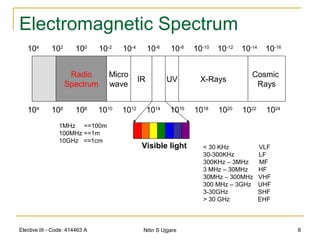
Electromagnetic Spectrum
104
102
100
10-2
10-4
10-6
10-8
10-10
10-12
10-14
10-16
104
106
108
1010
1012
1014
1016
1018
1020
1022
1024
IR UV X-Rays
Cosmic
Rays
Radio
Spectrum
1MHz ==100m
100MHz ==1m
10GHz ==1cm
< 30 KHz VLF
30-300KHz LF
300KHz – 3MHz MF
3 MHz – 30MHz HF
30MHz – 300MHz VHF
300 MHz – 3GHz UHF
3-30GHz SHF
> 30 GHz EHF
Micro
wave
Visible light
Elective III - Code: 414463 A Nitin S Ujgare 9
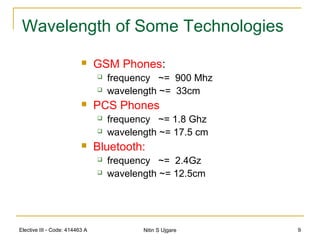
Wavelength of Some Technologies
 GSM Phones:
 frequency ~= 900 Mhz
 wavelength ~= 33cm
 PCS Phones
 frequency ~= 1.8 Ghz
 wavelength ~= 17.5 cm
 Bluetooth:
 frequency ~= 2.4Gz
 wavelength ~= 12.5cm
Elective III - Code: 414463 A Nitin S Ujgare 10
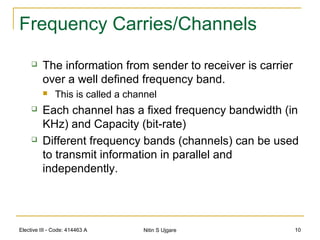
Frequency Carries/Channels
 The information from sender to receiver is carrier
over a well defined frequency band.
 This is called a channel
 Each channel has a fixed frequency bandwidth (in
KHz) and Capacity (bit-rate)
 Different frequency bands (channels) can be used
to transmit information in parallel and
independently.
Elective III - Code: 414463 A Nitin S Ujgare 11
Example
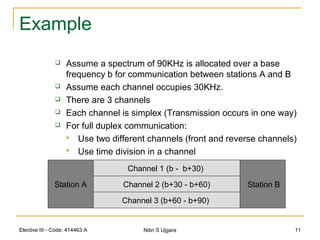
 Assume a spectrum of 90KHz is allocated over a base
frequency b for communication between stations A and B
 Assume each channel occupies 30KHz.
 There are 3 channels
 Each channel is simplex (Transmission occurs in one way)
 For full duplex communication:
 Use two different channels (front and reverse channels)
 Use time division in a channel
Channel 1 (b - b+30)
Channel 2 (b+30 - b+60)
Channel 3 (b+60 - b+90)
Station A Station B
Elective III - Code: 414463 A Nitin S Ujgare 12
Simplex Communication
 Normally, on a channel, a station can
transmit only in one way.
 This is called simplex transmision
 To enable two-way communication (called
full-duplex communication)
 We can use Frequency Division Multiplexing
 We can use Time Division Multiplexing
Elective III - Code: 414463 A Nitin S Ujgare 13
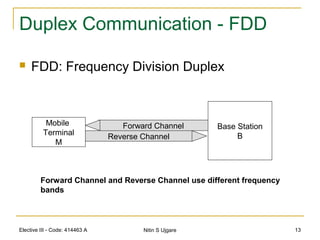
Duplex Communication - FDD
 FDD: Frequency Division Duplex
Base Station
B
Mobile
Terminal
M
Forward Channel
Reverse Channel
Forward Channel and Reverse Channel use different frequency
bands
Elective III - Code: 414463 A Nitin S Ujgare 14
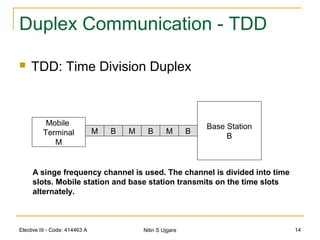
Duplex Communication - TDD
 TDD: Time Division Duplex
Base Station
B
Mobile
Terminal
M
A singe frequency channel is used. The channel is divided into time
slots. Mobile station and base station transmits on the time slots
alternately.
M B M B M B
Elective III - Code: 414463 A Nitin S Ujgare 15
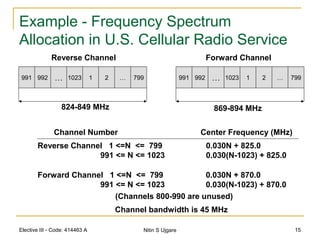
Example - Frequency Spectrum
Allocation in U.S. Cellular Radio Service
991 992 … 1023 1 2 … 799 991 992 … 1023 1 2 … 799
824-849 MHz 869-894 MHz
Reverse Channel Forward Channel
Channel Number Center Frequency (MHz)
Reverse Channel 1 <=N <= 799
991 <= N <= 1023
Forward Channel 1 <=N <= 799
991 <= N <= 1023
0.030N + 825.0
0.030(N-1023) + 825.0
0.030N + 870.0
0.030(N-1023) + 870.0
(Channels 800-990 are unused)
Channel bandwidth is 45 MHz
Elective III - Code: 414463 A Nitin S Ujgare 16
What is Mobility
 Initially Internet and Telephone Networks is
designed assuming the user terminals are
static
 No change of location during a call/connection
 A user terminals accesses the network always from a
fixed location
 Mobility and portability
 Portability means changing point of attachment to
the network offline
 Mobility means changing point of attachment to
the network online
Elective III - Code: 414463 A Nitin S Ujgare 17
Degrees of Mobility
 Walking Users
 Low speed
 Small roaming area
 Usually uses high-bandwith/low-latency access
 Vehicles
 High speeds
 Large roaming area
 Usually uses low-bandwidth/high-latency access
 Uses sophisticated terminal equipment (cell phones)
Elective III - Code: 414463 A Nitin S Ujgare 18
The Need for Wireless/Mobile
Networking
 Demand for Ubiquitous Computing
 Anywhere, anytime computing and
communication
 You don’t have to go to the lab to check your email
 Pushing the computers more into background
 Focus on the task and life, not on the computer
 Use computers seamlessly to help you and to make your
life more easier.
 Computers should be location aware
 Adapt to the current location, discover services
Elective III - Code: 414463 A Nitin S Ujgare 19
More Examples
 You walk into a Conference room or a shopping Mall
with your PDA and your PDA is smart enough to
collect and filter the public profiles of other people
that are passing nearby
 Of course other people should also have smart PDAs.
 The cows in a village are equipped with GPS and
GPRS devices and they are monitored from a
central location on a digital map.
 No need for a person to guide and feed them
 You can find countless examples
Elective III - Code: 414463 A Nitin S Ujgare 20
How to realize Ubiquitous Computing
 Small and different size computing and
communication devices
 Tabs, pads, boards
 PDAs, Handhelds, Laptops, Cell-phones
 A communication network to support this
 Anywhere, anytime access
 Seamless, wireless and mobile access
 Need for Personal Communication Services (PCS)
 Ubiquitous Applications
 New software
Elective III - Code: 414463 A Nitin S Ujgare 21
Some Example Applications of Ubiquitous
Computing
 You walk into your office and your computer
automatically authenticates you through your
active badge and logs you into the Unix system
 You go to a foreign building and your PDA
automatically discovers the closest public printer
where you can print your schedule and give to
your friend
22
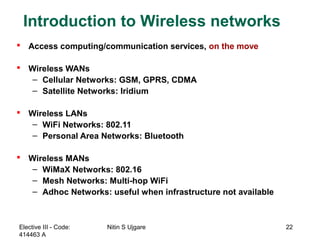
Introduction to Wireless networks
 Access computing/communication services, on the move
 Wireless WANs
– Cellular Networks: GSM, GPRS, CDMA
– Satellite Networks: Iridium
 Wireless LANs
– WiFi Networks: 802.11
– Personal Area Networks: Bluetooth
 Wireless MANs
– WiMaX Networks: 802.16
– Mesh Networks: Multi-hop WiFi
– Adhoc Networks: useful when infrastructure not available
Elective III - Code:
414463 A
Nitin S Ujgare
Elective III - Code:
414463 A
Nitin S Ujgare 23
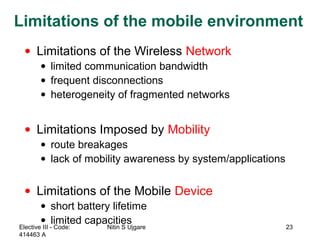
Limitations of the mobile environment
• Limitations of the Wireless Network
• limited communication bandwidth
• frequent disconnections
• heterogeneity of fragmented networks
• Limitations Imposed by Mobility
• route breakages
• lack of mobility awareness by system/applications
• Limitations of the Mobile Device
• short battery lifetime
• limited capacities
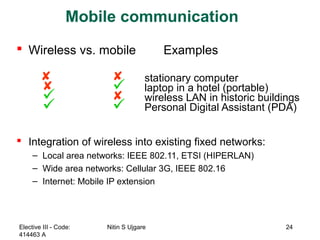
Mobile communication
 Wireless vs. mobile Examples
  stationary computer
  laptop in a hotel (portable)
  wireless LAN in historic buildings
  Personal Digital Assistant (PDA)
 Integration of wireless into existing fixed networks:
– Local area networks: IEEE 802.11, ETSI (HIPERLAN)
– Wide area networks: Cellular 3G, IEEE 802.16
– Internet: Mobile IP extension
Elective III - Code:
414463 A
Nitin S Ujgare 24
Elective III - Code:
414463 A
Nitin S Ujgare 25
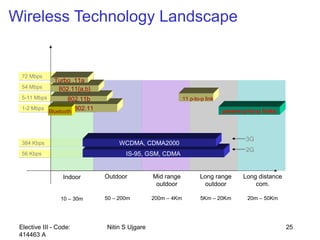
384 Kbps384 Kbps
56 Kbps56 Kbps
54 Mbps54 Mbps
72 Mbps72 Mbps
5-11 Mbps5-11 Mbps
1-2 Mbps1-2 Mbps 802.11
Wireless Technology Landscape
Bluetooth
802.11b
802.11{a,b}
Turbo .11a
Indoor
10 – 30m
IS-95, GSM, CDMA
WCDMA, CDMA2000
Outdoor
50 – 200m
Mid range
outdoor
200m – 4Km
Long range
outdoor
5Km – 20Km
Long distance
com.
20m – 50Km
µwave p-to-p links
.11 p-to-p link
2G
3G
Elective III - Code: 414463 A Nitin S Ujgare 26
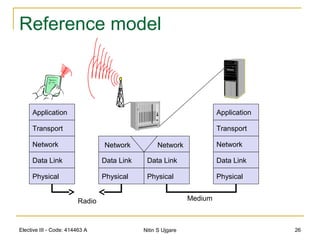
Reference model
Application
Transport
Network
Data Link
Physical
Medium
Data Link
Physical
Application
Transport
Network
Data Link
Physical
Data Link
Physical
Network Network
Radio
Elective III - Code: 414463 A Nitin S Ujgare 27
Perspectives
 Network designers: Concerned with cost-effective
design
 Need to ensure that network resources are efficiently utilized
and fairly allocated to different users.
 Network users: Concerned with application services
 Need guarantees that each message sent will be delivered
without error within a certain amount of time.
 Network providers: Concerned with system
administration
 Need mechanisms for security, management, fault-tolerance
and accounting.
Elective III - Code: 414463 A Nitin S Ujgare 28
Wireless frequency allocation
 Radio frequencies range from 9KHz to 400GHZ (ITU)
 Microwave frequency range
 1 GHz to 40 GHz
 Directional beams possible
 Suitable for point-to-point transmission
 Used for satellite communications
 Radio frequency range
 30 MHz to 1 GHz
 Suitable for omnidirectional applications
 Infrared frequency range
 Roughly, 3x10¹¹
to 2x10¹⁴
Hz
 Useful in local point-to-point multipoint applications within confined
areas
Elective III - Code: 414463 A Nitin S Ujgare 29
Frequencies for mobile communication
 VHF-/UHF-ranges for mobile radio
 simple, small antenna for cars
 deterministic propagation characteristics, reliable connections
 SHF and higher for directed radio links, satellite
communication
 small antenna, focusing
 large bandwidth available
 Wireless LANs use frequencies in UHF to SHF spectrum
 some systems planned up to EHF
 limitations due to absorption by water and oxygen molecules
(resonance frequencies)
 weather dependent fading, signal loss caused by heavy
rainfall etc.
Elective III - Code: 414463 A Nitin S Ujgare 30
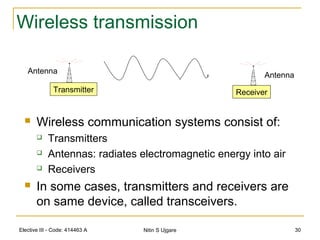
Wireless transmission
 Wireless communication systems consist of:
 Transmitters
 Antennas: radiates electromagnetic energy into air
 Receivers
 In some cases, transmitters and receivers are
on same device, called transceivers.
Transmitter Receiver
Antenna
Antenna
Elective III - Code: 414463 A Nitin S Ujgare 31
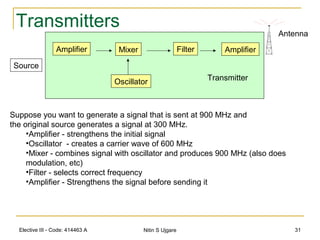
Transmitters
Amplifier
Oscillator
Mixer Filter Amplifier
Antenna
Transmitter
Suppose you want to generate a signal that is sent at 900 MHz and
the original source generates a signal at 300 MHz.
•Amplifier - strengthens the initial signal
•Oscillator - creates a carrier wave of 600 MHz
•Mixer - combines signal with oscillator and produces 900 MHz (also does
modulation, etc)
•Filter - selects correct frequency
•Amplifier - Strengthens the signal before sending it
Source
Elective III - Code: 414463 A Nitin S Ujgare 32
Satellite Based Mobile Systems
 Categorized as
 Two-way (or one-way) limited quality voice or data
transmission
 Very wide range and coverage
 Large regions
 Sometimes global coverage
 Very useful in sparsely populated areas: rural areas, sea,
mountains, etc.
 Target: Vehicles and/or other stationary/mobile
uses
 Expensive base station (satellites) systems
Elective III - Code: 414463 A Nitin S Ujgare 33
History of
Wireless and Mobile
Communication
Elective III - Code: 414463 A Nitin S Ujgare 34
History
 1831: Faraday had first started experimenting with
electromagnetic waves.
 Electromagnetic wave:
 one of the waves that are propagated by simultaneous
periodic variations of electric and magnetic field intensity
and that include
 radio waves
 infrared
 visible light
 ultraviolet,
 X rays
 Gamma rays
Elective III - Code: 414463 A Nitin S Ujgare 35
History – Mathematics and EM
 1864: Maxwell who had been working on a
mathematical model for electromagnetic waves
finally published his paper on the subject.
 One of the consequences of his theories was that E.M.
waves would travel at near the speed of light.
 This had also been experimentally determined by others
at the time.
Elective III - Code: 414463 A Nitin S Ujgare 36
History – Existence of EM Waves
 At the same time that Lodge was carrying out his
experiments, Heinrich Hertz in Germany was also
doing some of his own concerning Maxwell’s
equations.
 Hertz's investigations into Maxwell’s equations involved
generation, detection, and measurement of waves in
free space, rather than along wires.
 1887: Hertz proves existence of EM waves; first
spark transmitter generates a spark in a receiver
several meters away
 The units of frequency waves is named after him, 1
cycle/second equals a Hertz.
Elective III - Code: 414463 A Nitin S Ujgare 37
History – Frequency Tuning
 In 1898: Tesla gave one of the first wireless
demonstrations with a what we would call a
remote control boat.
 He realized that things of this nature would need to only
respond to their own frequency, and remain inactive
otherwise.
 This was Tesla’s fundamental radio tuning invention,
which he had first described several years earlier.
Elective III - Code: 414463 A Nitin S Ujgare 38
History – Transoceanic
Communication
 1901: Marconi successfully transmits radio signal
across Atlantic Ocean from Cornwall to
Newfoundland
 1902: First bidirectional communication across
Atlantic
 1909: Marconi awarded Nobel prize for physics
Elective III - Code: 414463 A Nitin S Ujgare 39
History – Voice over Radio
1914: First voice over radio transmission
1930s: Mobile transmitters developed; radio
equipment occupied most of police car trunk
1935: Edwin Armstrong demonstrated frequency
modulation (FM) for the first time. Majority of
police systems converted to FM
Elective III - Code: 414463 A Nitin S Ujgare 40
History – Mobile Telephony
 1946: First public mobile telephone service was
introduced. First interconnection of mobile users
to public switched telephone
network (PSTN)
 1950-1960: AT&T Bell Labs developed theory and
techniques for cellular telephony
Elective III - Code: 414463 A Nitin S Ujgare 41
History
 1993: IS-95 code-division multiple-access
(CDMA) spread- spectrum digital cellular system
deployed in US
 1993: CDPD (Cellular Digital Packet Data) over
AMPS was realized
 1994: GSM system deployed in US
Elective III - Code: 414463 A Nitin S Ujgare 42
History – Bluetooth, PCS
 1994: Ericsson starts investigating a low-power,
low-cost radio technology to remove cables
around cell phones (born of Bluetooth idea)
Elective III - Code: 414463 A Nitin S Ujgare 43
History – 3G Trials and Progress
 1998: The first call using a Nokia W-CDMA
terminal in DoCoMo's trial network was completed
at Nokia's R&D unit near Tokyo in Japan.
 Jun 1998: CDMA2000 submitted to ITU for IMT-
2000
 Dec 1998: The first meetings of the 3GPP
Technical Specification Groups in France.
 1999: IEEE 802.11b approved (11 Mbps)
 1999: The first open Bluetooth specification 1.0 is
released.
Elective III - Code: 414463 A Nitin S Ujgare 44
History – 3G Progress
 2001 Ericsson and Vodafone UK claim to have
made the world's first WCDMA voice call over
commercial network.
 Jun 2001: NTT DoCoMo launched a trial 3G
service
 June 2001: CDMA2000 1xEV-DO recognized as
part of the 3G IMT-2000 standard
Elective III - Code: 414463 A Nitin S Ujgare 1.45
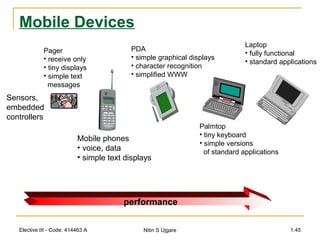
Mobile Devices
performanceperformance
Pager
• receive only
• tiny displays
• simple text
messages
Mobile phones
• voice, data
• simple text displays
PDA
• simple graphical displays
• character recognition
• simplified WWW
Palmtop
• tiny keyboard
• simple versions
of standard applications
Laptop
• fully functional
• standard applications
Sensors,
embedded
controllers
References
 Presentation by Shridhar Iyer on Wireless
Communication, KR School of Information Technology,
IIT Bombay.
 Mobile and Wireless Networking İbrahim Korpeoğlu
Computer Engineering Department Bilkent University,
Ankara.
 Yi-Bing Lin, Imrich Chlamtac, Wireless and Mobile
Network Architectures, Wiley Publication, 2 nd edition,
2002
 Wireless communication by Ranjan bose, NPTEL, HRD,
IIT Delhi.
Elective III - Code: 414463 A Nitin S Ujgare 46

Introduction to Mobile Computing

  • 1.
    Elective III -Code: 414463 A Nitin S Ujgare 1 Introduction to Wireless Systems & History Mobile Computing Prof. Nitin S Ujgare Department of Information Technology NDMVPs KBTCOE , Nasik.
  • 2.
    Elective III -Code: 414463 A Nitin S Ujgare 2 Outline  Motivation  Introduction  What is Wireless  Wireless Network  History of Wireless of Communication
  • 3.
    Elective III -Code: 414463 A Nitin S Ujgare 3 Recommended Textbooks  Theodore Rappaport, Wireless Communications: Principles and Practice, Second Edition, Prentice Hall, December 2001.  Yi-Bing Lin, Imrich Chlamtac, Wireless and Mobile Network Architectures, Wiley Publication, 2nd edition, 2002.
  • 4.
    Elective III -Code: 414463 A Nitin S Ujgare 4 Grading  There will be one midterm and one final exam  There may be projects. I did not determine them yet.  Simulation or implementation projects  No idea how hard they will be!  No idea which language(s) they will be implemented on!  Attendance is important!
  • 5.
    Elective III -Code: 414463 A Nitin S Ujgare 5
  • 6.
    Elective III -Code: 414463 A Nitin S Ujgare 6 What is Wireless and Mobile Communication?
  • 7.
    Elective III -Code: 414463 A Nitin S Ujgare 7 Wireless Communication  Transmitting voice and data using electromagnetic waves in open space  Electromagnetic waves  Travel at speed of light (c = 3x10⁸ m/s)  Has a frequency (f) and wavelength (λ)  c = f x λ  Higher frequency means higher energy photons  The higher the energy photon the more penetrating is the radiation
  • 8.
    Elective III -Code: 414463 A Nitin S Ujgare 8 Electromagnetic Spectrum 104 102 100 10-2 10-4 10-6 10-8 10-10 10-12 10-14 10-16 104 106 108 1010 1012 1014 1016 1018 1020 1022 1024 IR UV X-Rays Cosmic Rays Radio Spectrum 1MHz ==100m 100MHz ==1m 10GHz ==1cm < 30 KHz VLF 30-300KHz LF 300KHz – 3MHz MF 3 MHz – 30MHz HF 30MHz – 300MHz VHF 300 MHz – 3GHz UHF 3-30GHz SHF > 30 GHz EHF Micro wave Visible light
  • 9.
    Elective III -Code: 414463 A Nitin S Ujgare 9 Wavelength of Some Technologies  GSM Phones:  frequency ~= 900 Mhz  wavelength ~= 33cm  PCS Phones  frequency ~= 1.8 Ghz  wavelength ~= 17.5 cm  Bluetooth:  frequency ~= 2.4Gz  wavelength ~= 12.5cm
  • 10.
    Elective III -Code: 414463 A Nitin S Ujgare 10 Frequency Carries/Channels  The information from sender to receiver is carrier over a well defined frequency band.  This is called a channel  Each channel has a fixed frequency bandwidth (in KHz) and Capacity (bit-rate)  Different frequency bands (channels) can be used to transmit information in parallel and independently.
  • 11.
    Elective III -Code: 414463 A Nitin S Ujgare 11 Example  Assume a spectrum of 90KHz is allocated over a base frequency b for communication between stations A and B  Assume each channel occupies 30KHz.  There are 3 channels  Each channel is simplex (Transmission occurs in one way)  For full duplex communication:  Use two different channels (front and reverse channels)  Use time division in a channel Channel 1 (b - b+30) Channel 2 (b+30 - b+60) Channel 3 (b+60 - b+90) Station A Station B
  • 12.
    Elective III -Code: 414463 A Nitin S Ujgare 12 Simplex Communication  Normally, on a channel, a station can transmit only in one way.  This is called simplex transmision  To enable two-way communication (called full-duplex communication)  We can use Frequency Division Multiplexing  We can use Time Division Multiplexing
  • 13.
    Elective III -Code: 414463 A Nitin S Ujgare 13 Duplex Communication - FDD  FDD: Frequency Division Duplex Base Station B Mobile Terminal M Forward Channel Reverse Channel Forward Channel and Reverse Channel use different frequency bands
  • 14.
    Elective III -Code: 414463 A Nitin S Ujgare 14 Duplex Communication - TDD  TDD: Time Division Duplex Base Station B Mobile Terminal M A singe frequency channel is used. The channel is divided into time slots. Mobile station and base station transmits on the time slots alternately. M B M B M B
  • 15.
    Elective III -Code: 414463 A Nitin S Ujgare 15 Example - Frequency Spectrum Allocation in U.S. Cellular Radio Service 991 992 … 1023 1 2 … 799 991 992 … 1023 1 2 … 799 824-849 MHz 869-894 MHz Reverse Channel Forward Channel Channel Number Center Frequency (MHz) Reverse Channel 1 <=N <= 799 991 <= N <= 1023 Forward Channel 1 <=N <= 799 991 <= N <= 1023 0.030N + 825.0 0.030(N-1023) + 825.0 0.030N + 870.0 0.030(N-1023) + 870.0 (Channels 800-990 are unused) Channel bandwidth is 45 MHz
  • 16.
    Elective III -Code: 414463 A Nitin S Ujgare 16 What is Mobility  Initially Internet and Telephone Networks is designed assuming the user terminals are static  No change of location during a call/connection  A user terminals accesses the network always from a fixed location  Mobility and portability  Portability means changing point of attachment to the network offline  Mobility means changing point of attachment to the network online
  • 17.
    Elective III -Code: 414463 A Nitin S Ujgare 17 Degrees of Mobility  Walking Users  Low speed  Small roaming area  Usually uses high-bandwith/low-latency access  Vehicles  High speeds  Large roaming area  Usually uses low-bandwidth/high-latency access  Uses sophisticated terminal equipment (cell phones)
  • 18.
    Elective III -Code: 414463 A Nitin S Ujgare 18 The Need for Wireless/Mobile Networking  Demand for Ubiquitous Computing  Anywhere, anytime computing and communication  You don’t have to go to the lab to check your email  Pushing the computers more into background  Focus on the task and life, not on the computer  Use computers seamlessly to help you and to make your life more easier.  Computers should be location aware  Adapt to the current location, discover services
  • 19.
    Elective III -Code: 414463 A Nitin S Ujgare 19 More Examples  You walk into a Conference room or a shopping Mall with your PDA and your PDA is smart enough to collect and filter the public profiles of other people that are passing nearby  Of course other people should also have smart PDAs.  The cows in a village are equipped with GPS and GPRS devices and they are monitored from a central location on a digital map.  No need for a person to guide and feed them  You can find countless examples
  • 20.
    Elective III -Code: 414463 A Nitin S Ujgare 20 How to realize Ubiquitous Computing  Small and different size computing and communication devices  Tabs, pads, boards  PDAs, Handhelds, Laptops, Cell-phones  A communication network to support this  Anywhere, anytime access  Seamless, wireless and mobile access  Need for Personal Communication Services (PCS)  Ubiquitous Applications  New software
  • 21.
    Elective III -Code: 414463 A Nitin S Ujgare 21 Some Example Applications of Ubiquitous Computing  You walk into your office and your computer automatically authenticates you through your active badge and logs you into the Unix system  You go to a foreign building and your PDA automatically discovers the closest public printer where you can print your schedule and give to your friend
  • 22.
    22 Introduction to Wirelessnetworks  Access computing/communication services, on the move  Wireless WANs – Cellular Networks: GSM, GPRS, CDMA – Satellite Networks: Iridium  Wireless LANs – WiFi Networks: 802.11 – Personal Area Networks: Bluetooth  Wireless MANs – WiMaX Networks: 802.16 – Mesh Networks: Multi-hop WiFi – Adhoc Networks: useful when infrastructure not available Elective III - Code: 414463 A Nitin S Ujgare
  • 23.
    Elective III -Code: 414463 A Nitin S Ujgare 23 Limitations of the mobile environment • Limitations of the Wireless Network • limited communication bandwidth • frequent disconnections • heterogeneity of fragmented networks • Limitations Imposed by Mobility • route breakages • lack of mobility awareness by system/applications • Limitations of the Mobile Device • short battery lifetime • limited capacities
  • 24.
    Mobile communication  Wirelessvs. mobile Examples   stationary computer   laptop in a hotel (portable)   wireless LAN in historic buildings   Personal Digital Assistant (PDA)  Integration of wireless into existing fixed networks: – Local area networks: IEEE 802.11, ETSI (HIPERLAN) – Wide area networks: Cellular 3G, IEEE 802.16 – Internet: Mobile IP extension Elective III - Code: 414463 A Nitin S Ujgare 24
  • 25.
    Elective III -Code: 414463 A Nitin S Ujgare 25 384 Kbps384 Kbps 56 Kbps56 Kbps 54 Mbps54 Mbps 72 Mbps72 Mbps 5-11 Mbps5-11 Mbps 1-2 Mbps1-2 Mbps 802.11 Wireless Technology Landscape Bluetooth 802.11b 802.11{a,b} Turbo .11a Indoor 10 – 30m IS-95, GSM, CDMA WCDMA, CDMA2000 Outdoor 50 – 200m Mid range outdoor 200m – 4Km Long range outdoor 5Km – 20Km Long distance com. 20m – 50Km µwave p-to-p links .11 p-to-p link 2G 3G
  • 26.
    Elective III -Code: 414463 A Nitin S Ujgare 26 Reference model Application Transport Network Data Link Physical Medium Data Link Physical Application Transport Network Data Link Physical Data Link Physical Network Network Radio
  • 27.
    Elective III -Code: 414463 A Nitin S Ujgare 27 Perspectives  Network designers: Concerned with cost-effective design  Need to ensure that network resources are efficiently utilized and fairly allocated to different users.  Network users: Concerned with application services  Need guarantees that each message sent will be delivered without error within a certain amount of time.  Network providers: Concerned with system administration  Need mechanisms for security, management, fault-tolerance and accounting.
  • 28.
    Elective III -Code: 414463 A Nitin S Ujgare 28 Wireless frequency allocation  Radio frequencies range from 9KHz to 400GHZ (ITU)  Microwave frequency range  1 GHz to 40 GHz  Directional beams possible  Suitable for point-to-point transmission  Used for satellite communications  Radio frequency range  30 MHz to 1 GHz  Suitable for omnidirectional applications  Infrared frequency range  Roughly, 3x10¹¹ to 2x10¹⁴ Hz  Useful in local point-to-point multipoint applications within confined areas
  • 29.
    Elective III -Code: 414463 A Nitin S Ujgare 29 Frequencies for mobile communication  VHF-/UHF-ranges for mobile radio  simple, small antenna for cars  deterministic propagation characteristics, reliable connections  SHF and higher for directed radio links, satellite communication  small antenna, focusing  large bandwidth available  Wireless LANs use frequencies in UHF to SHF spectrum  some systems planned up to EHF  limitations due to absorption by water and oxygen molecules (resonance frequencies)  weather dependent fading, signal loss caused by heavy rainfall etc.
  • 30.
    Elective III -Code: 414463 A Nitin S Ujgare 30 Wireless transmission  Wireless communication systems consist of:  Transmitters  Antennas: radiates electromagnetic energy into air  Receivers  In some cases, transmitters and receivers are on same device, called transceivers. Transmitter Receiver Antenna Antenna
  • 31.
    Elective III -Code: 414463 A Nitin S Ujgare 31 Transmitters Amplifier Oscillator Mixer Filter Amplifier Antenna Transmitter Suppose you want to generate a signal that is sent at 900 MHz and the original source generates a signal at 300 MHz. •Amplifier - strengthens the initial signal •Oscillator - creates a carrier wave of 600 MHz •Mixer - combines signal with oscillator and produces 900 MHz (also does modulation, etc) •Filter - selects correct frequency •Amplifier - Strengthens the signal before sending it Source
  • 32.
    Elective III -Code: 414463 A Nitin S Ujgare 32 Satellite Based Mobile Systems  Categorized as  Two-way (or one-way) limited quality voice or data transmission  Very wide range and coverage  Large regions  Sometimes global coverage  Very useful in sparsely populated areas: rural areas, sea, mountains, etc.  Target: Vehicles and/or other stationary/mobile uses  Expensive base station (satellites) systems
  • 33.
    Elective III -Code: 414463 A Nitin S Ujgare 33 History of Wireless and Mobile Communication
  • 34.
    Elective III -Code: 414463 A Nitin S Ujgare 34 History  1831: Faraday had first started experimenting with electromagnetic waves.  Electromagnetic wave:  one of the waves that are propagated by simultaneous periodic variations of electric and magnetic field intensity and that include  radio waves  infrared  visible light  ultraviolet,  X rays  Gamma rays
  • 35.
    Elective III -Code: 414463 A Nitin S Ujgare 35 History – Mathematics and EM  1864: Maxwell who had been working on a mathematical model for electromagnetic waves finally published his paper on the subject.  One of the consequences of his theories was that E.M. waves would travel at near the speed of light.  This had also been experimentally determined by others at the time.
  • 36.
    Elective III -Code: 414463 A Nitin S Ujgare 36 History – Existence of EM Waves  At the same time that Lodge was carrying out his experiments, Heinrich Hertz in Germany was also doing some of his own concerning Maxwell’s equations.  Hertz's investigations into Maxwell’s equations involved generation, detection, and measurement of waves in free space, rather than along wires.  1887: Hertz proves existence of EM waves; first spark transmitter generates a spark in a receiver several meters away  The units of frequency waves is named after him, 1 cycle/second equals a Hertz.
  • 37.
    Elective III -Code: 414463 A Nitin S Ujgare 37 History – Frequency Tuning  In 1898: Tesla gave one of the first wireless demonstrations with a what we would call a remote control boat.  He realized that things of this nature would need to only respond to their own frequency, and remain inactive otherwise.  This was Tesla’s fundamental radio tuning invention, which he had first described several years earlier.
  • 38.
    Elective III -Code: 414463 A Nitin S Ujgare 38 History – Transoceanic Communication  1901: Marconi successfully transmits radio signal across Atlantic Ocean from Cornwall to Newfoundland  1902: First bidirectional communication across Atlantic  1909: Marconi awarded Nobel prize for physics
  • 39.
    Elective III -Code: 414463 A Nitin S Ujgare 39 History – Voice over Radio 1914: First voice over radio transmission 1930s: Mobile transmitters developed; radio equipment occupied most of police car trunk 1935: Edwin Armstrong demonstrated frequency modulation (FM) for the first time. Majority of police systems converted to FM
  • 40.
    Elective III -Code: 414463 A Nitin S Ujgare 40 History – Mobile Telephony  1946: First public mobile telephone service was introduced. First interconnection of mobile users to public switched telephone network (PSTN)  1950-1960: AT&T Bell Labs developed theory and techniques for cellular telephony
  • 41.
    Elective III -Code: 414463 A Nitin S Ujgare 41 History  1993: IS-95 code-division multiple-access (CDMA) spread- spectrum digital cellular system deployed in US  1993: CDPD (Cellular Digital Packet Data) over AMPS was realized  1994: GSM system deployed in US
  • 42.
    Elective III -Code: 414463 A Nitin S Ujgare 42 History – Bluetooth, PCS  1994: Ericsson starts investigating a low-power, low-cost radio technology to remove cables around cell phones (born of Bluetooth idea)
  • 43.
    Elective III -Code: 414463 A Nitin S Ujgare 43 History – 3G Trials and Progress  1998: The first call using a Nokia W-CDMA terminal in DoCoMo's trial network was completed at Nokia's R&D unit near Tokyo in Japan.  Jun 1998: CDMA2000 submitted to ITU for IMT- 2000  Dec 1998: The first meetings of the 3GPP Technical Specification Groups in France.  1999: IEEE 802.11b approved (11 Mbps)  1999: The first open Bluetooth specification 1.0 is released.
  • 44.
    Elective III -Code: 414463 A Nitin S Ujgare 44 History – 3G Progress  2001 Ericsson and Vodafone UK claim to have made the world's first WCDMA voice call over commercial network.  Jun 2001: NTT DoCoMo launched a trial 3G service  June 2001: CDMA2000 1xEV-DO recognized as part of the 3G IMT-2000 standard
  • 45.
    Elective III -Code: 414463 A Nitin S Ujgare 1.45 Mobile Devices performanceperformance Pager • receive only • tiny displays • simple text messages Mobile phones • voice, data • simple text displays PDA • simple graphical displays • character recognition • simplified WWW Palmtop • tiny keyboard • simple versions of standard applications Laptop • fully functional • standard applications Sensors, embedded controllers
  • 46.
    References  Presentation byShridhar Iyer on Wireless Communication, KR School of Information Technology, IIT Bombay.  Mobile and Wireless Networking İbrahim Korpeoğlu Computer Engineering Department Bilkent University, Ankara.  Yi-Bing Lin, Imrich Chlamtac, Wireless and Mobile Network Architectures, Wiley Publication, 2 nd edition, 2002  Wireless communication by Ranjan bose, NPTEL, HRD, IIT Delhi. Elective III - Code: 414463 A Nitin S Ujgare 46