Wireless Networks
CS 6710
Spring 2010
Rajmohan Rajaraman
Outline of the course: Basic topics
Transmission Fundamentals
o Analog and digital transmission
o Channel capacity
o Antennas, propagation modes, and fading
o Signal encoding techniques
Spread spectrum technology
Coding and error control
Cellular networks
Wireless LANs
o IEEE 802.11
o Bluetooth
Outline: Advanced topics
WiMAX, Zigbee, UWB, 3G and 4G
Mobile Application platforms
Mobile IP, TCP for wireless
Multihop ad hoc networks
o MAC and routing protocols
o Power control and topology control
o Capacity of ad hoc networks
Sensor networks
o Infrastructure, MAC, and routing protocols
o Algorithms for query processing
Wireless Comes of Age
 Guglielmo Marconi invented the wireless telegraph in 1896
o Communication by encoding alphanumeric characters in analog
signal
o Sent telegraphic signals across the Atlantic Ocean
 Communications satellites launched in 1960s
 Advances in wireless technology
o Radio, television, mobile telephone, communication satellites
 More recently
o Satellite communications, wireless networking, cellular
technology, ad hoc networks, sensor networks
Wireless communication systems
 Target information systems: “Anytime, Anywhere,
Any form”
 Applications: Ubiquitous computing and
information access
 Market in continuous growth:
o 35-60% annual growth of PCS
o Number of subscribers:
• By 2001: over 700M mobile phones
• By 2003: 1 billion subscribers
• By 2005: 2 billion
• By 2009: 4.6 billion
 Large diversity of standards and products
 Confusing terminology
Limitations and difficulties
Wireless is convenient and less expensive
Limitations and political and technical
difficulties inhibit wireless technologies
Lack of an industry-wide standard
Device limitations
o E.g., small LCD on a mobile telephone can only
displaying a few lines of text
o E.g., browsers of most mobile wireless devices
use wireless markup language (WML) instead of
HTML
o Switching speed of the material (e.g., silicon)
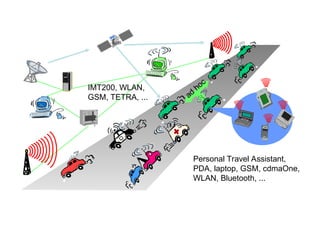
ad
hoc
IMT200, WLAN,
GSM, TETRA, ...
Personal Travel Assistant,
PDA, laptop, GSM, cdmaOne,
WLAN, Bluetooth, ...
Wireless & Mobility
 Wireless:
o Limited bandwidth
o Broadcast medium: requires multiple access schemes
o Variable link quality (noise, interference)
o High latency, higher jitter
o Heterogeneous air interfaces
o Security: easier snooping
 Mobility:
o User location may change with time
o Speed of mobile impacts wireless bandwidth
o Need mechanism for handoff
o Security: easier spoofing
 Portability
o Limited battery, storage, computing, and UI
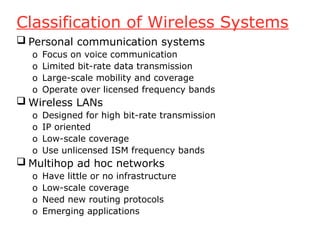
Classification of Wireless Systems
 Personal communication systems
o Focus on voice communication
o Limited bit-rate data transmission
o Large-scale mobility and coverage
o Operate over licensed frequency bands
 Wireless LANs
o Designed for high bit-rate transmission
o IP oriented
o Low-scale coverage
o Use unlicensed ISM frequency bands
 Multihop ad hoc networks
o Have little or no infrastructure
o Low-scale coverage
o Need new routing protocols
o Emerging applications
Transmission fundamentals
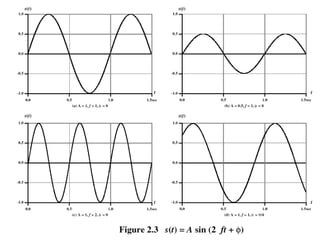
Electromagnetic signals
o Time domain
o Frequency domain
Data rate and bandwidth
Channel capacity
o Nyquist theorem
o Shannon capacity theorem
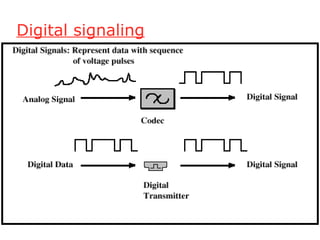
Analog and digital data transmission
Transmission media
QuickTime™ and a
TIFF (LZW) decompressor
are needed to see this picture.
QuickTime™ and a
TIFF (LZW) decompressor
are needed to see this picture.
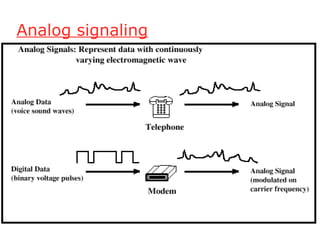
Analog signaling
Digital signaling
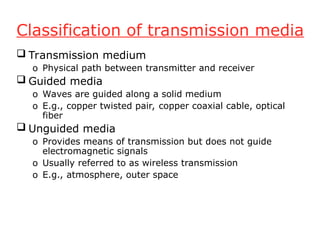
Classification of transmission media
 Transmission medium
o Physical path between transmitter and receiver
 Guided media
o Waves are guided along a solid medium
o E.g., copper twisted pair, copper coaxial cable, optical
fiber
 Unguided media
o Provides means of transmission but does not guide
electromagnetic signals
o Usually referred to as wireless transmission
o E.g., atmosphere, outer space
Unguided media
Transmission and reception are achieved
by means of an antenna
Configurations for wireless transmission
o Directional
o Omnidirectional
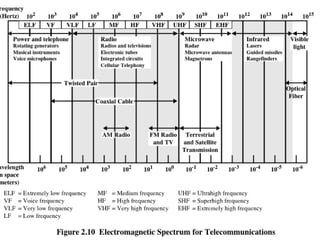
General frequency ranges
 Microwave frequency range
o 1 GHz to 40 GHz
o Directional beams possible
o Suitable for point-to-point transmission
o Used for satellite communications
 Radio frequency range
o 30 MHz to 1 GHz
o Suitable for omnidirectional applications
 Infrared frequency range
o Roughly, 3x10¹¹
to 2x10¹⁴
Hz
o Useful in local point-to-point multipoint applications within
confined areas
Terrestrial microwave
 Description of common microwave antenna
o Parabolic "dish", 3 m in diameter
o Fixed rigidly and focuses a narrow beam
o Achieves line-of-sight transmission to receiving antenna
o Located at substantial heights above ground level
 Applications
o Long haul telecommunications service
o Short point-to-point links between buildings
Satellite microwave
 Description of communication satellite
o Microwave relay station
o Used to link two or more ground-based microwave
transmitter/receivers
o Receives transmissions on one frequency band (uplink),
amplifies or repeats the signal, and transmits it on
another frequency (downlink)
 Applications
o Television distribution
o Long-distance telephone transmission
o Private business networks
Broadcast radio
 Description of broadcast radio antennas
o Omnidirectional
o Antennas not required to be dish-shaped
o Antennas need not be rigidly mounted to a precise
alignment
 Applications
o Broadcast radio
• VHF and part of the UHF band; 30 MHZ to 1GHz
• Covers FM radio and UHF and VHF television
Infrared
Beyond the EHF spectrum
o 1012
to 1014
Hz
Transceivers must be within line of sight or
reachable via reflection
o Does not penetrate walls

Introduction.ppt wireless

  • 1.
    Wireless Networks CS 6710 Spring2010 Rajmohan Rajaraman
  • 2.
    Outline of thecourse: Basic topics Transmission Fundamentals o Analog and digital transmission o Channel capacity o Antennas, propagation modes, and fading o Signal encoding techniques Spread spectrum technology Coding and error control Cellular networks Wireless LANs o IEEE 802.11 o Bluetooth
  • 3.
    Outline: Advanced topics WiMAX,Zigbee, UWB, 3G and 4G Mobile Application platforms Mobile IP, TCP for wireless Multihop ad hoc networks o MAC and routing protocols o Power control and topology control o Capacity of ad hoc networks Sensor networks o Infrastructure, MAC, and routing protocols o Algorithms for query processing
  • 4.
    Wireless Comes ofAge  Guglielmo Marconi invented the wireless telegraph in 1896 o Communication by encoding alphanumeric characters in analog signal o Sent telegraphic signals across the Atlantic Ocean  Communications satellites launched in 1960s  Advances in wireless technology o Radio, television, mobile telephone, communication satellites  More recently o Satellite communications, wireless networking, cellular technology, ad hoc networks, sensor networks
  • 5.
    Wireless communication systems Target information systems: “Anytime, Anywhere, Any form”  Applications: Ubiquitous computing and information access  Market in continuous growth: o 35-60% annual growth of PCS o Number of subscribers: • By 2001: over 700M mobile phones • By 2003: 1 billion subscribers • By 2005: 2 billion • By 2009: 4.6 billion  Large diversity of standards and products  Confusing terminology
  • 6.
    Limitations and difficulties Wirelessis convenient and less expensive Limitations and political and technical difficulties inhibit wireless technologies Lack of an industry-wide standard Device limitations o E.g., small LCD on a mobile telephone can only displaying a few lines of text o E.g., browsers of most mobile wireless devices use wireless markup language (WML) instead of HTML o Switching speed of the material (e.g., silicon)
  • 7.
    ad hoc IMT200, WLAN, GSM, TETRA,... Personal Travel Assistant, PDA, laptop, GSM, cdmaOne, WLAN, Bluetooth, ...
  • 8.
    Wireless & Mobility Wireless: o Limited bandwidth o Broadcast medium: requires multiple access schemes o Variable link quality (noise, interference) o High latency, higher jitter o Heterogeneous air interfaces o Security: easier snooping  Mobility: o User location may change with time o Speed of mobile impacts wireless bandwidth o Need mechanism for handoff o Security: easier spoofing  Portability o Limited battery, storage, computing, and UI
  • 9.
    Classification of WirelessSystems  Personal communication systems o Focus on voice communication o Limited bit-rate data transmission o Large-scale mobility and coverage o Operate over licensed frequency bands  Wireless LANs o Designed for high bit-rate transmission o IP oriented o Low-scale coverage o Use unlicensed ISM frequency bands  Multihop ad hoc networks o Have little or no infrastructure o Low-scale coverage o Need new routing protocols o Emerging applications
  • 10.
    Transmission fundamentals Electromagnetic signals oTime domain o Frequency domain Data rate and bandwidth Channel capacity o Nyquist theorem o Shannon capacity theorem Analog and digital data transmission Transmission media
  • 12.
    QuickTime™ and a TIFF(LZW) decompressor are needed to see this picture. QuickTime™ and a TIFF (LZW) decompressor are needed to see this picture.
  • 13.
  • 14.
  • 16.
    Classification of transmissionmedia  Transmission medium o Physical path between transmitter and receiver  Guided media o Waves are guided along a solid medium o E.g., copper twisted pair, copper coaxial cable, optical fiber  Unguided media o Provides means of transmission but does not guide electromagnetic signals o Usually referred to as wireless transmission o E.g., atmosphere, outer space
  • 17.
    Unguided media Transmission andreception are achieved by means of an antenna Configurations for wireless transmission o Directional o Omnidirectional
  • 18.
    General frequency ranges Microwave frequency range o 1 GHz to 40 GHz o Directional beams possible o Suitable for point-to-point transmission o Used for satellite communications  Radio frequency range o 30 MHz to 1 GHz o Suitable for omnidirectional applications  Infrared frequency range o Roughly, 3x10¹¹ to 2x10¹⁴ Hz o Useful in local point-to-point multipoint applications within confined areas
  • 19.
    Terrestrial microwave  Descriptionof common microwave antenna o Parabolic "dish", 3 m in diameter o Fixed rigidly and focuses a narrow beam o Achieves line-of-sight transmission to receiving antenna o Located at substantial heights above ground level  Applications o Long haul telecommunications service o Short point-to-point links between buildings
  • 20.
    Satellite microwave  Descriptionof communication satellite o Microwave relay station o Used to link two or more ground-based microwave transmitter/receivers o Receives transmissions on one frequency band (uplink), amplifies or repeats the signal, and transmits it on another frequency (downlink)  Applications o Television distribution o Long-distance telephone transmission o Private business networks
  • 21.
    Broadcast radio  Descriptionof broadcast radio antennas o Omnidirectional o Antennas not required to be dish-shaped o Antennas need not be rigidly mounted to a precise alignment  Applications o Broadcast radio • VHF and part of the UHF band; 30 MHZ to 1GHz • Covers FM radio and UHF and VHF television
  • 22.
    Infrared Beyond the EHFspectrum o 1012 to 1014 Hz Transceivers must be within line of sight or reachable via reflection o Does not penetrate walls