MS. NEETHU TRESSA
ASSISTANT PROFESSOR
MOBILE COMMERCE
CONTENTS
 Introduction
 Mobile Commerce
 Wireless Applications
 Cellular Network
 Technologies for Mobile Commerce
 Wireless Technologies
 Different Generations in Wireless Communication
 Security Issues Pertaining to Cellular Technology
 Portals
 Human Resource Management
 Various HRIS Modules
INTRODUCTION
 Mobility – key factor which help business thrive
 Make business a real-time organization
MOBILE COMMERCE
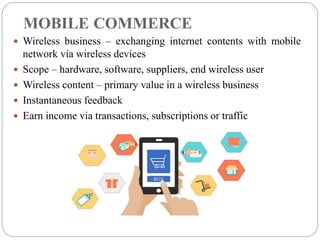
 Wireless business – exchanging internet contents with mobile
network via wireless devices
 Scope – hardware, software, suppliers, end wireless user
 Wireless content – primary value in a wireless business
 Instantaneous feedback
 Earn income via transactions, subscriptions or traffic
WIRELESS APPLICATIONS
 Wireless application – software that runs on a wireless device
that exchanges content over a wireless network
 Types:
 Web Phones(internet-ready cellular phone)
 Wireless handhelds(message and micro browser, work
offline)
 Two-way Pagers(send and receive message, micro browser)
 Voice Portals(conversation with an information service)
 Communicating Appliances(electronic devices with
wireless technology such as wireless camera, watches, pen
etc.)
 Web PCs(internet connected personal computers)
CELLULAR NETWORK
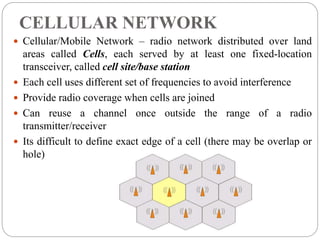
 Cellular/Mobile Network – radio network distributed over land
areas called Cells, each served by at least one fixed-location
transceiver, called cell site/base station
 Each cell uses different set of frequencies to avoid interference
 Provide radio coverage when cells are joined
 Can reuse a channel once outside the range of a radio
transmitter/receiver
 Its difficult to define exact edge of a cell (there may be overlap or
hole)
CELLULAR NETWORK (Contd..)
 Mobile phone systems are comprised of:
 Network of cells – each with radio transmitter at its center
 Radio signals – to carry digital voice and data
 Base stations – connected with each other via high-speed fiber and then
to public phone system and internet
 Responsibilities:
 Route calls to and from mobile phones
 Enable calls to be maintained while moving between cells
 Enable access to network, billing, security etc.
CELLULAR NETWORK (Contd..)
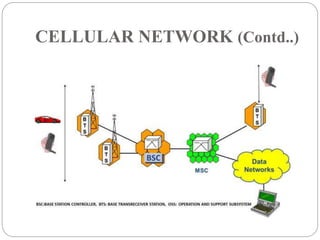
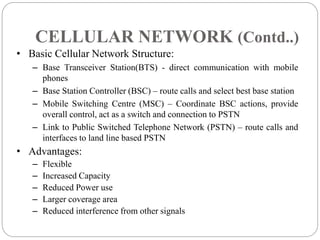
• Basic Cellular Network Structure:
– Base Transceiver Station(BTS) - direct communication with mobile
phones
– Base Station Controller (BSC) – route calls and select best base station
– Mobile Switching Centre (MSC) – Coordinate BSC actions, provide
overall control, act as a switch and connection to PSTN
– Link to Public Switched Telephone Network (PSTN) – route calls and
interfaces to land line based PSTN
• Advantages:
– Flexible
– Increased Capacity
– Reduced Power use
– Larger coverage area
– Reduced interference from other signals
CELLULAR NETWORK (Contd..)
TECHNOLOGIES FOR MOBILE
COMMERCE
 Wireless Spectrum
 WAP
WIRELESS SPECTRUM
WIRELESS SPECTRUM
 Electromagnetic spectrum – entire range over which
communicating devices transmit energy waves called airwaves
with a transceiver
 Dedicated frequency range for each transceiver measured in
hertz(Hz)
 Broadcasters prefer lower frequency that costs less to transmit
a signal and carries farther
 Agencies like FCC break up the spectrum to bands
 Restricts bands of coverage to prohibit interference from
neighboring transmitter
 Band owner should get an FCC license
 Unlicensed sections of the spectrum are open to any
transmitting device
WAP
 Wireless Application Protocol
 Invented by WAP Forum – a group formed by Nokia, Ericsson,
Motorola and Phone.com in 1997
 Standard method of specification to wireless access of internet-
based content and services
 Mobile device - embedded browser, operator’s network
connected to WAP Gateway, makes requests in form of URL
 Content for wireless devices – stored on web server, formatted
suitably, written in WML (Wireless Markup Language)
WAP TRANSACTION MODEL
WAPARCHITECTURE
 WAP Application Environment (WAE) – Application layer
encompassing the devices, content-development languages, the
telephony APIs and content formats
 Wireless Session Protocol (WSP) – Session layer interfacing to
connection oriented and connectionless services such as creating
and releasing connection, exchanging data and suspending and
releasing sessions
 Wireless Transaction Protocol (WTP) – Transaction layer
providing transaction services such as handling acknowledgments,
retransmission of unsuccessful transactions and removal of
duplicate transactions. Transactions supported are unreliable and
reliable one-way requests and reliable two-way requests
WAPARCHITECTURE (Contd..)
 Wireless Transport Layer Security (WTLS) – Security layer
protecting data with data integrity, privacy, authentication and
denial-of-service protection
 Wireless Datagram Protocol (WDP) – Transport layer
providing consistent interface to higher layers of WAP
architecture, also data error correction
 Wireless Communications Networks (Bearers) – lowest level
WAPARCHITECTURE (Contd..)
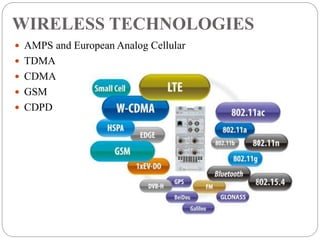
WIRELESS TECHNOLOGIES
 AMPS and European Analog Cellular
 TDMA
 CDMA
 GSM
 CDPD
 AMPS AND EUROPEAN ANALOG CELLULAR
 Advanced Mobile Phone Service – voice-only analog support
 Operates at 800 MHz
 TDMA
 Time Division Multiple Access – digital transport
 Frequency range divided to series of channels
 Each channel divided to time slots
 Digital AMPS (D-AMPS) – overlay of TDMA over AMPS to create
hybrid analog/digital network
WIRELESS TECHNOLOGIES (Contd..)
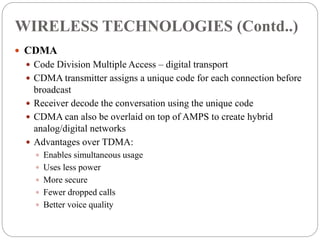
 CDMA
 Code Division Multiple Access – digital transport
 CDMA transmitter assigns a unique code for each connection before
broadcast
 Receiver decode the conversation using the unique code
 CDMA can also be overlaid on top of AMPS to create hybrid
analog/digital networks
 Advantages over TDMA:
 Enables simultaneous usage
 Uses less power
 More secure
 Fewer dropped calls
 Better voice quality
WIRELESS TECHNOLOGIES (Contd..)
 GSM
 Global System for Mobile communications
 Provides the following data services:
 Direct-connect internet access without requiring a modem
 Mobile Fax capabilities
 Short Message Service (SMS)
 CDPD
 Cellular Digital Packet Data
 TCP/IP based mobile data-only service that runs on AMPS networks
 Requires a modem to convert TCP/IP-based data to analog
 CDPD offers:
 Analog voice
 Circuit-switched data
 Packet data services
 Not suitable for short, fast data communications
WIRELESS TECHNOLOGIES (Contd..)
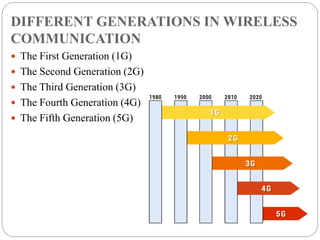
DIFFERENT GENERATIONS IN WIRELESS
COMMUNICATION
 The First Generation (1G)
 The Second Generation (2G)
 The Third Generation (3G)
 The Fourth Generation (4G)
 The Fifth Generation (5G)
The First Generation (1G)
 Used AMPS based analog technology
 Technical Specifications:
 Bandwidth : 30KHz
 Frequency Range : 824-894 MHz
 Multiple Access Method : FDM
 832 full-duplex channels, each consisting of a pair of 30KHz wide
simplex channels
 Suffers from high level of echo and signal distortion
 Channels categorized into:
 Control (base to mobile)
 Paging (base to mobile)
 Access (bidirectional)
 Data (bidirectional)
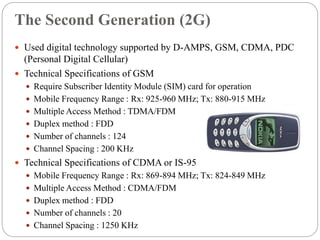
The Second Generation (2G)
 Used digital technology supported by D-AMPS, GSM, CDMA, PDC
(Personal Digital Cellular)
 Technical Specifications of GSM
 Require Subscriber Identity Module (SIM) card for operation
 Mobile Frequency Range : Rx: 925-960 MHz; Tx: 880-915 MHz
 Multiple Access Method : TDMA/FDM
 Duplex method : FDD
 Number of channels : 124
 Channel Spacing : 200 KHz
 Technical Specifications of CDMA or IS-95
 Mobile Frequency Range : Rx: 869-894 MHz; Tx: 824-849 MHz
 Multiple Access Method : CDMA/FDM
 Duplex method : FDD
 Number of channels : 20
 Channel Spacing : 1250 KHz
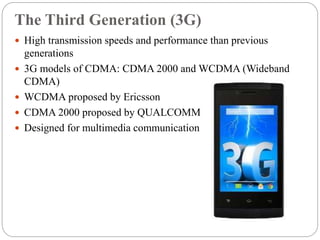
The Third Generation (3G)
 High transmission speeds and performance than previous
generations
 3G models of CDMA: CDMA 2000 and WCDMA (Wideband
CDMA)
 WCDMA proposed by Ericsson
 CDMA 2000 proposed by QUALCOMM
 Designed for multimedia communication
The Fourth Generation (4G)
 High Speed data transfer
 Uninterrupted connectivity
 Benefits:
 Easy Installation
 Faster Speed
 Better Signal
 Wider Coverage
 Better Security
 Flexible Plans
The Fifth Generation (5G)
 Perfection level of wireless communication
SECURITY ISSUES PERTAINING TO
CELLULAR TECHNOLOGY
 Security issues include:
 Eavesdropping or hacking into mobile conversations
 Denial of service
 Identity theft
 Data piracy
 jamming
PORTALS
 Sites and services organized about some common theme
 Library of categorized and personalized content
 2 types of e-commerce portals:
1. B2B portals
2. B2C portals
 The portals should be:
 Attractive
 Display of real-time relevant information
 Horizontal portals – aggregate information on a broad range of
topics (e.g. search engines)
 Vertical portals – information relating to a single area of interest
 PDK – Portal Development Kit – to customize and extend
services and business content
HUMAN RESOURCE MANAGEMENT
 HRIS – Human Resource Information System
 Definition:
System of collecting, recording, classifying, presenting, processing,
storing and disseminating information, required for efficient and
effective management of human resources in an organization
 Purposes:
1. Planning human resource requirements of organization
2. Employee training & development to increase efficiency
3. Formulation of policies and programs relating to human resource
VARIOUS HRIS MODULES
1. Record Keeping – standardized recording of all relevant
employee information
2. Payroll Module – automate employee pay process along with
the financial management of the company
3. Benefits Administration Module – monitor all benefit
programs and to notice any potential deficiencies
4. Training Module – administer and track employee training
and development efforts
5. Performance Management – continuous monitoring and
evaluation of the organization
6. Employee Self-Service Module – allow employees to manage
employee’s database together with professionals in HR
department
Mobile commerce

Mobile commerce

  • 1.
    MS. NEETHU TRESSA ASSISTANTPROFESSOR MOBILE COMMERCE
  • 2.
    CONTENTS  Introduction  MobileCommerce  Wireless Applications  Cellular Network  Technologies for Mobile Commerce  Wireless Technologies  Different Generations in Wireless Communication  Security Issues Pertaining to Cellular Technology  Portals  Human Resource Management  Various HRIS Modules
  • 3.
    INTRODUCTION  Mobility –key factor which help business thrive  Make business a real-time organization
  • 4.
    MOBILE COMMERCE  Wirelessbusiness – exchanging internet contents with mobile network via wireless devices  Scope – hardware, software, suppliers, end wireless user  Wireless content – primary value in a wireless business  Instantaneous feedback  Earn income via transactions, subscriptions or traffic
  • 5.
    WIRELESS APPLICATIONS  Wirelessapplication – software that runs on a wireless device that exchanges content over a wireless network  Types:  Web Phones(internet-ready cellular phone)  Wireless handhelds(message and micro browser, work offline)  Two-way Pagers(send and receive message, micro browser)  Voice Portals(conversation with an information service)  Communicating Appliances(electronic devices with wireless technology such as wireless camera, watches, pen etc.)  Web PCs(internet connected personal computers)
  • 6.
    CELLULAR NETWORK  Cellular/MobileNetwork – radio network distributed over land areas called Cells, each served by at least one fixed-location transceiver, called cell site/base station  Each cell uses different set of frequencies to avoid interference  Provide radio coverage when cells are joined  Can reuse a channel once outside the range of a radio transmitter/receiver  Its difficult to define exact edge of a cell (there may be overlap or hole)
  • 7.
    CELLULAR NETWORK (Contd..) Mobile phone systems are comprised of:  Network of cells – each with radio transmitter at its center  Radio signals – to carry digital voice and data  Base stations – connected with each other via high-speed fiber and then to public phone system and internet  Responsibilities:  Route calls to and from mobile phones  Enable calls to be maintained while moving between cells  Enable access to network, billing, security etc.
  • 8.
  • 9.
    • Basic CellularNetwork Structure: – Base Transceiver Station(BTS) - direct communication with mobile phones – Base Station Controller (BSC) – route calls and select best base station – Mobile Switching Centre (MSC) – Coordinate BSC actions, provide overall control, act as a switch and connection to PSTN – Link to Public Switched Telephone Network (PSTN) – route calls and interfaces to land line based PSTN • Advantages: – Flexible – Increased Capacity – Reduced Power use – Larger coverage area – Reduced interference from other signals CELLULAR NETWORK (Contd..)
  • 10.
    TECHNOLOGIES FOR MOBILE COMMERCE Wireless Spectrum  WAP
  • 11.
  • 12.
    WIRELESS SPECTRUM  Electromagneticspectrum – entire range over which communicating devices transmit energy waves called airwaves with a transceiver  Dedicated frequency range for each transceiver measured in hertz(Hz)  Broadcasters prefer lower frequency that costs less to transmit a signal and carries farther  Agencies like FCC break up the spectrum to bands  Restricts bands of coverage to prohibit interference from neighboring transmitter  Band owner should get an FCC license  Unlicensed sections of the spectrum are open to any transmitting device
  • 13.
    WAP  Wireless ApplicationProtocol  Invented by WAP Forum – a group formed by Nokia, Ericsson, Motorola and Phone.com in 1997  Standard method of specification to wireless access of internet- based content and services  Mobile device - embedded browser, operator’s network connected to WAP Gateway, makes requests in form of URL  Content for wireless devices – stored on web server, formatted suitably, written in WML (Wireless Markup Language)
  • 14.
  • 15.
  • 16.
     WAP ApplicationEnvironment (WAE) – Application layer encompassing the devices, content-development languages, the telephony APIs and content formats  Wireless Session Protocol (WSP) – Session layer interfacing to connection oriented and connectionless services such as creating and releasing connection, exchanging data and suspending and releasing sessions  Wireless Transaction Protocol (WTP) – Transaction layer providing transaction services such as handling acknowledgments, retransmission of unsuccessful transactions and removal of duplicate transactions. Transactions supported are unreliable and reliable one-way requests and reliable two-way requests WAPARCHITECTURE (Contd..)
  • 17.
     Wireless TransportLayer Security (WTLS) – Security layer protecting data with data integrity, privacy, authentication and denial-of-service protection  Wireless Datagram Protocol (WDP) – Transport layer providing consistent interface to higher layers of WAP architecture, also data error correction  Wireless Communications Networks (Bearers) – lowest level WAPARCHITECTURE (Contd..)
  • 18.
    WIRELESS TECHNOLOGIES  AMPSand European Analog Cellular  TDMA  CDMA  GSM  CDPD
  • 19.
     AMPS ANDEUROPEAN ANALOG CELLULAR  Advanced Mobile Phone Service – voice-only analog support  Operates at 800 MHz  TDMA  Time Division Multiple Access – digital transport  Frequency range divided to series of channels  Each channel divided to time slots  Digital AMPS (D-AMPS) – overlay of TDMA over AMPS to create hybrid analog/digital network WIRELESS TECHNOLOGIES (Contd..)
  • 20.
     CDMA  CodeDivision Multiple Access – digital transport  CDMA transmitter assigns a unique code for each connection before broadcast  Receiver decode the conversation using the unique code  CDMA can also be overlaid on top of AMPS to create hybrid analog/digital networks  Advantages over TDMA:  Enables simultaneous usage  Uses less power  More secure  Fewer dropped calls  Better voice quality WIRELESS TECHNOLOGIES (Contd..)
  • 21.
     GSM  GlobalSystem for Mobile communications  Provides the following data services:  Direct-connect internet access without requiring a modem  Mobile Fax capabilities  Short Message Service (SMS)  CDPD  Cellular Digital Packet Data  TCP/IP based mobile data-only service that runs on AMPS networks  Requires a modem to convert TCP/IP-based data to analog  CDPD offers:  Analog voice  Circuit-switched data  Packet data services  Not suitable for short, fast data communications WIRELESS TECHNOLOGIES (Contd..)
  • 22.
    DIFFERENT GENERATIONS INWIRELESS COMMUNICATION  The First Generation (1G)  The Second Generation (2G)  The Third Generation (3G)  The Fourth Generation (4G)  The Fifth Generation (5G)
  • 23.
    The First Generation(1G)  Used AMPS based analog technology  Technical Specifications:  Bandwidth : 30KHz  Frequency Range : 824-894 MHz  Multiple Access Method : FDM  832 full-duplex channels, each consisting of a pair of 30KHz wide simplex channels  Suffers from high level of echo and signal distortion  Channels categorized into:  Control (base to mobile)  Paging (base to mobile)  Access (bidirectional)  Data (bidirectional)
  • 24.
    The Second Generation(2G)  Used digital technology supported by D-AMPS, GSM, CDMA, PDC (Personal Digital Cellular)  Technical Specifications of GSM  Require Subscriber Identity Module (SIM) card for operation  Mobile Frequency Range : Rx: 925-960 MHz; Tx: 880-915 MHz  Multiple Access Method : TDMA/FDM  Duplex method : FDD  Number of channels : 124  Channel Spacing : 200 KHz  Technical Specifications of CDMA or IS-95  Mobile Frequency Range : Rx: 869-894 MHz; Tx: 824-849 MHz  Multiple Access Method : CDMA/FDM  Duplex method : FDD  Number of channels : 20  Channel Spacing : 1250 KHz
  • 25.
    The Third Generation(3G)  High transmission speeds and performance than previous generations  3G models of CDMA: CDMA 2000 and WCDMA (Wideband CDMA)  WCDMA proposed by Ericsson  CDMA 2000 proposed by QUALCOMM  Designed for multimedia communication
  • 26.
    The Fourth Generation(4G)  High Speed data transfer  Uninterrupted connectivity  Benefits:  Easy Installation  Faster Speed  Better Signal  Wider Coverage  Better Security  Flexible Plans The Fifth Generation (5G)  Perfection level of wireless communication
  • 27.
    SECURITY ISSUES PERTAININGTO CELLULAR TECHNOLOGY  Security issues include:  Eavesdropping or hacking into mobile conversations  Denial of service  Identity theft  Data piracy  jamming
  • 28.
    PORTALS  Sites andservices organized about some common theme  Library of categorized and personalized content  2 types of e-commerce portals: 1. B2B portals 2. B2C portals  The portals should be:  Attractive  Display of real-time relevant information  Horizontal portals – aggregate information on a broad range of topics (e.g. search engines)  Vertical portals – information relating to a single area of interest  PDK – Portal Development Kit – to customize and extend services and business content
  • 29.
    HUMAN RESOURCE MANAGEMENT HRIS – Human Resource Information System  Definition: System of collecting, recording, classifying, presenting, processing, storing and disseminating information, required for efficient and effective management of human resources in an organization  Purposes: 1. Planning human resource requirements of organization 2. Employee training & development to increase efficiency 3. Formulation of policies and programs relating to human resource
  • 30.
    VARIOUS HRIS MODULES 1.Record Keeping – standardized recording of all relevant employee information 2. Payroll Module – automate employee pay process along with the financial management of the company 3. Benefits Administration Module – monitor all benefit programs and to notice any potential deficiencies 4. Training Module – administer and track employee training and development efforts 5. Performance Management – continuous monitoring and evaluation of the organization 6. Employee Self-Service Module – allow employees to manage employee’s database together with professionals in HR department