Mobile Cloning Technology
Department of Computer Science & Engineering
K.C.T Engineering College, Kalaburagi-04 Page 1
CHAPTER - 1
INTRODUCTION
The Economic Crimes Policy Team was chartered to advance the Commission’s
work in several areas including the development of options for implementing the
directives contained in the Wireless Telephone Protection Act (WTPA).13 This Act
effectuated amendments to 18 U.S.C. § 1029 (Fraud and related activity in connection
with access devices) related to the cloning of cellular telephones. The “cloning” of a
cellular telephone occurs when the account number of a victim telephone user is stolen
and reprogrammed into another cellular telephone. This report details the mission,
background, analysis, and policy options of the Team.
While mobile cloning is an emerging threat for Indian subscribers, it has been
happening in other telecom markets since the 1990s, though mostly with regard to CDMA
phones. Pleas in an US District Court in 1997 effectively ended West Texas authorities'
first case of `phone cloning.' Authorities in the case estimated the loss at $3,000 to $4,000
for each number used. According to media reports, recently the Delhi (India) police
arrested a person with 20 cell- phones, a laptop, a SIM scanner, and a writer. The accused
was running an exchange illegally wherein he cloned CDMA based cell phones. He used
software named Patagonia for the cloning and provided cheap international calls to Indian
immigrants in West Asia.
Southwestern Bell claims wireless fraud costs the industry $650 million each year
in the US. Some federal agents in the US have called phone cloning an especially
`popular' crime because it is hard to trace. Back home, police officers say the Yasin case
is just the tip of the iceberg and have asked operators to improve their technology. But the
operators claim they can't do much for now. "It's like stealing cars or duplicating credit
card numbers.
The service providers cannot do much except keep track of the billing pattern of
the users. But since the billing cycle is monthly, the damage is done by the time we can
detect the mischief," says a Reliance executive. Qualcomm, which develops CDMA
technology globally, says each instance of mobile hacking is different and therefore there
Mobile Cloning Technology
Department of Computer Science & Engineering
K.C.T Engineering College, Kalaburagi-04 Page 2
is very little an operator can do to prevent hacking. "It's like a virus hitting the computer.
Each software used to hack into the network is different, so operators can only keep
upgrading their security firewall as and when the hackers strike," says a Qualcomm
executive
.
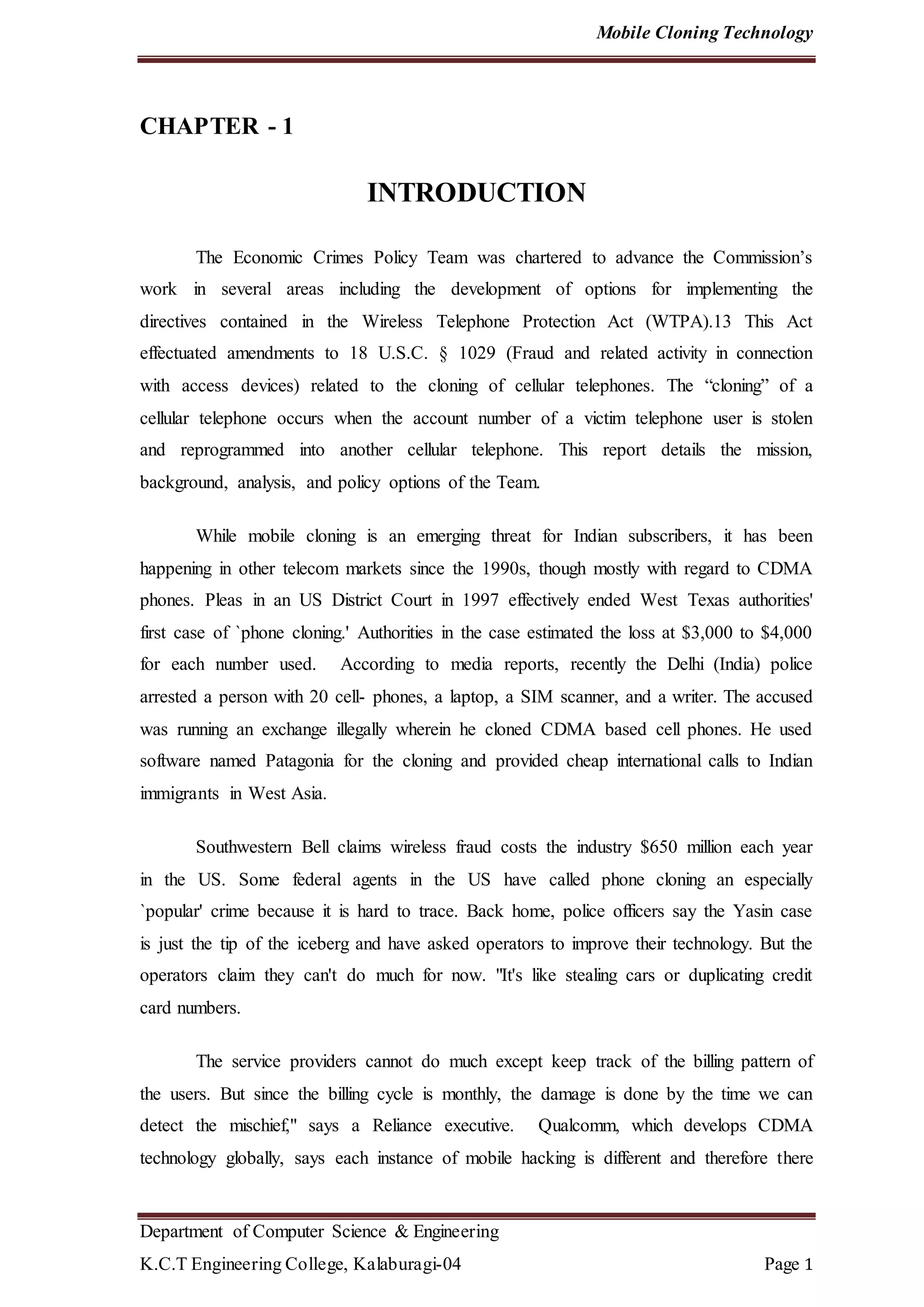
Figure1.Phone Cloning
Mobile Cloning Technology
Department of Computer Science & Engineering
K.C.T Engineering College, Kalaburagi-04 Page 3
1.1 WHAT IS CELL PHONE CLONING?
Cell phone cloning can be defined by the following definitions
 Cell phone cloning is copying the identity of one mobile telephone to another mobile
telephone.
 Usually this is done for the purpose of making fraudulent telephone calls. The bills for
the calls go to the legitimate subscriber.
 The cloner is also able to make effectively anonymous calls, which attracts another
group of interested users.
 Cloning is the process of taking the programmed information that is stored in a
legitimate mobile phone and illegally programming the identical information into
another mobile phone.
 The result is that the "cloned" phone can make and receive calls and the charges for
those calls are billed to the legitimate subscriber. The service provider network does
not have a way to differentiate between the legitimate phone and the "cloned" phone.
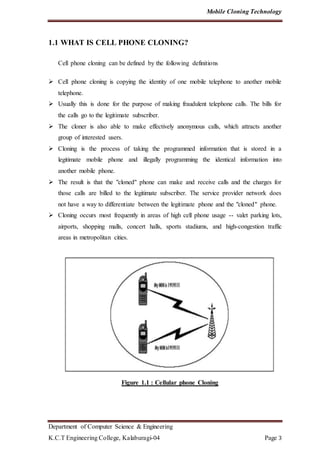
 Cloning occurs most frequently in areas of high cell phone usage -- valet parking lots,
airports, shopping malls, concert halls, sports stadiums, and high-congestion traffic
areas in metropolitan cities.
Figure 1.1 : Cellular phone Cloning
Mobile Cloning Technology
Department of Computer Science & Engineering
K.C.T Engineering College, Kalaburagi-04 Page 4
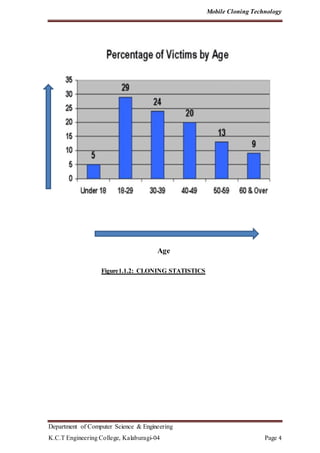
Age
Figure1.1.2: CLONING STATISTICS
Mobile Cloning Technology
Department of Computer Science & Engineering
K.C.T Engineering College, Kalaburagi-04 Page 5
1.2 HOW WIRELESS TECHNOLOGYWORKS?
 Each cellular phone has a unique pair of identifying numbers:
1. The Electronic Serial Number (“ESN”) and
2. The Mobile Identification Number (“MIN”).
 The ESN is programmed into the wireless phone’s microchip by the manufacturer at
the time of production.
 The MIN is a ten-digit phone number that is assigned by the wireless carrier to a
customer when an account is opened.
 The MIN can be changed by the carrier, but the ESN, by law, cannot be altered. When
a cellular phone is first turned on, it emits a radio signal that broadcasts these numbers
to the nearest cellular tower.
 The phone will continue to emit these signals at regular intervals, remaining in contact
with the nearest cellular tower.
 These emissions (called autonomous registration) allow computers at the cellular
carrier to know how to route incoming calls to that phone, to verify that the account is
valid so that outgoing calls can be made, and to provide the foundation for proper
billing of calls.
 This autonomous registration occurs whenever the phone is on, regardless of whether
a call is actually in progress.
Mobile Cloning Technology
Department of Computer Science & Engineering
K.C.T Engineering College, Kalaburagi-04 Page 6
CHAPTER - 2
WHEN DID CELL CLONING START?
The early 1990s were boom times for eavesdroppers. Any curious teenager with a
£100 Tandy Scanner could listen in to nearly any analogue mobile phone call.
As a result, Cabinet Ministers, company chiefs and celebrities routinely found
their most intimate conversations published in the next day's tabloids
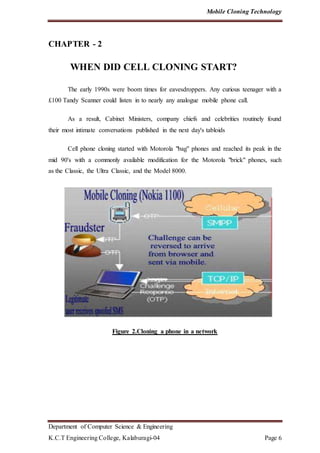
Cell phone cloning started with Motorola "bag" phones and reached its peak in the
mid 90's with a commonly available modification for the Motorola "brick" phones, such
as the Classic, the Ultra Classic, and the Model 8000.
Figure 2.Cloning a phone in a network
Mobile Cloning Technology
Department of Computer Science & Engineering
K.C.T Engineering College, Kalaburagi-04 Page 7
CHAPTER - 3
WHAT ARE CDMA AND GSM MOBILE PHONE
SETS?
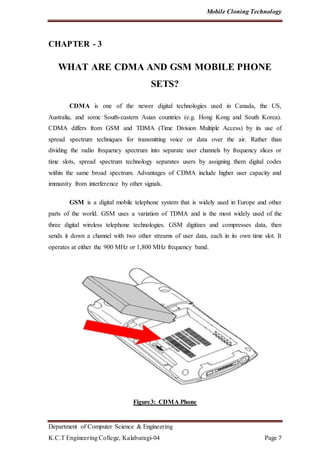
CDMA is one of the newer digital technologies used in Canada, the US,
Australia, and some South-eastern Asian countries (e.g. Hong Kong and South Korea).
CDMA differs from GSM and TDMA (Time Division Multiple Access) by its use of
spread spectrum techniques for transmitting voice or data over the air. Rather than
dividing the radio frequency spectrum into separate user channels by frequency slices or
time slots, spread spectrum technology separates users by assigning them digital codes
within the same broad spectrum. Advantages of CDMA include higher user capacity and
immunity from interference by other signals.
GSM is a digital mobile telephone system that is widely used in Europe and other
parts of the world. GSM uses a variation of TDMA and is the most widely used of the
three digital wireless telephone technologies. GSM digitizes and compresses data, then
sends it down a channel with two other streams of user data, each in its own time slot. It
operates at either the 900 MHz or 1,800 MHz frequency band.
Figure3: CDMA Phone
Mobile Cloning Technology
Department of Computer Science & Engineering
K.C.T Engineering College, Kalaburagi-04 Page 8
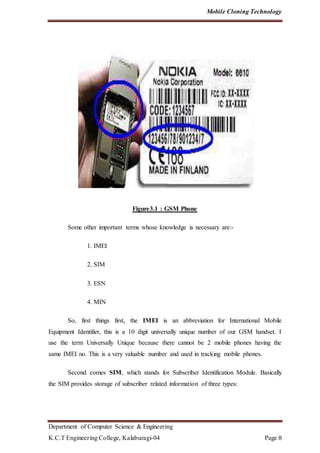
Figure3.1 : GSM Phone
Some other important terms whose knowledge is necessary are:-
1. IMEI
2. SIM
3. ESN
4. MIN
So, first things first, the IMEI is an abbreviation for International Mobile
Equipment Identifier, this is a 10 digit universally unique number of our GSM handset. I
use the term Universally Unique because there cannot be 2 mobile phones having the
same IMEI no. This is a very valuable number and used in tracking mobile phones.
Second comes SIM, which stands for Subscriber Identification Module. Basically
the SIM provides storage of subscriber related information of three types:
Mobile Cloning Technology
Department of Computer Science & Engineering
K.C.T Engineering College, Kalaburagi-04 Page 9
1. Fixed data stored before the subscription is sold
2. Temporary network data
3. Service related data
Next is the ESN, which stands for Electronic Serial Number. It is same as the
IMEI but is used in CDMA handsets. The ESN is transmitted to the cell site and used in
conjunction with the NAM to verify that you are a legitimate user of the cellular system.
MIN stands for Mobile Identification Number, which is the same as the SIM of
GSM. It is simply the phone number of the cellular telephone.
The basic difference between a CDMA handset and a GSM handset is that a
CDMA handset has no sim i.e. the CDMA handset uses MIN as its Sim, which cannot be
replaced as in GSM. The MIN chip is embedded in the CDMA hand set.
3.1 SECURITYFUNCTIONS OF THE GSM AND CDMA
As background to a better understanding of the attacks on the GSM and CDMA
network the following gives a brief introduction to the Security functions available in
GSM. The following functions exist:
a. Access control by means of a personal smart card (called
subscriber Identity module, SIM) and PIN (personal identification
number)
b. Authentication of the users towards the network carrier and generation of a
session key in order to prevent abuse.
c. Encryption of communication on the radio interface, i.e. between mobile
Station and base station,
d. Concealing the user’s identity on the radio interface, i.e. a
temporary valid Identity code (TMSI) is used for the
identification of a mobile user instead Of the IMSI.
Mobile Cloning Technology
Department of Computer Science & Engineering
K.C.T Engineering College, Kalaburagi-04 Page 10
CHAPTER - 4
MOBILE PHONE CLONING SOFTWARE
Cloning involved modifying or replacing the EPROM in the phone with a new
chip which would allow you to configure an ESN (Electronic serial number) via software.
You would also have to change the MIN (Mobile Identification Number). When you had
successfully changed the ESN/MIN pair, your phone was an effective clone of the other
phone. Cloning required access to ESN and MIN pairs. ESN/MIN pairs were discovered
in several ways:
 Sniffing the cellular phones.
 Trashing cellular companies or cellular resellers.
 Hacking cellular companies or cellular resellers.
Cloning still works under the AMPS/NAMPS system, but has fallen in
popularity as older clone able phones are more difficult to find and newer phones
have not been successful. Reverse-engineered Cloning has been successfully
demonstrated under GSM, but the process is not easy and it currently remains in
the realm of serious hobbyists and researchers.
Mobile Cloning Technology
Department of Computer Science & Engineering
K.C.T Engineering College, Kalaburagi-04 Page 11
CHAPTER - 5
HOW IS A PHONE CLONED?
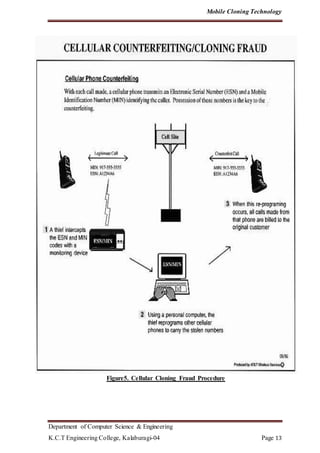
Cellular thieves can capture ESN/MINs using devices such as cell phone
ESN reader or digital data interpreters (DDI). DDIs are devices specially
manufactured to intercept ESN/MINs. By simply sitting near busy roads where
the volume of cellular traffic is high, cellular thieves monitoring the radio wave
transmissions from the cell phones of legitimate subscribers can capture
ESN/MIN pair. Numbers can be recorded by hand, one-by-one, or stored in the
box and later downloaded to a computer. ESN/MIN readers can also be used
from inside an offender’s home, office, or hotel room, increasing the difficulty of
detection.
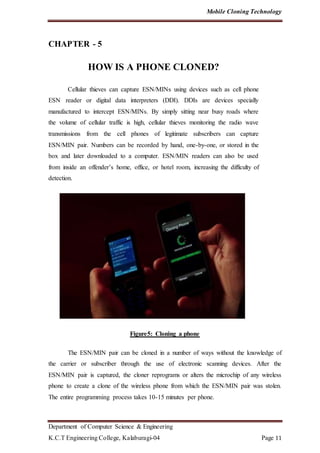
Figure5: Cloning a phone
The ESN/MIN pair can be cloned in a number of ways without the knowledge of
the carrier or subscriber through the use of electronic scanning devices. After the
ESN/MIN pair is captured, the cloner reprograms or alters the microchip of any wireless
phone to create a clone of the wireless phone from which the ESN/MIN pair was stolen.
The entire programming process takes 10-15 minutes per phone.
Mobile Cloning Technology
Department of Computer Science & Engineering
K.C.T Engineering College, Kalaburagi-04 Page 12
Any call made with cloned phone are billed to and traced to a legitimate phone
account. Innocent citizens end up with unexplained monthly phone bills. To reprogram a
phone, the ESN/MINs are transferred using a computer loaded with specialized software,
or a “copycat” box, a device whose sole purpose is to clone phones.
The devices are connected to the cellular handsets and the new identifying
information is entered into the phone. There are also more discreet, concealable devices
used to clone cellular phones. Plugs and ES-Pros, which are about the size of a pager or
small calculator, do not require computers or copycat boxes for cloning. The entire
programming process takes 10-15 minutes per phone. Figure5.shows cellular cloning
fraud.
Mobile Cloning Technology
Department of Computer Science & Engineering
K.C.T Engineering College, Kalaburagi-04 Page 13
Figure5. Cellular Cloning Fraud Procedure
Mobile Cloning Technology
Department of Computer Science & Engineering
K.C.T Engineering College, Kalaburagi-04 Page 14
This was how CDMA handsets are cloned but now we face a question that being:
5.1 DO GSM SETS RUN THE RISK OF ‘CLONING’?
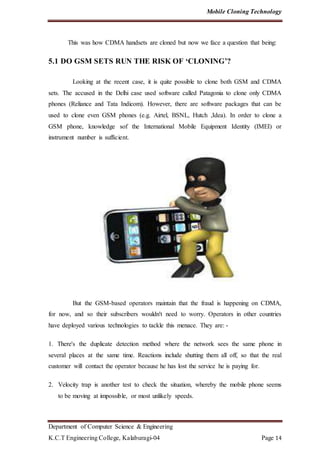
Looking at the recent case, it is quite possible to clone both GSM and CDMA
sets. The accused in the Delhi case used software called Patagonia to clone only CDMA
phones (Reliance and Tata Indicom). However, there are software packages that can be
used to clone even GSM phones (e.g. Airtel, BSNL, Hutch ,Idea). In order to clone a
GSM phone, knowledge sof the International Mobile Equipment Identity (IMEI) or
instrument number is sufficient.
But the GSM-based operators maintain that the fraud is happening on CDMA,
for now, and so their subscribers wouldn't need to worry. Operators in other countries
have deployed various technologies to tackle this menace. They are: -
1. There's the duplicate detection method where the network sees the same phone in
several places at the same time. Reactions include shutting them all off, so that the real
customer will contact the operator because he has lost the service he is paying for.
2. Velocity trap is another test to check the situation, whereby the mobile phone seems
to be moving at impossible, or most unlikely speeds.
Mobile Cloning Technology
Department of Computer Science & Engineering
K.C.T Engineering College, Kalaburagi-04 Page 15
For example, if a call is first made in Delhi,and five minutes later, another call is made
but this time in Chennai, there must be two phones with the same identity on the network.
3. Some operators also use Radio Frequency fingerprinting, originally a military
technology. Even identical radio equipment has a distinguishing `fingerprint', so the
network software stores and compares fingerprints for all the phones that it sees. This
way, it will spot the clones with the same identity, but different fingerprints.
4. Usage profiling is another way wherein profiles of customers' phone usage are kept,
and when discrepancies are noticed, the customer is contacted. For example, if a customer
normally makes only local network calls but is suddenly placing calls to foreign countries
for hours of airtime, it indicates a possible clone.
5.2 WHAT IS PATAGONIA?
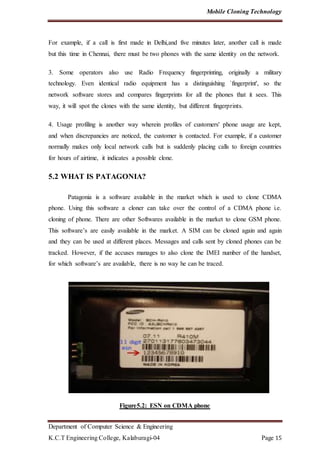
Patagonia is a software available in the market which is used to clone CDMA
phone. Using this software a cloner can take over the control of a CDMA phone i.e.
cloning of phone. There are other Softwares available in the market to clone GSM phone.
This software’s are easily available in the market. A SIM can be cloned again and again
and they can be used at different places. Messages and calls sent by cloned phones can be
tracked. However, if the accuses manages to also clone the IMEI number of the handset,
for which software’s are available, there is no way he can be traced.
Figure5.2: ESN on CDMA phone
Mobile Cloning Technology
Department of Computer Science & Engineering
K.C.T Engineering College, Kalaburagi-04 Page 16
CHAPTER - 6
IMPACT OF CLONING
Each year, the mobile phone industry loses millions of dollars in revenue because
of the criminal actions of persons who are able to reconfigure mobile phones so that their
calls are billed to other phones owned by innocent third persons. Often these cloned
phones are used to place hundreds of calls, often long distance, even to foreign countries,
resulting in thousands of dollars in airtime and long distance charges. Cellular telephone
companies do not require their customers to pay for any charges illegally made to their
account, no matter how great the cost. But some portion of the cost of these illegal
telephone calls is passed along to cellular telephone consumers as a whole.
Many criminals use cloned cellular telephones for illegal activities, because their
calls are not billed to them, and are therefore much more difficult to trace. His
phenomenon is especially prevalent in drug crimes. Drug dealers need to be in constant
contact with their sources of supply and their confederates on the streets. Traffickers
acquire cloned phones at a minimum cost, make dozens of calls, and then throw the
phone away after as little as a days' use. In the same way, criminals who pose a threat to
our national security, such as terrorists, have been known to use cloned phones to thwart
law enforcement efforts aimed at tracking their whereabouts.
6.1 HOW TO KNOW THAT THE CELL HAS BEEN CLONED?
1. Frequent wrong number phone calls to your phone, or hang-ups.
2. Difficulty in placing outgoing calls.
3. Difficulty in retrieving voice mail messages.
4. Incoming calls constantly receiving busy signals or wrong numbers.
5. Unusual calls appearing on your phone bills.
Mobile Cloning Technology
Department of Computer Science & Engineering
K.C.T Engineering College, Kalaburagi-04 Page 17
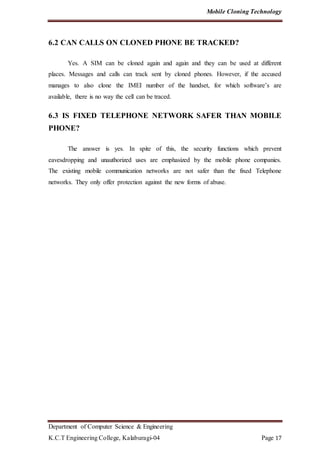
6.2 CAN CALLS ON CLONED PHONE BE TRACKED?
Yes. A SIM can be cloned again and again and they can be used at different
places. Messages and calls can track sent by cloned phones. However, if the accused
manages to also clone the IMEI number of the handset, for which software’s are
available, there is no way the cell can be traced.
6.3 IS FIXED TELEPHONE NETWORK SAFER THAN MOBILE
PHONE?
The answer is yes. In spite of this, the security functions which prevent
eavesdropping and unauthorized uses are emphasized by the mobile phone companies.
The existing mobile communication networks are not safer than the fixed Telephone
networks. They only offer protection against the new forms of abuse.
Mobile Cloning Technology
Department of Computer Science & Engineering
K.C.T Engineering College, Kalaburagi-04 Page 18
CHAPTER - 7
METHODS TO DETECT CLONED PHONES IN A
NETWORK
Several countermeasures were taken with varying success. Here are various
methods to detect cloned phones on the network:
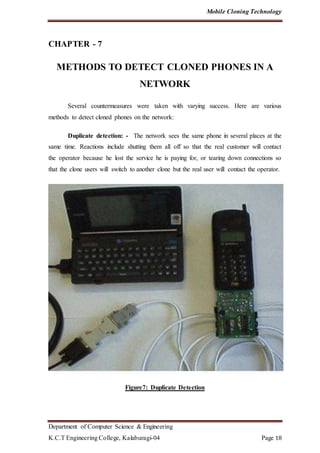
Duplicate detection: - The network sees the same phone in several places at the
same time. Reactions include shutting them all off so that the real customer will contact
the operator because he lost the service he is paying for, or tearing down connections so
that the clone users will switch to another clone but the real user will contact the operator.
Figure7: Duplicate Detection
Mobile Cloning Technology
Department of Computer Science & Engineering
K.C.T Engineering College, Kalaburagi-04 Page 19
Velocity trap: - The mobile phone seems to be moving at impossible, or most unlikely
speeds. For example, if a call is first made in Helsinki, and five minutes later, another call
is made but this time in Tampere, there must be two phones with the same identity on the
network.
RF (Radio Frequency): - Fingerprinting is originally a military technology. Even
nominally identical radio equipment has a distinguishing ``fingerprint'', so the network
software stores and compares fingerprints for all the phones that it sees. This way, it will
spot the clones with the same identity but different fingerprints.
Usage profiling :- Profiles of customers' phone usage are kept, and when discrepancies
are noticed, the customer is contacted. Credit card companies use the same method. For
example, if a customer normally makes only local network calls but is suddenly placing
calls to foreign countries for hours of airtime, it indicates a possible clone.
Call counting: - Both the phone and the network keep track of calls made with the
phone, and should they differ more than the usually allowed one call, service is denied.
PIN codes: - Prior to placing a call, the caller unlocks the phone by entering a PIN code
and then calls as usual. After the call has been completed, the user locks the phone by
entering the PIN code again. Operators may share PIN information to enable safer
roaming.
Mobile Cloning Technology
Department of Computer Science & Engineering
K.C.T Engineering College, Kalaburagi-04 Page 20
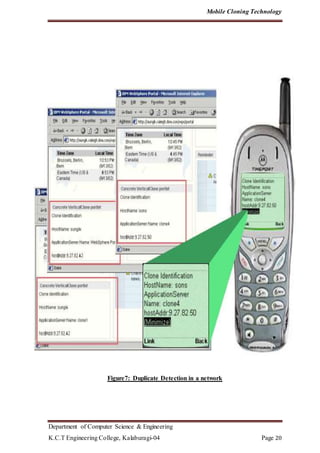
Figure7: Duplicate Detection in a network
Mobile Cloning Technology
Department of Computer Science & Engineering
K.C.T Engineering College, Kalaburagi-04 Page 21
CHAPTER - 8
ADVANTAGES AND DISADVANTAGES OF PHONE
CLONING
The advantages and disadvantages of mobile phone cloning are
8.1 ADVANTAGES
1. If your phone has been lost, you can use your cloned cell phone.
2. If your phone got damaged or if you forgot your phone at home or any other
place. Cloned phone can be helpful.
8.2 DISADVANTAGES
1. It can be used by the terrorists for criminal activities.
2. It can be used by the cloner for fraud calls.
3. It can be used for illegal money transfer.
Mobile Cloning Technology
Department of Computer Science & Engineering
K.C.T Engineering College, Kalaburagi-04 Page 22
CHAPTER – 9
SOLUTION OF THE PROBLEM
Cloning, as the crime branch detectives divulge, starts when someone, working for
a mobile phone service provider, agrees to sell the security numbers to grey market
operators. Every mobile handset has a unique factory-coded electronic serial number and
a mobile identification number. The buyer can then program these security numbers into
new handsets. The onus to check the misuse of mobile cloning phenomenon falls on the
subscriber himself. The subscribers, according to the officials, should be on the alert and
inform the police on suspecting any foul play. It would be advisable for them to ask for
the list of outgoing calls, as soon as they realize that they've been overcharged.
Meanwhile, the crime branch is hopeful to find out a way to stop the mobile cloning
phenomenon.
For example
The Central Forensic Laboratory at Hyderabad has reportedly developed software
that would detect cloned mobile phones. Called the Speaker Identification Technique,
the software enables one to recognize the voice of a person by acoustics analysis. These
methods are only good at detecting cloning, not preventing damage. A better solution is to
add authentication to the system. But this means upgrading the software of the operators'
network, and renewing the SIM-cards, which is not an easy or a cheap task. This initiative
by the Forensic Laboratory had to be taken up in the wake of more and more reports of
misuse of cloned mobiles.
Mobile Cloning Technology
Department of Computer Science & Engineering
K.C.T Engineering College, Kalaburagi-04 Page 23
CHAPTER-10
HOW TO PREVENT CELL CLONING?
Uniquely identifies a mobile unit within a wireless carrier's network. The MIN
often can be dialed from other wireless or wire line networks. The number differs from
the electronic serial number (ESN), which is the unit number assigned by a phone
manufacturer. MINs and ESNs can be checked electronically to help prevent fraud.
Mobiles should never be trusted for communicating/storing confidential information.
Always set a Pin that's required before the phone can be used. Check that all
mobile devices are covered by a corporate security policy. Ensure one person is
responsible for keeping tabs on who has what equipment and that they update the central
register.
10.1 WHAT EXACTLY IS AUTHENTICATION?
Authentication is a mathematical process by which identical calculations are
performed in both the network and the mobile phone. These calculations use secret
information (known as a "key") pre-programmed into both the mobile phone and the
network before service is activated. Cloners typically have no access to this secret
information (i.e., the key), and therefore cannot obtain the same results to the
calculations. A legitimate mobile phone will produce the same calculated result as the
network. The mobile phone's result is sent to the network and compared with the
network's results. If they match, the phone is not a "clone."
10.2 ARE THESE METHODS EFFECTIVE?
Yes, for the most part. However, Authentication is the most robust and reliable
method for preventing cloning fraud and it is the only industry "standard" method for
eliminating cloning. The fact that it is standardized means that all mobile
telecommunications networks using IS-41 can support Authentication. There is no need
to add proprietary equipment, software, or communications protocols to the networks to
prevent cloning fraud.
Mobile Cloning Technology
Department of Computer Science & Engineering
K.C.T Engineering College, Kalaburagi-04 Page 24
10.3 IS MY PHONE AUTHENTICATION CAPABLE?
If the phone supports TDMA or CDMA digital radio, then yes. Otherwise, it
depends on how old the phone is and the make and model. Almost all phones
manufactured since the beginning of 1996 support the Authentication function. The best
bet is to check with your service.
10.4 WIRELESS TELEPHONE PROTECTION ACT
Because of increasing financial losses to the telecommunications industry and the
growing use of cloned phones in connection with other criminal activity, Congress passed
the Wireless Telephone Protection Act (WTPA) in April 1998. The legislative history
indicates that, in amending 18 U.S.C. § 1029, Congress was attempting to address two
primary concerns presented by law enforcement and the wireless telecommunications
industry.
10.4.1 MANUFACTURING AND DISTRIBUTING
Section 1029 covers cloning behavior that ranges from mere possession of a
cloned phone to using, producing, or trafficking in cloning equipment. The statutory
maximum for these offenses is ten or 15 years, depending upon the conduct, and are
sentenced under §2F1.1. This guideline provides different punishment levels based on
whether any or all of the following three factors are applicable: the amount of “loss”
involved in the offense the offense involved “more than minimal planning” and the
offense involved “sophisticated means.” However, the current guideline does not provide
distinctions in sentence severity based on whether the defendant was involved in
manufacturing or distributing cloned phones. It is possible that without a separate
enhancement for manufacturing or distributing, the current fraud guideline does not
adequately distinguish between possessing a clone.
First, law enforcement officials testified at congressional hearings that they
were having difficulty proving the “intent to defraud” element of the pre-amendment
provision regarding some equipment used to clone phones.2 Although there is no
legitimate reason to possess the equipment unless an individual is employed in the
Mobile Cloning Technology
Department of Computer Science & Engineering
K.C.T Engineering College, Kalaburagi-04 Page 25
telecommunications industry, the prosecution often could not prove that the equipment
was possessed with the intent to defraud.
Second, law enforcement officials often discovered cloning equipment and
cloned cellular telephones in the course of investigating other criminal activities, such as
drug trafficking and other fraud. The use of cloned phones to facilitate other crimes
increases the ability of offenders to escape detection because of the increased mobility
and anonymity afforded by the phones. Gangs and foreign terrorist groups are also known
to sell or rent cloned phones to finance their illegal activities.
Wireless Telephone Protection Act (Pub. L. No. 105-418, April 24,
1998).Configured for altering or modifying a telecommunications instrument3. C
Modification of the current definition of "scanning receiver" to ensure that the term is
understood to include a device that can be used to intercept an electronic serial number,
mobile identification number, or other identifier of any telecommunications service,
equipment, or instrument; and C Correction of an error in the current penalty provision of
18 U.S.C. § 1029 that provided two different statutory maximum penalties (ten and 15
years) for the same offense. With respect to cellular phone cloning, the Act makes clear
that a person convicted of such an offense without a prior section 1029 conviction is
subject to a statutory maximum of 15 years; a person convicted of such an offense after a
prior section 1029 conviction is subject to a statutory maximum of 20 years.
In addition to the amendments to section 1029, the Wireless Telephone
Protection Act directs the Commission to “review and amend the federal sentencing
guidelines and the policy statements of the Commission, and, if appropriate, to provide an
appropriate penalty for offenses involving the cloning of wireless telephones. The Act
also directs the Commission to consider eight specific factors:
(A) The range of conduct covered by the offenses.
(B) The existing sentences for the offense.
(C) The extent to which the value of the loss caused by the offenses (as defined in the
federal sentencing guidelines) is an adequate measure for establishing penalties under the
federal sentencing guidelines.
Mobile Cloning Technology
Department of Computer Science & Engineering
K.C.T Engineering College, Kalaburagi-04 Page 26
(D) The extent to which sentencing enhancements within the federal sentencing
guidelines and the court’s authority to sentence above the applicable guideline range are
adequate to ensure punishment at or near the maximum penalty for the most egregious
conduct covered by the offenses.
(E) The extent to which the federal sentencing guideline sentences for the offenses have
been constrained by statutory maximum penalties.
(F) The extent to which federal sentencing guidelines for the offense(s) adequately
achieve the purposes of sentencing set forth in 18 U.S.C. § 3553(a)(2)
(G) The relationship of the federal sentencing guidelines for these offenses to offenses of
comparable seriousness; and
(H) Any other factor the Commission considers to be appropriate.
10.5 WHAT IS IS-41?
IS-41(Interim Standard No. 41) is a document prescribing standards for
communications between mobile networks. The standard was developed by the
Telecommunications Industry Association (TIA) and is used primarily throughout North
America as well as many Latin American countries and Asia.
The IS-41 network communications standard supports AMPS, NAMPS, TDMA,
and CDMA radio technologies. IS-41 is the standard that defines the methods for
automatic roaming, handoff between systems, and for performing Authentication.
Mobile Cloning Technology
Department of Computer Science & Engineering
K.C.T Engineering College, Kalaburagi-04 Page 27
CHAPTER - 11
ROLE OF SERVICE PROVIDER TO COMBAT
CLONING FRAUD?
They are using many methods such as RF Fingerprinting, subscriber behaviour
profiling, and Authentication. RF Fingerprinting is a method to uniquely identify mobile
phones based on certain unique radio frequency transmission characteristics that are
essentially "fingerprints" of the radio being used. Subscriber behaviour profiling is used
to predict possible fraudulent use of mobile service based on the types of calls previously
made by the subscriber. Calls that are not typical of the subscriber's past usage are
flagged as potentially fraudulent and appropriate actions can be taken.
Authentication has advantages over these technologies in that it is the only
industry standardized procedure that is transparent to the user, a technology that can
effectively combat roamer fraud, and is a prevention system as opposed to a detection
system.
11.1 HOW CAN ORGANIZATIONS HELP THEMSELVES?
1. Mobiles should never be trusted for communicating/storing confidential
information.
2. Always set a Pin that's required before the phone can be used.
3. Check that all mobile devices are covered by a corporate security policy.
4. Ensure one person is responsible for keeping tabs on who has what equipment and
that they update the central register.
5. Such preventive measures are our only defence till we get a way or a technique to
prevent cloning of mobile phones.
Mobile Cloning Technology
Department of Computer Science & Engineering
K.C.T Engineering College, Kalaburagi-04 Page 28
11.2 WHAT CAN BE DONE?
With technically sophisticated thieves, customers are relatively helpless against
cellular phone fraud. Usually they became aware of the fraud only once receiving their
phone bill. Service providers have adopted certain measures to prevent cellular fraud.
These include encryption, blocking, blacklisting, user verification and traffic analysis.
Encryption is regarded as the most effective way to prevent cellular fraud as it
prevents eavesdropping on cellular calls and makes it nearly impossible for thieves to
steal Electronic Serial Number (ESN) and Personal Identification Number (PIN) pairs.
Blocking is used by service providers to protect themselves from high risk callers. For
example, international calls can be made only with prior approval. In some countries only
users with major credit cards and good credit ratings are allowed to make long distance
calls.
1. Blacklisting of stolen phones is another mechanism to prevent unauthorized use.
An Equipment Identity Register (EIR) enables network operators to disable stolen
cellular phones on networks around the world.
2. User verification using Personal Identification Number (PIN) codes is one method
for customer protection against cellular phone fraud.
3. Tests conducted have proved that United States found that having a PIN code
reduced fraud by more than 80%.
4. Traffic analysis detects cellular fraud by using artificial intelligence software to
detect suspicious calling patterns, such as a sudden increase in the length of calls
or a sudden increase in the number of international calls.
11.3 VICTIMS OF PHONE CLONING
 Anita Davis, a mobile clone victim. One month, her cell phone bill showed
$3,151 worth of calls in one month, to Pakistan, Israel, Jordan, Africa, and other
countries.
 A Louisville woman was shocked when she got her February cell phone bill from
T-Mobile. It was ten times higher than it's ever been before. Equally troubling, she
didn't recognize most of the phone numbers on it.
Mobile Cloning Technology
Department of Computer Science & Engineering
K.C.T Engineering College, Kalaburagi-04 Page 29
11.4 FUTURE THREATS
Resolving subscriber fraud can be a long and difficult process for the victim. It
may take time to discover that subscriber fraud has occurred and an even longer time to
prove that you did not incur the debts. As described in this article there are many ways to
abuse telecommunication system, and to prevent abuse from occurring it is absolutely
necessary to check out the weakness and vulnerability of existing telecom systems. If it is
planned to invest in new telecom equipment, a security plan should be made and the
system tested before being implemented. It is therefore mandatory to keep in mind that a
technique which is described as safe today can be the most unsecured technique in the
future.
Mobile Cloning Technology
Department of Computer Science & Engineering
K.C.T Engineering College, Kalaburagi-04 Page 30
CHAPTER – 12
CONCLUSION
Presently the cellular phone industry relies on common law (fraud and theft) and
in-house counter measures to address cellular phone fraud.is in initial stages in India so
preventive steps should be taken by the network provider and the Government the
enactment of legislation to prosecute crimes related to cellular phones is not viewed as a
priority, however. It is essential that intended mobile crime legislation be comprehensive
enough to incorporate cellular phone fraud, in particular "cloning fraud" as a specific
crime.
Mobile Cloning Technology
Department of Computer Science & Engineering
K.C.T Engineering College, Kalaburagi-04 Page 31
CHAPTER - 13
BIBLOGRAPHY
[1] Google: www.google.com
[2] Mobile phone cloning www.seminarsonly.com
[3] Wikipedia: www.wikipedia.org
[4] http://www.hackinthebox.org/
[5] http://www.slideshare.net
[6] IEEE journal for mobile communication
[7] Mobile communication Govt. of India reports
[8] Fundamentals of Mobile and Pervasive Computing
Frank Adelstein, Sandeep Gupta.
[9] Wireless and Cellular Communication 3rd Edition
William C.Y.Lee.
[10] 3G Networks 1st Edition
Clint Smith, Saniel Collins
[11] Introduction to Telecom Communication Converging Technologies 1st Edition.
Kimberly Massey.
[12] Rehault, F. (2010). Windows mobile advanced forensics: An alternative to existing
tools.Journal of Digital Investigation, 7(1–2).
[13] Mislan, R., Casey, E., & Kessler, G. (2010). The growing need for on-scene triage
of mobile devices. Journal of Digital Investigation, 6.

Mobile Cloning Technology Report

  • 1.
    Mobile Cloning Technology Departmentof Computer Science & Engineering K.C.T Engineering College, Kalaburagi-04 Page 1 CHAPTER - 1 INTRODUCTION The Economic Crimes Policy Team was chartered to advance the Commission’s work in several areas including the development of options for implementing the directives contained in the Wireless Telephone Protection Act (WTPA).13 This Act effectuated amendments to 18 U.S.C. § 1029 (Fraud and related activity in connection with access devices) related to the cloning of cellular telephones. The “cloning” of a cellular telephone occurs when the account number of a victim telephone user is stolen and reprogrammed into another cellular telephone. This report details the mission, background, analysis, and policy options of the Team. While mobile cloning is an emerging threat for Indian subscribers, it has been happening in other telecom markets since the 1990s, though mostly with regard to CDMA phones. Pleas in an US District Court in 1997 effectively ended West Texas authorities' first case of `phone cloning.' Authorities in the case estimated the loss at $3,000 to $4,000 for each number used. According to media reports, recently the Delhi (India) police arrested a person with 20 cell- phones, a laptop, a SIM scanner, and a writer. The accused was running an exchange illegally wherein he cloned CDMA based cell phones. He used software named Patagonia for the cloning and provided cheap international calls to Indian immigrants in West Asia. Southwestern Bell claims wireless fraud costs the industry $650 million each year in the US. Some federal agents in the US have called phone cloning an especially `popular' crime because it is hard to trace. Back home, police officers say the Yasin case is just the tip of the iceberg and have asked operators to improve their technology. But the operators claim they can't do much for now. "It's like stealing cars or duplicating credit card numbers. The service providers cannot do much except keep track of the billing pattern of the users. But since the billing cycle is monthly, the damage is done by the time we can detect the mischief," says a Reliance executive. Qualcomm, which develops CDMA technology globally, says each instance of mobile hacking is different and therefore there
  • 2.
    Mobile Cloning Technology Departmentof Computer Science & Engineering K.C.T Engineering College, Kalaburagi-04 Page 2 is very little an operator can do to prevent hacking. "It's like a virus hitting the computer. Each software used to hack into the network is different, so operators can only keep upgrading their security firewall as and when the hackers strike," says a Qualcomm executive . Figure1.Phone Cloning
  • 3.
    Mobile Cloning Technology Departmentof Computer Science & Engineering K.C.T Engineering College, Kalaburagi-04 Page 3 1.1 WHAT IS CELL PHONE CLONING? Cell phone cloning can be defined by the following definitions  Cell phone cloning is copying the identity of one mobile telephone to another mobile telephone.  Usually this is done for the purpose of making fraudulent telephone calls. The bills for the calls go to the legitimate subscriber.  The cloner is also able to make effectively anonymous calls, which attracts another group of interested users.  Cloning is the process of taking the programmed information that is stored in a legitimate mobile phone and illegally programming the identical information into another mobile phone.  The result is that the "cloned" phone can make and receive calls and the charges for those calls are billed to the legitimate subscriber. The service provider network does not have a way to differentiate between the legitimate phone and the "cloned" phone.  Cloning occurs most frequently in areas of high cell phone usage -- valet parking lots, airports, shopping malls, concert halls, sports stadiums, and high-congestion traffic areas in metropolitan cities. Figure 1.1 : Cellular phone Cloning
  • 4.
    Mobile Cloning Technology Departmentof Computer Science & Engineering K.C.T Engineering College, Kalaburagi-04 Page 4 Age Figure1.1.2: CLONING STATISTICS
  • 5.
    Mobile Cloning Technology Departmentof Computer Science & Engineering K.C.T Engineering College, Kalaburagi-04 Page 5 1.2 HOW WIRELESS TECHNOLOGYWORKS?  Each cellular phone has a unique pair of identifying numbers: 1. The Electronic Serial Number (“ESN”) and 2. The Mobile Identification Number (“MIN”).  The ESN is programmed into the wireless phone’s microchip by the manufacturer at the time of production.  The MIN is a ten-digit phone number that is assigned by the wireless carrier to a customer when an account is opened.  The MIN can be changed by the carrier, but the ESN, by law, cannot be altered. When a cellular phone is first turned on, it emits a radio signal that broadcasts these numbers to the nearest cellular tower.  The phone will continue to emit these signals at regular intervals, remaining in contact with the nearest cellular tower.  These emissions (called autonomous registration) allow computers at the cellular carrier to know how to route incoming calls to that phone, to verify that the account is valid so that outgoing calls can be made, and to provide the foundation for proper billing of calls.  This autonomous registration occurs whenever the phone is on, regardless of whether a call is actually in progress.
  • 6.
    Mobile Cloning Technology Departmentof Computer Science & Engineering K.C.T Engineering College, Kalaburagi-04 Page 6 CHAPTER - 2 WHEN DID CELL CLONING START? The early 1990s were boom times for eavesdroppers. Any curious teenager with a £100 Tandy Scanner could listen in to nearly any analogue mobile phone call. As a result, Cabinet Ministers, company chiefs and celebrities routinely found their most intimate conversations published in the next day's tabloids Cell phone cloning started with Motorola "bag" phones and reached its peak in the mid 90's with a commonly available modification for the Motorola "brick" phones, such as the Classic, the Ultra Classic, and the Model 8000. Figure 2.Cloning a phone in a network
  • 7.
    Mobile Cloning Technology Departmentof Computer Science & Engineering K.C.T Engineering College, Kalaburagi-04 Page 7 CHAPTER - 3 WHAT ARE CDMA AND GSM MOBILE PHONE SETS? CDMA is one of the newer digital technologies used in Canada, the US, Australia, and some South-eastern Asian countries (e.g. Hong Kong and South Korea). CDMA differs from GSM and TDMA (Time Division Multiple Access) by its use of spread spectrum techniques for transmitting voice or data over the air. Rather than dividing the radio frequency spectrum into separate user channels by frequency slices or time slots, spread spectrum technology separates users by assigning them digital codes within the same broad spectrum. Advantages of CDMA include higher user capacity and immunity from interference by other signals. GSM is a digital mobile telephone system that is widely used in Europe and other parts of the world. GSM uses a variation of TDMA and is the most widely used of the three digital wireless telephone technologies. GSM digitizes and compresses data, then sends it down a channel with two other streams of user data, each in its own time slot. It operates at either the 900 MHz or 1,800 MHz frequency band. Figure3: CDMA Phone
  • 8.
    Mobile Cloning Technology Departmentof Computer Science & Engineering K.C.T Engineering College, Kalaburagi-04 Page 8 Figure3.1 : GSM Phone Some other important terms whose knowledge is necessary are:- 1. IMEI 2. SIM 3. ESN 4. MIN So, first things first, the IMEI is an abbreviation for International Mobile Equipment Identifier, this is a 10 digit universally unique number of our GSM handset. I use the term Universally Unique because there cannot be 2 mobile phones having the same IMEI no. This is a very valuable number and used in tracking mobile phones. Second comes SIM, which stands for Subscriber Identification Module. Basically the SIM provides storage of subscriber related information of three types:
  • 9.
    Mobile Cloning Technology Departmentof Computer Science & Engineering K.C.T Engineering College, Kalaburagi-04 Page 9 1. Fixed data stored before the subscription is sold 2. Temporary network data 3. Service related data Next is the ESN, which stands for Electronic Serial Number. It is same as the IMEI but is used in CDMA handsets. The ESN is transmitted to the cell site and used in conjunction with the NAM to verify that you are a legitimate user of the cellular system. MIN stands for Mobile Identification Number, which is the same as the SIM of GSM. It is simply the phone number of the cellular telephone. The basic difference between a CDMA handset and a GSM handset is that a CDMA handset has no sim i.e. the CDMA handset uses MIN as its Sim, which cannot be replaced as in GSM. The MIN chip is embedded in the CDMA hand set. 3.1 SECURITYFUNCTIONS OF THE GSM AND CDMA As background to a better understanding of the attacks on the GSM and CDMA network the following gives a brief introduction to the Security functions available in GSM. The following functions exist: a. Access control by means of a personal smart card (called subscriber Identity module, SIM) and PIN (personal identification number) b. Authentication of the users towards the network carrier and generation of a session key in order to prevent abuse. c. Encryption of communication on the radio interface, i.e. between mobile Station and base station, d. Concealing the user’s identity on the radio interface, i.e. a temporary valid Identity code (TMSI) is used for the identification of a mobile user instead Of the IMSI.
  • 10.
    Mobile Cloning Technology Departmentof Computer Science & Engineering K.C.T Engineering College, Kalaburagi-04 Page 10 CHAPTER - 4 MOBILE PHONE CLONING SOFTWARE Cloning involved modifying or replacing the EPROM in the phone with a new chip which would allow you to configure an ESN (Electronic serial number) via software. You would also have to change the MIN (Mobile Identification Number). When you had successfully changed the ESN/MIN pair, your phone was an effective clone of the other phone. Cloning required access to ESN and MIN pairs. ESN/MIN pairs were discovered in several ways:  Sniffing the cellular phones.  Trashing cellular companies or cellular resellers.  Hacking cellular companies or cellular resellers. Cloning still works under the AMPS/NAMPS system, but has fallen in popularity as older clone able phones are more difficult to find and newer phones have not been successful. Reverse-engineered Cloning has been successfully demonstrated under GSM, but the process is not easy and it currently remains in the realm of serious hobbyists and researchers.
  • 11.
    Mobile Cloning Technology Departmentof Computer Science & Engineering K.C.T Engineering College, Kalaburagi-04 Page 11 CHAPTER - 5 HOW IS A PHONE CLONED? Cellular thieves can capture ESN/MINs using devices such as cell phone ESN reader or digital data interpreters (DDI). DDIs are devices specially manufactured to intercept ESN/MINs. By simply sitting near busy roads where the volume of cellular traffic is high, cellular thieves monitoring the radio wave transmissions from the cell phones of legitimate subscribers can capture ESN/MIN pair. Numbers can be recorded by hand, one-by-one, or stored in the box and later downloaded to a computer. ESN/MIN readers can also be used from inside an offender’s home, office, or hotel room, increasing the difficulty of detection. Figure5: Cloning a phone The ESN/MIN pair can be cloned in a number of ways without the knowledge of the carrier or subscriber through the use of electronic scanning devices. After the ESN/MIN pair is captured, the cloner reprograms or alters the microchip of any wireless phone to create a clone of the wireless phone from which the ESN/MIN pair was stolen. The entire programming process takes 10-15 minutes per phone.
  • 12.
    Mobile Cloning Technology Departmentof Computer Science & Engineering K.C.T Engineering College, Kalaburagi-04 Page 12 Any call made with cloned phone are billed to and traced to a legitimate phone account. Innocent citizens end up with unexplained monthly phone bills. To reprogram a phone, the ESN/MINs are transferred using a computer loaded with specialized software, or a “copycat” box, a device whose sole purpose is to clone phones. The devices are connected to the cellular handsets and the new identifying information is entered into the phone. There are also more discreet, concealable devices used to clone cellular phones. Plugs and ES-Pros, which are about the size of a pager or small calculator, do not require computers or copycat boxes for cloning. The entire programming process takes 10-15 minutes per phone. Figure5.shows cellular cloning fraud.
  • 13.
    Mobile Cloning Technology Departmentof Computer Science & Engineering K.C.T Engineering College, Kalaburagi-04 Page 13 Figure5. Cellular Cloning Fraud Procedure
  • 14.
    Mobile Cloning Technology Departmentof Computer Science & Engineering K.C.T Engineering College, Kalaburagi-04 Page 14 This was how CDMA handsets are cloned but now we face a question that being: 5.1 DO GSM SETS RUN THE RISK OF ‘CLONING’? Looking at the recent case, it is quite possible to clone both GSM and CDMA sets. The accused in the Delhi case used software called Patagonia to clone only CDMA phones (Reliance and Tata Indicom). However, there are software packages that can be used to clone even GSM phones (e.g. Airtel, BSNL, Hutch ,Idea). In order to clone a GSM phone, knowledge sof the International Mobile Equipment Identity (IMEI) or instrument number is sufficient. But the GSM-based operators maintain that the fraud is happening on CDMA, for now, and so their subscribers wouldn't need to worry. Operators in other countries have deployed various technologies to tackle this menace. They are: - 1. There's the duplicate detection method where the network sees the same phone in several places at the same time. Reactions include shutting them all off, so that the real customer will contact the operator because he has lost the service he is paying for. 2. Velocity trap is another test to check the situation, whereby the mobile phone seems to be moving at impossible, or most unlikely speeds.
  • 15.
    Mobile Cloning Technology Departmentof Computer Science & Engineering K.C.T Engineering College, Kalaburagi-04 Page 15 For example, if a call is first made in Delhi,and five minutes later, another call is made but this time in Chennai, there must be two phones with the same identity on the network. 3. Some operators also use Radio Frequency fingerprinting, originally a military technology. Even identical radio equipment has a distinguishing `fingerprint', so the network software stores and compares fingerprints for all the phones that it sees. This way, it will spot the clones with the same identity, but different fingerprints. 4. Usage profiling is another way wherein profiles of customers' phone usage are kept, and when discrepancies are noticed, the customer is contacted. For example, if a customer normally makes only local network calls but is suddenly placing calls to foreign countries for hours of airtime, it indicates a possible clone. 5.2 WHAT IS PATAGONIA? Patagonia is a software available in the market which is used to clone CDMA phone. Using this software a cloner can take over the control of a CDMA phone i.e. cloning of phone. There are other Softwares available in the market to clone GSM phone. This software’s are easily available in the market. A SIM can be cloned again and again and they can be used at different places. Messages and calls sent by cloned phones can be tracked. However, if the accuses manages to also clone the IMEI number of the handset, for which software’s are available, there is no way he can be traced. Figure5.2: ESN on CDMA phone
  • 16.
    Mobile Cloning Technology Departmentof Computer Science & Engineering K.C.T Engineering College, Kalaburagi-04 Page 16 CHAPTER - 6 IMPACT OF CLONING Each year, the mobile phone industry loses millions of dollars in revenue because of the criminal actions of persons who are able to reconfigure mobile phones so that their calls are billed to other phones owned by innocent third persons. Often these cloned phones are used to place hundreds of calls, often long distance, even to foreign countries, resulting in thousands of dollars in airtime and long distance charges. Cellular telephone companies do not require their customers to pay for any charges illegally made to their account, no matter how great the cost. But some portion of the cost of these illegal telephone calls is passed along to cellular telephone consumers as a whole. Many criminals use cloned cellular telephones for illegal activities, because their calls are not billed to them, and are therefore much more difficult to trace. His phenomenon is especially prevalent in drug crimes. Drug dealers need to be in constant contact with their sources of supply and their confederates on the streets. Traffickers acquire cloned phones at a minimum cost, make dozens of calls, and then throw the phone away after as little as a days' use. In the same way, criminals who pose a threat to our national security, such as terrorists, have been known to use cloned phones to thwart law enforcement efforts aimed at tracking their whereabouts. 6.1 HOW TO KNOW THAT THE CELL HAS BEEN CLONED? 1. Frequent wrong number phone calls to your phone, or hang-ups. 2. Difficulty in placing outgoing calls. 3. Difficulty in retrieving voice mail messages. 4. Incoming calls constantly receiving busy signals or wrong numbers. 5. Unusual calls appearing on your phone bills.
  • 17.
    Mobile Cloning Technology Departmentof Computer Science & Engineering K.C.T Engineering College, Kalaburagi-04 Page 17 6.2 CAN CALLS ON CLONED PHONE BE TRACKED? Yes. A SIM can be cloned again and again and they can be used at different places. Messages and calls can track sent by cloned phones. However, if the accused manages to also clone the IMEI number of the handset, for which software’s are available, there is no way the cell can be traced. 6.3 IS FIXED TELEPHONE NETWORK SAFER THAN MOBILE PHONE? The answer is yes. In spite of this, the security functions which prevent eavesdropping and unauthorized uses are emphasized by the mobile phone companies. The existing mobile communication networks are not safer than the fixed Telephone networks. They only offer protection against the new forms of abuse.
  • 18.
    Mobile Cloning Technology Departmentof Computer Science & Engineering K.C.T Engineering College, Kalaburagi-04 Page 18 CHAPTER - 7 METHODS TO DETECT CLONED PHONES IN A NETWORK Several countermeasures were taken with varying success. Here are various methods to detect cloned phones on the network: Duplicate detection: - The network sees the same phone in several places at the same time. Reactions include shutting them all off so that the real customer will contact the operator because he lost the service he is paying for, or tearing down connections so that the clone users will switch to another clone but the real user will contact the operator. Figure7: Duplicate Detection
  • 19.
    Mobile Cloning Technology Departmentof Computer Science & Engineering K.C.T Engineering College, Kalaburagi-04 Page 19 Velocity trap: - The mobile phone seems to be moving at impossible, or most unlikely speeds. For example, if a call is first made in Helsinki, and five minutes later, another call is made but this time in Tampere, there must be two phones with the same identity on the network. RF (Radio Frequency): - Fingerprinting is originally a military technology. Even nominally identical radio equipment has a distinguishing ``fingerprint'', so the network software stores and compares fingerprints for all the phones that it sees. This way, it will spot the clones with the same identity but different fingerprints. Usage profiling :- Profiles of customers' phone usage are kept, and when discrepancies are noticed, the customer is contacted. Credit card companies use the same method. For example, if a customer normally makes only local network calls but is suddenly placing calls to foreign countries for hours of airtime, it indicates a possible clone. Call counting: - Both the phone and the network keep track of calls made with the phone, and should they differ more than the usually allowed one call, service is denied. PIN codes: - Prior to placing a call, the caller unlocks the phone by entering a PIN code and then calls as usual. After the call has been completed, the user locks the phone by entering the PIN code again. Operators may share PIN information to enable safer roaming.
  • 20.
    Mobile Cloning Technology Departmentof Computer Science & Engineering K.C.T Engineering College, Kalaburagi-04 Page 20 Figure7: Duplicate Detection in a network
  • 21.
    Mobile Cloning Technology Departmentof Computer Science & Engineering K.C.T Engineering College, Kalaburagi-04 Page 21 CHAPTER - 8 ADVANTAGES AND DISADVANTAGES OF PHONE CLONING The advantages and disadvantages of mobile phone cloning are 8.1 ADVANTAGES 1. If your phone has been lost, you can use your cloned cell phone. 2. If your phone got damaged or if you forgot your phone at home or any other place. Cloned phone can be helpful. 8.2 DISADVANTAGES 1. It can be used by the terrorists for criminal activities. 2. It can be used by the cloner for fraud calls. 3. It can be used for illegal money transfer.
  • 22.
    Mobile Cloning Technology Departmentof Computer Science & Engineering K.C.T Engineering College, Kalaburagi-04 Page 22 CHAPTER – 9 SOLUTION OF THE PROBLEM Cloning, as the crime branch detectives divulge, starts when someone, working for a mobile phone service provider, agrees to sell the security numbers to grey market operators. Every mobile handset has a unique factory-coded electronic serial number and a mobile identification number. The buyer can then program these security numbers into new handsets. The onus to check the misuse of mobile cloning phenomenon falls on the subscriber himself. The subscribers, according to the officials, should be on the alert and inform the police on suspecting any foul play. It would be advisable for them to ask for the list of outgoing calls, as soon as they realize that they've been overcharged. Meanwhile, the crime branch is hopeful to find out a way to stop the mobile cloning phenomenon. For example The Central Forensic Laboratory at Hyderabad has reportedly developed software that would detect cloned mobile phones. Called the Speaker Identification Technique, the software enables one to recognize the voice of a person by acoustics analysis. These methods are only good at detecting cloning, not preventing damage. A better solution is to add authentication to the system. But this means upgrading the software of the operators' network, and renewing the SIM-cards, which is not an easy or a cheap task. This initiative by the Forensic Laboratory had to be taken up in the wake of more and more reports of misuse of cloned mobiles.
  • 23.
    Mobile Cloning Technology Departmentof Computer Science & Engineering K.C.T Engineering College, Kalaburagi-04 Page 23 CHAPTER-10 HOW TO PREVENT CELL CLONING? Uniquely identifies a mobile unit within a wireless carrier's network. The MIN often can be dialed from other wireless or wire line networks. The number differs from the electronic serial number (ESN), which is the unit number assigned by a phone manufacturer. MINs and ESNs can be checked electronically to help prevent fraud. Mobiles should never be trusted for communicating/storing confidential information. Always set a Pin that's required before the phone can be used. Check that all mobile devices are covered by a corporate security policy. Ensure one person is responsible for keeping tabs on who has what equipment and that they update the central register. 10.1 WHAT EXACTLY IS AUTHENTICATION? Authentication is a mathematical process by which identical calculations are performed in both the network and the mobile phone. These calculations use secret information (known as a "key") pre-programmed into both the mobile phone and the network before service is activated. Cloners typically have no access to this secret information (i.e., the key), and therefore cannot obtain the same results to the calculations. A legitimate mobile phone will produce the same calculated result as the network. The mobile phone's result is sent to the network and compared with the network's results. If they match, the phone is not a "clone." 10.2 ARE THESE METHODS EFFECTIVE? Yes, for the most part. However, Authentication is the most robust and reliable method for preventing cloning fraud and it is the only industry "standard" method for eliminating cloning. The fact that it is standardized means that all mobile telecommunications networks using IS-41 can support Authentication. There is no need to add proprietary equipment, software, or communications protocols to the networks to prevent cloning fraud.
  • 24.
    Mobile Cloning Technology Departmentof Computer Science & Engineering K.C.T Engineering College, Kalaburagi-04 Page 24 10.3 IS MY PHONE AUTHENTICATION CAPABLE? If the phone supports TDMA or CDMA digital radio, then yes. Otherwise, it depends on how old the phone is and the make and model. Almost all phones manufactured since the beginning of 1996 support the Authentication function. The best bet is to check with your service. 10.4 WIRELESS TELEPHONE PROTECTION ACT Because of increasing financial losses to the telecommunications industry and the growing use of cloned phones in connection with other criminal activity, Congress passed the Wireless Telephone Protection Act (WTPA) in April 1998. The legislative history indicates that, in amending 18 U.S.C. § 1029, Congress was attempting to address two primary concerns presented by law enforcement and the wireless telecommunications industry. 10.4.1 MANUFACTURING AND DISTRIBUTING Section 1029 covers cloning behavior that ranges from mere possession of a cloned phone to using, producing, or trafficking in cloning equipment. The statutory maximum for these offenses is ten or 15 years, depending upon the conduct, and are sentenced under §2F1.1. This guideline provides different punishment levels based on whether any or all of the following three factors are applicable: the amount of “loss” involved in the offense the offense involved “more than minimal planning” and the offense involved “sophisticated means.” However, the current guideline does not provide distinctions in sentence severity based on whether the defendant was involved in manufacturing or distributing cloned phones. It is possible that without a separate enhancement for manufacturing or distributing, the current fraud guideline does not adequately distinguish between possessing a clone. First, law enforcement officials testified at congressional hearings that they were having difficulty proving the “intent to defraud” element of the pre-amendment provision regarding some equipment used to clone phones.2 Although there is no legitimate reason to possess the equipment unless an individual is employed in the
  • 25.
    Mobile Cloning Technology Departmentof Computer Science & Engineering K.C.T Engineering College, Kalaburagi-04 Page 25 telecommunications industry, the prosecution often could not prove that the equipment was possessed with the intent to defraud. Second, law enforcement officials often discovered cloning equipment and cloned cellular telephones in the course of investigating other criminal activities, such as drug trafficking and other fraud. The use of cloned phones to facilitate other crimes increases the ability of offenders to escape detection because of the increased mobility and anonymity afforded by the phones. Gangs and foreign terrorist groups are also known to sell or rent cloned phones to finance their illegal activities. Wireless Telephone Protection Act (Pub. L. No. 105-418, April 24, 1998).Configured for altering or modifying a telecommunications instrument3. C Modification of the current definition of "scanning receiver" to ensure that the term is understood to include a device that can be used to intercept an electronic serial number, mobile identification number, or other identifier of any telecommunications service, equipment, or instrument; and C Correction of an error in the current penalty provision of 18 U.S.C. § 1029 that provided two different statutory maximum penalties (ten and 15 years) for the same offense. With respect to cellular phone cloning, the Act makes clear that a person convicted of such an offense without a prior section 1029 conviction is subject to a statutory maximum of 15 years; a person convicted of such an offense after a prior section 1029 conviction is subject to a statutory maximum of 20 years. In addition to the amendments to section 1029, the Wireless Telephone Protection Act directs the Commission to “review and amend the federal sentencing guidelines and the policy statements of the Commission, and, if appropriate, to provide an appropriate penalty for offenses involving the cloning of wireless telephones. The Act also directs the Commission to consider eight specific factors: (A) The range of conduct covered by the offenses. (B) The existing sentences for the offense. (C) The extent to which the value of the loss caused by the offenses (as defined in the federal sentencing guidelines) is an adequate measure for establishing penalties under the federal sentencing guidelines.
  • 26.
    Mobile Cloning Technology Departmentof Computer Science & Engineering K.C.T Engineering College, Kalaburagi-04 Page 26 (D) The extent to which sentencing enhancements within the federal sentencing guidelines and the court’s authority to sentence above the applicable guideline range are adequate to ensure punishment at or near the maximum penalty for the most egregious conduct covered by the offenses. (E) The extent to which the federal sentencing guideline sentences for the offenses have been constrained by statutory maximum penalties. (F) The extent to which federal sentencing guidelines for the offense(s) adequately achieve the purposes of sentencing set forth in 18 U.S.C. § 3553(a)(2) (G) The relationship of the federal sentencing guidelines for these offenses to offenses of comparable seriousness; and (H) Any other factor the Commission considers to be appropriate. 10.5 WHAT IS IS-41? IS-41(Interim Standard No. 41) is a document prescribing standards for communications between mobile networks. The standard was developed by the Telecommunications Industry Association (TIA) and is used primarily throughout North America as well as many Latin American countries and Asia. The IS-41 network communications standard supports AMPS, NAMPS, TDMA, and CDMA radio technologies. IS-41 is the standard that defines the methods for automatic roaming, handoff between systems, and for performing Authentication.
  • 27.
    Mobile Cloning Technology Departmentof Computer Science & Engineering K.C.T Engineering College, Kalaburagi-04 Page 27 CHAPTER - 11 ROLE OF SERVICE PROVIDER TO COMBAT CLONING FRAUD? They are using many methods such as RF Fingerprinting, subscriber behaviour profiling, and Authentication. RF Fingerprinting is a method to uniquely identify mobile phones based on certain unique radio frequency transmission characteristics that are essentially "fingerprints" of the radio being used. Subscriber behaviour profiling is used to predict possible fraudulent use of mobile service based on the types of calls previously made by the subscriber. Calls that are not typical of the subscriber's past usage are flagged as potentially fraudulent and appropriate actions can be taken. Authentication has advantages over these technologies in that it is the only industry standardized procedure that is transparent to the user, a technology that can effectively combat roamer fraud, and is a prevention system as opposed to a detection system. 11.1 HOW CAN ORGANIZATIONS HELP THEMSELVES? 1. Mobiles should never be trusted for communicating/storing confidential information. 2. Always set a Pin that's required before the phone can be used. 3. Check that all mobile devices are covered by a corporate security policy. 4. Ensure one person is responsible for keeping tabs on who has what equipment and that they update the central register. 5. Such preventive measures are our only defence till we get a way or a technique to prevent cloning of mobile phones.
  • 28.
    Mobile Cloning Technology Departmentof Computer Science & Engineering K.C.T Engineering College, Kalaburagi-04 Page 28 11.2 WHAT CAN BE DONE? With technically sophisticated thieves, customers are relatively helpless against cellular phone fraud. Usually they became aware of the fraud only once receiving their phone bill. Service providers have adopted certain measures to prevent cellular fraud. These include encryption, blocking, blacklisting, user verification and traffic analysis. Encryption is regarded as the most effective way to prevent cellular fraud as it prevents eavesdropping on cellular calls and makes it nearly impossible for thieves to steal Electronic Serial Number (ESN) and Personal Identification Number (PIN) pairs. Blocking is used by service providers to protect themselves from high risk callers. For example, international calls can be made only with prior approval. In some countries only users with major credit cards and good credit ratings are allowed to make long distance calls. 1. Blacklisting of stolen phones is another mechanism to prevent unauthorized use. An Equipment Identity Register (EIR) enables network operators to disable stolen cellular phones on networks around the world. 2. User verification using Personal Identification Number (PIN) codes is one method for customer protection against cellular phone fraud. 3. Tests conducted have proved that United States found that having a PIN code reduced fraud by more than 80%. 4. Traffic analysis detects cellular fraud by using artificial intelligence software to detect suspicious calling patterns, such as a sudden increase in the length of calls or a sudden increase in the number of international calls. 11.3 VICTIMS OF PHONE CLONING  Anita Davis, a mobile clone victim. One month, her cell phone bill showed $3,151 worth of calls in one month, to Pakistan, Israel, Jordan, Africa, and other countries.  A Louisville woman was shocked when she got her February cell phone bill from T-Mobile. It was ten times higher than it's ever been before. Equally troubling, she didn't recognize most of the phone numbers on it.
  • 29.
    Mobile Cloning Technology Departmentof Computer Science & Engineering K.C.T Engineering College, Kalaburagi-04 Page 29 11.4 FUTURE THREATS Resolving subscriber fraud can be a long and difficult process for the victim. It may take time to discover that subscriber fraud has occurred and an even longer time to prove that you did not incur the debts. As described in this article there are many ways to abuse telecommunication system, and to prevent abuse from occurring it is absolutely necessary to check out the weakness and vulnerability of existing telecom systems. If it is planned to invest in new telecom equipment, a security plan should be made and the system tested before being implemented. It is therefore mandatory to keep in mind that a technique which is described as safe today can be the most unsecured technique in the future.
  • 30.
    Mobile Cloning Technology Departmentof Computer Science & Engineering K.C.T Engineering College, Kalaburagi-04 Page 30 CHAPTER – 12 CONCLUSION Presently the cellular phone industry relies on common law (fraud and theft) and in-house counter measures to address cellular phone fraud.is in initial stages in India so preventive steps should be taken by the network provider and the Government the enactment of legislation to prosecute crimes related to cellular phones is not viewed as a priority, however. It is essential that intended mobile crime legislation be comprehensive enough to incorporate cellular phone fraud, in particular "cloning fraud" as a specific crime.
  • 31.
    Mobile Cloning Technology Departmentof Computer Science & Engineering K.C.T Engineering College, Kalaburagi-04 Page 31 CHAPTER - 13 BIBLOGRAPHY [1] Google: www.google.com [2] Mobile phone cloning www.seminarsonly.com [3] Wikipedia: www.wikipedia.org [4] http://www.hackinthebox.org/ [5] http://www.slideshare.net [6] IEEE journal for mobile communication [7] Mobile communication Govt. of India reports [8] Fundamentals of Mobile and Pervasive Computing Frank Adelstein, Sandeep Gupta. [9] Wireless and Cellular Communication 3rd Edition William C.Y.Lee. [10] 3G Networks 1st Edition Clint Smith, Saniel Collins [11] Introduction to Telecom Communication Converging Technologies 1st Edition. Kimberly Massey. [12] Rehault, F. (2010). Windows mobile advanced forensics: An alternative to existing tools.Journal of Digital Investigation, 7(1–2). [13] Mislan, R., Casey, E., & Kessler, G. (2010). The growing need for on-scene triage of mobile devices. Journal of Digital Investigation, 6.