(Pronounced "ne-mon'-ics")
The art of assisting the memory,
by using a system of artificial aids
USE OF MNEMONICS FOR EFFECTIVE
          TEACHING

     A.S.Nene & V.S.Landge
Artificial aids

• Rhymes,
• Rules,
• Phrases
• Diagrams,
• Acronyms
• Other devices
From childhood to old age
one uses this technique knowingly or unknowingly.

       Government also uses this technique
Abstract concepts, principles and ideas.

  Hard for students to comprehend.
Remove a misconception that

Geotechnical engineering subjects

 are descriptive and less scoring
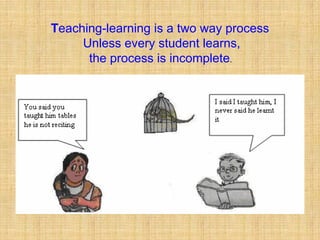
Teaching-learning is a two way process
     Unless every student learns,
      the process is incomplete.
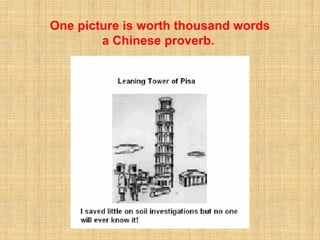
One picture is worth thousand words
        a Chinese proverb.
MAIN LEARNING STYLES


        Visual

       Auditory

      Kinesthetic
Visual Learners

Visual learners relate most effectively to

written information, notes, diagrams and
pictures.

Visual learners make up around 65% of the
population.

 You will find such learners sitting on first
              5 to 6 benches
Auditory Learners

Auditory learners relate most effectively

to the spoken word.

Auditory learners make up about

30% of the population.

 You will find such learners sitting on Middle
                 three benches
Kinesthetic Learners


Kinesthetic Learners learn effectively
through touch and movement and space,
and learn skills by imitation and practice
Kinesthetic learners make up around
5% of the population.

       You will find such learners sitting on
                   Last benches
Senses of Perception

Use all the senses to code information or
dress up an image.
Ask the students to use all senses
of perceptions to learn new things,

  Plasticity of fine grained soils

     Knead and roll a wet soil mass
     Use clay and fly-ash samples
Innovative Questions

Use humor, Funny or peculiar things


Name the curve which is plotted as a
straight line!

Flow curve
Enigmatic questions

Enigmatic questions are very difficult to forget!

What is common / uncommon between
Foot & Footing?

Both transfer loads to earth but
one is above and
other is below the ground
Rude Rhymes
Rude rhymes are very difficult to forget.


          A for Atterberg,
          B for Boussinesq,
          C for Coulomb and
          D for Darcy
Models
Bringing three dimensions & movement to an image
makes it more vivid.

Show models in the class room itself.

Arrange model competitions with subjects such as
• Plate/pile load test,
• Dewatering techniques,
• Construction with Geosynthetics etc.
Positive, Pleasant Images.
The brain often blocks out unpleasant ones.
Vivid, colorful images are easier to remember
than drab ones.
Use well drawn colored charts.. Use cartoons
Exaggeration

Exaggerate the size of important parts of
              the image


     Use Appropriate Symbols
Three Dimensions and Movement


Three dimensions and movement

to an image makes it more vivid.
Mnemonics of Ancient India

 Vedic literature (Veda, Puranas & Upnishadas)
 could be preserved as it is in poetic form with
 strict grammatical rules.

Things were named to indicate its quality
Copper Sulphate - Mayurgriva- Green as neck of a
peacock

  Each of Digits 0 to 9 has hundreds of alternate
  names 1- Sun, Moon, 2 Hands, eyes etc
CONCLUSION


Mnemonics is a very useful tool
  for educators and students
For any suggestions


         Contact
Dr.A.S.Nene
M4 Laxmi Nagar,
Nagpur (India) 440022
Email: nene_ashok@yahoo.com
Mnemonics for geotechnical engineering

Mnemonics for geotechnical engineering

  • 1.
    (Pronounced "ne-mon'-ics") The artof assisting the memory, by using a system of artificial aids
  • 2.
    USE OF MNEMONICSFOR EFFECTIVE TEACHING A.S.Nene & V.S.Landge
  • 3.
    Artificial aids • Rhymes, •Rules, • Phrases • Diagrams, • Acronyms • Other devices
  • 4.
    From childhood toold age one uses this technique knowingly or unknowingly. Government also uses this technique
  • 5.
    Abstract concepts, principlesand ideas. Hard for students to comprehend.
  • 6.
    Remove a misconceptionthat Geotechnical engineering subjects are descriptive and less scoring
  • 7.
    Teaching-learning is atwo way process Unless every student learns, the process is incomplete.
  • 8.
    One picture isworth thousand words a Chinese proverb.
  • 9.
    MAIN LEARNING STYLES Visual Auditory Kinesthetic
  • 10.
    Visual Learners Visual learnersrelate most effectively to written information, notes, diagrams and pictures. Visual learners make up around 65% of the population. You will find such learners sitting on first 5 to 6 benches
  • 11.
    Auditory Learners Auditory learnersrelate most effectively to the spoken word. Auditory learners make up about 30% of the population. You will find such learners sitting on Middle three benches
  • 12.
    Kinesthetic Learners Kinesthetic Learnerslearn effectively through touch and movement and space, and learn skills by imitation and practice Kinesthetic learners make up around 5% of the population. You will find such learners sitting on Last benches
  • 13.
    Senses of Perception Useall the senses to code information or dress up an image. Ask the students to use all senses of perceptions to learn new things, Plasticity of fine grained soils Knead and roll a wet soil mass Use clay and fly-ash samples
  • 14.
    Innovative Questions Use humor,Funny or peculiar things Name the curve which is plotted as a straight line! Flow curve
  • 15.
    Enigmatic questions Enigmatic questionsare very difficult to forget! What is common / uncommon between Foot & Footing? Both transfer loads to earth but one is above and other is below the ground
  • 16.
    Rude Rhymes Rude rhymesare very difficult to forget. A for Atterberg, B for Boussinesq, C for Coulomb and D for Darcy
  • 17.
    Models Bringing three dimensions& movement to an image makes it more vivid. Show models in the class room itself. Arrange model competitions with subjects such as • Plate/pile load test, • Dewatering techniques, • Construction with Geosynthetics etc.
  • 18.
    Positive, Pleasant Images. Thebrain often blocks out unpleasant ones. Vivid, colorful images are easier to remember than drab ones. Use well drawn colored charts.. Use cartoons
  • 19.
    Exaggeration Exaggerate the sizeof important parts of the image Use Appropriate Symbols
  • 20.
    Three Dimensions andMovement Three dimensions and movement to an image makes it more vivid.
  • 21.
    Mnemonics of AncientIndia Vedic literature (Veda, Puranas & Upnishadas) could be preserved as it is in poetic form with strict grammatical rules. Things were named to indicate its quality Copper Sulphate - Mayurgriva- Green as neck of a peacock Each of Digits 0 to 9 has hundreds of alternate names 1- Sun, Moon, 2 Hands, eyes etc
  • 22.
    CONCLUSION Mnemonics is avery useful tool for educators and students
  • 23.
    For any suggestions Contact Dr.A.S.Nene M4 Laxmi Nagar, Nagpur (India) 440022 Email: nene_ashok@yahoo.com