A.S.Nene


Professor of Civil Engineering (Retd)
        VNIT Nagpur, India
Introduction - Shilpashashtra


 Engineering sciences were very advanced in India in
 ancient period (5000 BC to 1500 AD).
 More than thousand texts can be mentioned on the
 various engineering sciences
 Many references are available in ancient Indian
literature (Vedas, Puranas, and Shilpa-Samhitas etc).
Most of the practices mentioned in these references
are scientific and relevant to modern engineering.
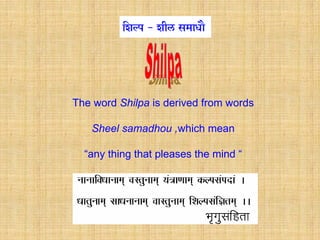
The word Shilpa is derived from words

   Sheel samadhou ,which mean

  “any thing that pleases the mind “
Terms and terminology


. Shilpashashtra - Science which deals with
creation of a Shilpa.

. Shilpa Samhita –Compilation (of rules and
  procedures) related to Shilpashastra.

 Sthapati – One who has complete knowledge of
 Shilpa Samhita (An engineer or architect).
Extent of Shilpa


                                             3 Parts- (Khanda)


                 A                              B                                C
          Dhatu -Materials             Sadhana - Transport                 Vastu -Habitat            10. Yantra
                                                                                                     Machines


     1.Krushi                 4.Rath         5.Nau           6.Agniyan                7.Veshma
Biological Sciences          Surface         Water           Air / space               Housing


      2.Jala                                                                          8.Prakar
 Water Resources                                                                    Forts/ Castles


      3.Khani                                                                     9.Nagar Rachana
Mining & Metallurgy                                                                Town Planning
Vidya- Vidya means a particular technique. One must
 have both theoretical and practical knowledge of that
 subject.
 Kala - Kala means an art which can be acquired by practice
and observation. Even a handicapped person can be expert
in a particular art without any theoretical knowledge.


     There are 32 Vidyas and 64 Kalas related to
                  Shilpashashtra.
Relevant Vidya & Kalas

     Vidya                     Kalas
8.Bhasmikaran 27. Estikadibhajan- Making of
(Incineration) bricks, roof tiles etc
               48. Mrudsadhan- Collection of
               soils for a specific purpose
               53. Mrudkarm- Soil conditioning
GROUND IMPROVEMENT


As a leather is stretched by driving nails, the ground was
stabilized (by Gods) with gravels and boulders.
Shatapatha Brahman, Chapter 21
“The marshy land was stabilized by gods using sands”
                 Kapisamhita, 6.7
If ground is waterlogged, then the water should be
drained out by digging drains parallel to north-east and
refilling the trenches by brickbats and stones so that
excess water drains out.
SOIL STABILIZATION

          Functions of soil plasticizers

• Increase the workability with minimum water
   content

• Increase the water repellent property

• Increase the strength by increasing the
   density.

• Impart glazing to pottery products.
Ancient plasticizers can be grouped as


Extracts of Herbs, Fruits and tree barks
 Trifala- Aamla, Hirda and Behada1
 Wood apple2, Holy tree fruit3
 Barks- Khadir4, Arjun trees
Natural fibers


Cotton, coir, wool, silk   cotton1   , jute2
Natural polymers


Cow Dung, Jaggaery, Coconut water,
Eggs, Green Algae, burnt coconut shell
Brick making


Bricks of Lothal -1500 BC   Village Sirpur (chhattisgarh)
                            5th century AD.
Foundry soils for metal casting
 The Dhokra Technique of the tribal artists of Bastar


         1. The first layer, the closest to the wax sculpture,
            is the river bed soil, water and coal powder applied
             with brush.

         2. A paste of red soil with rice husk is applied to first dry
            solidified layer This is applied with hands.

          3.A final coating of rice husk, sand and clay
            is applied to the entire surface of the piece.


 .
Idols - Mud plaster

This constancy is determined by rolling
the clay mass on the palms. When the lines
of palm are clearly impressed on the clay
mass the constancy is proper.


Liquidity index for this consistency (Palm line limit)
corresponds to 15 to 20 %
CASE STUDIES
 A. Gadhi soils –white soil
          The main constituents
          are local soil, fine sand,
          cow dung, quick lime,
          extracts of Belphal ,
          fibers of jute and water
          for mixing.

          The mixture is allowed to
          mature for a minimum
          period of 30 days and
          kneaded everyday.
2. Mud flooring.
          The floors of
          Padmanabhapurum palace
          (1601 A.D) in Kerala were
          made of a material that is
          unique blend of burnt
          coconut shells, quick lime,
          palm toddy, the whites of
          eggs and extracts of
          certain barks of trees and
          nuts.
Reasons for loss of ancient technical literature


   Natural - Limited life of the writing materials,
   Language – Most of the texts were in Sanskrit.
   Secrecy – The knowledge was encrypted
   Foreign aggression
   Improper interpretation
   Neglect by modern engineers
   Religion –misconception
   Irrelevance
   Absence of technical data
CONCLUSIONS

1. Ancient Indian engineers and artisans had deep
   knowledge about ground improvement and
   stabilization techniques.

2. Many of the ancient Indian techniques may not
   be relevant as modern methods and materials
   are more cost effective. But one must appreciate
   the ancient Indian knowledge which was
   centauries ahead of that available in rest of the
   world.

3. There is a need to preserve this treasure of
   ancient Indian traditions.
This paper is based on references from
the vast collection of rare literature on
Shilpasamhita, compiled by Late Shri
G.G.Joshi, Nagpur
Ground improvement  2011

Ground improvement 2011

  • 1.
    A.S.Nene Professor of CivilEngineering (Retd) VNIT Nagpur, India
  • 2.
    Introduction - Shilpashashtra Engineering sciences were very advanced in India in ancient period (5000 BC to 1500 AD). More than thousand texts can be mentioned on the various engineering sciences Many references are available in ancient Indian literature (Vedas, Puranas, and Shilpa-Samhitas etc). Most of the practices mentioned in these references are scientific and relevant to modern engineering.
  • 3.
    The word Shilpais derived from words Sheel samadhou ,which mean “any thing that pleases the mind “
  • 4.
    Terms and terminology .Shilpashashtra - Science which deals with creation of a Shilpa. . Shilpa Samhita –Compilation (of rules and procedures) related to Shilpashastra. Sthapati – One who has complete knowledge of Shilpa Samhita (An engineer or architect).
  • 5.
    Extent of Shilpa 3 Parts- (Khanda) A B C Dhatu -Materials Sadhana - Transport Vastu -Habitat 10. Yantra Machines 1.Krushi 4.Rath 5.Nau 6.Agniyan 7.Veshma Biological Sciences Surface Water Air / space Housing 2.Jala 8.Prakar Water Resources Forts/ Castles 3.Khani 9.Nagar Rachana Mining & Metallurgy Town Planning
  • 6.
    Vidya- Vidya meansa particular technique. One must have both theoretical and practical knowledge of that subject. Kala - Kala means an art which can be acquired by practice and observation. Even a handicapped person can be expert in a particular art without any theoretical knowledge. There are 32 Vidyas and 64 Kalas related to Shilpashashtra.
  • 7.
    Relevant Vidya &Kalas Vidya Kalas 8.Bhasmikaran 27. Estikadibhajan- Making of (Incineration) bricks, roof tiles etc 48. Mrudsadhan- Collection of soils for a specific purpose 53. Mrudkarm- Soil conditioning
  • 8.
    GROUND IMPROVEMENT As aleather is stretched by driving nails, the ground was stabilized (by Gods) with gravels and boulders. Shatapatha Brahman, Chapter 21
  • 9.
    “The marshy landwas stabilized by gods using sands” Kapisamhita, 6.7
  • 10.
    If ground iswaterlogged, then the water should be drained out by digging drains parallel to north-east and refilling the trenches by brickbats and stones so that excess water drains out.
  • 11.
    SOIL STABILIZATION Functions of soil plasticizers • Increase the workability with minimum water content • Increase the water repellent property • Increase the strength by increasing the density. • Impart glazing to pottery products.
  • 12.
    Ancient plasticizers canbe grouped as Extracts of Herbs, Fruits and tree barks Trifala- Aamla, Hirda and Behada1 Wood apple2, Holy tree fruit3 Barks- Khadir4, Arjun trees
  • 13.
    Natural fibers Cotton, coir,wool, silk cotton1 , jute2
  • 14.
    Natural polymers Cow Dung,Jaggaery, Coconut water, Eggs, Green Algae, burnt coconut shell
  • 15.
    Brick making Bricks ofLothal -1500 BC Village Sirpur (chhattisgarh) 5th century AD.
  • 16.
    Foundry soils formetal casting The Dhokra Technique of the tribal artists of Bastar 1. The first layer, the closest to the wax sculpture, is the river bed soil, water and coal powder applied with brush. 2. A paste of red soil with rice husk is applied to first dry solidified layer This is applied with hands. 3.A final coating of rice husk, sand and clay is applied to the entire surface of the piece. .
  • 17.
    Idols - Mudplaster This constancy is determined by rolling the clay mass on the palms. When the lines of palm are clearly impressed on the clay mass the constancy is proper. Liquidity index for this consistency (Palm line limit) corresponds to 15 to 20 %
  • 18.
    CASE STUDIES A.Gadhi soils –white soil The main constituents are local soil, fine sand, cow dung, quick lime, extracts of Belphal , fibers of jute and water for mixing. The mixture is allowed to mature for a minimum period of 30 days and kneaded everyday.
  • 19.
    2. Mud flooring. The floors of Padmanabhapurum palace (1601 A.D) in Kerala were made of a material that is unique blend of burnt coconut shells, quick lime, palm toddy, the whites of eggs and extracts of certain barks of trees and nuts.
  • 20.
    Reasons for lossof ancient technical literature Natural - Limited life of the writing materials, Language – Most of the texts were in Sanskrit. Secrecy – The knowledge was encrypted Foreign aggression Improper interpretation Neglect by modern engineers Religion –misconception Irrelevance Absence of technical data
  • 21.
    CONCLUSIONS 1. Ancient Indianengineers and artisans had deep knowledge about ground improvement and stabilization techniques. 2. Many of the ancient Indian techniques may not be relevant as modern methods and materials are more cost effective. But one must appreciate the ancient Indian knowledge which was centauries ahead of that available in rest of the world. 3. There is a need to preserve this treasure of ancient Indian traditions.
  • 22.
    This paper isbased on references from the vast collection of rare literature on Shilpasamhita, compiled by Late Shri G.G.Joshi, Nagpur