Van Thuy Hoang
Network Science Lab
Dept. of Artificial Intelligence
The Catholic University of Korea
E-mail: hoangvanthuy90@gmail.com
2023-12-04
Liu et.al., ESWC 2019
2
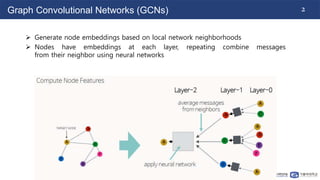
Graph Convolutional Networks (GCNs)
 Generate node embeddings based on local network neighborhoods
 Nodes have embeddings at each layer, repeating combine messages
from their neighbor using neural networks
3
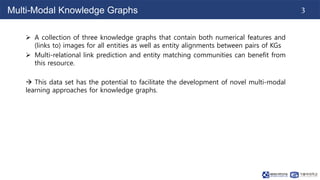
Multi-Modal Knowledge Graphs
 A collection of three knowledge graphs that contain both numerical features and
(links to) images for all entities as well as entity alignments between pairs of KGs
 Multi-relational link prediction and entity matching communities can benefit from
this resource.
 This data set has the potential to facilitate the development of novel multi-modal
learning approaches for knowledge graphs.
4
The contributions
 The creation of two knowledge graphs DBPEDIA15K and YAGO15K, that are the
DBPEDIA and YAGO
 All three KGs are enriched with numeric literals and image information
 Validate our hypothesis that knowledge graph completion related problems can
benefit from multi-modal data:
 Completion in queries such as (head?, sameAs, tail) and (head, sameAs, tail?),
where head and tail are entities, each one from a different KG.
 Analyze the performance of the different modalities in isolation for different
percentages of known aligned entities between KGs, as well as for different
combinations of feature types.
5
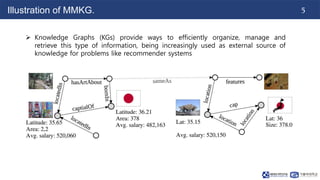
Illustration of MMKG.
 Knowledge Graphs (KGs) provide ways to efficiently organize, manage and
retrieve this type of information, being increasingly used as external source of
knowledge for problems like recommender systems
6
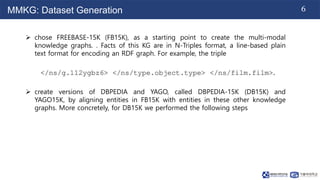
MMKG: Dataset Generation
 chose FREEBASE-15K (FB15K), as a starting point to create the multi-modal
knowledge graphs. . Facts of this KG are in N-Triples format, a line-based plain
text format for encoding an RDF graph. For example, the triple
 create versions of DBPEDIA and YAGO, called DBPEDIA-15K (DB15K) and
YAGO15K, by aligning entities in FB15K with entities in these other knowledge
graphs. More concretely, for DB15K we performed the following steps
7
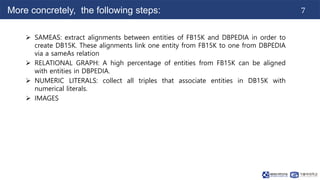
More concretely, the following steps:
 SAMEAS: extract alignments between entities of FB15K and DBPEDIA in order to
create DB15K. These alignments link one entity from FB15K to one from DBPEDIA
via a sameAs relation
 RELATIONAL GRAPH: A high percentage of entities from FB15K can be aligned
with entities in DBPEDIA.
 NUMERIC LITERALS: collect all triples that associate entities in DB15K with
numerical literals.
 IMAGES
8
Common relationships
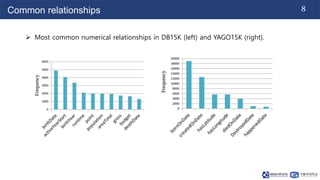
 Most common numerical relationships in DB15K (left) and YAGO15K (right).
9
methods
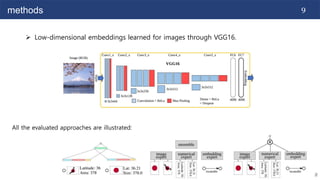
 Low-dimensional embeddings learned for images through VGG16.
All the evaluated approaches are illustrated:
10
methods
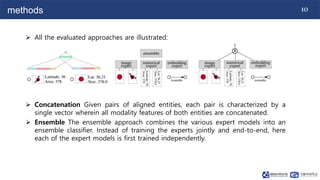
 All the evaluated approaches are illustrated:
 Concatenation Given pairs of aligned entities, each pair is characterized by a
single vector wherein all modality features of both entities are concatenated.
 Ensemble The ensemble approach combines the various expert models into an
ensemble classifier. Instead of training the experts jointly and end-to-end, here
each of the expert models is first trained independently.
11
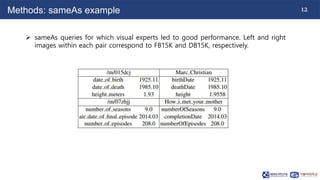
Methods: sameAs example
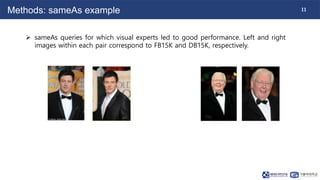
 sameAs queries for which visual experts led to good performance. Left and right
images within each pair correspond to FB15K and DB15K, respectively.
12
Methods: sameAs example
 sameAs queries for which visual experts led to good performance. Left and right
images within each pair correspond to FB15K and DB15K, respectively.
13
Experiments
 Evaluate the impact of the different modalities in scenarios wherein the number
of given alignments P [%] between two KGs is low, medium and high.
 sameAs queries for which numerical experts led to good performance.
14
Conclusion
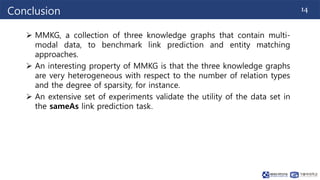
 MMKG, a collection of three knowledge graphs that contain multi-
modal data, to benchmark link prediction and entity matching
approaches.
 An interesting property of MMKG is that the three knowledge graphs
are very heterogeneous with respect to the number of relation types
and the degree of sparsity, for instance.
 An extensive set of experiments validate the utility of the data set in
the sameAs link prediction task.
MMKG: Multi-Modal Knowledge Graphs dddddd

MMKG: Multi-Modal Knowledge Graphs dddddd

  • 1.
    Van Thuy Hoang NetworkScience Lab Dept. of Artificial Intelligence The Catholic University of Korea E-mail: hoangvanthuy90@gmail.com 2023-12-04 Liu et.al., ESWC 2019
  • 2.
    2 Graph Convolutional Networks(GCNs)  Generate node embeddings based on local network neighborhoods  Nodes have embeddings at each layer, repeating combine messages from their neighbor using neural networks
  • 3.
    3 Multi-Modal Knowledge Graphs A collection of three knowledge graphs that contain both numerical features and (links to) images for all entities as well as entity alignments between pairs of KGs  Multi-relational link prediction and entity matching communities can benefit from this resource.  This data set has the potential to facilitate the development of novel multi-modal learning approaches for knowledge graphs.
  • 4.
    4 The contributions  Thecreation of two knowledge graphs DBPEDIA15K and YAGO15K, that are the DBPEDIA and YAGO  All three KGs are enriched with numeric literals and image information  Validate our hypothesis that knowledge graph completion related problems can benefit from multi-modal data:  Completion in queries such as (head?, sameAs, tail) and (head, sameAs, tail?), where head and tail are entities, each one from a different KG.  Analyze the performance of the different modalities in isolation for different percentages of known aligned entities between KGs, as well as for different combinations of feature types.
  • 5.
    5 Illustration of MMKG. Knowledge Graphs (KGs) provide ways to efficiently organize, manage and retrieve this type of information, being increasingly used as external source of knowledge for problems like recommender systems
  • 6.
    6 MMKG: Dataset Generation chose FREEBASE-15K (FB15K), as a starting point to create the multi-modal knowledge graphs. . Facts of this KG are in N-Triples format, a line-based plain text format for encoding an RDF graph. For example, the triple  create versions of DBPEDIA and YAGO, called DBPEDIA-15K (DB15K) and YAGO15K, by aligning entities in FB15K with entities in these other knowledge graphs. More concretely, for DB15K we performed the following steps
  • 7.
    7 More concretely, thefollowing steps:  SAMEAS: extract alignments between entities of FB15K and DBPEDIA in order to create DB15K. These alignments link one entity from FB15K to one from DBPEDIA via a sameAs relation  RELATIONAL GRAPH: A high percentage of entities from FB15K can be aligned with entities in DBPEDIA.  NUMERIC LITERALS: collect all triples that associate entities in DB15K with numerical literals.  IMAGES
  • 8.
    8 Common relationships  Mostcommon numerical relationships in DB15K (left) and YAGO15K (right).
  • 9.
    9 methods  Low-dimensional embeddingslearned for images through VGG16. All the evaluated approaches are illustrated:
  • 10.
    10 methods  All theevaluated approaches are illustrated:  Concatenation Given pairs of aligned entities, each pair is characterized by a single vector wherein all modality features of both entities are concatenated.  Ensemble The ensemble approach combines the various expert models into an ensemble classifier. Instead of training the experts jointly and end-to-end, here each of the expert models is first trained independently.
  • 11.
    11 Methods: sameAs example sameAs queries for which visual experts led to good performance. Left and right images within each pair correspond to FB15K and DB15K, respectively.
  • 12.
    12 Methods: sameAs example sameAs queries for which visual experts led to good performance. Left and right images within each pair correspond to FB15K and DB15K, respectively.
  • 13.
    13 Experiments  Evaluate theimpact of the different modalities in scenarios wherein the number of given alignments P [%] between two KGs is low, medium and high.  sameAs queries for which numerical experts led to good performance.
  • 14.
    14 Conclusion  MMKG, acollection of three knowledge graphs that contain multi- modal data, to benchmark link prediction and entity matching approaches.  An interesting property of MMKG is that the three knowledge graphs are very heterogeneous with respect to the number of relation types and the degree of sparsity, for instance.  An extensive set of experiments validate the utility of the data set in the sameAs link prediction task.