0
MIXED REALITY
HEADSET
A novel concept of mixed reality headset
Pedro Cuadra, Meghdoot Gardi, Hari Kumar
Venkatesh, Gaurav Kulkarni, Rohith Raju,
Monika Jurgutyte, Jishnu Jayaram
Winter School on “Entrepreneurship – Concept & Pitch” 14-18 November 2016,
Fachhochschule Dortmund
1. Product and customer value proposition
What is the product / service?
Product Description
The current market for VR is dominated by devices which focusses mainly on entertainment,
gaming and connectivity, which are, in fact mere 3D extensions of the application of what
smartphones can already do today. Here our product, which absorbs the positives of the design
and progress in the VR industry aims to serve a niche market where organizations need to
seamlessly conduct meetings over long distances. We all know how information is wrongly
understood when we only speak over the phone even to people who share the same language
and culture as ours. This situation gets to worsen more when we deal with people talking about
more specific and technical topics during meeting which often happen between people across
continents. This is where our “Lord Brain” comes to the rescue. Our product is an affordable
and a path breaking device for effective conferencing. This product of ours could be of great
help to markets such as large MNCs, the Mittelstand companies importing state-of-the-art
technologies, and even universities for smarter collaborations over the internet. These
facilities along with a very flexible tariff plan makes our product a must have for effective
and productive conferencing.
A virtual reality headset that is light, portable and no wires attached. Think Google Glass?
That was a failure due to the costs involved. Think Oculus Rift? That is expensive, huge and
has wires attached to expensive equipments. A product that overcomes the above
disadvantages: LORD BRAIN (Light Optical Reality Device for the BRAIN). The device
allows the user to experience mixed reality using the VR headset. The content is broadcasted
using a T- REX. A 3D view of objects help the user visualize better than 2D images and the
augmented reality feature allows users to see critical information of products around them.
The main advantage of our product is that it will be wireless VR HeadSets, which will help
us to provide the product to more companies as this will be easily portable and easier to use.
In the first table you can see the growth of wireless headset sales in the market from 2015 to
2025.
Table 1. Forecast of virtual reality wired and wireless sales.
What value for the customer does the product provide?
The customer is able to visualise the objects better in a 3D view, without the hassles of storage issues
and speed. Multiple users can be connected at the same time in the same room and they can view the
3D object.
1. Market situation and relevance
What is the customer situation today, how does the product / service help?
Virtual reality, augmented reality and mixed reality is seen as a 4th degree - capital platform wave.
Considering that previous three waves had an even unexpected success in the market, the 4th wave
is likely to be a similar success.
Picture 1. Digi-Capital Platform Waves
In the first picture we can see the relevance of VR, AR and MR nowadays. The biggest necessities
that it suggests are - more effective way to use your time and in some ways expenses as well. You
might not need to spend a lot of time in making many different prototypes (this applies for
architecture field) or you will not need to make a lot of input into going somewhere for a business
meeting (MR business meeting model).
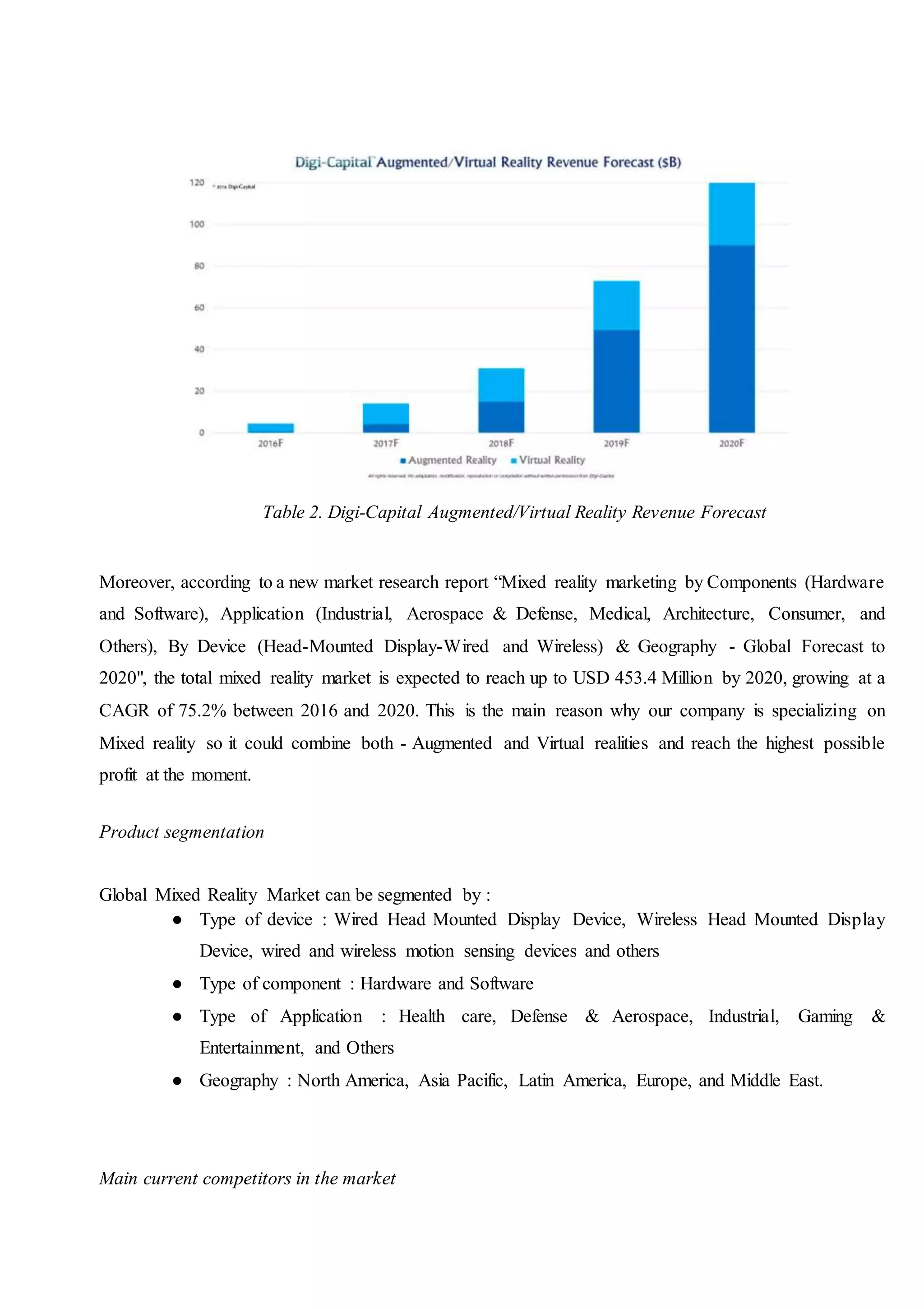
In second table you can see the market opportunities to grow by the revenue from Augmented and
Virtual realities. By the picture we can assume that Augmented reality has much higher potential to
grow in the upcoming 4 years than the Virtual reality.
Table 2. Digi-Capital Augmented/Virtual Reality Revenue Forecast
Moreover, according to a new market research report “Mixed reality marketing by Components (Hardware
and Software), Application (Industrial, Aerospace & Defense, Medical, Architecture, Consumer, and
Others), By Device (Head-Mounted Display-Wired and Wireless) & Geography - Global Forecast to
2020", the total mixed reality market is expected to reach up to USD 453.4 Million by 2020, growing at a
CAGR of 75.2% between 2016 and 2020. This is the main reason why our company is specializing on
Mixed reality so it could combine both - Augmented and Virtual realities and reach the highest possible
profit at the moment.
Product segmentation
Global Mixed Reality Market can be segmented by :
● Type of device : Wired Head Mounted Display Device, Wireless Head Mounted Display
Device, wired and wireless motion sensing devices and others
● Type of component : Hardware and Software
● Type of Application : Health care, Defense & Aerospace, Industrial, Gaming &
Entertainment, and Others
● Geography : North America, Asia Pacific, Latin America, Europe, and Middle East.
Main current competitors in the market
We should also consider key trends that will impact the industry and key profiles of leading suppliers of
Global Mixed reality Market. Some of the top competing companies are Microsoft Inc., Magic Leap Inc.,
Eon Reality, Canon Technology, Atheer Inc., Meta Company, Daqri Llc., Infinity AR and Seiko Epson
Corporation. They are all global players who have really strong impact into all VR, AR and MR industry.
High level technical design
High level technology architecture of product
Systemdesignoverview
Picture 2. Deployment diagram
Component Diagram
ProcessDiagram
Picture 3. Process diagram
Overview target markets and customersegments
Target markets
Our target market is developed countries all over the world due to infrastructure requirements
(dark blue color in the 2nd picture). Setting up the EDGE server in the locality requires
considerable infrastructure needs and due to the comparatively high price of the entire setup.
Further versions of the product may be cheaper and affordable for the Developing countries
as well.
Picture 2. Map of developed countries in the world.
Customer segments
Our customer segmentation is based on B2B model, where all our customer segments are
business companies. We are basing the sale of our product on Pareto principle, which means
that 20% of customers will guarantee us 80% of the profit. This 20% of customers are big
multi-national companies for whom virtual conference might seem as time and cost saving
solution. This includes - education institutions, architecture companies and all business
organizations in general. In the future it might also include Armies, Police Departments and
Health Care organizations. So our concentration is on big companies, who might see VR usage
on contract as a more beneficial solution for them and the rest of 80% of companies, who will
give us approximately 20% of incomes, will just simply buy our VR and T-REX installations.
Business model and pricing
• Market & revenue estimation, cost estimation & business model
Main idea of our business model is to make two types of sales - by contract and by purchase.
Contract means that company pays monthly fee for our product usage, which includes 5 VR
sets, 1 T-REX and 300 hours of information streaming from Vodafone. In the future we might
make different contracts, which might include more or less components by the need of every
single company. The second option is to buy VR and T- REX and then it is property of the
customer. Then the customer company is just supposed to pay 0,85$ per hour of information
streaming from the EDGE Server for Vodafone.
CONTRACT
(per month)
SALE
Vodafone 300 free hours included into
package. Every extra hour
costs 0,58$
0,85$/hours (from the first
hour of information stream)
VR 5 VR sets included, every
extra set costs 30$/month
1 VR - 150 $
T- REX 1 T- REX is included, every
extra T- REX is 100$/month
1 T- REX - 950 $
Price per month / support 300$/month + 0,58$/hours for
every extra hour (after 300
hours) of information
streaming must be paid to
2 years of support included
Vodafone.
● Product costings:
The product cost is divided into three segments:
1. VR device cost: The estimated cost of a VR device is 95€. As the users will
need many VR devices depending upon no. of participants, we have kept the
cost of VR device as low as possible.
2. T-REX cost: One TRex device will be required per customer. The projected
cost of a TRex device is 430€.
3. EDGE Server cost: EDGE server cost will change as per the usage. The typical
cost of edge server usage is 0.58 to 0.85 euros per hour.
❖ Total cost:
The estimated total cost of hardware is 525€ + variable cost as per usage of
edge server.
Picture 2. Cost Breakdown analysis (all prices are in €)
Capital Investment
We are launching a completely new product, we must need a relatively highinitial
capital investments.(shown as 1.5M$). Especially because of the research, development
and deployment of the new technology. As our product settles down in the market,
Capital requirement will be declined.
Revenue Estimation
Returnof Investment
Especially, we are considering our Investment returns after the 1.5 to 2 years of
launching the VR and TR both. As the Wireless Technology deployed in our product
more well-known, we are expecting to have a high profit margin(specifically after 4 to
5 years). On the same lines, we are expecting to have more reliability and robustness as
time progresses.
Project management
Organization
In the following diagram the organizational breakdown of the company is shown.
Picture x. Organization Breakdown Structure
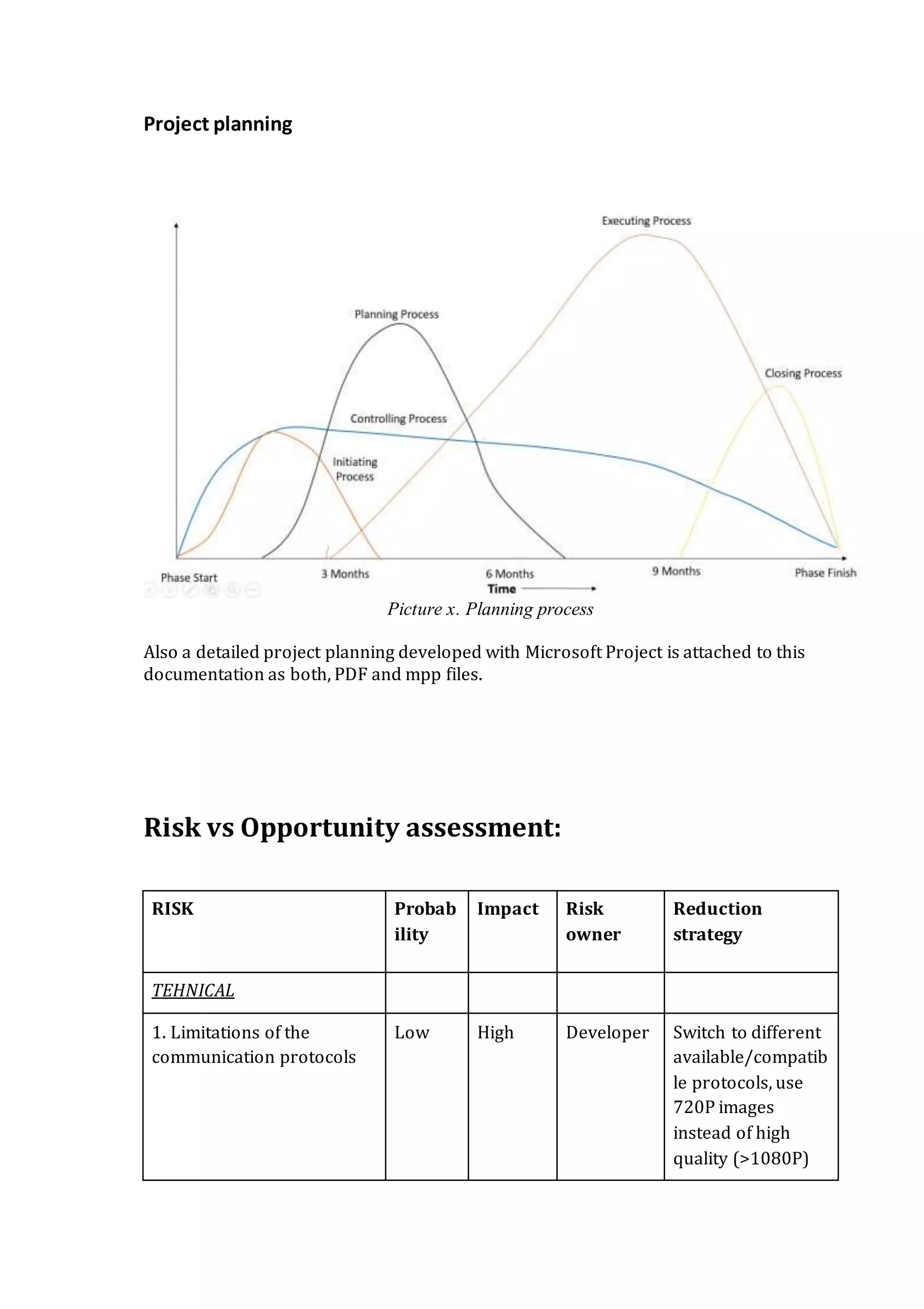
Project planning
Picture x. Planning process
Also a detailed project planning developed with Microsoft Project is attached to this
documentation as both, PDF and mpp files.
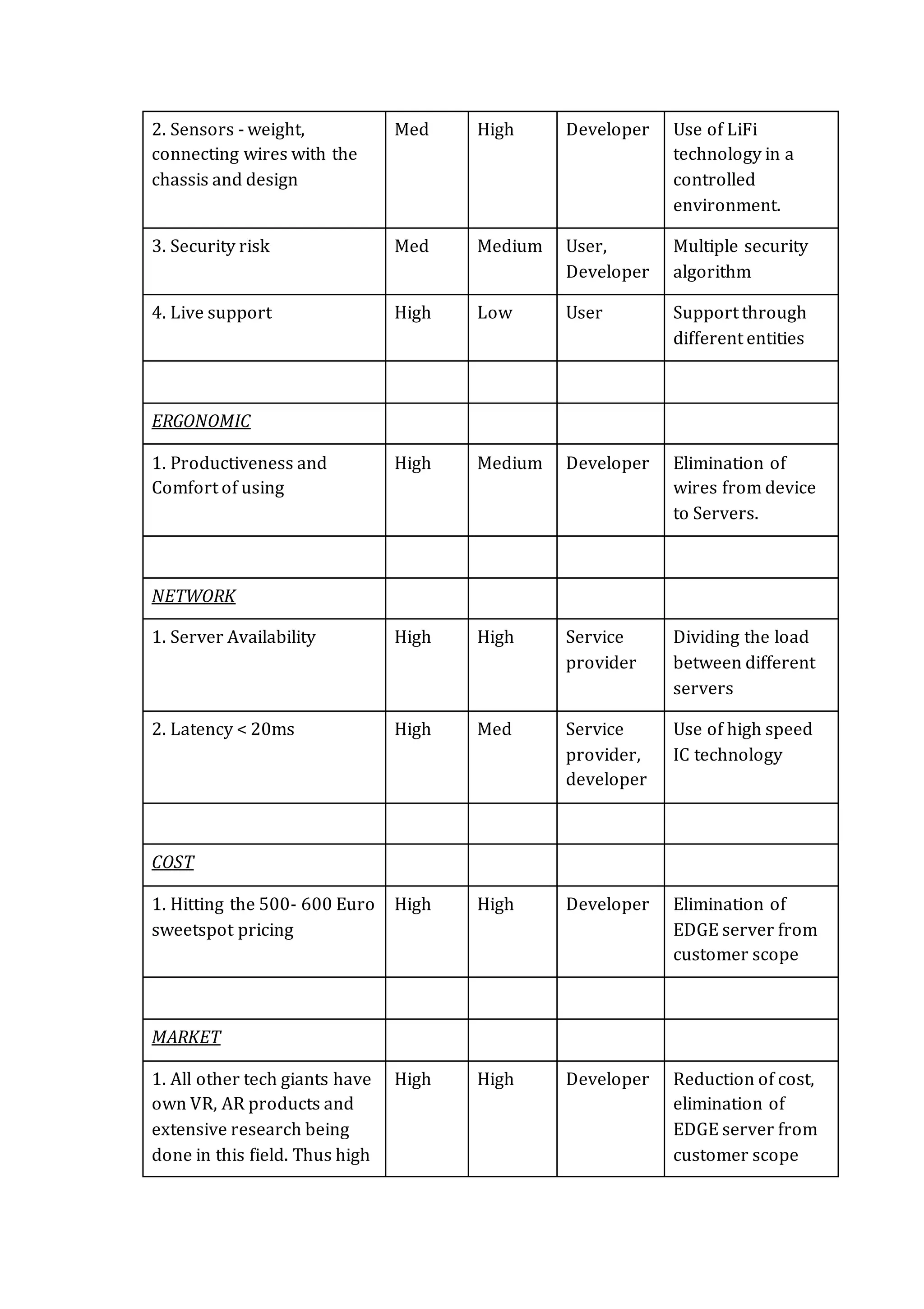
Risk vs Opportunity assessment:
RISK Probab
ility
Impact Risk
owner
Reduction
strategy
TEHNICAL
1. Limitations of the
communication protocols
Low High Developer Switch to different
available/compatib
le protocols, use
720P images
instead of high
quality (>1080P)
2. Sensors - weight,
connecting wires with the
chassis and design
Med High Developer Use of LiFi
technology in a
controlled
environment.
3. Security risk Med Medium User,
Developer
Multiple security
algorithm
4. Live support High Low User Support through
different entities
ERGONOMIC
1. Productiveness and
Comfort of using
High Medium Developer Elimination of
wires from device
to Servers.
NETWORK
1. Server Availability High High Service
provider
Dividing the load
between different
servers
2. Latency < 20ms High Med Service
provider,
developer
Use of high speed
IC technology
COST
1. Hitting the 500- 600 Euro
sweetspot pricing
High High Developer Elimination of
EDGE server from
customer scope
MARKET
1. All other tech giants have
own VR, AR products and
extensive research being
done in this field. Thus high
High High Developer Reduction of cost,
elimination of
EDGE server from
customer scope
competition
Picture x. Capital estimation
●
Channels and partnerships
● Dealers & Distributors: Both distributors and dealers actually purchase the
goods they sell—the distributor from us, the dealer from the distributor.
Distributors maintain parts inventories and the dealers provide service
functions to the ultimate consumers ("servicing dealers").
Especially, In case of the Contracts, we are expecting to have a dealer who can
provide the TRX and set of VR devices to our intended market i.e. Universities.
Dealer can provide and keep track of all the proceedings.
● Website & Social Media Advertisements : Website or Social Media
Advertisements are really vital for the promotions of the new product launching
in the market. This will be a part of our marketing strategy, as our product is IT-
product . We are planning to tie-up with the E-commerce sites such as AMAZON
in USA-pacific region market and as Alibaba Express or Flipkart in Asian
market.
● Partnerships: As per our Business plan Partnerships is a voluntary
collaborative agreement between two or more parties in which all participants
agree to work together to achieve a common purpose or undertake a specific
task and to share risks, responsibilities, resources, competencies and benefits.
We are expecting to have a strong tie-up with Telecom giants in the field of the
Edge Computing. Especially, Vodafone or Deutsche Telecom for the provision of
Edge Server.
Advantages comparing to competitors:
1. Cost
2. Security
3. Refresh rate
4. Compatibility
Digital, augmented and mixed reality is the FOURTH wave after PC, Internet and Mobile waves.
By the year of 2020 it is expected to grow by 75,2% and it shows that there is a high chance of growth and
success in this market.
Why do we need virtual reality headsets?
What virtual reality needs to make it feel, well, real at this point is not new helmets, new screens,
and higher resolution. Rather, the medium needs compelling experiences that make a case for why it’s
unique and important. The people who are going to make the first acclaimed works of virtual reality
aren’t Google engineers, but novelists, artists, and designers ready to work in multimedia.
The Google glass was one of the pioneers in the field of virtual reality. The project was not a huge
success due to the costs involved, low frame rate and the not-so-clear use of the product.
Cheaper versions like the Google Cardboard are available. However, it just involves placing the
mobile phone inside a box to provide a virtual reality experience. These versions of VR devices however
relies very much on the computing capabilities of the smartphone used, which we know is very limited.
A product in between these 2, is the need of the hour. A product that is portable, fast, does not
involve too many additional equipment wired to it, and is light enough to wear all the time.
This requires the replacementof conventionalHDMI communication between
the headsetand the computer with a novel, wireless solutionlike Wireless HD and
LiFi (Light Fidelity).
Design Patterns
Manager Design Pattern:
Real-time software generally manages multiple entities of the same type. Here we introduce
the Manager Design Pattern to control multiple entities. The T- REX is the manager when it
communicates with the Virtual Reality Headsets.
Feature Coordination Real-time Design Pattern
Feature design involves defining the sequence of messages that will be exchanged between
tasks. The T- REX is the Feature Coordinator. The main role of the Feature Coordinator is to
ensure that the feature goes to a logical completion. No feature should be left in suspended
animation because of message loss or failure of a single task involved in the message
interactions.
In most cases, the task coordinating the feature will be running a timer to keep track of
progress of the feature. If the timer times out, the coordinator will take appropriate recovery
action to take the feature execution to a logical conclusion, i.e. feature success or failure.
Parallel Coordination
Here, on receipt of the feature initiation trigger, A (T- REX) sends message triggers to B,
C and D tasks (All are VR headsets). B, C and D perform their jobs and reply back to A.
In this case, A may keep one timer for all the message interactions or it may keep different
timers. The main difference of this scheme from the serial coordination scheme is that
there is no dependence of the different phases of the feature on each other, so they can be
initiated at the same time. Like in case of serial coordination, in this scheme also,
intelligent recovery action can be taken if a failure condition is hit because A knows about
the feature progress at all times. In parallel coordination, the delay in feature execution is
minimized due to parallel activation of sub-features. But parallel activation places a higher
resource requirement on the system, as multiple message buffers are acquired at the same
time.
Design Anti Pattern
Technology is changing so rapidly that developers often have trouble keeping up with
current versions of software and finding combinations of product releases that work
together. Given that every commercial product line evolves through new releases, the
situation is becoming more difficult for developers to cope with. Finding compatible
releases of products that successfully interoperate is even harder. Our hardware can become
obsolete in the future but we need to have the compatible software available for the new
hardware. We may also optimize the software but have to keep it compatible with the
existing hardware.
The link to full business canvas model - https://canvanizer.com/canvas/wg3UumzFgiNmI

Mixed reality headset

  • 1.
    0 MIXED REALITY HEADSET A novelconcept of mixed reality headset Pedro Cuadra, Meghdoot Gardi, Hari Kumar Venkatesh, Gaurav Kulkarni, Rohith Raju, Monika Jurgutyte, Jishnu Jayaram Winter School on “Entrepreneurship – Concept & Pitch” 14-18 November 2016, Fachhochschule Dortmund
  • 2.
    1. Product andcustomer value proposition What is the product / service? Product Description The current market for VR is dominated by devices which focusses mainly on entertainment, gaming and connectivity, which are, in fact mere 3D extensions of the application of what smartphones can already do today. Here our product, which absorbs the positives of the design and progress in the VR industry aims to serve a niche market where organizations need to seamlessly conduct meetings over long distances. We all know how information is wrongly understood when we only speak over the phone even to people who share the same language and culture as ours. This situation gets to worsen more when we deal with people talking about more specific and technical topics during meeting which often happen between people across continents. This is where our “Lord Brain” comes to the rescue. Our product is an affordable and a path breaking device for effective conferencing. This product of ours could be of great help to markets such as large MNCs, the Mittelstand companies importing state-of-the-art technologies, and even universities for smarter collaborations over the internet. These facilities along with a very flexible tariff plan makes our product a must have for effective and productive conferencing. A virtual reality headset that is light, portable and no wires attached. Think Google Glass? That was a failure due to the costs involved. Think Oculus Rift? That is expensive, huge and has wires attached to expensive equipments. A product that overcomes the above disadvantages: LORD BRAIN (Light Optical Reality Device for the BRAIN). The device allows the user to experience mixed reality using the VR headset. The content is broadcasted using a T- REX. A 3D view of objects help the user visualize better than 2D images and the augmented reality feature allows users to see critical information of products around them. The main advantage of our product is that it will be wireless VR HeadSets, which will help us to provide the product to more companies as this will be easily portable and easier to use. In the first table you can see the growth of wireless headset sales in the market from 2015 to 2025.
  • 3.
    Table 1. Forecastof virtual reality wired and wireless sales.
  • 4.
    What value forthe customer does the product provide? The customer is able to visualise the objects better in a 3D view, without the hassles of storage issues and speed. Multiple users can be connected at the same time in the same room and they can view the 3D object. 1. Market situation and relevance What is the customer situation today, how does the product / service help? Virtual reality, augmented reality and mixed reality is seen as a 4th degree - capital platform wave. Considering that previous three waves had an even unexpected success in the market, the 4th wave is likely to be a similar success. Picture 1. Digi-Capital Platform Waves In the first picture we can see the relevance of VR, AR and MR nowadays. The biggest necessities that it suggests are - more effective way to use your time and in some ways expenses as well. You might not need to spend a lot of time in making many different prototypes (this applies for architecture field) or you will not need to make a lot of input into going somewhere for a business meeting (MR business meeting model). In second table you can see the market opportunities to grow by the revenue from Augmented and Virtual realities. By the picture we can assume that Augmented reality has much higher potential to grow in the upcoming 4 years than the Virtual reality.
  • 5.
    Table 2. Digi-CapitalAugmented/Virtual Reality Revenue Forecast Moreover, according to a new market research report “Mixed reality marketing by Components (Hardware and Software), Application (Industrial, Aerospace & Defense, Medical, Architecture, Consumer, and Others), By Device (Head-Mounted Display-Wired and Wireless) & Geography - Global Forecast to 2020", the total mixed reality market is expected to reach up to USD 453.4 Million by 2020, growing at a CAGR of 75.2% between 2016 and 2020. This is the main reason why our company is specializing on Mixed reality so it could combine both - Augmented and Virtual realities and reach the highest possible profit at the moment. Product segmentation Global Mixed Reality Market can be segmented by : ● Type of device : Wired Head Mounted Display Device, Wireless Head Mounted Display Device, wired and wireless motion sensing devices and others ● Type of component : Hardware and Software ● Type of Application : Health care, Defense & Aerospace, Industrial, Gaming & Entertainment, and Others ● Geography : North America, Asia Pacific, Latin America, Europe, and Middle East. Main current competitors in the market
  • 6.
    We should alsoconsider key trends that will impact the industry and key profiles of leading suppliers of Global Mixed reality Market. Some of the top competing companies are Microsoft Inc., Magic Leap Inc., Eon Reality, Canon Technology, Atheer Inc., Meta Company, Daqri Llc., Infinity AR and Seiko Epson Corporation. They are all global players who have really strong impact into all VR, AR and MR industry. High level technical design High level technology architecture of product Systemdesignoverview Picture 2. Deployment diagram Component Diagram
  • 7.
    ProcessDiagram Picture 3. Processdiagram Overview target markets and customersegments Target markets Our target market is developed countries all over the world due to infrastructure requirements (dark blue color in the 2nd picture). Setting up the EDGE server in the locality requires considerable infrastructure needs and due to the comparatively high price of the entire setup. Further versions of the product may be cheaper and affordable for the Developing countries as well.
  • 8.
    Picture 2. Mapof developed countries in the world. Customer segments Our customer segmentation is based on B2B model, where all our customer segments are business companies. We are basing the sale of our product on Pareto principle, which means that 20% of customers will guarantee us 80% of the profit. This 20% of customers are big multi-national companies for whom virtual conference might seem as time and cost saving solution. This includes - education institutions, architecture companies and all business organizations in general. In the future it might also include Armies, Police Departments and Health Care organizations. So our concentration is on big companies, who might see VR usage on contract as a more beneficial solution for them and the rest of 80% of companies, who will give us approximately 20% of incomes, will just simply buy our VR and T-REX installations. Business model and pricing • Market & revenue estimation, cost estimation & business model Main idea of our business model is to make two types of sales - by contract and by purchase. Contract means that company pays monthly fee for our product usage, which includes 5 VR sets, 1 T-REX and 300 hours of information streaming from Vodafone. In the future we might make different contracts, which might include more or less components by the need of every single company. The second option is to buy VR and T- REX and then it is property of the customer. Then the customer company is just supposed to pay 0,85$ per hour of information streaming from the EDGE Server for Vodafone. CONTRACT (per month) SALE Vodafone 300 free hours included into package. Every extra hour costs 0,58$ 0,85$/hours (from the first hour of information stream) VR 5 VR sets included, every extra set costs 30$/month 1 VR - 150 $ T- REX 1 T- REX is included, every extra T- REX is 100$/month 1 T- REX - 950 $ Price per month / support 300$/month + 0,58$/hours for every extra hour (after 300 hours) of information streaming must be paid to 2 years of support included
  • 9.
    Vodafone. ● Product costings: Theproduct cost is divided into three segments: 1. VR device cost: The estimated cost of a VR device is 95€. As the users will need many VR devices depending upon no. of participants, we have kept the cost of VR device as low as possible. 2. T-REX cost: One TRex device will be required per customer. The projected cost of a TRex device is 430€. 3. EDGE Server cost: EDGE server cost will change as per the usage. The typical cost of edge server usage is 0.58 to 0.85 euros per hour. ❖ Total cost: The estimated total cost of hardware is 525€ + variable cost as per usage of edge server.
  • 10.
    Picture 2. CostBreakdown analysis (all prices are in €)
  • 11.
    Capital Investment We arelaunching a completely new product, we must need a relatively highinitial capital investments.(shown as 1.5M$). Especially because of the research, development and deployment of the new technology. As our product settles down in the market, Capital requirement will be declined. Revenue Estimation
  • 12.
    Returnof Investment Especially, weare considering our Investment returns after the 1.5 to 2 years of launching the VR and TR both. As the Wireless Technology deployed in our product more well-known, we are expecting to have a high profit margin(specifically after 4 to 5 years). On the same lines, we are expecting to have more reliability and robustness as time progresses. Project management Organization In the following diagram the organizational breakdown of the company is shown. Picture x. Organization Breakdown Structure
  • 13.
    Project planning Picture x.Planning process Also a detailed project planning developed with Microsoft Project is attached to this documentation as both, PDF and mpp files. Risk vs Opportunity assessment: RISK Probab ility Impact Risk owner Reduction strategy TEHNICAL 1. Limitations of the communication protocols Low High Developer Switch to different available/compatib le protocols, use 720P images instead of high quality (>1080P)
  • 14.
    2. Sensors -weight, connecting wires with the chassis and design Med High Developer Use of LiFi technology in a controlled environment. 3. Security risk Med Medium User, Developer Multiple security algorithm 4. Live support High Low User Support through different entities ERGONOMIC 1. Productiveness and Comfort of using High Medium Developer Elimination of wires from device to Servers. NETWORK 1. Server Availability High High Service provider Dividing the load between different servers 2. Latency < 20ms High Med Service provider, developer Use of high speed IC technology COST 1. Hitting the 500- 600 Euro sweetspot pricing High High Developer Elimination of EDGE server from customer scope MARKET 1. All other tech giants have own VR, AR products and extensive research being done in this field. Thus high High High Developer Reduction of cost, elimination of EDGE server from customer scope
  • 15.
    competition Picture x. Capitalestimation ● Channels and partnerships ● Dealers & Distributors: Both distributors and dealers actually purchase the goods they sell—the distributor from us, the dealer from the distributor. Distributors maintain parts inventories and the dealers provide service functions to the ultimate consumers ("servicing dealers"). Especially, In case of the Contracts, we are expecting to have a dealer who can provide the TRX and set of VR devices to our intended market i.e. Universities. Dealer can provide and keep track of all the proceedings. ● Website & Social Media Advertisements : Website or Social Media Advertisements are really vital for the promotions of the new product launching in the market. This will be a part of our marketing strategy, as our product is IT- product . We are planning to tie-up with the E-commerce sites such as AMAZON in USA-pacific region market and as Alibaba Express or Flipkart in Asian market. ● Partnerships: As per our Business plan Partnerships is a voluntary collaborative agreement between two or more parties in which all participants agree to work together to achieve a common purpose or undertake a specific task and to share risks, responsibilities, resources, competencies and benefits. We are expecting to have a strong tie-up with Telecom giants in the field of the Edge Computing. Especially, Vodafone or Deutsche Telecom for the provision of Edge Server. Advantages comparing to competitors: 1. Cost 2. Security 3. Refresh rate 4. Compatibility Digital, augmented and mixed reality is the FOURTH wave after PC, Internet and Mobile waves. By the year of 2020 it is expected to grow by 75,2% and it shows that there is a high chance of growth and success in this market.
  • 16.
    Why do weneed virtual reality headsets? What virtual reality needs to make it feel, well, real at this point is not new helmets, new screens, and higher resolution. Rather, the medium needs compelling experiences that make a case for why it’s unique and important. The people who are going to make the first acclaimed works of virtual reality aren’t Google engineers, but novelists, artists, and designers ready to work in multimedia. The Google glass was one of the pioneers in the field of virtual reality. The project was not a huge success due to the costs involved, low frame rate and the not-so-clear use of the product. Cheaper versions like the Google Cardboard are available. However, it just involves placing the mobile phone inside a box to provide a virtual reality experience. These versions of VR devices however relies very much on the computing capabilities of the smartphone used, which we know is very limited. A product in between these 2, is the need of the hour. A product that is portable, fast, does not involve too many additional equipment wired to it, and is light enough to wear all the time. This requires the replacementof conventionalHDMI communication between the headsetand the computer with a novel, wireless solutionlike Wireless HD and LiFi (Light Fidelity). Design Patterns Manager Design Pattern: Real-time software generally manages multiple entities of the same type. Here we introduce the Manager Design Pattern to control multiple entities. The T- REX is the manager when it communicates with the Virtual Reality Headsets. Feature Coordination Real-time Design Pattern Feature design involves defining the sequence of messages that will be exchanged between tasks. The T- REX is the Feature Coordinator. The main role of the Feature Coordinator is to ensure that the feature goes to a logical completion. No feature should be left in suspended animation because of message loss or failure of a single task involved in the message interactions.
  • 17.
    In most cases,the task coordinating the feature will be running a timer to keep track of progress of the feature. If the timer times out, the coordinator will take appropriate recovery action to take the feature execution to a logical conclusion, i.e. feature success or failure. Parallel Coordination Here, on receipt of the feature initiation trigger, A (T- REX) sends message triggers to B, C and D tasks (All are VR headsets). B, C and D perform their jobs and reply back to A. In this case, A may keep one timer for all the message interactions or it may keep different timers. The main difference of this scheme from the serial coordination scheme is that there is no dependence of the different phases of the feature on each other, so they can be initiated at the same time. Like in case of serial coordination, in this scheme also, intelligent recovery action can be taken if a failure condition is hit because A knows about the feature progress at all times. In parallel coordination, the delay in feature execution is minimized due to parallel activation of sub-features. But parallel activation places a higher resource requirement on the system, as multiple message buffers are acquired at the same time. Design Anti Pattern Technology is changing so rapidly that developers often have trouble keeping up with current versions of software and finding combinations of product releases that work together. Given that every commercial product line evolves through new releases, the situation is becoming more difficult for developers to cope with. Finding compatible releases of products that successfully interoperate is even harder. Our hardware can become obsolete in the future but we need to have the compatible software available for the new
  • 18.
    hardware. We mayalso optimize the software but have to keep it compatible with the existing hardware.
  • 19.
    The link tofull business canvas model - https://canvanizer.com/canvas/wg3UumzFgiNmI