Course Business
! We will have class this coming Monday (Labor
Day)
! Lab materials on Canvas
! Follow-up on fixed effects – experimental vs.
observational variables
! No difference in how we include them in R script
! Difference is just in conclusions we can draw
Week 3.2: Fixed Effect Interactions
! Residuals
! Predicted Values & Residuals
! Using Residuals to Detect Outliers
! Interactions
! In the Model Formula
! Interpretation
! Lab
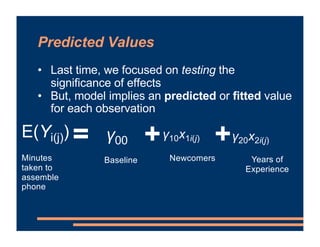
Predicted Values
• Last time, we focused on testing the
significance of effects
• But, model implies an predicted or fitted value
for each observation
=
Minutes
taken to
assemble
phone
Newcomers
+
Years of
Experience
Baseline
γ00
γ10x1i(j) γ20x2i(j)
E(Yi(j)) +
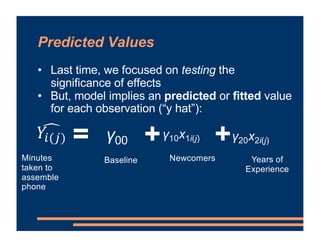
Predicted Values
• Last time, we focused on testing the
significance of effects
• But, model implies an predicted or fitted value
for each observation (“y hat”):
=
Minutes
taken to
assemble
phone
Newcomers
+
Years of
Experience
Baseline
γ00
γ10x1i(j) γ20x2i(j)
!
𝑌#(%) +
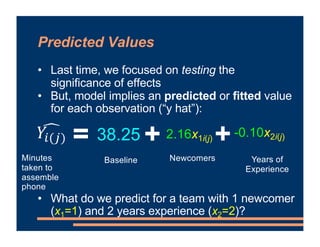
Predicted Values
• Last time, we focused on testing the
significance of effects
• But, model implies an predicted or fitted value
for each observation (“y hat”):
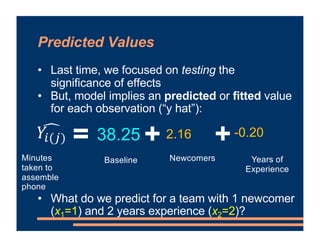
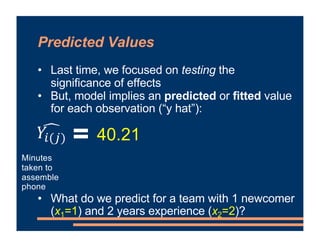
• What do we predict for a team with 1 newcomer
(x1=1) and 2 years experience (x2=2)?
=
Minutes
taken to
assemble
phone
Newcomers
+
Years of
Experience
Baseline
38.25 2.16x1i(j)
-0.10x2i(j)
+
!
𝑌#(%)
Predicted Values
• Last time, we focused on testing the
significance of effects
• But, model implies an predicted or fitted value
for each observation (“y hat”):
• What do we predict for a team with 1 newcomer
(x1=1) and 2 years experience (x2=2)?
=
Minutes
taken to
assemble
phone
Newcomers
+
Years of
Experience
Baseline
38.25 2.16 -0.20
+
!
𝑌#(%)
Predicted Values
• Last time, we focused on testing the
significance of effects
• But, model implies an predicted or fitted value
for each observation (“y hat”):
• What do we predict for a team with 1 newcomer
(x1=1) and 2 years experience (x2=2)?
=
Minutes
taken to
assemble
phone
40.21
!
𝑌#(%)
Predicted Values
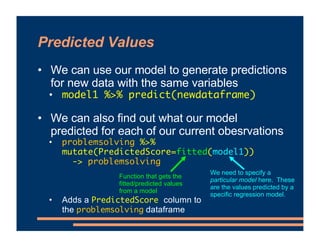
• We can use our model to generate predictions
for new data with the same variables
• model1 %>% predict(newdataframe)
• We can also find out what our model
predicted for each of our current obesrvations
• problemsolving %>%
mutate(PredictedScore=fitted(model1))
-> problemsolving
• Adds a PredictedScore column to
the problemsolving dataframe
Function that gets the
fitted/predicted values
from a model
We need to specify a
particular model here. These
are the values predicted by a
specific regression model.
Predicted Values
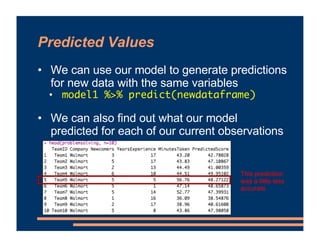
• We can use our model to generate predictions
for new data with the same variables
• model1 %>% predict(newdataframe)
• We can also find out what our model
predicted for each of our current observations
This prediction
was a little less
accurate
Residuals
• How far off are our individual predictions?
• Residuals: Difference between predicted &
actual for a specific observation
• “2% or 3% [market share] is
what Apple might get.”
– former Microsoft CEO Steve Ballmer on the iPhone
• Actual iPhone market
share (2014): 43%
• Residual: 40 to 41 percentage points
Residuals
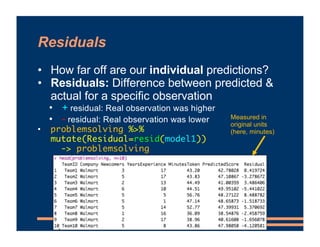
• How far off are our individual predictions?
• Residuals: Difference between predicted &
actual for a specific observation
• + residual: Real observation was higher
• - residual: Real observation was lower
• problemsolving %>%
mutate(Residual=resid(model1))
-> problemsolving
Measured in
original units
(here, minutes)
Week 3.2: Fixed Effect Interactions
! Residuals
! Predicted Values & Residuals
! Using Residuals to Detect Outliers
! Interactions
! In the Model Formula
! Interpretation
! Lab
Outliers
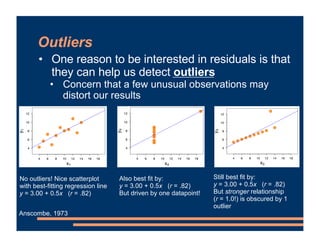
• One reason to be interested in residuals is that
they can help us detect outliers
• Concern that a few unusual observations may
distort our results
No outliers! Nice scatterplot
with best-fitting regression line
y = 3.00 + 0.5x (r = .82)
Anscombe, 1973
Also best fit by:
y = 3.00 + 0.5x (r = .82)
But driven by one datapoint!
Still best fit by:
y = 3.00 + 0.5x (r = .82)
But stronger relationship
(r = 1.0!) is obscured by 1
outlier
Residuals
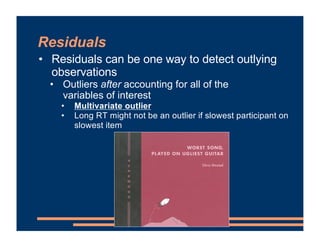
• Residuals can be one way to detect outlying
observations
• Outliers after accounting for all of the
variables of interest
• Multivariate outlier
• Long RT might not be an outlier if slowest participant on
slowest item
Residuals
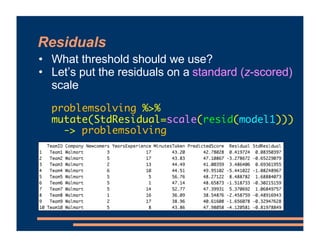
• What threshold should we use?
• Let’s put the residuals on a standard (z-scored)
scale
problemsolving %>%
mutate(StdResidual=scale(resid(model1)))
-> problemsolving
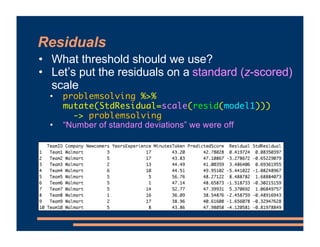
Residuals
• What threshold should we use?
• Let’s put the residuals on a standard (z-scored)
scale
• problemsolving %>%
mutate(StdResidual=scale(resid(model1)))
-> problemsolving
• “Number of standard deviations” we were off
Residuals
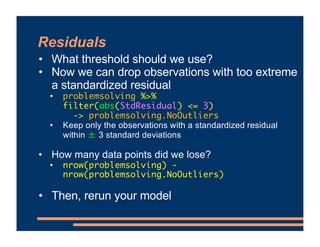
• What threshold should we use?
• Now we can drop observations with too extreme
a standardized residual
• problemsolving %>%
filter(abs(StdResidual) <= 3)
-> problemsolving.NoOutliers
• Keep only the observations with a standardized residual
within ± 3 standard deviations
• How many data points did we lose?
• nrow(problemsolving) -
nrow(problemsolving.NoOutliers)
• Then, rerun your model
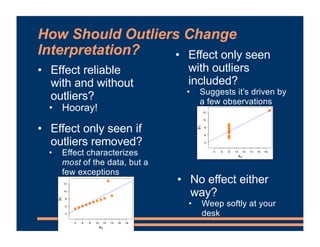
How Should Outliers Change
Interpretation?
• Effect reliable
with and without
outliers?
• Hooray!
• Effect only seen
with outliers
included?
• Suggests it’s driven by
a few observations
• Effect only seen if
outliers removed?
• Effect characterizes
most of the data, but a
few exceptions
• No effect either
way?
• Weep softly at your
desk
Week 3.2: Fixed Effect Interactions
! Residuals
! Predicted Values & Residuals
! Using Residuals to Detect Outliers
! Interactions
! In the Model Formula
! Interpretation
! Lab
Model Formulae: Interactions
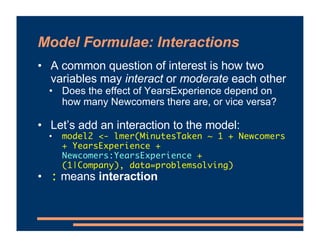
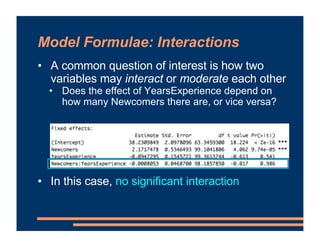
• A common question of interest is how two
variables may interact or moderate each other
• Does the effect of YearsExperience depend on
how many Newcomers there are, or vice versa?
• Let’s add an interaction to the model:
• model2 <- lmer(MinutesTaken ~ 1 + Newcomers
+ YearsExperience +
Newcomers:YearsExperience +
(1|Company), data=problemsolving)
• : means interaction
Model Formulae: Interactions
• A common question of interest is how two
variables may interact or moderate each other
• Does the effect of YearsExperience depend on
how many Newcomers there are, or vice versa?
• In this case, no significant interaction
Model Formulae: Interactions
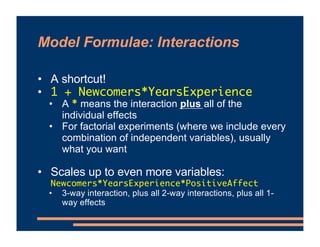
• A shortcut!
• 1 + Newcomers*YearsExperience
• A * means the interaction plus all of the
individual effects
• For factorial experiments (where we include every
combination of independent variables), usually
what you want
• Scales up to even more variables:
Newcomers*YearsExperience*PositiveAffect
• 3-way interaction, plus all 2-way interactions, plus all 1-
way effects
Model Formulae: Interactions
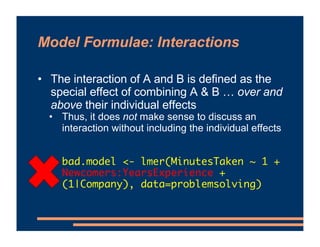
• The interaction of A and B is defined as the
special effect of combining A & B … over and
above their individual effects
• Thus, it does not make sense to discuss an
interaction without including the individual effects
• bad.model <- lmer(MinutesTaken ~ 1 +
Newcomers:YearsExperience +
(1|Company), data=problemsolving)
Week 3.2: Fixed Effect Interactions
! Residuals
! Predicted Values & Residuals
! Using Residuals to Detect Outliers
! Interactions
! In the Model Formula
! Interpretation
! Lab
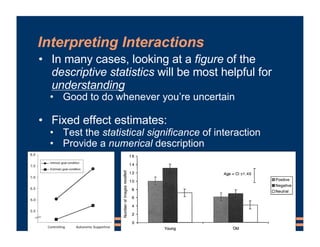
Interpreting Interactions
• In many cases, looking at a figure of the
descriptive statistics will be most helpful for
understanding
• Good to do whenever you’re uncertain
• Fixed effect estimates:
• Test the statistical significance of interaction
• Provide a numerical description
Interpreting Interactions
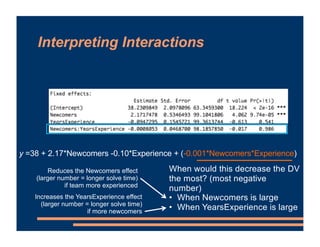
y =38 + 2.17*Newcomers -0.10*Experience + (-0.001*Newcomers*Experience)
When would this decrease the DV
the most? (most negative
number)
• When Newcomers is large
• When YearsExperience is large
Reduces the Newcomers effect
(larger number = longer solve time)
if team more experienced
Increases the YearsExperience effect
(larger number = longer solve time)
if more newcomers
Interpreting Interactions
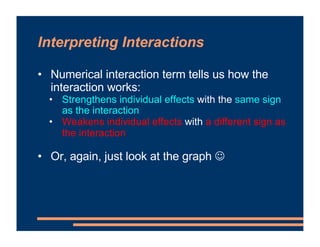
• Numerical interaction term tells us how the
interaction works:
• Strengthens individual effects with the same sign
as the interaction
• Weakens individual effects with a different sign as
the interaction
• Or, again, just look at the graph ☺
Week 3.2: Fixed Effect Interactions
! Residuals
! Predicted Values & Residuals
! Using Residuals to Detect Outliers
! Interactions
! In the Model Formula
! Interpretation
! Lab
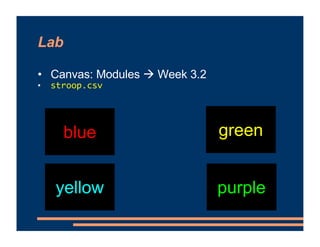
Lab
• Canvas: Modules # Week 3.2
• stroop.csv
blue green
yellow purple

Mixed Effects Models - Fixed Effect Interactions

  • 1.
    Course Business ! Wewill have class this coming Monday (Labor Day) ! Lab materials on Canvas ! Follow-up on fixed effects – experimental vs. observational variables ! No difference in how we include them in R script ! Difference is just in conclusions we can draw
  • 2.
    Week 3.2: FixedEffect Interactions ! Residuals ! Predicted Values & Residuals ! Using Residuals to Detect Outliers ! Interactions ! In the Model Formula ! Interpretation ! Lab
  • 3.
    Predicted Values • Lasttime, we focused on testing the significance of effects • But, model implies an predicted or fitted value for each observation = Minutes taken to assemble phone Newcomers + Years of Experience Baseline γ00 γ10x1i(j) γ20x2i(j) E(Yi(j)) +
  • 4.
    Predicted Values • Lasttime, we focused on testing the significance of effects • But, model implies an predicted or fitted value for each observation (“y hat”): = Minutes taken to assemble phone Newcomers + Years of Experience Baseline γ00 γ10x1i(j) γ20x2i(j) ! 𝑌#(%) +
  • 5.
    Predicted Values • Lasttime, we focused on testing the significance of effects • But, model implies an predicted or fitted value for each observation (“y hat”): • What do we predict for a team with 1 newcomer (x1=1) and 2 years experience (x2=2)? = Minutes taken to assemble phone Newcomers + Years of Experience Baseline 38.25 2.16x1i(j) -0.10x2i(j) + ! 𝑌#(%)
  • 6.
    Predicted Values • Lasttime, we focused on testing the significance of effects • But, model implies an predicted or fitted value for each observation (“y hat”): • What do we predict for a team with 1 newcomer (x1=1) and 2 years experience (x2=2)? = Minutes taken to assemble phone Newcomers + Years of Experience Baseline 38.25 2.16 -0.20 + ! 𝑌#(%)
  • 7.
    Predicted Values • Lasttime, we focused on testing the significance of effects • But, model implies an predicted or fitted value for each observation (“y hat”): • What do we predict for a team with 1 newcomer (x1=1) and 2 years experience (x2=2)? = Minutes taken to assemble phone 40.21 ! 𝑌#(%)
  • 8.
    Predicted Values • Wecan use our model to generate predictions for new data with the same variables • model1 %>% predict(newdataframe) • We can also find out what our model predicted for each of our current obesrvations • problemsolving %>% mutate(PredictedScore=fitted(model1)) -> problemsolving • Adds a PredictedScore column to the problemsolving dataframe Function that gets the fitted/predicted values from a model We need to specify a particular model here. These are the values predicted by a specific regression model.
  • 9.
    Predicted Values • Wecan use our model to generate predictions for new data with the same variables • model1 %>% predict(newdataframe) • We can also find out what our model predicted for each of our current observations This prediction was a little less accurate
  • 10.
    Residuals • How faroff are our individual predictions? • Residuals: Difference between predicted & actual for a specific observation • “2% or 3% [market share] is what Apple might get.” – former Microsoft CEO Steve Ballmer on the iPhone • Actual iPhone market share (2014): 43% • Residual: 40 to 41 percentage points
  • 11.
    Residuals • How faroff are our individual predictions? • Residuals: Difference between predicted & actual for a specific observation • + residual: Real observation was higher • - residual: Real observation was lower • problemsolving %>% mutate(Residual=resid(model1)) -> problemsolving Measured in original units (here, minutes)
  • 12.
    Week 3.2: FixedEffect Interactions ! Residuals ! Predicted Values & Residuals ! Using Residuals to Detect Outliers ! Interactions ! In the Model Formula ! Interpretation ! Lab
  • 13.
    Outliers • One reasonto be interested in residuals is that they can help us detect outliers • Concern that a few unusual observations may distort our results No outliers! Nice scatterplot with best-fitting regression line y = 3.00 + 0.5x (r = .82) Anscombe, 1973 Also best fit by: y = 3.00 + 0.5x (r = .82) But driven by one datapoint! Still best fit by: y = 3.00 + 0.5x (r = .82) But stronger relationship (r = 1.0!) is obscured by 1 outlier
  • 14.
    Residuals • Residuals canbe one way to detect outlying observations • Outliers after accounting for all of the variables of interest • Multivariate outlier • Long RT might not be an outlier if slowest participant on slowest item
  • 15.
    Residuals • What thresholdshould we use? • Let’s put the residuals on a standard (z-scored) scale problemsolving %>% mutate(StdResidual=scale(resid(model1))) -> problemsolving
  • 16.
    Residuals • What thresholdshould we use? • Let’s put the residuals on a standard (z-scored) scale • problemsolving %>% mutate(StdResidual=scale(resid(model1))) -> problemsolving • “Number of standard deviations” we were off
  • 17.
    Residuals • What thresholdshould we use? • Now we can drop observations with too extreme a standardized residual • problemsolving %>% filter(abs(StdResidual) <= 3) -> problemsolving.NoOutliers • Keep only the observations with a standardized residual within ± 3 standard deviations • How many data points did we lose? • nrow(problemsolving) - nrow(problemsolving.NoOutliers) • Then, rerun your model
  • 18.
    How Should OutliersChange Interpretation? • Effect reliable with and without outliers? • Hooray! • Effect only seen with outliers included? • Suggests it’s driven by a few observations • Effect only seen if outliers removed? • Effect characterizes most of the data, but a few exceptions • No effect either way? • Weep softly at your desk
  • 19.
    Week 3.2: FixedEffect Interactions ! Residuals ! Predicted Values & Residuals ! Using Residuals to Detect Outliers ! Interactions ! In the Model Formula ! Interpretation ! Lab
  • 20.
    Model Formulae: Interactions •A common question of interest is how two variables may interact or moderate each other • Does the effect of YearsExperience depend on how many Newcomers there are, or vice versa? • Let’s add an interaction to the model: • model2 <- lmer(MinutesTaken ~ 1 + Newcomers + YearsExperience + Newcomers:YearsExperience + (1|Company), data=problemsolving) • : means interaction
  • 21.
    Model Formulae: Interactions •A common question of interest is how two variables may interact or moderate each other • Does the effect of YearsExperience depend on how many Newcomers there are, or vice versa? • In this case, no significant interaction
  • 22.
    Model Formulae: Interactions •A shortcut! • 1 + Newcomers*YearsExperience • A * means the interaction plus all of the individual effects • For factorial experiments (where we include every combination of independent variables), usually what you want • Scales up to even more variables: Newcomers*YearsExperience*PositiveAffect • 3-way interaction, plus all 2-way interactions, plus all 1- way effects
  • 23.
    Model Formulae: Interactions •The interaction of A and B is defined as the special effect of combining A & B … over and above their individual effects • Thus, it does not make sense to discuss an interaction without including the individual effects • bad.model <- lmer(MinutesTaken ~ 1 + Newcomers:YearsExperience + (1|Company), data=problemsolving)
  • 24.
    Week 3.2: FixedEffect Interactions ! Residuals ! Predicted Values & Residuals ! Using Residuals to Detect Outliers ! Interactions ! In the Model Formula ! Interpretation ! Lab
  • 25.
    Interpreting Interactions • Inmany cases, looking at a figure of the descriptive statistics will be most helpful for understanding • Good to do whenever you’re uncertain • Fixed effect estimates: • Test the statistical significance of interaction • Provide a numerical description
  • 26.
    Interpreting Interactions y =38+ 2.17*Newcomers -0.10*Experience + (-0.001*Newcomers*Experience) When would this decrease the DV the most? (most negative number) • When Newcomers is large • When YearsExperience is large Reduces the Newcomers effect (larger number = longer solve time) if team more experienced Increases the YearsExperience effect (larger number = longer solve time) if more newcomers
  • 27.
    Interpreting Interactions • Numericalinteraction term tells us how the interaction works: • Strengthens individual effects with the same sign as the interaction • Weakens individual effects with a different sign as the interaction • Or, again, just look at the graph ☺
  • 28.
    Week 3.2: FixedEffect Interactions ! Residuals ! Predicted Values & Residuals ! Using Residuals to Detect Outliers ! Interactions ! In the Model Formula ! Interpretation ! Lab
  • 29.
    Lab • Canvas: Modules# Week 3.2 • stroop.csv blue green yellow purple