MIXED DENTITION
ANALYSIS
DR. NAILA SUNBAL
POST GRADUATE RESIDENT
ORTHODONTIC DEPARTMENT
PRIME DENTAL COLLEGE AND HOSPITAL
MIXED DENTITION
 The period in which both primary and permanent teeth are present
in the oral cavity.
 Usually present between age 6 to 12 years.
 when some of the primary teeth are being replaced by permanent
teeth,
starts with the eruption of the first permanent tooth.
Mixed Dentition Analysis
 The Mixed Dentition Analysis helps to estimate
the amount of spacing or crowding which would
exist for the patient if all the primary teeth were
replaced by their successors.
Methods of space analysis in mixed
dentition
 Arch Length Discrepancy
 Moyers predictability table
 Tanaka and Johnston
 Radiographic method
Arch Length Discrepancy
 Arch Length Discrepancy : is the difference
between the space available, generally
determined by the bony dental alveolus between
two per. Molars, and the space required which is
the sum of all mesiodistal tooth widths mesial to
1st molars.
SPACE AVAILABLLE
 SPACE AVAILABLE: Is measured from mesial of one 1st
permanent Molar to the mesial of other 1st permanent
Molar.
 Also called Arch perimeter
 Measured by
1. Brass wire
2. Vernier Caliper
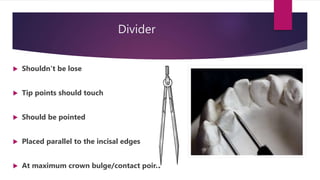
3. Divider
SPACE AVAILABLE
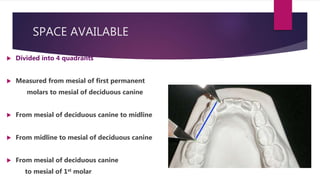
 Divided into 4 quadrants
 Measured from mesial of first permanent
molars to mesial of deciduous canine
 From mesial of deciduous canine to midline
 From midline to mesial of deciduous canine
 From mesial of deciduous canine
to mesial of 1st molar
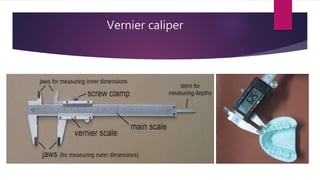
Vernier Caliper
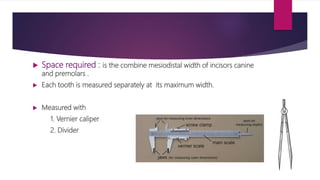
 Space required : is the combine mesiodistal width of incisors canine
and premolars .
 Each tooth is measured separately at its maximum width.
 Measured with
1. Vernier caliper
2. Divider
Vernier caliper
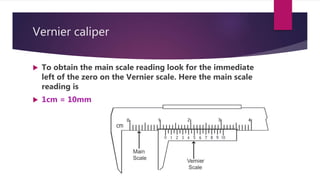
Vernier caliper
 To obtain the main scale reading look for the immediate
left of the zero on the Vernier scale. Here the main scale
reading is
 1cm = 10mm
Vernier caliper
 To obtain the Vernier scale reading look closely for
an alignment of the scale lines of the main scale and
Vernier scale, here the Vernier scale reading is 0.05cm
=0.5mm
 Reading is 7.5 mm
Divider
 Shouldn't be lose
 Tip points should touch
 Should be pointed
 Placed parallel to the incisal edges
 At maximum crown bulge/contact point
Space required in mixed dentition
 Three methods to find out mesiodistal width of
unerupted canine and premolars
1. Tanaka and Johnston
2. Moyer’s predictability table
3. Radiographic
Tanaka and Johnston
 Measure mesiodistal width of mandibular incisors
[Not maxillary as their sizes varies]
 Sum the mesiodistal widths of mandibular incisors and divide by 2
 For mandibular canine and premolars MD width add 10.5
 For maxillary canine and premolars MD width add 11
 If Mesiodistal width of lower incisors = 22
 22/2=11
 For lower premolars and canine add 10.5
 11+10.5=21.5 (width of single side so multiply by 2)
 21.5 x 2 =43 (MD width of canine premolars of both sides )
 Add width of lower incisors and canine
 43+22=65mm
 SPACE REQUIRED in lower arch for incisors, canines and
premolars .
FOR MAXILLARY UNERUPTED CANINES AND
PREMOLARS:
 Now here we will put the MD width of Mandibular incisors for
formula correction i.e. 22mm
 22/2=11
 ADD 11
 11+11= 22mm [for one side]
 FOR BOTH SIDES X 2 = 22X2 =44mm
 For upper premolars and canines add 11
 11+11 = 22 (width of single side so multiply by 2)
 22x 2 =44 (MD width of canine premolars of both sides )
 Sum both sides plus maxillary incisors value
 44+ 38 =82 space required in maxillary arch
Moyer’s Methods
 Measure the mesiodistal width of mandibular incisors (22)
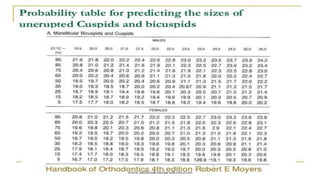
 See for the value of premolars and canine at 75% in the table
 75% it is percentile
 75% is standard set by American guidelines
HOW TO USE MOYERS table ?
 Check whether it is maxilla or mandible
 Male or female
 FOR EXAMPLE
what is the value of a male’s lower cuspids & bicuspids on Moyer's
chart
if MD width of patients mandibular incisors
is 22m
 MD width of unerupted canine or premolars of 1 side is 21.4 mm
For both sides
21.4 x 2 =42.8mm
42.8 + 22 = 64.8 mm (space required of lower canines and premolars
by moyer’s method)
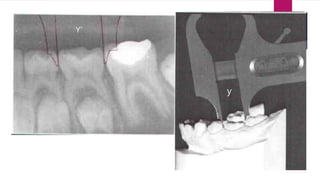
Radiographic Method
[HUCKABA’S]
 Dental cast and patient radiograph is required
 Radiograph may be periapical or OPG
 Reaquired Mesiodistal width of each tooth is measured separately
on the cast and radiograph.
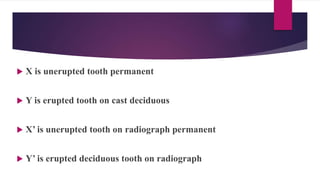
 Calculate with formula x = x’y/y’
 X is unerupted tooth permanent
 Y is erupted tooth on cast deciduous
 X’ is unerupted tooth on radiograph permanent
 Y’ is erupted deciduous tooth on radiograph
POINTS TO BE NOTED
 BAR means something on the radiograph
 We take Y’ to check the magnification
 The formula given above is used to cancel the magnification in order to
get the actual value.
Y’
y
Mixed dentition analysis

Mixed dentition analysis

  • 2.
    MIXED DENTITION ANALYSIS DR. NAILASUNBAL POST GRADUATE RESIDENT ORTHODONTIC DEPARTMENT PRIME DENTAL COLLEGE AND HOSPITAL
  • 3.
    MIXED DENTITION  Theperiod in which both primary and permanent teeth are present in the oral cavity.  Usually present between age 6 to 12 years.  when some of the primary teeth are being replaced by permanent teeth, starts with the eruption of the first permanent tooth.
  • 4.
    Mixed Dentition Analysis The Mixed Dentition Analysis helps to estimate the amount of spacing or crowding which would exist for the patient if all the primary teeth were replaced by their successors.
  • 5.
    Methods of spaceanalysis in mixed dentition  Arch Length Discrepancy  Moyers predictability table  Tanaka and Johnston  Radiographic method
  • 6.
    Arch Length Discrepancy Arch Length Discrepancy : is the difference between the space available, generally determined by the bony dental alveolus between two per. Molars, and the space required which is the sum of all mesiodistal tooth widths mesial to 1st molars.
  • 7.
    SPACE AVAILABLLE  SPACEAVAILABLE: Is measured from mesial of one 1st permanent Molar to the mesial of other 1st permanent Molar.  Also called Arch perimeter  Measured by 1. Brass wire 2. Vernier Caliper 3. Divider
  • 8.
    SPACE AVAILABLE  Dividedinto 4 quadrants  Measured from mesial of first permanent molars to mesial of deciduous canine  From mesial of deciduous canine to midline  From midline to mesial of deciduous canine  From mesial of deciduous canine to mesial of 1st molar
  • 9.
  • 10.
     Space required: is the combine mesiodistal width of incisors canine and premolars .  Each tooth is measured separately at its maximum width.  Measured with 1. Vernier caliper 2. Divider
  • 11.
  • 12.
    Vernier caliper  Toobtain the main scale reading look for the immediate left of the zero on the Vernier scale. Here the main scale reading is  1cm = 10mm
  • 13.
    Vernier caliper  Toobtain the Vernier scale reading look closely for an alignment of the scale lines of the main scale and Vernier scale, here the Vernier scale reading is 0.05cm =0.5mm  Reading is 7.5 mm
  • 14.
    Divider  Shouldn't belose  Tip points should touch  Should be pointed  Placed parallel to the incisal edges  At maximum crown bulge/contact point
  • 15.
    Space required inmixed dentition  Three methods to find out mesiodistal width of unerupted canine and premolars 1. Tanaka and Johnston 2. Moyer’s predictability table 3. Radiographic
  • 16.
    Tanaka and Johnston Measure mesiodistal width of mandibular incisors [Not maxillary as their sizes varies]  Sum the mesiodistal widths of mandibular incisors and divide by 2  For mandibular canine and premolars MD width add 10.5  For maxillary canine and premolars MD width add 11
  • 17.
     If Mesiodistalwidth of lower incisors = 22  22/2=11  For lower premolars and canine add 10.5  11+10.5=21.5 (width of single side so multiply by 2)  21.5 x 2 =43 (MD width of canine premolars of both sides )
  • 18.
     Add widthof lower incisors and canine  43+22=65mm  SPACE REQUIRED in lower arch for incisors, canines and premolars .
  • 19.
    FOR MAXILLARY UNERUPTEDCANINES AND PREMOLARS:  Now here we will put the MD width of Mandibular incisors for formula correction i.e. 22mm  22/2=11  ADD 11  11+11= 22mm [for one side]  FOR BOTH SIDES X 2 = 22X2 =44mm
  • 20.
     For upperpremolars and canines add 11  11+11 = 22 (width of single side so multiply by 2)  22x 2 =44 (MD width of canine premolars of both sides )  Sum both sides plus maxillary incisors value  44+ 38 =82 space required in maxillary arch
  • 21.
    Moyer’s Methods  Measurethe mesiodistal width of mandibular incisors (22)  See for the value of premolars and canine at 75% in the table  75% it is percentile  75% is standard set by American guidelines
  • 22.
    HOW TO USEMOYERS table ?  Check whether it is maxilla or mandible  Male or female  FOR EXAMPLE what is the value of a male’s lower cuspids & bicuspids on Moyer's chart if MD width of patients mandibular incisors is 22m  MD width of unerupted canine or premolars of 1 side is 21.4 mm
  • 23.
    For both sides 21.4x 2 =42.8mm 42.8 + 22 = 64.8 mm (space required of lower canines and premolars by moyer’s method)
  • 26.
    Radiographic Method [HUCKABA’S]  Dentalcast and patient radiograph is required  Radiograph may be periapical or OPG  Reaquired Mesiodistal width of each tooth is measured separately on the cast and radiograph.  Calculate with formula x = x’y/y’
  • 27.
     X isunerupted tooth permanent  Y is erupted tooth on cast deciduous  X’ is unerupted tooth on radiograph permanent  Y’ is erupted deciduous tooth on radiograph
  • 28.
    POINTS TO BENOTED  BAR means something on the radiograph  We take Y’ to check the magnification  The formula given above is used to cancel the magnification in order to get the actual value.
  • 29.