MIT323 : Managing Information
and Technology
Module Title: The Technological Innovation Process
Module Developer: Mr. Edgardo C. Villafuerte, MIT
RECAPITULATION
Scope of Technology Management
Designing & Implementing Technology Strategy
Technology Management in High- & Low-Tech
Industries
Distinctive Technological Competencies
Integration of Technology and Business Strategy
SPECIFIC LEARNING OBJECTIVES:
Understand different types of innovation model.
Know the basic concepts, methods and applications of
technological forecasting.
Identify and understand the products and process innovation
for assembled and non-assembled products.
Know the management of research and development in a
company.
Know the procedures and corporate technology audit models.
TOPICS
Static and Dynamic Models of Technological Innovation
Technological Forecasting - Basic Concepts, Methods, and
Applications
Product & Process Innovation for Assembled and Non-
Assembled Products
Organizational Determinants
Management of R & D: Project Selection, Planning, and
Control
Corporate Technology Audit Models and Procedures
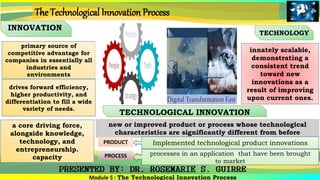
INNOVATION
TECHNOLOGY
primary source of
competitive advantage for
companies in essentially all
industries and
environments
innately scalable,
demonstrating a
consistent trend
toward new
innovations as a
result of improving
upon current ones.
Module 5 : The Technological Innovation Process
The Technological Innovation Process
a core driving force,
alongside knowledge,
technology, and
entrepreneurship.
capacity
drives forward efficiency,
higher productivity, and
differentiation to fill a wide
variety of needs.
TECHNOLOGICAL INNOVATION
new or improved product or process whose technological
characteristics are significantly different from before
PROCESS
PRODUCT Implemented technological product innovations
processes in an application that have been brought
to market
Module 5 : The Technological Innovation Process
BBM OR LENI.INNOVATION IS PRIMARY SOURCE OF
COMPETITIVE ADVANTAGE FOR COMPANIES IN
ESSENTIALLY ALL INDUSTRIES AND ENVIRONMENTS AND
DRIVES FORWARD EFFICIENCY, HIGHER PRODUCTIVITY,
AND DIFFERENTIATION TO FILL A WIDE VARIETY OF
NEEDS.
BBM
QUESTION | TRUE(BBM) – FALSE (LENI)
Module 5 : The Technological Innovation Process
ISKO OR LACSON. TECHNOLOGICAL INNOVATION IS
INNATELY SCALABLE, DEMONSTRATING A CONSISTENT
TREND TOWARD NEW INNOVATIONS AS A RESULT OF
IMPROVING UPON CURRENT ONES.
LACSON
QUESTION | TRUE(ISKO) – FALSE
(LACSON)
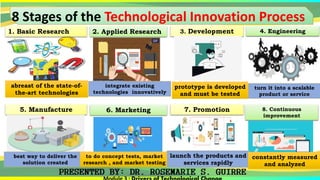
8 Stages of the Technological Innovation Process
2. Applied Research 3. Development 4. Engineering
5. Manufacture 6. Marketing 7. Promotion 8. Continuous
improvement
1. Basic Research
abreast of the state-of-
the-art technologies
integrate existing
technologies innovatively
prototype is developed
and must be tested
turn it into a scalable
product or service
best way to deliver the
solution created
to do concept tests, market
research , and market testing
launch the products and
services rapidly
constantly measured
and analyzed
Module 5 : The Technological Innovation Process
A COMPLEX SET OF ACTIVITIES THAT TRANSFORMS
IDEAS AND SCIENTIFIC KNOWLEDGE INTO PHYSICAL
REALITY AND REAL-WORLD APPLICATION. THERE ARE
EIGHT STAGES IN THE PROCESS OF TECHNOLOGICAL
INNOVATION.
TECHNOLOGICAL INNOVATION PROCESS
QUESTION | IDENTIFICATION
Module 5 : The Technological Innovation Process
IN PROPER ORDER GIVE THE FIRST FOUR
TECHNOLOGICAL INNOVATION PROCESS
1. BASIC RESEARCH | 2. APPLIED RESEARCH |
3. DEVELOPMENT | 4. ENGINEERING
QUESTION | ENUMERATION
INNOVATION MODELS
provides a detailed framework to identify, advance,
and implement ideas
Roy Rothwell put forward five generations of
innovations
Various marketing factors includes - inflation,
stagflation, economic recovery, unemployment, etc
Module 5 : The Technological Innovation Process
His findings are termed a descriptive
innovation model.
His Innovation Models are beneficial in creating an
innovation management strategy for business.
Module 5 : The Technological Innovation Process
BRITISH SOCIOLOGIST WHICH IS A
PIONEER IN INDUSTRIAL INNOVATION
ROY ROTHWELL
QUESTION | IDENTIFICATION
TYPES OF INNOVATION MODELS
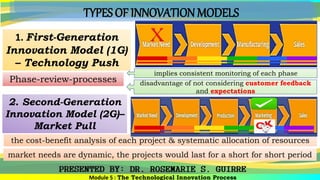
1. First-Generation
Innovation Model (1G)
– Technology Push
the cost-benefit analysis of each project & systematic allocation of resources
2. Second-Generation
Innovation Model (2G)–
Market Pull
Phase-review-processes
implies consistent monitoring of each phase
disadvantage of not considering customer feedback
and expectations
Module 5 : The Technological Innovation Process
market needs are dynamic, the projects would last for a short for short period
TYPES OF INNOVATION MODELS
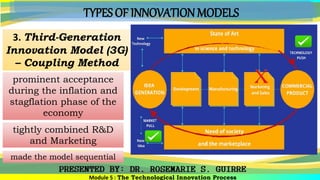
3. Third-Generation
Innovation Model (3G)
– Coupling Method
Module 5 : The Technological Innovation Process
prominent acceptance
during the inflation and
stagflation phase of the
economy
tightly combined R&D
and Marketing
made the model sequential
TYPES OF INNOVATION MODELS
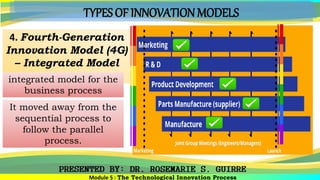
4. Fourth-Generation
Innovation Model (4G)
– Integrated Model
Module 5 : The Technological Innovation Process
integrated model for the
business process
It moved away from the
sequential process to
follow the parallel
process.
TYPES OF INNOVATION MODELS
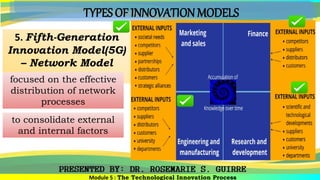
5. Fifth-Generation
Innovation Model(5G)
– Network Model
Module 5 : The Technological Innovation Process
focused on the effective
distribution of network
processes
to consolidate external
and internal factors
TYPES OF INNOVATION MODELS
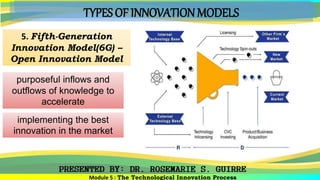
5. Fifth-Generation
Innovation Model(6G) –
Open Innovation Model
Module 5 : The Technological Innovation Process
purposeful inflows and
outflows of knowledge to
accelerate
implementing the best
innovation in the market
Module 5 : The Technological Innovation Process
IDENTIFY THE GENERATION.
OPEN INNOVATION | COUPLING METHOD
TECHNOLOGY PUSH
3 QUESTION | IDENTIFICATION
Module 5 : The Technological Innovation Process
FOCUSED ON THE EFFECTIVE DISTRIBUTION OF
NETWORK PROCESSES. IT EMPHASIZED GAINING
FLEXIBILITY AND INCREASING THE DEVELOPMENT
SPEED.
(5G) – Network Model
QUESTION | IDENTIFICATION
Module 5 : The Technological Innovation Process
BEBONG OR AGILA.
THE FOURTH-GENERATION INNOVATION
MODEL IS COUPLING METHOD
AGILA
QUESTION | TRUE (BEBONG) OR FALSE (AGILA)
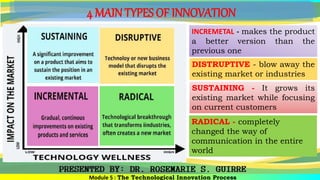
4 MAIN TYPES OF INNOVATION
INCREMETAL - makes the product
a better version than the
previous one
Module 5 : The Technological Innovation Process
DISTRUPTIVE - blow away the
existing market or industries
SUSTAINING - It grows its
existing market while focusing
on current customers
RADICAL - completely
changed the way of
communication in the entire
world
Module 5 : The Technological Innovation Process
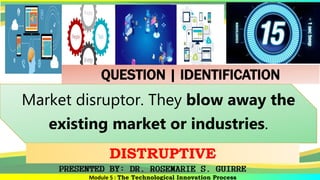
Market disruptor. They blow away the
existing market or industries.
DISTRUPTIVE
QUESTION | IDENTIFICATION
REFERENCES
https://en.wikipedia.org/wiki/Technology_forecasting
AF Bureau (October 1, 2020). Innovation Models, Innovation Process Models, Examples.
https://alcorfund.com/insight/innovation-models-innovation-process-models-examples/
Basquillat Consulting (November 25th 2020). IT Audit: Step-by-Step Guide.
https://hackernoon.com/it-audit-or-step-by-step-guide-xl39344a
James, Stephen (18 November 2020). What is R&D? Its role in business and how it relates to
R&D tax credits. https://forrestbrown.co.uk/news/what-is-r-and-d/
Kenton, Will (Mar 31, 2021). Research and Development.
https://www.investopedia.com/terms/r/randd.asp
McClure, Dave (July 27, 2011). The 7-Step Technology Audit.
https://www.cpapracticeadvisor.com/directory/accounting/account-reconciliation-
software/article/10308014/the-7step-technology-audit
Quinn, James Brian (March 1967). Technological Forecasting.
https://hbr.org/1967/03/technological-forecasting
Veyrat, P.(December 16, 2017). The Technological Innovation Process and Its 8 Steps.
https://www.heflo.com/blog/technology/technological-innovation-process/
Wayne Dennison, T. (May, 2015). Technological Innovation. https://universitybusiness.com/5-
factors-for-successful-technological-innovation/
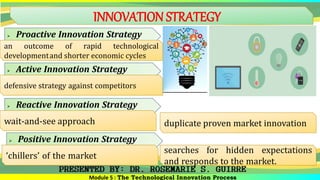
INNOVATION STRATEGY
Module 5 : The Technological Innovation Process
 Proactive Innovation Strategy
an outcome of rapid technological
developmentand shorter economic cycles
 Active Innovation Strategy
defensive strategy against competitors
 Reactive Innovation Strategy
wait-and-see approach duplicate proven market innovation
 Positive Innovation Strategy
‘chillers’ of the market
searches for hidden expectations
and responds to the market.
Module 5 : The Technological Innovation Process
IDENTIFY DIFFERENT INNOVATION STRATEGIES
Proactive Innovation Strategy | Active Innovation Strategy
Reactive Innovation Strategy | Passive Innovation Strategy
QUESTION | IDENTIFICATION
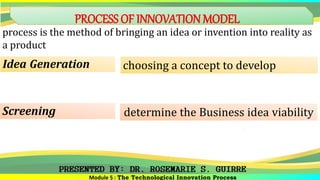
PROCESS OF INNOVATIONMODEL
process is the method of bringing an idea or invention into reality as
a product
Idea Generation
Screening
choosing a concept to develop
determine the Business idea viability

Module 5 : The Technological Innovation Process
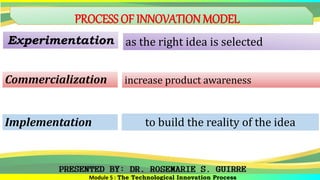
PROCESS OF INNOVATIONMODEL
Experimentation
Commercialization
Implementation
as the right idea is selected
increase product awareness
to build the reality of the idea
Module 5 : The Technological Innovation Process
THE METHOD OF BRINGING AN IDEA OR
INVENTION INTO REALITY AS A PRODUCT. THE
INNOVATION MODEL SHOULD MAKE THE
ECONOMICAL AND A GREAT VALUE DRIVER
PROCESS OF INNOVATION MODEL
QUESTION | IDENTIFICATION
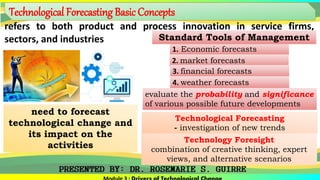
Technological Forecasting Basic Concepts
refers to both product and process innovation in service firms,
sectors, and industries
need to forecast
technological change and
its impact on the
activities
1. Economic forecasts
2. market forecasts
3. financial forecasts
4. weather forecasts
Standard Tools of Management
evaluate the probability and significance
of various possible future developments
Technological Forecasting
- investigation of new trends
Technology Foresight
combination of creative thinking, expert
views, and alternative scenarios
Module 5 : The Technological Innovation Process
STANDARD TOOLS OF
MANAGEMENT
ECONOMIC FORECASTS | MARKET FORECASTS |
FINANCIAL FORECASTS |WEATHER FORECASTS
QUESTION | IDENTIFICATION
Module 5 : The Technological Innovation Process
BSAIS3A OR BSAIS3B
TECHNOLOGY FORECASTING
COMBINATION OF CREATIVE THINKING, EXPERT
VIEWS, AND ALTERNATIVE SCENARIOS
BSAIS3B
QUESTION | TRUE (BSAIS3A) OR FALSE
(BSAIS3B)
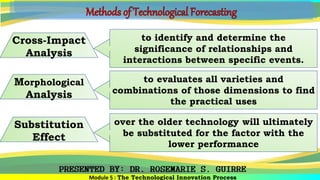
Cross-Impact
Analysis
Module 5 : The Technological Innovation Process
to identify and determine the
significance of relationships and
interactions between specific events.
Morphological
Analysis
to evaluates all varieties and
combinations of those dimensions to find
the practical uses
Substitution
Effect
over the older technology will ultimately
be substituted for the factor with the
lower performance
Module 5 : The Technological Innovation Process
THIS METHOD ATTEMPTS TO IDENTIFY AND
DETERMINE THE SIGNIFICANCE OF
RELATIONSHIPS AND INTERACTIONS BETWEEN
SPECIFIC EVENTS.
CROSS-IMPACT ANALYSIS
QUESTION | IDENTIFICATION
APPLICATIONS OF TECHNOLOGICAL FORECASTING
1. Forecasts should develop the pragmatic insights
needed to make decisions.
2. Forecasters should place opportunities and threats
in an appropriate order of priority
3. Forecasts should be fitted in with the company’s
regular cycles of executive decision
Module 5 : The Technological Innovation Process
4. Promising executives should, whenever possible, be
exposed to planning and forecasting activities as a
routine part of their training
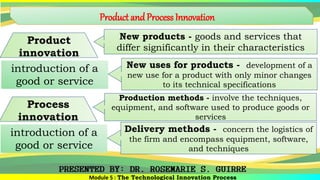
Product andProcess Innovation
Module 5 : The Technological Innovation Process
Product
innovation
New products - goods and services that
differ significantly in their characteristics
introduction of a
good or service
New uses for products - development of a
new use for a product with only minor changes
to its technical specifications
Process
innovation
Production methods - involve the techniques,
equipment, and software used to produce goods or
services
introduction of a
good or service
Delivery methods - concern the logistics of
the firm and encompass equipment, software,
and techniques
REFERENCES
https://en.wikipedia.org/wiki/Technology_forecasting
AF Bureau (October 1, 2020). Innovation Models, Innovation Process Models, Examples.
https://alcorfund.com/insight/innovation-models-innovation-process-models-examples/
Basquillat Consulting (November 25th 2020). IT Audit: Step-by-Step Guide.
https://hackernoon.com/it-audit-or-step-by-step-guide-xl39344a
James, Stephen (18 November 2020). What is R&D? Its role in business and how it relates to
R&D tax credits. https://forrestbrown.co.uk/news/what-is-r-and-d/
Kenton, Will (Mar 31, 2021). Research and Development.
https://www.investopedia.com/terms/r/randd.asp
McClure, Dave (July 27, 2011). The 7-Step Technology Audit.
https://www.cpapracticeadvisor.com/directory/accounting/account-reconciliation-
software/article/10308014/the-7step-technology-audit
Quinn, James Brian (March 1967). Technological Forecasting.
https://hbr.org/1967/03/technological-forecasting
Veyrat, P.(December 16, 2017). The Technological Innovation Process and Its 8 Steps.
https://www.heflo.com/blog/technology/technological-innovation-process/
Wayne Dennison, T. (May, 2015). Technological Innovation. https://universitybusiness.com/5-
factors-for-successful-technological-innovation/
THANKYOU

MIT 323_5 The Technological Innovation Process.pptx

  • 1.
    MIT323 : ManagingInformation and Technology Module Title: The Technological Innovation Process Module Developer: Mr. Edgardo C. Villafuerte, MIT
  • 2.
    RECAPITULATION Scope of TechnologyManagement Designing & Implementing Technology Strategy Technology Management in High- & Low-Tech Industries Distinctive Technological Competencies Integration of Technology and Business Strategy
  • 3.
    SPECIFIC LEARNING OBJECTIVES: Understanddifferent types of innovation model. Know the basic concepts, methods and applications of technological forecasting. Identify and understand the products and process innovation for assembled and non-assembled products. Know the management of research and development in a company. Know the procedures and corporate technology audit models.
  • 4.
    TOPICS Static and DynamicModels of Technological Innovation Technological Forecasting - Basic Concepts, Methods, and Applications Product & Process Innovation for Assembled and Non- Assembled Products Organizational Determinants Management of R & D: Project Selection, Planning, and Control Corporate Technology Audit Models and Procedures
  • 5.
    INNOVATION TECHNOLOGY primary source of competitiveadvantage for companies in essentially all industries and environments innately scalable, demonstrating a consistent trend toward new innovations as a result of improving upon current ones. Module 5 : The Technological Innovation Process The Technological Innovation Process a core driving force, alongside knowledge, technology, and entrepreneurship. capacity drives forward efficiency, higher productivity, and differentiation to fill a wide variety of needs. TECHNOLOGICAL INNOVATION new or improved product or process whose technological characteristics are significantly different from before PROCESS PRODUCT Implemented technological product innovations processes in an application that have been brought to market
  • 6.
    Module 5 :The Technological Innovation Process BBM OR LENI.INNOVATION IS PRIMARY SOURCE OF COMPETITIVE ADVANTAGE FOR COMPANIES IN ESSENTIALLY ALL INDUSTRIES AND ENVIRONMENTS AND DRIVES FORWARD EFFICIENCY, HIGHER PRODUCTIVITY, AND DIFFERENTIATION TO FILL A WIDE VARIETY OF NEEDS. BBM QUESTION | TRUE(BBM) – FALSE (LENI)
  • 7.
    Module 5 :The Technological Innovation Process ISKO OR LACSON. TECHNOLOGICAL INNOVATION IS INNATELY SCALABLE, DEMONSTRATING A CONSISTENT TREND TOWARD NEW INNOVATIONS AS A RESULT OF IMPROVING UPON CURRENT ONES. LACSON QUESTION | TRUE(ISKO) – FALSE (LACSON)
  • 8.
    8 Stages ofthe Technological Innovation Process 2. Applied Research 3. Development 4. Engineering 5. Manufacture 6. Marketing 7. Promotion 8. Continuous improvement 1. Basic Research abreast of the state-of- the-art technologies integrate existing technologies innovatively prototype is developed and must be tested turn it into a scalable product or service best way to deliver the solution created to do concept tests, market research , and market testing launch the products and services rapidly constantly measured and analyzed
  • 9.
    Module 5 :The Technological Innovation Process A COMPLEX SET OF ACTIVITIES THAT TRANSFORMS IDEAS AND SCIENTIFIC KNOWLEDGE INTO PHYSICAL REALITY AND REAL-WORLD APPLICATION. THERE ARE EIGHT STAGES IN THE PROCESS OF TECHNOLOGICAL INNOVATION. TECHNOLOGICAL INNOVATION PROCESS QUESTION | IDENTIFICATION
  • 10.
    Module 5 :The Technological Innovation Process IN PROPER ORDER GIVE THE FIRST FOUR TECHNOLOGICAL INNOVATION PROCESS 1. BASIC RESEARCH | 2. APPLIED RESEARCH | 3. DEVELOPMENT | 4. ENGINEERING QUESTION | ENUMERATION
  • 11.
    INNOVATION MODELS provides adetailed framework to identify, advance, and implement ideas Roy Rothwell put forward five generations of innovations Various marketing factors includes - inflation, stagflation, economic recovery, unemployment, etc Module 5 : The Technological Innovation Process His findings are termed a descriptive innovation model. His Innovation Models are beneficial in creating an innovation management strategy for business.
  • 12.
    Module 5 :The Technological Innovation Process BRITISH SOCIOLOGIST WHICH IS A PIONEER IN INDUSTRIAL INNOVATION ROY ROTHWELL QUESTION | IDENTIFICATION
  • 13.
    TYPES OF INNOVATIONMODELS 1. First-Generation Innovation Model (1G) – Technology Push the cost-benefit analysis of each project & systematic allocation of resources 2. Second-Generation Innovation Model (2G)– Market Pull Phase-review-processes implies consistent monitoring of each phase disadvantage of not considering customer feedback and expectations Module 5 : The Technological Innovation Process market needs are dynamic, the projects would last for a short for short period
  • 14.
    TYPES OF INNOVATIONMODELS 3. Third-Generation Innovation Model (3G) – Coupling Method Module 5 : The Technological Innovation Process prominent acceptance during the inflation and stagflation phase of the economy tightly combined R&D and Marketing made the model sequential
  • 15.
    TYPES OF INNOVATIONMODELS 4. Fourth-Generation Innovation Model (4G) – Integrated Model Module 5 : The Technological Innovation Process integrated model for the business process It moved away from the sequential process to follow the parallel process.
  • 16.
    TYPES OF INNOVATIONMODELS 5. Fifth-Generation Innovation Model(5G) – Network Model Module 5 : The Technological Innovation Process focused on the effective distribution of network processes to consolidate external and internal factors
  • 17.
    TYPES OF INNOVATIONMODELS 5. Fifth-Generation Innovation Model(6G) – Open Innovation Model Module 5 : The Technological Innovation Process purposeful inflows and outflows of knowledge to accelerate implementing the best innovation in the market
  • 18.
    Module 5 :The Technological Innovation Process IDENTIFY THE GENERATION. OPEN INNOVATION | COUPLING METHOD TECHNOLOGY PUSH 3 QUESTION | IDENTIFICATION
  • 19.
    Module 5 :The Technological Innovation Process FOCUSED ON THE EFFECTIVE DISTRIBUTION OF NETWORK PROCESSES. IT EMPHASIZED GAINING FLEXIBILITY AND INCREASING THE DEVELOPMENT SPEED. (5G) – Network Model QUESTION | IDENTIFICATION
  • 20.
    Module 5 :The Technological Innovation Process BEBONG OR AGILA. THE FOURTH-GENERATION INNOVATION MODEL IS COUPLING METHOD AGILA QUESTION | TRUE (BEBONG) OR FALSE (AGILA)
  • 21.
    4 MAIN TYPESOF INNOVATION INCREMETAL - makes the product a better version than the previous one Module 5 : The Technological Innovation Process DISTRUPTIVE - blow away the existing market or industries SUSTAINING - It grows its existing market while focusing on current customers RADICAL - completely changed the way of communication in the entire world
  • 22.
    Module 5 :The Technological Innovation Process Market disruptor. They blow away the existing market or industries. DISTRUPTIVE QUESTION | IDENTIFICATION
  • 23.
    REFERENCES https://en.wikipedia.org/wiki/Technology_forecasting AF Bureau (October1, 2020). Innovation Models, Innovation Process Models, Examples. https://alcorfund.com/insight/innovation-models-innovation-process-models-examples/ Basquillat Consulting (November 25th 2020). IT Audit: Step-by-Step Guide. https://hackernoon.com/it-audit-or-step-by-step-guide-xl39344a James, Stephen (18 November 2020). What is R&D? Its role in business and how it relates to R&D tax credits. https://forrestbrown.co.uk/news/what-is-r-and-d/ Kenton, Will (Mar 31, 2021). Research and Development. https://www.investopedia.com/terms/r/randd.asp McClure, Dave (July 27, 2011). The 7-Step Technology Audit. https://www.cpapracticeadvisor.com/directory/accounting/account-reconciliation- software/article/10308014/the-7step-technology-audit Quinn, James Brian (March 1967). Technological Forecasting. https://hbr.org/1967/03/technological-forecasting Veyrat, P.(December 16, 2017). The Technological Innovation Process and Its 8 Steps. https://www.heflo.com/blog/technology/technological-innovation-process/ Wayne Dennison, T. (May, 2015). Technological Innovation. https://universitybusiness.com/5- factors-for-successful-technological-innovation/
  • 24.
    INNOVATION STRATEGY Module 5: The Technological Innovation Process  Proactive Innovation Strategy an outcome of rapid technological developmentand shorter economic cycles  Active Innovation Strategy defensive strategy against competitors  Reactive Innovation Strategy wait-and-see approach duplicate proven market innovation  Positive Innovation Strategy ‘chillers’ of the market searches for hidden expectations and responds to the market.
  • 25.
    Module 5 :The Technological Innovation Process IDENTIFY DIFFERENT INNOVATION STRATEGIES Proactive Innovation Strategy | Active Innovation Strategy Reactive Innovation Strategy | Passive Innovation Strategy QUESTION | IDENTIFICATION
  • 26.
    PROCESS OF INNOVATIONMODEL processis the method of bringing an idea or invention into reality as a product Idea Generation Screening choosing a concept to develop determine the Business idea viability Module 5 : The Technological Innovation Process
  • 27.
    PROCESS OF INNOVATIONMODEL Experimentation Commercialization Implementation asthe right idea is selected increase product awareness to build the reality of the idea Module 5 : The Technological Innovation Process
  • 28.
    Module 5 :The Technological Innovation Process THE METHOD OF BRINGING AN IDEA OR INVENTION INTO REALITY AS A PRODUCT. THE INNOVATION MODEL SHOULD MAKE THE ECONOMICAL AND A GREAT VALUE DRIVER PROCESS OF INNOVATION MODEL QUESTION | IDENTIFICATION
  • 29.
    Technological Forecasting BasicConcepts refers to both product and process innovation in service firms, sectors, and industries need to forecast technological change and its impact on the activities 1. Economic forecasts 2. market forecasts 3. financial forecasts 4. weather forecasts Standard Tools of Management evaluate the probability and significance of various possible future developments Technological Forecasting - investigation of new trends Technology Foresight combination of creative thinking, expert views, and alternative scenarios
  • 30.
    Module 5 :The Technological Innovation Process STANDARD TOOLS OF MANAGEMENT ECONOMIC FORECASTS | MARKET FORECASTS | FINANCIAL FORECASTS |WEATHER FORECASTS QUESTION | IDENTIFICATION
  • 31.
    Module 5 :The Technological Innovation Process BSAIS3A OR BSAIS3B TECHNOLOGY FORECASTING COMBINATION OF CREATIVE THINKING, EXPERT VIEWS, AND ALTERNATIVE SCENARIOS BSAIS3B QUESTION | TRUE (BSAIS3A) OR FALSE (BSAIS3B)
  • 32.
    Cross-Impact Analysis Module 5 :The Technological Innovation Process to identify and determine the significance of relationships and interactions between specific events. Morphological Analysis to evaluates all varieties and combinations of those dimensions to find the practical uses Substitution Effect over the older technology will ultimately be substituted for the factor with the lower performance
  • 33.
    Module 5 :The Technological Innovation Process THIS METHOD ATTEMPTS TO IDENTIFY AND DETERMINE THE SIGNIFICANCE OF RELATIONSHIPS AND INTERACTIONS BETWEEN SPECIFIC EVENTS. CROSS-IMPACT ANALYSIS QUESTION | IDENTIFICATION
  • 34.
    APPLICATIONS OF TECHNOLOGICALFORECASTING 1. Forecasts should develop the pragmatic insights needed to make decisions. 2. Forecasters should place opportunities and threats in an appropriate order of priority 3. Forecasts should be fitted in with the company’s regular cycles of executive decision Module 5 : The Technological Innovation Process 4. Promising executives should, whenever possible, be exposed to planning and forecasting activities as a routine part of their training
  • 35.
    Product andProcess Innovation Module5 : The Technological Innovation Process Product innovation New products - goods and services that differ significantly in their characteristics introduction of a good or service New uses for products - development of a new use for a product with only minor changes to its technical specifications Process innovation Production methods - involve the techniques, equipment, and software used to produce goods or services introduction of a good or service Delivery methods - concern the logistics of the firm and encompass equipment, software, and techniques
  • 36.
    REFERENCES https://en.wikipedia.org/wiki/Technology_forecasting AF Bureau (October1, 2020). Innovation Models, Innovation Process Models, Examples. https://alcorfund.com/insight/innovation-models-innovation-process-models-examples/ Basquillat Consulting (November 25th 2020). IT Audit: Step-by-Step Guide. https://hackernoon.com/it-audit-or-step-by-step-guide-xl39344a James, Stephen (18 November 2020). What is R&D? Its role in business and how it relates to R&D tax credits. https://forrestbrown.co.uk/news/what-is-r-and-d/ Kenton, Will (Mar 31, 2021). Research and Development. https://www.investopedia.com/terms/r/randd.asp McClure, Dave (July 27, 2011). The 7-Step Technology Audit. https://www.cpapracticeadvisor.com/directory/accounting/account-reconciliation- software/article/10308014/the-7step-technology-audit Quinn, James Brian (March 1967). Technological Forecasting. https://hbr.org/1967/03/technological-forecasting Veyrat, P.(December 16, 2017). The Technological Innovation Process and Its 8 Steps. https://www.heflo.com/blog/technology/technological-innovation-process/ Wayne Dennison, T. (May, 2015). Technological Innovation. https://universitybusiness.com/5- factors-for-successful-technological-innovation/
  • 37.