Understanding
Innovation Process
Innovation Process
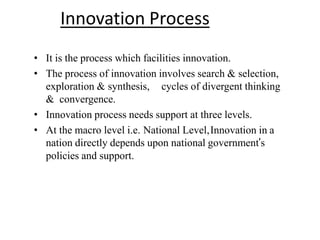
• It is the process which facilities innovation.
• The process of innovation involves search & selection,
exploration & synthesis, cycles of divergent thinking
& convergence.
• Innovation process needs support at three levels.
• At the macro level i.e. National Level,Innovation in a
nation directly depends upon national government’s
policies and support.
Innovation
Process
Contd …
•
•
• At the next level i.e. Enterprise Level, Innovation in
enterprises depends upon top management’s support and
commitment. It is the top management which sets the
direction and environment for the innovation in an
organization.
Lastly at the bottom level ie. Individual Level,
Organizations should create mutifunctional teams and
encourage individuals involved in the innovation process.
Innovation largely depends upon actions and motivation of
multifunctional teams and individuals involved in the
innovation process.
Innovation is largely responsibility of enterprise
Innovation Process vs Process innovation
S Innovation Process Process innovation
No
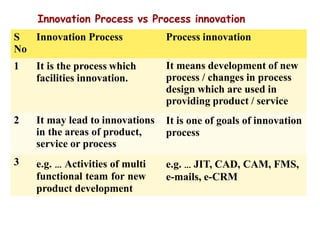
1 It is the process which
facilities innovation.
It means development of new
process / changes in process
design which are used in
providing product / service
2 It may lead to innovations
in the areas of product,
service or process
It is one of goals of innovation
process
3 e.g. … Activities of multi
functional team for new
product development
e.g. … JIT, CAD, CAM, FMS,
e-mails, e-CRM
Innovation Process Models
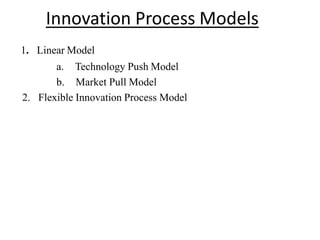
1. Linear Model
a. Technology Push Model
b. Market Pull Model
2. Flexible Innovation Process Model
Linear Innovation Process Models
1. Linear Model
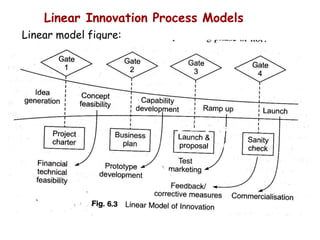
• Under this model, product or service concept is
frozen at early stage so as to minimize risk.
• In this model, innovation process in enterprises
involves series of sequential phases / steps
arranged in such manner that the preceding phase
must be cleared before moving to next /
succeeding phase.
• Thus project must through pass a gate with the
permission of a gatekeeper before moving to next
/ succeeding phase.
Linear Innovation Process Models
Contd….
• Criteria for passing through each gate and the person at
each gate (gate keeper) are defined beforehand.
• The gatekeeper examines whethere stated objectives for
the preceding phase have been properly met or not &
whether desired development has taken place at the
preceding phase or not?
Linear Innovation Process Models
Linear model figure:
Linear Innovation Process Models
Linear model works well only when
• Time required to innovate is shorter than rate of change in
environment
• Quality, reliability & safety requirements are critical
•Safe and suitable for a first time beginner This
model is generally followed for incremental
Innovation. It is linear in the sense that here innovation
process is tightly controlled and directed from the
beginning itself towards set targets / goals and inputs are
controlled to attain desired targets / goals.
Linear Innovation Process Models
Weakness / Limitations of the linear model are
•
•
•
•
•
•
• Low gatekeeper knowledge may lead to poor judgements,
delayed evaluation or rejection of good projects
Slow & serial process as it is step by step approach, thus time
consuming
Concept frozen too early, however customer needs / market
requirements may undergo change subsequently at later stage
Focused on control through gates, not on customer
Long review preparation time
Narrow criteria for evaluation which may be rigid
More focus on attaining target / maturity, less focus on
learning
Linear Innovation Process Models
Common types of linear model are
a. Technology push model
b. Market pull model
Linear Innovation Process Models
1.a. Technology Push model
• It is the first generation linear model .
• Under this model, technology is regarded as key driver of
innovation.
• Whenever a new / improvedtechnology emerges, it leads
to innovations of new products, services or processes.
• Technology Push innovation involves series of sequential
steps i.e. Fundamental research (Basic science),
Application Research, Design, Engineering,
Manufacturing, Marketing & Sales.
Contd…. Technology Push model
•
• User / Consumer is treated as passive recipient of output
i.e. it is presumed that if a new / improved product or
service, based on new technology, is developed without
getting feedback / consulting consumer / user and it is
offered to consumer / user, he will accept the new
product or service.
Thus the model ignores the consumer needs and market
requirements.
1.b. Market Pull linear model
•
•
This is the second generation linear model.
It includes and integrates user needs in the innovation
process.
Here consumer needs / market requirements are regarded as
the key driver of innovation process.
Market Pull innovation involves series of sequential steps i.e:
Assessing consumer needs / market requirements, Concept
/idea generation, Refining idea to atleast meet consumer
needs, Design, Engineering, Manufacturing, Test marketing &
Sales.
Some examples are : Market Pull Innovations In
Phones,UPS, Invertors
•
•
•
Flexible Innovation Process Models
2. Flexible Innovation Process Model
•
•
•
• Initially, Innovation was deemed to be linear / directed /
palnned activity.
Now innovation is regarded also as non-linear and ideas /
improvements can emerge from any source and at any stage
of innovation process.
The combination of linear & non linearity approaches have
led to emergence of Third Generation models which reflect
complexity of real innovation process.
These models include Technology Push + Market Pull
combination, R&D + Marketing, Cyclical Model etc.
Contd … Flexible Innovation ProcessModel
•
•
• The models attempt to explain the radical innovation
process in rapidly changing business environment.
In these models, phases are over lapped i.e. development in
more than one phase can continue at the same point of time.
No design is locked down earlier than absolute necessary so
as not to miss a newly emerging technology or new
opportunity.
Flexible Innovation Process Models
Flexible Innovation Process Model
Contd … Flexible Innovation Process Model
• According to Cycling Model, innovation is cyclical in the
sense that it is driven by the product improvement cycle.
• This cycle often begins with customer needs.; which keep
on changing. Also an enterprises may be working for new
product development simultaneously. Thus there are cycles
of innovation.
Contd … Flexible Innovation ProcessModel
•
•
• The process of technological innovation involves complex
relationships amongst set of key variables like –
Inventions,Innovations, Diffusion Paths and Investment
Activity.
The complex relations between these variables form a non-
linear system with its underlying ramifications which can
lead to unexpected & possible chaotic results.
Thus proper interaction & integration between R&D,
Manufacturing, Marketing & Other Corporate Functions
helps in proper management of Innovation process.
Flexible Innovation
Process Models
• Continuous interaction with market User needs
oriented
• More chances of acceptance of product etc Less risk of
failure & resultant after-effects
a. Advantages
b. Disadvantages
• Chaotic in nature
• May become directionless

Understanding innovation process

  • 1.
  • 2.
    Innovation Process • Itis the process which facilities innovation. • The process of innovation involves search & selection, exploration & synthesis, cycles of divergent thinking & convergence. • Innovation process needs support at three levels. • At the macro level i.e. National Level,Innovation in a nation directly depends upon national government’s policies and support.
  • 3.
  • 4.
    Contd … • • • Atthe next level i.e. Enterprise Level, Innovation in enterprises depends upon top management’s support and commitment. It is the top management which sets the direction and environment for the innovation in an organization. Lastly at the bottom level ie. Individual Level, Organizations should create mutifunctional teams and encourage individuals involved in the innovation process. Innovation largely depends upon actions and motivation of multifunctional teams and individuals involved in the innovation process. Innovation is largely responsibility of enterprise
  • 5.
    Innovation Process vsProcess innovation S Innovation Process Process innovation No 1 It is the process which facilities innovation. It means development of new process / changes in process design which are used in providing product / service 2 It may lead to innovations in the areas of product, service or process It is one of goals of innovation process 3 e.g. … Activities of multi functional team for new product development e.g. … JIT, CAD, CAM, FMS, e-mails, e-CRM
  • 6.
    Innovation Process Models 1.Linear Model a. Technology Push Model b. Market Pull Model 2. Flexible Innovation Process Model
  • 7.
    Linear Innovation ProcessModels 1. Linear Model • Under this model, product or service concept is frozen at early stage so as to minimize risk. • In this model, innovation process in enterprises involves series of sequential phases / steps arranged in such manner that the preceding phase must be cleared before moving to next / succeeding phase. • Thus project must through pass a gate with the permission of a gatekeeper before moving to next / succeeding phase.
  • 8.
    Linear Innovation ProcessModels Contd…. • Criteria for passing through each gate and the person at each gate (gate keeper) are defined beforehand. • The gatekeeper examines whethere stated objectives for the preceding phase have been properly met or not & whether desired development has taken place at the preceding phase or not?
  • 9.
    Linear Innovation ProcessModels Linear model figure:
  • 10.
    Linear Innovation ProcessModels Linear model works well only when • Time required to innovate is shorter than rate of change in environment • Quality, reliability & safety requirements are critical •Safe and suitable for a first time beginner This model is generally followed for incremental Innovation. It is linear in the sense that here innovation process is tightly controlled and directed from the beginning itself towards set targets / goals and inputs are controlled to attain desired targets / goals.
  • 11.
    Linear Innovation ProcessModels Weakness / Limitations of the linear model are • • • • • • • Low gatekeeper knowledge may lead to poor judgements, delayed evaluation or rejection of good projects Slow & serial process as it is step by step approach, thus time consuming Concept frozen too early, however customer needs / market requirements may undergo change subsequently at later stage Focused on control through gates, not on customer Long review preparation time Narrow criteria for evaluation which may be rigid More focus on attaining target / maturity, less focus on learning
  • 12.
    Linear Innovation ProcessModels Common types of linear model are a. Technology push model b. Market pull model
  • 13.
    Linear Innovation ProcessModels 1.a. Technology Push model • It is the first generation linear model . • Under this model, technology is regarded as key driver of innovation. • Whenever a new / improvedtechnology emerges, it leads to innovations of new products, services or processes. • Technology Push innovation involves series of sequential steps i.e. Fundamental research (Basic science), Application Research, Design, Engineering, Manufacturing, Marketing & Sales.
  • 14.
    Contd…. Technology Pushmodel • • User / Consumer is treated as passive recipient of output i.e. it is presumed that if a new / improved product or service, based on new technology, is developed without getting feedback / consulting consumer / user and it is offered to consumer / user, he will accept the new product or service. Thus the model ignores the consumer needs and market requirements.
  • 15.
    1.b. Market Pulllinear model • • This is the second generation linear model. It includes and integrates user needs in the innovation process. Here consumer needs / market requirements are regarded as the key driver of innovation process. Market Pull innovation involves series of sequential steps i.e: Assessing consumer needs / market requirements, Concept /idea generation, Refining idea to atleast meet consumer needs, Design, Engineering, Manufacturing, Test marketing & Sales. Some examples are : Market Pull Innovations In Phones,UPS, Invertors • • •
  • 16.
    Flexible Innovation ProcessModels 2. Flexible Innovation Process Model • • • • Initially, Innovation was deemed to be linear / directed / palnned activity. Now innovation is regarded also as non-linear and ideas / improvements can emerge from any source and at any stage of innovation process. The combination of linear & non linearity approaches have led to emergence of Third Generation models which reflect complexity of real innovation process. These models include Technology Push + Market Pull combination, R&D + Marketing, Cyclical Model etc.
  • 17.
    Contd … FlexibleInnovation ProcessModel • • • The models attempt to explain the radical innovation process in rapidly changing business environment. In these models, phases are over lapped i.e. development in more than one phase can continue at the same point of time. No design is locked down earlier than absolute necessary so as not to miss a newly emerging technology or new opportunity.
  • 18.
    Flexible Innovation ProcessModels Flexible Innovation Process Model
  • 19.
    Contd … FlexibleInnovation Process Model • According to Cycling Model, innovation is cyclical in the sense that it is driven by the product improvement cycle. • This cycle often begins with customer needs.; which keep on changing. Also an enterprises may be working for new product development simultaneously. Thus there are cycles of innovation.
  • 20.
    Contd … FlexibleInnovation ProcessModel • • • The process of technological innovation involves complex relationships amongst set of key variables like – Inventions,Innovations, Diffusion Paths and Investment Activity. The complex relations between these variables form a non- linear system with its underlying ramifications which can lead to unexpected & possible chaotic results. Thus proper interaction & integration between R&D, Manufacturing, Marketing & Other Corporate Functions helps in proper management of Innovation process.
  • 21.
    Flexible Innovation Process Models •Continuous interaction with market User needs oriented • More chances of acceptance of product etc Less risk of failure & resultant after-effects a. Advantages b. Disadvantages • Chaotic in nature • May become directionless