ILHAMRI
CHAPTER ONE
IS STRATEGY
INFORMATION SYSTEM
ilhamri022@gmail.com
THE IMPORTANCE OF
TECHNOLOGICAL INNOVATION
In many industries technological innovation is now the most important driver
of competitive success. Firms in a wide range of industries rely on products
developed within the past five years for almost one-third (or more) of their
sales and profits. For example, at Johnson & Johnson, products developed
within the last five years account for over 30 percent of sales, and sales from
products developed within the past five years at 3M have hit as high as 45
percent in recent years.
LO R E M IPS UM DO LO R S IT A ME T
• If the push for innovation has raised the competitive bar for
industries, arguably making success just that much more
complicated for organizations, its net effect on society is
more clearly positive. Innovation enables a wider range of
goods and services to be delivered to people worldwide. It
has made the production of food and other necessities more
efficient, yielded medical treatments that improve health
conditions, and enabled people to travel to and
communicate with almost every part of the world. To get a
real sense of the magnitude of the effect of technological
innovation on society, look at Figure 1.1, which shows a
timeline of some of the most important technological
innovations developed over the last 200 years. Imagine how
different life would be without these innovations!
Add a footer 3
THE IMPACT OF TECHNOLOGICAL
INNOVATION ON SOCIETY
FR
INNOVATION BY INDUSTRY: THE
IMPORTANCE OF STRATEGY
• As will be shown in Chapter Two, the majority
of effort and money invested in technological
innovation comes from industrial firms.
However, in the frenetic race to innovate,
many firms charge headlong into new product
development without clear strategies or well-
developed processes for choosing and
managing projects. Such firms often initiate
more projects than they can effectively
support, choose projects that are a poor fit
with the firm’s resources and objectives,
Add a footer 4
FR
The Innovation Funnel
• Most innovative ideas do not become successful new products. Many
studies suggest that only one out of several thousand ideas results in
a successful new product: Many projects do not result in technically
feasible products and, of those that do, many fail to earn a
commercial return. According a 2012 study by the Product
Development and Management Association,
• only about one in nine projects that are initiated are successful, and
of those that make it to the point of being launched to the market,
only about half earn a profit.7 Furthermore, many ideas are sifted
through and abandoned before
Add a footer 5
FRThe Strategic Management of
Technological Innovation
Improving a firm’s innovation success rate requires a well-
crafted strategy. A firm’s innovation projects should align
with its resources and objectives, leveraging its core
competencies and helping it achieve its strategic intent. A
firm’s organizational structure and control systems should
encourage the generation of innovative ideas while also
ensuring efficient implementation. A firm’s new product
development process should maximize the likelihood of
projects being both technically and commercially successful.
To achieve these things,
Add a footer 6
FR
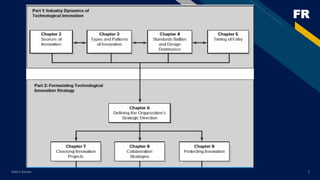
Add a footer 7

Chapter one

  • 1.
  • 2.
    THE IMPORTANCE OF TECHNOLOGICALINNOVATION In many industries technological innovation is now the most important driver of competitive success. Firms in a wide range of industries rely on products developed within the past five years for almost one-third (or more) of their sales and profits. For example, at Johnson & Johnson, products developed within the last five years account for over 30 percent of sales, and sales from products developed within the past five years at 3M have hit as high as 45 percent in recent years.
  • 3.
    LO R EM IPS UM DO LO R S IT A ME T • If the push for innovation has raised the competitive bar for industries, arguably making success just that much more complicated for organizations, its net effect on society is more clearly positive. Innovation enables a wider range of goods and services to be delivered to people worldwide. It has made the production of food and other necessities more efficient, yielded medical treatments that improve health conditions, and enabled people to travel to and communicate with almost every part of the world. To get a real sense of the magnitude of the effect of technological innovation on society, look at Figure 1.1, which shows a timeline of some of the most important technological innovations developed over the last 200 years. Imagine how different life would be without these innovations! Add a footer 3 THE IMPACT OF TECHNOLOGICAL INNOVATION ON SOCIETY
  • 4.
    FR INNOVATION BY INDUSTRY:THE IMPORTANCE OF STRATEGY • As will be shown in Chapter Two, the majority of effort and money invested in technological innovation comes from industrial firms. However, in the frenetic race to innovate, many firms charge headlong into new product development without clear strategies or well- developed processes for choosing and managing projects. Such firms often initiate more projects than they can effectively support, choose projects that are a poor fit with the firm’s resources and objectives, Add a footer 4
  • 5.
    FR The Innovation Funnel •Most innovative ideas do not become successful new products. Many studies suggest that only one out of several thousand ideas results in a successful new product: Many projects do not result in technically feasible products and, of those that do, many fail to earn a commercial return. According a 2012 study by the Product Development and Management Association, • only about one in nine projects that are initiated are successful, and of those that make it to the point of being launched to the market, only about half earn a profit.7 Furthermore, many ideas are sifted through and abandoned before Add a footer 5
  • 6.
    FRThe Strategic Managementof Technological Innovation Improving a firm’s innovation success rate requires a well- crafted strategy. A firm’s innovation projects should align with its resources and objectives, leveraging its core competencies and helping it achieve its strategic intent. A firm’s organizational structure and control systems should encourage the generation of innovative ideas while also ensuring efficient implementation. A firm’s new product development process should maximize the likelihood of projects being both technically and commercially successful. To achieve these things, Add a footer 6
  • 7.