Mise-en-scène
'Mise-en-scène' is a French term meaning
"what is put into the scene/frame"
The elements of mise-en-scène:
1- Settings and props
2- Costume, hair and make-up
3- Body language and facial expressions
4- Positioning of the characters in the scene
5- Lighting and colour
1- Settings and props
The setting is the time, place and circumstances
in which a media text takes place. Props are the
objects that the audience see in the setting.
Settings and props in various genres of
film
Typical settings and props in
a science-fiction film
include:
- A battle against aliens
- "Sci-fi" technology such as
time travel machines

- Travelling space
- Mystical/metaphysical
elements
Settings and props in various genres of
film
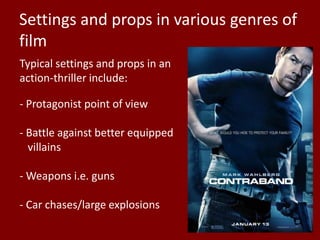
Typical settings and props in an
action-thriller include:
- Protagonist point of view
- Battle against better equipped
villains
- Weapons i.e. guns

- Car chases/large explosions
2- Costume, hair and make-up
The costume, hair and make-up immediately
reveal what time period, society or culture the
film is set in. It also indicate what the character’s
personality is like alongside their status and job.
2- Costume, hair and make-up
Villains will typically wear black. We usually
associate black with death which works
effectively in films because a black costume
would convey the feel of mystery and danger.
2- Costume, hair and make-up
Accessories such as hats and dark glasses to
conceal the face slightly are also effective
villainous costumes. On the other hand, heroes
will tend to wear lighter colours, even white
because it symbolises purity and innocence. A
hero would have nothing sinister to conceal
unlike a villain.
Costume, hair and make-up in various
genres of film
In a Western film the costume will consist of a
cowboy hat, boots with spurs and boot-cut
jeans. The hair and
make-up will make
the characters look
unkempt to suit the
rough, desert setting.
3- Body language and facial
expressions
We communicate through body language and
facial expressions. Facial expressions are
particularly important when used in media texts
with a close ups and extreme close ups. They
reveal different emotions towards various
situations and other characters.
4- Positioning of the characters in the
scene
The positioning of characters in the scene is vital
in emphasising the importance of characters.
They can be placed in the foreground, middle
ground or background.
4- Positioning of the characters in the
scene
When characters are placed within the frame
they give a balanced feel to the shot whereas
when they are both placed at the edge of the
frame, it indicates distance between them.
5- Lighting and colour
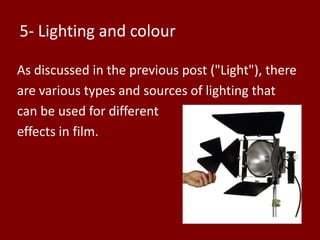
As discussed in the previous post ("Light"), there
are various types and sources of lighting that
can be used for different
effects in film.
5- Lighting and colour
Light can create suspense when shading areas of
the face of body. It can also reflect a characters
state of mind, for example if the light source is
bright then the character may be happy, if the
light source is dark then they may be distressed,
a strobe effect can show confusion and
disorientation.
A brief overview of the different types
of lighting:
Key Light
The brightest and most influential light which forms sharp shadows and can
be used to highlight a subject or create suspense.
Back Light
This counteracts the key light in order to balance the lighting however if used
alone, a silhouette of the subject is formed which can create suspense.
Low-Key Lighting
This is when key and back lights are used together to produce harsh shadows
due to the sharp contrast in lighting.
A brief overview of the different types
of lighting:
Reflector/Filler Light
This helps to soften the shadowing that the key and back lights produce- it
reveals the entire subject giving a character an honest or vulnerable
appearance as nothing is hidden.
High-Key Lighting
This is when more filler lights are used to remove all shadows and this makes
the lighting appear more realistic.
A brief overview of the different types
of lighting:
Underlighting
When the light source is positioned below the subject- this is often used in
thrillers and/or horrors.

Top Lighting
The light source is above the subject which creates a glamorous look.
5- Lighting and colour
Colour:
Colour works on the subconscious mind to create the mood, for example we
associate the colour red with danger, passion or love. The first use of colour in
films featured in Voyage Travers l’Impossible (Georges
s, 1904)- the
frames were hand painted.
http://www.youtube.com/watch?v=sPYyq9vB6fY
5- Lighting and colour
The next development was the use of two-strip technicolour which used only
red and green.
This is a clip from The Mystery of the Wax Museum (1933) which
demonstrates the use of two-strip technicolour:

http://www.youtube.com/watch?v=eVrgbxcQhbA
The first full three-strip technicolour was Becky Sharp (1935):
http://www.youtube.com/watch?v=a-P_Ira6kgE
In the 1930-1940s colour represented fantasy whereas black
and white represented reality; today the opposite is true.
5- Lighting and colour
Denotation and Connotation:
“Denotation” is the literal description of an idea, concept or
object.
“Connotation” is what we associate an idea, concept or object
with.

For example: the colour BLUE
Denotation: a particular wavelength in the electromagnetic spectrum
Connotation: blue indicates calmness, sadness, depression
5- Lighting and colour
http://www.youtube.com/watch?v=KxHdvs01QEA
The opening of We Need to Talk About Kevin
uses red as the dominant colour. It is used in a
brutal way which suggests that there will be
death and violence to follow.

Mise-en-scène

  • 1.
    Mise-en-scène 'Mise-en-scène' is aFrench term meaning "what is put into the scene/frame"
  • 2.
    The elements ofmise-en-scène: 1- Settings and props 2- Costume, hair and make-up 3- Body language and facial expressions 4- Positioning of the characters in the scene 5- Lighting and colour
  • 3.
    1- Settings andprops The setting is the time, place and circumstances in which a media text takes place. Props are the objects that the audience see in the setting.
  • 4.
    Settings and propsin various genres of film Typical settings and props in a science-fiction film include: - A battle against aliens - "Sci-fi" technology such as time travel machines - Travelling space - Mystical/metaphysical elements
  • 5.
    Settings and propsin various genres of film Typical settings and props in an action-thriller include: - Protagonist point of view - Battle against better equipped villains - Weapons i.e. guns - Car chases/large explosions
  • 6.
    2- Costume, hairand make-up The costume, hair and make-up immediately reveal what time period, society or culture the film is set in. It also indicate what the character’s personality is like alongside their status and job.
  • 7.
    2- Costume, hairand make-up Villains will typically wear black. We usually associate black with death which works effectively in films because a black costume would convey the feel of mystery and danger.
  • 8.
    2- Costume, hairand make-up Accessories such as hats and dark glasses to conceal the face slightly are also effective villainous costumes. On the other hand, heroes will tend to wear lighter colours, even white because it symbolises purity and innocence. A hero would have nothing sinister to conceal unlike a villain.
  • 9.
    Costume, hair andmake-up in various genres of film In a Western film the costume will consist of a cowboy hat, boots with spurs and boot-cut jeans. The hair and make-up will make the characters look unkempt to suit the rough, desert setting.
  • 10.
    3- Body languageand facial expressions We communicate through body language and facial expressions. Facial expressions are particularly important when used in media texts with a close ups and extreme close ups. They reveal different emotions towards various situations and other characters.
  • 11.
    4- Positioning ofthe characters in the scene The positioning of characters in the scene is vital in emphasising the importance of characters. They can be placed in the foreground, middle ground or background.
  • 12.
    4- Positioning ofthe characters in the scene When characters are placed within the frame they give a balanced feel to the shot whereas when they are both placed at the edge of the frame, it indicates distance between them.
  • 13.
    5- Lighting andcolour As discussed in the previous post ("Light"), there are various types and sources of lighting that can be used for different effects in film.
  • 14.
    5- Lighting andcolour Light can create suspense when shading areas of the face of body. It can also reflect a characters state of mind, for example if the light source is bright then the character may be happy, if the light source is dark then they may be distressed, a strobe effect can show confusion and disorientation.
  • 15.
    A brief overviewof the different types of lighting: Key Light The brightest and most influential light which forms sharp shadows and can be used to highlight a subject or create suspense. Back Light This counteracts the key light in order to balance the lighting however if used alone, a silhouette of the subject is formed which can create suspense. Low-Key Lighting This is when key and back lights are used together to produce harsh shadows due to the sharp contrast in lighting.
  • 16.
    A brief overviewof the different types of lighting: Reflector/Filler Light This helps to soften the shadowing that the key and back lights produce- it reveals the entire subject giving a character an honest or vulnerable appearance as nothing is hidden. High-Key Lighting This is when more filler lights are used to remove all shadows and this makes the lighting appear more realistic.
  • 17.
    A brief overviewof the different types of lighting: Underlighting When the light source is positioned below the subject- this is often used in thrillers and/or horrors. Top Lighting The light source is above the subject which creates a glamorous look.
  • 18.
    5- Lighting andcolour Colour: Colour works on the subconscious mind to create the mood, for example we associate the colour red with danger, passion or love. The first use of colour in films featured in Voyage Travers l’Impossible (Georges s, 1904)- the frames were hand painted. http://www.youtube.com/watch?v=sPYyq9vB6fY
  • 19.
    5- Lighting andcolour The next development was the use of two-strip technicolour which used only red and green. This is a clip from The Mystery of the Wax Museum (1933) which demonstrates the use of two-strip technicolour: http://www.youtube.com/watch?v=eVrgbxcQhbA The first full three-strip technicolour was Becky Sharp (1935): http://www.youtube.com/watch?v=a-P_Ira6kgE In the 1930-1940s colour represented fantasy whereas black and white represented reality; today the opposite is true.
  • 20.
    5- Lighting andcolour Denotation and Connotation: “Denotation” is the literal description of an idea, concept or object. “Connotation” is what we associate an idea, concept or object with. For example: the colour BLUE Denotation: a particular wavelength in the electromagnetic spectrum Connotation: blue indicates calmness, sadness, depression
  • 21.
    5- Lighting andcolour http://www.youtube.com/watch?v=KxHdvs01QEA The opening of We Need to Talk About Kevin uses red as the dominant colour. It is used in a brutal way which suggests that there will be death and violence to follow.