Management Information
System (MIS)
Introduction
Management Information System (MIS) provides
information for the managerial activities in an organization.
The main purpose of this research is, MIS provides accurate
and timely information necessary to facilitate the decision-
making process and enable the organizations planning,
control, and operational functions to be carried out
effectively.
Management Information System (MIS) is basically
concerned with processing data information and is then
communicated to the various Departments in an
organization for appropriate decision-making.
In Simple words
MIS Gives
 Right Information
 To the right person
 At the right Place
 At the right time
 In the right form
 At the right cost
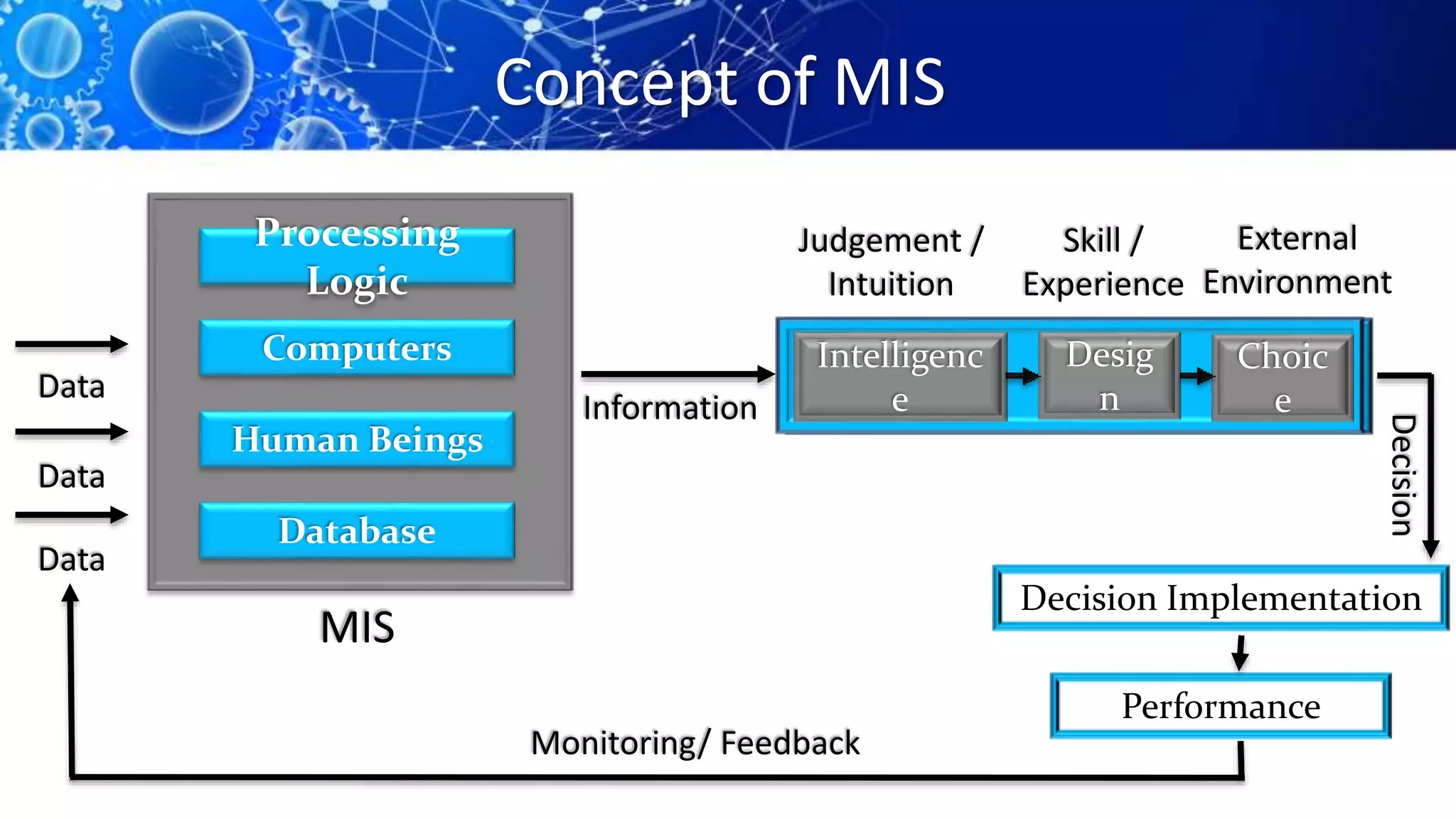
Concept of MIS
Data
Data
Data
Processing
Logic
Computers
Human Beings
Database
MIS
Information
Intelligence Design Choice
Intelligenc
e
Desig
n
Choic
e
Judgement /
Intuition
Skill /
Experience
External
Environment
Monitoring/ Feedback
Decision Implementation
Performance
Decision
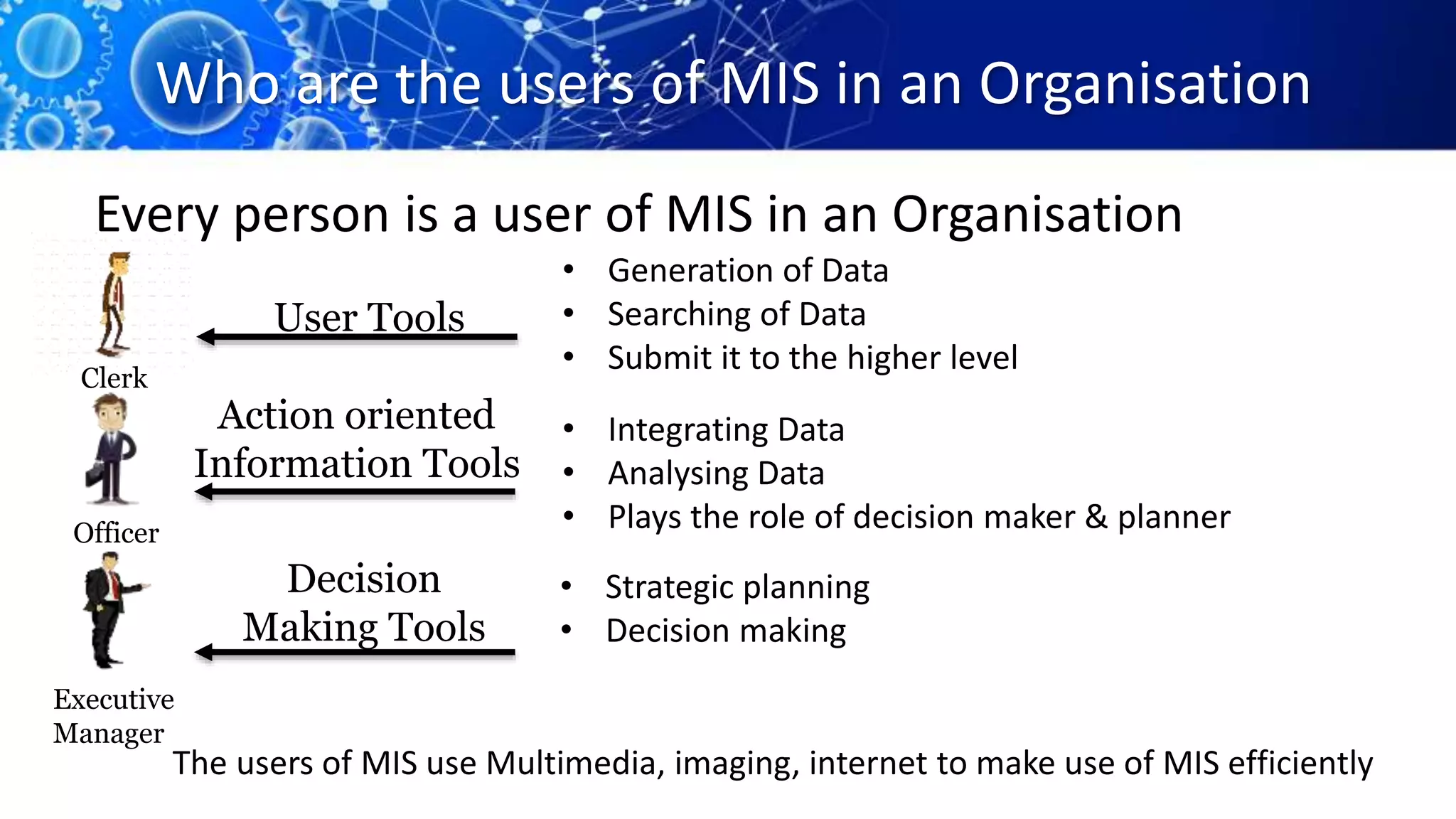
Who are the users of MIS in an Organisation
Every person is a user of MIS in an Organisation
Clerk
User Tools
• Generation of Data
• Searching of Data
• Submit it to the higher level
Officer
Action oriented
Information Tools
• Integrating Data
• Analysing Data
• Plays the role of decision maker & planner
Executive
Manager
Decision
Making Tools
• Strategic planning
• Decision making
The users of MIS use Multimedia, imaging, internet to make use of MIS efficiently
• Helps in decision making
• Helps in co-ordination between the
department
• Helps in finding out the problem
• Helps to sustain in competitive market
• Improves the Profit margin.
Roles Of MIS
Management Information System (MIS) Reports
1. Sales Report:
• This report is prepared by marketing and sales division and provided a
complete sales analysis of different products sold in different geographical
areas by the concern.
• The analysis is based on the budgeted and actual sales figures. It clearly points
out the difference between budgeted and actual sales figures, known as sales
variance, with reasons.
2. Budget:
• Several types of budgets are prepared in the business, i.e. income and
expenditure budget, production budgets, cash budgets etc. These budgets
contain a vast information.
3. Production Report:
• This report is prepared by the manufacturing division of the concern and states
4. Cash flow statements:
• Such as a statement gives, the figures of cash inflows and cash outflow during
the period of operations. It also indicates the sources of funds utilised in case
cash outflows are more than cash inflows.
5. Funds flow statement:
• This statement is prepared by the accounting and finance division of the
concern and it clearly points out various sources of funds as well as their
application areas during any period.
6. Budgeted and actual profit report:
• This report is prepared in accounts department and points out clearly the
figures of budgeted and actual profit of the concern during a specified period. It
also states the reasons which have accounted for any decrease or increase in the
actual profit figure.
7. Machine utilization report:
• This report too is prepared by the superior in-charge of the shop floor in the
manufacturing division. Such a report clearly gives the details of machine hours
utilised for different jobs and the duration for which machine remained idle.
8. Report on financial statements:
• Income statement and balance sheet are important sources of giving financial
information not only to shareholders but also to the government and other
concerned parties.
9. Report on ideal time:
• This report is prepared at the shop floor level of the manufacturing division by
using time booking records. This report states clearly the time actually spent by
the worker on different jobs and the time for which he was sitting idle due to
either want of material, electricity or any other resource.
10. Abnormal losses report:
• This report is submitted by the manufacturing division of the concern and reflects any
increase in product cost arising due to abnormal situations in the areas of material, labour
and ideal facilities.
11. Cost reports:
• In respect of different departments of an enterprise, several cost reports are prepared. For
example, production cost report, departmental cost report etc. Through these reports,
several types of information are given to the management.
12. Statistical publications:
• Several types of statistical information are needed for plan formulation, decision making
and control. They are obtained from published and other sources.
13. Orders in hand report:
• This report is prepared by marketing and sales division and states in qualitative terms the
orders received by the concern in respect of each of its products along with the ratio of
• Effective communication between developer
• Understanding the management process
• Create the unfide procedure
• Understanding the requirement of MIS
• Flexible for Future change
• Problem in MIS
Guideline for developing MIS
Case Study
McDonald’s Corporation (McDonald’s), a US-based global hamburger
was one of the world’s largest restaurant chains as of 2017. The company had
its roots in a small fast food joint started by two brothers named Richard James
McDonald and Maurice James McDonald in San Bernardino, California in
1940. There was the rapid growth of the fast food retail chain in the US and
globally in the subsequent years. It took 33 years for McDonald’s to open its
first 10,000 restaurants. While it touched the 20,000-restaurant mark in mid-
1996 and the number went on increasing. McDonald’s controlled many of its
self-operated and franchised restaurants globally, managing the marketing,
restaurant operations, HR, real estate development training, as well as quality
control. As a consequence, the network was huge and the amount of
information was massive. The company encountered many challenges in
developing and preserving the information needed for effective decision
making. To solve this problem, McDonald’s developed MIS to maintain and
leverage the customers’ information across the globe.
15
Lay Chheda 21
Romin Chheta 22
Dhwani Cholera 23
Durga Choudhary 24
Mahima Choudhary 25
Groupno.5

MIS and their Reports

  • 1.
  • 2.
    Introduction Management Information System(MIS) provides information for the managerial activities in an organization. The main purpose of this research is, MIS provides accurate and timely information necessary to facilitate the decision- making process and enable the organizations planning, control, and operational functions to be carried out effectively. Management Information System (MIS) is basically concerned with processing data information and is then communicated to the various Departments in an organization for appropriate decision-making.
  • 3.
    In Simple words MISGives  Right Information  To the right person  At the right Place  At the right time  In the right form  At the right cost
  • 4.
    Concept of MIS Data Data Data Processing Logic Computers HumanBeings Database MIS Information Intelligence Design Choice Intelligenc e Desig n Choic e Judgement / Intuition Skill / Experience External Environment Monitoring/ Feedback Decision Implementation Performance Decision
  • 6.
    Who are theusers of MIS in an Organisation Every person is a user of MIS in an Organisation Clerk User Tools • Generation of Data • Searching of Data • Submit it to the higher level Officer Action oriented Information Tools • Integrating Data • Analysing Data • Plays the role of decision maker & planner Executive Manager Decision Making Tools • Strategic planning • Decision making The users of MIS use Multimedia, imaging, internet to make use of MIS efficiently
  • 7.
    • Helps indecision making • Helps in co-ordination between the department • Helps in finding out the problem • Helps to sustain in competitive market • Improves the Profit margin. Roles Of MIS
  • 8.
    Management Information System(MIS) Reports 1. Sales Report: • This report is prepared by marketing and sales division and provided a complete sales analysis of different products sold in different geographical areas by the concern. • The analysis is based on the budgeted and actual sales figures. It clearly points out the difference between budgeted and actual sales figures, known as sales variance, with reasons. 2. Budget: • Several types of budgets are prepared in the business, i.e. income and expenditure budget, production budgets, cash budgets etc. These budgets contain a vast information. 3. Production Report: • This report is prepared by the manufacturing division of the concern and states
  • 9.
    4. Cash flowstatements: • Such as a statement gives, the figures of cash inflows and cash outflow during the period of operations. It also indicates the sources of funds utilised in case cash outflows are more than cash inflows. 5. Funds flow statement: • This statement is prepared by the accounting and finance division of the concern and it clearly points out various sources of funds as well as their application areas during any period. 6. Budgeted and actual profit report: • This report is prepared in accounts department and points out clearly the figures of budgeted and actual profit of the concern during a specified period. It also states the reasons which have accounted for any decrease or increase in the actual profit figure.
  • 10.
    7. Machine utilizationreport: • This report too is prepared by the superior in-charge of the shop floor in the manufacturing division. Such a report clearly gives the details of machine hours utilised for different jobs and the duration for which machine remained idle. 8. Report on financial statements: • Income statement and balance sheet are important sources of giving financial information not only to shareholders but also to the government and other concerned parties. 9. Report on ideal time: • This report is prepared at the shop floor level of the manufacturing division by using time booking records. This report states clearly the time actually spent by the worker on different jobs and the time for which he was sitting idle due to either want of material, electricity or any other resource.
  • 11.
    10. Abnormal lossesreport: • This report is submitted by the manufacturing division of the concern and reflects any increase in product cost arising due to abnormal situations in the areas of material, labour and ideal facilities. 11. Cost reports: • In respect of different departments of an enterprise, several cost reports are prepared. For example, production cost report, departmental cost report etc. Through these reports, several types of information are given to the management. 12. Statistical publications: • Several types of statistical information are needed for plan formulation, decision making and control. They are obtained from published and other sources. 13. Orders in hand report: • This report is prepared by marketing and sales division and states in qualitative terms the orders received by the concern in respect of each of its products along with the ratio of
  • 12.
    • Effective communicationbetween developer • Understanding the management process • Create the unfide procedure • Understanding the requirement of MIS • Flexible for Future change • Problem in MIS Guideline for developing MIS
  • 13.
    Case Study McDonald’s Corporation(McDonald’s), a US-based global hamburger was one of the world’s largest restaurant chains as of 2017. The company had its roots in a small fast food joint started by two brothers named Richard James McDonald and Maurice James McDonald in San Bernardino, California in 1940. There was the rapid growth of the fast food retail chain in the US and globally in the subsequent years. It took 33 years for McDonald’s to open its first 10,000 restaurants. While it touched the 20,000-restaurant mark in mid- 1996 and the number went on increasing. McDonald’s controlled many of its self-operated and franchised restaurants globally, managing the marketing, restaurant operations, HR, real estate development training, as well as quality control. As a consequence, the network was huge and the amount of information was massive. The company encountered many challenges in developing and preserving the information needed for effective decision making. To solve this problem, McDonald’s developed MIS to maintain and leverage the customers’ information across the globe.
  • 15.
    15 Lay Chheda 21 RominChheta 22 Dhwani Cholera 23 Durga Choudhary 24 Mahima Choudhary 25 Groupno.5