CASE STUDY
4544
Steven Casey, Ergonomic systems design
iVTInternational.com November 2012iVTInternational.com November 2012
To ensure THE new cab for ITS shovels and draglines was truly
‘operator-centric’, CATERPILLAR’S design team conducted 83
interviews on 50 machines WORLDWIDE, GATHERING fascinating
insights into the needs of the people who ‘live’ in them
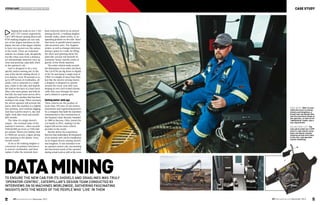
main image: With 12-hour
shifts the norm in mining
shovels and draglines, a
brand-new cab design that
met the functional needs of
the operator, as well as his
‘habitational’ needs, was a
key requirement
Below from left: The
new cab in action on a 7495
electric rope shovel; early
basic cab layout concept
showing second entry door
to the rear; and operator
station modelling
DATAMINING
Tipping the scales at over 1,361
and 7,257 tonnes respectively,
Cat’s 7495 electric mining shovel and
8750 walking dragline are not only
two of the largest machines on the
planet, but two of the largest vehicles
to have ever moved over the surface
of the Earth. These are industrial
vehicles on a titanic scale, deceptively
toy-like when seen from a distance,
yet astonishingly immense once up
close and personal, especially when
in the operator’s cab.
Each is designed to do a very
specific surface-mining job. In the
case of the electric mining shovel, it
is to remove, every 30 seconds or so,
up to 109 tonnes of overburden, oil
sands, coal or minerals in a single
pass, rotate to the side, and deposit
the load in the back of a haul truck.
After a few more passes, and with its
bed full, the haul truck moves off to
be replaced by another that has been
waiting in the wings. When necessary,
the shovel operator will activate the
tracks, drive the machine to a slightly
new position, and continue digging.
And that is pretty much it, day and
night, week after week and month
after month.
The value of a single shovel’s
output – the eventual value of the
material it removes – often exceeds
US$160,000 per hour or US$2,666
per minute. Sliced even further, that
is US$44 per second, a figure giving
new meaning to the phrase ‘every
second counts’.
As far as the walking dragline is
concerned, its primary function is
to remove overburden, and then
replace it after the minerals have
been removed (often by an electric
mining shovel). A walking dragline
literally walks, albeit slowly, to its
operating position on two side ‘shoes’
that move in parallel about massive
side-mounted cams. The dragline
rotates, as well as changes direction,
during a pause in a walk, by lifting
the shoes and spinning about the
plate-like circular tub beneath its
enormous ‘house’ and the centre of
gravity of the whole machine.
The entire vehicle easily exceeds
the dimensions of an entire city block.
The Cat 8750 can dig down to depths
of 66.7m and dump a single load of
129m3
at a height of more than 50m.
Just like the electric mining shovel,
a dragline is designed to operate
around the clock, year after year,
keeping in tow a reel of thick electric
cable that runs through the mine
and is linked to a power grid.
Getting better with age
These vehicles are the product of
more than 130 years of rich history,
innovation and engineering prowess
by a company that built the machines
instrumental in the construction of
the Panama Canal. Bucyrus, founded
in 1880 in Bucyrus, Ohio, joined the
Cat family in 2011, making Cat the
largest full-service mine vehicle
provider in the world.
Shortly before the acquisition,
Bucyrus had undertaken development
of an entirely new cab for installation
on its largest electric mining shovels
and draglines. It was intended to be
an operator-centric cab, one meeting
the functional needs of the operator
during actual work as well as the more
CASE STUDYCASE STUDY
46 iVTInternational.com November 2012
quality. All answers and other
comments were written down, and
particularly insightful observations
on the part of the operator were
explored and discussed. We also
made an inventory of everything
that was inside the cab. As well as all
control, display and communication
gear, this typically included a coffee
pot, microwave oven, portable radios,
helmets and safety gear, coats, tools,
documents, seats and chairs, window
cleaning equipment, vacuum cleaner,
brooms and much, much more.
Each to their own
It is important to understand that,
when employing an operator-centric
approach to design, the designer, not
the operator, still does the designing.
Operators are trained to operate, and
designers and engineers are trained
to design and engineer.
The operator, however, based on
his or her extensive experience with
the product, is in an excellent position
to point out strengths and weaknesses
to the designer, identify features that
work well and those that do not, and
discern needs and requirements that
can be the inspiration for new and
improved designs.
During our interviews, for
example, a number of skilled shovel
47iVTInternational.com November 2012
‘habitation’ or comfort-orientated
needs associated with operating a
complex machine over a long
shift in a harsh and remote
operating environment. The
cab also needed to address
the somewhat different
requirements of draglines
and shovels, as well as
integrate state-of-the-art
technology and design.
So, with an operator-
centric cab in their sights, the
cab engineering group and
product planners in South
Milwaukee, Wisconsin, USA
enlisted the expertise of Santa
Barbara, California-based
Ergonomic Systems Design,
and Formation Design Group
of Atlanta, Georgia. The two
research and design consultancies
have worked together for over 20
years, engaged in the development
of numerous industrial vehicles,
aircraft interiors, medical devices
and other products.
The team quickly set about
devising and implementing an
extensive worldwide research plan
to determine and define the new cab.
This was followed by intensive design
activities and evaluation and testing
with operators.
Operator-centric field research
The keystone of the undertaking was
a plan to visit mine sites, to see and
board as many existing machines as
possible, and interview a considerable
number of individual operators as
they went about their work.
The first stop in this multinational
trek was in the Canadian oil sands
north of Fort McMurray, Alberta.
Electric mining shovels are used
extensively in the region both for
the removal of overburden and the
extraction of oil sands. Arrangements
were made ahead of time to meet up
with a number of major mine owners.
One, sometimes two, team members
were transported, often dozens of
miles, out to the electric shovels.
The operator would cease digging
for less than a minute in preparation
for boarding. We visitors quickly
approached the shovel and tugged
on a hanging rope to pull down the
retracted stairway. Once on board,
the stairway was raised as quickly as
possible and digging was resumed.
The climb continued, three storeys
up, to the cab.
Aside from the sheer size of the
machine, the first thing one realises
after boarding a working electric
mining shovel is that there is a great
deal of motion in all axes. There may
be in excess of 3,000,000 lb of mass
under your feet, but it nonetheless
spins, decelerates, lurches, jerks and
vibrates as it engages the high wall,
lifts and fills the bucket, rotates
towards the haul truck, and releases
the load out of the bottom of the
bucket. A touch of motion sickness
is not uncommon for a first-time
visitor to an electric mining shovel.
You also find yourself looking for
things to hold on to!
Our technique was to let the
operators continue to dig while we
peppered them with questions
covering all conceivable aspects of
the machine: visibility and lighting,
push button locations and joystick
forces, display design and camera
locations, radios and communication
links, and seat comfort and ride
transportation in particularly distant
corners of some mines. Personal
safety was also of importance and of
particular concern when attempting
to board or leave a shovel with haul
trucks moving about nearby.
Although some shovel activities
involve a single individual working
alone, many times they are assisted
by a tender in a dozer whose job is
to keep the working floor flat and
clear of debris for access by the
shovel as well as arriving haul trucks.
The tender might also monitor and
position the power cable during
travel manoeuvres, as well as operate
the shovel when the main operator
takes a break for a meal. Most surface
mines usually operate on 12-hour
shifts, with shift changes in the
morning and evening.
From the Alberta oil sands, the
research team moved on to Wyoming
and the Powder River Basin, a region
supplying about 40% of all power
plant coal consumed in the USA.
Once again, shovels were visited
and operators interviewed. Visits to
various draglines and their operators
were made here as well. But unlike
shovels, draglines typically have an
anteroom behind the cab. Although
their designs and layouts can differ
considerably, anterooms are usually
about the size of a large travel trailer
and can contain cooking facilities,
dining tables, refrigerators and
considerable additional storage.
And, again unlike shovels,
draglines may frequently be staffed
with a number of individuals who
are employed as tenders, as well as
maintaining equipment inside the
massive ‘house’.
top and BOTTOM: Visibility
improvements on the shovel
and dragline (green) relative
to previous model (blue)
Above: Watching out for the
power cable when in propel
mode is a vital part of shovel
operation – superb visibility
is therefore essential
ABOVE: The importance of a
comfortable trainer’s seat
was stressed early on, as
was the need for plenty of
storage space
operators who also conduct training
noted the importance of addressing
the requirements of the trainer, not
just the operator. This eventually
led to a number of cab features that
directly support real-world training,
including the trainer and observer
seats and a separate emergency stop
switch accessible by the trainer.
Operators of different makes and
models of shovels and draglines were
interviewed, although most of them
were operators of vehicles previously
manufactured by Bucyrus or Marion,
a company acquired by Bucyrus in
1997. Our interviews lasted anywhere
from one to four hours and depended
somewhat on the availability of
“Our technique was to let the
operators continue to dig while
we peppered them with questions
covering all conceivable aspects
of the machine”
CASE STUDYCASE STUDY
After moving on to Queensland,
Australia, and two weeks visiting
various mines (primarily coking
coal) in the vicinity of Moranbah
and Emerald in the outback, the
team eventually racked up a total
of 83 (3 women, 80 men) operator
interviews on 50 machines in the
USA, Canada and Australia. Taken
together, the interviewed operators
represented a collective machine
operation experience of upwards of
one million hours, an impressive
number by any measure.
Electronic research outreach
Despite our interest in understanding
all markets, it was recognised that
not all markets around the world
could be visited by the research team.
Accordingly, shovel and dragline
operators worldwide were sent an
electronic questionnaire to further
extend the research outreach.
A total of 66 machine surveys
containing complete descriptive and
photographic records of cab interiors
and exteriors were received from
mines in Asia, Africa, North America,
South America and Europe.
Shovel and dragline operators
can be surprisingly devoted to their
unusual machines and take great
pleasure in providing detailed
information when an interest is
expressed. Whereas oriental carpets
and curtains might hang from the
walls of a dragline cab in North
Africa – and rice cookers often take
the place of a microwave oven in
cabs in Mongolia and China – there
were certainly more similarities than
differences in regards to operator
requirements for the next-generation
cab and control system.
The results from this expedition
proved to be invaluable, and were
added to the eyewitness data that
was collected during the team’s
actual mine visits.
Design development
More than 1,000 user comments
and observations were computer
analysed to identify important
themes and, ultimately, design
objectives. This information, taken
together with the team’s personal
observations and ideas, resulted in a
cab specification that would serve as
a roadmap to development.
Initially, particular attention was
paid to the basic size, structure and
layout of the cab. Numerous layout,
as well as styling, concepts were
developed using 3D computer models.
48 iVTInternational.com November 2012
The final design incorporated
an operator-forward arrangement,
trainer’s station, observer’s station,
an entry door on the side, and a
second entry door at the rear – the
latter serving as the entrance from
the anteroom in the case of a
dragline. Another reason for having
the back door was that it provided a
straight-on path to facilitate moving
a stretcher into and out of the cab in
the case of a medical emergency; an
issue we had occasionally heard about
during our interviews.
Storage, cabinets and counter
tops lined the central fore-aft aisle,
providing an efficient and functional
arrangement for the cab as a whole.
Particular attention was given to
ensuring that all of the gear that had
been previously inventoried in the
50 visited machines could be stowed
within the new layout.
Seating comfort, ride quality,
fatigue reduction, communication,
remote viewing and camera systems,
emergency systems, noise, ingress
and egress, control adjustability,
glare control, operator reach zones
and hand holds are just a few of the
topics addressed during the cab
design phase.
Visibility was deemed to be of
particular importance, so numerous
visibility studies were therefore
performed for optimal window and
pillar placement and sizing – the
result being notable improvements
ABOVE: Future operators
evaluate the cab design
mock-up in Wisconsin as
the author listens in
ABOVE: The rather cramped
toilet doesn’t quite share
the same feeling of luxury
as the cab
BELOW: Optimum window
and pillar placement and
sizing was achieved after
numerous studies had been
carried out
in the upward views of the boom,
downward views of the ground, and
views out of the side – something of
particular importance with a shovel
that is constantly co-ordinating its
movements with the comings and
goings of haul trucks.
Designing the operator’s station
was a major undertaking in its own
right. Special emphasis was given to
having a fully adjustable seating and
armrest system to accommodate the
full range of operators as they ran
controls while experiencing a
considerable amount of motion.
Touchscreen control systems have
been employed extensively due to the
large number of elements requiring
control as well as the design flexibility
that is provided by touchscreens. For
example, not only do shovel and
dragline controls operate somewhat
differently, but individual mines can
have preferred control-response
mapping. The use of touchscreens
was therefore important in meeting
these and other control and display
reconfiguration needs without the
need to have entirely different sets
of hardware.
Military human factors interface
design specifications were used in
the design of touchscreen control
and display elements to help ensure
operability in a rugged and moving
environment. Custom, patented
joystick controllers were developed
and incorporated into the fully
adjustable and supporting armrests.
Camera views from inside the ‘house’
as well as all around the vehicle are
provided by displays mounted above
the front cab window, along with a
rearview mirror that provides the
operator with a view of the cab
behind him or her without the
need to turn around.
Prior to the construction and
extensive field testing of the final
cab in mines, two-dozen shovel and
dragline operators from all around
the world were brought to South
Milwaukee for a week-long test and
evaluation of the new cab concept.
These miners systematically
evaluated all aspects of the cab,
helped in the selection of seating
and other elements benefiting from
their final input, and by comparing
the new design with the one it has
replaced, helped to quantify the
improvements of the new cab.
The new, super cab has met with
great success since its introduction,
and is now in operation on dozens
of new machines all around the
world. The product is a testament
to the value of an operator-centric
approach to design. iVT
a view from the operator
iVT’s editor recently had the pleasure of
clambering around this new cab, not
just as a self-contained unit exhibited at
MinExpo, but on an actual 7495 electric
rope shovel at Caterpillar’s training facility
in Tinaja Hills, Arizona, USA.
Having climbed up the 44 steps to the
cab on a very warm day indeed, while
musing on the possibility of simplifying
access with a Stairmaster, a luxurious seat
was a welcome sight in itself.
Sitting across from me in the operator’s
chair was demo instructor Jim Shanklin,
who left me in no doubt as to how much
he loved the new, bigger design.
“The seat is comfortable, and it handles
like a champ,” was his succinct appraisal.
“I grew up using traditionally positioned
controls, but the kids nowadays like to run
them right here,” he said, deftly drawing
them together in front of his stomach. “You
can just about set them up any way you
like, and the indents to rest your forearms
in are really comfortable too.
“The older machines just didn’t have
this level of visibility. Now it’s incredible
– you can see round the sides, to the
back and straight down to the ground,”
he enthused, lifting up the grate and
angling it to brace his feet against.
“There’s good lighting, and the electric
shades come in really handy too, when
you’re working all night and the sun
suddenly pops up over the horizon.
“What I love about it is that it’s super
quiet,” he continued. “It’s not exactly
soundproof, but those doors are heavy
– so for all the noise that’s going on back
there, it’s pretty amazing!”
He also highlights the refrigerator and
microwave as bonuses, which means he
no longer has to bring a sandwich toaster
to work(!) From my point of view, I was
highly impressed, but couldn’t quite
shake the feeling that some of that space
– and more pertinently, luxuriousness –
should have been allocated to the rather
poky downstairs toilet (see left)…

Mining Shovel Cab

  • 1.
    CASE STUDY 4544 Steven Casey,Ergonomic systems design iVTInternational.com November 2012iVTInternational.com November 2012 To ensure THE new cab for ITS shovels and draglines was truly ‘operator-centric’, CATERPILLAR’S design team conducted 83 interviews on 50 machines WORLDWIDE, GATHERING fascinating insights into the needs of the people who ‘live’ in them main image: With 12-hour shifts the norm in mining shovels and draglines, a brand-new cab design that met the functional needs of the operator, as well as his ‘habitational’ needs, was a key requirement Below from left: The new cab in action on a 7495 electric rope shovel; early basic cab layout concept showing second entry door to the rear; and operator station modelling DATAMINING Tipping the scales at over 1,361 and 7,257 tonnes respectively, Cat’s 7495 electric mining shovel and 8750 walking dragline are not only two of the largest machines on the planet, but two of the largest vehicles to have ever moved over the surface of the Earth. These are industrial vehicles on a titanic scale, deceptively toy-like when seen from a distance, yet astonishingly immense once up close and personal, especially when in the operator’s cab. Each is designed to do a very specific surface-mining job. In the case of the electric mining shovel, it is to remove, every 30 seconds or so, up to 109 tonnes of overburden, oil sands, coal or minerals in a single pass, rotate to the side, and deposit the load in the back of a haul truck. After a few more passes, and with its bed full, the haul truck moves off to be replaced by another that has been waiting in the wings. When necessary, the shovel operator will activate the tracks, drive the machine to a slightly new position, and continue digging. And that is pretty much it, day and night, week after week and month after month. The value of a single shovel’s output – the eventual value of the material it removes – often exceeds US$160,000 per hour or US$2,666 per minute. Sliced even further, that is US$44 per second, a figure giving new meaning to the phrase ‘every second counts’. As far as the walking dragline is concerned, its primary function is to remove overburden, and then replace it after the minerals have been removed (often by an electric mining shovel). A walking dragline literally walks, albeit slowly, to its operating position on two side ‘shoes’ that move in parallel about massive side-mounted cams. The dragline rotates, as well as changes direction, during a pause in a walk, by lifting the shoes and spinning about the plate-like circular tub beneath its enormous ‘house’ and the centre of gravity of the whole machine. The entire vehicle easily exceeds the dimensions of an entire city block. The Cat 8750 can dig down to depths of 66.7m and dump a single load of 129m3 at a height of more than 50m. Just like the electric mining shovel, a dragline is designed to operate around the clock, year after year, keeping in tow a reel of thick electric cable that runs through the mine and is linked to a power grid. Getting better with age These vehicles are the product of more than 130 years of rich history, innovation and engineering prowess by a company that built the machines instrumental in the construction of the Panama Canal. Bucyrus, founded in 1880 in Bucyrus, Ohio, joined the Cat family in 2011, making Cat the largest full-service mine vehicle provider in the world. Shortly before the acquisition, Bucyrus had undertaken development of an entirely new cab for installation on its largest electric mining shovels and draglines. It was intended to be an operator-centric cab, one meeting the functional needs of the operator during actual work as well as the more
  • 2.
    CASE STUDYCASE STUDY 46iVTInternational.com November 2012 quality. All answers and other comments were written down, and particularly insightful observations on the part of the operator were explored and discussed. We also made an inventory of everything that was inside the cab. As well as all control, display and communication gear, this typically included a coffee pot, microwave oven, portable radios, helmets and safety gear, coats, tools, documents, seats and chairs, window cleaning equipment, vacuum cleaner, brooms and much, much more. Each to their own It is important to understand that, when employing an operator-centric approach to design, the designer, not the operator, still does the designing. Operators are trained to operate, and designers and engineers are trained to design and engineer. The operator, however, based on his or her extensive experience with the product, is in an excellent position to point out strengths and weaknesses to the designer, identify features that work well and those that do not, and discern needs and requirements that can be the inspiration for new and improved designs. During our interviews, for example, a number of skilled shovel 47iVTInternational.com November 2012 ‘habitation’ or comfort-orientated needs associated with operating a complex machine over a long shift in a harsh and remote operating environment. The cab also needed to address the somewhat different requirements of draglines and shovels, as well as integrate state-of-the-art technology and design. So, with an operator- centric cab in their sights, the cab engineering group and product planners in South Milwaukee, Wisconsin, USA enlisted the expertise of Santa Barbara, California-based Ergonomic Systems Design, and Formation Design Group of Atlanta, Georgia. The two research and design consultancies have worked together for over 20 years, engaged in the development of numerous industrial vehicles, aircraft interiors, medical devices and other products. The team quickly set about devising and implementing an extensive worldwide research plan to determine and define the new cab. This was followed by intensive design activities and evaluation and testing with operators. Operator-centric field research The keystone of the undertaking was a plan to visit mine sites, to see and board as many existing machines as possible, and interview a considerable number of individual operators as they went about their work. The first stop in this multinational trek was in the Canadian oil sands north of Fort McMurray, Alberta. Electric mining shovels are used extensively in the region both for the removal of overburden and the extraction of oil sands. Arrangements were made ahead of time to meet up with a number of major mine owners. One, sometimes two, team members were transported, often dozens of miles, out to the electric shovels. The operator would cease digging for less than a minute in preparation for boarding. We visitors quickly approached the shovel and tugged on a hanging rope to pull down the retracted stairway. Once on board, the stairway was raised as quickly as possible and digging was resumed. The climb continued, three storeys up, to the cab. Aside from the sheer size of the machine, the first thing one realises after boarding a working electric mining shovel is that there is a great deal of motion in all axes. There may be in excess of 3,000,000 lb of mass under your feet, but it nonetheless spins, decelerates, lurches, jerks and vibrates as it engages the high wall, lifts and fills the bucket, rotates towards the haul truck, and releases the load out of the bottom of the bucket. A touch of motion sickness is not uncommon for a first-time visitor to an electric mining shovel. You also find yourself looking for things to hold on to! Our technique was to let the operators continue to dig while we peppered them with questions covering all conceivable aspects of the machine: visibility and lighting, push button locations and joystick forces, display design and camera locations, radios and communication links, and seat comfort and ride transportation in particularly distant corners of some mines. Personal safety was also of importance and of particular concern when attempting to board or leave a shovel with haul trucks moving about nearby. Although some shovel activities involve a single individual working alone, many times they are assisted by a tender in a dozer whose job is to keep the working floor flat and clear of debris for access by the shovel as well as arriving haul trucks. The tender might also monitor and position the power cable during travel manoeuvres, as well as operate the shovel when the main operator takes a break for a meal. Most surface mines usually operate on 12-hour shifts, with shift changes in the morning and evening. From the Alberta oil sands, the research team moved on to Wyoming and the Powder River Basin, a region supplying about 40% of all power plant coal consumed in the USA. Once again, shovels were visited and operators interviewed. Visits to various draglines and their operators were made here as well. But unlike shovels, draglines typically have an anteroom behind the cab. Although their designs and layouts can differ considerably, anterooms are usually about the size of a large travel trailer and can contain cooking facilities, dining tables, refrigerators and considerable additional storage. And, again unlike shovels, draglines may frequently be staffed with a number of individuals who are employed as tenders, as well as maintaining equipment inside the massive ‘house’. top and BOTTOM: Visibility improvements on the shovel and dragline (green) relative to previous model (blue) Above: Watching out for the power cable when in propel mode is a vital part of shovel operation – superb visibility is therefore essential ABOVE: The importance of a comfortable trainer’s seat was stressed early on, as was the need for plenty of storage space operators who also conduct training noted the importance of addressing the requirements of the trainer, not just the operator. This eventually led to a number of cab features that directly support real-world training, including the trainer and observer seats and a separate emergency stop switch accessible by the trainer. Operators of different makes and models of shovels and draglines were interviewed, although most of them were operators of vehicles previously manufactured by Bucyrus or Marion, a company acquired by Bucyrus in 1997. Our interviews lasted anywhere from one to four hours and depended somewhat on the availability of “Our technique was to let the operators continue to dig while we peppered them with questions covering all conceivable aspects of the machine”
  • 3.
    CASE STUDYCASE STUDY Aftermoving on to Queensland, Australia, and two weeks visiting various mines (primarily coking coal) in the vicinity of Moranbah and Emerald in the outback, the team eventually racked up a total of 83 (3 women, 80 men) operator interviews on 50 machines in the USA, Canada and Australia. Taken together, the interviewed operators represented a collective machine operation experience of upwards of one million hours, an impressive number by any measure. Electronic research outreach Despite our interest in understanding all markets, it was recognised that not all markets around the world could be visited by the research team. Accordingly, shovel and dragline operators worldwide were sent an electronic questionnaire to further extend the research outreach. A total of 66 machine surveys containing complete descriptive and photographic records of cab interiors and exteriors were received from mines in Asia, Africa, North America, South America and Europe. Shovel and dragline operators can be surprisingly devoted to their unusual machines and take great pleasure in providing detailed information when an interest is expressed. Whereas oriental carpets and curtains might hang from the walls of a dragline cab in North Africa – and rice cookers often take the place of a microwave oven in cabs in Mongolia and China – there were certainly more similarities than differences in regards to operator requirements for the next-generation cab and control system. The results from this expedition proved to be invaluable, and were added to the eyewitness data that was collected during the team’s actual mine visits. Design development More than 1,000 user comments and observations were computer analysed to identify important themes and, ultimately, design objectives. This information, taken together with the team’s personal observations and ideas, resulted in a cab specification that would serve as a roadmap to development. Initially, particular attention was paid to the basic size, structure and layout of the cab. Numerous layout, as well as styling, concepts were developed using 3D computer models. 48 iVTInternational.com November 2012 The final design incorporated an operator-forward arrangement, trainer’s station, observer’s station, an entry door on the side, and a second entry door at the rear – the latter serving as the entrance from the anteroom in the case of a dragline. Another reason for having the back door was that it provided a straight-on path to facilitate moving a stretcher into and out of the cab in the case of a medical emergency; an issue we had occasionally heard about during our interviews. Storage, cabinets and counter tops lined the central fore-aft aisle, providing an efficient and functional arrangement for the cab as a whole. Particular attention was given to ensuring that all of the gear that had been previously inventoried in the 50 visited machines could be stowed within the new layout. Seating comfort, ride quality, fatigue reduction, communication, remote viewing and camera systems, emergency systems, noise, ingress and egress, control adjustability, glare control, operator reach zones and hand holds are just a few of the topics addressed during the cab design phase. Visibility was deemed to be of particular importance, so numerous visibility studies were therefore performed for optimal window and pillar placement and sizing – the result being notable improvements ABOVE: Future operators evaluate the cab design mock-up in Wisconsin as the author listens in ABOVE: The rather cramped toilet doesn’t quite share the same feeling of luxury as the cab BELOW: Optimum window and pillar placement and sizing was achieved after numerous studies had been carried out in the upward views of the boom, downward views of the ground, and views out of the side – something of particular importance with a shovel that is constantly co-ordinating its movements with the comings and goings of haul trucks. Designing the operator’s station was a major undertaking in its own right. Special emphasis was given to having a fully adjustable seating and armrest system to accommodate the full range of operators as they ran controls while experiencing a considerable amount of motion. Touchscreen control systems have been employed extensively due to the large number of elements requiring control as well as the design flexibility that is provided by touchscreens. For example, not only do shovel and dragline controls operate somewhat differently, but individual mines can have preferred control-response mapping. The use of touchscreens was therefore important in meeting these and other control and display reconfiguration needs without the need to have entirely different sets of hardware. Military human factors interface design specifications were used in the design of touchscreen control and display elements to help ensure operability in a rugged and moving environment. Custom, patented joystick controllers were developed and incorporated into the fully adjustable and supporting armrests. Camera views from inside the ‘house’ as well as all around the vehicle are provided by displays mounted above the front cab window, along with a rearview mirror that provides the operator with a view of the cab behind him or her without the need to turn around. Prior to the construction and extensive field testing of the final cab in mines, two-dozen shovel and dragline operators from all around the world were brought to South Milwaukee for a week-long test and evaluation of the new cab concept. These miners systematically evaluated all aspects of the cab, helped in the selection of seating and other elements benefiting from their final input, and by comparing the new design with the one it has replaced, helped to quantify the improvements of the new cab. The new, super cab has met with great success since its introduction, and is now in operation on dozens of new machines all around the world. The product is a testament to the value of an operator-centric approach to design. iVT a view from the operator iVT’s editor recently had the pleasure of clambering around this new cab, not just as a self-contained unit exhibited at MinExpo, but on an actual 7495 electric rope shovel at Caterpillar’s training facility in Tinaja Hills, Arizona, USA. Having climbed up the 44 steps to the cab on a very warm day indeed, while musing on the possibility of simplifying access with a Stairmaster, a luxurious seat was a welcome sight in itself. Sitting across from me in the operator’s chair was demo instructor Jim Shanklin, who left me in no doubt as to how much he loved the new, bigger design. “The seat is comfortable, and it handles like a champ,” was his succinct appraisal. “I grew up using traditionally positioned controls, but the kids nowadays like to run them right here,” he said, deftly drawing them together in front of his stomach. “You can just about set them up any way you like, and the indents to rest your forearms in are really comfortable too. “The older machines just didn’t have this level of visibility. Now it’s incredible – you can see round the sides, to the back and straight down to the ground,” he enthused, lifting up the grate and angling it to brace his feet against. “There’s good lighting, and the electric shades come in really handy too, when you’re working all night and the sun suddenly pops up over the horizon. “What I love about it is that it’s super quiet,” he continued. “It’s not exactly soundproof, but those doors are heavy – so for all the noise that’s going on back there, it’s pretty amazing!” He also highlights the refrigerator and microwave as bonuses, which means he no longer has to bring a sandwich toaster to work(!) From my point of view, I was highly impressed, but couldn’t quite shake the feeling that some of that space – and more pertinently, luxuriousness – should have been allocated to the rather poky downstairs toilet (see left)…