C O N N E C T I N G B U S I N E S S & T E C H N O L O G Y
Minimize the project risk - build good
business requirements
C O N N E C T I N G B U S I N E S S & T E C H N O L O G Y
About me
Areas: Business and System Analysis, Quality
Assurance, IT consulting and trainings.
International experience in banking and insurance
sector.
Customers: leading financial organizations in South
Africa, Netherlands, Austria, Slovakia, Italy and Poland.
Author of several publications in QA and BA area.
Member of REQB and IBAQB.
2/15/2016
2
C O N N E C T I N G B U S I N E S S & T E C H N O L O G Y
What we are going to speak about?
Impact of business requirements on IT projects
Gold rules
Writing good business requirements
2/15/2016
3
C O N N E C T I N G B U S I N E S S & T E C H N O L O G Y
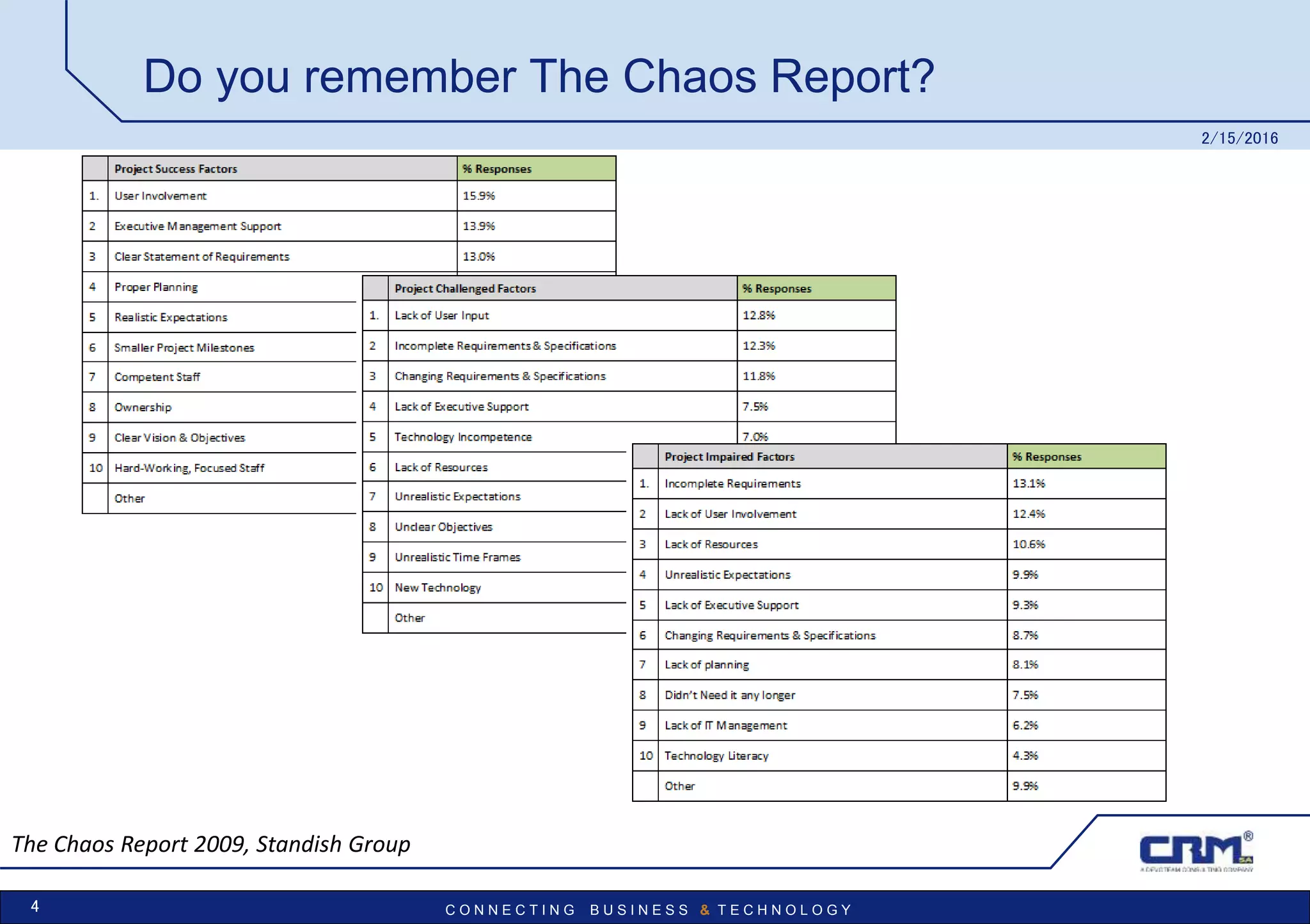
Do you remember The Chaos Report?
2/15/2016
4
The Chaos Report 2009, Standish Group
C O N N E C T I N G B U S I N E S S & T E C H N O L O G Y
Do you remember The Chaos Report?
2/15/2016
5
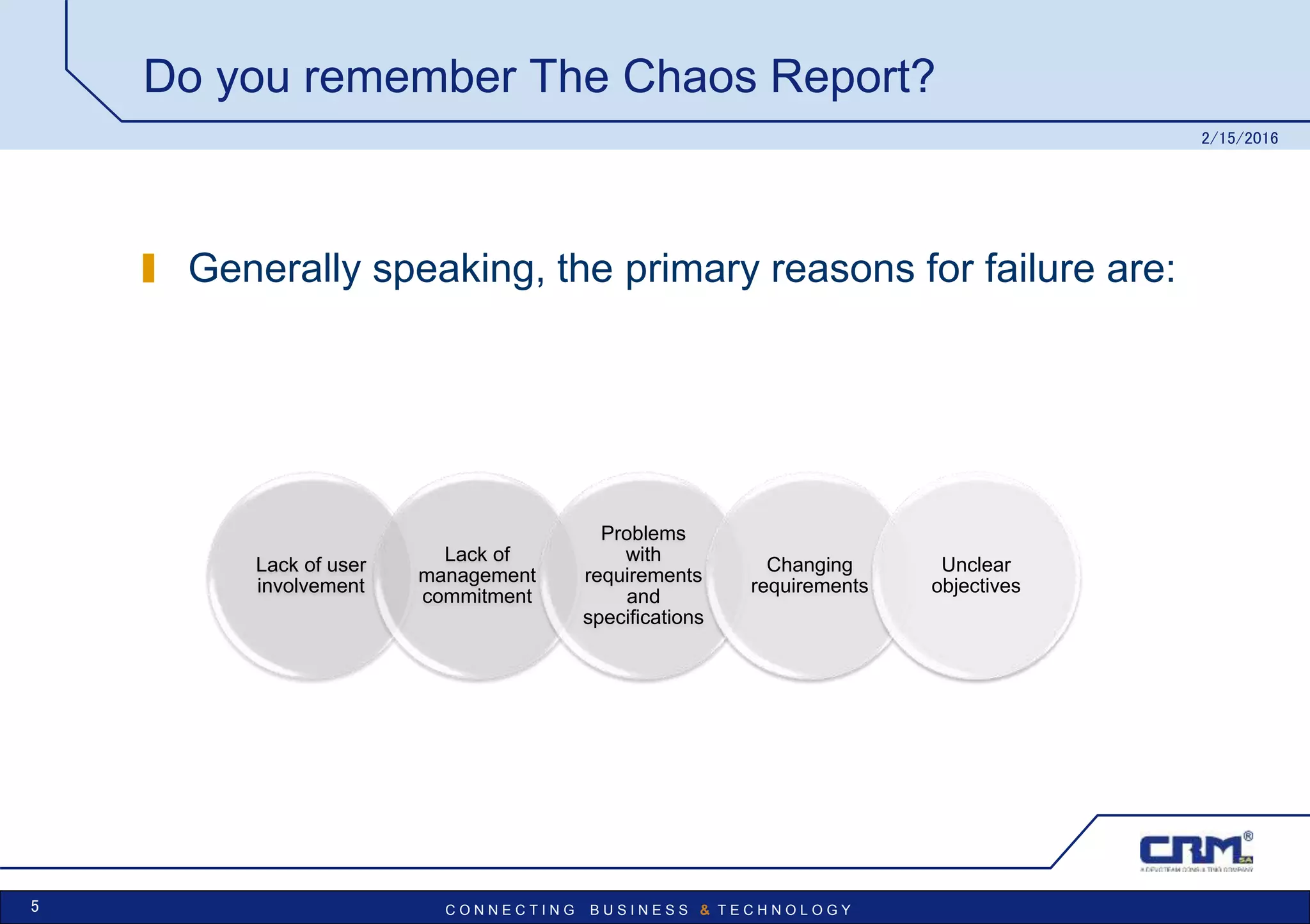
Generally speaking, the primary reasons for failure are:
Lack of user
involvement
Lack of
management
commitment
Problems
with
requirements
and
specifications
Changing
requirements
Unclear
objectives
C O N N E C T I N G B U S I N E S S & T E C H N O L O G Y
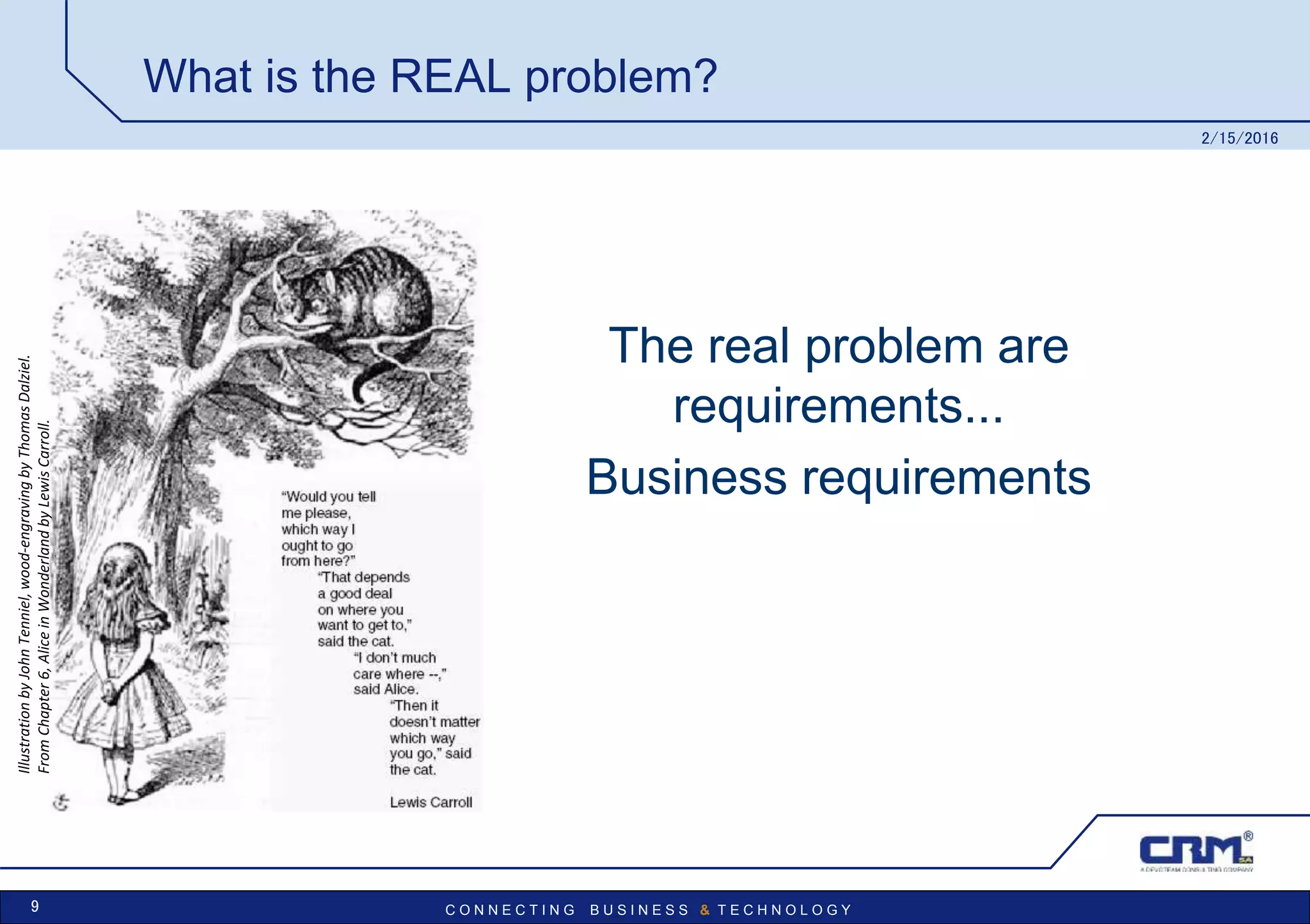
What is the REAL problem?
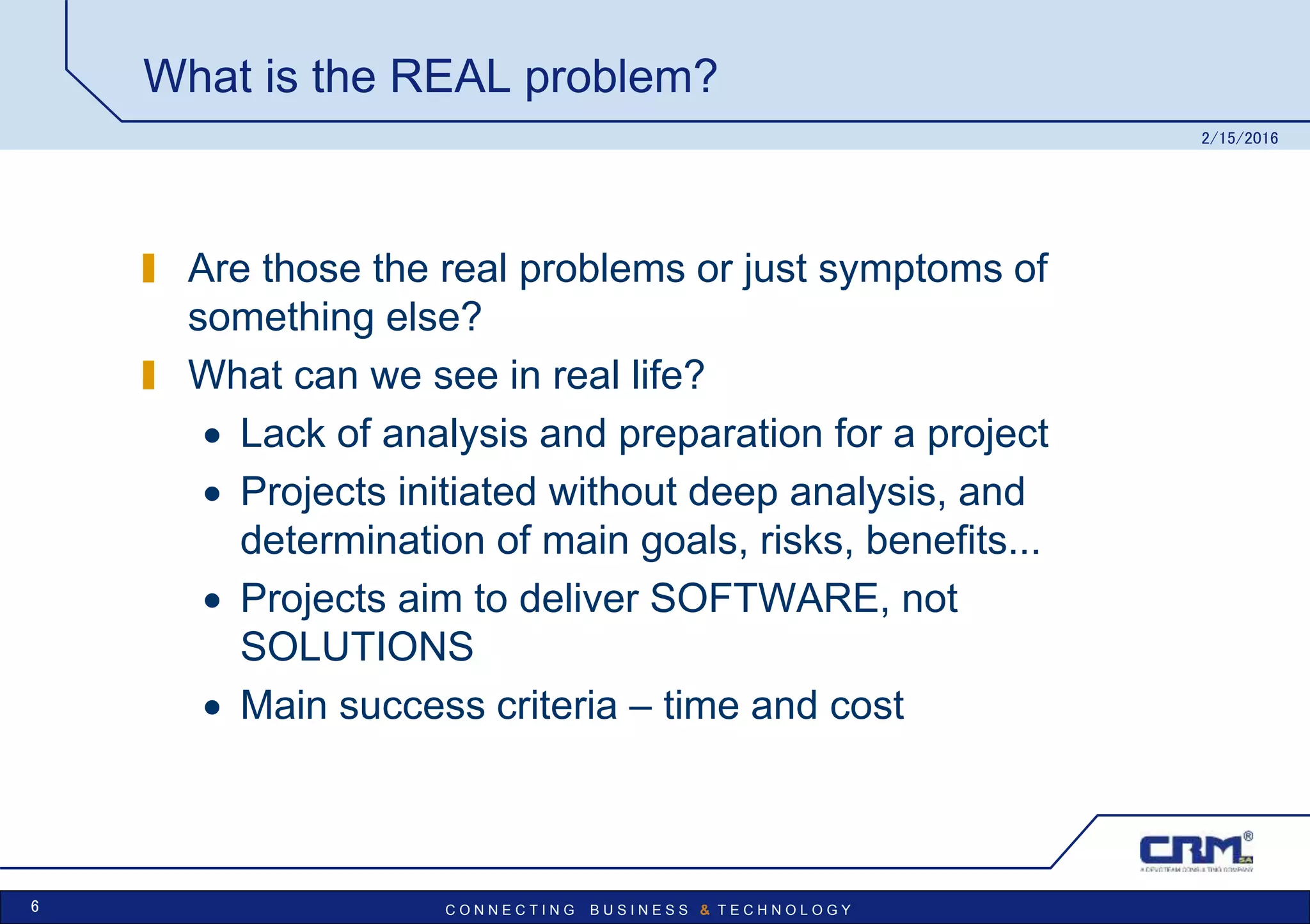
Are those the real problems or just symptoms of
something else?
What can we see in real life?
 Lack of analysis and preparation for a project
 Projects initiated without deep analysis, and
determination of main goals, risks, benefits...
 Projects aim to deliver SOFTWARE, not
SOLUTIONS
 Main success criteria – time and cost
2/15/2016
6
C O N N E C T I N G B U S I N E S S & T E C H N O L O G Y
What is the REAL problem?
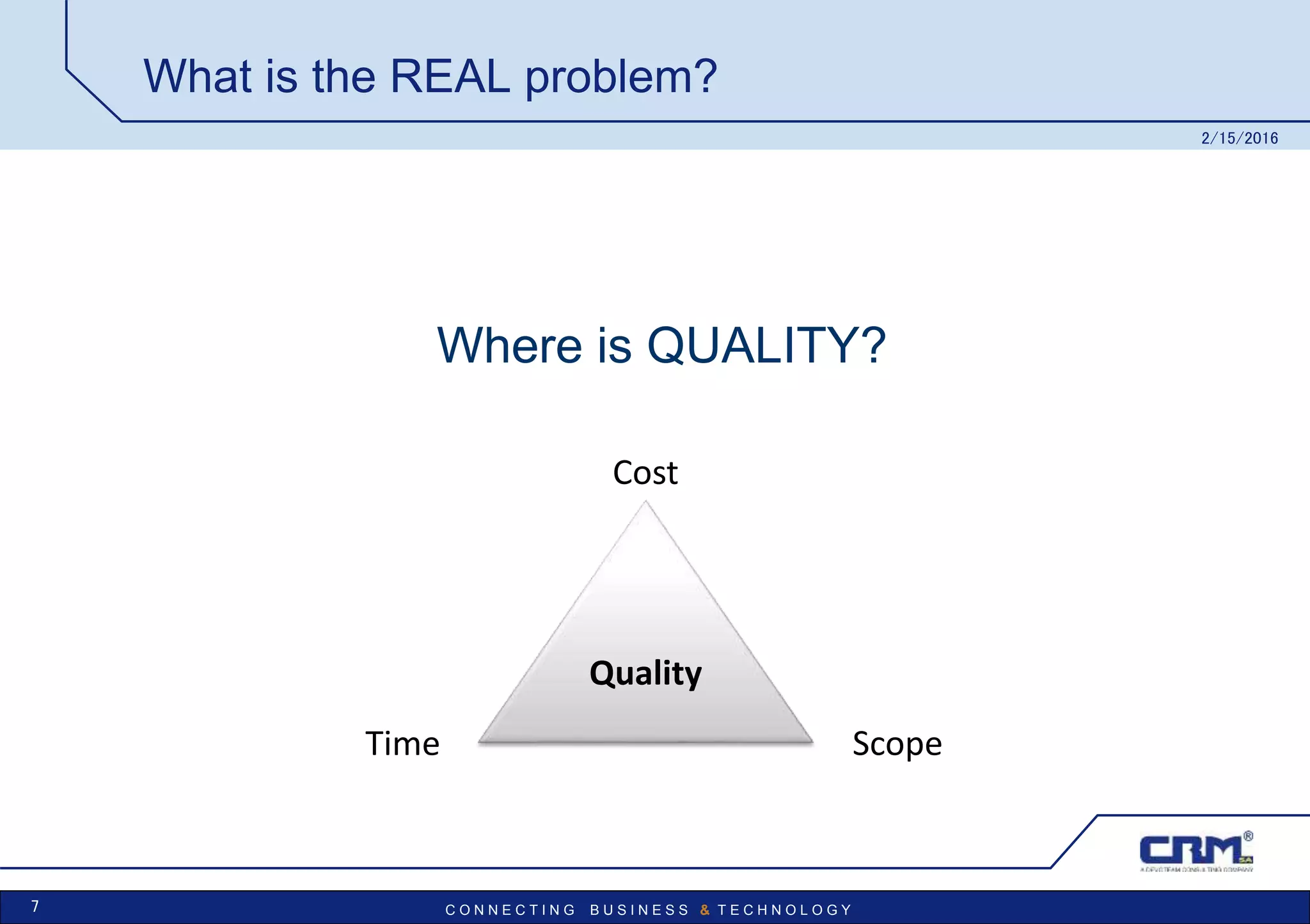
Where is QUALITY?
2/15/2016
7
Cost
ScopeTime
Quality
C O N N E C T I N G B U S I N E S S & T E C H N O L O G Y
What is the REAL problem?
What is quality?
 ISO 9000 – „Degree to which a set of inherent
characteristics fulfills requirements”
How to assure quality if:
 Stated requirements are not complete?
 Stated requirements have no business value?
 We don’t know how requirements meet business
goals?
2/15/2016
8
C O N N E C T I N G B U S I N E S S & T E C H N O L O G Y
What is the REAL problem?
The real problem are
requirements...
Business requirements
2/15/2016
9
IllustrationbyJohnTenniel,wood-engravingbyThomasDalziel.
FromChapter6,AliceinWonderlandbyLewisCarroll.
C O N N E C T I N G B U S I N E S S & T E C H N O L O G Y
Writing Business Requirements
How to write good business requirements?
Learn from mistakes
Follow best practices!
2/15/2016
10
C O N N E C T I N G B U S I N E S S & T E C H N O L O G Y
Writing Business Requirements
Ten Key Principles for Successful
Requirements
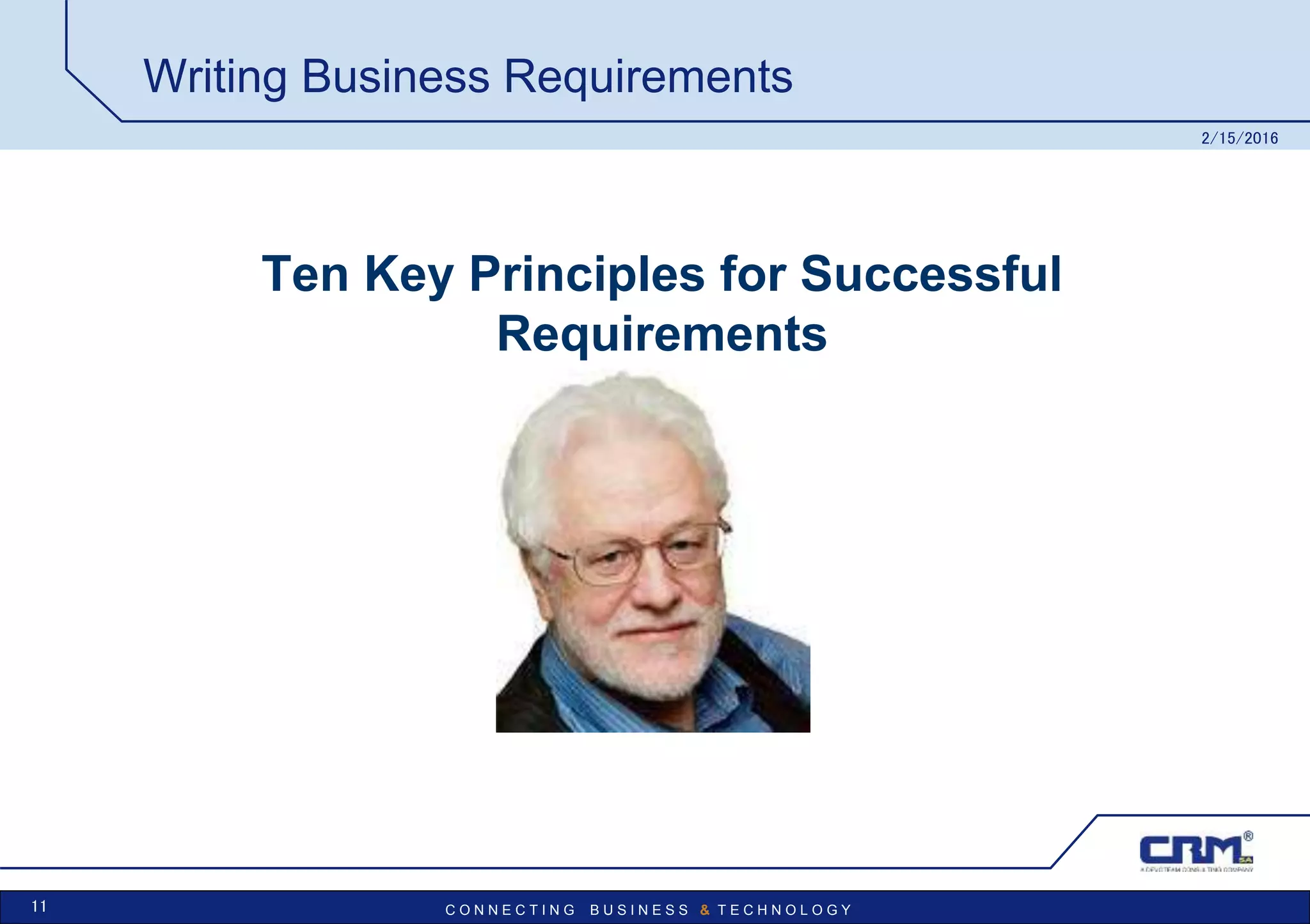
Tom Gilb
2/15/2016
11
C O N N E C T I N G B U S I N E S S & T E C H N O L O G Y
Ten key principles for successful requirements
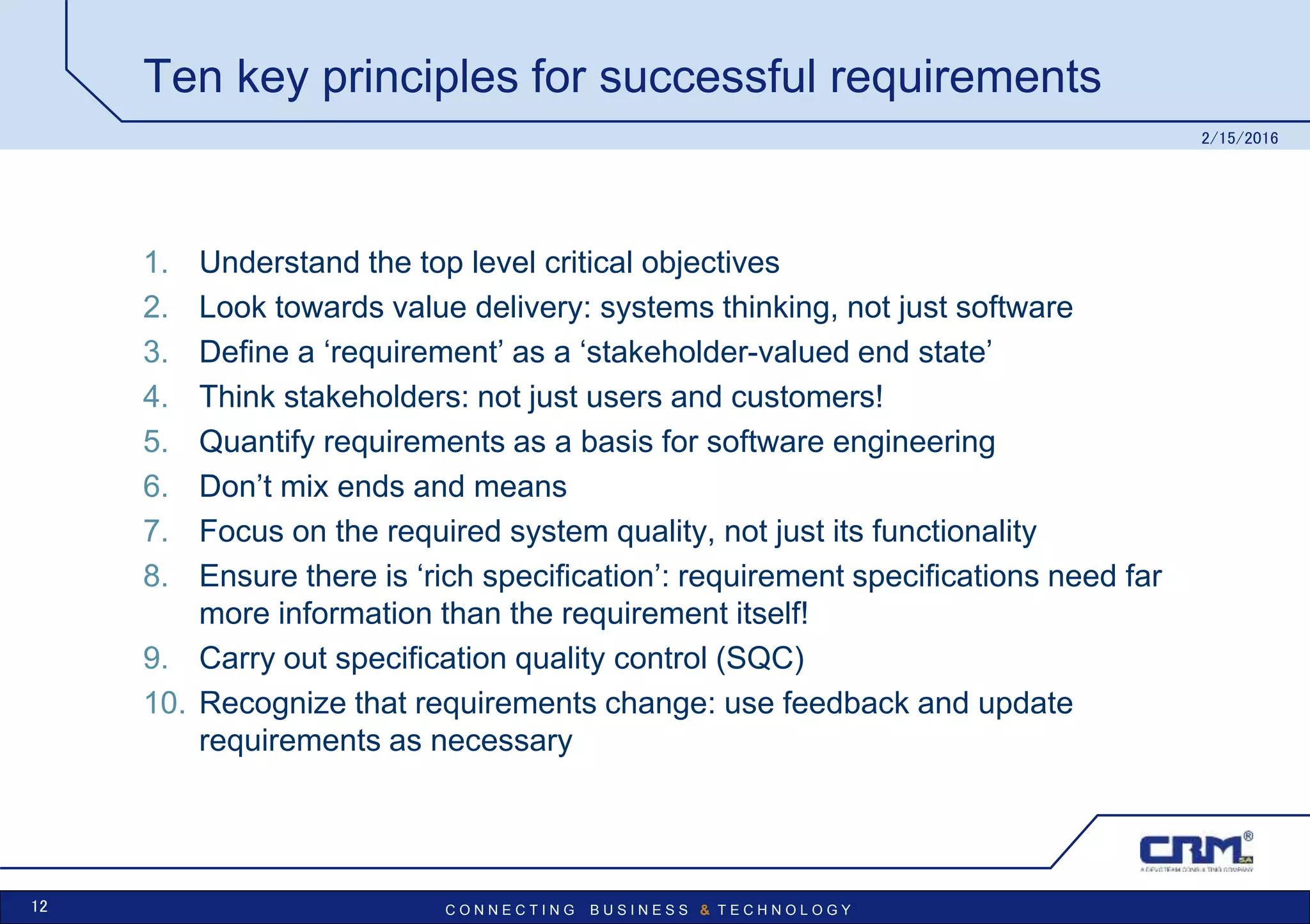
1. Understand the top level critical objectives
2. Look towards value delivery: systems thinking, not just software
3. Define a ‘requirement’ as a ‘stakeholder-valued end state’
4. Think stakeholders: not just users and customers!
5. Quantify requirements as a basis for software engineering
6. Don’t mix ends and means
7. Focus on the required system quality, not just its functionality
8. Ensure there is ‘rich specification’: requirement specifications need far
more information than the requirement itself!
9. Carry out specification quality control (SQC)
10. Recognize that requirements change: use feedback and update
requirements as necessary
2/15/2016
12
C O N N E C T I N G B U S I N E S S & T E C H N O L O G Y
Understand the top level critical objectives
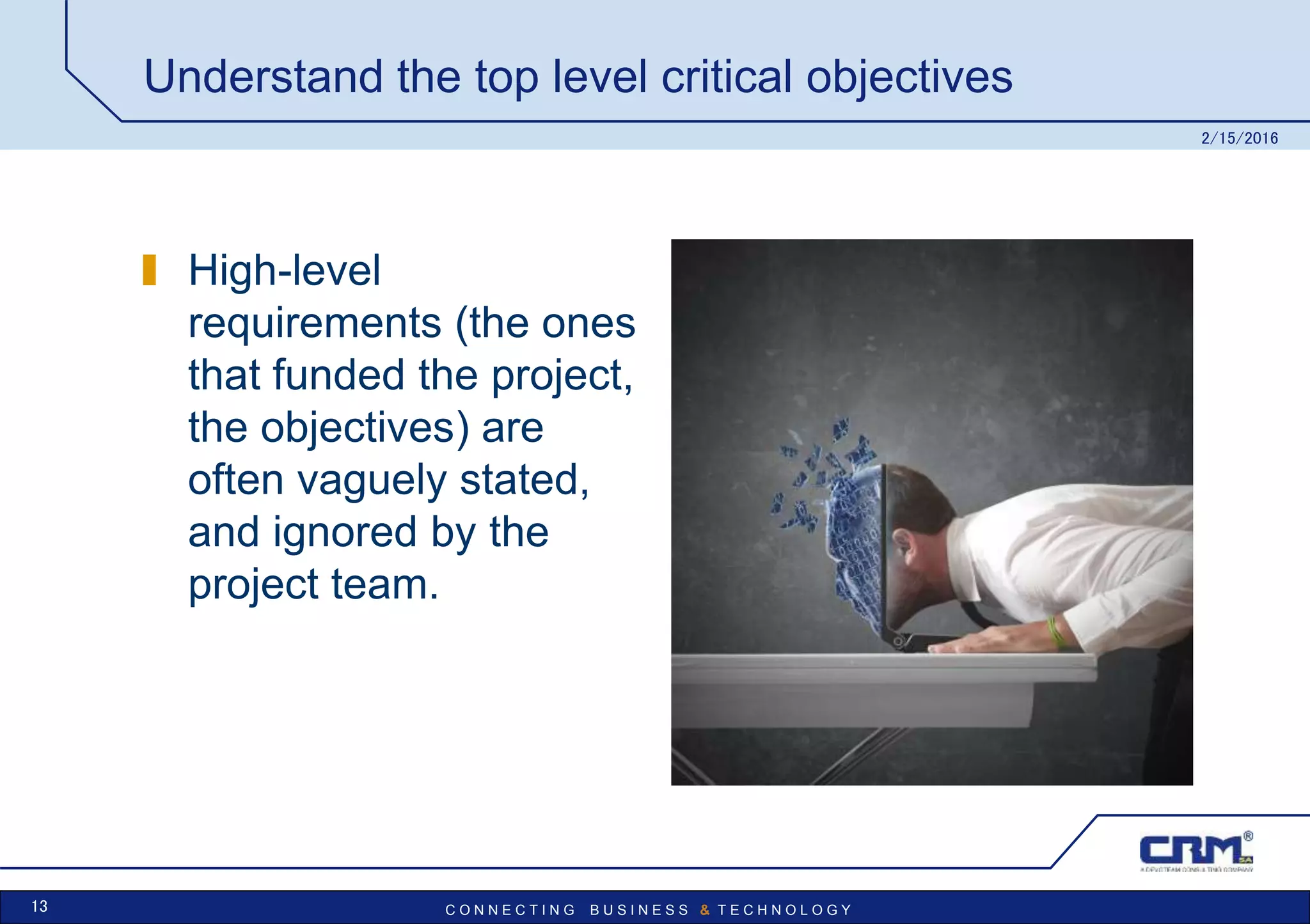
High-level
requirements (the ones
that funded the project,
the objectives) are
often vaguely stated,
and ignored by the
project team.
2/15/2016
13
C O N N E C T I N G B U S I N E S S & T E C H N O L O G Y
Understand the top level critical objectives
Example of Initial Top
Level Objective
Will allow to perform core
banking transaction in
shorter time
2/15/2016
14
C O N N E C T I N G B U S I N E S S & T E C H N O L O G Y
Look towards value delivery
Systems thinking, not just a focus on software.
The real aim of a project is delivering realized value
(benefits) to the stakeholders.
Realized value is not the defined functionality!
Value is „the benefit we think we get from something”
(Tom Gilb).
Conventional requirements engineering is not closely
enough coupled with „value”.
2/15/2016
15
C O N N E C T I N G B U S I N E S S & T E C H N O L O G Y
Look towards value delivery
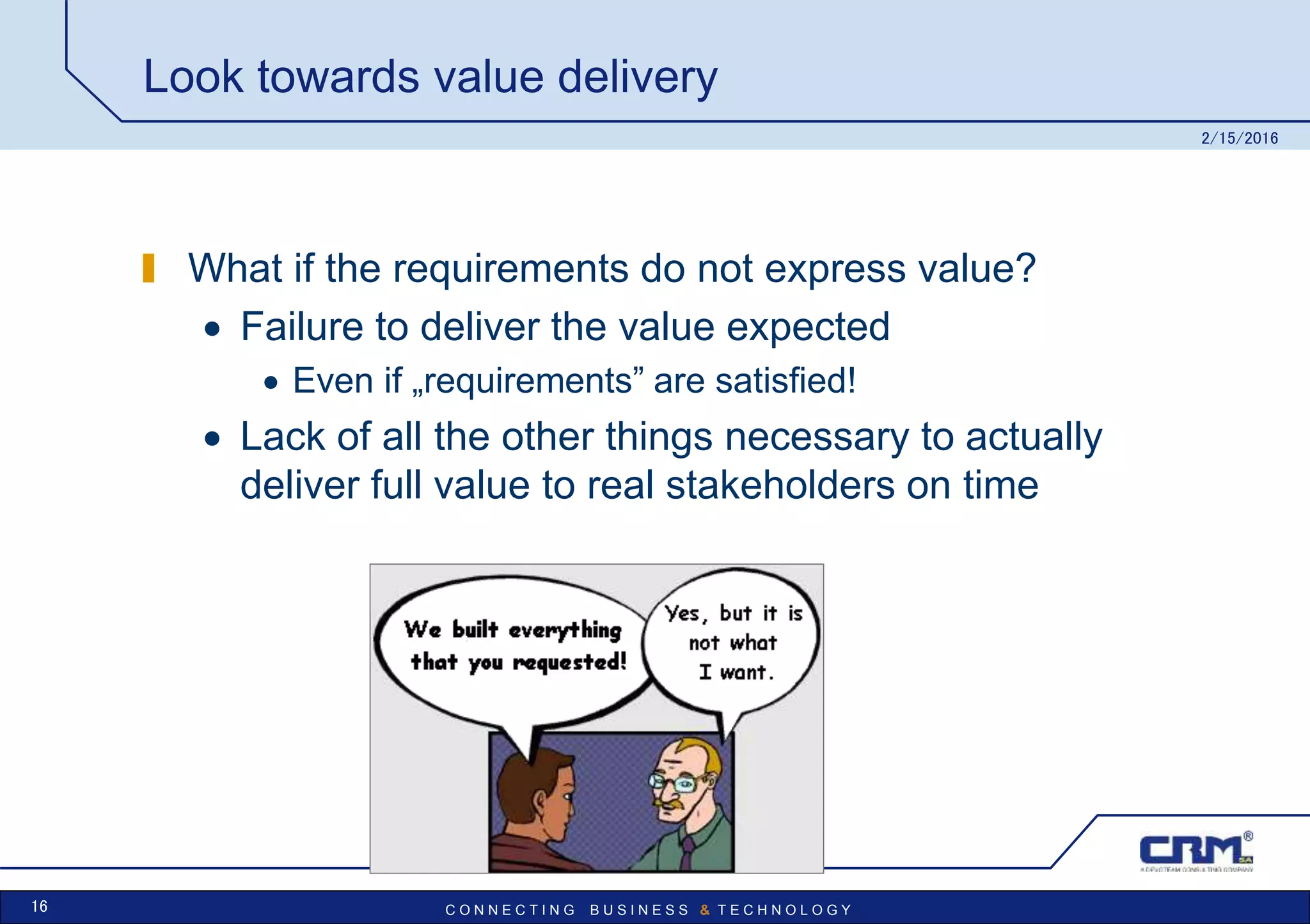
What if the requirements do not express value?
 Failure to deliver the value expected
 Even if „requirements” are satisfied!
 Lack of all the other things necessary to actually
deliver full value to real stakeholders on time
2/15/2016
16
C O N N E C T I N G B U S I N E S S & T E C H N O L O G Y
Define a „requirement” as a „stakeholder-valued end state”
What a requirement is?
What it is for you, and what it is for your customer?
Define:
 A requirement (a stakeholder-valued end state)
 A requirement specification
 An implemented requirement
 A design in partial, or full service, of implementing a
requirement
2/15/2016
17
C O N N E C T I N G B U S I N E S S & T E C H N O L O G Y
Think stakeholders: not just users and customers!
Don’t focus requirements solely on user or customer
needs.
Identify stakeholders.
 A stakeholder is anyone or anything that has an
interest in the system.
 It is not just the end-users and customers.
 Consider: IT development, IT maintenance, senior
management, government, regulation bodies, etc.
Consider thea broader area of stakeholders’ needs and
their values.
2/15/2016
18
C O N N E C T I N G B U S I N E S S & T E C H N O L O G Y
Quantify requirements as a basis for software engineering
Are you working in software engineering? Then
practice real engineering!
The problem is the lack of numeric quality
requirements.
Argue with numbers and measures.
Don’t produce requirements specifications consisting
merely of words.
Solution: define, or reuse a definition, of a scale of
measure.
2/15/2016
19
C O N N E C T I N G B U S I N E S S & T E C H N O L O G Y
Quantify requirements as a basis for software engineering
Responsiveness:
Ambition: Fast immediate response to any type of user asking for information.
Type: Workload Capacity Requirement.
Scale: Time in seconds from when a defined [User] knows what they want to ask until the
correct necessary information is available to them to carry out a defined [Task].
Past [User = Free Set, Task = Inquiry]: Over one minute. Note: Considered unacceptably
slow.
Goal [User = Responsible Administrator, Task = Any Administration Task]: under 5
seconds?
Goal [User = Phone User, Task = Call Setup]: Less than <2 seconds>
2/15/2016
20
Tom Gilb, Competitive Engineering
C O N N E C T I N G B U S I N E S S & T E C H N O L O G Y
Don’t mix ends and means
Perfection of means and confusion of ends
seem to characterize our age.
Albert Einstein
2/15/2016
21
C O N N E C T I N G B U S I N E S S & T E C H N O L O G Y
Don’t mix ends and means
Solutions are more concrete.
Qualities we want are more abstract.
Don’t mix ends and means.
Don’t specify a solution, design and/or architecture,
instead of what you really want – real requirement.
WHY?
2/15/2016
22
C O N N E C T I N G B U S I N E S S & T E C H N O L O G Y
Don’t mix ends and means
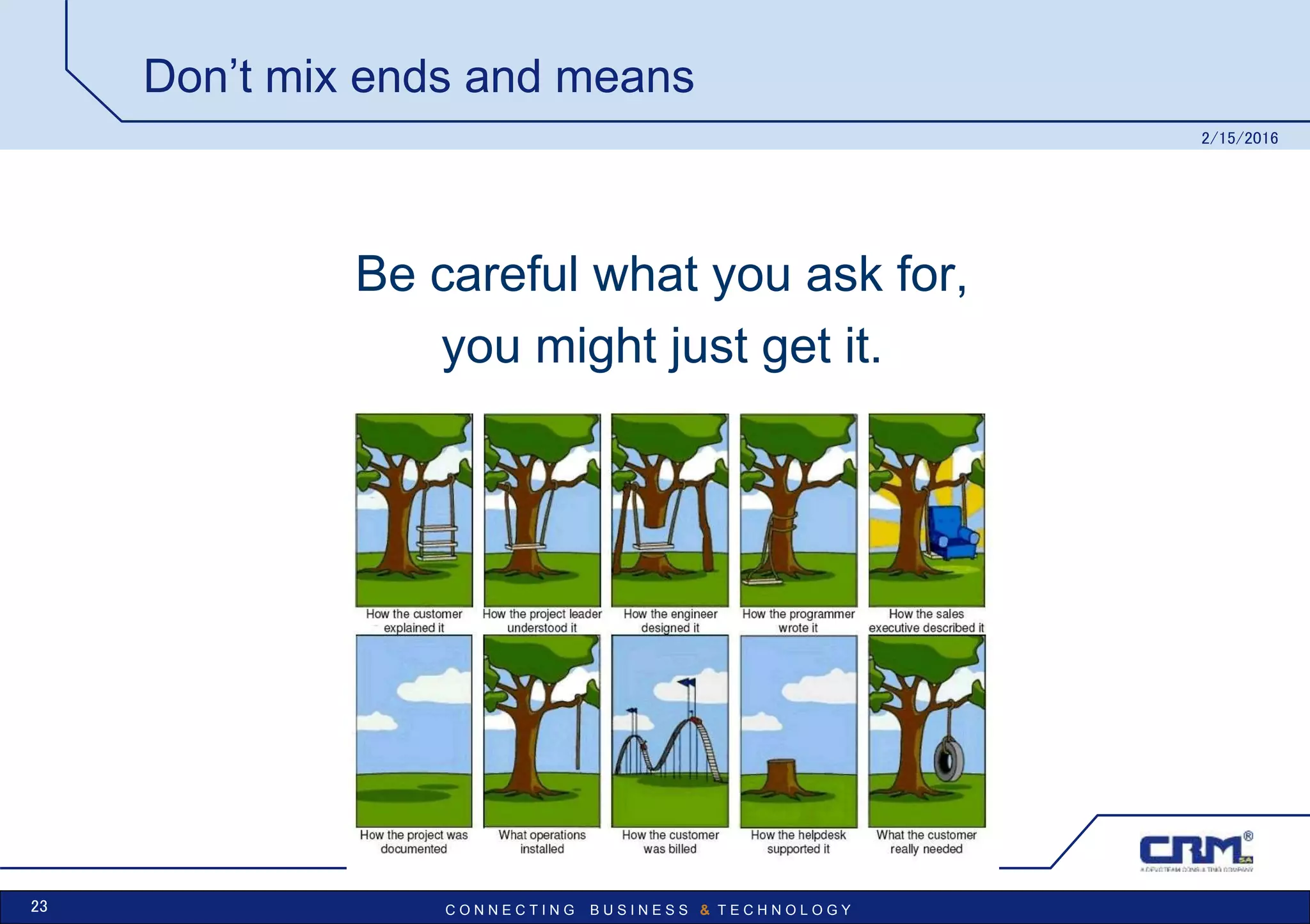
Be careful what you ask for,
you might just get it.
2/15/2016
23
C O N N E C T I N G B U S I N E S S & T E C H N O L O G Y
Don’t mix ends and means
If you specify a solution, instead of what you really
want:
 You might not get what you really want
 The solution you have specified might cost too
much or have bad side effects, even if you do get
what you want
 There may be much better solutions you don’t
know about yet
2/15/2016
24
C O N N E C T I N G B U S I N E S S & T E C H N O L O G Y
Don’t mix ends and means
Not:
“The system must print a transaction receipt
for the customer.”
But:
“The customer must be provided with a
transaction confirmation after every
transaction, within 2 minutes after completing
a transaction.”
2/15/2016
25
C O N N E C T I N G B U S I N E S S & T E C H N O L O G Y
Don’t mix ends and means
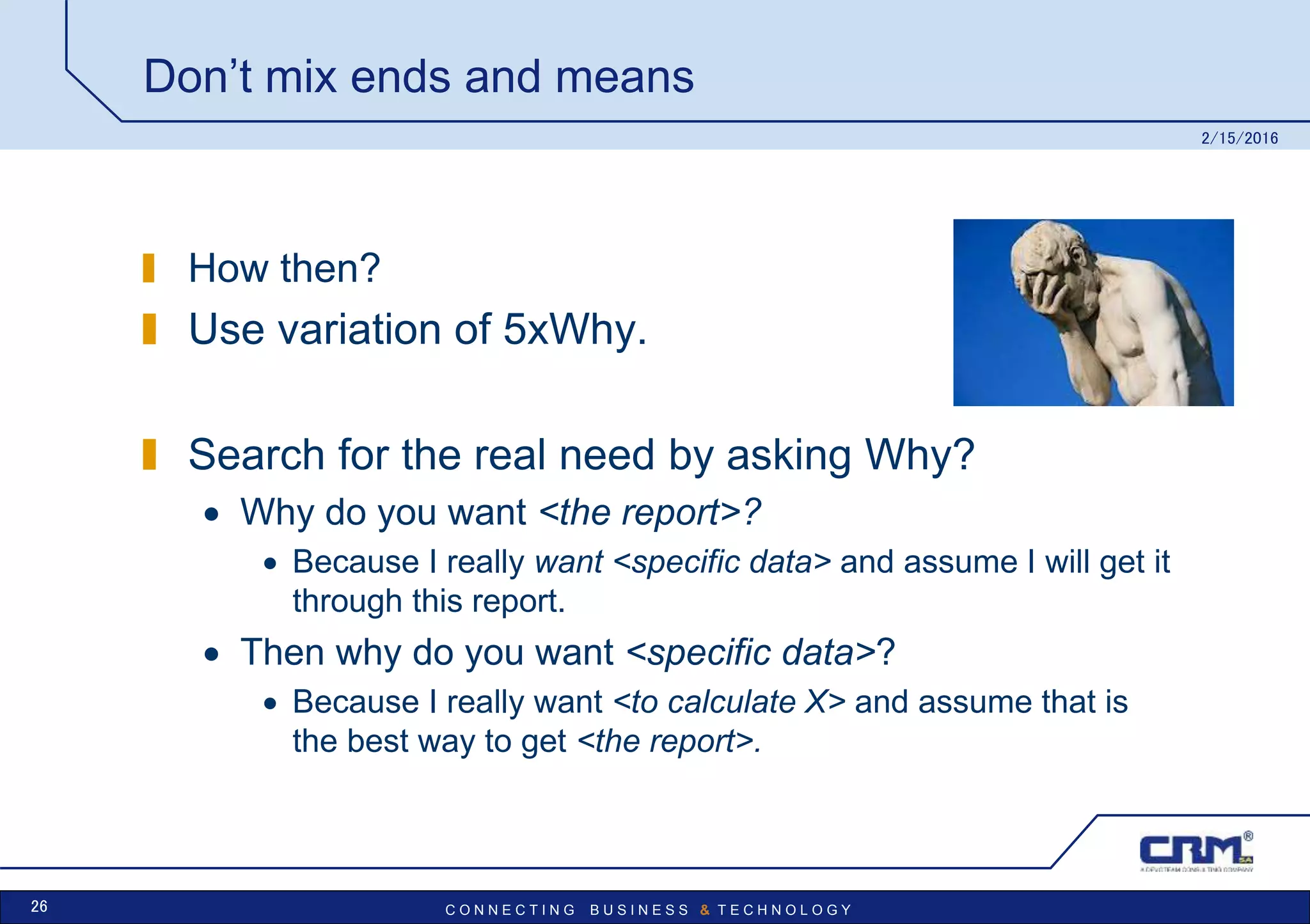
How then?
Use variation of 5xWhy.
Search for the real need by asking Why?
 Why do you want <the report>?
 Because I really want <specific data> and assume I will get it
through this report.
 Then why do you want <specific data>?
 Because I really want <to calculate X> and assume that is
the best way to get <the report>.
2/15/2016
26
C O N N E C T I N G B U S I N E S S & T E C H N O L O G Y
Focus on the system quality, not just its functionality
Quality improvements tend to be the major drivers for
new projects.
What the system must do (function) is important.
But don’t forget about how well it should do it
(qualities).
Focus on the quality requirements, rather than the
functions.
2/15/2016
27
C O N N E C T I N G B U S I N E S S & T E C H N O L O G Y
Ensure there is „rich specification”
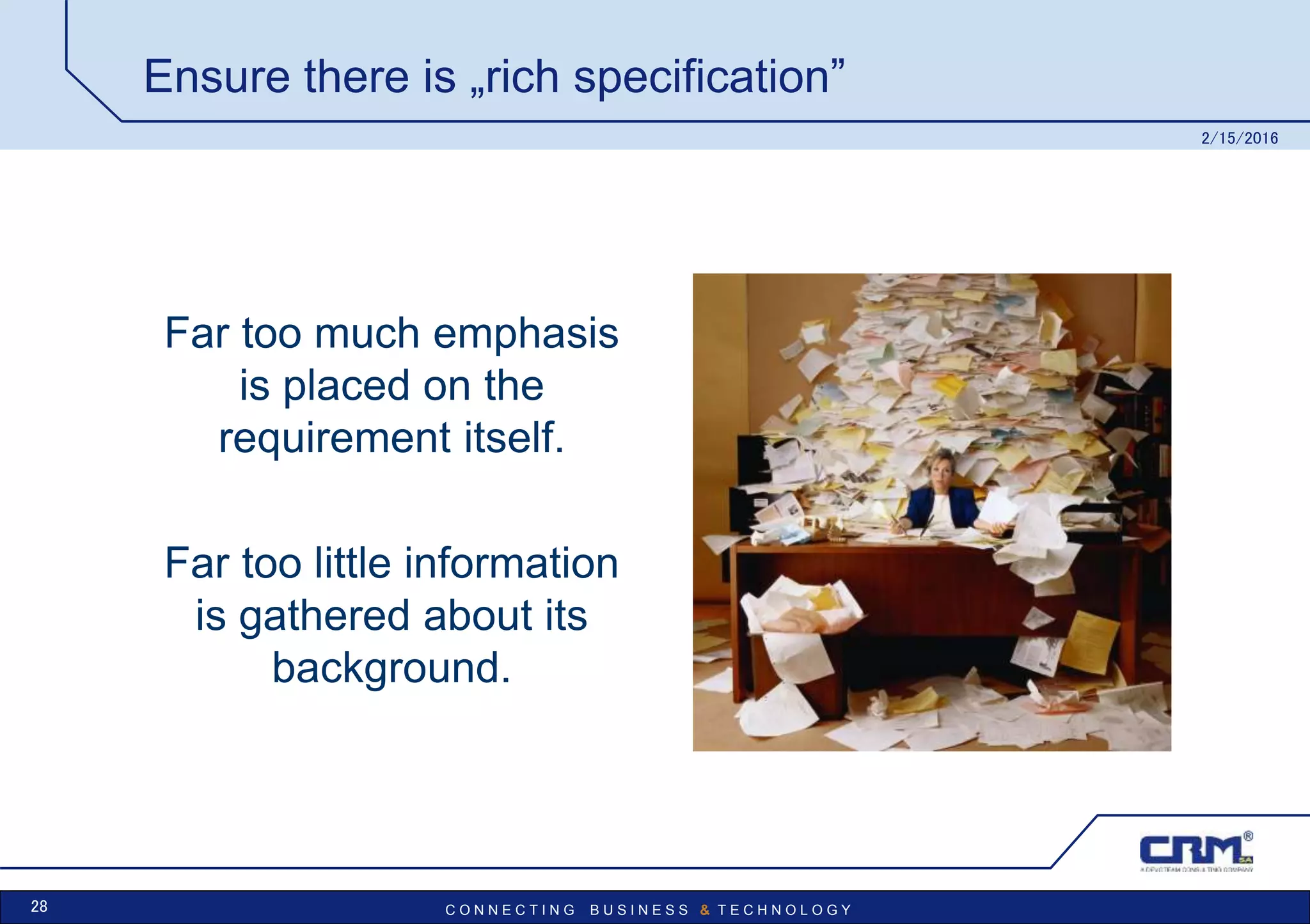
Far too much emphasis
is placed on the
requirement itself.
Far too little information
is gathered about its
background.
2/15/2016
28
C O N N E C T I N G B U S I N E S S & T E C H N O L O G Y
Ensure there is ‘rich specification’
Background specification may include:
 Benchmarks {Past, Record, Trend}
 Owner
 Version
 Stakeholders
 Gist (brief description)
 Ambition
 Impacts
2/15/2016
29
C O N N E C T I N G B U S I N E S S & T E C H N O L O G Y
Ensure there is ‘rich specification’
Such information:
 Allows to judge value of the requirement
 Allows to prioritize the requirement
 Help understand risks related with the requirement
 Helps when updating a requirement
 Synchronizes the relationships between different but
related levels of the requirements
 Improves the clarity of the requirement
2/15/2016
30
C O N N E C T I N G B U S I N E S S & T E C H N O L O G Y
Carry out Specification Quality Control (SQC)
Apply quality control of requirements against relevant
standards for requirements.
Use quality control checklists.
All requirements and specifications should pass quality
control checks before they are released for use by the
next processes.
2/15/2016
31
C O N N E C T I N G B U S I N E S S & T E C H N O L O G Y
Carry out Specification Quality Control (SQC)
Initial quality control of requirements specification
typically identifies 80 to 200+ words per 300 words of
requirement text as ambiguous or unclear.
2/15/2016
32
C O N N E C T I N G B U S I N E S S & T E C H N O L O G Y
Carry out Specification Quality Control (SQC)
Use quality criteria – each requirement should be:
Correct
Feasible
Necessary
Prioritized
Unambiguous
Verifiable
Singular
Design independent
2/15/2016
33
C O N N E C T I N G B U S I N E S S & T E C H N O L O G Y
Recognize that requirements change
Requirements evolve due to feedback from
stakeholders.
 Stakeholders can give feedback about their
perception of value, based on realities.
 The whole process follows Plan-Do-Study-Act.
Consider factors from outside the system:
 Politics, law, regulations, international differences,
economics, and technology and/or business
change.
2/15/2016
34
C O N N E C T I N G B U S I N E S S & T E C H N O L O G Y
Recognize that requirements change
Implement traceability to manage changes in effective
way.
2/15/2016
35
Business goal
Business
requirement
Solution/system
requrement
Solution/system
requrement
Solution/system
requrement
Business
requrement
Solution/system
requrement
Solution/system
requrement
C O N N E C T I N G B U S I N E S S & T E C H N O L O G Y
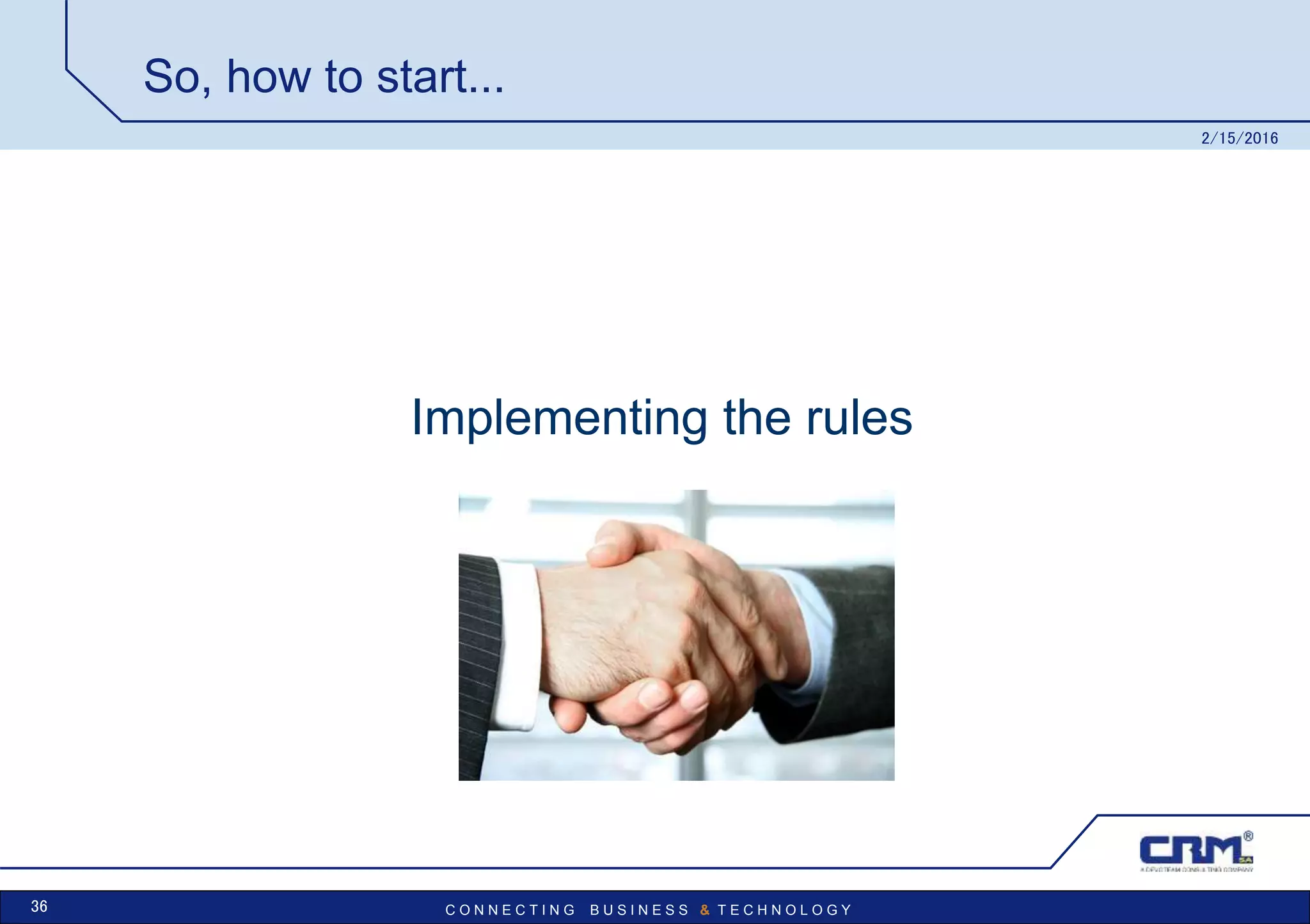
So, how to start...
Implementing the rules
2/15/2016
36
C O N N E C T I N G B U S I N E S S & T E C H N O L O G Y
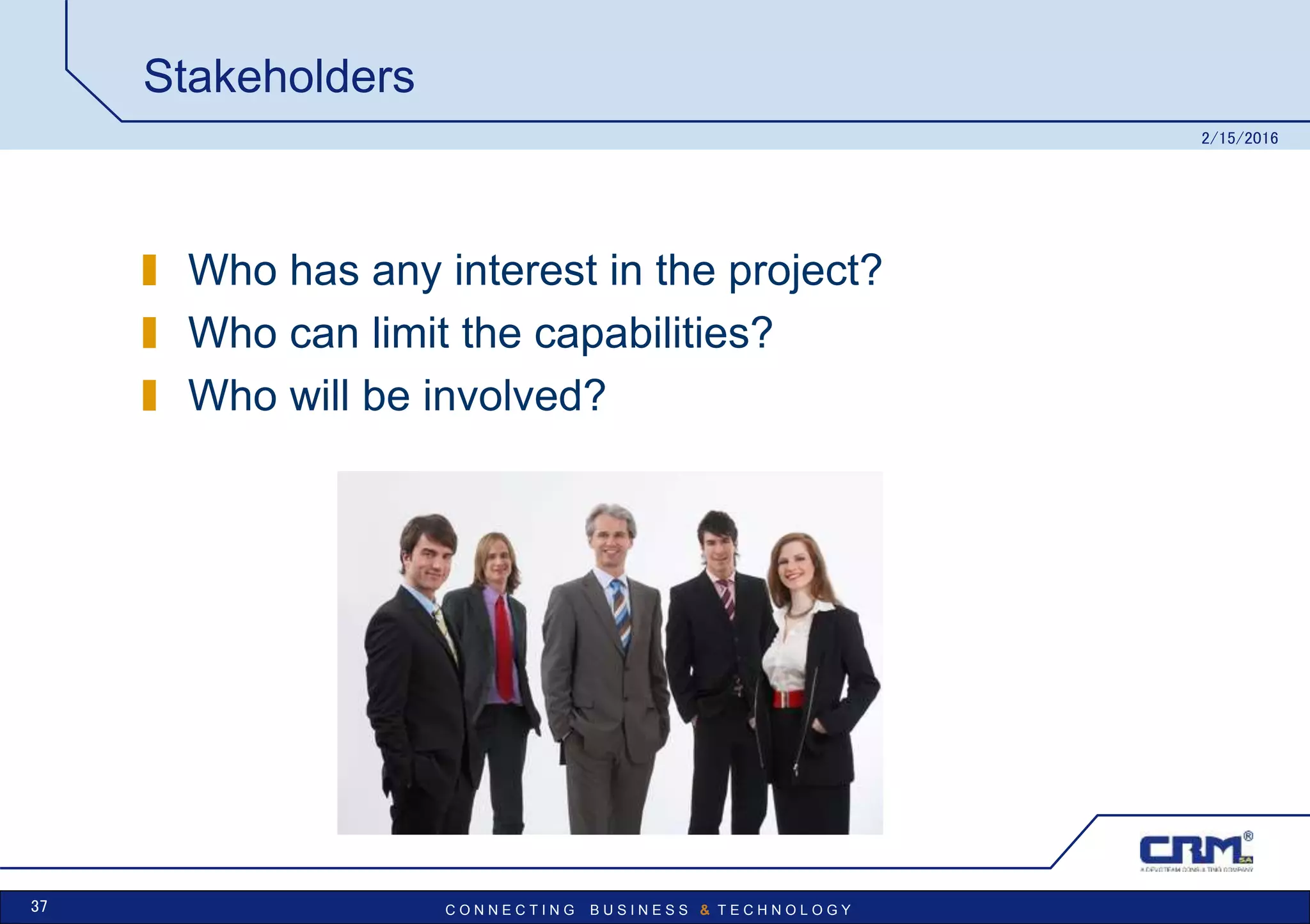
Stakeholders
Who has any interest in the project?
Who can limit the capabilities?
Who will be involved?
2/15/2016
37
C O N N E C T I N G B U S I N E S S & T E C H N O L O G Y
Business objectives
Collect and understand business objectives.
Decompose them into smaller, SMART goals.
SMART goals:
 Specific
 Measurable
 Attainable
 Relevant
 Timely (time-bound)
2/15/2016
38
C O N N E C T I N G B U S I N E S S & T E C H N O L O G Y
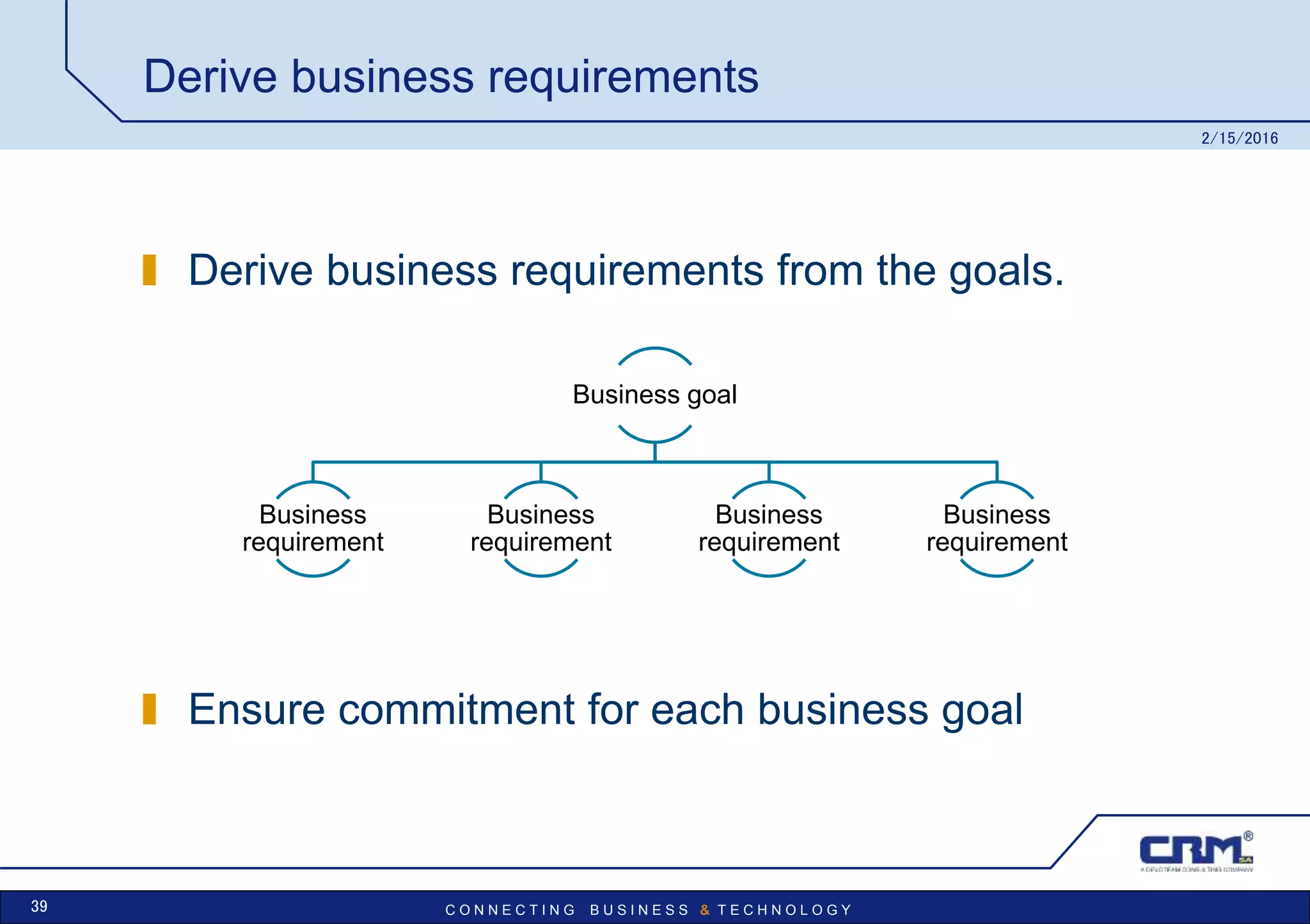
Derive business requirements
Derive business requirements from the goals.
Ensure commitment for each business goal
2/15/2016
39
Business goal
Business
requirement
Business
requirement
Business
requirement
Business
requirement
C O N N E C T I N G B U S I N E S S & T E C H N O L O G Y
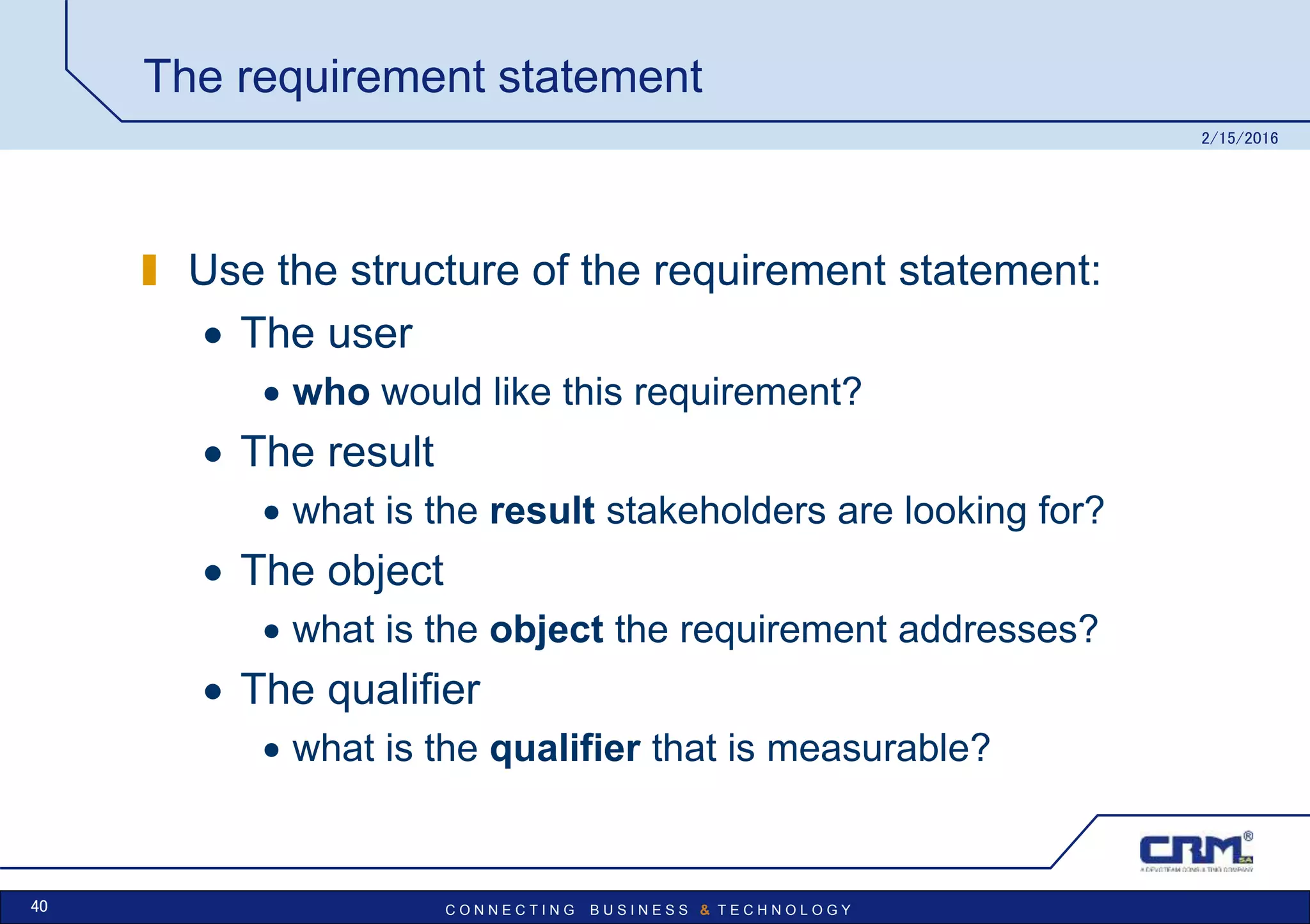
The requirement statement
Use the structure of the requirement statement:
 The user
 who would like this requirement?
 The result
 what is the result stakeholders are looking for?
 The object
 what is the object the requirement addresses?
 The qualifier
 what is the qualifier that is measurable?
2/15/2016
40
C O N N E C T I N G B U S I N E S S & T E C H N O L O G Y
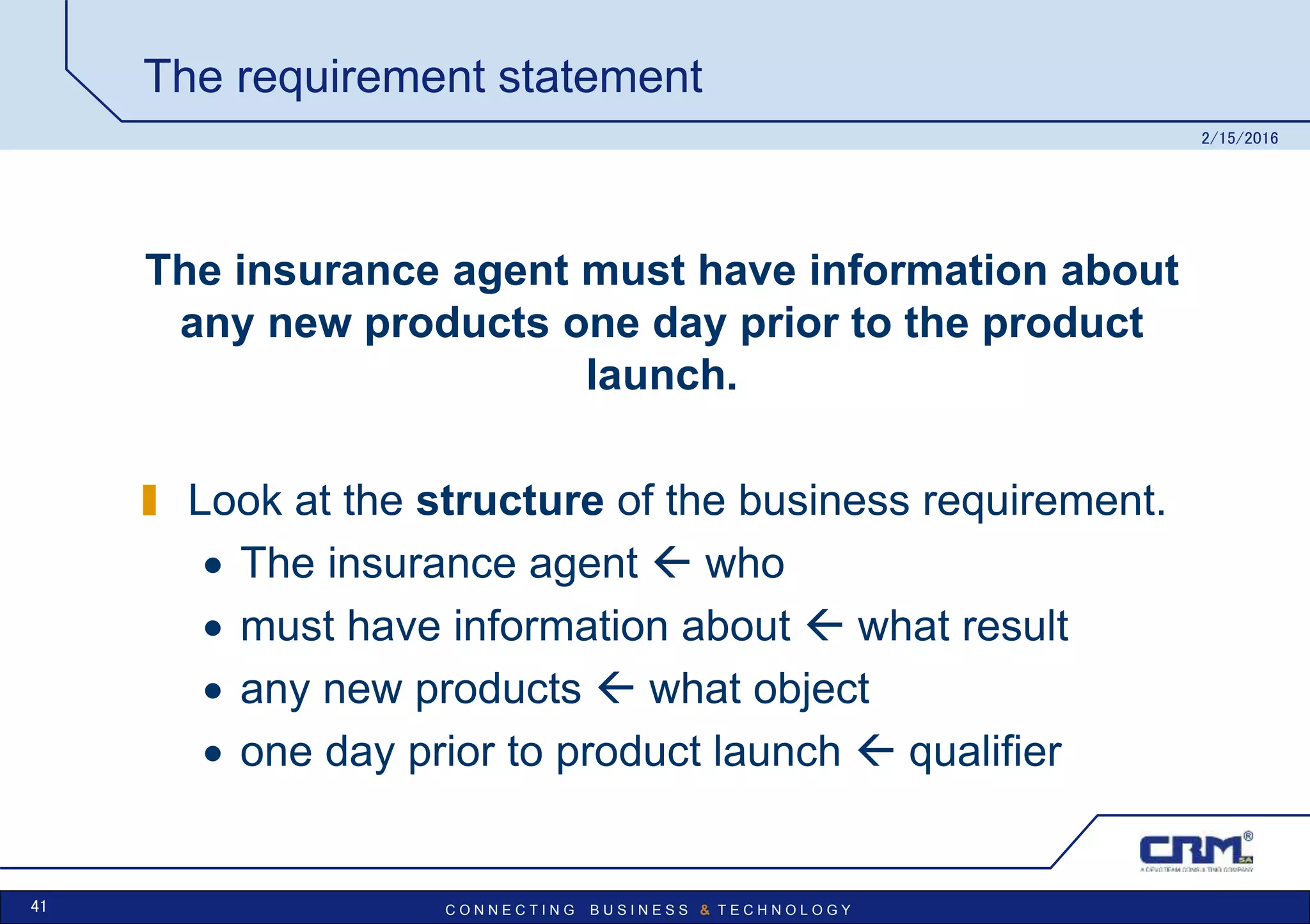
The requirement statement
The insurance agent must have information about
any new products one day prior to the product
launch.
Look at the structure of the business requirement.
 The insurance agent  who
 must have information about  what result
 any new products  what object
 one day prior to product launch  qualifier
2/15/2016
41
C O N N E C T I N G B U S I N E S S & T E C H N O L O G Y
The requirement statement
Don’t determine the solution – just state what needs
to be achieved.
State WHAT, not HOW.
2/15/2016
42
C O N N E C T I N G B U S I N E S S & T E C H N O L O G Y
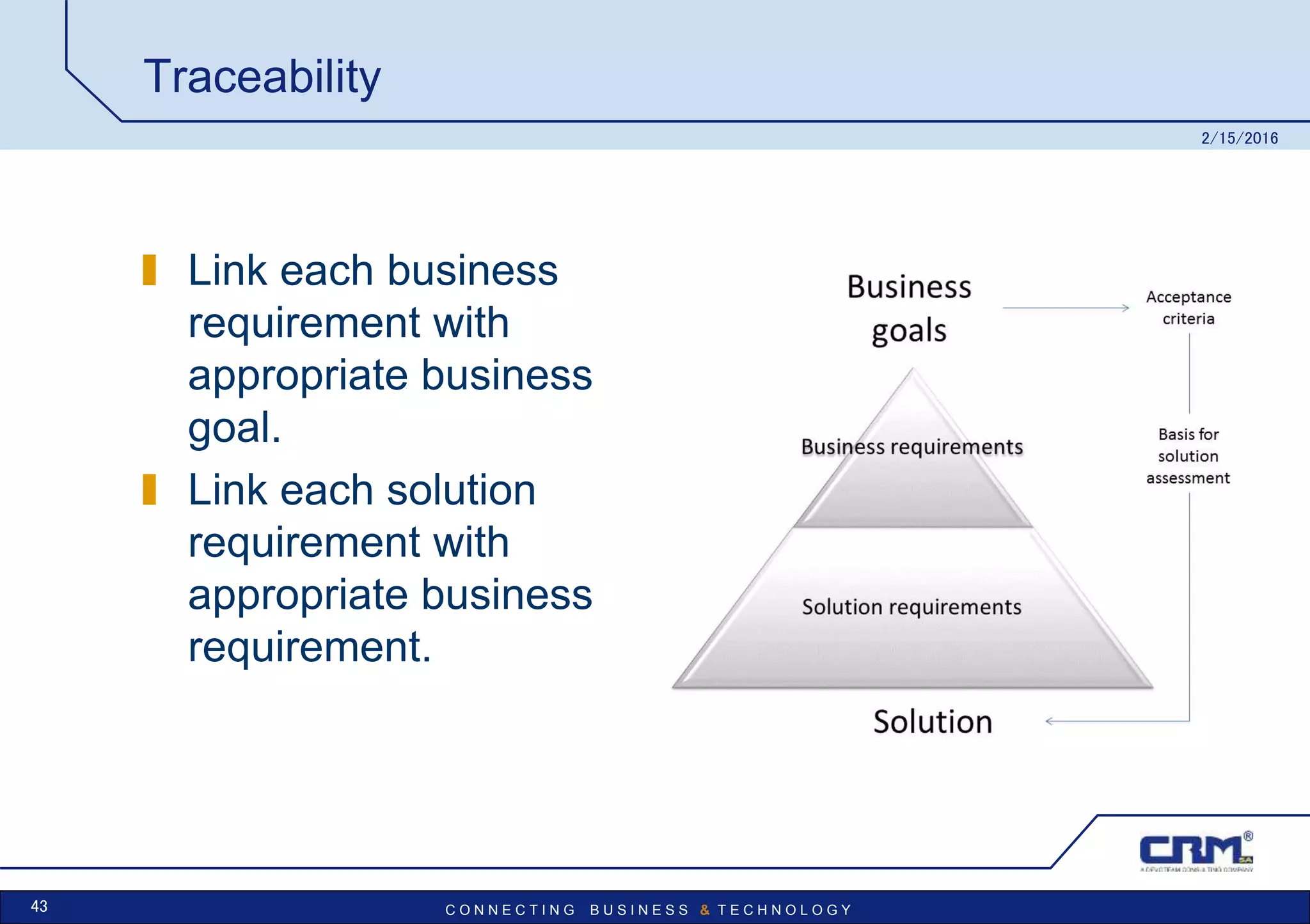
Traceability
Link each business
requirement with
appropriate business
goal.
Link each solution
requirement with
appropriate business
requirement.
2/15/2016
43
C O N N E C T I N G B U S I N E S S & T E C H N O L O G Y
Quality Control
Use check lists...
Use standards...
Use best practices...
... to ensure the
requirements are of good
quality.
2/15/2016
44
C O N N E C T I N G B U S I N E S S & T E C H N O L O G Y
Summary
The impact of business requirements on the success of
any IT project cannot be neglected
Link business requirements with goals
State requirements in measurable way and ensure they
express stakeholders’ value
Think who wants what, not how
Don’t forget about quality control
2/15/2016
45
C O N N E C T I N G B U S I N E S S & T E C H N O L O G Y
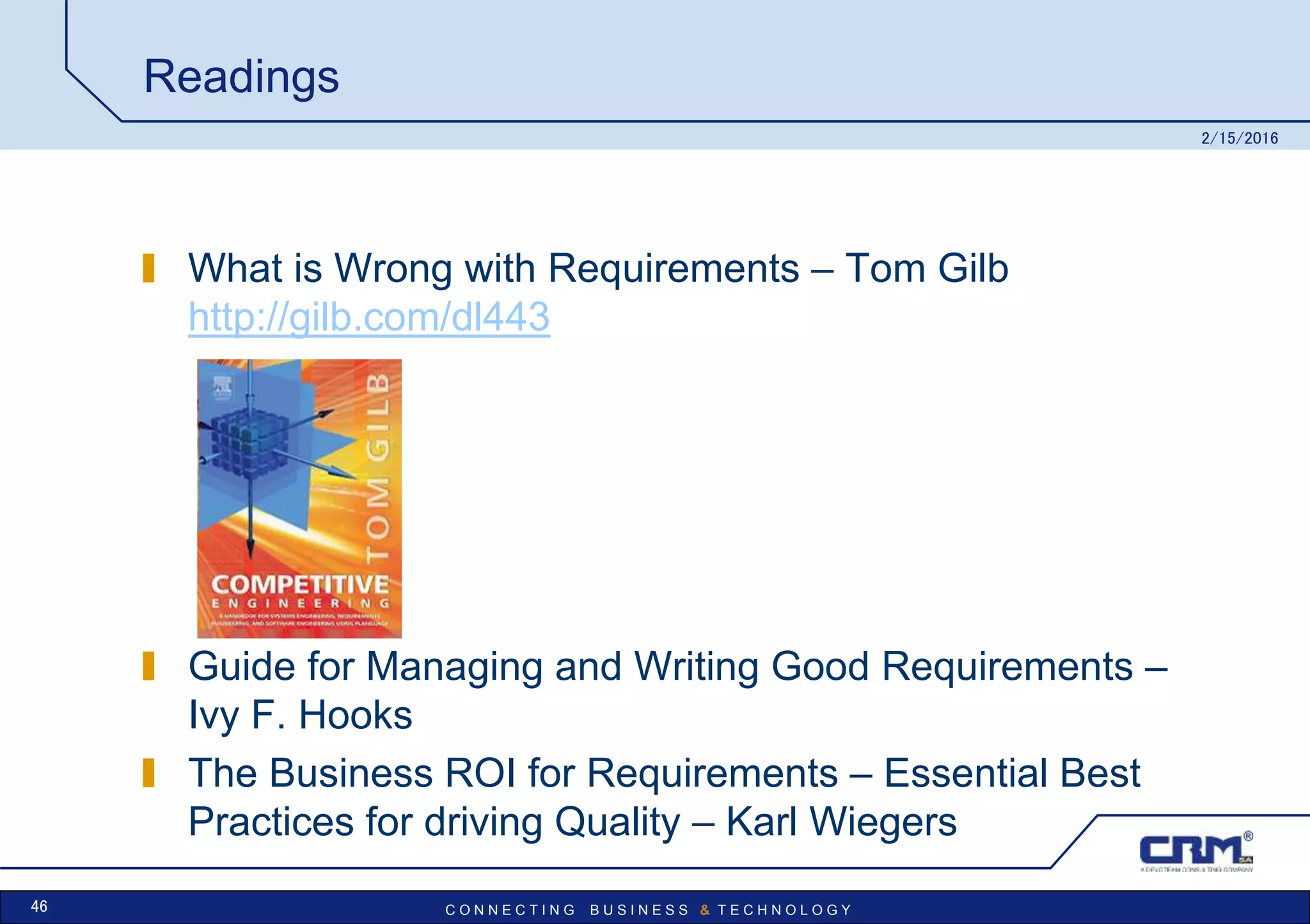
Readings
What is Wrong with Requirements – Tom Gilb
http://gilb.com/dl443
Guide for Managing and Writing Good Requirements –
Ivy F. Hooks
The Business ROI for Requirements – Essential Best
Practices for driving Quality – Karl Wiegers
2/15/2016
46
C O N N E C T I N G B U S I N E S S & T E C H N O L O G Y
Contact
2/15/2016
47
PRINCE2®, ITIL®, M_o_R®, P3O®, MSP®, P3M3® są zarejestrowanymi znakami handlowymi Cabinet Office. MoV™, MoP™, Swirl logo™ są znakami handlowymi Cabinet
Office. CHAMPS2® jest zarejestrowanym znakiem handlowym Birmingham City Council. PMBoK is a registered mark of the Project Management Institute, Inc. The PMI
Registered Provider logo is a registered mark of the Project Management Institute, Inc.
www.crm.com.pl
KAROLINA ZMITROWCZ
k.zmitrowicz@crm.com.pl
Centrum Rozwiązań Menedżerskich S.A.
Devoteam Consulting
ul. Kłobucka 25, 02-699 Warszawa

Minimize the project risk - build good business requirements

  • 1.
    C O NN E C T I N G B U S I N E S S & T E C H N O L O G Y Minimize the project risk - build good business requirements
  • 2.
    C O NN E C T I N G B U S I N E S S & T E C H N O L O G Y About me Areas: Business and System Analysis, Quality Assurance, IT consulting and trainings. International experience in banking and insurance sector. Customers: leading financial organizations in South Africa, Netherlands, Austria, Slovakia, Italy and Poland. Author of several publications in QA and BA area. Member of REQB and IBAQB. 2/15/2016 2
  • 3.
    C O NN E C T I N G B U S I N E S S & T E C H N O L O G Y What we are going to speak about? Impact of business requirements on IT projects Gold rules Writing good business requirements 2/15/2016 3
  • 4.
    C O NN E C T I N G B U S I N E S S & T E C H N O L O G Y Do you remember The Chaos Report? 2/15/2016 4 The Chaos Report 2009, Standish Group
  • 5.
    C O NN E C T I N G B U S I N E S S & T E C H N O L O G Y Do you remember The Chaos Report? 2/15/2016 5 Generally speaking, the primary reasons for failure are: Lack of user involvement Lack of management commitment Problems with requirements and specifications Changing requirements Unclear objectives
  • 6.
    C O NN E C T I N G B U S I N E S S & T E C H N O L O G Y What is the REAL problem? Are those the real problems or just symptoms of something else? What can we see in real life?  Lack of analysis and preparation for a project  Projects initiated without deep analysis, and determination of main goals, risks, benefits...  Projects aim to deliver SOFTWARE, not SOLUTIONS  Main success criteria – time and cost 2/15/2016 6
  • 7.
    C O NN E C T I N G B U S I N E S S & T E C H N O L O G Y What is the REAL problem? Where is QUALITY? 2/15/2016 7 Cost ScopeTime Quality
  • 8.
    C O NN E C T I N G B U S I N E S S & T E C H N O L O G Y What is the REAL problem? What is quality?  ISO 9000 – „Degree to which a set of inherent characteristics fulfills requirements” How to assure quality if:  Stated requirements are not complete?  Stated requirements have no business value?  We don’t know how requirements meet business goals? 2/15/2016 8
  • 9.
    C O NN E C T I N G B U S I N E S S & T E C H N O L O G Y What is the REAL problem? The real problem are requirements... Business requirements 2/15/2016 9 IllustrationbyJohnTenniel,wood-engravingbyThomasDalziel. FromChapter6,AliceinWonderlandbyLewisCarroll.
  • 10.
    C O NN E C T I N G B U S I N E S S & T E C H N O L O G Y Writing Business Requirements How to write good business requirements? Learn from mistakes Follow best practices! 2/15/2016 10
  • 11.
    C O NN E C T I N G B U S I N E S S & T E C H N O L O G Y Writing Business Requirements Ten Key Principles for Successful Requirements Tom Gilb 2/15/2016 11
  • 12.
    C O NN E C T I N G B U S I N E S S & T E C H N O L O G Y Ten key principles for successful requirements 1. Understand the top level critical objectives 2. Look towards value delivery: systems thinking, not just software 3. Define a ‘requirement’ as a ‘stakeholder-valued end state’ 4. Think stakeholders: not just users and customers! 5. Quantify requirements as a basis for software engineering 6. Don’t mix ends and means 7. Focus on the required system quality, not just its functionality 8. Ensure there is ‘rich specification’: requirement specifications need far more information than the requirement itself! 9. Carry out specification quality control (SQC) 10. Recognize that requirements change: use feedback and update requirements as necessary 2/15/2016 12
  • 13.
    C O NN E C T I N G B U S I N E S S & T E C H N O L O G Y Understand the top level critical objectives High-level requirements (the ones that funded the project, the objectives) are often vaguely stated, and ignored by the project team. 2/15/2016 13
  • 14.
    C O NN E C T I N G B U S I N E S S & T E C H N O L O G Y Understand the top level critical objectives Example of Initial Top Level Objective Will allow to perform core banking transaction in shorter time 2/15/2016 14
  • 15.
    C O NN E C T I N G B U S I N E S S & T E C H N O L O G Y Look towards value delivery Systems thinking, not just a focus on software. The real aim of a project is delivering realized value (benefits) to the stakeholders. Realized value is not the defined functionality! Value is „the benefit we think we get from something” (Tom Gilb). Conventional requirements engineering is not closely enough coupled with „value”. 2/15/2016 15
  • 16.
    C O NN E C T I N G B U S I N E S S & T E C H N O L O G Y Look towards value delivery What if the requirements do not express value?  Failure to deliver the value expected  Even if „requirements” are satisfied!  Lack of all the other things necessary to actually deliver full value to real stakeholders on time 2/15/2016 16
  • 17.
    C O NN E C T I N G B U S I N E S S & T E C H N O L O G Y Define a „requirement” as a „stakeholder-valued end state” What a requirement is? What it is for you, and what it is for your customer? Define:  A requirement (a stakeholder-valued end state)  A requirement specification  An implemented requirement  A design in partial, or full service, of implementing a requirement 2/15/2016 17
  • 18.
    C O NN E C T I N G B U S I N E S S & T E C H N O L O G Y Think stakeholders: not just users and customers! Don’t focus requirements solely on user or customer needs. Identify stakeholders.  A stakeholder is anyone or anything that has an interest in the system.  It is not just the end-users and customers.  Consider: IT development, IT maintenance, senior management, government, regulation bodies, etc. Consider thea broader area of stakeholders’ needs and their values. 2/15/2016 18
  • 19.
    C O NN E C T I N G B U S I N E S S & T E C H N O L O G Y Quantify requirements as a basis for software engineering Are you working in software engineering? Then practice real engineering! The problem is the lack of numeric quality requirements. Argue with numbers and measures. Don’t produce requirements specifications consisting merely of words. Solution: define, or reuse a definition, of a scale of measure. 2/15/2016 19
  • 20.
    C O NN E C T I N G B U S I N E S S & T E C H N O L O G Y Quantify requirements as a basis for software engineering Responsiveness: Ambition: Fast immediate response to any type of user asking for information. Type: Workload Capacity Requirement. Scale: Time in seconds from when a defined [User] knows what they want to ask until the correct necessary information is available to them to carry out a defined [Task]. Past [User = Free Set, Task = Inquiry]: Over one minute. Note: Considered unacceptably slow. Goal [User = Responsible Administrator, Task = Any Administration Task]: under 5 seconds? Goal [User = Phone User, Task = Call Setup]: Less than <2 seconds> 2/15/2016 20 Tom Gilb, Competitive Engineering
  • 21.
    C O NN E C T I N G B U S I N E S S & T E C H N O L O G Y Don’t mix ends and means Perfection of means and confusion of ends seem to characterize our age. Albert Einstein 2/15/2016 21
  • 22.
    C O NN E C T I N G B U S I N E S S & T E C H N O L O G Y Don’t mix ends and means Solutions are more concrete. Qualities we want are more abstract. Don’t mix ends and means. Don’t specify a solution, design and/or architecture, instead of what you really want – real requirement. WHY? 2/15/2016 22
  • 23.
    C O NN E C T I N G B U S I N E S S & T E C H N O L O G Y Don’t mix ends and means Be careful what you ask for, you might just get it. 2/15/2016 23
  • 24.
    C O NN E C T I N G B U S I N E S S & T E C H N O L O G Y Don’t mix ends and means If you specify a solution, instead of what you really want:  You might not get what you really want  The solution you have specified might cost too much or have bad side effects, even if you do get what you want  There may be much better solutions you don’t know about yet 2/15/2016 24
  • 25.
    C O NN E C T I N G B U S I N E S S & T E C H N O L O G Y Don’t mix ends and means Not: “The system must print a transaction receipt for the customer.” But: “The customer must be provided with a transaction confirmation after every transaction, within 2 minutes after completing a transaction.” 2/15/2016 25
  • 26.
    C O NN E C T I N G B U S I N E S S & T E C H N O L O G Y Don’t mix ends and means How then? Use variation of 5xWhy. Search for the real need by asking Why?  Why do you want <the report>?  Because I really want <specific data> and assume I will get it through this report.  Then why do you want <specific data>?  Because I really want <to calculate X> and assume that is the best way to get <the report>. 2/15/2016 26
  • 27.
    C O NN E C T I N G B U S I N E S S & T E C H N O L O G Y Focus on the system quality, not just its functionality Quality improvements tend to be the major drivers for new projects. What the system must do (function) is important. But don’t forget about how well it should do it (qualities). Focus on the quality requirements, rather than the functions. 2/15/2016 27
  • 28.
    C O NN E C T I N G B U S I N E S S & T E C H N O L O G Y Ensure there is „rich specification” Far too much emphasis is placed on the requirement itself. Far too little information is gathered about its background. 2/15/2016 28
  • 29.
    C O NN E C T I N G B U S I N E S S & T E C H N O L O G Y Ensure there is ‘rich specification’ Background specification may include:  Benchmarks {Past, Record, Trend}  Owner  Version  Stakeholders  Gist (brief description)  Ambition  Impacts 2/15/2016 29
  • 30.
    C O NN E C T I N G B U S I N E S S & T E C H N O L O G Y Ensure there is ‘rich specification’ Such information:  Allows to judge value of the requirement  Allows to prioritize the requirement  Help understand risks related with the requirement  Helps when updating a requirement  Synchronizes the relationships between different but related levels of the requirements  Improves the clarity of the requirement 2/15/2016 30
  • 31.
    C O NN E C T I N G B U S I N E S S & T E C H N O L O G Y Carry out Specification Quality Control (SQC) Apply quality control of requirements against relevant standards for requirements. Use quality control checklists. All requirements and specifications should pass quality control checks before they are released for use by the next processes. 2/15/2016 31
  • 32.
    C O NN E C T I N G B U S I N E S S & T E C H N O L O G Y Carry out Specification Quality Control (SQC) Initial quality control of requirements specification typically identifies 80 to 200+ words per 300 words of requirement text as ambiguous or unclear. 2/15/2016 32
  • 33.
    C O NN E C T I N G B U S I N E S S & T E C H N O L O G Y Carry out Specification Quality Control (SQC) Use quality criteria – each requirement should be: Correct Feasible Necessary Prioritized Unambiguous Verifiable Singular Design independent 2/15/2016 33
  • 34.
    C O NN E C T I N G B U S I N E S S & T E C H N O L O G Y Recognize that requirements change Requirements evolve due to feedback from stakeholders.  Stakeholders can give feedback about their perception of value, based on realities.  The whole process follows Plan-Do-Study-Act. Consider factors from outside the system:  Politics, law, regulations, international differences, economics, and technology and/or business change. 2/15/2016 34
  • 35.
    C O NN E C T I N G B U S I N E S S & T E C H N O L O G Y Recognize that requirements change Implement traceability to manage changes in effective way. 2/15/2016 35 Business goal Business requirement Solution/system requrement Solution/system requrement Solution/system requrement Business requrement Solution/system requrement Solution/system requrement
  • 36.
    C O NN E C T I N G B U S I N E S S & T E C H N O L O G Y So, how to start... Implementing the rules 2/15/2016 36
  • 37.
    C O NN E C T I N G B U S I N E S S & T E C H N O L O G Y Stakeholders Who has any interest in the project? Who can limit the capabilities? Who will be involved? 2/15/2016 37
  • 38.
    C O NN E C T I N G B U S I N E S S & T E C H N O L O G Y Business objectives Collect and understand business objectives. Decompose them into smaller, SMART goals. SMART goals:  Specific  Measurable  Attainable  Relevant  Timely (time-bound) 2/15/2016 38
  • 39.
    C O NN E C T I N G B U S I N E S S & T E C H N O L O G Y Derive business requirements Derive business requirements from the goals. Ensure commitment for each business goal 2/15/2016 39 Business goal Business requirement Business requirement Business requirement Business requirement
  • 40.
    C O NN E C T I N G B U S I N E S S & T E C H N O L O G Y The requirement statement Use the structure of the requirement statement:  The user  who would like this requirement?  The result  what is the result stakeholders are looking for?  The object  what is the object the requirement addresses?  The qualifier  what is the qualifier that is measurable? 2/15/2016 40
  • 41.
    C O NN E C T I N G B U S I N E S S & T E C H N O L O G Y The requirement statement The insurance agent must have information about any new products one day prior to the product launch. Look at the structure of the business requirement.  The insurance agent  who  must have information about  what result  any new products  what object  one day prior to product launch  qualifier 2/15/2016 41
  • 42.
    C O NN E C T I N G B U S I N E S S & T E C H N O L O G Y The requirement statement Don’t determine the solution – just state what needs to be achieved. State WHAT, not HOW. 2/15/2016 42
  • 43.
    C O NN E C T I N G B U S I N E S S & T E C H N O L O G Y Traceability Link each business requirement with appropriate business goal. Link each solution requirement with appropriate business requirement. 2/15/2016 43
  • 44.
    C O NN E C T I N G B U S I N E S S & T E C H N O L O G Y Quality Control Use check lists... Use standards... Use best practices... ... to ensure the requirements are of good quality. 2/15/2016 44
  • 45.
    C O NN E C T I N G B U S I N E S S & T E C H N O L O G Y Summary The impact of business requirements on the success of any IT project cannot be neglected Link business requirements with goals State requirements in measurable way and ensure they express stakeholders’ value Think who wants what, not how Don’t forget about quality control 2/15/2016 45
  • 46.
    C O NN E C T I N G B U S I N E S S & T E C H N O L O G Y Readings What is Wrong with Requirements – Tom Gilb http://gilb.com/dl443 Guide for Managing and Writing Good Requirements – Ivy F. Hooks The Business ROI for Requirements – Essential Best Practices for driving Quality – Karl Wiegers 2/15/2016 46
  • 47.
    C O NN E C T I N G B U S I N E S S & T E C H N O L O G Y Contact 2/15/2016 47 PRINCE2®, ITIL®, M_o_R®, P3O®, MSP®, P3M3® są zarejestrowanymi znakami handlowymi Cabinet Office. MoV™, MoP™, Swirl logo™ są znakami handlowymi Cabinet Office. CHAMPS2® jest zarejestrowanym znakiem handlowym Birmingham City Council. PMBoK is a registered mark of the Project Management Institute, Inc. The PMI Registered Provider logo is a registered mark of the Project Management Institute, Inc. www.crm.com.pl KAROLINA ZMITROWCZ k.zmitrowicz@crm.com.pl Centrum Rozwiązań Menedżerskich S.A. Devoteam Consulting ul. Kłobucka 25, 02-699 Warszawa

Editor's Notes