Don’t just test Usability –
build it!
About me
I do not code.
The rest is ok.
Instead of agenda
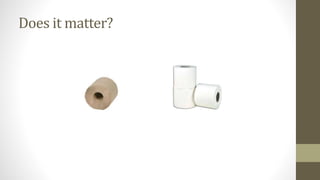
Does it matter?
"The extent to which a product can be used by specified
users to achieve specified goals with effectiveness,
efficiency, and satisfaction in a specified context of use."
ISO 9241-11
Does it matter?
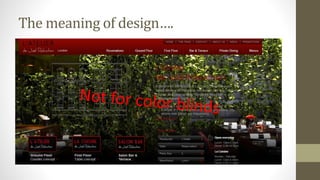
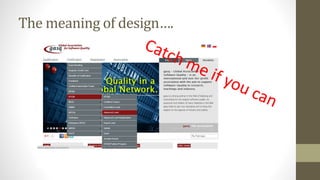
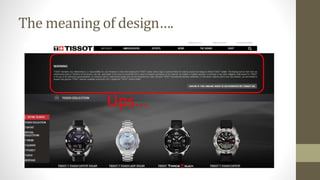
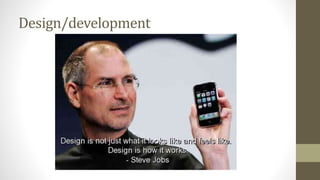
The meaning of design….
Ups...
Elements of Usability
Utility = whether it provides the features you need.
Usability = how easy & pleasant these features are to use.
Useful = usability + utility.
Jakob Nielsen
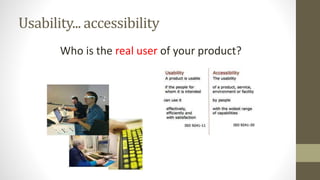
Usability... accessibility
Who is the real user of your product?
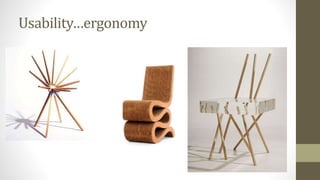
Usability…ergonomy
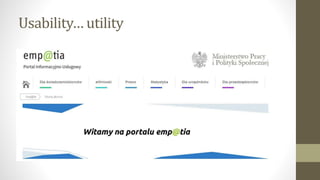
Usability… utility
In case of errors....
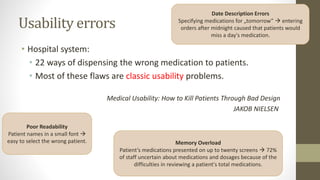
Usability errors
• Hospital system:
• 22 ways of dispensing the wrong medication to patients.
• Most of these flaws are classic usability problems.
Medical Usability: How to Kill Patients Through Bad Design
JAKOB NIELSEN
Poor Readability
Patient names in a small font 
easy to select the wrong patient. Memory Overload
Patient’s medications presented on up to twenty screens  72%
of staff uncertain about medications and dosages because of the
difficulties in reviewing a patient's total medications.
Date Description Errors
Specifying medications for „tomorrow”  entering
orders after midnight caused that patients would
miss a day's medication.
Bad usability = no customers
Yes
Usability matters
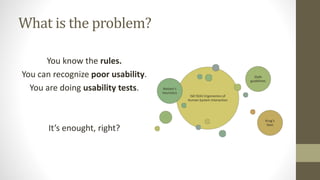
What is the problem?
You know the rules.
You can recognize poor usability.
You are doing usability tests.
It’s enought, right?
ISO 9241 Ergonomics of
Human System Interaction
Nielsen’s
heuristics
Style
guidelines
Krug’s
laws
Not really
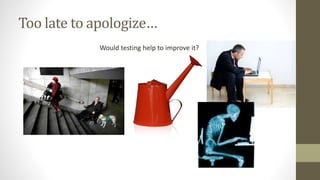
Too late to apologize…
Would testing help to improve it?
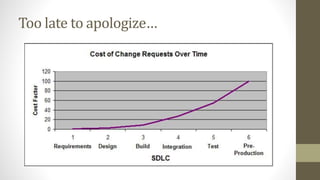
Too late to apologize…
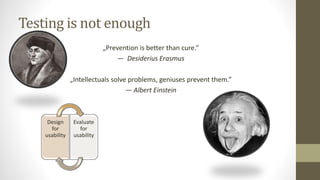
Testing is not enough
„Prevention is better than cure.”
― Desiderius Erasmus
„Intellectuals solve problems, geniuses prevent them.”
― Albert Einstein
Design
for
usability
Evaluate
for
usability
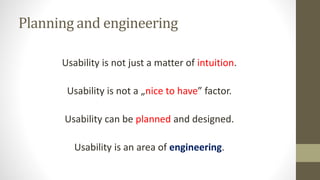
Planning and engineering
Usability is not just a matter of intuition.
Usability is not a „nice to have” factor.
Usability can be planned and designed.
Usability is an area of engineering.
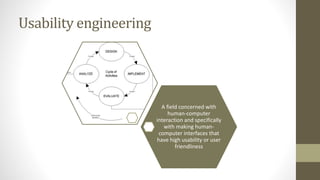
Usability engineering
A field concerned with
human-computer
interaction and specifically
with making human-
computer interfaces that
have high usability or user
friendliness
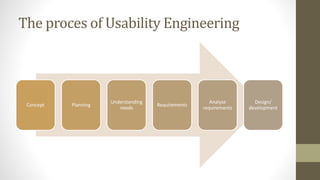
The proces of Usability Engineering
Concept Planning
Understanding
needs
Requirements
Analyse
requirements
Design/
development
Concept
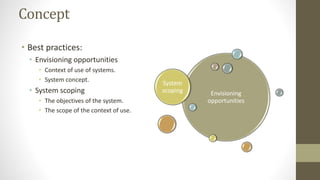
• Best practices:
• Envisioning opportunities
• Context of use of systems.
• System concept.
• System scoping
• The objectives of the system.
• The scope of the context of use.
Envisioning
opportunities
System
scoping
Concept
Know your users.
Know their goals, skills, preferences, and tendencies.
“Obsess over customers: when given the choice between obsessing over competitors or
customers, always obsess over customers. Start with customers and work backward.”
– Jeff Bezos
Concept
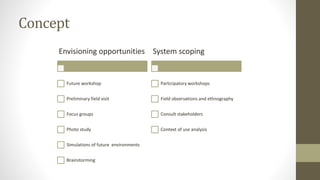
Envisioning opportunities
Future workshop
Preliminary field visit
Focus groups
Photo study
Simulations of future environments
Brainstorming
System scoping
Participatory workshops
Field observations and ethnography
Consult stakeholders
Context of use analysis
Planning
• Plan – how to achieve and maintain usability throughout the life of the
system.
• Plan – how to provide required specialist skills.
„If you fail to plan, you are planning to fail”
― Benjamin Franklin
Understanding needs
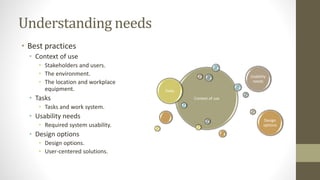
• Best practices
• Context of use
• Stakeholders and users.
• The environment.
• The location and workplace
equipment.
• Tasks
• Tasks and work system.
• Usability needs
• Required system usability.
• Design options
• Design options.
• User-centered solutions.
Context of use
Tasks
Usability
needs
Design
options
Understanding needs
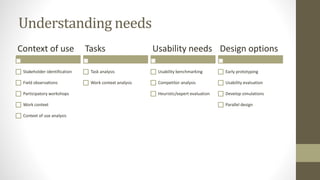
Context of use
Stakeholder identification
Field observations
Participatory workshops
Work context
Context of use analysis
Tasks
Task analysis
Work context analysis
Usability needs
Usability benchmarking
Competitor analysis
Heuristic/expert evaluation
Design options
Early prototyping
Usability evaluation
Develop simulations
Parallel design
Understanding needs
Understanding needs
Understanding needs
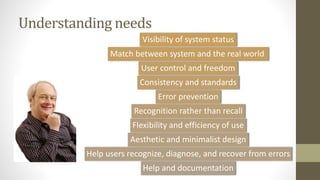
Visibility of system status
Match between system and the real world
User control and freedom
Consistency and standards
Error prevention
Recognition rather than recall
Flexibility and efficiency of use
Aesthetic and minimalist design
Help users recognize, diagnose, and recover from errors
Help and documentation
Requirements
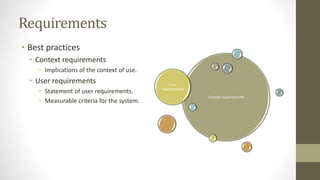
• Best practices
• Context requirements
• Implications of the context of use.
• User requirements
• Statement of user requirements.
• Measurable criteria for the system.
Context requirements
User
requirements
Requirements
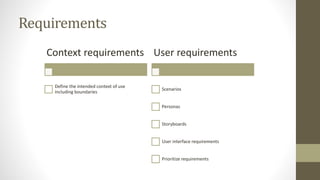
Context requirements
Define the intended context of use
including boundaries
User requirements
Scenarios
Personas
Storyboards
User interface requirements
Prioritize requirements
Analyze requirements
• Best practices
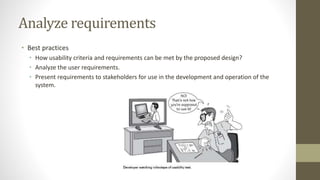
• How usability criteria and requirements can be met by the proposed design?
• Analyze the user requirements.
• Present requirements to stakeholders for use in the development and operation of the
system.
Analyze requirements
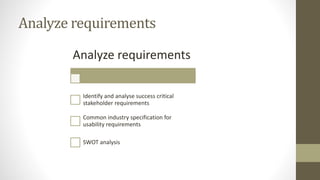
Identify and analyse success critical
stakeholder requirements
Common industry specification for
usability requirements
SWOT analysis
Design/development
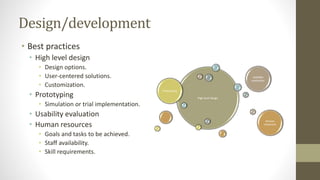
• Best practices
• High level design
• Design options.
• User-centered solutions.
• Customization.
• Prototyping
• Simulation or trial implementation.
• Usability evaluation
• Human resources
• Goals and tasks to be achieved.
• Staff availability.
• Skill requirements.
High level design
Prototyping
Usability
evaluation
Human
resources
Design/development
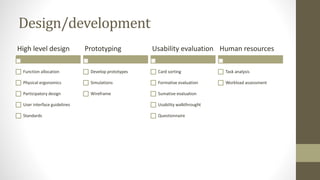
High level design
Function allocation
Physical ergonomics
Participatory design
User interface guidelines
Standards
Prototyping
Develop prototypes
Simulations
Wireframe
Usability evaluation
Card sorting
Formative evaluation
Sumative evaluation
Usability walkthrought
Questionnaire
Human resources
Task analysis
Workload assessment
Design/development
Design/development
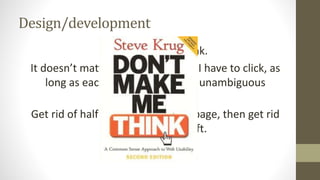
Don’t make me think.
It doesn’t matter how many times I have to click, as
long as each click is a mindless, unambiguous
choice.
Get rid of half the words on each page, then get rid
of half of what is left.
Failed at first?
Don’t worry.
“No matter how thoroughly you plan, no matter how much you think you know, you've
never thought of everything.”
― John Flanagan
Readings
• http://www.usabilitybok.org/
• http://www.usabilitynet.org
• http://www.usabilityplanner.org/#methods
Q & A

Don’t just test Usability – build it!

  • 1.
    Don’t just testUsability – build it!
  • 2.
    About me I donot code. The rest is ok.
  • 3.
  • 4.
    Does it matter? "Theextent to which a product can be used by specified users to achieve specified goals with effectiveness, efficiency, and satisfaction in a specified context of use." ISO 9241-11
  • 5.
  • 6.
    The meaning ofdesign….
  • 7.
    The meaning ofdesign….
  • 8.
    The meaning ofdesign…. Ups...
  • 9.
    Elements of Usability Utility= whether it provides the features you need. Usability = how easy & pleasant these features are to use. Useful = usability + utility. Jakob Nielsen
  • 10.
    Usability... accessibility Who isthe real user of your product?
  • 11.
  • 12.
  • 13.
    In case oferrors....
  • 14.
    Usability errors • Hospitalsystem: • 22 ways of dispensing the wrong medication to patients. • Most of these flaws are classic usability problems. Medical Usability: How to Kill Patients Through Bad Design JAKOB NIELSEN Poor Readability Patient names in a small font  easy to select the wrong patient. Memory Overload Patient’s medications presented on up to twenty screens  72% of staff uncertain about medications and dosages because of the difficulties in reviewing a patient's total medications. Date Description Errors Specifying medications for „tomorrow”  entering orders after midnight caused that patients would miss a day's medication.
  • 15.
    Bad usability =no customers
  • 16.
  • 17.
    What is theproblem? You know the rules. You can recognize poor usability. You are doing usability tests. It’s enought, right? ISO 9241 Ergonomics of Human System Interaction Nielsen’s heuristics Style guidelines Krug’s laws
  • 18.
  • 19.
    Too late toapologize… Would testing help to improve it?
  • 20.
    Too late toapologize…
  • 21.
    Testing is notenough „Prevention is better than cure.” ― Desiderius Erasmus „Intellectuals solve problems, geniuses prevent them.” ― Albert Einstein Design for usability Evaluate for usability
  • 22.
    Planning and engineering Usabilityis not just a matter of intuition. Usability is not a „nice to have” factor. Usability can be planned and designed. Usability is an area of engineering.
  • 23.
    Usability engineering A fieldconcerned with human-computer interaction and specifically with making human- computer interfaces that have high usability or user friendliness
  • 24.
    The proces ofUsability Engineering Concept Planning Understanding needs Requirements Analyse requirements Design/ development
  • 25.
    Concept • Best practices: •Envisioning opportunities • Context of use of systems. • System concept. • System scoping • The objectives of the system. • The scope of the context of use. Envisioning opportunities System scoping
  • 26.
    Concept Know your users. Knowtheir goals, skills, preferences, and tendencies. “Obsess over customers: when given the choice between obsessing over competitors or customers, always obsess over customers. Start with customers and work backward.” – Jeff Bezos
  • 27.
    Concept Envisioning opportunities Future workshop Preliminaryfield visit Focus groups Photo study Simulations of future environments Brainstorming System scoping Participatory workshops Field observations and ethnography Consult stakeholders Context of use analysis
  • 28.
    Planning • Plan –how to achieve and maintain usability throughout the life of the system. • Plan – how to provide required specialist skills. „If you fail to plan, you are planning to fail” ― Benjamin Franklin
  • 29.
    Understanding needs • Bestpractices • Context of use • Stakeholders and users. • The environment. • The location and workplace equipment. • Tasks • Tasks and work system. • Usability needs • Required system usability. • Design options • Design options. • User-centered solutions. Context of use Tasks Usability needs Design options
  • 30.
    Understanding needs Context ofuse Stakeholder identification Field observations Participatory workshops Work context Context of use analysis Tasks Task analysis Work context analysis Usability needs Usability benchmarking Competitor analysis Heuristic/expert evaluation Design options Early prototyping Usability evaluation Develop simulations Parallel design
  • 31.
  • 32.
  • 33.
    Understanding needs Visibility ofsystem status Match between system and the real world User control and freedom Consistency and standards Error prevention Recognition rather than recall Flexibility and efficiency of use Aesthetic and minimalist design Help users recognize, diagnose, and recover from errors Help and documentation
  • 34.
    Requirements • Best practices •Context requirements • Implications of the context of use. • User requirements • Statement of user requirements. • Measurable criteria for the system. Context requirements User requirements
  • 35.
    Requirements Context requirements Define theintended context of use including boundaries User requirements Scenarios Personas Storyboards User interface requirements Prioritize requirements
  • 36.
    Analyze requirements • Bestpractices • How usability criteria and requirements can be met by the proposed design? • Analyze the user requirements. • Present requirements to stakeholders for use in the development and operation of the system.
  • 37.
    Analyze requirements Analyze requirements Identifyand analyse success critical stakeholder requirements Common industry specification for usability requirements SWOT analysis
  • 38.
    Design/development • Best practices •High level design • Design options. • User-centered solutions. • Customization. • Prototyping • Simulation or trial implementation. • Usability evaluation • Human resources • Goals and tasks to be achieved. • Staff availability. • Skill requirements. High level design Prototyping Usability evaluation Human resources
  • 39.
    Design/development High level design Functionallocation Physical ergonomics Participatory design User interface guidelines Standards Prototyping Develop prototypes Simulations Wireframe Usability evaluation Card sorting Formative evaluation Sumative evaluation Usability walkthrought Questionnaire Human resources Task analysis Workload assessment
  • 40.
  • 41.
    Design/development Don’t make methink. It doesn’t matter how many times I have to click, as long as each click is a mindless, unambiguous choice. Get rid of half the words on each page, then get rid of half of what is left.
  • 42.
    Failed at first? Don’tworry. “No matter how thoroughly you plan, no matter how much you think you know, you've never thought of everything.” ― John Flanagan
  • 43.
  • 44.