Instructions for the Mini-Cog Test
Administration
the Mini-Cog test is a 3-minute instrument to screen for cognitive impairment in older
adults in the primary care setting. The Mini-Cog uses a three-item recall test for memory
and a simply scored clock-drawing test (CDT). The latter serves as an “informative
distractor,” helping to clarify scores when the memory recall score is intermediate. The
Mini-Cog was as effective as or better than established screening tests in both an
epidemiologic survey in a mainstream sample and a multi-ethnic, multilingual population
comprising many individuals of low socioeconomic status and education level. In
comparative tests, the Mini-Cog was at least twice as fast as the Mini-Mental State
Examination. The Mini-Cog is less affected by subject ethnicity, language, and
education, and can detect a variety of different dementias. Moreover, the Mini-Cog
detects many people with mild cognitive impairment (cognitive impairment too mild to
meet diagnostic criteria for dementia).
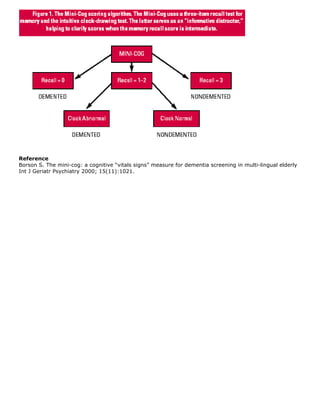
Scoring (see figure 1)
1 point for each recalled word
Score clock drawing as Normal (the patient places the correct time and the clock
appears grossly normal) or Abnormal
Score
0 Positive for cognitive impairment
1-2 Abnormal CDT then positive for cognitive impairment
1-2 Normal CDT then negative for cognitive impairment
3 Negative screen for dementia (no need to score CDT)
Page 1 of 2Instructions for the Mini-Cog Test
2/13/2008http://geriatrics.uthscsa.edu/educational/med_students/minicog_admin.htm
Reference
Borson S. The mini-cog: a cognitive “vitals signs” measure for dementia screening in multi-lingual elderly
Int J Geriatr Psychiatry 2000; 15(11):1021.
Page 2 of 2Instructions for the Mini-Cog Test
2/13/2008http://geriatrics.uthscsa.edu/educational/med_students/minicog_admin.htm
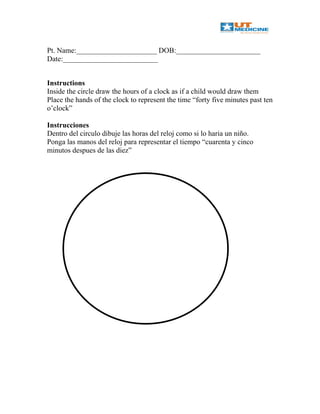
Pt. Name:______________________ DOB:_______________________
Date:__________________________
Instructions
Inside the circle draw the hours of a clock as if a child would draw them
Place the hands of the clock to represent the time “forty five minutes past ten
o’clock”
Instrucciones
Dentro del circulo dibuje las horas del reloj como si lo haria un niño.
Ponga las manos del reloj para representar el tiempo “cuarenta y cinco
minutos despues de las diez”
The MINI-COG
1. Instruct the patient to listen carefully and repeat the following
` APPLE WATCH PENNY
MANZANA RELOJ PESETA
2. Administer the Clock Drawing Test
3. Ask the patient to repeat the three words given previously
_________ _________ __________
Scoring
Number of correct items recalled _______ [if 3 then negative screen. STOP]
If answer is 1-2
Is CDT Abnormal? No Yes
If No, then negative screen
If Yes, then screen positive for cognitive impairment

Mini cog

  • 1.
    Instructions for theMini-Cog Test Administration the Mini-Cog test is a 3-minute instrument to screen for cognitive impairment in older adults in the primary care setting. The Mini-Cog uses a three-item recall test for memory and a simply scored clock-drawing test (CDT). The latter serves as an “informative distractor,” helping to clarify scores when the memory recall score is intermediate. The Mini-Cog was as effective as or better than established screening tests in both an epidemiologic survey in a mainstream sample and a multi-ethnic, multilingual population comprising many individuals of low socioeconomic status and education level. In comparative tests, the Mini-Cog was at least twice as fast as the Mini-Mental State Examination. The Mini-Cog is less affected by subject ethnicity, language, and education, and can detect a variety of different dementias. Moreover, the Mini-Cog detects many people with mild cognitive impairment (cognitive impairment too mild to meet diagnostic criteria for dementia). Scoring (see figure 1) 1 point for each recalled word Score clock drawing as Normal (the patient places the correct time and the clock appears grossly normal) or Abnormal Score 0 Positive for cognitive impairment 1-2 Abnormal CDT then positive for cognitive impairment 1-2 Normal CDT then negative for cognitive impairment 3 Negative screen for dementia (no need to score CDT) Page 1 of 2Instructions for the Mini-Cog Test 2/13/2008http://geriatrics.uthscsa.edu/educational/med_students/minicog_admin.htm
  • 2.
    Reference Borson S. Themini-cog: a cognitive “vitals signs” measure for dementia screening in multi-lingual elderly Int J Geriatr Psychiatry 2000; 15(11):1021. Page 2 of 2Instructions for the Mini-Cog Test 2/13/2008http://geriatrics.uthscsa.edu/educational/med_students/minicog_admin.htm
  • 3.
    Pt. Name:______________________ DOB:_______________________ Date:__________________________ Instructions Insidethe circle draw the hours of a clock as if a child would draw them Place the hands of the clock to represent the time “forty five minutes past ten o’clock” Instrucciones Dentro del circulo dibuje las horas del reloj como si lo haria un niño. Ponga las manos del reloj para representar el tiempo “cuarenta y cinco minutos despues de las diez”
  • 4.
    The MINI-COG 1. Instructthe patient to listen carefully and repeat the following ` APPLE WATCH PENNY MANZANA RELOJ PESETA 2. Administer the Clock Drawing Test 3. Ask the patient to repeat the three words given previously _________ _________ __________ Scoring Number of correct items recalled _______ [if 3 then negative screen. STOP] If answer is 1-2 Is CDT Abnormal? No Yes If No, then negative screen If Yes, then screen positive for cognitive impairment