Mindset
Mindset Definition A way of thinking that determines one's outlook, mental attitude and behaviour A fixed mental attitude or disposition that predetermines a person's responses to and interpretations of situations.
Mindsets are naturally occurring What are  some of yours?
Mindset
Mindset Components
State by choice, State by design  Creative Persistent Resilient Determined Focused Open  Aware Calm Confident Controlled Organised Taking Action Passionate Excited Motivated
Achievement Family   Respect Equity Money   Love Team working Responsibility   Truth Mindset Components Importance, Guidelines for behaviour Values
Elicited, examined & reorganised, reinforced Hierarchy vs. Heterarchy  Balanced, congruent, ecological Mindset Components Values
Mindset Components  Motivation Force
Mindset Components  Motivation Force = A Propulsion System Motivation Towards Motivation Away From
Mindset Components Assumptions and convictions that are held to be true, by an individual or a group, regarding concepts, events, people, and things Beliefs
Mindset Components “ Men often become what they believe themselves to be. If I believe I cannot do something, it makes me incapable of doing it. But when I believe I can, then I acquire the ability to do it even if I didn't have it in the beginning” Mahatma Ghandi Beliefs
Mindset Components Empowering beliefs strengthened, installed Congruent, ecological Limiting Beliefs explored, reframed, deleted Beliefs
Mindset Components General or over-arching view of myself Specific underlying identities  Identity
Mindset Components My identity when I’m engaged in it Who I become Who I need to be   Identity
Mindset Components Competence is the acquisition of knowledge skills and abilities at a level of expertise sufficient to be able to perform in an appropriate work setting Competence
We already know! Do you know how to do the thing? Have you any highly successful role models ?
Mindset Components  A sequence of representations to achieve an outcome V c  A id   V r  K i+   A id+ Mental Strategies
Strategy Elicitation "My last thought before I take the club away isn't a thought at all. It's a picture, a visualization, a sensation. If I think of swinging slowly, my last thought isn't "swing slowly." It's an image of me swinging slowly."    Jack Nicklaus   "I like to stand behind the ball, facing the line of the putt, and visualising the outcome in my mind’s eye. I like to ‘see’ the ball roll into the cup"     Annika Sorenstam
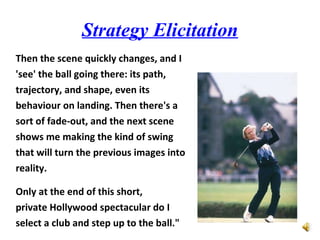
Strategy Elicitation Jack Nicklaus described his visualisation in his mental movie this way; "I never hit a shot, even in practice, without having a very sharp, in-focus picture of it in my head.  It's like a colour movie. First I 'see' the ball where I want it to finish, nice and white and sitting up high on the bright green grass.
Strategy Elicitation Then the scene quickly changes, and I  'see' the ball going there: its path, trajectory, and shape, even its behaviour on landing. Then there's a sort of fade-out, and the next scene shows me making the kind of swing that will turn the previous images into reality.  Only at the end of this short, private Hollywood spectacular do I select a club and step up to the ball."
Mindset Components  A sequence of representations to achieve an outcome Sub Modalities Mental Strategies
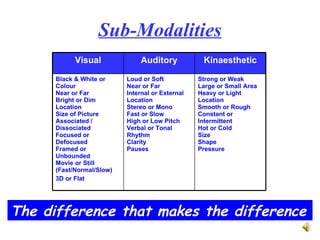
Sub-Modalities The difference that makes the difference Visual Auditory Kinaesthetic Black & White or Colour Near or Far Bright or Dim Location Size of Picture Associated / Dissociated Focused or Defocused Framed or Unbounded Movie or Still (Fast/Normal/Slow) 3D or Flat Loud or Soft Near or Far Internal or External Location Stereo or Mono Fast or Slow High or Low Pitch Verbal or Tonal Rhythm Clarity Pauses Strong or Weak Large or Small Area Heavy or Light Location Smooth or Rough Constant or Intermittent Hot or Cold Size Shape Pressure
Mindset Components  A sequence of representations to achieve an outcome V c  A id   V r  K i+   A id+ Mental Strategies
Mental Rehearsal –  Visualisation The greatest golfers will have played every hole on the course countless times through visualisation. They will know the best course of action to take under every set of circumstances - no shot they play on the day will cause a surprise (not to them anyway!), allowing them to feel in total control of every aspect of their performance.
Mental Rehearsal –  Visualisation They will not only have seen every shot in their mind’s-eye, they will have felt every tiny detail of their body position through every swing they take, and they will have heard the sound of the ball as it rolls into the cup each time.
Positive self-talk Definition:    Anything said to oneself for encouragement or motivation, such as phrases or mantras;  One's constant internal conversation
Ecology Parts and their objections It should already be sorted, he mustn’t want to change!
Solving Problems Strategy identification and enhancement Sub-modality work Reframing The SWISH Role-modelling New Behaviour Generator Identity Coaching Perspective Patterns Changing Criteria Accessing Resources
Mindset Components
Attitude is a decision!
Attitude is a decision! So, what do you want?
Mindset

Mindset intro

  • 1.
  • 2.
    Mindset Definition Away of thinking that determines one's outlook, mental attitude and behaviour A fixed mental attitude or disposition that predetermines a person's responses to and interpretations of situations.
  • 3.
    Mindsets are naturallyoccurring What are some of yours?
  • 4.
  • 5.
  • 6.
    State by choice,State by design Creative Persistent Resilient Determined Focused Open Aware Calm Confident Controlled Organised Taking Action Passionate Excited Motivated
  • 7.
    Achievement Family Respect Equity Money Love Team working Responsibility Truth Mindset Components Importance, Guidelines for behaviour Values
  • 8.
    Elicited, examined &reorganised, reinforced Hierarchy vs. Heterarchy Balanced, congruent, ecological Mindset Components Values
  • 9.
    Mindset Components Motivation Force
  • 10.
    Mindset Components Motivation Force = A Propulsion System Motivation Towards Motivation Away From
  • 11.
    Mindset Components Assumptionsand convictions that are held to be true, by an individual or a group, regarding concepts, events, people, and things Beliefs
  • 12.
    Mindset Components “Men often become what they believe themselves to be. If I believe I cannot do something, it makes me incapable of doing it. But when I believe I can, then I acquire the ability to do it even if I didn't have it in the beginning” Mahatma Ghandi Beliefs
  • 13.
    Mindset Components Empoweringbeliefs strengthened, installed Congruent, ecological Limiting Beliefs explored, reframed, deleted Beliefs
  • 14.
    Mindset Components Generalor over-arching view of myself Specific underlying identities Identity
  • 15.
    Mindset Components Myidentity when I’m engaged in it Who I become Who I need to be Identity
  • 16.
    Mindset Components Competenceis the acquisition of knowledge skills and abilities at a level of expertise sufficient to be able to perform in an appropriate work setting Competence
  • 17.
    We already know!Do you know how to do the thing? Have you any highly successful role models ?
  • 18.
    Mindset Components A sequence of representations to achieve an outcome V c A id V r K i+ A id+ Mental Strategies
  • 19.
    Strategy Elicitation "Mylast thought before I take the club away isn't a thought at all. It's a picture, a visualization, a sensation. If I think of swinging slowly, my last thought isn't "swing slowly." It's an image of me swinging slowly." Jack Nicklaus "I like to stand behind the ball, facing the line of the putt, and visualising the outcome in my mind’s eye. I like to ‘see’ the ball roll into the cup" Annika Sorenstam
  • 20.
    Strategy Elicitation JackNicklaus described his visualisation in his mental movie this way; "I never hit a shot, even in practice, without having a very sharp, in-focus picture of it in my head. It's like a colour movie. First I 'see' the ball where I want it to finish, nice and white and sitting up high on the bright green grass.
  • 21.
    Strategy Elicitation Thenthe scene quickly changes, and I 'see' the ball going there: its path, trajectory, and shape, even its behaviour on landing. Then there's a sort of fade-out, and the next scene shows me making the kind of swing that will turn the previous images into reality. Only at the end of this short, private Hollywood spectacular do I select a club and step up to the ball."
  • 22.
    Mindset Components A sequence of representations to achieve an outcome Sub Modalities Mental Strategies
  • 23.
    Sub-Modalities The differencethat makes the difference Visual Auditory Kinaesthetic Black & White or Colour Near or Far Bright or Dim Location Size of Picture Associated / Dissociated Focused or Defocused Framed or Unbounded Movie or Still (Fast/Normal/Slow) 3D or Flat Loud or Soft Near or Far Internal or External Location Stereo or Mono Fast or Slow High or Low Pitch Verbal or Tonal Rhythm Clarity Pauses Strong or Weak Large or Small Area Heavy or Light Location Smooth or Rough Constant or Intermittent Hot or Cold Size Shape Pressure
  • 24.
    Mindset Components A sequence of representations to achieve an outcome V c A id V r K i+ A id+ Mental Strategies
  • 25.
    Mental Rehearsal – Visualisation The greatest golfers will have played every hole on the course countless times through visualisation. They will know the best course of action to take under every set of circumstances - no shot they play on the day will cause a surprise (not to them anyway!), allowing them to feel in total control of every aspect of their performance.
  • 26.
    Mental Rehearsal – Visualisation They will not only have seen every shot in their mind’s-eye, they will have felt every tiny detail of their body position through every swing they take, and they will have heard the sound of the ball as it rolls into the cup each time.
  • 27.
    Positive self-talk Definition:   Anything said to oneself for encouragement or motivation, such as phrases or mantras; One's constant internal conversation
  • 28.
    Ecology Parts andtheir objections It should already be sorted, he mustn’t want to change!
  • 29.
    Solving Problems Strategyidentification and enhancement Sub-modality work Reframing The SWISH Role-modelling New Behaviour Generator Identity Coaching Perspective Patterns Changing Criteria Accessing Resources
  • 30.
  • 31.
    Attitude is adecision!
  • 32.
    Attitude is adecision! So, what do you want?
  • 33.