


www.mrg.comManagement Research Group®
Insight  Evidence  Inspiration
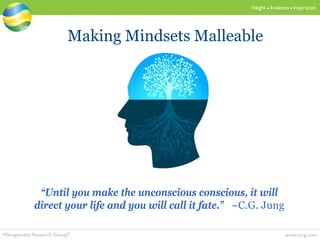
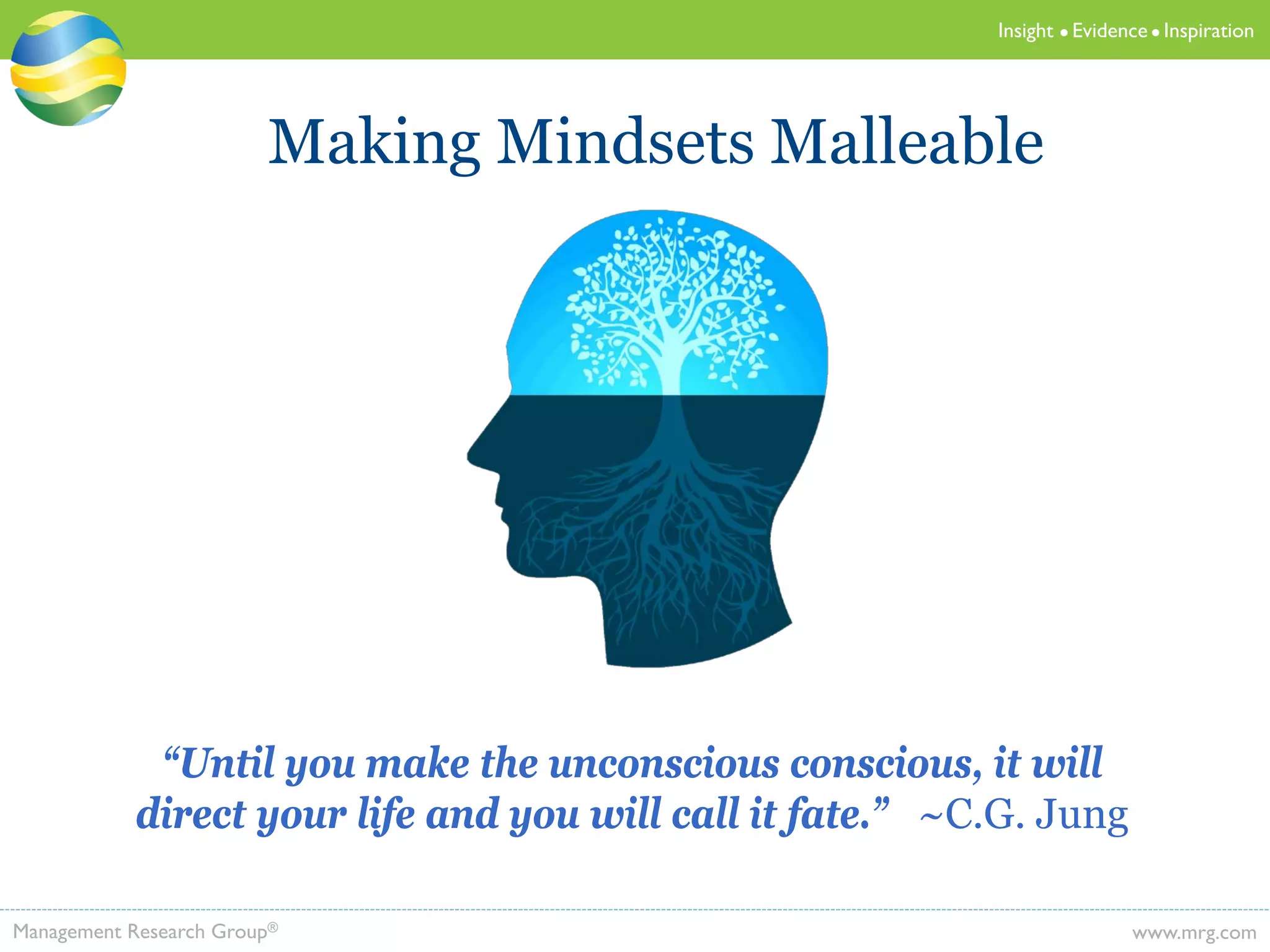
Making Mindsets Malleable
“Until you make the unconscious conscious, it will
direct your life and you will call it fate.” ~C.G. Jung
www.mrg.comManagement Research Group®
Insight  Evidence  Inspiration
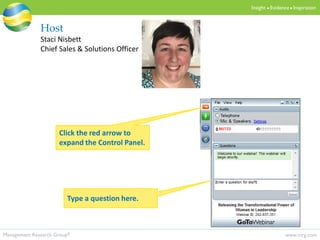
Type a question here.
Click the red arrow to
expand the Control Panel.
Host
Staci Nisbett
Chief Sales & Solutions Officer
www.mrg.comManagement Research Group®
Insight  Evidence  Inspiration
www.mrg.comManagement Research Group®
Insight  Evidence  Inspiration
Our Presenter
Tricia Naddaff
President, MRG
www.mrg.comManagement Research Group®
Insight  Evidence  Inspiration
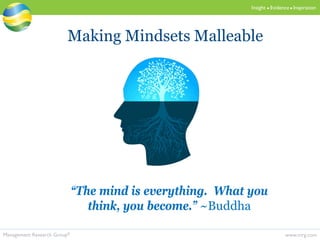
Making Mindsets Malleable
“The mind is everything. What you
think, you become.” ~Buddha
www.mrg.comManagement Research Group®
Insight  Evidence  Inspiration
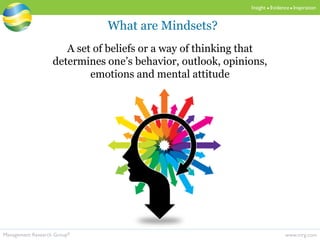
A set of beliefs or a way of thinking that
determines one’s behavior, outlook, opinions,
emotions and mental attitude
What are Mindsets?
www.mrg.comManagement Research Group®
Insight  Evidence  Inspiration
 To what degree are you currently focusing on discovering
and developing mindsets with your clients?
 It’s a significant part of the work I do
 I incorporate it relatively regularly
 I am beginning to experiment with it a little bit
 I am just starting to learn more about mindsets
Poll #1
www.mrg.comManagement Research Group®
Insight  Evidence  Inspiration
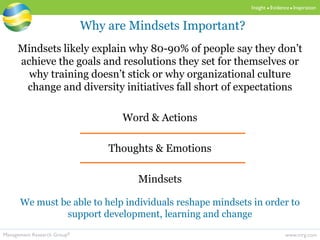
Mindsets likely explain why 80-90% of people say they don’t
achieve the goals and resolutions they set for themselves or
why training doesn’t stick or why organizational culture
change and diversity initiatives fall short of expectations
Word & Actions
Thoughts & Emotions
Mindsets
Why are Mindsets Important?
We must be able to help individuals reshape mindsets in order to
support development, learning and change
www.mrg.comManagement Research Group®
Insight  Evidence  Inspiration
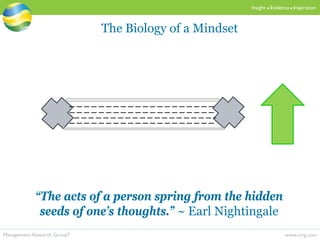
The Biology of a Mindset
“The acts of a person spring from the hidden
seeds of one’s thoughts.” ~ Earl Nightingale
www.mrg.comManagement Research Group®
Insight  Evidence  Inspiration
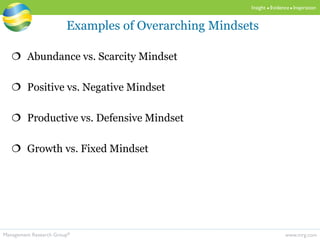
 Abundance vs. Scarcity Mindset
 Positive vs. Negative Mindset
 Productive vs. Defensive Mindset
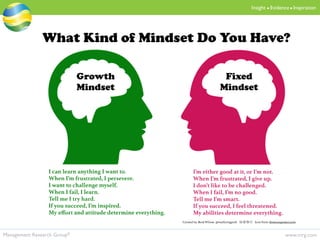
 Growth vs. Fixed Mindset
Examples of Overarching Mindsets
www.mrg.comManagement Research Group®
Insight  Evidence  Inspiration
www.mrg.comManagement Research Group®
Insight  Evidence  Inspiration
Questions, Comments and
Recommendations
Please type them into the questions box!
www.mrg.comManagement Research Group®
Insight  Evidence  Inspiration
 Assessment Instruments
 Increasing Self Awareness
 Dialogue/Guided Reflection
Uncovering Mindsets
“What is necessary to create change is to
change one’s awareness of self.”
~Abraham Maslow
www.mrg.comManagement Research Group®
Insight  Evidence  Inspiration
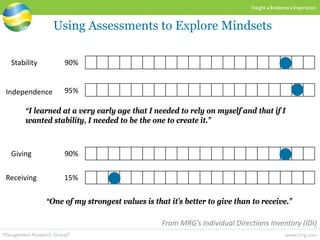
Using Assessments to Explore Mindsets
Stability
Independence
90%
95%
“I learned at a very early age that I needed to rely on myself and that if I
wanted stability, I needed to be the one to create it.”
“One of my strongest values is that it’s better to give than to receive.”
Giving 90%
Receiving 15%
From MRG’s Individual Directions Inventory (IDI)
www.mrg.comManagement Research Group®
Insight  Evidence  Inspiration
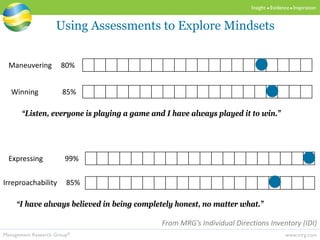
Using Assessments to Explore Mindsets
Maneuvering 80%
Winning 85%
“Listen, everyone is playing a game and I have always played it to win.”
Expressing 99%
Irreproachability 85%
“I have always believed in being completely honest, no matter what.”
From MRG’s Individual Directions Inventory (IDI)
www.mrg.comManagement Research Group®
Insight  Evidence  Inspiration
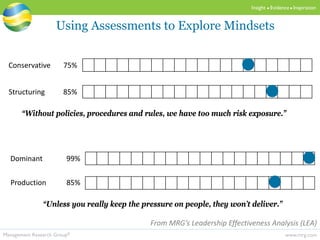
Using Assessments to Explore Mindsets
Conservative 75%
Structuring 85%
“Without policies, procedures and rules, we have too much risk exposure.”
Dominant 99%
Production 85%
“Unless you really keep the pressure on people, they won’t deliver.”
From MRG’s Leadership Effectiveness Analysis (LEA)
www.mrg.comManagement Research Group®
Insight  Evidence  Inspiration
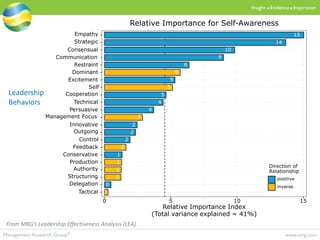
 On average, how self-aware are the leaders you work with?
 Extremely self-aware
 Mostly self-aware
 Somewhat self-aware
 Relatively little self-awareness
Poll #2
www.mrg.comManagement Research Group®
Insight  Evidence  Inspiration
15
14
10
9
6
6
5
5
5
4
4
3
2
2
2
2
1
1
1
1
0
0Tactical
Delegation
Structuring
Authority
Production
Conservative
Feedback
Control
Outgoing
Innovative
Management Focus
Persuasive
Technical
Cooperation
Self
Excitement
Dominant
Restraint
Communication
Consensual
Strategic
Empathy
0 5 10 15
Relative Importance Index
(Total variance explained = 41%)
Direction of
Relationship
positive
inverse
Relative Importance for Self-Awareness
Leadership
Behaviors
From MRG’s Leadership Effectiveness Analysis (LEA)
www.mrg.comManagement Research Group®
Insight  Evidence  Inspiration
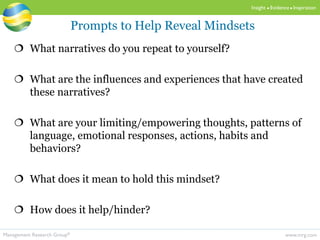
 What narratives do you repeat to yourself?
 What are the influences and experiences that have created
these narratives?
 What are your limiting/empowering thoughts, patterns of
language, emotional responses, actions, habits and
behaviors?
 What does it mean to hold this mindset?
 How does it help/hinder?
Prompts to Help Reveal Mindsets
www.mrg.comManagement Research Group®
Insight  Evidence  Inspiration
Questions, Comments and
Recommendations
Please type them into the questions box!
www.mrg.comManagement Research Group®
Insight  Evidence  Inspiration
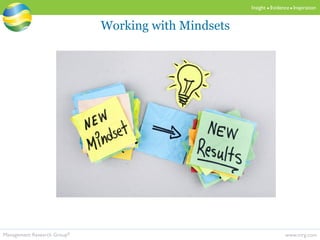
Working with Mindsets
www.mrg.comManagement Research Group®
Insight  Evidence  Inspiration
Candace Pert, PhD , former head of Brain
Biochemistry at the NIH found that every time
we feed a positive mindset it weakens the
negative ones
www.mrg.comManagement Research Group®
Insight  Evidence  Inspiration
 Think of a recurring stressful situation, a situation that is
reliably stressful even though it may have happened only once
and recurs only in your mind
 Complete the “Judging” worksheet
http://thework.com/sites/thework/downloads/worksheets/JudgeY
ourNeighbor_Worksheet.pdf
 Answer the questions:
1. Is it true? (Yes or no. If no, move to 3.)
2. Can you absolutely know that it's true? (Yes or no.)
3. How do you react, what happens, when you believe that
thought?
4. Who would you be without the thought?
thework.com
Byron Katie’s “The Work”
www.mrg.comManagement Research Group®
Insight  Evidence  Inspiration
 State Improvement Goal
 Specify the concrete behaviors needed to achieve the goal
 Identify the Behaviors that go against the goal
 Identify the things you do/don’t do that get in the way of achieving the
goal
 Identify your fears/worries
 These are the emotional things that block progress toward your goal
 Identify Hidden Competing Commitments
 The counter mindsets/goals/pressures/desires that are obstacles to
making progress on the goal
 Identify the Big Assumptions
 From Lisa Lahey “(these) are the beliefs and internalized truths (i.e.
Mindsets) we hold about how the world works, how we work and how
people respond to us. They are the assumptions that make each
hidden commitment feel necessary.”
 Establish an Action Plan to test your big assumptions
Immunity to Change
www.mrg.comManagement Research Group®
Insight  Evidence  Inspiration
 Establish “Toward” goal vs. “Away” goals
 Examples:
 Toward goal = “Carve out more time to think strategically.”
 Away goal = “Stop procrastinating and wasting time.”
 Toward goals are more likely to stimulate a reward response in
the brain
 Toward goals organize the brain to perceive information related
to the attainment of the goal
 Away goals more easily stimulate threat in the brain because
problems come to mind more easily than solutions
Goal Focused Brain Patterns
From “Your Brain at Work” by David Rock
www.mrg.comManagement Research Group®
Insight  Evidence  Inspiration
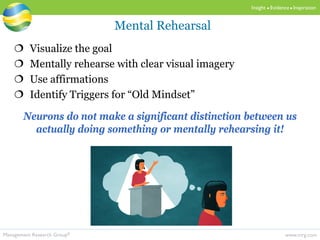
 Visualize the goal
 Mentally rehearse with clear visual imagery
 Use affirmations
 Identify Triggers for “Old Mindset”
Neurons do not make a significant distinction between us
actually doing something or mentally rehearsing it!
Mental Rehearsal
www.mrg.comManagement Research Group®
Insight  Evidence  Inspiration
Questions, Comments and
Recommendations
Please type them into the questions box!
www.mrg.comManagement Research Group®
Insight  Evidence  Inspiration
 Mindset by Carol S. Dweck, Ph.D.
 Mindset Matters Most by Brian J. Grasso
 Mymindsettools.com
 Immunity to Change by Robert Kegan and Lisa Lahey
 Thework.com (Byron Katie’s website)
 Your Brain at Work by David Rock
 http://lifehacker.com/how-to-calm-your-nerves-with-
mental-rehearsal-and-get-1705202829
 http://7mindsets.com/how-to-change-your-mindset/
Resources
www.mrg.comManagement Research Group®
Insight  Evidence  Inspiration
Interested in More Insights and Ideas?
Our webinars will begin again in September!
Catch up on any you missed:
www.mrg.com/research
www.mrg.comManagement Research Group®
Insight  Evidence  Inspiration
Thank you for joining us!
“We can’t solve our problems with the
same thinking we used to create them.”
~Albert Einstein
www.mrg.comManagement Research Group®
Insight  Evidence  Inspiration
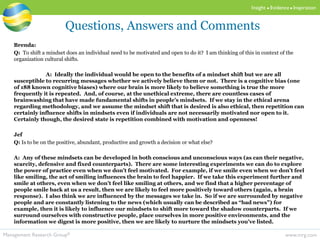
Brenda:
Q: To shift a mindset does an individual need to be motivated and open to do it? I am thinking of this in context of the
organization cultural shifts.
A: Ideally the individual would be open to the benefits of a mindset shift but we are all
susceptible to recurring messages whether we actively believe them or not. There is a cognitive bias (one
of 188 known cognitive biases) where our brain is more likely to believe something is true the more
frequently it is repeated. And, of course, at the unethical extreme, there are countless cases of
brainwashing that have made fundamental shifts in people’s mindsets. If we stay in the ethical arena
regarding methodology, and we assume the mindset shift that is desired is also ethical, then repetition can
certainly influence shifts in mindsets even if individuals are not necessarily motivated nor open to it.
Certainly though, the desired state is repetition combined with motivation and openness!
Jef
Q: Is to be on the positive, abundant, productive and growth a decision or what else?
A: Any of these mindsets can be developed in both conscious and unconscious ways (as can their negative,
scarcity, defensive and fixed counterparts). There are some interesting experiments we can do to explore
the power of practice even when we don’t feel motivated. For example, if we smile even when we don’t feel
like smiling, the act of smiling influences the brain to feel happier. If we take this experiment further and
smile at others, even when we don’t feel like smiling at others, and we find that a higher percentage of
people smile back at us a result, then we are likely to feel more positively toward others (again, a brain
response). I also think we are influenced by the messages we take in. So if we are surrounded by negative
people and are constantly listening to the news (which usually can be described as “bad news”) for
example, then it is likely to influence our mindsets to shift more toward the shadow counterparts. If we
surround ourselves with constructive people, place ourselves in more positive environments, and the
information we digest is more positive, then we are likely to nurture the mindsets you’ve listed.
Questions, Answers and Comments
www.mrg.comManagement Research Group®
Insight  Evidence  Inspiration
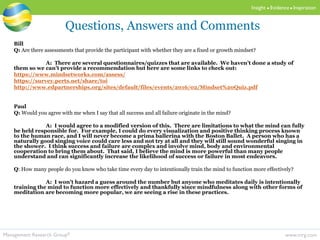
Bill
Q: Are there assessments that provide the participant with whether they are a fixed or growth mindset?
A: There are several questionnaires/quizzes that are available. We haven’t done a study of
them so we can’t provide a recommendation but here are some links to check out:
https://www.mindsetworks.com/assess/
https://survey.perts.net/share/toi
http://www.edpartnerships.org/sites/default/files/events/2016/02/Mindset%20Quiz.pdf
Paul
Q: Would you agree with me when I say that all success and all failure originate in the mind?
A: I would agree to a modified version of this. There are limitations to what the mind can fully
be held responsible for. For example, I could do every visualization and positive thinking process known
to the human race, and I will never become a prima ballerina with the Boston Ballet. A person who has a
naturally good singing voice could care less and not try at all and they will still sound wonderful singing in
the shower. I think success and failure are complex and involve mind, body and environmental
cooperation to bring them about. That said, I believe the mind is more powerful than many people
understand and can significantly increase the likelihood of success or failure in most endeavors.
Q: How many people do you know who take time every day to intentionally train the mind to function more effectively?
A: I won’t hazard a guess around the number but anyone who meditates daily is intentionally
training the mind to function more effectively and thankfully since mindfulness along with other forms of
meditation are becoming more popular, we are seeing a rise in these practices.
Questions, Answers and Comments
www.mrg.comManagement Research Group®
Insight  Evidence  Inspiration
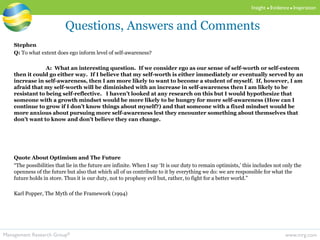
Stephen
Q: To what extent does ego inform level of self-awareness?
A: What an interesting question. If we consider ego as our sense of self-worth or self-esteem
then it could go either way. If I believe that my self-worth is either immediately or eventually served by an
increase in self-awareness, then I am more likely to want to become a student of myself. If, however, I am
afraid that my self-worth will be diminished with an increase in self-awareness then I am likely to be
resistant to being self-reflective. I haven’t looked at any research on this but I would hypothesize that
someone with a growth mindset would be more likely to be hungry for more self-awareness (How can I
continue to grow if I don’t know things about myself?) and that someone with a fixed mindset would be
more anxious about pursuing more self-awareness lest they encounter something about themselves that
don’t want to know and don’t believe they can change.
Quote About Optimism and The Future
“The possibilities that lie in the future are infinite. When I say ‘It is our duty to remain optimists,’ this includes not only the
openness of the future but also that which all of us contribute to it by everything we do: we are responsible for what the
future holds in store. Thus it is our duty, not to prophesy evil but, rather, to fight for a better world.”
Karl Popper, The Myth of the Framework (1994)
Questions, Answers and Comments

Making Mindsets Malleable: Supporting Shifts in Perspective that Unlock Transformative Development

  • 1.
    www.mrg.comManagement Research Group® Insight Evidence  Inspiration Making Mindsets Malleable “Until you make the unconscious conscious, it will direct your life and you will call it fate.” ~C.G. Jung
  • 2.
    www.mrg.comManagement Research Group® Insight Evidence  Inspiration Type a question here. Click the red arrow to expand the Control Panel. Host Staci Nisbett Chief Sales & Solutions Officer
  • 3.
  • 4.
    www.mrg.comManagement Research Group® Insight Evidence  Inspiration Our Presenter Tricia Naddaff President, MRG
  • 5.
    www.mrg.comManagement Research Group® Insight Evidence  Inspiration Making Mindsets Malleable “The mind is everything. What you think, you become.” ~Buddha
  • 6.
    www.mrg.comManagement Research Group® Insight Evidence  Inspiration A set of beliefs or a way of thinking that determines one’s behavior, outlook, opinions, emotions and mental attitude What are Mindsets?
  • 7.
    www.mrg.comManagement Research Group® Insight Evidence  Inspiration  To what degree are you currently focusing on discovering and developing mindsets with your clients?  It’s a significant part of the work I do  I incorporate it relatively regularly  I am beginning to experiment with it a little bit  I am just starting to learn more about mindsets Poll #1
  • 8.
    www.mrg.comManagement Research Group® Insight Evidence  Inspiration Mindsets likely explain why 80-90% of people say they don’t achieve the goals and resolutions they set for themselves or why training doesn’t stick or why organizational culture change and diversity initiatives fall short of expectations Word & Actions Thoughts & Emotions Mindsets Why are Mindsets Important? We must be able to help individuals reshape mindsets in order to support development, learning and change
  • 9.
    www.mrg.comManagement Research Group® Insight Evidence  Inspiration The Biology of a Mindset “The acts of a person spring from the hidden seeds of one’s thoughts.” ~ Earl Nightingale
  • 10.
    www.mrg.comManagement Research Group® Insight Evidence  Inspiration  Abundance vs. Scarcity Mindset  Positive vs. Negative Mindset  Productive vs. Defensive Mindset  Growth vs. Fixed Mindset Examples of Overarching Mindsets
  • 11.
  • 12.
    www.mrg.comManagement Research Group® Insight Evidence  Inspiration Questions, Comments and Recommendations Please type them into the questions box!
  • 13.
    www.mrg.comManagement Research Group® Insight Evidence  Inspiration  Assessment Instruments  Increasing Self Awareness  Dialogue/Guided Reflection Uncovering Mindsets “What is necessary to create change is to change one’s awareness of self.” ~Abraham Maslow
  • 14.
    www.mrg.comManagement Research Group® Insight Evidence  Inspiration Using Assessments to Explore Mindsets Stability Independence 90% 95% “I learned at a very early age that I needed to rely on myself and that if I wanted stability, I needed to be the one to create it.” “One of my strongest values is that it’s better to give than to receive.” Giving 90% Receiving 15% From MRG’s Individual Directions Inventory (IDI)
  • 15.
    www.mrg.comManagement Research Group® Insight Evidence  Inspiration Using Assessments to Explore Mindsets Maneuvering 80% Winning 85% “Listen, everyone is playing a game and I have always played it to win.” Expressing 99% Irreproachability 85% “I have always believed in being completely honest, no matter what.” From MRG’s Individual Directions Inventory (IDI)
  • 16.
    www.mrg.comManagement Research Group® Insight Evidence  Inspiration Using Assessments to Explore Mindsets Conservative 75% Structuring 85% “Without policies, procedures and rules, we have too much risk exposure.” Dominant 99% Production 85% “Unless you really keep the pressure on people, they won’t deliver.” From MRG’s Leadership Effectiveness Analysis (LEA)
  • 17.
    www.mrg.comManagement Research Group® Insight Evidence  Inspiration  On average, how self-aware are the leaders you work with?  Extremely self-aware  Mostly self-aware  Somewhat self-aware  Relatively little self-awareness Poll #2
  • 18.
    www.mrg.comManagement Research Group® Insight Evidence  Inspiration 15 14 10 9 6 6 5 5 5 4 4 3 2 2 2 2 1 1 1 1 0 0Tactical Delegation Structuring Authority Production Conservative Feedback Control Outgoing Innovative Management Focus Persuasive Technical Cooperation Self Excitement Dominant Restraint Communication Consensual Strategic Empathy 0 5 10 15 Relative Importance Index (Total variance explained = 41%) Direction of Relationship positive inverse Relative Importance for Self-Awareness Leadership Behaviors From MRG’s Leadership Effectiveness Analysis (LEA)
  • 19.
    www.mrg.comManagement Research Group® Insight Evidence  Inspiration  What narratives do you repeat to yourself?  What are the influences and experiences that have created these narratives?  What are your limiting/empowering thoughts, patterns of language, emotional responses, actions, habits and behaviors?  What does it mean to hold this mindset?  How does it help/hinder? Prompts to Help Reveal Mindsets
  • 20.
    www.mrg.comManagement Research Group® Insight Evidence  Inspiration Questions, Comments and Recommendations Please type them into the questions box!
  • 21.
    www.mrg.comManagement Research Group® Insight Evidence  Inspiration Working with Mindsets
  • 22.
    www.mrg.comManagement Research Group® Insight Evidence  Inspiration Candace Pert, PhD , former head of Brain Biochemistry at the NIH found that every time we feed a positive mindset it weakens the negative ones
  • 23.
    www.mrg.comManagement Research Group® Insight Evidence  Inspiration  Think of a recurring stressful situation, a situation that is reliably stressful even though it may have happened only once and recurs only in your mind  Complete the “Judging” worksheet http://thework.com/sites/thework/downloads/worksheets/JudgeY ourNeighbor_Worksheet.pdf  Answer the questions: 1. Is it true? (Yes or no. If no, move to 3.) 2. Can you absolutely know that it's true? (Yes or no.) 3. How do you react, what happens, when you believe that thought? 4. Who would you be without the thought? thework.com Byron Katie’s “The Work”
  • 24.
    www.mrg.comManagement Research Group® Insight Evidence  Inspiration  State Improvement Goal  Specify the concrete behaviors needed to achieve the goal  Identify the Behaviors that go against the goal  Identify the things you do/don’t do that get in the way of achieving the goal  Identify your fears/worries  These are the emotional things that block progress toward your goal  Identify Hidden Competing Commitments  The counter mindsets/goals/pressures/desires that are obstacles to making progress on the goal  Identify the Big Assumptions  From Lisa Lahey “(these) are the beliefs and internalized truths (i.e. Mindsets) we hold about how the world works, how we work and how people respond to us. They are the assumptions that make each hidden commitment feel necessary.”  Establish an Action Plan to test your big assumptions Immunity to Change
  • 25.
    www.mrg.comManagement Research Group® Insight Evidence  Inspiration  Establish “Toward” goal vs. “Away” goals  Examples:  Toward goal = “Carve out more time to think strategically.”  Away goal = “Stop procrastinating and wasting time.”  Toward goals are more likely to stimulate a reward response in the brain  Toward goals organize the brain to perceive information related to the attainment of the goal  Away goals more easily stimulate threat in the brain because problems come to mind more easily than solutions Goal Focused Brain Patterns From “Your Brain at Work” by David Rock
  • 26.
    www.mrg.comManagement Research Group® Insight Evidence  Inspiration  Visualize the goal  Mentally rehearse with clear visual imagery  Use affirmations  Identify Triggers for “Old Mindset” Neurons do not make a significant distinction between us actually doing something or mentally rehearsing it! Mental Rehearsal
  • 27.
    www.mrg.comManagement Research Group® Insight Evidence  Inspiration Questions, Comments and Recommendations Please type them into the questions box!
  • 28.
    www.mrg.comManagement Research Group® Insight Evidence  Inspiration  Mindset by Carol S. Dweck, Ph.D.  Mindset Matters Most by Brian J. Grasso  Mymindsettools.com  Immunity to Change by Robert Kegan and Lisa Lahey  Thework.com (Byron Katie’s website)  Your Brain at Work by David Rock  http://lifehacker.com/how-to-calm-your-nerves-with- mental-rehearsal-and-get-1705202829  http://7mindsets.com/how-to-change-your-mindset/ Resources
  • 29.
    www.mrg.comManagement Research Group® Insight Evidence  Inspiration Interested in More Insights and Ideas? Our webinars will begin again in September! Catch up on any you missed: www.mrg.com/research
  • 30.
    www.mrg.comManagement Research Group® Insight Evidence  Inspiration Thank you for joining us! “We can’t solve our problems with the same thinking we used to create them.” ~Albert Einstein
  • 31.
    www.mrg.comManagement Research Group® Insight Evidence  Inspiration Brenda: Q: To shift a mindset does an individual need to be motivated and open to do it? I am thinking of this in context of the organization cultural shifts. A: Ideally the individual would be open to the benefits of a mindset shift but we are all susceptible to recurring messages whether we actively believe them or not. There is a cognitive bias (one of 188 known cognitive biases) where our brain is more likely to believe something is true the more frequently it is repeated. And, of course, at the unethical extreme, there are countless cases of brainwashing that have made fundamental shifts in people’s mindsets. If we stay in the ethical arena regarding methodology, and we assume the mindset shift that is desired is also ethical, then repetition can certainly influence shifts in mindsets even if individuals are not necessarily motivated nor open to it. Certainly though, the desired state is repetition combined with motivation and openness! Jef Q: Is to be on the positive, abundant, productive and growth a decision or what else? A: Any of these mindsets can be developed in both conscious and unconscious ways (as can their negative, scarcity, defensive and fixed counterparts). There are some interesting experiments we can do to explore the power of practice even when we don’t feel motivated. For example, if we smile even when we don’t feel like smiling, the act of smiling influences the brain to feel happier. If we take this experiment further and smile at others, even when we don’t feel like smiling at others, and we find that a higher percentage of people smile back at us a result, then we are likely to feel more positively toward others (again, a brain response). I also think we are influenced by the messages we take in. So if we are surrounded by negative people and are constantly listening to the news (which usually can be described as “bad news”) for example, then it is likely to influence our mindsets to shift more toward the shadow counterparts. If we surround ourselves with constructive people, place ourselves in more positive environments, and the information we digest is more positive, then we are likely to nurture the mindsets you’ve listed. Questions, Answers and Comments
  • 32.
    www.mrg.comManagement Research Group® Insight Evidence  Inspiration Bill Q: Are there assessments that provide the participant with whether they are a fixed or growth mindset? A: There are several questionnaires/quizzes that are available. We haven’t done a study of them so we can’t provide a recommendation but here are some links to check out: https://www.mindsetworks.com/assess/ https://survey.perts.net/share/toi http://www.edpartnerships.org/sites/default/files/events/2016/02/Mindset%20Quiz.pdf Paul Q: Would you agree with me when I say that all success and all failure originate in the mind? A: I would agree to a modified version of this. There are limitations to what the mind can fully be held responsible for. For example, I could do every visualization and positive thinking process known to the human race, and I will never become a prima ballerina with the Boston Ballet. A person who has a naturally good singing voice could care less and not try at all and they will still sound wonderful singing in the shower. I think success and failure are complex and involve mind, body and environmental cooperation to bring them about. That said, I believe the mind is more powerful than many people understand and can significantly increase the likelihood of success or failure in most endeavors. Q: How many people do you know who take time every day to intentionally train the mind to function more effectively? A: I won’t hazard a guess around the number but anyone who meditates daily is intentionally training the mind to function more effectively and thankfully since mindfulness along with other forms of meditation are becoming more popular, we are seeing a rise in these practices. Questions, Answers and Comments
  • 33.
    www.mrg.comManagement Research Group® Insight Evidence  Inspiration Stephen Q: To what extent does ego inform level of self-awareness? A: What an interesting question. If we consider ego as our sense of self-worth or self-esteem then it could go either way. If I believe that my self-worth is either immediately or eventually served by an increase in self-awareness, then I am more likely to want to become a student of myself. If, however, I am afraid that my self-worth will be diminished with an increase in self-awareness then I am likely to be resistant to being self-reflective. I haven’t looked at any research on this but I would hypothesize that someone with a growth mindset would be more likely to be hungry for more self-awareness (How can I continue to grow if I don’t know things about myself?) and that someone with a fixed mindset would be more anxious about pursuing more self-awareness lest they encounter something about themselves that don’t want to know and don’t believe they can change. Quote About Optimism and The Future “The possibilities that lie in the future are infinite. When I say ‘It is our duty to remain optimists,’ this includes not only the openness of the future but also that which all of us contribute to it by everything we do: we are responsible for what the future holds in store. Thus it is our duty, not to prophesy evil but, rather, to fight for a better world.” Karl Popper, The Myth of the Framework (1994) Questions, Answers and Comments