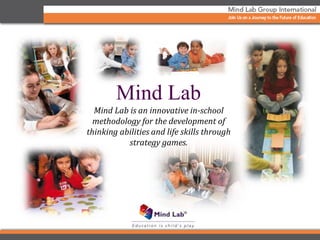
Mind Lab
Mind Lab is an innovative in-school
methodology for the development of
thinking abilities and life skills through
strategy games.
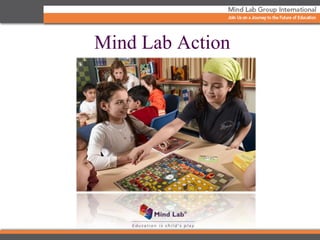
Mind Lab Action
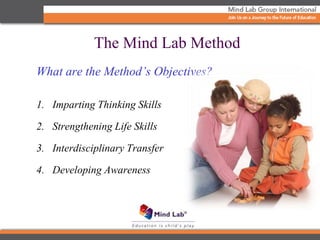
The Mind Lab Method
What are the Method’s Objectives?
1. Imparting Thinking Skills
2. Strengthening Life Skills
3. Interdisciplinary Transfer
4. Developing Awareness
The Mind Lab Method
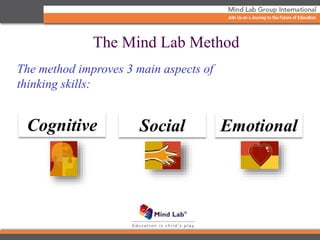
Cognitive Social Emotional
The method improves 3 main aspects of
thinking skills:
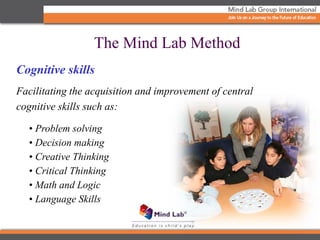
Cognitive skills
Facilitating the acquisition and improvement of central
cognitive skills such as:
• Problem solving
• Decision making
• Creative Thinking
• Critical Thinking
• Math and Logic
• Language Skills
The Mind Lab Method
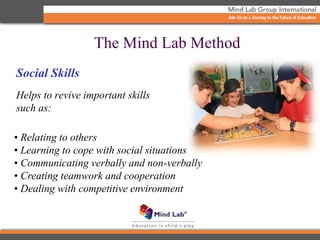
Social Skills
Helps to revive important skills
such as:
• Relating to others
• Learning to cope with social situations
• Communicating verbally and non-verbally
• Creating teamwork and cooperation
• Dealing with competitive environment
The Mind Lab Method
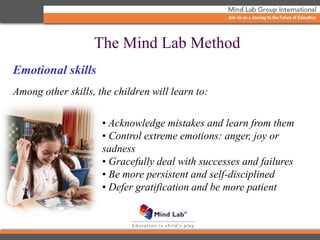
Emotional skills
Among other skills, the children will learn to:
• Acknowledge mistakes and learn from them
• Control extreme emotions: anger, joy or
sadness
• Gracefully deal with successes and failures
• Be more persistent and self-disciplined
• Defer gratification and be more patient
The Mind Lab Method
The Mind Lab Method
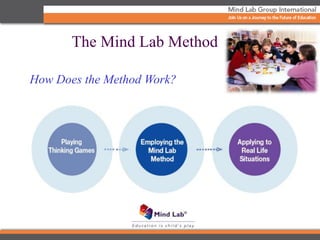
How Does the Method Work?
The Mind Lab Method
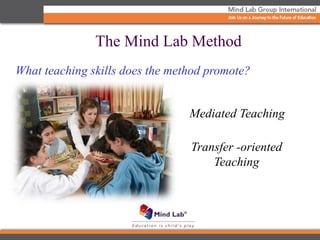
What teaching skills does the method promote?
Mediated Teaching
Transfer -oriented
Teaching
Essential Facts about Mind Lab
• A unique concept worldwide.
• More than 20 years of experience.
• Thousands of schools in more than 15 countries,
among them: Israel, Brazil, US, Italy, Turkey,
Chile, Panama, China, Australia and Romania.
• Over 4,000,000 students and 10,000 teachers.
• Scientifically Proven effectiveness (research led
by Yale University, USA and North Umbria
University, UK).
The Mind Lab Method
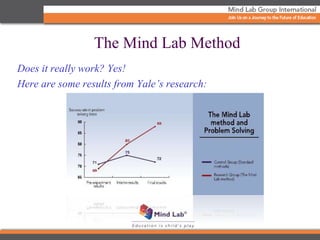
Does it really work? Yes!
Here are some results from Yale’s research:
The Mind Lab Method
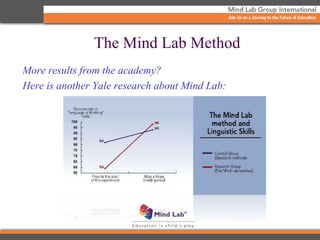
More results from the academy?
Here is another Yale research about Mind Lab:
The Mind Lab Method
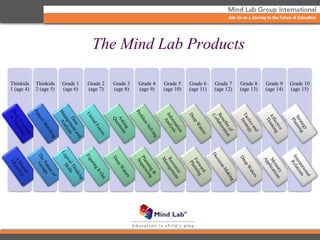
The Mind Lab Products
.......
Thinkids
1 (age 4)
Thinkids
2 (age 5)
Grade 1
(age 6)
Grade 2
(age 7)
Grade 3
(age 8)
Grade 4
(age 9)
Grade 5
(age 10)
Grade 6
(age 11)
Grade 7
(age 12)
Grade 8
(age 13)
Grade 9
(age 14)
Grade 10
(age 15)
The Mind Lab Products
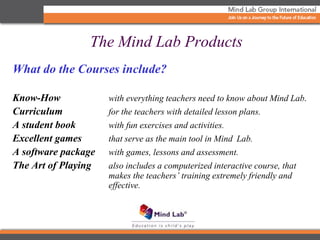
What do the Courses include?
Know-How with everything teachers need to know about Mind Lab.
Curriculum for the teachers with detailed lesson plans.
A student book with fun exercises and activities.
Excellent games that serve as the main tool in Mind Lab.
A software package with games, lessons and assessment.
The Art of Playing also includes a computerized interactive course, that
makes the teachers’ training extremely friendly and
effective.
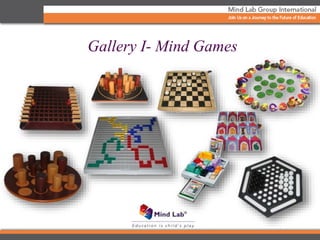
Gallery I- Mind Games
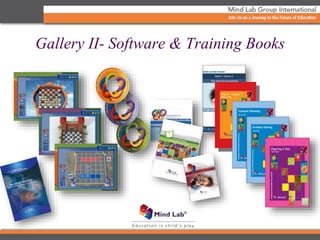
Gallery II- Software & Training Books
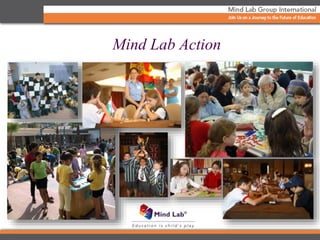
Mind Lab Action
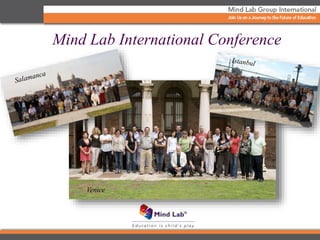
Istanbul 2008
Venice
Mind Lab International Conference
Thank You!
Join us for a fascinating educational experience!

Mind Lab Method English

  • 1.
    Mind Lab Mind Labis an innovative in-school methodology for the development of thinking abilities and life skills through strategy games.
  • 2.
  • 3.
    The Mind LabMethod What are the Method’s Objectives? 1. Imparting Thinking Skills 2. Strengthening Life Skills 3. Interdisciplinary Transfer 4. Developing Awareness
  • 4.
    The Mind LabMethod Cognitive Social Emotional The method improves 3 main aspects of thinking skills:
  • 5.
    Cognitive skills Facilitating theacquisition and improvement of central cognitive skills such as: • Problem solving • Decision making • Creative Thinking • Critical Thinking • Math and Logic • Language Skills The Mind Lab Method
  • 6.
    Social Skills Helps torevive important skills such as: • Relating to others • Learning to cope with social situations • Communicating verbally and non-verbally • Creating teamwork and cooperation • Dealing with competitive environment The Mind Lab Method
  • 7.
    Emotional skills Among otherskills, the children will learn to: • Acknowledge mistakes and learn from them • Control extreme emotions: anger, joy or sadness • Gracefully deal with successes and failures • Be more persistent and self-disciplined • Defer gratification and be more patient The Mind Lab Method
  • 8.
    The Mind LabMethod How Does the Method Work?
  • 9.
    The Mind LabMethod What teaching skills does the method promote? Mediated Teaching Transfer -oriented Teaching
  • 10.
    Essential Facts aboutMind Lab • A unique concept worldwide. • More than 20 years of experience. • Thousands of schools in more than 15 countries, among them: Israel, Brazil, US, Italy, Turkey, Chile, Panama, China, Australia and Romania. • Over 4,000,000 students and 10,000 teachers. • Scientifically Proven effectiveness (research led by Yale University, USA and North Umbria University, UK). The Mind Lab Method
  • 11.
    Does it reallywork? Yes! Here are some results from Yale’s research: The Mind Lab Method
  • 12.
    More results fromthe academy? Here is another Yale research about Mind Lab: The Mind Lab Method
  • 13.
    The Mind LabProducts ....... Thinkids 1 (age 4) Thinkids 2 (age 5) Grade 1 (age 6) Grade 2 (age 7) Grade 3 (age 8) Grade 4 (age 9) Grade 5 (age 10) Grade 6 (age 11) Grade 7 (age 12) Grade 8 (age 13) Grade 9 (age 14) Grade 10 (age 15)
  • 14.
    The Mind LabProducts What do the Courses include? Know-How with everything teachers need to know about Mind Lab. Curriculum for the teachers with detailed lesson plans. A student book with fun exercises and activities. Excellent games that serve as the main tool in Mind Lab. A software package with games, lessons and assessment. The Art of Playing also includes a computerized interactive course, that makes the teachers’ training extremely friendly and effective.
  • 15.
  • 16.
    Gallery II- Software& Training Books
  • 17.
  • 18.
    Istanbul 2008 Venice Mind LabInternational Conference
  • 19.
    Thank You! Join usfor a fascinating educational experience!

Editor's Notes

  • #2 The world is changing fast. Experts believe it will change even faster in the future. We will need to change along with it – faster and faster every day. Being a parent and educator, I constantly search for ways to better prepare my children and students (and myself too…) for the world of tomorrow. It is not an easy task. There's so much to be done, and so many difficulties and barriers to overcome! True, education has been an important and challenging mission throughout human history, but today, so it would seem, educators face unprecedented challenges, mostly due to the growing complexity of human civilization. While challenges facing us educators have grown significantly, our mission has become more important than ever before. Today, education is the key to individuals' and societies' well-being. Since 1994, we at Mind Lab have been collaborating with thousands of schools around the world – working with teachers, students, and their families. We know how demanding (and at times seemingly ungrateful) the work of an educator can be. Violence at schools is growing at a terrifying rate. Looking at society as a whole, this should come as no surprise. Surrounded by an abundance of information and overloaded with stimuli, children today are not easily impressed. They often feel that their lessons are slow and boring. We educators often find it difficult to get our message across, not to mention nurturing cognitive, emotional, and social skills.
  • #3 Our mission is to prepare the next generation for the complex challenges of the 21st century: by strengthening a broad range of cognitive, emotional, and social skills; by teaching children how to think reflectively; and by encouraging students to “learn how to learn.” Most importantly, Mind Lab helps our children to become fulfilled, contributing, and happy human beings. In order to accomplish this, we empower teachers and schools with innovative educational tools that work. At the heart of the Mind Lab Method is the notion that the most effective way to learn is through an immediate and authentic experience that leaves one wanting more. Game playing is the perfect example of such an experience – it is entertaining, engaging, and exciting, and therefore stimulates eager involvement. Game-playing also provides fertile ground for the training and application of thinking abilities and life skills. In other words – the Mind Lab Method both stimulates learning and simulates real-life. The philosopher Plato best articulated this with his sayings: “Not by force shall the children learn, but through play.”
  • #4 Developing Awareness – Awareness of thinking processes is essential for personal enhancement in every walk of life. The Mind Lab Method enhances students’ capacity for reflective thinking and enables students to be more aware of internal and external Processes. 2. Strengthening Life Skills – The game-playing experience is an extraordinary simulator of emotional and social processes. It obliges us to deal with situations involving cooperation and competition, winning and losing, success and failure, and it reinforces our ability to effectively manage and control our emotions, to defer gratification, and to enhance our determination, perseverance and self-discipline. 3. Imparting Thinking Skills – In our information rich age, an ever-increasing emphasis is being placed on the importance of basic thinking skills. The Mind Lab Method provides a broad range of these skills: problem-solving strategies, decision-making models, logical and mathematical thinking, verbal and communication skills, and more. 4. Interdisciplinary Transfer– The application of content and skills learned in one setting to another is considered by many researchers to be one of the most important learning abilities. The Mind Lab Method establishes an organizing base for many aspects of our lives. Through this method, children develop the ability to identify links between different fields of human thinking and activity, and this consequently enables them to transfer knowledge and apply it to other fields.
  • #6 The use of selected mind games, combined with the Mind Lab unique and special methodology has been proven to facilitate the acquisition and improvement of central cognitive skills such as: Problem solving Decision making Creative Thinking Critical Thinking Math and Logic Language Skills
  • #7 In this technological age, certain aspects of social relationships tend to be forgotten. With the use of mind games, the Mind Lab method helps to revive important skills such as: Relating to others Learning to cope with social situations Communicating verbally and non-verbally Creating teamwork and cooperation Dealing with competitive environment
  • #8 The Mind Lab method helps the children to enhance their emotional intelligence by way of managing emotions and learning from a wide range of emotionally-loaded situations that arise during the games. Among other skills, the children will learn to: Acknowledge mistakes and learn from them Control extreme emotions: anger, joy or sadness Gracefully deal with successes and failures Be more persistent and self-disciplined Defer gratification and be more patient