ED 209 Unit Plan 
BENJAMIN CARLETON
Variable Expressions 
• Standards: 
• Math.Content.6.EE.6 
• Use variables to represent numbers and write expressions when 
solving a real-world or mathematical problem; understand that a 
variable can represent an unknown number, or, depending on the 
purpose at hand, any number in a specified set.
Why? 
• I chose this unit because variables are the foundation for 
all future math. 
• I chose the standards based on my choosing of Variable 
Expressions as a Unit Plan. 
• The content and approach was direct by the 4 different 
lesson plan templates. 
• I decided to get creative and push myself to make fun 
and interesting lessons, which I can use when I become a 
teacher.
Assessment 
• I have built-in Warm-ups that allow for students to 
focus, and to give me a tool for class assessment. 
• I have built-in Exit assessments that I will use to 
assess students. 
• Group Work will have a self-assessment rubric, and 
a group assessment rubric. 
• Based on the information I gain from these 
assessments, I can continue on in the unit or 
reteach where needed.
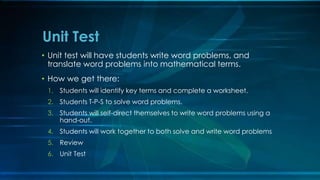
Unit Test 
• Unit test will have students write word problems, and 
translate word problems into mathematical terms. 
• How we get there: 
1. Students will identify key terms and complete a worksheet. 
2. Students T-P-S to solve word problems. 
3. Students will self-direct themselves to write word problems using a 
hand-out. 
4. Students will work together to both solve and write word problems 
5. Review 
6. Unit Test
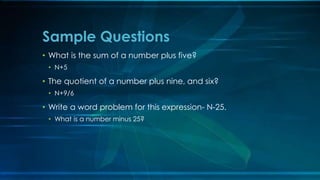
Sample Questions 
• What is the sum of a number plus five? 
• N+5 
• The quotient of a number plus nine, and six? 
• N+9/6 
• Write a word problem for this expression- N-25. 
• What is a number minus 25?
Revisions 
• The addition of a self-assessment rubric. 
• The addition of a group-assessment rubric.
Management 
• I will make sure that students that have problems 
working with others do not work together, or sit 
near one-another. 
• I will use warm-ups on a daily basis to cut down on 
wasted class time. 
• I will use a word wall to help students understand 
key terms and concepts. 
• Students need to be ON-TASK!
Student Specific Needs 
• I will provide Carlos with Spanish hand-outs. 
• Since most students like group work I tried to incorporate it 
where possible. 
• If students are having difficulty in groups they will work 
individually and one-on-one with myself or a 
paraprofessional.
Being a Great Teacher 
• I must be well prepared and flexible at the same 
time to challenge students to learn the content. 
• I love math, I hope my enthusiasm permeates into 
my classroom 
• Information from exit assessments and warm-ups 
will allow me to start the lesson at the zone of 
proximal development.
Questions? 
• I have a couple questions for the group- 
1. Where can I improve this lesson? 
2. What other assessments could I use? 
3. Suggestions for Carlos?

Unit plan power point

  • 1.
    ED 209 UnitPlan BENJAMIN CARLETON
  • 2.
    Variable Expressions •Standards: • Math.Content.6.EE.6 • Use variables to represent numbers and write expressions when solving a real-world or mathematical problem; understand that a variable can represent an unknown number, or, depending on the purpose at hand, any number in a specified set.
  • 3.
    Why? • Ichose this unit because variables are the foundation for all future math. • I chose the standards based on my choosing of Variable Expressions as a Unit Plan. • The content and approach was direct by the 4 different lesson plan templates. • I decided to get creative and push myself to make fun and interesting lessons, which I can use when I become a teacher.
  • 4.
    Assessment • Ihave built-in Warm-ups that allow for students to focus, and to give me a tool for class assessment. • I have built-in Exit assessments that I will use to assess students. • Group Work will have a self-assessment rubric, and a group assessment rubric. • Based on the information I gain from these assessments, I can continue on in the unit or reteach where needed.
  • 5.
    Unit Test •Unit test will have students write word problems, and translate word problems into mathematical terms. • How we get there: 1. Students will identify key terms and complete a worksheet. 2. Students T-P-S to solve word problems. 3. Students will self-direct themselves to write word problems using a hand-out. 4. Students will work together to both solve and write word problems 5. Review 6. Unit Test
  • 6.
    Sample Questions •What is the sum of a number plus five? • N+5 • The quotient of a number plus nine, and six? • N+9/6 • Write a word problem for this expression- N-25. • What is a number minus 25?
  • 7.
    Revisions • Theaddition of a self-assessment rubric. • The addition of a group-assessment rubric.
  • 8.
    Management • Iwill make sure that students that have problems working with others do not work together, or sit near one-another. • I will use warm-ups on a daily basis to cut down on wasted class time. • I will use a word wall to help students understand key terms and concepts. • Students need to be ON-TASK!
  • 9.
    Student Specific Needs • I will provide Carlos with Spanish hand-outs. • Since most students like group work I tried to incorporate it where possible. • If students are having difficulty in groups they will work individually and one-on-one with myself or a paraprofessional.
  • 10.
    Being a GreatTeacher • I must be well prepared and flexible at the same time to challenge students to learn the content. • I love math, I hope my enthusiasm permeates into my classroom • Information from exit assessments and warm-ups will allow me to start the lesson at the zone of proximal development.
  • 11.
    Questions? • Ihave a couple questions for the group- 1. Where can I improve this lesson? 2. What other assessments could I use? 3. Suggestions for Carlos?