Milky Way
By:
Fernanda Pena
Hana Kim
Important Facts
• There are more than 200 billion stars in Milky
Way Galaxy
• The largest neighboring galaxy to Milky Way
galaxy is the Andromeda Galaxy
• The oldest star in Milky Way Galaxy is 13.2
billion years old which is almost same as old
as the universe
• The diameter of Milky Way Galaxy is 100,000
light years
• There are black holes in Milky Way Galaxy
Orbit
Tars and gases at a wide range of distances
from the Galactic center orbit at
approximately 220 kilometers per second.
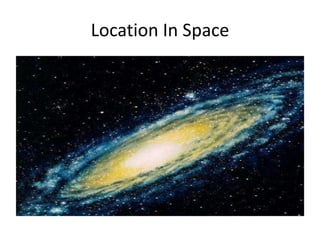
Location In Space
Rotation
Yes, this rate of rotation means that the Solar
System – which is 28,000 light years from the
center of the Milky Way – completely orbits the
galaxy about every 225 million years.
Revolution
The galactic year, also known as a cosmic year, is
the duration of time required for the Solar
System to orbit once around the center of the
Milky Way Galaxy.[1] Estimates of the length of
one orbit range from 225 to 250 million
"terrestrial" years.
Gravity
There are gravitational forces between
every particle of mass in the universe and
every
other particle of mass.

Milky way

  • 1.
  • 2.
    Important Facts • Thereare more than 200 billion stars in Milky Way Galaxy • The largest neighboring galaxy to Milky Way galaxy is the Andromeda Galaxy • The oldest star in Milky Way Galaxy is 13.2 billion years old which is almost same as old as the universe • The diameter of Milky Way Galaxy is 100,000 light years • There are black holes in Milky Way Galaxy
  • 3.
    Orbit Tars and gasesat a wide range of distances from the Galactic center orbit at approximately 220 kilometers per second.
  • 4.
  • 5.
    Rotation Yes, this rateof rotation means that the Solar System – which is 28,000 light years from the center of the Milky Way – completely orbits the galaxy about every 225 million years.
  • 6.
    Revolution The galactic year,also known as a cosmic year, is the duration of time required for the Solar System to orbit once around the center of the Milky Way Galaxy.[1] Estimates of the length of one orbit range from 225 to 250 million "terrestrial" years.
  • 7.
    Gravity There are gravitationalforces between every particle of mass in the universe and every other particle of mass.