Dr Shubham Upadhyay
OVERVIEW
• Introduction
• Etiopathogenesis
• Clinical Features
• Diagnosis
• Prognosis
• Treatment
3
© Medi - Lectures Dr Shubham Upadhyay
4
© Medi - Lectures Dr Shubham Upadhyay
INTRODUCTION
• Responsible for 50% of mortality from all cirrhosis
• Pathology consists 3 major lesions:
1. Fatty Liver
2. Alcoholic Hepatitis
3. Cirrhosis
• World’s 3rd largest risk factor for disease burden
• Most of the mortality fue to ALD is secondary to cirrhosis
ETIOLOGY & RISK FACTORS
• Most imp. risk factors- Quantity & Duration of alcohol intake
• 1 beer= 4 ounces wine = 1ounce spirit(80%) = 12 gm alcohol
PATHOGENESIS
• Alcohol Metabolism
• Gastric
• Hepatic
• Alcohol- Direct Hepatotoxin
• Inflammatory Cascade after metabolism of alcohol
PATHOGENESIS
• Alcohol Metabolism
• Gastric
• Hepatic
• Alcohol- Direct Hepatotoxin
• Inflammatory Cascade after metabolism of alcohol
• Steatosis - fatty acid synthesis, ↓ fatty acid oxidation
• Intestinal derived Endotoxin
• Lipopolysaccharide hepatic influx, intestinal microbiome dysbiosis
PATHOGENESIS
• Alcohol Metabolism
• Gastric
• Hepatic
• Alcohol- Direct Hepatotoxin
• Inflammatory Cascade after metabolism of alcohol
• Steatosis - fatty acid synthesis, ↓ fatty acid oxidation
• Intestinal derived Endotoxin
• Lipopolysaccharide hepatic influx, intestinal microbiome dysbiosis
• Protein aldehyde adducts, Reducing equivalents, oxidative stress
• Kupffer cell, Stellate cell activation & Collagen production
• Micronodular Cirrhosis
PATHOLOGY
• Fatty Liver - Initial & most common histologic response to hepatotoxic
stimuli
• Alcoholic Hepatitis
• Cirrhosis- present in 50% of patients with biopsy proven alcoholic
hepatitis
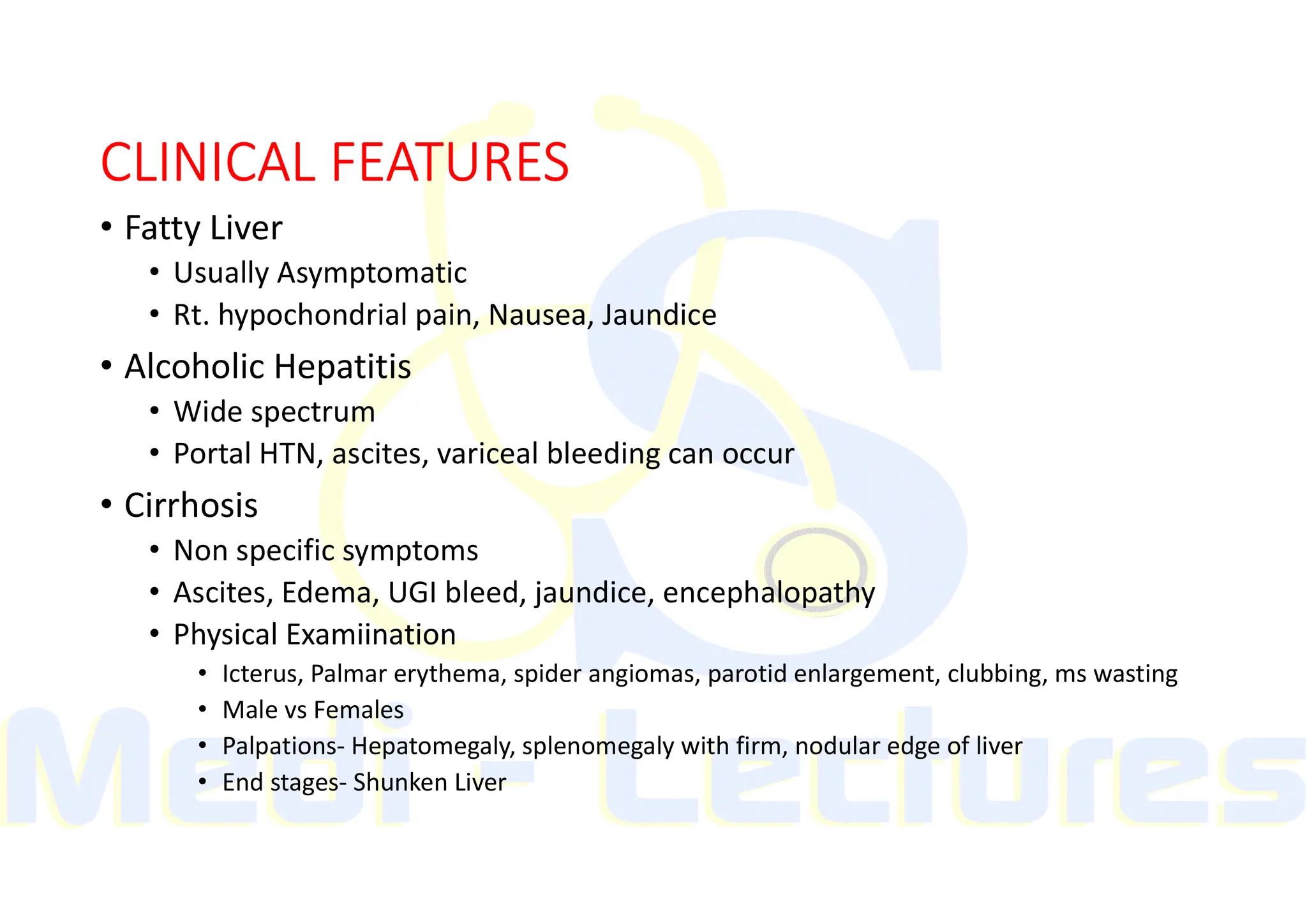
CLINICAL FEATURES
• Fatty Liver
• Usually Asymptomatic
• Rt. hypochondrial pain, Nausea, Jaundice
• Alcoholic Hepatitis
• Wide spectrum
• Portal HTN, ascites, variceal bleeding can occur
CLINICAL FEATURES
• Fatty Liver
• Usually Asymptomatic
• Rt. hypochondrial pain, Nausea, Jaundice
• Alcoholic Hepatitis
• Wide spectrum
• Portal HTN, ascites, variceal bleeding can occur
• Cirrhosis
• Non specific symptoms
• Ascites, Edema, UGI bleed, jaundice, encephalopathy
• Physical Examiination
• Icterus, Palmar erythema, spider angiomas, parotid enlargement, clubbing, ms wasting
• Male vs Females
• Palpations- Hepatomegaly, splenomegaly with firm, nodular edge of liver
• End stages- Shunken Liver
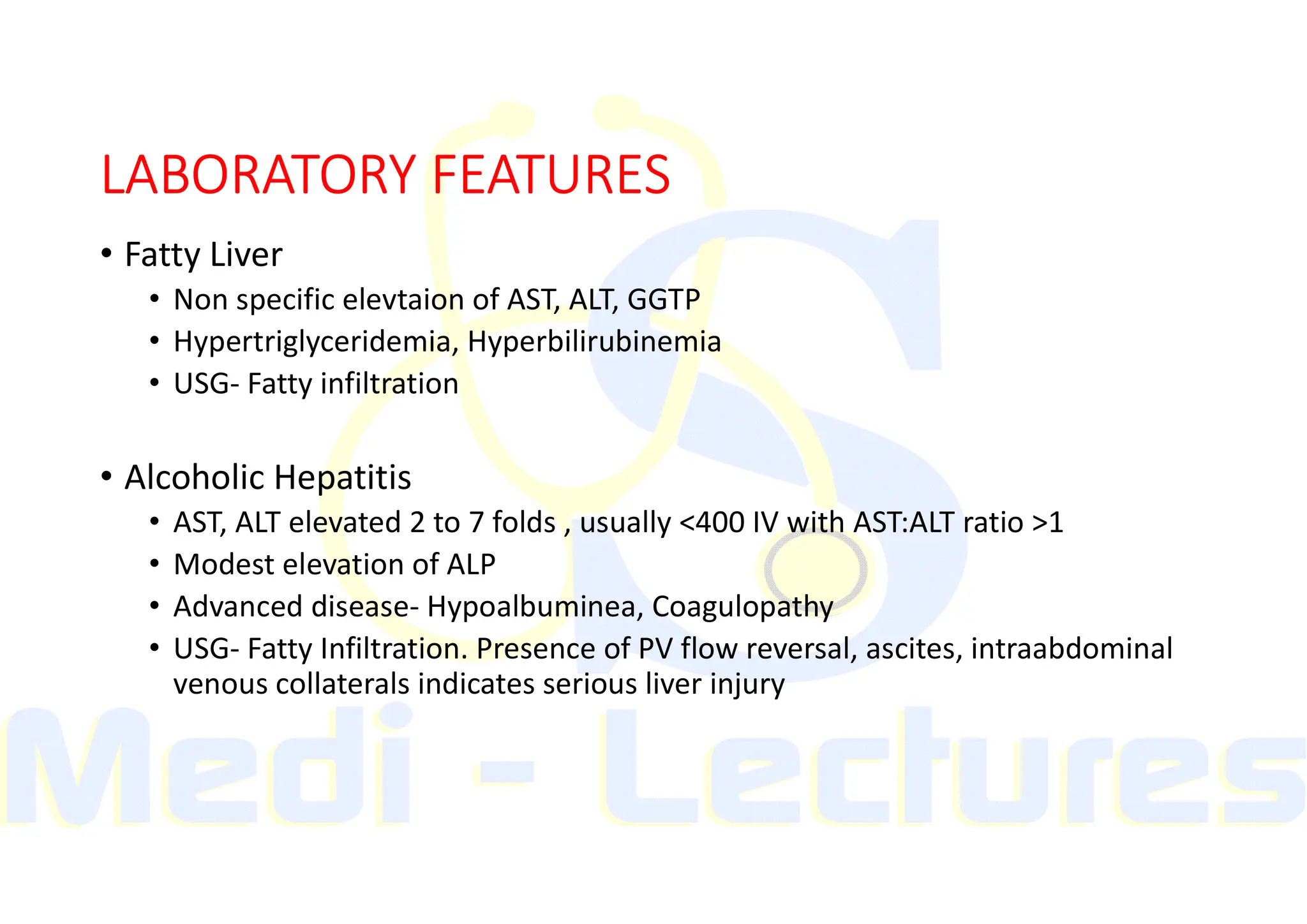
LABORATORY FEATURES
• Fatty Liver
• Non specific elevtaion of AST, ALT, GGTP
• Hypertriglyceridemia, Hyperbilirubinemia
• USG- Fatty infiltration
• Alcoholic Hepatitis
• AST, ALT elevated 2 to 7 folds , usually <400 IV with AST:ALT ratio >1
• Modest elevation of ALP
• Advanced disease- Hypoalbuminea, Coagulopathy
• USG- Fatty Infiltration. Presence of PV flow reversal, ascites, intraabdominal
venous collaterals indicates serious liver injury
• Cirrhosis
• Early Compensated- Normal lab values
• Anemia
• Thrombocytopenia
• S. Bilirubin
• Prothrombin Time
• s. Na+
• AST:ALT ratio: 2:1
• USG: Shunken, fibrosed liver
PROGNOSIS
• Critically ill patients with alcoholic hepatitis
• Severe alcoholic hepatitis
• Coaguopathy
• Anemia
• Hypoalbuminemia
• Hyperbilirubinemia
• Renal Failure
• Ascites
• Discriminant Function
• MELD score
• Poor Prognosis - Ascites, variceal hmg, encephalopathy, heptaorenal
syndrome
• 5 yr survival in cirrhotics who continue to drink?
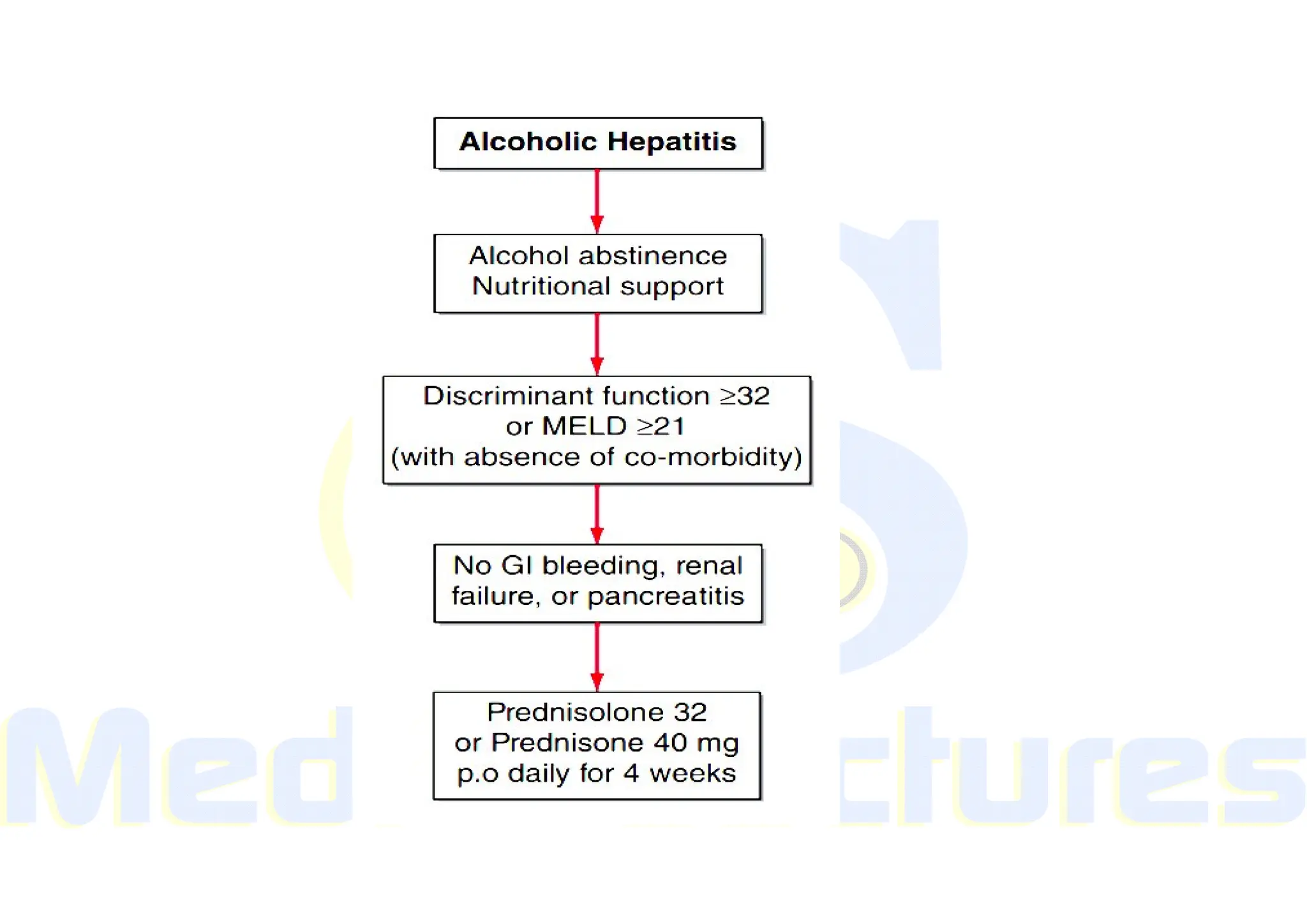
TREATMENT
• Complete Abstinence from Alcohol
• Glucocorticoids
• Prednisolone
• DF>32 or MELD>20
• C/I
• Pentoxiphylline
• Avoidance of concomitant hepatotoxic drugs
• Liver Transplantation
ALCOHOL LIVER DISEASE.pdf

ALCOHOL LIVER DISEASE.pdf

  • 1.
  • 2.
    OVERVIEW • Introduction • Etiopathogenesis •Clinical Features • Diagnosis • Prognosis • Treatment
  • 3.
    3 © Medi -Lectures Dr Shubham Upadhyay
  • 4.
    4 © Medi -Lectures Dr Shubham Upadhyay
  • 5.
    INTRODUCTION • Responsible for50% of mortality from all cirrhosis • Pathology consists 3 major lesions: 1. Fatty Liver 2. Alcoholic Hepatitis 3. Cirrhosis • World’s 3rd largest risk factor for disease burden • Most of the mortality fue to ALD is secondary to cirrhosis
  • 6.
    ETIOLOGY & RISKFACTORS • Most imp. risk factors- Quantity & Duration of alcohol intake • 1 beer= 4 ounces wine = 1ounce spirit(80%) = 12 gm alcohol
  • 8.
    PATHOGENESIS • Alcohol Metabolism •Gastric • Hepatic • Alcohol- Direct Hepatotoxin • Inflammatory Cascade after metabolism of alcohol
  • 9.
    PATHOGENESIS • Alcohol Metabolism •Gastric • Hepatic • Alcohol- Direct Hepatotoxin • Inflammatory Cascade after metabolism of alcohol • Steatosis - fatty acid synthesis, ↓ fatty acid oxidation • Intestinal derived Endotoxin • Lipopolysaccharide hepatic influx, intestinal microbiome dysbiosis
  • 10.
    PATHOGENESIS • Alcohol Metabolism •Gastric • Hepatic • Alcohol- Direct Hepatotoxin • Inflammatory Cascade after metabolism of alcohol • Steatosis - fatty acid synthesis, ↓ fatty acid oxidation • Intestinal derived Endotoxin • Lipopolysaccharide hepatic influx, intestinal microbiome dysbiosis • Protein aldehyde adducts, Reducing equivalents, oxidative stress • Kupffer cell, Stellate cell activation & Collagen production • Micronodular Cirrhosis
  • 11.
    PATHOLOGY • Fatty Liver- Initial & most common histologic response to hepatotoxic stimuli • Alcoholic Hepatitis • Cirrhosis- present in 50% of patients with biopsy proven alcoholic hepatitis
  • 12.
    CLINICAL FEATURES • FattyLiver • Usually Asymptomatic • Rt. hypochondrial pain, Nausea, Jaundice • Alcoholic Hepatitis • Wide spectrum • Portal HTN, ascites, variceal bleeding can occur
  • 13.
    CLINICAL FEATURES • FattyLiver • Usually Asymptomatic • Rt. hypochondrial pain, Nausea, Jaundice • Alcoholic Hepatitis • Wide spectrum • Portal HTN, ascites, variceal bleeding can occur • Cirrhosis • Non specific symptoms • Ascites, Edema, UGI bleed, jaundice, encephalopathy • Physical Examiination • Icterus, Palmar erythema, spider angiomas, parotid enlargement, clubbing, ms wasting • Male vs Females • Palpations- Hepatomegaly, splenomegaly with firm, nodular edge of liver • End stages- Shunken Liver
  • 14.
    LABORATORY FEATURES • FattyLiver • Non specific elevtaion of AST, ALT, GGTP • Hypertriglyceridemia, Hyperbilirubinemia • USG- Fatty infiltration • Alcoholic Hepatitis • AST, ALT elevated 2 to 7 folds , usually <400 IV with AST:ALT ratio >1 • Modest elevation of ALP • Advanced disease- Hypoalbuminea, Coagulopathy • USG- Fatty Infiltration. Presence of PV flow reversal, ascites, intraabdominal venous collaterals indicates serious liver injury
  • 16.
    • Cirrhosis • EarlyCompensated- Normal lab values • Anemia • Thrombocytopenia • S. Bilirubin • Prothrombin Time • s. Na+ • AST:ALT ratio: 2:1 • USG: Shunken, fibrosed liver
  • 17.
    PROGNOSIS • Critically illpatients with alcoholic hepatitis • Severe alcoholic hepatitis • Coaguopathy • Anemia • Hypoalbuminemia • Hyperbilirubinemia • Renal Failure • Ascites • Discriminant Function • MELD score • Poor Prognosis - Ascites, variceal hmg, encephalopathy, heptaorenal syndrome • 5 yr survival in cirrhotics who continue to drink?
  • 18.
    TREATMENT • Complete Abstinencefrom Alcohol • Glucocorticoids • Prednisolone • DF>32 or MELD>20 • C/I • Pentoxiphylline • Avoidance of concomitant hepatotoxic drugs • Liver Transplantation