Don Quıxote Mıguel De Cervantes
The story happened in the 15th century in Spain.   The story is about Don Quixote’s life. The writer of the book Cervantes wrote this story in 1605.In the book Don Quixote read stories about chivalry and gets impressed from them. He thinks that he is a knight and starts to his journey. In this story Cervantes tries to take the reader’s attention to the literature of his time which is full of Chivalry stories, Ideas and class distinction. About the story
Don Quixote thinks that he is a knight but he is not; he is not idealized, the people he meets are not people who are honourable.   He meets real people in real life but takes them differently. By using this motifs Cervantes tries to criticize the society which thinks that upper class and educated people are idealized. He thinks this kind of thinking is out of date because in real life no one is perfect and upper class people are ones who are wicked.
If we think about his life we can say that he also fought for his country but in the end  he didn’t have a happy life. He wasn’t idealized in his country for his services. It was when he wrote this book he gained a position in his society. He fought as the knights that people read books about but he was kidnapped and had an unhappy life. If we emphasize again that this book is written in 1605,we can say that he is a rebel and his work is revolutionary.
Characters Don Quixote  Sancho Panza Rocinante  Dapple  Cide Hamete Benengeli Dulcinea del Toboso The Duke and Duchess Altisidora Sampson Carrasco The priest The barber Teresa Panza Cardenio  Lucinda  Ferdinand  Dorothea  Countess Trifaldi Gines de Pasamonte Roque Guinart
main characters
The novel’s tragicomic hero. Don   Quixote's main quest in life is to revive knight-errantry in a world devoid of chivalric virtues and values. He believes   only what he chooses to believe and sees the world very differently from most people. Honest, dignified, proud   and idealistic,   he wants to save the world. As intelligent as he is mad,   Don Quixote starts out as an absurd and isolated figure and ends up as a pitiable and lovable old man whose strength and wisdom have failed him. Don Quıxote
The peasant  laborer -greedy but kind, faithful but cowardly-whom Don Quixote takes as his squire. A representation of the common man.   Sancho  is a foil to Don Quixote and virtually every other character in the novel. His proverb-ridden peasant’s wisdom and self-sacrificing Christian behaviour prove to be the novel's most insightful and honourable worldview. He has an awestruck love for Don Quixote but grows self-confident and saucy, ending the novel by advising his master in matters of deep personal philosophy.  Sancho Panza
Other Characters
Don Quixote's barn horse.  Rocinante  is slow but faithful and he is as worn out as Don Quixote is. Sancho ’s donkey. Dapple’s disappearance and  redisappearance is the subject of much controversy   both within the story and within the literary criticism concerning Don Quixote. Rocinante Dapple
The unseen force driving all of Don Quixote’s adventures.  Dulcinea , a peasant woman whom Don Quixote envisions as his ladylove, has no knowledge of his chivalric dedication to her. Though constantly mentioned and centrally important to the novel, she never appears as a physical character.  Cide Hamete Benengeli The fictional writer of Moorish decent from whose manuscripts Cervantes supposedly translates the novel . Cervantes uses the figure of  Benengeli  to comment on the ideas of authorship and literature explored ‘n the novel and to critique historians .  Benengeli’s opinions, bound  i n h i s so-called historical text, show his contempt for those who write about chivalry falsely and with embellishment. Dulcinea del Toboso
The supposed translator of Benengeli’s historical novel, who interjects his opinions into the novel at key times. Cervantes intentionally creates the impression that he did not invent the character of Don Quixote. Like Benengeli, Cervantes is not physically present but is a character nonetheless. In his prologues, dedications, and invention of Benengeli, Cervantes enhances the self - referential nature of the novel and forces us to think about literature’s purpose and limitations. The cruel and haughty contrivers of the adventures that occupy Don Quixote for the majority of the novel’s second part. Bored and snobby, the Duke and Duchess  feign interest in Don Quixote and Sancho but continually play pranks on them for their personal entertainment. The Duke and Duchess spend so much money and effort on their ploys that they seem as mad as Don Quixote. Cervantes The Duke and Duchess
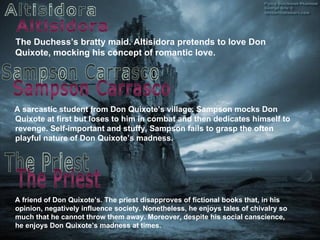
The Duchess’s br a tty maid. Altisidora pretends to love Don Quixote, mocking his concept of romantic love. A sarcastic student from Don Quixote’s village. Sampson mocks Don Quixote at first but loses to him in combat and then dedicates himself to revenge. Self-important and stuffy,   Sampson fails to grasp the often playful nature of Don Quixote’s madness. Altisidora Sampson Carrasco The Priest A friend of Don Quixote’s. The priest disapproves of fictional books that, in his opinion, negatively influence society. Nonetheless, he enjoys tales of chivalry so much that he cannot throw them away. Moreover, despite his social canscience, he enjoys Don Quixote’s madness at times.
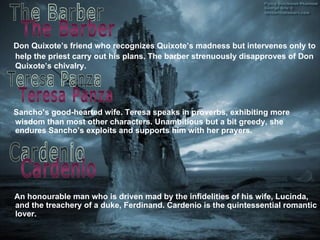
An honourable man who is driven mad by the infidelities of his wife, Lucinda, and the treachery of a duke, Ferdinand. Cardenio is the quintessential romantic lover.  Sancho’s good-hearted wife. Teresa speaks in proverbs, exhibiting more wisdom than most other characters. Unambitious but a bit greedy, she endures Sancho’s exploits and supports him with her prayers. The Barber Don Quixote’s friend who recognizes Quixote’s madness but intervenes only to help the priest carry out his plans. The barber strenuously disapproves of Don Quixote’s chivalry. Teresa Panza Cardenio
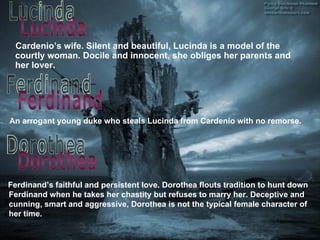
An arrogant young duke who steals Lucinda from Cardenio with no remorse . Cardenio’s wife. Silent and beautiful, Lucinda is a model of the courtly woman. Docile and innocent, she obliges her parents and her lover. Lucinda Ferdinand Ferdinand’s faithful and persistent love. Dorothea flouts tradition to hunt down Ferdinand when he takes her chastity but refuses to marry her. Deceptive and cunning, smart  a nd aggressive, Dorothea is not the typical female character of her time. Dorothea
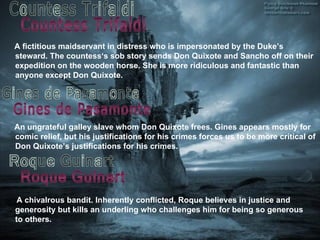
An  ungrateful galley slave whom Don Quixote frees. Gines appears mostly for comic relief, but his justifications for his crimes forces us to be more critical of Don Quixote’s justifications for his crimes. A fictitious maidservant in distress who is impersonated by the Duke’s steward. The countess‘s sob story sends Don Quixote and Sancho off on their expedition on the wooden horse. She is more ridiculous and fantastic than anyone except Don Quixote. Countess Trifaldi Gines de Pasamonte Roque Guinart A chivalrous bandit. Inherently conflicted, Roque believes in justice and generosity but kills an underling who challenges him for being so generous to others.
THEME MOTIFS SYMBOLS &
THEME
The Distinction Between Class and Worth Distinguishing between a person’s worth was a fairly radical idea in Cervantes ‘s time. In Don Quixote, Cervantes attacks the conventional notion that aristocrats are automatically respectable and noble. The contrasts between Duke and Duchess’s thoughtless malice and Sancho’s anxiety ridden compassion highlights this problem of class. Despite his low social status, the peasant Sancho ‘s wise and thoughtful. Likewise, the lowly goatherds and shepherds often appear as philosophers. In contrast, the cosmopolitan or aristocratic characters like the Duke and Duchess are often frivolous and unkind. Cervantes’s emphasis on these disparities between class and worth is a primary reason that Don Quixote was such a revolutionary work in its time.
MOTIFS
Honour Some characters in Don Quixote show a deep concern for their personal honour and some do not. Cervantes implies that either option can lead to good or disastrous results. Anselmo, for example, is so overly protective of his wife’s honour that he distrusts her fidelity, which ultimately results in her adultery and his death. Likewise, Don Quixote’s obsession with his honour leads him to do battle with parties who never mean him offense or harm. Other characters, especially those who exploit Don Quixote’s madness for their own entertainment, seem to care very little about their personal  honor. The Duke and Duchess show that one’s true personal honor  has nothing to do with the honour typically associated with one’s social position.
Romance Though many people in Don Quixote’s world seem to have given up on romantic love. Don Quixote and a few other characters hold dear this ideal. Don Louis’s love for Clara, Camacho’s wedding and the tale of the captive and Zoraida, for instance, are all situations in which romantic love rises above all else. Even in the case of Sancho and Teresa, romantic love prevails as a significant part of matrimonial commitment, which we see in Teresa’s desire to honor her husband at court. Ironically, Don Quixote’s own devotion to Dulcinea mocks romantic love, pushing it to the extreme as he idolizes a woman he has never even seen.
SYMBOLS
Books and Manuscripts The books and manuscripts that appear everywhere in Don Quixote symbolizes the importance and influence of fiction and literature in everyday life. The books instruct and inform the ignorant and provide an imaginative outlet for characters with otherwise dull lives.
Horses Horses symbolize movement and status in the novel and often denote a character’s worth or class. The  pilgrims outside Barcelona, for instance, walk to the city. The noblemen ride in carriages, and the robbers and Don Quixote ride on horseback. In Don Quixote’s mind, at least, the appearance of horses on the horizon symbolizes the coming of a new adventure. Indeed, Rocinante and Dapple play an important role in the journeys of Don Quixote and Sancho, they are not only means of transport and symbols of status but also companions.
Inns The inns that appear throughout the novel are meeting places for people of all classes. They are the only locations  in  the novel where ordinarily segregated individuals speak and exchange stories. Inns symbolize rest and food also corruption and greed, since many innkeepers in the novel are devious.
www.sparknots.com Source
Bianca Sarıaslan

Don quıxote

  • 1.
  • 2.
    The story happenedin the 15th century in Spain. The story is about Don Quixote’s life. The writer of the book Cervantes wrote this story in 1605.In the book Don Quixote read stories about chivalry and gets impressed from them. He thinks that he is a knight and starts to his journey. In this story Cervantes tries to take the reader’s attention to the literature of his time which is full of Chivalry stories, Ideas and class distinction. About the story
  • 3.
    Don Quixote thinksthat he is a knight but he is not; he is not idealized, the people he meets are not people who are honourable. He meets real people in real life but takes them differently. By using this motifs Cervantes tries to criticize the society which thinks that upper class and educated people are idealized. He thinks this kind of thinking is out of date because in real life no one is perfect and upper class people are ones who are wicked.
  • 4.
    If we thinkabout his life we can say that he also fought for his country but in the end he didn’t have a happy life. He wasn’t idealized in his country for his services. It was when he wrote this book he gained a position in his society. He fought as the knights that people read books about but he was kidnapped and had an unhappy life. If we emphasize again that this book is written in 1605,we can say that he is a rebel and his work is revolutionary.
  • 5.
    Characters Don Quixote Sancho Panza Rocinante Dapple Cide Hamete Benengeli Dulcinea del Toboso The Duke and Duchess Altisidora Sampson Carrasco The priest The barber Teresa Panza Cardenio Lucinda Ferdinand Dorothea Countess Trifaldi Gines de Pasamonte Roque Guinart
  • 6.
  • 7.
    The novel’s tragicomichero. Don Quixote's main quest in life is to revive knight-errantry in a world devoid of chivalric virtues and values. He believes only what he chooses to believe and sees the world very differently from most people. Honest, dignified, proud and idealistic, he wants to save the world. As intelligent as he is mad, Don Quixote starts out as an absurd and isolated figure and ends up as a pitiable and lovable old man whose strength and wisdom have failed him. Don Quıxote
  • 8.
    The peasant laborer -greedy but kind, faithful but cowardly-whom Don Quixote takes as his squire. A representation of the common man. Sancho is a foil to Don Quixote and virtually every other character in the novel. His proverb-ridden peasant’s wisdom and self-sacrificing Christian behaviour prove to be the novel's most insightful and honourable worldview. He has an awestruck love for Don Quixote but grows self-confident and saucy, ending the novel by advising his master in matters of deep personal philosophy. Sancho Panza
  • 9.
  • 10.
    Don Quixote's barnhorse. Rocinante is slow but faithful and he is as worn out as Don Quixote is. Sancho ’s donkey. Dapple’s disappearance and redisappearance is the subject of much controversy both within the story and within the literary criticism concerning Don Quixote. Rocinante Dapple
  • 11.
    The unseen forcedriving all of Don Quixote’s adventures. Dulcinea , a peasant woman whom Don Quixote envisions as his ladylove, has no knowledge of his chivalric dedication to her. Though constantly mentioned and centrally important to the novel, she never appears as a physical character. Cide Hamete Benengeli The fictional writer of Moorish decent from whose manuscripts Cervantes supposedly translates the novel . Cervantes uses the figure of Benengeli to comment on the ideas of authorship and literature explored ‘n the novel and to critique historians . Benengeli’s opinions, bound i n h i s so-called historical text, show his contempt for those who write about chivalry falsely and with embellishment. Dulcinea del Toboso
  • 12.
    The supposed translatorof Benengeli’s historical novel, who interjects his opinions into the novel at key times. Cervantes intentionally creates the impression that he did not invent the character of Don Quixote. Like Benengeli, Cervantes is not physically present but is a character nonetheless. In his prologues, dedications, and invention of Benengeli, Cervantes enhances the self - referential nature of the novel and forces us to think about literature’s purpose and limitations. The cruel and haughty contrivers of the adventures that occupy Don Quixote for the majority of the novel’s second part. Bored and snobby, the Duke and Duchess feign interest in Don Quixote and Sancho but continually play pranks on them for their personal entertainment. The Duke and Duchess spend so much money and effort on their ploys that they seem as mad as Don Quixote. Cervantes The Duke and Duchess
  • 13.
    The Duchess’s bra tty maid. Altisidora pretends to love Don Quixote, mocking his concept of romantic love. A sarcastic student from Don Quixote’s village. Sampson mocks Don Quixote at first but loses to him in combat and then dedicates himself to revenge. Self-important and stuffy, Sampson fails to grasp the often playful nature of Don Quixote’s madness. Altisidora Sampson Carrasco The Priest A friend of Don Quixote’s. The priest disapproves of fictional books that, in his opinion, negatively influence society. Nonetheless, he enjoys tales of chivalry so much that he cannot throw them away. Moreover, despite his social canscience, he enjoys Don Quixote’s madness at times.
  • 14.
    An honourable manwho is driven mad by the infidelities of his wife, Lucinda, and the treachery of a duke, Ferdinand. Cardenio is the quintessential romantic lover. Sancho’s good-hearted wife. Teresa speaks in proverbs, exhibiting more wisdom than most other characters. Unambitious but a bit greedy, she endures Sancho’s exploits and supports him with her prayers. The Barber Don Quixote’s friend who recognizes Quixote’s madness but intervenes only to help the priest carry out his plans. The barber strenuously disapproves of Don Quixote’s chivalry. Teresa Panza Cardenio
  • 15.
    An arrogant youngduke who steals Lucinda from Cardenio with no remorse . Cardenio’s wife. Silent and beautiful, Lucinda is a model of the courtly woman. Docile and innocent, she obliges her parents and her lover. Lucinda Ferdinand Ferdinand’s faithful and persistent love. Dorothea flouts tradition to hunt down Ferdinand when he takes her chastity but refuses to marry her. Deceptive and cunning, smart a nd aggressive, Dorothea is not the typical female character of her time. Dorothea
  • 16.
    An ungratefulgalley slave whom Don Quixote frees. Gines appears mostly for comic relief, but his justifications for his crimes forces us to be more critical of Don Quixote’s justifications for his crimes. A fictitious maidservant in distress who is impersonated by the Duke’s steward. The countess‘s sob story sends Don Quixote and Sancho off on their expedition on the wooden horse. She is more ridiculous and fantastic than anyone except Don Quixote. Countess Trifaldi Gines de Pasamonte Roque Guinart A chivalrous bandit. Inherently conflicted, Roque believes in justice and generosity but kills an underling who challenges him for being so generous to others.
  • 17.
  • 18.
  • 19.
    The Distinction BetweenClass and Worth Distinguishing between a person’s worth was a fairly radical idea in Cervantes ‘s time. In Don Quixote, Cervantes attacks the conventional notion that aristocrats are automatically respectable and noble. The contrasts between Duke and Duchess’s thoughtless malice and Sancho’s anxiety ridden compassion highlights this problem of class. Despite his low social status, the peasant Sancho ‘s wise and thoughtful. Likewise, the lowly goatherds and shepherds often appear as philosophers. In contrast, the cosmopolitan or aristocratic characters like the Duke and Duchess are often frivolous and unkind. Cervantes’s emphasis on these disparities between class and worth is a primary reason that Don Quixote was such a revolutionary work in its time.
  • 20.
  • 21.
    Honour Some charactersin Don Quixote show a deep concern for their personal honour and some do not. Cervantes implies that either option can lead to good or disastrous results. Anselmo, for example, is so overly protective of his wife’s honour that he distrusts her fidelity, which ultimately results in her adultery and his death. Likewise, Don Quixote’s obsession with his honour leads him to do battle with parties who never mean him offense or harm. Other characters, especially those who exploit Don Quixote’s madness for their own entertainment, seem to care very little about their personal honor. The Duke and Duchess show that one’s true personal honor has nothing to do with the honour typically associated with one’s social position.
  • 22.
    Romance Though manypeople in Don Quixote’s world seem to have given up on romantic love. Don Quixote and a few other characters hold dear this ideal. Don Louis’s love for Clara, Camacho’s wedding and the tale of the captive and Zoraida, for instance, are all situations in which romantic love rises above all else. Even in the case of Sancho and Teresa, romantic love prevails as a significant part of matrimonial commitment, which we see in Teresa’s desire to honor her husband at court. Ironically, Don Quixote’s own devotion to Dulcinea mocks romantic love, pushing it to the extreme as he idolizes a woman he has never even seen.
  • 23.
  • 24.
    Books and ManuscriptsThe books and manuscripts that appear everywhere in Don Quixote symbolizes the importance and influence of fiction and literature in everyday life. The books instruct and inform the ignorant and provide an imaginative outlet for characters with otherwise dull lives.
  • 25.
    Horses Horses symbolizemovement and status in the novel and often denote a character’s worth or class. The pilgrims outside Barcelona, for instance, walk to the city. The noblemen ride in carriages, and the robbers and Don Quixote ride on horseback. In Don Quixote’s mind, at least, the appearance of horses on the horizon symbolizes the coming of a new adventure. Indeed, Rocinante and Dapple play an important role in the journeys of Don Quixote and Sancho, they are not only means of transport and symbols of status but also companions.
  • 26.
    Inns The innsthat appear throughout the novel are meeting places for people of all classes. They are the only locations in the novel where ordinarily segregated individuals speak and exchange stories. Inns symbolize rest and food also corruption and greed, since many innkeepers in the novel are devious.
  • 27.
  • 28.