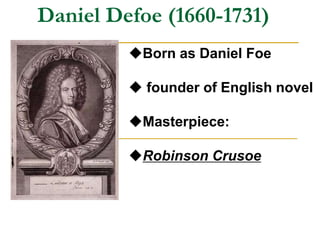
Daniel Defoe (1660-1731)
Born as Daniel Foe
 founder of English novel
Masterpiece:
Robinson Crusoe
Daniel Defoe (1660-1731)
 Biography:
 Born into a butcher’s family
 son of James Foe, a tallow chandler (动物油脂杂货商)
 education from a dissenting academy
 merchant; prisoner; adventurer ; official;
 intelligence agent (间谍).
 Works: a prolific writer and at least 198 pen names
 Captain Singleton辛格尔顿船长 ,
 Moll Flanders摩尔·费兰德斯 ,
 Colonel Jack杰克上校 ,
 Roxana罗克萨娜
Robinson Crusoe
Robinson Crusoe (1719)
 fictional autobiography of the castaway
 a castaway who spends 28 years on a remote
tropical island near Trinidad, encountering
cannibals, captives and mutineers before
being rescued.
Plot Summary
 Crusoe sets on a sea voyage in August 1651,
against the wishes of his parents, who want
him to stay at home and pursue a career,
possibly in law.
 After a tumultuous journey that sees his ship
wrecked in a storm, his lust for the sea remains
so strong that he sets out to sea again. This
journey too ends in disaster and Crusoe
becomes the slave of a Moor.

Muslim living
in the
northwest of
Africa
 After two years of slavery, he manages
to escape and is rescued and
befriended by the Captain of a
Portuguese ship off the west coast of
Africa. The ship is en route to Brazil.
There, with the help of the captain,
Crusoe becomes owner of a plantation
 Years later, he joins an expedition to bring
slaves from Africa but he is shipwrecked in a
storm about forty miles out to sea on an island
(which he calls the Island of Despair) on
September 30, 1659.
 His companions all die, save himself, and three
animals who survived the shipwreck, the
captain's dog and two cats. Having overcome
his despair, he fetches arms, tools and other
supplies from the ship before it breaks apart
and sinks. He proceeds to build a fenced-in
habitation near a cave which he excavates
himself.
 He keeps a calendar by making marks in a
wooden cross which he has built. He hunts,
grows corn and rice, dries grapes to make
raisins for the winter months, learns to make
pottery and raises goats, all using tools
created from stone and wood which he
harvests on the island. He also adopts a small
parrot. He reads the Bible and becomes
religious, thanking God for his fate in which
nothing is missing but human society.
 Years later, he discovers native cannibals who
occasionally visit the island to kill and eat
prisoners. At first he plans to kill them but later
realizes that he has no right to do so as the
cannibals do not knowingly commit a crime. He
dreams of obtaining one or two servants by
freeing some prisoners; when a prisoner
manages to escape, Crusoe helps him, naming
his new companion "Friday" after the day of the
week he appeared. Crusoe then teaches him
English and converts him to Christianity.
Crusoe and Friday
 After another party of natives arrives to
partake in a cannibal feast, Crusoe and Friday
manage to kill most of the natives and save
two of the prisoners. One is Friday's father and
the other is a Spaniard, who informs Crusoe
that there are other Spaniards shipwrecked on
the mainland. A plan is devised wherein the
Spaniard would return with Friday's father to
the mainland and bring back the others, build a
ship and sail to a Spanish port.
 Before the Spaniards return, an English ship
appears; mutineers have taken control of the
ship and intend to maroon their former
captain on the island. Crusoe and the ship's
captain strike a deal in which he helps the
captain and the loyal sailors retake the ship
from the mutineers, whereupon they intend to
leave the worst of the mutineers on the island.
Before they leave for England, Crusoe shows
the former mutineers how he lived on the
island and states that there will be more men
coming.
 Crusoe leaves the island December 19, 1686
and arrives in England on June 11, 1687. He
learns that his family believed him dead and
there was nothing in his father's will for him.
Crusoe departs for Lisbon to reclaim the profits
of his estate in Brazil, which has granted him a
large amount of wealth. In conclusion, he takes
his wealth overland to England to avoid
traveling at sea. Friday comes with him and
along the way they endure one last adventure
together as they fight off hundreds of famished
wolves while crossing the Pyrenees.
Reception
 published on April 25, 1719
 Before the end of the year, this first volume had
run through four editions.
 Within years, it had reached an audience as
wide as any book ever written in English.
 By the end of the 19th century, no book in the
history of Western literature had had more
editions, spin-offs and translations than
Robinson Crusoe, with more than 700 such
alternative versions, including children's
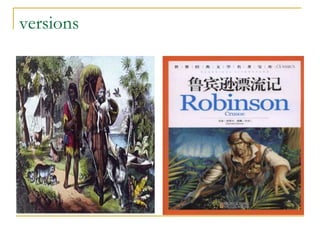
versions with mainly pictures and no text.
versions
versions
 The term "Robinsonade" was coined to
describe the genre of stories similar to
Robinson Crusoe.
 Defoe went on to write a lesser-known sequel,
The Farther Adventures of Robinson Crusoe.
It was intended to be the last part of his
stories, according to the original title-page of
its first edition but a third part, Serious
Reflections of Robinson Crusoe was written; it
is a mostly forgotten series of moral essays
with Crusoe's name attached to give interest.
colonialism
 Robinson Crusoe is the true symbol of the British
conquest: The whole Anglo-Saxon spirit is in Crusoe.
 Crusoe attempts to replicate his own society on the
island: application of European technology, agriculture,
and even a rudimentary political hierarchy.
 The idealised master-servant relationship between
Crusoe and Friday.
 Crusoe represents the 'enlightened' European
 Friday is the 'savage' who can only be redeemed from
his supposedly barbarous way of life through the
assimilation into Crusoe's culture.
 Nevertheless, within the novel Defoe also takes the
opportunity to criticize the historic Spanish conquest of
South America.
Religion
 Robinson is not a hero, but an everyman--a
wanderer to become a pilgrim, building a
promised land on a desolate island.
 Robinson becomes closer to God, not
through listening to sermons in a church but
through spending time alone amongst nature
with only a Bible to read.
 Defoe's central concern is the Christian
notion of Providence.
Response
 J. M. Coetzee's 1986 novel Foe
recounts the tale of Robinson Crusoe
from the aspect of Susan Barton who
went on to star in another of DeFoe's
novels. In this novel Crusoe is
depicted as a much less motivated
man and Friday as a mute.

robinson-crusoe.ppt

  • 1.
    Daniel Defoe (1660-1731) Bornas Daniel Foe  founder of English novel Masterpiece: Robinson Crusoe
  • 2.
    Daniel Defoe (1660-1731) Biography:  Born into a butcher’s family  son of James Foe, a tallow chandler (动物油脂杂货商)  education from a dissenting academy  merchant; prisoner; adventurer ; official;  intelligence agent (间谍).  Works: a prolific writer and at least 198 pen names  Captain Singleton辛格尔顿船长 ,  Moll Flanders摩尔·费兰德斯 ,  Colonel Jack杰克上校 ,  Roxana罗克萨娜
  • 3.
  • 4.
    Robinson Crusoe (1719) fictional autobiography of the castaway  a castaway who spends 28 years on a remote tropical island near Trinidad, encountering cannibals, captives and mutineers before being rescued.
  • 5.
    Plot Summary  Crusoesets on a sea voyage in August 1651, against the wishes of his parents, who want him to stay at home and pursue a career, possibly in law.  After a tumultuous journey that sees his ship wrecked in a storm, his lust for the sea remains so strong that he sets out to sea again. This journey too ends in disaster and Crusoe becomes the slave of a Moor.  Muslim living in the northwest of Africa
  • 6.
     After twoyears of slavery, he manages to escape and is rescued and befriended by the Captain of a Portuguese ship off the west coast of Africa. The ship is en route to Brazil. There, with the help of the captain, Crusoe becomes owner of a plantation
  • 7.
     Years later,he joins an expedition to bring slaves from Africa but he is shipwrecked in a storm about forty miles out to sea on an island (which he calls the Island of Despair) on September 30, 1659.  His companions all die, save himself, and three animals who survived the shipwreck, the captain's dog and two cats. Having overcome his despair, he fetches arms, tools and other supplies from the ship before it breaks apart and sinks. He proceeds to build a fenced-in habitation near a cave which he excavates himself.
  • 8.
     He keepsa calendar by making marks in a wooden cross which he has built. He hunts, grows corn and rice, dries grapes to make raisins for the winter months, learns to make pottery and raises goats, all using tools created from stone and wood which he harvests on the island. He also adopts a small parrot. He reads the Bible and becomes religious, thanking God for his fate in which nothing is missing but human society.
  • 9.
     Years later,he discovers native cannibals who occasionally visit the island to kill and eat prisoners. At first he plans to kill them but later realizes that he has no right to do so as the cannibals do not knowingly commit a crime. He dreams of obtaining one or two servants by freeing some prisoners; when a prisoner manages to escape, Crusoe helps him, naming his new companion "Friday" after the day of the week he appeared. Crusoe then teaches him English and converts him to Christianity.
  • 10.
  • 11.
     After anotherparty of natives arrives to partake in a cannibal feast, Crusoe and Friday manage to kill most of the natives and save two of the prisoners. One is Friday's father and the other is a Spaniard, who informs Crusoe that there are other Spaniards shipwrecked on the mainland. A plan is devised wherein the Spaniard would return with Friday's father to the mainland and bring back the others, build a ship and sail to a Spanish port.
  • 12.
     Before theSpaniards return, an English ship appears; mutineers have taken control of the ship and intend to maroon their former captain on the island. Crusoe and the ship's captain strike a deal in which he helps the captain and the loyal sailors retake the ship from the mutineers, whereupon they intend to leave the worst of the mutineers on the island. Before they leave for England, Crusoe shows the former mutineers how he lived on the island and states that there will be more men coming.
  • 13.
     Crusoe leavesthe island December 19, 1686 and arrives in England on June 11, 1687. He learns that his family believed him dead and there was nothing in his father's will for him. Crusoe departs for Lisbon to reclaim the profits of his estate in Brazil, which has granted him a large amount of wealth. In conclusion, he takes his wealth overland to England to avoid traveling at sea. Friday comes with him and along the way they endure one last adventure together as they fight off hundreds of famished wolves while crossing the Pyrenees.
  • 14.
    Reception  published onApril 25, 1719  Before the end of the year, this first volume had run through four editions.  Within years, it had reached an audience as wide as any book ever written in English.  By the end of the 19th century, no book in the history of Western literature had had more editions, spin-offs and translations than Robinson Crusoe, with more than 700 such alternative versions, including children's versions with mainly pictures and no text.
  • 15.
  • 16.
  • 17.
     The term"Robinsonade" was coined to describe the genre of stories similar to Robinson Crusoe.  Defoe went on to write a lesser-known sequel, The Farther Adventures of Robinson Crusoe. It was intended to be the last part of his stories, according to the original title-page of its first edition but a third part, Serious Reflections of Robinson Crusoe was written; it is a mostly forgotten series of moral essays with Crusoe's name attached to give interest.
  • 18.
    colonialism  Robinson Crusoeis the true symbol of the British conquest: The whole Anglo-Saxon spirit is in Crusoe.  Crusoe attempts to replicate his own society on the island: application of European technology, agriculture, and even a rudimentary political hierarchy.  The idealised master-servant relationship between Crusoe and Friday.  Crusoe represents the 'enlightened' European  Friday is the 'savage' who can only be redeemed from his supposedly barbarous way of life through the assimilation into Crusoe's culture.  Nevertheless, within the novel Defoe also takes the opportunity to criticize the historic Spanish conquest of South America.
  • 19.
    Religion  Robinson isnot a hero, but an everyman--a wanderer to become a pilgrim, building a promised land on a desolate island.  Robinson becomes closer to God, not through listening to sermons in a church but through spending time alone amongst nature with only a Bible to read.  Defoe's central concern is the Christian notion of Providence.
  • 20.
    Response  J. M.Coetzee's 1986 novel Foe recounts the tale of Robinson Crusoe from the aspect of Susan Barton who went on to star in another of DeFoe's novels. In this novel Crusoe is depicted as a much less motivated man and Friday as a mute.