POPULATION DYNAMICS
TOPIC: International migration – past and present
trend. Migration in India, trend and pattern
DONE BY:
SALIAALIAS
DOS IN GEOGRAPHY
SUBMITTED TO:
DR.VISHWANATH
DOS IN GEOGRAPHY
• Migration in geography usually refers to the movement of humans from one
place to another. It occurs when the perceived interaction of Push and Pull
factors overcome the friction of moving.
• Emigration refers to the act of leaving one's own country to live in another
country. It's when people decide to move away from their homeland to settle in
a different place.
• Immigration, on the other hand, refers to the act of entering and settling in a new
country that is not one's native land. It's when people come to a different country
to live there permanently or for an extended period of time.
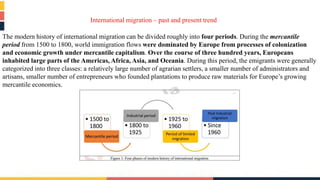
The modern history of international migration can be divided roughly into four periods. During the mercantile
period from 1500 to 1800, world immigration flows were dominated by Europe from processes of colonization
and economic growth under mercantile capitalism. Over the course of three hundred years, Europeans
inhabited large parts of the Americas, Africa, Asia, and Oceania. During this period, the emigrants were generally
categorized into three classes: a relatively large number of agrarian settlers, a smaller number of administrators and
artisans, smaller number of entrepreneurs who founded plantations to produce raw materials for Europe’s growing
mercantile economics.
International migration – past and present trend
The second period of emigration, the industrial period, began early in the nineteenth century and stemmed from the
economic development of Europe and spread of industrialism to former colonies in the new world. From 1800 to 1925,
more than forty-eight million people left the industrializing countries of Europe in search of new lives in the Americas, and
Oceania. Of these emigrants, 85 percent went to five destinations: Argentina, Australia, Canada, New Zealand, and the United
States (the last alone receiving 60 percent). The key sending nations were Britain, Italy, Norway, Portugal, Spain, and Sweden,
which exported a large share of their potential population in the course of industrializing. Although international migrants
were not exclusively European, the overwhelming majority came from that continent. Of all the U.S. immigrants between
1820 and 1920, 88 percent were from Europe, 3 percent were from Asia, and 8 percent came from the Americas.
The period of large scale European emigration faltered with the outbreak of World War I period of limited
migration, early 1920s, by then several important receiving countries had passed restrictive immigration laws. The
onset of the Great Depression virtually stopped all international movement in 1929, During the 1940s,
international migration was checked by the Second World War. The mobility that occurred largely comprised the
movements of refugees and displaced persons, and it was not strongly connected to the rhythms of economic growth
and development;
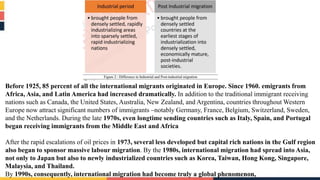
The period of post-industrial migration emerged during the 1960s and constituted a sharp break with the past.
Rather than being dominated by outflows from Europe to a handful of former colonies, immigration became a
truly global phenomenon as the number of and the variety of both the sending and the receiving countries
increased, and the global supply of immigrants shifted from Europe to the developing world.
Before 1925, 85 percent of all the international migrants originated in Europe. Since 1960. emigrants from
Africa, Asia, and Latin America had increased dramatically. In addition to the traditional immigrant receiving
nations such as Canada, the United States, Australia, New Zealand, and Argentina, countries throughout Western
Europe now attract significant numbers of immigrants –notably Germany, France, Belgium, Switzerland, Sweden,
and the Netherlands. During the late 1970s, even longtime sending countries such as Italy, Spain, and Portugal
began receiving immigrants from the Middle East and Africa
After the rapid escalations of oil prices in 1973, several less developed but capital rich nations in the Gulf region
also began to sponsor massive labour migration. By the 1980s, international migration had spread into Asia,
not only to Japan but also to newly industrialized countries such as Korea, Taiwan, Hong Kong, Singapore,
Malaysia, and Thailand.
By 1990s, consequently, international migration had become truly a global phenomenon,
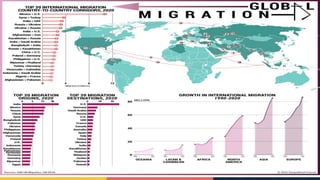
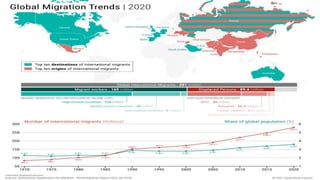
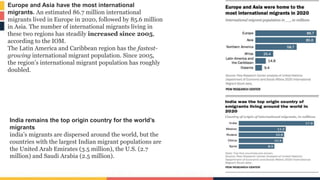
Europe and Asia have the most international
migrants. An estimated 86.7 million international
migrants lived in Europe in 2020, followed by 85.6 million
in Asia. The number of international migrants living in
these two regions has steadily increased since 2005,
according to the IOM.
The Latin America and Caribbean region has the fastest-
growing international migrant population. Since 2005,
the region’s international migrant population has roughly
doubled.
India remains the top origin country for the world’s
migrants
india’s migrants are dispersed around the world, but the
countries with the largest Indian migrant populations are
the United Arab Emirates (3.5 million), the U.S. (2.7
million) and Saudi Arabia (2.5 million).
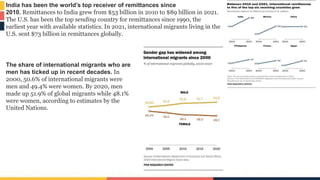
India has been the world’s top receiver of remittances since
2010. Remittances to India grew from $53 billion in 2010 to $89 billion in 2021.
The U.S. has been the top sending country for remittances since 1990, the
earliest year with available statistics. In 2021, international migrants living in the
U.S. sent $73 billion in remittances globally.
The share of international migrants who are
men has ticked up in recent decades. In
2000, 50.6% of international migrants were
men and 49.4% were women. By 2020, men
made up 51.9% of global migrants while 48.1%
were women, according to estimates by the
United Nations.
Following are the recent trends of international migration:
•In 2017, the USA was the largest recipient of immigration followed by Saudi Arabia,
Germany, Russia, and the UK.
•In 2017, the largest source of migration is India followed by Mexico, Russia, and China.
•Asia and Europe are the top regions of sources and destinations of international migration.
•48% of international expatriates are female.
•70% of international migrants are workers.
•10% of international migrants are refugees persecuted by armed conflict or civil war.
•The trend of student migration is from developing countries to developed countries.
•India and the US have the largest number of illegal immigrants.
•According to the World Migration Report, there were 3.3 million migrations to South
Asia in 2018 due to sudden climatic threats.
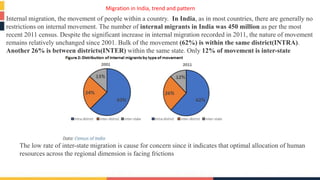
Internal migration, the movement of people within a country. In India, as in most countries, there are generally no
restrictions on internal movement. The number of internal migrants in India was 450 million as per the most
recent 2011 census. Despite the significant increase in internal migration recorded in 2011, the nature of movement
remains relatively unchanged since 2001. Bulk of the movement (62%) is within the same district(INTRA).
Another 26% is between districts(INTER) within the same state. Only 12% of movement is inter-state
The low rate of inter-state migration is cause for concern since it indicates that optimal allocation of human
resources across the regional dimension is facing frictions
Migration in India, trend and pattern
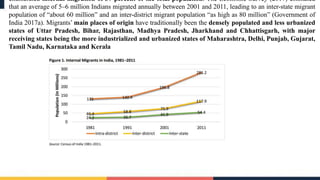
enumerated internal migration of 37 percent of the total population. The Economic Survey (2017) estimated
that an average of 5–6 million Indians migrated annually between 2001 and 2011, leading to an inter-state migrant
population of “about 60 million” and an inter-district migrant population “as high as 80 million” (Government of
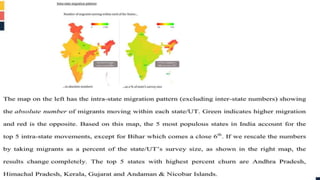
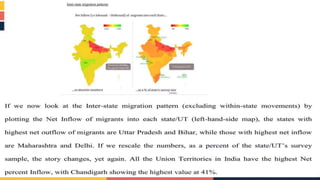
India 2017a). Migrants’ main places of origin have traditionally been the densely populated and less urbanized
states of Uttar Pradesh, Bihar, Rajasthan, Madhya Pradesh, Jharkhand and Chhattisgarh, with major
receiving states being the more industrialized and urbanized states of Maharashtra, Delhi, Punjab, Gujarat,
Tamil Nadu, Karnataka and Kerala
• The majority of internal migrants in India are short-distance, intra- and inter-district .One of the main
barriers is the non-portability of social welfare schemes such as subsidized grain and the
requirement of state domicility for government jobs.
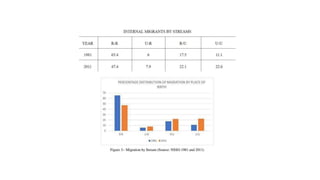
• Among major geographical streams, the most prevalent stream of migration is rural to rural,
accounting for 62 percent, followed by the rural to urban stream at 20 percent, then the urban to
urban at 13 percent, and urban to rural migration at 5 percent (Government of India 2010).
According to the 2011 Census, 68 percent of all migrants were females. Over the years, it has been seen
that the main reason cited for the migration of females has been marriage, followed by employment .On
the other hand, males mainly migrate for employment and education. However, an underreported fact is
that women, while primarily migrating for marriage, do enter the labor market at their destinations; this
underreporting as well as a strongly male-centric view of migration leaves the issues of women migrants
too often invisible .
• Another aspect to note is that rural areas still depend on employment in agriculture. With agriculture
heavily dependent on seasonal factors, this seasonal cycle also shapes the rural-urban migration stream.
The rate of temporary and seasonal migration is seven times larger when permanent and semipermanent
migration is considered. An estimated 21 out of every 1,000 migrants in India are temporary and
seasonal migrants, which amounts to approximately 14 million persons circulating annually.
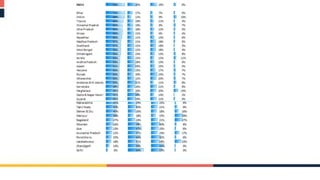
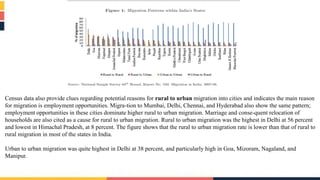
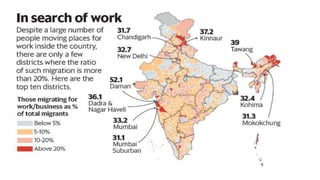
Census data also provide clues regarding potential reasons for rural to urban migration into cities and indicates the main reason
for migration is employment opportunities. Migra-tion to Mumbai, Delhi, Chennai, and Hyderabad also show the same pattern;
employment opportunities in these cities dominate higher rural to urban migration. Marriage and conse-quent relocation of
households are also cited as a cause for rural to urban migration. Rural to urban migration was the highest in Delhi at 56 percent
and lowest in Himachal Pradesh, at 8 percent. The figure shows that the rural to urban migration rate is lower than that of rural to
rural migration in most of the states in India.
Urban to urban migration was quite highest in Delhi at 38 percent, and particularly high in Goa, Mizoram, Nagaland, and
Manipur.
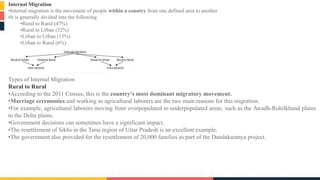
Internal Migration
•Internal migration is the movement of people within a country from one defined area to another.
•It is generally divided into the following
•Rural to Rural (47%)
•Rural to Urban (32%)
•Urban to Urban (15%)
•Urban to Rural (6%)
Types of Internal Migration
Rural to Rural
•According to the 2011 Census, this is the country's most dominant migratory movement.
•Marriage ceremonies and working as agricultural laborers are the two main reasons for this migration.
•For example, agricultural laborers moving from overpopulated to underpopulated areas, such as the Awadh-Rohilkhand plains
to the Delta plains.
•Government decisions can sometimes have a significant impact.
•The resettlement of Sikhs in the Tarai region of Uttar Pradesh is an excellent example.
•The government also provided for the resettlement of 20,000 families as part of the Dandakaranya project.
Rural to Urban
•It is the second most noticeable migratory pattern.
•Since independence, inter-sectoral migration has been the most dominant migratory trend.
•It is the result of both push and pulls factors in rural and urban areas.
•However, since the 1981 census, the positive impact of rural development programs has resulted in a reduction in push factors,
causing this trend to fall to second place.
•Megacities serve as a destination, with rural residents primarily from population surplus states like Uttar Pradesh, Bihar, and
MP serving as source areas.
Urban to Urban
•It primarily involves people moving from small towns to larger cities.
•This migration takes place in stages, with people moving from rural areas to small towns and then to larger cities (Class II to Class I towns)
•The majority of urban to urban migration occurs in search of better opportunities and a higher standard of living.
•It is dominated by middle-class individuals. In small towns, it creates a void.
Urban to Rural
•It is a reversal or push-back migration.
•It occurs at a high level of urbanization when cities are characterized by overcrowding, haphazard growth, and high living costs.
•It is less because it involves the elderly population migrating primarily after their professional commitments are completed.
•The technical term for this migratory movement is "counter-current migration".
1.Rural-to-Urban Migration: A significant portion of migration in India is from rural areas to urban centers.
This pattern is driven by the allure of better job opportunities, improved living conditions, access to education,
healthcare facilities, and urban amenities in cities and towns. Major cities like Mumbai, Delhi, Bangalore, and
Chennai have experienced substantial rural-to-urban migration.
2.North-South Migration: There is a noticeable trend of migration from northern states to southern states.
Southern states like Tamil Nadu, Karnataka, Kerala, and Andhra Pradesh have more developed
industries and higher economic growth rates, attracting migrants seeking better employment prospects. This
has led to the emergence of diverse urban centers in the southern part of the country.
3.Interstate Migration: People often move from states with lower economic development to states with more
vibrant economies. States like Maharashtra, Gujarat, Delhi, and Karnataka have been destinations for migrants
due to their robust industrial and service sectors.
4.Seasonal Migration: Seasonal migration is prevalent in India, especially in the agricultural sector. Farmers
and laborers from rural areas migrate to urban areas for temporary work during specific seasons, such as
planting and harvesting. These migrants return to their native places after the seasonal work is completed.
5. Intra-State Migration: Within states, there can be migration from less developed rural regions to more
developed urban or peri-urban areas. For instance, in states like Uttar Pradesh and Bihar, migrants often
move from rural districts to the capital cities or industrial regions within the same state.
•Internal Migration
•Types: Internal migration in India is primarily of two types:
• Long term Migration, resulting in the relocation of an
individual or household.
• Short term Migration, involving back and forth movement
between a source and destination.
•Key Source States: Uttar Pradesh, Bihar, Rajasthan, Madhya
Pradesh, Andhra Pradesh, Chhattisgarh.
•Key Destination States: Delhi, Maharashtra, Gujarat, Haryana,
Punjab and Karnataka.
•Internal Migrants in India constitute a large population of 309 million
internal migrants or 30 percent of the population (Census of India
2001).
• When a person is enumerated in the census at a different
place than his / her place of birth, she/he is considered a
migrant.
•Female Migration: Out of the total internal migrants, 70.7
percent are women (Census of India 2001) and marriage is one of
the major reasons for female migration in both the rural and urban
areas.
•Male Migration: Migration for employment-related reasons is one of
the prominent reasons for male migration in both rural and urban
areas.
•Employing Sectors: Migrants are mostly employed
in subsectors like construction, domestic work, textile, brick-kilns,
transportation, mines, quarries, and agriculture.
•Urbanization: Rates of urbanization influence rural-urban
wage differences and an increase in the demand for labor in urban
areas can push up urban wages and increase migration.
THANKYOU

MIGRATION.pptx

  • 1.
    POPULATION DYNAMICS TOPIC: Internationalmigration – past and present trend. Migration in India, trend and pattern DONE BY: SALIAALIAS DOS IN GEOGRAPHY SUBMITTED TO: DR.VISHWANATH DOS IN GEOGRAPHY
  • 2.
    • Migration ingeography usually refers to the movement of humans from one place to another. It occurs when the perceived interaction of Push and Pull factors overcome the friction of moving. • Emigration refers to the act of leaving one's own country to live in another country. It's when people decide to move away from their homeland to settle in a different place. • Immigration, on the other hand, refers to the act of entering and settling in a new country that is not one's native land. It's when people come to a different country to live there permanently or for an extended period of time.
  • 4.
    The modern historyof international migration can be divided roughly into four periods. During the mercantile period from 1500 to 1800, world immigration flows were dominated by Europe from processes of colonization and economic growth under mercantile capitalism. Over the course of three hundred years, Europeans inhabited large parts of the Americas, Africa, Asia, and Oceania. During this period, the emigrants were generally categorized into three classes: a relatively large number of agrarian settlers, a smaller number of administrators and artisans, smaller number of entrepreneurs who founded plantations to produce raw materials for Europe’s growing mercantile economics. International migration – past and present trend
  • 5.
    The second periodof emigration, the industrial period, began early in the nineteenth century and stemmed from the economic development of Europe and spread of industrialism to former colonies in the new world. From 1800 to 1925, more than forty-eight million people left the industrializing countries of Europe in search of new lives in the Americas, and Oceania. Of these emigrants, 85 percent went to five destinations: Argentina, Australia, Canada, New Zealand, and the United States (the last alone receiving 60 percent). The key sending nations were Britain, Italy, Norway, Portugal, Spain, and Sweden, which exported a large share of their potential population in the course of industrializing. Although international migrants were not exclusively European, the overwhelming majority came from that continent. Of all the U.S. immigrants between 1820 and 1920, 88 percent were from Europe, 3 percent were from Asia, and 8 percent came from the Americas. The period of large scale European emigration faltered with the outbreak of World War I period of limited migration, early 1920s, by then several important receiving countries had passed restrictive immigration laws. The onset of the Great Depression virtually stopped all international movement in 1929, During the 1940s, international migration was checked by the Second World War. The mobility that occurred largely comprised the movements of refugees and displaced persons, and it was not strongly connected to the rhythms of economic growth and development; The period of post-industrial migration emerged during the 1960s and constituted a sharp break with the past. Rather than being dominated by outflows from Europe to a handful of former colonies, immigration became a truly global phenomenon as the number of and the variety of both the sending and the receiving countries increased, and the global supply of immigrants shifted from Europe to the developing world.
  • 6.
    Before 1925, 85percent of all the international migrants originated in Europe. Since 1960. emigrants from Africa, Asia, and Latin America had increased dramatically. In addition to the traditional immigrant receiving nations such as Canada, the United States, Australia, New Zealand, and Argentina, countries throughout Western Europe now attract significant numbers of immigrants –notably Germany, France, Belgium, Switzerland, Sweden, and the Netherlands. During the late 1970s, even longtime sending countries such as Italy, Spain, and Portugal began receiving immigrants from the Middle East and Africa After the rapid escalations of oil prices in 1973, several less developed but capital rich nations in the Gulf region also began to sponsor massive labour migration. By the 1980s, international migration had spread into Asia, not only to Japan but also to newly industrialized countries such as Korea, Taiwan, Hong Kong, Singapore, Malaysia, and Thailand. By 1990s, consequently, international migration had become truly a global phenomenon,
  • 9.
    Europe and Asiahave the most international migrants. An estimated 86.7 million international migrants lived in Europe in 2020, followed by 85.6 million in Asia. The number of international migrants living in these two regions has steadily increased since 2005, according to the IOM. The Latin America and Caribbean region has the fastest- growing international migrant population. Since 2005, the region’s international migrant population has roughly doubled. India remains the top origin country for the world’s migrants india’s migrants are dispersed around the world, but the countries with the largest Indian migrant populations are the United Arab Emirates (3.5 million), the U.S. (2.7 million) and Saudi Arabia (2.5 million).
  • 10.
    India has beenthe world’s top receiver of remittances since 2010. Remittances to India grew from $53 billion in 2010 to $89 billion in 2021. The U.S. has been the top sending country for remittances since 1990, the earliest year with available statistics. In 2021, international migrants living in the U.S. sent $73 billion in remittances globally. The share of international migrants who are men has ticked up in recent decades. In 2000, 50.6% of international migrants were men and 49.4% were women. By 2020, men made up 51.9% of global migrants while 48.1% were women, according to estimates by the United Nations.
  • 11.
    Following are therecent trends of international migration: •In 2017, the USA was the largest recipient of immigration followed by Saudi Arabia, Germany, Russia, and the UK. •In 2017, the largest source of migration is India followed by Mexico, Russia, and China. •Asia and Europe are the top regions of sources and destinations of international migration. •48% of international expatriates are female. •70% of international migrants are workers. •10% of international migrants are refugees persecuted by armed conflict or civil war. •The trend of student migration is from developing countries to developed countries. •India and the US have the largest number of illegal immigrants. •According to the World Migration Report, there were 3.3 million migrations to South Asia in 2018 due to sudden climatic threats.
  • 12.
    Internal migration, themovement of people within a country. In India, as in most countries, there are generally no restrictions on internal movement. The number of internal migrants in India was 450 million as per the most recent 2011 census. Despite the significant increase in internal migration recorded in 2011, the nature of movement remains relatively unchanged since 2001. Bulk of the movement (62%) is within the same district(INTRA). Another 26% is between districts(INTER) within the same state. Only 12% of movement is inter-state The low rate of inter-state migration is cause for concern since it indicates that optimal allocation of human resources across the regional dimension is facing frictions Migration in India, trend and pattern
  • 13.
    enumerated internal migrationof 37 percent of the total population. The Economic Survey (2017) estimated that an average of 5–6 million Indians migrated annually between 2001 and 2011, leading to an inter-state migrant population of “about 60 million” and an inter-district migrant population “as high as 80 million” (Government of India 2017a). Migrants’ main places of origin have traditionally been the densely populated and less urbanized states of Uttar Pradesh, Bihar, Rajasthan, Madhya Pradesh, Jharkhand and Chhattisgarh, with major receiving states being the more industrialized and urbanized states of Maharashtra, Delhi, Punjab, Gujarat, Tamil Nadu, Karnataka and Kerala
  • 15.
    • The majorityof internal migrants in India are short-distance, intra- and inter-district .One of the main barriers is the non-portability of social welfare schemes such as subsidized grain and the requirement of state domicility for government jobs. • Among major geographical streams, the most prevalent stream of migration is rural to rural, accounting for 62 percent, followed by the rural to urban stream at 20 percent, then the urban to urban at 13 percent, and urban to rural migration at 5 percent (Government of India 2010). According to the 2011 Census, 68 percent of all migrants were females. Over the years, it has been seen that the main reason cited for the migration of females has been marriage, followed by employment .On the other hand, males mainly migrate for employment and education. However, an underreported fact is that women, while primarily migrating for marriage, do enter the labor market at their destinations; this underreporting as well as a strongly male-centric view of migration leaves the issues of women migrants too often invisible . • Another aspect to note is that rural areas still depend on employment in agriculture. With agriculture heavily dependent on seasonal factors, this seasonal cycle also shapes the rural-urban migration stream. The rate of temporary and seasonal migration is seven times larger when permanent and semipermanent migration is considered. An estimated 21 out of every 1,000 migrants in India are temporary and seasonal migrants, which amounts to approximately 14 million persons circulating annually.
  • 16.
    Census data alsoprovide clues regarding potential reasons for rural to urban migration into cities and indicates the main reason for migration is employment opportunities. Migra-tion to Mumbai, Delhi, Chennai, and Hyderabad also show the same pattern; employment opportunities in these cities dominate higher rural to urban migration. Marriage and conse-quent relocation of households are also cited as a cause for rural to urban migration. Rural to urban migration was the highest in Delhi at 56 percent and lowest in Himachal Pradesh, at 8 percent. The figure shows that the rural to urban migration rate is lower than that of rural to rural migration in most of the states in India. Urban to urban migration was quite highest in Delhi at 38 percent, and particularly high in Goa, Mizoram, Nagaland, and Manipur.
  • 18.
    Internal Migration •Internal migrationis the movement of people within a country from one defined area to another. •It is generally divided into the following •Rural to Rural (47%) •Rural to Urban (32%) •Urban to Urban (15%) •Urban to Rural (6%) Types of Internal Migration Rural to Rural •According to the 2011 Census, this is the country's most dominant migratory movement. •Marriage ceremonies and working as agricultural laborers are the two main reasons for this migration. •For example, agricultural laborers moving from overpopulated to underpopulated areas, such as the Awadh-Rohilkhand plains to the Delta plains. •Government decisions can sometimes have a significant impact. •The resettlement of Sikhs in the Tarai region of Uttar Pradesh is an excellent example. •The government also provided for the resettlement of 20,000 families as part of the Dandakaranya project.
  • 19.
    Rural to Urban •Itis the second most noticeable migratory pattern. •Since independence, inter-sectoral migration has been the most dominant migratory trend. •It is the result of both push and pulls factors in rural and urban areas. •However, since the 1981 census, the positive impact of rural development programs has resulted in a reduction in push factors, causing this trend to fall to second place. •Megacities serve as a destination, with rural residents primarily from population surplus states like Uttar Pradesh, Bihar, and MP serving as source areas. Urban to Urban •It primarily involves people moving from small towns to larger cities. •This migration takes place in stages, with people moving from rural areas to small towns and then to larger cities (Class II to Class I towns) •The majority of urban to urban migration occurs in search of better opportunities and a higher standard of living. •It is dominated by middle-class individuals. In small towns, it creates a void. Urban to Rural •It is a reversal or push-back migration. •It occurs at a high level of urbanization when cities are characterized by overcrowding, haphazard growth, and high living costs. •It is less because it involves the elderly population migrating primarily after their professional commitments are completed. •The technical term for this migratory movement is "counter-current migration".
  • 22.
    1.Rural-to-Urban Migration: Asignificant portion of migration in India is from rural areas to urban centers. This pattern is driven by the allure of better job opportunities, improved living conditions, access to education, healthcare facilities, and urban amenities in cities and towns. Major cities like Mumbai, Delhi, Bangalore, and Chennai have experienced substantial rural-to-urban migration. 2.North-South Migration: There is a noticeable trend of migration from northern states to southern states. Southern states like Tamil Nadu, Karnataka, Kerala, and Andhra Pradesh have more developed industries and higher economic growth rates, attracting migrants seeking better employment prospects. This has led to the emergence of diverse urban centers in the southern part of the country. 3.Interstate Migration: People often move from states with lower economic development to states with more vibrant economies. States like Maharashtra, Gujarat, Delhi, and Karnataka have been destinations for migrants due to their robust industrial and service sectors. 4.Seasonal Migration: Seasonal migration is prevalent in India, especially in the agricultural sector. Farmers and laborers from rural areas migrate to urban areas for temporary work during specific seasons, such as planting and harvesting. These migrants return to their native places after the seasonal work is completed. 5. Intra-State Migration: Within states, there can be migration from less developed rural regions to more developed urban or peri-urban areas. For instance, in states like Uttar Pradesh and Bihar, migrants often move from rural districts to the capital cities or industrial regions within the same state.
  • 23.
    •Internal Migration •Types: Internalmigration in India is primarily of two types: • Long term Migration, resulting in the relocation of an individual or household. • Short term Migration, involving back and forth movement between a source and destination. •Key Source States: Uttar Pradesh, Bihar, Rajasthan, Madhya Pradesh, Andhra Pradesh, Chhattisgarh. •Key Destination States: Delhi, Maharashtra, Gujarat, Haryana, Punjab and Karnataka. •Internal Migrants in India constitute a large population of 309 million internal migrants or 30 percent of the population (Census of India 2001). • When a person is enumerated in the census at a different place than his / her place of birth, she/he is considered a migrant. •Female Migration: Out of the total internal migrants, 70.7 percent are women (Census of India 2001) and marriage is one of the major reasons for female migration in both the rural and urban areas. •Male Migration: Migration for employment-related reasons is one of the prominent reasons for male migration in both rural and urban areas. •Employing Sectors: Migrants are mostly employed in subsectors like construction, domestic work, textile, brick-kilns, transportation, mines, quarries, and agriculture. •Urbanization: Rates of urbanization influence rural-urban wage differences and an increase in the demand for labor in urban areas can push up urban wages and increase migration.
  • 25.