Migration, Population  Mr. A  South High 252
Ravenstein's Migration Laws 1870's-1880's (Still relevant today) Most migrants go only a short distance (gravity law)  Longer-distance migration favors big-city destinations  Most migration is rural to urban S Each migration flow produces a counter flow (i.e. return to place of birth)  Most migrants are adults--families are less likely to make international moves
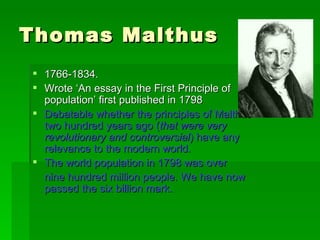
Thomas Malthus 1766-1834. Wrote ‘An essay in the First Principle of population’ first published in 1798 Debatable whether the principles of Malthus two hundred years ago ( that were very revolutionary and controversial ) have any relevance to the modern world. The world population in 1798 was over nine hundred million people. We have now passed the six billion mark.
The Core Principles of Malthus: Food is necessary for human existence Human population tends to grow faster than the power on the earth to produce subsistence. The effects of these two unequal powers must be kept equal Since humans tend not to limit their population size voluntarily - “preventive checks” will control population.
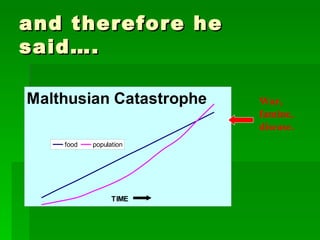
Malthus recognised that population if unchecked, grows at a geometric rate: 1   2  4  8  16  32 However, food only increases at an arithmetic rate,  as land is finite. 1  2  3  4  5  6
and therefore he said…. War, famine, disease.
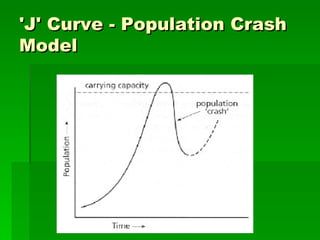
CHECKS Malthus suggested that once this ceiling (catastrophe) had been reached, further growth in population would be prevented by negative and positive checks. He saw the checks as a natural method of population control.
Negative checks (decreased birth rate)…. Negative Checks were used to limit the population growth.  It included abstinence/ postponement of marriage which lowered the fertility rate. Malthus favored moral restraint (including late marriage and sexual abstinence) as a check on population growth. However, it is worth noting that Malthus proposed this only for the working and poor classes!
Positive checks (increased death rate) Positive Checks  were ways to reduce population size by events such as famine, disease, war - increasing the mortality rate and reducing life expectancy.
'J' Curve - Population Crash Model
Was he right? Technological improvements which he could not have foreseen have taken place. Increased amount of cropland due to irrigation Reduced population growth as countries move through the DTM

Migration, Population mra

  • 1.
    Migration, Population Mr. A South High 252
  • 2.
    Ravenstein's Migration Laws1870's-1880's (Still relevant today) Most migrants go only a short distance (gravity law) Longer-distance migration favors big-city destinations Most migration is rural to urban S Each migration flow produces a counter flow (i.e. return to place of birth) Most migrants are adults--families are less likely to make international moves
  • 3.
    Thomas Malthus 1766-1834.Wrote ‘An essay in the First Principle of population’ first published in 1798 Debatable whether the principles of Malthus two hundred years ago ( that were very revolutionary and controversial ) have any relevance to the modern world. The world population in 1798 was over nine hundred million people. We have now passed the six billion mark.
  • 4.
    The Core Principlesof Malthus: Food is necessary for human existence Human population tends to grow faster than the power on the earth to produce subsistence. The effects of these two unequal powers must be kept equal Since humans tend not to limit their population size voluntarily - “preventive checks” will control population.
  • 5.
    Malthus recognised thatpopulation if unchecked, grows at a geometric rate: 1 2 4 8 16 32 However, food only increases at an arithmetic rate, as land is finite. 1 2 3 4 5 6
  • 6.
    and therefore hesaid…. War, famine, disease.
  • 7.
    CHECKS Malthus suggestedthat once this ceiling (catastrophe) had been reached, further growth in population would be prevented by negative and positive checks. He saw the checks as a natural method of population control.
  • 8.
    Negative checks (decreasedbirth rate)…. Negative Checks were used to limit the population growth. It included abstinence/ postponement of marriage which lowered the fertility rate. Malthus favored moral restraint (including late marriage and sexual abstinence) as a check on population growth. However, it is worth noting that Malthus proposed this only for the working and poor classes!
  • 9.
    Positive checks (increaseddeath rate) Positive Checks were ways to reduce population size by events such as famine, disease, war - increasing the mortality rate and reducing life expectancy.
  • 10.
    'J' Curve -Population Crash Model
  • 11.
    Was he right?Technological improvements which he could not have foreseen have taken place. Increased amount of cropland due to irrigation Reduced population growth as countries move through the DTM