Economic Sectors Mr. A
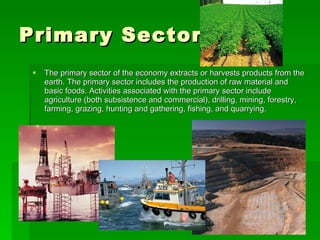
Primary Sector The primary sector of the economy extracts or harvests products from the earth. The primary sector includes the production of raw material and basic foods. Activities associated with the primary sector include agriculture (both subsistence and commercial), drilling, mining, forestry, farming, grazing, hunting and gathering, fishing, and quarrying.
Trends In developed and developing countries, a decreasing proportion of workers are involved in the primary sector. About 3% of the U.S. labor force is engaged in primary sector activity today, while more than two-thirds of the labor force were primary sector workers in the mid-nineteenth century.
Secondary Sector The secondary sector of the economy manufactures finished goods. All of manufacturing, processing, and construction lies within the secondary sector. Activities associated with the secondary sector include metal working and smelting, automobile production, textile production, chemical and engineering industries, aerospace manufacturing, energy utilities, engineering, breweries and bottlers, construction, and shipbuilding.
Tertiary Sector The tertiary sector of the economy is the service industry. This sector provides services to the general population and to businesses. Activities associated with this sector include retail and wholesale sales, transportation and distribution, entertainment (movies, television, radio, music, theater, etc.), restaurants, clerical services, media, tourism, insurance, banking, healthcare, and law.
In most developed and developing countries, a growing proportion of workers are devoted to the tertiary sector. In the U.S., more than 80% of the labor force are tertiary workers.
Quaternary Sector The quaternary sector of the economy consists of intellectual activities. Activities associated with this sector include government, culture, libraries, scientific research, education, and information technology.
Quinary Sector Some consider there to be a branch of the quaternary sector called the quinary sector, which includes the highest levels of decision making in a society or economy. This sector would include the top executives or officials in such fields as government, science, universities, nonprofit, healthcare, culture, and the media.

Economic sectors

  • 1.
  • 2.
    Primary Sector Theprimary sector of the economy extracts or harvests products from the earth. The primary sector includes the production of raw material and basic foods. Activities associated with the primary sector include agriculture (both subsistence and commercial), drilling, mining, forestry, farming, grazing, hunting and gathering, fishing, and quarrying.
  • 3.
    Trends In developedand developing countries, a decreasing proportion of workers are involved in the primary sector. About 3% of the U.S. labor force is engaged in primary sector activity today, while more than two-thirds of the labor force were primary sector workers in the mid-nineteenth century.
  • 4.
    Secondary Sector Thesecondary sector of the economy manufactures finished goods. All of manufacturing, processing, and construction lies within the secondary sector. Activities associated with the secondary sector include metal working and smelting, automobile production, textile production, chemical and engineering industries, aerospace manufacturing, energy utilities, engineering, breweries and bottlers, construction, and shipbuilding.
  • 5.
    Tertiary Sector Thetertiary sector of the economy is the service industry. This sector provides services to the general population and to businesses. Activities associated with this sector include retail and wholesale sales, transportation and distribution, entertainment (movies, television, radio, music, theater, etc.), restaurants, clerical services, media, tourism, insurance, banking, healthcare, and law.
  • 6.
    In most developedand developing countries, a growing proportion of workers are devoted to the tertiary sector. In the U.S., more than 80% of the labor force are tertiary workers.
  • 7.
    Quaternary Sector Thequaternary sector of the economy consists of intellectual activities. Activities associated with this sector include government, culture, libraries, scientific research, education, and information technology.
  • 8.
    Quinary Sector Someconsider there to be a branch of the quaternary sector called the quinary sector, which includes the highest levels of decision making in a society or economy. This sector would include the top executives or officials in such fields as government, science, universities, nonprofit, healthcare, culture, and the media.