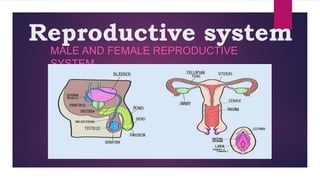
Reproductive system
MALE AND FEMALE REPRODUCTIVE
SYSTEM
REPRODUCTIVE SYSTEM
 Reproductive system ensures the continuation of species
Gonads- are the primary reproductive organ which produce the gametes (egg or ovum)
A pair of testes produces sperms in males
A pair of ovaries produces ovum in females
Reproductive Organs includes:
1. Primary sex Organ
Testes- primary sex organ or gonads in males
2. Accessory Sex organ
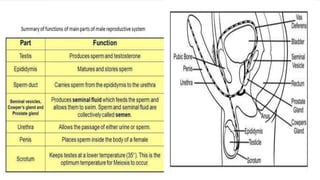
Seminal Vesicles, Prostate gland, Urethra, Penis
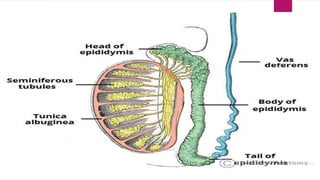
Sertoli cells
- The supporting cells for spermatogenic cells in seminiferous tubules, supply all the materials for
spermatogenesis
- Also called sustentacullar cells or nurse cells.
TESTES
 FUNCTIONS OF TESTES
- Gametogenic function: Spermatogenesis
- Endocrine Function: Secretion of hormones
1. Spermatogenesis--- the process by which the male gametes called spermatozoa (sperms) are
formed from the primitive spermatogenic cells (spermatogonia) in the testis.
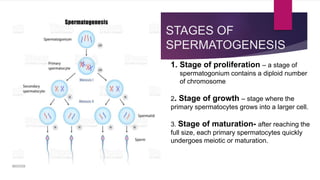
STAGES OF
SPERMATOGENESIS
1. Stage of proliferation – a stage of
spermatogonium contains a diploid number
of chromosome
2. Stage of growth – stage where the
primary spermatocytes grows into a larger cell.
3. Stage of maturation- after reaching the
full size, each primary spermatocytes quickly
undergoes meiotic or maturation.
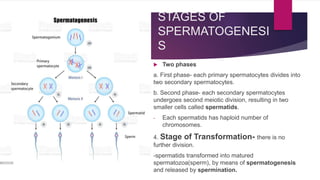
STAGES OF
SPERMATOGENESI
S
 Two phases
a. First phase- each primary spermatocytes divides into
two secondary spermatocytes.
b. Second phase- each secondary spermatocytes
undergoes second meiotic division, resulting in two
smaller cells called spermatids.
- Each spermatids has haploid number of
chromosomes.
4. Stage of Transformation- there is no
further division.
-spermatids transformed into matured
spermatozoa(sperm), by means of spermatogenesis
and released by spermination.
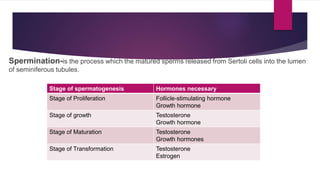
Spermination-is the process which the matured sperms released from Sertoli cells into the lumen
of seminiferous tubules.
Stage of spermatogenesis Hormones necessary
Stage of Proliferation Follicle-stimulating hormone
Growth hormone
Stage of growth Testosterone
Growth hormone
Stage of Maturation Testosterone
Growth hormones
Stage of Transformation Testosterone
Estrogen
Roles of Hormones in Spermatogenesis
1. Follicle- Stimulating Hormone
- Responsible for the initiation of spermatogenesis. It binds with the sertoli cells and spermatogonia,
induces the proliferation.
2. Testosterone
- Responsible for the sequence of remaining stages in spermatogenesis
- Responsible for the maintenance of spermatogenesis
3. Estrogen
- Formed from the testosterone in Sertoli cells.
4. Growth Hormone
- Essential for the general metabolic processes in testes.
QUALITIES OF SEN REQUIRED FOR
FERTILITY
 MINIMUM REQUIRED QUALITIES OF SEMEN FOR FERTILITY ARE:
1. Volume of semen per ejaculation must be at least 2mL
2. Sperm count must be at least 20million/mL
3. Number of sperms in each ejaculation must be at least 40 million
4. 75% of sperms per ejaculation must be alive
5. 50% of sperm must be motile
6. 30% of sperms must have normal shape and structure
7. Sperms with head defect must be less than 35%
8. Sperms with midpiece defect must be less than 20%
9. Sperms with tail defect must be less than 20%
SEMEN
 A white or grey fluid that contains sperms. It is the collection of fluid from testes, seminal fluids,
prostate glands, and bulbourethral glands.
 Discharged during sexual act and the process of discharge of semen is called ejaculation.
Prostate glands- gives milky appearance to the semen.
 PROPERTIES OF SEMEN
- Specific gravity: 1.028
- Volume: 2ml to 6ml per ejaculation
- Reaction: it is alkaline with a pH of 7.5
- Alkalinity is due to the prostate fluid.
SPERM
 The male gametes (reproductive cell) developed in the testes.
 Matured sperm is 60 µ long / 0.06milli
 Sperm count- 100 to 50 million/mL of semen
 After ejaculation the survival time is only about 24-48 hours at the temperature equivalent to body temperature.
FEMALE REPRODUCTIVE SYSTEM
A. OVARIES
- The primary sex organ which produce eggs or ova
- Secretes female sex hormone, the estrogen and progesterone
 ACCESORY SEX ORGAN
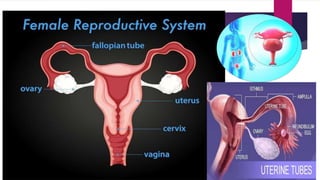
1. A System of genital ducts- Fallopian tubes, uterus, cervix, and vagina
2. External genitalia- Labia mijora, labia minora and clitoris
Mammary glands are not the female genital organs but the important glands of female
reproductive system.
PARTS OF FEMALE REPRODUCTIVE
ORGAN
B. UTERUS- also called as womb. It lies in the pelvic cavity in between the rectum
and urinary bladder
- A hollow muscular organ with a thick wall,
- Virgin uterus is pyriform in shape and its flattened anteroposteroirly.
- There is constriction almost at the middle of uterus called isthmus
 DIVISION OF UTERUS
A. Fundus- above the entrance point of fallopian tubes
B. Body- between fundus and isthmus
C. Cervix- below isthmus
PARTS OF FEMALE REPRODUCTIVE
ORGAN
 STRUCTURE OF UTERUS
 (perimetonium) Serous or outer layer- outer covering of
uterus
 Myometrium (middle muscular layer)- thickest layer made up
of smooth muscle fiber
 Endometrium (inner mucus layer)- smooth and soft with pale
red color. Made up of ciliated columnar epithelial cell
CHANGES IN UTERUS
 Uterus changes its size, structure and function in different phases of
sexual life.
 Before Menstruation, uterus is enlarged, becomes more vascular. The
Endometrium thickens with more blood supply.
 During Pregnancy, uterus is enlarged very much with increase weight.
 After Parturition (delivery), it comes back to its original size but the cavity
remains larger. In old age, uterus is atrophied
PARTS OF FEMALE REPRODUCTIVE
ORGAN
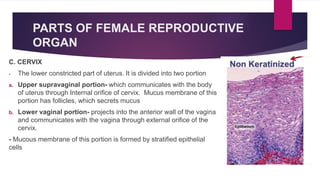
C. CERVIX
- The lower constricted part of uterus. It is divided into two portion
a. Upper supravaginal portion- which communicates with the body
of uterus through Internal orifice of cervix. Mucus membrane of this
portion has follicles, which secrets mucus
b. Lower vaginal portion- projects into the anterior wall of the vagina
and communicates with the vagina through external orifice of the
cervix.
- Mucous membrane of this portion is formed by stratified epithelial
cells
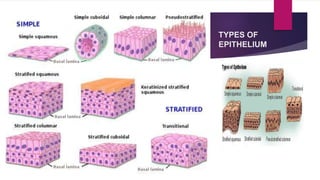
TYPES OF
EPITHELIUM
PARTS OF FEMALE REPRODUCTIVE
ORGAN
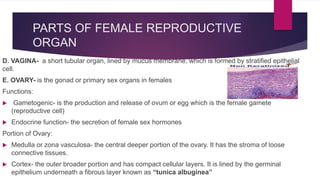
D. VAGINA- a short tubular organ, lined by mucus membrane, which is formed by stratified epithelial
cell.
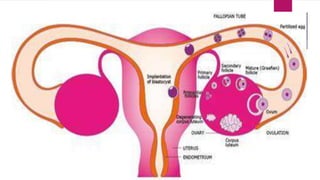
E. OVARY- is the gonad or primary sex organs in females
Functions:
 Gametogenic- is the production and release of ovum or egg which is the female gamete
(reproductive cell)
 Endocrine function- the secretion of female sex hormones
Portion of Ovary:
 Medulla or zona vasculosa- the central deeper portion of the ovary. It has the stroma of loose
connective tissues.
 Cortex- the outer broader portion and has compact cellular layers. It is lined by the germinal
epithelium underneath a fibrous layer known as “tunica albuginea”
Midterm_Module-2-Reproductive-system.pptx

Midterm_Module-2-Reproductive-system.pptx

  • 1.
    Reproductive system MALE ANDFEMALE REPRODUCTIVE SYSTEM
  • 2.
    REPRODUCTIVE SYSTEM  Reproductivesystem ensures the continuation of species Gonads- are the primary reproductive organ which produce the gametes (egg or ovum) A pair of testes produces sperms in males A pair of ovaries produces ovum in females Reproductive Organs includes: 1. Primary sex Organ Testes- primary sex organ or gonads in males 2. Accessory Sex organ Seminal Vesicles, Prostate gland, Urethra, Penis
  • 4.
    Sertoli cells - Thesupporting cells for spermatogenic cells in seminiferous tubules, supply all the materials for spermatogenesis - Also called sustentacullar cells or nurse cells. TESTES  FUNCTIONS OF TESTES - Gametogenic function: Spermatogenesis - Endocrine Function: Secretion of hormones 1. Spermatogenesis--- the process by which the male gametes called spermatozoa (sperms) are formed from the primitive spermatogenic cells (spermatogonia) in the testis.
  • 6.
    STAGES OF SPERMATOGENESIS 1. Stageof proliferation – a stage of spermatogonium contains a diploid number of chromosome 2. Stage of growth – stage where the primary spermatocytes grows into a larger cell. 3. Stage of maturation- after reaching the full size, each primary spermatocytes quickly undergoes meiotic or maturation.
  • 7.
    STAGES OF SPERMATOGENESI S  Twophases a. First phase- each primary spermatocytes divides into two secondary spermatocytes. b. Second phase- each secondary spermatocytes undergoes second meiotic division, resulting in two smaller cells called spermatids. - Each spermatids has haploid number of chromosomes. 4. Stage of Transformation- there is no further division. -spermatids transformed into matured spermatozoa(sperm), by means of spermatogenesis and released by spermination.
  • 8.
    Spermination-is the processwhich the matured sperms released from Sertoli cells into the lumen of seminiferous tubules. Stage of spermatogenesis Hormones necessary Stage of Proliferation Follicle-stimulating hormone Growth hormone Stage of growth Testosterone Growth hormone Stage of Maturation Testosterone Growth hormones Stage of Transformation Testosterone Estrogen
  • 9.
    Roles of Hormonesin Spermatogenesis 1. Follicle- Stimulating Hormone - Responsible for the initiation of spermatogenesis. It binds with the sertoli cells and spermatogonia, induces the proliferation. 2. Testosterone - Responsible for the sequence of remaining stages in spermatogenesis - Responsible for the maintenance of spermatogenesis 3. Estrogen - Formed from the testosterone in Sertoli cells. 4. Growth Hormone - Essential for the general metabolic processes in testes.
  • 10.
    QUALITIES OF SENREQUIRED FOR FERTILITY  MINIMUM REQUIRED QUALITIES OF SEMEN FOR FERTILITY ARE: 1. Volume of semen per ejaculation must be at least 2mL 2. Sperm count must be at least 20million/mL 3. Number of sperms in each ejaculation must be at least 40 million 4. 75% of sperms per ejaculation must be alive 5. 50% of sperm must be motile 6. 30% of sperms must have normal shape and structure 7. Sperms with head defect must be less than 35% 8. Sperms with midpiece defect must be less than 20% 9. Sperms with tail defect must be less than 20%
  • 11.
    SEMEN  A whiteor grey fluid that contains sperms. It is the collection of fluid from testes, seminal fluids, prostate glands, and bulbourethral glands.  Discharged during sexual act and the process of discharge of semen is called ejaculation. Prostate glands- gives milky appearance to the semen.  PROPERTIES OF SEMEN - Specific gravity: 1.028 - Volume: 2ml to 6ml per ejaculation - Reaction: it is alkaline with a pH of 7.5 - Alkalinity is due to the prostate fluid.
  • 12.
    SPERM  The malegametes (reproductive cell) developed in the testes.  Matured sperm is 60 µ long / 0.06milli  Sperm count- 100 to 50 million/mL of semen  After ejaculation the survival time is only about 24-48 hours at the temperature equivalent to body temperature.
  • 13.
    FEMALE REPRODUCTIVE SYSTEM A.OVARIES - The primary sex organ which produce eggs or ova - Secretes female sex hormone, the estrogen and progesterone  ACCESORY SEX ORGAN 1. A System of genital ducts- Fallopian tubes, uterus, cervix, and vagina 2. External genitalia- Labia mijora, labia minora and clitoris Mammary glands are not the female genital organs but the important glands of female reproductive system.
  • 14.
    PARTS OF FEMALEREPRODUCTIVE ORGAN B. UTERUS- also called as womb. It lies in the pelvic cavity in between the rectum and urinary bladder - A hollow muscular organ with a thick wall, - Virgin uterus is pyriform in shape and its flattened anteroposteroirly. - There is constriction almost at the middle of uterus called isthmus  DIVISION OF UTERUS A. Fundus- above the entrance point of fallopian tubes B. Body- between fundus and isthmus C. Cervix- below isthmus
  • 15.
    PARTS OF FEMALEREPRODUCTIVE ORGAN  STRUCTURE OF UTERUS  (perimetonium) Serous or outer layer- outer covering of uterus  Myometrium (middle muscular layer)- thickest layer made up of smooth muscle fiber  Endometrium (inner mucus layer)- smooth and soft with pale red color. Made up of ciliated columnar epithelial cell
  • 16.
    CHANGES IN UTERUS Uterus changes its size, structure and function in different phases of sexual life.  Before Menstruation, uterus is enlarged, becomes more vascular. The Endometrium thickens with more blood supply.  During Pregnancy, uterus is enlarged very much with increase weight.  After Parturition (delivery), it comes back to its original size but the cavity remains larger. In old age, uterus is atrophied
  • 18.
    PARTS OF FEMALEREPRODUCTIVE ORGAN C. CERVIX - The lower constricted part of uterus. It is divided into two portion a. Upper supravaginal portion- which communicates with the body of uterus through Internal orifice of cervix. Mucus membrane of this portion has follicles, which secrets mucus b. Lower vaginal portion- projects into the anterior wall of the vagina and communicates with the vagina through external orifice of the cervix. - Mucous membrane of this portion is formed by stratified epithelial cells
  • 19.
  • 20.
    PARTS OF FEMALEREPRODUCTIVE ORGAN D. VAGINA- a short tubular organ, lined by mucus membrane, which is formed by stratified epithelial cell. E. OVARY- is the gonad or primary sex organs in females Functions:  Gametogenic- is the production and release of ovum or egg which is the female gamete (reproductive cell)  Endocrine function- the secretion of female sex hormones Portion of Ovary:  Medulla or zona vasculosa- the central deeper portion of the ovary. It has the stroma of loose connective tissues.  Cortex- the outer broader portion and has compact cellular layers. It is lined by the germinal epithelium underneath a fibrous layer known as “tunica albuginea”