Mid-terms
Dat word, tho!
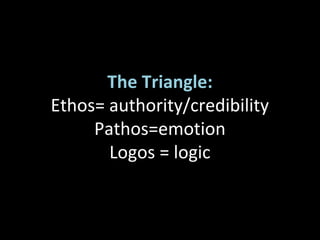
The Triangle:
Ethos= authority/credibility
Pathos=emotion
Logos = logic
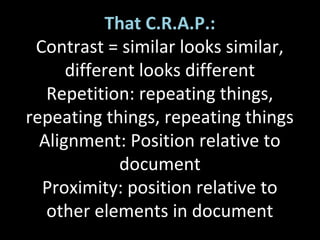
That C.R.A.P.:
Contrast = similar looks similar,
different looks different
Repetition: repeating things,
repeating things, repeating things
Alignment: Position relative to
document
Proximity: position relative to
other elements in document
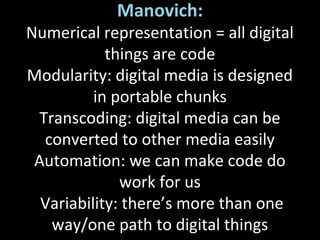
Manovich:
Numerical representation = all digital
things are code
Modularity: digital media is designed
in portable chunks
Transcoding: digital media can be
converted to other media easily
Automation: we can make code do
work for us
Variability: there’s more than one
way/one path to digital things
Kairos:
The time/space a things occupies
(or when a thing occurs) is of key
importance to understanding that
thing. Some things can only
happen at certain times. Other
things will seem much different at
other times.
Logo:
A logo is a visual representation of
a thing. It is meant to be clear,
iconic, and instantly recognized.
Technological Instrumentalism:
A false belief that technology itself
does things. E.g. “my phone texts.”
No it doesn’t. YOU text with your
phone. 
Mnemonic Value:
Mnemonic means “a device that
can be used to remember.” A great
logo has the mnemonic value of
causing people to instantly call to
mind that company/thing without
needing words.
Related text forms:
Assemblage: made of new and old
things
Remix: Made of two or more
unique things mixed
Meme: made of old and new,
meant to be copied and
redistributed
Remediation: swapping from one
media to another
Audience:
Simple: who you’re writing
to/talking to
More complex: Who ends up
seeing/hearing/reading
even more complex: who MIGHT
see/read/hear?
Metaphor:
Describing by comparison, as if
these words sprung from my head
like a cascade of brilliance.
*that’s the name of my new emo band: Cascade of Head
Brilliance*
Style:
The way a text is presented and
shaped: this includes voice, design,
font choices, color, etc.
Delivery:
How your “text” gets to the
audience.
Activity:
1) Pair off
2) You will receive a number from
1-10
3) That number is the music video
you will be rhetorically analyzing as
a pair to then explain to class in 3-
5 PowerPoint slides.
4) Use the terms here in some way
5) Email me your finished slides
Example:
using Kairos, Pathos, a little bit of
Ethos, a huge chunk of style, and a
very, very clear understanding of
audience.
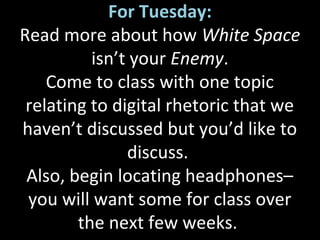
For Tuesday:
Read more about how White Space
isn’t your Enemy.
Come to class with one topic
relating to digital rhetoric that we
haven’t discussed but you’d like to
discuss.
Also, begin locating headphones–
you will want some for class over
the next few weeks.

Midterm224

  • 1.
  • 2.
  • 3.
    That C.R.A.P.: Contrast =similar looks similar, different looks different Repetition: repeating things, repeating things, repeating things Alignment: Position relative to document Proximity: position relative to other elements in document
  • 4.
    Manovich: Numerical representation =all digital things are code Modularity: digital media is designed in portable chunks Transcoding: digital media can be converted to other media easily Automation: we can make code do work for us Variability: there’s more than one way/one path to digital things
  • 5.
    Kairos: The time/space athings occupies (or when a thing occurs) is of key importance to understanding that thing. Some things can only happen at certain times. Other things will seem much different at other times.
  • 6.
    Logo: A logo isa visual representation of a thing. It is meant to be clear, iconic, and instantly recognized.
  • 7.
    Technological Instrumentalism: A falsebelief that technology itself does things. E.g. “my phone texts.” No it doesn’t. YOU text with your phone. 
  • 8.
    Mnemonic Value: Mnemonic means“a device that can be used to remember.” A great logo has the mnemonic value of causing people to instantly call to mind that company/thing without needing words.
  • 9.
    Related text forms: Assemblage:made of new and old things Remix: Made of two or more unique things mixed Meme: made of old and new, meant to be copied and redistributed Remediation: swapping from one media to another
  • 10.
    Audience: Simple: who you’rewriting to/talking to More complex: Who ends up seeing/hearing/reading even more complex: who MIGHT see/read/hear?
  • 11.
    Metaphor: Describing by comparison,as if these words sprung from my head like a cascade of brilliance. *that’s the name of my new emo band: Cascade of Head Brilliance*
  • 12.
    Style: The way atext is presented and shaped: this includes voice, design, font choices, color, etc.
  • 13.
    Delivery: How your “text”gets to the audience.
  • 14.
    Activity: 1) Pair off 2)You will receive a number from 1-10 3) That number is the music video you will be rhetorically analyzing as a pair to then explain to class in 3- 5 PowerPoint slides. 4) Use the terms here in some way 5) Email me your finished slides
  • 15.
    Example: using Kairos, Pathos,a little bit of Ethos, a huge chunk of style, and a very, very clear understanding of audience.
  • 17.
    For Tuesday: Read moreabout how White Space isn’t your Enemy. Come to class with one topic relating to digital rhetoric that we haven’t discussed but you’d like to discuss. Also, begin locating headphones– you will want some for class over the next few weeks.