7/28/09


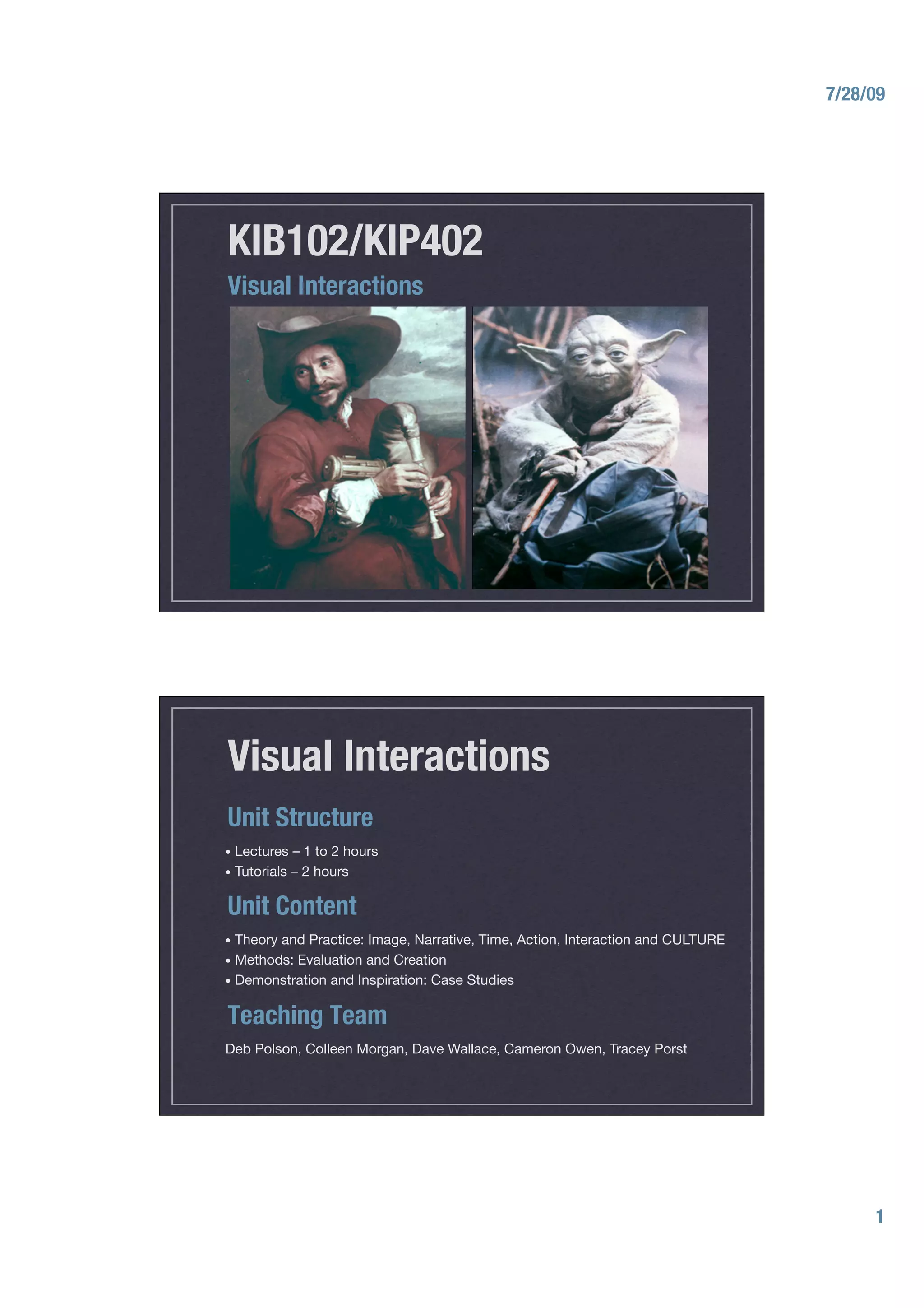
KIB102/KIP402
Visual Interactions


Visual Interactions
Unit Structure
•  Lectures    – 1 to 2 hours
•  Tutorials   – 2 hours

Unit Content
•  Theoryand Practice: Image, Narrative, Time, Action, Interaction and CULTURE
•  Methods: Evaluation and Creation
•  Demonstration and Inspiration: Case Studies


Teaching Team
Deb Polson, Colleen Morgan, Dave Wallace, Cameron Owen, Tracey Porst


                                                                                        1
7/28/09


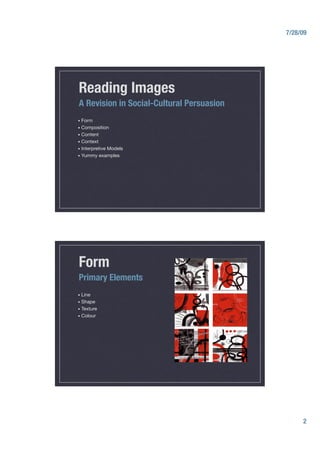
Reading Images
A Revision in Social-Cultural Persuasion
•  Form
•  Composition
•  Content
•  Context
•  Interpretive  Models
•  Yummy      examples


Form
Primary Elements
•  Line
•  Shape
•  Texture
•  Colour


                                                  2
7/28/09


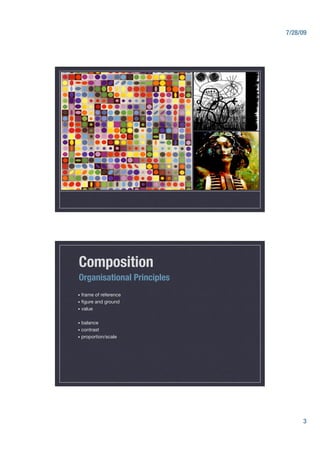
Composition
Organisational Principles
•  frame    of reference
•  figure    and ground
•  value"


•  balance
•  contrast
•  proportion/scale


                                   3
7/28/09


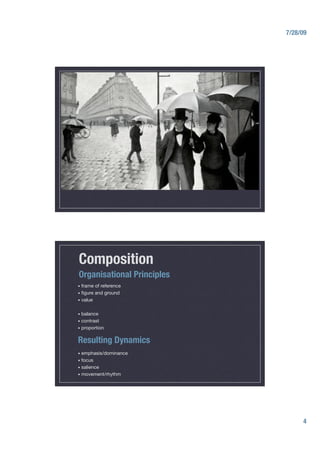
Composition
Organisational Principles
•  frame    of reference
•  figure    and ground
•  value"


•  balance
•  contrast
•  proportion


Resulting Dynamics
•  emphasis/dominance
•  focus
•  salience
•  movement/rhythm


                                   4
7/28/09


                        Content
                        Ways of seeing
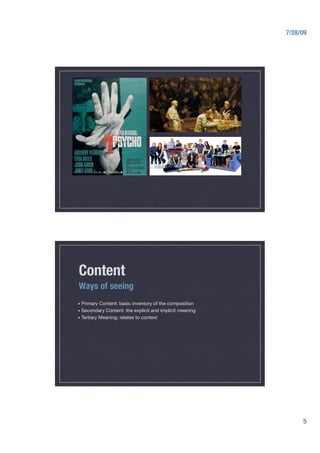
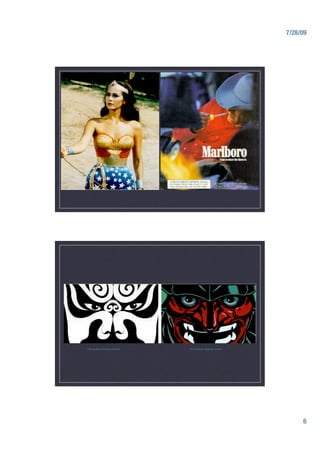
                        •  Primary  Content: basic inventory of the composition
                        •  Secondary Content: the explicit and implicit meaning
                        •  Tertiary Meaning: relates to context"


file:///Volumes/SCOOT/admin/CV_web/public_html/dotdoc/worship/topics/03/origins/prop.jpg


                                                                                                 5
7/28/09


15th century Chinese woodcut
   21st century Japanese anime


                                                                     6
7/28/09


Context
Self, Site and Field

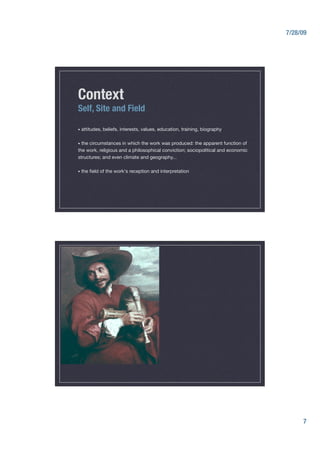
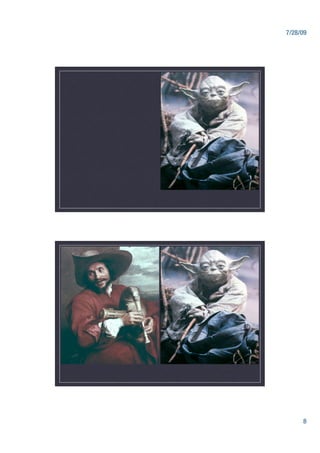
•  attitudes,   beliefs, interests, values, education, training, biography"

•  the
     circumstances in which the work was produced: the apparent function of
the work, religious and a philosophical conviction; sociopolitical and economic
structures; and even climate and geography... "

•  the   field of the work's reception and interpretation"


                                                                                        7
7/28/09


      8
7/28/09


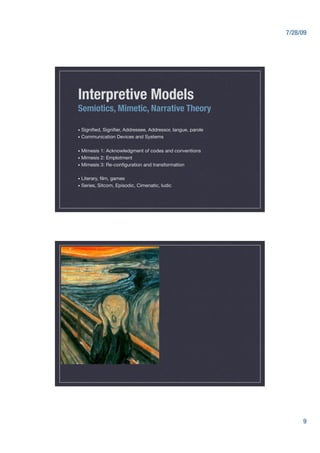
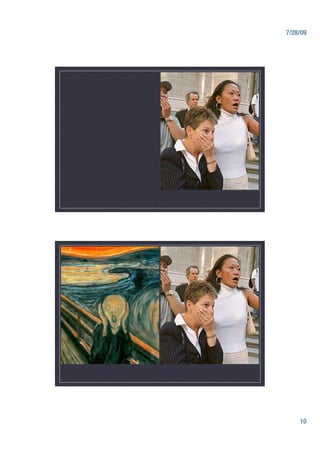
Interpretive Models
Semiotics, Mimetic, Narrative Theory

•  Signified,   Signifier, Addressee, Addressor, langue, parole
•  Communication     Devices and Systems"

•  Mimesis 1: Acknowledgment of codes and conventions 
•  Mimesis 2: Emplotment
•  Mimesis 3: Re-configuration and transformation


•  Literary,  film, games
•  Series,   Sitcom, Episodic, Cimenatic, ludic"


                                                                       9
7/28/09


     10
7/28/09


     11
7/28/09


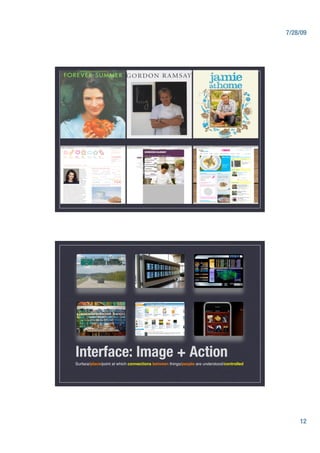
Interface: Image + Action
Surface/place/point at which connections between things/people are understood/controlled


                                                                                                 12
7/28/09


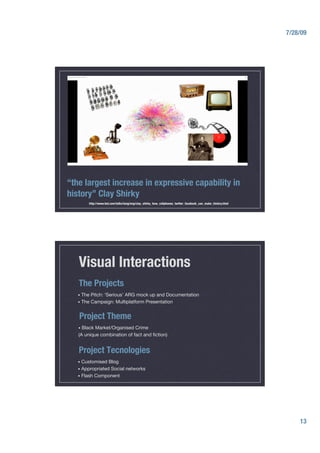
“the largest increase in expressive capability in
history” Clay Shirky
        http://www.ted.com/talks/lang/eng/clay_shirky_how_cellphones_twitter_facebook_can_make_history.html


   Visual Interactions
   The Projects
   •  The   Pitch: ‘Serious’ ARG mock up and Documentation
   •  The   Campaign: Multiplatform Presentation


   Project Theme
   •  BlackMarket/Organised Crime
   (A unique combination of fact and fiction)


   Project Tecnologies
   •  Customised  Blog
   •  Appropriated Social networks
   •  Flash Component


                                                                                                                    13
7/28/09


       Visual Interactions
       Project Criteria
      •  Response          to the Brief
      •  Representation/Evidence    of Concept
      •  Appropriate use of basic Interface and Interaction Design Principles
      •  Effective Articulation of Design Intentions and Process
      •  Presentation and Communication


“True interactivity is not about clicking on icons
or downloading files, itʼs about encouraging
communication.”

Ed Scholssberg, 2002   


                                                                                      14

Kip402 Lecture 01

  • 1.
    7/28/09 KIB102/KIP402 Visual Interactions Visual Interactions UnitStructure •  Lectures – 1 to 2 hours •  Tutorials – 2 hours Unit Content •  Theoryand Practice: Image, Narrative, Time, Action, Interaction and CULTURE •  Methods: Evaluation and Creation •  Demonstration and Inspiration: Case Studies Teaching Team Deb Polson, Colleen Morgan, Dave Wallace, Cameron Owen, Tracey Porst 1
  • 2.
    7/28/09 Reading Images A Revisionin Social-Cultural Persuasion •  Form •  Composition •  Content •  Context •  Interpretive Models •  Yummy examples Form Primary Elements •  Line •  Shape •  Texture •  Colour 2
  • 3.
    7/28/09 Composition Organisational Principles •  frame of reference •  figure and ground •  value" •  balance •  contrast •  proportion/scale 3
  • 4.
    7/28/09 Composition Organisational Principles •  frame of reference •  figure and ground •  value" •  balance •  contrast •  proportion Resulting Dynamics •  emphasis/dominance •  focus •  salience •  movement/rhythm 4
  • 5.
    7/28/09 Content Ways of seeing •  Primary Content: basic inventory of the composition •  Secondary Content: the explicit and implicit meaning •  Tertiary Meaning: relates to context" file:///Volumes/SCOOT/admin/CV_web/public_html/dotdoc/worship/topics/03/origins/prop.jpg 5
  • 6.
    7/28/09 15th century Chinesewoodcut 21st century Japanese anime 6
  • 7.
    7/28/09 Context Self, Site andField •  attitudes, beliefs, interests, values, education, training, biography" •  the circumstances in which the work was produced: the apparent function of the work, religious and a philosophical conviction; sociopolitical and economic structures; and even climate and geography... " •  the field of the work's reception and interpretation" 7
  • 8.
  • 9.
    7/28/09 Interpretive Models Semiotics, Mimetic,Narrative Theory •  Signified, Signifier, Addressee, Addressor, langue, parole •  Communication Devices and Systems" •  Mimesis 1: Acknowledgment of codes and conventions •  Mimesis 2: Emplotment •  Mimesis 3: Re-configuration and transformation •  Literary, film, games •  Series, Sitcom, Episodic, Cimenatic, ludic" 9
  • 10.
  • 11.
  • 12.
    7/28/09 Interface: Image +Action Surface/place/point at which connections between things/people are understood/controlled 12
  • 13.
    7/28/09 “the largest increasein expressive capability in history” Clay Shirky http://www.ted.com/talks/lang/eng/clay_shirky_how_cellphones_twitter_facebook_can_make_history.html Visual Interactions The Projects •  The Pitch: ‘Serious’ ARG mock up and Documentation •  The Campaign: Multiplatform Presentation Project Theme •  BlackMarket/Organised Crime (A unique combination of fact and fiction) Project Tecnologies •  Customised Blog •  Appropriated Social networks •  Flash Component 13
  • 14.
    7/28/09 Visual Interactions Project Criteria •  Response to the Brief •  Representation/Evidence of Concept •  Appropriate use of basic Interface and Interaction Design Principles •  Effective Articulation of Design Intentions and Process •  Presentation and Communication “True interactivity is not about clicking on icons or downloading files, itʼs about encouraging communication.”
 Ed Scholssberg, 2002 14