The Color PurpleBy Alice WalkerDiana Montes de Oca
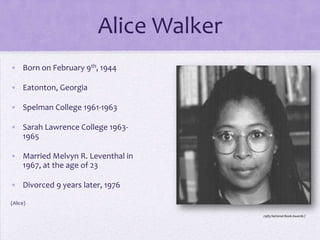
Alice WalkerBorn on February 9th, 1944Eatonton, GeorgiaSpelman College 1961-1963Sarah Lawrence College 1963-1965Married Melvyn R. Leventhal in 1967, at the age of 23Divorced 9 years later, 1976(Alice)(1983 National Book Awards )
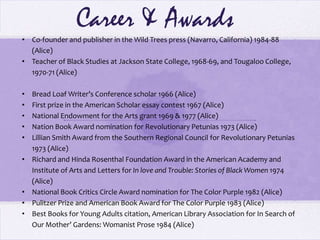
Career & AwardsCo-founder and publisher in the Wild Trees press (Navarro, California) 1984-88 (Alice)
Teacher of Black Studies at Jackson State College, 1968-69, and Tougaloo College, 1970-71 (Alice)
Bread Loaf Writer’s Conference scholar 1966 (Alice)
First prize in the American Scholar essay contest 1967 (Alice)
National Endowment for the Arts grant 1969 & 1977 (Alice)
Nation Book Award nomination for Revolutionary Petunias 1973 (Alice)
Lillian Smith Award from the Southern Regional Council for Revolutionary Petunias 1973 (Alice)
Richard and Hinda Rosenthal Foundation Award in the American Academy and Institute of Arts and Letters for In love and Trouble: Stories of Black Women 1974 (Alice)
National Book Critics Circle Award nomination for The Color Purple 1982 (Alice)
Pulitzer Prize and American Book Awardfor The Color Purple 1983 (Alice)
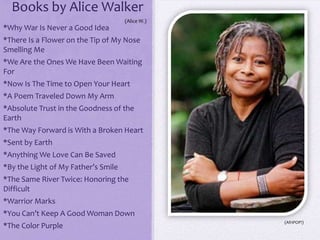
Best Books for Young Adults citation, American Library Association for In Search of Our Mother’ Gardens: Womanist Prose 1984 (Alice)Books by Alice Walker(Alice W.)*Why War Is Never a Good Idea*There Is a Flower on the Tip of My Nose Smelling Me*We Are the Ones We Have Been Waiting For*Now Is The Time to Open Your Heart*A Poem Traveled Down My Arm*Absolute Trust in the Goodness of the Earth*The Way Forward is With a Broken Heart*Sent by Earth*Anything We Love Can Be Saved*By the Light of My Father’s Smile*The Same River Twice: Honoring the Difficult*Warrior Marks*You Can’t Keep A Good Woman Down*The Color Purple (AfriPOP!)
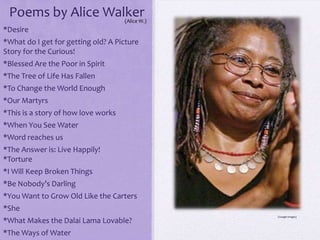
Poems by Alice Walker(Alice W.)*Desire*What do I get for getting old? A Picture Story for the Curious!*Blessed Are the Poor in Spirit*The Tree of Life Has Fallen*To Change the World Enough*Our Martyrs*This is a story of how love works*When You See Water*Word reaches us*The Answer is: Live Happily!*Torture*I Will Keep Broken Things*Be Nobody’s Darling*You Want to Grow Old Like the Carters*She*What Makes the Dalai Lama Lovable?*The Ways of Water(Google Images)
The Color Purple
How The Color PurpleFits Into African American Literature
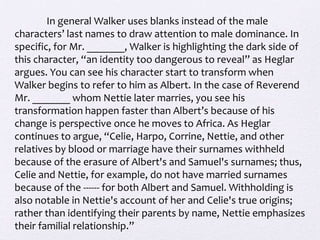
	The Color Purple is a piece of text that includes very touchy subjects. Unlike many other books at the time, the Color Purple brings these issues into the spotlight rather than sweep them under the rug. As Cornish argues, “Walker was always aware of the problems of personal relations of her men and women and sought to understand rather than excuse or ignore, them.” The Color Purple touches on hardships many African Americans encountered, such as sexism, lesbianism, rape and religion. This book is also unique in its characteristic that racism isn’t as dominating as several other works categorized as African American Literature. Here , the characters confront one another, all of the same race. It is a very feministic novel and is written to not only show the hardships of African Americans, but African American women specifically.
DISCUSSION QUESTIONONEHow does the rejection of African Americans within African tribes relate to the rejection of African Americans in the United States? What about internal racism?
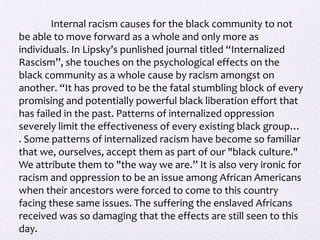
	Internal racism causes for the black community to not be able to move forward as a whole and only more as individuals. In Lipsky’spunlished journal titled “Internalized Rascism”, she touches on the psychological effects on the black community as a whole cause by racism amongst on another. “It has proved to be the fatal stumbling block of every promising and potentially powerful black liberation effort that has failed in the past. Patterns of internalized oppression severely limit the effectiveness of every existing black group… . Some patterns of internalized racism have become so familiar that we, ourselves, accept them as part of our "black culture." We attribute them to "the way we are.” It is also very ironic for racism and oppression to be an issue among African Americans when their ancestors were forced to come to this country facing these same issues. The suffering the enslaved Africans received was so damaging that the effects are still seen to this day.
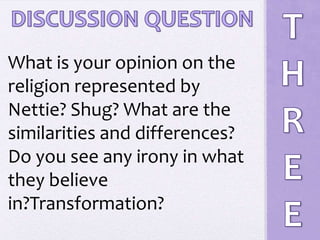
DISCUSSION QUESTIONTWOWhat is the impact of each of the following female relationships in Celie’s life? Think about Motherhood. Sisterhood. Love.*Nettie*Shug
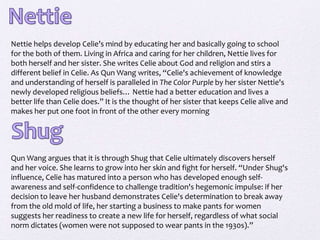
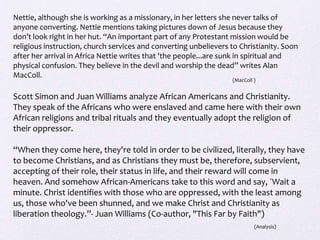
NettieNettie helps develop Celie’s mind by educating her and basically going to school for the both of them. Living in Africa and caring for her children, Nettie lives for both herself and her sister. She writes Celie about God and religion and stirs a different belief in Celie. As Qun Wang writes, “Celie's achievement of knowledge and understanding of herself is paralleled in The Color Purple by her sister Nettie's newly developed religious beliefs… Nettie had a better education and lives a better life than Celiedoes.” It is the thought of her sister that keeps Celie alive and makes her put one foot in front of the other every morningShugQun Wang argues that it is through Shug that Celie ultimately discovers herself and her voice. She learns to grow into her skin and fight for herself. “Under Shug's influence, Celie has matured into a person who has developed enough self-awareness and self-confidence to challenge tradition's hegemonic impulse: if her decision to leave her husband demonstrates Celie's determination to break away from the old mold of life, her starting a business to make pants for women suggests her readiness to create a new life for herself, regardless of what social norm dictates (women were not supposed to wear pants in the 1930s).”

The color purple

  • 1.
    The Color PurpleByAlice WalkerDiana Montes de Oca
  • 2.
    Alice WalkerBorn onFebruary 9th, 1944Eatonton, GeorgiaSpelman College 1961-1963Sarah Lawrence College 1963-1965Married Melvyn R. Leventhal in 1967, at the age of 23Divorced 9 years later, 1976(Alice)(1983 National Book Awards )
  • 3.
    Career & AwardsCo-founderand publisher in the Wild Trees press (Navarro, California) 1984-88 (Alice)
  • 4.
    Teacher of BlackStudies at Jackson State College, 1968-69, and Tougaloo College, 1970-71 (Alice)
  • 5.
    Bread Loaf Writer’sConference scholar 1966 (Alice)
  • 6.
    First prize inthe American Scholar essay contest 1967 (Alice)
  • 7.
    National Endowment forthe Arts grant 1969 & 1977 (Alice)
  • 8.
    Nation Book Awardnomination for Revolutionary Petunias 1973 (Alice)
  • 9.
    Lillian Smith Awardfrom the Southern Regional Council for Revolutionary Petunias 1973 (Alice)
  • 10.
    Richard and HindaRosenthal Foundation Award in the American Academy and Institute of Arts and Letters for In love and Trouble: Stories of Black Women 1974 (Alice)
  • 11.
    National Book CriticsCircle Award nomination for The Color Purple 1982 (Alice)
  • 12.
    Pulitzer Prize andAmerican Book Awardfor The Color Purple 1983 (Alice)
  • 13.
    Best Books forYoung Adults citation, American Library Association for In Search of Our Mother’ Gardens: Womanist Prose 1984 (Alice)Books by Alice Walker(Alice W.)*Why War Is Never a Good Idea*There Is a Flower on the Tip of My Nose Smelling Me*We Are the Ones We Have Been Waiting For*Now Is The Time to Open Your Heart*A Poem Traveled Down My Arm*Absolute Trust in the Goodness of the Earth*The Way Forward is With a Broken Heart*Sent by Earth*Anything We Love Can Be Saved*By the Light of My Father’s Smile*The Same River Twice: Honoring the Difficult*Warrior Marks*You Can’t Keep A Good Woman Down*The Color Purple (AfriPOP!)
  • 14.
    Poems by AliceWalker(Alice W.)*Desire*What do I get for getting old? A Picture Story for the Curious!*Blessed Are the Poor in Spirit*The Tree of Life Has Fallen*To Change the World Enough*Our Martyrs*This is a story of how love works*When You See Water*Word reaches us*The Answer is: Live Happily!*Torture*I Will Keep Broken Things*Be Nobody’s Darling*You Want to Grow Old Like the Carters*She*What Makes the Dalai Lama Lovable?*The Ways of Water(Google Images)
  • 15.
  • 16.
    How The ColorPurpleFits Into African American Literature
  • 17.
    The Color Purpleis a piece of text that includes very touchy subjects. Unlike many other books at the time, the Color Purple brings these issues into the spotlight rather than sweep them under the rug. As Cornish argues, “Walker was always aware of the problems of personal relations of her men and women and sought to understand rather than excuse or ignore, them.” The Color Purple touches on hardships many African Americans encountered, such as sexism, lesbianism, rape and religion. This book is also unique in its characteristic that racism isn’t as dominating as several other works categorized as African American Literature. Here , the characters confront one another, all of the same race. It is a very feministic novel and is written to not only show the hardships of African Americans, but African American women specifically.
  • 18.
    DISCUSSION QUESTIONONEHow doesthe rejection of African Americans within African tribes relate to the rejection of African Americans in the United States? What about internal racism?
  • 19.
    Internal racism causesfor the black community to not be able to move forward as a whole and only more as individuals. In Lipsky’spunlished journal titled “Internalized Rascism”, she touches on the psychological effects on the black community as a whole cause by racism amongst on another. “It has proved to be the fatal stumbling block of every promising and potentially powerful black liberation effort that has failed in the past. Patterns of internalized oppression severely limit the effectiveness of every existing black group… . Some patterns of internalized racism have become so familiar that we, ourselves, accept them as part of our "black culture." We attribute them to "the way we are.” It is also very ironic for racism and oppression to be an issue among African Americans when their ancestors were forced to come to this country facing these same issues. The suffering the enslaved Africans received was so damaging that the effects are still seen to this day.
  • 20.
    DISCUSSION QUESTIONTWOWhat isthe impact of each of the following female relationships in Celie’s life? Think about Motherhood. Sisterhood. Love.*Nettie*Shug
  • 21.
    NettieNettie helps developCelie’s mind by educating her and basically going to school for the both of them. Living in Africa and caring for her children, Nettie lives for both herself and her sister. She writes Celie about God and religion and stirs a different belief in Celie. As Qun Wang writes, “Celie's achievement of knowledge and understanding of herself is paralleled in The Color Purple by her sister Nettie's newly developed religious beliefs… Nettie had a better education and lives a better life than Celiedoes.” It is the thought of her sister that keeps Celie alive and makes her put one foot in front of the other every morningShugQun Wang argues that it is through Shug that Celie ultimately discovers herself and her voice. She learns to grow into her skin and fight for herself. “Under Shug's influence, Celie has matured into a person who has developed enough self-awareness and self-confidence to challenge tradition's hegemonic impulse: if her decision to leave her husband demonstrates Celie's determination to break away from the old mold of life, her starting a business to make pants for women suggests her readiness to create a new life for herself, regardless of what social norm dictates (women were not supposed to wear pants in the 1930s).”